

Gene expression and cancer (AQA 3.8.2.3) is A-level only, so it's Year 13 content. You need the main differences between benign and malignant tumours, how mutations and abnormal methylation of tumour suppressor genes and oncogenes lead to tumours, and how increased oestrogen concentrations cause some breast cancers. You also have to evaluate evidence linking genetic and environmental factors to cancer, and interpret how this knowledge is used to prevent and treat it.
The examiners' reports show where the marks go. Students write about uncontrolled cell 'growth' instead of cell division, say an oncogene makes 'no protein' when it makes more or altered protein, and mix up mutation with methylation: only 6% got full marks explaining how BRCA1 and BRCA2 mutations cause cancer. On data questions most assumed that more CAG repeats meant more prostate cancer, and fewer than 30% scored anything on that table of P values.
Start with tumour suppressor genes and oncogenes, then methylation and oestrogen, and finish with the data and evaluation questions, quoting numbers from each table or graph. If you'd like help with this topic, my AQA masterclasses run online on Tuesdays at 5.15pm for Year 12 and on Wednesdays or Thursdays at 6.30pm for Year 13.
Want help with this topic? It comes up in my weekly AQA masterclasses. See the timetable →
What you need from GCSE and Year 12
Each question on this page assumes you're secure on these GCSE and Year 12 ideas. If any of them feels shaky, revise it before you start.
- GCSE: cancer is the result of changes in cells that lead to uncontrolled growth and division, forming a benign or malignant tumour.
- Year 12 (AQA 3.2.2): cells divide by mitosis in the cell cycle, and uncontrolled cell division can lead to tumours.
- Year 12 (AQA 3.1.4.2): a competitive inhibitor has a similar shape to the substrate and binds to the enzyme's active site.
- Year 13 (AQA 3.8.1): a gene mutation changes the base sequence of DNA and can change the amino acid sequence and tertiary structure of a protein.
- Year 13 (AQA 3.8.2.2): transcription factors bind to the promoter so RNA polymerase can start transcription, and increased methylation of DNA inhibits transcription.
Key terms
These words come up in the questions and mark schemes. Examiners expect you to use them exactly.
- Benign tumour: a tumour that grows slowly, is usually surrounded by a capsule and doesn't spread to other parts of the body.
- Malignant tumour: a cancer: a tumour that grows rapidly, invades nearby tissue and can spread (metastasise) to other parts of the body.
- Tumour suppressor gene: a gene whose protein slows or stops cell division, for example until damaged DNA is repaired; if it is mutated or not transcribed, cell division becomes uncontrolled.
- Oncogene: a mutated form of a gene that stimulates cell division; it makes more of, or an altered, protein, so division is rapid and uncontrolled.
- Abnormal methylation: increased methylation (hypermethylation) of a tumour suppressor gene stops it being transcribed; decreased methylation of an oncogene can switch it on.
- DNA methyltransferase: an enzyme that adds methyl groups to cytosine bases in DNA.
- Oestrogen: a steroid hormone that binds to a receptor and activates a transcription factor; increased concentrations can cause some breast cancers.
- ER-positive breast cancer: a breast cancer whose cells have oestrogen receptors, so it develops when oestrogen concentrations increase.
- Rapid or uncontrollable cell division: the mark-scheme phrase for how a tumour forms; 'growth' on its own is ignored.
- P value: the probability that a difference or association is due to chance; below 0.05 it is significant.
What these questions cover (AQA 3.8.2.3)
The questions test these statements from the AQA AS and A-level Biology specification (7401/7402):
- Benign and malignant tumours: The main characteristics of benign and malignant tumours. (no written question asks you to compare benign and malignant tumours; the tumour cell calculation is the only part here, so learn the differences (growth rate, capsule, metastasis) from your notes)
- Tumour suppressor genes and oncogenes: tumour suppressor genes and oncogenes
- Abnormal methylation: abnormal methylation of tumour suppressor genes and oncogenes
- Oestrogen and breast cancer: increased oestrogen concentrations in the development of some breast cancers.
- Evaluating evidence on cancer: evaluate evidence showing correlations between genetic and environmental factors and various forms of cancer
- Using oncogenes and tumour suppressor genes in treatment: interpret information relating to the way in which an understanding of the roles of oncogenes and tumour suppressor genes could be used in the prevention, treatment and cure of cancer.
How to use this page
Write your answer on paper before you open the mark scheme. Allow about 1.3 minutes per mark: the 14 questions are worth 42 marks, so about 55 minutes in total. Then mark your answer strictly against the mark scheme and read the examiners' tip underneath it. If you'd rather print the questions, download the PDF pack.
Tumour suppressor genes and oncogenes (3.8.2.3)
Question 1
A level Paper 2 · June 2018 · Q02.2 · 3 marks · Easy
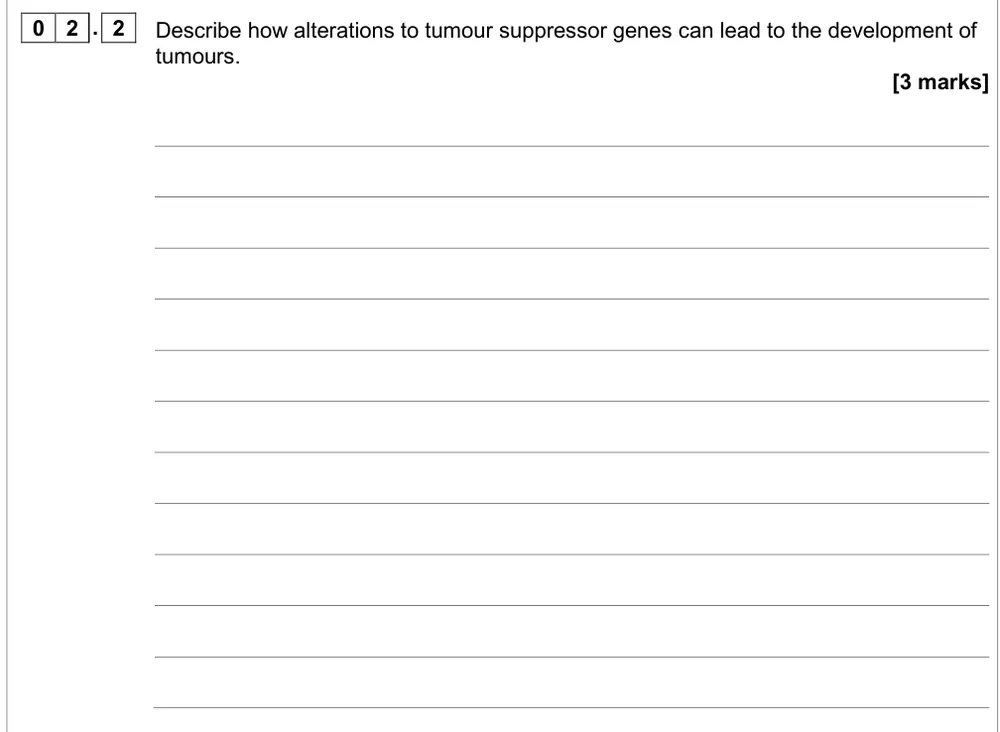
Describe how alterations to tumour suppressor genes can lead to tumours.
Show the mark scheme
Tap an image to open it full size.
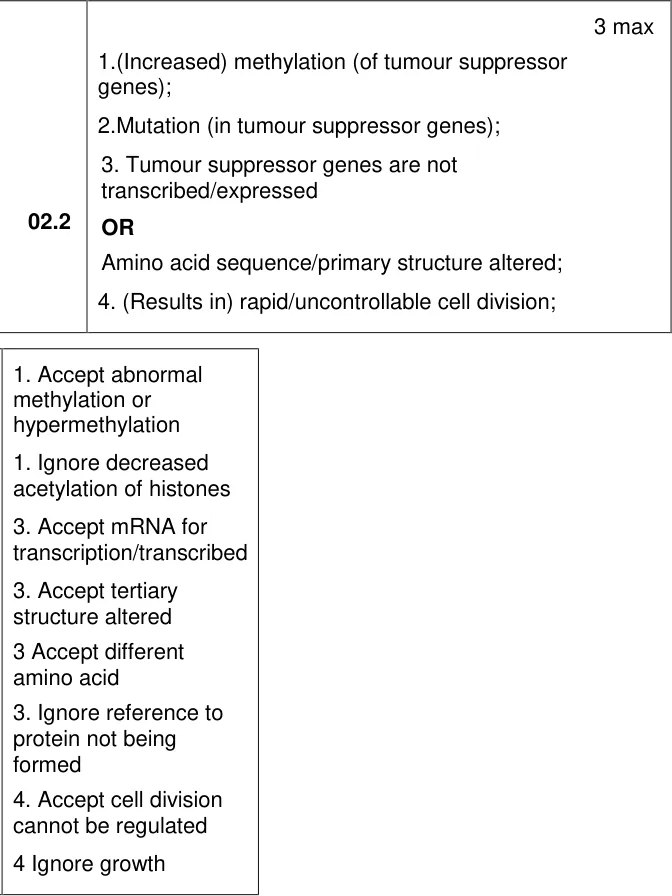
From the examiners' report: One in three got full marks. Give both alterations, mutation and methylation, say what each does (altered primary structure, or no transcription), and finish with uncontrolled cell division. Oncogenes aren't asked for.
Question 2
A level Paper 2 · June 2022 · Q10.1 · 3 marks · Medium
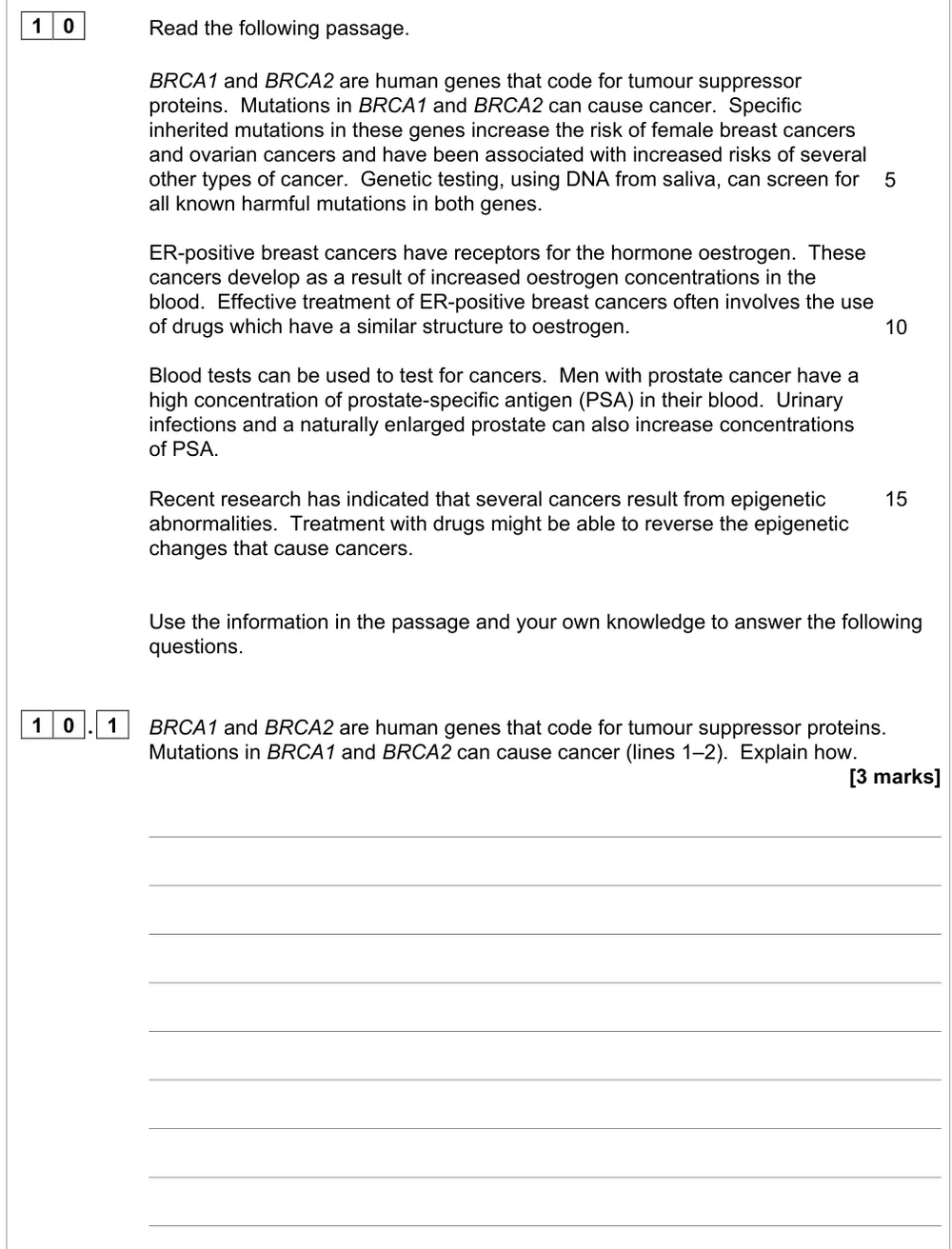
Explain how mutations in BRCA1 and BRCA2 can cause cancer.
Show the mark scheme
Tap an image to open it full size.
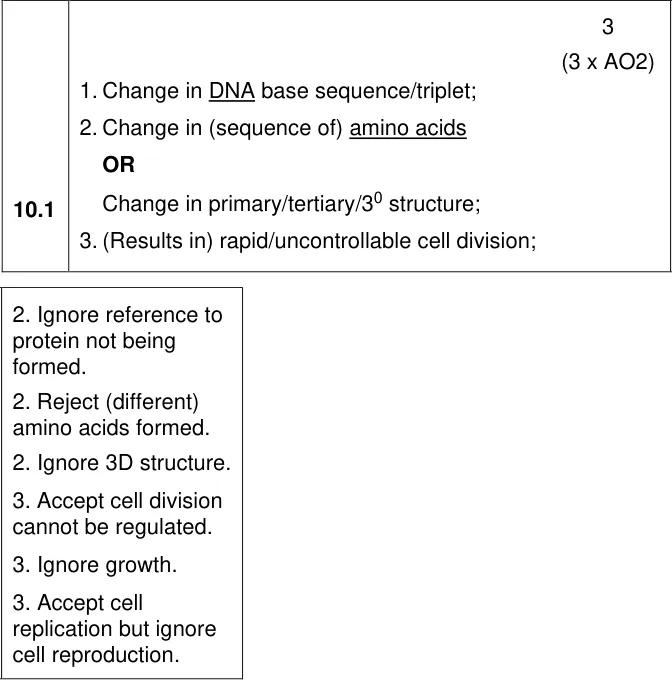
From the examiners' report: Only 6% got all three. Say the DNA base sequence changes, then the amino acid sequence and tertiary structure of the protein, then uncontrolled cell division. Don't confuse mutation with methylation.
Question 3
A level Paper 2 · June 2023 · Q08.1 · 3 marks · Medium
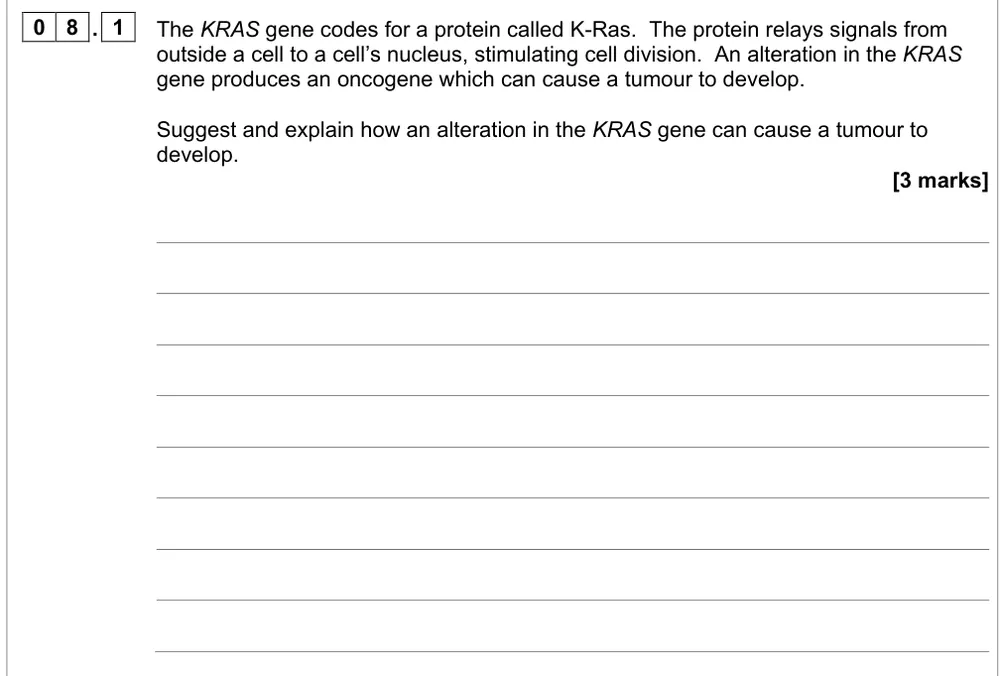
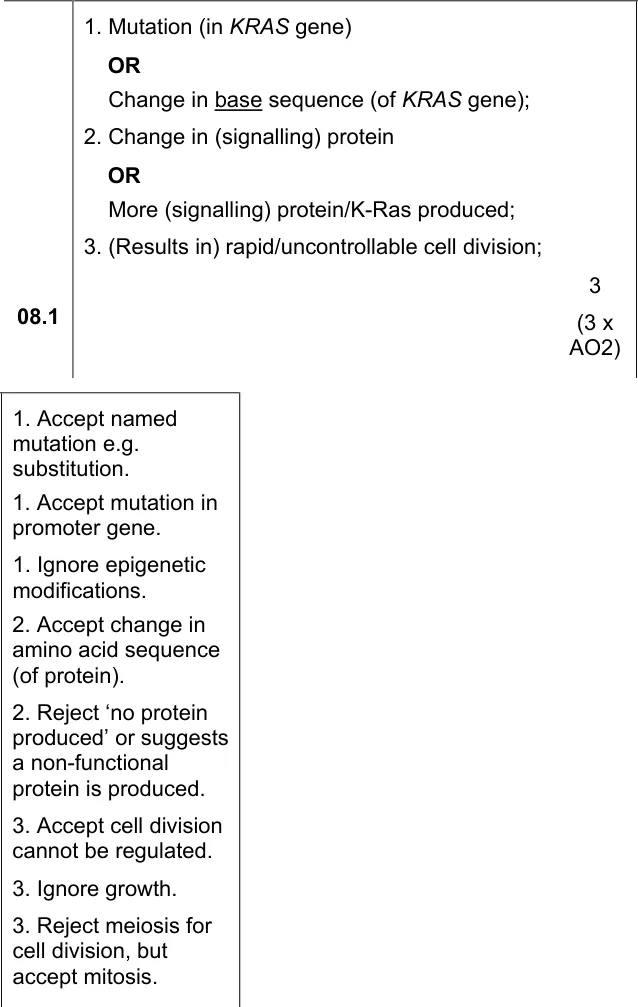
Explain how an alteration in the KRAS gene can cause a tumour.
Show the mark scheme
Tap an image to open it full size.
From the examiners' report: About 15% got all three. An oncogene makes more K-Ras, or an altered K-Ras, that keeps stimulating division; it doesn't make 'no protein'. Say mutation, not 'alteration'.
Question 4
A level Paper 3 · June 2017 · Q05.4 · 3 marks · Easy
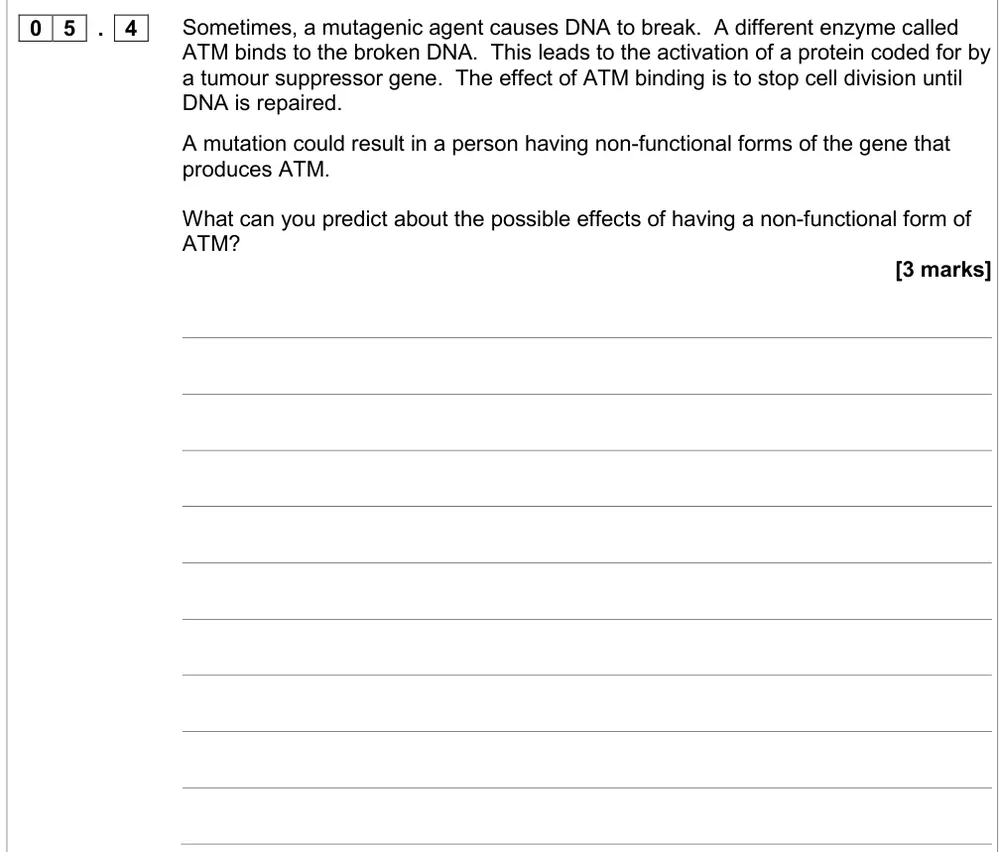
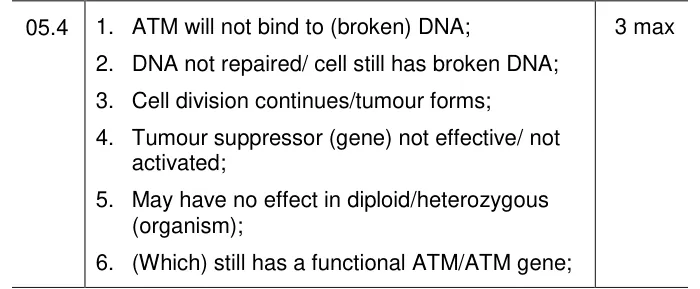
Predict the effects of a non-functional form of the DNA repair enzyme ATM.
Show the mark scheme
Tap an image to open it full size.
From the examiners' report: 47% got all three. Follow the chain in the stem step by step: no binding, no activation of the tumour suppressor protein, so cells with broken DNA keep dividing and a tumour can form.
Abnormal methylation and oestrogen (3.8.2.3)
Question 5
A level Paper 3 · November 2020 · Q05.2 · 3 marks · Medium
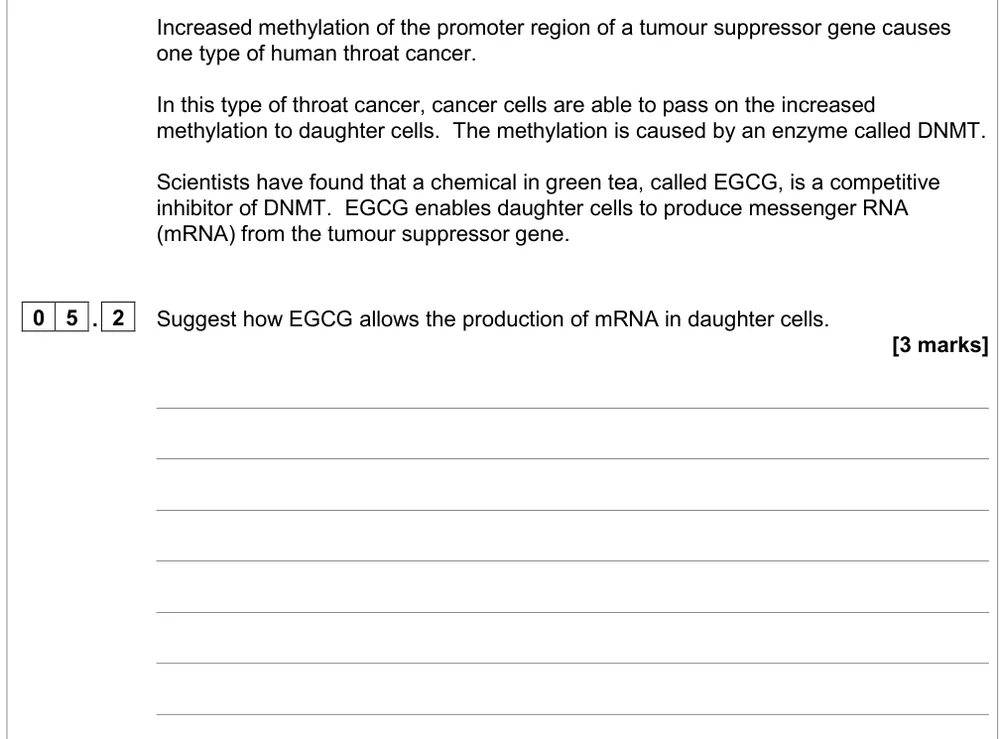
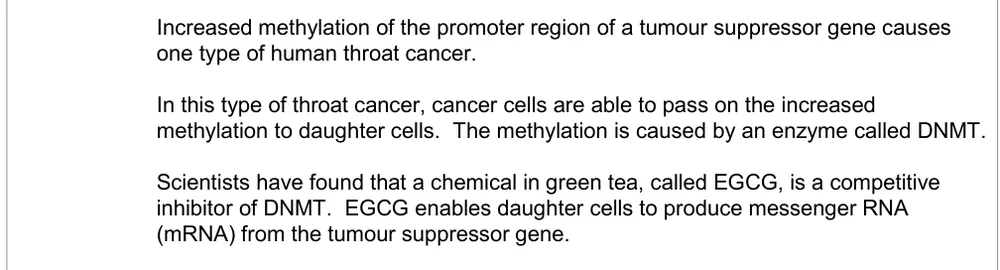
Suggest how EGCG from green tea lets throat cancer cells make mRNA from a tumour suppressor gene.
Show the mark scheme
Tap an image to open it full size.
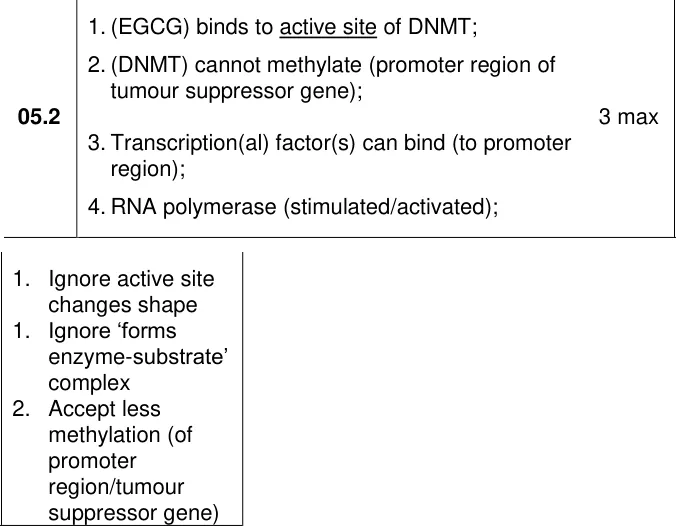
From the examiners' report: Only 14% got all three. EGCG is the inhibitor and DNMT is the enzyme: EGCG fills DNMT's active site, so the promoter isn't methylated and transcription factors can bind. It doesn't bind to the promoter.
Question 6
A level Paper 2 · November 2021 · Q06.2 · 3 marks · Medium
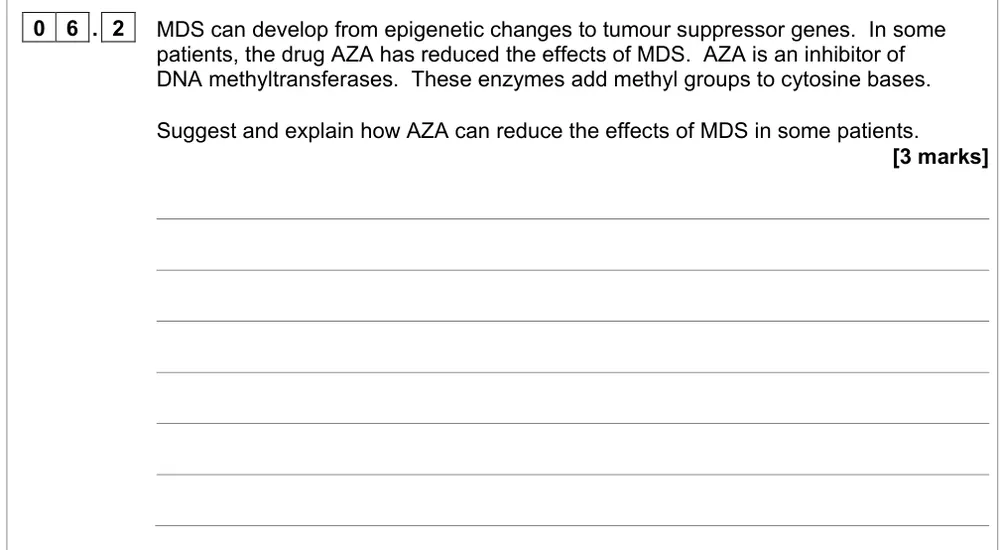
Suggest how the DNA methyltransferase inhibitor AZA reduces the effects of MDS.
Information from earlier in this question:

Show the mark scheme
Tap an image to open it full size.
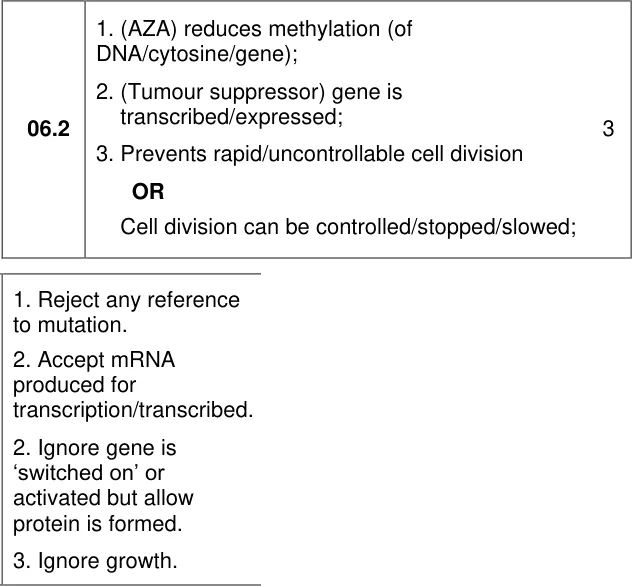
From the examiners' report: 42% got two or more marks. Say the tumour suppressor gene is transcribed, not 'switched on' or 'translated', and then link its protein to controlling cell division.
Question 7
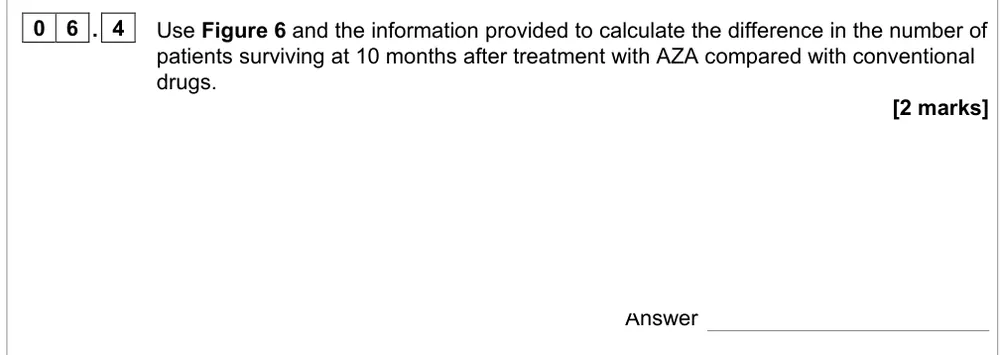
A level Paper 2 · November 2021 · Q06.4 · 2 marks · Easy
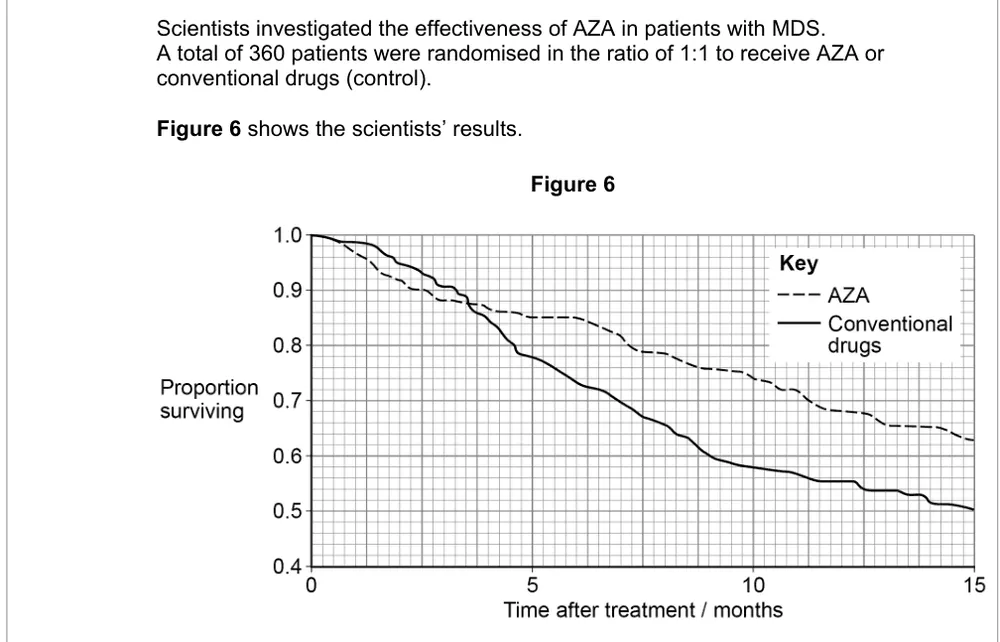
Read a survival graph to find how many more patients survived 10 months on AZA.
Information from earlier in this question:
Show the mark scheme
Tap an image to open it full size.
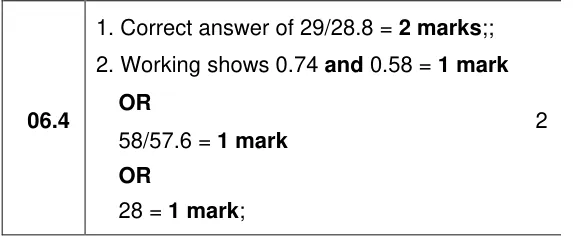
From the examiners' report: About 34% got both marks. Each group had 180 patients: (0.74 − 0.58) × 180 = 28.8, so 29 patients. Rounding 28.8 down to 28 lost a mark.
Question 8
A level Paper 2 · June 2022 · Q10.3 · 3 marks · Medium
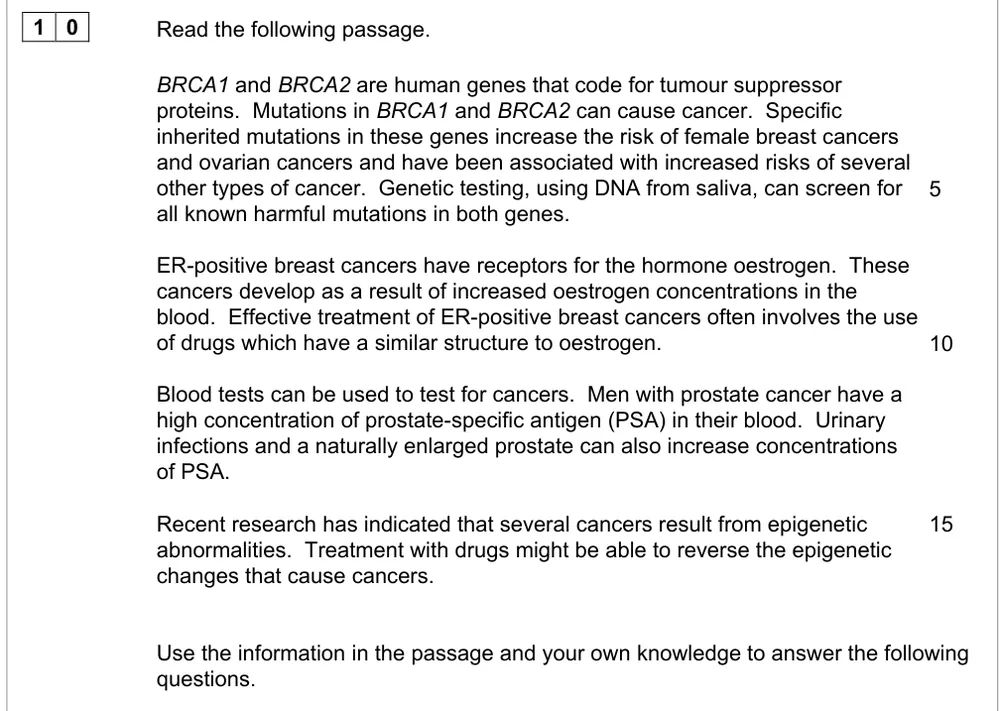
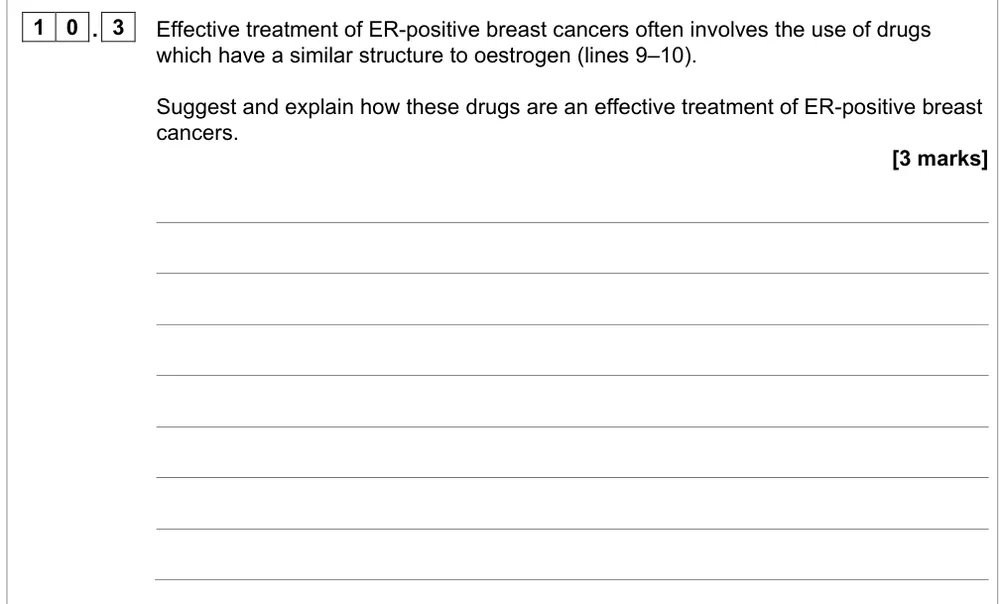
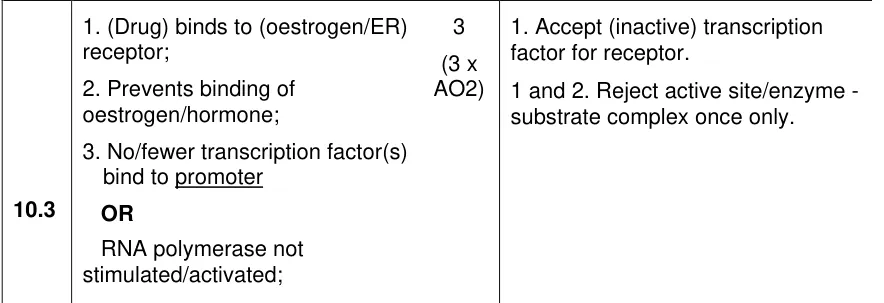
Explain how drugs with a similar structure to oestrogen treat ER-positive breast cancer.
Information from earlier in this question:
Show the mark scheme
Tap an image to open it full size.
From the examiners' report: Only 7% got all three, though 75% got one. The drug binds to the oestrogen receptor so oestrogen can't; then say the transcription factor doesn't bind to the promoter, so genes for cell division aren't transcribed.
Evaluating evidence about cancer (3.8.2.3)
Question 9
A level Paper 2 · June 2018 · Q02.3 · 2 marks · Easy
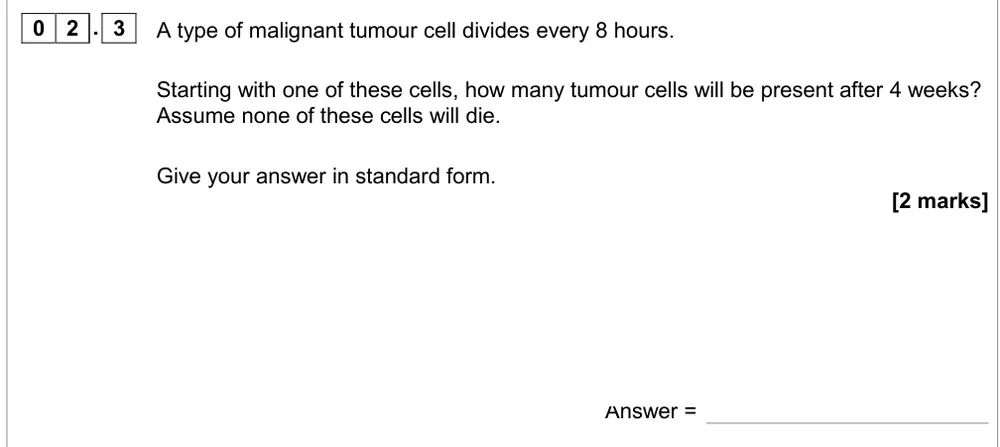
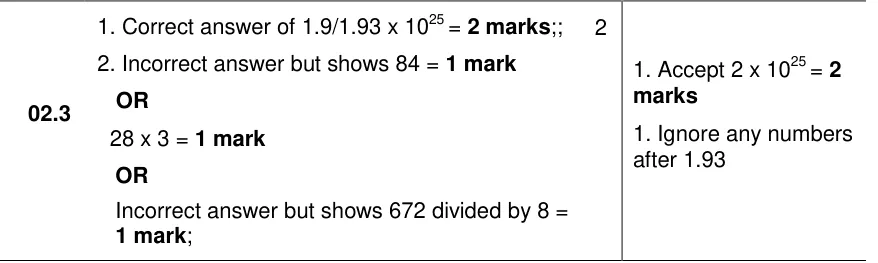
Calculate how many malignant tumour cells there are after 4 weeks of division every 8 hours.
Show the mark scheme
Tap an image to open it full size.
From the examiners' report: Over 83% got a mark, almost always for 84 divisions, and about half went on to the right answer. The number of cells is 2⁸⁴, not 84² or 28³.
Question 10
A level Paper 2 · June 2022 · Q10.4 · 2 marks · Medium
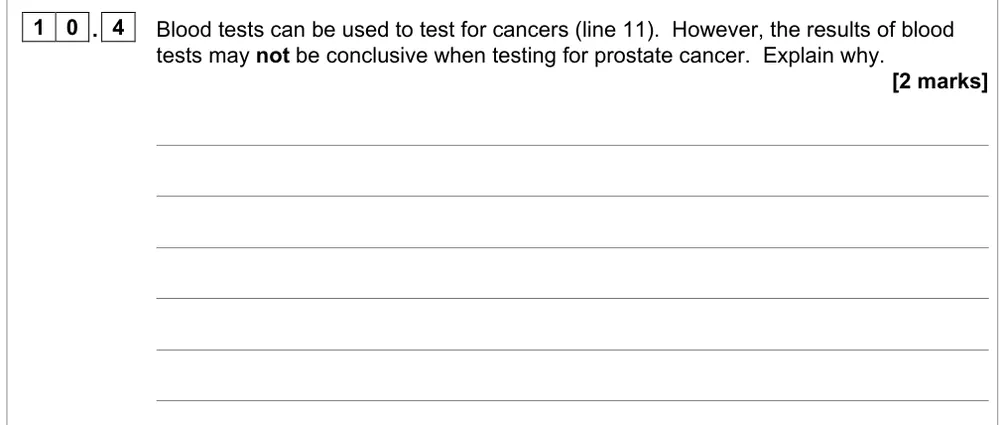
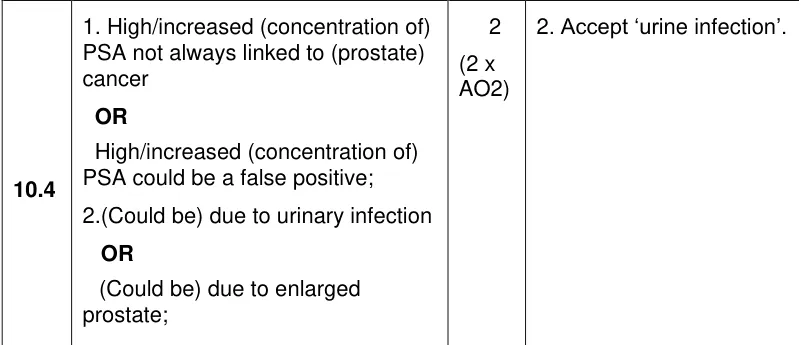
Explain why a blood test for PSA may not be conclusive for prostate cancer.
Information from earlier in this question:
Show the mark scheme
Tap an image to open it full size.
From the examiners' report: 49% got both marks from the passage. Say a high PSA concentration could be a false positive, then give the other cause from the passage: a urinary infection or an enlarged prostate, not just 'infection'.
Question 11
A level Paper 2 · June 2023 · Q08.2 · 5 marks · Medium
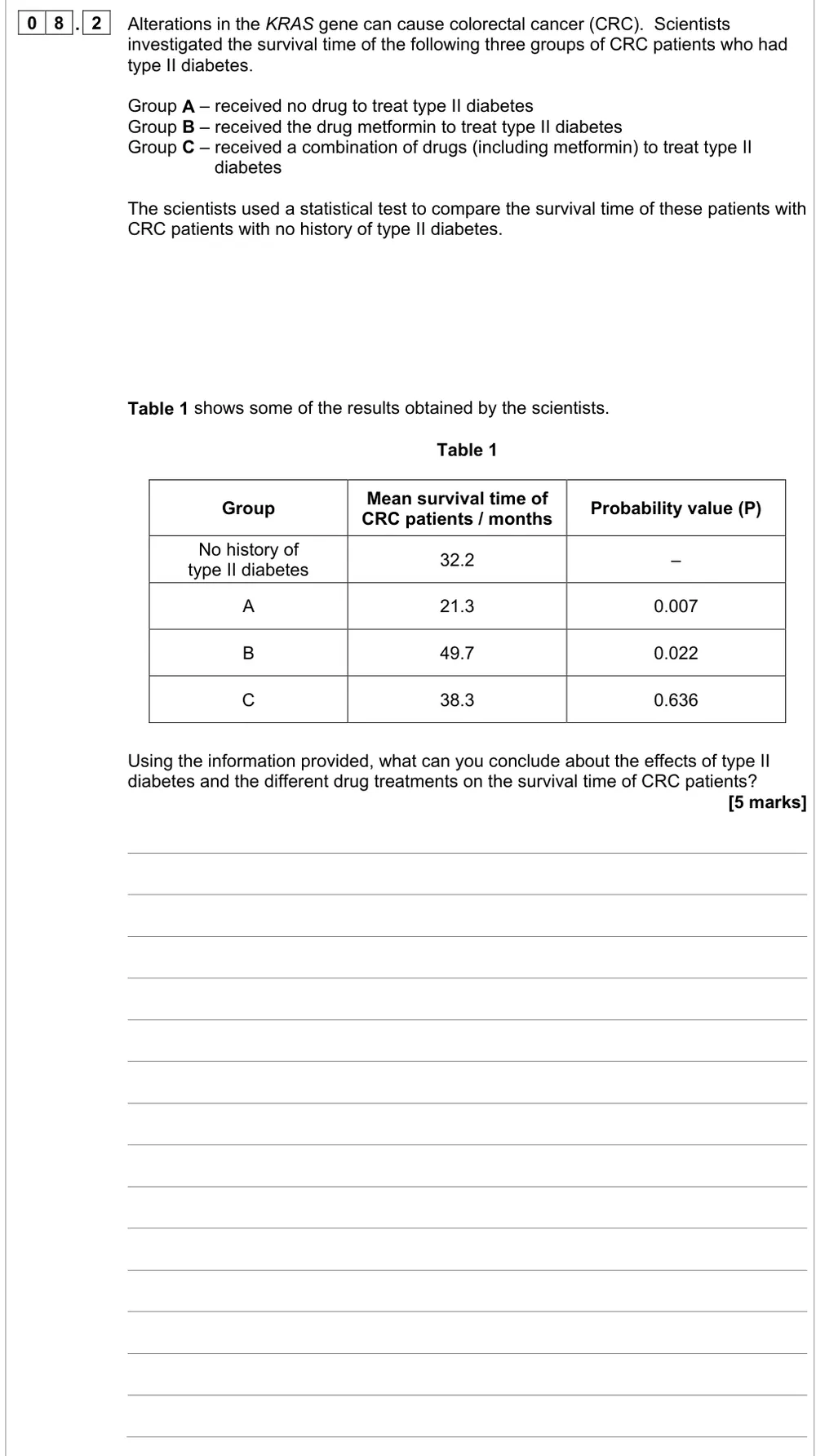
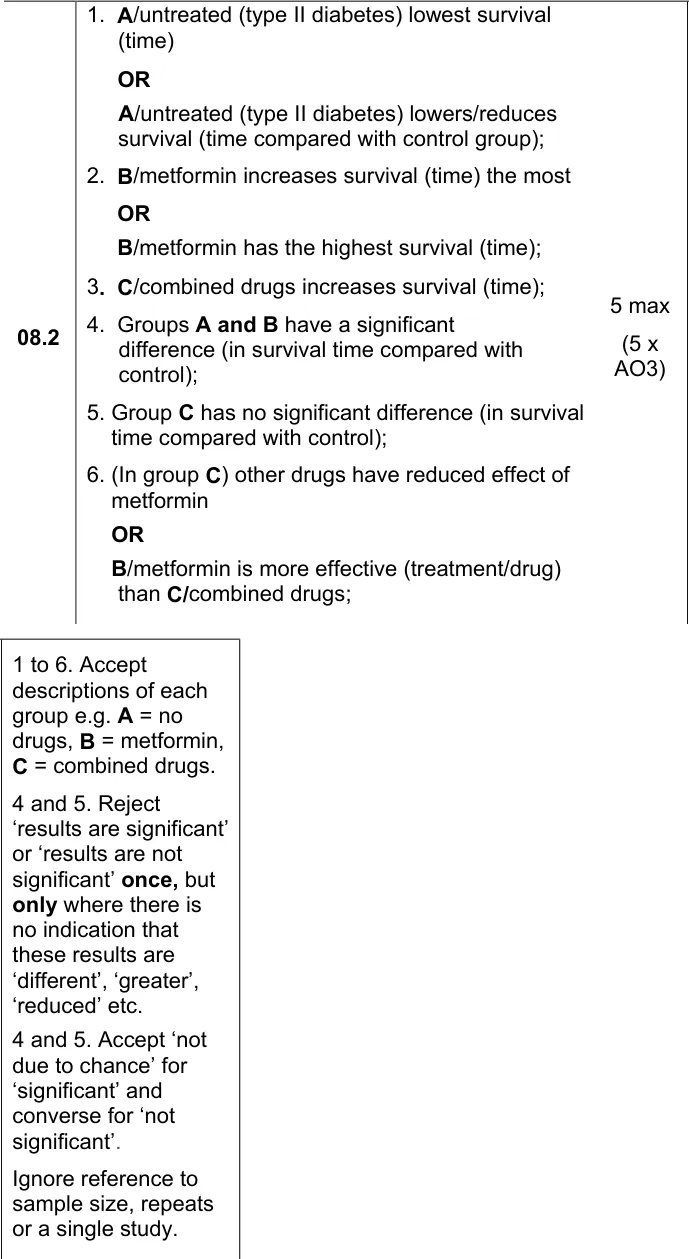
Draw conclusions about type II diabetes, metformin and survival of colorectal cancer patients.
Show the mark scheme
Tap an image to open it full size.
From the examiners' report: About 9% got all five. Most used the survival times; fewer used the P values. Say A and B differ significantly from the control (P < 0.05) and C doesn't. A higher P value doesn't mean more significant.
Question 12
A level Paper 2 · June 2025 · Q08.4 · 4 marks · Medium
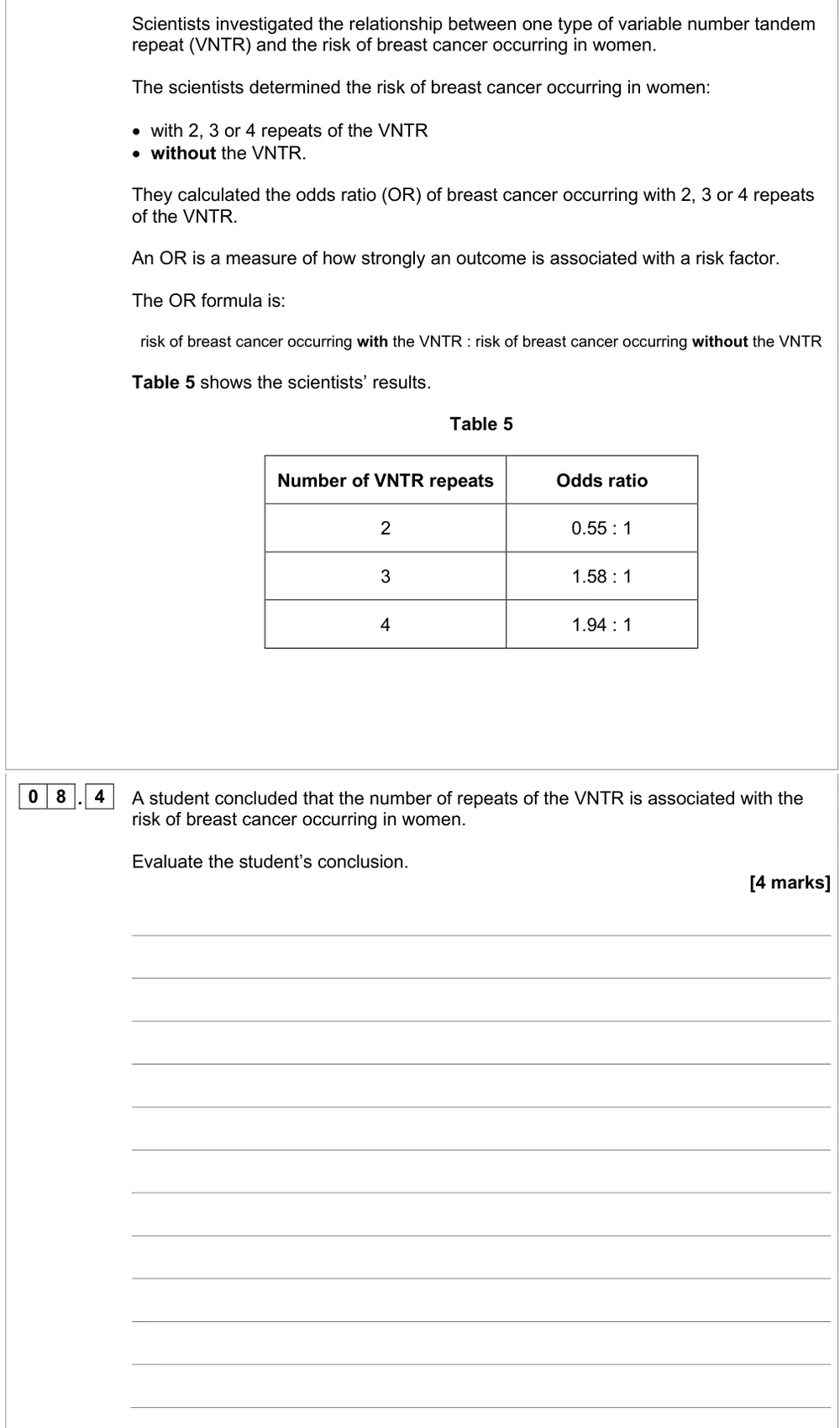
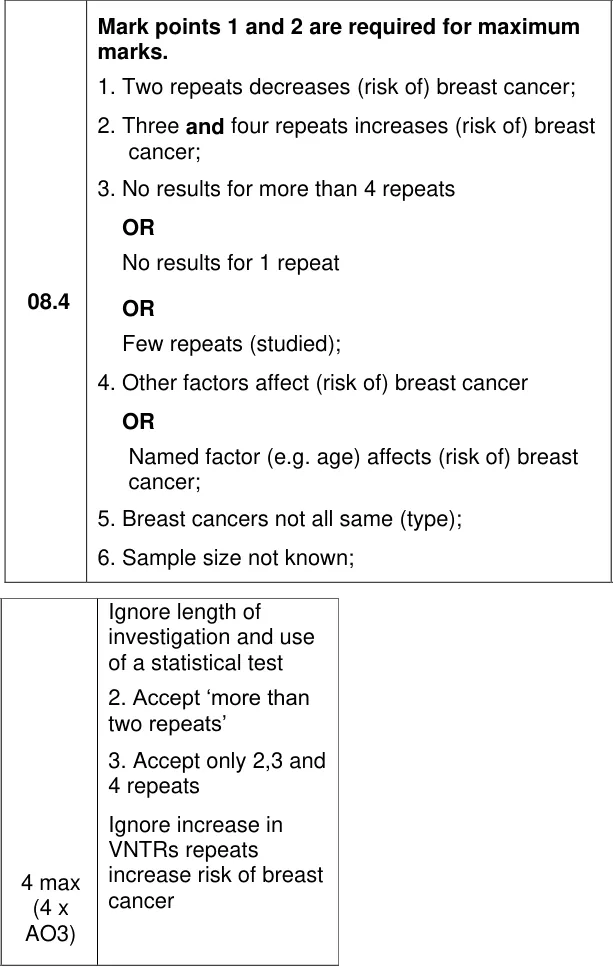
Evaluate a conclusion linking the number of VNTR repeats to breast cancer risk.
Show the mark scheme
Tap an image to open it full size.
From the examiners' report: Fewer than 10% got all four. An odds ratio below 1 means lower risk, so two repeats reduce risk and three or four increase it. Then give limits: few repeat numbers, other risk factors, sample size unknown.
Question 13
A level Paper 2 · November 2020 · Q02.4 · 3 marks · Hard
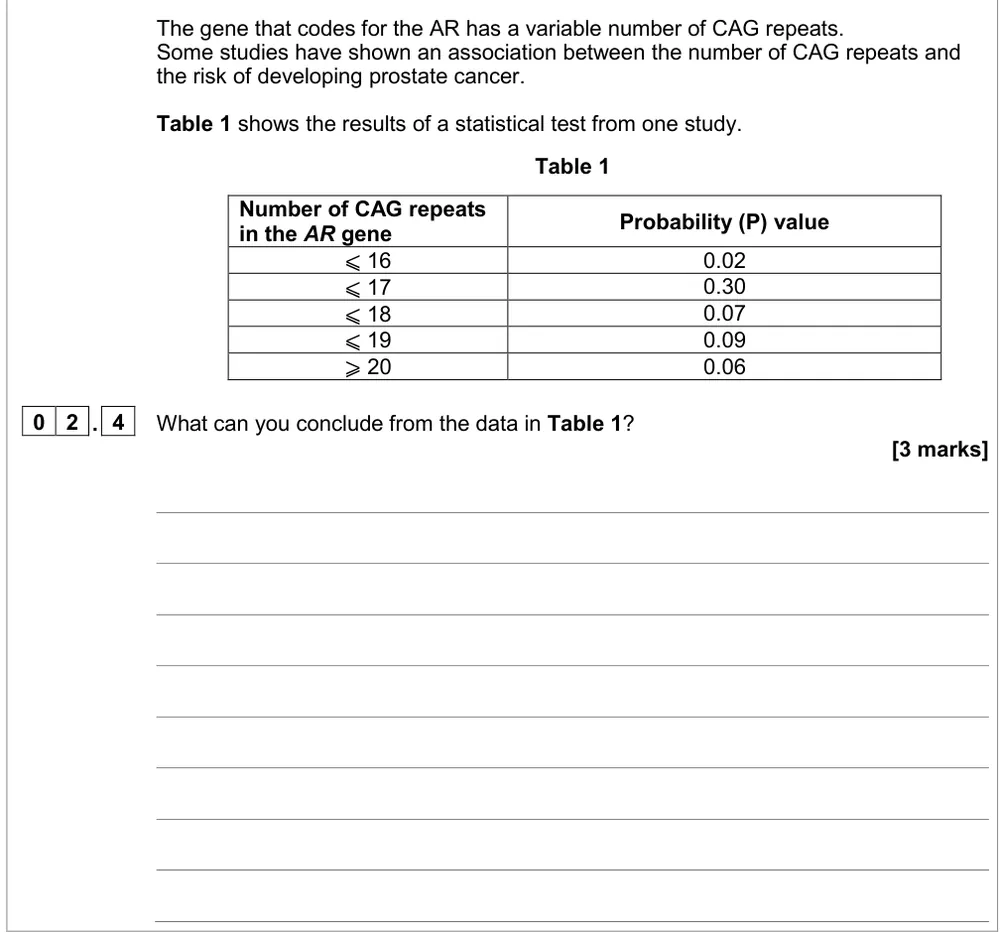
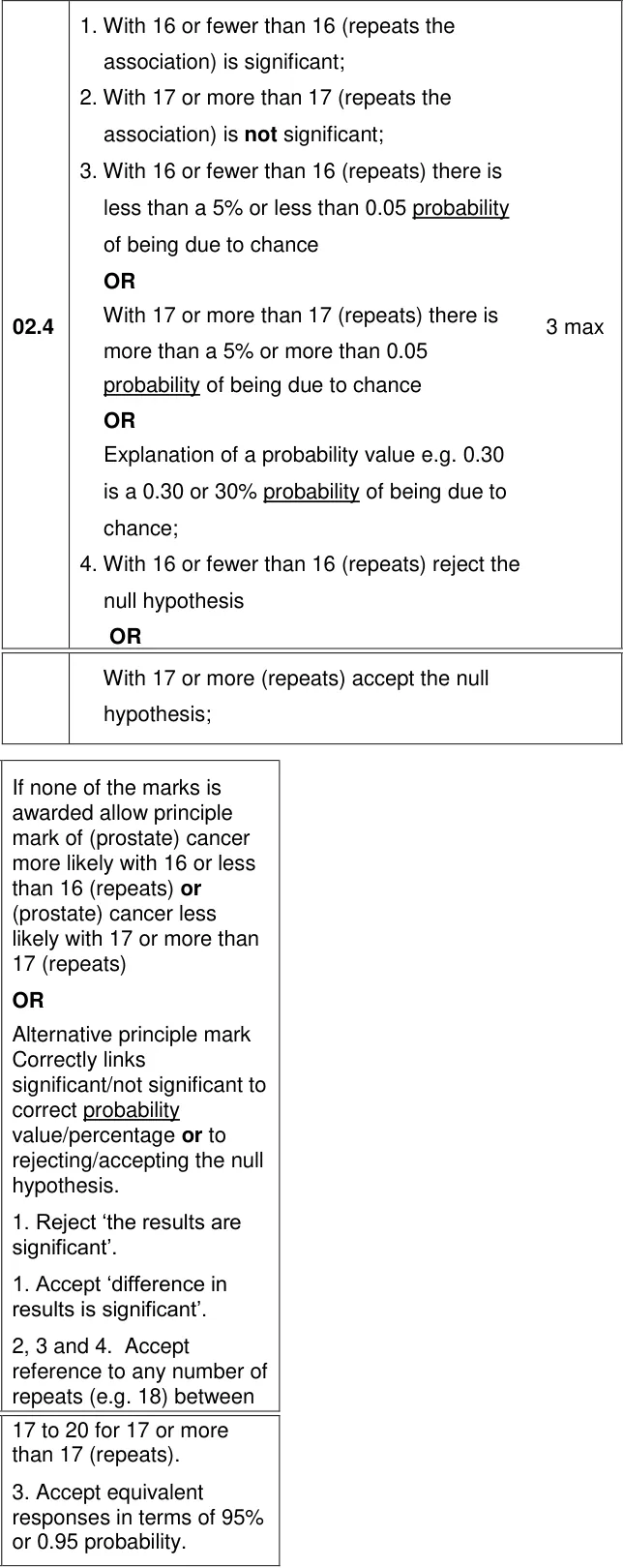
Conclude what a table of P values shows about CAG repeats and prostate cancer.
Information from earlier in this question:

Show the mark scheme
Tap an image to open it full size.
From the examiners' report: Fewer than 30% scored and only 6% got all three. The table shows P values, not risk: only ≤16 repeats (P = 0.02) is below 0.05, so only that association is significant.
Question 14
A level Paper 3 · November 2020 · Q05.3 · 3 marks · Medium
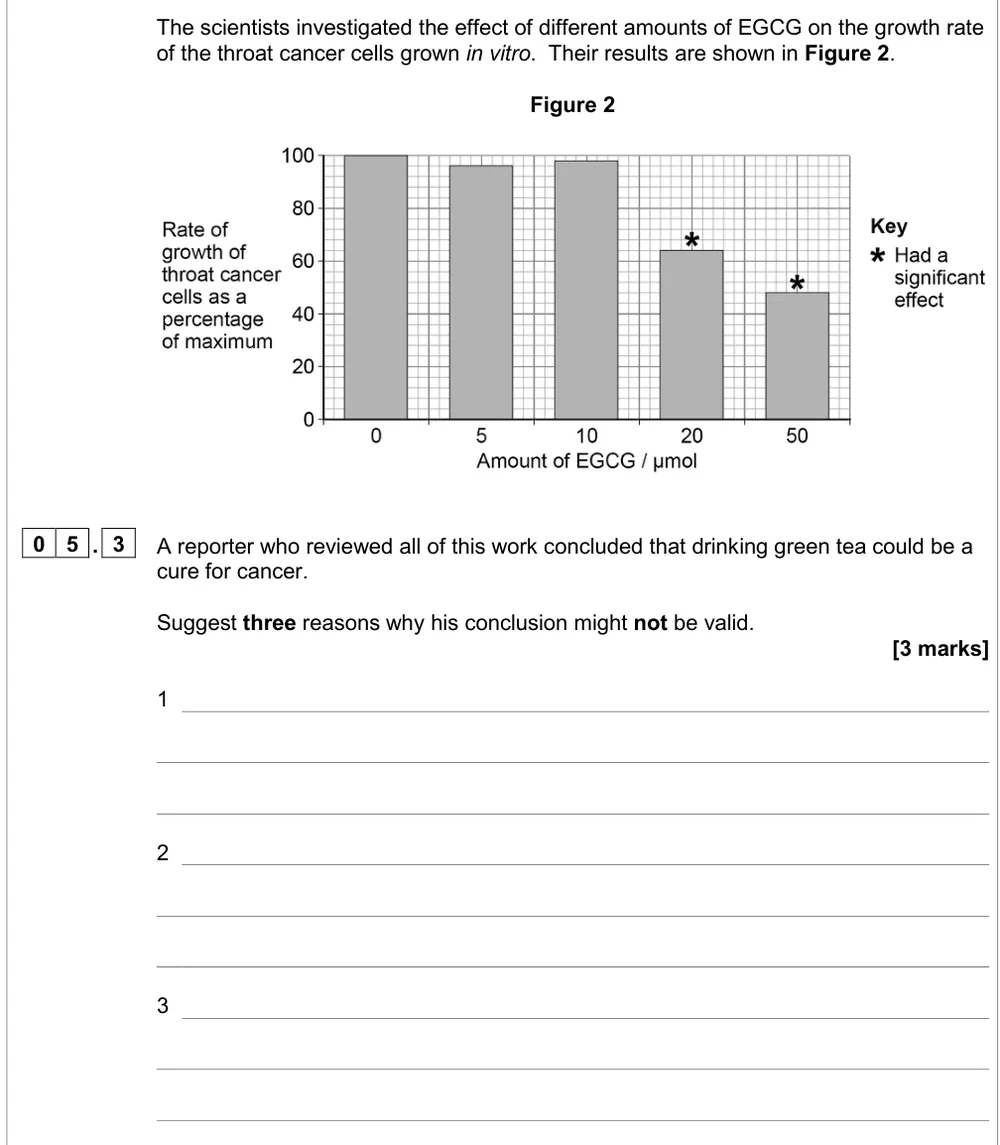
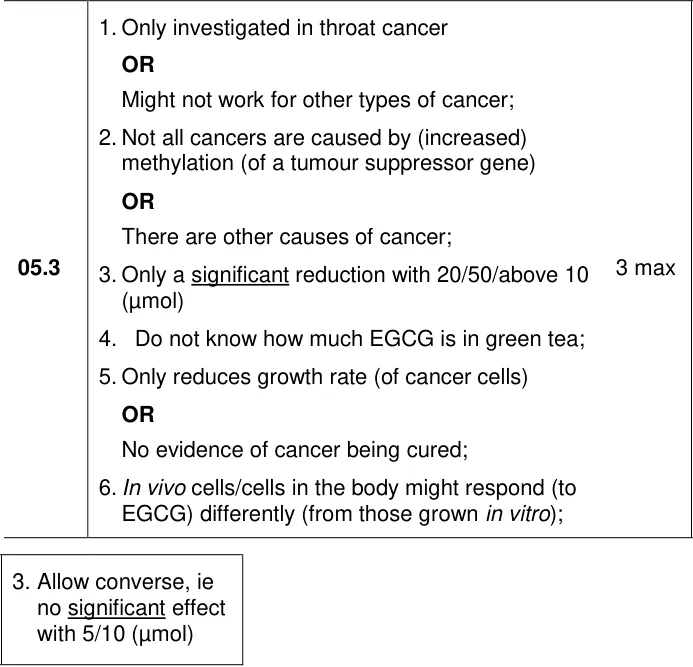
Give reasons why green tea may not be a cure for cancer.
Information from earlier in this question:
Show the mark scheme
Tap an image to open it full size.
From the examiners' report: Only 11% scored zero, but many lost marks to rote answers such as 'no statistical test' or 'no control' when Figure 2 shows both. Use the study itself: one cancer, cells in vitro, and growth slowed rather than cured.
Where students lose marks (from AQA examiners' reports and mark schemes)
Each point below is followed by wording that gained marks.
Tumours come from cell division, not 'growth': On BRCA1 and BRCA2 almost 80% got the cell division mark, but those who didn't usually wrote about the growth of cells. A significant minority did the same when describing tumour suppressor genes.
✔ Gains credit: "(Results in) rapid/uncontrollable cell division" (mark schemes say "ignore growth").
A mutation changes the DNA bases; methylation doesn't: Only 6% got all three marks for BRCA1 and BRCA2. Very few explained what a mutation is, some wrote about the 'amino acid sequence of a gene', and a surprisingly large number confused mutation with methylation.
✔ Gains credit: "Change in DNA base sequence/triplet"; "change in (sequence of) amino acids OR change in primary/tertiary structure".
An oncogene makes more or altered protein, not none: About 15% got all three marks for KRAS. Many said no protein or a non-functional protein was made, gave epigenetic changes instead of a mutation, or just repeated 'an alteration in the gene'.
✔ Gains credit: "Mutation (in KRAS gene)"; "change in (signalling) protein OR more (signalling) protein/K-Ras produced".
Less methylation means the gene is transcribed again: 42% got at least two marks for AZA. Most said it reduces methylation but fewer said the tumour suppressor gene is transcribed, using 'switched on' or even 'translated' instead.
✔ Gains credit: "(AZA) reduces methylation"; "(tumour suppressor) gene is transcribed/expressed"; "cell division can be controlled".
EGCG binds DNMT, not the promoter: Only 14% got all three marks. Students mixed up the enzyme and the substrate and said EGCG binds to the promoter, though the stem says it's a competitive inhibitor of DNMT.
✔ Gains credit: "(EGCG) binds to active site of DNMT"; "(DNMT) cannot methylate (promoter region)"; "transcription factor(s) can bind (to promoter region)".
Oestrogen-like drugs block the receptor: Only 7% got all three marks for ER-positive breast cancer drugs. Some said 'competitive inhibitor' without binding, talked about active sites, or said the drug binds to oestrogen; only the best mentioned the promoter or RNA polymerase.
✔ Gains credit: "(Drug) binds to (oestrogen/ER) receptor"; "prevents binding of oestrogen"; "no/fewer transcription factor(s) bind to promoter OR RNA polymerase not stimulated".
Only 16 repeats or fewer was significant: Fewer than 30% scored on the CAG repeats table and only 6% got all three. Most concluded that more repeats meant more prostate cancer, and many read the P values as the chance of getting cancer.
✔ Gains credit: "With 16 or fewer (repeats the association) is significant"; "with 17 or more (repeats the association) is not significant"; "less than a 5% probability of being due to chance".
Two repeats lowered the risk; read every odds ratio: Fewer than 10% got all four marks on the VNTR odds ratios. Most said more repeats always increased the risk, which was ignored; you needed both directions to reach full marks.
✔ Gains credit: "Two repeats decreases (risk of) breast cancer"; "three and four repeats increases (risk of) breast cancer"; "no results for more than 4 repeats".
Download the questions
Download the PDF pack (14 questions, mark schemes at the end)
Keep practising
- Mutations and stem cells: AQA A Level Biology exam questions by topic
- Regulation of transcription and translation: AQA A Level Biology exam questions by topic
- Cell division: AQA A Level Biology exam questions by topic
- DNA probes and genetic fingerprinting: AQA A Level Biology exam questions by topic
- AQA 3.8.1–3.8.2 gene expression: self-marking quiz
- AQA A Level Biology masterclasses
Questions, mark schemes and examiners' report extracts © AQA.