

DNA probes and genetic fingerprinting (AQA 3.8.4.2 and 3.8.4.3) are A-level only, so they're Year 13 content. You need to know what a labelled DNA probe is and how DNA hybridisation finds a specific allele, how probes are used to screen people for heritable conditions, drug responses and health risks, and how genetic fingerprinting separates repeated DNA sequences by gel electrophoresis to compare people, show relationships and measure variability.
The examiners' reports are blunt about this topic. Only around 11% could define a DNA probe for both marks, because answers left out 'single strand' or 'complementary bases'. Describing how a radioactively labelled probe shows a gene is present earned full marks for just 1.20%, and almost 47% scored zero on screening DNA for harmful mutations, often by mixing up probes, primers and marker genes. Gels catch people out too: only about 17% picked out the right volunteers from a band pattern.
Learn the definitions first, then put the steps of probe screening in order: cut, separate, make single-stranded, add the probe, detect it. After that, work through the gel questions, reading every band against a ladder of known sizes. If you'd like help with this topic, my AQA masterclasses run online on Tuesdays at 5.15pm for Year 12 and on Wednesdays or Thursdays at 6.30pm for Year 13.
Want help with this topic? It comes up in my weekly AQA masterclasses. See the timetable →
What you need from GCSE and Year 12
Each question on this page assumes you're secure on these GCSE and Year 12 ideas. If any of them feels shaky, revise it before you start.
- Year 12 (AQA 3.1.5.1): DNA is two strands held together by hydrogen bonds between complementary bases, and its phosphate groups are negatively charged.
- Year 12 (AQA 3.1.4.1): proteins differ in the number and sequence of their amino acids and in their R groups.
- Year 12 (AQA 3.4.3): a mutation such as a deletion changes the base sequence and produces a new allele.
- Year 13 (AQA 3.7.1): a recessive condition shows only in homozygous recessive people, while heterozygotes are carriers.
- Year 13 (AQA 3.8.4.1): restriction endonucleases cut DNA at specific base sequences, and PCR makes many copies of a DNA fragment.
Key terms
These words come up in the questions and mark schemes. Examiners expect you to use them exactly.
- DNA probe: a short, single strand of DNA with a base sequence complementary to the allele or gene being looked for.
- Labelled: carrying a radioactive or fluorescent marker so the bound probe can be detected.
- DNA hybridisation: the probe base pairs with (binds to) a complementary single-stranded DNA sequence.
- Restriction endonuclease: an enzyme that cuts DNA into fragments at a specific recognition sequence.
- Gel electrophoresis: separating DNA fragments by length: the negatively charged DNA moves towards the positive electrode, and shorter fragments travel further.
- DNA ladder: fragments of known sizes run alongside the samples so that unknown fragment sizes can be found by comparing positions.
- Autoradiography: placing X-ray or photographic film over the membrane to show where a radioactively labelled probe has bound.
- VNTRs and STRs: variable number tandem repeats and short tandem repeats: base sequences repeated one after another, with the number of repeats varying between individuals.
- Genetic fingerprinting: analysing VNTR fragments, copied by PCR and separated by electrophoresis, to compare individuals and find genetic relationships.
- Genetic screening: testing people's DNA with probes for alleles linked to heritable conditions, drug responses or health risks.
What these questions cover (AQA 3.8.4.2 and 3.8.4.3)
The questions test these statements from the AQA AS and A-level Biology specification (7401/7402):
- DNA probes and hybridisation: The use of labelled DNA probes and DNA hybridisation to locate specific alleles of genes.
- Screening patients: The use of labelled DNA probes that can be used to screen patients for heritable conditions, drug responses or health risks.
- Genetic counselling and personalised medicine: The use of this information in genetic counselling and personalised medicine. (no part asks about counselling or personalised medicine directly; the Leigh syndrome evaluation credits screening because it allows informed decisions about having children)
- Evaluating screening: Students should be able to evaluate information relating to screening individuals for genetically determined conditions and drug responses.
- VNTRs: An organism’s genome contains many variable number tandem repeats (VNTRs). The probability of two individuals having the same VNTRs is very low. (no part tests VNTRs on their own; the STR question's stem explains that repeat numbers vary between people, which is the same idea)
- The technique of genetic fingerprinting: The technique of genetic fingerprinting in analysing DNA fragments that have been cloned by PCR, and its use in determining genetic relationships and in determining the genetic variability within a population.
- Uses of genetic fingerprinting: The use of genetic fingerprinting in the fields of forensic science, medical diagnosis, animal and plant breeding. (no written question on forensic, medical or breeding uses was available, so learn an example of each from your notes)
- Biological principles: explain the biological principles that underpin genetic fingerprinting techniques
- Interpreting gels: interpret data showing the results of gel electrophoresis to separate DNA fragments
- Why scientists use fingerprinting: explain why scientists might use genetic fingerprinting in the fields of forensic science, medical diagnosis, animal and plant breeding. (no written question on why scientists use fingerprinting was available; the family CF gel is the closest practice, using band positions to identify relatives)
How to use this page
Write your answer on paper before you open the mark scheme. Allow about 1.3 minutes per mark: the 12 questions are worth 28 marks, so about 36 minutes in total. Then mark your answer strictly against the mark scheme and read the examiners' tip underneath it. If you'd rather print the questions, download the PDF pack.
DNA probes and hybridisation (3.8.4.2)
Question 1
A level Paper 2 · June 2019 · Q08.1 · 2 marks · Hard
State what a DNA probe is.
Show the mark scheme

Tap an image to open it full size.
From the examiners' report: Only around 11% got both marks. Define what a probe is, not what it's used for: a single strand of DNA whose bases are complementary to the allele you're looking for.
Question 2
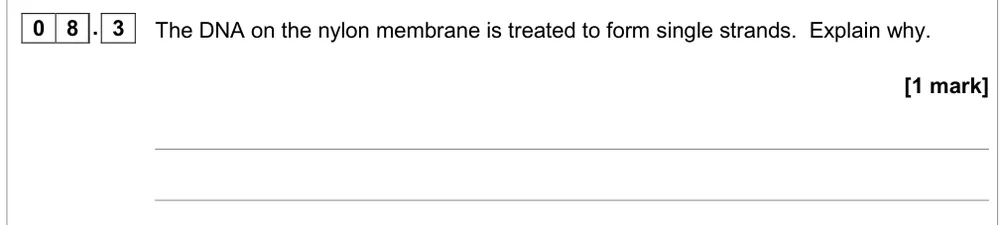
A level Paper 2 · June 2019 · Q08.3 · 1 mark · Hard
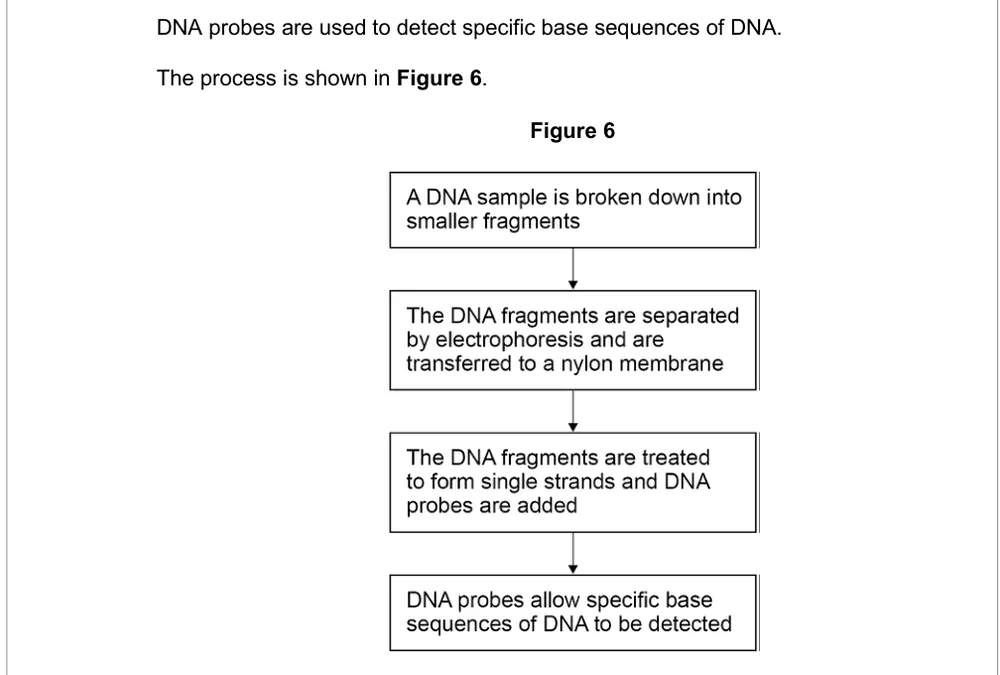
Explain why DNA on the nylon membrane is made single-stranded before adding probes.
Information from earlier in this question:
Show the mark scheme

Tap an image to open it full size.
From the examiners' report: About 55% got this. Saying it exposes the bases isn't enough: say the probe can then bind (hybridise) to the complementary sequence.
Question 3
A level Paper 3 · November 2021 · Q06.1 · 4 marks · Hard
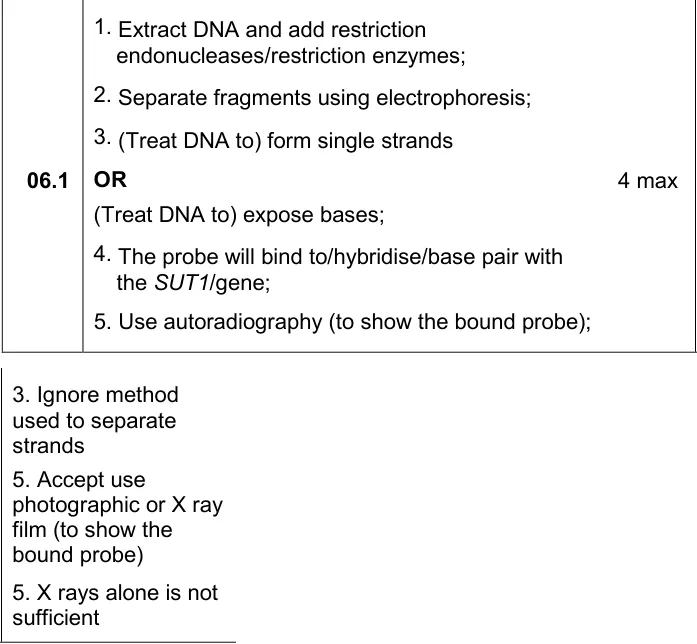
Describe how a radioactively labelled probe could show tobacco leaf cells contain the SUT1 gene.
Show the mark scheme
Tap an image to open it full size.
From the examiners' report: Only 1.20% got full marks. Give the steps in order and keep the radioactive probe radioactive, so autoradiography detects it; don't confuse a probe with a marker gene or describe microarrays.
Question 4
A level Paper 2 · June 2017 · Q10.7 · 2 marks
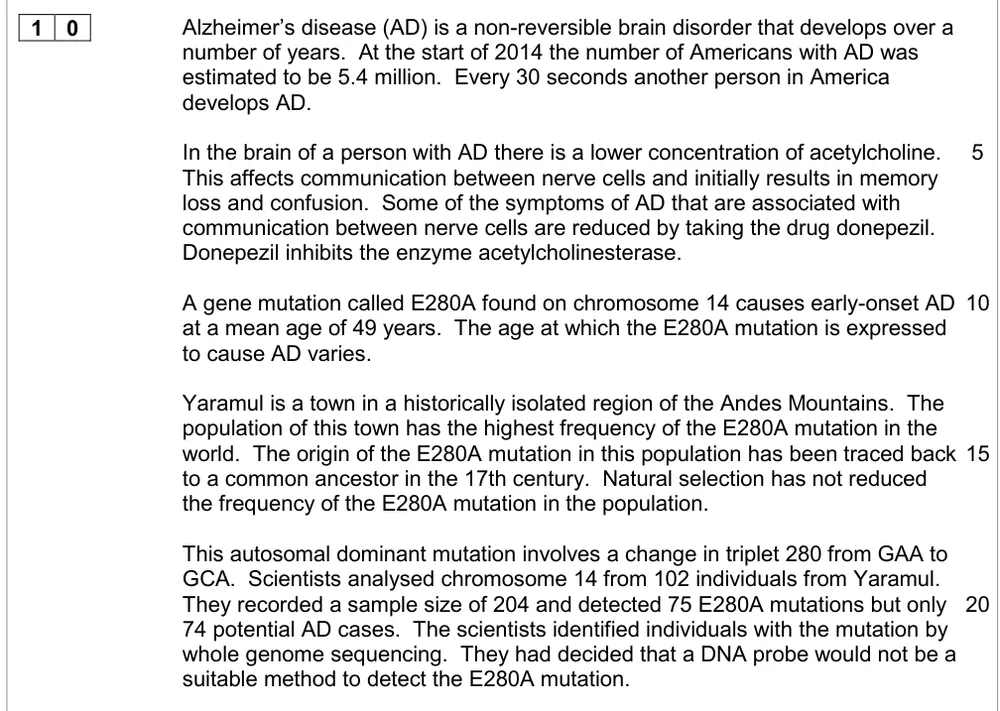
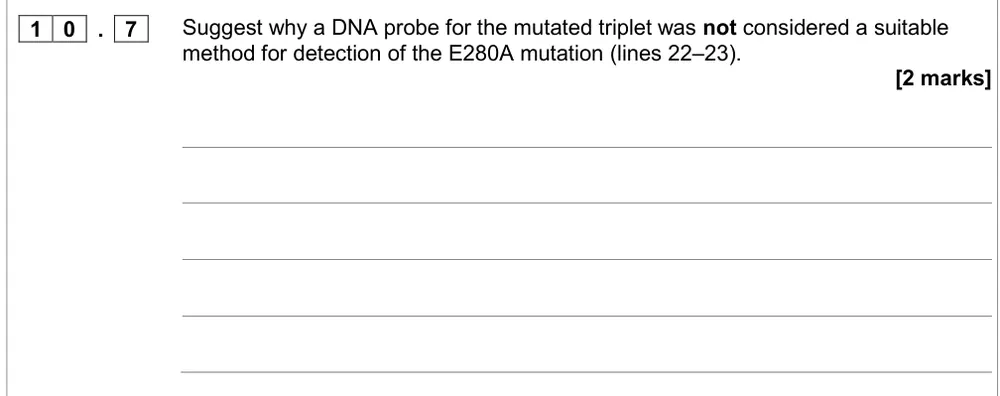
Suggest why a probe for one mutated triplet couldn't detect the E280A Alzheimer's mutation.
Information from earlier in this question:
Show the mark scheme
Tap an image to open it full size.
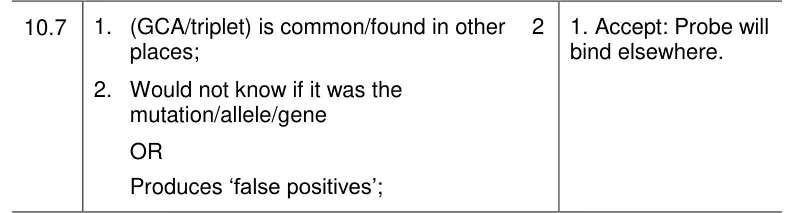
From the examiners' report: A probe only three bases long matches many places in the genome, so it would bind elsewhere and give false positives. Probes work because they're long enough to be specific.
Screening for heritable conditions (3.8.4.2)
Question 5
A level Paper 2 · June 2022 · Q10.2 · 4 marks · Hard
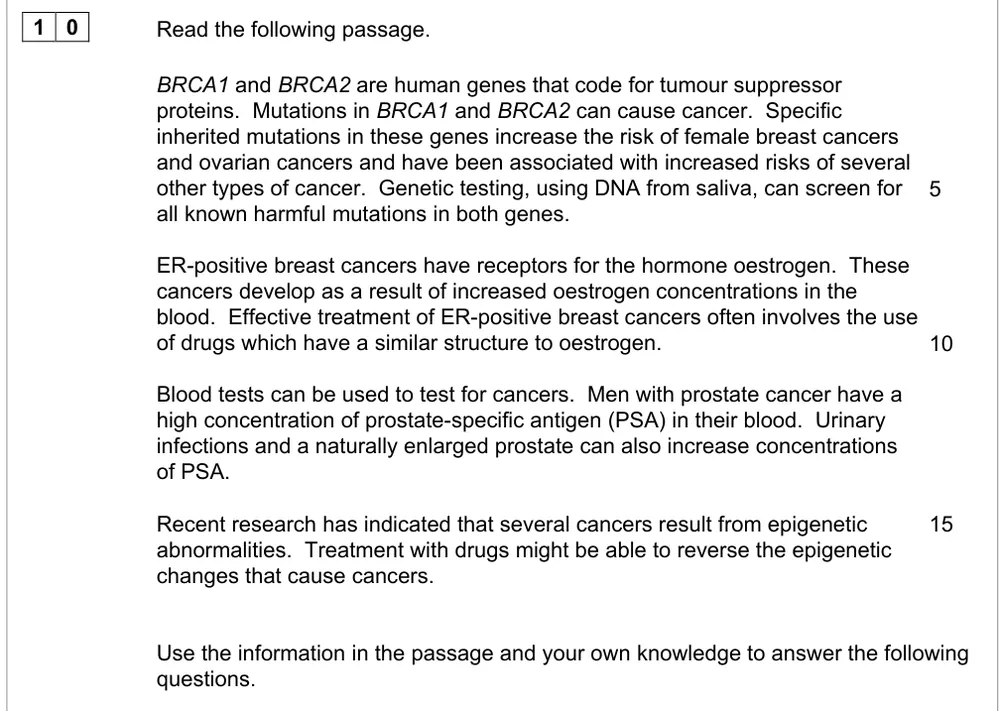
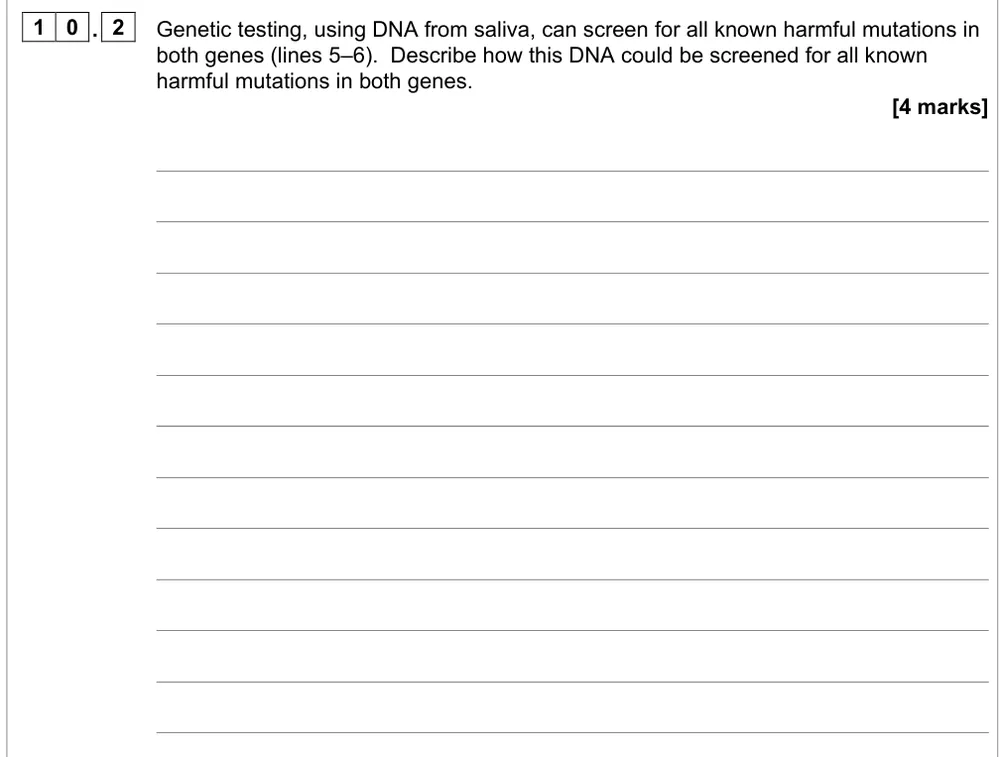
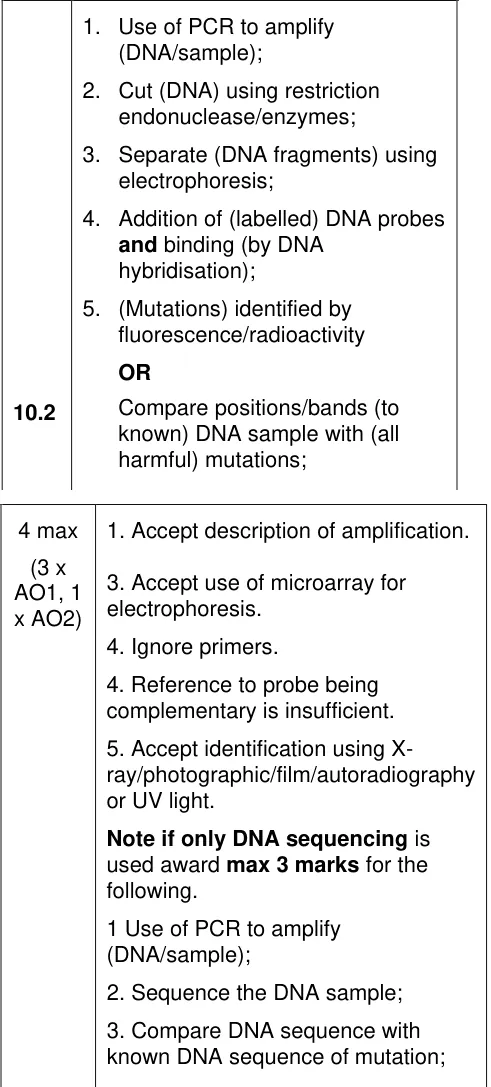
Describe how DNA from saliva could be screened for all known harmful BRCA1 and BRCA2 mutations.
Information from earlier in this question:
Show the mark scheme
Tap an image to open it full size.
From the examiners' report: Only 5% got all four and almost 47% scored zero. Use PCR, restriction enzymes, electrophoresis, then labelled probes that bind to the mutated alleles; don't swap probes for primers or marker genes.
Question 6
A level Paper 2 · June 2025 · Q09.3 · 3 marks · Medium
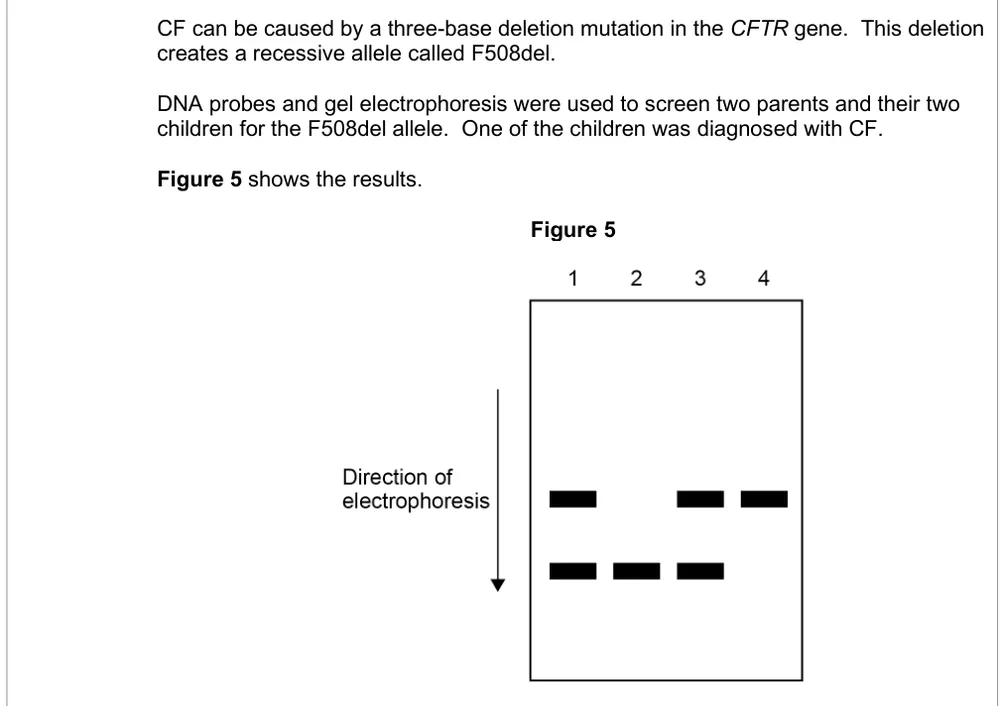
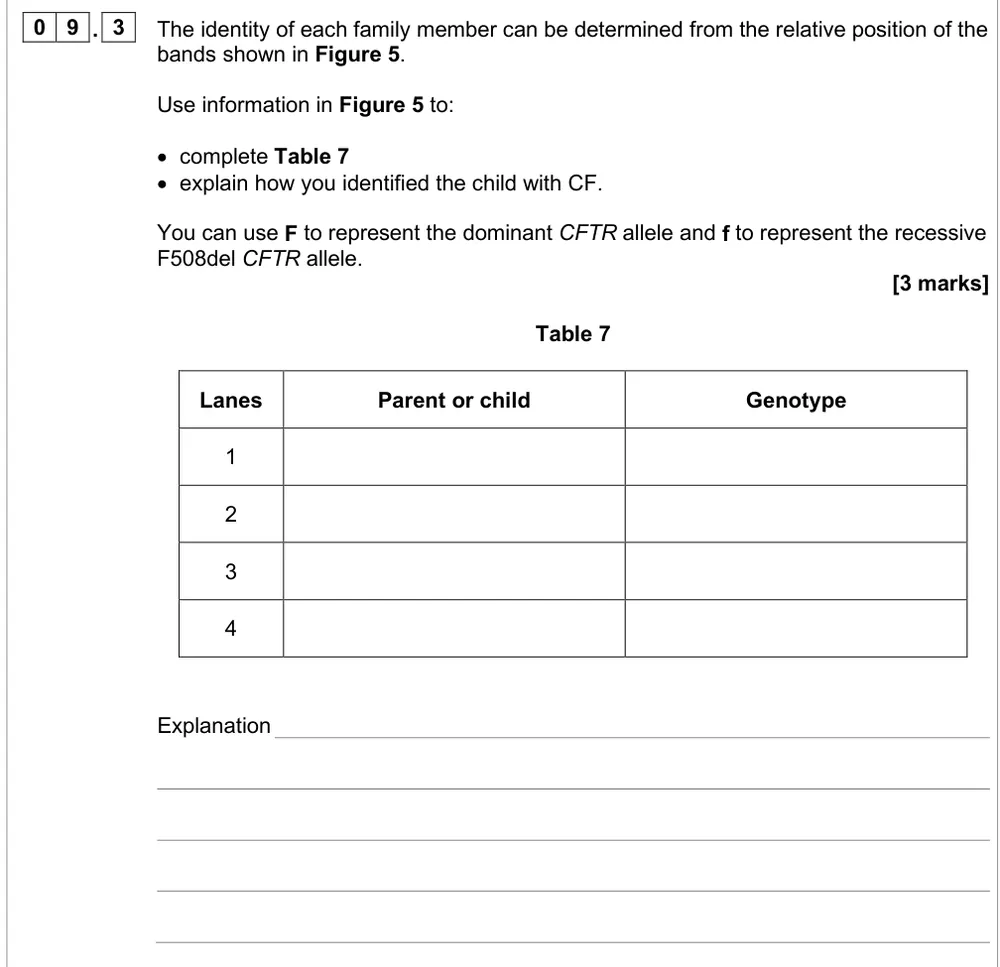
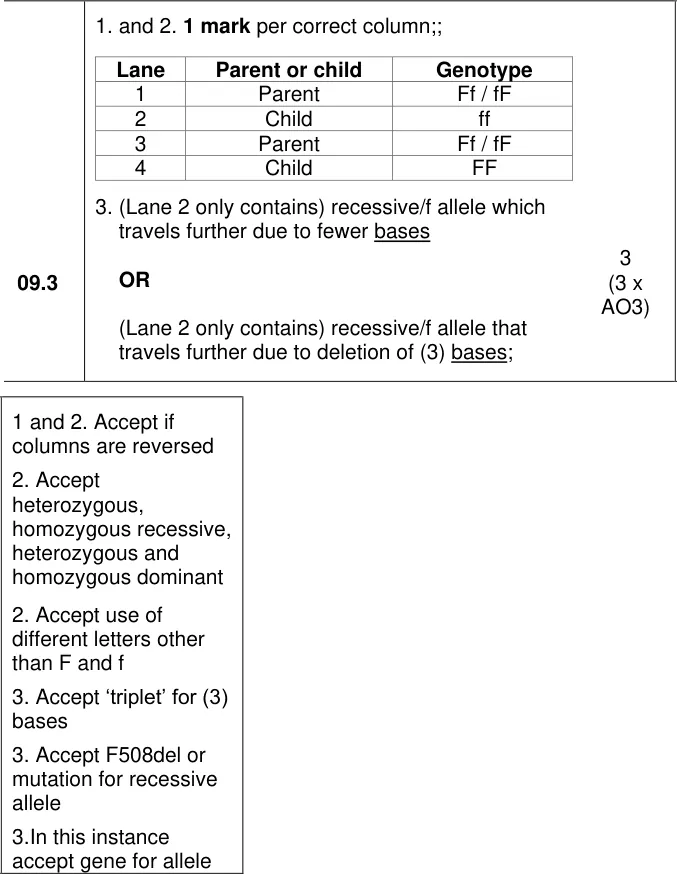
Use probe and gel results to give each family member's CF genotype and identify the child with CF.
Information from earlier in this question:
Show the mark scheme
Tap an image to open it full size.
From the examiners' report: Over half got at least two marks, but only one in five explained the CF band by the deletion. The F508del allele is three bases shorter, so it moves further; the child with only that band is ff.
Question 7
A level Paper 3 · June 2024 · Q05.4 · 3 marks · Easy
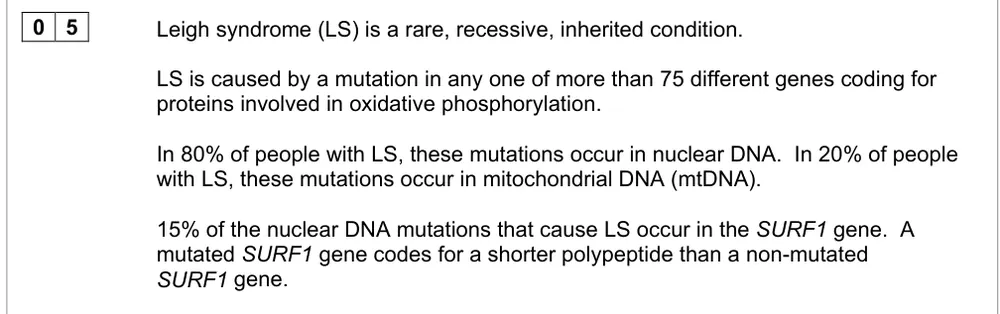
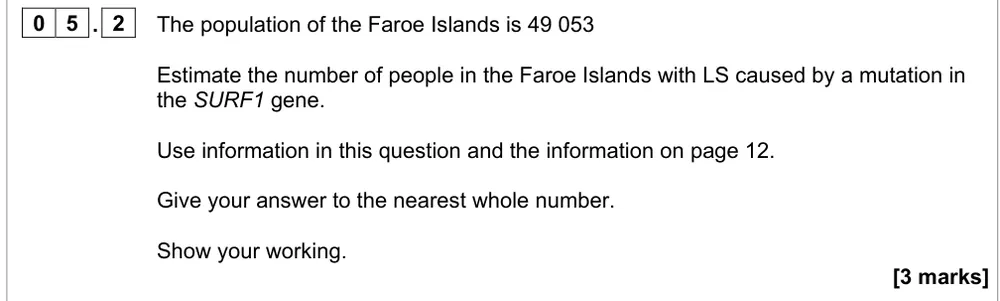
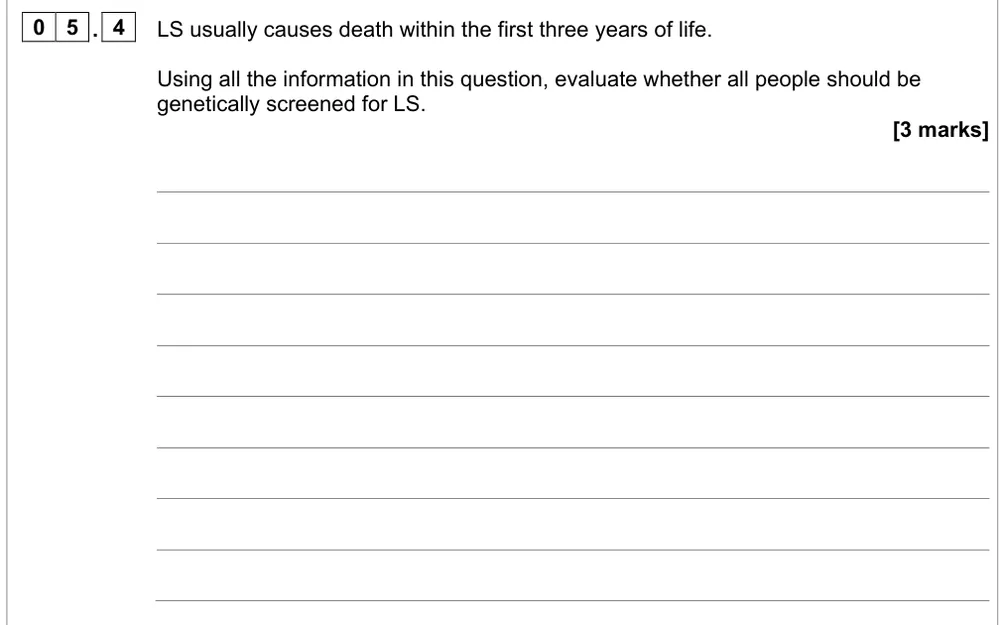
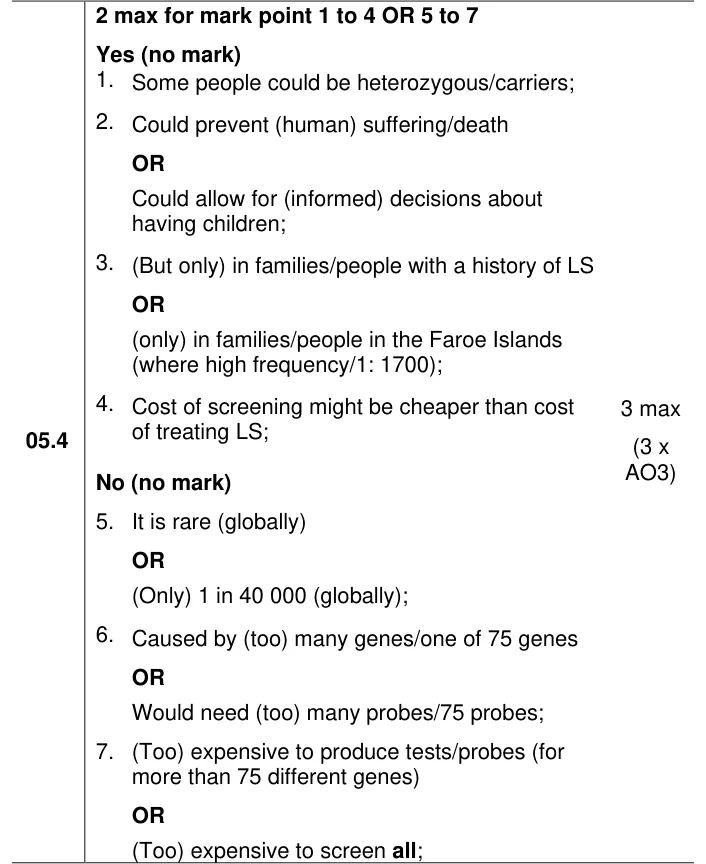
Evaluate whether everyone should be genetically screened for Leigh syndrome.
Information from earlier in this question:
Show the mark scheme
Tap an image to open it full size.
From the examiners' report: Marks were split fairly evenly. Use the stem: LS is rare globally (1 in 40 000, though 1 in 1700 in the Faroe Islands) and can be caused by any of 75 genes, so screening everyone needs many probes. 'No stats test' and 'it can be cured if caught early' don't fit.
Genetic fingerprinting and gel electrophoresis (3.8.4.3)
Question 8
A level Paper 2 · June 2023 · Q09.4 · 2 marks · Medium
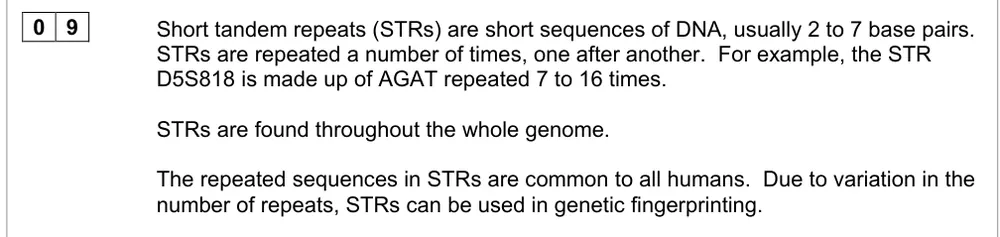
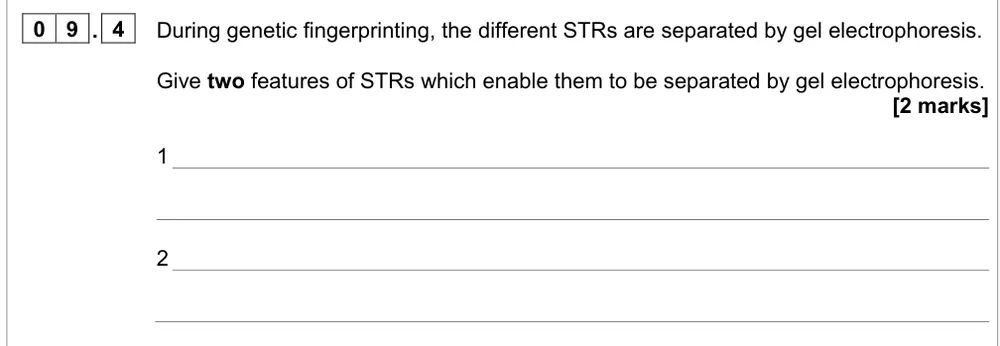
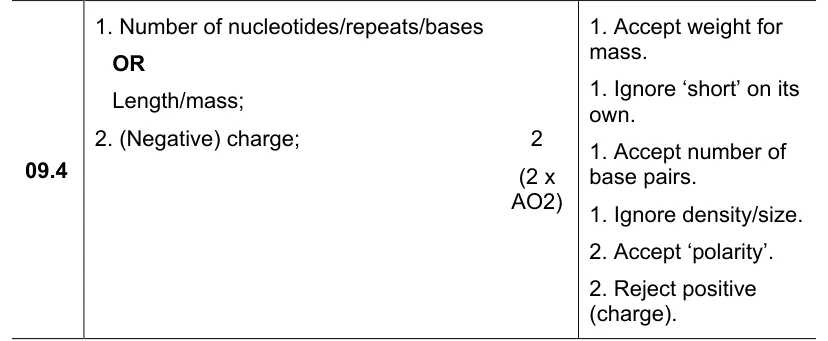
Give two features of STRs that let them be separated by gel electrophoresis.
Information from earlier in this question:
Show the mark scheme
Tap an image to open it full size.
From the examiners' report: A third got both. Give the number of repeats (or length) and the negative charge from the phosphate groups; R groups and amino acids belong to proteins.
Question 9
A level Paper 2 · June 2018 · Q08.6 · 2 marks · Medium
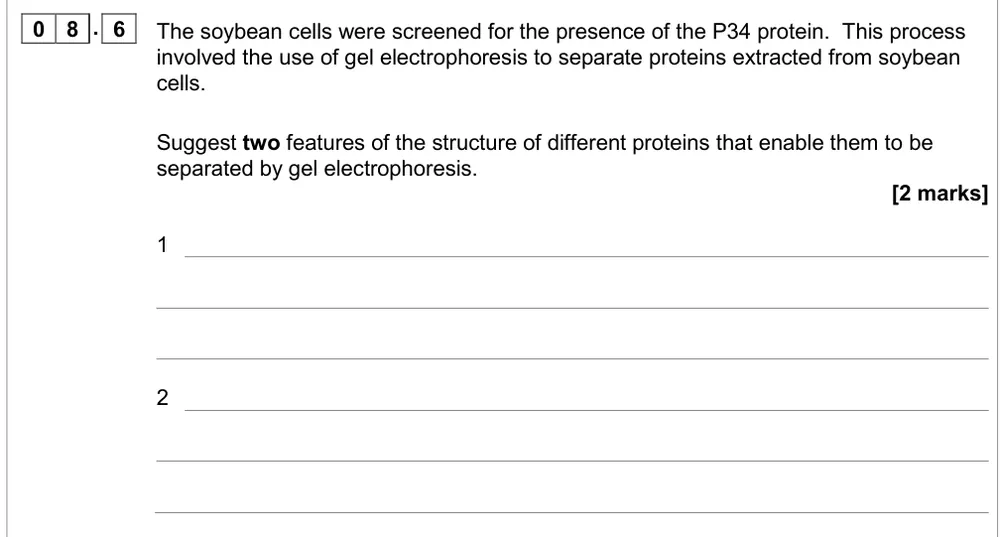
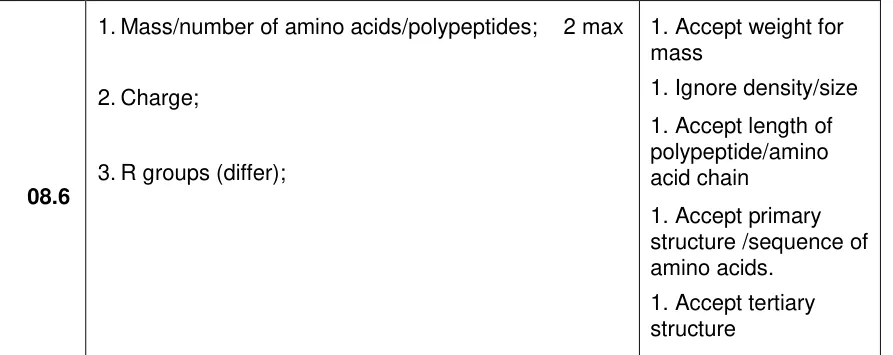
Suggest two features of protein structure that let gel electrophoresis separate proteins.
Information from earlier in this question:

Show the mark scheme
Tap an image to open it full size.
From the examiners' report: Only 14% got both. This is about proteins, not DNA: link mass to the number of amino acids, and say that charge differs because of the R groups.
Question 10
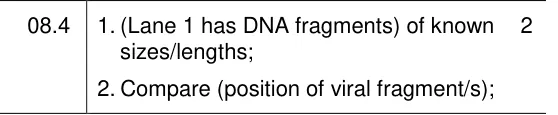
A level Paper 2 · June 2019 · Q08.4 · 2 marks · Medium
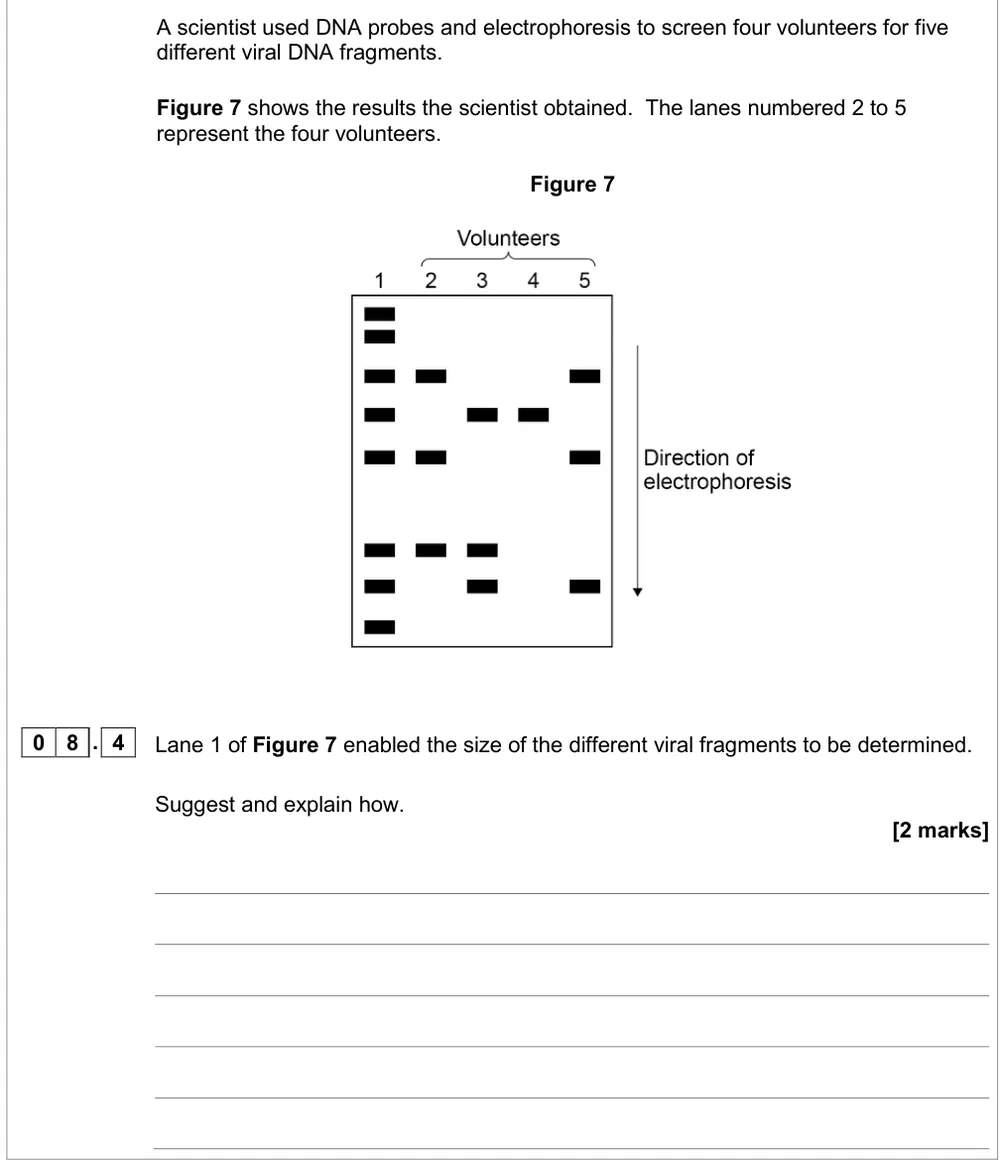
Explain how lane 1 of a gel lets you find the sizes of the viral DNA fragments.
Information from earlier in this question:
Show the mark scheme
Tap an image to open it full size.
From the examiners' report: About 60% got a mark but only about 24% got both. Say the lane 1 fragments are of known length, then compare positions; describing how electrophoresis works doesn't answer it.
Question 11
A level Paper 2 · June 2019 · Q08.5 · 1 mark · Hard
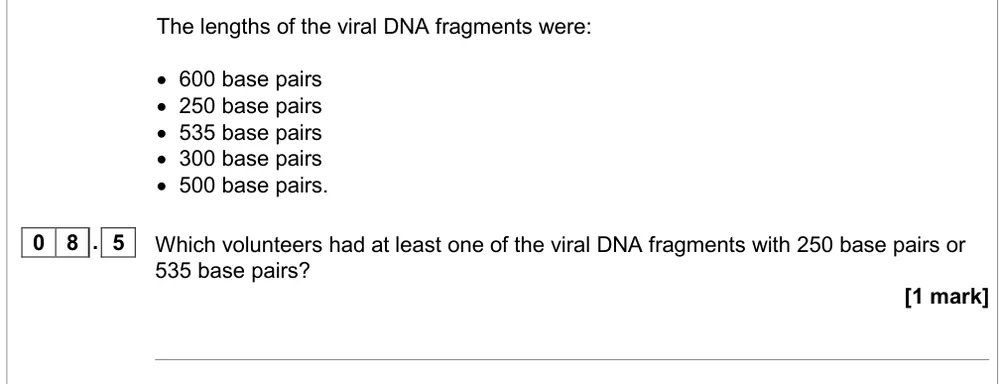
Read the gel to find which volunteers had the 250 or 535 base-pair viral fragment.
Show the mark scheme

Tap an image to open it full size.
From the examiners' report: Only about 17% got this. The volunteers' bands sit at five positions: rank the five sizes with the largest nearest the start, then check which lanes have a band at the 535 and 250 positions.
Question 12
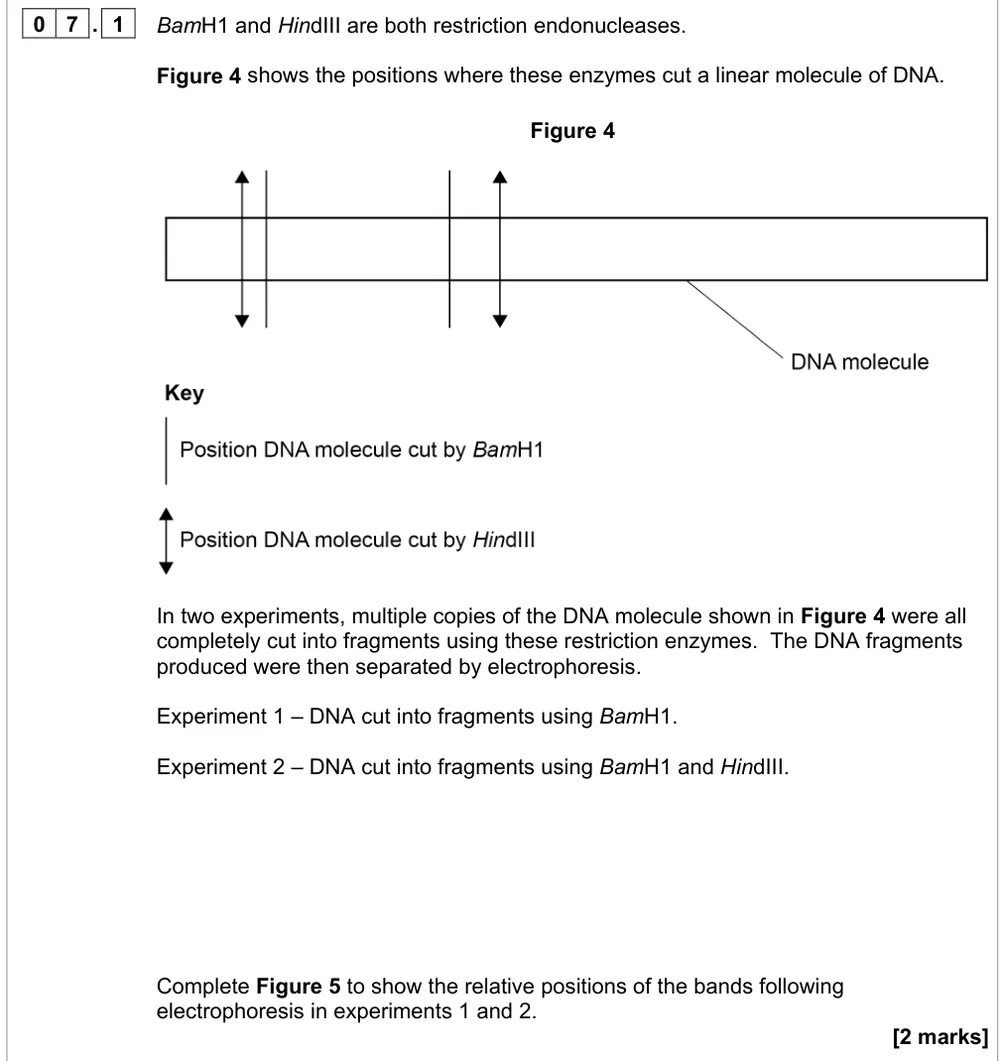
A level Paper 2 · June 2024 · Q07.2 · 2 marks · Hard
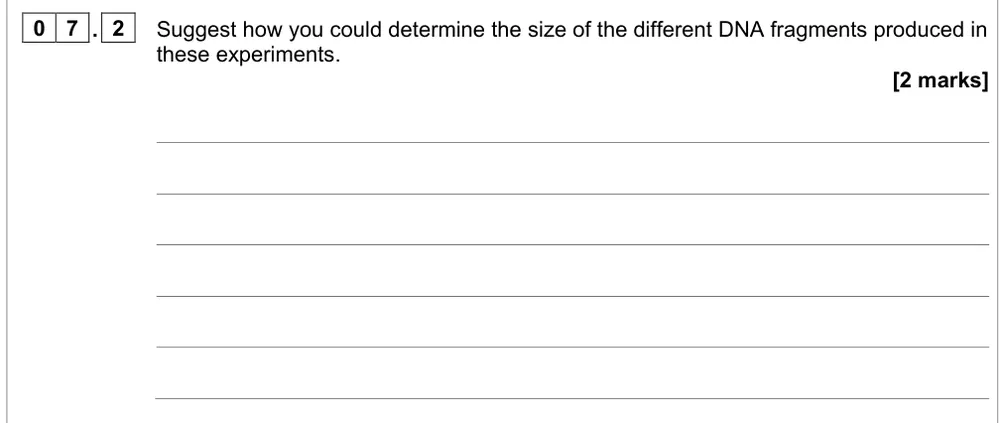
Suggest how you could find the sizes of DNA fragments cut by restriction enzymes.
Information from earlier in this question:
Show the mark scheme

Tap an image to open it full size.
From the examiners' report: The examiners found the answers very disappointing. You need both halves: a ladder of fragments of known length on the same gel, and comparing how far the unknown bands travel with it.
Where students lose marks (from AQA examiners' reports and mark schemes)
Each point below is followed by wording that gained marks.
Define a probe by what it is, not what it does: Only around 11% got both marks in 2019 and about 30% in 2025. Answers described what probes detect or how they're labelled, said 'short section' instead of single strand, or left out 'bases' or 'complementary'.
✔ Gains credit: "(Short) single strand of DNA; bases complementary (with DNA/allele/gene)."
Separate the strands so the probe can bind: About 55% knew why the DNA on the membrane is made single-stranded. Others said it exposes the bases but never said the probe then binds, or wrote about replication or transcription.
✔ Gains credit: "(So DNA) probe binds/attaches/anneals."
Cut, separate, single strands, probe, detect: Only 1.20% got full marks for showing the SUT1 gene with a radioactive probe, and almost 47% scored zero on screening BRCA genes. Restriction enzymes were left out or replaced by helicase, and probes were confused with primers and marker genes.
✔ Gains credit: "Extract DNA and add restriction endonucleases; separate fragments using electrophoresis; (treat DNA to) form single strands; the probe will bind to/hybridise with the SUT1 gene; use autoradiography."
A three-base probe binds all over the genome: A probe for just the mutated triplet won't identify the E280A mutation, because the same three bases turn up in many other places.
✔ Gains credit: "(GCA/triplet) is common/found in other places; would not know if it was the mutation/allele OR produces 'false positives'."
STRs separate by length and negative charge: A third got both marks. Few said number of repeats or bases, the negative charge mark was less common, and weaker answers gave positive charge, R groups or amino acids for DNA.
✔ Gains credit: "Number of nucleotides/repeats/bases OR length/mass; (negative) charge."
Proteins separate by amino acids and R groups: Only 14% got both marks for separating soybean proteins. Many wrote about DNA and VNTRs, and 'size' or 'mass' alone didn't score without linking it to the number of amino acids.
✔ Gains credit: "Mass/number of amino acids/polypeptides; charge; R groups (differ)."
Size unknown bands against fragments of known length: About 60% said compare with lane 1 but only about 24% got both marks, because they didn't say the lane 1 fragments were of known sizes. Some called lane 1 a control or said it held VNTRs.
✔ Gains credit: "(Lane 1 has DNA fragments) of known sizes/lengths; compare (position of viral fragments)."
A deletion makes the allele travel further: Over half got the family's genotypes, but only one in five explained the CF child's single band in terms of the three deleted bases.
✔ Gains credit: "(Lane 2 only contains) recessive/f allele that travels further due to deletion of (3) bases."
Download the questions
Download the PDF pack (12 questions, mark schemes at the end)
Keep practising
- Genome projects and recombinant DNA: AQA A Level Biology exam questions by topic
- Inheritance: AQA A Level Biology exam questions by topic
- Gene expression and cancer: AQA A Level Biology exam questions by topic
- AQA 3.8.3 and 3.8.4 gene technologies: self-marking quiz
- AQA A Level Biology masterclasses
Questions, mark schemes and examiners' report extracts © AQA.