

Regulation of transcription and translation (AQA 3.8.2.2) is A-level only, so it's Year 13 content. You need to know how transcription factors move into the nucleus to stimulate or inhibit transcription, including the role of oestrogen; how epigenetic changes, increased methylation of DNA and decreased acetylation of histones, inhibit transcription and matter in diseases such as cancer; and how RNA interference stops mRNA being translated.
The examiners' reports show this topic catches a lot of students out. Only 5% got both marks for explaining how a mutation outside the lactase gene causes lactase persistence, because few thought of a promoter or a transcription factor gene. On RNA interference, 63% scored zero on the poplar question and almost 57% on antisense SUT1 mRNA, mostly by having the RNA bind to the gene and block transcription. And 'switched on' or 'switched off' never earns the mark on its own: say that transcription is stimulated or inhibited.
Start with the transcription factor questions, then the epigenetics ones, and keep RNAi separate in your head: it acts on mRNA, after transcription. Finish with the data questions, where reading a log scale and spotting what a method can't show are the skills being tested. If you'd like help with this topic, my AQA masterclasses run online on Tuesdays at 5.15pm for Year 12 and on Wednesdays or Thursdays at 6.30pm for Year 13.
Want help with this topic? It comes up in my weekly AQA masterclasses. See the timetable →
What you need from GCSE and Year 12
Each question on this page assumes you're secure on these GCSE and Year 12 ideas. If any of them feels shaky, revise it before you start.
- GCSE: hormones are chemical messengers carried in the blood to target cells.
- Year 12 (AQA 3.4.2): RNA polymerase transcribes a gene into mRNA in the nucleus, and ribosomes translate mRNA codons into a polypeptide.
- Year 12 (AQA 3.1.5.1): complementary bases pair up (A with U in RNA), so one nucleic acid strand can bind to another.
- Year 12 (AQA 3.4.1): in eukaryotes, nuclear DNA is wound around histone proteins.
- Year 12 (AQA 3.1.4.1): a protein's tertiary structure gives it a specific shape, so a change in its amino acid sequence can stop it binding.
Key terms
These words come up in the questions and mark schemes. Examiners expect you to use them exactly.
- Transcription factor: a protein that moves from the cytoplasm into the nucleus and binds to DNA (the promoter) to stimulate or inhibit transcription of a target gene.
- Promoter: the region of DNA next to a gene where transcription factors and RNA polymerase bind to start transcription.
- RNA polymerase: the enzyme that joins RNA nucleotides to make mRNA during transcription; a transcription factor can help it bind.
- Oestrogen: a lipid-soluble steroid hormone that diffuses into a cell and binds to a receptor, forming an active transcription factor that initiates transcription.
- Epigenetics: heritable changes in gene function, without changes to the base sequence of DNA, caused by changes in the environment.
- Methylation of DNA: adding methyl groups to DNA (often the promoter); increased methylation inhibits transcription.
- Acetylation of histones: adding acetyl groups to the histones that DNA is wound around; decreased acetylation inhibits transcription, increased acetylation stimulates it.
- Oncogene and tumour suppressor gene: increased methylation of a tumour suppressor gene or decreased methylation of an oncogene can lead to cancer.
- RNA interference (RNAi): small RNA molecules such as siRNA bind to complementary mRNA, which is destroyed or not translated.
- Antisense RNA or DNA: a single strand with a base sequence complementary to an mRNA, so it binds to that mRNA and ribosomes can't translate it.
What these questions cover (AQA 3.8.2.2)
The questions test these statements from the AQA AS and A-level Biology specification (7401/7402):
- Transcription factors and oestrogen: In eukaryotes, transcription of target genes can be stimulated or inhibited when specific transcriptional factors move from the cytoplasm into the nucleus. The role of the steroid hormone, oestrogen, in initiating transcription. (no written question asks about oestrogen itself; the testosterone and androgen receptor question works in exactly the same way)
- Epigenetic control: Epigenetic control of gene expression in eukaryotes.
- What epigenetics is: Epigenetics involves heritable changes in gene function, without changes to the base sequence of DNA. These changes are caused by changes in the environment that inhibit transcription by:
- Increased methylation of DNA: increased methylation of the DNA or
- Decreased acetylation of histones: decreased acetylation of associated histones. (no part tests acetylation on its own, but the Huntington's disease and cancer drug questions both credit decreased acetylation of histones inhibiting transcription)
- Epigenetics and disease: The relevance of epigenetics on the development and treatment of disease, especially cancer.
- RNA interference: In eukaryotes and some prokaryotes, translation of the mRNA produced from target genes can be inhibited by RNA interference (RNAi).
- Gene expression data: interpret data provided from investigations into gene expression
- Genetic and environmental influences: evaluate appropriate data for the relative influences of genetic and environmental factors on phenotype. (no written question on this page asks you to weigh genetic against environmental factors; the Alzheimer's question, where an environmental factor changes when a mutation is expressed, is the closest practice)
How to use this page
Write your answer on paper before you open the mark scheme. Allow about 1.3 minutes per mark: the 18 questions are worth 44 marks, so about 57 minutes in total. Then mark your answer strictly against the mark scheme and read the examiners' tip underneath it. If you'd rather print the questions, download the PDF pack.
Transcription factors and steroid hormones (3.8.2.2)
Question 1
A level Paper 2 · November 2020 · Q02.3 · 2 marks · Medium
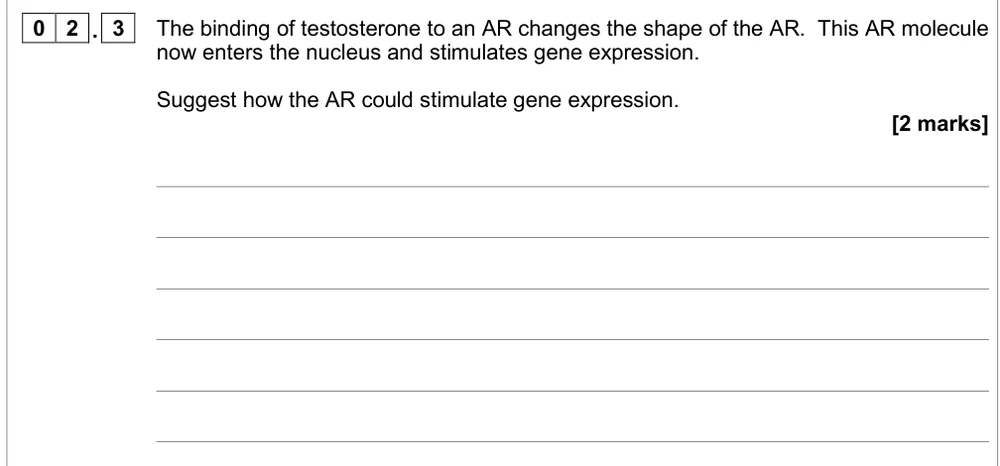
Suggest how testosterone bound to the androgen receptor stimulates gene expression.
Information from earlier in this question:

Show the mark scheme
Tap an image to open it full size.
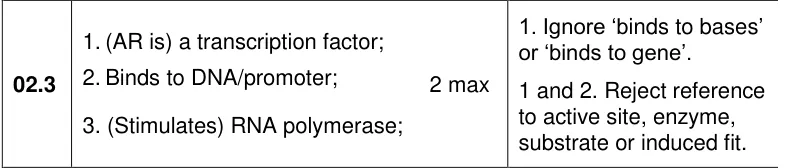
From the examiners' report: Only 54% scored and about half of those got both. Call the AR a transcription factor, say it binds to the promoter, and link it to RNA polymerase, not DNA polymerase.
Question 2
A level Paper 2 · June 2017 · Q06.3 · 2 marks · Medium
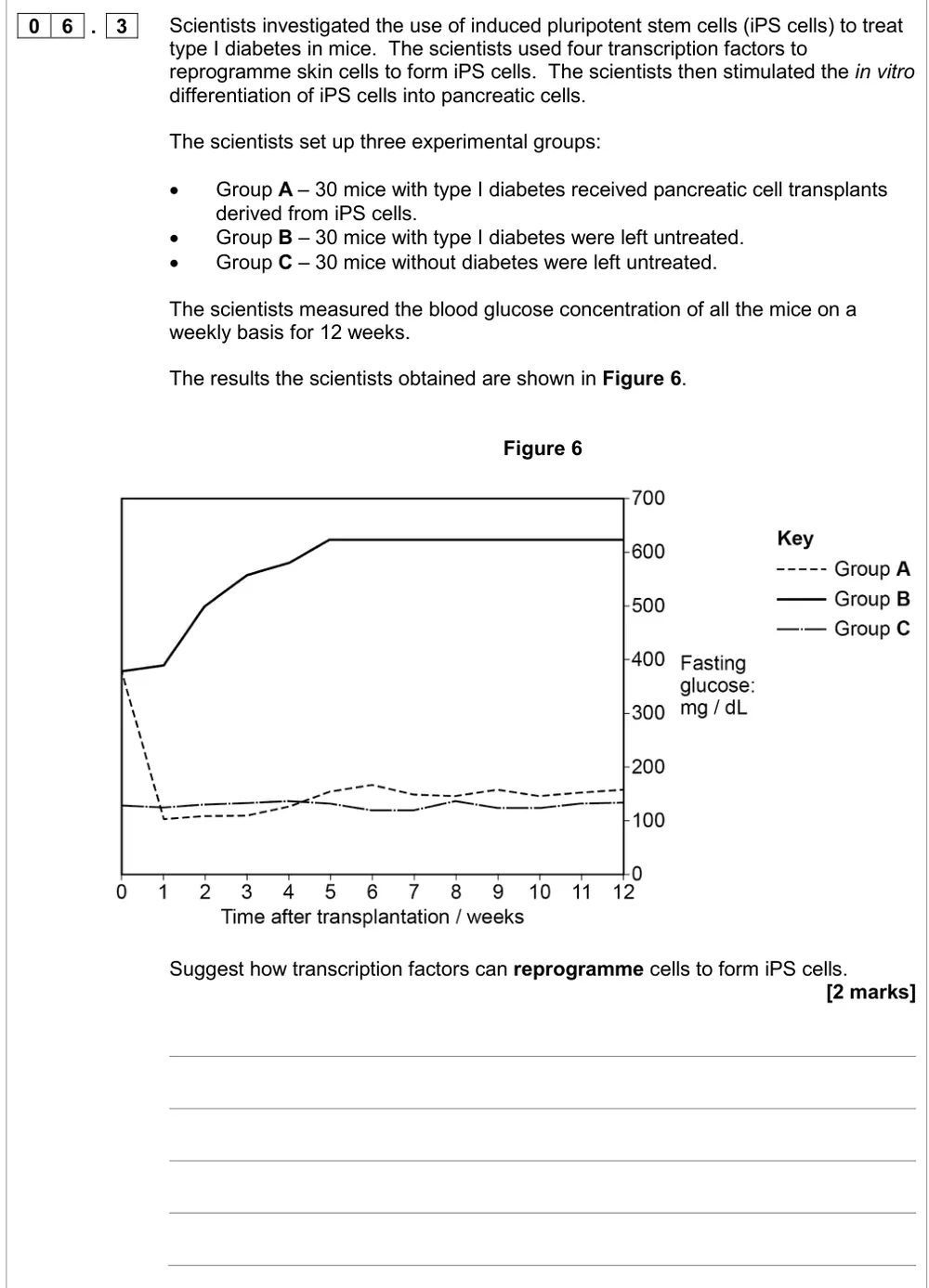
Suggest how transcription factors reprogramme skin cells into iPS cells.
Show the mark scheme
Tap an image to open it full size.
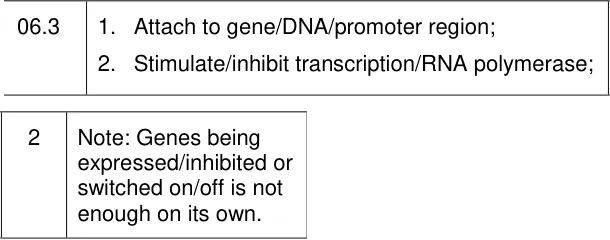
From the examiners' report: Over 50% got at least one mark, usually for binding. Say that the transcription factor binds to the promoter and stimulates or inhibits transcription; 'switching genes on' doesn't score, and don't confuse transcription with translation.
Question 3
A level Paper 2 · June 2018 · Q08.3 · 1 mark · Hard
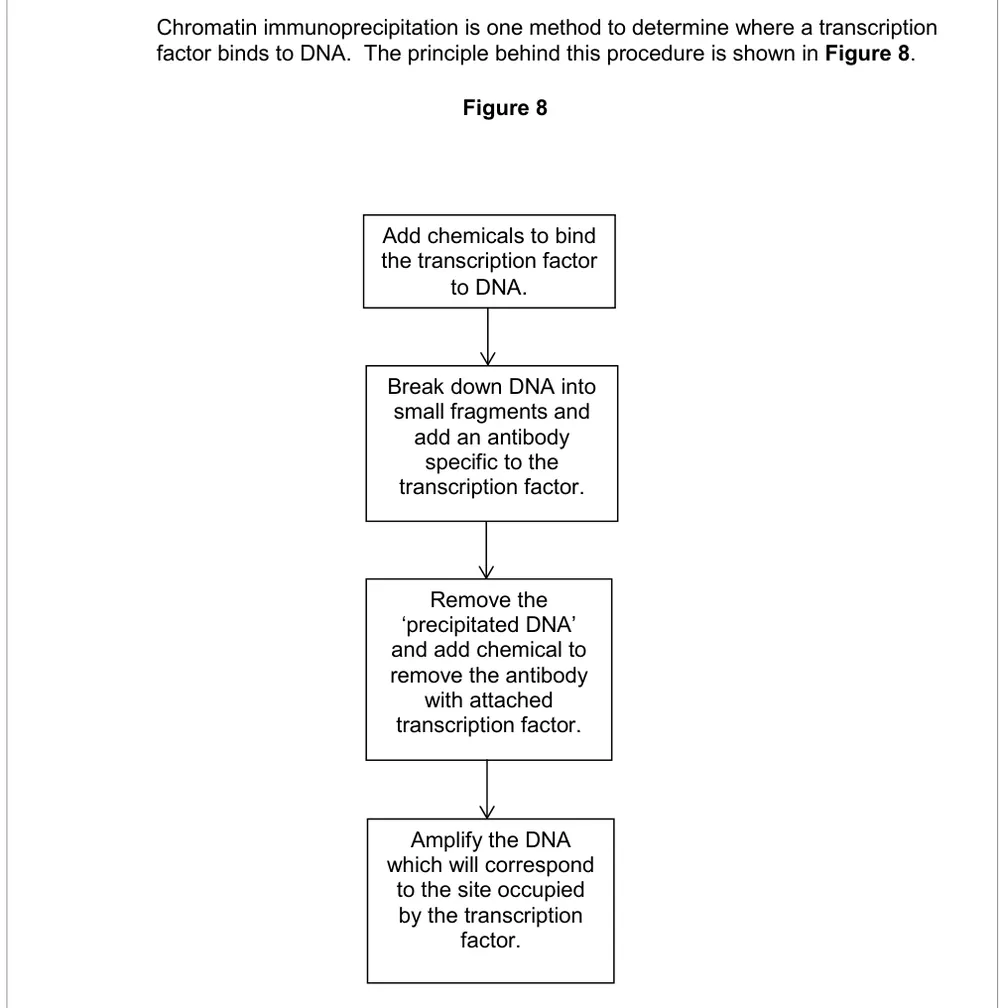
Use a chromatin immunoprecipitation flow chart to say what 'precipitated DNA' contains.
Information from earlier in this question:

Show the mark scheme

Tap an image to open it full size.
From the examiners' report: Only 26% got this. Follow the flow chart: the transcription factor is bound to the DNA and the antibody is bound to the transcription factor, so you need all three, not just DNA fragments.
Question 4
A level Paper 2 · June 2018 · Q09.3 · 2 marks · Hard
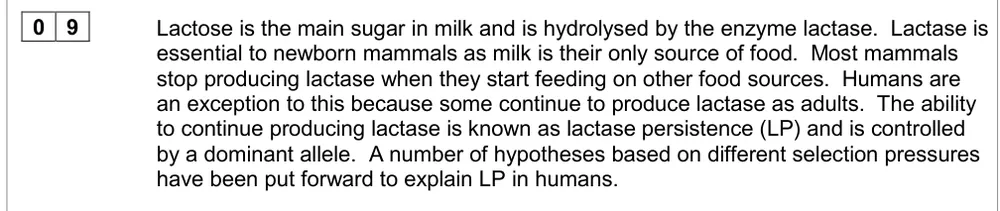
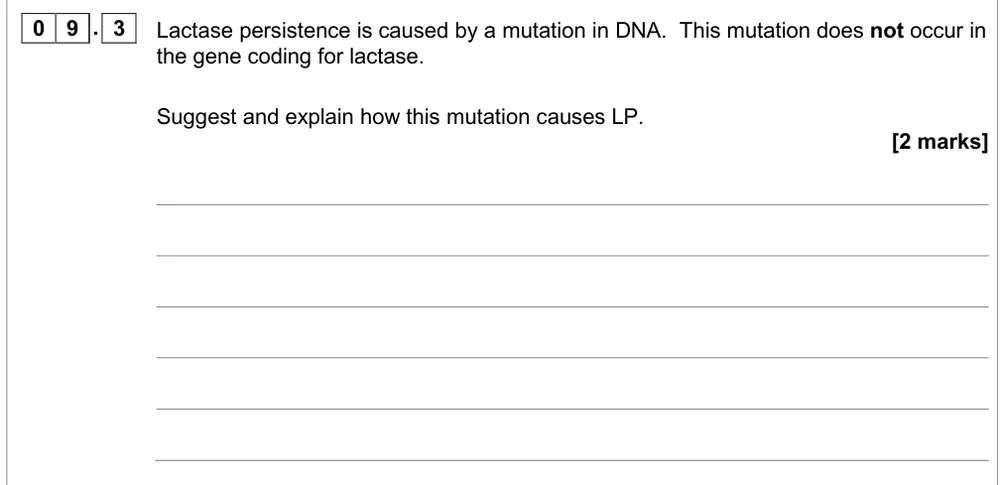
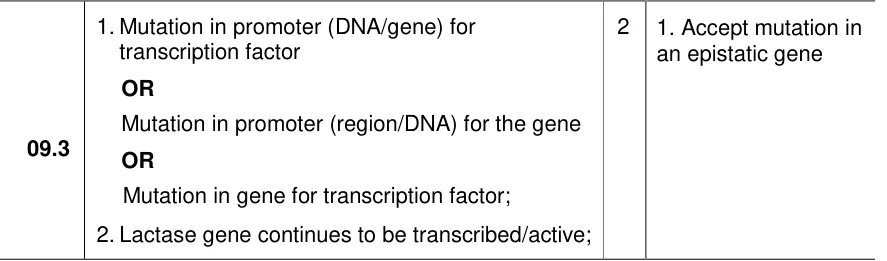
Explain how a mutation outside the lactase gene could cause lactase persistence.
Information from earlier in this question:
Show the mark scheme
Tap an image to open it full size.
From the examiners' report: Only 18% got a mark and 5% got both. If the lactase gene is unchanged, think about what controls its transcription: its promoter or a transcription factor, and then say it keeps being transcribed.
Question 5
A level Paper 3 · June 2018 · Q02.4 · 3 marks · Medium
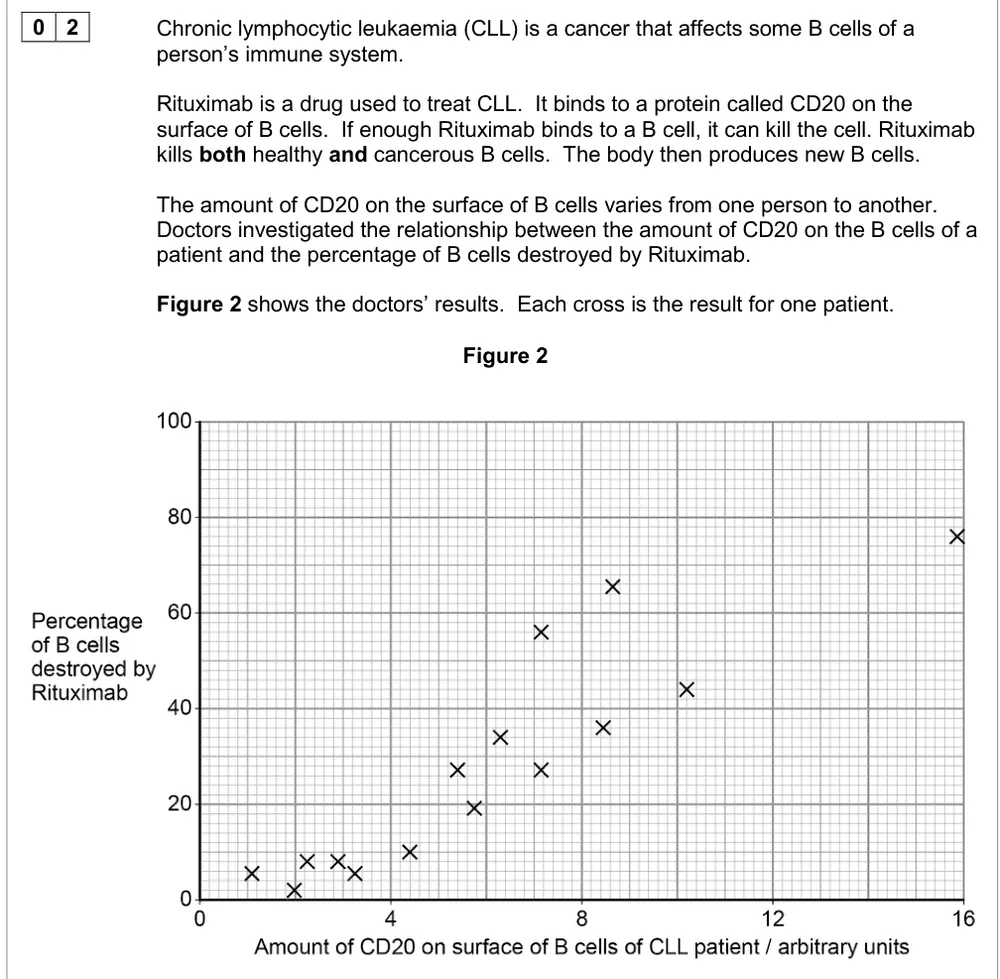
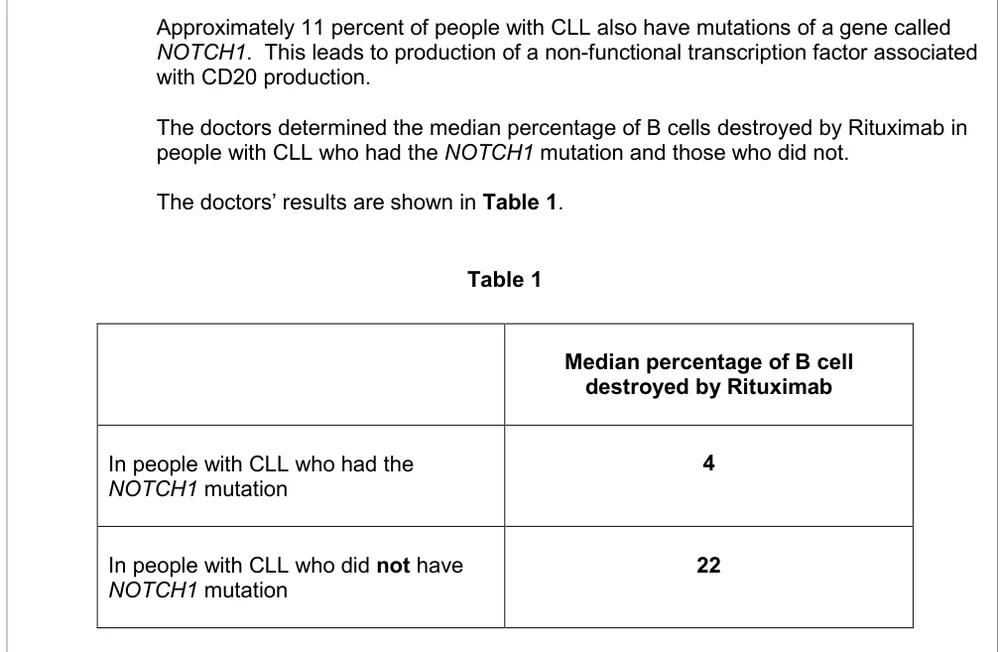
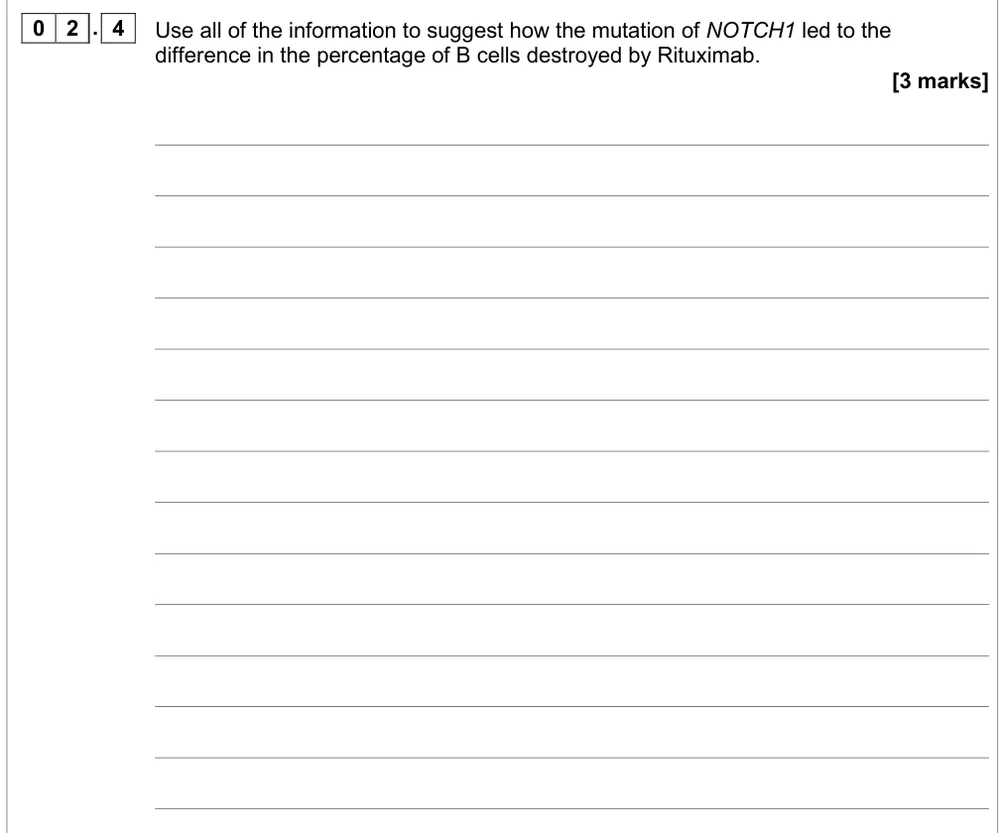
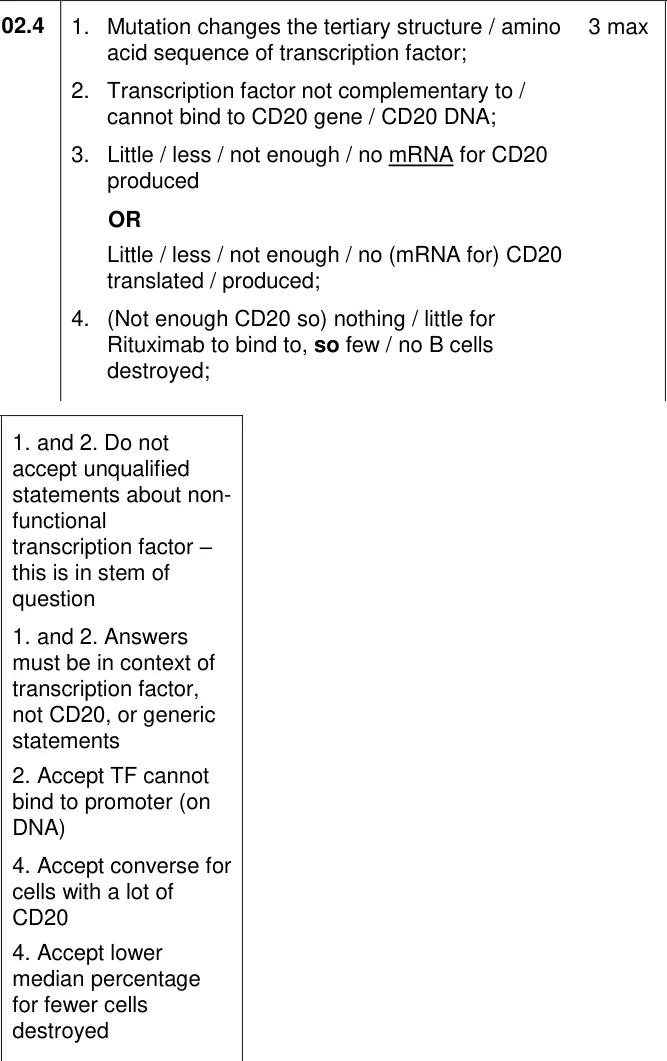
Explain how a NOTCH1 mutation affecting a transcription factor reduced the B cells destroyed by Rituximab.
Information from earlier in this question:
Show the mark scheme
Tap an image to open it full size.
From the examiners' report: Only 14% got all three and 20% scored zero. The mutation is in the transcription factor, not CD20: change its shape, stop it binding to the CD20 gene, so less CD20 mRNA and protein are made.
Epigenetics: methylation and acetylation (3.8.2.2)
Question 6
A level Paper 3 · June 2025 · Q05.2 · 1 mark · Easy
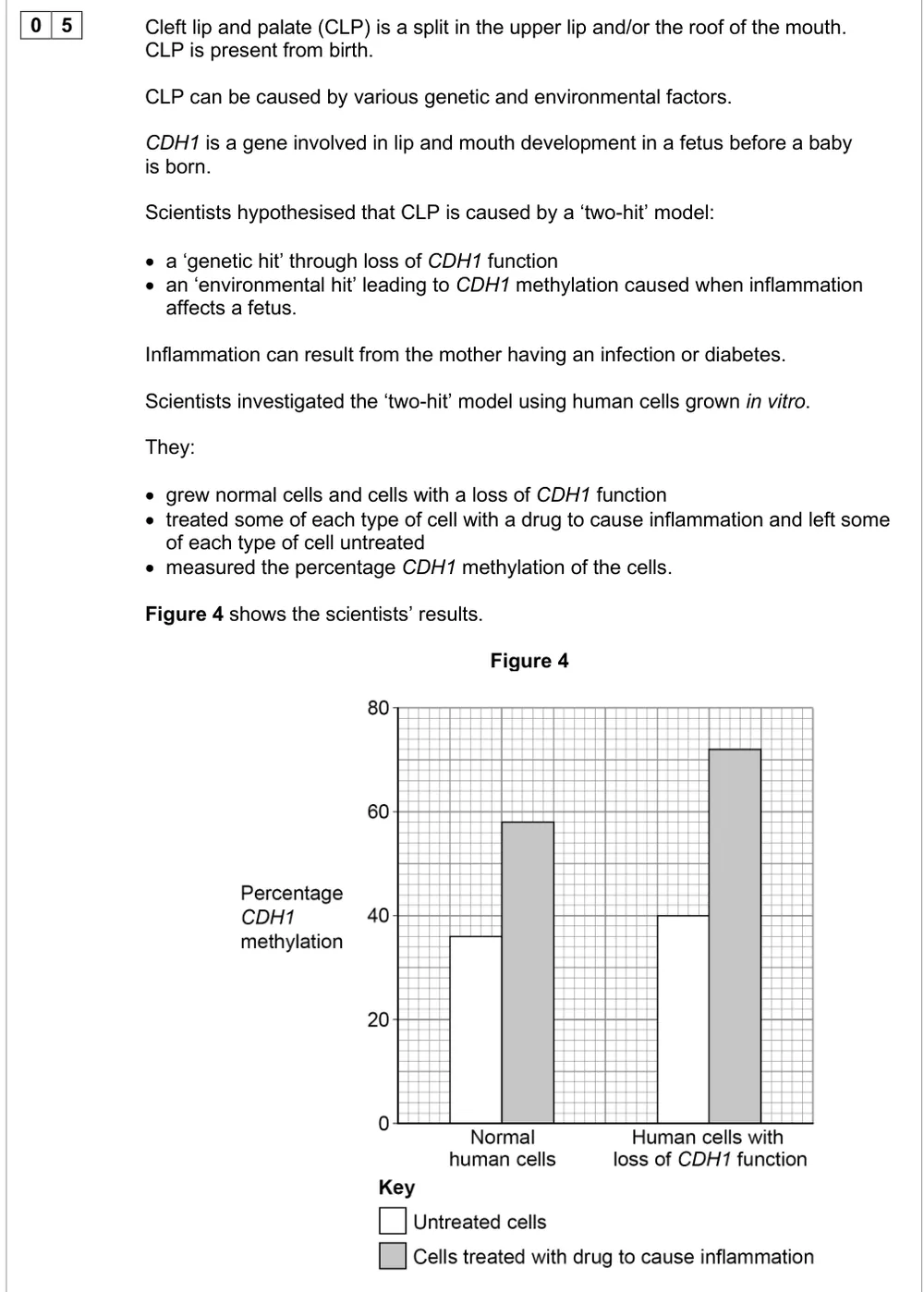
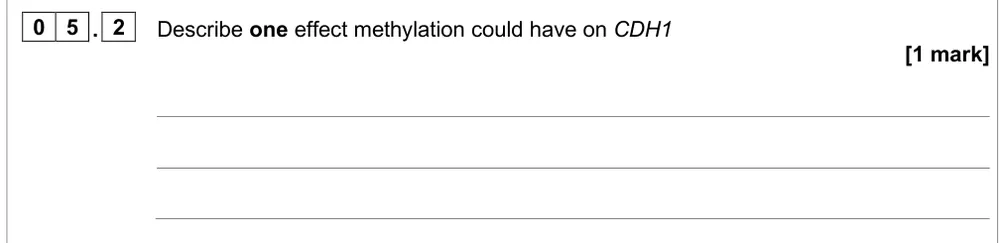
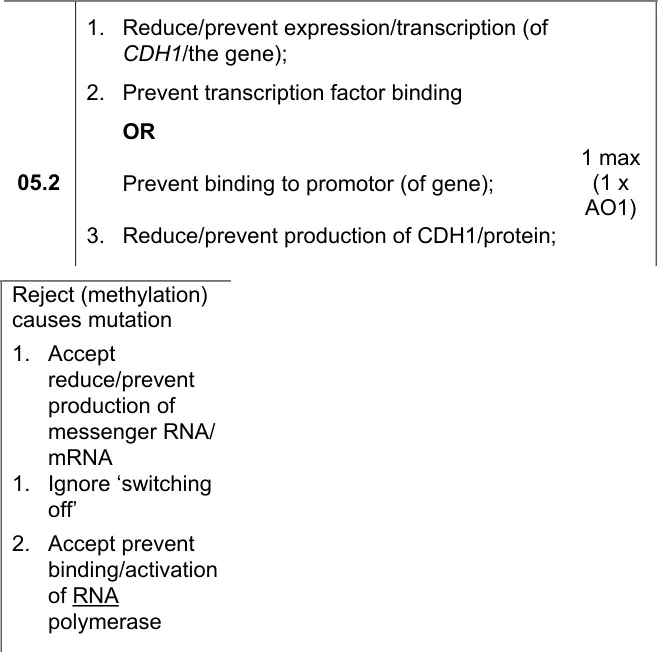
Describe one effect methylation could have on the CDH1 gene.
Information from earlier in this question:
Show the mark scheme
Tap an image to open it full size.
From the examiners' report: About 70% got this. Say methylation prevents transcription of the gene; vague answers about the gene being 'switched off' didn't score.
Question 7
A level Paper 2 · June 2017 · Q10.5 · 2 marks · Hard
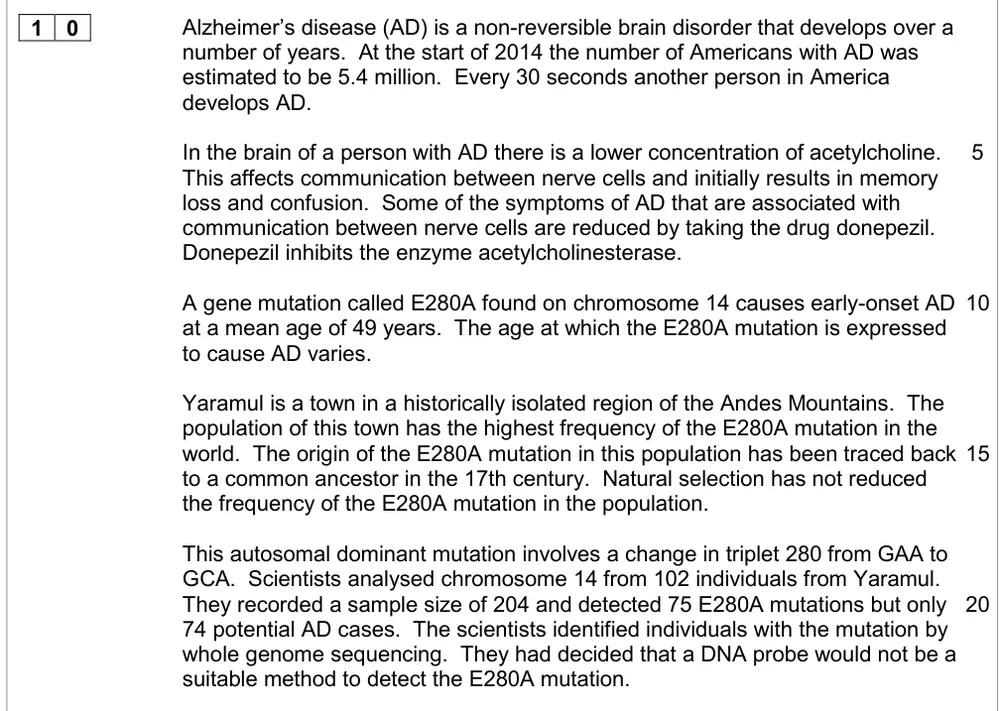
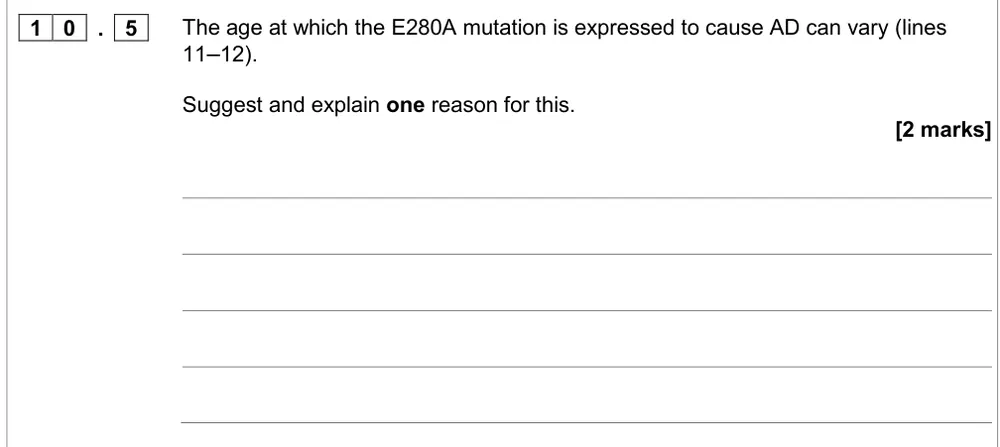
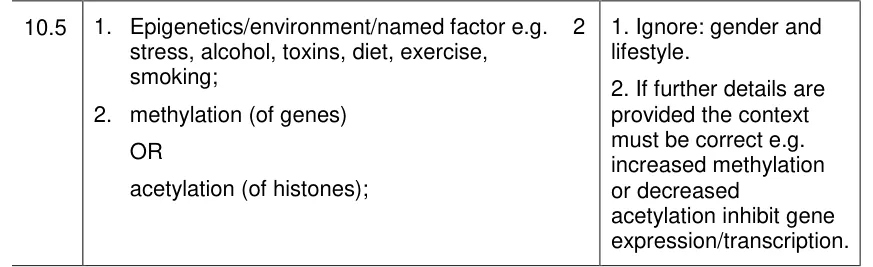
Suggest and explain why the age at which the E280A Alzheimer's mutation is expressed varies.
Information from earlier in this question:
Show the mark scheme
Tap an image to open it full size.
From the examiners' report: Over half scored zero, often by blaming acetylcholine levels or mutagens. Name an environmental factor and then the epigenetic mechanism: only 10% added methylation or acetylation for the second mark.
Question 8
A level Paper 2 · June 2019 · Q10.6 · 2 marks · Hard
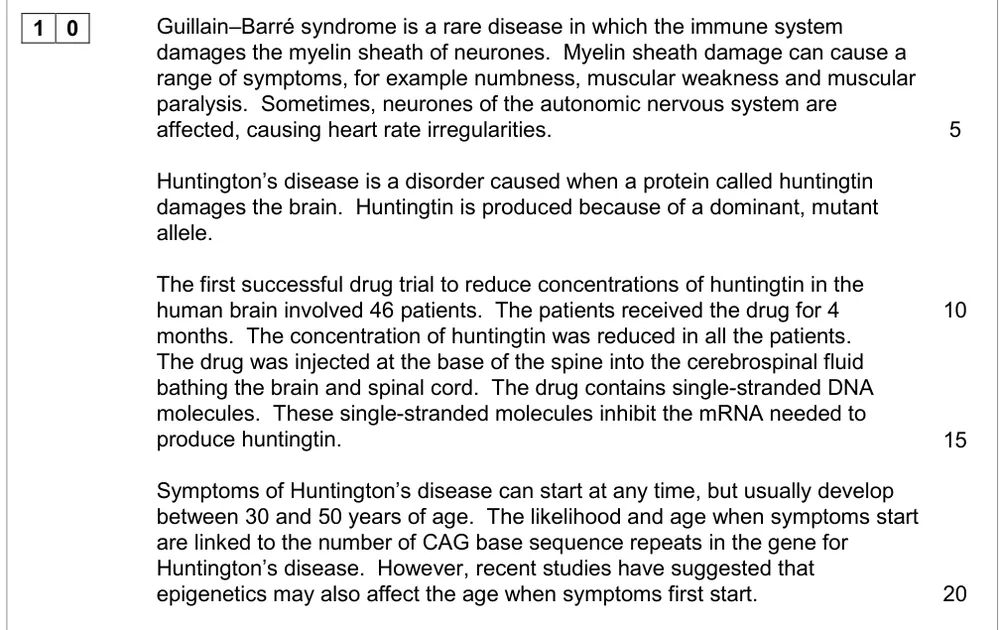
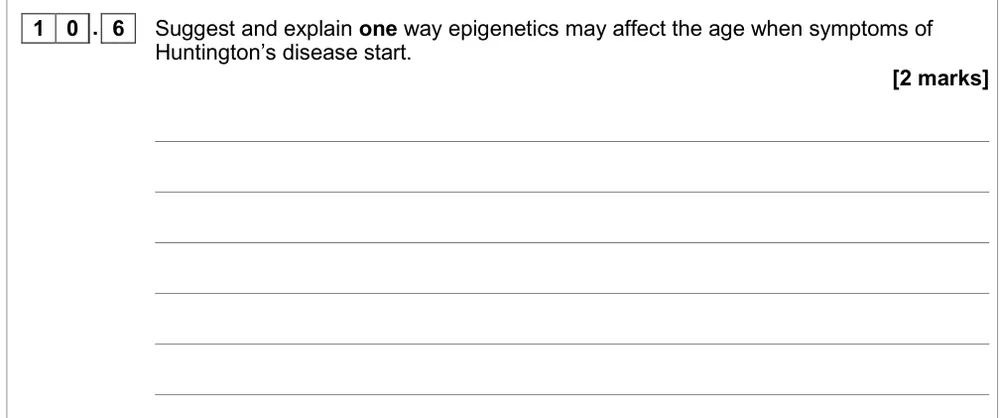
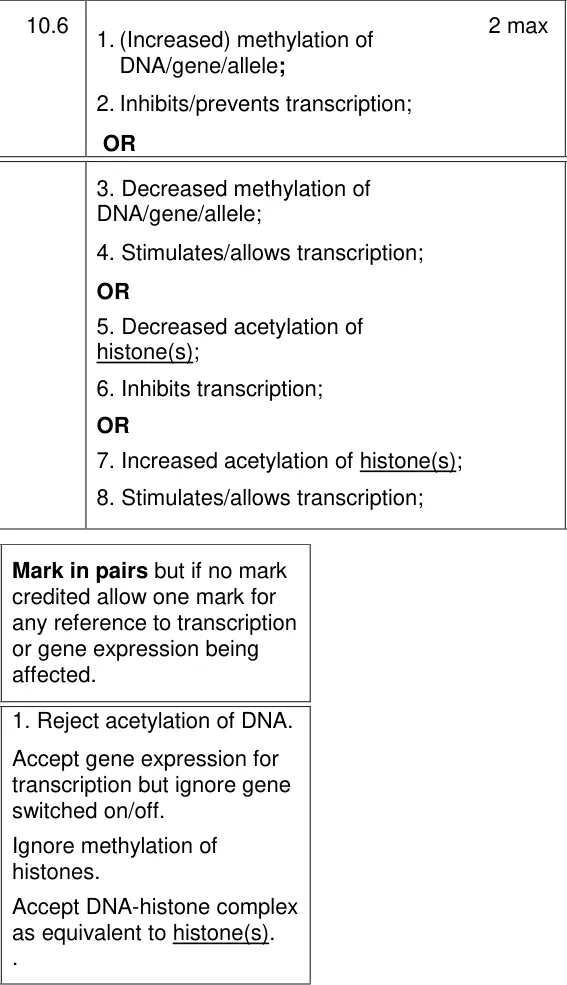
Suggest and explain one way epigenetics may affect when Huntington's disease symptoms start.
Information from earlier in this question:
Show the mark scheme
Tap an image to open it full size.
From the examiners' report: About 42% got a mark and 16% both. Say what is changed (methylation of DNA, or acetylation of histones), whether it increases or decreases, and its effect on transcription.
Question 9
A level Paper 2 · June 2022 · Q10.5 · 3 marks · Hard
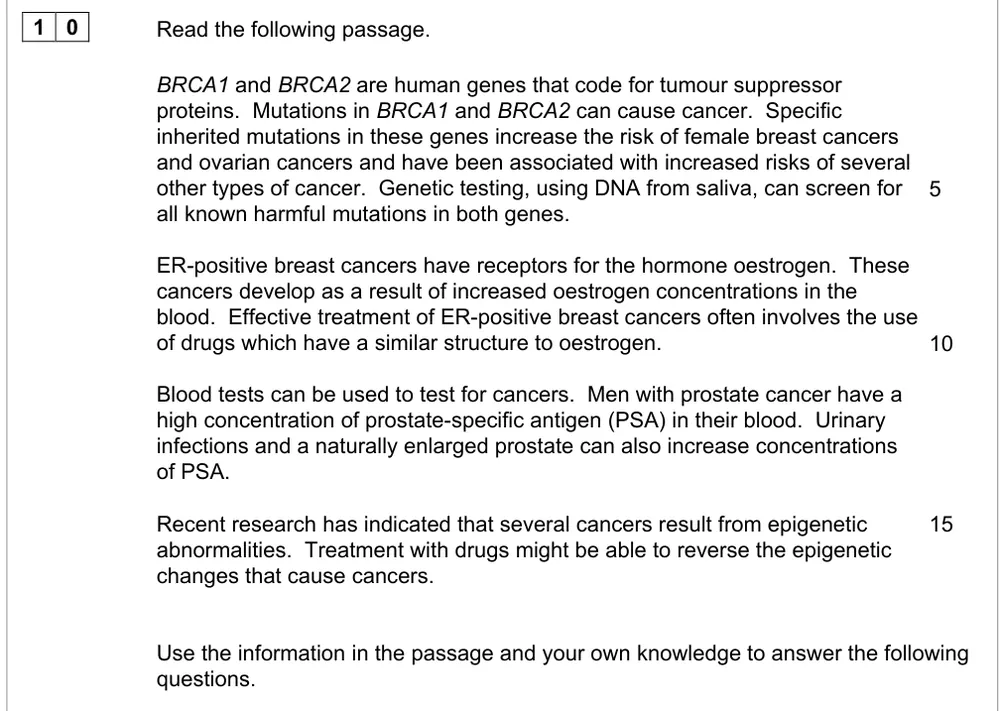
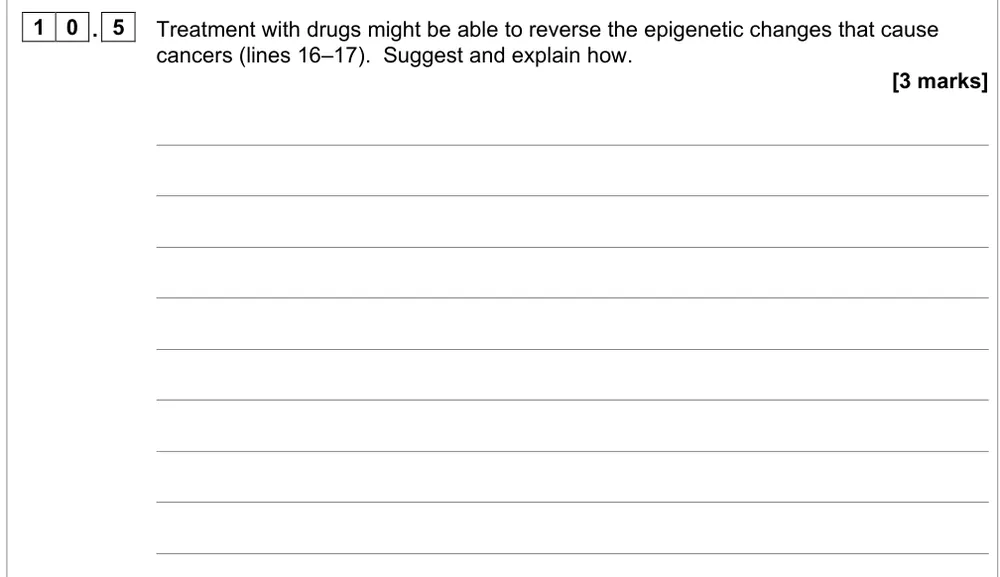
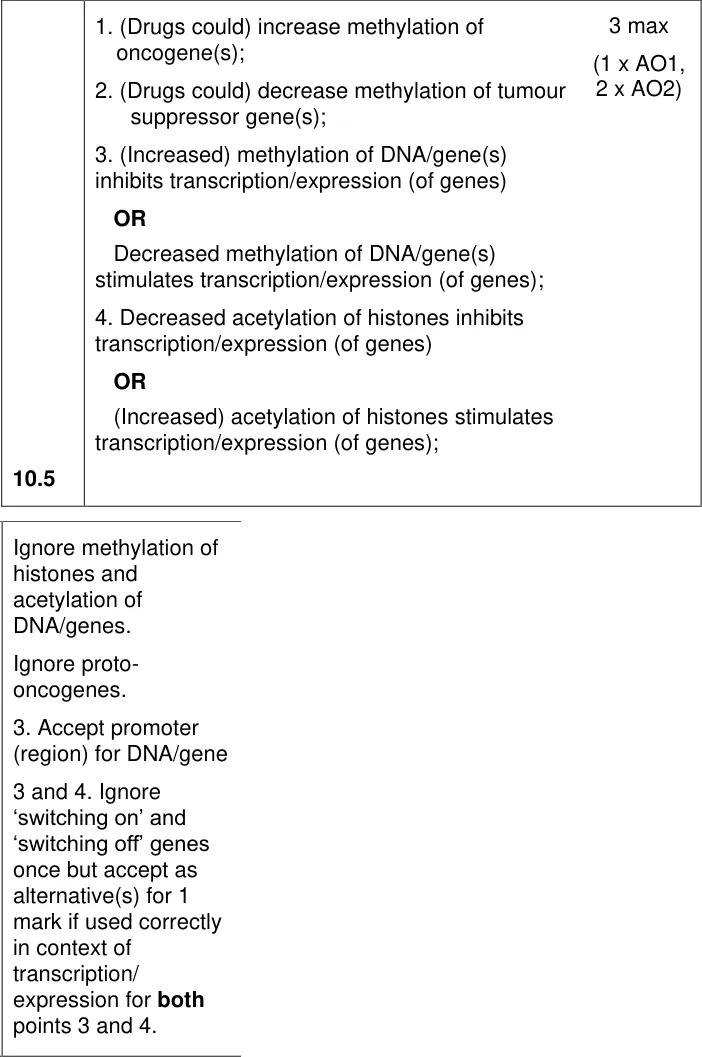
Suggest and explain how drugs might reverse the epigenetic changes that cause cancers.
Information from earlier in this question:
Show the mark scheme
Tap an image to open it full size.
From the examiners' report: Only 5% got all three and 37% scored. Treat the two gene types separately: increase methylation of oncogenes, decrease methylation of tumour suppressor genes, and explain each in terms of transcription.
RNA interference and blocking translation (3.8.2.2)
Question 10
A level Paper 2 · June 2018 · Q08.4 · 1 mark · Hard
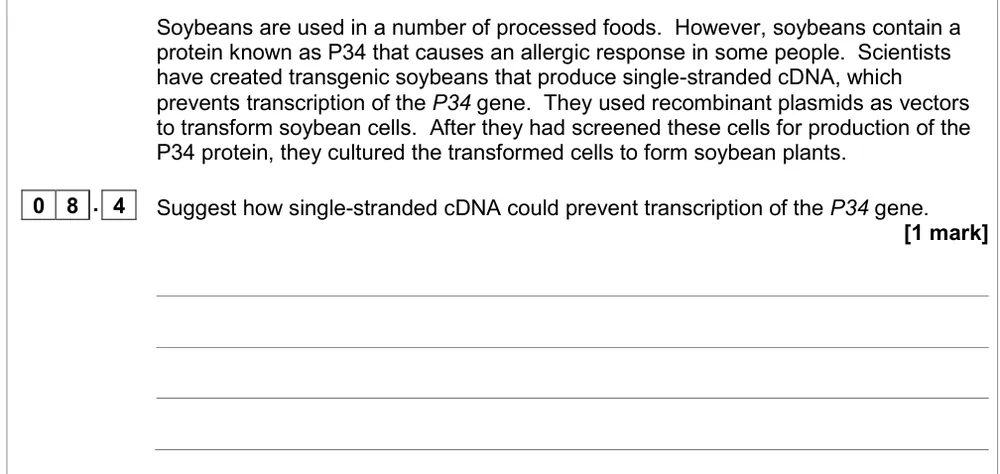
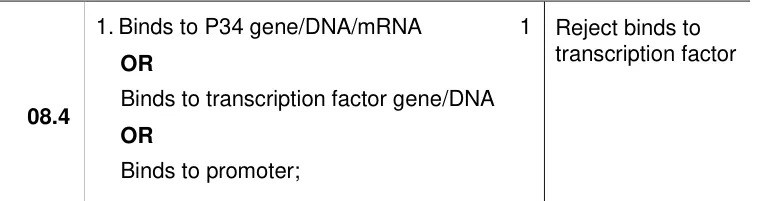
Suggest how single-stranded cDNA could stop the P34 allergy gene being expressed in soybeans.
Show the mark scheme
Tap an image to open it full size.
From the examiners' report: Only 30% got this. Use base pairing: the single strand is complementary, so it binds to the P34 gene or its promoter (or to its mRNA). Saying it stops RNA polymerase binding without saying how didn't score.
Question 11
A level Paper 2 · June 2019 · Q10.3 · 3 marks · Medium
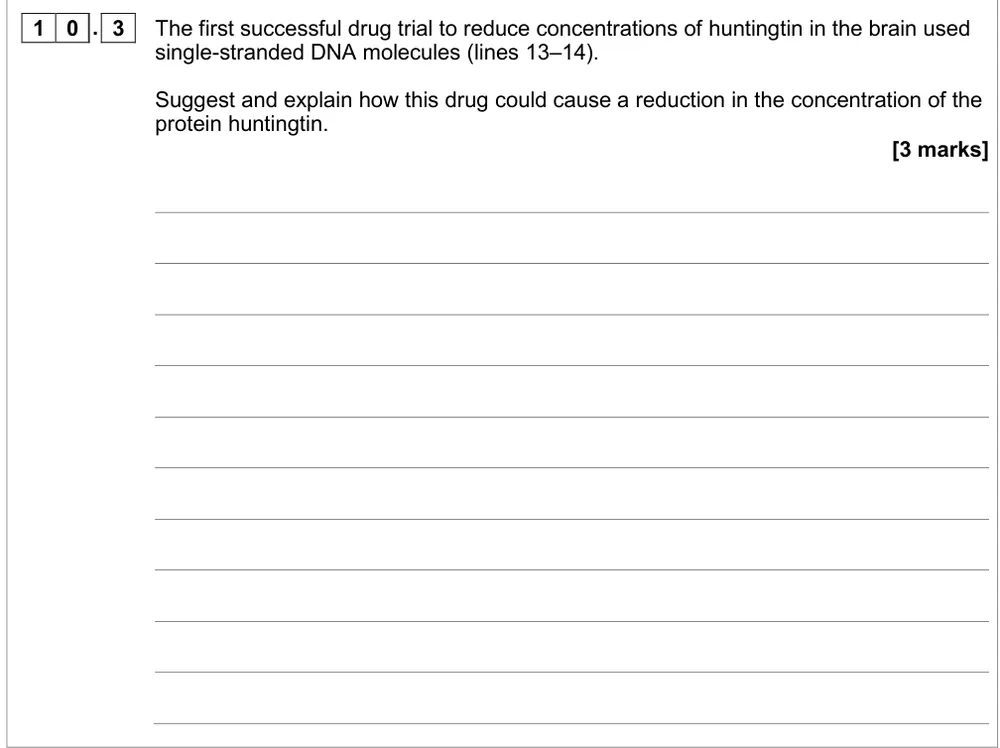
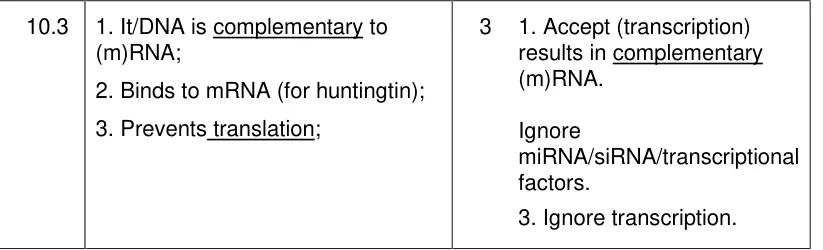
Explain how a drug of single-stranded DNA reduces the concentration of huntingtin.
Information from earlier in this question:
Show the mark scheme
Tap an image to open it full size.
From the examiners' report: About 21% got all three. Many said the mRNA was 'inhibited' without saying how, or had the drug bind to the gene. Say it's complementary, binds to the mRNA, and so stops translation.
Question 12
A level Paper 3 · November 2021 · Q06.2 · 4 marks · Hard
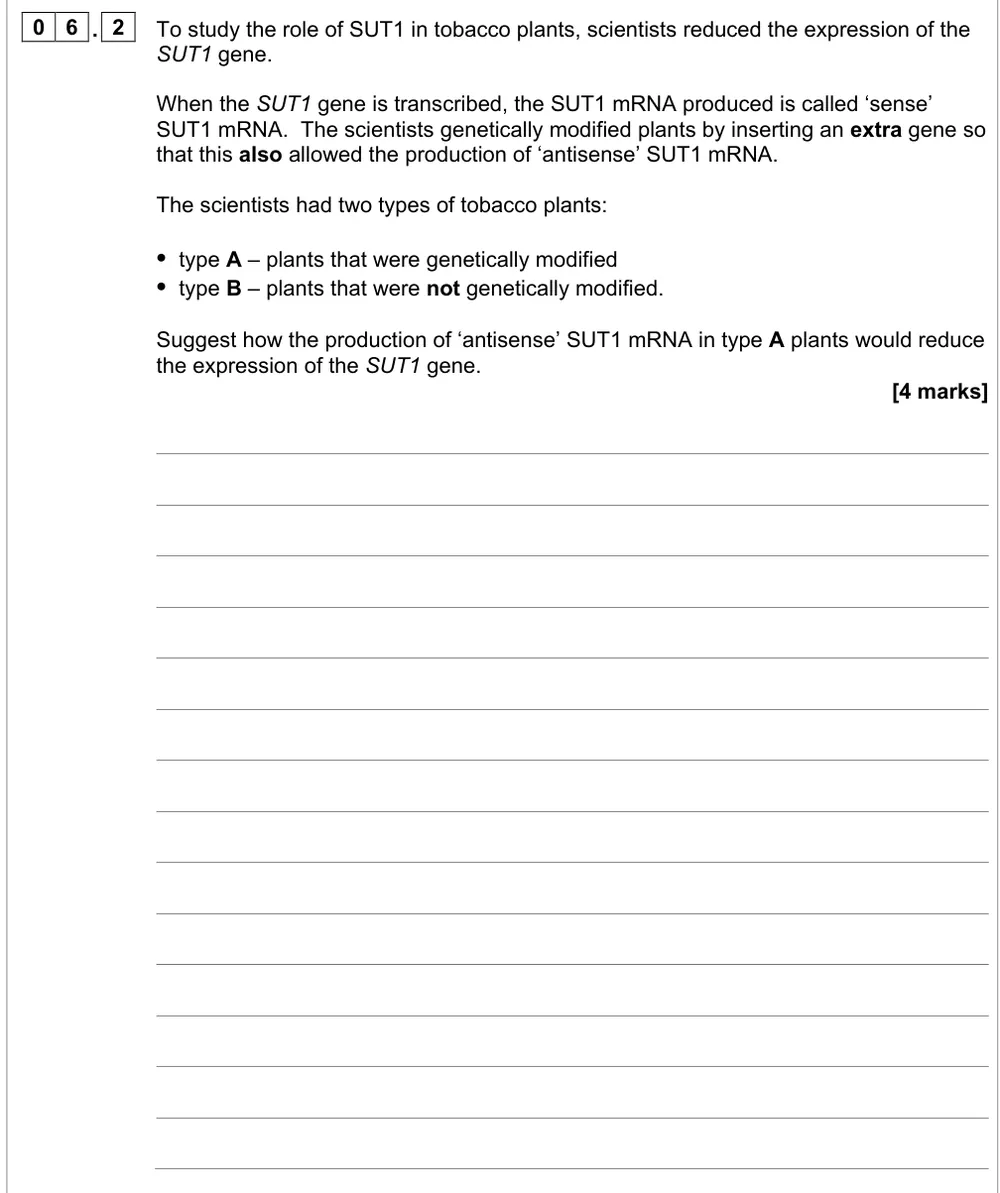
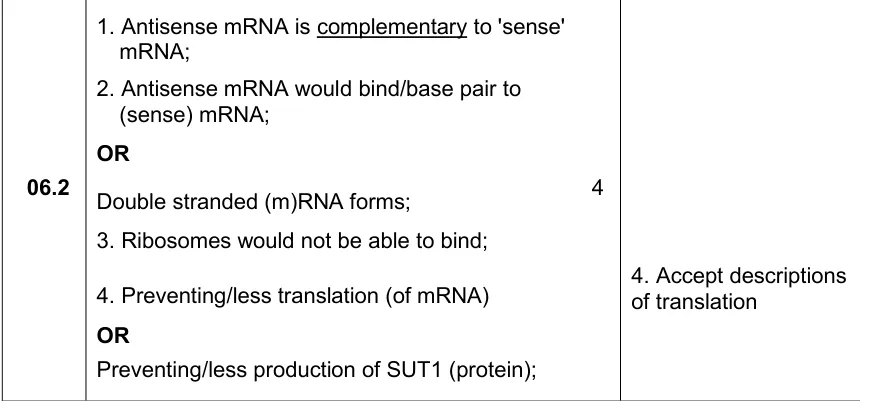
Suggest how antisense SUT1 mRNA reduces expression of the SUT1 gene in tobacco plants.
Information from earlier in this question:

Show the mark scheme
Tap an image to open it full size.
From the examiners' report: Only 2.05% got all four and 56.87% scored zero. The antisense mRNA pairs with the sense mRNA, not the gene, so ribosomes can't bind and SUT1 isn't made. Genes are transcribed; only mRNA is translated.
Question 13
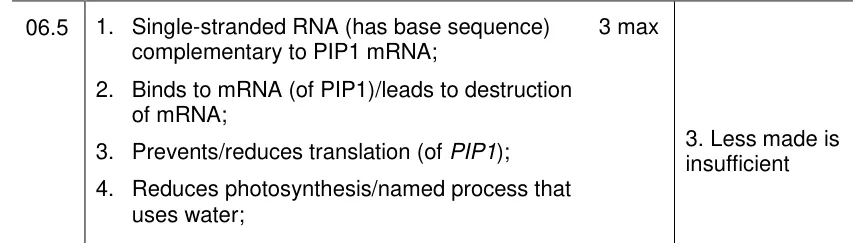
A level Paper 3 · June 2017 · Q06.5 · 3 marks · Hard
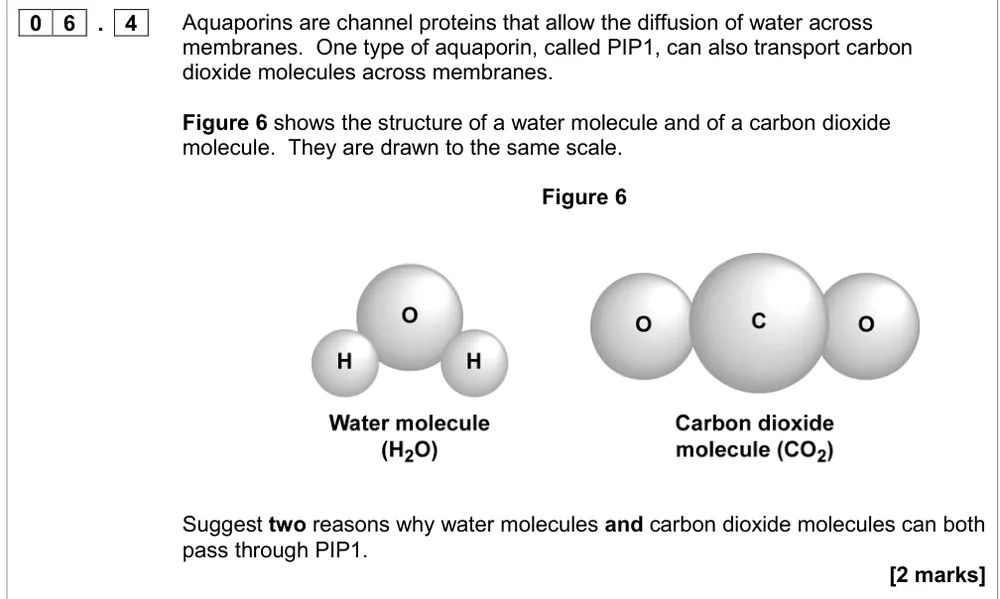
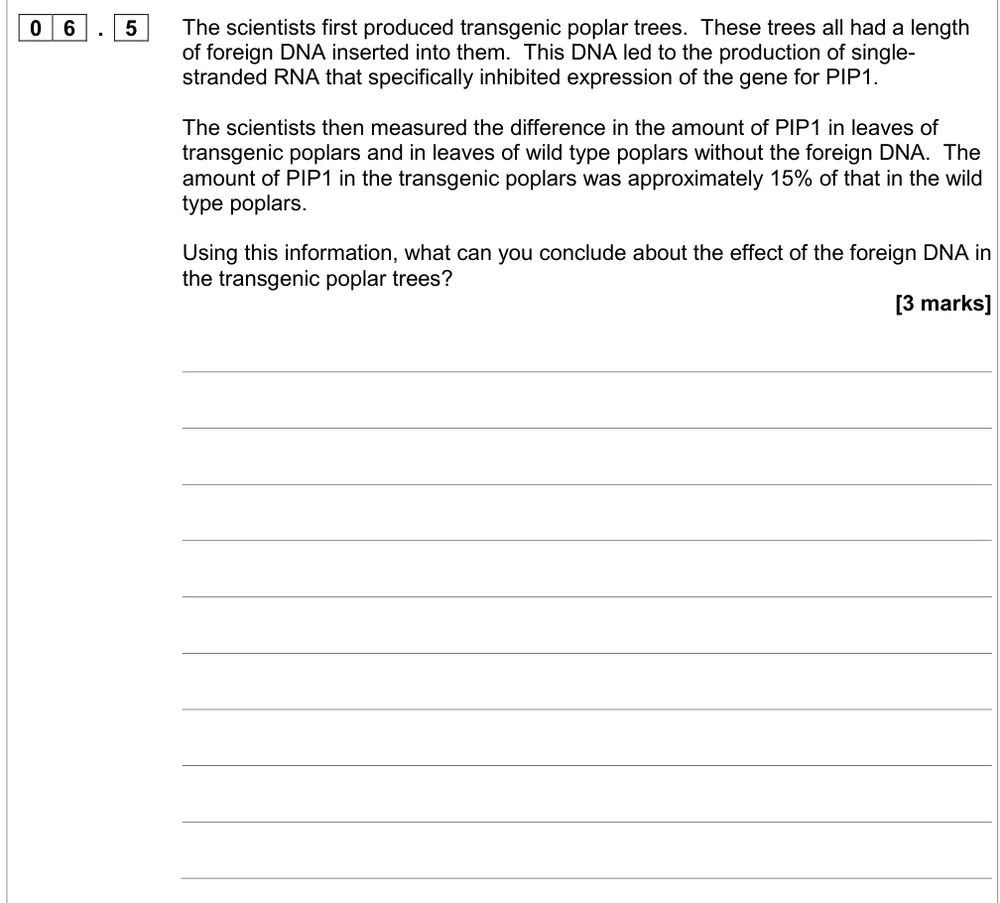
Conclude how foreign DNA making single-stranded RNA cut PIP1 to 15% in transgenic poplars.
Information from earlier in this question:
Show the mark scheme
Tap an image to open it full size.
From the examiners' report: 63% scored zero, often by not linking the single-stranded RNA to the mRNA. Say it's complementary to PIP1 mRNA, binds to it, and stops translation; then link less PIP1 to less water or carbon dioxide for photosynthesis.
Question 14
A level Paper 3 · June 2017 · Q06.6 · 1 mark · Hard
Suggest why the transgenic poplars still made some PIP1.
Show the mark scheme

Tap an image to open it full size.
From the examiners' report: Only 28% got this. Think about numbers: if there's more PIP1 mRNA than interfering RNA, some mRNA is still translated. Not every cell being transformed was also credited.
Question 15
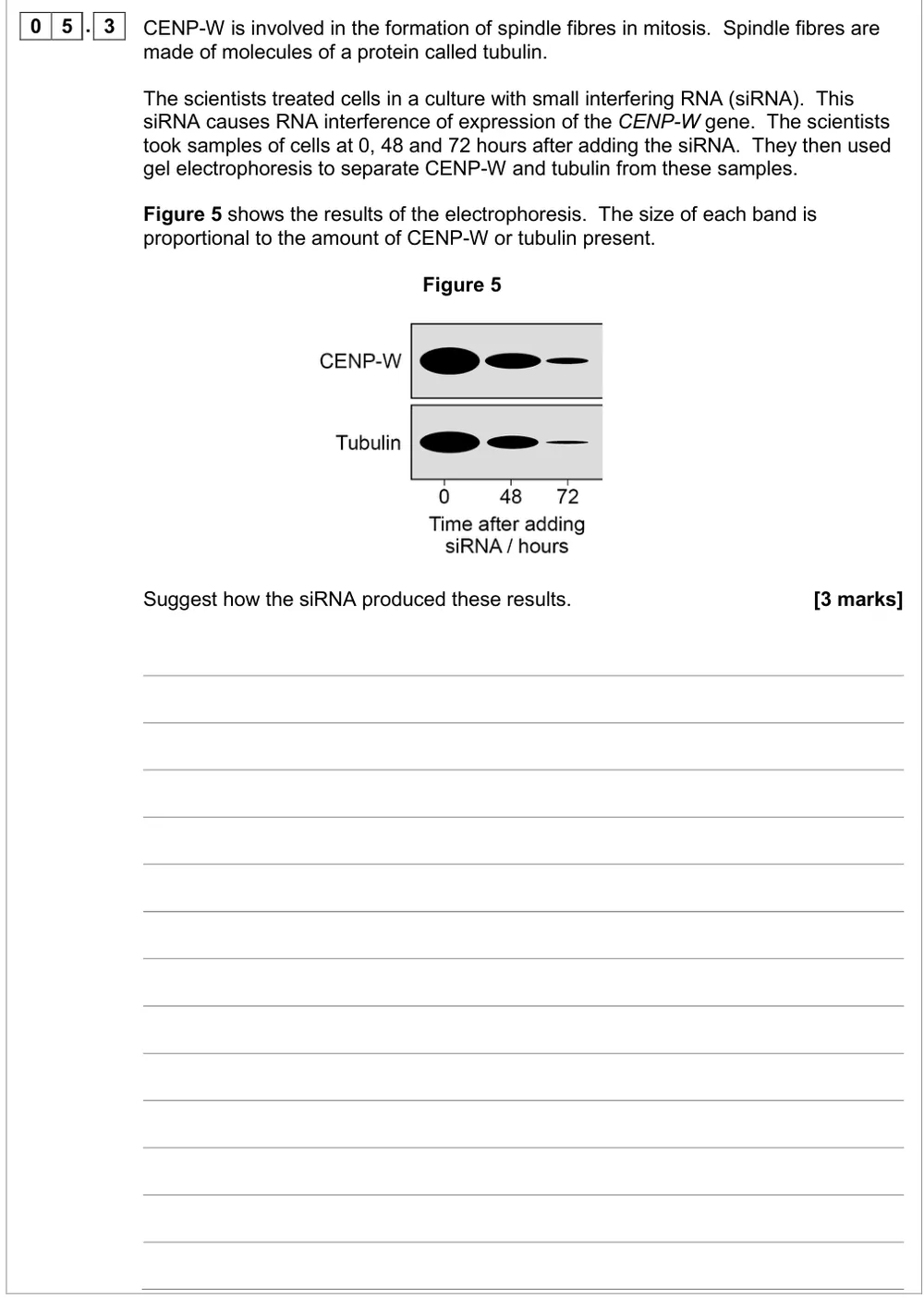
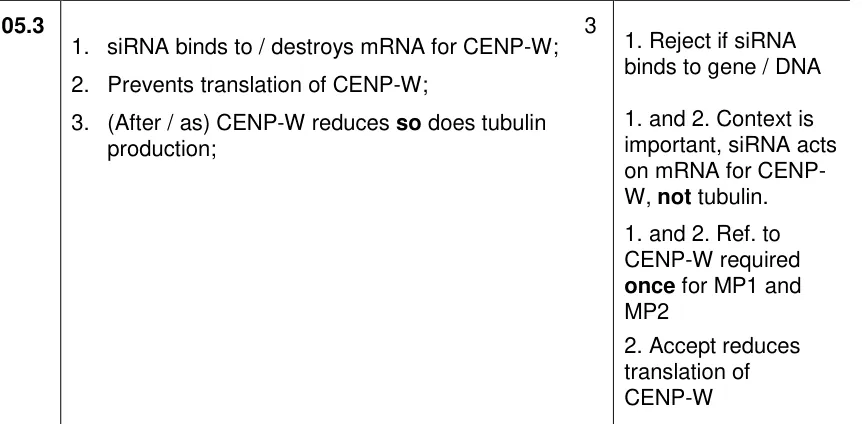
A level Paper 3 · June 2018 · Q05.3 · 3 marks · Hard
Use electrophoresis bands to explain how siRNA reduced CENP-W and tubulin.
Information from earlier in this question:

Show the mark scheme
Tap an image to open it full size.
From the examiners' report: About 17% got all three and 37% scored zero. siRNA binds to the CENP-W mRNA and stops its translation; then link less CENP-W to less tubulin. Saying siRNA stops transcription loses the first mark.
Interpreting gene expression data (3.8.2.2)
Question 16
A level Paper 2 · November 2021 · Q07.3 · 5 marks · Medium
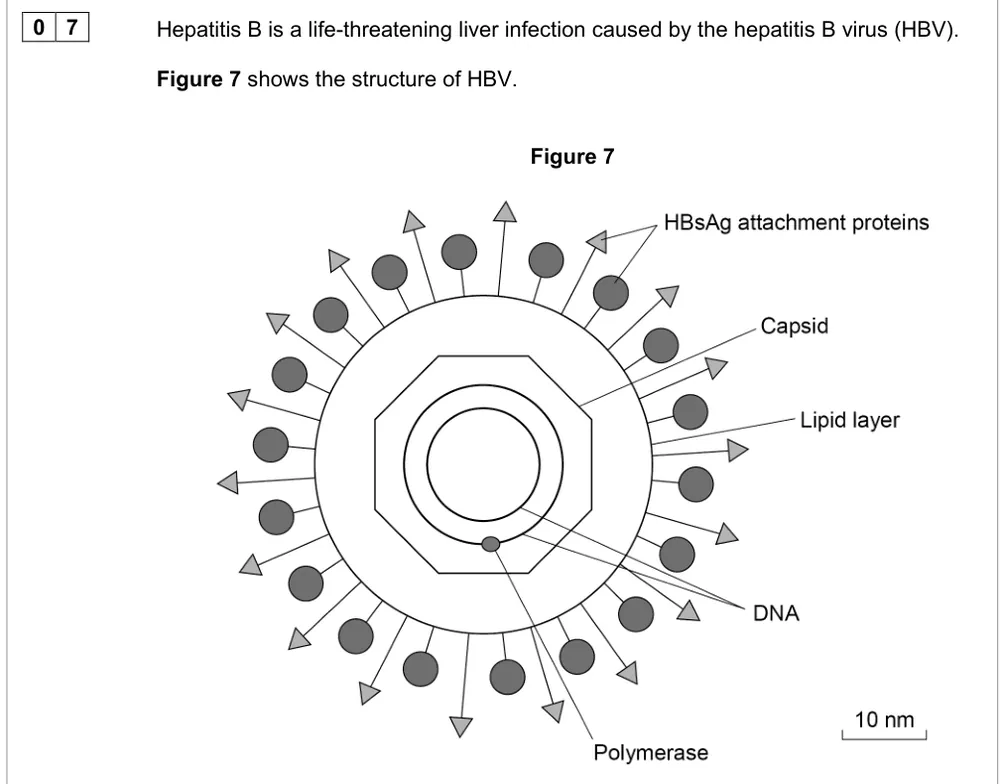
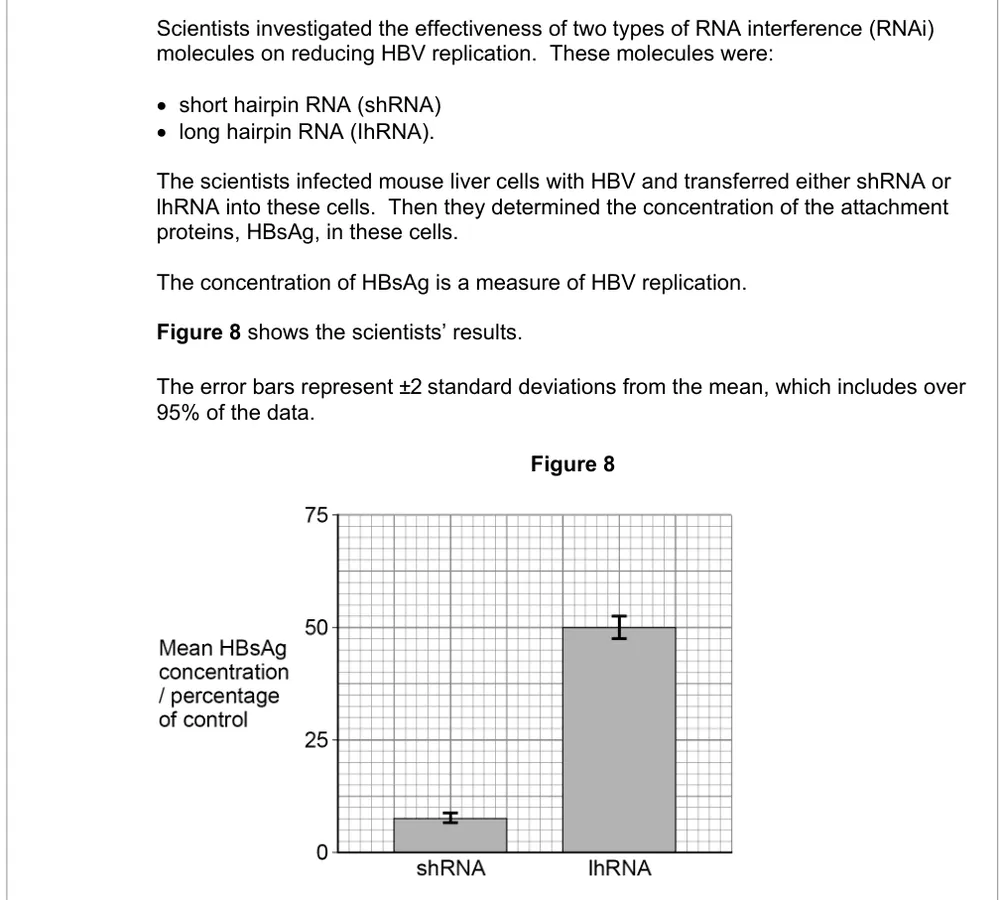
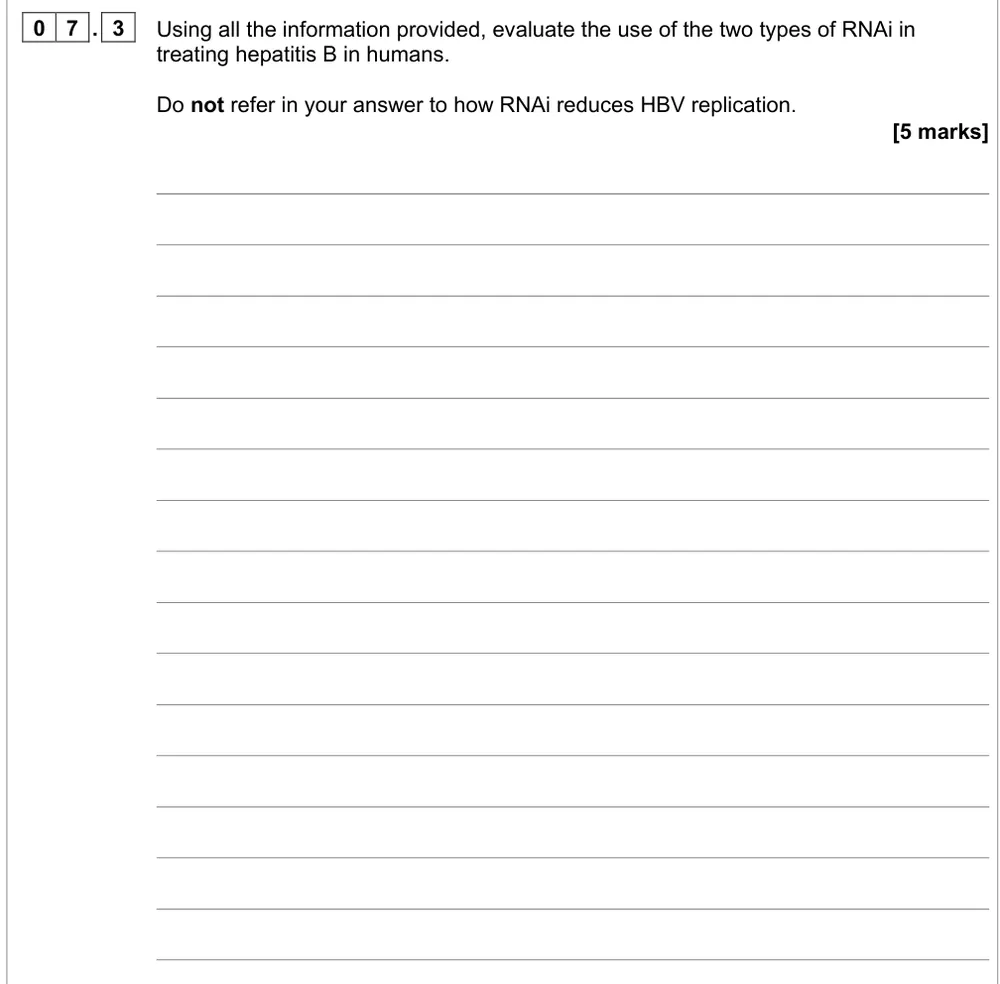
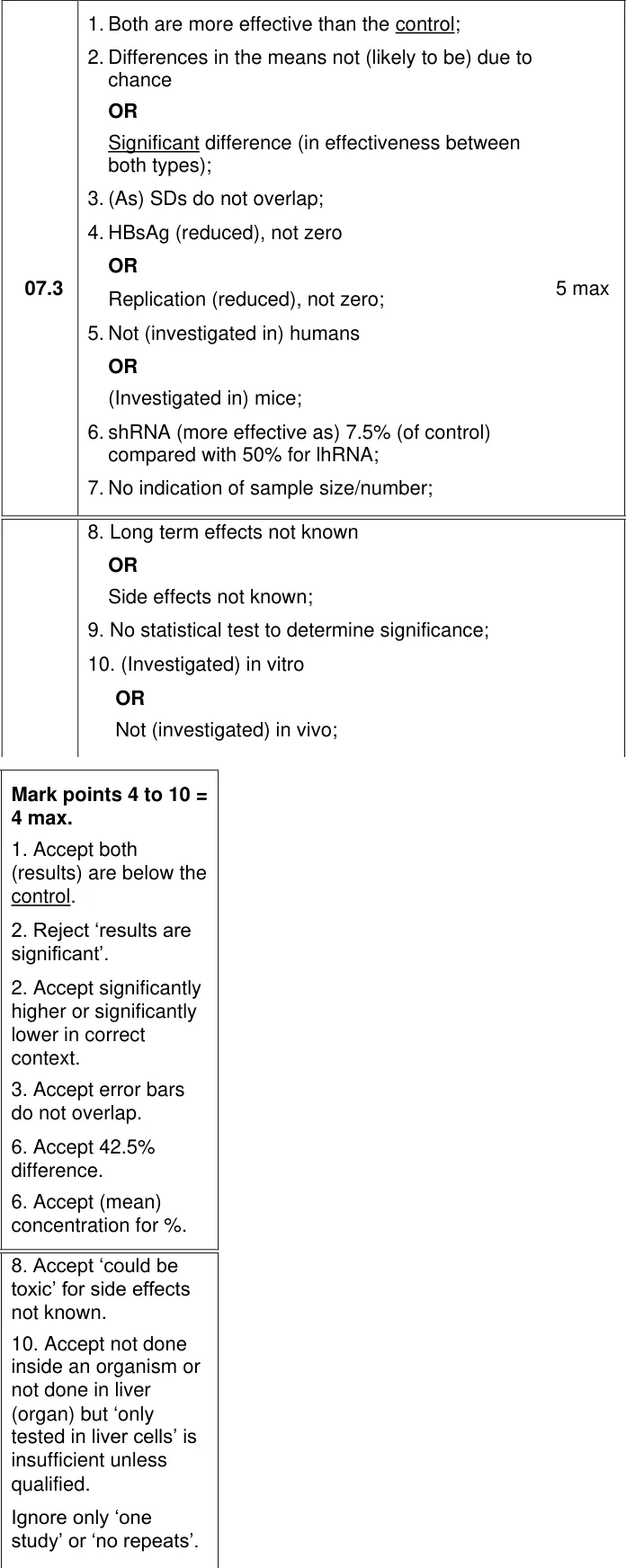
Evaluate the use of shRNA and lhRNA to treat hepatitis B, using a bar chart with error bars.
Information from earlier in this question:
Show the mark scheme
Tap an image to open it full size.
From the examiners' report: About 14% got all five. Being in mice, not humans, was the most common mark; link the non-overlapping SDs to a significant difference, quote the figures, and add side effects, sample size or in vitro.
Question 17
A level Paper 3 · June 2018 · Q06.4 · 2 marks · Medium
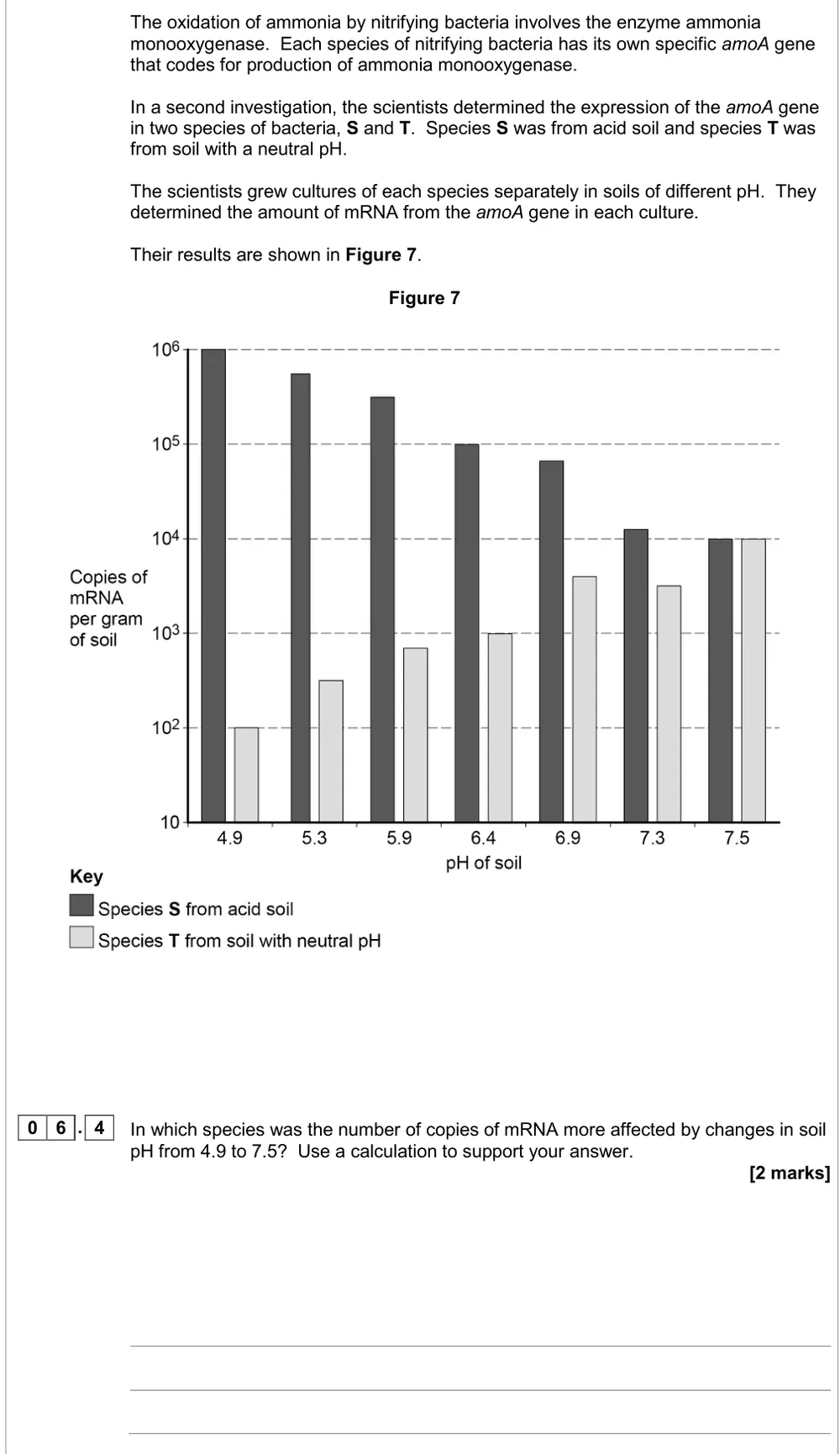
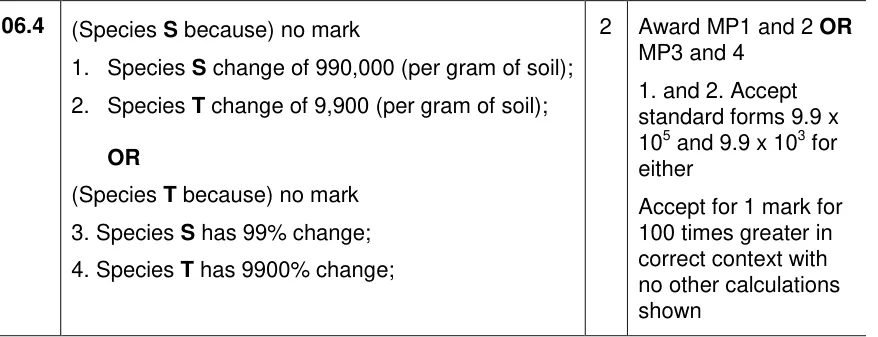
Use a log-scale bar chart to decide which bacterium's amoA mRNA changed more with soil pH.
Show the mark scheme
Tap an image to open it full size.
From the examiners' report: 42% got both. Convert the powers of ten to numbers before subtracting: students who treated 10⁶ and 10⁴ as 6 and 4 said both changed by 2 and scored nothing.
Question 18
A level Paper 3 · June 2018 · Q06.5 · 4 marks · Hard
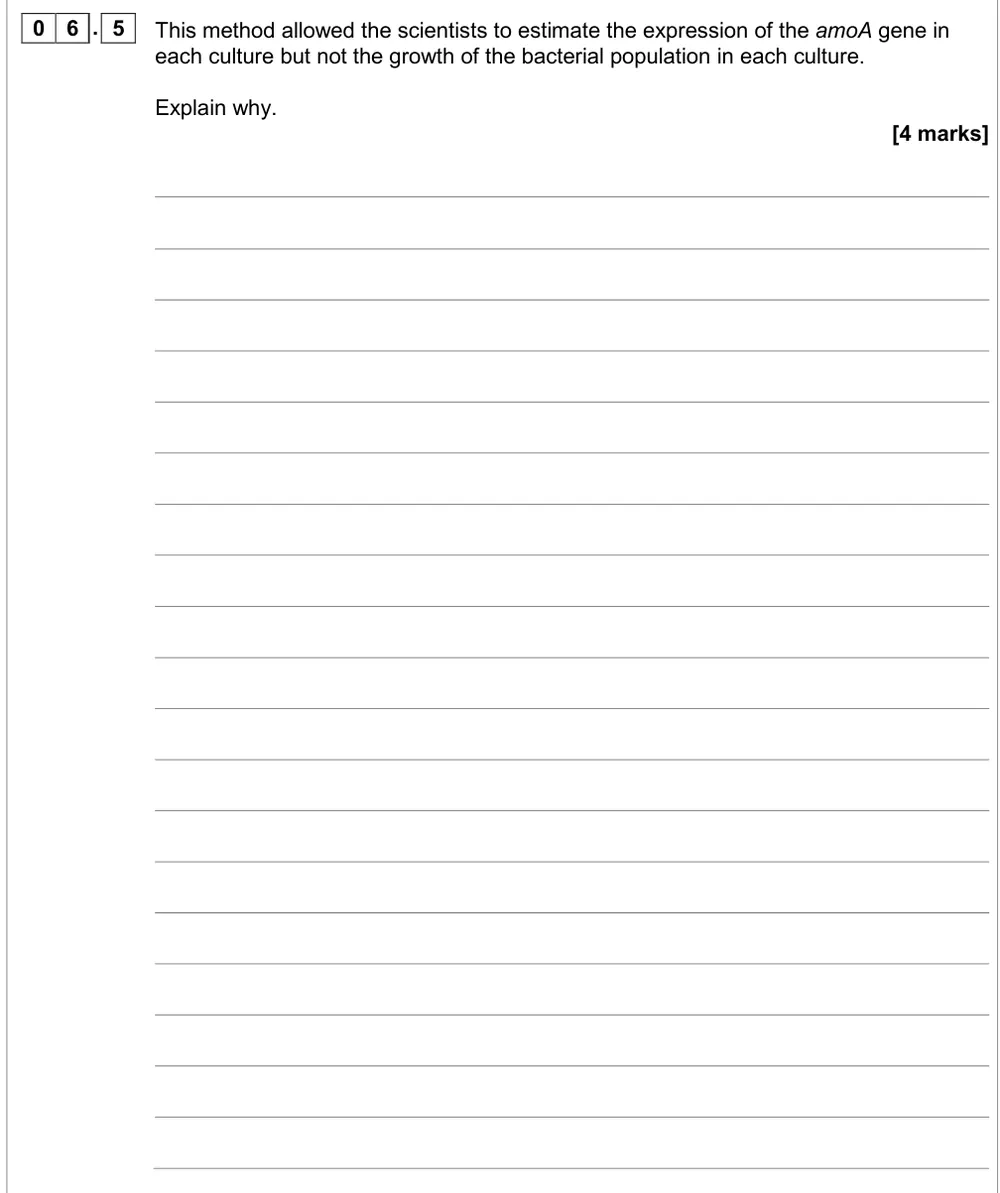
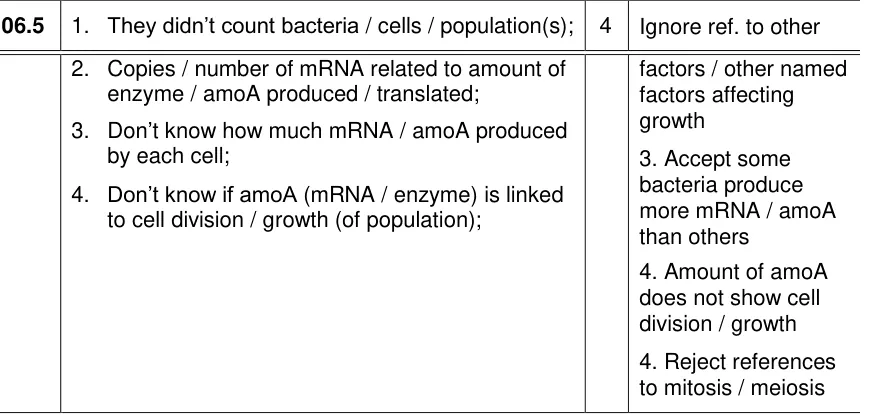
Explain why amoA mRNA copies show gene expression but not population growth.
Show the mark scheme
Tap an image to open it full size.
From the examiners' report: The worst-answered part of the paper; 11% didn't attempt it and few scored more than one. Point out that no cells were counted, and that mRNA per cell can vary, so mRNA copies measure expression, not numbers.
Where students lose marks (from AQA examiners' reports and mark schemes)
Each point below is followed by wording that gained marks.
Name where the transcription factor binds: Only 54% scored on how the androgen receptor stimulates gene expression; DNA polymerase, methylation and histones were common wrong turns. On iPS cells, many stopped at genes being 'switched on' or 'expressed', which isn't enough.
✔ Gains credit: "(AR is) a transcription factor; binds to DNA/promoter; (stimulates) RNA polymerase."
Look beyond the gene itself for lactase persistence: Only 18% got a mark and 5% got both. Students mutated the lactase protein, invented new genes or blamed methylation, instead of a promoter or a transcription factor gene.
✔ Gains credit: "Mutation in promoter (region/DNA) for the gene OR mutation in gene for transcription factor; lactase gene continues to be transcribed."
Say what is methylated and the effect on transcription: On Huntington's disease only 16% got both marks. Many left out DNA or the gene when describing methylation, left out 'increased' or 'decreased', or methylated histones and acetylated DNA, which are both ignored or rejected.
✔ Gains credit: "(Increased) methylation of DNA/gene/allele; inhibits/prevents transcription" or "Increased acetylation of histone(s); stimulates/allows transcription."
Oncogenes and tumour suppressors need opposite changes: Only 5% got all three marks for how drugs might reverse epigenetic cancers. Oncogenes were rarely mentioned and were often confused with proto-oncogenes, and some said epigenetic changes cause mutations.
✔ Gains credit: "(Drugs could) increase methylation of oncogene(s); (drugs could) decrease methylation of tumour suppressor gene(s)."
siRNA acts on the mRNA, not the DNA: 37% scored zero on how siRNA reduced CENP-W. Many thought siRNA binds to the gene and prevents transcription; the mark scheme rejects that and wants CENP-W named.
✔ Gains credit: "siRNA binds to/destroys mRNA for CENP-W; prevents translation of CENP-W; (as) CENP-W reduces so does tubulin production."
Genes are transcribed; mRNA is translated: 56.87% scored zero on antisense SUT1 mRNA and only 2.05% got all four. The ER calls 'translation of the SUT1 gene is prevented' a fundamental mistake, and many had the antisense mRNA binding to the gene.
✔ Gains credit: "Antisense mRNA is complementary to 'sense' mRNA; would bind to (sense) mRNA; ribosomes would not be able to bind; preventing translation."
Treat a log axis as powers of ten: On the amoA bar chart 42% got both marks. Students who read only the powers said both species fell by 2 and scored nothing.
✔ Gains credit: "Species S change of 990,000 (per gram of soil); species T change of 9,900" (or 99% compared with 9900%).
mRNA copies don't count the cells: This was the worst-answered part of the paper and 11% didn't attempt it. Few saw that the bacteria were never counted, so the method only shows how much amoA is being made.
✔ Gains credit: "They didn't count bacteria/cells; don't know how much mRNA/amoA produced by each cell; don't know if amoA is linked to cell division/growth."
Download the questions
Download the PDF pack (18 questions, mark schemes at the end)
Keep practising
- Mutations and stem cells: AQA A Level Biology exam questions by topic
- Gene expression and cancer: AQA A Level Biology exam questions by topic
- DNA and protein synthesis: AQA A Level Biology exam questions by topic
- AQA 3.8.1 and 3.8.2 gene expression: self-marking quiz
- AQA A Level Biology masterclasses
Questions, mark schemes and examiners' report extracts © AQA.