

OCR A PAG 11 · 8 questions · mark schemes and examiners’ tips included
PAG 11 is about measuring how living things respond. In class you will probably have grown seedlings in the dark or with light from one side, soaked seeds in different concentrations of auxin or gibberellin, or measured your own pulse before and after exercise.
Most of the marks on PAG 11 questions are for experimental design rather than recall. You need to say why each condition is set up the way it is, tell a control experiment apart from a control variable, measure the response precisely (the length of the stem, or the angle of a bend), and choose a statistical test that fits the data. Half of these questions are 6-mark extended responses, so practise writing a structured method and an evaluation that looks at both sides.
Work through the eight questions below in order. They start with setting up tropism and hormone experiments, move on to evaluating seedling investigations and gibberellin data, and finish with heart rate. If you'd like to go through questions like these with me each week, my OCR A masterclasses run on Wednesdays at 5.15pm for Year 12 and on Tuesdays at 6.30pm or Thursdays at 5.15pm for Year 13.
What these questions cover (OCR PAG 11: plant and animal responses)
PAG 11 is one of the twelve practical activity groups in the OCR A Level Biology A specification (H420). The questions test these parts of the specification:
- 1.2.2(h)(i) plant or animal responses
- 5.1.5(a)(ii) practical investigations into phototropism and geotropism
- 5.1.5(e) practical investigations into the effect of plant hormones on growth
- 5.1.5(d) the experimental evidence for the role of gibberellin in the control of stem elongation and seed germination (to include the effects of gibberellin concentration on stem elongation)
- 5.1.5(k) the effects of hormones and nervous mechanisms on heart rate (for example pulse rate before, during and after exercise)
How to use this page
Write your answer on paper before you open the mark scheme. Allow about 1.2 minutes per mark: the 8 questions are worth 35 marks, so about 42 minutes in total. Then mark your answer strictly against the mark scheme and read the examiners' tip underneath it. If you'd rather print the questions, download the PDF pack.
Setting up tropism and hormone experiments
Question 1
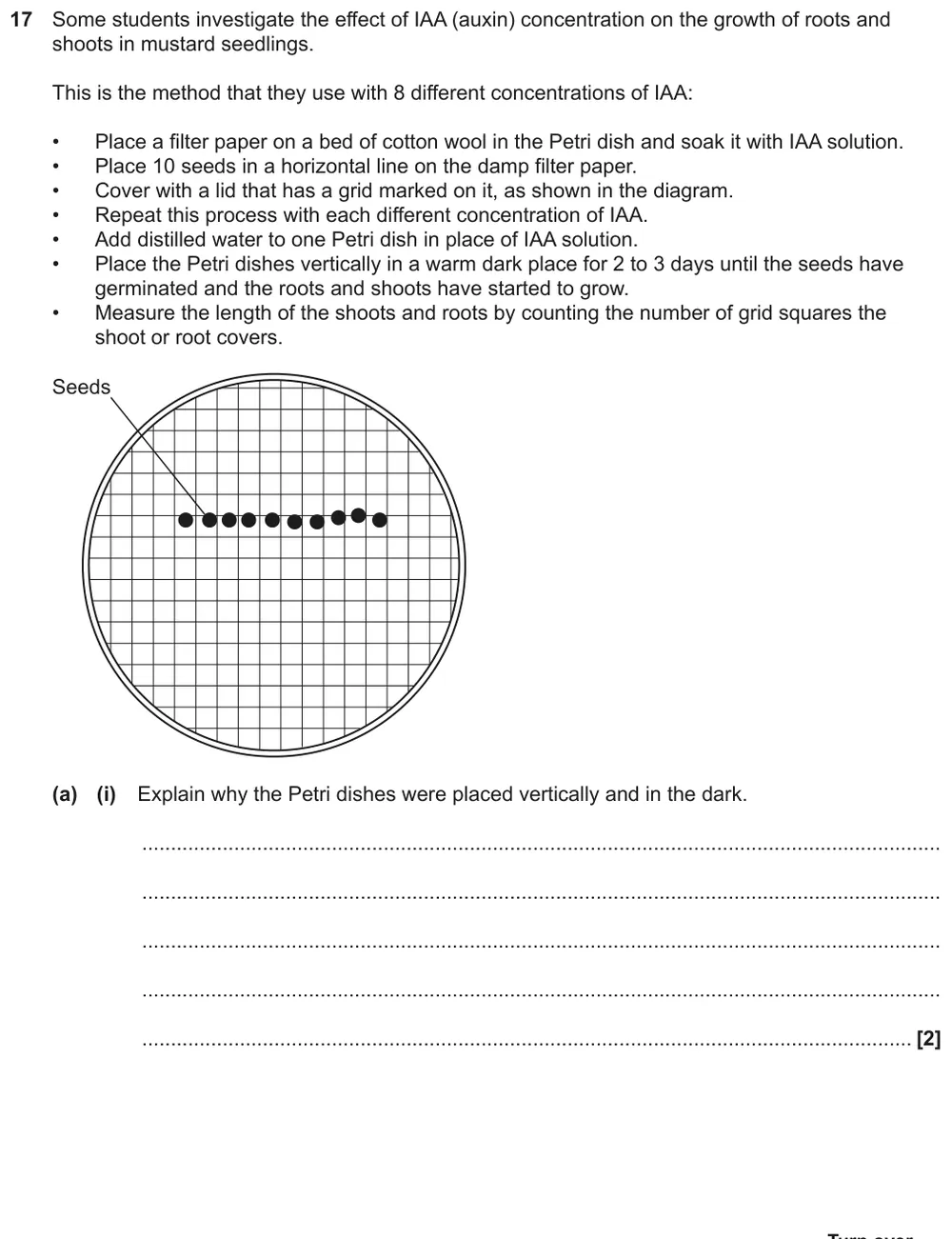
A level Paper 1 · June 2023 · Q17(a)(i) · 2 marks · Easy
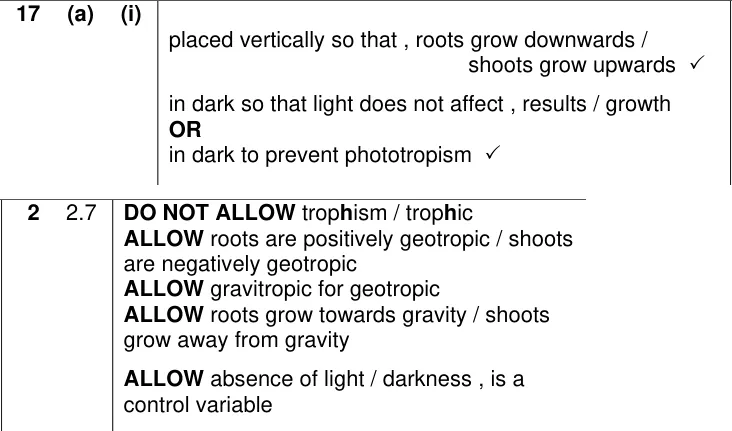
Explain why Petri dishes of germinating mustard seeds were placed vertically and in the dark.
Show the mark scheme
Tap an image to open it full size.
From the examiners' report: Most students linked the dark to preventing phototropism, but fewer explained the vertical dish: roots grow down and shoots grow up, which makes them easy to measure. When a question gives two conditions, deal with each one clearly.
Question 2
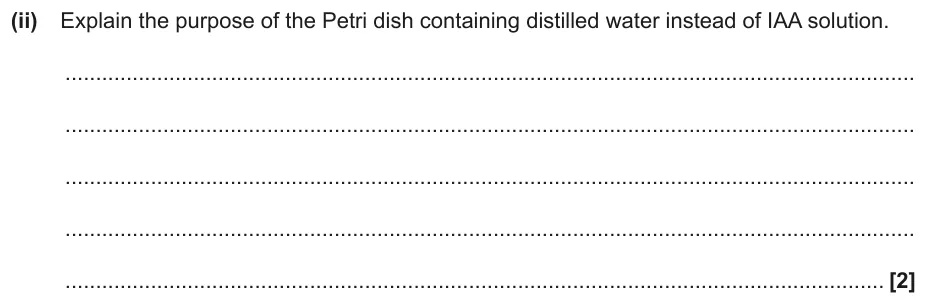
A level Paper 1 · June 2023 · Q17(a)(ii) · 2 marks · Easy
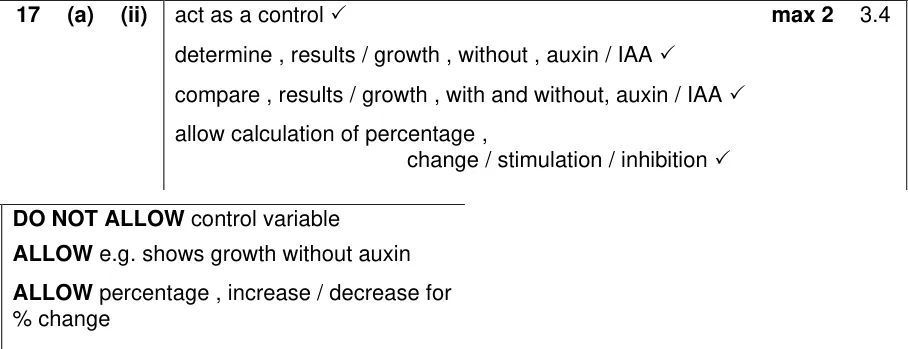
Explain the purpose of the Petri dish with distilled water instead of IAA solution.
Show the mark scheme
Tap an image to open it full size.
From the examiners' report: Most students called it a control experiment, but few earned the second mark by saying it lets you compare growth with and without IAA. Don't call it a control 'variable': that's something you keep the same.
Question 3
A level Paper 3 · November 2020 · Q3(c)(ii) · 1 mark · Medium
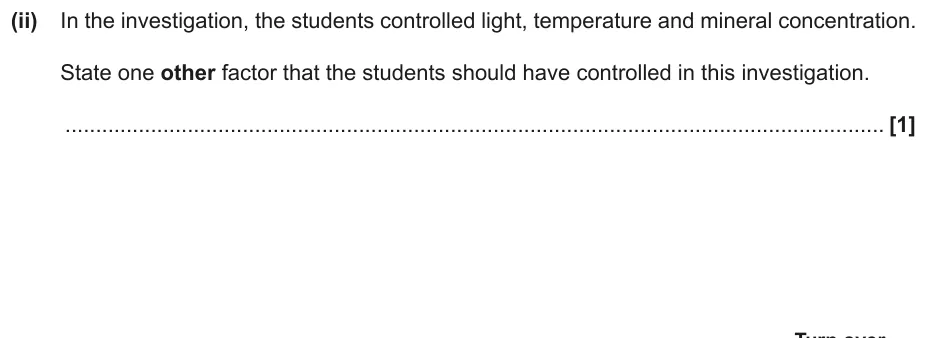
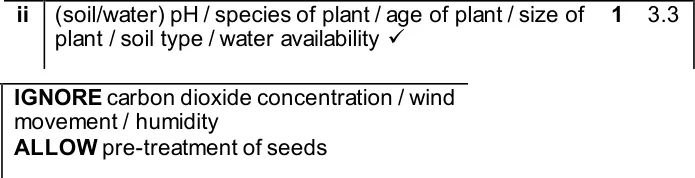
State one more factor to control in an investigation of plant hormone concentration and root growth.
Information from earlier in this question:

Show the mark scheme
Tap an image to open it full size.
From the examiners' report: The examiners' report doesn't comment on this part. Choose a factor that affects root growth in this set-up, such as pH, the plant species or its age; carbon dioxide concentration, wind and humidity weren't credited.
Evaluating seedling investigations
Question 4
A level Paper 3 · November 2020 · Q3(a)(i) · 6 marks · Medium
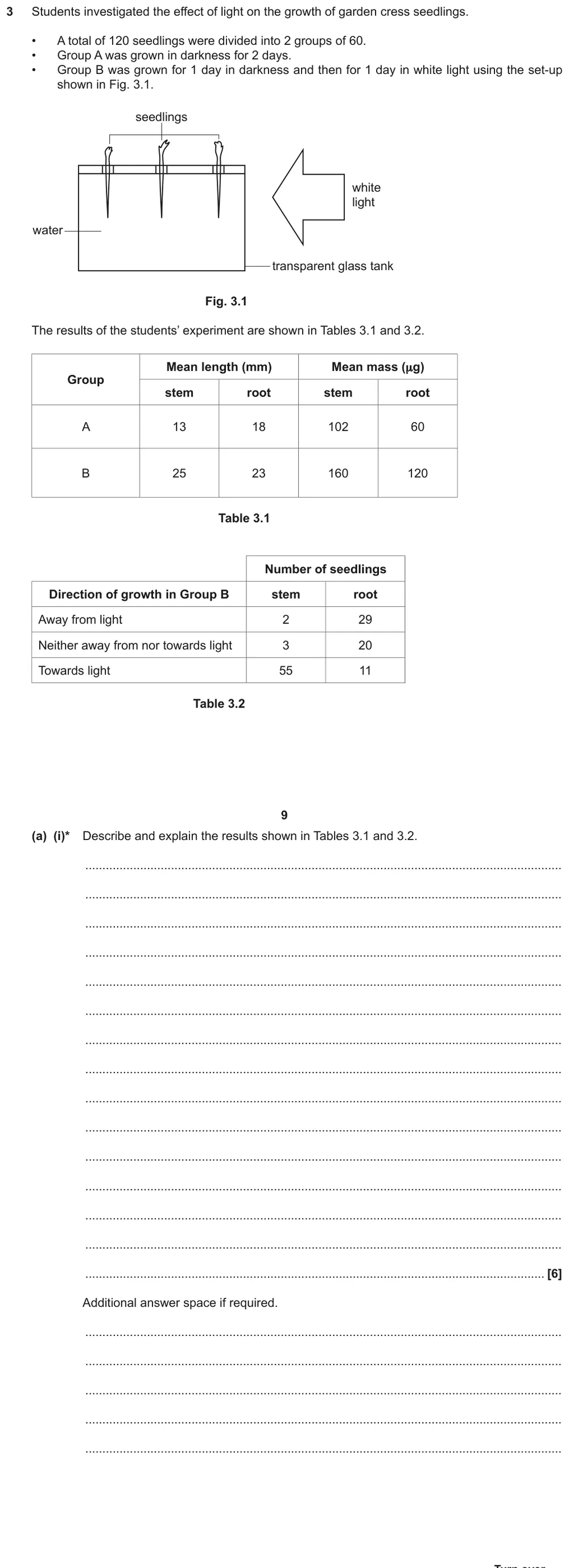
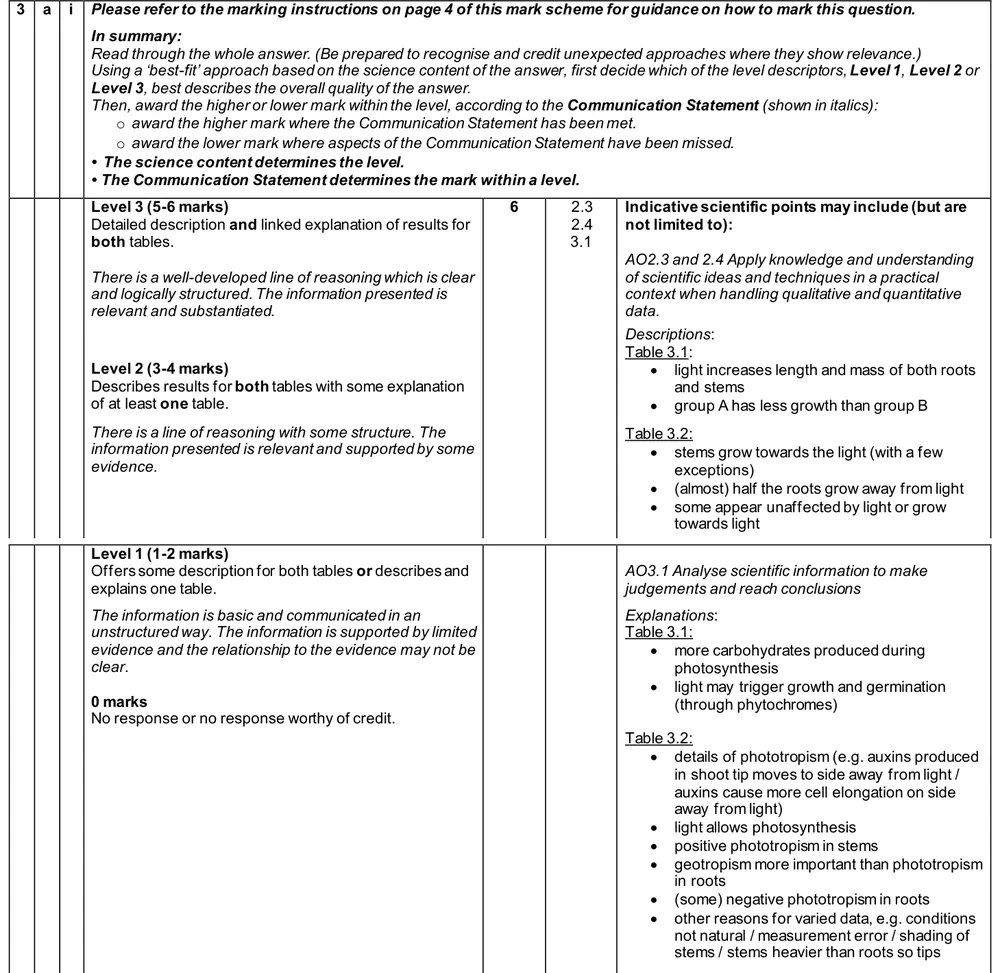
Describe and explain the length, mass and direction of growth of cress seedlings grown in darkness or white light.
Show the mark scheme
Tap an image to open it full size.
From the examiners' report: The examiners' report doesn't comment on this part. To reach Level 3 the mark scheme wants a description of both tables, using the figures, and an explanation linked to each, such as stems growing towards light because auxin builds up on the shaded side.
Question 5
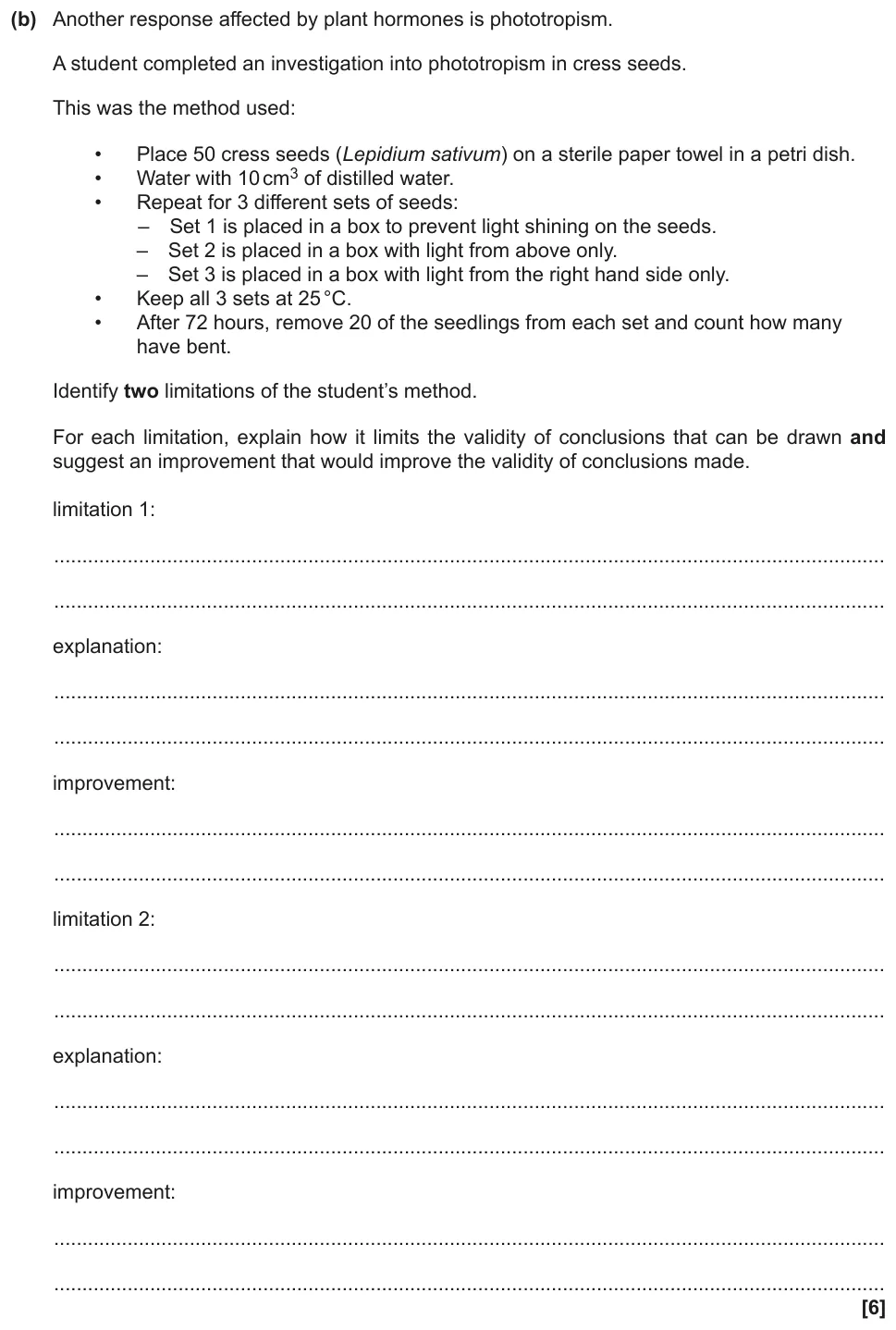
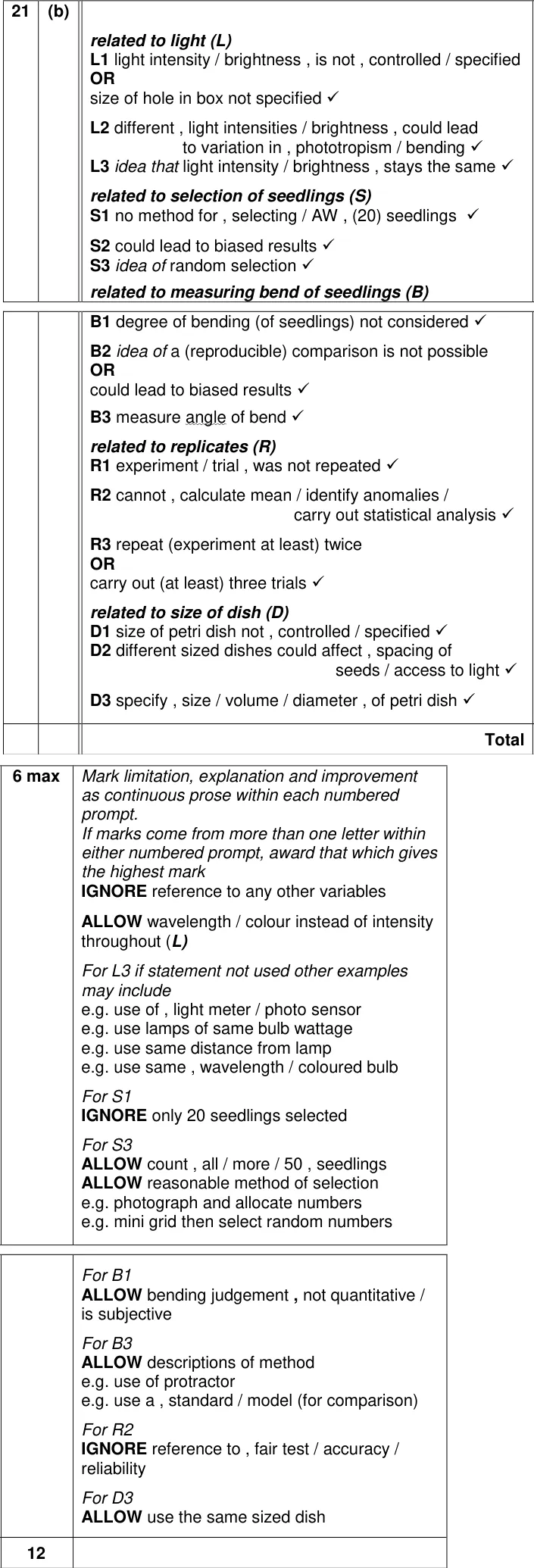
A level Paper 1 · June 2017 · Q21(b) · 6 marks · Medium
Identify two limitations of a cress phototropism method, explain each and suggest an improvement.
Show the mark scheme
Tap an image to open it full size.
From the examiners' report: There's no examiners' comment for this part. The mark scheme gives a mark each for the limitation, why it limits validity and the improvement, so link all three for each point, for example light intensity isn't controlled, so bending could vary, so put each lamp at the same distance.
Gibberellin and stem growth
Question 6
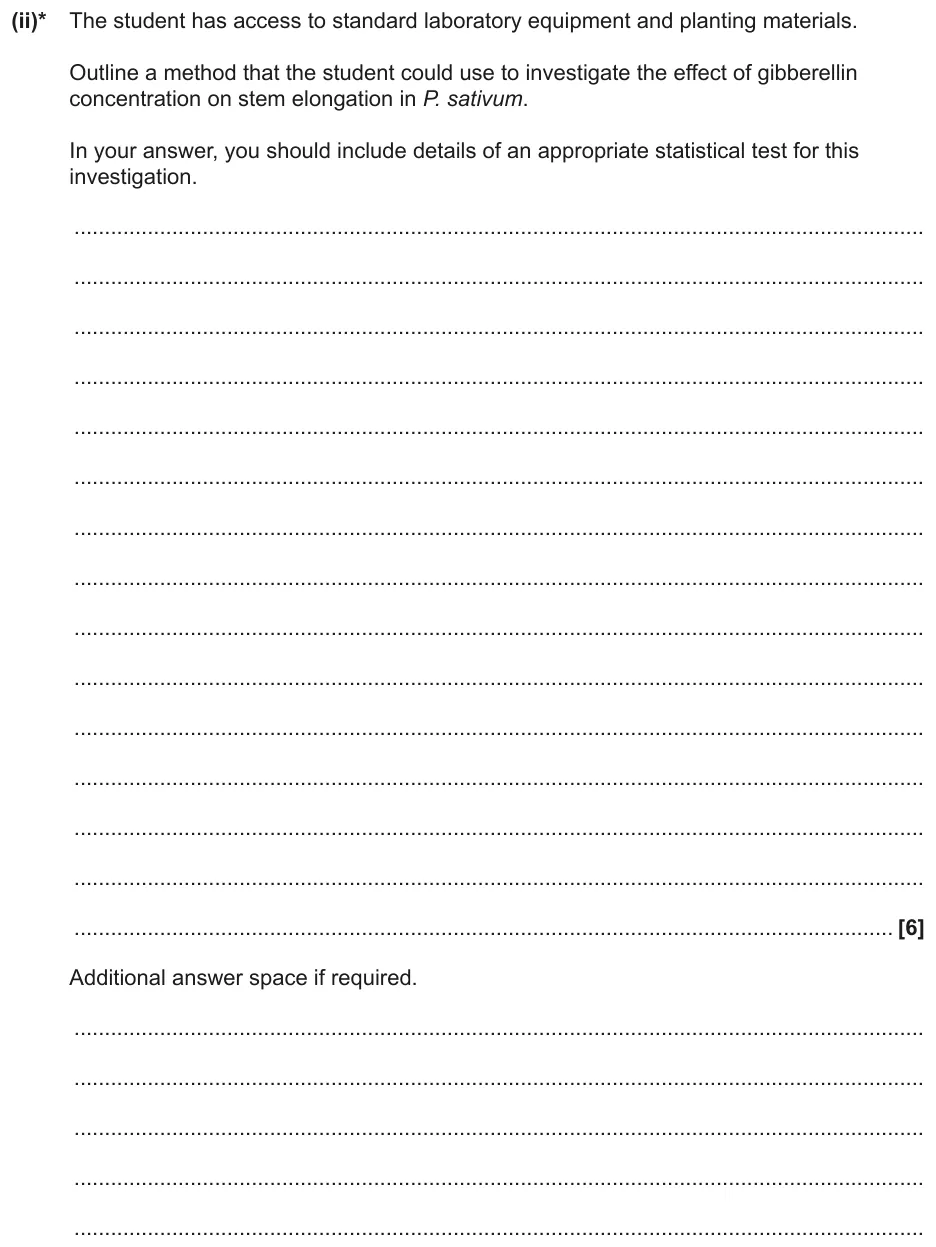
A level Paper 3 · June 2022 · Q3(c)(ii) · 6 marks · Easy
Outline a method to investigate the effect of gibberellin concentration on pea stem elongation, with a suitable statistical test.
Information from earlier in this question:

Show the mark scheme

Tap an image to open it full size.
From the examiners' report: Many students lost marks by writing 'measure growth' instead of measuring the length of the stem. The t-test was the most common choice, but it doesn't suit a range of gibberellin concentrations; a correlation test such as Spearman's rank does. Include a control group with no gibberellin and a sensible sample size.
Question 7
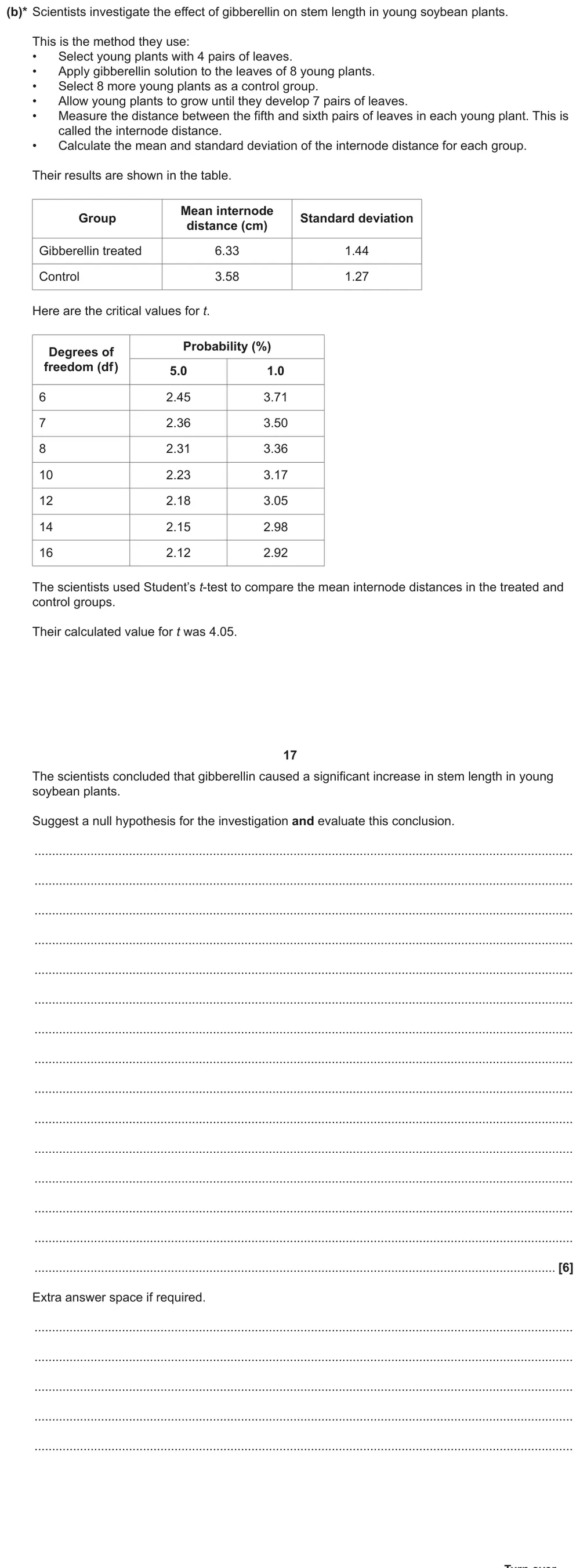
A level Paper 1 · June 2025 · Q18(b) · 6 marks · Hard
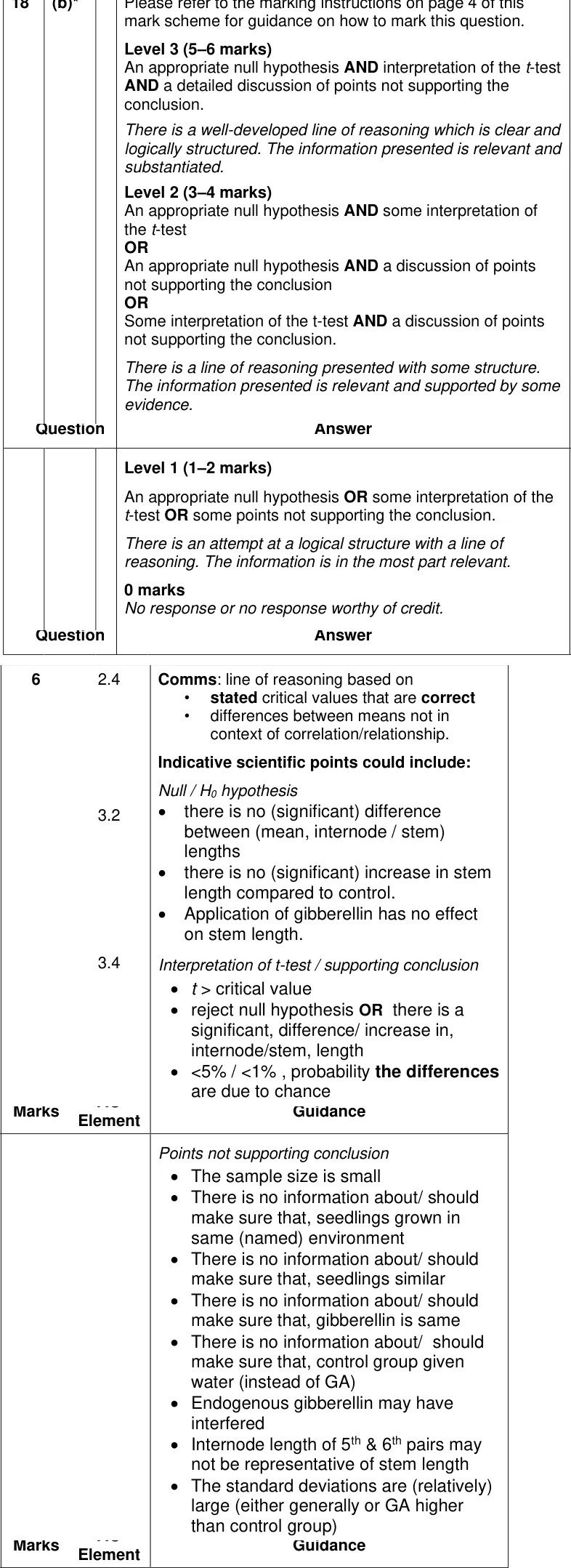
Suggest a null hypothesis for a soybean gibberellin study and evaluate the conclusion using the t-test result.
Show the mark scheme
Tap an image to open it full size.
From the examiners' report: Most students gave a null hypothesis and rejected it, but few worked out the degrees of freedom: for an unpaired t-test it is the total sample size minus two, (8 + 8) − 2 = 14. Very few noticed the control should be treated the same way, sprayed with the same solution minus the gibberellin.
Heart rate responses
Question 8
A level Paper 3 · June 2017 · Q6 · 6 marks · Medium
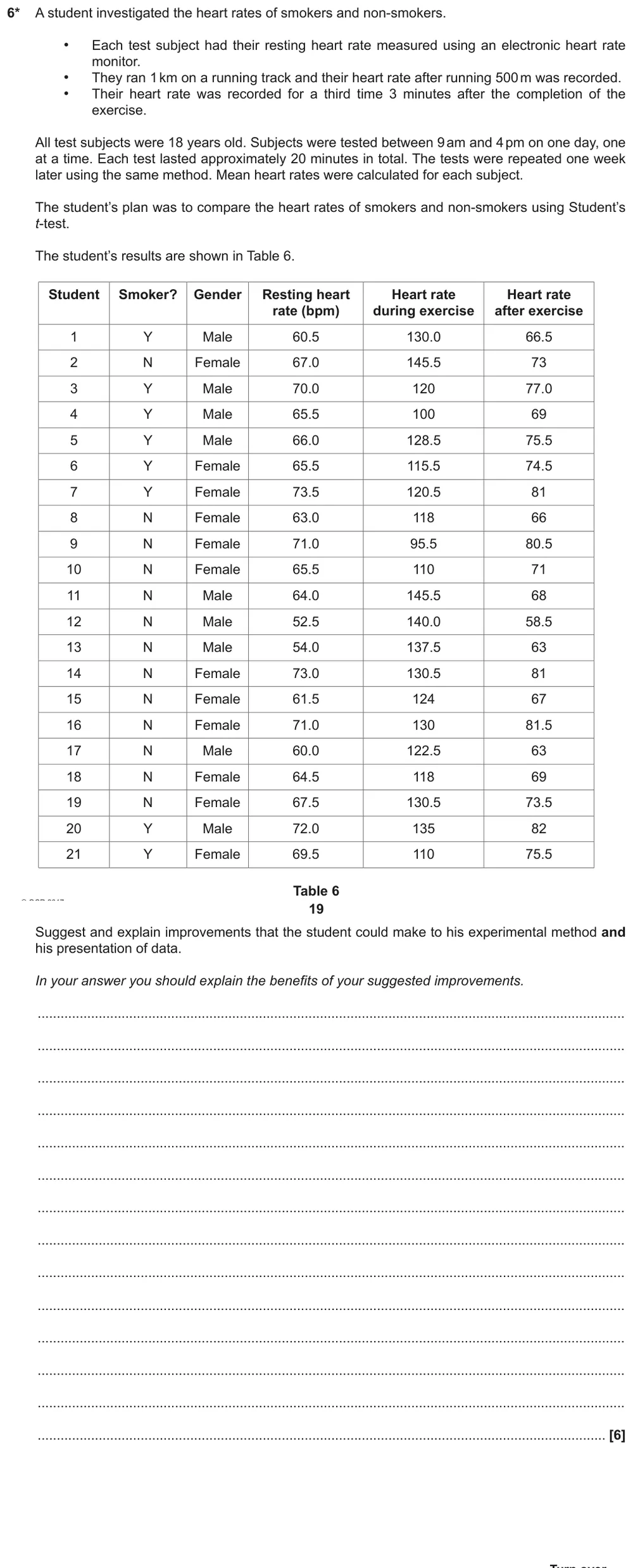
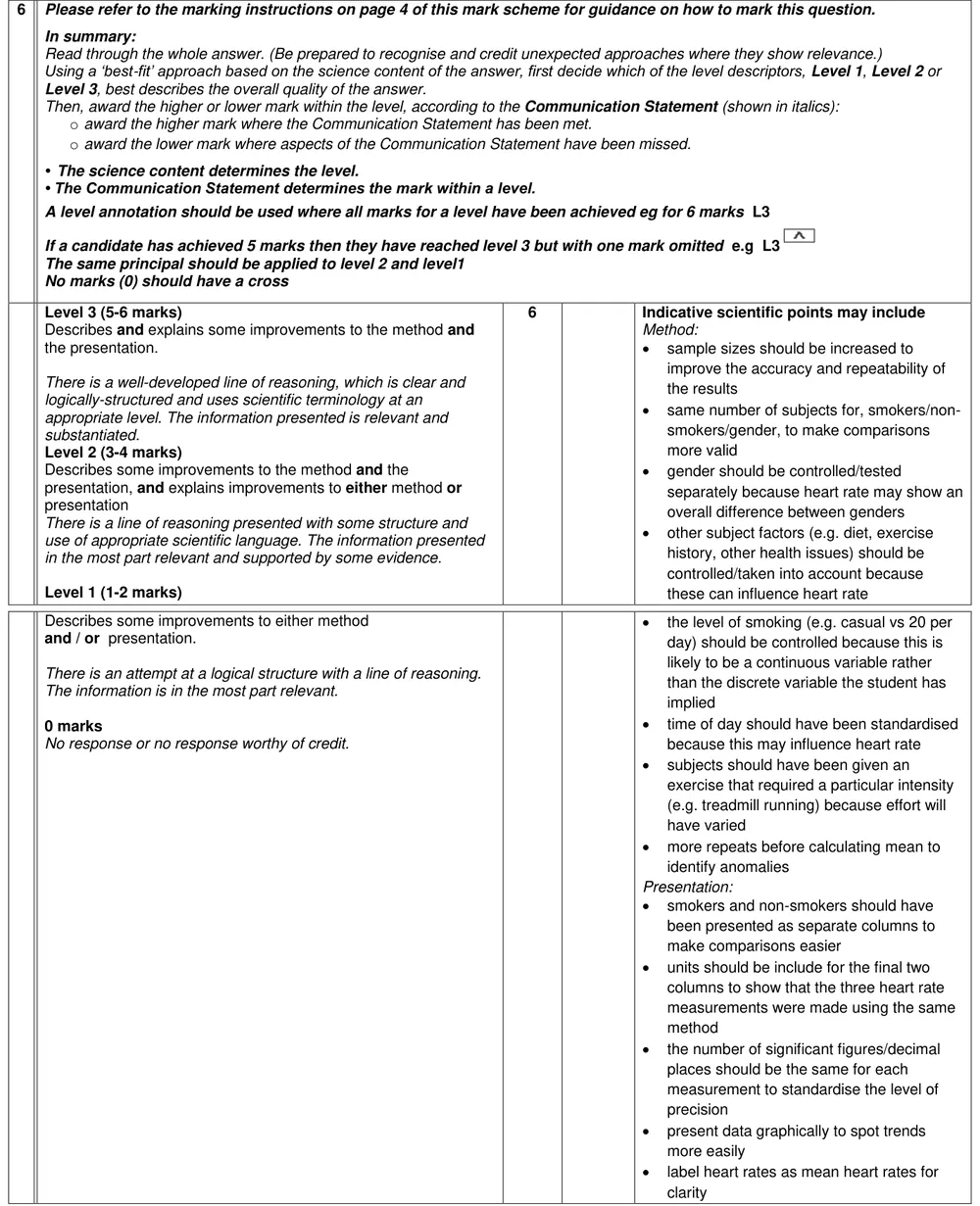
Suggest and explain improvements to a heart rate investigation of smokers and non-smokers, and to how the results are presented.
Show the mark scheme
Tap an image to open it full size.
From the examiners' report: Explanations were often weak. Making the age range wider adds another variable rather than improving the method, and repeats help you identify anomalies, not remove them. Inconsistent decimal places is a precision problem, not accuracy. Aim for fewer improvements, but cover both the method and the data, each explained.
Where students lose marks (from OCR examiners' reports and mark schemes)
Each point below is followed by wording that gained marks.
Vertical and dark: explain both: Students explained the dark (no phototropism) but not the vertical dish, or didn't make clear which condition they meant. The words 'trophism' and 'trophic' weren't allowed.
✔ Gains credit: "Placed vertically so that roots grow downwards / shoots grow upwards; in dark to prevent phototropism".
Control experiment, not control variable: Many students called the distilled water dish a control 'variable', and few went on to say what it is for.
✔ Gains credit: "Act as a control; compare results / growth with and without auxin / IAA".
Link limitation, reason and fix: On limitation questions each point is marked as a limitation, an explanation of how it limits validity, and an improvement; giving only the limitation loses two of the three marks.
✔ Gains credit: "Light intensity is not controlled; different light intensities could lead to variation in bending; use the same distance from the lamp".
Measure stem length, not 'growth': Students lost marks for writing 'measure growth' or 'measure the plant' as the dependent variable.
✔ Gains credit: Measure the length of the stem (shoot) for each gibberellin concentration, with a control group with no gibberellin.
A range of concentrations needs a correlation test: The t-test was the most common choice, but it doesn't suit an investigation using a range of gibberellin concentrations.
✔ Gains credit: Use of Spearman's rank or Pearson correlation test to analyse stem length against gibberellin concentration.
Unpaired t-test: total sample size minus two: Few students found the degrees of freedom; many used n − 1 for one group and so read the wrong critical value.
✔ Gains credit: "Degrees of freedom = (8 + 8) − 2 = 14; t > critical value, so reject the null hypothesis".
A control gets everything but the hormone: Very few students noticed that the control plants weren't treated in the same way as the gibberellin group.
✔ Gains credit: The control should be sprayed with the same volume of the same solution, minus the gibberellin.
A wider age range adds a variable: Many students thought testing a wider range of ages would improve the heart rate investigation, but that introduces another variable; improvements need explaining in terms of what they control.
✔ Gains credit: "Other subject factors (e.g. diet, exercise history, other health issues) should be controlled / taken into account because these can influence heart rate".
Download the questions
Download the PDF pack (8 questions, mark schemes at the end)
Keep practising
- OCR A plant and animal responses quiz
- OCR A Level Biology neuronal and hormonal communication quiz
- Handling Data (M1): OCR A Level Biology exam questions by topic
- PAG 10 Data Loggers and Computer Modelling: OCR A Level Biology exam questions by topic
- OCR A Level Biology masterclasses
Questions, mark schemes and examiners' report extracts © OCR.