

OCR A 2.1.3 · 5 exam questions worked through · about 15 minutes
Studying A-level Biology? I'm Tom, an A-level Biology teacher with 30 years' experience. I offer one-to-one lessons and weekly group classes for AQA and OCR A, with every lesson recorded.
This post covers OCR A specification 2.1.3, nucleotides and nucleic acids: DNA replication, transcription, translation and the practical extraction of DNA. Work through five real OCR questions and you'll see exactly what the mark schemes credit and where the examiners say marks were lost.
What you need to know first
- A nucleotide is made of a pentose sugar, a phosphate group and a nitrogenous base
- Complementary base pairs are held together by hydrogen bonds; nucleotides in a strand are joined by phosphodiester bonds
- DNA replication is semi-conservative and uses the enzymes helicase and DNA polymerase
- Transcription makes mRNA from a gene; translation uses the mRNA at a ribosome to make a polypeptide
Question 1: The action of helicase (2 marks)
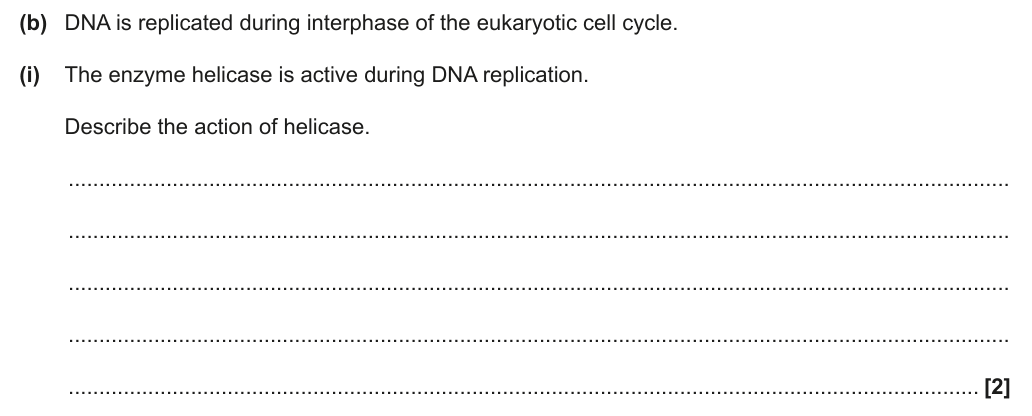
How to approach it. There are two marks, so give two ideas: what helicase does to the molecule, and how it does it. It unzips (or unwinds) the DNA double helix so that the two strands separate, and it does this by breaking the hydrogen bonds between the complementary base pairs.
Mark scheme

Common mistakes (from OCR's examiners' reports and mark schemes)
- Writing only "unzips" or "unwinds". The examiners' report says the most common mistake was not making it clear that two strands are being separated, or not linking this to the DNA double helix. Gains credit: "unzips the DNA double helix" or "separates the two strands of the DNA molecule".
- Leaving out the bonds. The report says many candidates missed the second mark for this. Gains credit: "breaks the hydrogen bonds between the bases of the two strands".
Question 2: How errors occur in DNA replication (2 marks)
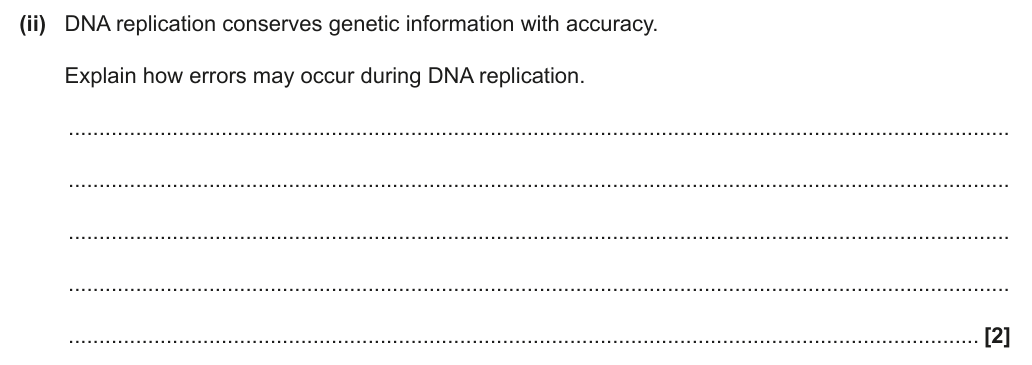
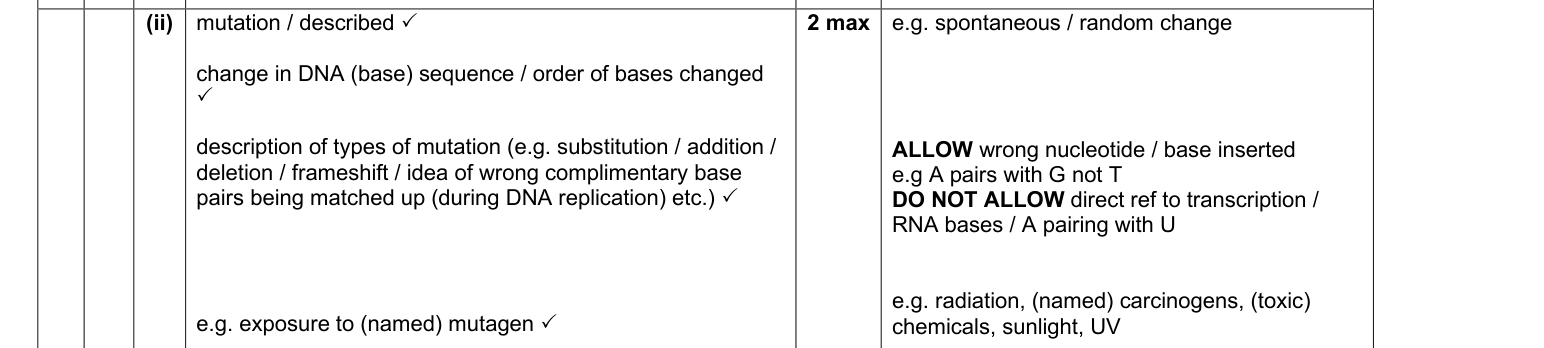
How to approach it. Name the error (a mutation), then say what it is: a change in the sequence of bases in the DNA. You can add how it happens, for example the wrong base is inserted so that A pairs with G instead of T, or a base is substituted, added or deleted, and what can cause it, such as a named mutagen. The question is about DNA replication, so keep to DNA bases.
Mark scheme
Common mistakes (from OCR's examiners' reports and mark schemes)
- Describing wrong base pairing but stopping there. The examiners' report says many candidates did not link the incorrect pairing to the DNA base sequence being different. Gains credit: "the wrong base is inserted, so the sequence of bases in the new DNA is changed".
- Writing about transcription or RNA. The report says a few candidates lost a mark this way, and the mark scheme does not allow references to transcription, RNA bases or A pairing with U. Gains credit: DNA bases only, for example "A pairs with G instead of T".
Question 3: The role of RNA polymerase (2 marks)
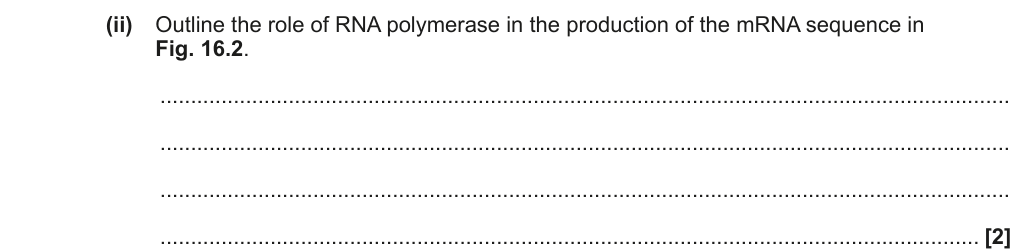
How to approach it. You do not need the figure to answer this. RNA polymerase joins RNA nucleotides together to build the mRNA strand, and the bonds it forms between those nucleotides are phosphodiester bonds (the sugar-phosphate backbone). It does not form the hydrogen bonds between the mRNA and the template strand.
Mark scheme

Common mistakes (from OCR's examiners' reports and mark schemes)
- Saying RNA polymerase forms hydrogen bonds between the mRNA and the template strand. The examiners' report says many candidates thought this. Gains credit: "forms phosphodiester bonds between RNA nucleotides".
- Confusing it with DNA polymerase or helicase. The report says a few candidates did. Gains credit: "joins RNA nucleotides together".
- Writing "joins bases" or "forms covalent bonds". The mark scheme ignores both. Gains credit: "nucleotides" and "phosphodiester bonds", or "forms the sugar-phosphate backbone".
Question 4: From gene to polypeptide (4 marks)
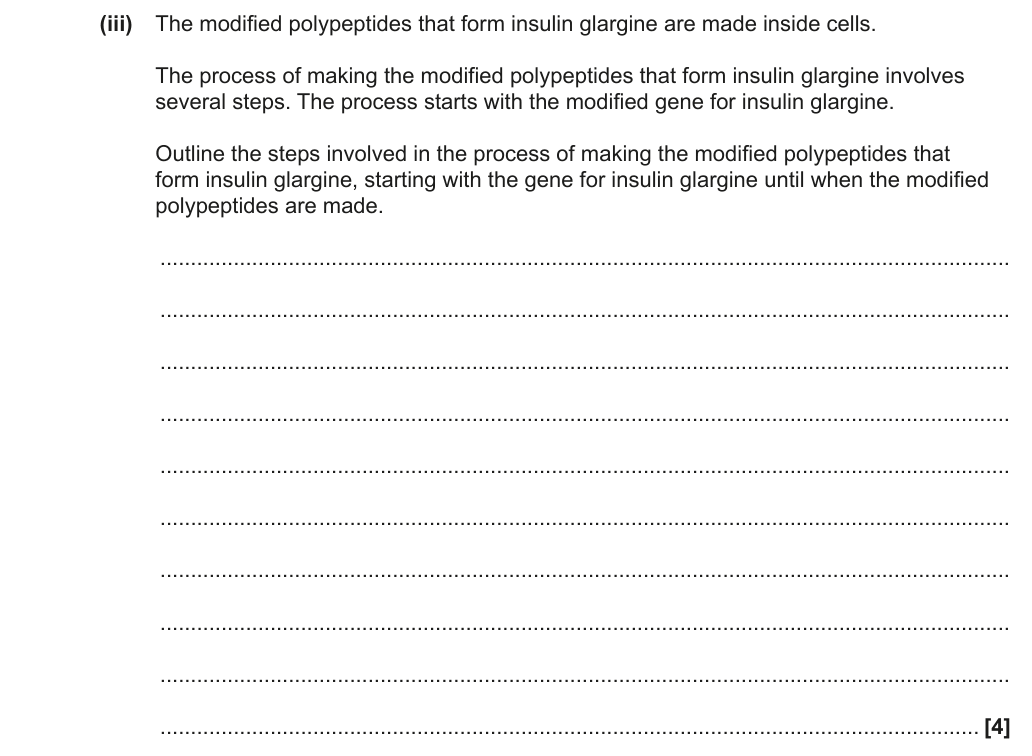
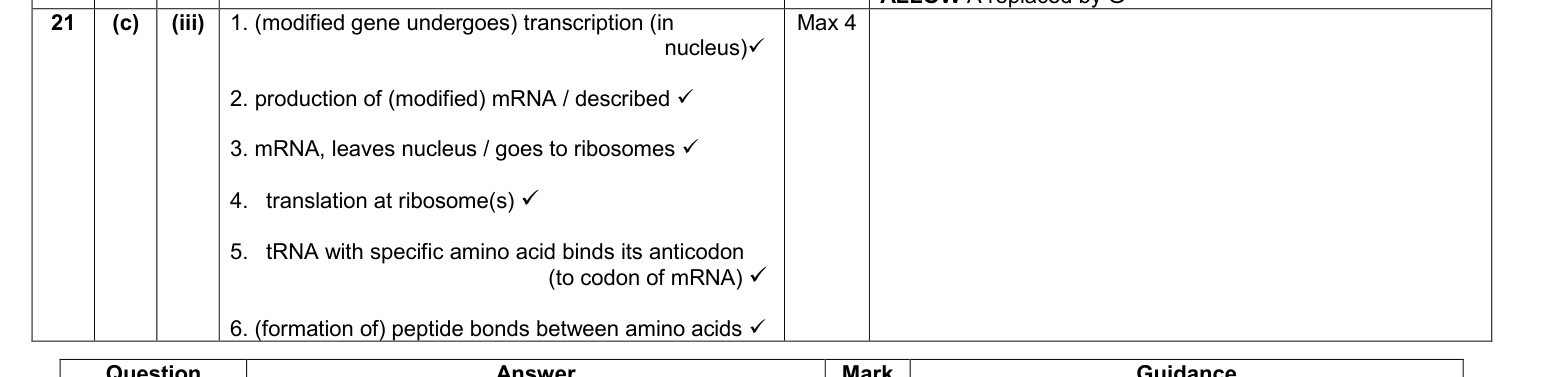
How to approach it. The question tells you where to start (the gene) and where to stop (the polypeptides), so write the steps in order. The gene is transcribed in the nucleus to produce mRNA. The mRNA leaves the nucleus and goes to a ribosome. Translation happens at the ribosome: tRNA molecules, each carrying a specific amino acid, bind by their anticodons to the codons on the mRNA, and peptide bonds form between the amino acids. Four clear steps are enough.
Mark scheme
Common mistakes (from OCR's examiners' reports and mark schemes)
- Describing genetic engineering. The examiners' report says a relatively large number of candidates saw the reference to a modified gene and explained how the gene could be modified. Gains credit: starting at the point the question gives: "the gene is transcribed to produce mRNA".
- Describing DNA replication instead of transcription. The report calls this another common error. Gains credit: "transcription in the nucleus produces mRNA".
- Not using the terms transcription and translation. The report says many candidates did not. Gains credit: naming both: "transcription" for making the mRNA and "translation at the ribosome".
- Leaving out the detail of translation. The report says the specific anticodon on tRNA was less well known and peptide bond formation was often missed. Gains credit: "tRNA with a specific amino acid binds its anticodon to the codon on the mRNA" and "peptide bonds form between the amino acids".
Question 5: Extracting DNA (3 marks)
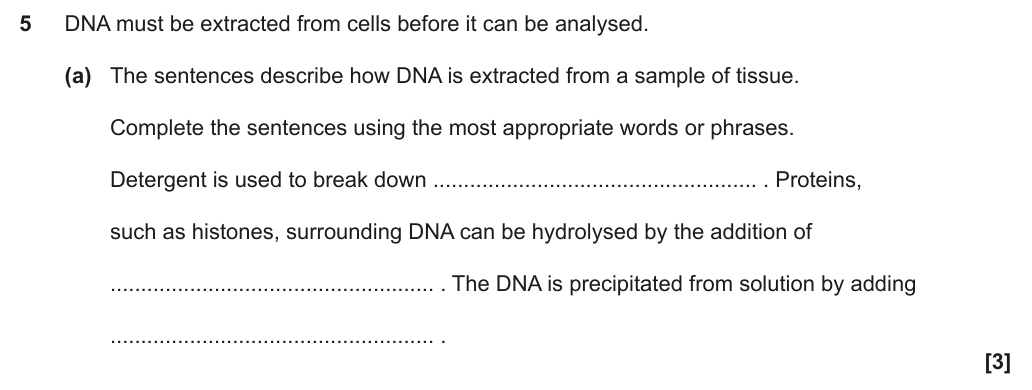
How to approach it. Each gap is one step of the extraction. Detergent breaks down the membranes (cell surface and nuclear) to release the DNA. The proteins around the DNA, such as histones, are hydrolysed by adding a protease. The DNA is then precipitated out of solution by adding ethanol.
Mark scheme

Common mistakes (from OCR's examiners' reports and mark schemes)
- Suggesting water to hydrolyse the histones. The examiners' report says relatively few candidates knew that a protease was needed, and water was often offered. Gains credit: "protease" (a named protease such as pepsin or trypsin is allowed).
- Suggesting salt to precipitate the DNA. The report says many candidates did. Gains credit: "ethanol" or "alcohol".
- Writing more than one answer in a gap. The mark scheme says the first answer in each space is the one marked. Gains credit: one clear answer in each gap, for example "membranes".
Key points to remember
- Helicase breaks hydrogen bonds between base pairs; polymerases form phosphodiester bonds between nucleotides.
- Say "nucleotides", not "bases", when you describe what a polymerase joins together.
- A mutation is a change in the sequence of bases in DNA. Link any mistake in base pairing to that changed sequence.
- For protein synthesis, name transcription and translation, and include tRNA anticodons binding to mRNA codons and peptide bonds forming.
- DNA extraction: detergent for membranes, protease for proteins, ethanol to precipitate the DNA.
Practise next
- OCR A nucleotides and nucleic acids exam questions by topic
- Nucleotides, DNA and protein synthesis written quiz
- All OCR A Level Biology revision resources
Studying this for OCR A? My weekly OCR A Year 12 masterclass works through topics like this with real exam questions. See the timetable or book a first one-to-one lesson.
Questions, mark schemes and examiners' report comments © OCR.