

Nucleotides and nucleic acids sit at the heart of OCR A Level Biology: they come back in cell division, genetics, gene technology and respiration. Spec point 2.1.3 asks you to know the structure of DNA and RNA nucleotides and of ATP and ADP, how phosphodiester bonds build a polynucleotide, how two antiparallel strands form the double helix, how DNA is copied semi-conservatively, and how a gene is transcribed and translated into a polypeptide. You also need to know the practical for purifying DNA by precipitation.
Students usually know the outline but lose marks on exact names and on reading the question. The examiners' reports mention "pentose" where deoxyribose was needed, hydrogen bonds named where phosphodiester bonds were asked for, triplet changes that didn't say both bases were swapped, and amino acids counted when the question asked for bases.
Work through the seventeen questions below in order. They start with recall, move on to applying the genetic code and nucleotide structures to new contexts, and finish with the DNA purification practical. If you'd like to practise questions like these with me each week, my OCR A masterclasses run on Wednesdays at 5.15pm for Year 12 and on Tuesdays at 6.30pm or Thursdays at 5.15pm for Year 13.
What you need from GCSE
Each question on this page assumes you're secure on these GCSE ideas. If any of them feels shaky, look it up before you start.
- DNA is a polymer made of two strands forming a double helix, found in the nucleus of eukaryotic cells as chromosomes.
- DNA is made of repeating nucleotide units, each with a sugar, a phosphate group and one of four bases: A, T, C or G.
- A gene is a section of DNA that codes for a protein; a sequence of three bases codes for one amino acid.
- Proteins are made on ribosomes from amino acids, using a template (mRNA) copied from the DNA.
Key terms
These words come up in the questions and mark schemes. Examiners expect you to use them exactly.
- Nucleotide: the monomer of a nucleic acid: a pentose sugar, a phosphate group and a nitrogenous base.
- Phosphodiester bond: the covalent bond, formed by condensation, that joins the phosphate of one nucleotide to the sugar of the next in a polynucleotide.
- Purine, pyrimidine: purines (adenine, guanine) have two rings; pyrimidines (cytosine, thymine, uracil) have one ring. A purine always pairs with a pyrimidine.
- Complementary base pairing: A pairs with T (or U in RNA) by two hydrogen bonds; C pairs with G by three hydrogen bonds.
- Antiparallel: the two strands of DNA run in opposite directions (5′ to 3′ and 3′ to 5′).
- Semi-conservative replication: each new DNA molecule contains one original strand and one newly made strand.
- Codon, anticodon: a codon is a triplet of bases on mRNA; the anticodon is the complementary triplet on a tRNA molecule.
- Degenerate code: most amino acids are coded for by more than one triplet.
- Histones: proteins that DNA is wound around in eukaryotic chromosomes; protease removes them during DNA purification.
What these questions cover (OCR 2.1.3)
The questions test these learning outcomes from the OCR A Level Biology A specification (H420):
- (a) the structure of a nucleotide as the monomer from which nucleic acids are made (including purines, pyrimidines and the pentose sugar)
- (b) the synthesis and breakdown of polynucleotides by the formation and breakage of phosphodiester bonds
- (c) the structure of ADP and ATP as phosphorylated nucleotides
- (d)(i) the structure of DNA (deoxyribonucleic acid)
- (d)(ii) practical investigations into the purification of DNA by precipitation (PAG 9)
- (e) semi-conservative DNA replication (helicase, DNA polymerase and mutations)
- (f) the nature of the genetic code
- (g) transcription and translation of genes resulting in the synthesis of polypeptides
How to use this page
Write your answer on paper before you open the mark scheme. Allow about 1.2 minutes per mark: the 17 questions are worth 39 marks, so about 47 minutes in total. Then mark your answer strictly against the mark scheme and read the examiners' tip underneath it. If you'd rather print the questions, download the PDF pack.
Recall
Question 1
AS Paper 1 · June 2018 · Q24(a)(i) · 1 mark · Medium
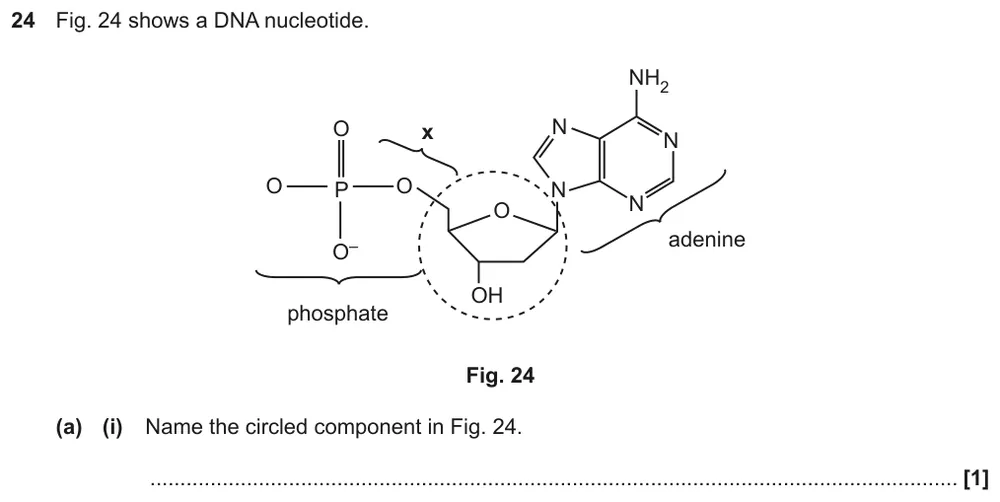
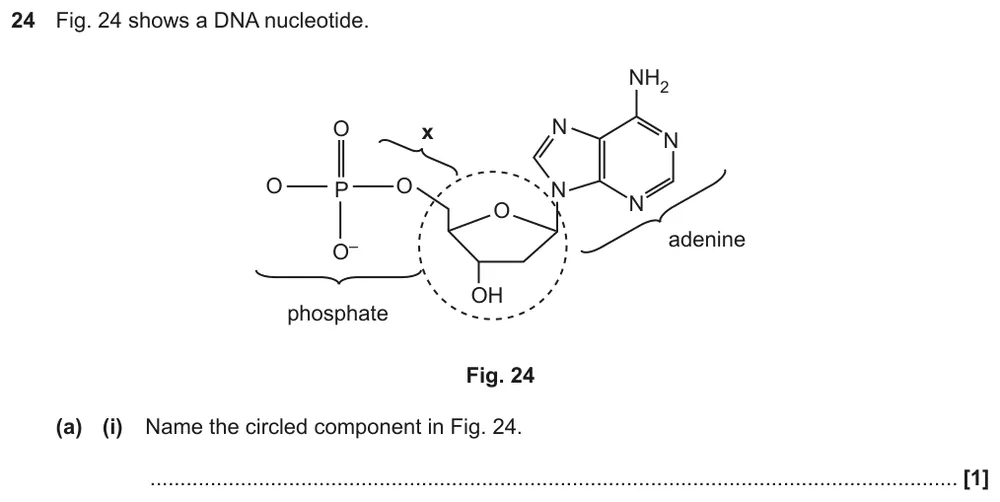
Name the circled sugar in a diagram of a DNA nucleotide.
Show the mark scheme

Tap an image to open it full size.
From the examiners' report: Many students got deoxyribose, but "pentose sugar" and "ribose" didn't score. In a DNA nucleotide, always name the sugar exactly: deoxyribose.
Question 2
AS Paper 1 · June 2018 · Q24(a)(ii) · 1 mark · Easy
Name the bond labelled x between the phosphate and the sugar.

Show the mark scheme

Tap an image to open it full size.
From the examiners' report: Most students named the phosphodiester bond. "Hydrogen bond" or just "covalent bond" didn't score: hydrogen bonds hold the two strands together, not the backbone.
Question 3
AS Paper 1 · June 2025 · Q22(a) · 3 marks · Medium
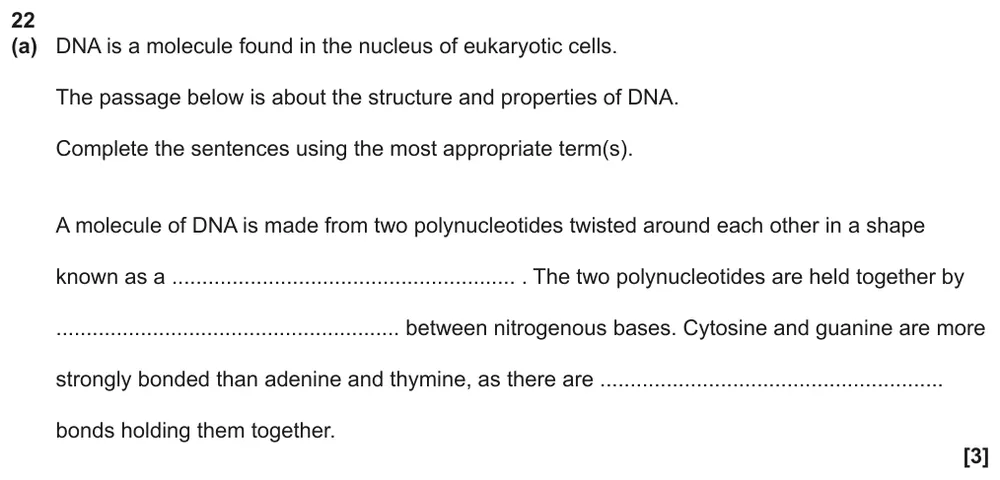
Complete a passage about the double helix and hydrogen bonding between bases.
Show the mark scheme

Tap an image to open it full size.
From the examiners' report: Most students got all three. Write "double helix", not "helix" or "alpha helix", write "hydrogen bonds" in full, and remember C and G are held by three hydrogen bonds, A and T by two.
Question 4
A level Paper 3 · June 2023 · Q7(b) · 2 marks · Medium
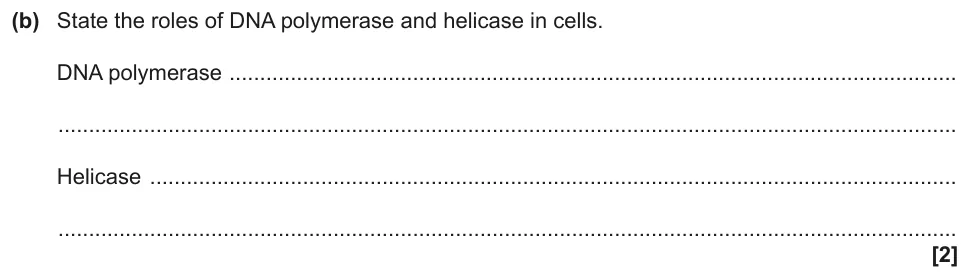
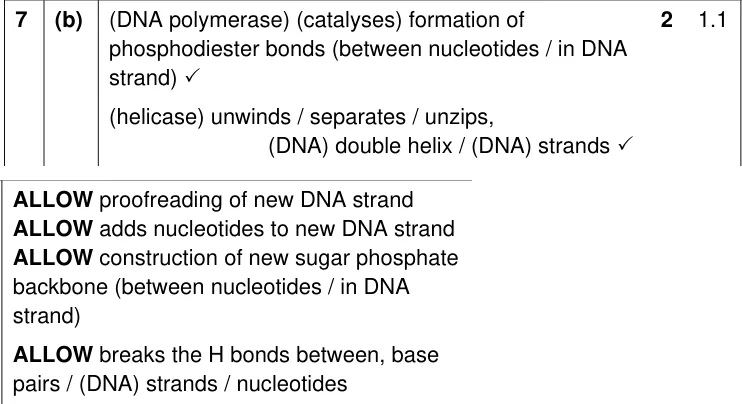
State the roles of DNA polymerase and helicase.
Show the mark scheme
Tap an image to open it full size.
From the examiners' report: Many students got both marks, but some swapped the two enzymes. DNA polymerase forms phosphodiester bonds (not hydrogen bonds), and helicase separates the two strands of the double helix, not just "unwinds DNA".
Question 5
AS Paper 2 · June 2018 · Q1(b)(i) · 2 marks · Medium
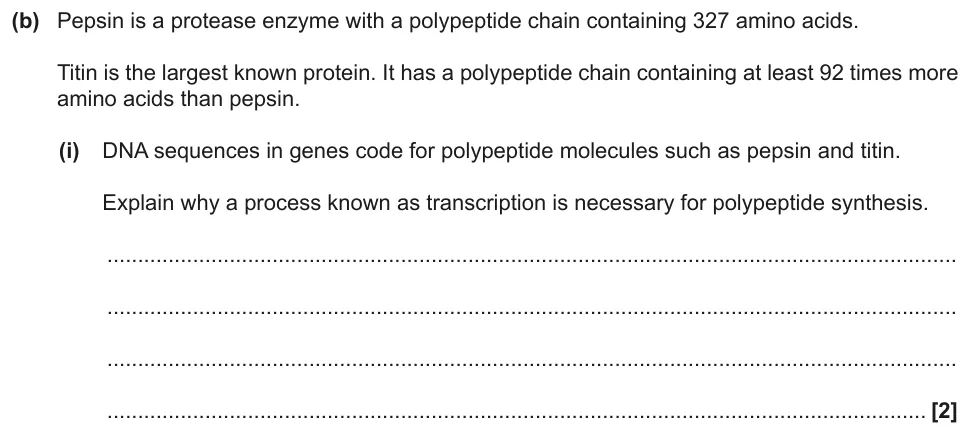
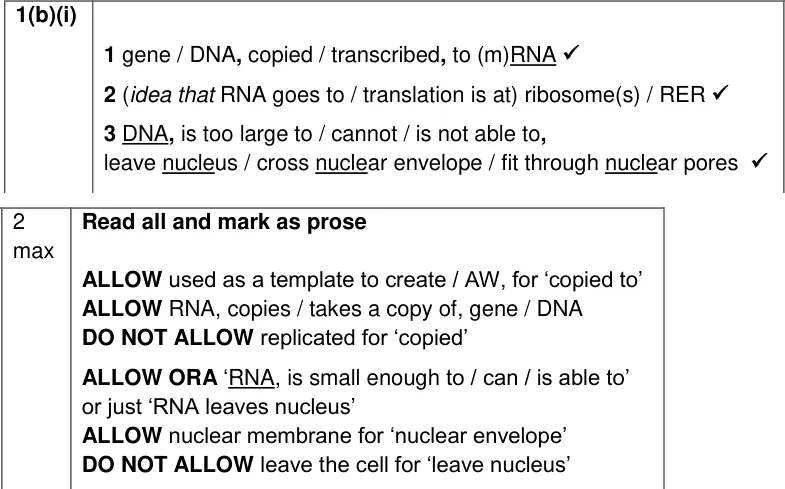
Explain why transcription is needed for polypeptide synthesis.
Show the mark scheme
Tap an image to open it full size.
From the examiners' report: This was done well, especially the point that DNA is too big to leave through the nuclear pores while mRNA can. Don't mix up transcription (DNA to mRNA in the nucleus) with translation (at the ribosome).
Question 6
A level Paper 3 · June 2025 · Q4(a) · 2 marks · Medium
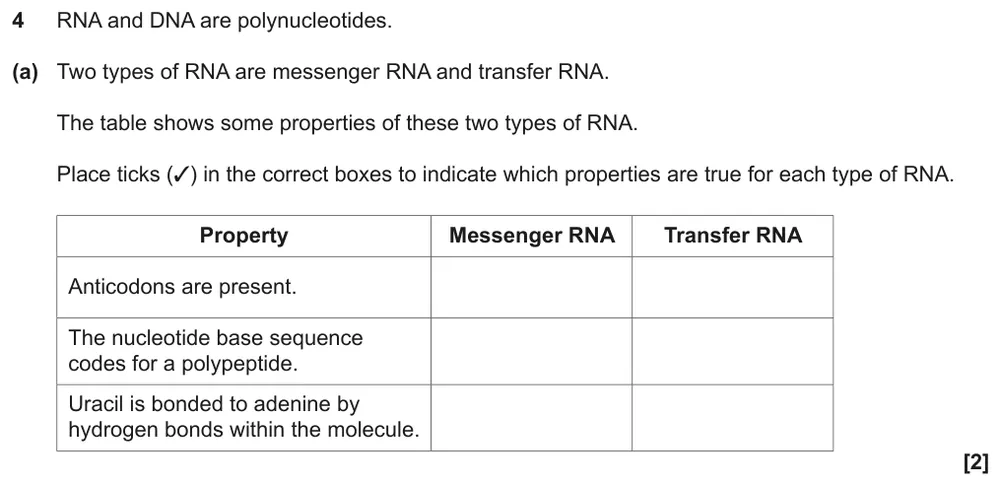
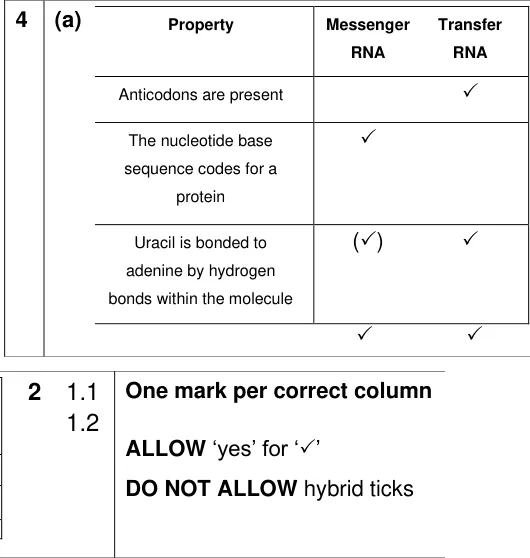
Tick which properties belong to messenger RNA and which to transfer RNA.
Show the mark scheme
Tap an image to open it full size.
From the examiners' report: Most students knew that mRNA codes for a polypeptide; fewer got the tRNA column. tRNA carries the anticodon, and its folded shape is held by hydrogen bonds between bases such as U and A.
Applying what you know
Question 7
AS Paper 1 · June 2018 · Q24(b) · 4 marks · Hard
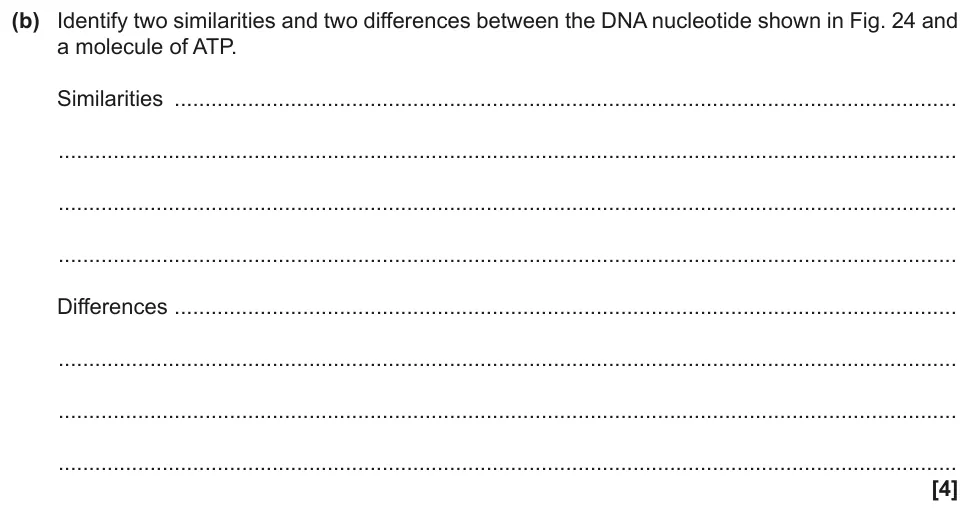
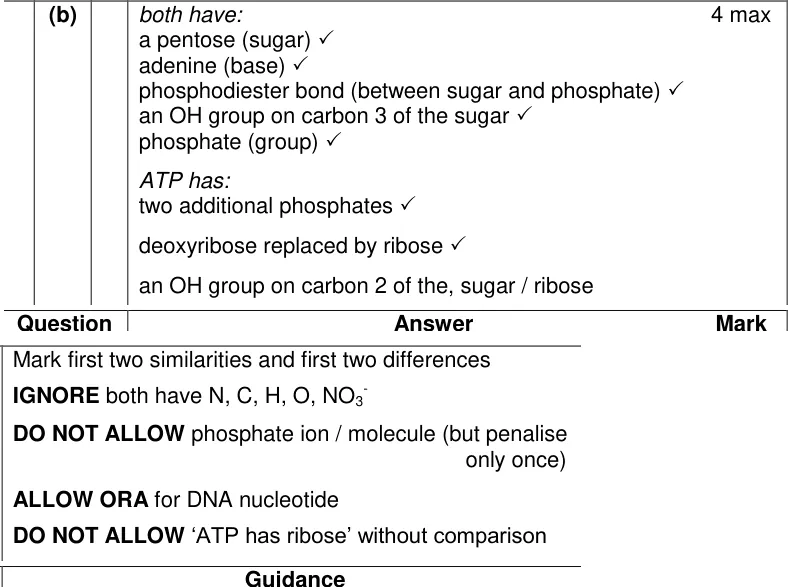
Give two similarities and two differences between the DNA nucleotide and ATP.
Information from earlier in this question:
Show the mark scheme
Tap an image to open it full size.
From the examiners' report: Most students spotted adenine and phosphate in both, and three phosphates versus one. Make every difference a comparison ("ATP has ribose but the nucleotide has deoxyribose"), not "ATP has ribose" on its own.
Question 8
A level Paper 3 · June 2024 · Q4(a) · 2 marks · Medium
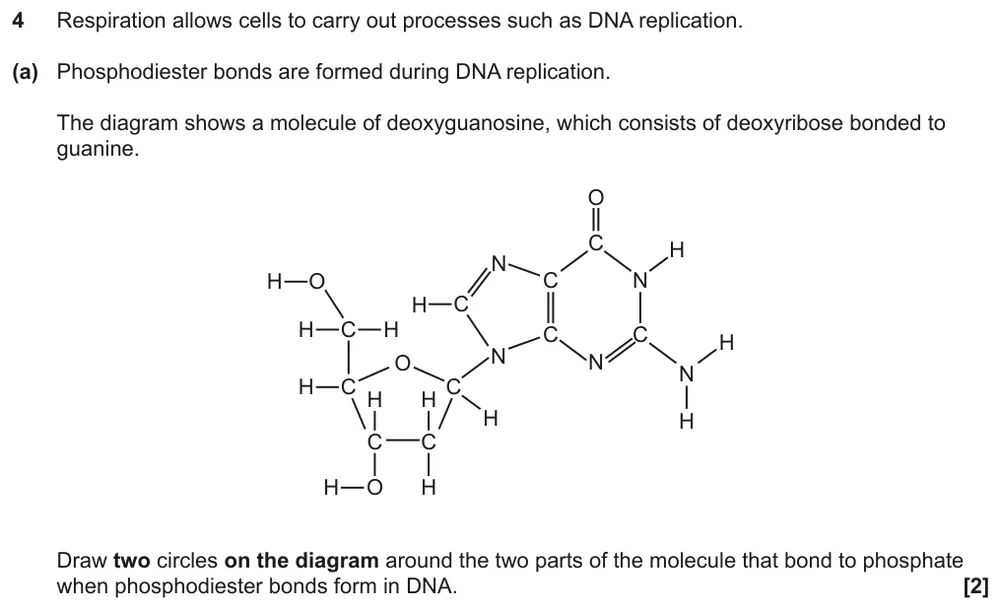
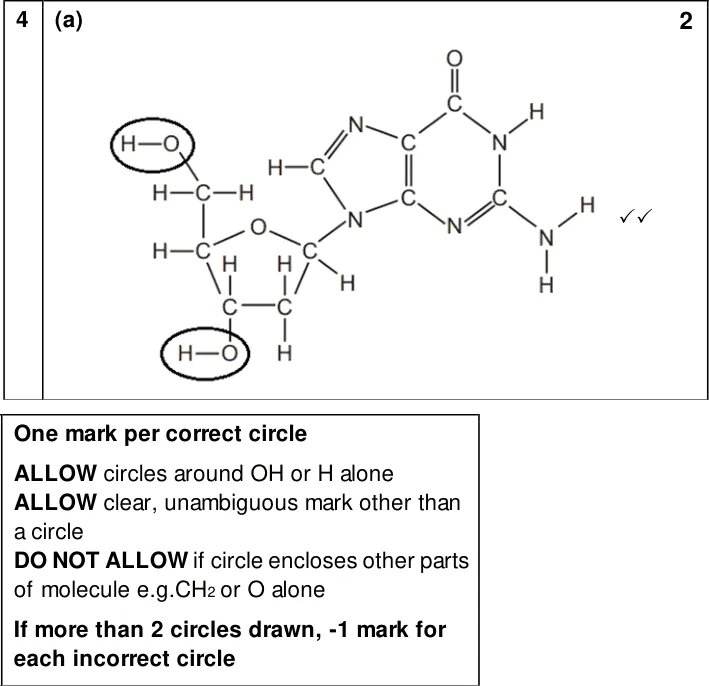
Circle the two groups on deoxyguanosine that bond to phosphate in phosphodiester bonds.
Show the mark scheme
Tap an image to open it full size.
From the examiners' report: Strong answers circled the two OH groups on the sugar. Circles that included the carbon atom, or went round part of the guanine, lost the marks. Phosphodiester bonds form between sugar and phosphate, never through the base.
Question 9
A level Paper 3 · June 2023 · Q2(b) · 2 marks · Medium
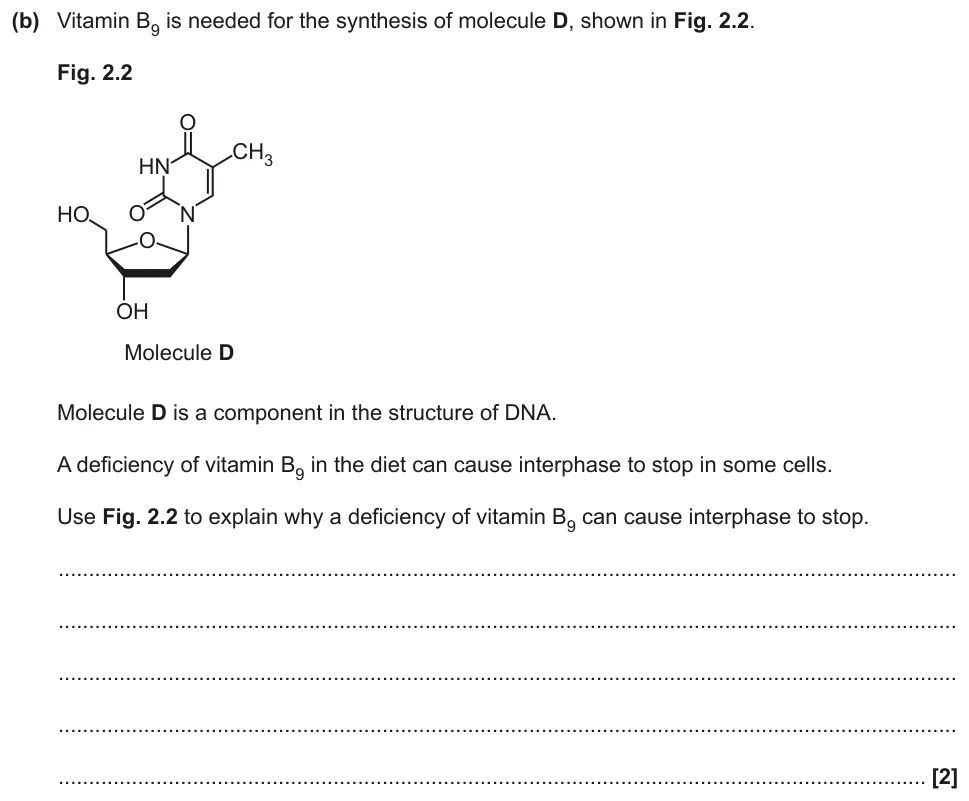
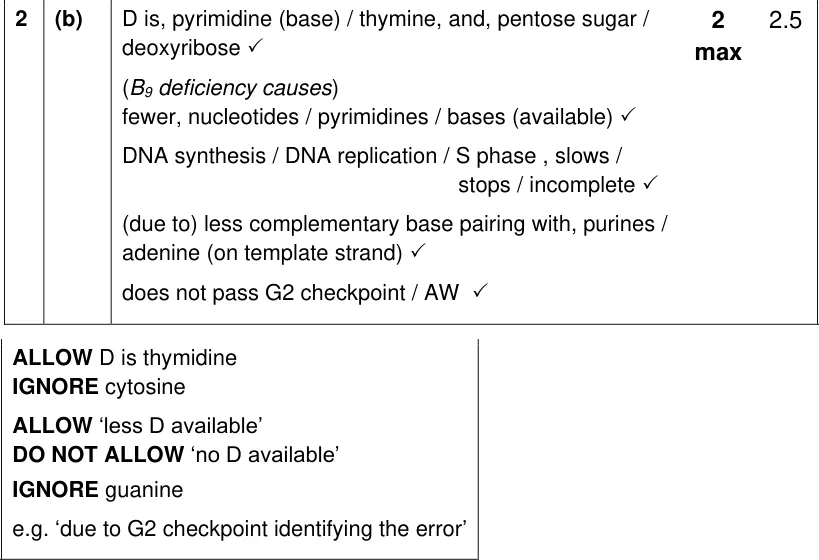
Use a diagram of a DNA component to explain why vitamin B9 deficiency can stop interphase.
Show the mark scheme
Tap an image to open it full size.
From the examiners' report: Many students said DNA replication would be incomplete. Read the stem: a deficiency means less D, not none. If you mention a checkpoint, name the G2 checkpoint.
Question 10
AS Paper 2 · June 2018 · Q1(b)(ii) · 2 marks · Hard
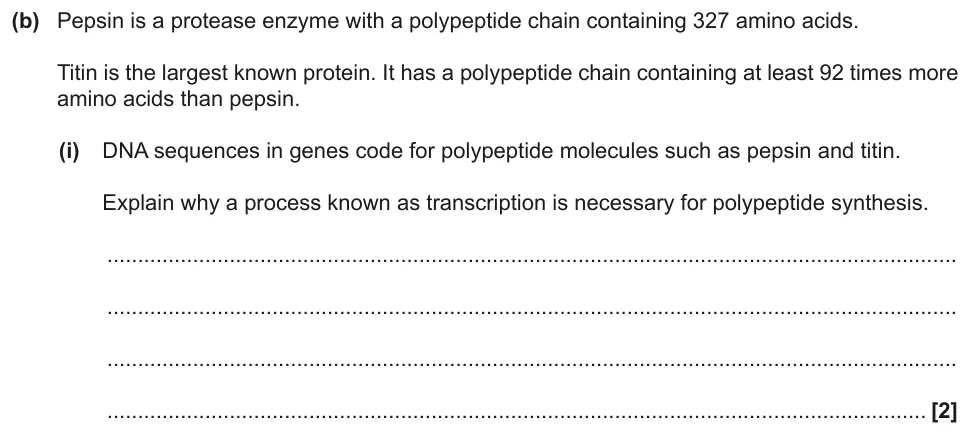
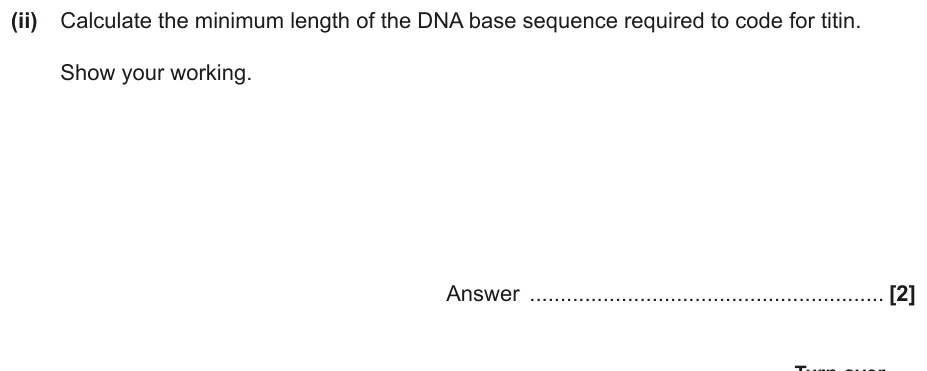
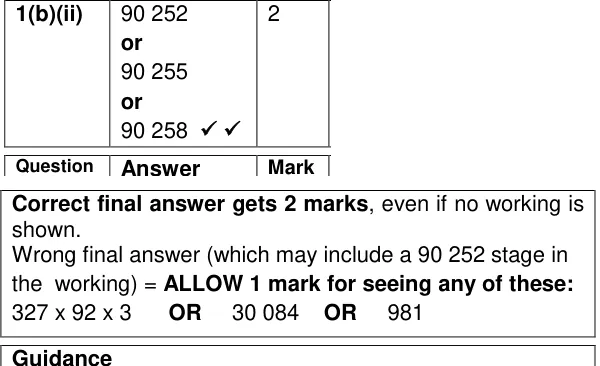
Calculate the minimum number of DNA bases needed to code for titin.
Information from earlier in this question:
Show the mark scheme
Tap an image to open it full size.
From the examiners' report: Most students worked out the number of amino acids (30 084) and stopped. The question asks for DNA bases, and each amino acid is coded by a triplet, so multiply by 3, don't divide.
Question 11
A level Paper 2 · June 2022 · Q16(b)(i) · 2 marks · Easy
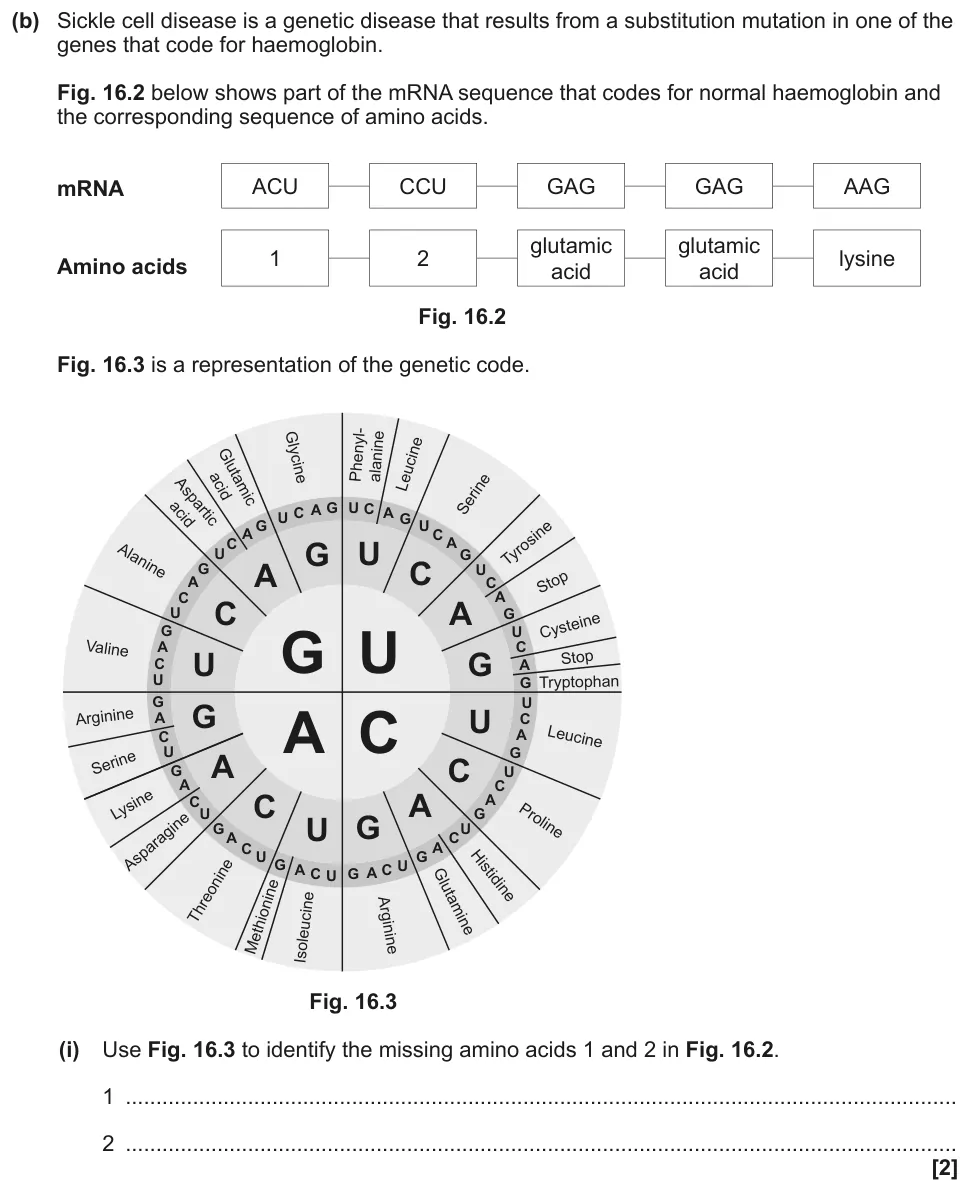
Use a genetic code wheel to identify two missing amino acids.
Show the mark scheme

Tap an image to open it full size.
From the examiners' report: Almost everyone got both marks. Read the wheel from the centre outwards: first base, second base, third base.
Question 12
A level Paper 2 · June 2022 · Q16(b)(ii) · 2 marks · Hard
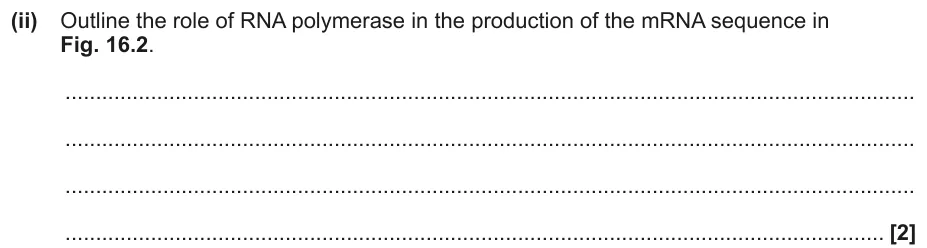
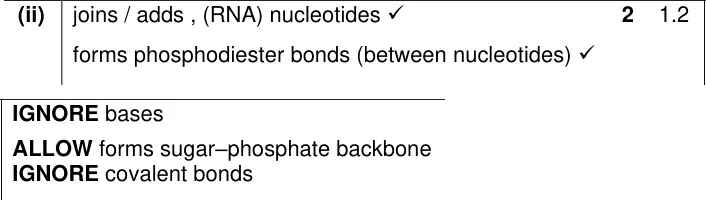
Outline the role of RNA polymerase in making the mRNA.
Show the mark scheme
Tap an image to open it full size.
From the examiners' report: Only a minority got both marks. RNA polymerase joins RNA nucleotides with phosphodiester bonds; it doesn't form hydrogen bonds with the template strand, and it isn't helicase or DNA polymerase.
Question 13
AS Paper 1 · June 2022 · Q21(c)(ii) · 2 marks · Easy
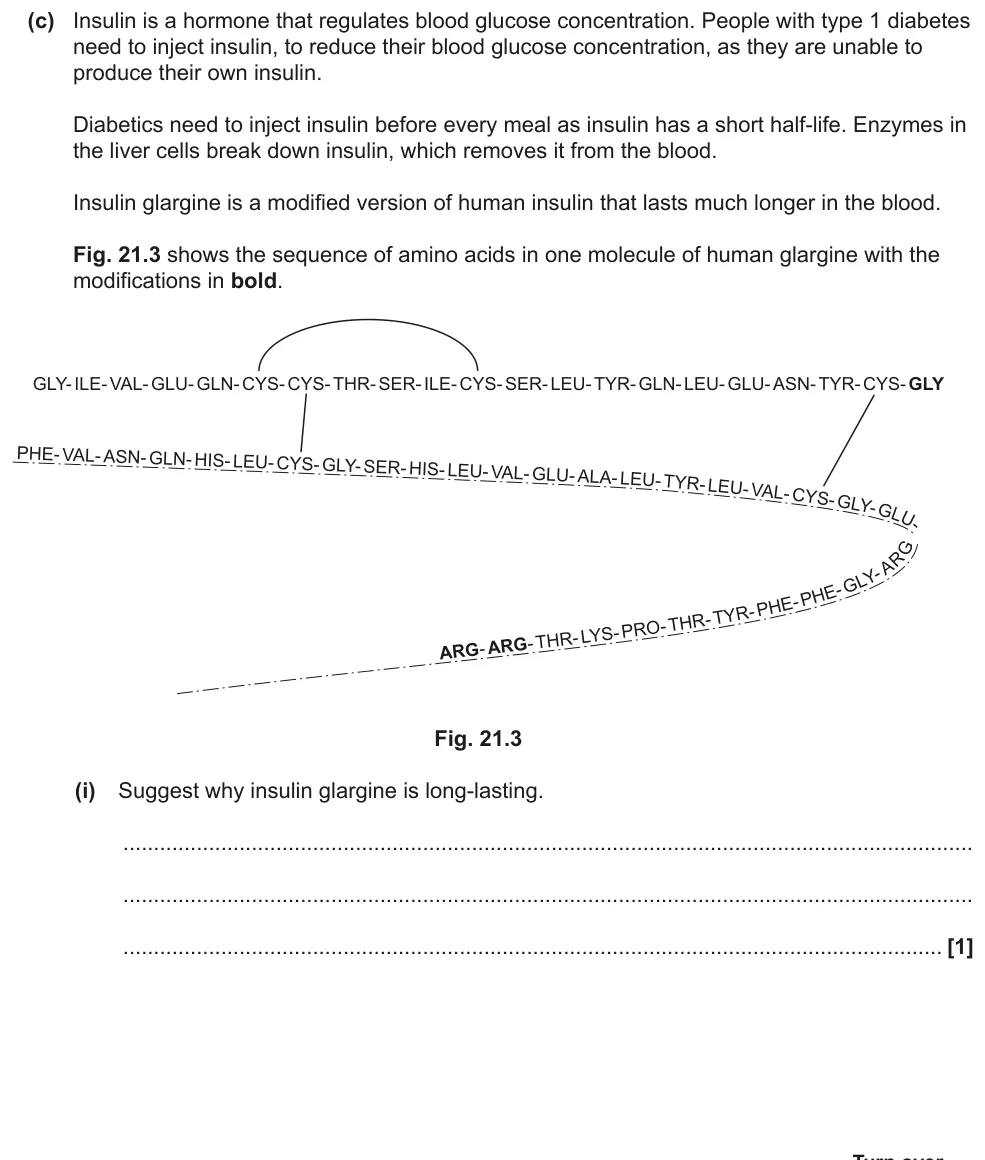
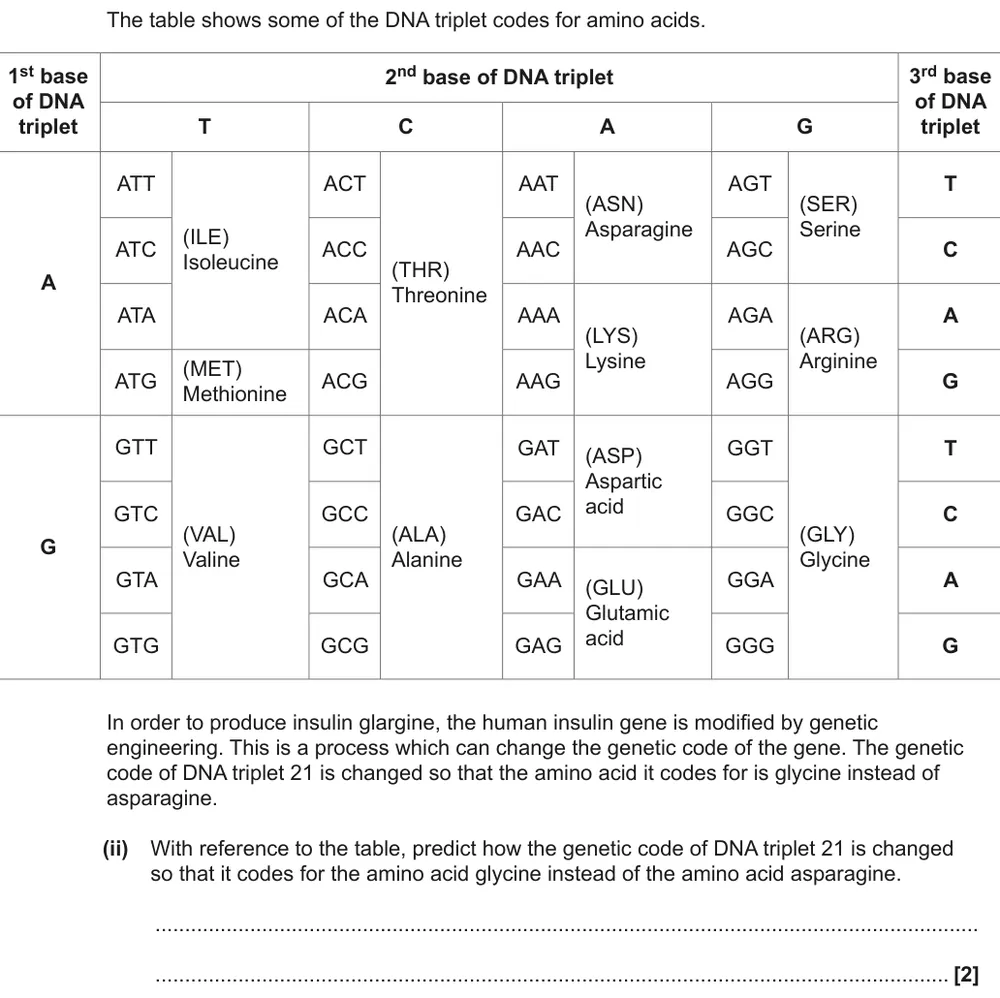
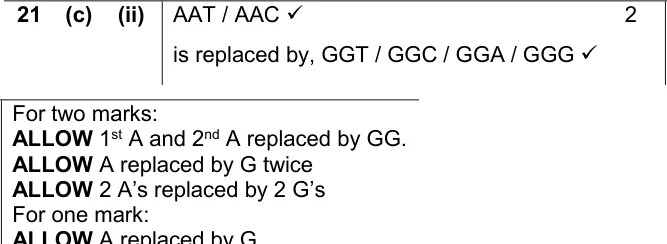
Use a DNA triplet table to predict how triplet 21 changes so it codes for glycine instead of asparagine.
Information from earlier in this question:
Show the mark scheme
Tap an image to open it full size.
From the examiners' report: Most students read the table well. Make it clear that both adenine bases are replaced by guanine, and remember that ASN and GLY are amino acid abbreviations, not codes; use the asparagine triplets, not arginine's.
Question 14
AS Paper 1 · June 2022 · Q21(c)(iii) · 4 marks · Easy
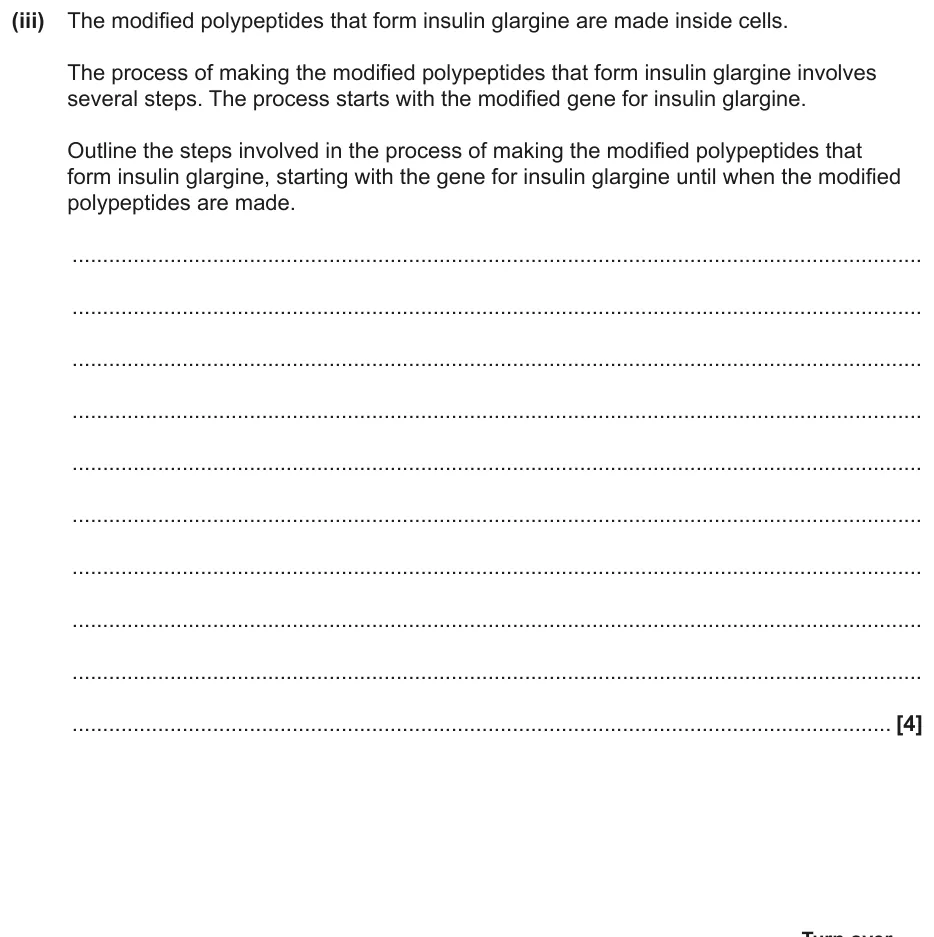
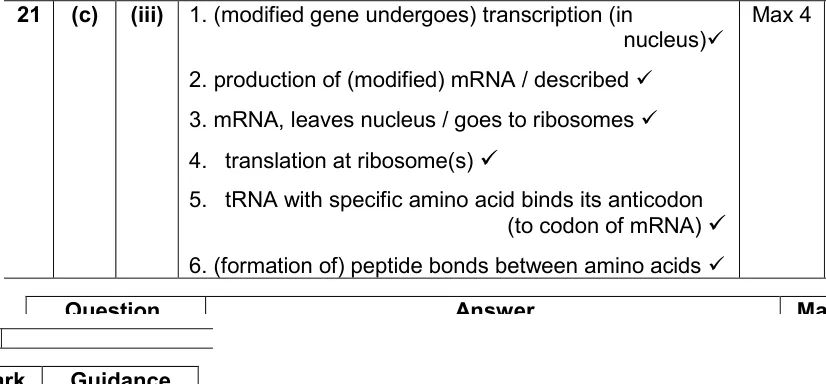
Outline the steps from a modified gene to the polypeptides of insulin glargine.
Show the mark scheme
Tap an image to open it full size.
From the examiners' report: Well-sequenced answers scored 3 or 4. Include the tRNA step (its specific anticodon brings a specific amino acid) and the peptide bonds, and stop when the polypeptide is made, as the question says.
DNA purification practical
Question 15
A level Paper 3 · June 2022 · Q5(a) · 3 marks · Medium
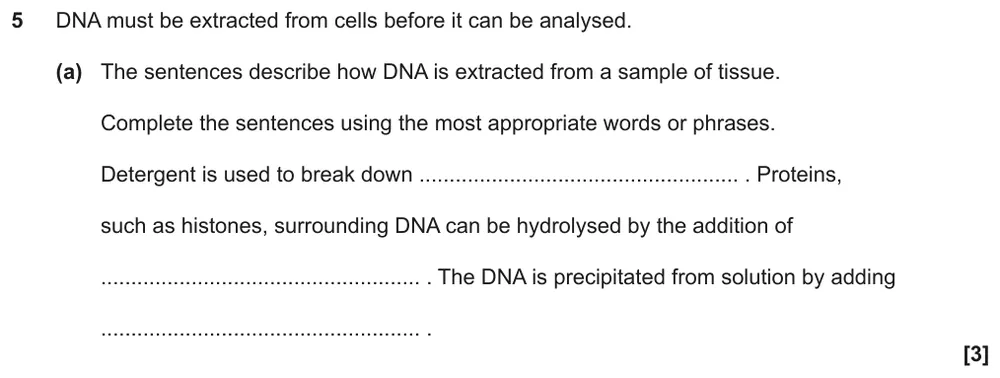
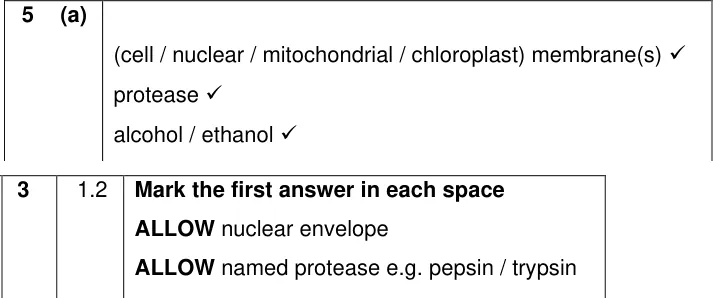
Complete sentences about the roles of detergent, protease and the precipitating agent in DNA extraction.
Show the mark scheme
Tap an image to open it full size.
From the examiners' report: Most students scored 2 or 3. Learn the job of each reagent: detergent breaks down membranes, protease hydrolyses histones (water doesn't), and ethanol, not salt, precipitates the DNA.
Question 16
A level Paper 2 · June 2019 · Q17(a)(i) · 1 mark · Medium
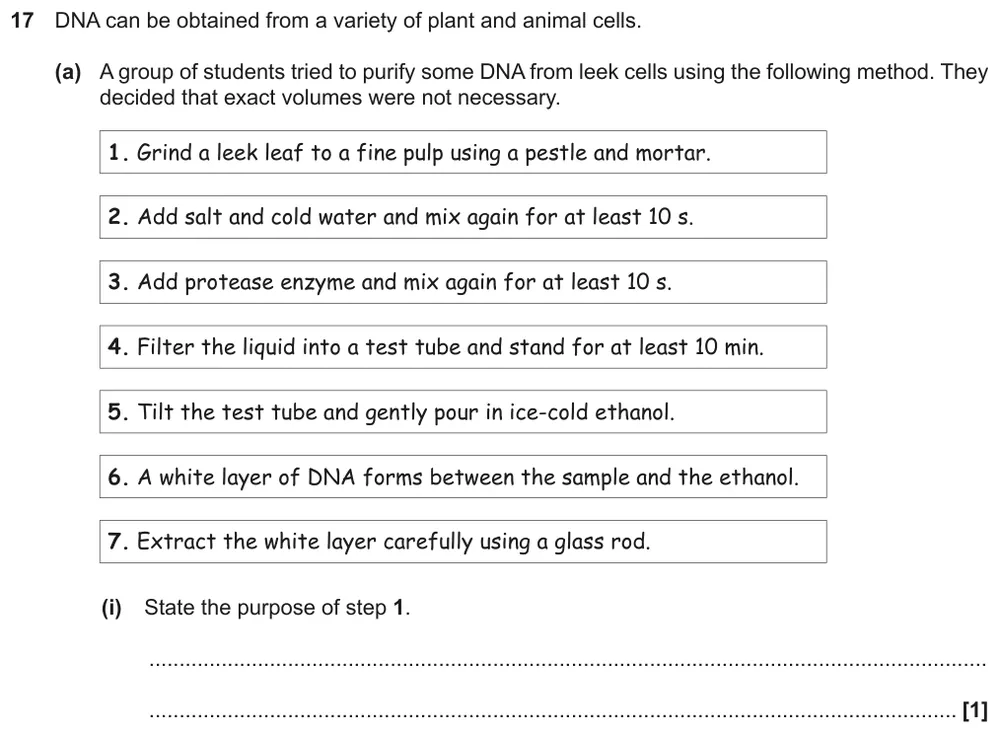
State the purpose of grinding the leek leaf in a DNA purification method.
Show the mark scheme

Tap an image to open it full size.
From the examiners' report: Grinding breaks the cell walls. Answers about increasing surface area, breaking membranes or breaking open nuclei didn't score; detergent deals with the membranes.
Question 17
AS Paper 1 · June 2024 · Q23(d) · 4 marks · Hard
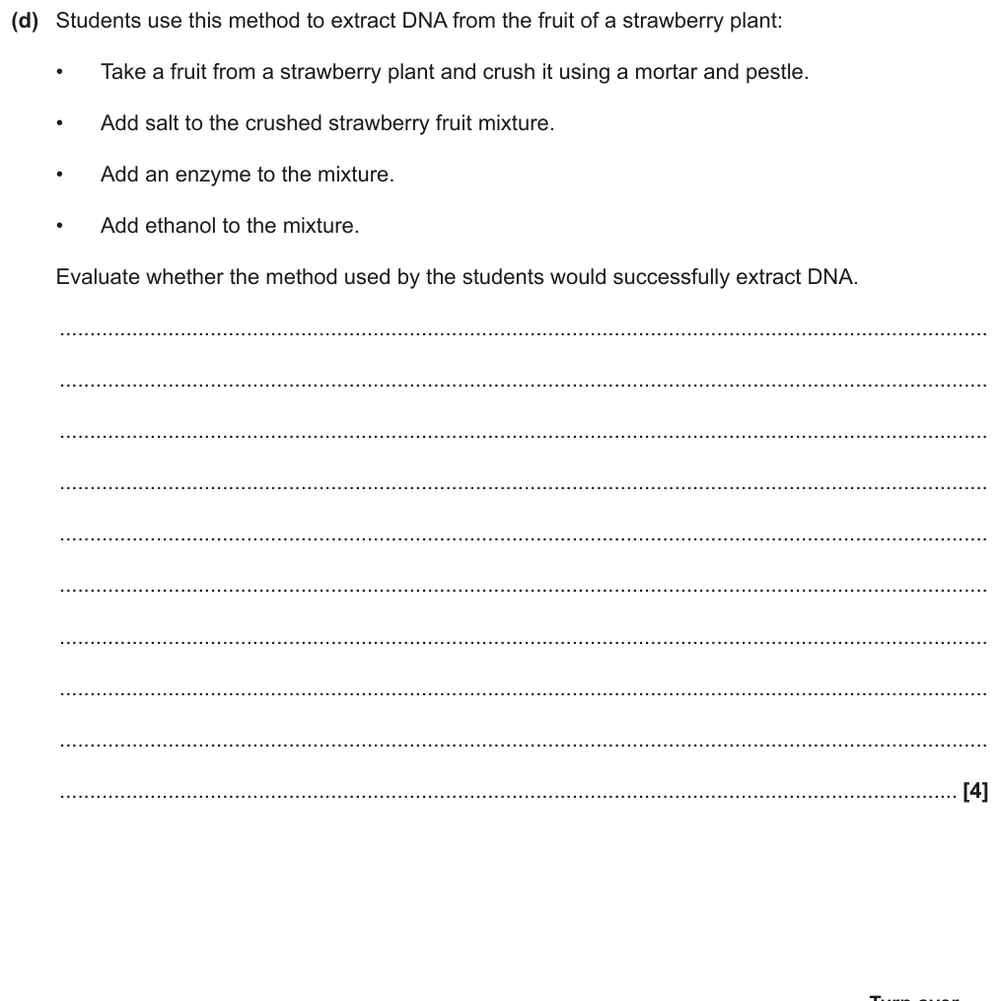
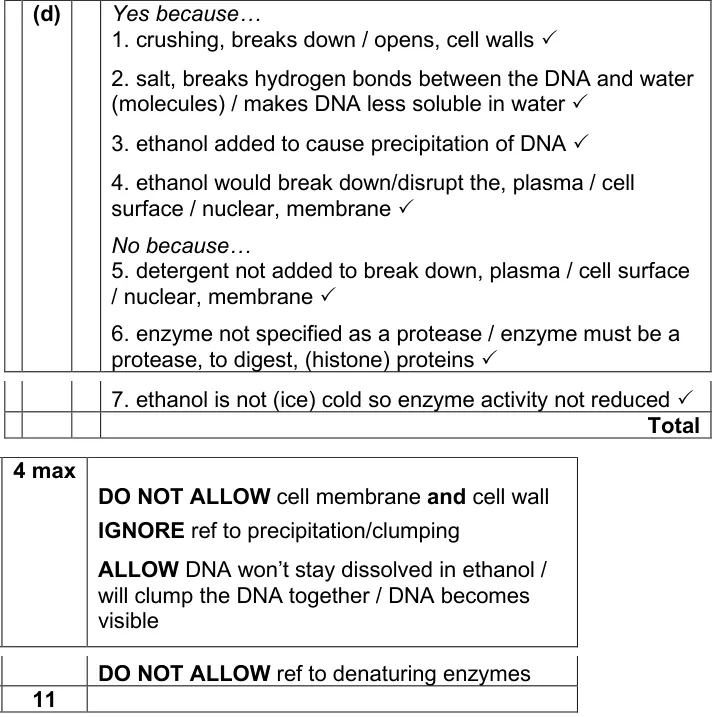
Evaluate whether a strawberry DNA extraction method would work.
Show the mark scheme
Tap an image to open it full size.
From the examiners' report: Only able students got 3 or 4. Give points on both sides, link each step to its purpose, and be precise: crushing breaks cell walls, but detergent is needed for the plasma and nuclear membranes. Few knew salt makes DNA less soluble.
Where students lose marks (from OCR examiners' reports and mark schemes)
Each point below is followed by wording that gained marks.
Deoxyribose, not just a pentose: Asked to name the sugar in a DNA nucleotide, many students wrote "pentose sugar" or "ribose", which did not score.
✔ Gains credit: "Deoxyribose".
The backbone bond is phosphodiester: Weaker answers named the bond between phosphate and sugar as a hydrogen bond or simply a covalent bond.
✔ Gains credit: "Phosphodiester (bond)".
Double helix, three bonds for C and G: Students lost marks for writing just "helix" or "alpha helix", for writing "hydrogen" or "H2 bonds" without the word bond, and for not knowing that C–G pairs have three hydrogen bonds.
✔ Gains credit: "Double helix", "hydrogen bonds", "three (hydrogen bonds)".
ATP versus nucleotide, in one sentence: Some students lost credit by writing "ATP has ribose" without saying what the DNA nucleotide has, so no comparison was made.
✔ Gains credit: "ATP has three phosphates but the nucleotide has one" and "ATP has ribose whereas the nucleotide has deoxyribose".
Three bases per amino acid: Most students multiplied 327 by 92 and stopped at 30 084 amino acids; some divided by 3 instead of multiplying.
✔ Gains credit: "327 × 92 × 3 = 90 252 bases".
RNA polymerase builds the backbone: Many students thought RNA polymerase forms hydrogen bonds between the mRNA and the template strand, or confused it with DNA polymerase or helicase.
✔ Gains credit: "Joins RNA nucleotides" and "forms phosphodiester bonds between them".
Both adenines become guanines: The most common error was not making it clear that both adenine bases change to guanine; some students wrote the amino acid abbreviations ASN or GLY as if they were the code, or used arginine's triplets.
✔ Gains credit: "AAT / AAC is replaced by GGT / GGC / GGA / GGG", or "both As are replaced by Gs".
Crushing opens walls, detergent opens membranes: Many students thought crushing the strawberry broke open the plasma membranes, and used vague terms such as "cell membrane and cell wall" together, which was not allowed.
✔ Gains credit: "Crushing breaks down cell walls"; "no detergent is added to break down the plasma and nuclear membranes"; "the enzyme must be a protease to digest histone proteins".
Download the questions
Download the PDF pack (17 questions, mark schemes at the end)
Keep practising
- DNA and Protein Synthesis quiz
- Carbohydrates (2.1.2): OCR A Level Biology exam questions by topic
- Enzymes (2.1.4): OCR A Level Biology exam questions by topic
- Nucleotides, DNA and protein synthesis: interactive written questions (20)
- OCR A Level Biology masterclasses
Questions, mark schemes and examiners' report extracts © OCR.