

In short: The Hardy-Weinberg principle predicts allele and genotype frequencies in a population that is not evolving. The equation p + q = 1 links the two allele frequencies, and p2 + 2pq + q2 = 1 links the three genotype frequencies. Almost every calculation starts from the homozygous recessive frequency, q2, because that is the one genotype you can identify from its phenotype.
Studying A-level Biology? I'm Tom, an A-level Biology teacher with 30 years' experience. I offer one-to-one lessons and weekly group classes for AQA, OCR A and CIE, with every lesson recorded.
Hardy-Weinberg questions are usually 2 or 3 marks, and they follow the same pattern every time. Yet the examiners' reports show many students losing marks on them, year after year. This guide explains what the equations mean, the conditions the principle assumes, and a step-by-step method with three worked examples. Then there are six real exam questions with the mark-scheme wording and what the examiners said. It matches OCR A 6.1.2(f) and AQA 3.7.2.
What the two equations mean (p + q = 1 and p2 + 2pq + q2 = 1)
Think about one gene with two alleles, a dominant allele A and a recessive allele a. The gene pool is all the alleles of all the genes in a population. An allele frequency is the proportion of all the alleles of that gene that are one particular allele.
p is the frequency of the dominant allele (A).
q is the frequency of the recessive allele (a).
There are only two alleles, so the two frequencies must add up to 1. That is the first equation, p + q = 1.
If gametes combine at random, the chance of an offspring getting two A alleles is p × p = p2. The chance of getting two a alleles is q2. A heterozygote can get A from the mother and a from the father, or the other way round, so its frequency is 2pq. The three genotype frequencies add up to 1, which gives the second equation.
homozygous dominant
AA
heterozygous (carriers)
Aa
homozygous recessive
aa
Frequencies are written as decimals between 0 and 1. A percentage of 36% is a frequency of 0.36. Read the question to see which form it wants for the answer.
The same idea works for more than two alleles. For the ABO blood groups, with alleles IA, IB and IO, the three allele frequencies add up to 1. AQA tested exactly this in June 2022.
The conditions the principle assumes
The Hardy-Weinberg principle says that allele frequencies stay the same from one generation to the next, as long as certain conditions are met. These conditions are:
a large population, so chance changes in allele frequency (genetic drift) have little effect;
random mating, so every genotype is equally likely to mate with every other;
no mutation, so no new alleles appear;
no migration, meaning no immigration or emigration, so there is no gene flow into or out of the population;
no selection, so no allele gives an advantage or disadvantage in survival or reproduction.
If allele frequencies do change between generations, at least one condition has been broken and the population is evolving. That is why Hardy-Weinberg sits in the evolution part of both specifications.
Exam questions usually ask why the principle may not apply in a given case. Name the condition that is broken, in context. Mark schemes credit phrases such as "population not large", "not randomly mating", "selection against a phenotype", "mutation" and "immigration or emigration". AQA rejects converse statements in this context: when asked why the principle does not hold, "no mutation" or "no migration" describes a condition being met, so it earns nothing.
Read the stem carefully. If it already says the population is large, do not suggest a small population. If a question asks why an estimate might be accurate, give a condition that is met, such as a large population or no migration.
Step-by-step method, starting from the homozygous recessive frequency
With a dominant and a recessive allele, you cannot tell AA from Aa by looking. The only genotype you know for certain is the homozygous recessive, aa, because only aa individuals show the recessive phenotype. So start there.
Write each step with its label, for example "q2 = 0.06", then "q = 0.245". Mark schemes give working marks for correct steps even when the final answer is wrong, but only if the examiner can see them.
One exception: if the alleles are codominant, every genotype has its own phenotype. Then you can start from either homozygote. A population with 9% red-flowered plants (homozygous) has a frequency of 0.09 for that genotype, so that allele frequency is √0.09 = 0.3.
Three worked examples
Example 1: starting from the homozygous recessive frequency
In a population, 1 in 2,500 people has a condition caused by a recessive allele. What proportion of the population are carriers?
q2 = 1 ÷ 2,500 = 0.0004
q = √0.0004 = 0.02
p = 1 − 0.02 = 0.98
Carriers are heterozygous: 2pq = 2 × 0.98 × 0.02 = 0.0392
As a percentage, 0.0392 × 100 = 3.92%. That is about 1 in 26 people (1 ÷ 0.0392 = 25.5).
Rounding note: the square root is exact here, so nothing is lost. A condition that looks rare can still have many carriers. Here carriers are about 100 times more common than affected people.
Example 2: starting from a dominant phenotype percentage
In a population of plants, 84% have purple flowers. Purple is dominant to white. Calculate the percentage of plants that are homozygous dominant and the percentage that are heterozygous.
The 84% includes both AA and Aa plants, so it is p2 + 2pq. The white plants are q2 = 1 − 0.84 = 0.16.
q = √0.16 = 0.4
p = 1 − 0.4 = 0.6
Homozygous dominant: p2 = 0.62 = 0.36, so 36%.
Heterozygous: 2pq = 2 × 0.6 × 0.4 = 0.48, so 48%.
Rounding note: check your answer. 36% + 48% = 84%, the percentage of purple plants you started with. This is the step most students miss. Never put the dominant phenotype percentage straight into q2 or p2.
Example 3: the number of carriers in a population
A town has 12,000 people. 3% of them show a recessive phenotype. Estimate the number of people who are heterozygous.
q2 = 0.03
q = √0.03 = 0.17320... (keep this in your calculator)
p = 1 − 0.17320... = 0.82679...
2pq = 2 × 0.82679... × 0.17320... = 0.28641...
Number of heterozygotes = 0.28641... × 12,000 = 3,436.9, so about 3,437 people.
Rounding note: if you round q to 0.17 too early, p becomes 0.83, 2pq becomes 0.2822 and you get 3,386. That is 51 people out. In OCR's June 2025 paper, rounding q to 0.24 gave 218 or 219 instead of 222. The mark scheme gave those answers 2 of the 3 marks. Give whole numbers for people, plants or animals, and follow any instruction about significant figures.
Six real exam questions with the mark-scheme wording
These come from OCR A and AQA A-level papers. Try each one before reading the answer.
Question 1 (7402/2, June 2022, 1 mark)
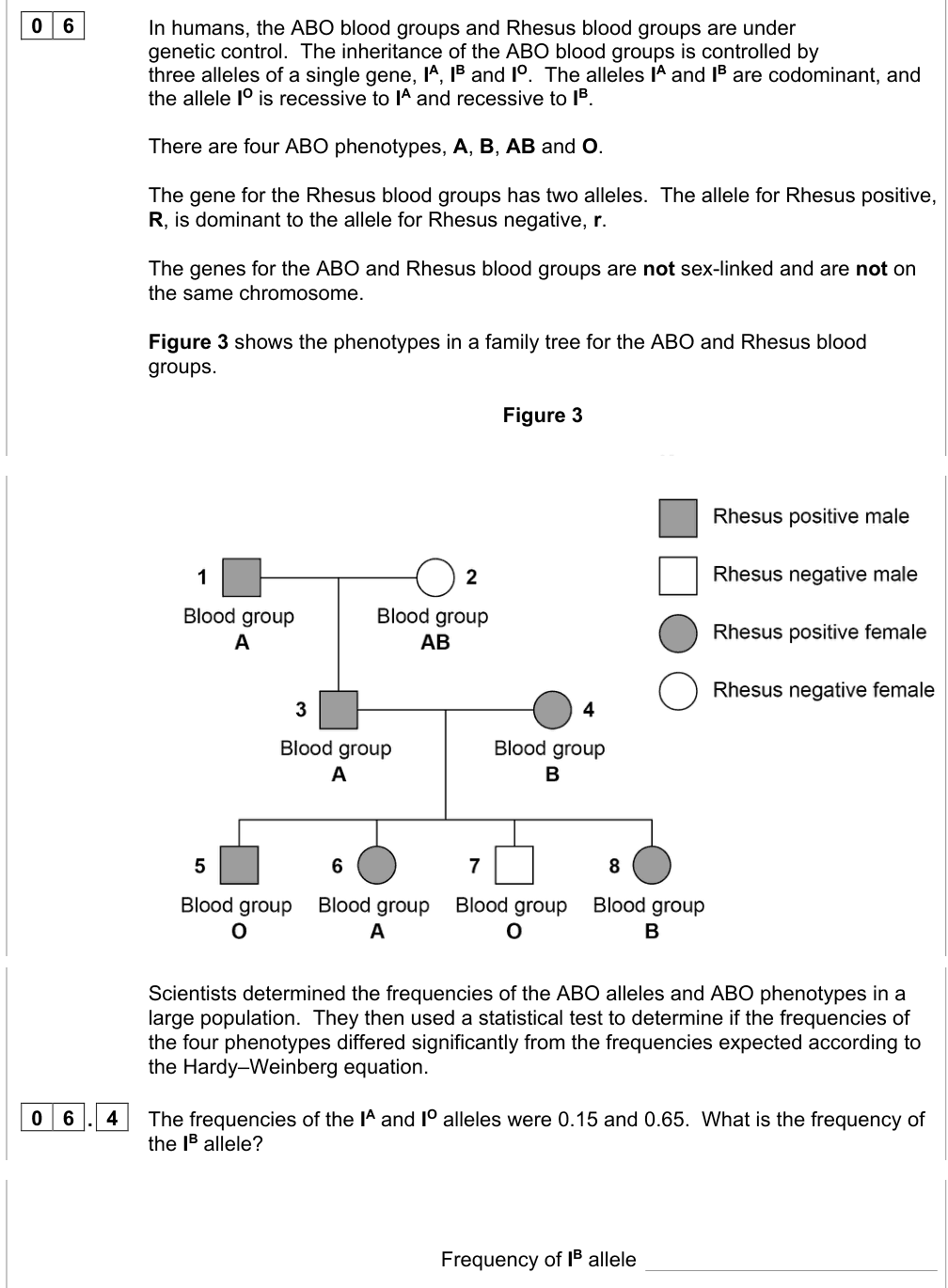
Mark scheme: 0.20.
Examiners said: about 82% answered correctly. The most common wrong answer was 0.02.
Question 2 (H420/03, June 2022, 2 marks)
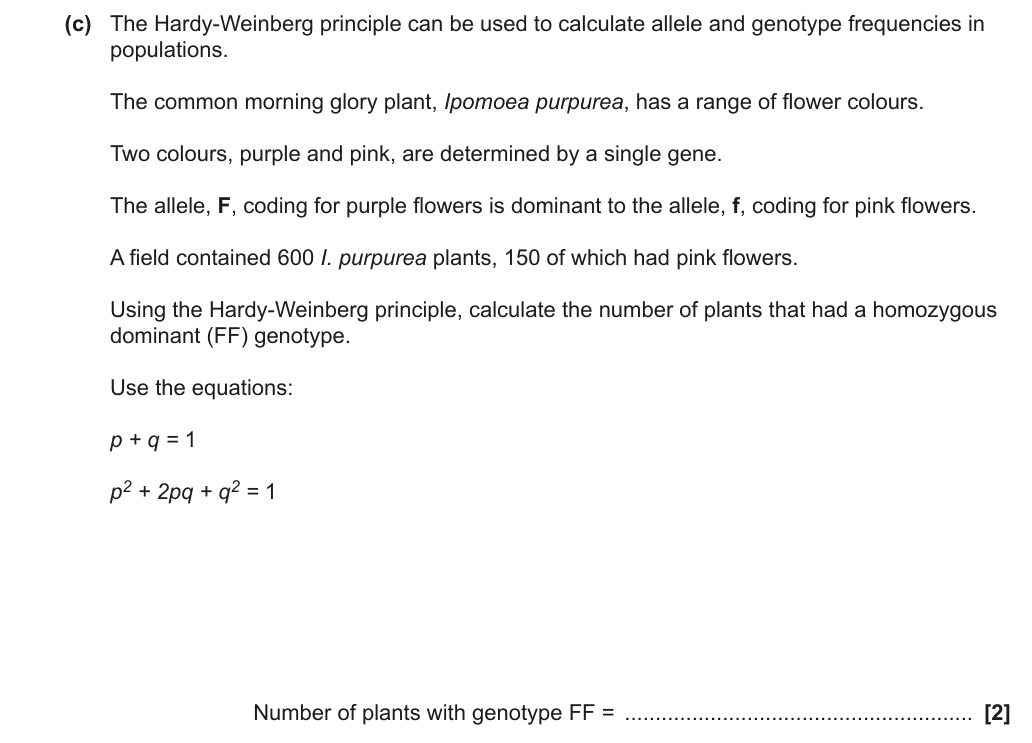
Mark scheme: 150/600 = 0.25 (q2); q = √0.25 = 0.5; p = 1 − 0.5 = 0.5; p2 = 0.25; 0.25 × 600 = 150 (2 marks). One mark for any two correct steps of the process, with error carried forward allowed.
Examiners said: students who correctly worked out that 150/600 = 0.25 is q2 often went on to get both marks. The most common error was to treat 150/600 as q rather than q2.
Question 3 (7402/2, June 2018, 2 marks)
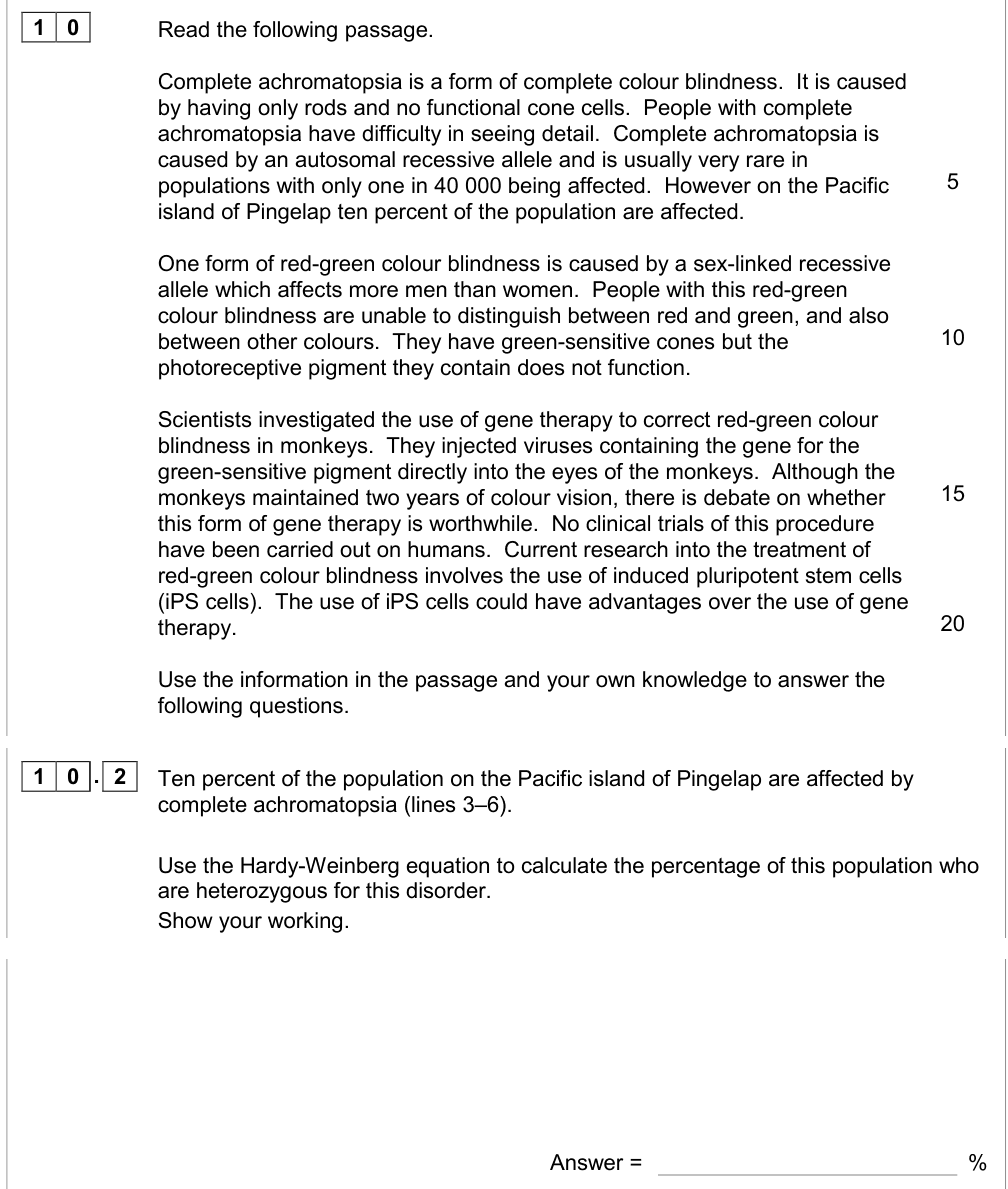
Mark scheme: correct answer in the range 42–44% = 2 marks. If the answer is wrong, 1 mark for showing that 2pq (or 1 − (p2 + q2)) represents the heterozygotes or carriers. (q2 = 0.1, q = 0.316, p = 0.684, 2pq = 0.43.)
Examiners said: 70% got at least one mark for recognising that 2pq is the heterozygous genotype, and 39% got both. Many who scored zero just wrote out the equation with no annotation. Students on one mark often took 0.1 as q rather than q2, and "pq" for the heterozygotes earned nothing.
Question 4 (H420/02, June 2025, 4 marks)
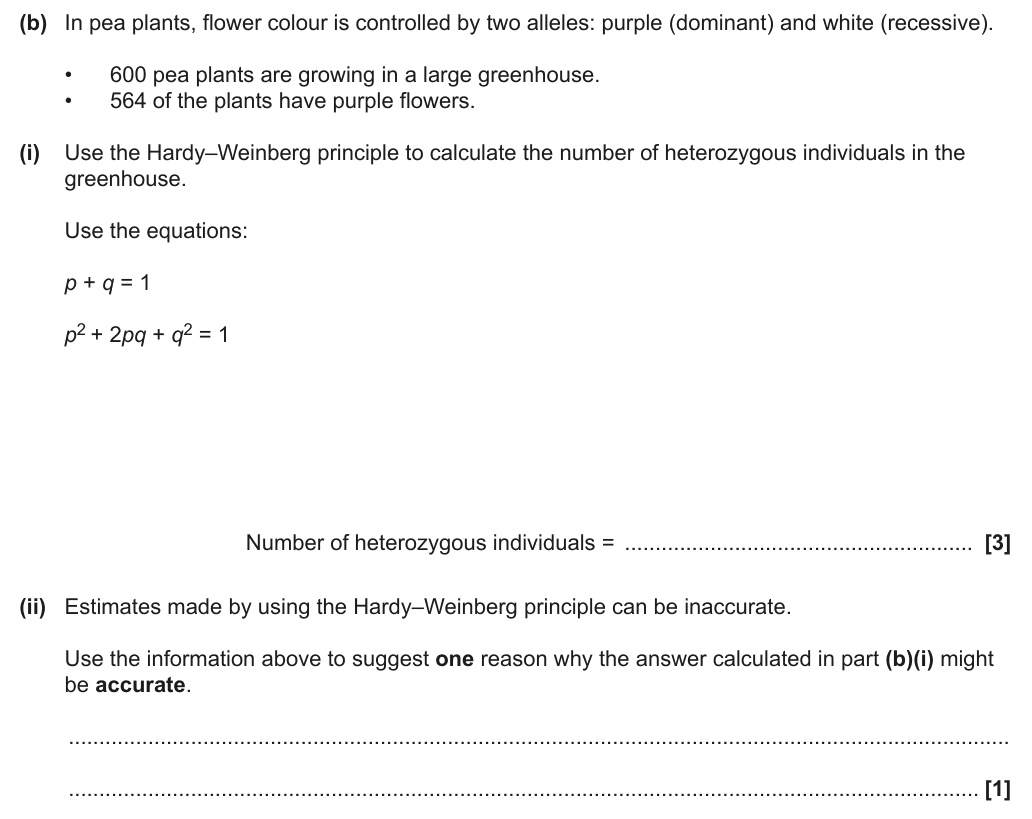
Mark scheme: (a) q2 = 0.06; q = 0.245, p = 0.755, 2pq = 0.37; 600 × 0.37 = 222 (220, 221 or 222 accepted for 3 marks). 2 marks for answers from common slips, such as 218 or 219 (q rounded to 0.24) and 67 or 68 (taking q as 0.06). (b) no migration or gene flow, or a large population (600). Isolated or closed environment allowed; "no mutations" ignored.
Examiners said: in (a), many students got no marks because of a lack of coherent working or not understanding the process. They should identify q first and work from there. The white plants are 600 − 564 = 36, so q2 = 36/600. In (b), despite "accurate" being in bold, many wrote about why the answer might be inaccurate. The most commonly credited answer was the large sample size.
Question 5 (7402/2, June 2022, 2 marks)
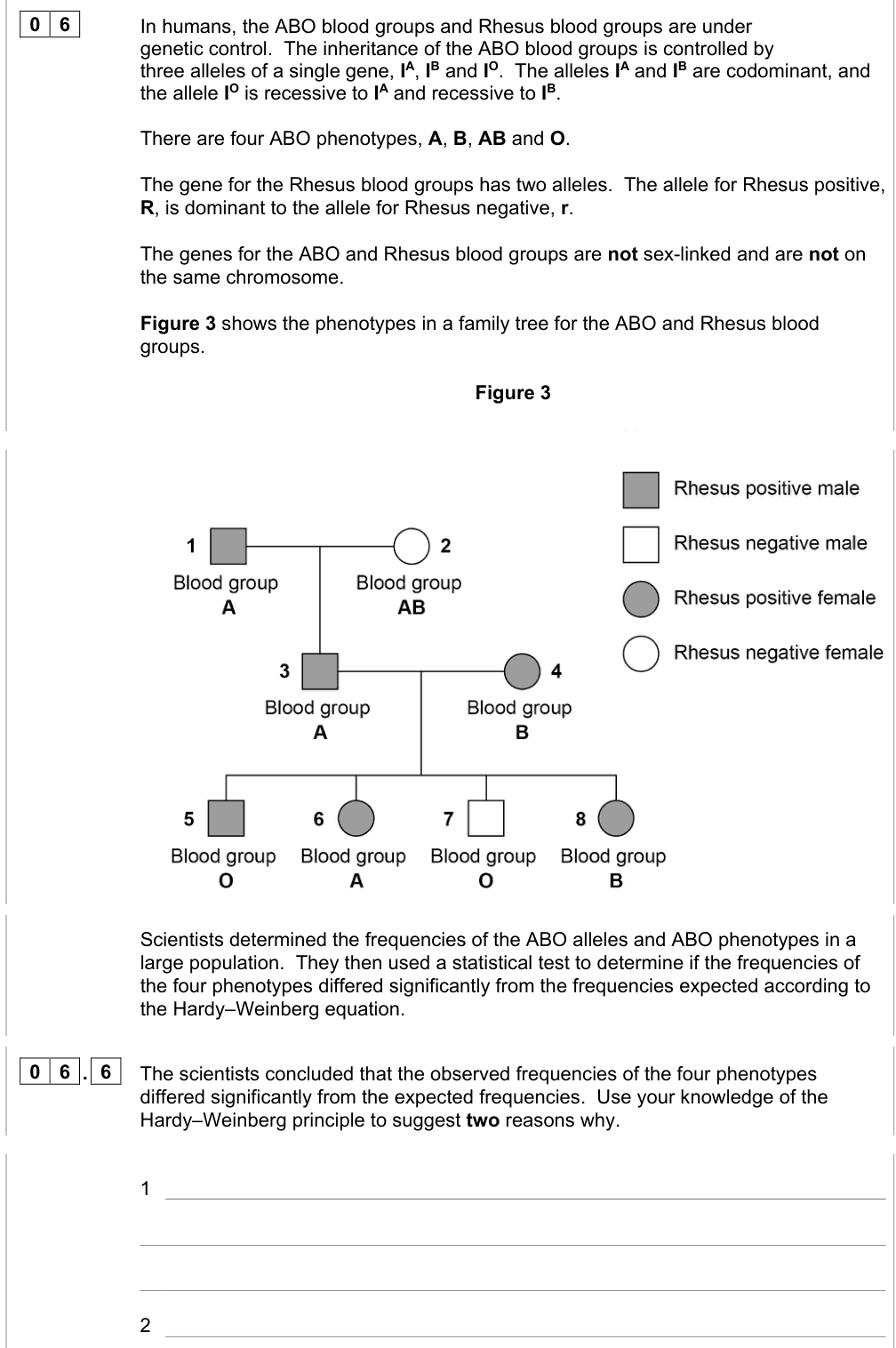
Mark scheme: any two of: selection (for or against a blood group); (high rate of) mutation; immigration or emigration (or the population is not isolated); no random mating. Converse statements are rejected, and births or deaths and "random fertilisation" are ignored.
Examiners said: almost four out of five students scored zero and only 9% got both marks. Wrong answers included crossing over, linked genes, codominance, independent assortment and random fertilisation. Many suggested a small population, even though the stem said it was large. Correct answers usually named mutation, migration or selection; non-random mating was rarely seen.
Question 6 (7402/2, June 2023, 2 marks)
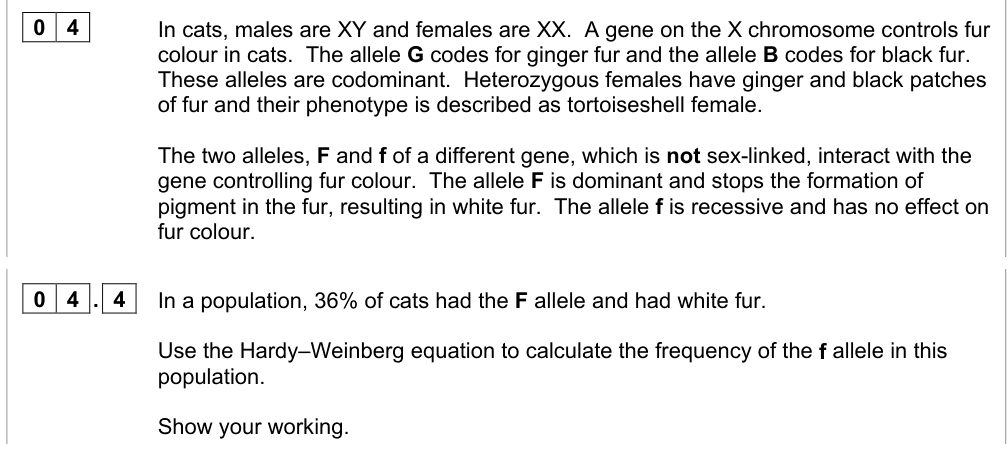
Mark scheme: correct answer 0.8 (or 80%) = 2 marks. If the answer is wrong, 1 mark for showing that ff (q2) = 0.64 or 64%.
Examiners said: about 70% of students got no marks and about 22% got both. The most common error was to assume that p or p2 was 0.36. Some correctly found q2 = 0.64 but then calculated the heterozygotes instead of the allele frequency.
Common mistakes (from the examiners’ reports and mark schemes)
Using the recessive phenotype frequency as q. Gains credit: "q2 = 0.1, so q = √0.1 = 0.316". The proportion of affected individuals is q2, not q.
Putting the dominant phenotype percentage straight into q2, p2 or p. Gains credit: "36% have the dominant phenotype, so q2 = 1 − 0.36 = 0.64 and q = 0.8".
Using pq, or dividing 2pq by 2, for the heterozygotes. Gains credit: "heterozygotes (carriers) = 2pq", or 1 − (p2 + q2).
Writing the equation incorrectly, for example 2pq2. Gains credit: "p2 + 2pq + q2 = 1", written correctly and with each term labelled.
Writing the equation with no annotation, or no clear working. Gains credit: labelled steps such as "q2 = 36/600 = 0.06; q = 0.245; p = 0.755; 2pq = 0.37".
Stopping at 2pq when the question asks for a number or a percentage. Gains credit: "600 × 0.37 = 222 plants" or "0.0198 × 100 = 2% to one significant figure".
Ignoring the instruction about significant figures. Gains credit: the answer in the form asked. OCR's tiger question (June 2017) capped answers at 2 marks if not given to one significant figure.
Giving reasons that have nothing to do with the Hardy-Weinberg conditions, such as crossing over, codominance, independent assortment or a small population when the stem says it is large. Gains credit: "selection", "mutation", "immigration or emigration" or "non-random mating", applied to the context.
Confusing Hardy-Weinberg with mark-release-recapture, or saying "we don't know if the allele is dominant or recessive". Gains credit: for a condition such as cleft lip and palate, "it is not caused by a single gene" or "environmental factors are involved".
Practice questions
For more practice, try my Hardy-Weinberg questions with mark schemes.
Want help with topics like this every week?
My weekly group classes for AQA and OCR A work through exam questions topic by topic, and every class is recorded. Or book a first one-to-one lesson. For the exam dates, see A-level Biology exam dates 2027.