

Repeatability and reproducibility are the words OCR wants when students talk about repeats, means and spread – and they are the words students most often get wrong. As the H420/01 June 2018 report puts it: "Few candidates used the correct terms, reproducibility or repeatability, in their responses."
This is the first of three articles on OCR practical language. The other two cover validity and control variables vs control experiments. Each example follows the same pattern:
The definition – OCR's wording from Appendix 3 of the Biology A Practical Skills Handbook.
The question – a screenshot of a real OCR Biology A question, followed by a screenshot of its mark scheme.
The examiners' report – what students wrote and where they lost marks.
Never write "reliable". The handbook says: "In particular please note that reliability will no longer be used." The June 2025 H420/02 report is blunt: "'Reliable' is not an acceptable term according to the language of measurement."
Repeatability
OCR definition: "Repeatability is the precision obtained when measurement results are produced over a short timescale by one person (or the same group) using the same equipment in the same place."
What it means: repeatability is about how closely your own repeat readings agree. You assess it by doing replicates and looking at the spread – the range, the standard deviation or the size of error bars. A small spread means high repeatability. Repeats let you assess repeatability; they do not make a single reading more accurate.
Example 1 – using standard deviations (H420/02, June 2023, Q17(b)(ii))
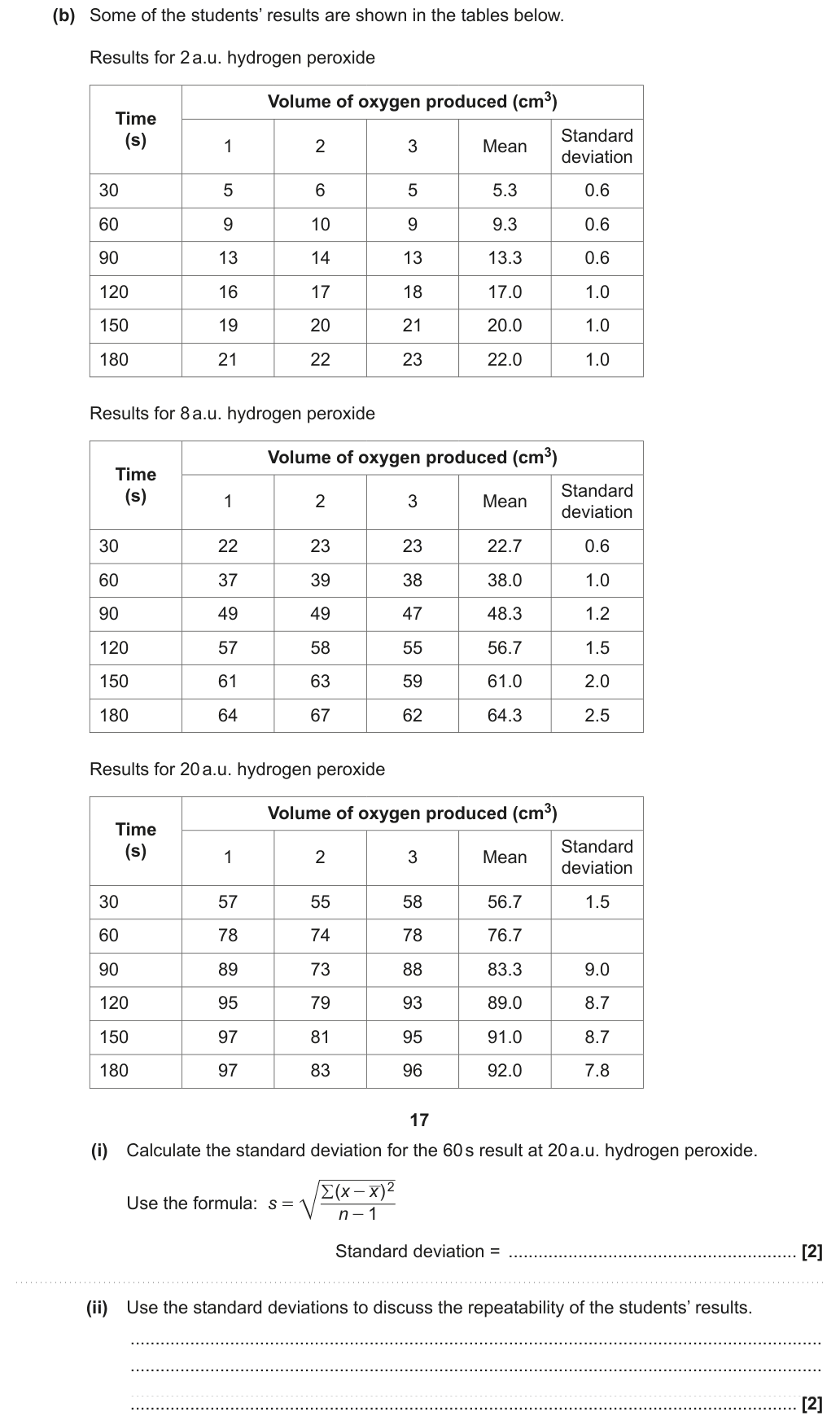
Students measured the oxygen released when potato cylinders (containing catalase) were placed in hydrogen peroxide at three concentrations, with three repeats each.
Mark scheme

Examiners' report: "Around a third of candidates scored both of the marks available for this question. One common mistake was to omit the word 'repeatability' or to use it in absolute, rather than comparative, terms (e.g. 'the results are repeatable'). Some candidates merely defined the terms without reference to the numbers in the table."
Why the mark scheme is right: a standard deviation measures how spread out the three repeats are around their mean. Repeatability is how closely repeats agree, so a smaller standard deviation means more repeatable results. Repeatability is always relative, which is why "it is repeatable" scores nothing: the mark scheme wants a comparison between concentrations or times. "Higher precision" is accepted because OCR defines repeatability as a kind of precision.
How to answer: look along the standard deviation columns and find the pattern (here it rises with concentration and with time). State the pattern, then turn it into a comparative statement using the word repeatable.
Model answer:
The standard deviations are lowest at 2 a.u. (0.6–1.0) and highest at 20 a.u. (up to 9.0), and at each concentration they increase with time. So the results are more repeatable at lower concentrations and at earlier times.
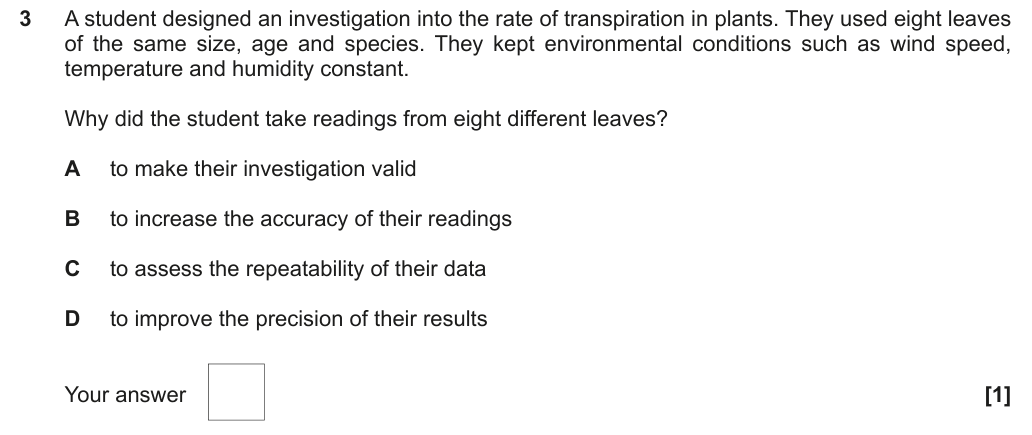
Example 2 – repeats do not increase accuracy (H020/01, June 2018, Q3)
Mark scheme

Examiners' report: "This question tests understanding of experimental design. Many readings are used to test repeatability but many candidates still believe that it will increase accuracy."
Why the mark scheme is right: the student has already controlled leaf size, age, species, wind speed, temperature and humidity, so the investigation is already designed to be valid (A). Taking several readings does not move any single reading closer to the true value, so it does not increase accuracy (B). It does not make the readings closer together either, so it does not improve precision (D). What eight readings do allow is a check on how much the results vary – they let you assess repeatability (C).
How to answer: watch the verb in each option. Repeats let you assess or measure repeatability; they don't increase accuracy or improve precision. Then check whether validity is already dealt with in the stem.
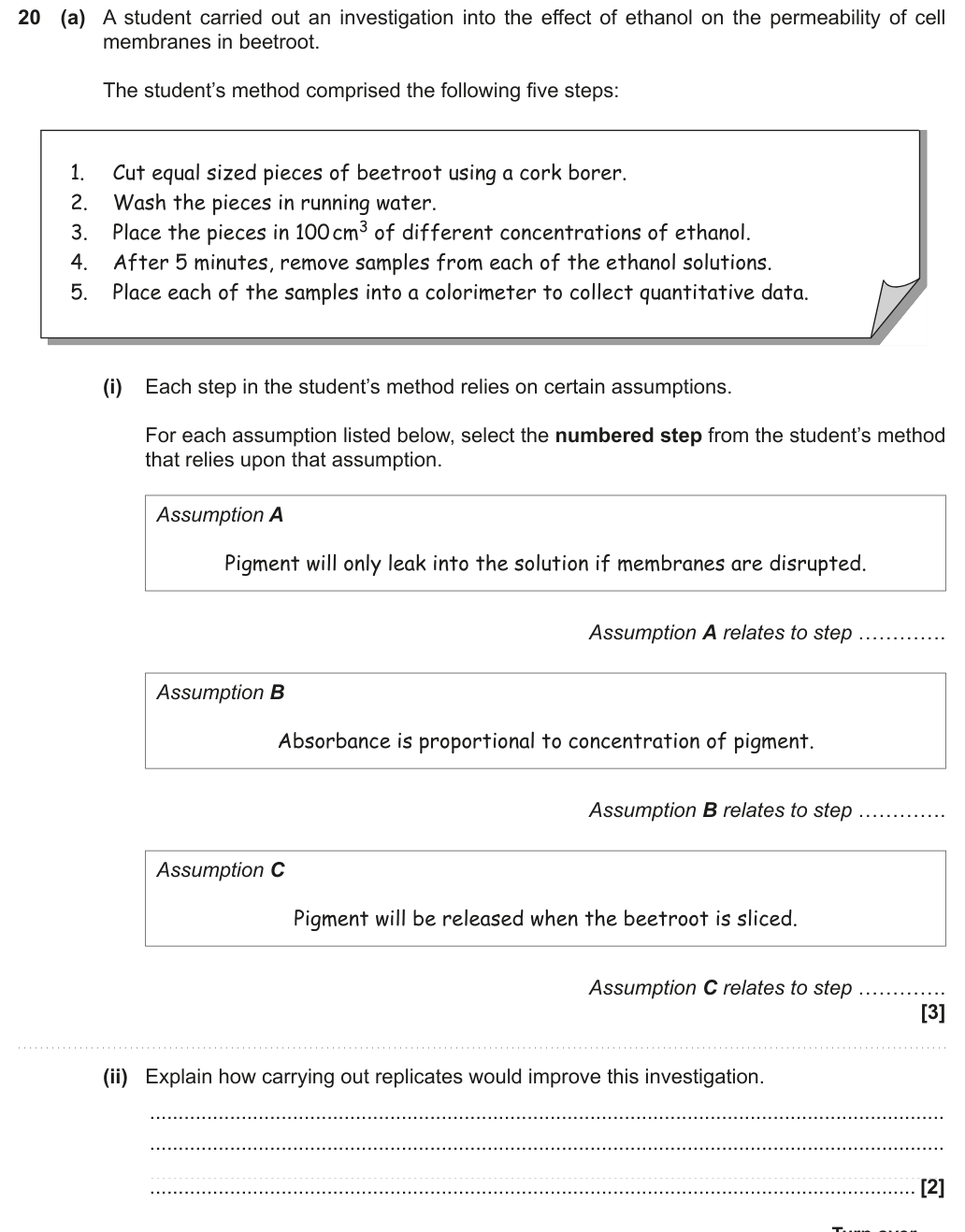
Example 3 – explaining why replicates help (H420/01, June 2018, Q20(b)(ii))
Mark scheme

Examiners' report: "Candidates who gained full marks generally considered the potential to identify anomalies and calculate means. Marks were lost due to incorrect use of terms such as averages and validity or reference to removing or preventing anomalies. Few candidates used the correct terms, reproducibility or repeatability, in their responses."
Why the mark scheme is right: each mark is something replicates actually let you do. With several readings at each ethanol concentration you can calculate a mean, spot a reading that doesn't fit the others, see how closely the repeats agree, and run a standard deviation or t-test. Replicates do not change what is being measured, so "validity" is ignored. They don't remove systematic error, so "accuracy" is ignored, and "reliability" is no longer used. They cannot prevent an anomaly – it still happens – and "removing" anomalies is not good practice unless there's a clear reason.
How to answer: this is "explain how", so give two separate things replicates allow you to do, using the correct terms.
Model answer:
Replicates allow a mean absorbance to be calculated at each ethanol concentration, and allow anomalous readings to be identified. They also allow the repeatability of the results to be assessed.
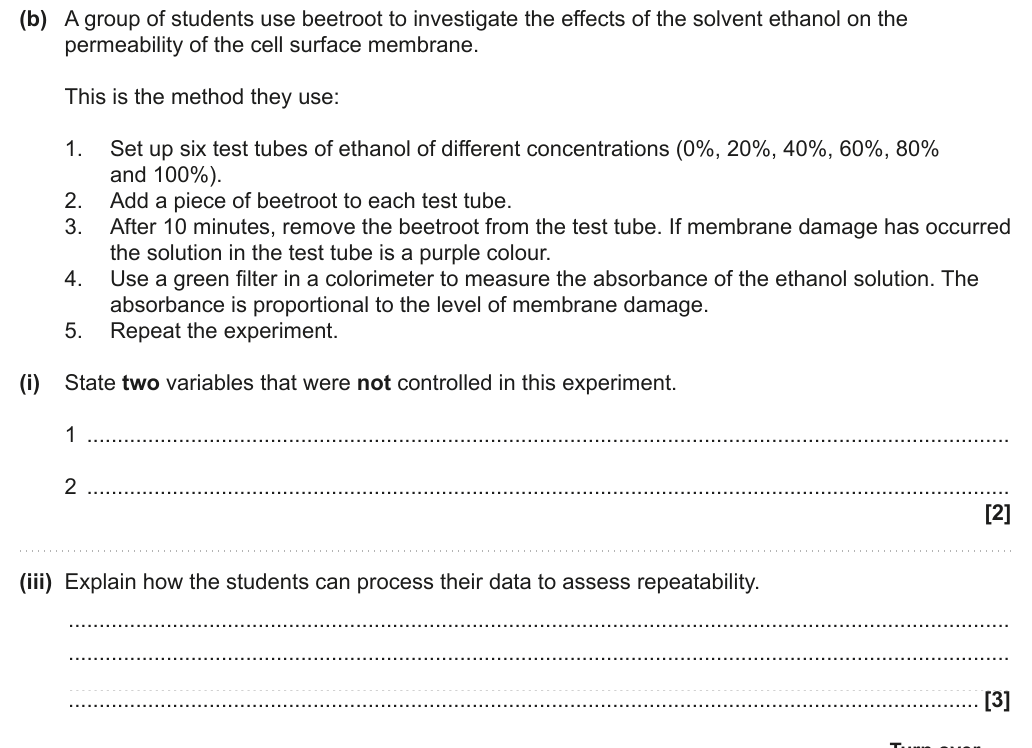
Example 4 – processing data to assess repeatability (H020/01, June 2025, Q24(b)(iii))
Mark scheme
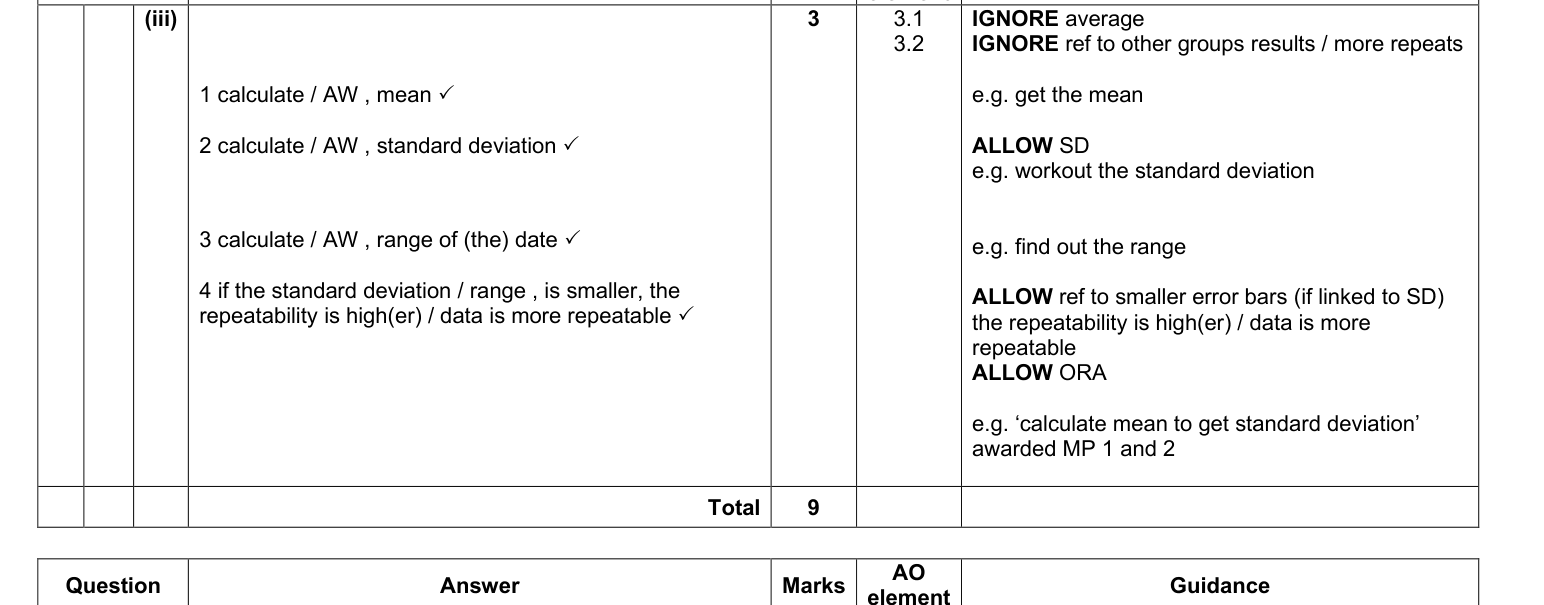
Examiners' report: "Some candidates got all 3 marks, but other candidates did not show an understanding of the term 'repeatability', confusing it with 'precise' and 'accurate'. Also, the question asked candidates how they would process the data to assess repeatability and many incorrectly talked about doing repeats and comparing the results to others, presumably not realising that although these methods can increase repeatability, they are not to do with processing the data obtained. Many described how to plot the data as a calibration curve and draw a line of best fit, which shows the pattern of data but does not show the repeatability of the experiment."
Why the mark scheme is right: "process the data" means calculations on readings you already have. The mark scheme rewards a mean, then a measure of spread (standard deviation or range), then the interpretation: a smaller spread means more repeatable data. Doing more repeats or comparing with other groups is collecting data, not processing it, so it is ignored. A calibration curve converts absorbance into a concentration and shows a trend, but it says nothing about how closely the repeats agree.
How to answer: three marks means three steps – calculate the mean, calculate the spread, and say what a small spread shows.
Model answer:
Calculate the mean absorbance for each ethanol concentration. Then calculate the standard deviation (or range) of the repeat readings at each concentration. The smaller the standard deviation, the more repeatable the data.
Common errors with repeatability
Writing "the results are repeatable" with no comparison and no reference to the data.
Thinking repeats increase accuracy.
Saying repeats "remove" or "prevent" anomalies – they help you identify them.
Writing "average" instead of "mean".
Answering "do more repeats" when the question asks how to process data: the route is mean → standard deviation or range → smaller spread means more repeatable.
Reproducibility
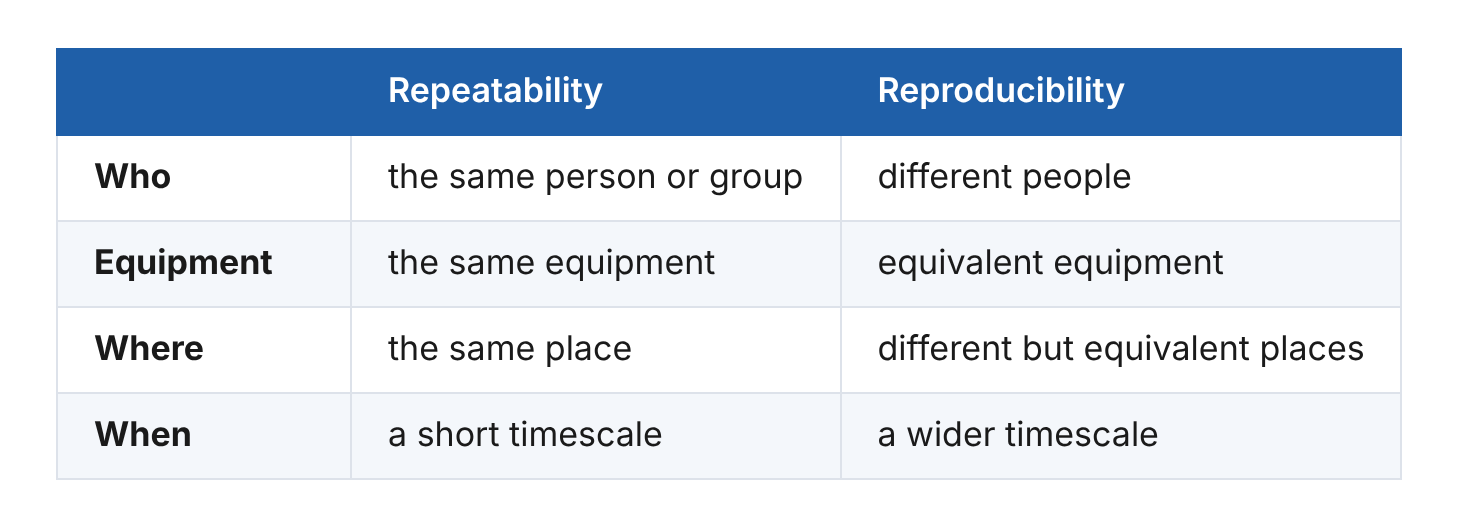
OCR definition: "Reproducibility is the precision obtained when measurement results are produced over a wider timescale by different people using equivalent equipment in different (but equivalent) places."
What it means: reproducibility asks whether someone else – another group, another lab, another day – gets similar results with the same method. That is why a clear, standardised method matters, and why scientists publish their methods and data.
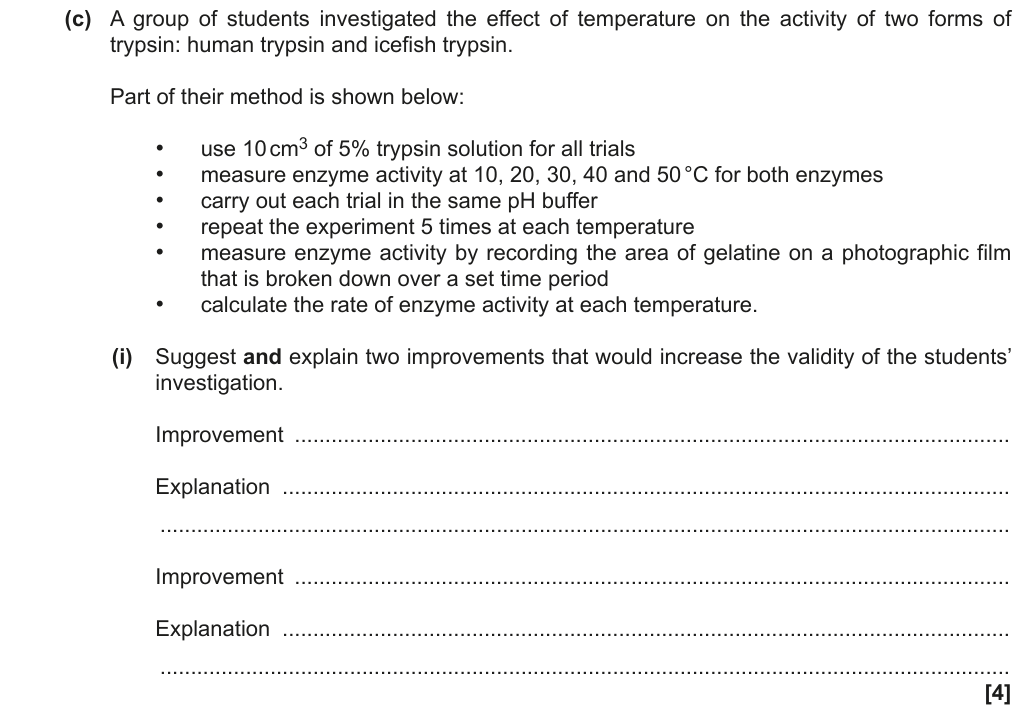
Example 5 – justifying an improvement (H420/03, June 2019, Q3(c)(i))
Mark scheme
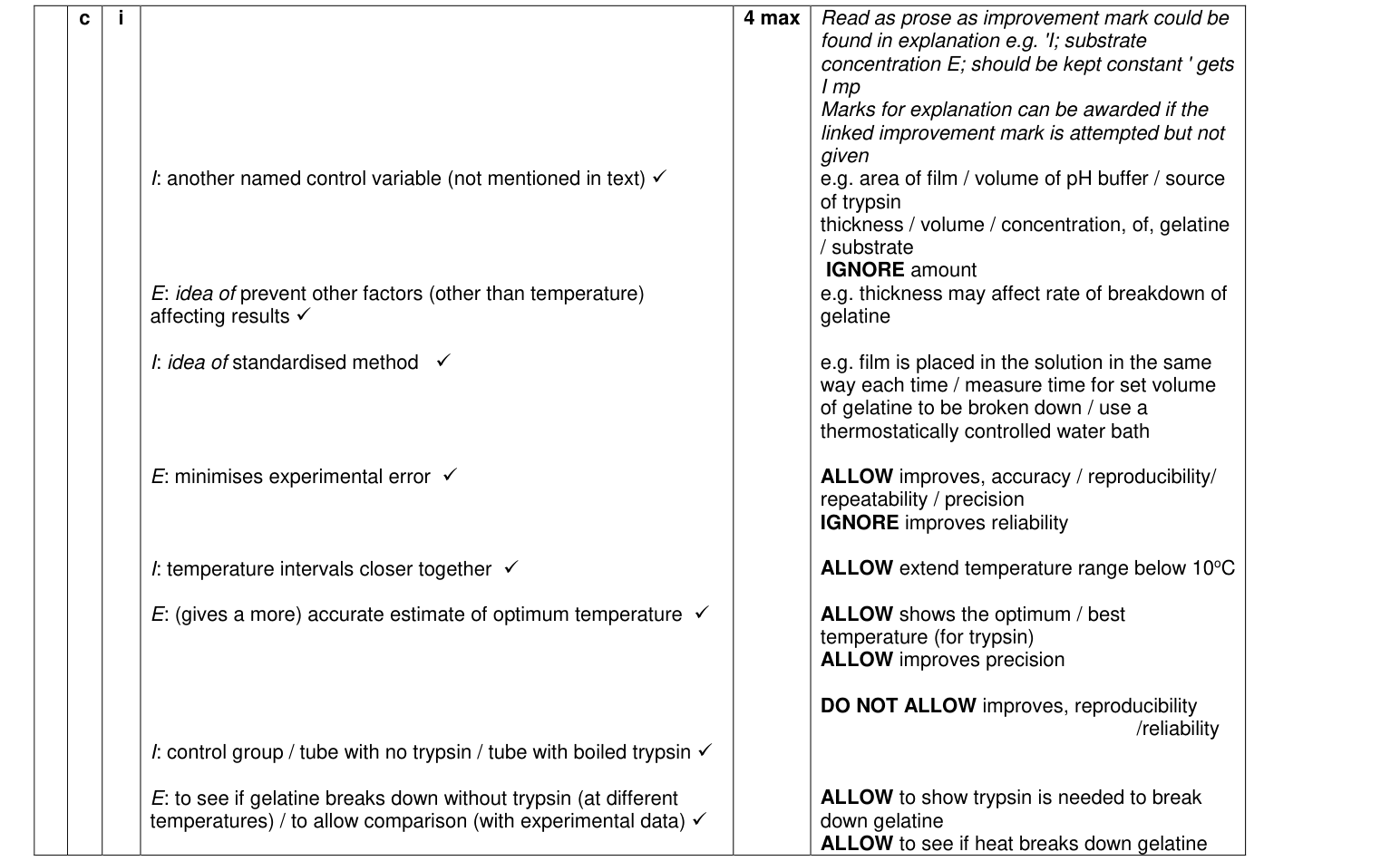
Note the guidance: for a standardised method, "improves accuracy / reproducibility / repeatability / precision" is allowed, but "improves reliability" is ignored.
Examiners' report: "Candidates also sometimes attempted to describe a way of standardising the method, such as using a thermostatically-controlled water bath, although again correct explanations relating to improved precision and reproducibility or repeatability were not always forthcoming… Correct use of terms such as accuracy, precision, reproducibility and repeatability were important in answering this question. Many candidates justified their suggested improvements by simply repeating the term 'validity' from the question."
Why the mark scheme is right: each improvement must be something new – the trypsin volume and concentration, the buffer and five repeats are already in the method. Each explanation must say why the change makes the results better at answering the question. Note the fine detail: a standardised method (such as a thermostatically controlled water bath) can improve repeatability or reproducibility, because everyone doing it the same way gets closer results. Closer temperature intervals improve accuracy in finding the optimum, but they don't make results more reproducible, so that word is not allowed there. "Reliability" is never credited.
How to answer: for each improvement, name one specific change not already in the method, then say what it achieves using the correct term.
Model answer:
Improvement 1: keep the thickness of the gelatine layer on the film the same. Explanation: gelatine thickness affects the rate of breakdown, so only temperature would affect the results.
Improvement 2: set up a tube with boiled trypsin at each temperature. Explanation: this shows whether the gelatine breaks down without active enzyme, so any breakdown in the test can be attributed to trypsin.
Example 6 – why results are published (H420/03, June 2022, Q1(d)(iii))

Mark scheme

Examiners' report: "Most candidates were able to get across the idea that publishing data was to allow other scientists to see the information, compare the results, or check the validity/reproducibility. Those candidates whose responses were given no marks suffered from lack of detail, mentioning just peer review, or describing what is included in a journal."
Why the mark scheme is right: results are published so that other scientists can see the methods and data, repeat the work and check the conclusions – in other words, check whether the results are reproducible. "Peer review" on its own only names the process; it doesn't say what publication is for.
How to answer: one mark, so one clear purpose. Say who uses the results and what they do with them.
Model answer:
So that other scientists can repeat the trials and check whether the results are reproducible.
Common errors with reproducibility
Using reproducible when the same student repeats the experiment – that is repeatability.
Explaining an improvement by echoing the question's own word ("it makes it more valid") instead of saying why it helps.
Answering "peer review" on its own without saying what other scientists would do with the results.
Terms students confuse with repeatability
Accuracy. OCR handbook definition: "a measure of the closeness of agreement between an individual test result and the true value". Typical error in the examiners' reports: Thinking repeats increase accuracy (H020/01 June 2018 Q3).
Precision. OCR handbook definition: "the closeness of agreement between independent measurements obtained under the same conditions" – it "does not relate to the true value". Typical error in the examiners' reports: Using "precise" for equipment, when the right word is resolution (H420/03 June 2023 Q5(b)(i)).
Confidence. OCR handbook definition: "a qualitative judgement expressing the extent to which a conclusion is justified by the quality of the evidence". Typical error in the examiners' reports: Describing validity when asked how to have confidence in results (H020/01 June 2018 Q21(d)(i)).
Anomaly. OCR handbook definition: "a value in a set of results that is judged not to be part of the inherent variation". Typical error in the examiners' reports: Saying repeats "remove" or "prevent" anomalies (H420/01 June 2018 Q20(b)(ii)).
Reliability. OCR handbook definition: "reliability will no longer be used". Typical error in the examiners' reports: Still written often – "'Reliable' is not an acceptable term" (H420/02 June 2025).
Two examiner statements worth learning word for word:
"'Accuracy' and 'precision' are terms used to describe data and experimental results rather than equipment." (H420/03, June 2023)
"Precise results are clustered together, while standard deviation gives an indication of how spread the data is around the mean and accuracy is a property of a single result." (H020/01, June 2022)
Checklist
Repeats → assess repeatability, calculate a mean, identify anomalies, allow a statistical test. Not "more accurate", not "removes anomalies".
Discussing repeatability from data → compare standard deviations or error bars and use repeatable comparatively.
Same person, same equipment, short time = repeatability. Different people, equivalent equipment, different place or time = reproducibility.
Write "mean", not "average".
Never write "reliable".
Sources
OCR Biology A Practical Skills Handbook, v2.1 – Appendix 3, Measurements: useful terms
Question, mark scheme and examiners' report extracts © OCR, from the OCR Question Bank app: H420/02 June 2023 Q17(b)(ii); H020/01 June 2018 Q3; H420/01 June 2018 Q20(b)(ii); H020/01 June 2025 Q24(b)(iii); H420/03 June 2019 Q3(c)(i); H420/03 June 2022 Q1(d)(iii); H420/02 June 2025 Q18(a)(ii)
OCR examiners' reports: H420/02 June 2023 · H020/01 June 2018 · H420/03 June 2019 · H420/03 June 2022 · H020/01 June 2022 · H420/03 June 2023 · H020/01 June 2025 · H420/02 June 2025