

AQA 3.5.2 · 5 exam questions worked through · about 15 minutes
Studying A-level Biology? I'm Tom, an A-level Biology teacher with 30 years' experience. I offer one-to-one lessons and weekly group classes for AQA and OCR A, with every lesson recorded.
This post covers AQA specification 3.5.2, respiration: glycolysis, the Krebs cycle, anaerobic respiration, the electron transfer chain and ATP synthase. Work through five real AQA A-level questions and you'll see exactly what the mark schemes credit and where the examiners say marks were lost.
What you need to know first
- The four stages of aerobic respiration and where each one happens in the cell
- That oxidation can mean the loss of hydrogen, and reduction the gain of hydrogen
- That reduced NAD and reduced FAD carry hydrogen to the electron transfer chain
- How ATP synthase uses the movement of protons to make ATP
Question 1: Describe glycolysis (4 marks)
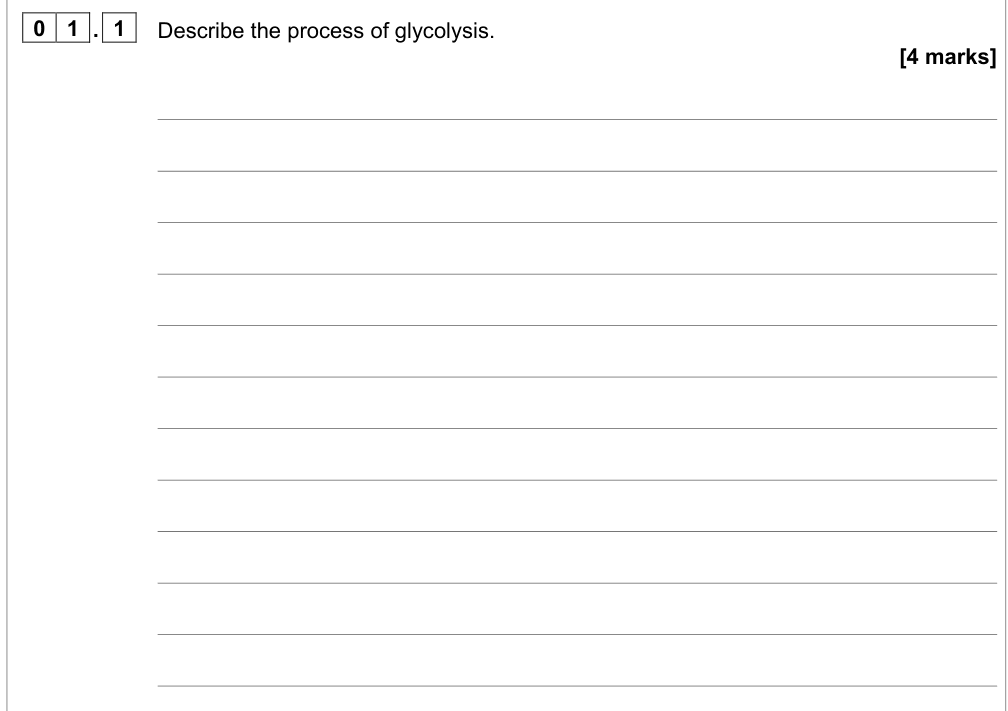
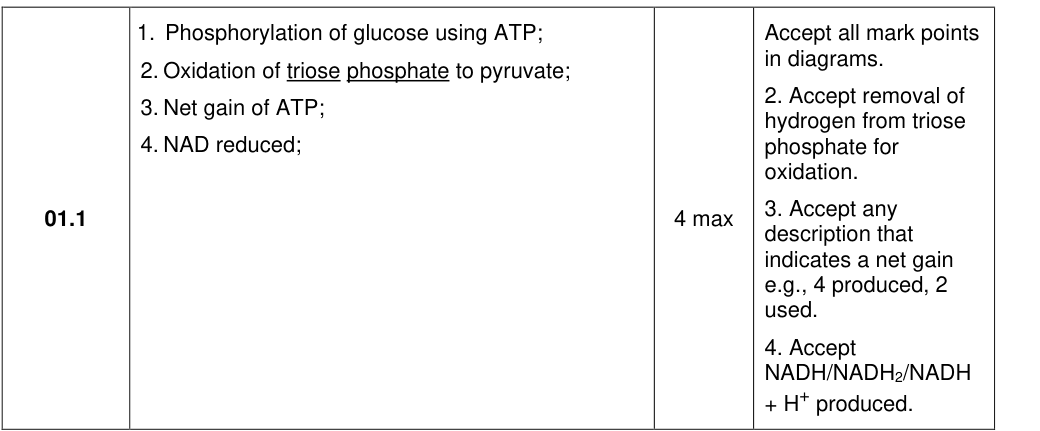
How to approach it. There are four marks and four steps to give, in order: glucose is phosphorylated using ATP; triose phosphate is oxidised to pyruvate; NAD is reduced; and there is a net gain of ATP (4 made, 2 used). A labelled flow diagram can score all four points.
Mark scheme
Common mistakes (from AQA's examiners' reports and mark schemes)
- Describing a different process. The examiners' report says a third of students scored 0, and a number of them described glycogenesis, glycogenolysis or gluconeogenesis. Gains credit: the steps of glycolysis itself, starting with "glucose is phosphorylated using ATP".
- Mixing in photosynthesis. The report saw answers with reduced NADP, RuBP and GP. Gains credit: "NAD is reduced" (the mark scheme accepts NADH or reduced NAD produced).
- Mentioning ATP production without making the net gain clear. Gains credit: "a net gain of ATP" or "4 ATP produced and 2 used".
- Writing that triose phosphate is "converted" or "broken down" to pyruvate. The report says this was the hardest mark, and fewer than 10% of students scored all four. Gains credit: "triose phosphate is oxidised to pyruvate" or "hydrogen is removed from triose phosphate".
Question 2: Malonate and oxygen uptake (2 marks)
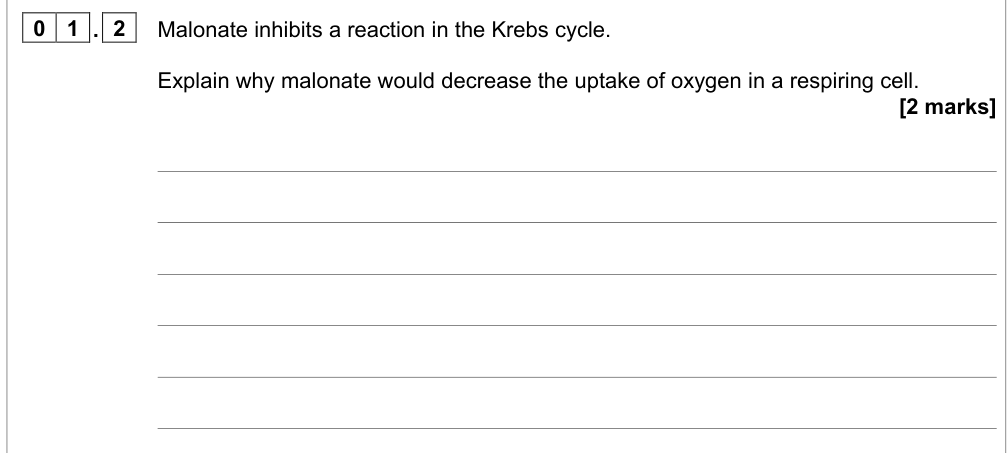
How to approach it. Link the Krebs cycle to oxygen in two steps. If a Krebs cycle reaction is inhibited, less reduced NAD (and reduced FAD) is made, so fewer hydrogens and electrons are passed to the electron transfer chain. Oxygen is the final electron acceptor of that chain, so less oxygen is needed.
Mark scheme

Common mistakes (from AQA's examiners' reports and mark schemes)
- Saying oxidative phosphorylation would not occur, with no further detail. Gains credit: "less reduced NAD is produced, so fewer electrons are passed to the electron transfer chain".
- Writing that no NAD or FAD would be produced. The mark is for the reduced coenzymes. Gains credit: "less reduced NAD" or "less FAD reduced".
- Suggesting that a lack of ATP reduces oxygen uptake, or that only anaerobic respiration would occur so less oxygen is needed. The examiners' report says the second of these was a common answer that gained no credit. Gains credit: "oxygen is the final electron acceptor".
Question 3: Why lactate keeps ATP production going (2 marks)
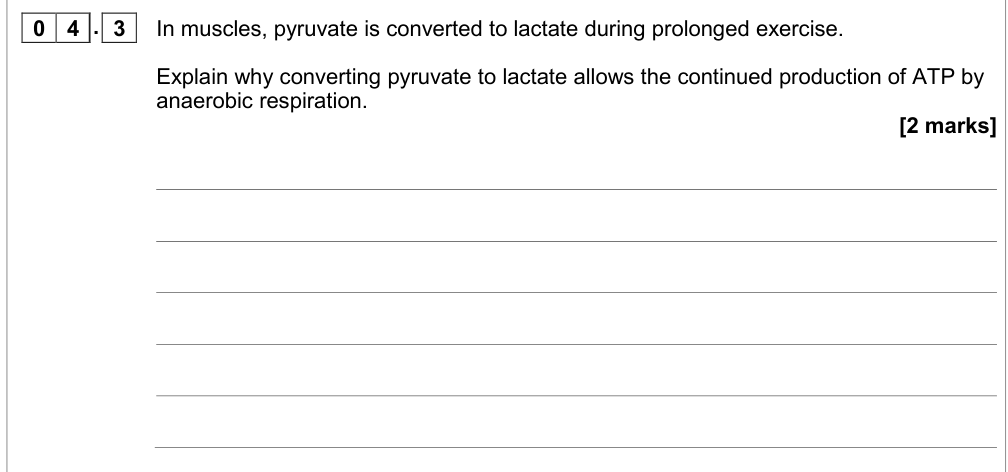
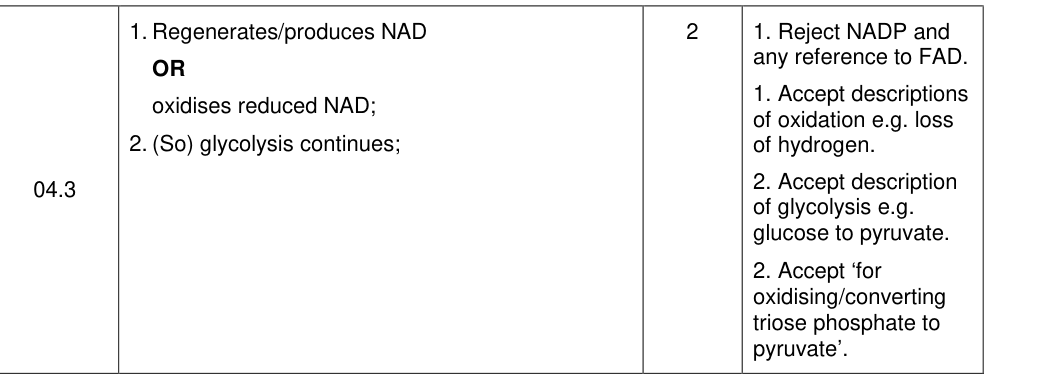
How to approach it. The lactate itself is not the point. Converting pyruvate to lactate oxidises reduced NAD, which regenerates NAD. NAD is needed for glycolysis, so glycolysis can continue and keep making ATP.
Mark scheme
Common mistakes (from AQA's examiners' reports and mark schemes)
- Bringing in the electron transport chain, the Krebs cycle or the link reaction, or saying ATP is made directly when pyruvate is converted to lactate. The examiners' report lists all of these as incorrect responses. Gains credit: "NAD is regenerated, so glycolysis continues".
- Confusing oxidation with reduction. The report says a significant number of students did. Gains credit: "reduced NAD is oxidised" (pyruvate is the molecule that is reduced).
- Writing NADP or FAD. The mark scheme rejects both. Gains credit: "NAD".
Question 4: Inhibiting the electron transfer chain in yeast (3 marks)
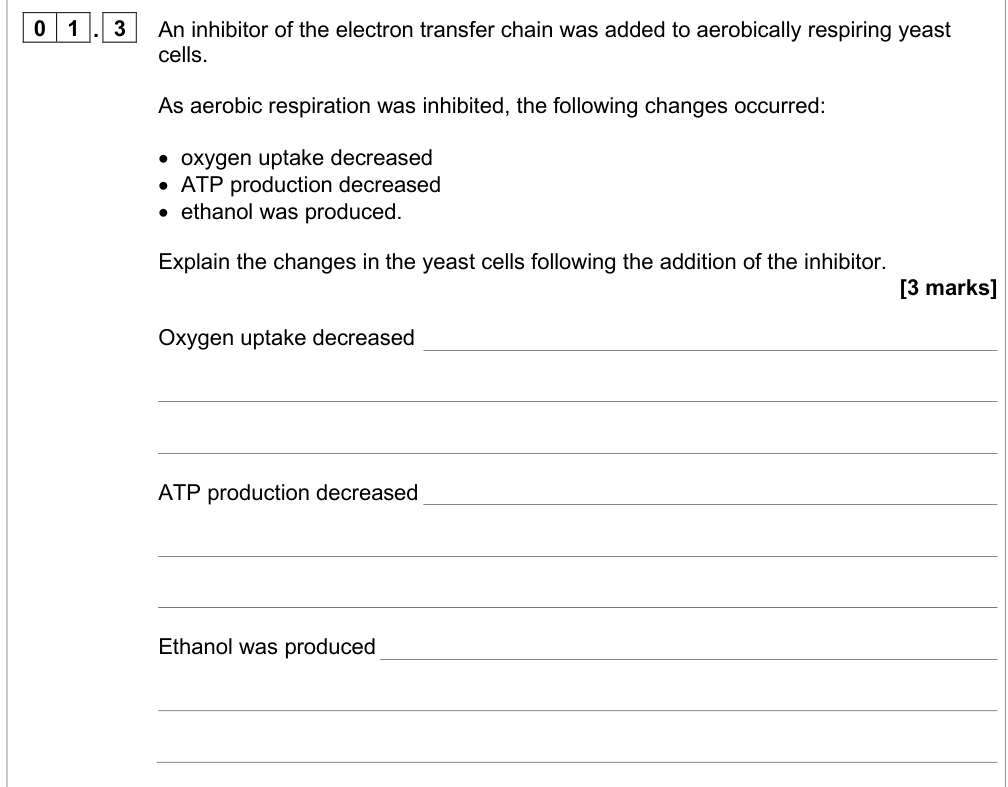
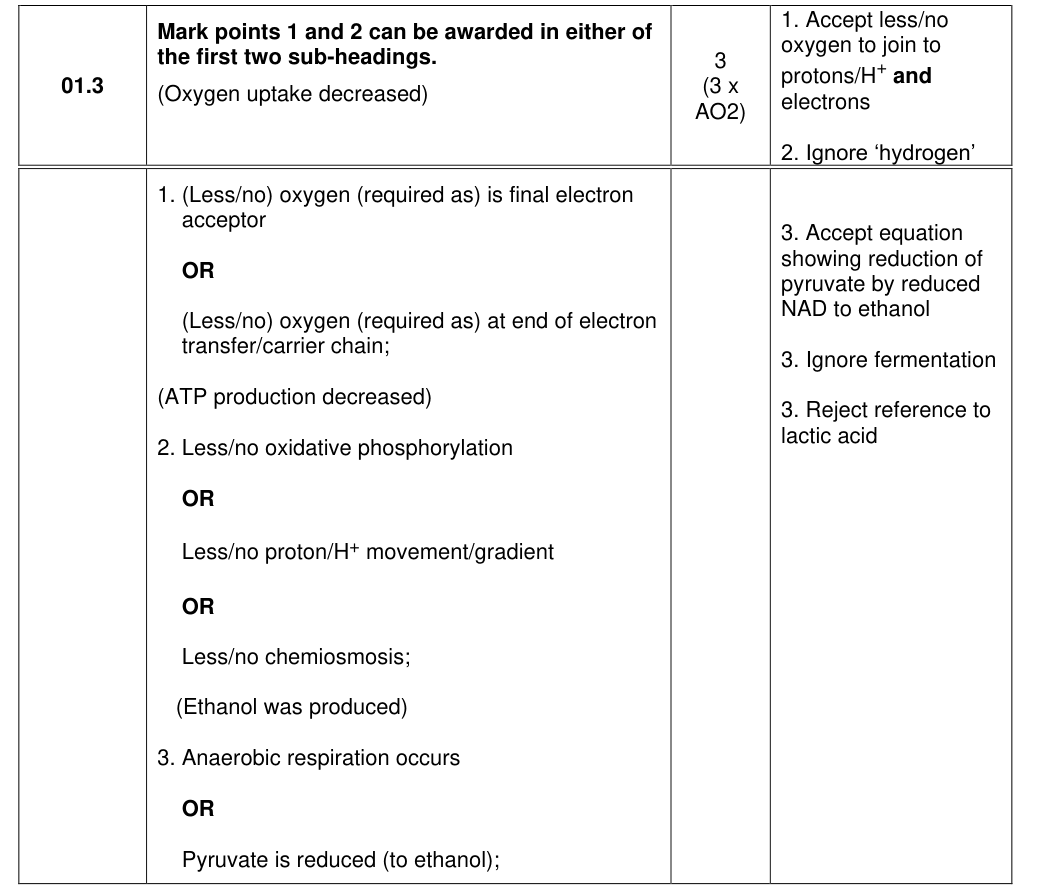
How to approach it. The answer space has three sub-headings, so give one explanation under each. Oxygen uptake falls because oxygen is the final electron acceptor at the end of the chain, so less is needed. ATP production falls because there is less proton movement and so less oxidative phosphorylation. Ethanol appears because anaerobic respiration takes place: pyruvate is reduced to ethanol.
Mark scheme
Common mistakes (from AQA's examiners' reports and mark schemes)
- Explaining the fall in oxygen uptake as "anaerobic respiration is taking place". The examiners' report says this was not credited. Gains credit: "oxygen is the final electron acceptor, so less is required".
- Saying only that fewer electrons move down the chain, so less ATP is made. Gains credit: "less movement of protons", "no proton gradient", "less oxidative phosphorylation" or "less chemiosmosis".
- Naming lactate or lactic acid as well as ethanol. The mark scheme rejects any reference to lactic acid. Gains credit: "anaerobic respiration occurs", with ethanol as the only product named.
- Writing that pyruvate is oxidised to ethanol, or just "converted" to ethanol. The report says the first is incorrect and the second was not credited. Gains credit: "pyruvate is reduced to ethanol".
Question 5: A drug that inhibits ATP synthase (3 marks)
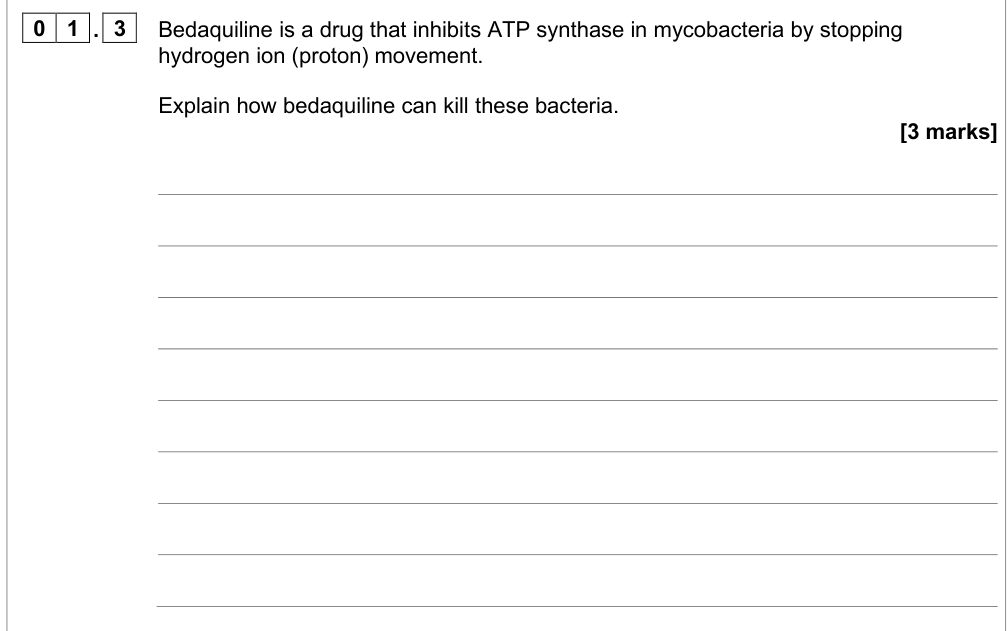
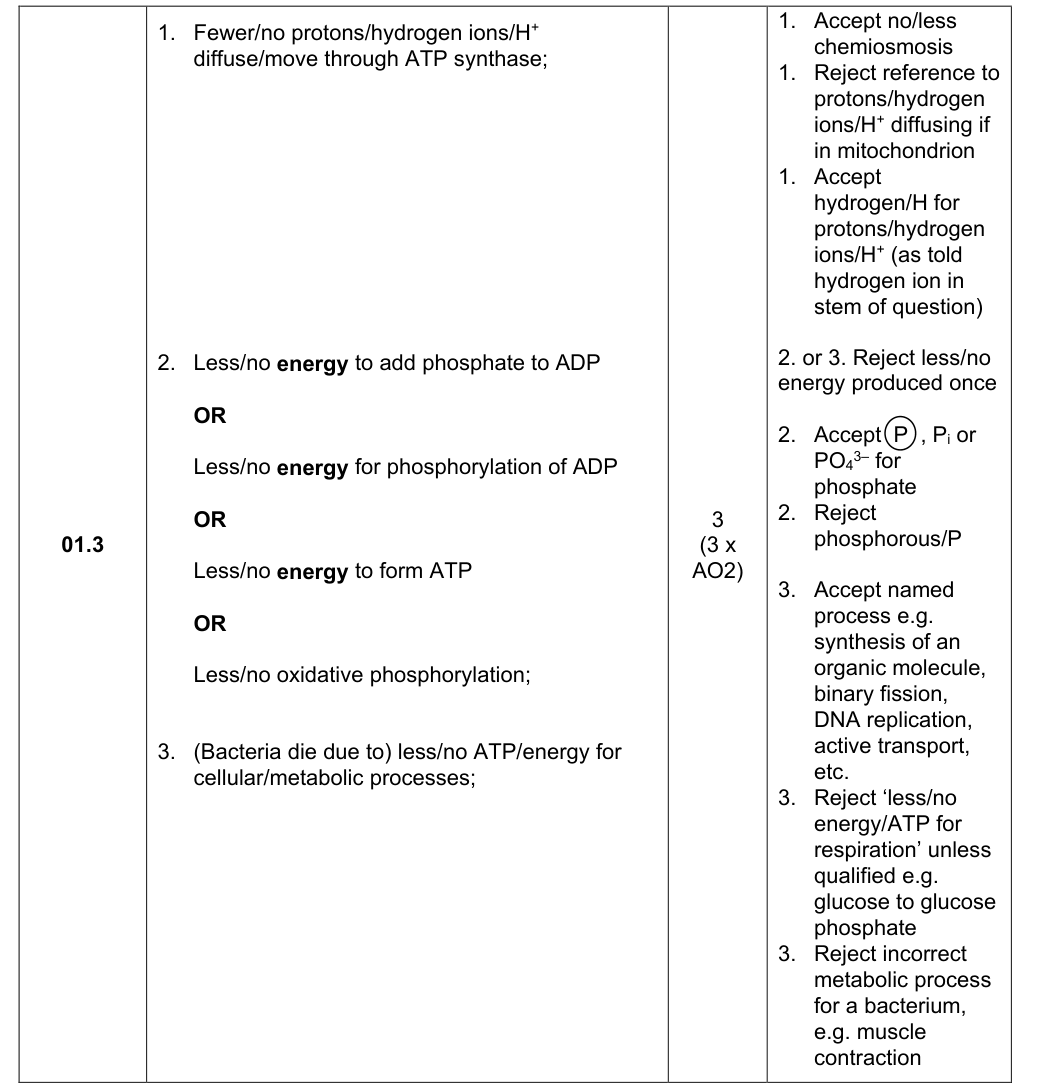
How to approach it. Start from what the question tells you: the drug stops protons moving at ATP synthase. So fewer protons diffuse through ATP synthase; there is less energy to add phosphate to ADP, so less ATP is formed; and without ATP the bacteria cannot carry out processes such as active transport or DNA replication, so they die. These are bacteria, so do not mention mitochondria.
Mark scheme
Common mistakes (from AQA's examiners' reports and mark schemes)
- Writing about the proton gradient being set up, rather than protons moving through ATP synthase. The examiners' report says most students did this. Gains credit: "fewer protons diffuse through ATP synthase".
- Placing the process in mitochondria. The report says students are expected to know that bacteria have no mitochondria, and the mark was rejected. Gains credit: the same point with no organelle named.
- Saying that energy is "produced". The mark scheme rejects this once. Gains credit: "less energy to add phosphate to ADP" or "less energy to form ATP".
- Saying the bacteria need ATP or energy "for respiration". The mark scheme rejects this unless it is qualified. Gains credit: a named process, for example "less ATP for active transport, DNA replication or binary fission".
Key points to remember
- Glycolysis: glucose is phosphorylated using ATP, triose phosphate is oxidised to pyruvate, NAD is reduced, and there is a net gain of ATP.
- Oxygen is the final electron acceptor. Anything that reduces the supply of reduced NAD and reduced FAD reduces oxygen uptake.
- In anaerobic respiration pyruvate is reduced (to lactate in animals, ethanol in yeast and plants). This oxidises reduced NAD so that glycolysis can continue.
- ATP is made when protons diffuse through ATP synthase. Energy is released or transferred, never "produced".
- Use the right coenzyme: NAD and FAD in respiration, NADP in photosynthesis.
Practise next
- AQA respiration exam questions by topic
- AQA Required Practical 9: respiration questions
- All AQA A-level Biology revision resources
Studying this for AQA? My weekly AQA Year 13 masterclass works through topics like this with real exam questions. See the timetable or book a first one-to-one lesson.
Questions, mark schemes and examiners' report comments © AQA.