

OCR A 5.2.2 · 5 exam questions worked through · about 15 minutes
Studying A-level Biology? I'm Tom, an A-level Biology teacher with 30 years' experience. I offer one-to-one lessons and weekly group classes for AQA and OCR A, with every lesson recorded.
This post covers OCR A specification 5.2.2, respiration: glycolysis, the Krebs cycle, the coenzymes NAD and FAD, the chemiosmotic theory and the respiratory quotient (RQ). Work through five real OCR A Level questions and you'll see exactly what the mark schemes credit and where the examiners say marks were lost.
What you need to know first
- The four stages of aerobic respiration and where each one happens in the cell
- That oxidation can mean the loss of hydrogen, and reduction the gain of hydrogen
- The difference between substrate-level phosphorylation and oxidative phosphorylation
- That RQ = volume of carbon dioxide produced ÷ volume of oxygen consumed
Question 1: Substrate-level phosphorylation (4 marks)
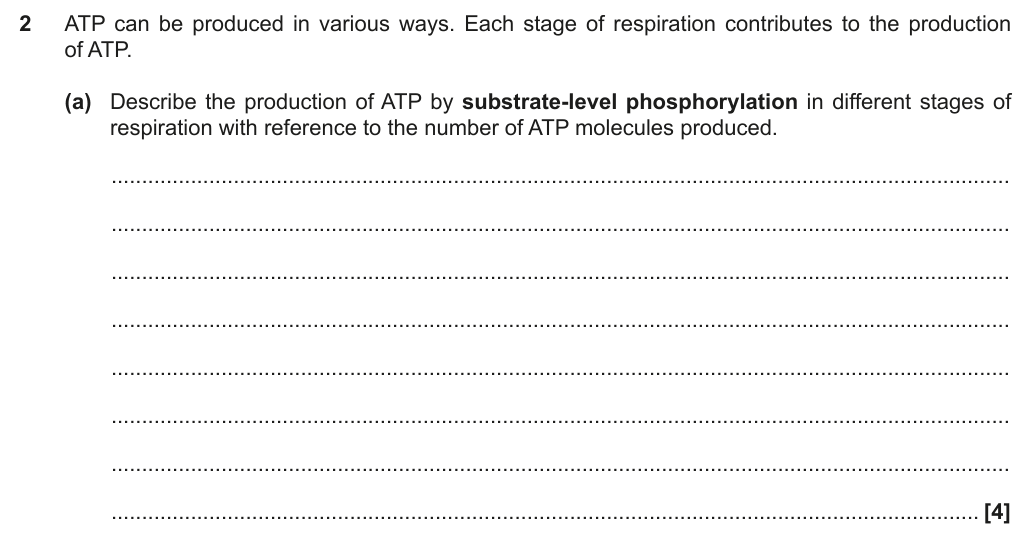
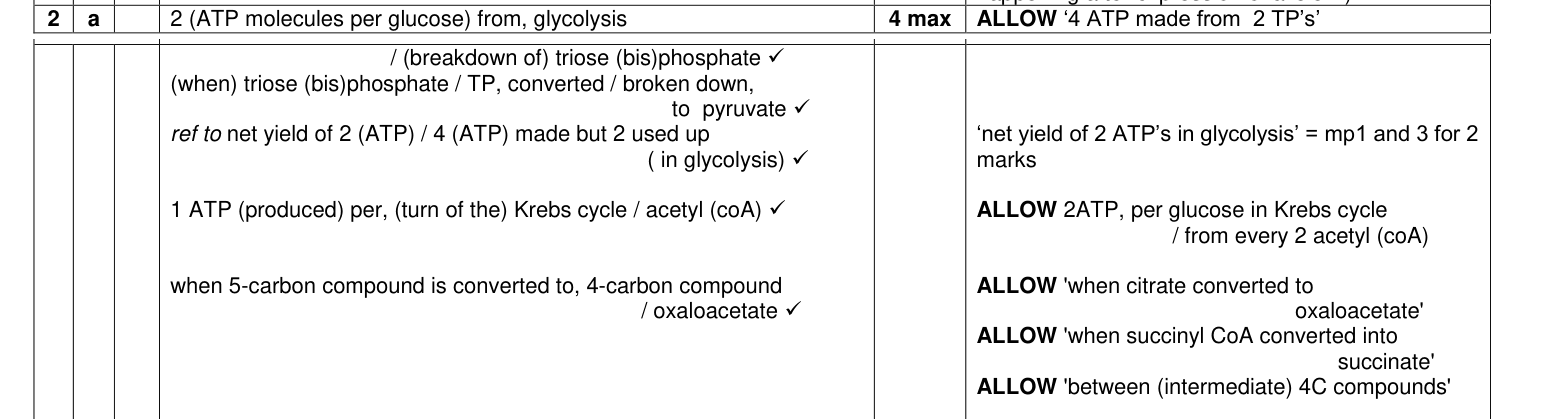
How to approach it. Substrate-level phosphorylation happens in two stages only, so give each one a pair of points: how many ATP, and at which step. In glycolysis, 4 ATP are made when triose phosphate is converted to pyruvate, but 2 ATP were used at the start, so the net yield is 2. In the Krebs cycle, 1 ATP is made per turn (2 per glucose), when the 5-carbon compound is converted to the 4-carbon compound. Stop there: the question is not about the electron transport chain.
Mark scheme
Common mistakes (from OCR's examiners' reports and mark schemes)
- Naming triose phosphate as the source of the phosphate but not saying what it is converted to. The examiners' report says few candidates added this. Gains credit: "ATP is made when triose phosphate is converted to pyruvate."
- Being unclear about how many ATP the Krebs cycle makes. The report says many candidates were. Gains credit: "One ATP per turn of the Krebs cycle" or "two ATP per glucose in the Krebs cycle".
- Placing the ATP between citrate and the 5-carbon compound, or at several points in the cycle. Gains credit: "when the 5-carbon compound is converted to the 4-carbon compound (oxaloacetate)".
- Saying ATP is made in the link reaction, or going on to describe oxidative phosphorylation. The report says this gained no credit. Gains credit: points about glycolysis and the Krebs cycle only, each with a number of ATP.
Question 2: How oxidation occurs in glycolysis (2 marks)
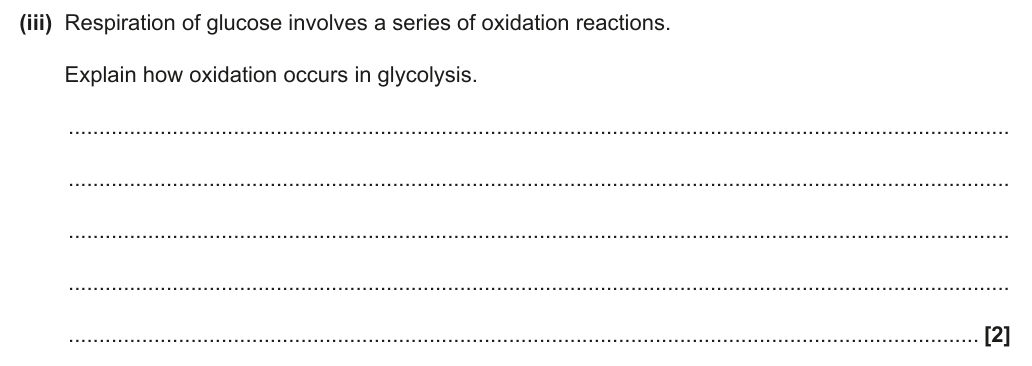
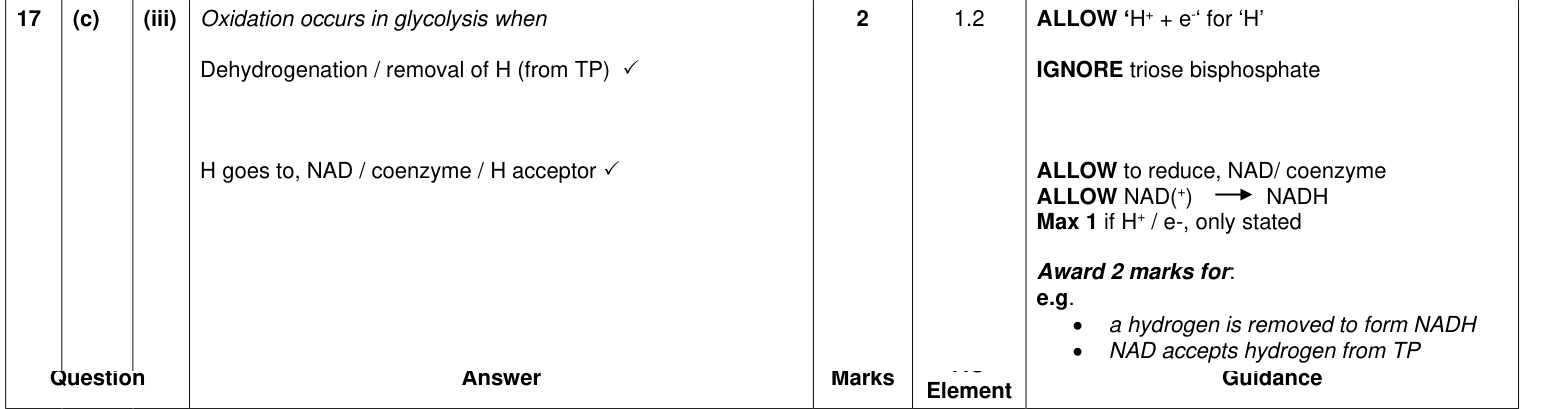
How to approach it. Two marks, two ideas: what is removed, and where it goes. Hydrogen is removed from triose phosphate (dehydrogenation), and it is accepted by the coenzyme NAD, which becomes reduced NAD.
Mark scheme
Common mistakes (from OCR's examiners' reports and mark schemes)
- Stating only that NAD becomes reduced. The examiners' report says many candidates got 1 mark this way but struggled to say how the reduction happens. Gains credit: "Hydrogen is removed from triose phosphate and accepted by NAD."
- Writing only about the loss of electrons, or only about H+. The mark scheme gives a maximum of 1 mark if only H+ or electrons are stated. Gains credit: "a hydrogen is removed to form NADH" or "NAD accepts hydrogen from TP" (both are 2-mark examples in the mark scheme).
Question 3: FAD and NAD compared (2 marks)
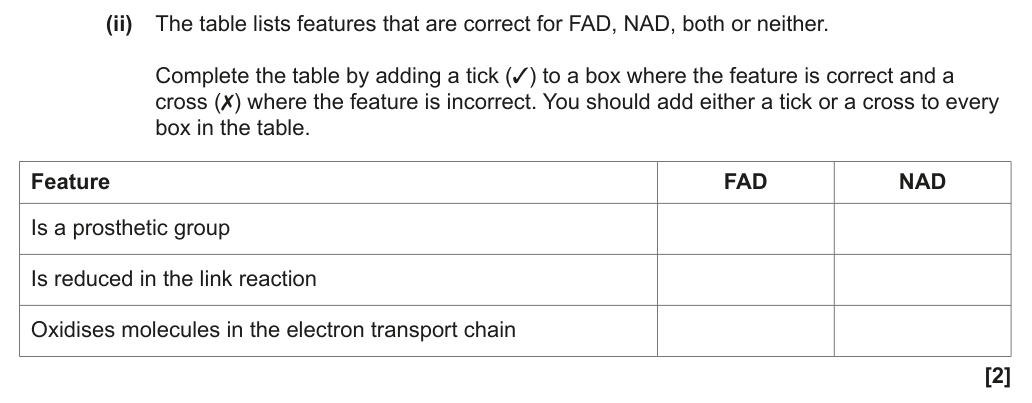
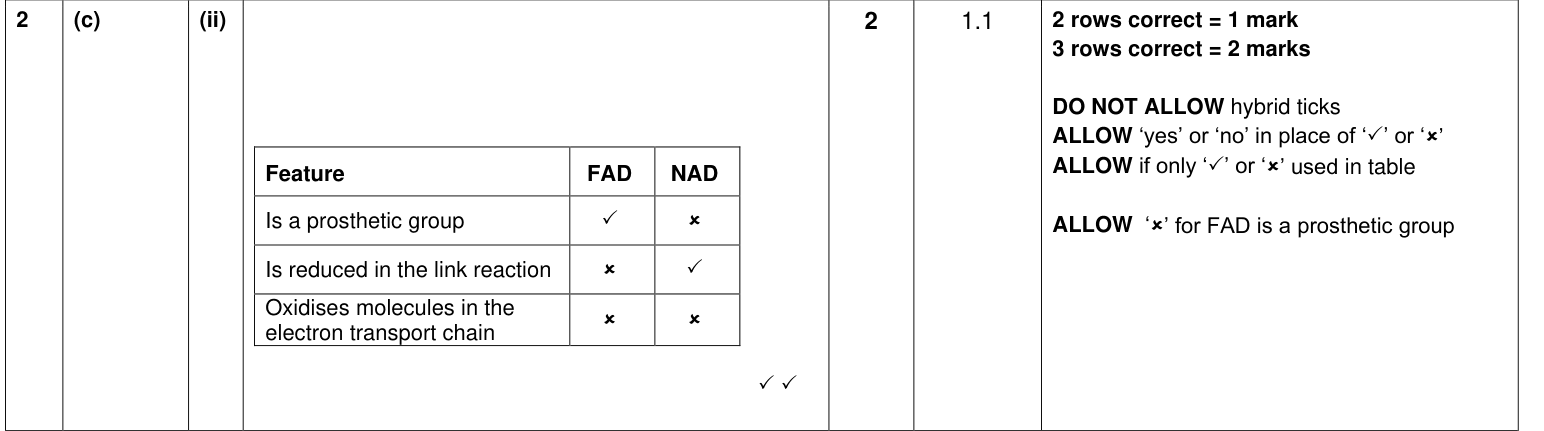
How to approach it. Take one row at a time and put a tick or a cross in both boxes. NAD is a coenzyme, not a prosthetic group. Only NAD is reduced in the link reaction. In the electron transport chain it is reduced NAD and reduced FAD that pass electrons on, so they reduce the carriers and are themselves oxidised: neither coenzyme oxidises molecules there.
Mark scheme
Common mistakes (from OCR's examiners' reports and mark schemes)
- Ticking the last row. The examiners' report says few candidates realised that neither FAD nor NAD oxidises molecules in the electron transport chain: reduced FAD and reduced NAD reduce molecules there. Gains credit: a cross for both FAD and NAD in the bottom row.
- Leaving a box empty or writing a tick over a cross. The mark scheme does not allow hybrid ticks, and the question asks for a tick or a cross in every box. Gains credit: one clear tick or cross in each of the six boxes; two correct rows score 1 mark and three score 2.
- Worrying about whether FAD counts as a prosthetic group. The report explains that sources differ, so both answers were accepted for FAD. Gains credit: either a tick or a cross for FAD in the top row, with a cross for NAD.
Question 4: Evidence for chemiosmosis (2 marks)
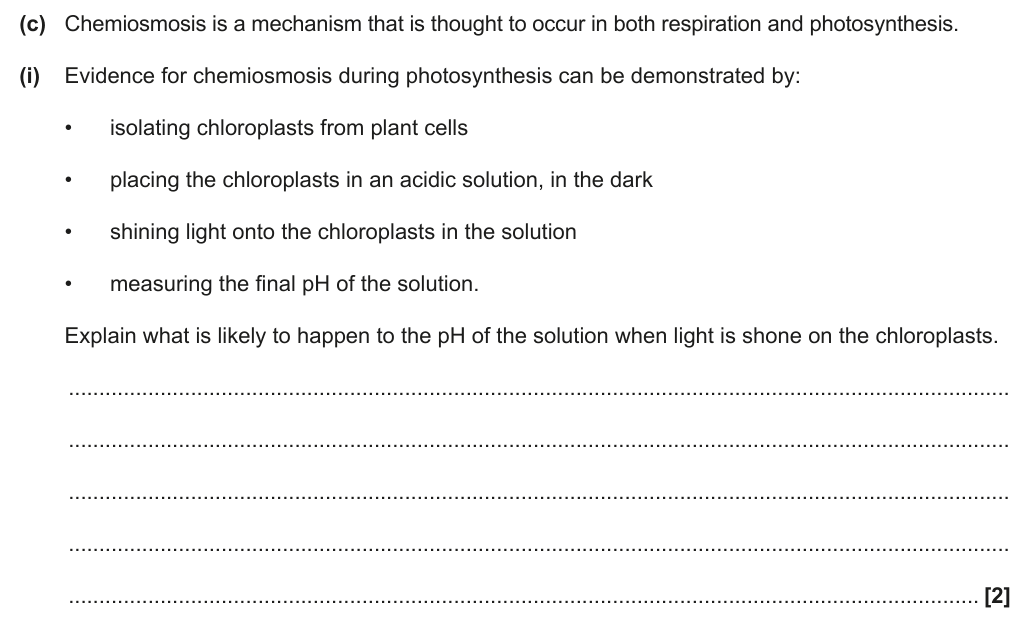
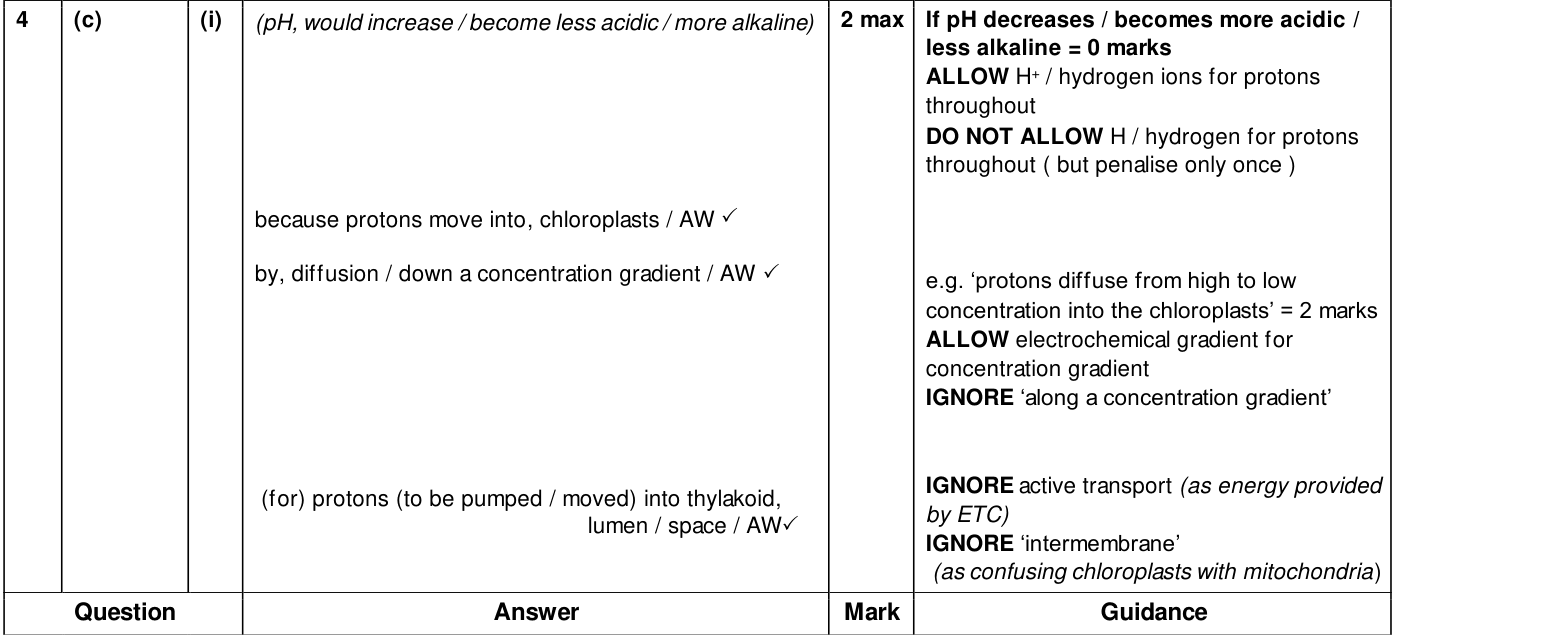
How to approach it. The context is photosynthesis, but the idea being tested is chemiosmosis, which works the same way in both processes. Start with the protons in the acidic solution and follow them: they move into the chloroplasts by diffusion, down a concentration gradient, and are then moved into the thylakoid space. Fewer protons are left in the solution, so its pH rises (it becomes less acidic).
Mark scheme
Common mistakes (from OCR's examiners' reports and mark schemes)
- Describing how the protons are used inside the chloroplast without first saying that they move into the chloroplasts. The examiners' report says this stopped candidates who understood the process from gaining both marks. Gains credit: "protons move from the solution into the chloroplasts".
- Saying the protons move in, but not how. The report says these answers did not state that the protons move down a concentration gradient by diffusion. Gains credit: "protons diffuse from high to low concentration into the chloroplasts" (a 2-mark example in the mark scheme).
- Saying the pH falls or the solution becomes more acidic. The mark scheme gives 0 marks for this. Gains credit: "the pH increases" or "the solution becomes less acidic".
- Writing "hydrogen" for protons. The mark scheme does not allow H or hydrogen. Gains credit: "protons", "hydrogen ions" or "H+".
Question 5: Respiratory quotient during exercise (1 + 3 marks)
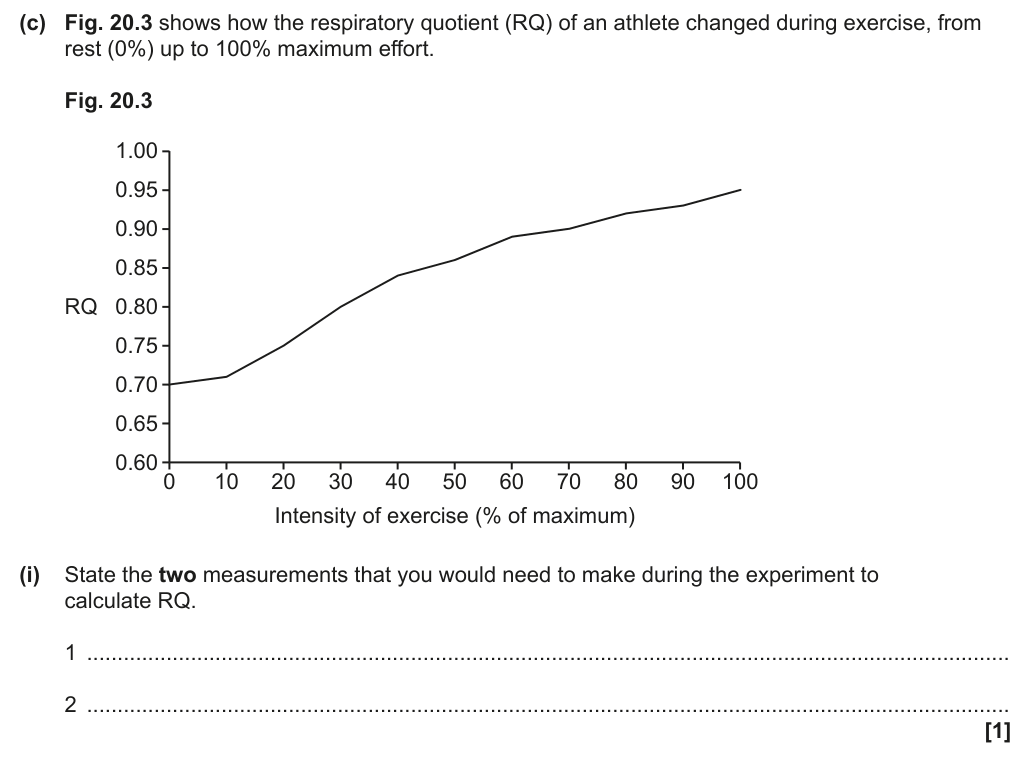
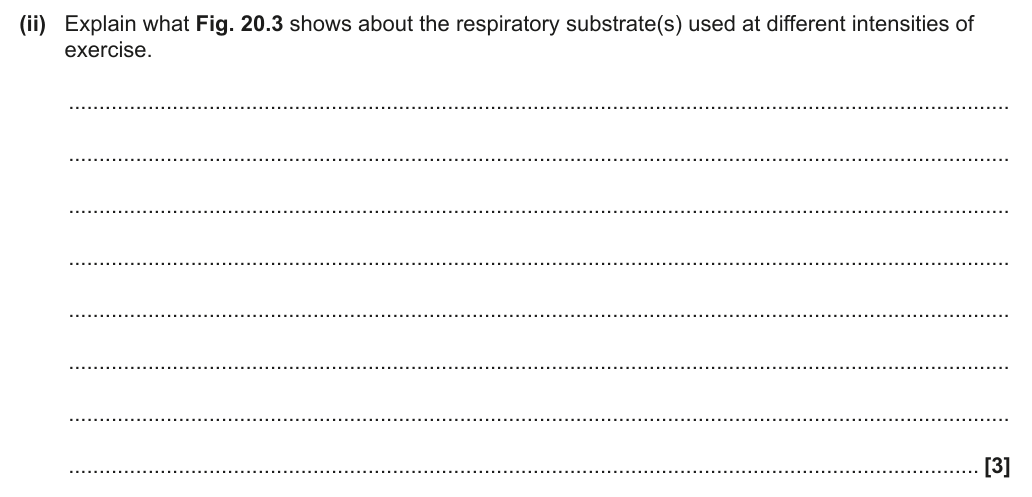
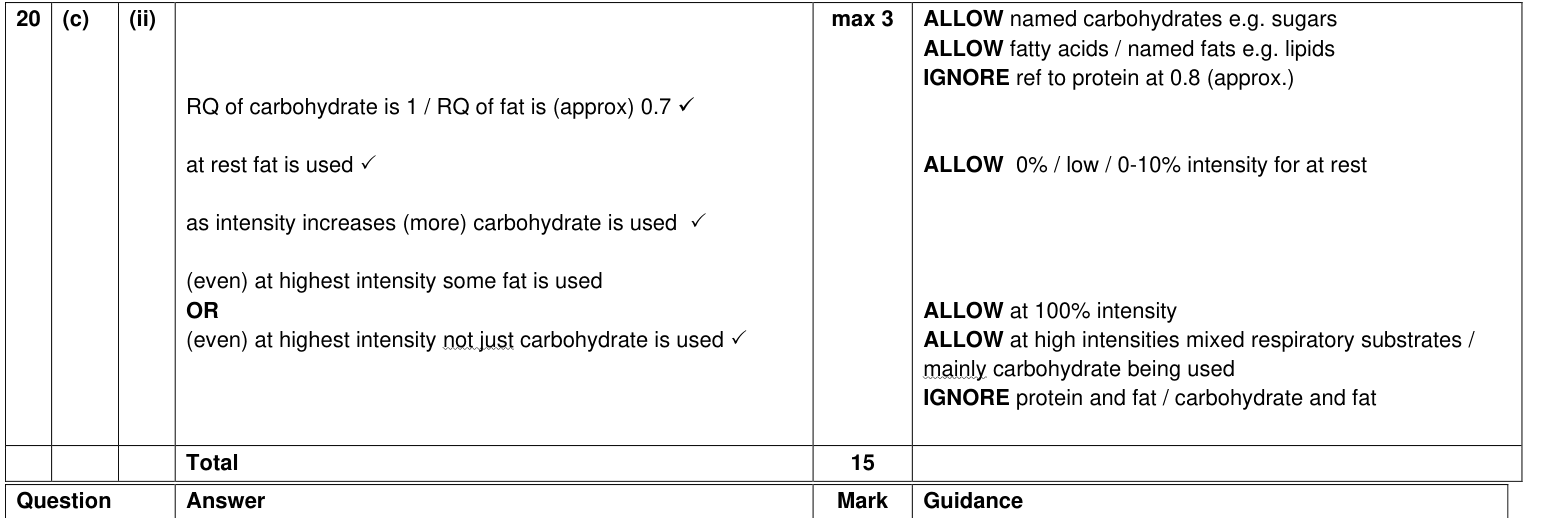
How to approach it. For part (i), RQ needs two volumes: oxygen consumed and carbon dioxide produced. For part (ii), state the RQ values you are comparing with (carbohydrate 1, fat about 0.7), then read the graph from left to right. At rest the RQ is 0.7, so fat is being respired. As intensity rises the RQ rises, so more carbohydrate is used. At 100% the line is still below 1, so some fat is still being used.
Mark scheme

Common mistakes (from OCR's examiners' reports and mark schemes)
- Giving only one measurement in part (i). The mark scheme needs both for the mark. Gains credit: "volume of oxygen consumed and volume of carbon dioxide produced".
- Explaining the rise to an RQ of 0.8 as protein being used. The examiners' report says many candidates did this, rather than seeing the increasing use of carbohydrate, and the mark scheme ignores references to protein. Gains credit: "as intensity increases, more carbohydrate is used".
- Not noticing that the RQ never reaches 1. The report says only high-achieving candidates saw this. Gains credit: "even at the highest intensity some fat is still used" or "at 100% intensity a mixture of respiratory substrates is used".
Key points to remember
- Substrate-level phosphorylation: net 2 ATP in glycolysis and 1 ATP per turn of the Krebs cycle. None in the link reaction.
- Oxidation in glycolysis is the removal of hydrogen from triose phosphate; NAD accepts it and becomes reduced NAD.
- NAD is reduced in glycolysis, the link reaction and the Krebs cycle; FAD is reduced in the Krebs cycle only. In the electron transport chain the reduced coenzymes are oxidised.
- In chemiosmosis, protons diffuse down a concentration gradient. Write "protons" or "H+", never just "hydrogen".
- RQ of carbohydrate is 1 and of fat about 0.7. A value in between means a mixture of substrates.
Practise next
- Respiration written quiz: 20 OCR A short-answer questions, marked as you go
- Respiration multiple choice quiz
- OCR A 5.2.1 (a–d): Photosynthesis worked questions
- All OCR A exam questions by topic
Studying this for OCR A? My weekly OCR A Year 13 masterclass works through topics like this with real exam questions. See the timetable or book a first one-to-one lesson.
Questions, mark schemes and examiners' report comments © OCR.