

Patterns of inheritance is the biggest spec point in Module 6, and it mixes genetics, evolution and maths. Spec point 6.1.2 asks you to explain how genes and the environment cause variation, draw genetic diagrams for dihybrid, sex-linked, codominant and multiple-allele crosses, and use phenotypic ratios to spot linkage and epistasis. It then moves on to the chi-squared test, the Hardy–Weinberg principle, selection, genetic drift and bottlenecks, speciation and artificial selection.
The genetics marks are lost on detail. Students leave the sex out of the phenotypes in a sex-linked cross, write one allele of each gene as a genotype, expect every dihybrid cross to give 9:3:3:1, and treat q² as q in Hardy–Weinberg. In the evolution questions, many explain what a bottleneck or genetic drift is instead of what it does to the alleles in a population.
Work through the nineteen questions below in order. They start with variation and genetic diagrams, move on to evolution, speciation and artificial selection, and finish with chi-squared and Hardy–Weinberg. If you'd like to go through questions like these with me each week, my OCR A masterclasses run on Wednesdays at 5.15pm for Year 12 and on Tuesdays at 6.30pm or Thursdays at 5.15pm for Year 13.
Want help with this topic? It comes up in my weekly OCR A masterclasses. See the timetable →
What you need from GCSE
Each question on this page assumes you're secure on these GCSE ideas. If any of them feels shaky, look it up before you start.
- Genes come in different versions called alleles; a dominant allele is expressed even when only one copy is present.
- Genotype, phenotype, homozygous and heterozygous, and how to use a Punnett square to predict a 3:1 ratio.
- Sex is determined by the sex chromosomes: XX is female and XY is male in humans.
- Mutations make new alleles, and natural selection and selective breeding change how common they are.
Key terms
These words come up in the questions and mark schemes. Examiners expect you to use them exactly.
- Codominance and multiple alleles: both alleles are expressed in the heterozygote; a gene has more than two alleles in the population (e.g. ABO blood groups).
- Sex linkage: a gene carried on a sex chromosome (usually X in mammals, Z in birds), so the phenotype ratio differs between males and females.
- Autosomal linkage: two genes on the same autosome are inherited together, so they don't assort independently and recombinants only appear by crossing over.
- Epistasis: the expression of one gene is masked or affected by another gene, changing the expected phenotypic ratio.
- Chi-squared (χ²) test: tests whether the difference between observed and expected numbers is significant; compare the value with the critical value at p = 0.05 for the right degrees of freedom (number of categories − 1).
- Hardy–Weinberg principle: p + q = 1 and p² + 2pq + q² = 1; q² is the proportion with the recessive phenotype.
- Genetic drift: chance changes in allele frequency, with a much bigger effect in small populations.
- Genetic bottleneck and founder effect: a sharp fall in population size, or a new population started by a few individuals, so many alleles are lost from the gene pool.
- Allopatric and sympatric speciation: new species form after geographical isolation; new species form in the same place through reproductive isolation (e.g. behavioural or ecological).
- Stabilising and directional selection: selection favours the average phenotype; selection favours one extreme, shifting the mean.
What these questions cover (OCR 6.1.2)
The questions test these learning outcomes from the OCR A Level Biology A specification (H420):
- (a)(i) the contribution of both environmental and genetic factors to phenotypic variation
- (a)(ii) how sexual reproduction can lead to genetic variation within a species
- (b)(i) genetic diagrams to show patterns of inheritance (monogenic, dihybrid, multiple alleles, sex linkage and codominance)
- (b)(ii) the use of phenotypic ratios to identify linkage (autosomal and sex linkage) and epistasis
- (c) using the chi-squared (χ2) test to determine the significance of the difference between observed and expected results (the formula is given in the exam)
- (d) the genetic basis of continuous and discontinuous variation (no written question in the bank tests this as its main point; see 4.2.2(f) for continuous variation)
- (e) the factors that can affect the evolution of a species
- (f) the use of the Hardy–Weinberg principle to calculate allele frequencies in populations (the equations are given in the exam)
- (g) the role of isolating mechanisms in the evolution of new species
- (h)(i) the principles of artificial selection and its uses
- (h)(ii) the ethical considerations surrounding the use of artificial selection (e.g. health problems in pedigree dog breeds)
How to use this page
Write your answer on paper before you open the mark scheme. Allow about 1.2 minutes per mark: the 19 questions are worth 47 marks, so about 56 minutes in total. Then mark your answer strictly against the mark scheme and read the examiners' tip underneath it. If you'd rather print the questions, download the PDF pack.
Variation
Question 1
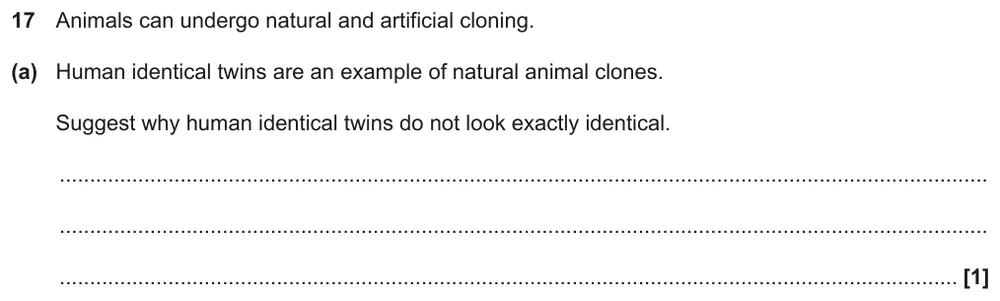
A level Paper 2 · June 2025 · Q17(a) · 1 mark · Medium
Suggest why identical twins do not look exactly identical.
Show the mark scheme
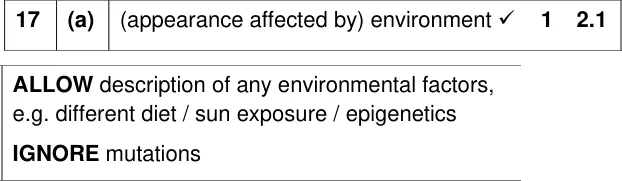
Tap an image to open it full size.
Question 2
A level Paper 2 · November 2020 · Q19(b)(ii) · 1 mark · Medium
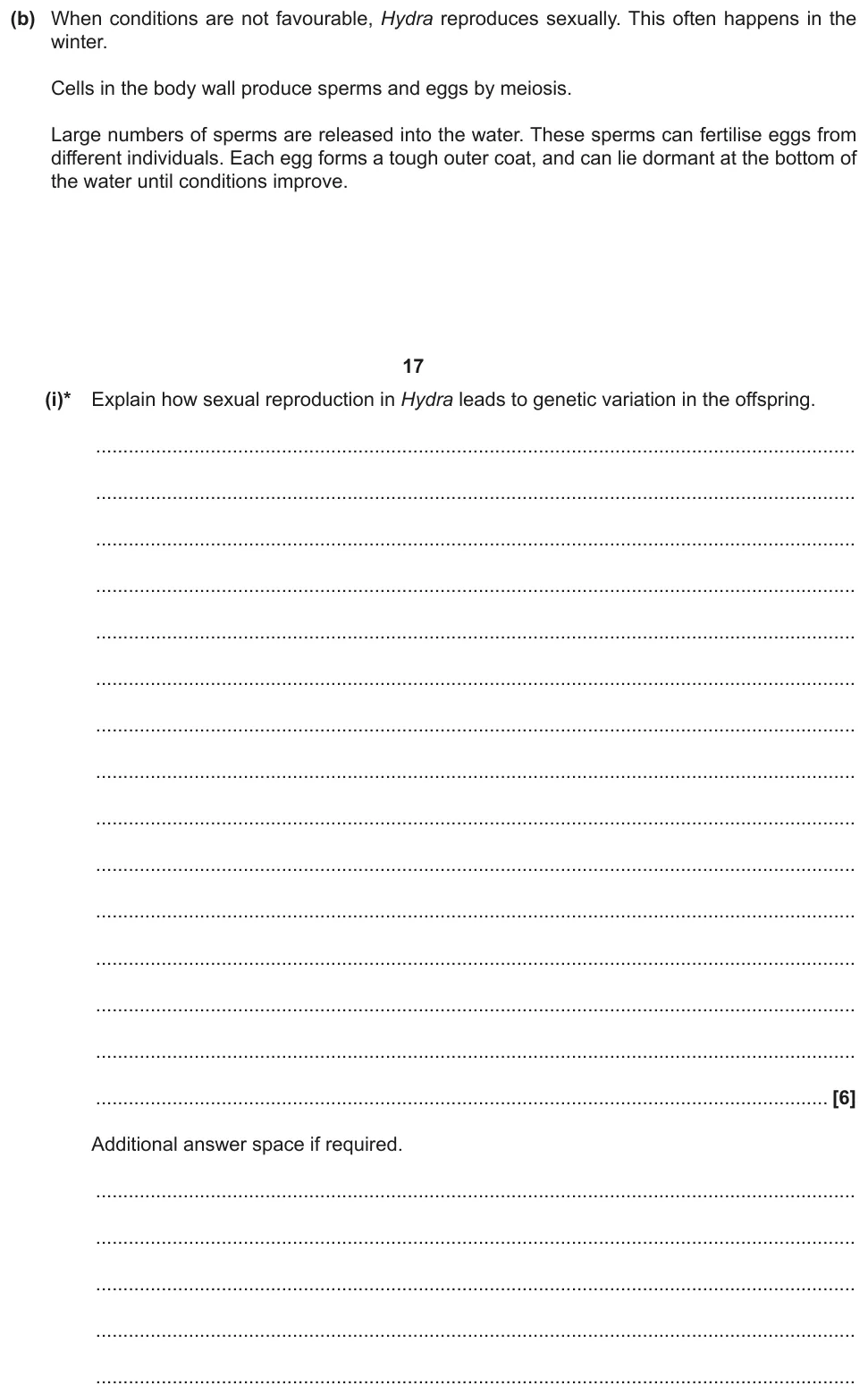
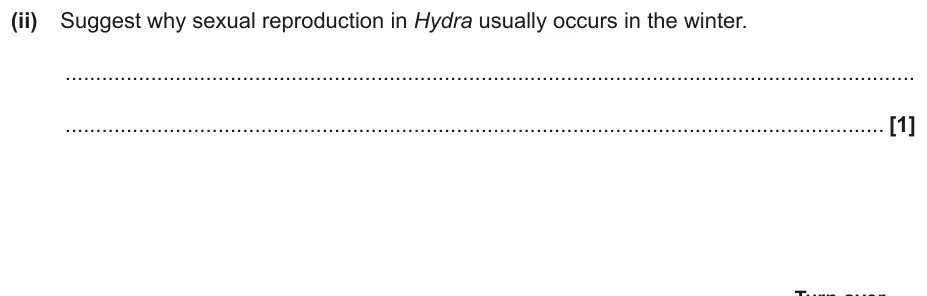
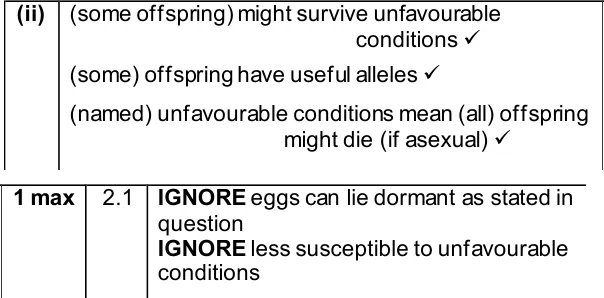
Suggest why Hydra usually reproduces sexually in the winter.
Information from earlier in this question:
Show the mark scheme
Tap an image to open it full size.
Genetic diagrams, linkage and epistasis
Question 3
A level Paper 3 · June 2018 · Q1(c)(i) · 3 marks · Easy
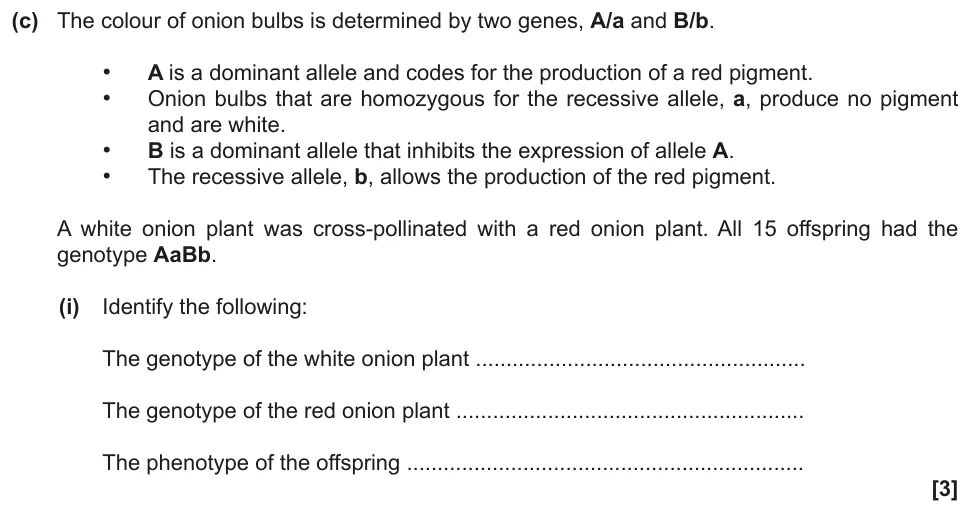
Identify the genotypes of white and red onion parents and the phenotype of their offspring.
Show the mark scheme

Tap an image to open it full size.
From the examiners' report: A genotype needs two alleles of each gene, so write aaBB and AAbb, not AB or ab (those are gametes).
Question 4
A level Paper 3 · June 2018 · Q1(c)(ii) · 1 mark · Medium
State the type of gene interaction shown by the onion genes.

Show the mark scheme

Tap an image to open it full size.
From the examiners' report: B masks A, so this is epistasis, and because the masking allele is dominant it's dominant epistasis. Codominance is a different thing entirely.
Question 5
A level Paper 3 · June 2018 · Q4(a)(ii) · 4 marks · Easy
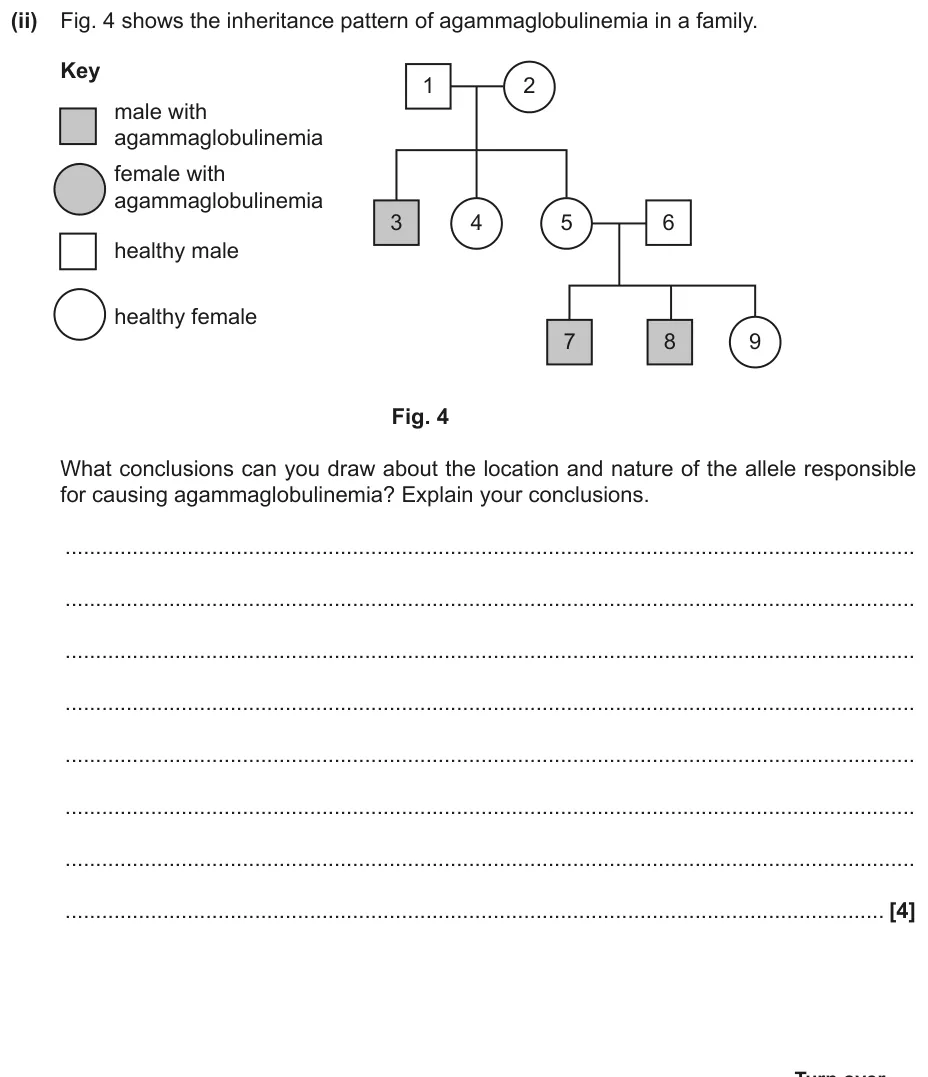
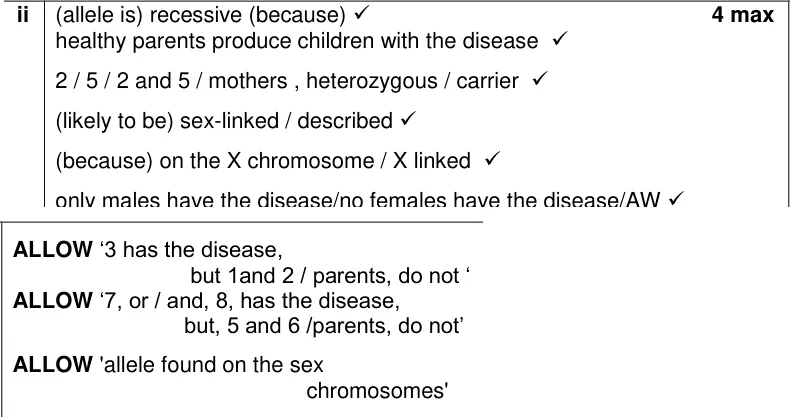
Use a family tree to draw conclusions about the allele causing agammaglobulinemia.
Show the mark scheme
Tap an image to open it full size.
From the examiners' report: Say "only males are affected", not "males are more likely", and link that to the X chromosome, not the Y. Name the carrier mothers by number.
Question 6
A level Paper 2 · November 2021 · Q19(a)(ii) · 4 marks · Medium
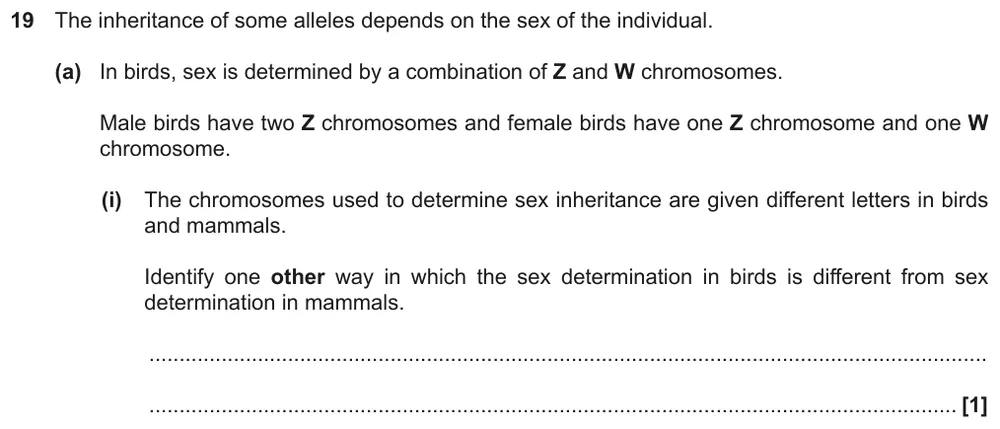
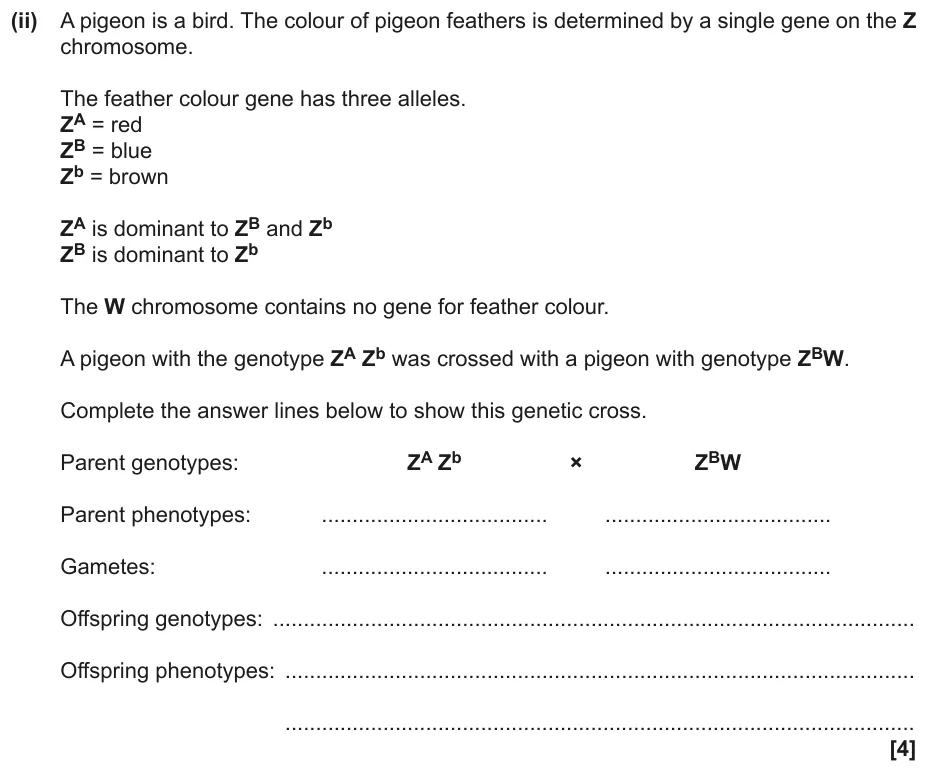
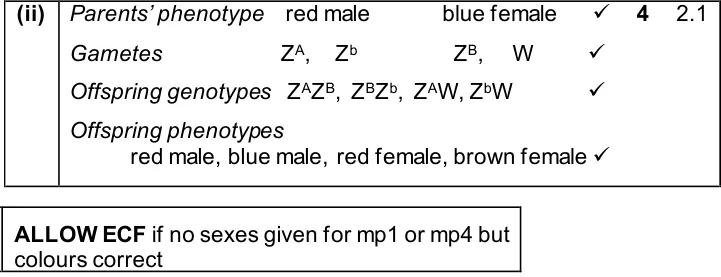
Complete a genetic cross for pigeon feather colour, a sex-linked gene with three alleles.
Information from earlier in this question:
Show the mark scheme
Tap an image to open it full size.
From the examiners' report: In a sex-linked cross the sex is part of the phenotype. Write "red male" and "blue female", not just the colours, or you lose a mark.
Question 7
A level Paper 3 · June 2023 · Q3(c) · 4 marks · Medium
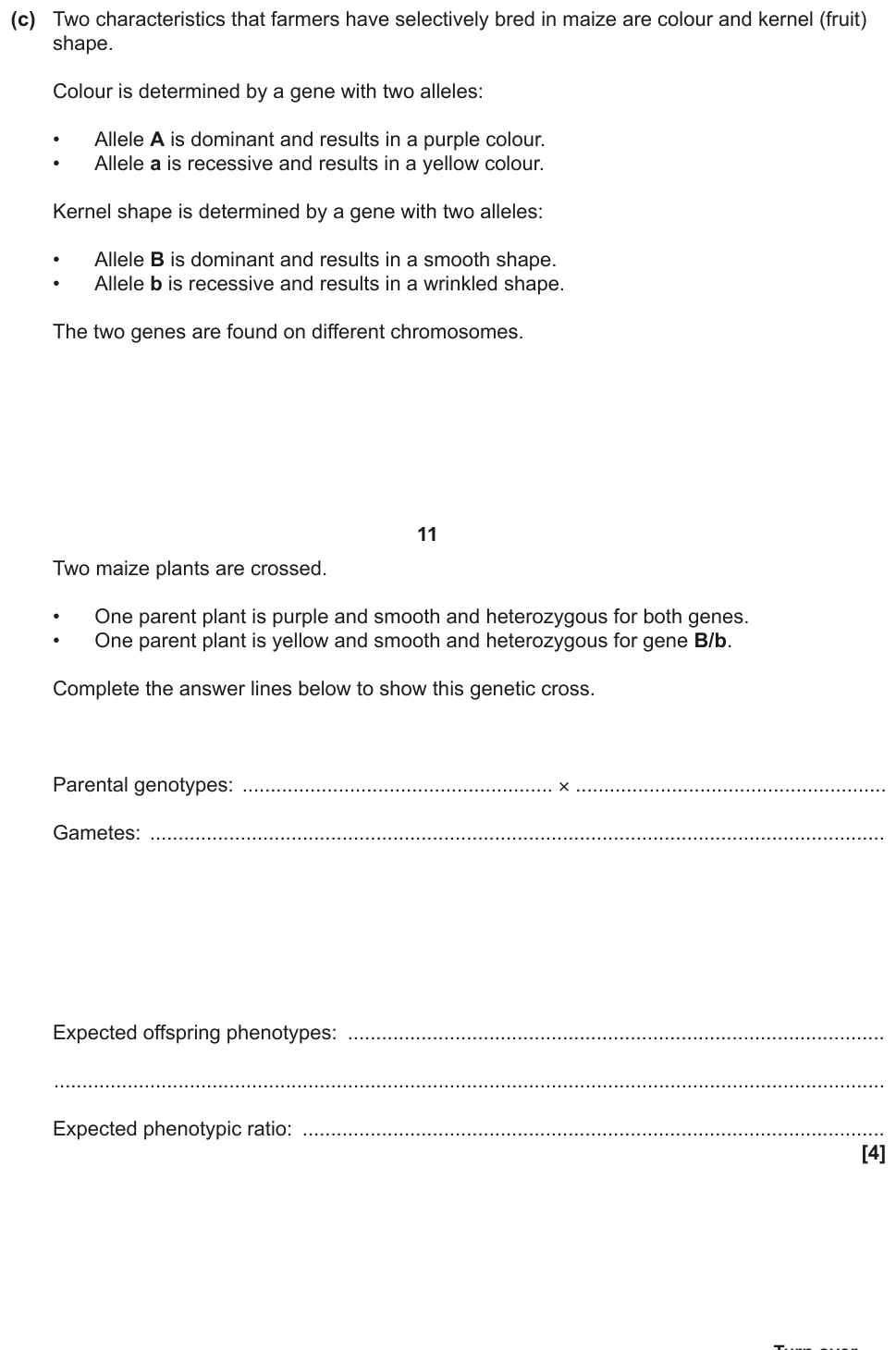
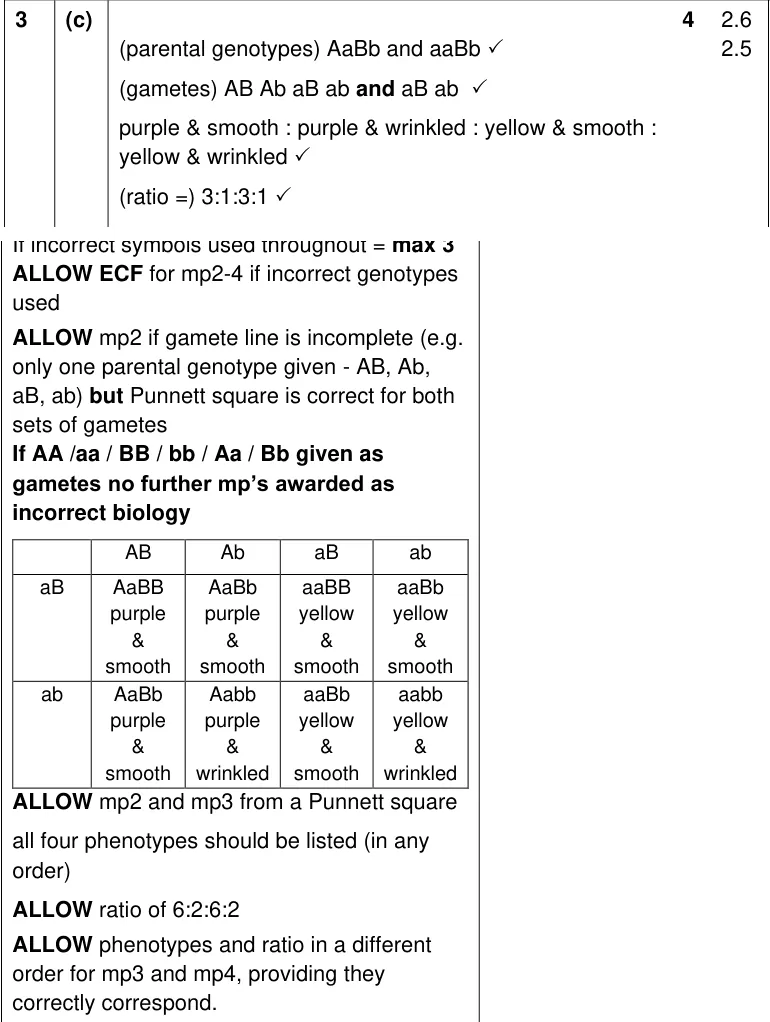
Complete a dihybrid cross for maize colour and kernel shape.
Show the mark scheme
Tap an image to open it full size.
From the examiners' report: Don't assume 9:3:3:1. Work out each parent's gametes properly, use a Punnett square, and match each phenotype to the right number in the ratio.
Question 8
A level Paper 2 · June 2025 · Q20(a)(i) · 3 marks · Medium
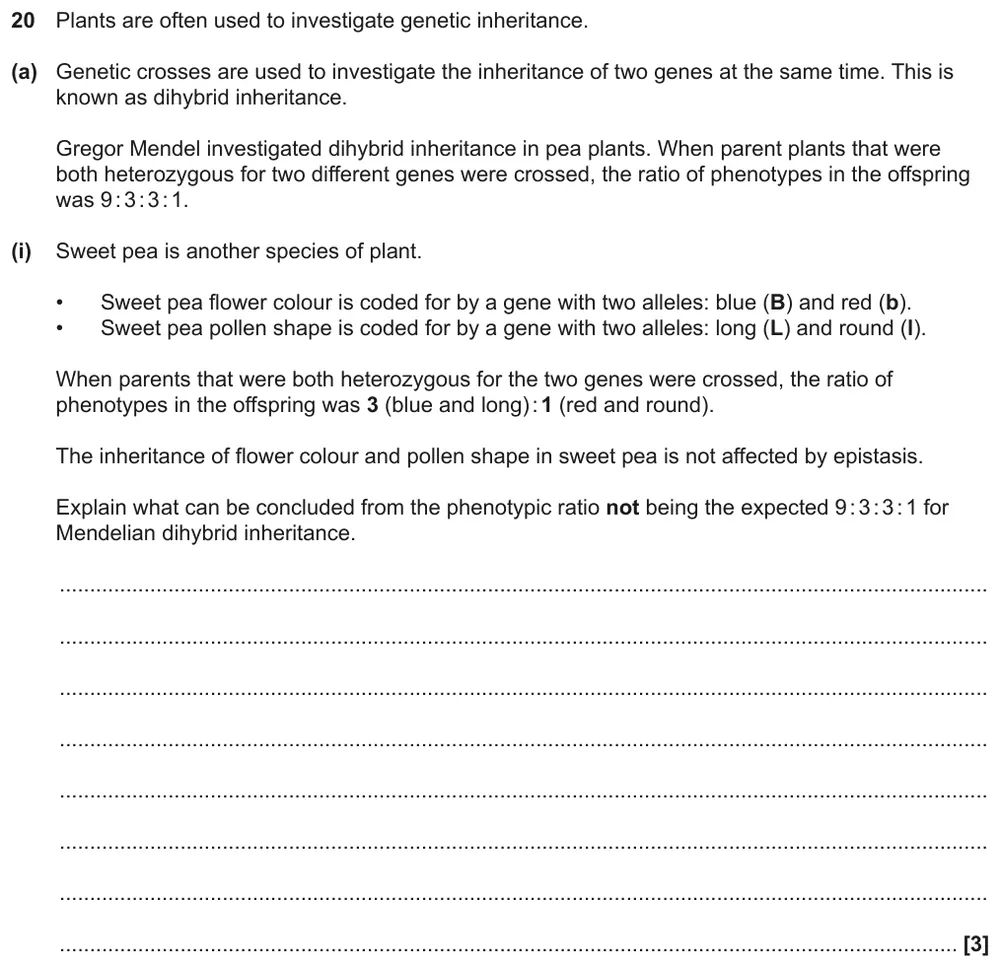
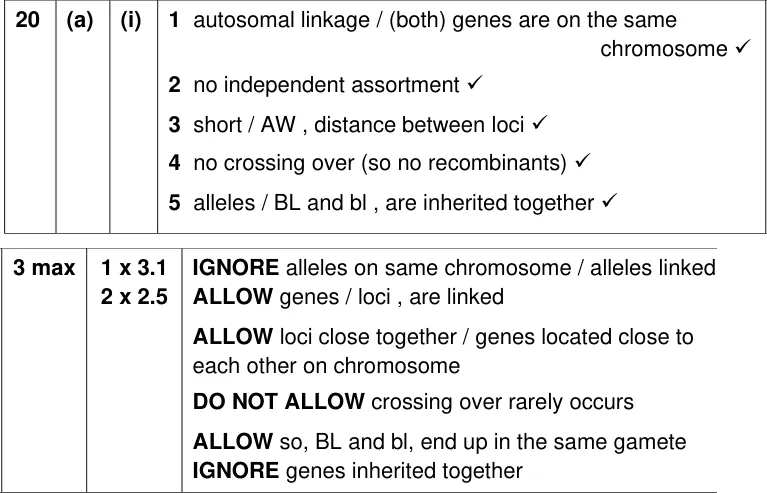
Explain what a 3:1 ratio in a sweet pea dihybrid cross shows.
Show the mark scheme
Tap an image to open it full size.
From the examiners' report: The question rules out epistasis, so think linkage: the two genes are on the same autosome, so they don't assort independently and BL and bl end up in the same gametes.
Question 9
A level Paper 2 · June 2025 · Q20(a)(ii) · 2 marks · Hard
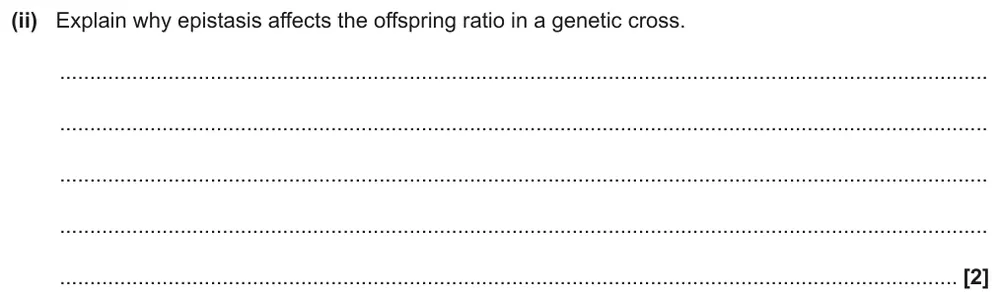
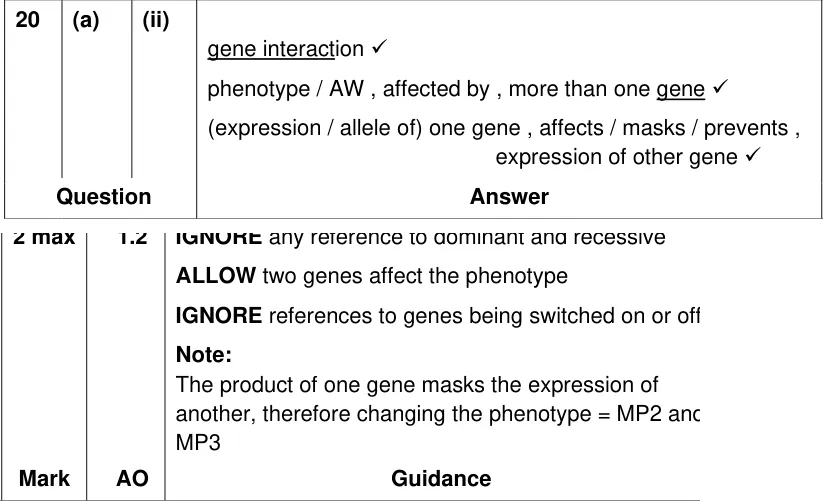
Explain why epistasis affects the offspring ratio in a genetic cross.
Show the mark scheme
Tap an image to open it full size.
From the examiners' report: Go further than "one gene masks another": say that the phenotype is then controlled by two genes, so some combinations give the same phenotype and the ratio changes. Don't mix up genes and alleles.
Evolution and speciation
Question 10
A level Paper 3 · June 2023 · Q4(b)(i) · 1 mark · Easy
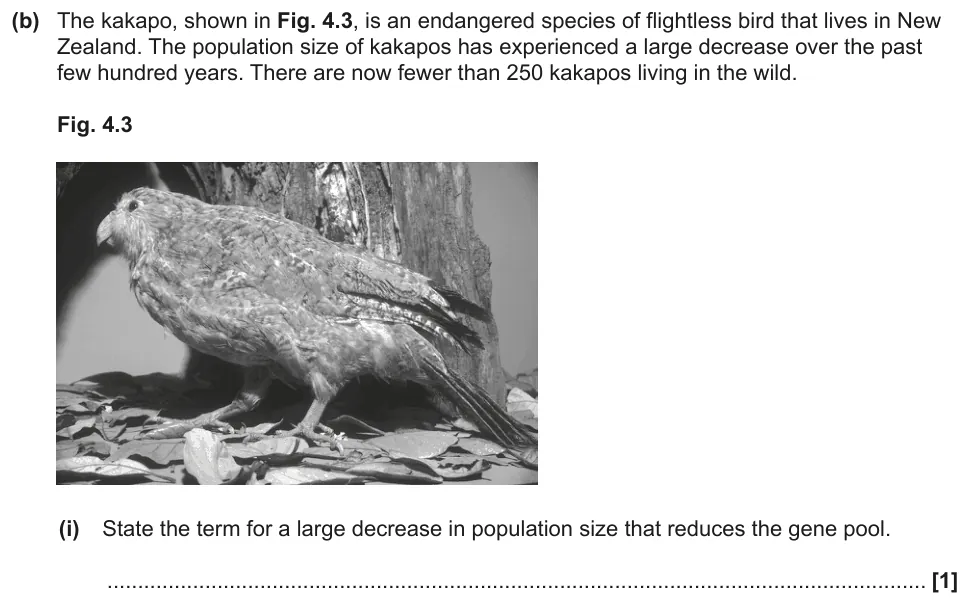
State the term for a large fall in population size that reduces the gene pool.
Show the mark scheme

Tap an image to open it full size.
From the examiners' report: This is a genetic bottleneck. Genetic drift is a chance change in allele frequency, which is a different idea.
Question 11
A level Paper 2 · June 2018 · Q20(b)(ii) · 2 marks · Medium
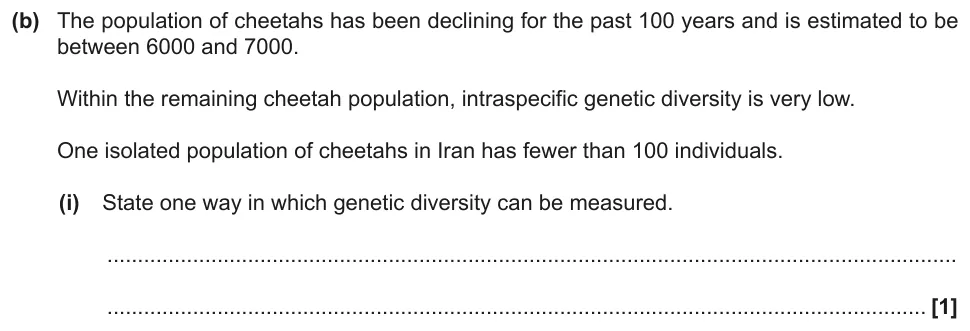
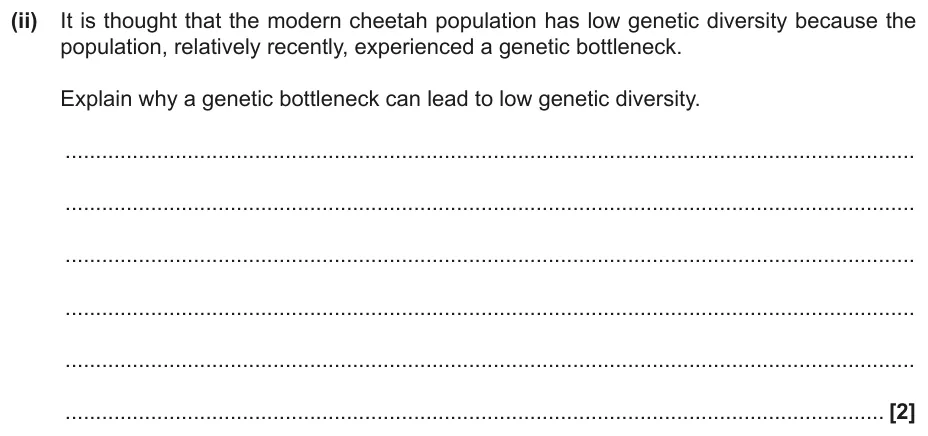
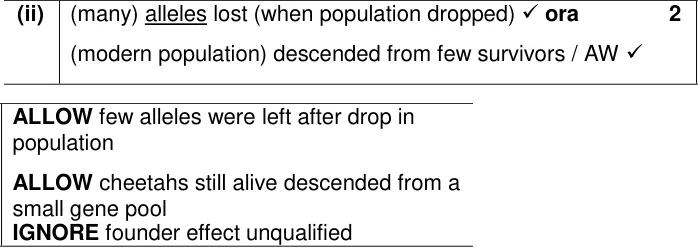
Explain why a genetic bottleneck can lead to low genetic diversity in cheetahs.
Information from earlier in this question:
Show the mark scheme
Tap an image to open it full size.
From the examiners' report: Don't define a bottleneck: explain its effect. Alleles are lost when the population crashes, and today's cheetahs all descend from the few survivors. Say alleles, not genes.
Question 12
A level Paper 2 · June 2018 · Q20(b)(iii) · 2 marks · Hard
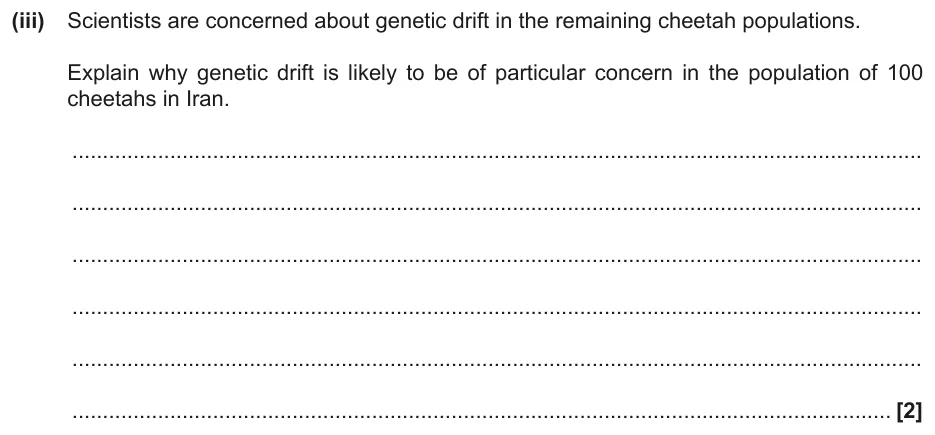
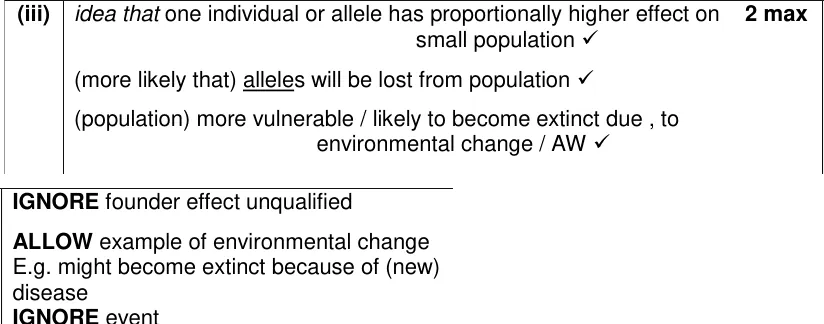
Explain why genetic drift is a particular concern in a population of 100 cheetahs.
Show the mark scheme
Tap an image to open it full size.
From the examiners' report: "Drift affects small populations" only repeats the question. Say that in 100 animals chance can remove alleles, so the population loses the variation it needs to survive a new disease or change.
Question 13
A level Paper 2 · June 2018 · Q20(c)(ii) · 4 marks · Hard
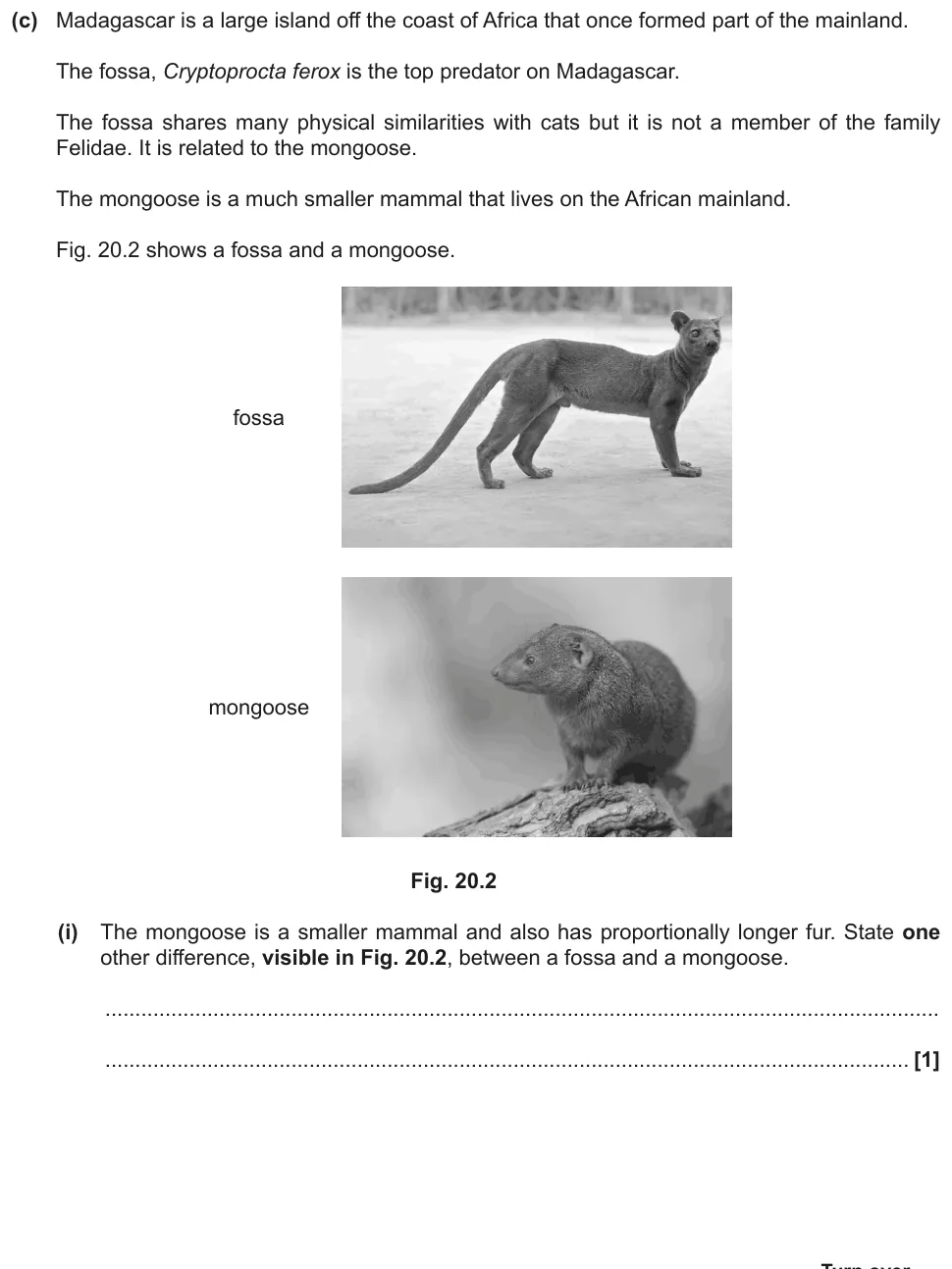
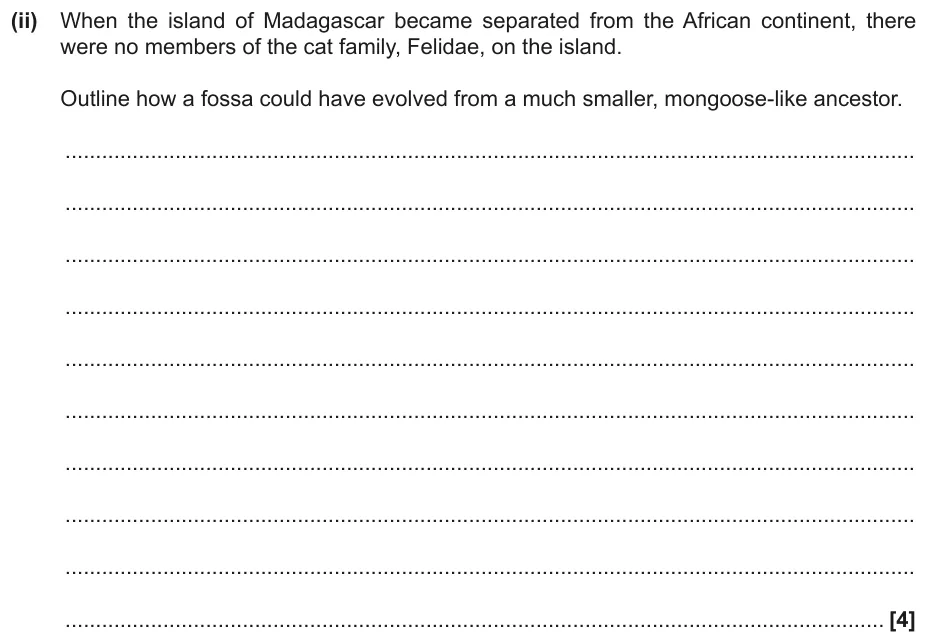
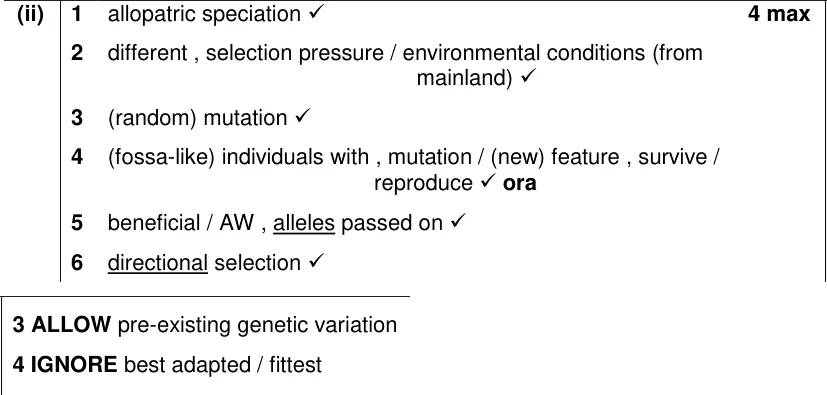
Outline how the fossa could have evolved from a smaller, mongoose-like ancestor on Madagascar.
Information from earlier in this question:
Show the mark scheme
Tap an image to open it full size.
From the examiners' report: Use the context and the terms: allopatric speciation, different selection pressures on the island, and directional selection. Say "alleles" are passed on, not traits or features.
Question 14
A level Paper 2 · November 2021 · Q20(b)(ii) · 1 mark · Medium
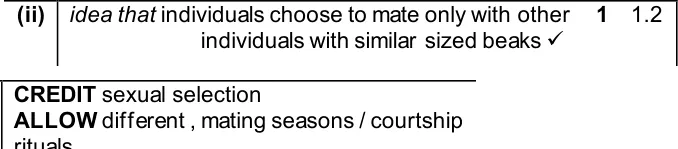
Suggest how large-beaked and small-beaked finches could become reproductively isolated in the same place.

Show the mark scheme
Tap an image to open it full size.
From the examiners' report: They share a location, so physical or genetic barriers aren't the answer. Think behaviour: birds choose mates with a similar beak size.
Artificial selection
Question 15
A level Paper 3 · November 2021 · Q1(c)(ii) · 1 mark · Hard
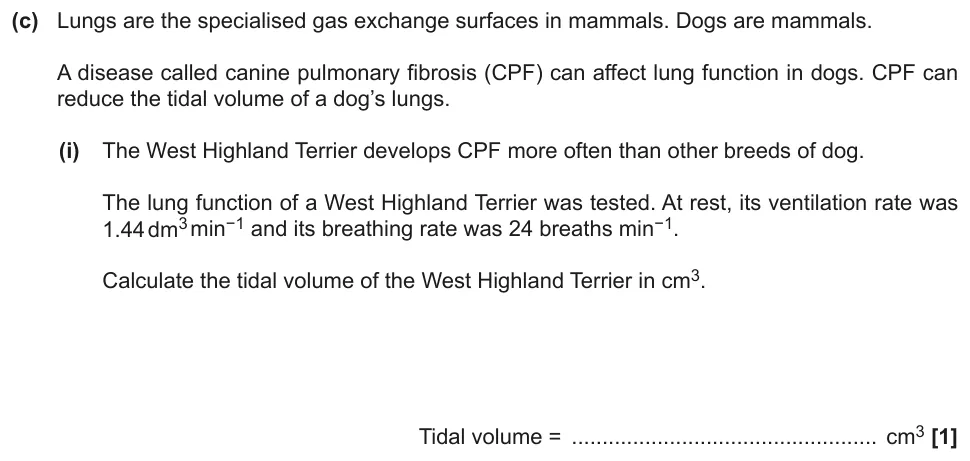
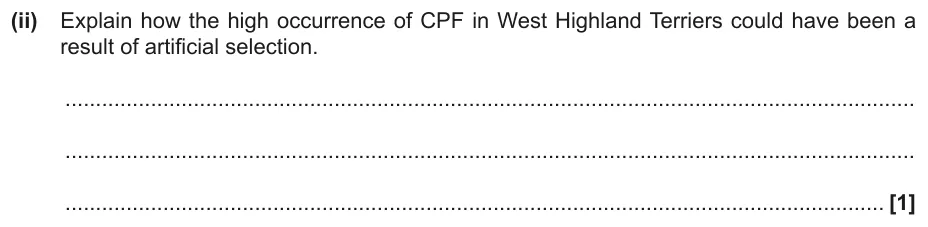
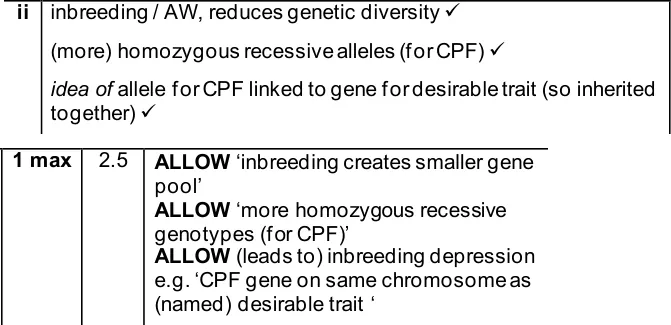
Explain how artificial selection could have made a disease common in West Highland Terriers.
Information from earlier in this question:
Show the mark scheme
Tap an image to open it full size.
From the examiners' report: The right ideas need detail: say inbreeding reduces genetic diversity so more dogs are homozygous for the recessive CPF allele.
Question 16
A level Paper 2 · June 2018 · Q18 · 6 marks · Medium
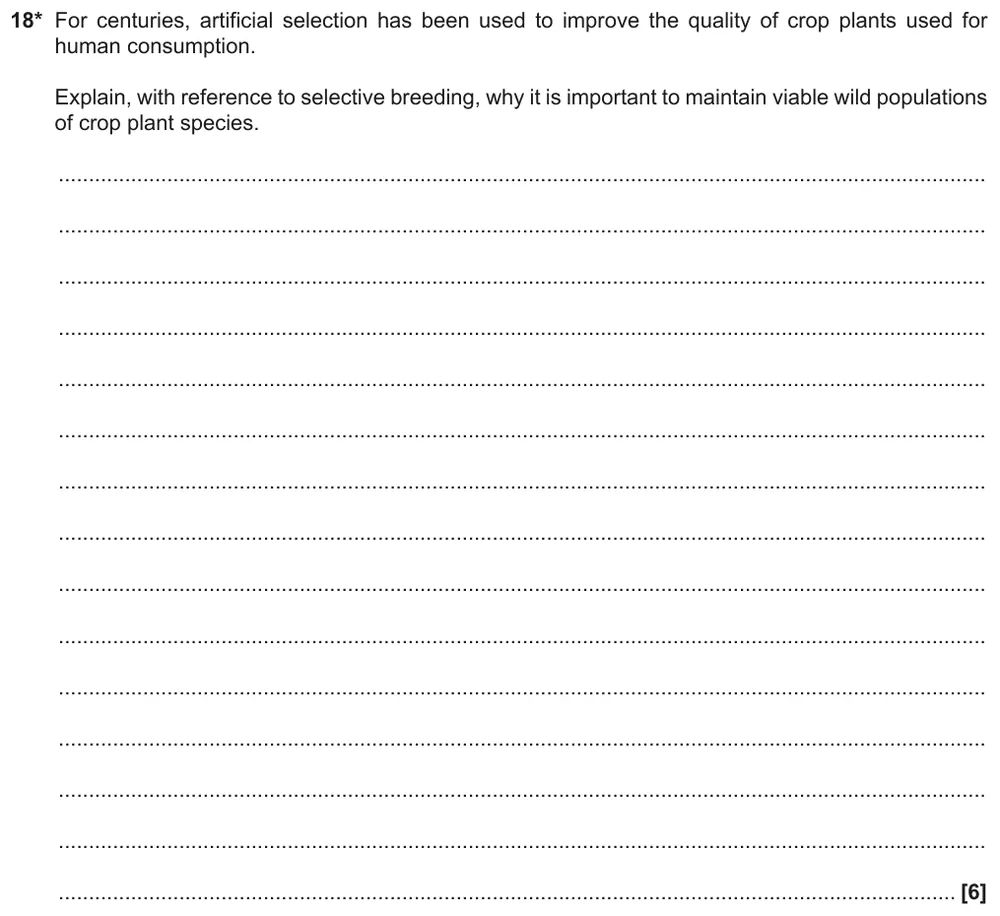
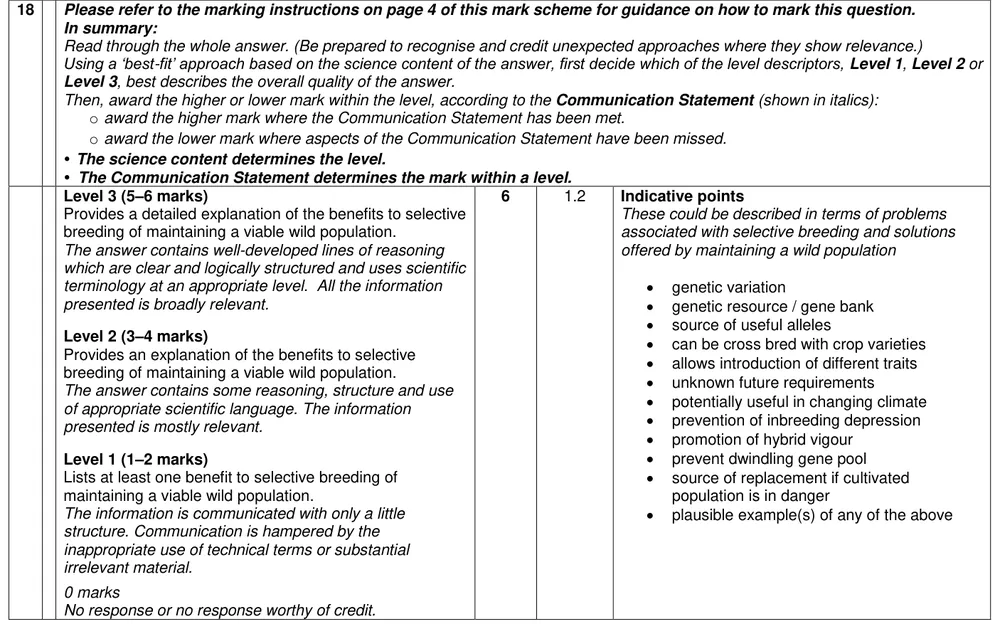
Explain why it is important to keep wild populations of crop plant species.
Show the mark scheme
Tap an image to open it full size.
From the examiners' report: Finish the argument: wild plants are a store of alleles lost from crops, which breeders can use for resistance or future climate change. Say alleles, not genes, and resistance, not immunity.
Chi-squared and Hardy–Weinberg
Question 17
A level Paper 3 · November 2020 · Q3(a)(iv) · 3 marks · Medium
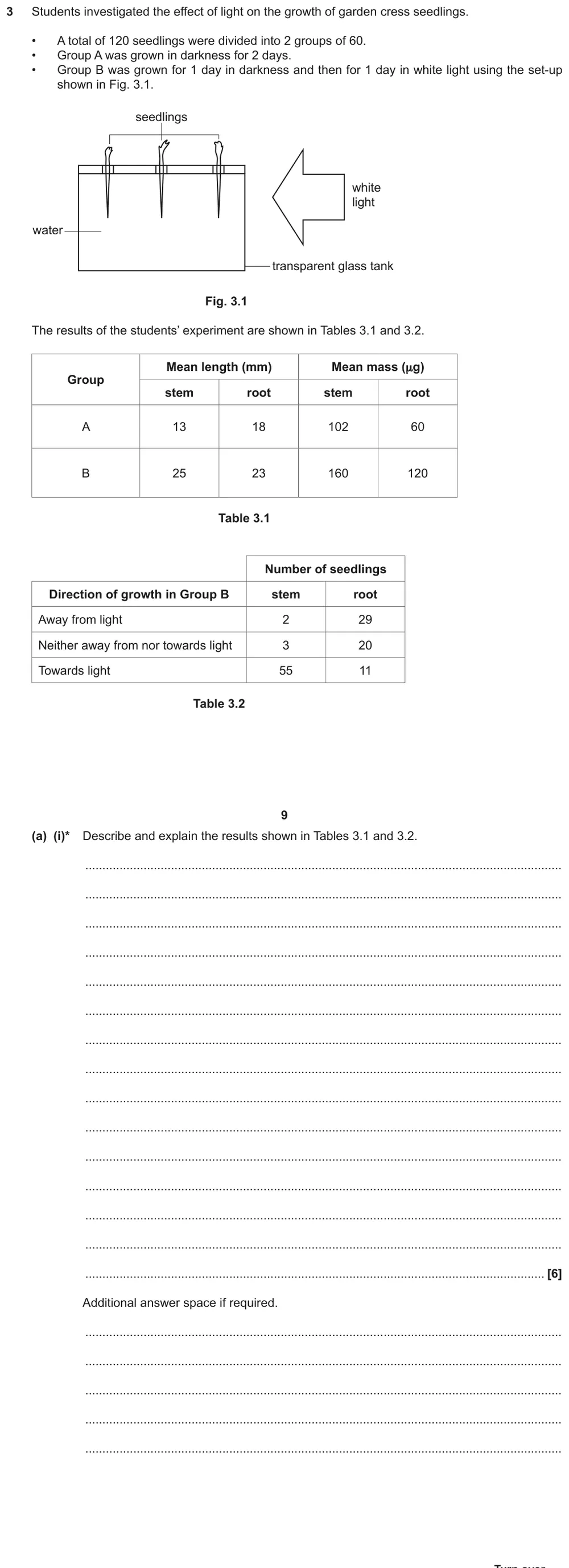
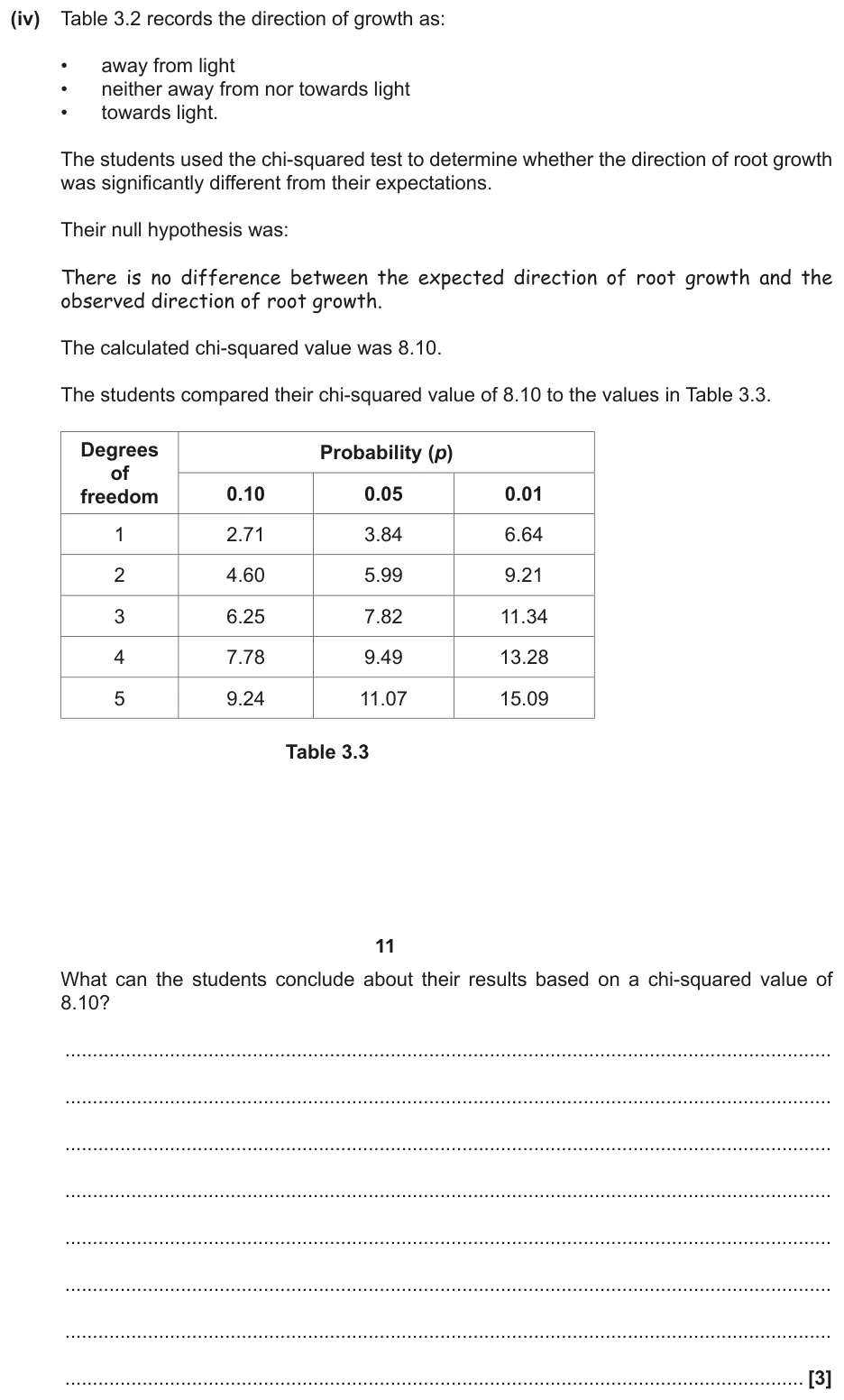
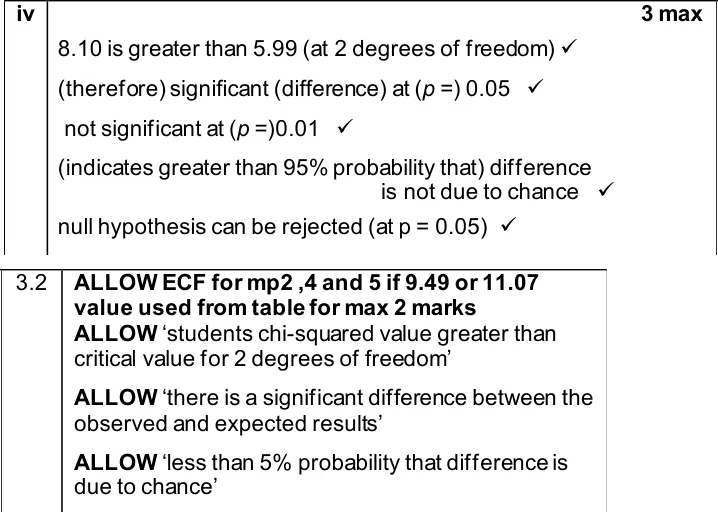
Draw a conclusion from a chi-squared value of 8.10.
Information from earlier in this question:
Show the mark scheme
Tap an image to open it full size.
From the examiners' report: Work out the degrees of freedom first: three categories means 2. Then compare 8.10 with 5.99 and say the null hypothesis is rejected.
Question 18
A level Paper 2 · November 2020 · Q18(b)(ii) · 3 marks · Medium
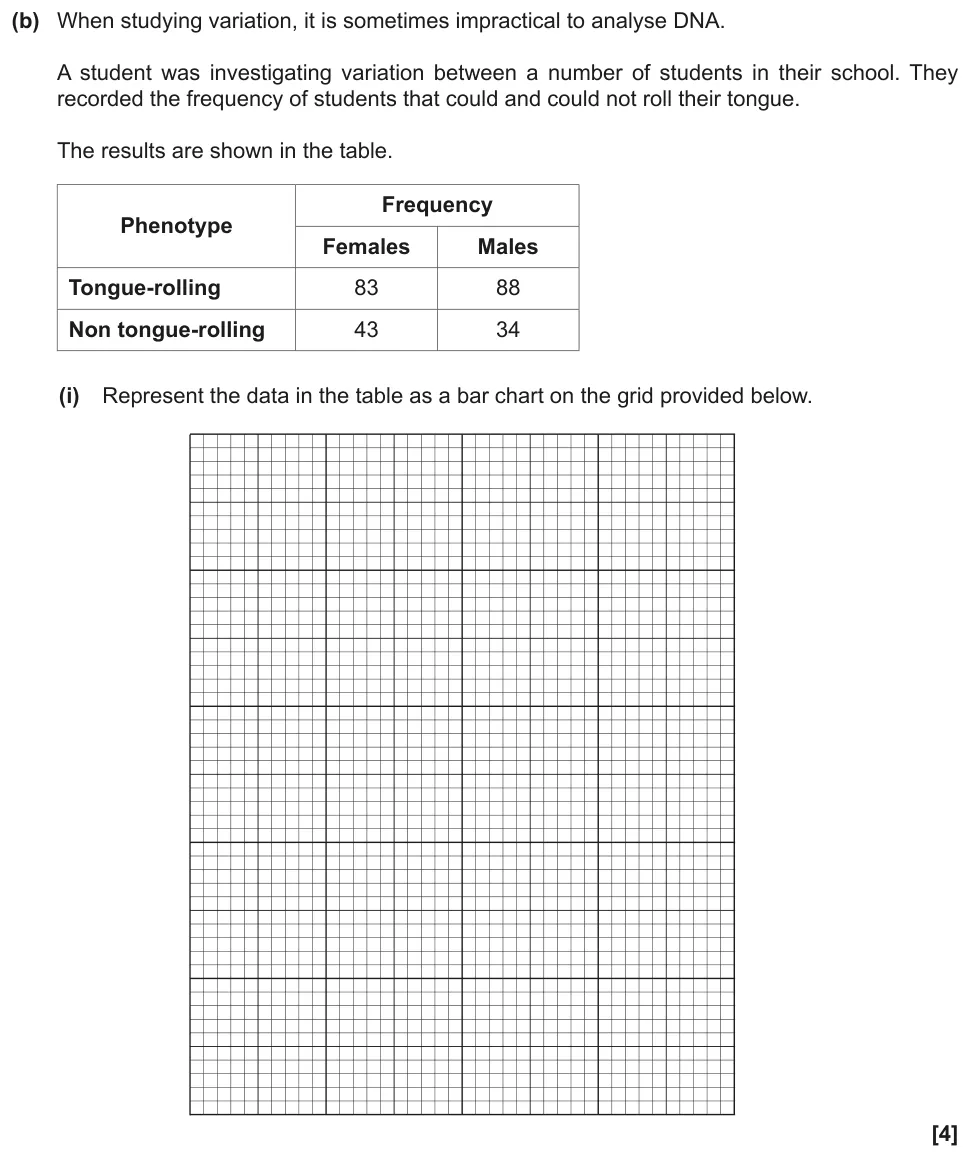
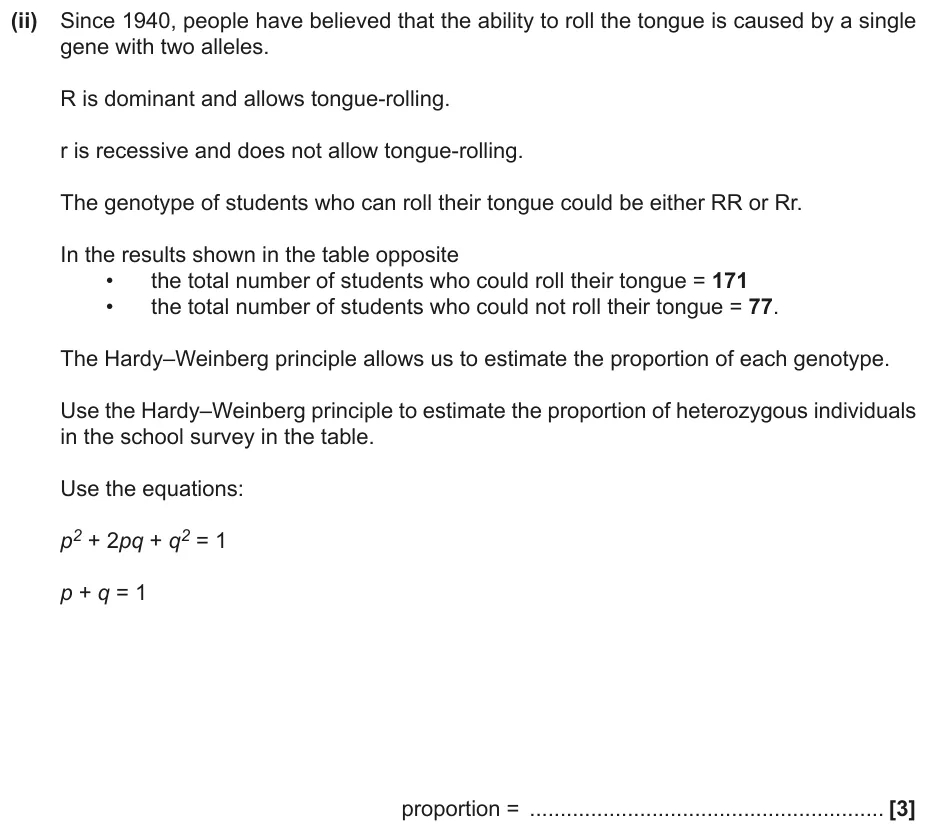
Use Hardy–Weinberg to estimate the proportion of heterozygous tongue-rollers.
Information from earlier in this question:
Show the mark scheme
Tap an image to open it full size.
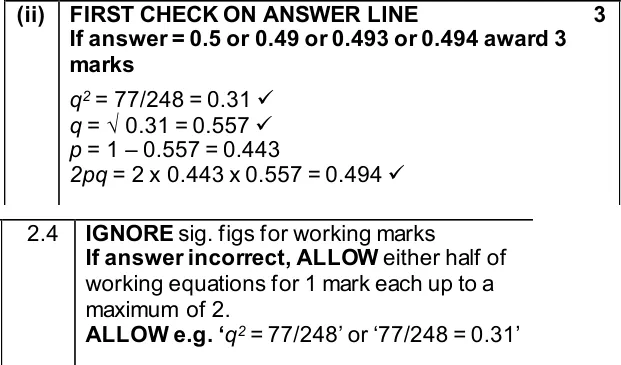
From the examiners' report: 77 ÷ 248 is q², not q. Square-root it to get q, then p = 1 − q and 2pq for the heterozygotes, showing every line of working.
Question 19
A level Paper 2 · June 2025 · Q20(b)(ii) · 1 mark · Medium
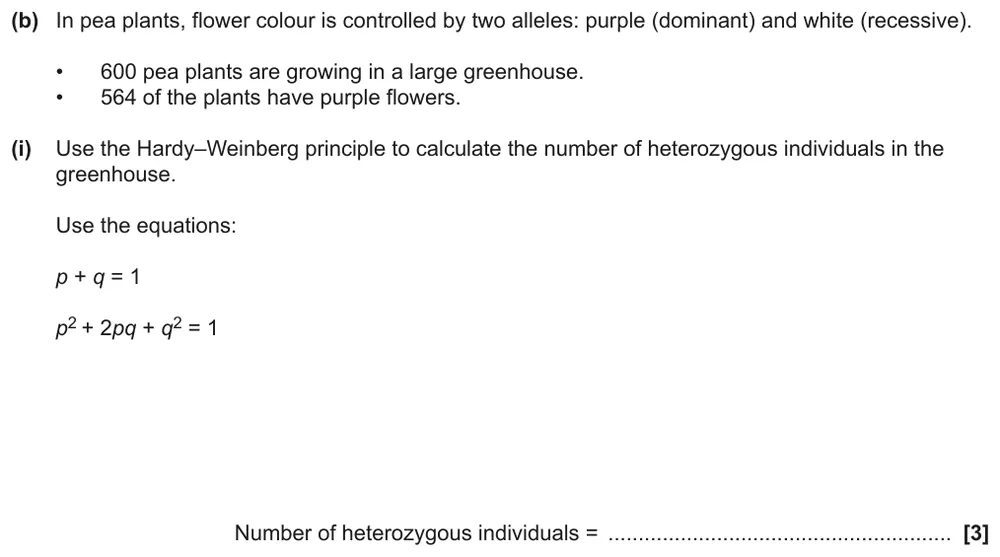
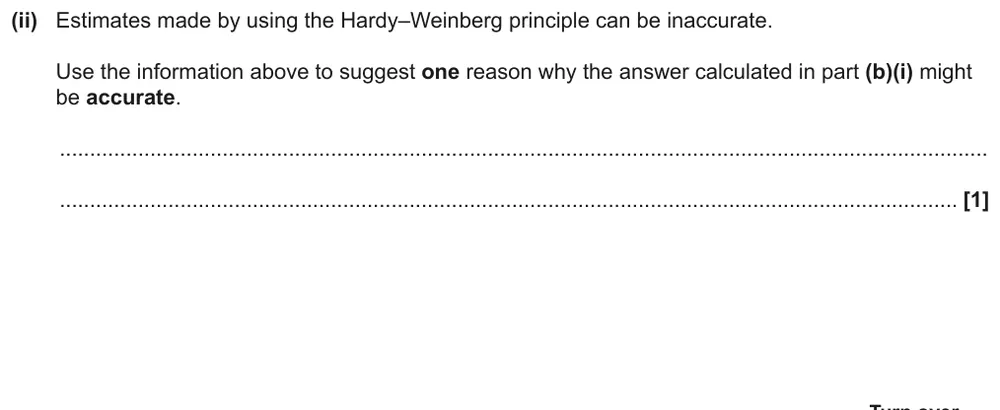
Suggest why a Hardy–Weinberg estimate for pea plants in a greenhouse might be accurate.
Information from earlier in this question:
Show the mark scheme

Tap an image to open it full size.
From the examiners' report: Read the bold word: it asks why the answer might be accurate. Large population and no migration in and out of the greenhouse both score.
Where students lose marks (from OCR examiners' reports and mark schemes)
Each point below is followed by wording that gained marks.
Red male, blue female: the sex is part of the phenotype: Most students did the pigeon cross correctly but gave only the feather colours as phenotypes.
✔ Gains credit: "Parents: red male, blue female" and "offspring: red male, blue male, red female, brown female".
An onion genotype has four letters: Students wrote one copy of each allele (AB, ab) for the parents' genotypes, or gave heterozygous genotypes.
✔ Gains credit: "White parent aaBB" and "red parent AAbb".
Only affected sons point to the X: Some students linked an allele that only affects males to the Y chromosome, or wrote that males are "more likely" to have the disease.
✔ Gains credit: "Sex-linked, on the X chromosome, because only males have the disease".
An AaBb × aaBb cross gives 3:1:3:1: Many students were ready for a standard 9:3:3:1 cross and couldn't work out the gametes from the parents' genotypes.
✔ Gains credit: "Gametes AB, Ab, aB, ab and aB, ab" and "ratio 3 : 1 : 3 : 1".
A 3:1 dihybrid ratio means linked genes: Just under half scored nothing; many tried sex linkage, codominance or epistasis even though the question ruled epistasis out.
✔ Gains credit: "Autosomal linkage: the genes are on the same chromosome, so there is no independent assortment".
Cheetah bottleneck: alleles lost, not frequencies: Most students defined a genetic bottleneck, or wrote about lower allele frequency and mixed up genes with alleles.
✔ Gains credit: "Many alleles were lost when the population dropped" and "the modern population descended from few survivors".
Tongue-rollers: 77/248 is q², not q: A common slip was to write q = 77/248, forgetting this is the proportion of homozygous recessives.
✔ Gains credit: "q² = 77/248 = 0.31, q = 0.557, p = 0.443, 2pq = 0.494".
Same island, so choosy mating: Students suggested physical or genetic barriers to reproduction for finches living in the same location.
✔ Gains credit: "Individuals choose to mate only with individuals with similar sized beaks".
Download the questions
Download the PDF pack (19 questions, mark schemes at the end)
Keep practising
- Genetics and Evolution quiz
- Patterns of inheritance: interactive written questions (20)
- Algebra (M2): OCR A Level Biology exam questions by topic
- Classification and Evolution (4.2.2): OCR A Level Biology exam questions by topic
- OCR A Level Biology masterclasses
Questions, mark schemes and examiners' report extracts © OCR.