

Cellular control is a short spec point with only four learning outcomes, but it draws on ideas from right across the course. Spec point 6.1.1 asks you about gene mutations and their effects on proteins, how gene expression is controlled at the transcriptional, post-transcriptional and post-translational levels (the lac operon, transcription factors, splicing and cyclic AMP), how homeobox genes control body plans, and why mitosis and apoptosis matter in shaping the body.
Students usually know the facts. The marks go when the wording slips. Examiners' reports describe students removing introns "from DNA", saying one allele "turns off" another instead of describing the protein it codes for, saying a stop codon ends transcription, and calling the bases or amino acids degenerate. In the six-mark questions, many answers covered one half of the question well and barely touched the other.
Work through the fifteen questions below in order. They start with recall, move on to applying what you know to unfamiliar genes and organisms, and finish with three extended-response questions. If you'd like to go through questions like these with me each week, my OCR A masterclasses run on Wednesdays at 5.15pm for Year 12 and on Tuesdays at 6.30pm or Thursdays at 5.15pm for Year 13.
Want help with this topic? It comes up in my weekly OCR A masterclasses. See the timetable →
What you need from GCSE
Each question on this page assumes you're secure on these GCSE ideas. If any of them feels shaky, look it up before you start.
- A gene is a section of DNA that codes for a protein; the sequence of bases decides the sequence of amino acids.
- Proteins are made by transcription (DNA to mRNA in the nucleus) and translation (mRNA to protein at the ribosome).
- A mutation is a change in the DNA; most have no effect on the phenotype, some change the protein's shape and function.
- Mitosis produces genetically identical cells for growth and repair; uncontrolled cell division can cause tumours.
Key terms
These words come up in the questions and mark schemes. Examiners expect you to use them exactly.
- Substitution, insertion and deletion: gene mutations in which a nucleotide is swapped, added or removed; insertions and deletions cause a frameshift.
- Degenerate code: most amino acids are coded for by more than one triplet, so some substitutions are silent.
- Nonsense mutation: a mutation that creates a stop codon, so translation ends early and the polypeptide is shorter.
- lac operon: a group of genes in E. coli (lacZ and lacY) with a shared promoter and operator; lactose binds to the repressor so it leaves the operator and the genes are transcribed.
- Transcription factor: a protein that binds to DNA (e.g. at a promoter) and switches transcription of a gene on or off.
- Introns and exons: non-coding and coding sequences; introns are removed from primary mRNA and exons joined to make mature mRNA.
- Post-translational control: activation of proteins after translation, e.g. cyclic AMP activating protein kinase A.
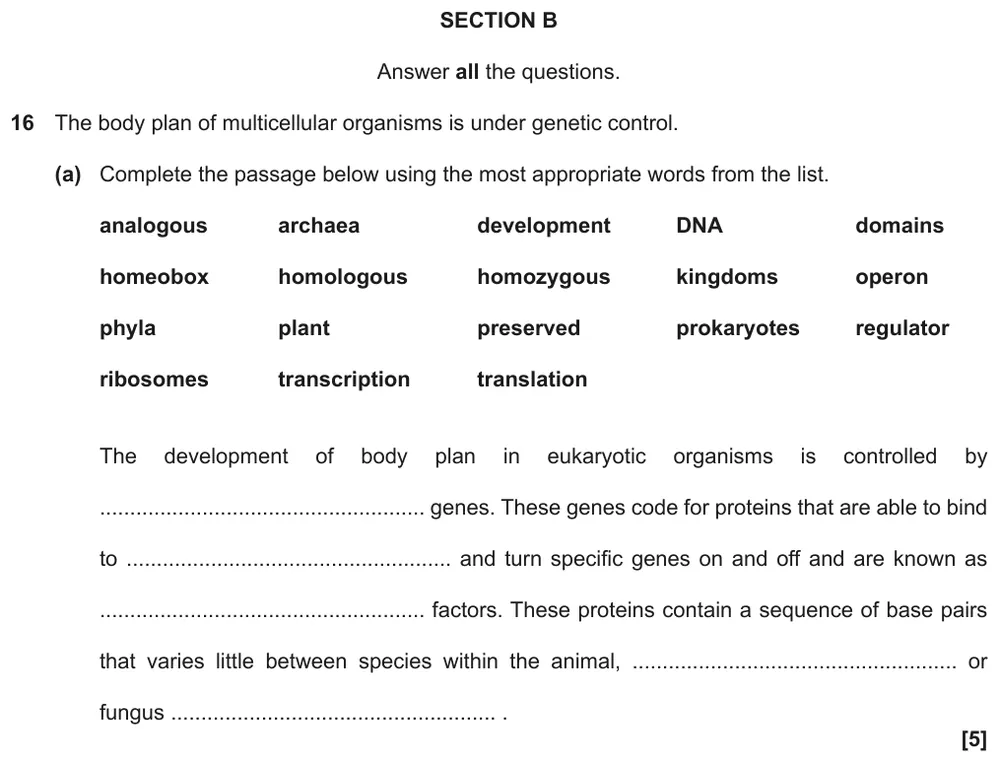
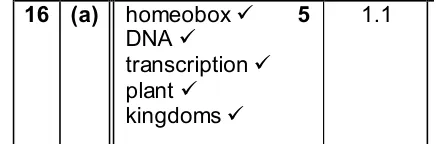
- Homeobox and Hox genes: highly conserved regulatory genes in plants, animals and fungi; Hox genes (a subset) control body plan development.
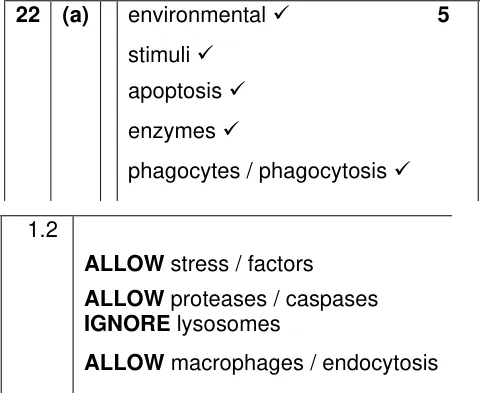
- Apoptosis: programmed cell death: enzymes break down the cell contents and phagocytes remove the fragments without damaging nearby tissue.
What these questions cover (OCR 6.1.1)
The questions test these learning outcomes from the OCR A Level Biology A specification (H420):
- (a) types of gene mutations and their possible effects on protein production and function (substitution, insertion and deletion, and beneficial, neutral or harmful effects)
- (b) the regulatory mechanisms that control gene expression at the transcriptional level, post-transcriptional level and post-translational level (the lac operon, transcription factors, splicing and activation of proteins by cAMP)
- (c) the genetic control of the development of body plans in different organisms
- (d) the importance of mitosis and apoptosis as mechanisms controlling the development of body form
How to use this page
Write your answer on paper before you open the mark scheme. Allow about 1.2 minutes per mark: the 15 questions are worth 44 marks, so about 53 minutes in total. Then mark your answer strictly against the mark scheme and read the examiners' tip underneath it. If you'd rather print the questions, download the PDF pack.
Recall
Question 1
A level Paper 2 · June 2022 · Q22(a) · 5 marks · Easy
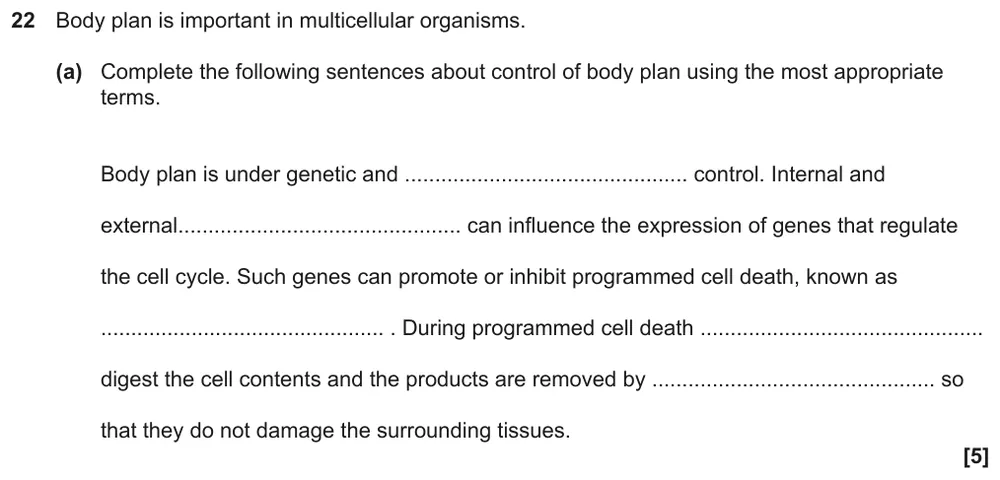
Complete sentences about the control of body plan, the cell cycle and apoptosis.
Show the mark scheme
Tap an image to open it full size.
From the examiners' report: Most students got the first three gaps. The common wrong answers were "hormonal" for environmental and "conditions" for stimuli, and the cell debris is removed by phagocytes, not lysosomes.
Question 2
A level Paper 2 · June 2022 · Q22(b) · 1 mark · Easy
Name the type of gene that controls body plan.

Show the mark scheme

Tap an image to open it full size.
From the examiners' report: Nearly everyone scored. Say Hox (homeobox) genes; "regulatory" or "lac operon" were the wrong answers seen.
Question 3
A level Paper 2 · November 2020 · Q16(a) · 5 marks · Medium
Complete a passage about the genes that control body plan, choosing words from a list.
Show the mark scheme
Tap an image to open it full size.
Question 4
A level Paper 2 · November 2021 · Q16(c)(i) · 2 marks · Easy
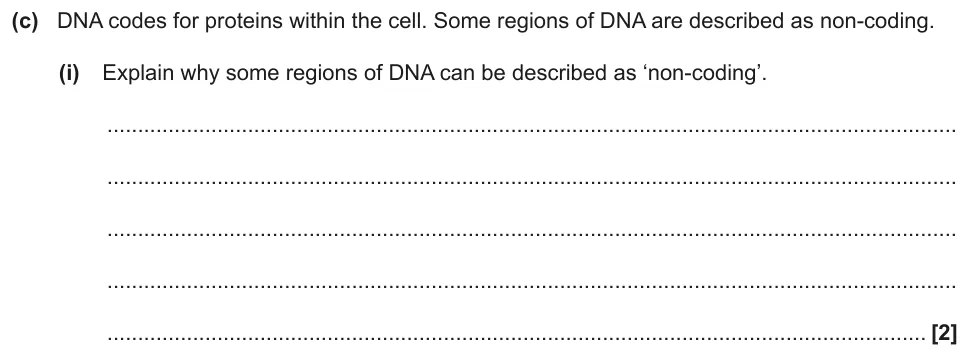
Explain why some regions of DNA are described as non-coding.
Show the mark scheme
Tap an image to open it full size.
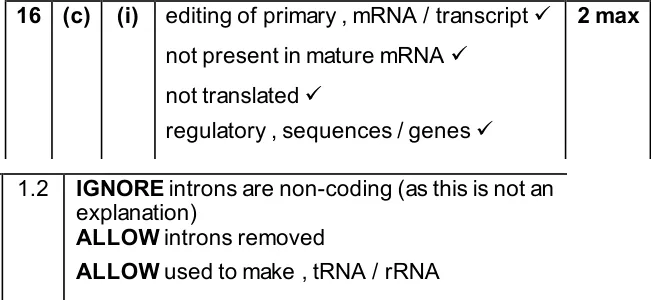
From the examiners' report: This asks you to explain, not define. Say that introns are removed from primary mRNA, so they aren't in mature mRNA and aren't translated.
Question 5
A level Paper 2 · November 2021 · Q16(c)(ii) · 1 mark · Easy
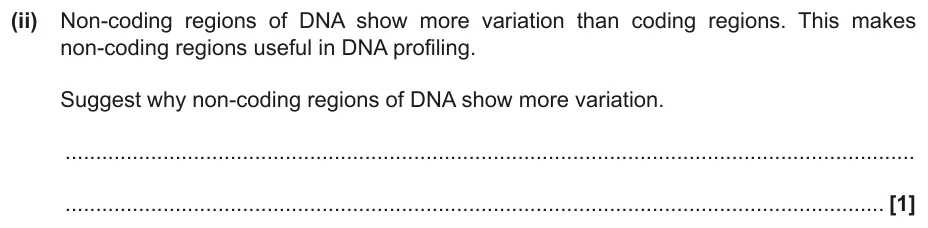
Suggest why non-coding regions of DNA show more variation than coding regions.
Show the mark scheme

Tap an image to open it full size.
Question 6
A level Paper 3 · June 2025 · Q4(b) · 2 marks · Hard
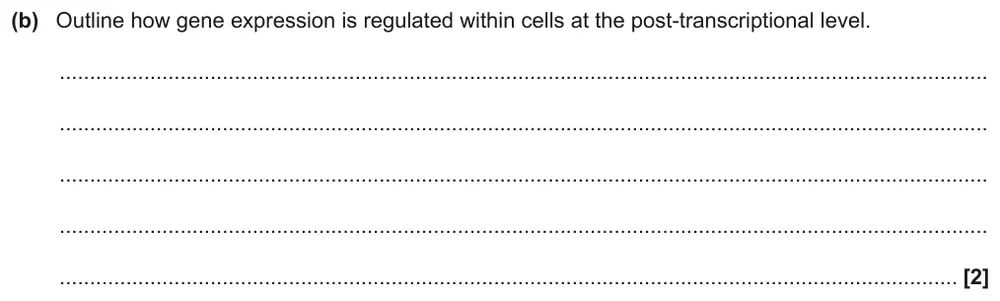
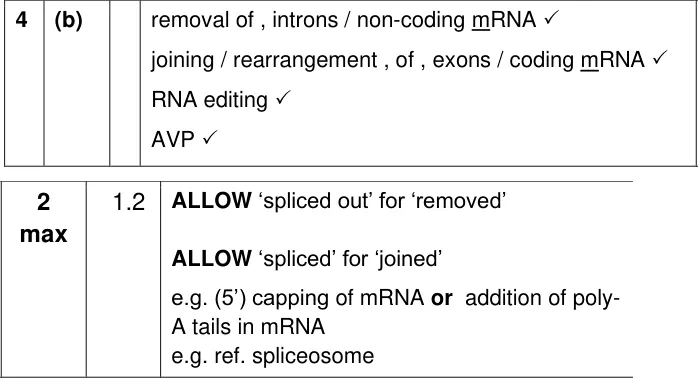
Outline how gene expression is regulated at the post-transcriptional level.
Show the mark scheme
Tap an image to open it full size.
From the examiners' report: Stay at the post-transcriptional level: introns are removed from primary mRNA and the exons joined. Introns are not removed from DNA, and the lac operon is transcriptional control.
Applying what you know
Question 7
A level Paper 2 · June 2017 · Q20(b)(iii) · 2 marks · Medium
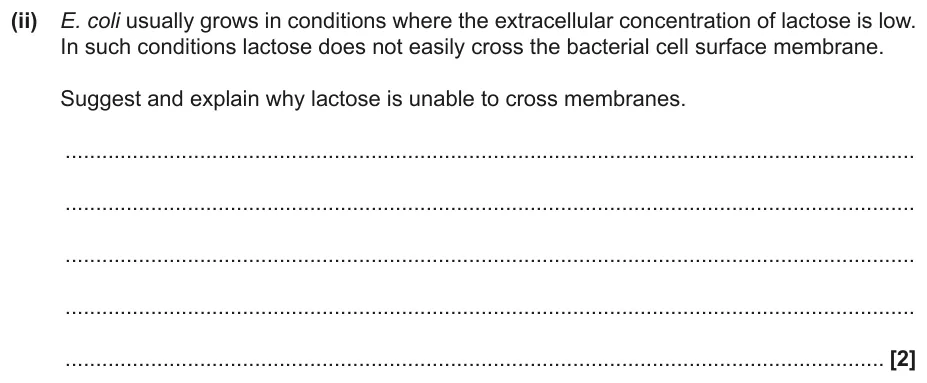
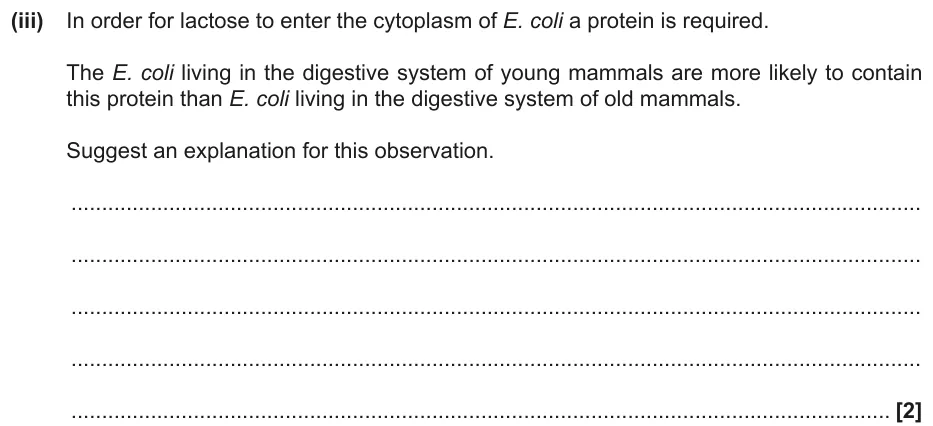
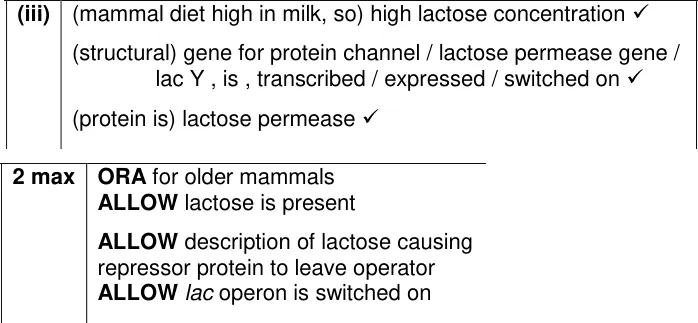
Explain why E. coli in young mammals are more likely to make the protein that lets lactose in.
Information from earlier in this question:
Show the mark scheme
Tap an image to open it full size.
Question 8
A level Paper 3 · June 2018 · Q1(c)(iii) · 2 marks · Hard
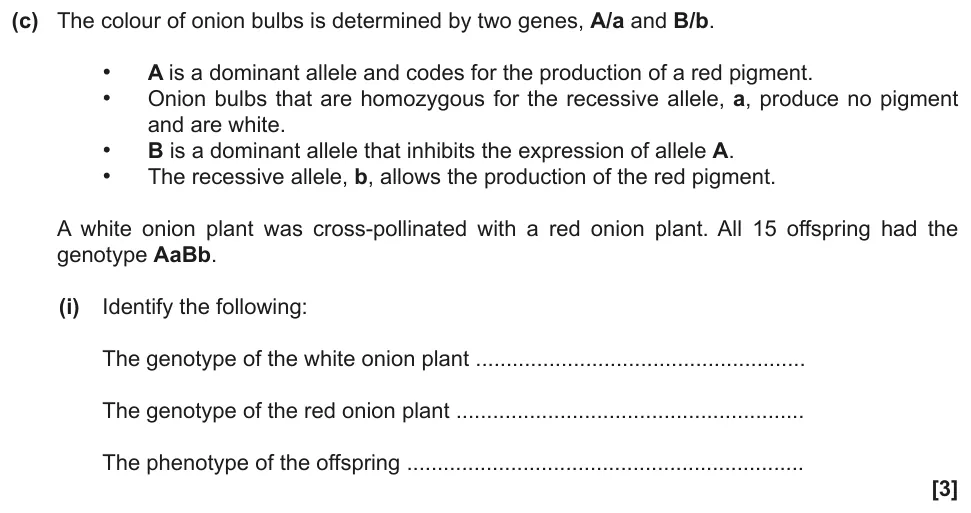
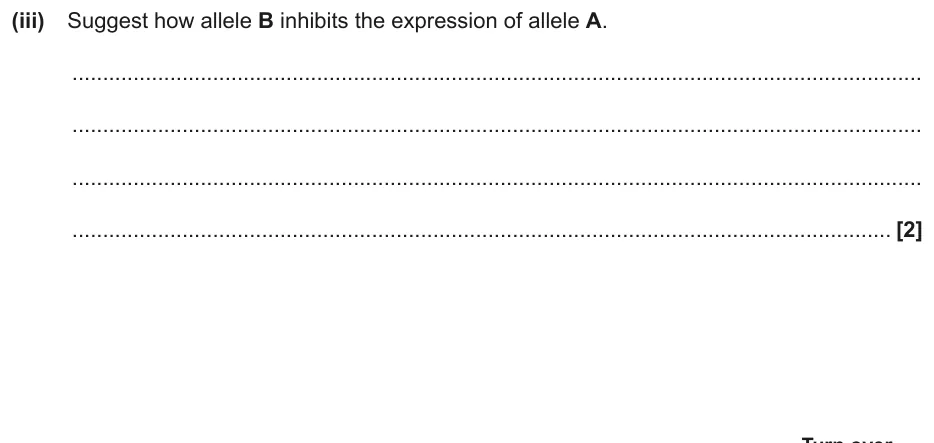
Suggest how allele B inhibits the expression of allele A.
Information from earlier in this question:
Show the mark scheme

Tap an image to open it full size.
From the examiners' report: Say what allele B codes for, such as a repressor protein or transcription factor, and that this product binds to the promoter of A and stops its transcription. "B turns off A" gained nothing.
Question 9
A level Paper 3 · June 2025 · Q6(a)(ii) · 1 mark · Hard
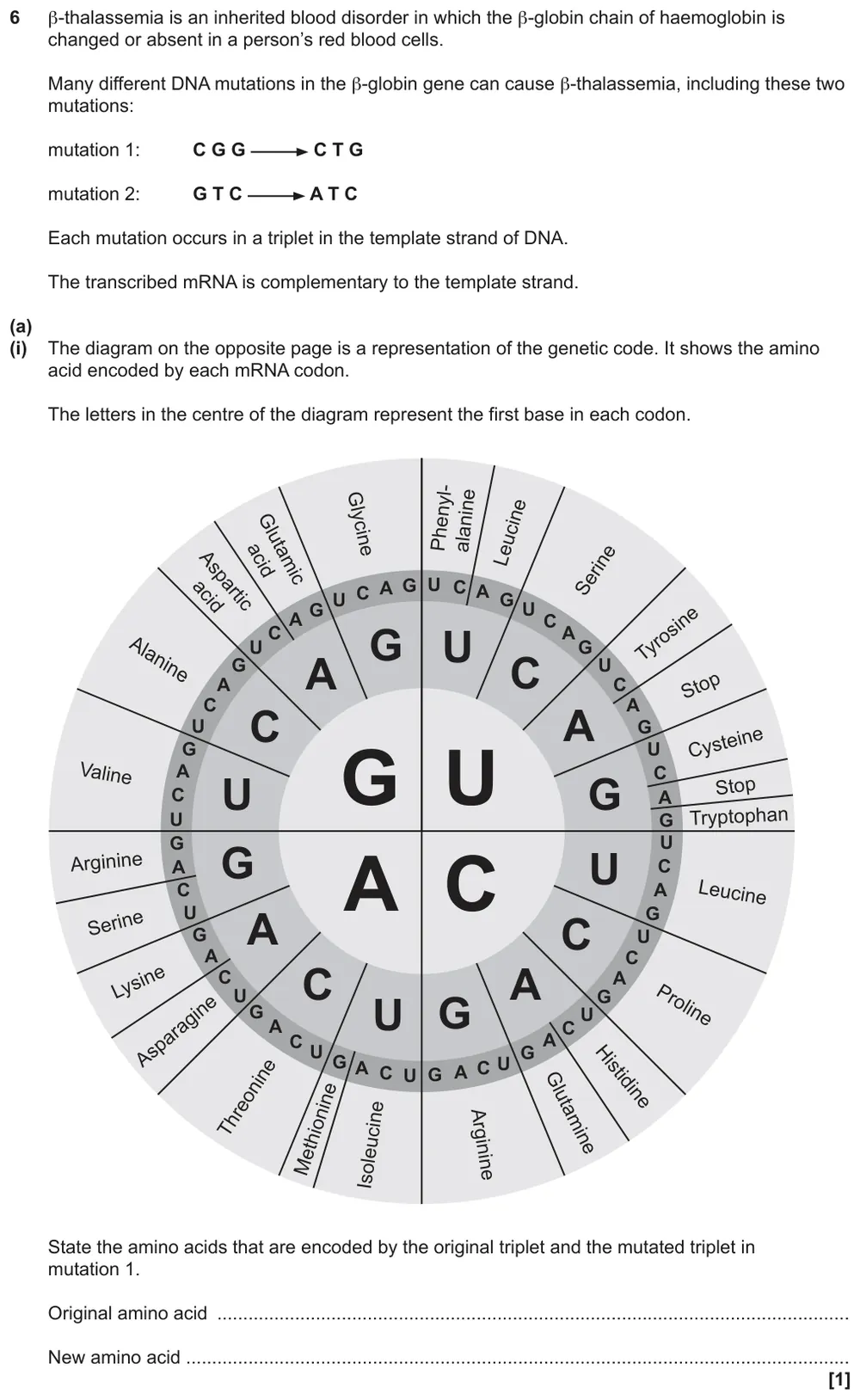
State and explain the effect of a mutation on the structure of the β-chain of haemoglobin.
Information from earlier in this question:

Show the mark scheme

Tap an image to open it full size.
From the examiners' report: Convert the DNA triplets into mRNA codons first. Then say the chain is shorter because a stop codon ends translation early; a stop codon doesn't stop transcription, and this isn't a frameshift.
Question 10
A level Paper 2 · June 2019 · Q17(b)(ii) · 2 marks · Hard
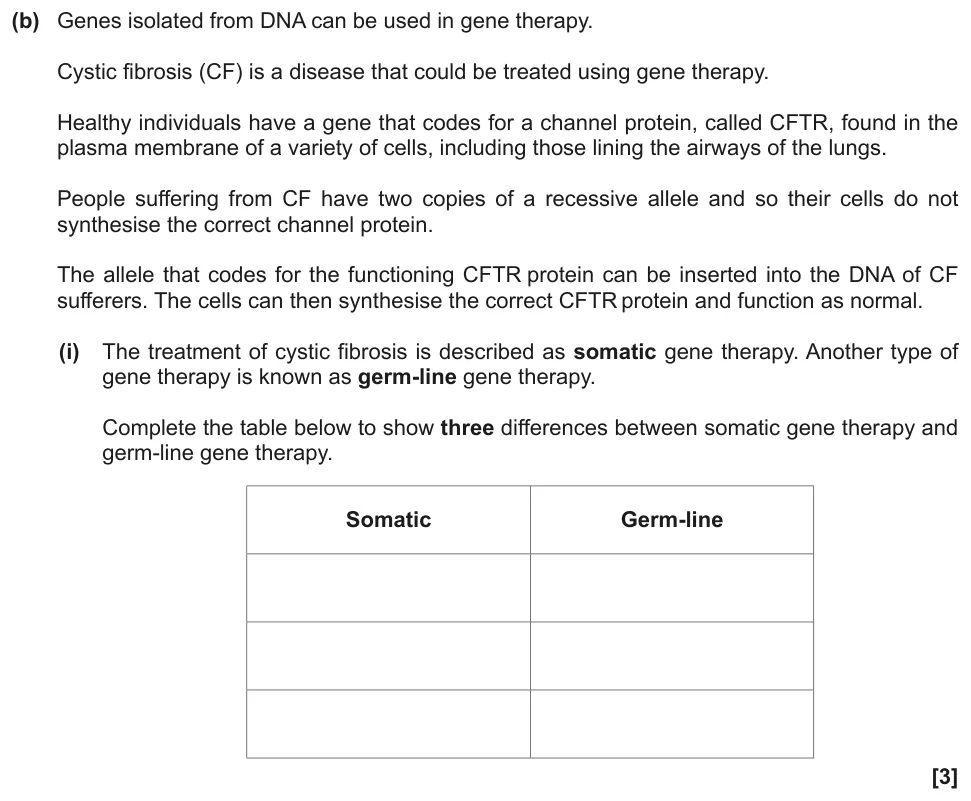
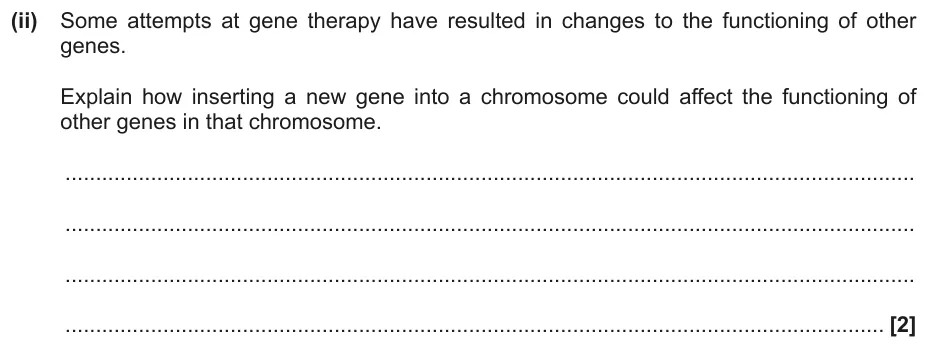
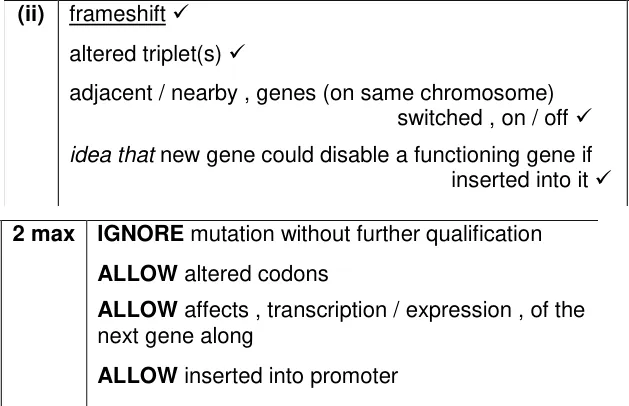
Explain how inserting a new gene into a chromosome could affect other genes on it.
Information from earlier in this question:
Show the mark scheme
Tap an image to open it full size.
From the examiners' report: Focus on "in that chromosome": an insertion inside a gene causes a frameshift and alters the triplets, and one next to a gene can switch it on or off. Epistasis and meiosis are not relevant.
Question 11
A level Paper 2 · June 2017 · Q19(b)(iv) · 1 mark · Medium
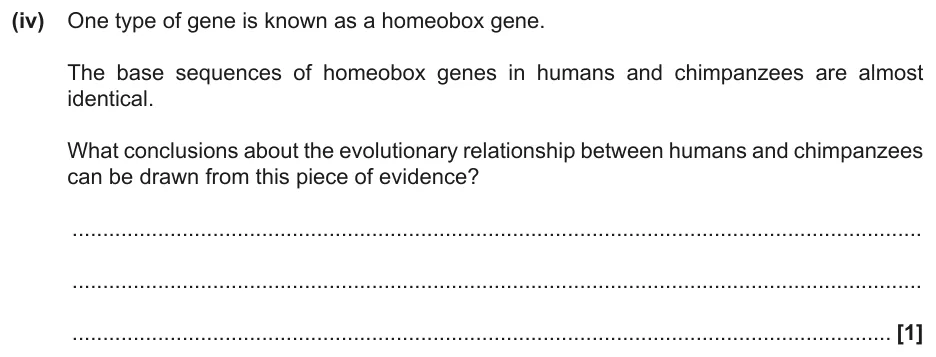
Decide what near-identical homeobox genes in humans and chimpanzees tell us about their relationship.
Show the mark scheme

Tap an image to open it full size.
Question 12
A level Paper 2 · November 2020 · Q16(b)(i) · 2 marks · Medium
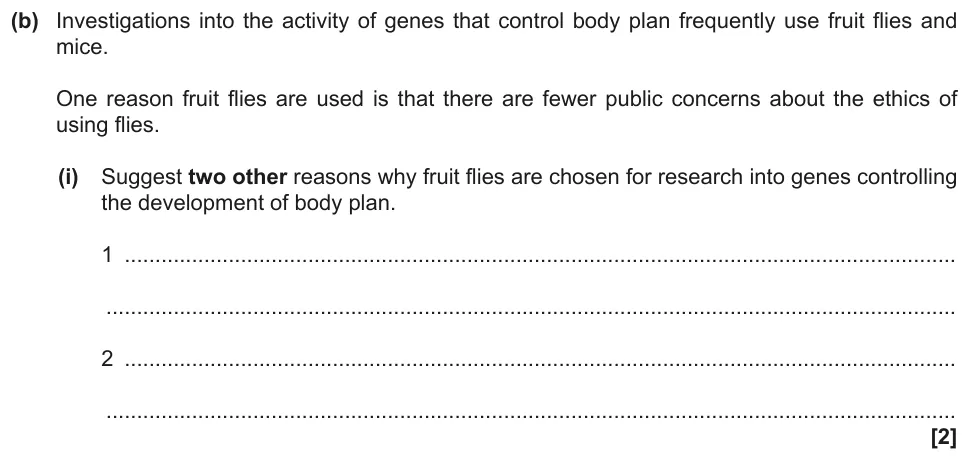
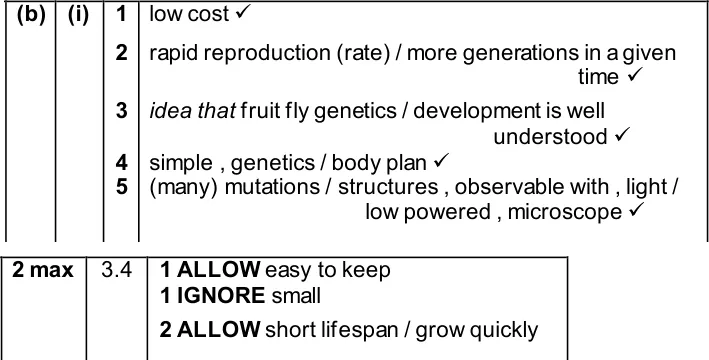
Suggest two reasons, other than ethics, why fruit flies are used to research body-plan genes.
Show the mark scheme
Tap an image to open it full size.
From the examiners' report: "A large number of offspring" wasn't enough: say they reproduce rapidly, so you get many generations in a short time.
Extended answers
Question 13
A level Paper 2 · June 2022 · Q16(b)(iv) · 6 marks · Hard
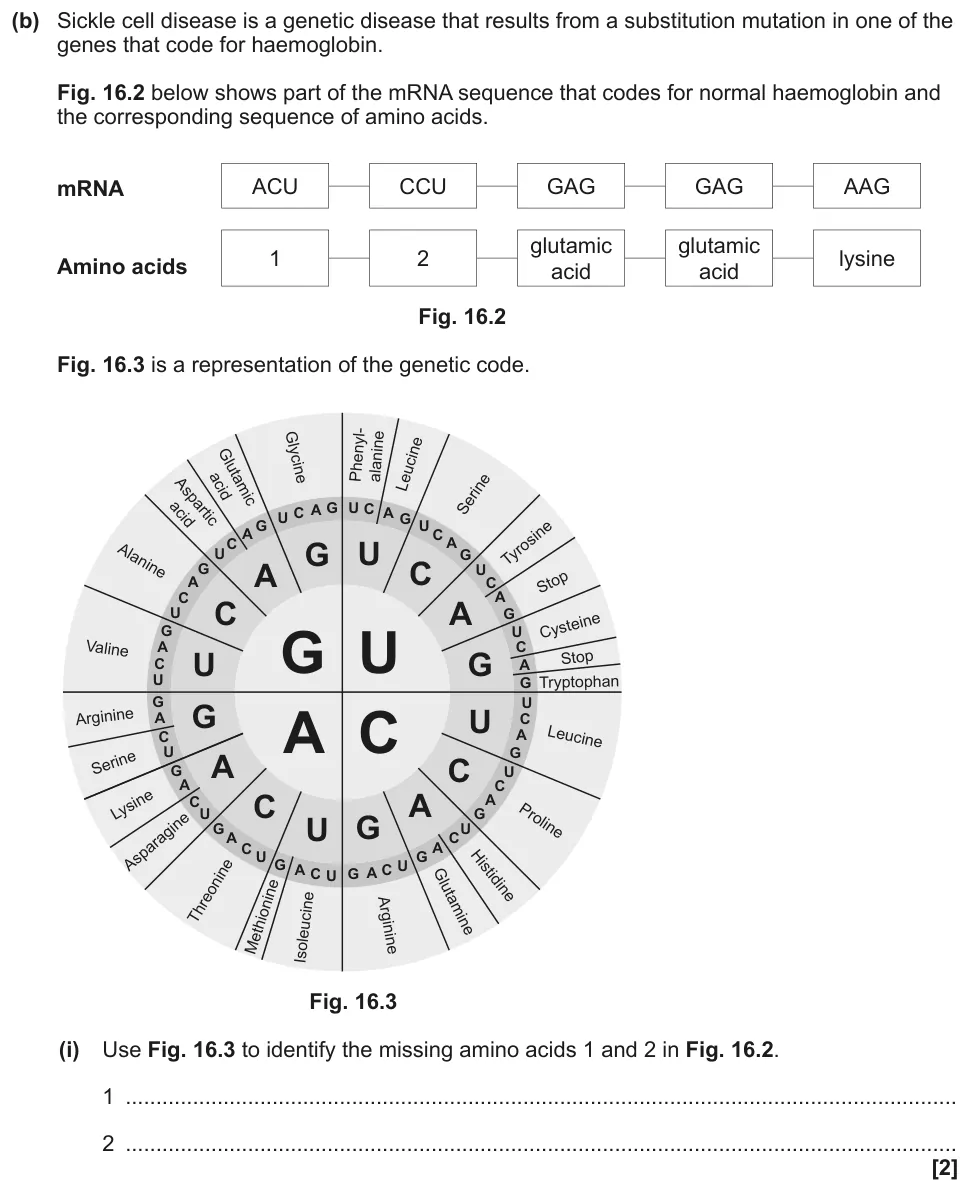
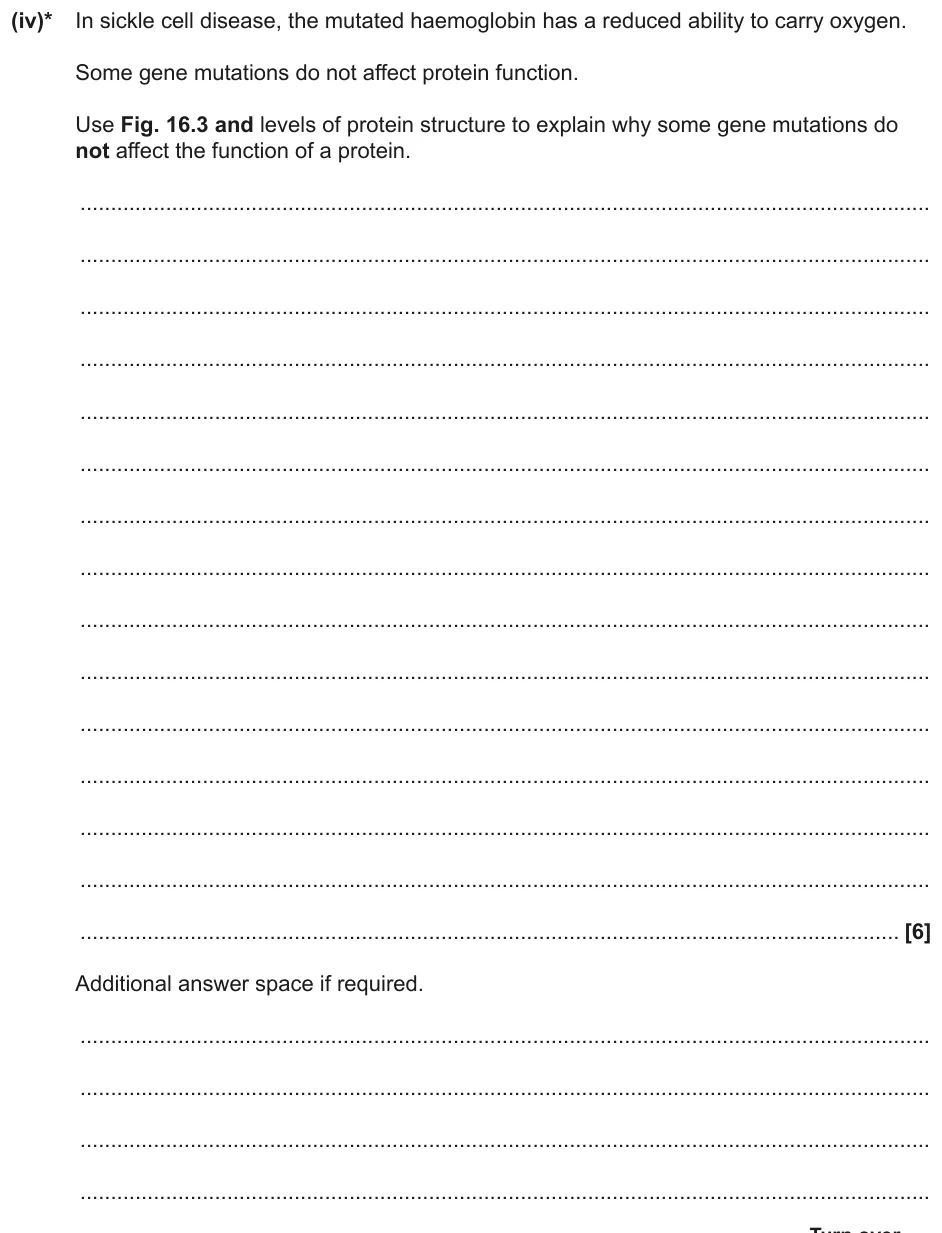
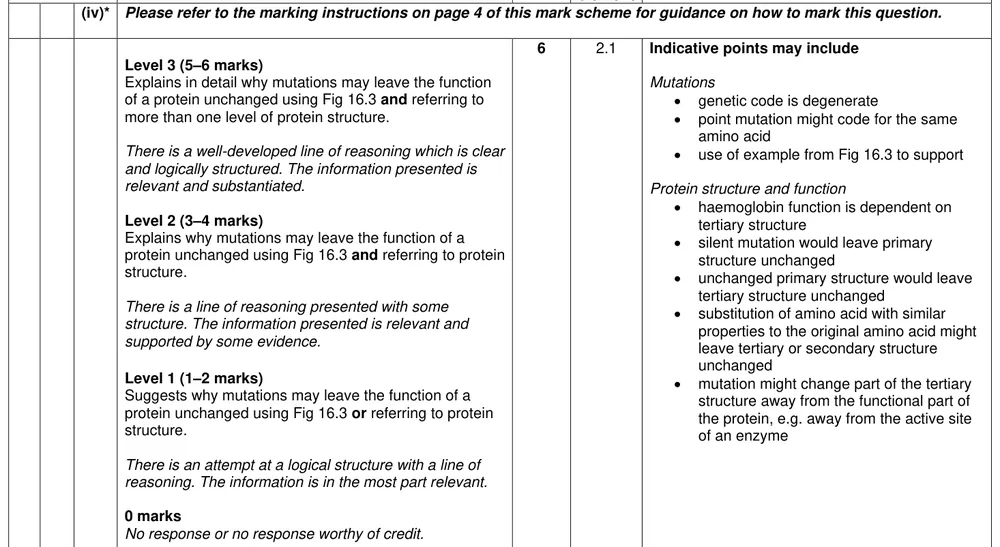
Use a codon table and levels of protein structure to explain why some mutations do not affect protein function.
Information from earlier in this question:
Show the mark scheme
Tap an image to open it full size.
From the examiners' report: Use all three things asked for: Fig. 16.3, mutations and levels of protein structure. It is the genetic code that is degenerate, not the bases or amino acids.
Question 14
A level Paper 3 · June 2023 · Q6 · 6 marks · Medium
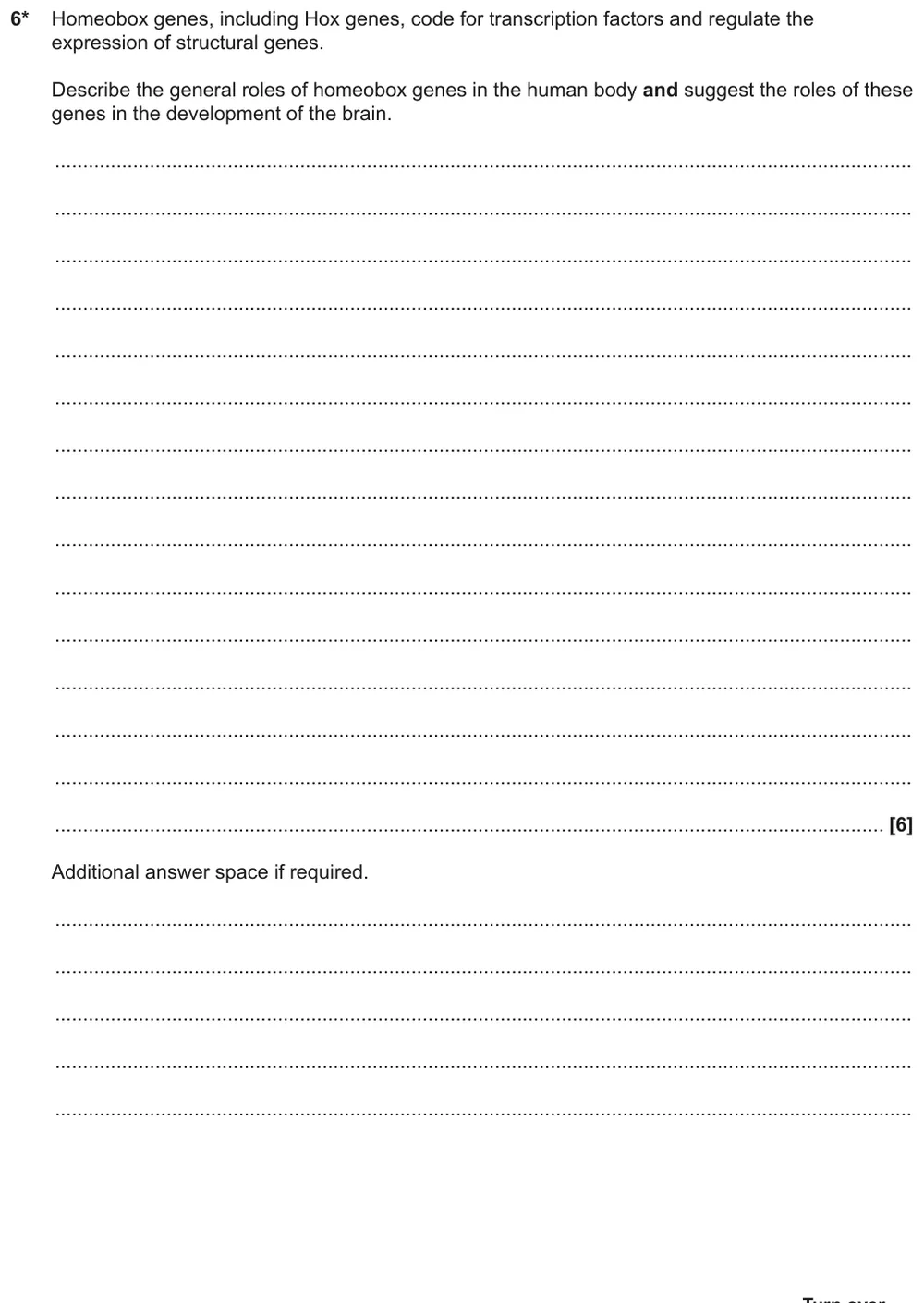
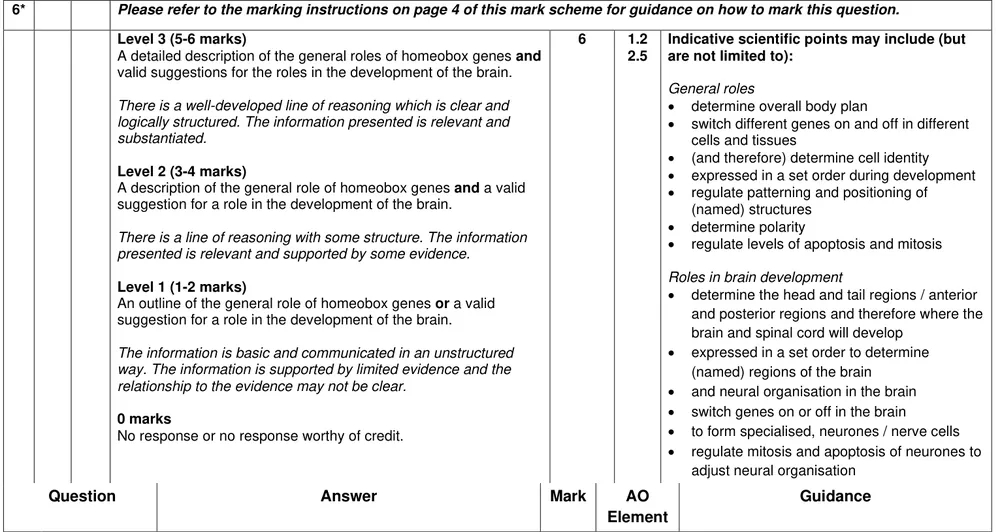
Describe the general roles of homeobox genes and suggest their roles in brain development.
Show the mark scheme
Tap an image to open it full size.
From the examiners' report: Give the brain as much space as the general roles: placing regions such as the cerebellum, and shaping neurones through mitosis and apoptosis. Long accounts of the lac operon or of conservation don't score.
Question 15
A level Paper 2 · June 2025 · Q16(c) · 6 marks · Medium
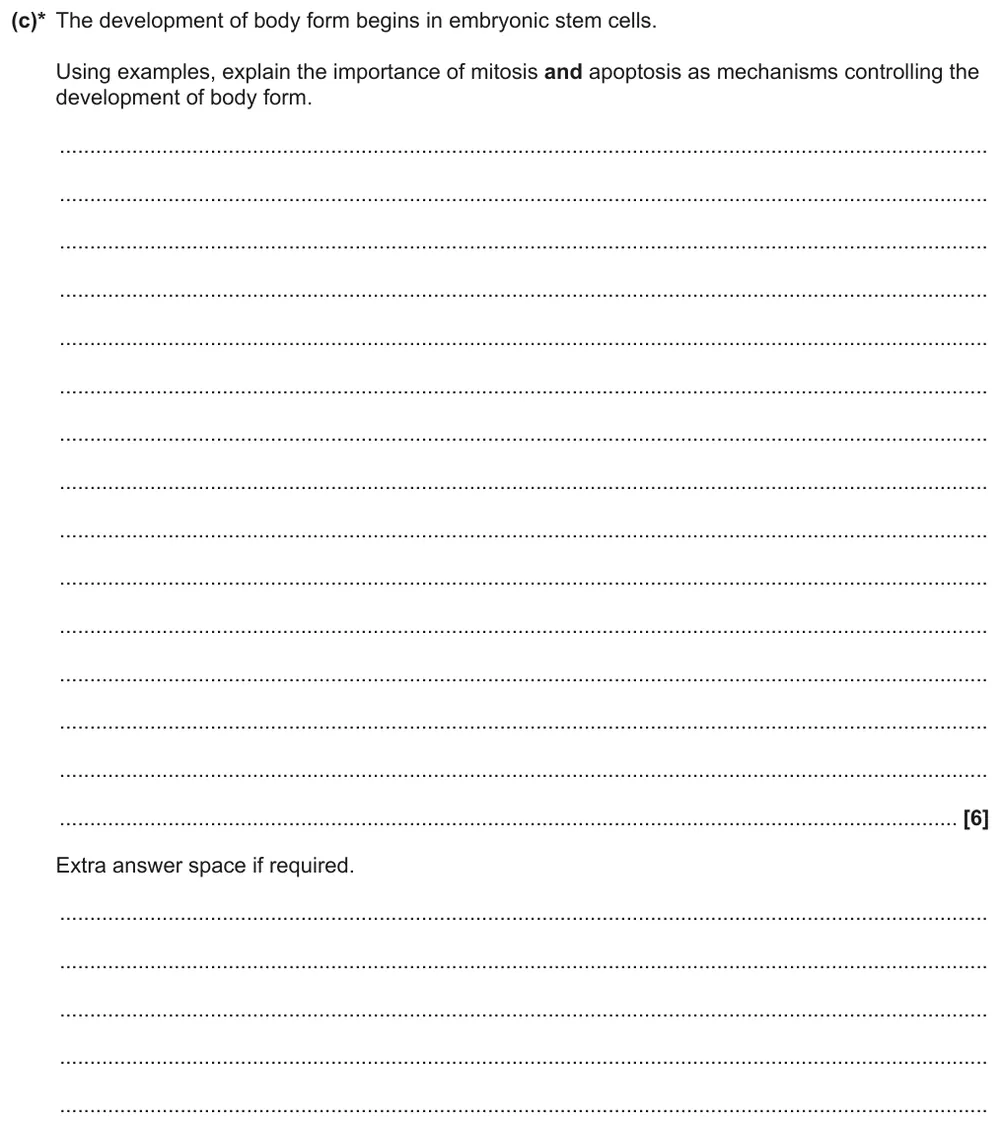
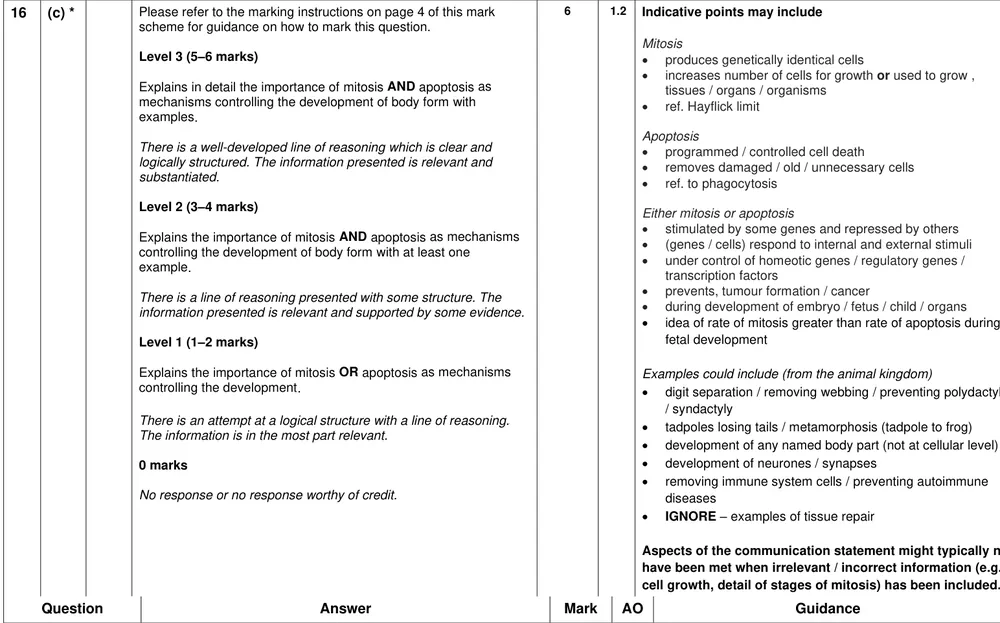
Using examples, explain the importance of mitosis and apoptosis in controlling the development of body form.
Show the mark scheme
Tap an image to open it full size.
From the examiners' report: Cover mitosis, apoptosis and examples separately (subheadings help), and give a clear example such as digit separation. Leave out the stages of mitosis.
Where students lose marks (from OCR examiners' reports and mark schemes)
Each point below is followed by wording that gained marks.
Introns leave the mRNA, not the DNA: Some students wrote about removing introns from DNA, used "extrons", or answered with the lac operon or histone modification.
✔ Gains credit: "Removal of introns" and "joining of exons" in the primary mRNA; "RNA editing".
Allele B acts through the protein it codes for: Many students wrote that "allele B turns off allele A", which gained no credit.
✔ Gains credit: "B codes for a repressor protein or transcription factor" that "binds to the promoter of A" and "stops transcription of A".
An inserted gene can disrupt its neighbours: Few students scored; many ignored "in that chromosome" and wrote about epistasis or meiosis.
✔ Gains credit: "Frameshift", "altered triplets", or "adjacent genes switched on or off".
A stop codon halts translation: Common errors were calling the change a frameshift or saying it caused early termination of transcription.
✔ Gains credit: "A shorter chain because an early stop codon has been introduced".
The genetic code is degenerate, not the bases: Many students called the amino acids, the bases or the DNA degenerate, and some gave a list of mutation types without linking them to protein structure.
✔ Gains credit: "The genetic code is degenerate", so "a silent mutation would leave the primary structure unchanged" and so the tertiary structure too.
Explain non-coding; don't just restate it: Many students described what non-coding might mean instead of explaining why those regions don't code for a polypeptide.
✔ Gains credit: "Introns are removed" so are "not present in mature mRNA" and "not translated".
Phagocytes tidy up after apoptosis: The usual wrong answers in the gaps were "hormonal", "conditions" and lysosomes, which were not credited.
✔ Gains credit: "Genetic and environmental control", "internal and external stimuli", and products "removed by phagocytes".
Hox genes in the brain need their own paragraph: Answers that didn't reach Level 3 were unbalanced, with most of the space on the general role of homeobox genes and little on the brain.
✔ Gains credit: "Expressed in a set order to determine regions of the brain" and "regulate mitosis and apoptosis of neurones".
Download the questions
Download the PDF pack (15 questions, mark schemes at the end)
Keep practising
- Cellular Control and Manipulating Genomes quiz
- Cellular control: interactive written questions (14)
- Nucleotides and Nucleic Acids (2.1.3): OCR A Level Biology exam questions by topic
- Manipulating Genomes (6.1.3): OCR A Level Biology exam questions by topic
- OCR A Level Biology masterclasses
Questions, mark schemes and examiners' report extracts © OCR.