

Manipulating genomes is the Module 6 topic that ties DNA, enzymes and ethics together. Spec point 6.1.3 asks you to explain the principles of DNA sequencing, from Sanger's method to high-throughput techniques, and how sequencing lets us compare genomes, predict amino acid sequences and build synthetic biology. It then covers DNA profiling, PCR, electrophoresis, genetic engineering with restriction enzymes, plasmids, ligase and electroporation, the ethics of genetic manipulation, and gene therapy.
The examiners' reports show the same slips every year. Students describe how sequencing is done when the question asks what it allows, say "base pairs" or mix up bases with amino acids, name the temperature of a PCR step instead of what happens in it, and confuse electroporation with electrofusion or a gene for fluorescence with a fluorescent dye. Data questions on DNA profiles catch out anyone who writes "gene" when they mean allele.
Work through the eighteen questions below in order. They start with recall, move on to bioinformatics, synthetic biology and DNA profiles, and finish with electrophoresis and PCR in practice. If you'd like to go through questions like these with me each week, my OCR A masterclasses run on Wednesdays at 5.15pm for Year 12 and on Tuesdays at 6.30pm or Thursdays at 5.15pm for Year 13.
Want help with this topic? It comes up in my weekly OCR A masterclasses. See the timetable →
What you need from GCSE
Each question on this page assumes you're secure on these GCSE ideas. If any of them feels shaky, look it up before you start.
- DNA is a polymer of nucleotides; the order of the bases A, T, C and G is the genetic code, and three bases code for one amino acid.
- A gene is a section of DNA that codes for a protein; different versions of a gene are alleles.
- Genetic engineering cuts a gene out of one organism with enzymes and inserts it into another, often bacteria, using a vector such as a plasmid.
- The whole human genome has been sequenced, which helps to find genes linked to disease and to trace human migration.
- Genetically modified crops can be resistant to insects or herbicides, but people worry about effects on wild populations and human health.
Key terms
These words come up in the questions and mark schemes. Examiners expect you to use them exactly.
- DNA sequencing: working out the sequence of nucleotides (bases) in a length of DNA.
- High-throughput sequencing: newer, automated methods (e.g. pyrosequencing, next generation sequencing) that sequence many DNA fragments at once, much faster and cheaper than Sanger sequencing.
- Bioinformatics and computational biology: storing and organising biological data in databases with software, and using algorithms and models to analyse and compare it.
- Synthetic biology: designing and building new biological parts, pathways or organisms, or redesigning existing ones for useful purposes.
- DNA profiling: comparing the lengths of variable, non-coding DNA regions (e.g. VNTRs) at several loci to identify individuals or relationships.
- PCR: the polymerase chain reaction: repeated cycles of denaturation (about 95 °C), annealing of primers (about 55 °C) and extension by Taq polymerase (about 72 °C) to amplify DNA.
- Electrophoresis: separating DNA fragments or proteins by size in a gel; DNA is negatively charged so it moves towards the positive electrode, small fragments furthest.
- Restriction enzyme and DNA ligase: a restriction endonuclease cuts DNA at a specific base sequence, often leaving sticky ends; ligase forms phosphodiester bonds to join the gene into a plasmid.
- Electroporation: an electric pulse makes the bacterial membrane more porous so the recombinant plasmid can enter.
- Somatic and germ line gene therapy: inserting a functional allele into body cells (not inherited, needs repeating) or into gametes or embryos (inherited by offspring).
What these questions cover (OCR 6.1.3)
The questions test these learning outcomes from the OCR A Level Biology A specification (H420):
- (a) the principles of DNA sequencing and new DNA sequencing techniques (from Sanger sequencing to high-throughput sequencing; details of high-throughput methods are not needed)
- (b)(i) how gene sequencing has allowed for genome-wide comparisons between individuals and between species (with reference to bioinformatics and computational biology)
- (b)(ii) how gene sequencing has allowed for the sequences of amino acids in polypeptides to be predicted
- (b)(iii) how gene sequencing has allowed for the development of synthetic biology
- (c) the principles of DNA profiling and its uses (including forensics and analysis of disease risk)
- (d) the principles of the polymerase chain reaction (PCR) and its application in DNA analysis
- (e) the principles and uses of electrophoresis for separating nucleic acid fragments or proteins
- (f)(i) the principles of genetic engineering
- (f)(ii) the techniques used in genetic engineering (restriction enzymes, plasmids, DNA ligase and electroporation)
- (g) the ethical issues (both positive and negative) relating to the genetic manipulation of animals (including humans), plants and microorganisms
- (h) the principles of, and potential for, gene therapy in medicine (including somatic and germ line cell gene therapy)
How to use this page
Write your answer on paper before you open the mark scheme. Allow about 1.2 minutes per mark: the 18 questions are worth 36 marks, so about 43 minutes in total. Then mark your answer strictly against the mark scheme and read the examiners' tip underneath it. If you'd rather print the questions, download the PDF pack.
Recall
Question 1
A level Paper 2 · June 2018 · Q21(a) · 1 mark · Easy
Define the term DNA sequencing.
Show the mark scheme

Tap an image to open it full size.
From the examiners' report: Give a one-line definition: working out the order of nucleotides (bases) in DNA. Don't describe the method, don't write "base pairs", and never suggest DNA is made of amino acids.
Question 2
A level Paper 2 · June 2018 · Q21(c)(i) · 1 mark · Medium
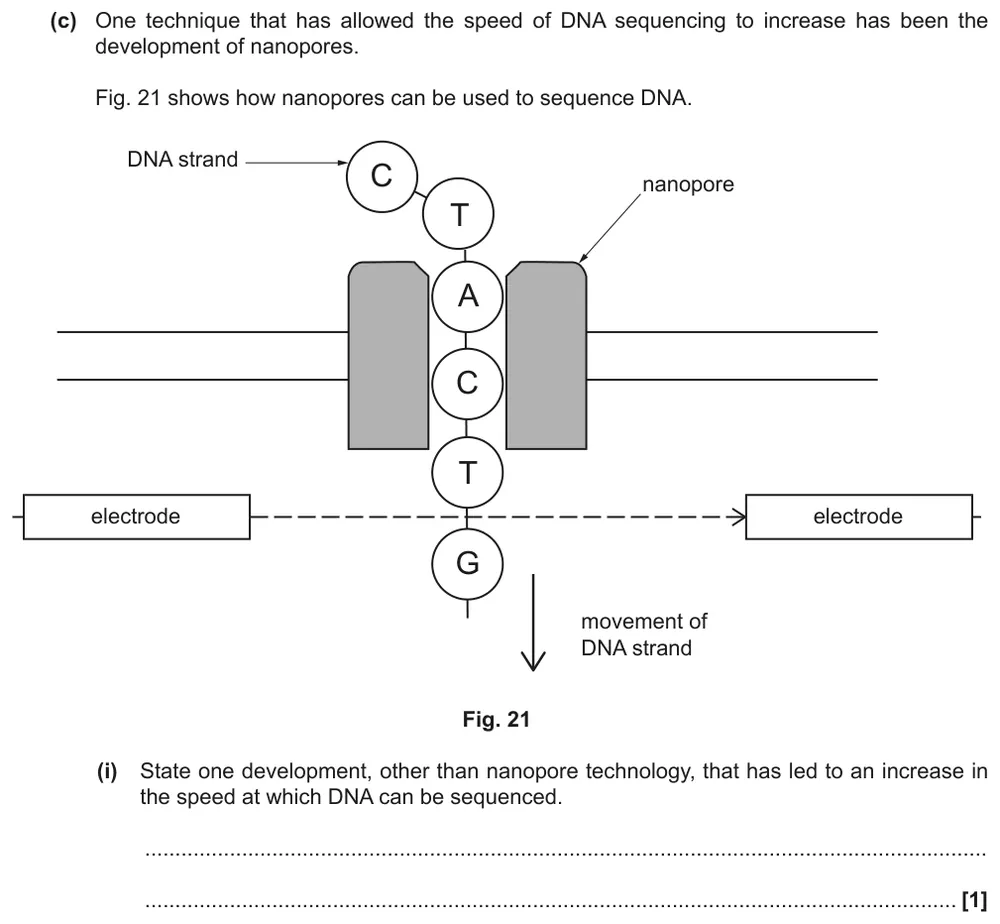
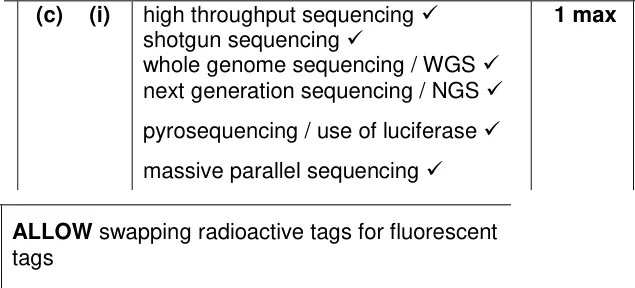
State one development, other than nanopores, that has made DNA sequencing faster.
Show the mark scheme
Tap an image to open it full size.
From the examiners' report: Only about a quarter of students scored. Name a sequencing technique, such as pyrosequencing or high-throughput sequencing; PCR, electrophoresis and "using a computer" don't count.
Question 3
A level Paper 2 · June 2018 · Q21(c)(iii) · 2 marks · Medium
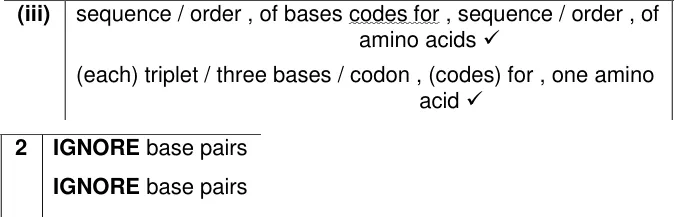
Explain how DNA sequencing allows the amino acid sequence of a polypeptide to be predicted.
Show the mark scheme
Tap an image to open it full size.
From the examiners' report: Answer the question asked, not "describe DNA sequencing". Link the base sequence to the amino acid sequence and say that each triplet of bases codes for one amino acid.
Question 4
A level Paper 2 · June 2024 · Q16(a) · 1 mark · Easy
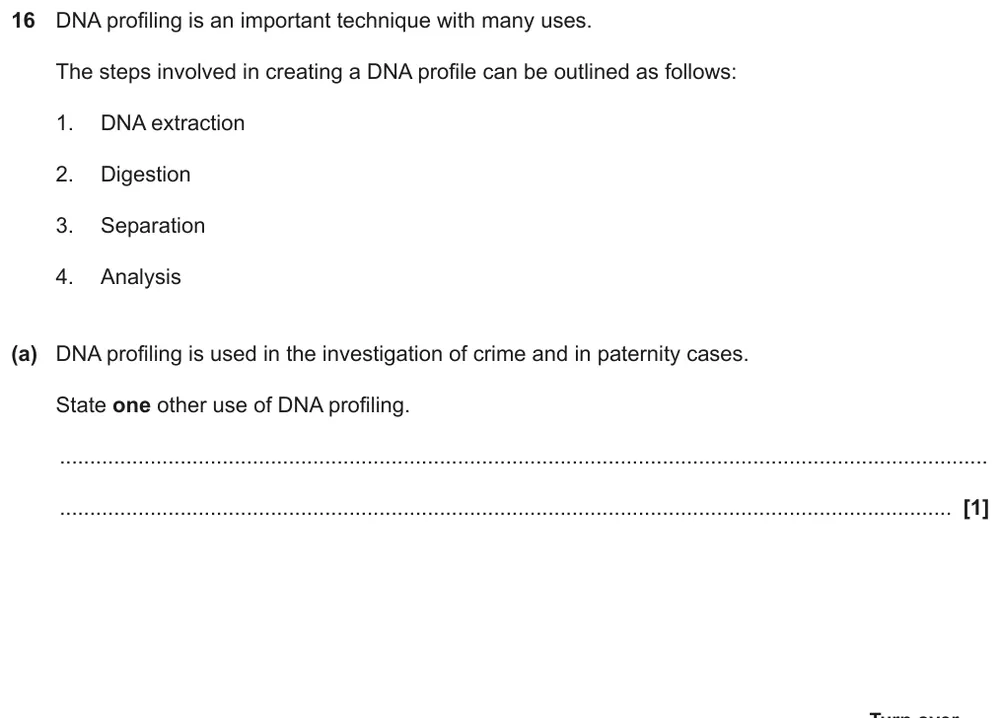
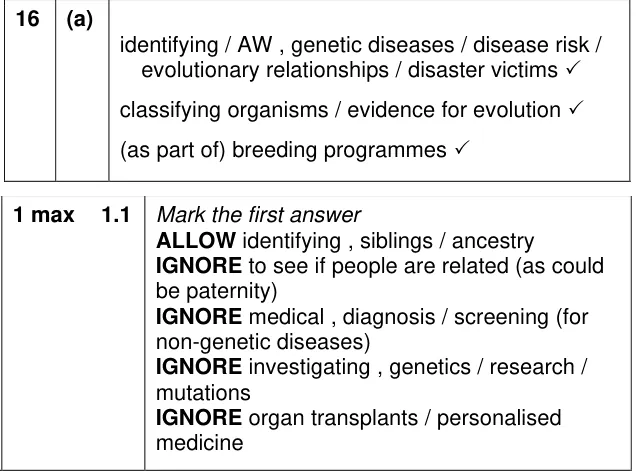
State one use of DNA profiling other than crime and paternity cases.
Show the mark scheme
Tap an image to open it full size.
From the examiners' report: Most students scored. Give one specific use, such as analysing the risk of a genetic disease; "seeing if people are related" is just paternity again.
Question 5
A level Paper 2 · June 2024 · Q16(b)(ii) · 3 marks · Easy
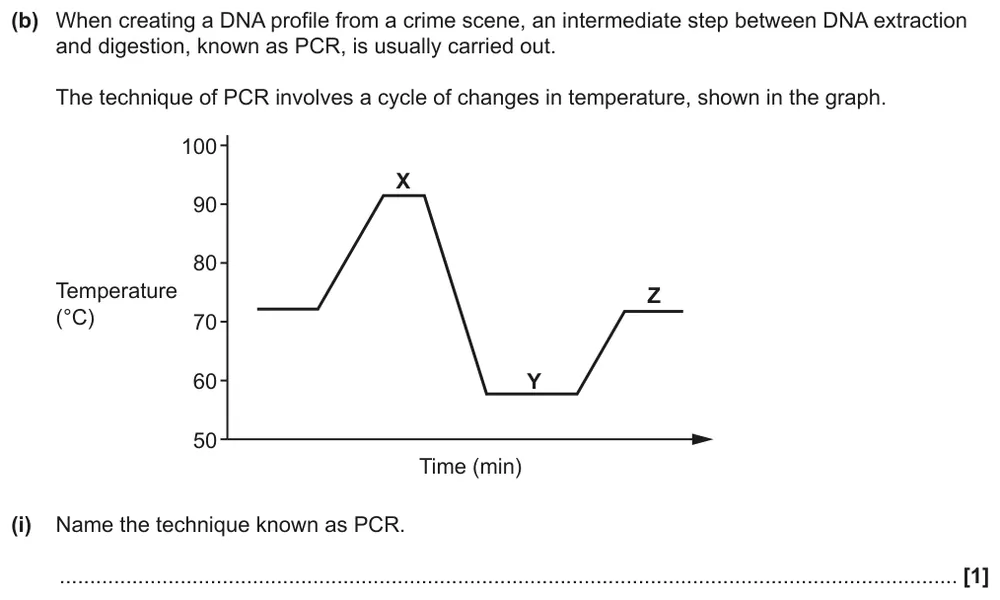
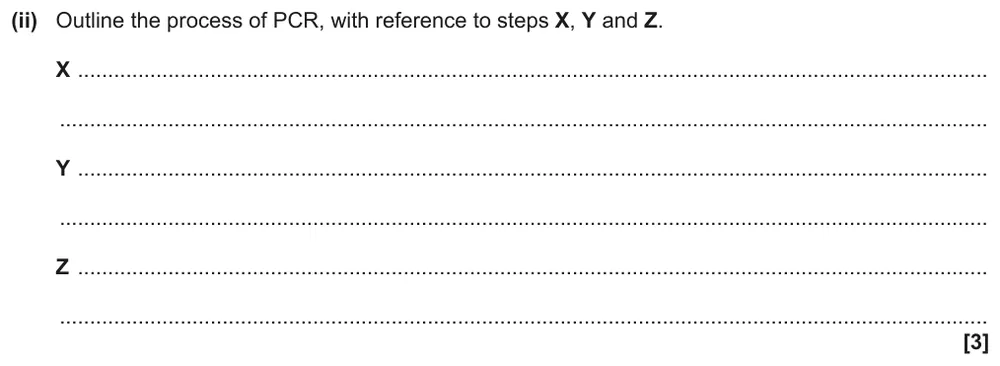
Outline the PCR cycle using steps X, Y and Z on a temperature graph.
Information from earlier in this question:
Show the mark scheme

Tap an image to open it full size.
From the examiners' report: Most students got X and Y. For Z, say what happens, synthesis of a new complementary strand, not just that 72 °C is the optimum for the polymerase.
Question 6
A level Paper 2 · June 2024 · Q16(b)(iii) · 3 marks · Medium
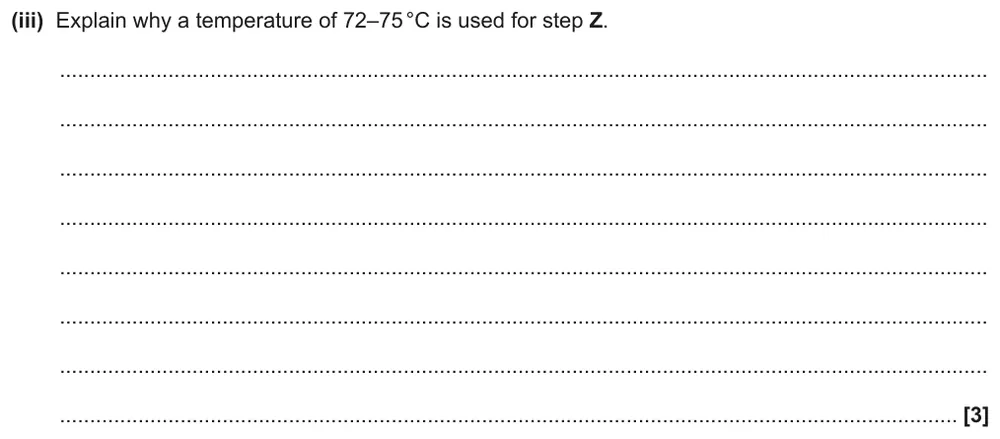
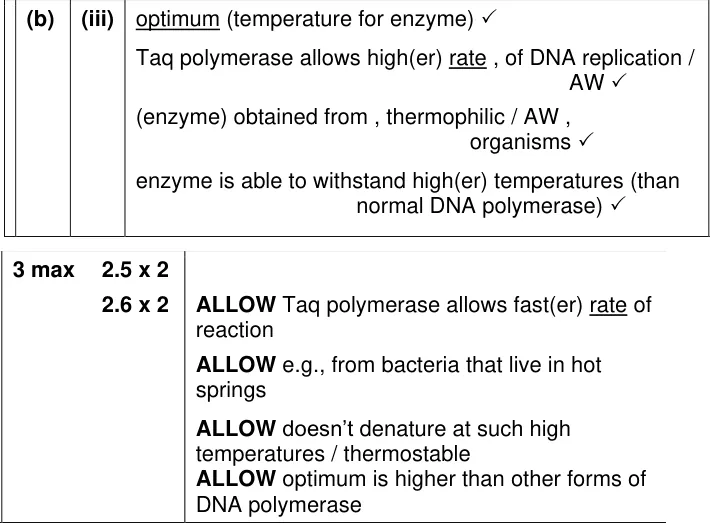
Explain why 72–75 °C is used for the extension step of PCR.
Show the mark scheme
Tap an image to open it full size.
From the examiners' report: Name Taq polymerase, say it comes from thermophilic bacteria in hot springs and that 72–75 °C is its optimum. General enzyme theory won't add marks.
Question 7
A level Paper 3 · November 2020 · Q4(c)(i) · 3 marks · Hard
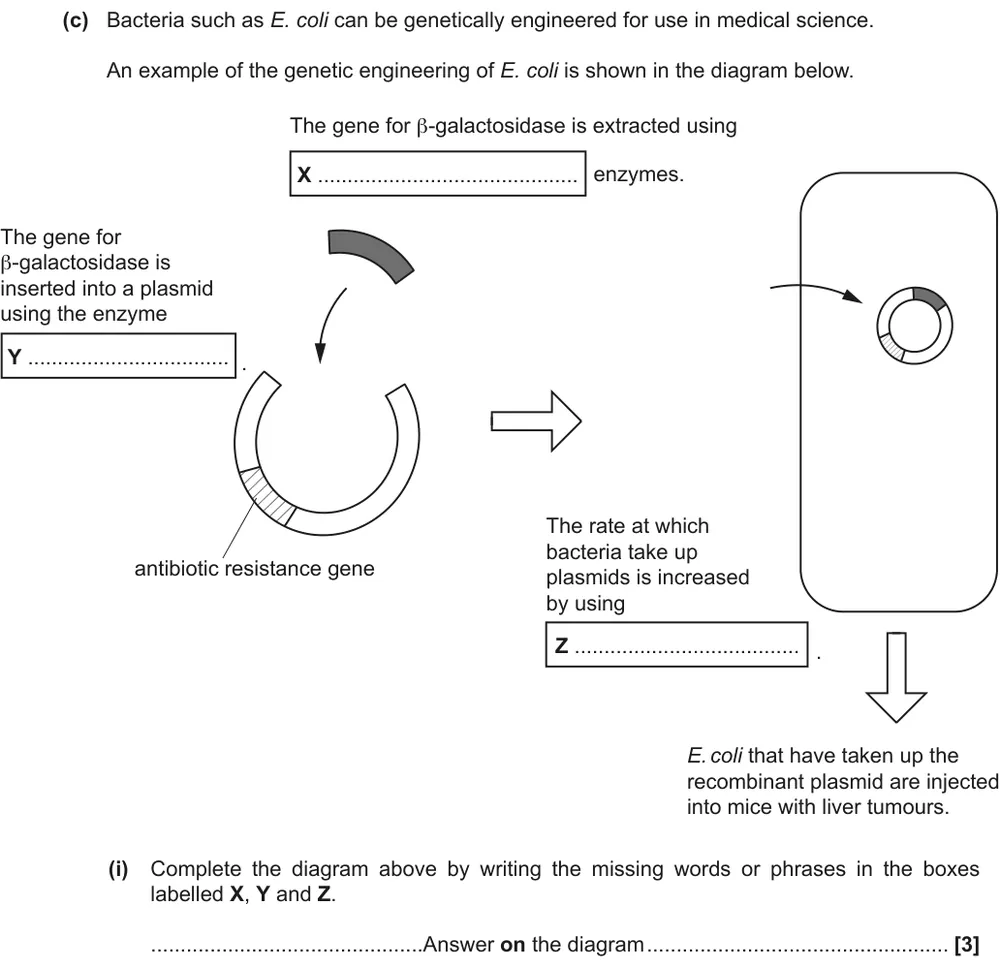
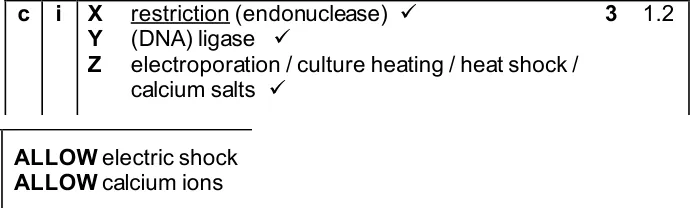
Complete a flow diagram of genetically engineering E. coli: name enzymes X and Y and method Z.
Show the mark scheme
Tap an image to open it full size.
From the examiners' report: Most students named X and Y, but few could name Z. Learn electroporation (or heat shock with calcium ions) as the way plasmids are taken up by bacteria.
Question 8
A level Paper 3 · June 2024 · Q5(e)(i) · 1 mark · Medium
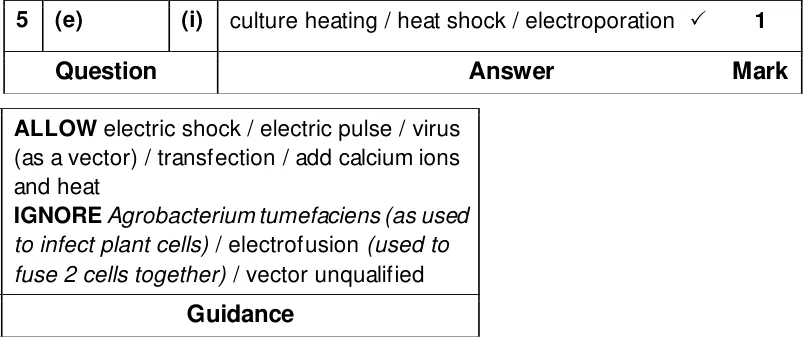
State how a plasmid carrying the insulin gene can be transferred into a bacterial cell.

Show the mark scheme
Tap an image to open it full size.
From the examiners' report: Electroporation or heat shock both score. Electrofusion fuses two cells, so it's wrong here, and "a vector" on its own needs to be named as a virus.
Question 9
A level Paper 3 · June 2024 · Q5(e)(ii) · 1 mark · Hard
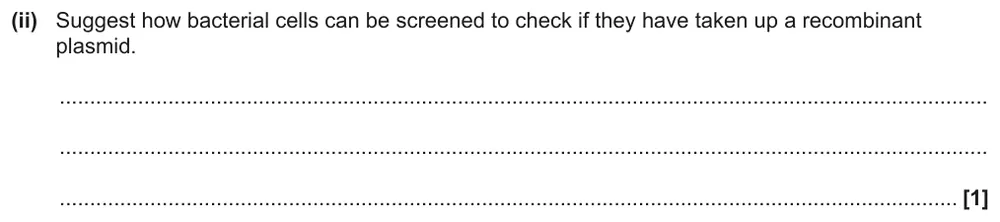
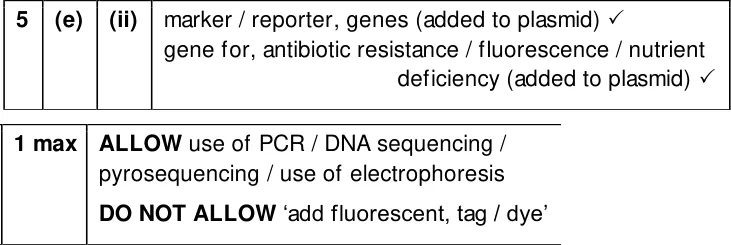
Suggest how bacteria can be screened to see if they have taken up a recombinant plasmid.
Show the mark scheme
Tap an image to open it full size.
From the examiners' report: The plasmid must carry a marker gene, for example a gene for antibiotic resistance or for a fluorescent protein. A fluorescent dye or tag scores nothing, and replica plating needs the resistance gene to make sense.
Question 10
A level Paper 2 · June 2019 · Q17(b)(i) · 3 marks · Medium
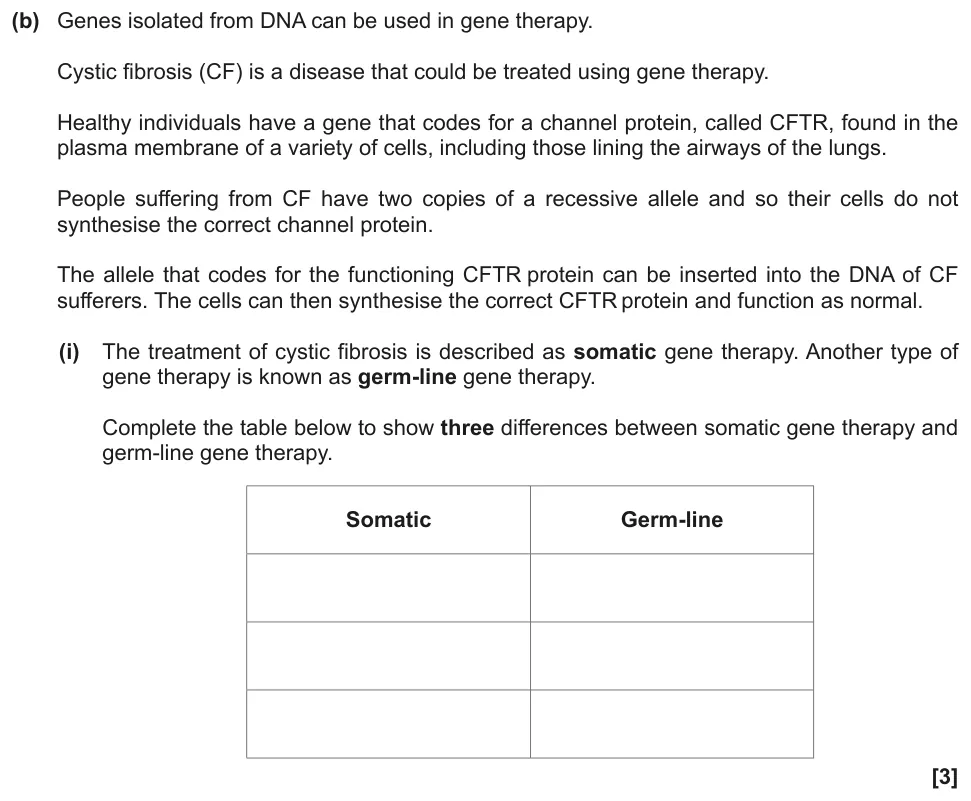
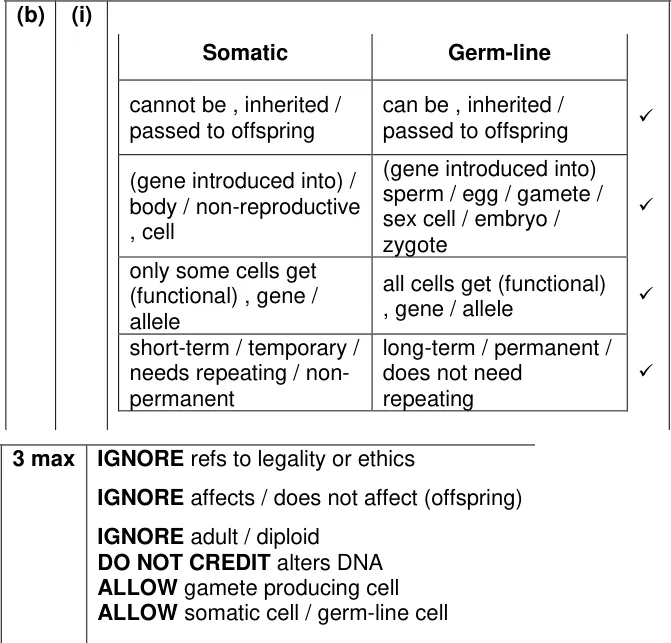
Complete a table of three differences between somatic and germ-line gene therapy.
Show the mark scheme
Tap an image to open it full size.
From the examiners' report: Be explicit: germ-line changes are passed on to offspring, not just "affect" them. Compare the cells the allele is inserted into and how long the treatment lasts; ethics and law score nothing here.
Question 11
A level Paper 3 · June 2023 · Q3(a)(iii) · 1 mark · Medium
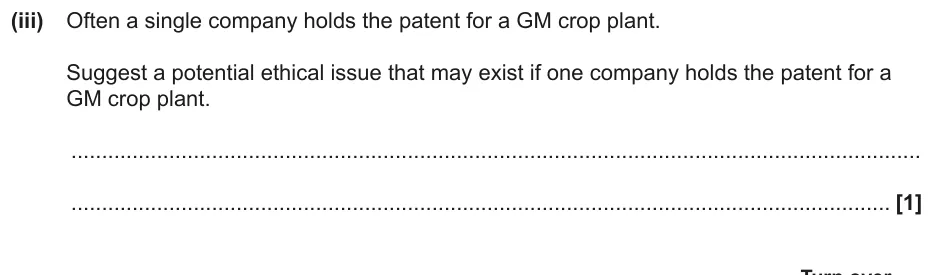
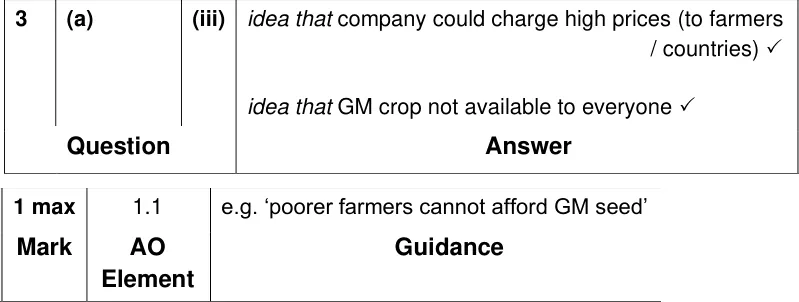
Suggest an ethical issue if one company holds the patent for a GM crop.
Show the mark scheme
Tap an image to open it full size.
From the examiners' report: Give the consequence of the patent, such as poorer farmers being unable to afford the seed. Don't define a patent or switch to general worries about GM crops.
Applying what you know
Question 12
A level Paper 3 · June 2023 · Q3(b) · 3 marks · Hard
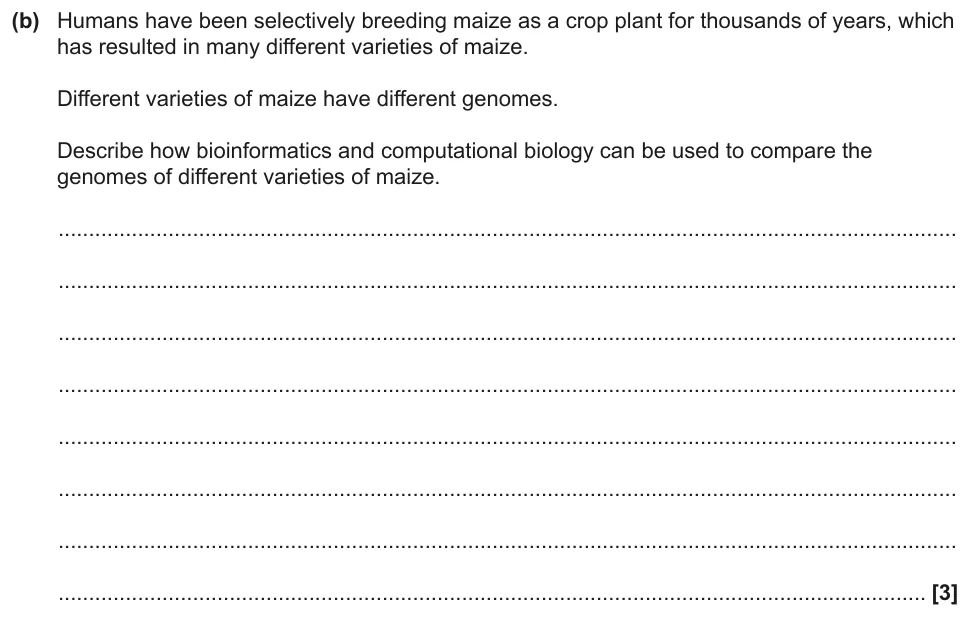
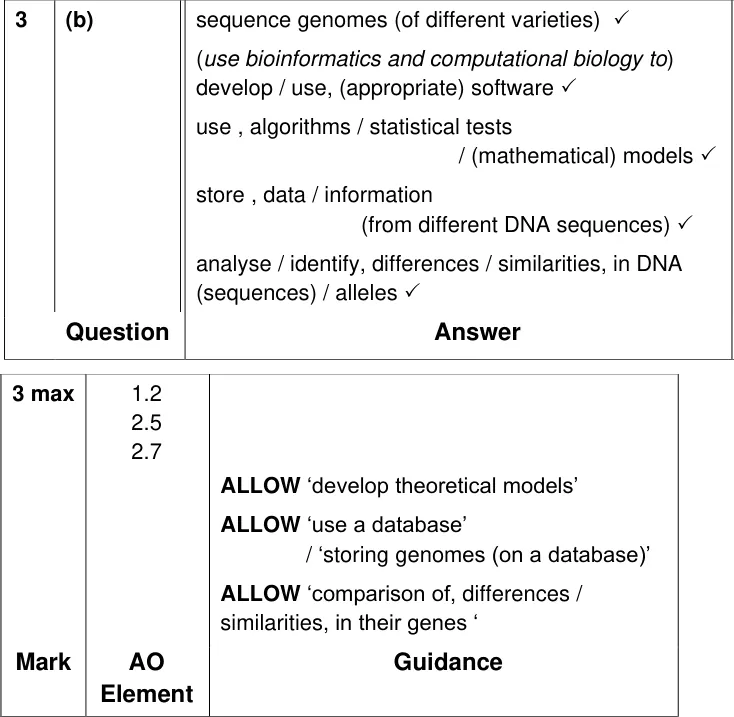
Describe how bioinformatics and computational biology can compare the genomes of maize varieties.
Show the mark scheme
Tap an image to open it full size.
From the examiners' report: Sequence the genomes first, then say the data are stored in databases and analysed with software and algorithms to find similarities and differences. PCR, Southern blotting and amino acid sequencing are off the point.
Question 13
A level Paper 2 · June 2023 · Q19(e) · 2 marks · Hard
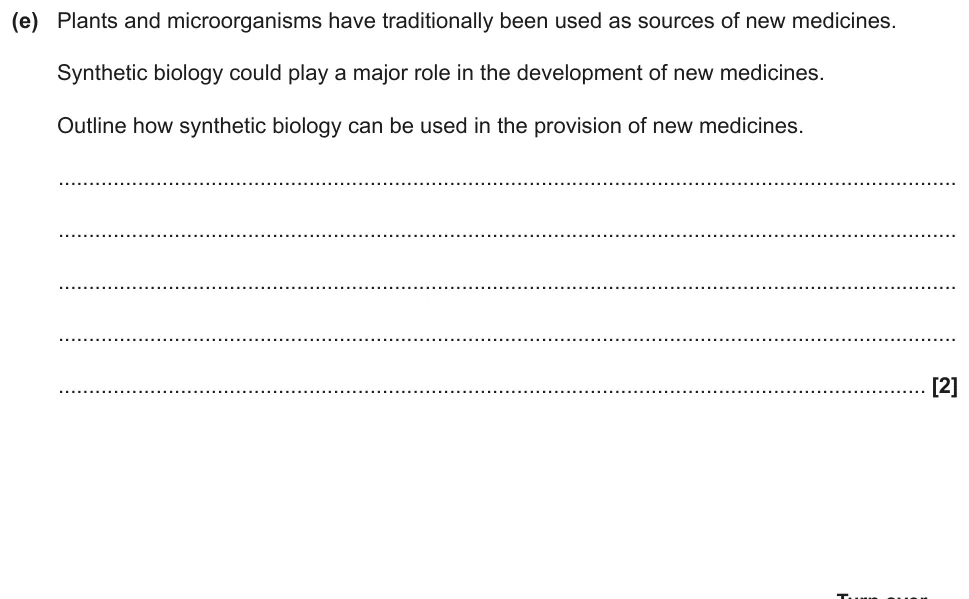
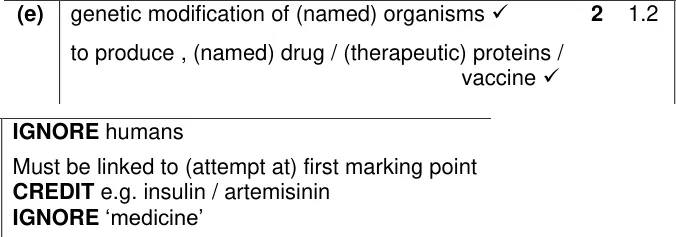
Outline how synthetic biology can be used to provide new medicines.
Show the mark scheme
Tap an image to open it full size.
From the examiners' report: Very few gave a concise answer. Say organisms such as bacteria or yeast are genetically modified, or redesigned, to make a named drug like insulin or artemisinin; personalised medicine and computer drug design don't score.
Question 14
A level Paper 2 · June 2024 · Q18(b)(ii) · 1 mark · Medium
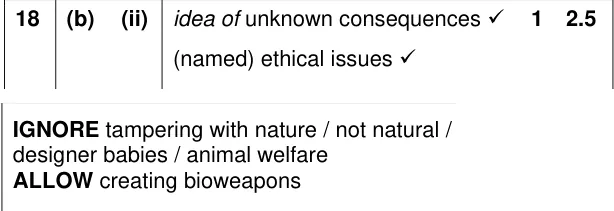
Suggest why some people are concerned about the growth of synthetic biology.

Show the mark scheme
Tap an image to open it full size.
From the examiners' report: The most scientific answer is that new proteins and organisms could have unknown consequences. Tabloid phrases like "playing God" or "designer babies" rarely earn credit.
Question 15
A level Paper 2 · November 2021 · Q16(b)(ii) · 2 marks · Hard
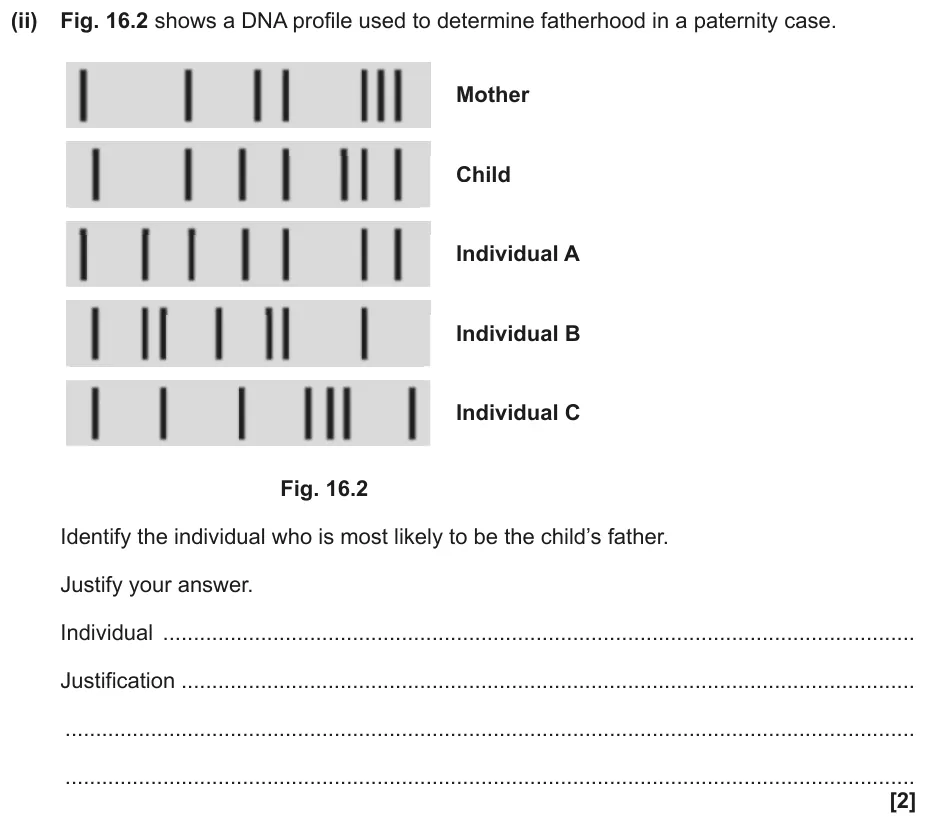
Use a DNA profile to identify the child's most likely father and justify your choice.
Show the mark scheme

Tap an image to open it full size.
From the examiners' report: Fewer than half picked C. First cross off every child band that matches the mother, then see who matches the bands left over.
Question 16
A level Paper 2 · June 2024 · Q16(c)(ii) · 3 marks · Medium
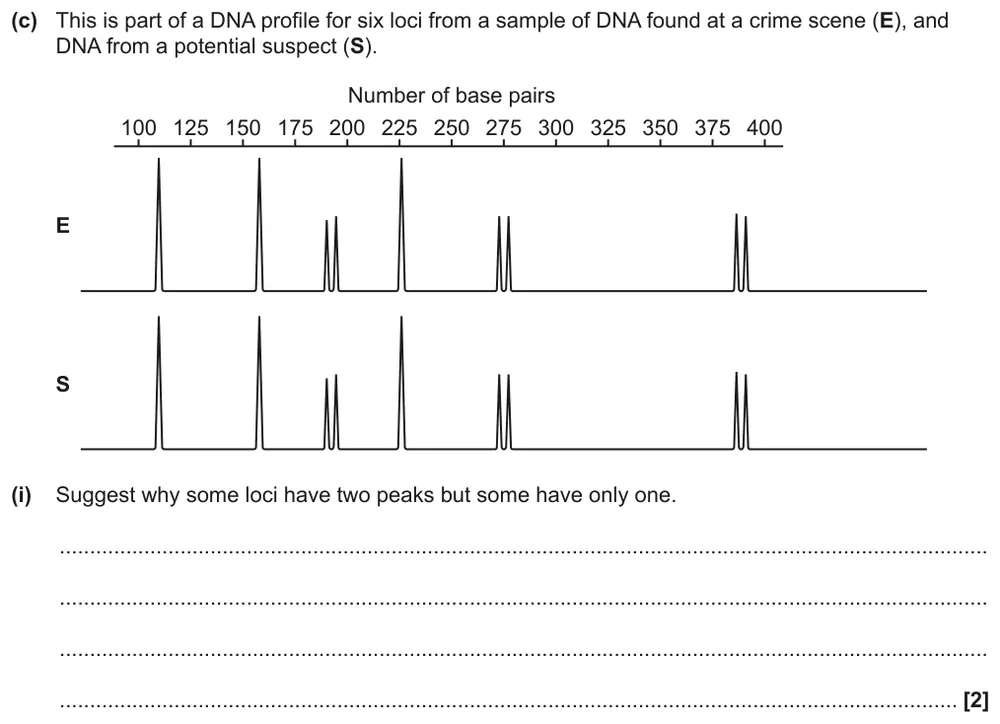
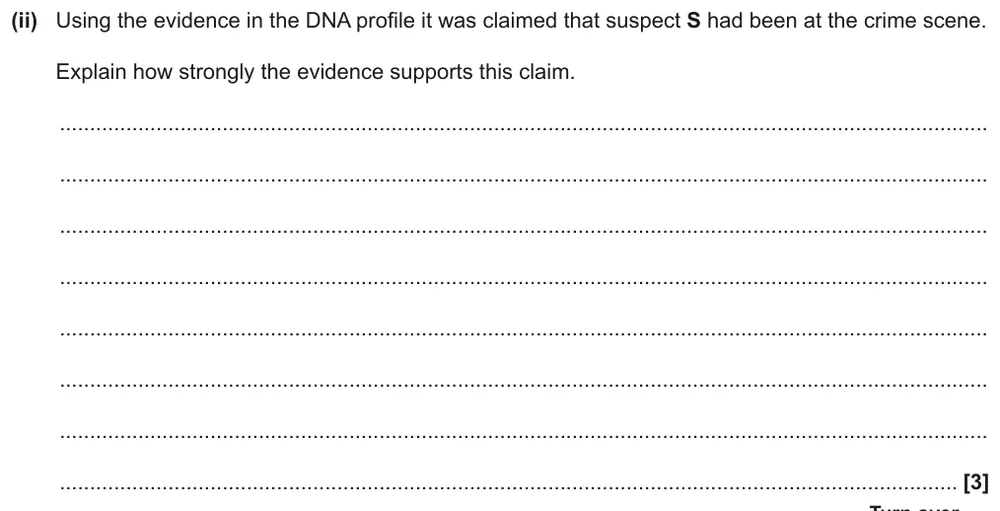
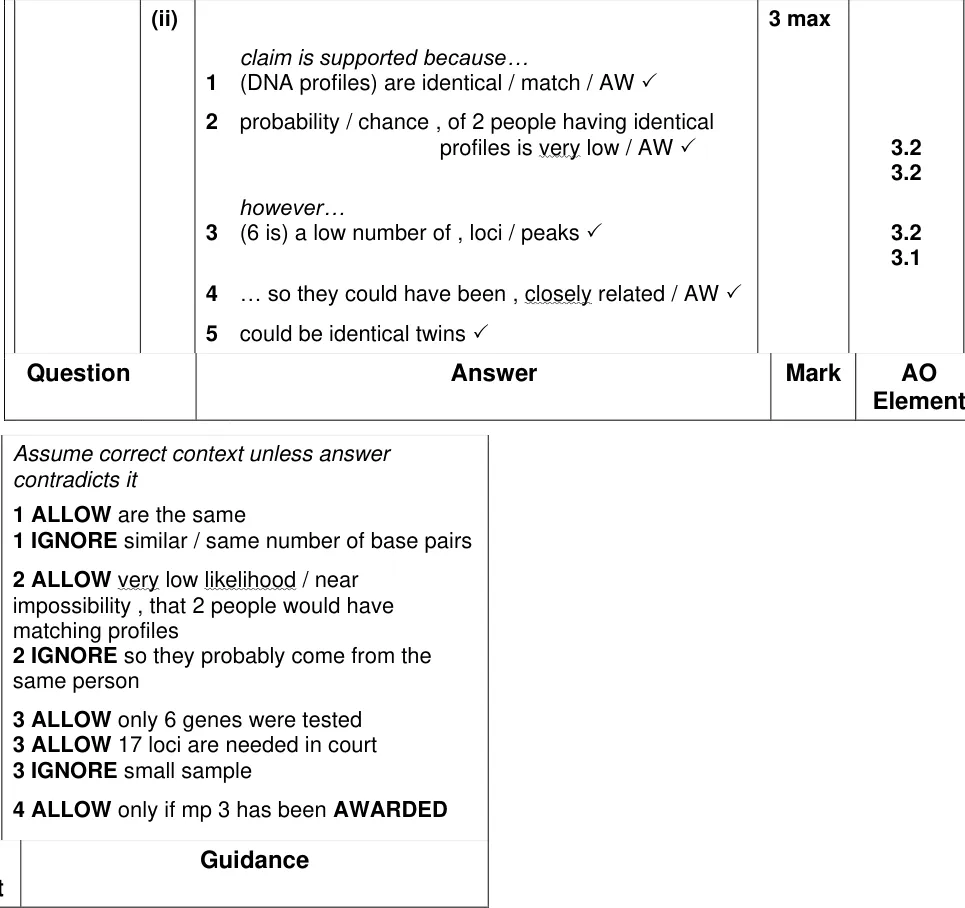
Explain how strongly matching DNA profiles support the claim that a suspect was at a crime scene.
Information from earlier in this question:
Show the mark scheme
Tap an image to open it full size.
From the examiners' report: "How strongly" needs both sides: the profiles match, but only six loci were compared. If you mention a twin, say an identical (monozygotic) twin.
Practical
Question 17
A level Paper 3 · June 2025 · Q4(d)(i) · 4 marks · Medium
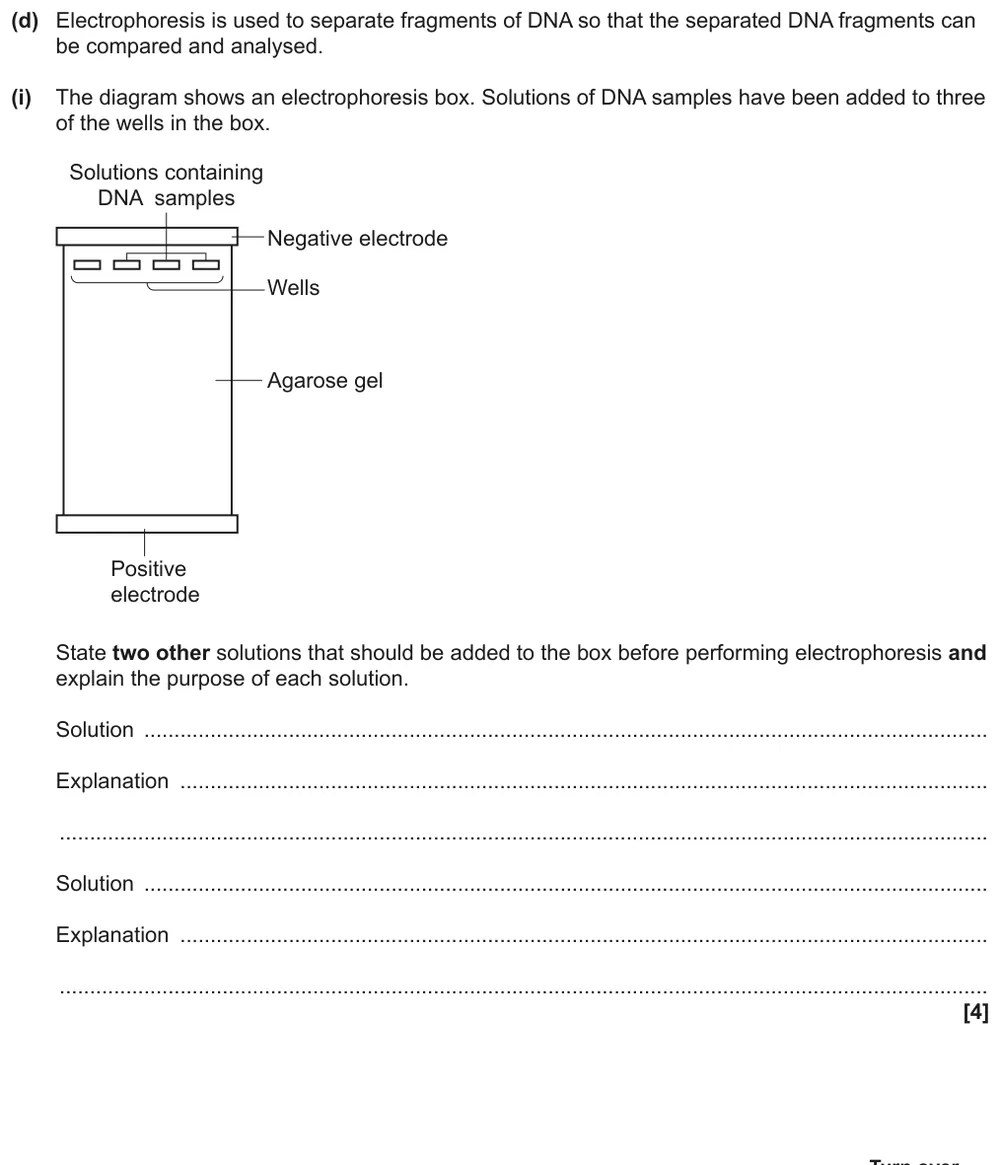
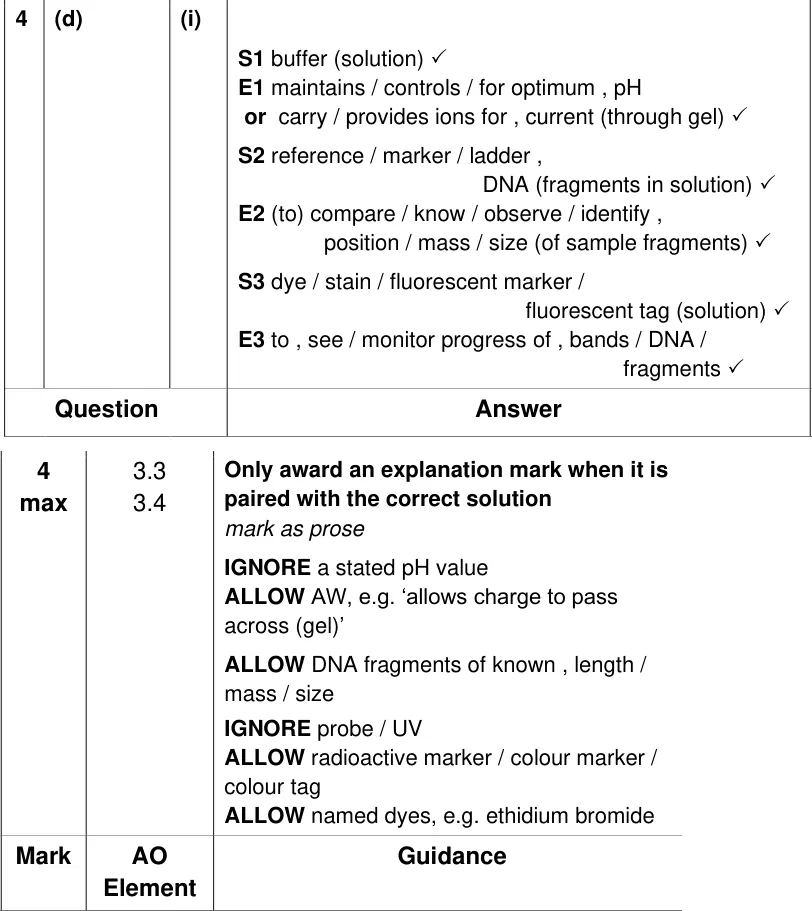
State two other solutions added to an electrophoresis box and explain the purpose of each.
Show the mark scheme
Tap an image to open it full size.
From the examiners' report: Buffer and dye were common; few remembered a DNA ladder of known fragment sizes. Pair each solution with its purpose, e.g. the buffer carries the current.
Question 18
A level Paper 3 · June 2018 · Q4(c)(iii) · 1 mark · Medium
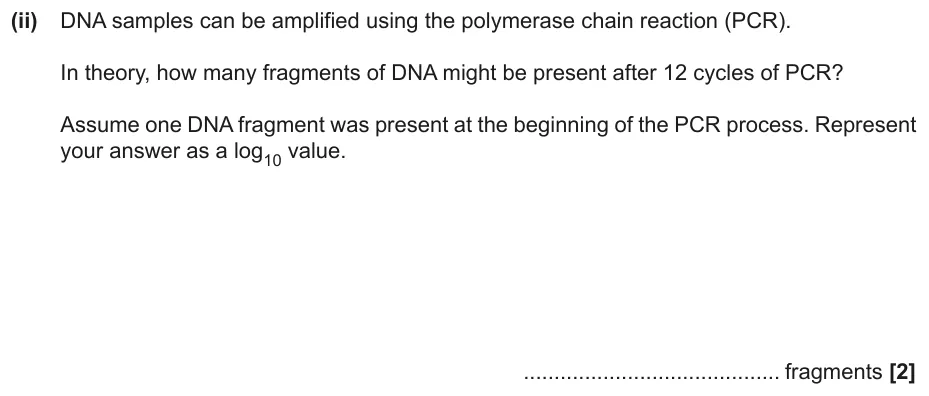
Suggest why the theoretical number of DNA copies after 12 PCR cycles may not be reached.
Information from earlier in this question:

Show the mark scheme
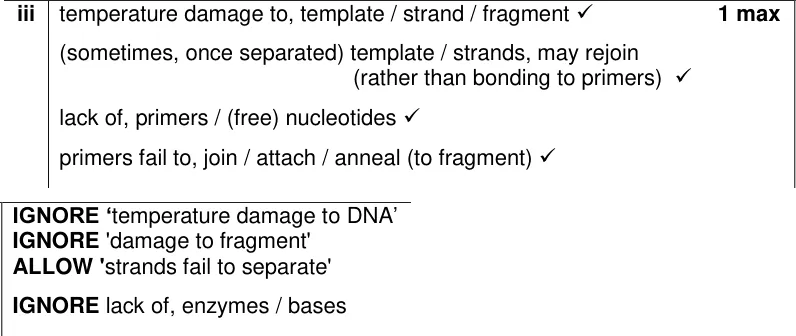
Tap an image to open it full size.
From the examiners' report: Think about what each cycle uses up: primers and free nucleotides run out, or primers fail to anneal. "DNA is lost" or "the polymerase denatures" don't score.
Where students lose marks (from OCR examiners' reports and mark schemes)
Each point below is followed by wording that gained marks.
Sequencing reads nucleotides, not base pairs: About half of students missed this easy definition, writing about "base pairs", suggesting DNA is made of amino acids, or describing the method instead.
✔ Gains credit: "Working out the sequence of nucleotides / bases".
PCR copies DNA; it doesn't sequence it: Asked for a development that speeds up sequencing, many students wrote PCR, electrophoresis or "use a computer".
✔ Gains credit: "Pyrosequencing", "high-throughput sequencing" or "next generation sequencing".
Step Z builds a strand; 72 °C is just why: Many students said step Z was the optimum temperature for DNA polymerase without saying what happens in that step.
✔ Gains credit: "Z represents synthesis of a new strand / addition of nucleotides to the new DNA strand".
Electroporation lets plasmids in; electrofusion joins cells: Some students said electrofusion, or just "a vector", for getting a plasmid into a bacterium.
✔ Gains credit: "Electroporation", "heat shock" or "add calcium ions and heat".
A gene for fluorescence, not a fluorescent dye: Many students suggested adding fluorescent tags or dyes to screen bacteria, which scores nothing.
✔ Gains credit: "Marker genes, such as a gene for antibiotic resistance or fluorescence, added to the plasmid".
Germ-line changes are passed on, not "affecting" offspring: Many tables said germ-line therapy "affects" offspring, or discussed law and ethics, which wasn't credited.
✔ Gains credit: "Germ-line: can be inherited / passed to offspring; somatic: cannot be inherited" and "temporary, needs repeating" versus "permanent".
Two peaks at a locus means two different alleles: Only about 1 in 10 explained the DNA profile peaks; many confused gene with allele, homologous with homozygous, or polygenic with polymorphic.
✔ Gains credit: "Double peaks are heterozygous / have different alleles; single peaks are homozygous / have the same allele".
A six-locus match could be an identical twin: Asked how strongly a matching profile supports a claim, most students gave the match and then more examples, without any limitation.
✔ Gains credit: "Only six loci were tested, so the DNA could be from a close relative or an identical twin".
Download the questions
Download the PDF pack (18 questions, mark schemes at the end)
Keep practising
- Cellular Control and Manipulating Genomes quiz
- Manipulating genomes: interactive written questions (20)
- PAG 6 Chromatography and Electrophoresis: OCR A Level Biology exam questions by topic
- Cellular Control (6.1.1): OCR A Level Biology exam questions by topic
- Cloning and Biotechnology (6.2.1): OCR A Level Biology exam questions by topic
- OCR A Level Biology masterclasses
Questions, mark schemes and examiners' report extracts © OCR.