

OCR A PAG 8 · 18 questions · mark schemes and examiners’ tips included
PAG 8 covers the practicals on how substances get in and out of cells. You will have soaked potato or other plant tissue in a range of sucrose solutions to find its water potential, heated beetroot or soaked it in ethanol to see how membranes leak, and filled dialysis tubing with glucose or sucrose as a model cell to measure diffusion and osmosis.
These questions are rarely about remembering a fact. The marks go on method and explanation: making a dilution series and saying how, giving the reason for percentage change in mass, finding where the mass doesn't change on a graph, and explaining every result in terms of water potential and what has happened to the membrane. The examiners often say it was obvious which students had done the practical themselves.
Work through the eighteen questions below in order. They start with making up sucrose solutions, move on to osmosis in plant tissue and beetroot membranes, and finish with model cells. If you'd like to go through questions like these with me each week, my OCR A masterclasses run on Wednesdays at 5.15pm for Year 12 and on Tuesdays at 6.30pm or Thursdays at 5.15pm for Year 13.
What these questions cover (OCR PAG 8: transport in and out of cells)
PAG 8 is one of the twelve practical activity groups in the OCR A Level Biology A specification (H420). The questions test these parts of the specification:
- 1.2.2(c) use of laboratory glassware apparatus for a variety of experimental techniques to include serial dilutions
- 2.1.5(c)(ii) practical investigations into factors affecting membrane structure and permeability (to include the effects of temperature and solvents)
- 2.1.5(d)(ii) practical investigations into the factors affecting diffusion rates in model cells
- 2.1.5(e)(i) the movement of water across membranes by osmosis and the effects that solutions of different water potential can have on plant and animal cells (osmosis explained in terms of a water potential gradient across a partially permeable membrane)
- 2.1.5(e)(ii) practical investigations into the effects of solutions of different water potential on plant and animal cells
How to use this page
Write your answer on paper before you open the mark scheme. Allow about 1.2 minutes per mark: the 18 questions are worth 39 marks, so about 47 minutes in total. Then mark your answer strictly against the mark scheme and read the examiners' tip underneath it. If you'd rather print the questions, download the PDF pack.
Making up sucrose solutions
Question 1
A level Paper 3 · June 2025 · Q5(a) · 1 mark · Medium
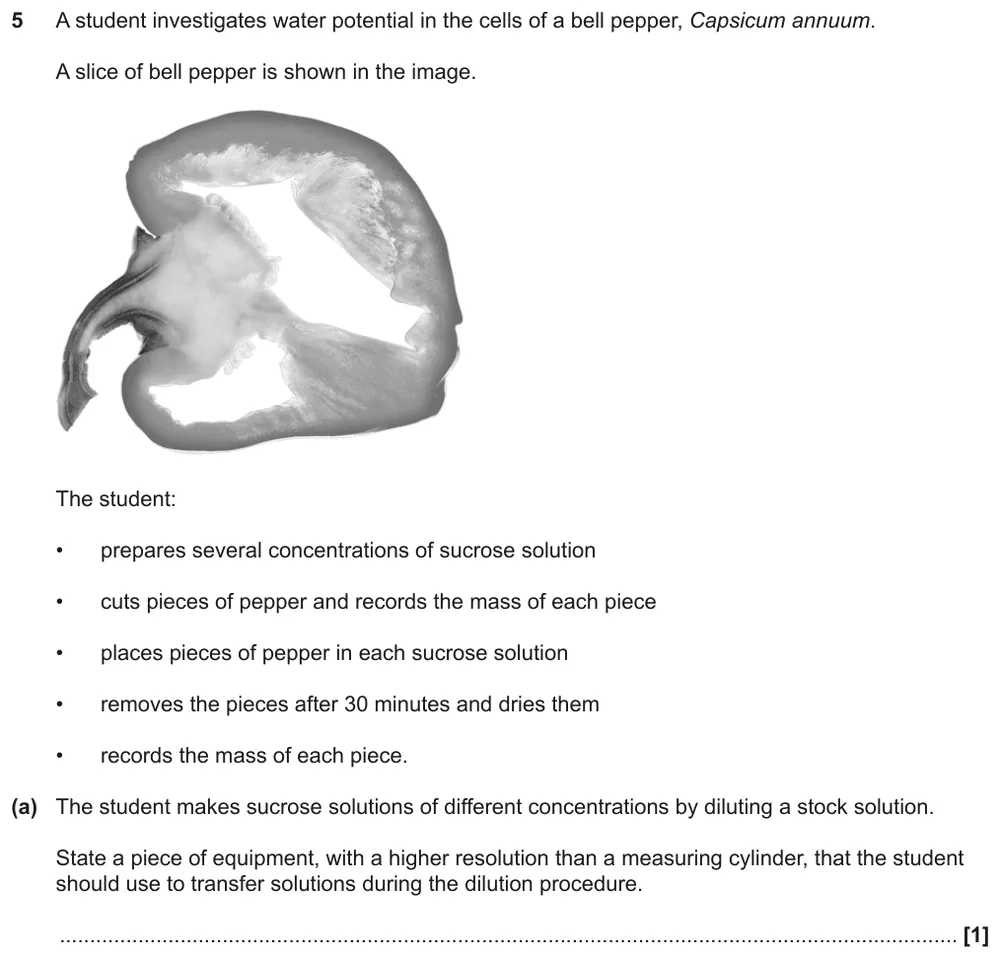
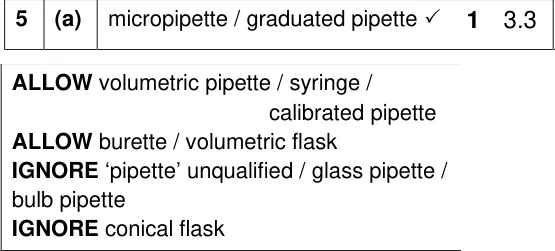
Name a piece of equipment with a higher resolution than a measuring cylinder for transferring solutions in a dilution.
Show the mark scheme
Tap an image to open it full size.
From the examiners' report: A range of equipment was accepted, but 'pipette' on its own didn't get the mark, because some dropping pipettes are less precise than a measuring cylinder. Name it fully: graduated pipette or micropipette.
Question 2
A level Paper 1 · June 2022 · Q18(a)(i) · 3 marks · Medium
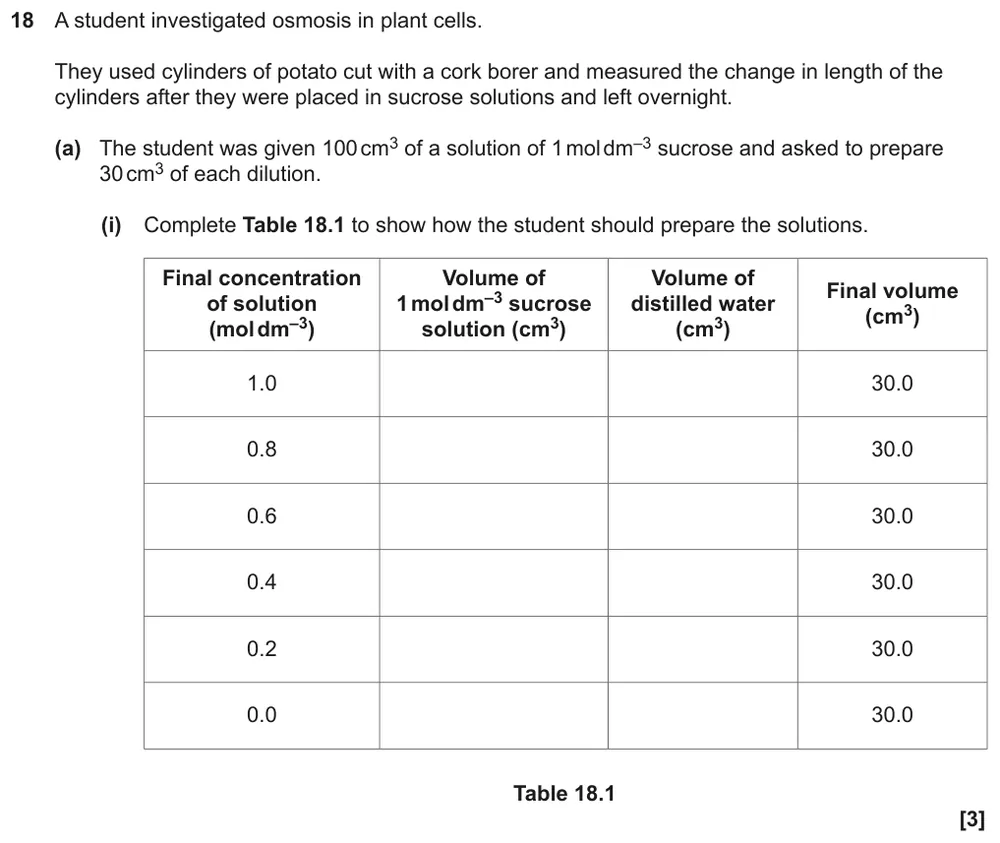
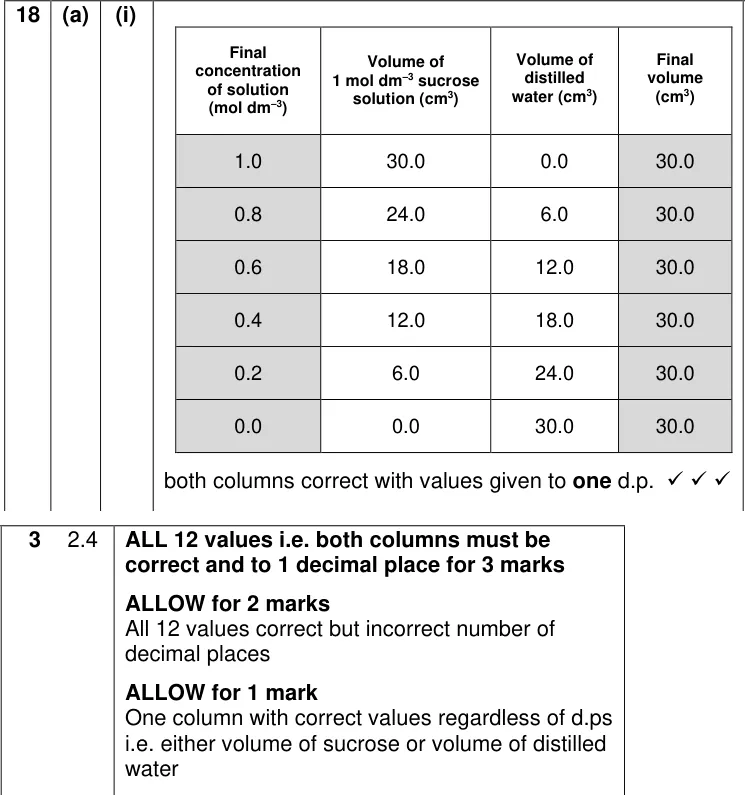
Complete a table showing the volumes of 1 mol dm⁻³ sucrose and water needed for 30 cm³ of each concentration.
Show the mark scheme
Tap an image to open it full size.
From the examiners' report: Most students worked out the volumes correctly. Marks were lost by not giving the values to 1 decimal place, as the table does: keep to the format you are given.
Question 3
AS Paper 1 · June 2024 · Q21(c) · 2 marks · Hard
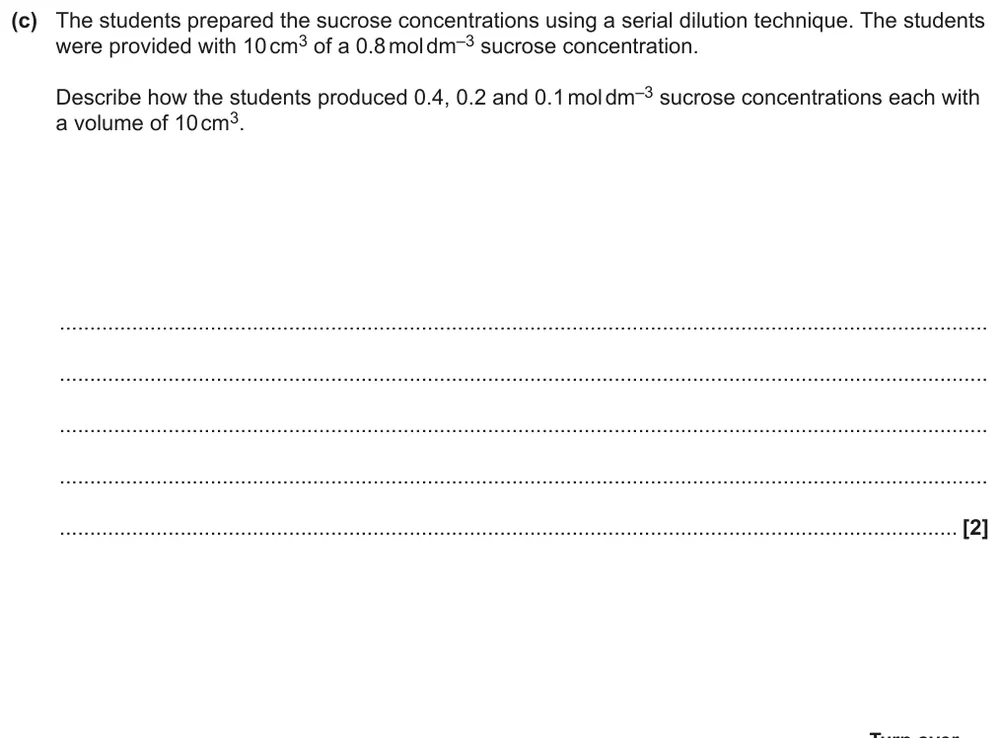
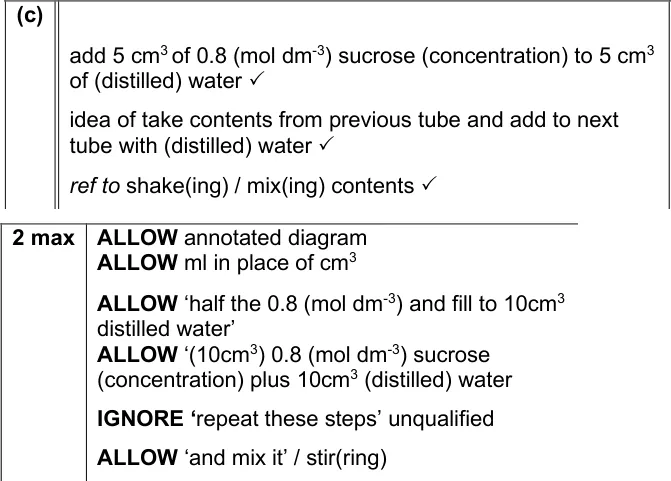
Describe how to make 10 cm³ each of 0.4, 0.2 and 0.1 mol dm⁻³ sucrose by serial dilution from 0.8 mol dm⁻³.
Show the mark scheme
Tap an image to open it full size.
From the examiners' report: Many students gave 5 cm³ of sucrose plus 5 cm³ of water, but just writing 'repeat' didn't earn the next mark. Say that each new solution is made from the previous one, and few remembered to mix each tube. A labelled diagram is allowed.
Osmosis in plant tissue
Question 4
A level Paper 1 · June 2022 · Q18(b)(i) · 1 mark · Easy
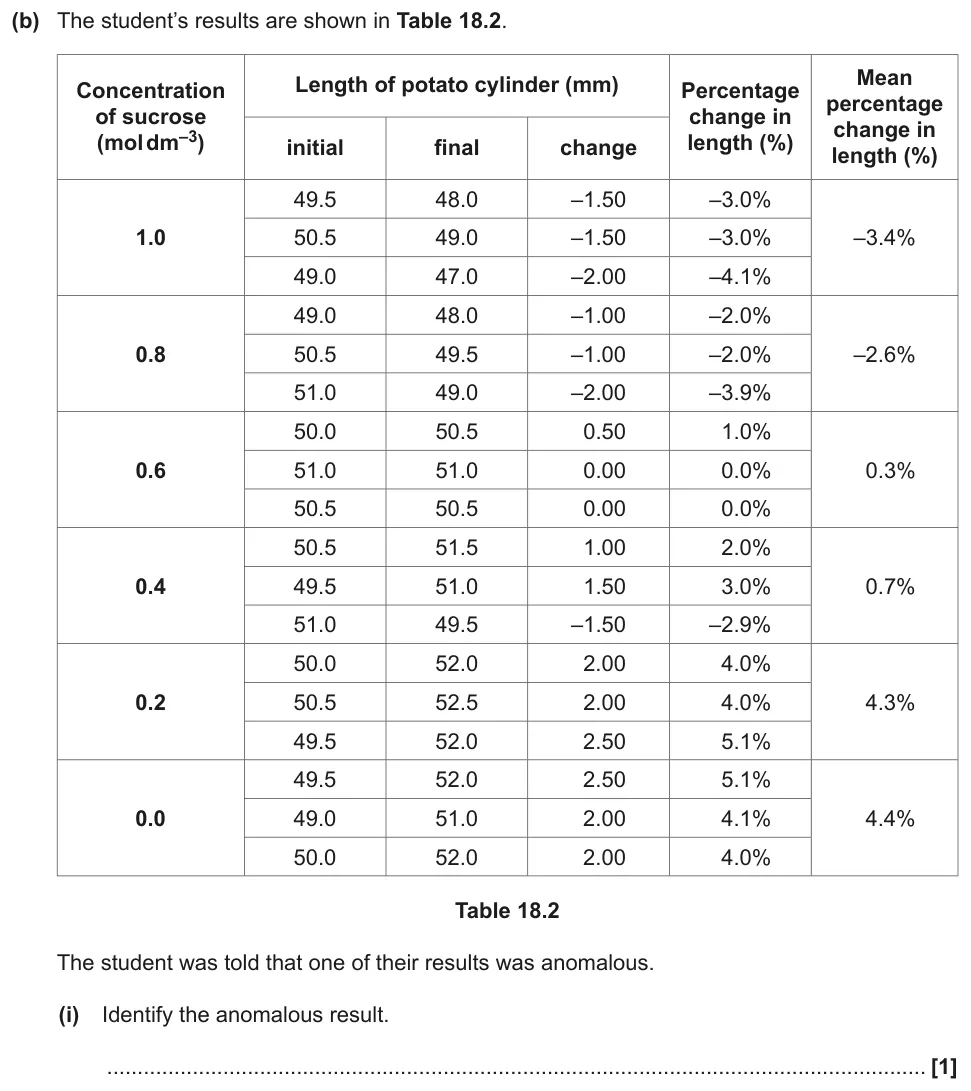
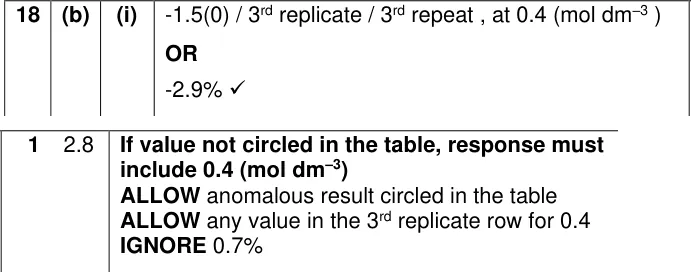
Identify the anomalous result in a table of potato cylinder lengths.
Show the mark scheme
Tap an image to open it full size.
From the examiners' report: Most students found the right value, and circling it in the table is good practice. Writing only '−1.50' or '49.5' didn't score, because those numbers appear at other concentrations too; say which concentration and replicate.
Question 5
A level Paper 1 · June 2022 · Q18(b)(ii) · 2 marks · Medium
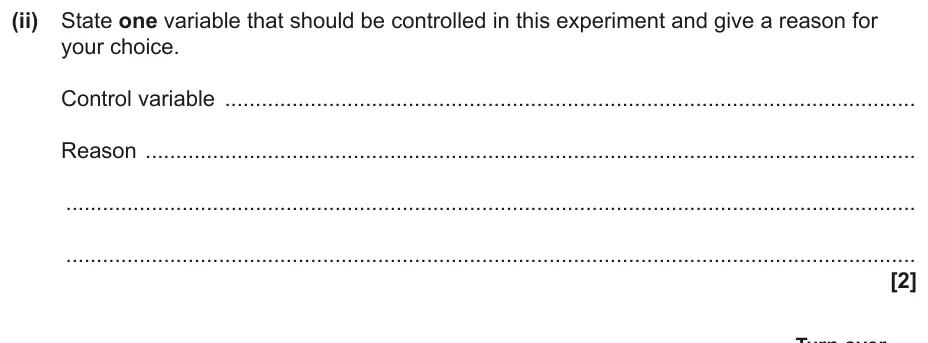
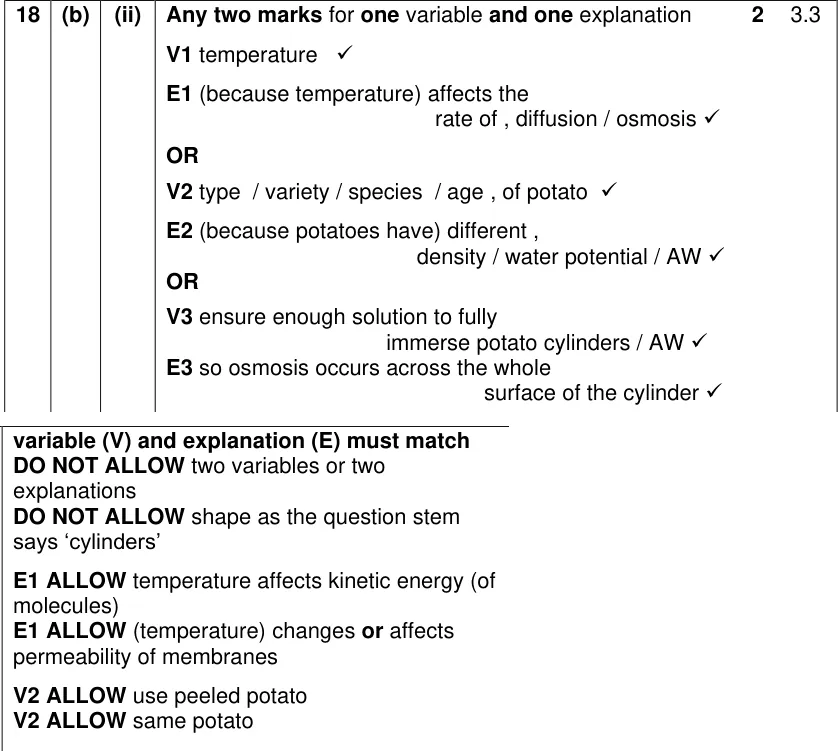
State one variable that should be controlled in the potato osmosis experiment and give a reason.
Show the mark scheme
Tap an image to open it full size.
From the examiners' report: Temperature with a reason about kinetic energy or the rate of osmosis was common and correct. Don't choose length or surface area: the method already controls them. If you choose the type of potato, the reason is that different potatoes have different water potentials.
Question 6
AS Paper 1 · June 2024 · Q21(a) · 2 marks · Medium
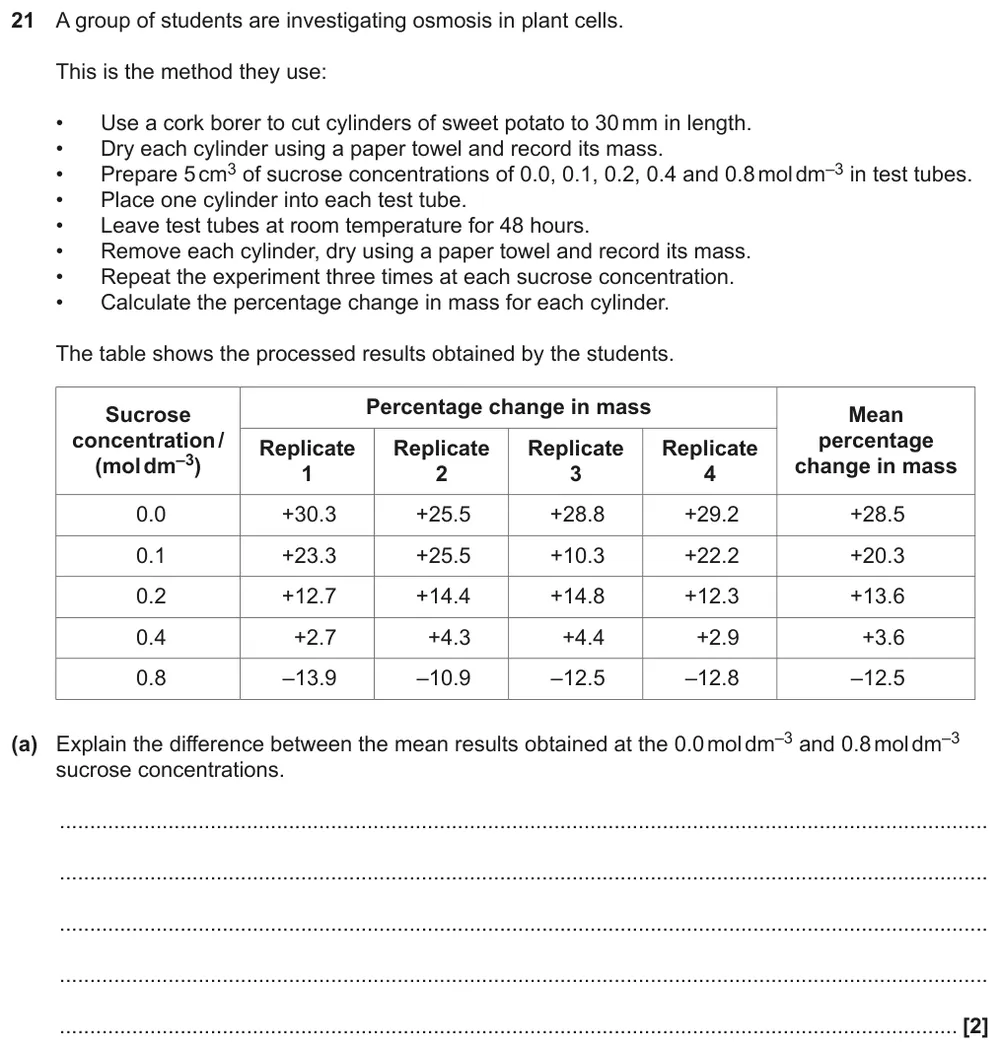
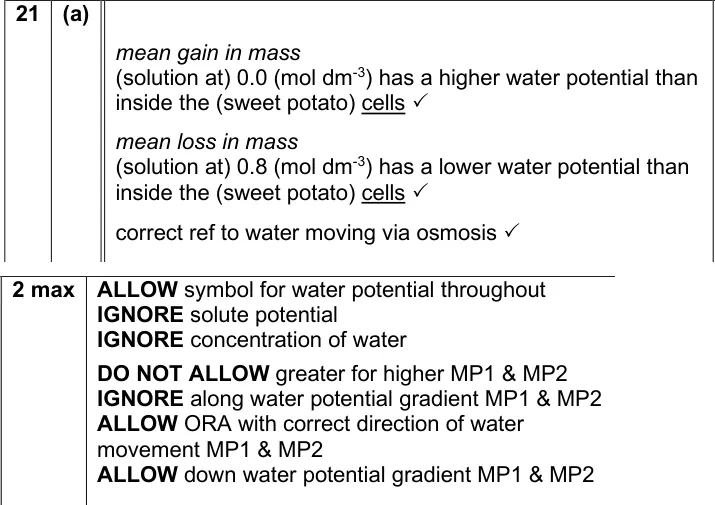
Explain the results for sweet potato in 0.0 and 0.8 mol dm⁻³ sucrose.
Show the mark scheme
Tap an image to open it full size.
From the examiners' report: Most students got a mark for water moving in or out by osmosis. For both marks, compare the water potential of the solution with the water potential inside the sweet potato cells, rather than talking about 'the cylinders'. The command word is 'explain', so don't spend time describing the table.
Question 7
AS Paper 1 · June 2024 · Q21(d) · 2 marks · Medium
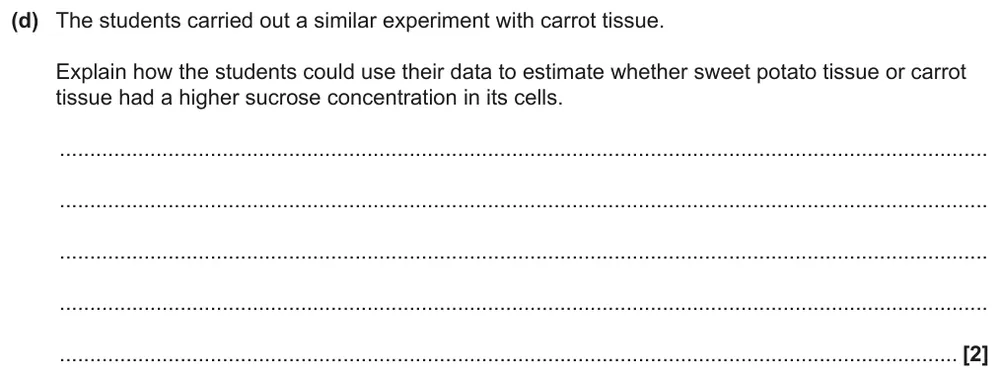
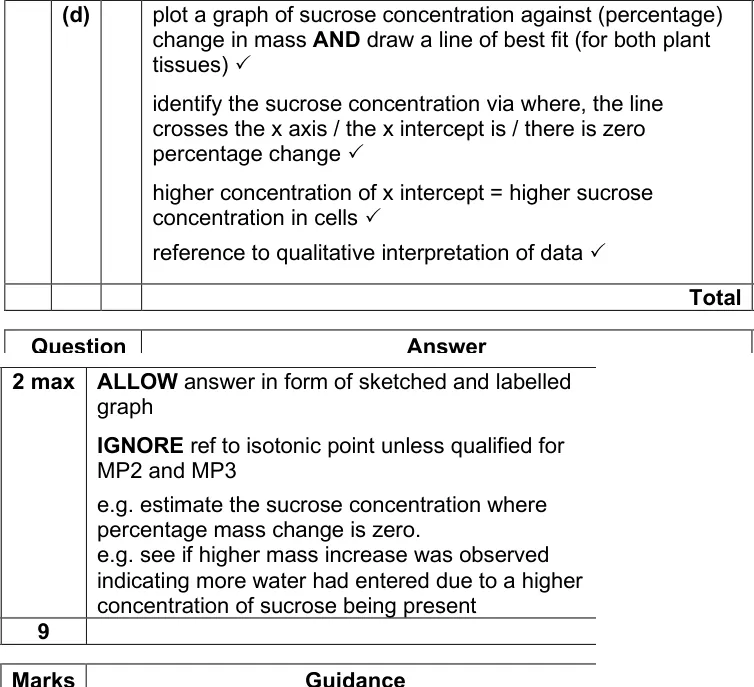
Explain how to use the data to decide whether sweet potato or carrot cells have the higher sucrose concentration.
Show the mark scheme
Tap an image to open it full size.
From the examiners' report: Only a few students said to plot a graph and use where the line crosses the x axis. Many said 'plot a graph' without saying how to use it, or forgot a line of best fit for both tissues.
Question 8
A level Paper 2 · June 2019 · Q16(c)(i) · 2 marks · Hard
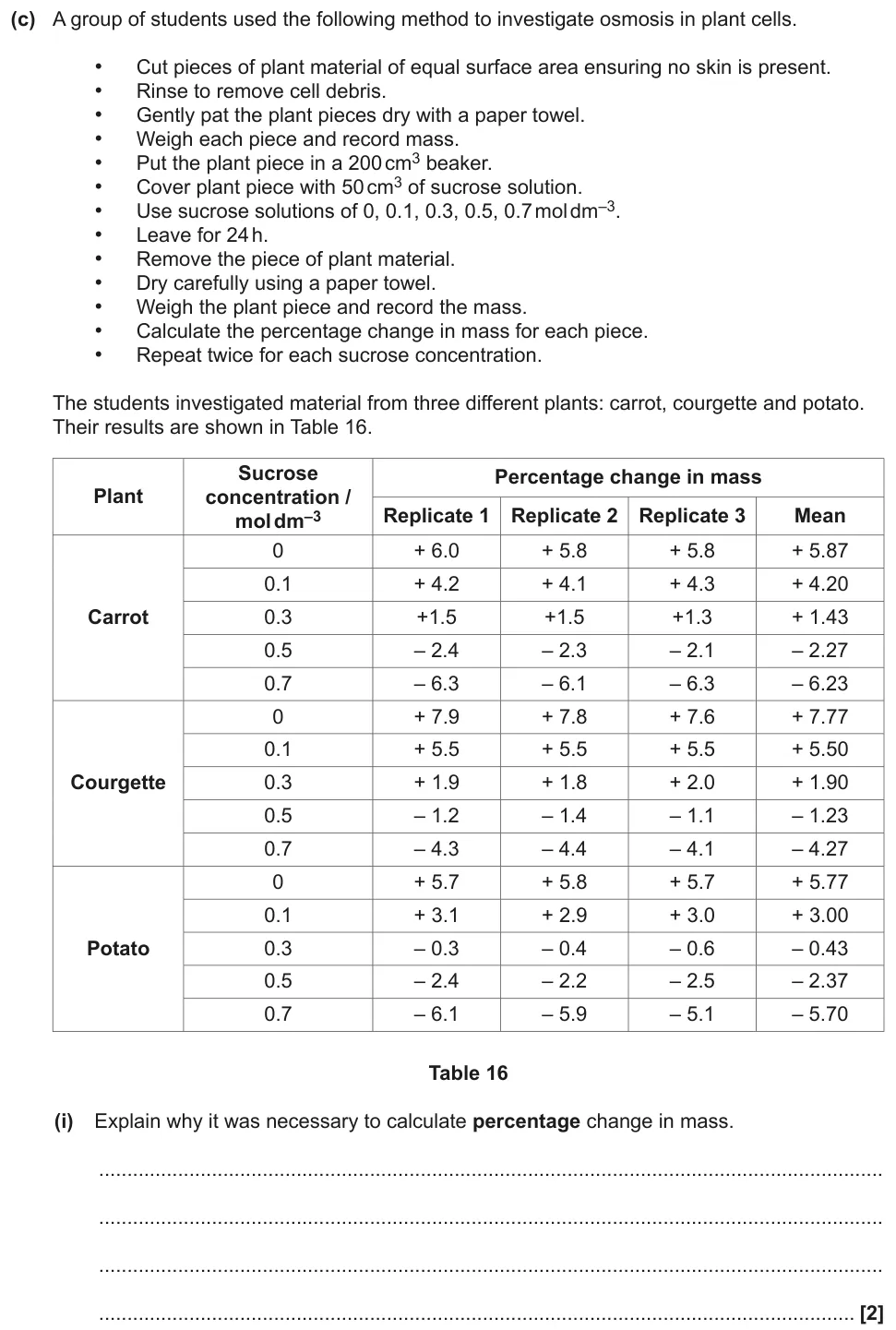
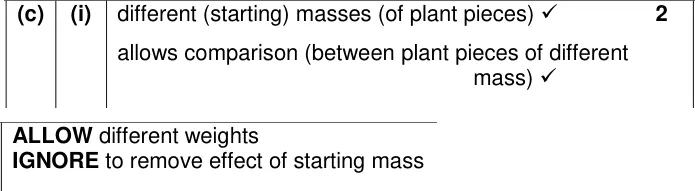
Explain why the students calculated percentage change in mass.
Show the mark scheme
Tap an image to open it full size.
From the examiners' report: Strong answers gave both ideas: the starting masses differ, and a percentage lets you compare them. Saying a percentage is more precise, accurate or reliable is wrong.
Question 9
A level Paper 2 · June 2019 · Q16(c)(ii) · 2 marks · Medium
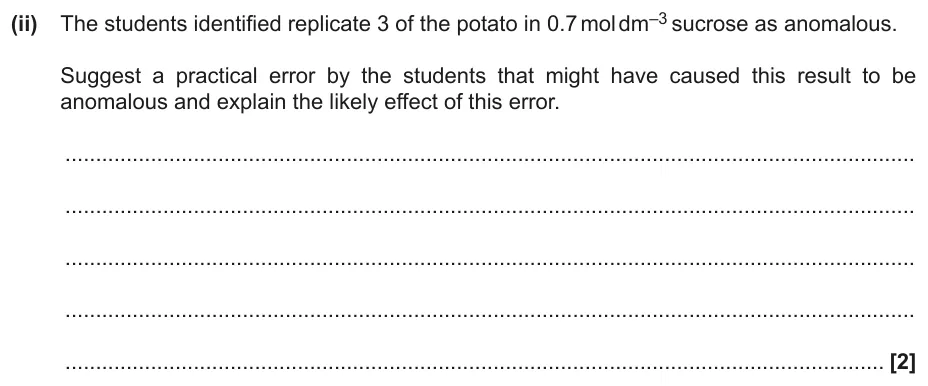
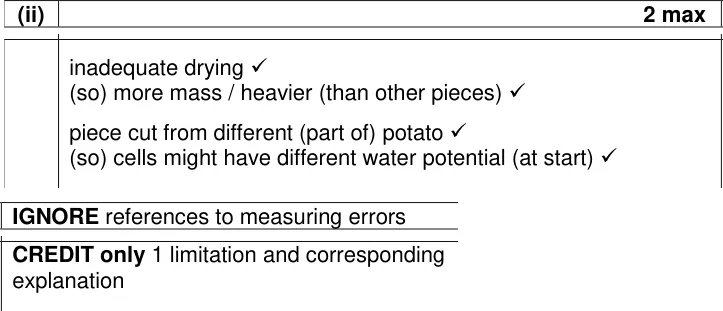
Suggest a practical error that could explain an anomalous potato result and explain its effect.
Show the mark scheme
Tap an image to open it full size.
From the examiners' report: Most students named a sensible error, usually poor drying, but then didn't link it to the data: the piece's mass was recorded as heavier than it really was. 'Human error' such as misreading the balance doesn't score.
Membrane permeability
Question 10
AS Paper 1 · June 2019 · Q21(b)(i) · 2 marks · Easy
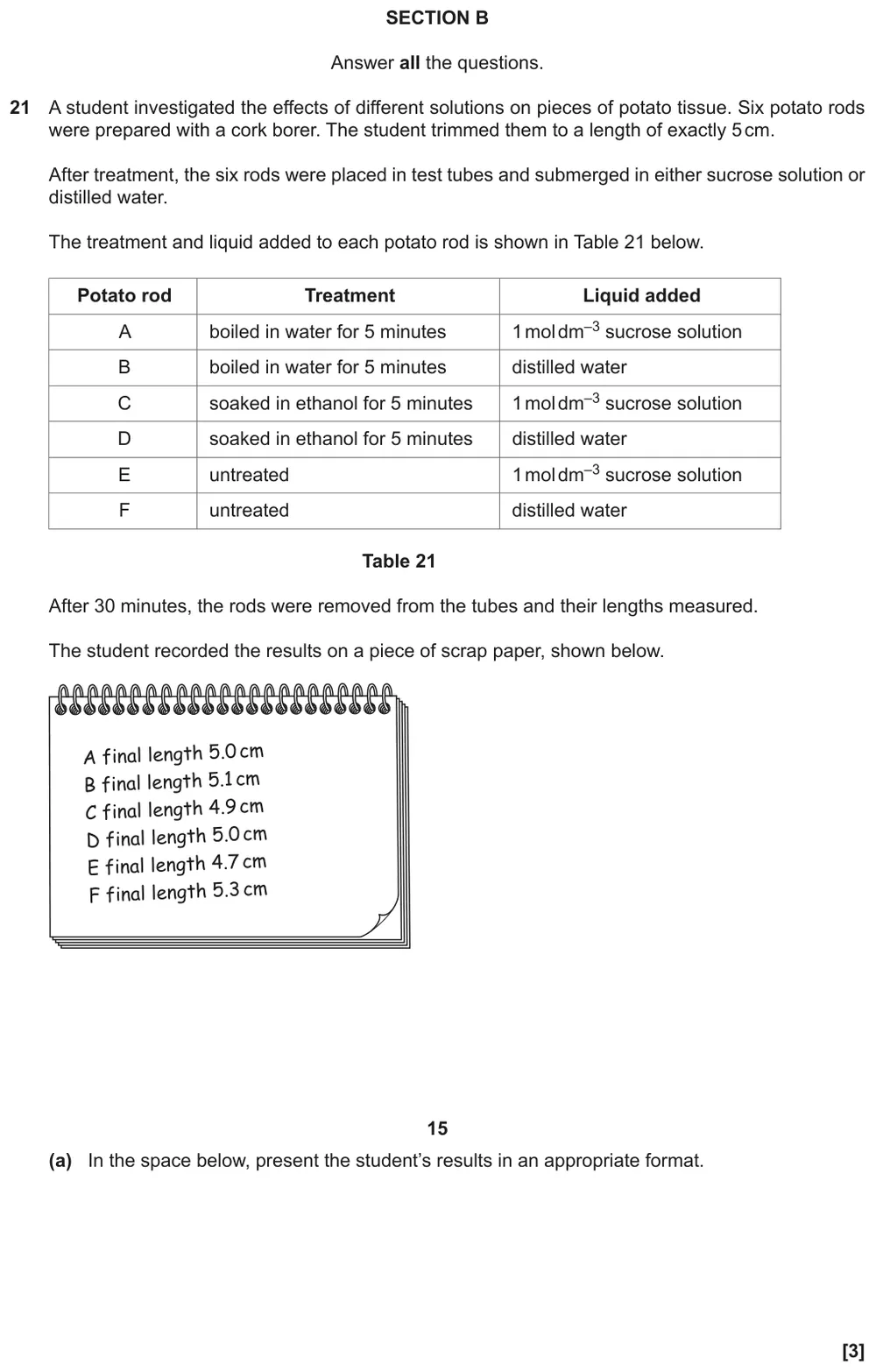
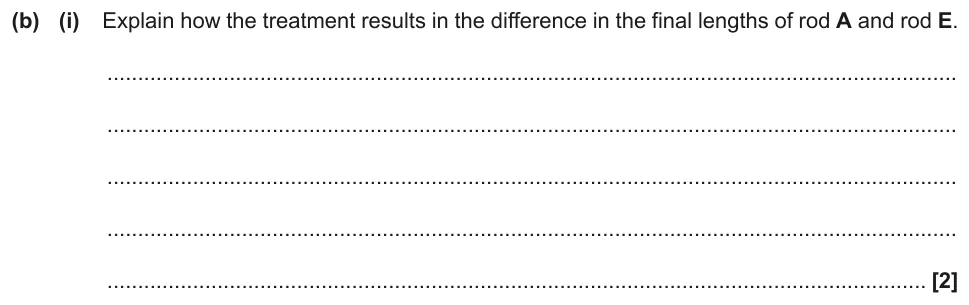
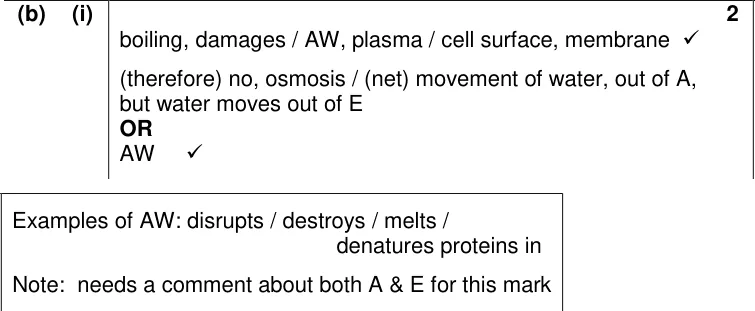
Explain why a boiled potato rod and an unboiled rod end up different lengths in sucrose solution.
Information from earlier in this question:
Show the mark scheme
Tap an image to open it full size.
From the examiners' report: This was one of the worst-answered questions on the paper. Start with what boiling does to the membrane, then say what happens to water in both rods. Don't describe water moving one way during boiling and back again later.
Question 11
AS Paper 1 · June 2019 · Q21(b)(ii) · 2 marks · Medium
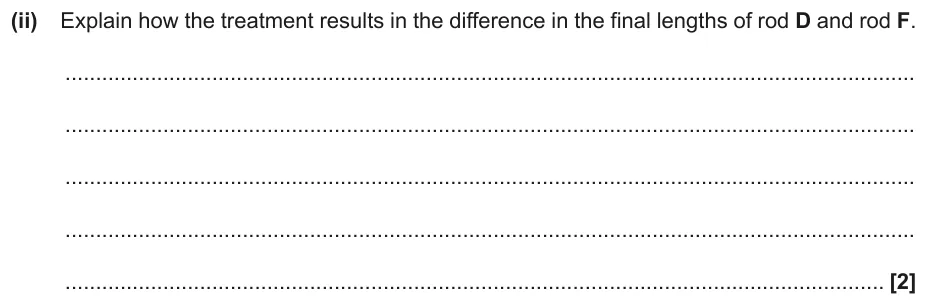
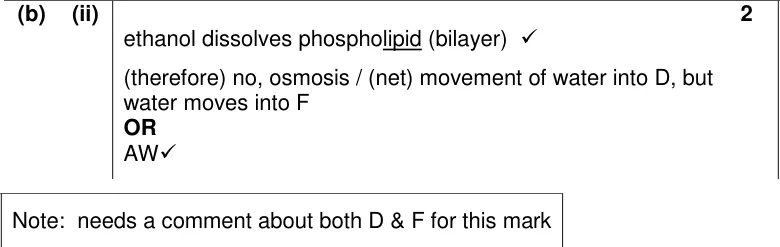
Explain why a potato rod soaked in ethanol and an untreated rod end up different lengths in distilled water.
Show the mark scheme
Tap an image to open it full size.
From the examiners' report: Few students explained what ethanol does to the membrane. Say that ethanol dissolves the phospholipid bilayer, then compare both rods: no net movement of water into D, but water enters F.
Question 12
AS Paper 2 · June 2022 · Q1(a) · 4 marks · Medium
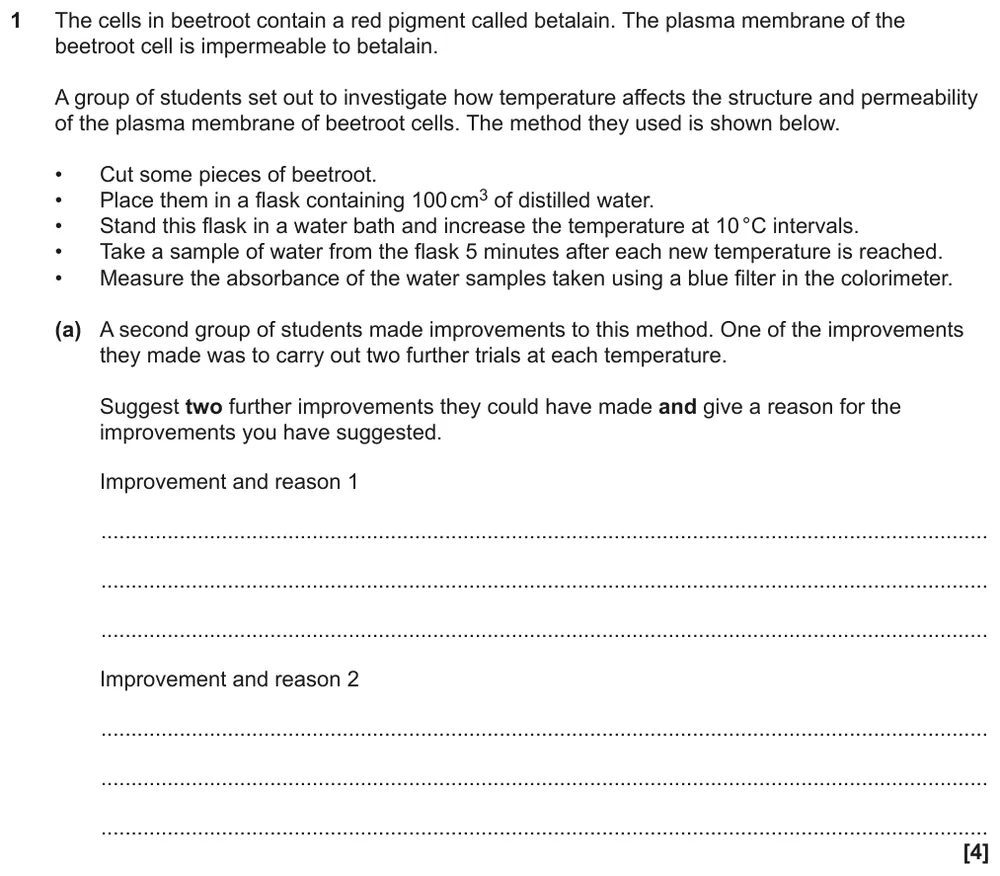
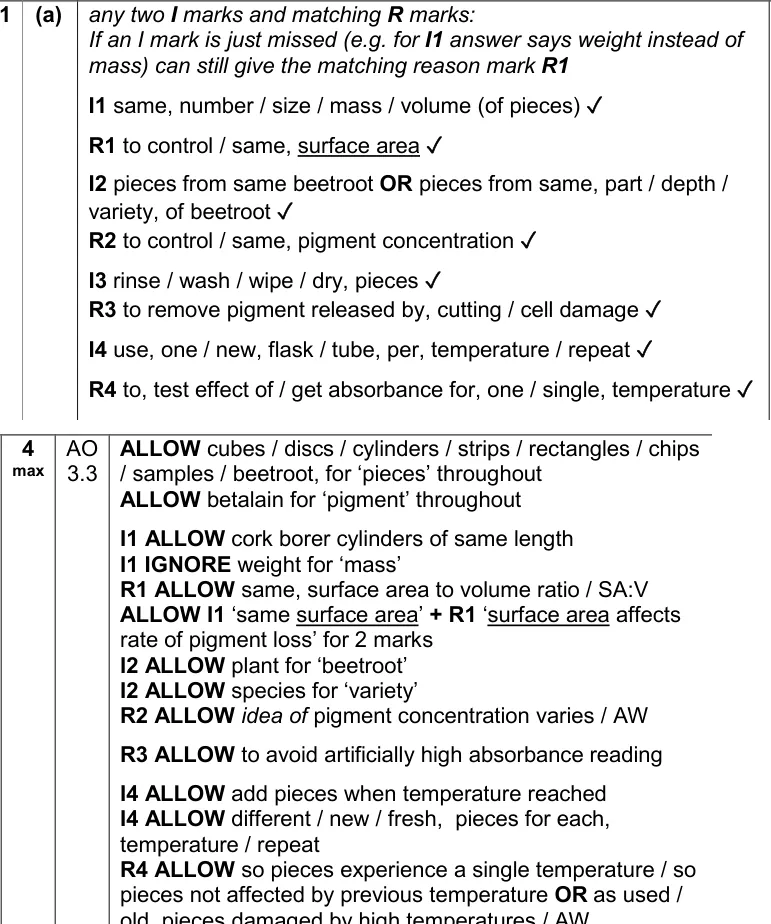
Suggest two improvements to a beetroot and temperature method and give a reason for each.
Show the mark scheme
Tap an image to open it full size.
From the examiners' report: Repeats and smaller temperature intervals didn't score. Look for the faults in the method you're given: 'some pieces' needs a set number and size, and heating the same pieces through every temperature needs fresh pieces in a new flask for each one. Give the reason, such as controlling surface area.
Diffusion and osmosis in model cells
Question 13
AS Paper 2 · June 2024 · Q3(c)(i) · 2 marks · Easy
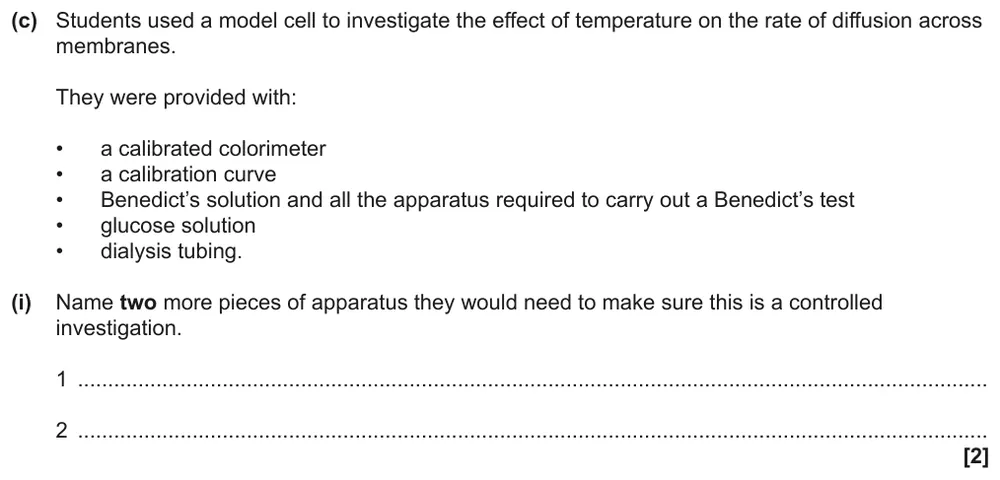
Name two more pieces of apparatus needed for a controlled investigation of temperature and diffusion in a model cell.
Show the mark scheme

Tap an image to open it full size.
From the examiners' report: This was well answered by students who read the title of the investigation. Cuvettes are needed but don't help to control it, so they didn't count.
Question 14
AS Paper 2 · June 2024 · Q3(c)(ii) · 4 marks · Medium
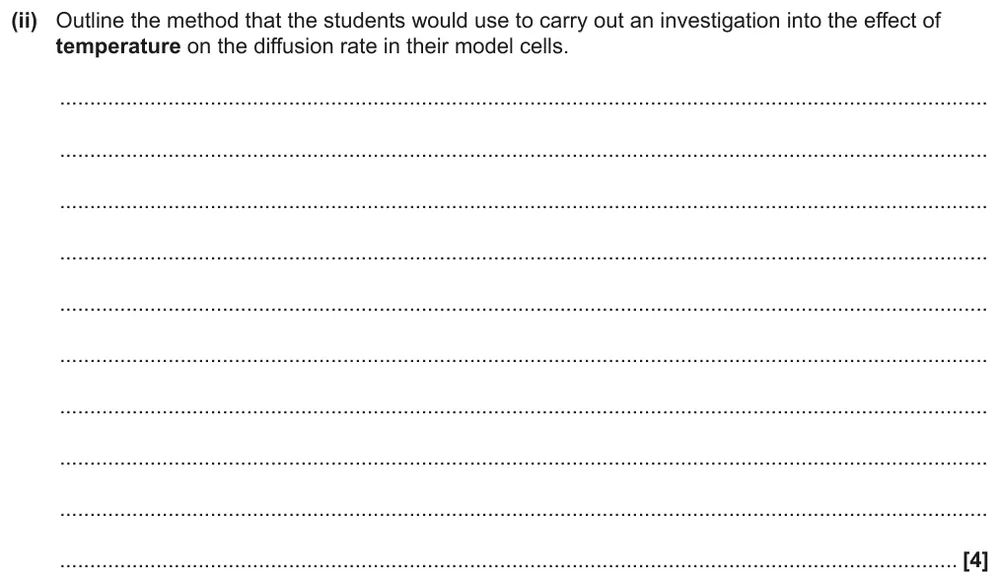
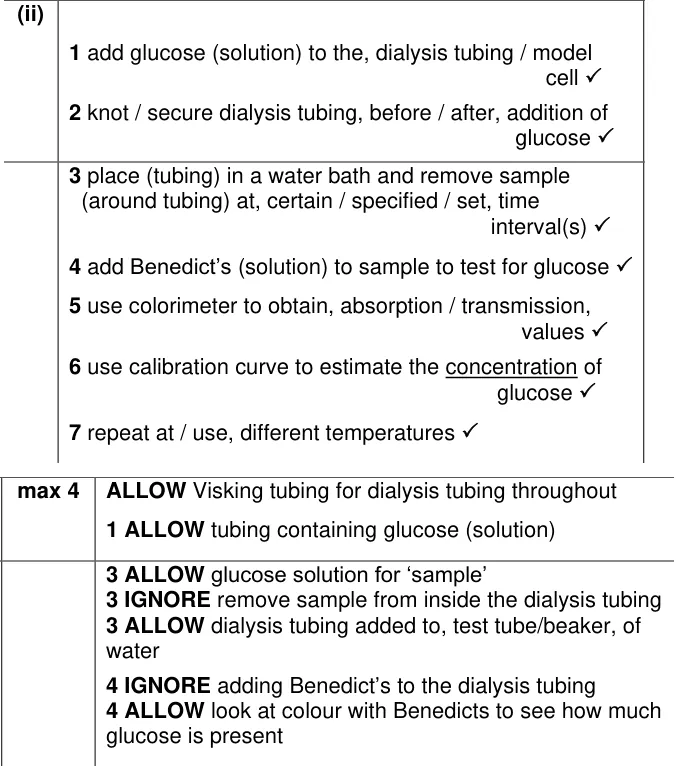
Outline a method to investigate the effect of temperature on diffusion of glucose out of a dialysis tubing model cell.
Show the mark scheme
Tap an image to open it full size.
From the examiners' report: Most students knew to use different temperatures, but few knew that the model cell is dialysis tubing filled with glucose; many wrote about potato or beetroot. Sample the liquid around the tubing, not inside it, and test it with Benedict's and the colorimeter.
Question 15
AS Paper 2 · June 2025 · Q2(a)(i) · 2 marks · Medium
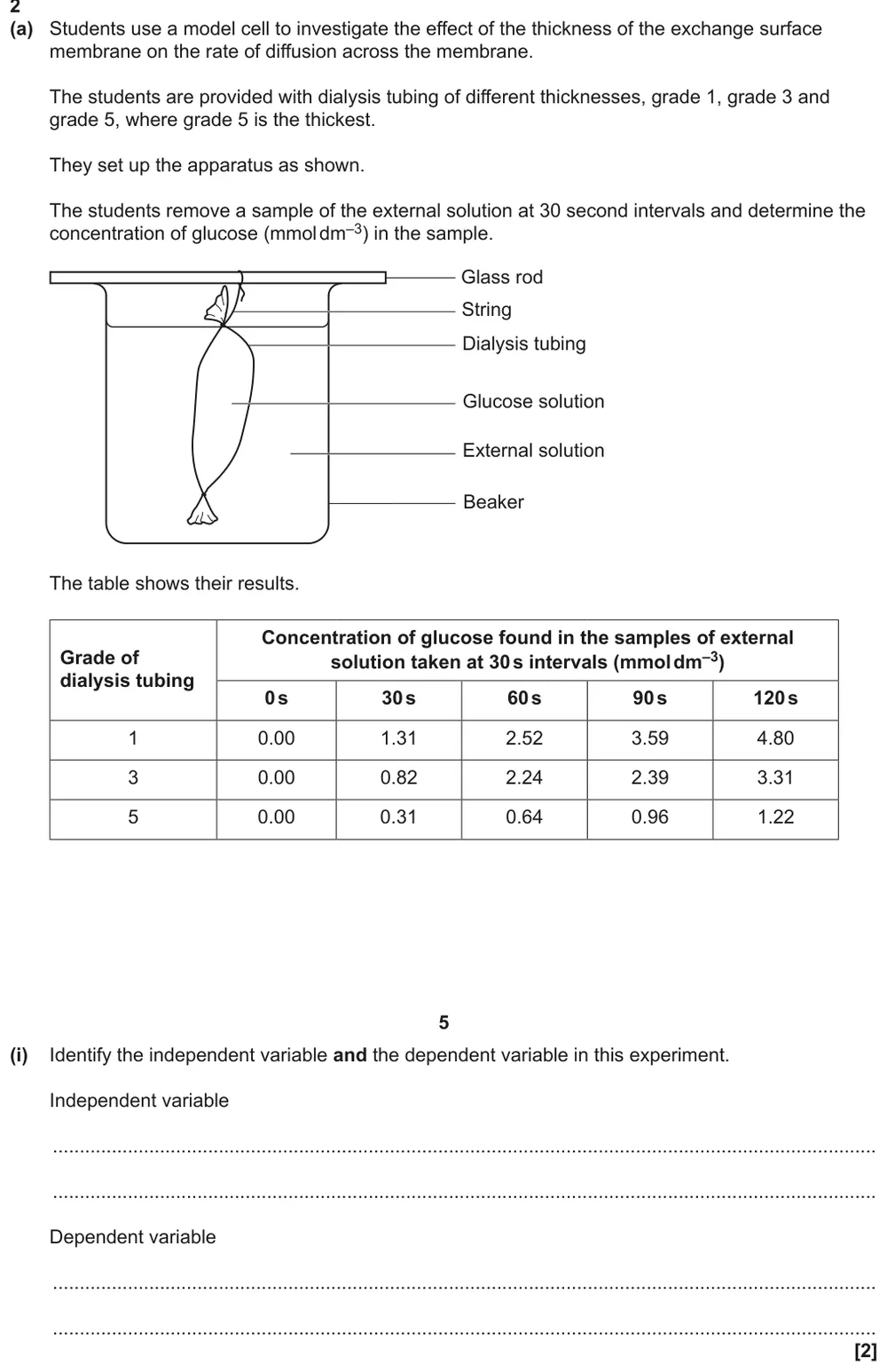
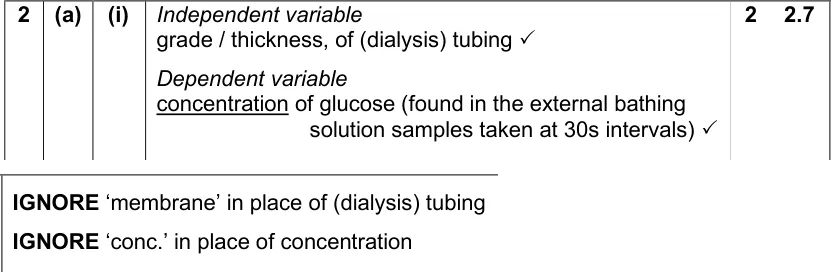
Identify the independent and dependent variables in a dialysis tubing diffusion experiment.
Show the mark scheme
Tap an image to open it full size.
From the examiners' report: Many students got both marks. The best answers used the table headings to give the dependent variable in full: the concentration of glucose in the samples of external solution.
Question 16
AS Paper 2 · June 2025 · Q2(a)(ii) · 2 marks · Medium
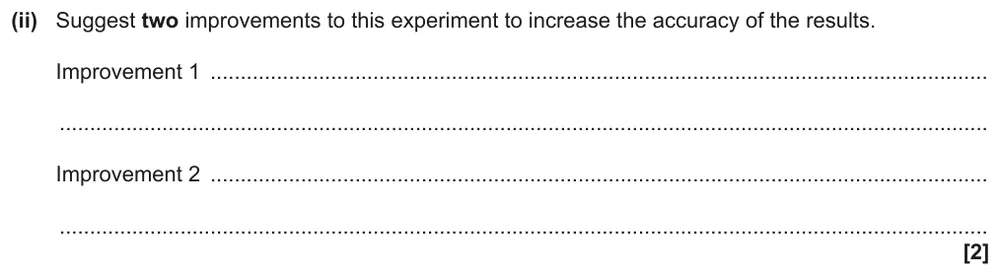
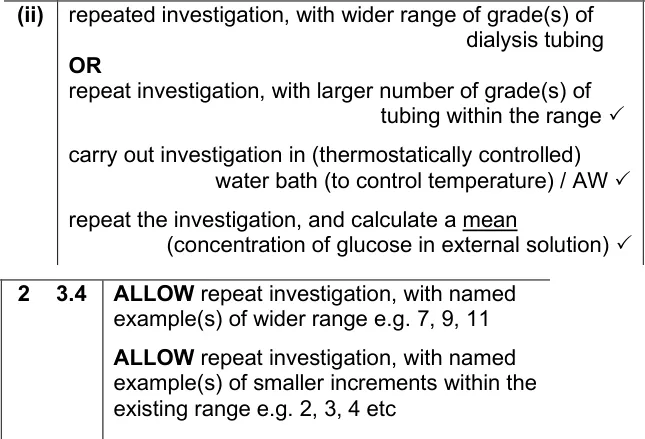
Suggest two improvements to increase the accuracy of the dialysis tubing results.
Show the mark scheme
Tap an image to open it full size.
From the examiners' report: 'Repeat the investigation' or 'use more grades' on its own was too vague: say it should be repeated with extra grades, such as 7 and 9. Use the word 'mean' rather than 'average'.
Question 17
AS Paper 2 · June 2025 · Q2(a)(iii) · 2 marks · Medium
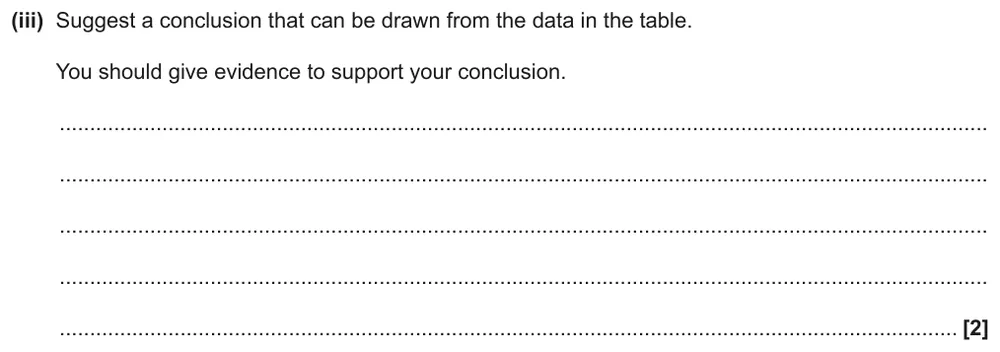
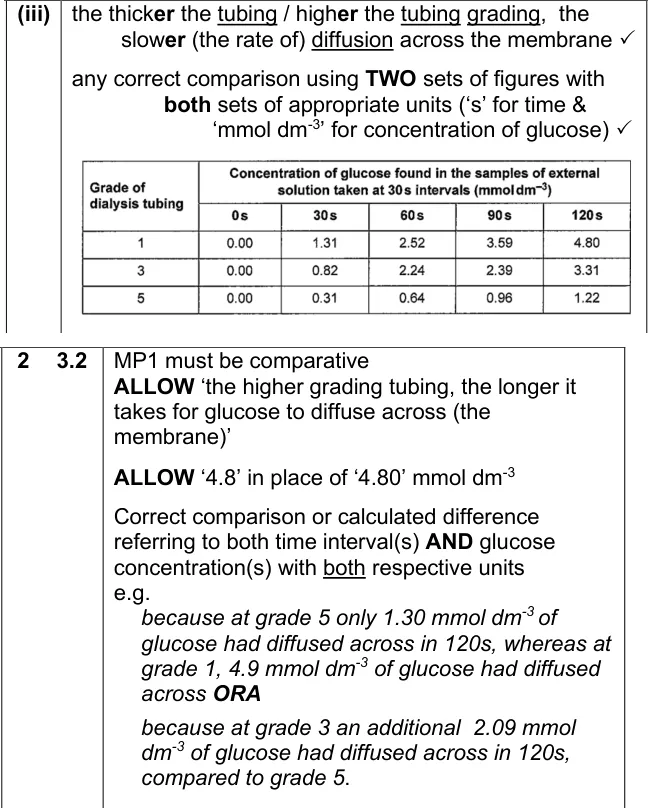
Suggest a conclusion from the dialysis tubing data, with evidence.
Show the mark scheme
Tap an image to open it full size.
From the examiners' report: Most students used the data, but many lost the mark by leaving out units or writing the concentration unit wrongly. Give a conclusion about the rate of diffusion, not just a description of the numbers.
Question 18
AS Paper 1 · June 2022 · Q24(a)(ii) · 2 marks · Hard
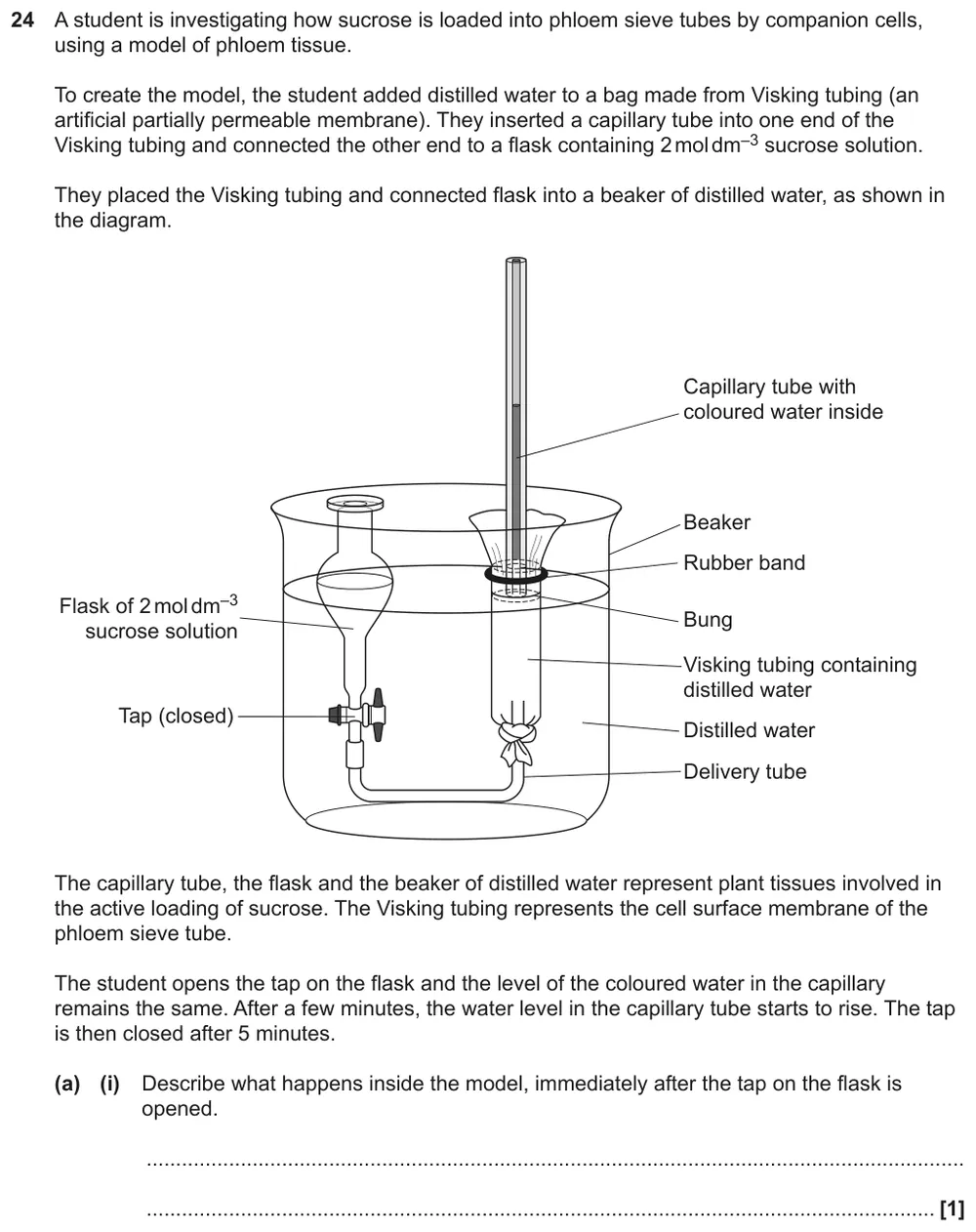
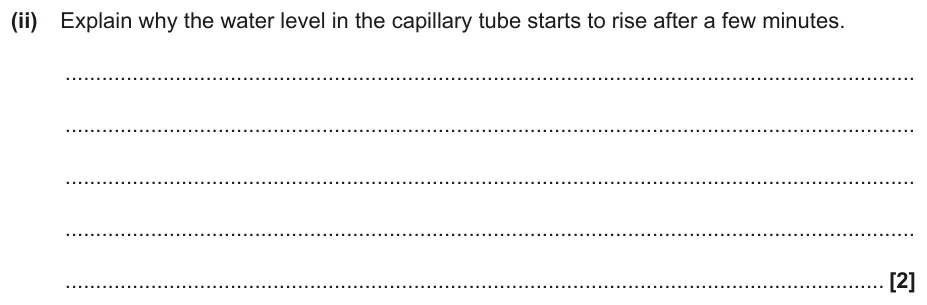
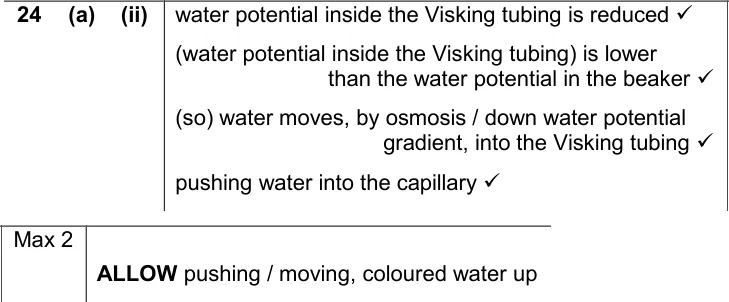
Explain why the water level rises in a capillary tube on Visking tubing once sucrose solution flows in from a flask.
Information from earlier in this question:
Show the mark scheme
Tap an image to open it full size.
From the examiners' report: Many students said the sucrose moved up the tube, or blamed capillary action, active transport or facilitated diffusion. Compare the water potential inside and outside the tubing and say water moves into the tubing by osmosis.
Where students lose marks (from OCR examiners' reports and mark schemes)
Each point below is followed by wording that gained marks.
Say what the membrane has done: For boiled or ethanol-treated tissue, few students explained what had happened to the membrane, and many had water moving one way during the treatment and back again afterwards.
✔ Gains credit: "Ethanol dissolves the phospholipid bilayer, so there is no net movement of water into D, but water moves into F".
Compare water potentials, inside and out: Many answers mentioned osmosis but didn't compare the water potential of the solution with the water potential inside the cells, or wrote about 'the cylinders' instead of the cells.
✔ Gains credit: "The solution at 0.0 mol dm⁻³ has a higher water potential than inside the sweet potato cells", so water moves in by osmosis.
Where the line crosses zero: Students said 'plot a graph' without saying what to read from it, or forgot the line of best fit.
✔ Gains credit: "Plot a graph of sucrose concentration against percentage change in mass and draw a line of best fit; identify the sucrose concentration where the line crosses the x axis".
Different starting masses: Some students said a percentage change is 'more precise, accurate or reliable'.
✔ Gains credit: The pieces had "different (starting) masses", so percentage change "allows comparison".
Dilute the previous tube: Writing 'repeat' after the first dilution didn't score, and few students mentioned mixing.
✔ Gains credit: "Add 5 cm³ of 0.8 mol dm⁻³ sucrose to 5 cm³ of distilled water", then "take contents from previous tube and add to next tube with distilled water", mixing each one.
Fresh pieces for each temperature: General improvements such as more repeats or smaller temperature intervals didn't score when the method had real faults, such as heating the same beetroot pieces through every temperature.
✔ Gains credit: "Use a new flask and fresh pieces for each temperature, so the pieces are not affected by the previous temperature"; "rinse the pieces to remove pigment released by cutting".
Units on both numbers: Quoting figures from a results table without units, or with the wrong concentration unit, lost the evidence mark.
✔ Gains credit: "A correct comparison using two sets of figures with both units: s for time and mmol dm⁻³ for the concentration of glucose".
Osmosis, not capillary action: Many students said sucrose solution moved up the capillary, or blamed capillary action, active transport or facilitated diffusion.
✔ Gains credit: "The water potential inside the Visking tubing is lower than in the beaker, so water moves into the tubing by osmosis, pushing water into the capillary".
Download the questions
Download the PDF pack (18 questions, mark schemes at the end)
Keep practising
- PAG 5 Colorimeter and Potometer: OCR A Level Biology exam questions by topic
- Geometry and Surface Area to Volume (M4): OCR A Level Biology exam questions by topic
- OCR A Level Biology cell membranes quiz
- OCR A Level Biology practical skills quiz
- OCR A Level Biology masterclasses
Questions, mark schemes and examiners' report extracts © OCR.