

OCR A PAG 7 · 15 questions · mark schemes and examiners’ tips included
PAG 7 is about growing microorganisms safely and counting them. You will have used aseptic technique to inoculate nutrient broth or agar plates, incubated cultures at a safe temperature, and estimated the size of a bacterial population by serial dilution, plating and counting colonies.
The examiners see the same slips every year. Students write 'amount' instead of naming a variable, say 'control' without explaining what it checks, or think the Bunsen flame kills every microbe. In the calculations, marks go on tracking each dilution factor, scaling up from the volume plated to the whole culture, and giving the answer in standard form. Choose a plate with plenty of separate, countable colonies.
Work through the fifteen questions below in order. They start with aseptic technique, move on to controlling a growth investigation, and finish with serial dilutions and colony count calculations. If you'd like to go through questions like these with me each week, my OCR A masterclasses run on Wednesdays at 5.15pm for Year 12 and on Tuesdays at 6.30pm or Thursdays at 5.15pm for Year 13.
What these questions cover (OCR PAG 7: microbiological techniques)
PAG 7 is one of the twelve practical activity groups in the OCR A Level Biology A specification (H420). The questions test these parts of the specification:
- 1.1.1(b) identification of variables that must be controlled, where appropriate
- 1.1.4(e) the refining of experimental design by suggestion of improvements to the procedures and apparatus
- 1.2.2(c) use of laboratory glassware apparatus for a variety of experimental techniques to include serial dilutions
- 1.2.2(i) use of microbiological aseptic techniques, including the use of agar plates and broth
- 6.2.1(g)(i) how to culture microorganisms effectively, using aseptic techniques
- 6.2.1(h)(ii) practical investigations into the factors affecting the growth of microorganisms (including estimating population size from colony counts)
How to use this page
Write your answer on paper before you open the mark scheme. Allow about 1.2 minutes per mark: the 15 questions are worth 29 marks, so about 35 minutes in total. Then mark your answer strictly against the mark scheme and read the examiners' tip underneath it. If you'd rather print the questions, download the PDF pack.
Aseptic technique
Question 1
A level Paper 2 · June 2022 · Q17(a)(i) · 1 mark · Easy
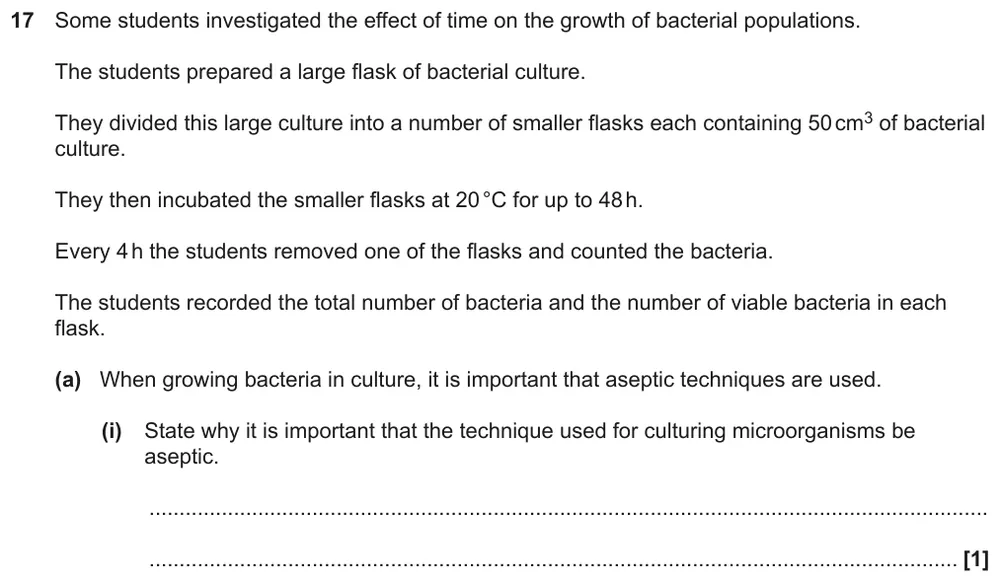
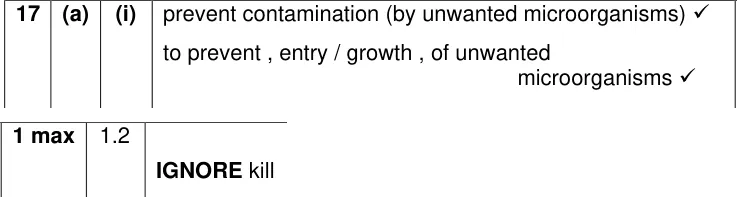
State why the technique for culturing microorganisms must be aseptic.
Show the mark scheme
Tap an image to open it full size.
From the examiners' report: Nearly everyone got this. Use the word contamination, or say it stops unwanted microorganisms getting in or growing.
Question 2
A level Paper 3 · June 2017 · Q2(b)(ii) · 2 marks · Medium
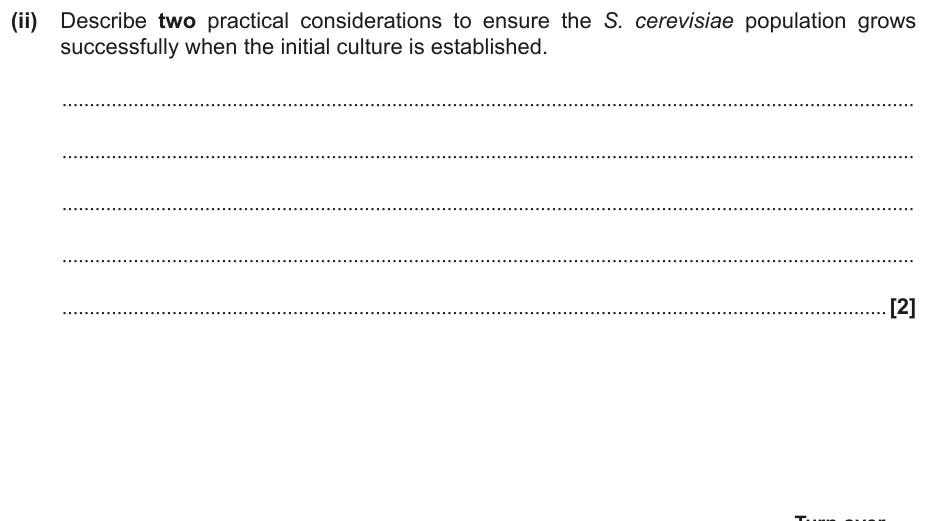
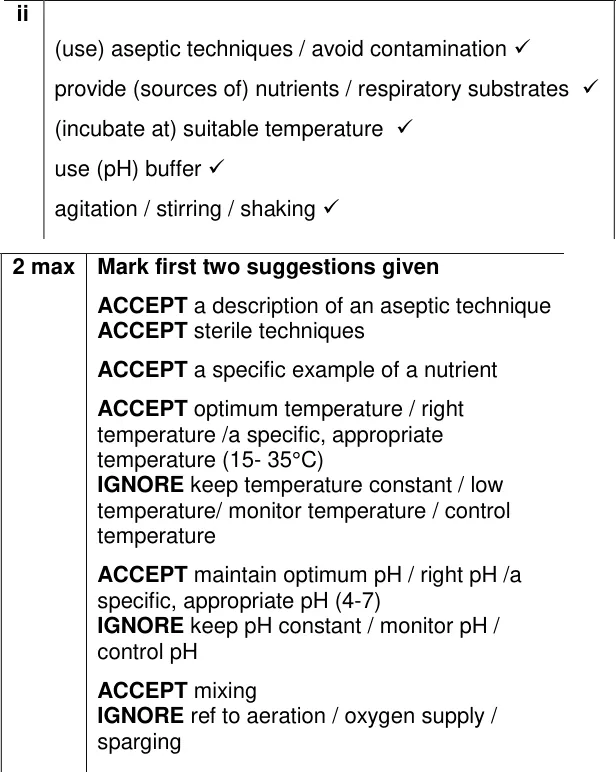
Describe two practical considerations for establishing a yeast culture successfully.
Show the mark scheme
Tap an image to open it full size.
From the examiners' report: Most students scored both marks, usually for aseptic technique and a suitable temperature or pH. Saying 'control' the temperature or pH wasn't enough: it has to be suitable for the yeast. Sterilising the culture itself got nothing.
Question 3
A level Paper 2 · June 2018 · Q19(c)(ii) · 2 marks · Medium
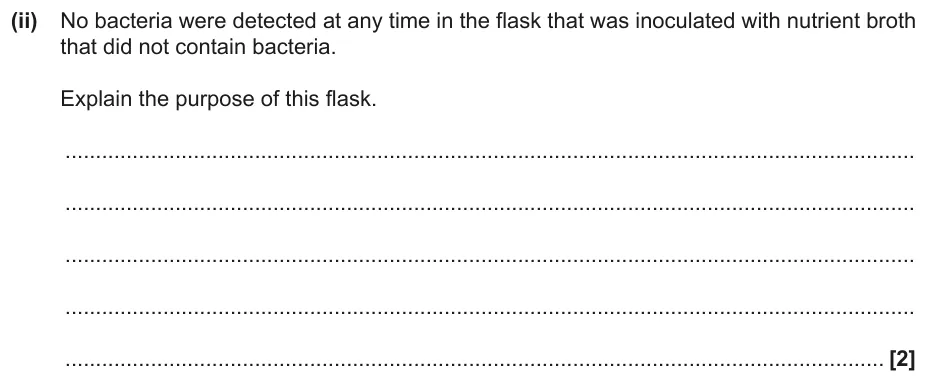
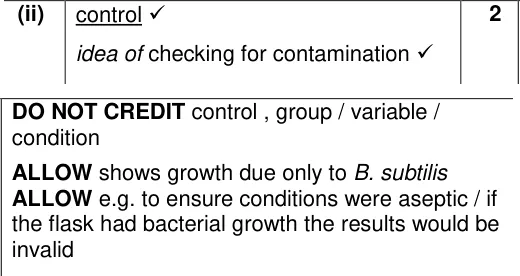
Explain the purpose of a flask of nutrient broth with no bacteria added.
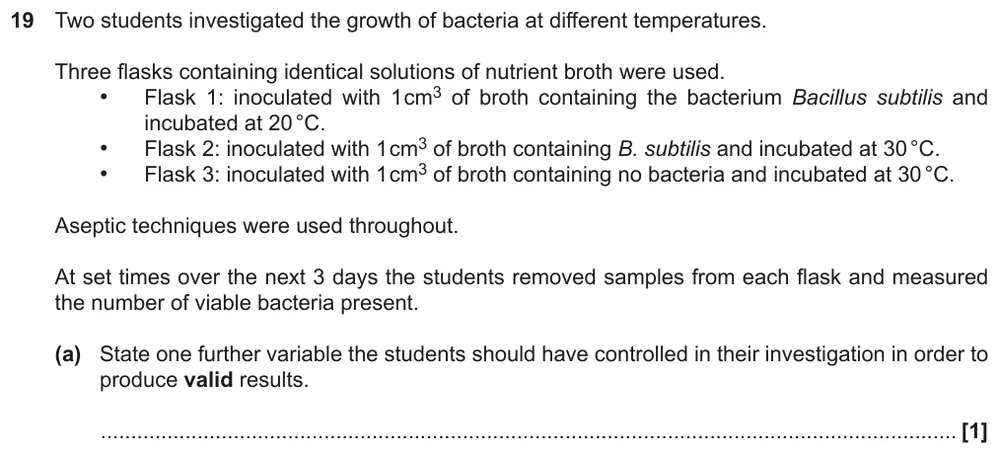
Information from earlier in this question:
Show the mark scheme
Tap an image to open it full size.
From the examiners' report: Most students said it was a control, but some mixed this up with a control variable or control group. The context points to contamination, so generic answers about comparison got nothing.
Question 4
A level Paper 2 · June 2018 · Q19(c)(iii) · 1 mark · Medium
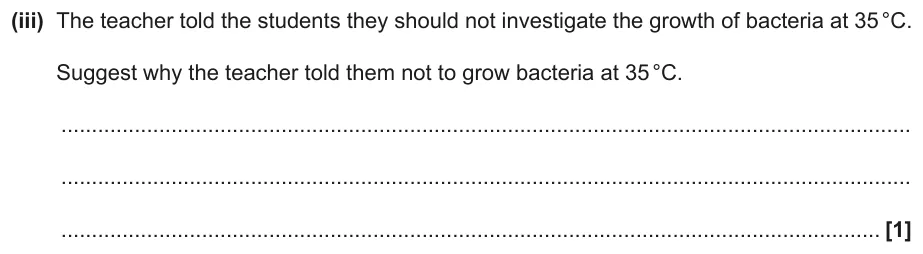
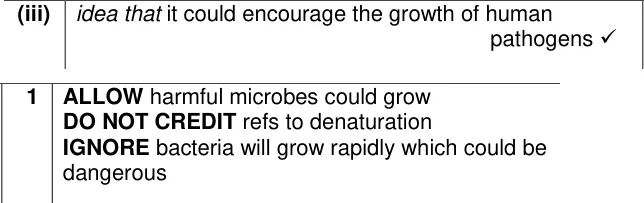
Suggest why the students should not grow bacteria at 35 °C.
Show the mark scheme
Tap an image to open it full size.
From the examiners' report: Only about a third of students scored. Wrong answers said the enzymes would denature, which is unlikely at 35 °C, or that growth would be rapid and uncontrollable. The point is that 35 °C is close to body temperature, so human pathogens could grow.
Question 5
A level Paper 2 · June 2022 · Q17(a)(ii) · 2 marks · Hard
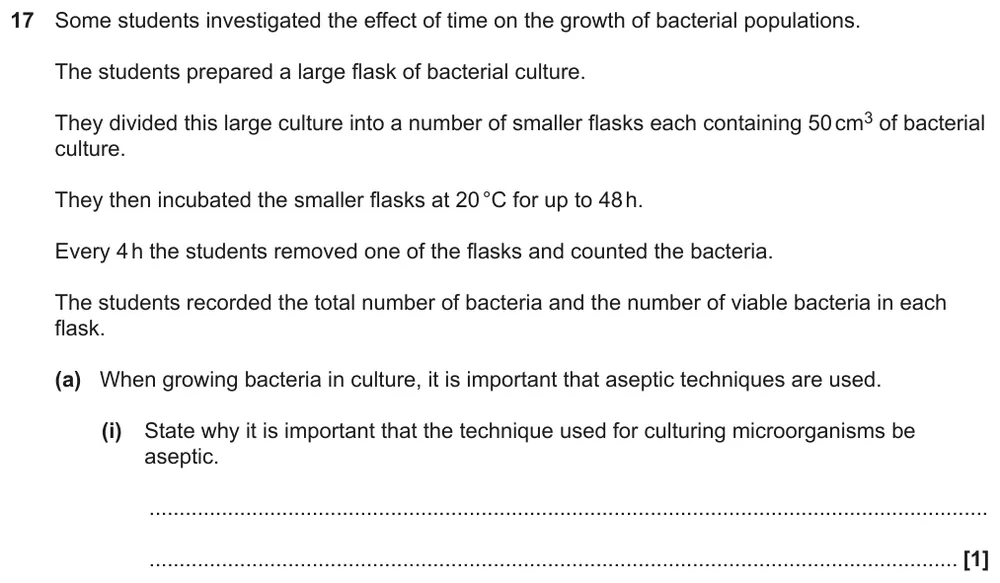
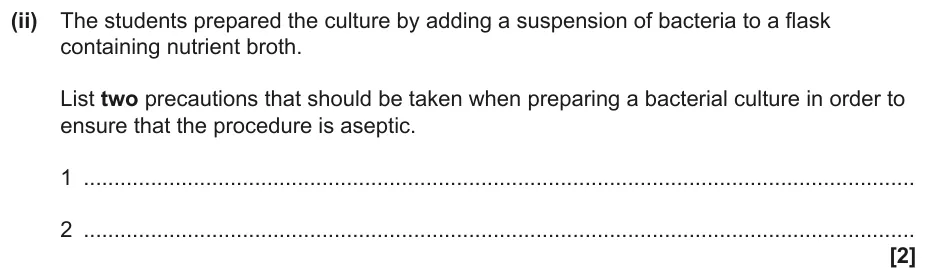
List two precautions that keep the preparation of a bacterial culture aseptic.
Information from earlier in this question:
Show the mark scheme
Tap an image to open it full size.
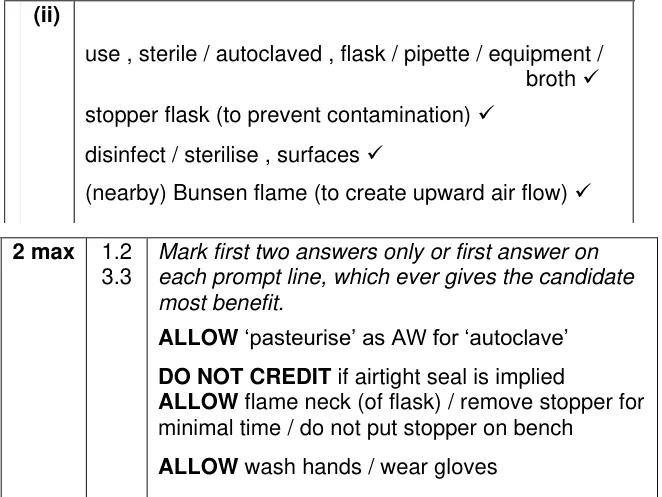
From the examiners' report: Students who used the context sterilised the flasks, broth and pipette and stoppered or flamed the flask. Answers about streaking an agar plate didn't fit the question. The Bunsen flame creates an upward air current; it doesn't kill all the microbes.
Controlling a growth investigation
Question 6
A level Paper 2 · June 2022 · Q17(b)(i) · 1 mark · Medium
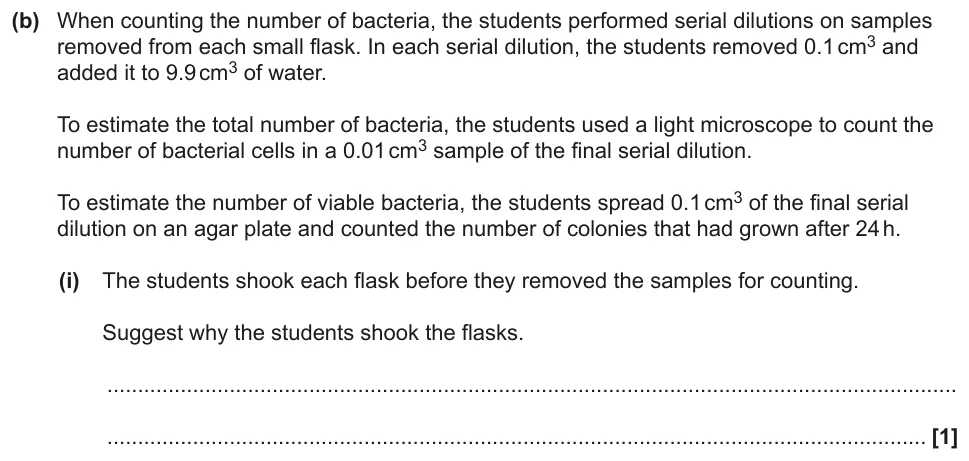
Suggest why the flasks were shaken before samples were removed.
Show the mark scheme

Tap an image to open it full size.
From the examiners' report: About half of students scored. Many said the sample needed mixing or that bacteria settle, but missed the key idea: the bacteria must be evenly distributed so the sample is representative.
Question 7
A level Paper 2 · June 2018 · Q19(a) · 1 mark · Medium
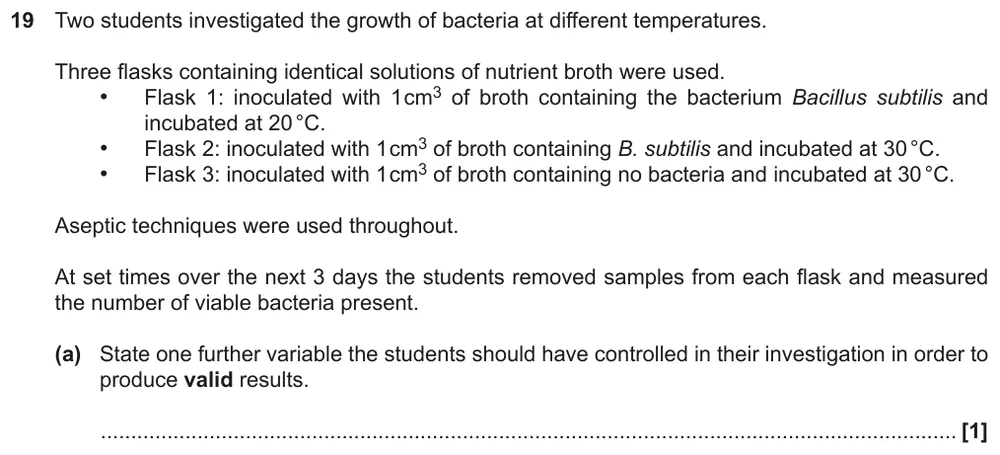
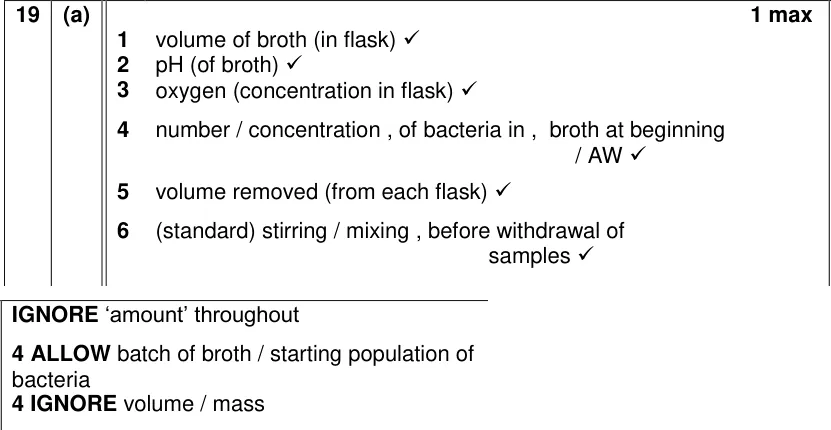
State one further variable to control when comparing bacterial growth at two temperatures.
Show the mark scheme
Tap an image to open it full size.
From the examiners' report: About half of students scored. 'Amount' got no credit as usual, and nor did irrelevant answers such as the size of the flask or light, or describing a control.
Serial dilutions and colony counts
Question 8
A level Paper 2 · June 2018 · Q19(b)(i) · 2 marks · Medium
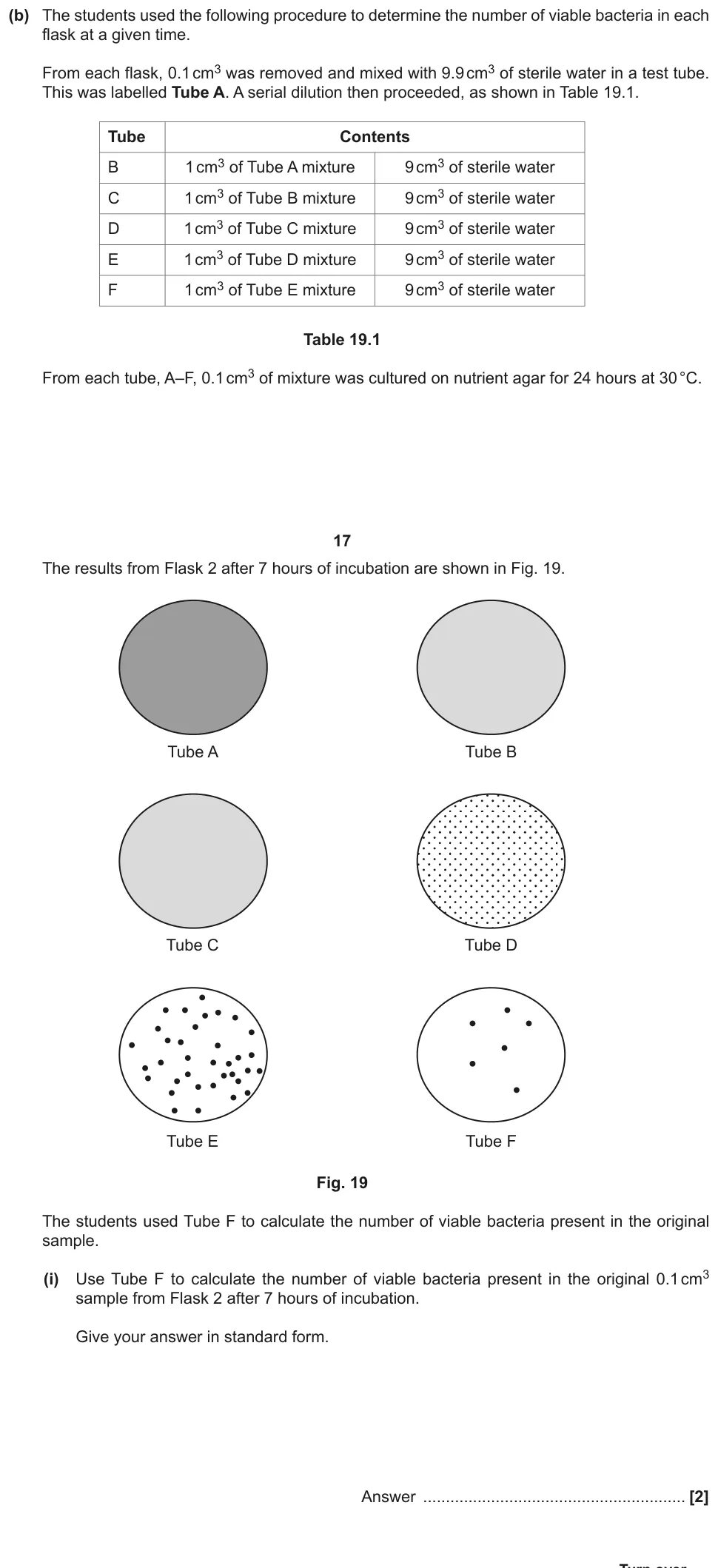
Use the colonies from Tube F to calculate the viable bacteria in the original sample, in standard form.
Show the mark scheme

Tap an image to open it full size.
From the examiners' report: Fewer than 1 in 5 got both marks. Many were out by a factor of 10 or 100 from the dilutions, and some ignored the instruction to give the answer in standard form.
Question 9
A level Paper 2 · June 2018 · Q19(b)(ii) · 3 marks · Medium
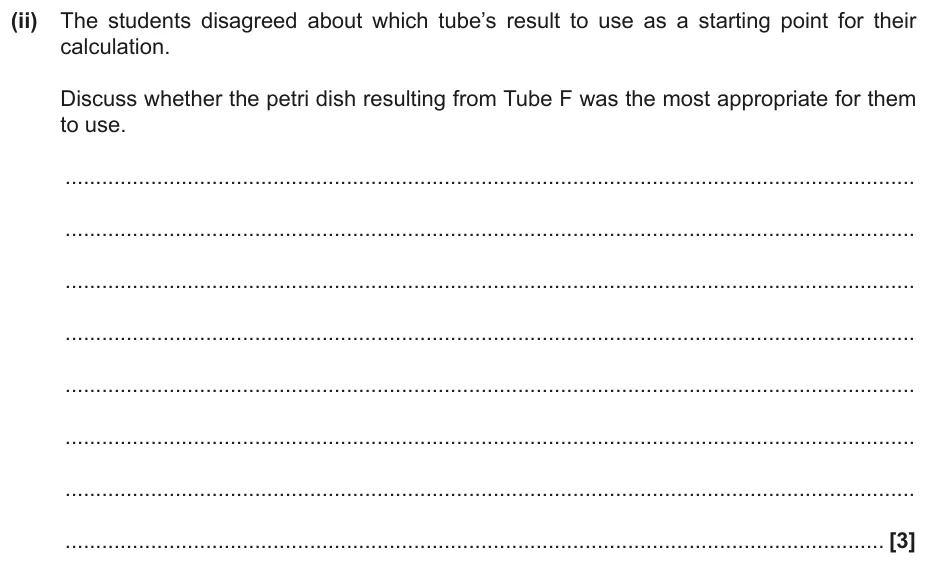
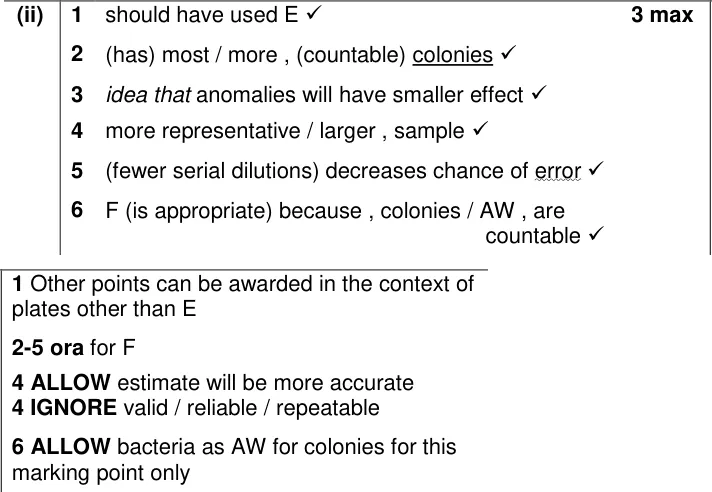
Discuss whether the plate from Tube F was the best one to use for the calculation.
Show the mark scheme
Tap an image to open it full size.
From the examiners' report: Many students thought F was best, which limited them to 1 mark, and others wouldn't clearly say E. Use the word 'colonies'. Saying someone might miscount E is human error and scored nothing.
Question 10
A level Paper 3 · June 2024 · Q1(b)(i) · 2 marks · Medium
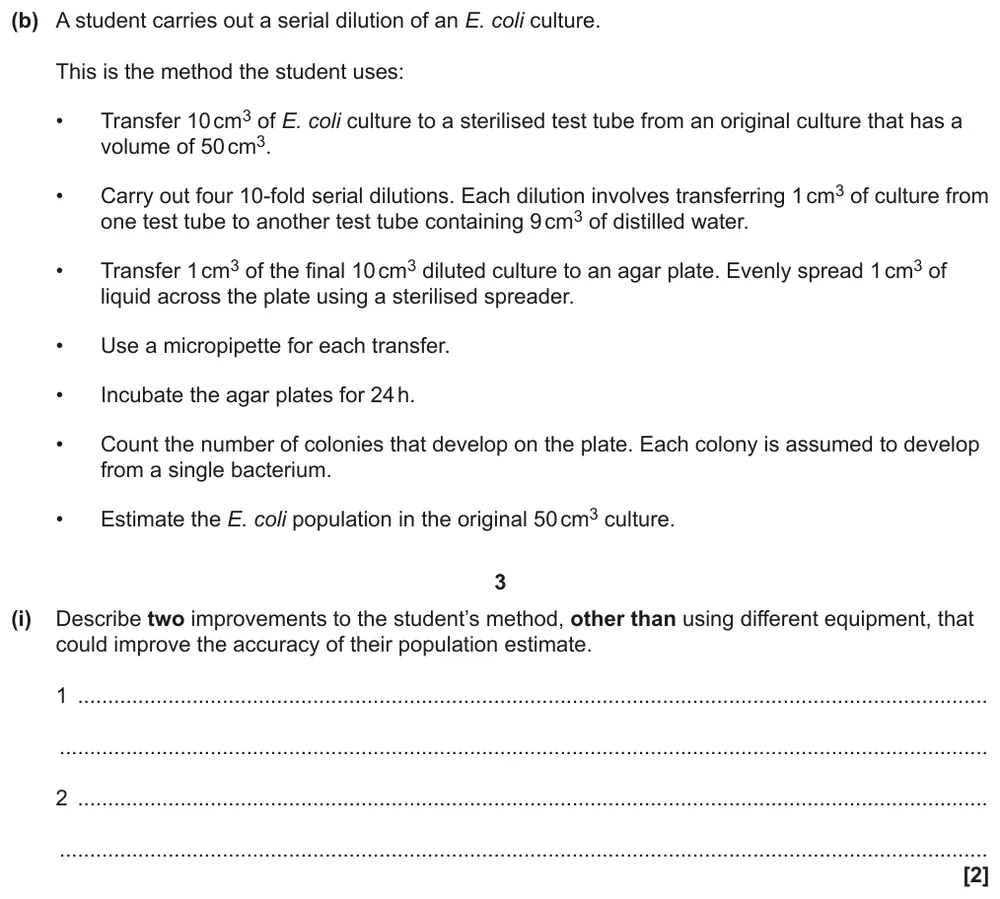
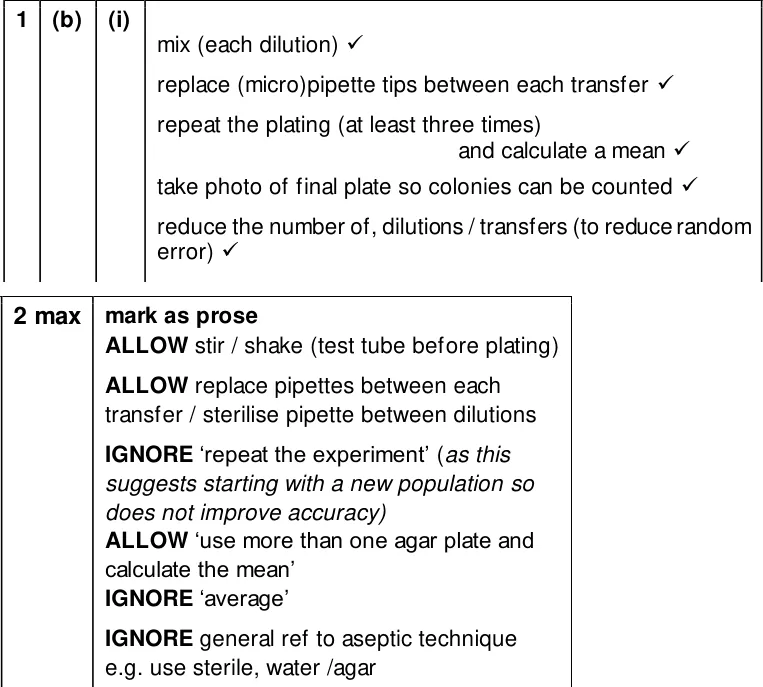
Describe two improvements, other than new equipment, to make a bacterial population estimate more accurate.
Show the mark scheme
Tap an image to open it full size.
From the examiners' report: Good answers repeated the plating or reduced the number of transfers. 'Repeat the experiment' wasn't credited, because it suggests starting again with a new population.
Question 11
A level Paper 3 · June 2024 · Q1(b)(ii) · 3 marks · Medium
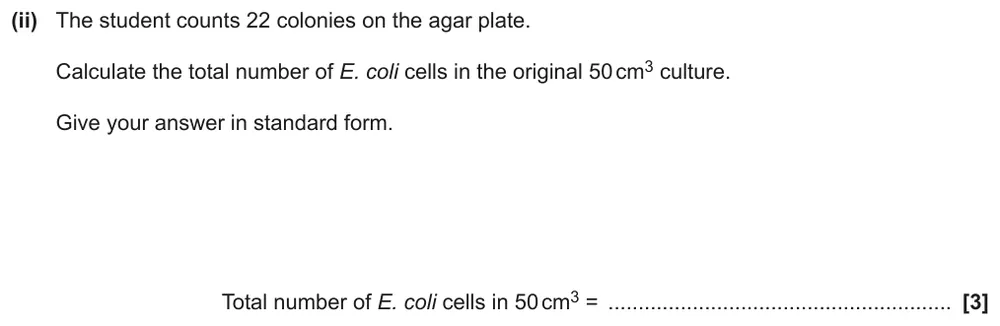
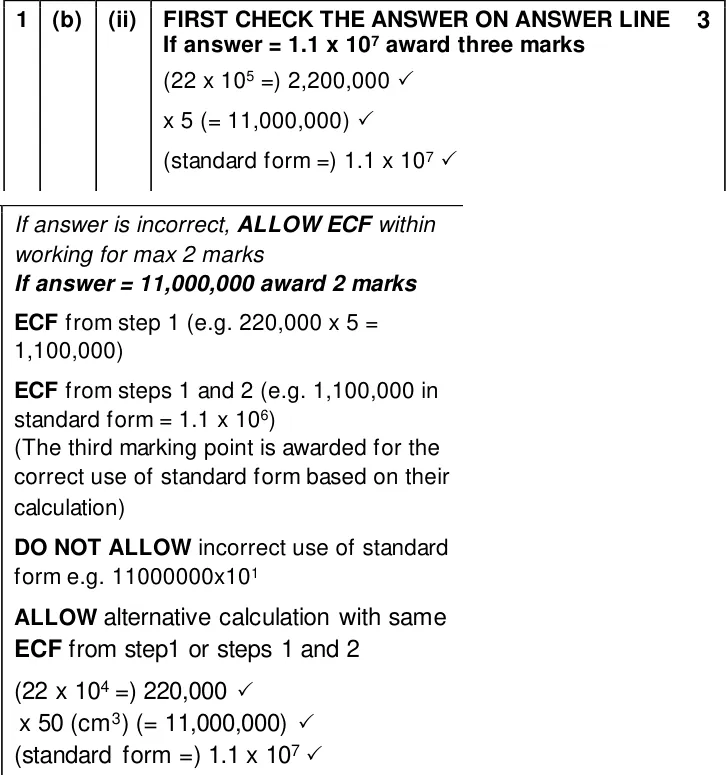
Calculate the number of E. coli cells in the original 50 cm³ culture from a count of 22 colonies.
Show the mark scheme
Tap an image to open it full size.
From the examiners' report: Many students got this right. Show your working, because marks are given for each stage, and give the final answer in standard form.
Question 12
A level Paper 2 · June 2022 · Q17(b)(iii) · 3 marks · Hard
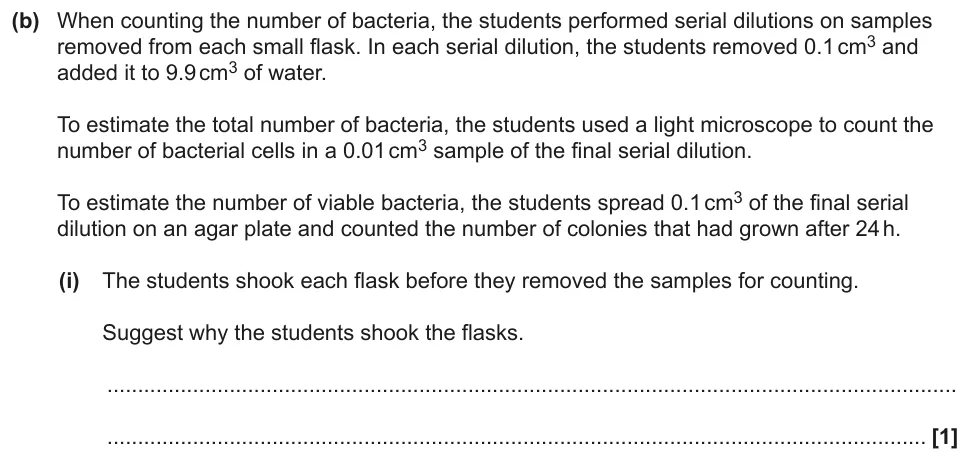
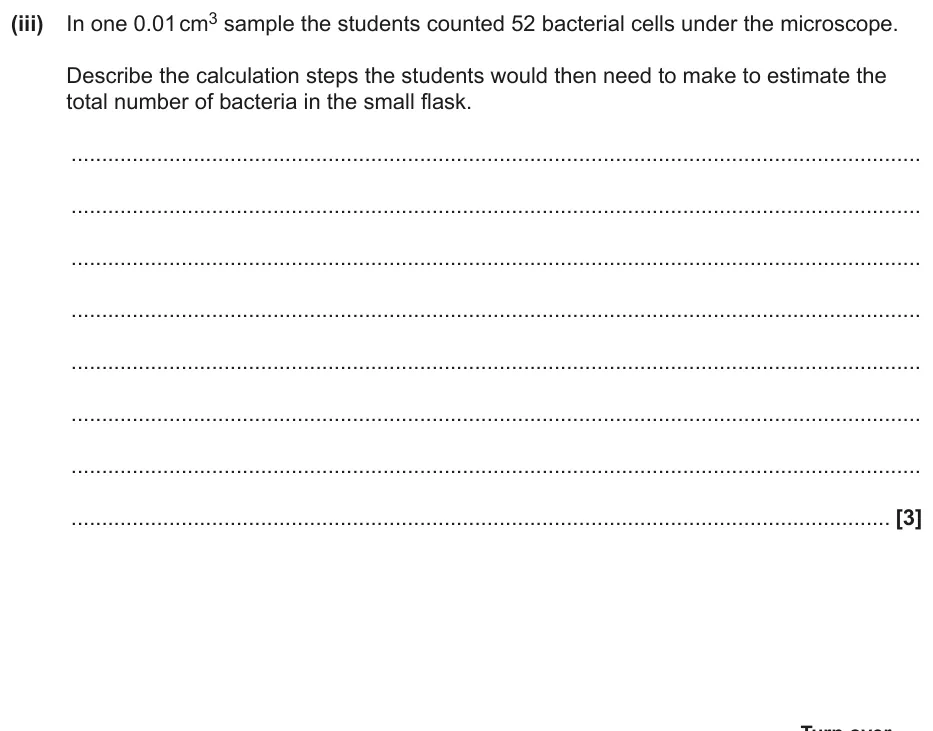
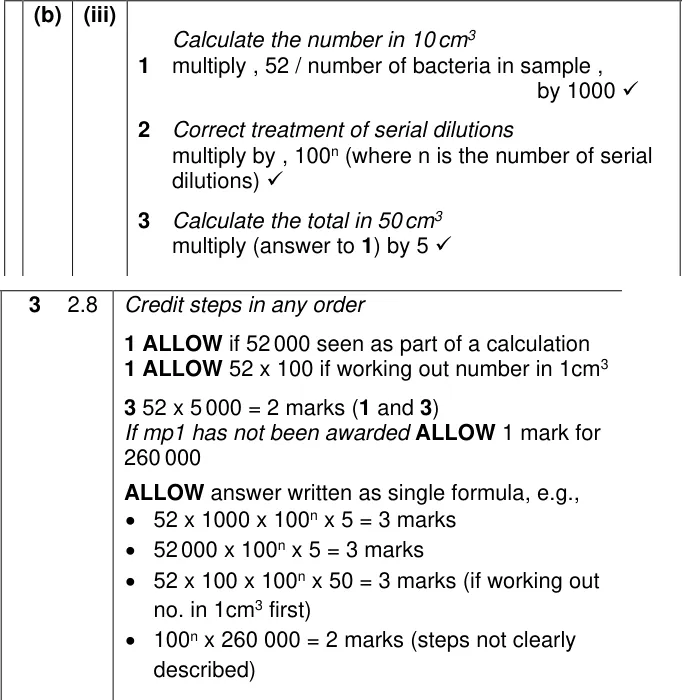
Describe the calculation steps to estimate the total bacteria in a flask from a microscope count of 52 cells.
Information from earlier in this question:
Show the mark scheme
Tap an image to open it full size.
From the examiners' report: Few students got all 3 marks. The dilution step was the hardest: each 0.1 into 9.9 cm³ dilution is 1 in 100, so multiply by 100ⁿ. Describe the steps as asked, because the number of dilutions isn't given.
Question 13
A level Paper 3 · November 2021 · Q2(d)(iii) · 2 marks · Hard
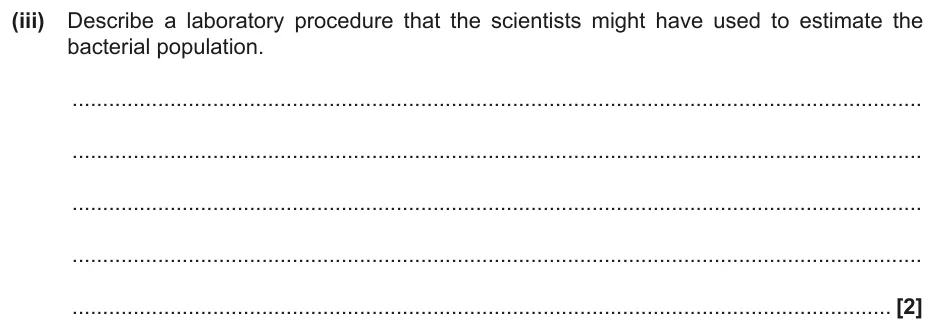
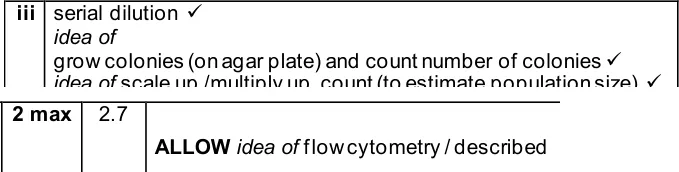
Describe a laboratory procedure to estimate the size of a bacterial population.
Show the mark scheme
Tap an image to open it full size.
From the examiners' report: Students often couldn't describe a procedure. Few mentioned serial dilution, or scaling up the colony count to the original culture.
Question 14
A level Paper 3 · June 2019 · Q6(b)(i) · 3 marks · Hard
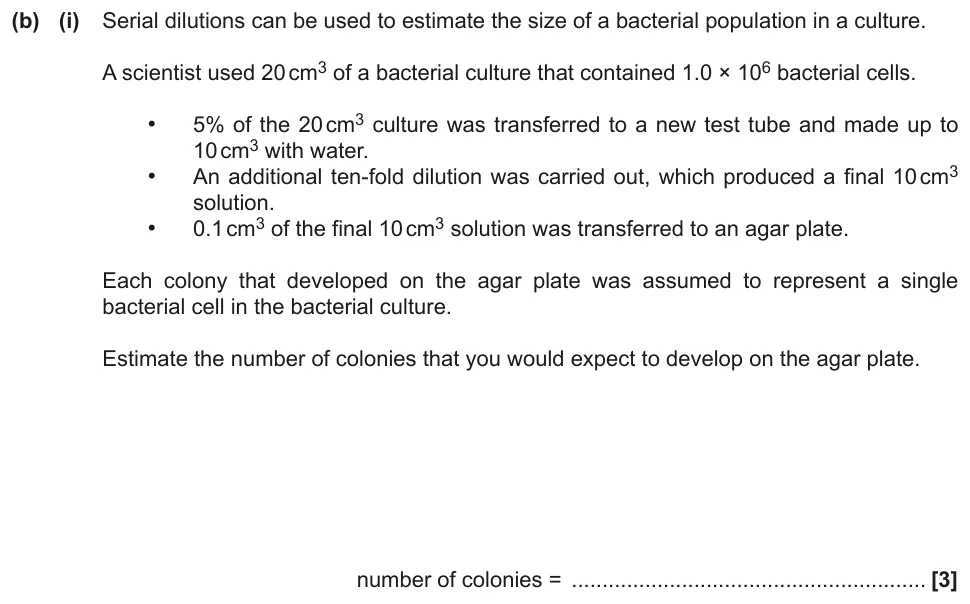
Estimate how many colonies would grow on a plate after a two-step dilution.
Show the mark scheme

Tap an image to open it full size.
From the examiners' report: This multi-step calculation was hard for many, but students who slipped at a later step still picked up working marks for 50 000 or 5000. Write each step down.
Question 15
A level Paper 3 · June 2019 · Q6(b)(ii) · 1 mark · Hard
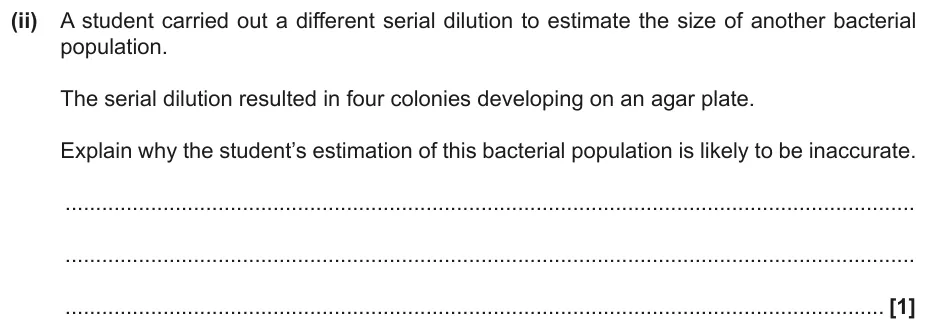
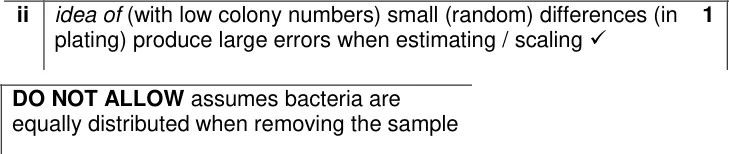
Explain why an estimate based on four colonies is likely to be inaccurate.
Show the mark scheme
Tap an image to open it full size.
From the examiners' report: Very few students saw that a low count magnifies error when it is scaled up. Some knew there had been too many dilutions but couldn't express the idea clearly.
Where students lose marks (from OCR examiners' reports and mark schemes)
Each point below is followed by wording that gained marks.
Suitable, not just controlled: Students said the temperature or pH of a culture should be 'controlled' or 'kept constant', which wasn't credited, and some suggested sterilising the culture itself.
✔ Gains credit: "(Incubate at) suitable temperature" or "maintain optimum pH / use (pH) buffer".
A control checks for contamination: Students confused the sterile broth flask with a control variable or control group, or gave generic answers about comparison.
✔ Gains credit: "Control; idea of checking for contamination".
Pathogens, not denaturation: Asked why bacteria shouldn't be grown at 35 °C, students said enzymes would denature or growth would be uncontrollable.
✔ Gains credit: "Idea that it could encourage the growth of human pathogens".
The flame makes an updraught: Many thought the Bunsen burner kills all the microbes, and some described streaking an agar plate when the question was about broth.
✔ Gains credit: "(Nearby) Bunsen flame (to create upward air flow)"; "use sterile / autoclaved flask / pipette / broth".
Evenly distributed: Students said the culture was shaken so it was mixed, or because the bacteria settle, without the reason that matters.
✔ Gains credit: "Idea of so bacterial cells are evenly distributed".
Pick the plate with most countable colonies: Many students chose the plate with the fewest colonies, or rejected a busier plate because someone might miscount.
✔ Gains credit: "Should have used E; (has) more (countable) colonies; anomalies will have smaller effect".
Track every dilution factor: Colony count answers were often out by a factor of 10 or 100, and few could deal with several serial dilutions.
✔ Gains credit: "Multiply by 100ⁿ (where n is the number of serial dilutions)", then "multiply by 5" to scale up to the 50 cm³ flask.
Repeat the plating, not the experiment: 'Repeat the experiment' wasn't credited as an improvement, because it means starting again with a new population.
✔ Gains credit: "Repeat the plating (at least three times) and calculate a mean".
Download the questions
Download the PDF pack (15 questions, mark schemes at the end)
Keep practising
- OCR A Level Biology cloning and biotechnology quiz
- PAG 4 Rates of Enzyme-Controlled Reactions: OCR A Level Biology exam questions by topic
- PAG 5 Colorimeter and Potometer: OCR A Level Biology exam questions by topic
- OCR A Level Biology practical skills quiz
- OCR A Level Biology masterclasses
Questions, mark schemes and examiners' report extracts © OCR.