

OCR A M4 · 10 questions · mark schemes and examiners’ tips included
Geometry only has one maths skill in the OCR A Level Biology specification, M4.1, but it comes up again and again. You'll use it to explain why large organisms need specialised exchange surfaces, to work out the volume of a cell from a microscope image, and to turn the distance a bubble moves along a capillary tube into a volume. The shapes are always a cube, a sphere or a cylinder.
The good news is that you are usually given the formula. The marks go on what you do with it. Most lost marks come from using the diameter instead of the radius, squaring when you should cube, writing the ratio the wrong way round, or not writing it as something to 1. The examiners' reports make the same points every year, so these are easy marks to win back.
Work through the ten questions below with a calculator. They start with cubes, then the SA:V of spheres and cylinders, and finish with volumes and surface areas, including rates from capillary tubes. If you'd like to go through questions like these with me each week, my OCR A masterclasses run on Wednesdays at 5.15pm for Year 12 and on Tuesdays at 6.30pm or Thursdays at 5.15pm for Year 13.
What these questions cover (OCR maths skill M4: geometry)
The questions test this mathematical skill from the OCR A Level Biology A specification (H420):
- M4.1 Calculate the circumferences, surface areas and volumes of regular shapes
How to use this page
Write your answer on paper before you open the mark scheme. Allow about 1.2 minutes per mark: the 10 questions are worth 25 marks, so about 30 minutes in total. Then mark your answer strictly against the mark scheme and read the examiners' tip underneath it. If you'd rather print the questions, download the PDF pack.
Surface area to volume ratio of cubes
Question 1
AS Paper 2 · June 2023 · Q1(a)(i) · 2 marks · Easy
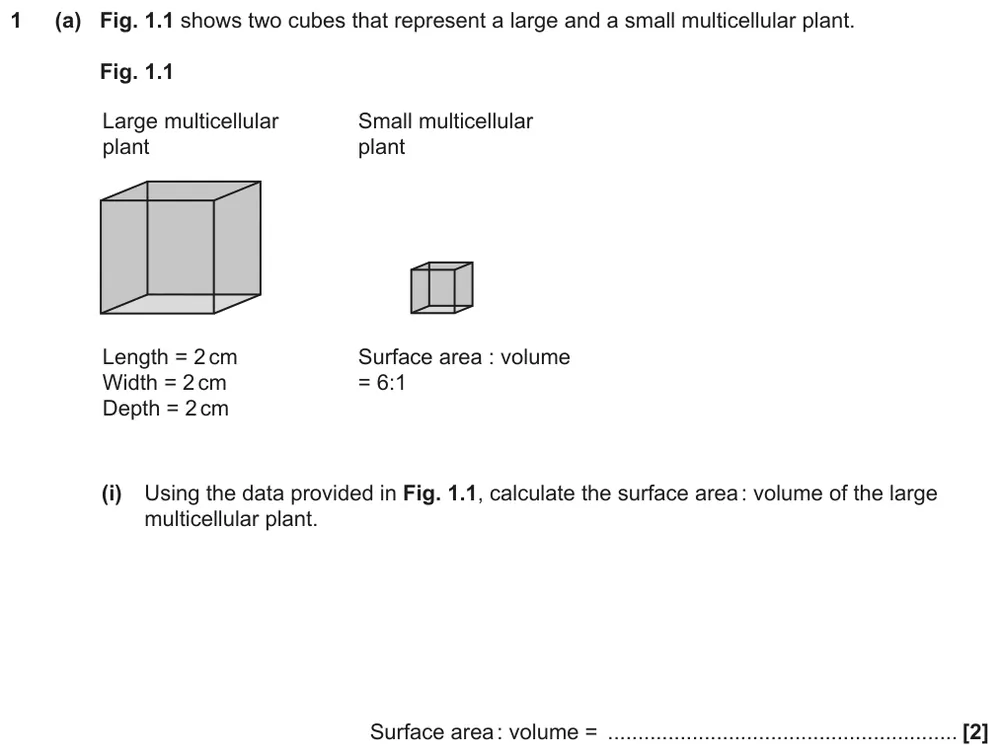
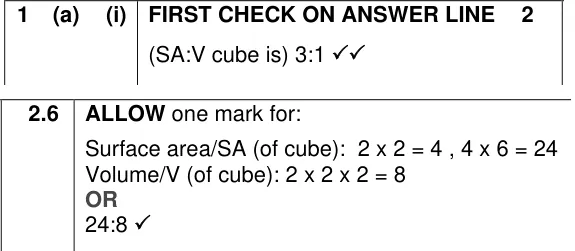
Calculate the SA:V of a 2 cm cube that represents a large multicellular plant.
Show the mark scheme
Tap an image to open it full size.
From the examiners' report: Most students got this and set out their working clearly. Marks were lost for leaving the ratio as 24:8 instead of simplifying it to 3:1, or for working out volume to surface area instead.
Question 2
AS Paper 2 · November 2020 · Q6(a) · 2 marks · Medium
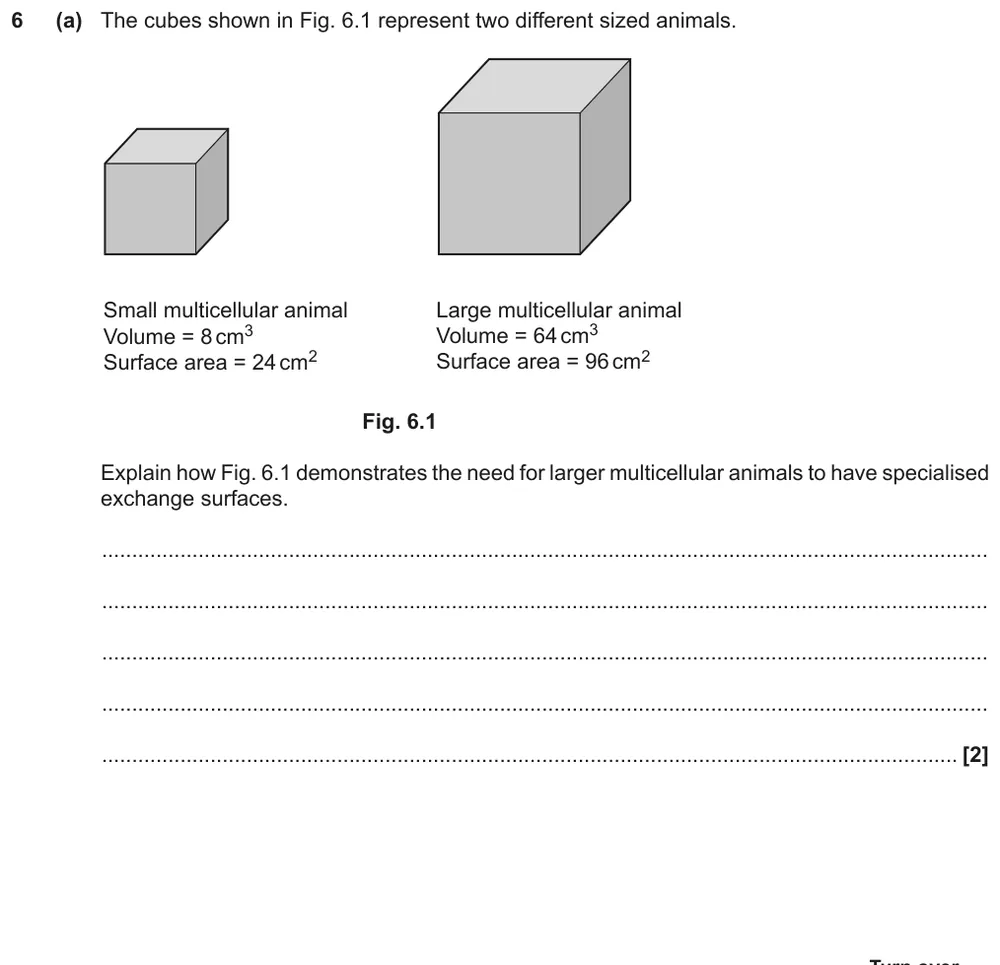
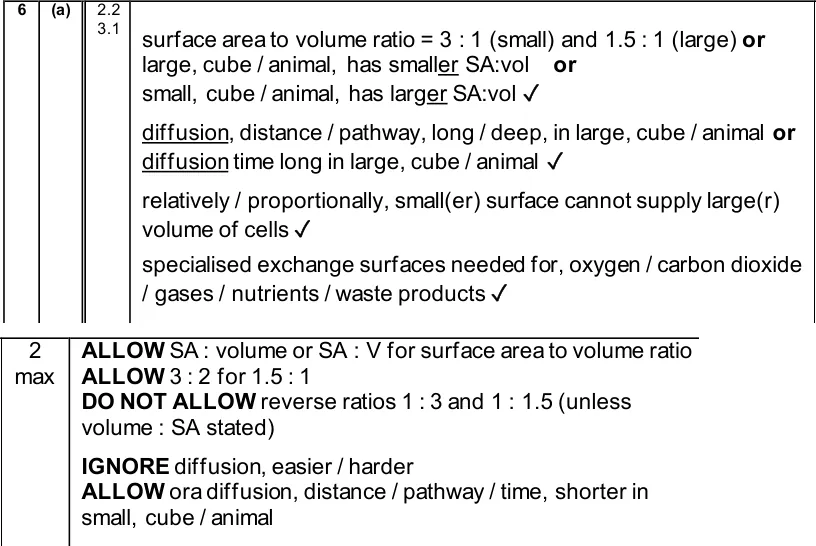
Use the SA:V of two cubes to explain why larger animals need specialised exchange surfaces.
Show the mark scheme
Tap an image to open it full size.
From the examiners' report: Some students worked out the surface area and volume but then wrote the ratio back to front, as 1:3 instead of 3:1. Surface area always comes first.
Question 3
AS Paper 1 · June 2018 · Q21(d)(ii) · 2 marks · Hard
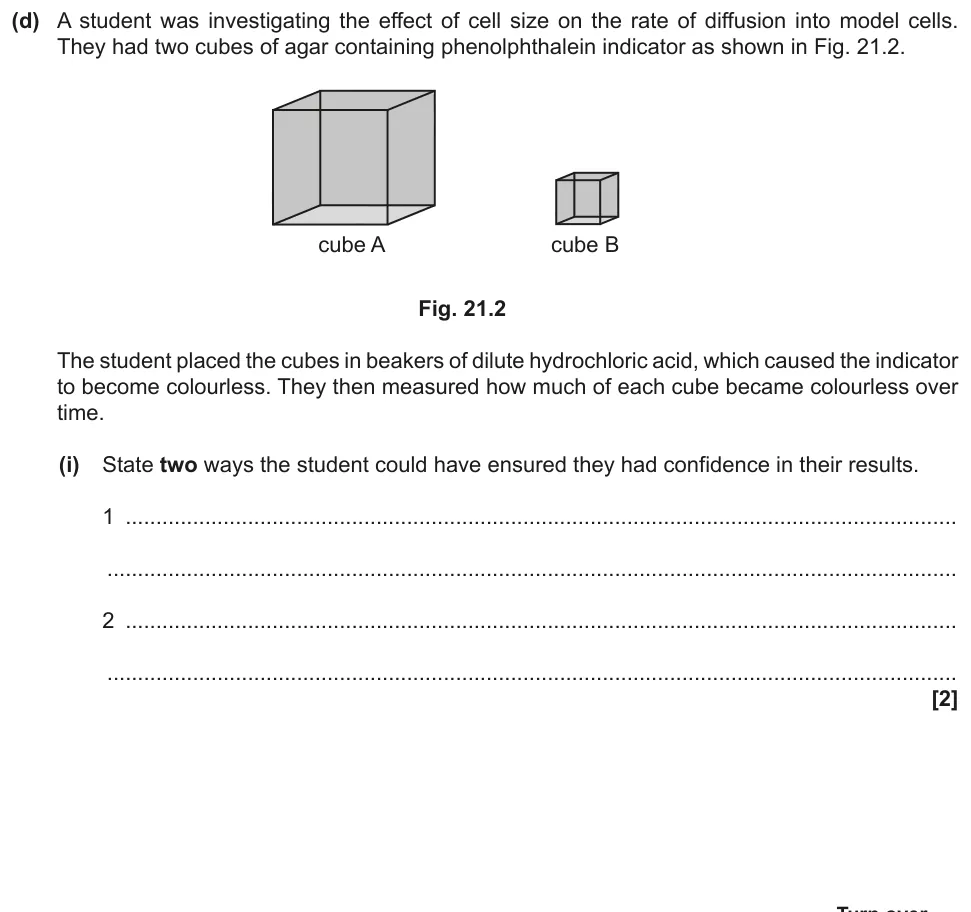
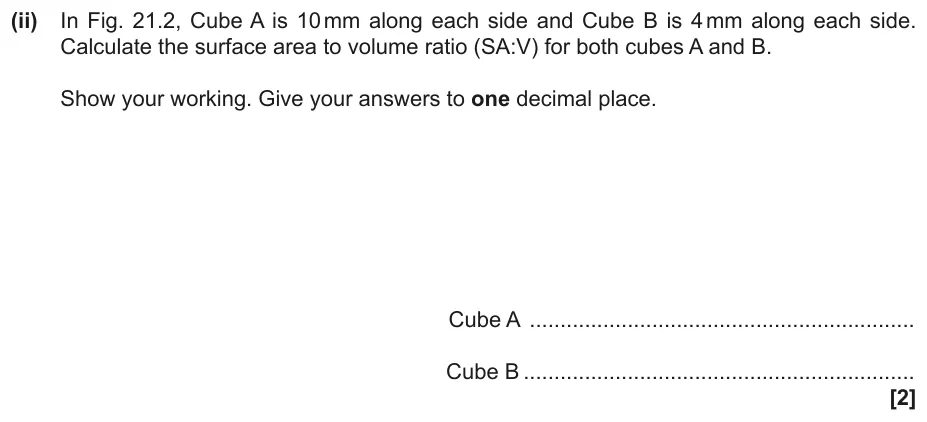
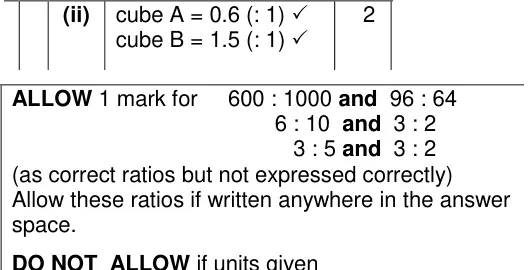
Calculate the SA:V of a 10 mm cube and a 4 mm cube to one decimal place.
Information from earlier in this question:
Show the mark scheme
Tap an image to open it full size.
From the examiners' report: Many students could work out the surface area and the volume but then struggled to combine them. Give the surface area for one unit of volume, such as 0.6:1, not the volume for one unit of surface area.
Surface area to volume ratio of spheres and cylinders
Question 4
A level Paper 3 · June 2025 · Q1(b)(i) · 3 marks · Easy
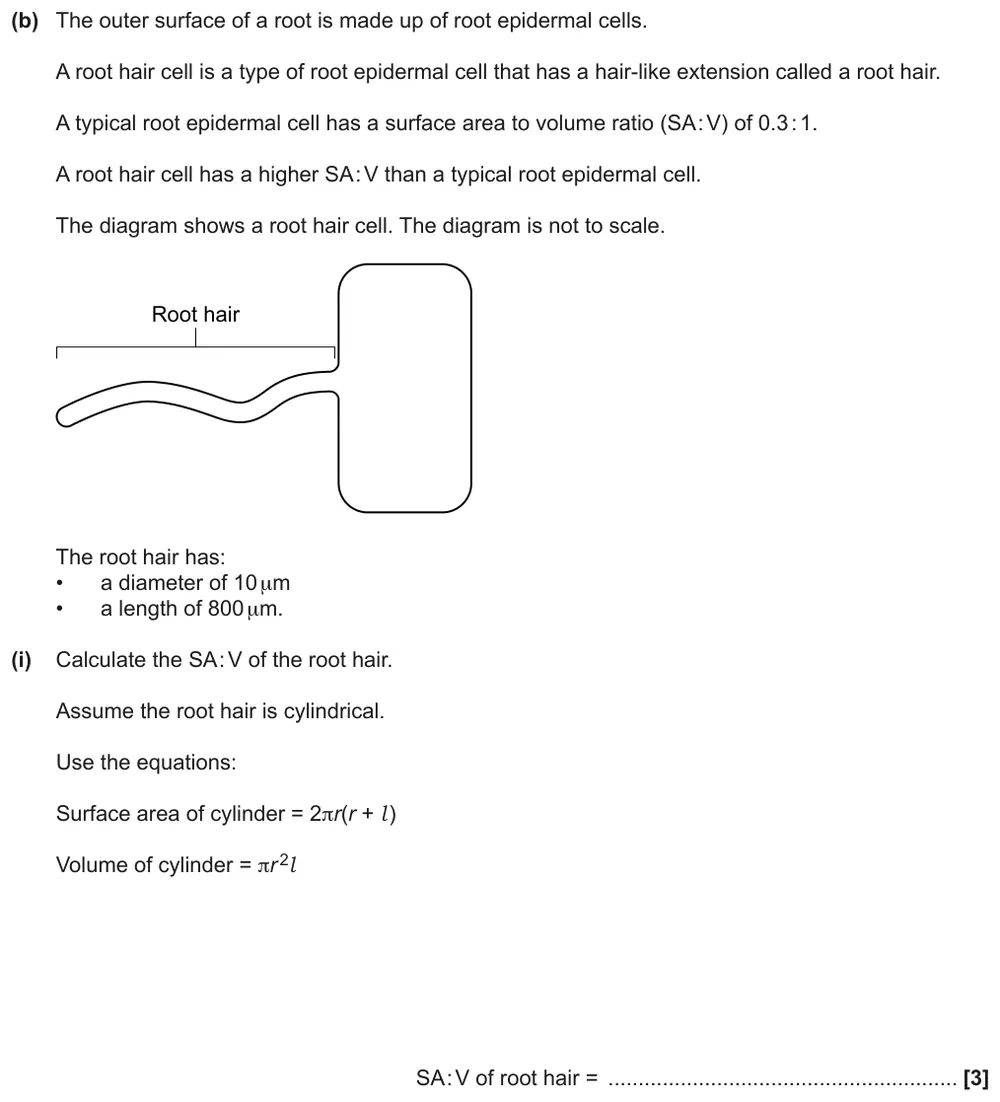
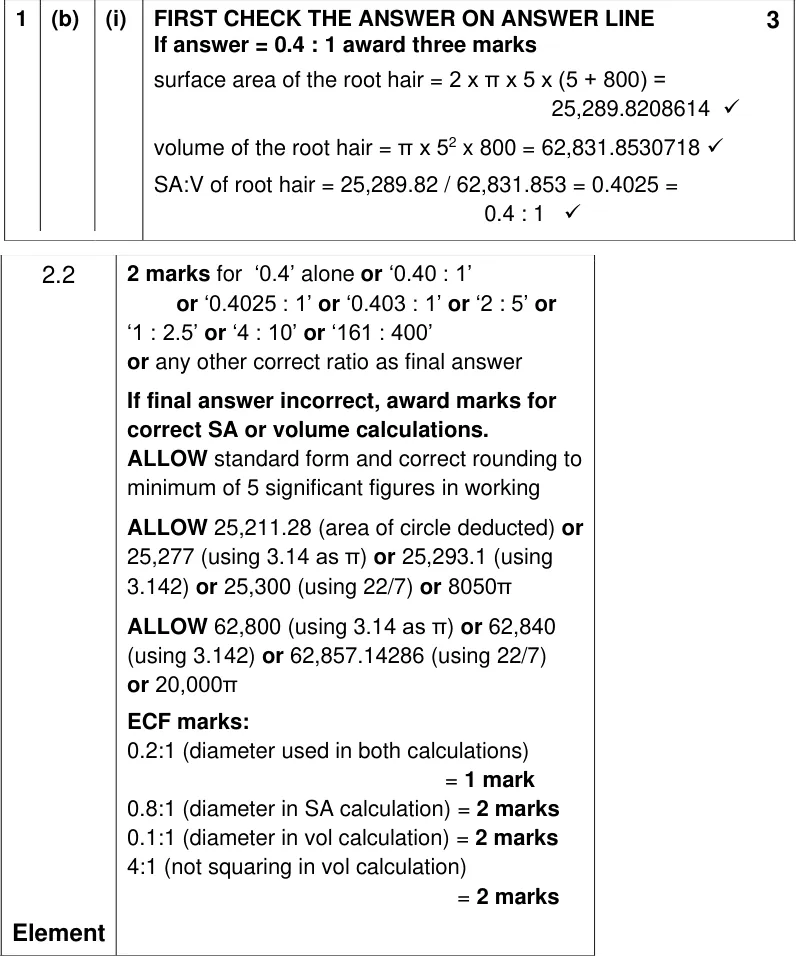
Calculate the SA:V of a cylindrical root hair 10 µm wide and 800 µm long.
Show the mark scheme
Tap an image to open it full size.
From the examiners' report: Most students calculated the surface area and volume correctly. Marks were lost for writing the ratio as 2:5 or 1:2.5 instead of 0.4:1, or for giving too many figures, such as 0.4025:1. The question says a typical cell is 0.3:1, so 0.4:1 is a sensible answer.
Question 5
AS Paper 1 · June 2025 · Q23(a)(i) · 2 marks · Medium
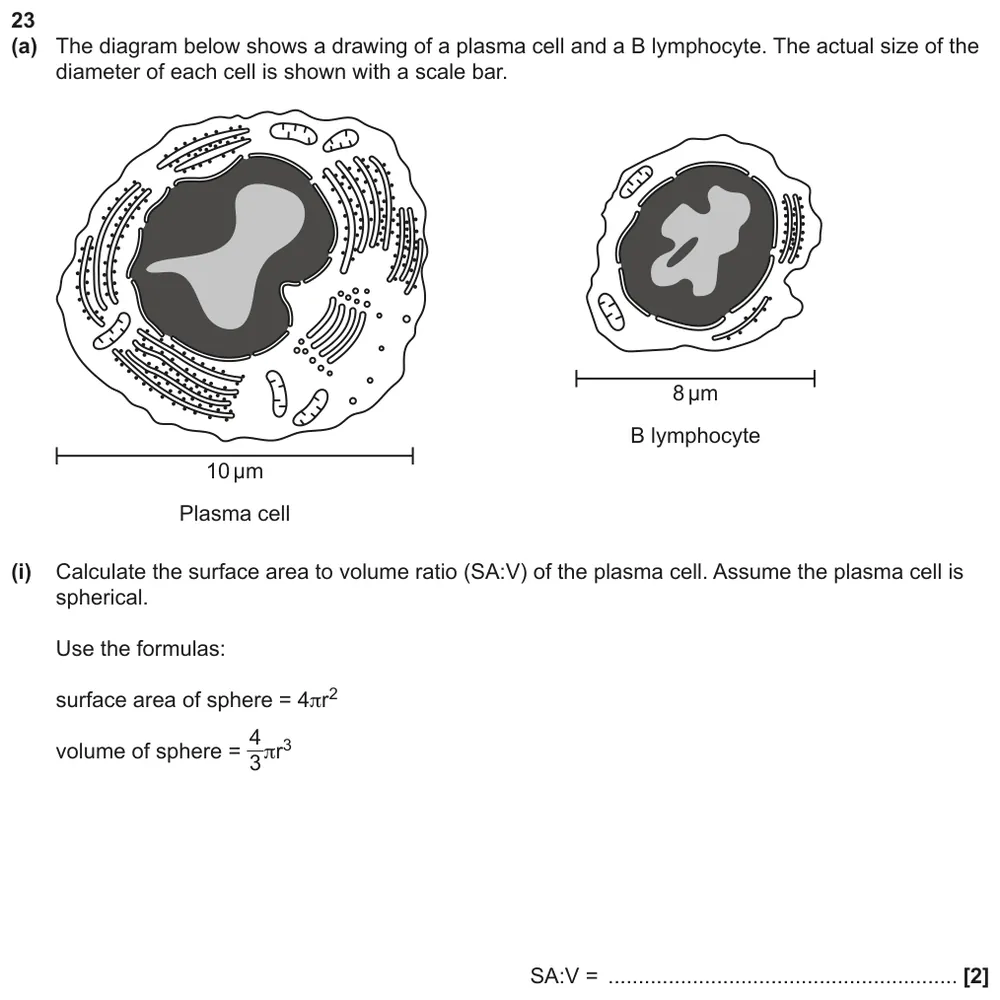
Calculate the SA:V of a spherical plasma cell with a 10 µm diameter.
Show the mark scheme
Tap an image to open it full size.
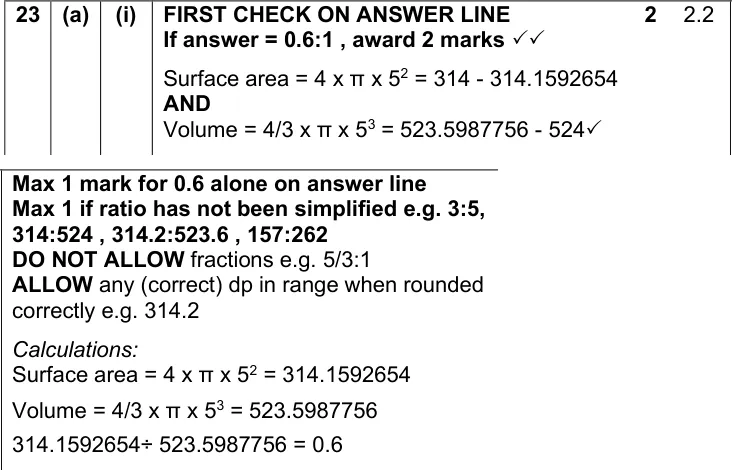
From the examiners' report: Most students calculated the surface area and the volume correctly, but few got full marks. The usual reason was not reducing the ratio to something to 1.
Question 6
A level Paper 3 · June 2023 · Q1(b)(i) · 3 marks · Hard
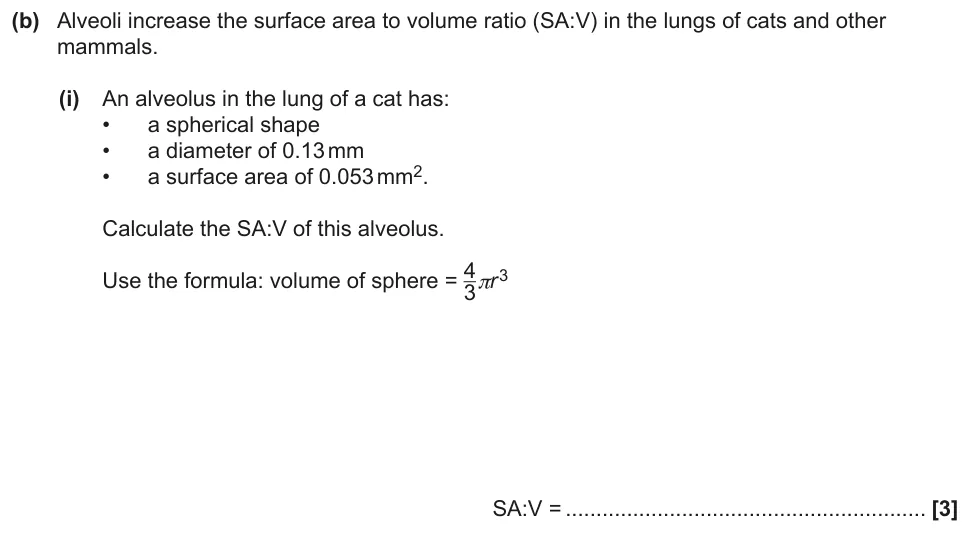
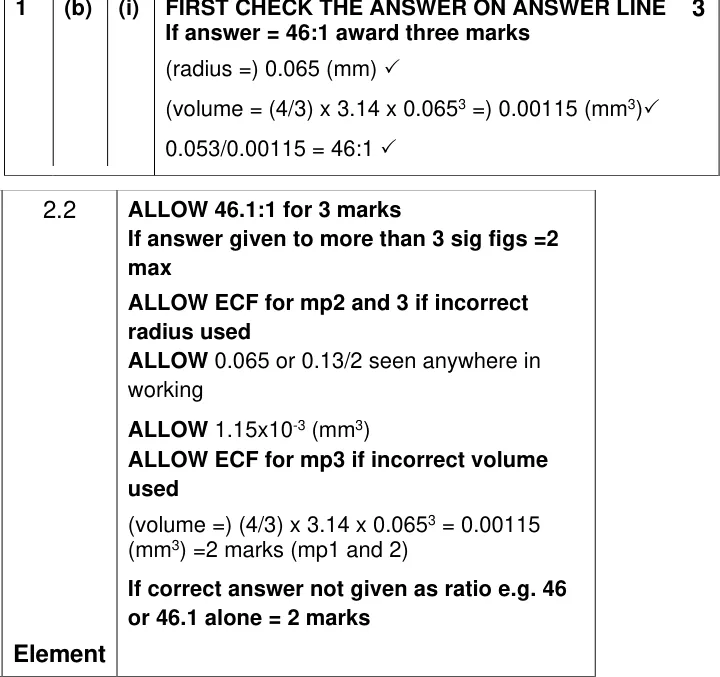
Calculate the SA:V of a spherical alveolus 0.13 mm across.
Show the mark scheme
Tap an image to open it full size.
From the examiners' report: Most students got the radius and volume right. Marks were lost for using the diameter instead of the radius, squaring instead of cubing, getting the ratio the wrong way round, or giving 46 without the ':1'.
Volumes and surface areas of spheres and cylinders
Question 7
AS Paper 1 · June 2022 · Q24(b) · 2 marks · Easy
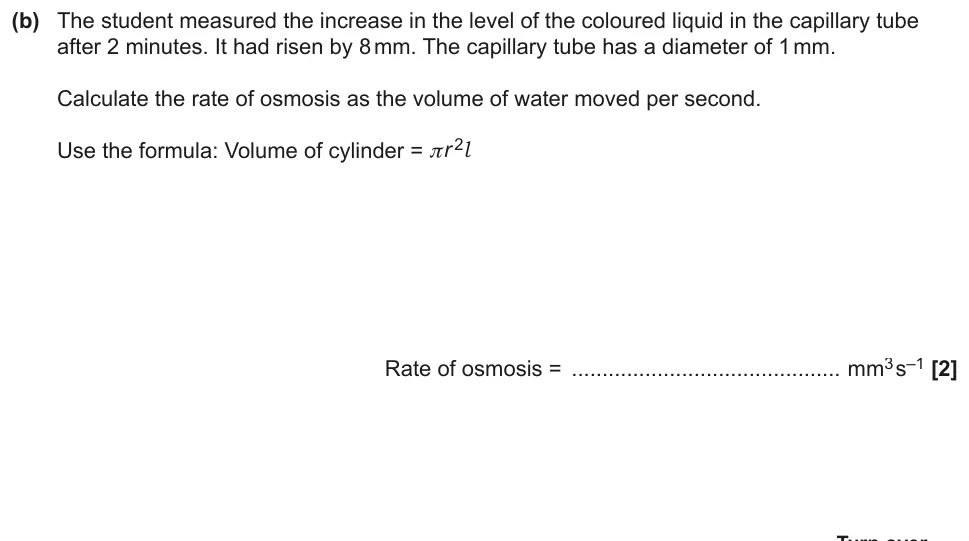
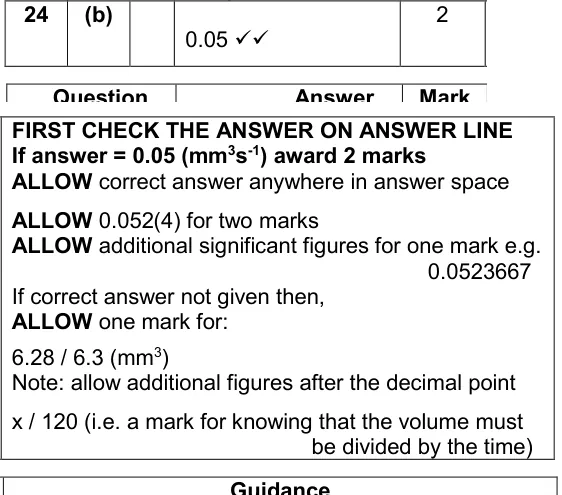
Calculate the rate of osmosis as the volume of water moving up a capillary tube per second.
Show the mark scheme
Tap an image to open it full size.
From the examiners' report: Most students got at least one mark. The common errors were using the diameter instead of the radius, dividing by 2 minutes instead of 120 seconds, or not dividing by the time at all.
Question 8
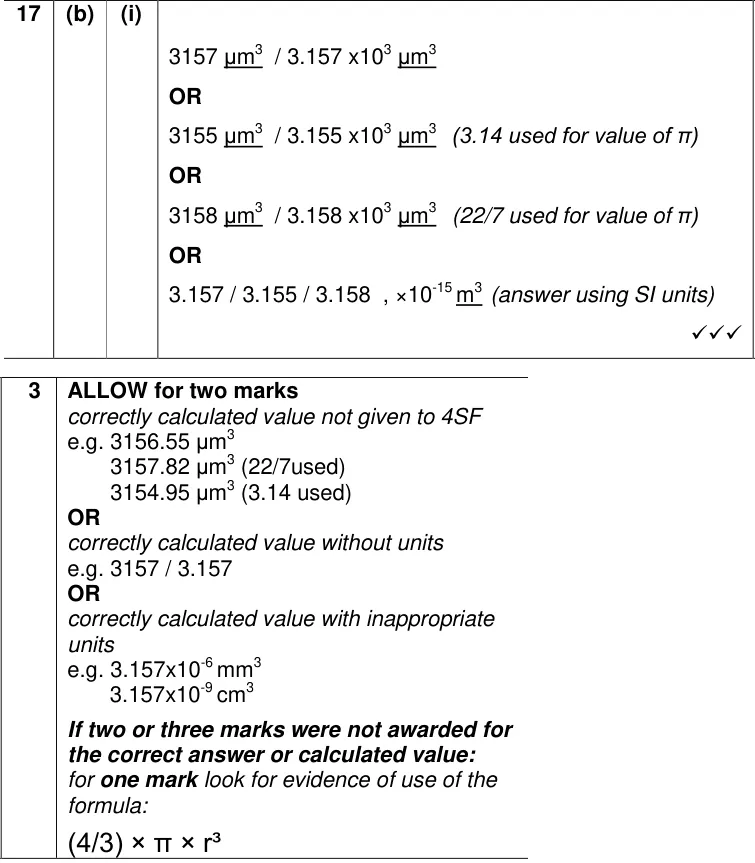
A level Paper 1 · June 2017 · Q17(b)(i) · 3 marks · Medium
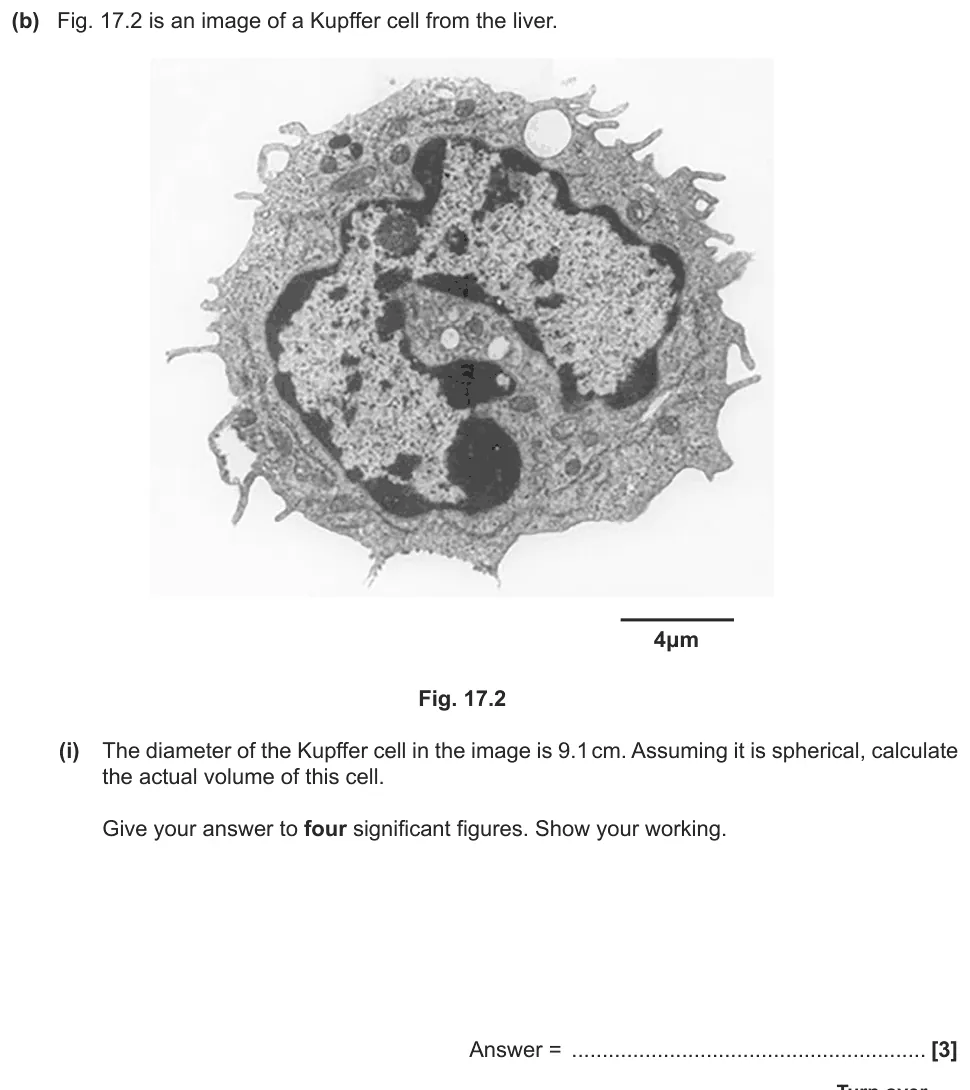
Calculate the actual volume of a spherical Kupffer cell from its image and a scale bar, to four significant figures.
Show the mark scheme
Tap an image to open it full size.
From the examiners' report: The mark scheme gives two marks for a correct value with no unit or the wrong number of figures, so finish the job: give 4 significant figures and µm³. Work out the actual diameter with the scale bar first, then halve it before you cube it.
Question 9
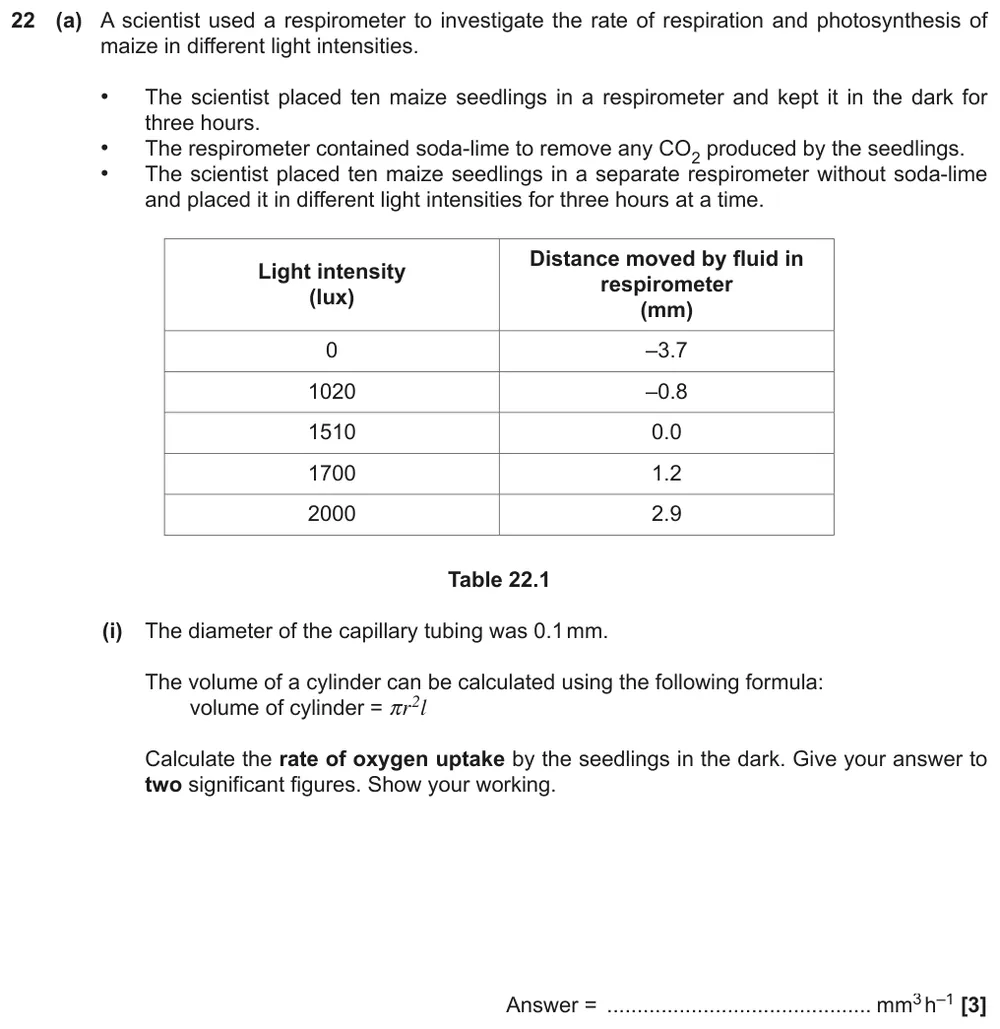
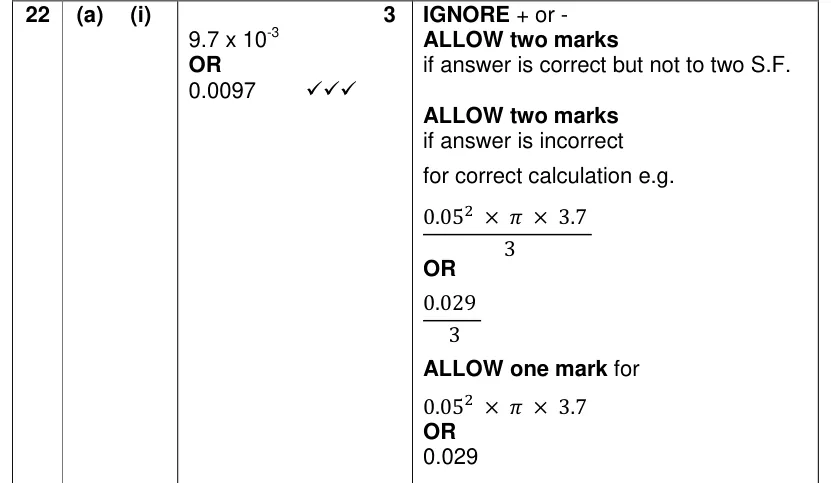
A level Paper 1 · June 2018 · Q22(a)(i) · 3 marks · Medium
Use the distance fluid moved in a respirometer to calculate the rate of oxygen uptake in the dark.
Show the mark scheme
Tap an image to open it full size.
From the examiners' report: Many students got all three marks. Others lost a mark for not giving 2 significant figures, forgot to divide by the three hours, or used the diameter instead of the radius.
Question 10
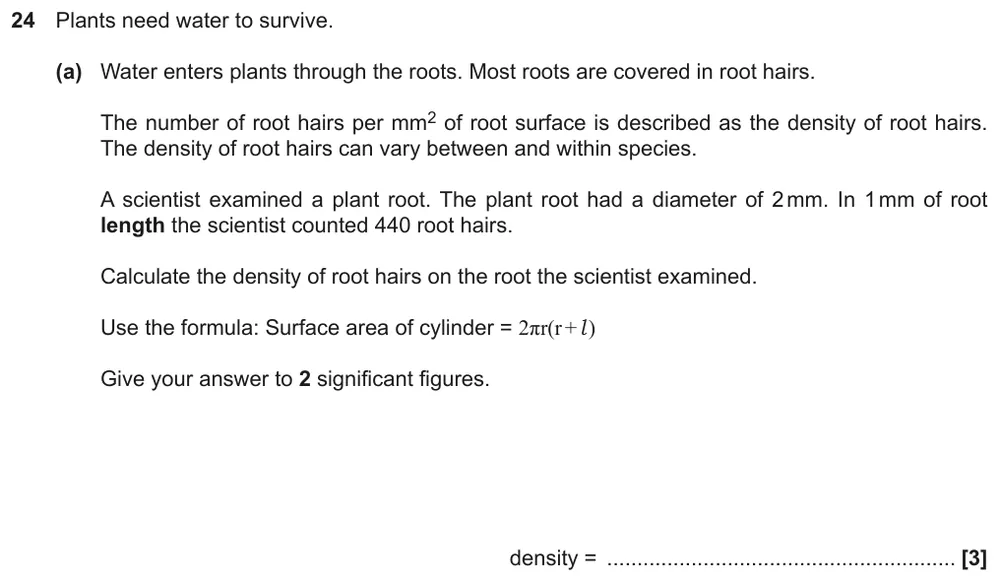
AS Paper 1 · June 2019 · Q24(a) · 3 marks · Medium
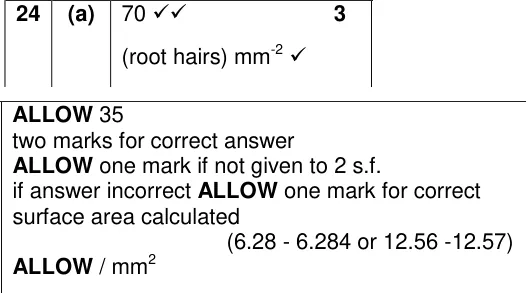
Use the surface area of a cylinder to calculate the density of root hairs on a root.
Show the mark scheme
Tap an image to open it full size.
From the examiners' report: Many students used the formula to get 35 per mm² and got full marks. The best answers noticed that the formula includes the two ends, which have no root hairs, and used only the curved side to get 70 per mm². Write the unit as mm⁻², not /mm².
Where students lose marks (from OCR examiners' reports and mark schemes)
Each point below is followed by wording that gained marks.
Halve the diameter first: Putting the diameter into πr²l or 4/3πr³ was one of the most common errors on capillary tube, alveolus and respirometer questions, and it wasn't credited.
✔ Gains credit: "(radius =) 0.065 (mm)" from a diameter of 0.13 mm, then "(4/3) × 3.14 × 0.065³ = 0.00115 (mm³)".
Surface area comes first in SA:V: Many students wrote the ratio back to front, as 1:3 instead of 3:1, or gave the volume for one unit of surface area. Mark schemes say "DO NOT ALLOW reverse ratios".
✔ Gains credit: "surface area to volume ratio = 3 : 1 (small) and 1.5 : 1 (large)".
Finish the ratio as x : 1: Unsimplified ratios such as 24:8, 3:5 or 600:1000, or a number with no ':1', lost a mark. So did 2:5 and 1:2.5 for the root hair.
✔ Gains credit: "(SA:V cube is) 3:1", "0.6 : 1" and "0.4 : 1", with no units on the ratio.
Cube the radius for a sphere: Some students squared the radius when working out the volume of a sphere, which made the SA:V of the alveolus far too small.
✔ Gains credit: "volume = 4/3 × π × 5³ = 523.6" and "surface area = 4 × π × 5² = 314.2", so "314.2 ÷ 523.6 = 0.6".
Divide by the time, in the right unit: For a rate of osmosis or oxygen uptake, students often forgot to divide the volume by the time, or divided by 2 minutes when the answer had to be per second.
✔ Gains credit: "6.28 (mm³) ÷ 120 (s) = 0.05 mm³ s⁻¹" and "0.05² × π × 3.7 ÷ 3 = 9.7 × 10⁻³ mm³ h⁻¹".
Check against the value you're given: A root hair cell has a higher SA:V than the 0.3:1 given for a typical epidermal cell, so 0.4:1 was the expected answer. Comparing with a value in the question is a quick way to catch a slip, such as using the diameter, which gave 0.2:1.
✔ Gains credit: "SA:V of root hair = 25,289.82 / 62,831.853 = 0.4025 = 0.4 : 1".
Round to the figures asked for: A correct value with too many figures, such as 3156.55 µm³ when four significant figures were asked for or 46.12:1 for SA:V, dropped a mark.
✔ Gains credit: "3157 µm³ / 3.157 × 10³ µm³" to four significant figures and "9.7 × 10⁻³" to two.
Download the questions
Download the PDF pack (10 questions, mark schemes at the end)
Keep practising
- Arithmetic and Numerical Computation (M0): OCR A Level Biology exam questions by topic
- Graph Skills (M3): OCR A Level Biology exam questions by topic
- OCR A Level Biology gas exchange quiz
- OCR A Level Biology practical skills quiz
- OCR A Level Biology masterclasses
Questions, mark schemes and examiners' report extracts © OCR.