

OCR A PAG 4 · 16 questions · mark schemes and examiners’ tips included
PAG 4 is about measuring how fast an enzyme works. You will have collected oxygen from catalase in potato or liver, timed how long lipase takes to change the colour of an indicator, or watched a protease digest gelatine. The plan is always the same: change one factor, such as temperature, pH, enzyme or substrate concentration, measure a rate, and keep everything else the same.
The examiners set these questions in unfamiliar contexts, and the marks go on precise wording. Name the variable, not just its value, and say 'concentration' rather than 'amount'. Make up solutions with the right dilution, draw a tangent at the start of the curve for an initial rate, and write units in the standard form. When you suggest an improvement, check it isn't already in the method.
Work through the sixteen questions below in order. They start with variables and controls, move on to making up concentrations and measuring the rate, then improving an investigation, and finish with inhibitors. If you'd like to go through questions like these with me each week, my OCR A masterclasses run on Wednesdays at 5.15pm for Year 12 and on Tuesdays at 6.30pm or Thursdays at 5.15pm for Year 13.
Want help with this topic? It comes up in my weekly OCR A masterclasses. See the timetable →
What these questions cover (OCR PAG 4: rates of enzyme-controlled reactions)
PAG 4 is one of the twelve practical activity groups in the OCR A Level Biology A specification (H420). The questions test these parts of the specification:
- 1.1.1(a) experimental design, including to solve problems set in a practical context
- 1.1.1(b) identification of variables that must be controlled, where appropriate
- 1.1.4(e) the refining of experimental design by suggestion of improvements to the procedures and apparatus
- 1.2.2(c) use of laboratory glassware apparatus for a variety of experimental techniques to include serial dilutions
- 2.1.4(d)(ii) practical investigations into the effects of pH, temperature, enzyme concentration and substrate concentration on enzyme activity (including initial rates and units)
- 2.1.4(f) the effects of inhibitors on the rate of enzyme-controlled reactions
How to use this page
Write your answer on paper before you open the mark scheme. Allow about 1.2 minutes per mark: the 16 questions are worth 33 marks, so about 40 minutes in total. Then mark your answer strictly against the mark scheme and read the examiners' tip underneath it. If you'd rather print the questions, download the PDF pack.
Variables in enzyme investigations
Question 1
AS Paper 2 · June 2016 · Q4(b)(i) · 1 mark · Medium
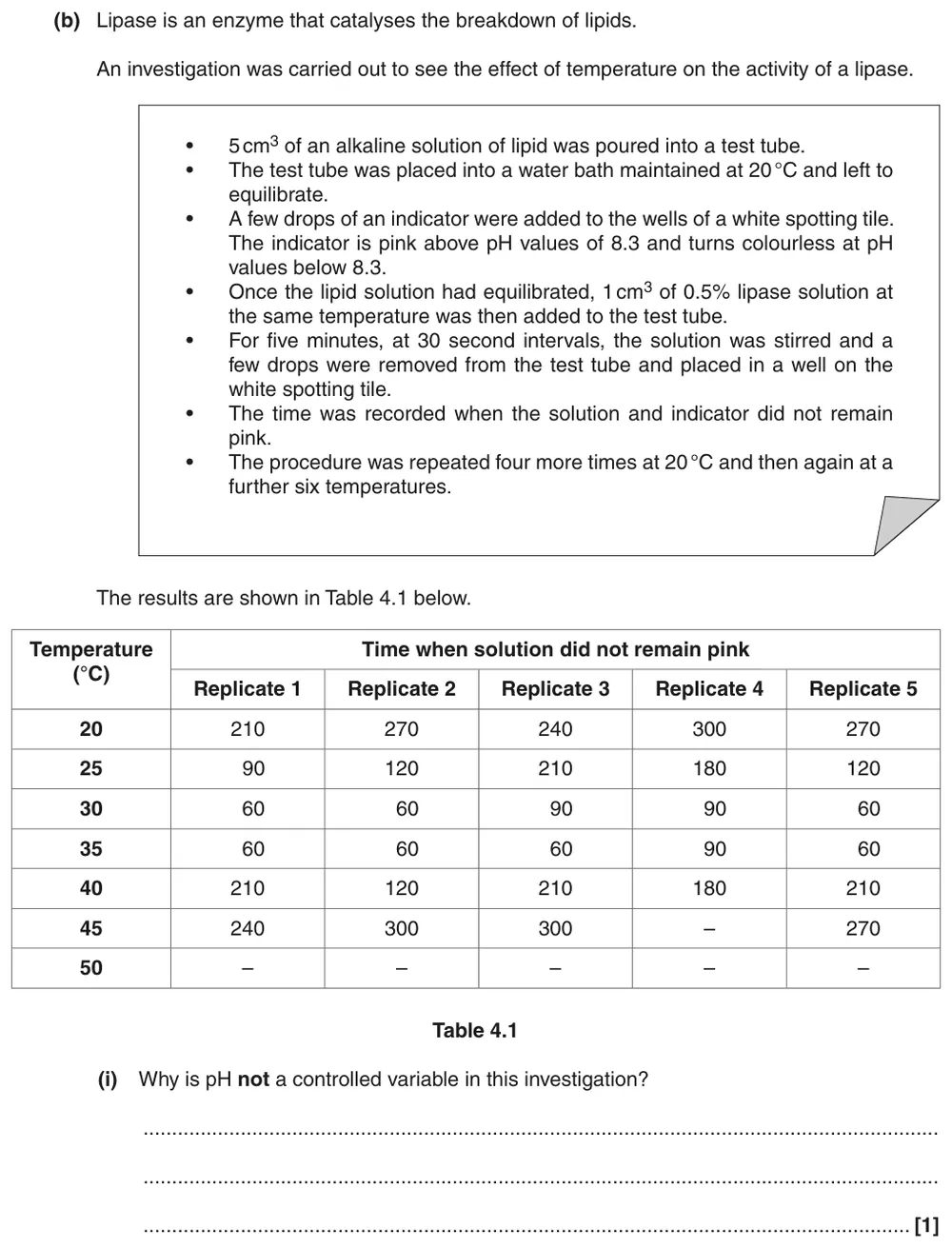
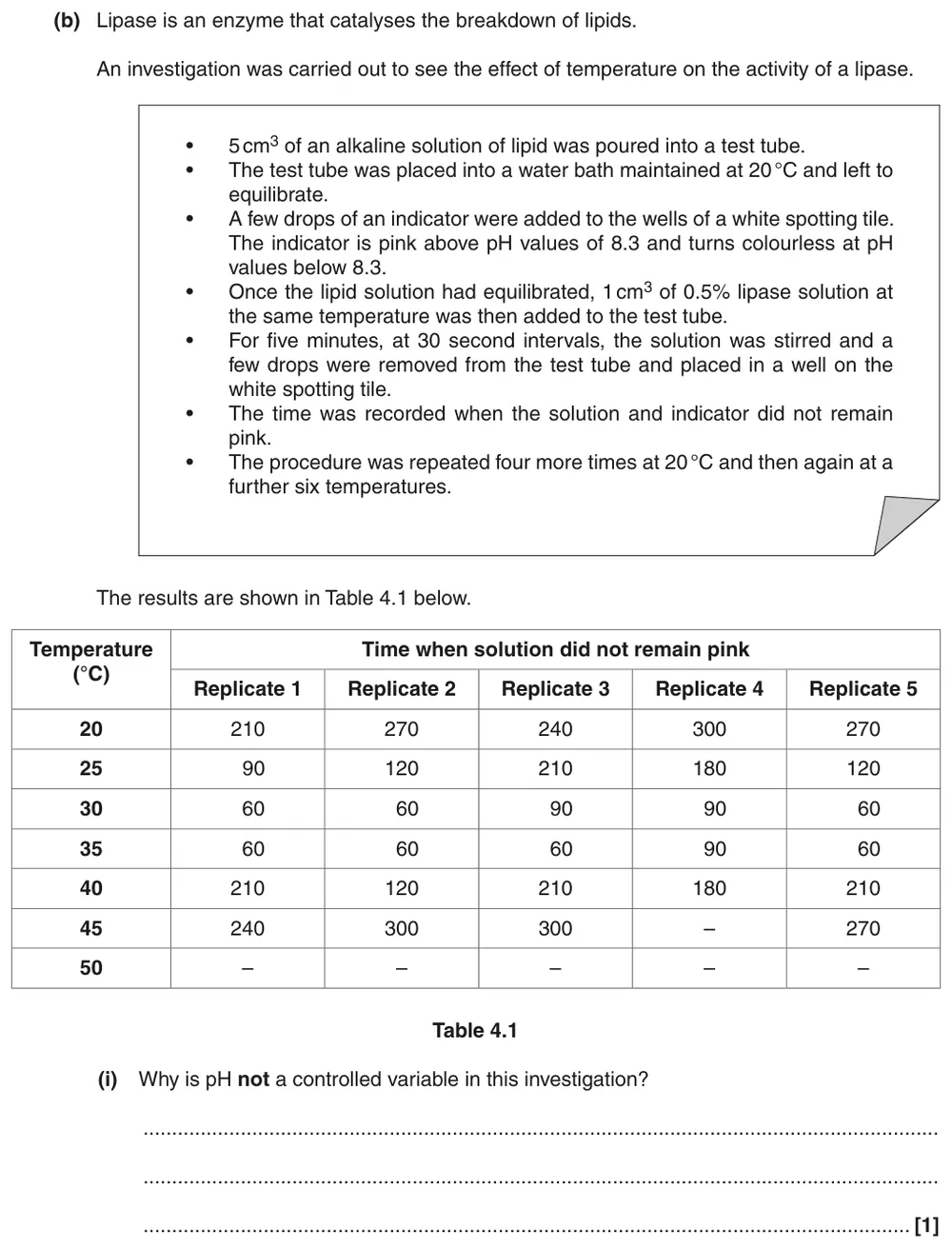
Explain why pH is not a controlled variable in a lipase and indicator investigation.
Show the mark scheme
Tap an image to open it full size.
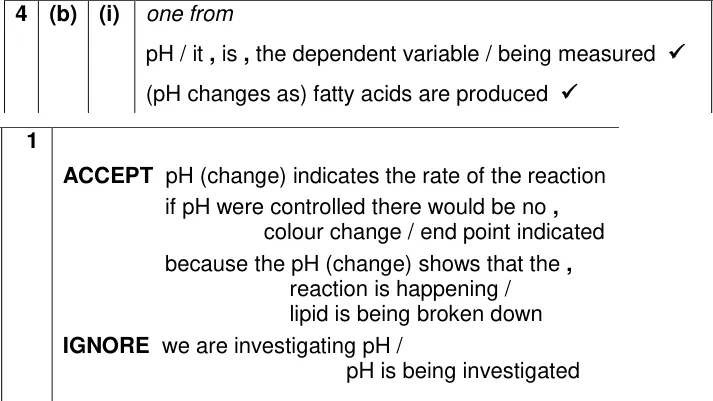
From the examiners' report: The mark scheme wants the idea that pH is what you are measuring: fatty acids lower the pH, so the colour change shows the reaction happening. Saying 'we are investigating pH' was ignored.
Question 2
AS Paper 2 · November 2021 · Q3(d)(i) · 2 marks · Medium
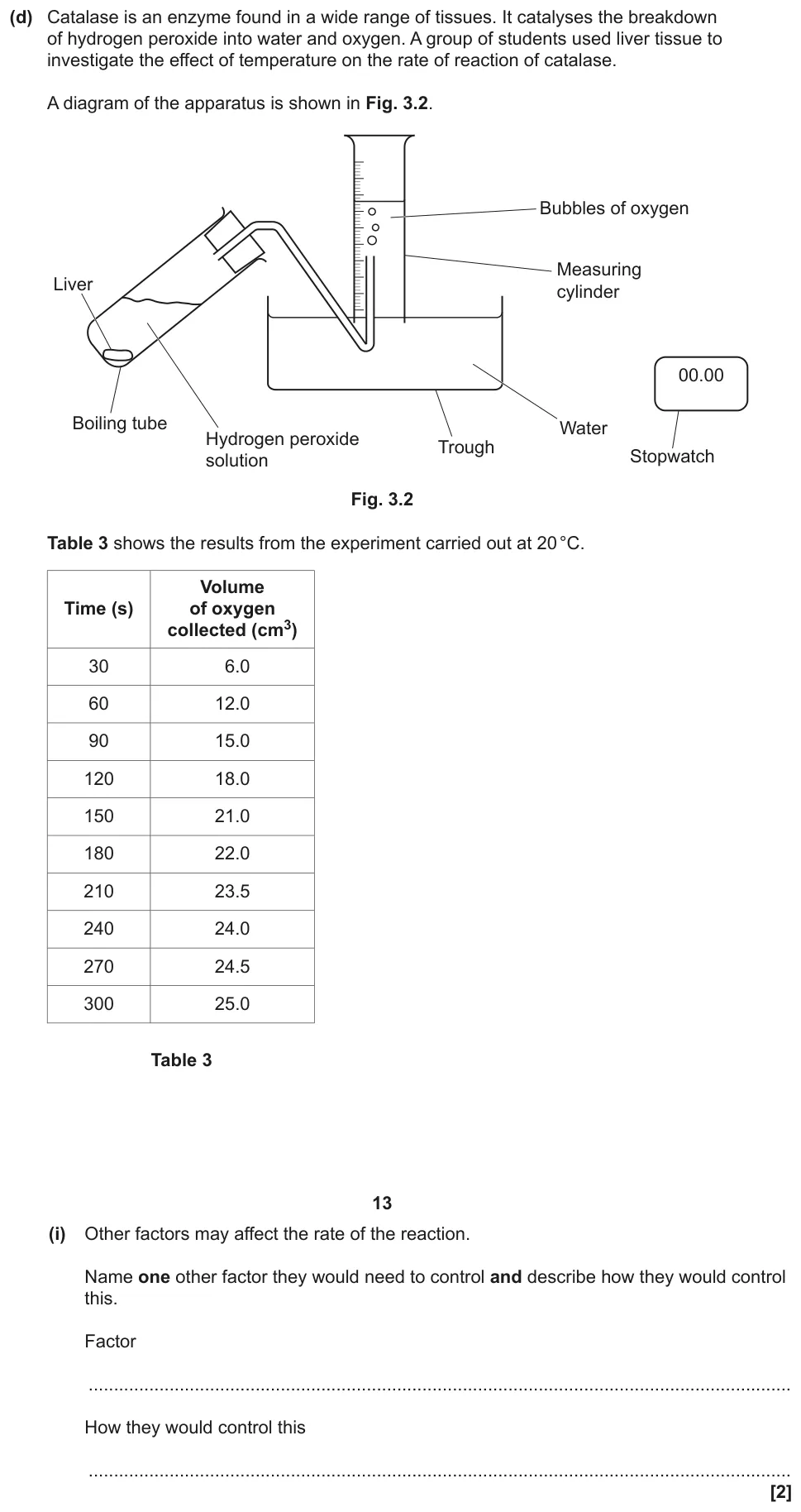
Name one other factor to control in a liver catalase experiment and say how you would control it.
Show the mark scheme
Tap an image to open it full size.
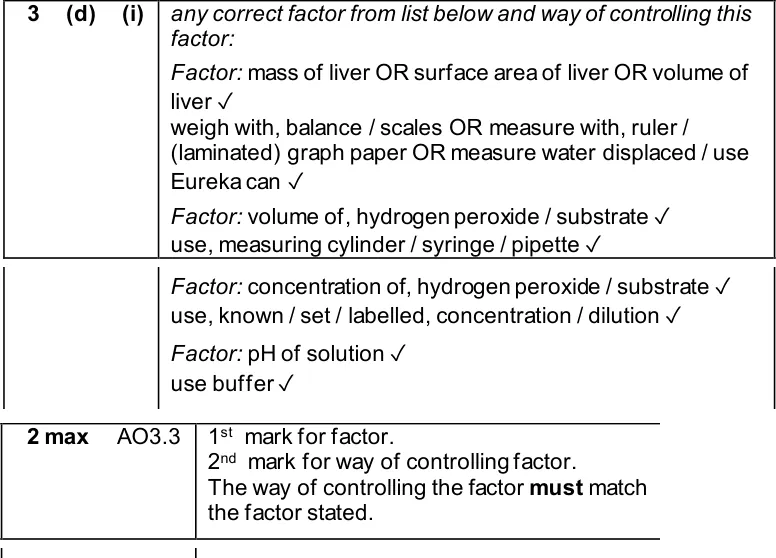
From the examiners' report: The second mark is only given when your method matches the factor you named, for example weighing the liver on a balance, or using a buffer to control pH.
Question 3
A level Paper 2 · June 2023 · Q17(a)(i) · 1 mark · Medium
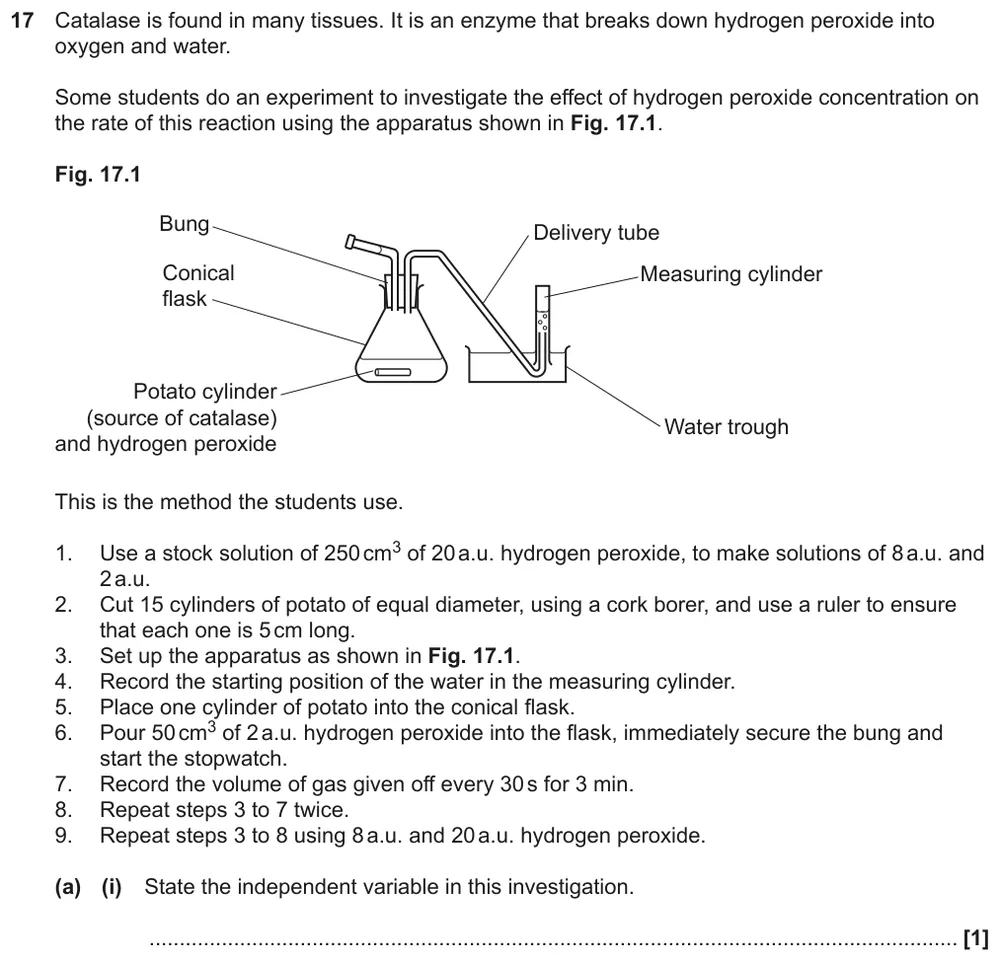
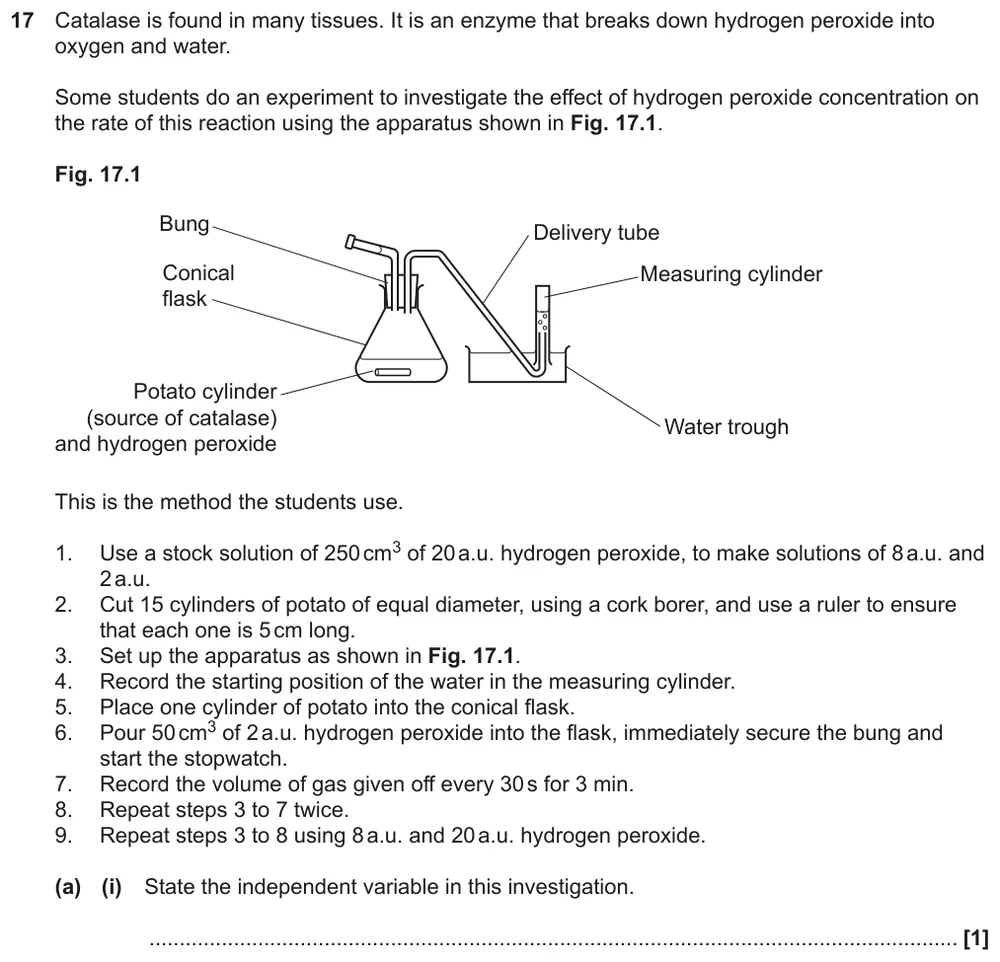
State the independent variable in a potato catalase investigation.
Show the mark scheme

Tap an image to open it full size.
From the examiners' report: Most students got this. Some lost the mark by writing 'a.u.', 'conc.' or 'amount' instead of concentration, and a few gave the volume of gas produced, which is the dependent variable.
Question 4
A level Paper 2 · June 2023 · Q17(a)(iv) · 1 mark · Medium
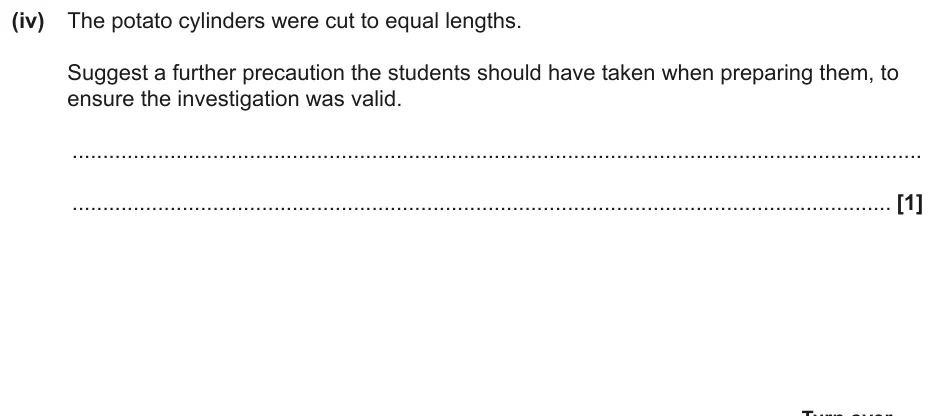
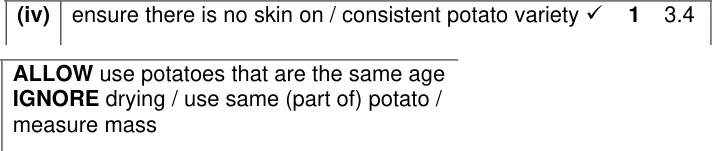
Suggest a further precaution when preparing the potato cylinders.
Show the mark scheme
Tap an image to open it full size.
From the examiners' report: Only about a quarter of students scored. Many said the pieces should be patted dry, mixing this up with an osmosis practical. 'Use the same potato' wasn't credited, because fifteen 5 cm cylinders won't come from one potato.
Question 5
A level Paper 2 · June 2023 · Q17(a)(iii) · 2 marks · Hard
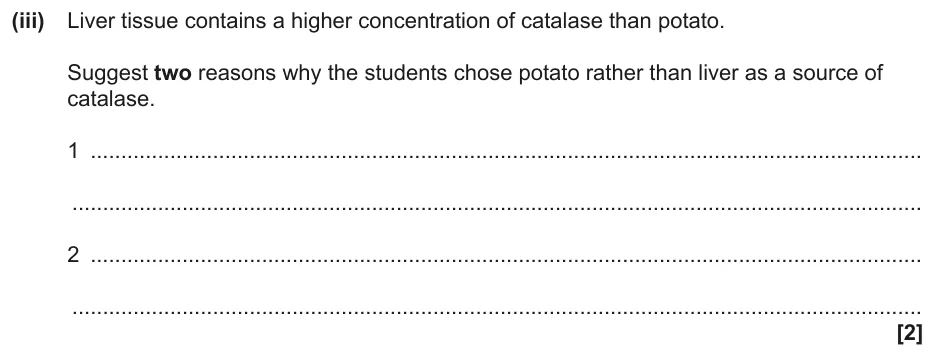
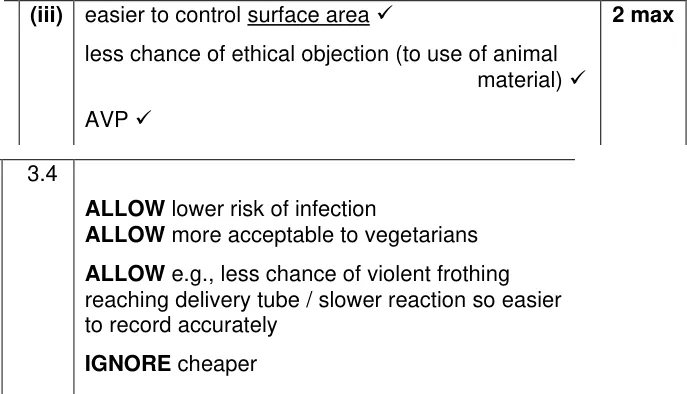
Suggest two reasons for using potato rather than liver as the source of catalase.
Show the mark scheme
Tap an image to open it full size.
From the examiners' report: Fewer than 1 in 20 got both marks, and ethics was the most common mark. Many students said potato is easier to cut into shape but didn't use the term surface area, which is the variable that matters.
Making up concentrations
Question 6
AS Paper 2 · November 2021 · Q3(a)(i) · 2 marks · Medium
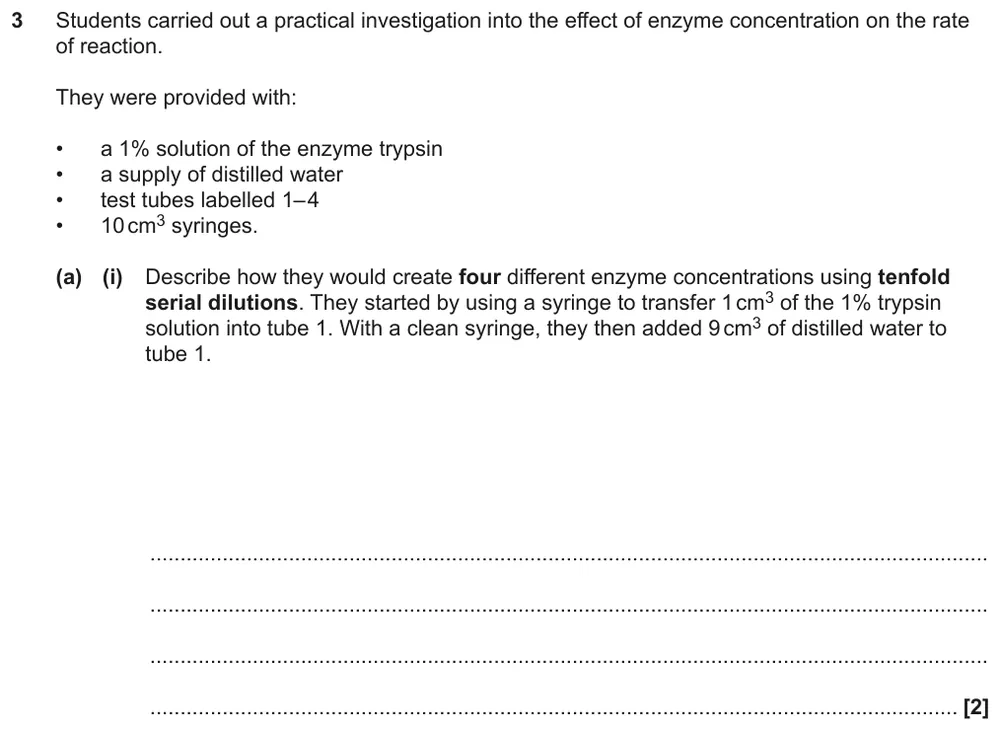
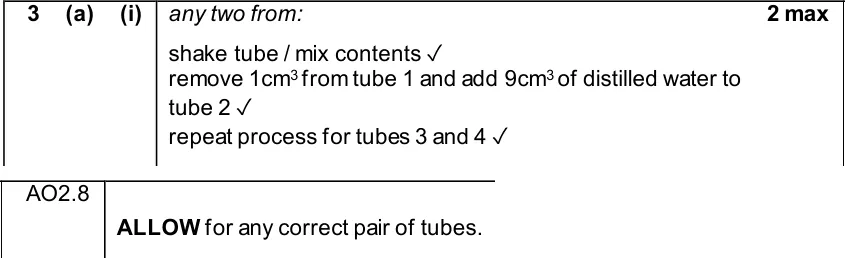
Describe how to make four trypsin concentrations by tenfold serial dilution.
Show the mark scheme
Tap an image to open it full size.
From the examiners' report: The mark scheme rewards the whole sequence: mix the tube, move 1 cm³ into 9 cm³ of distilled water in the next tube, and repeat. Mixing each tube is a mark in its own right.
Question 7
A level Paper 2 · June 2023 · Q17(a)(ii) · 2 marks · Hard
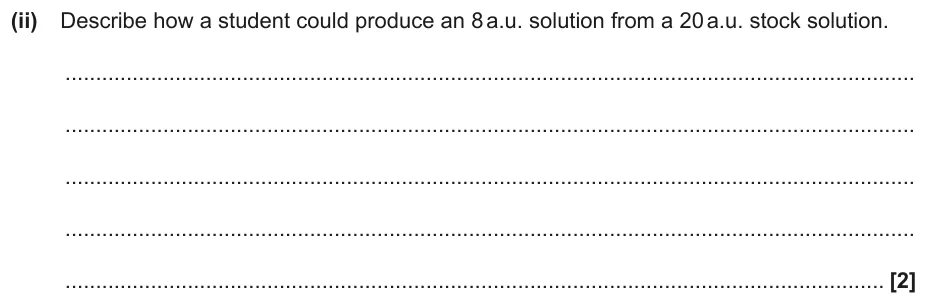
Describe how to make an 8 a.u. hydrogen peroxide solution from a 20 a.u. stock.
Information from earlier in this question:
Show the mark scheme
Tap an image to open it full size.
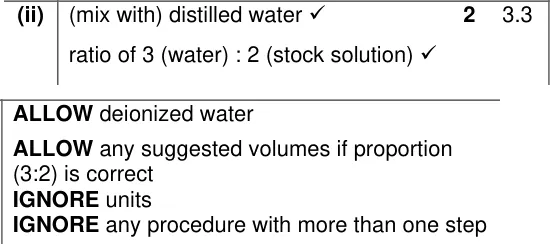
From the examiners' report: Most students knew to add distilled water but struggled with the ratio. Many used a serial dilution with several steps, stuck on 1 in 2 or 1 in 10. One mix of 2 parts stock to 3 parts water is the accurate way.
Measuring the rate of reaction
Question 8
A level Paper 2 · June 2023 · Q17(b)(iv) · 2 marks · Easy
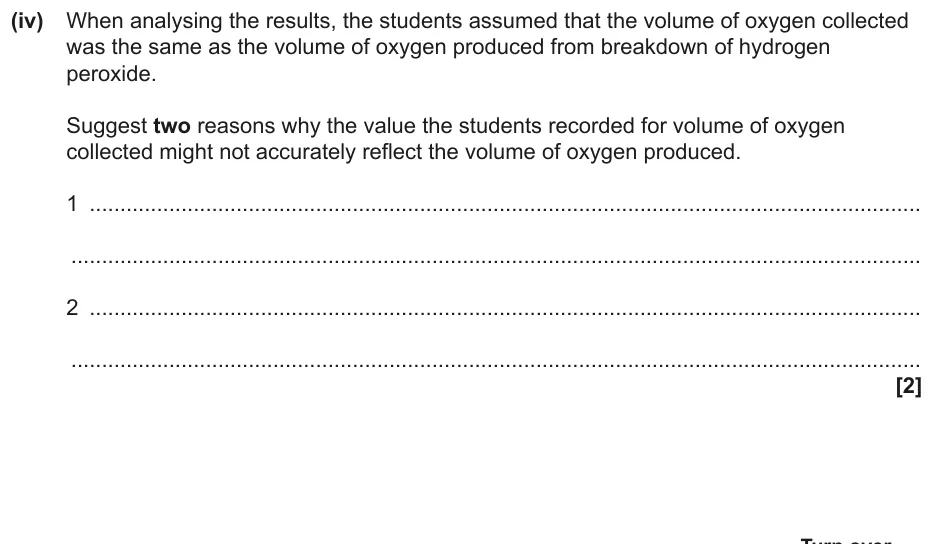
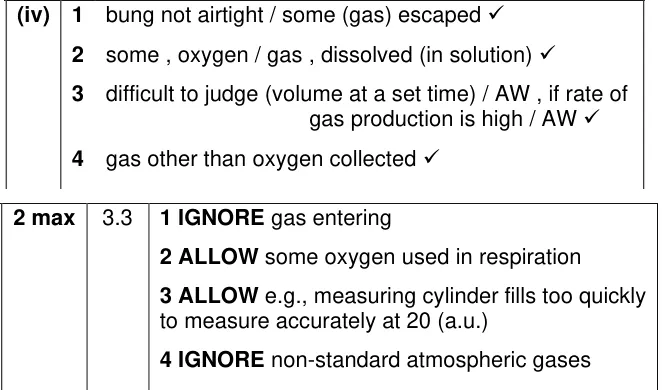
In the potato catalase experiment above, suggest two reasons why the oxygen collected might not equal the oxygen produced.
Show the mark scheme
Tap an image to open it full size.
From the examiners' report: Most students got at least one mark, usually for gas escaping or dissolving. 'Human error' was not credited: give a specific reason linked to the apparatus.
Question 9
AS Paper 2 · June 2025 · Q3(c) · 2 marks · Medium
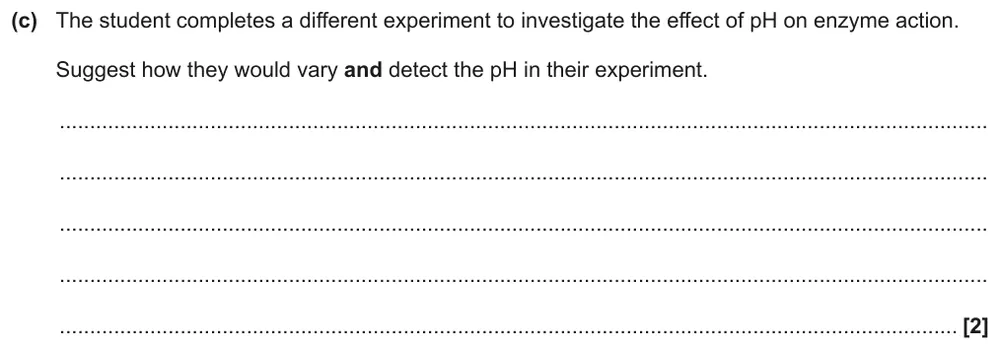
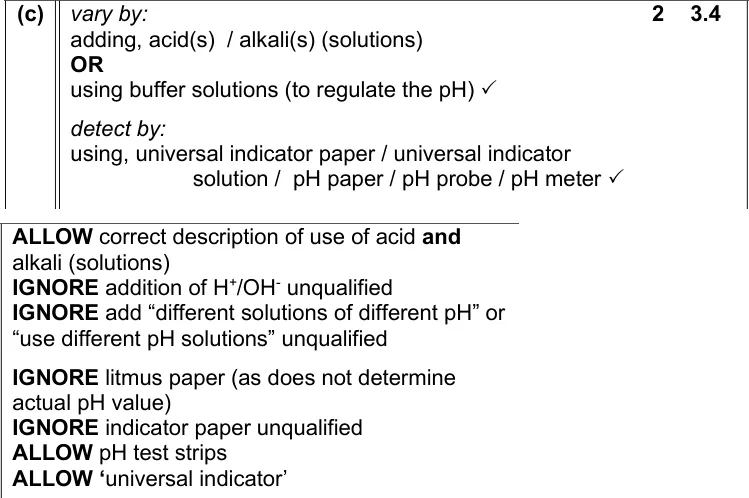
Suggest how to vary and detect the pH in an enzyme experiment.
Show the mark scheme
Tap an image to open it full size.
From the examiners' report: Most students got one mark, usually for detecting the pH. Vague answers like 'use indicators' or 'a pH test kit' got nothing. To vary the pH, name buffer solutions at different pHs, or acid and alkali solutions.
Question 10
AS Paper 2 · June 2025 · Q3(b)(i) · 3 marks · Medium
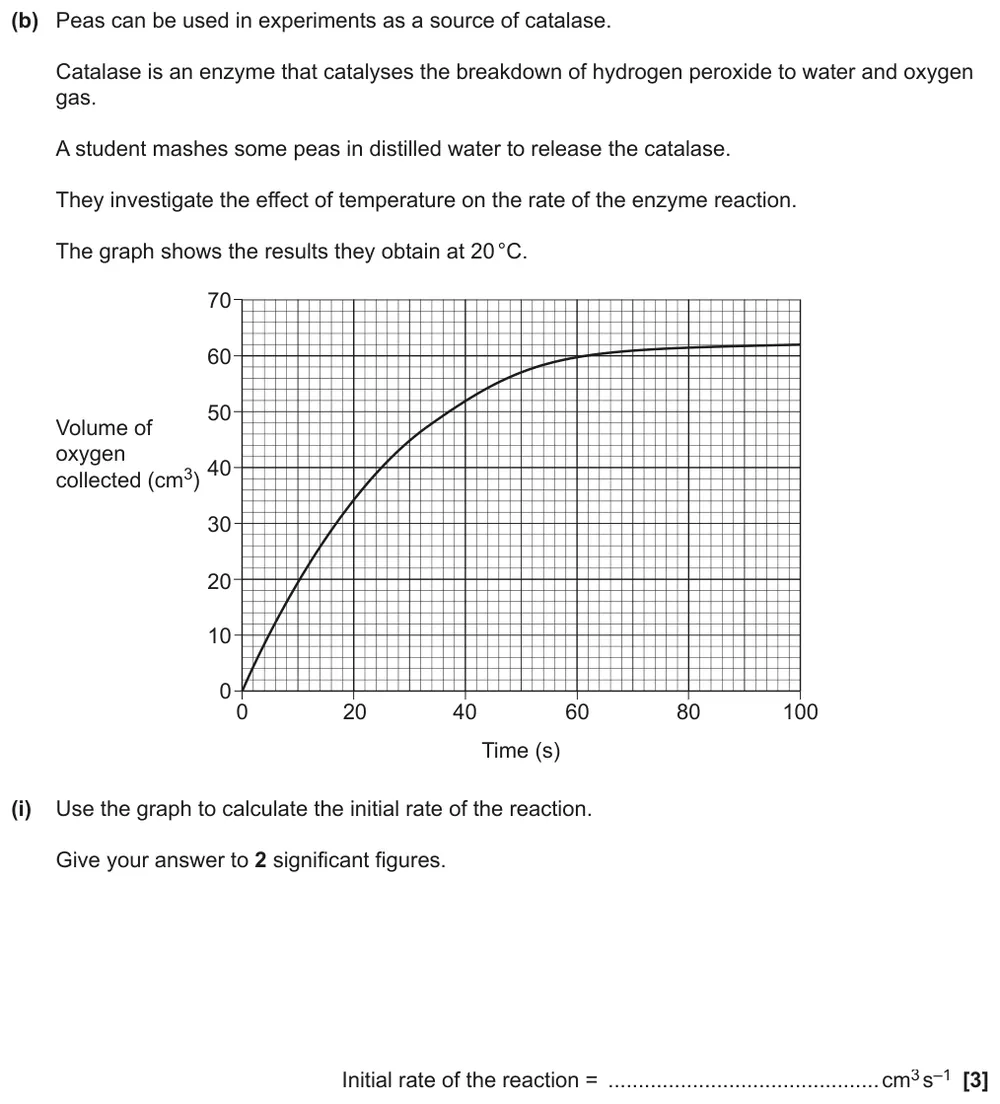
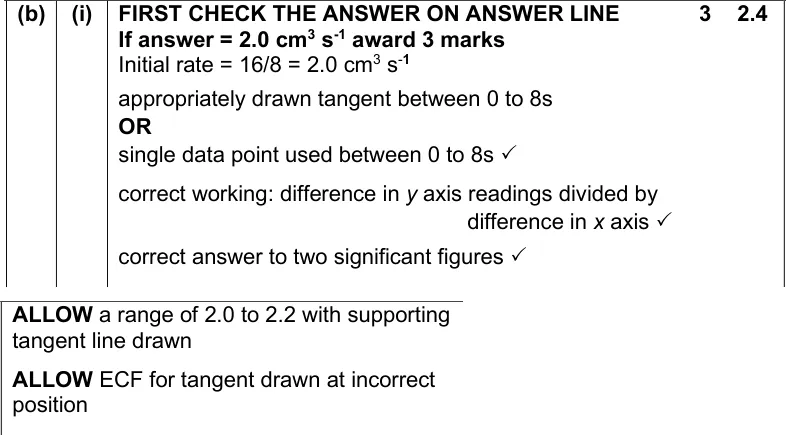
Use a tangent to calculate the initial rate of oxygen production, to 2 significant figures.
Show the mark scheme
Tap an image to open it full size.
From the examiners' report: Many students didn't draw the tangent in the right place, at the very start of the curve between 0 and 8 s, and many didn't give the answer to 2 significant figures.
Question 11
A level Paper 3 · June 2019 · Q3(c)(ii) · 1 mark · Medium
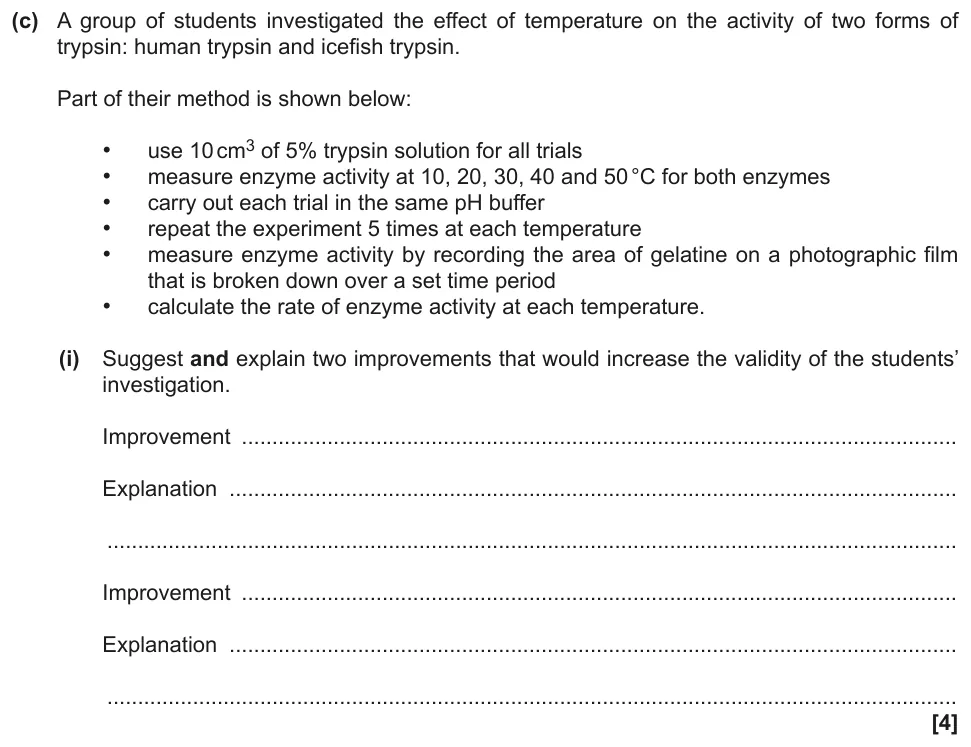
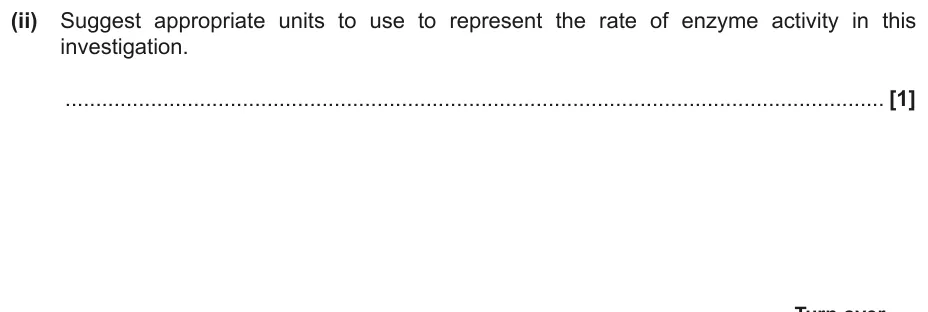
Suggest units for the rate of trypsin activity measured as area of gelatine digested over time.
Information from earlier in this question:
Show the mark scheme

Tap an image to open it full size.
From the examiners' report: Only a few students gave an area per unit time. Common errors were volume units, mixing a slash with ⁻¹, writing 'per', and using words like 'minutes' or 'sec' instead of standard abbreviations.
Question 12
AS Paper 2 · June 2016 · Q4(b)(v) · 1 mark · Medium
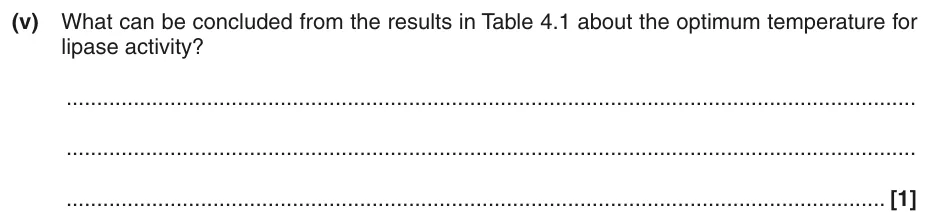
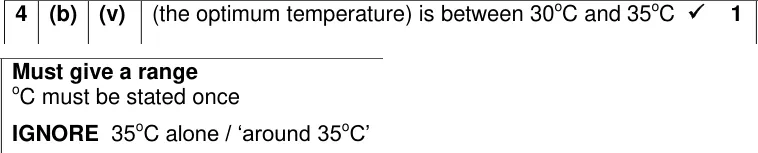
Conclude what the lipase results show about the optimum temperature.
Information from earlier in this question:
Show the mark scheme
Tap an image to open it full size.
From the examiners' report: Only a range gets the mark: between 30 °C and 35 °C, because those temperatures gave the shortest times. A single value, or 'around 35 °C', gets nothing.
Improving an enzyme investigation
Question 13
AS Paper 2 · June 2016 · Q4(b)(vi) · 4 marks · Medium
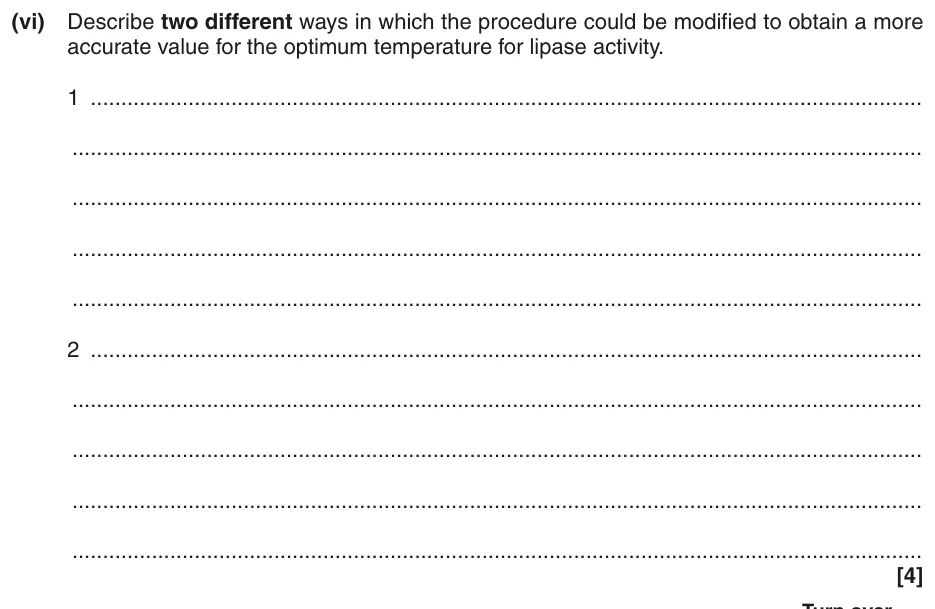
Describe two ways to get a more accurate value for the optimum temperature of lipase.
Show the mark scheme
Tap an image to open it full size.
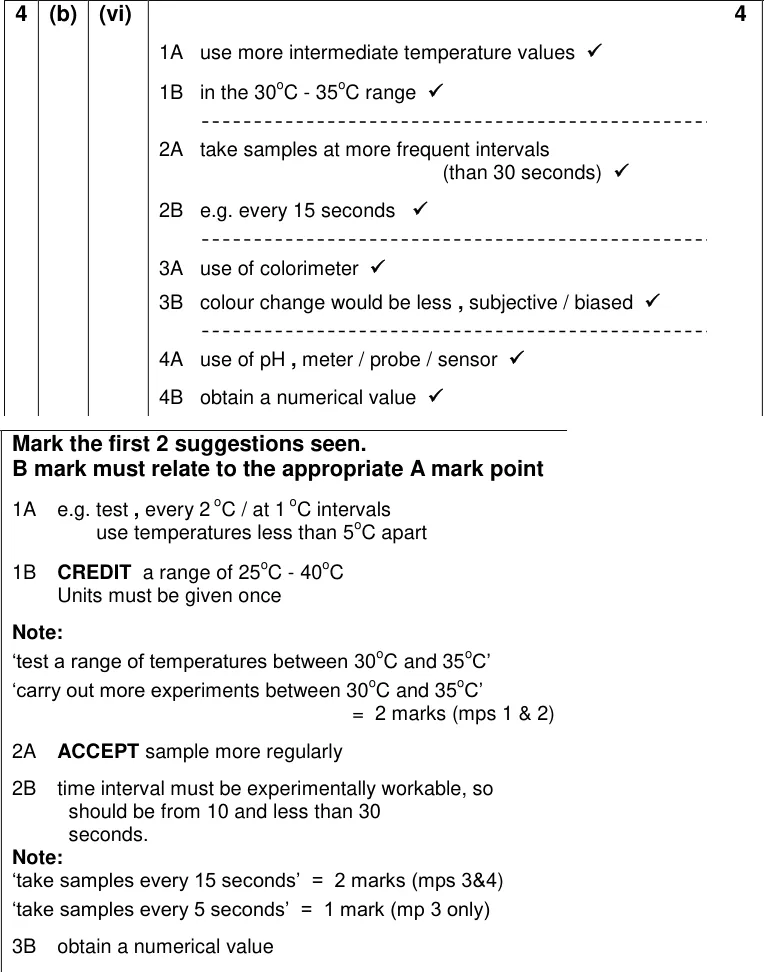
From the examiners' report: Each suggestion needs a detail for its second mark: say the extra temperatures go between 30 °C and 35 °C, or give a workable sampling interval such as every 15 seconds.
Question 14
A level Paper 3 · June 2019 · Q3(c)(i) · 4 marks · Hard
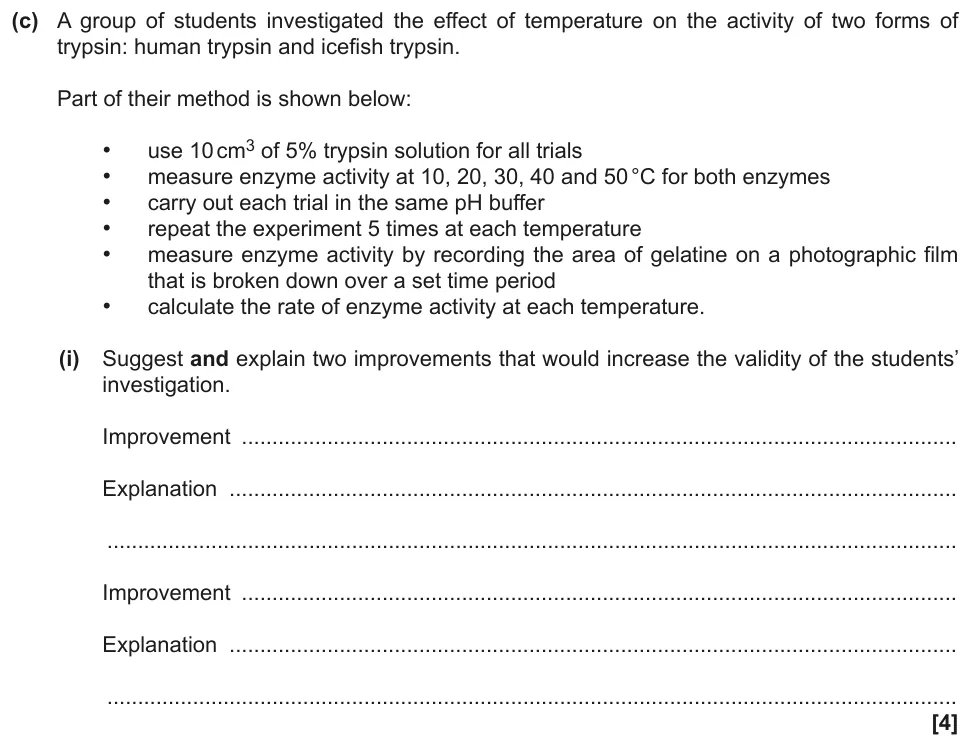
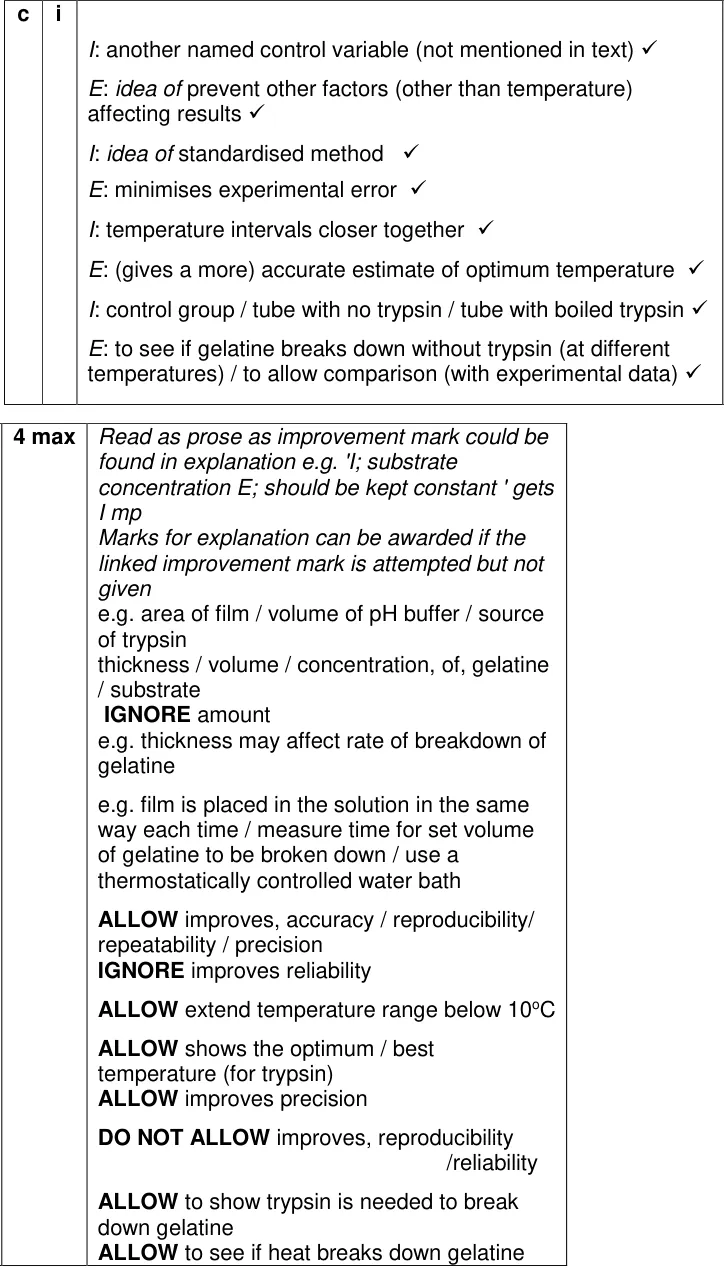
Suggest and explain two improvements that would increase the validity of a trypsin temperature investigation.
Show the mark scheme
Tap an image to open it full size.
From the examiners' report: Improvements already in the method, like using a buffer, gained nothing. The best answers controlled the gelatine thickness or concentration and explained that it would affect the rate. Don't just repeat the word 'validity' as your explanation.
Inhibitors
Question 15
AS Paper 1 · June 2024 · Q25(b) · 2 marks · Medium
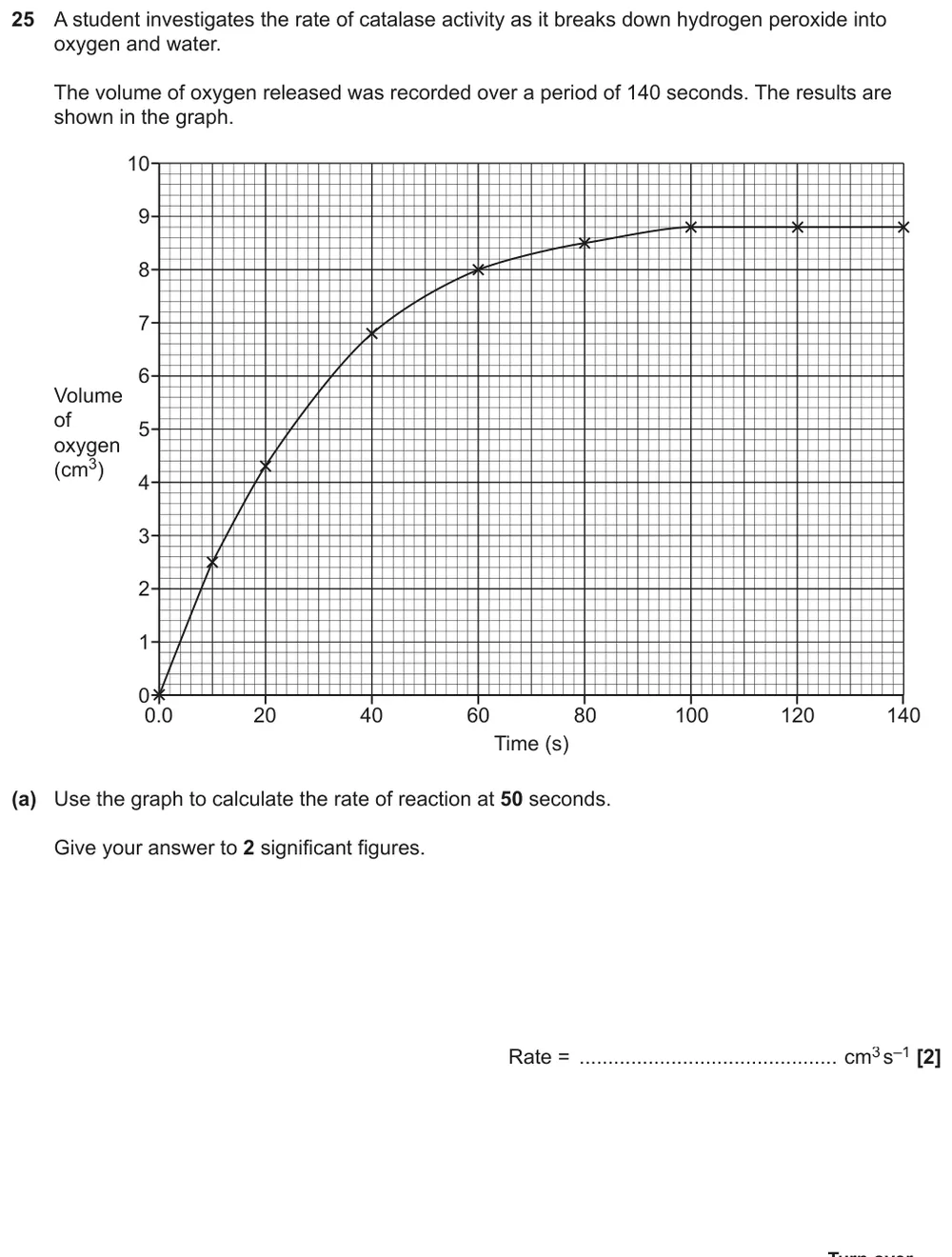
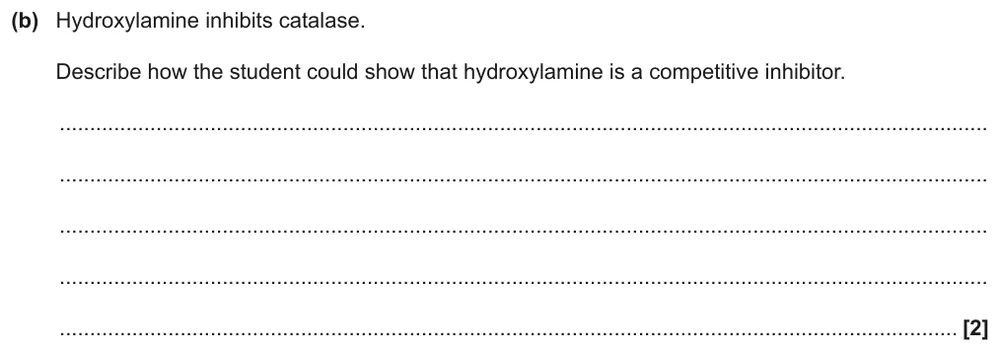
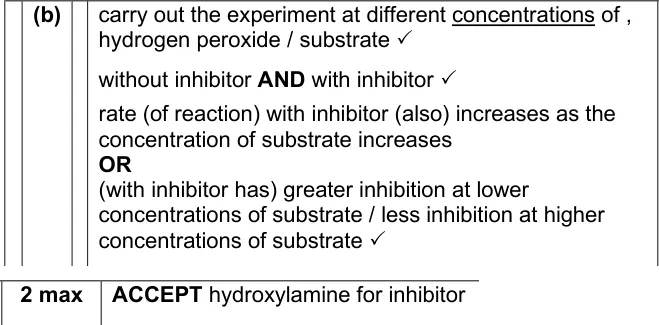
Describe how to show that hydroxylamine is a competitive inhibitor of catalase.
Information from earlier in this question:
Show the mark scheme
Tap an image to open it full size.
From the examiners' report: Many students just described what a competitive inhibitor is, which got no marks. Plan the experiment instead: vary the substrate concentration, with and without the inhibitor, and say what results you would expect.
Question 16
AS Paper 2 · June 2018 · Q4(b)(iv) · 3 marks · Hard
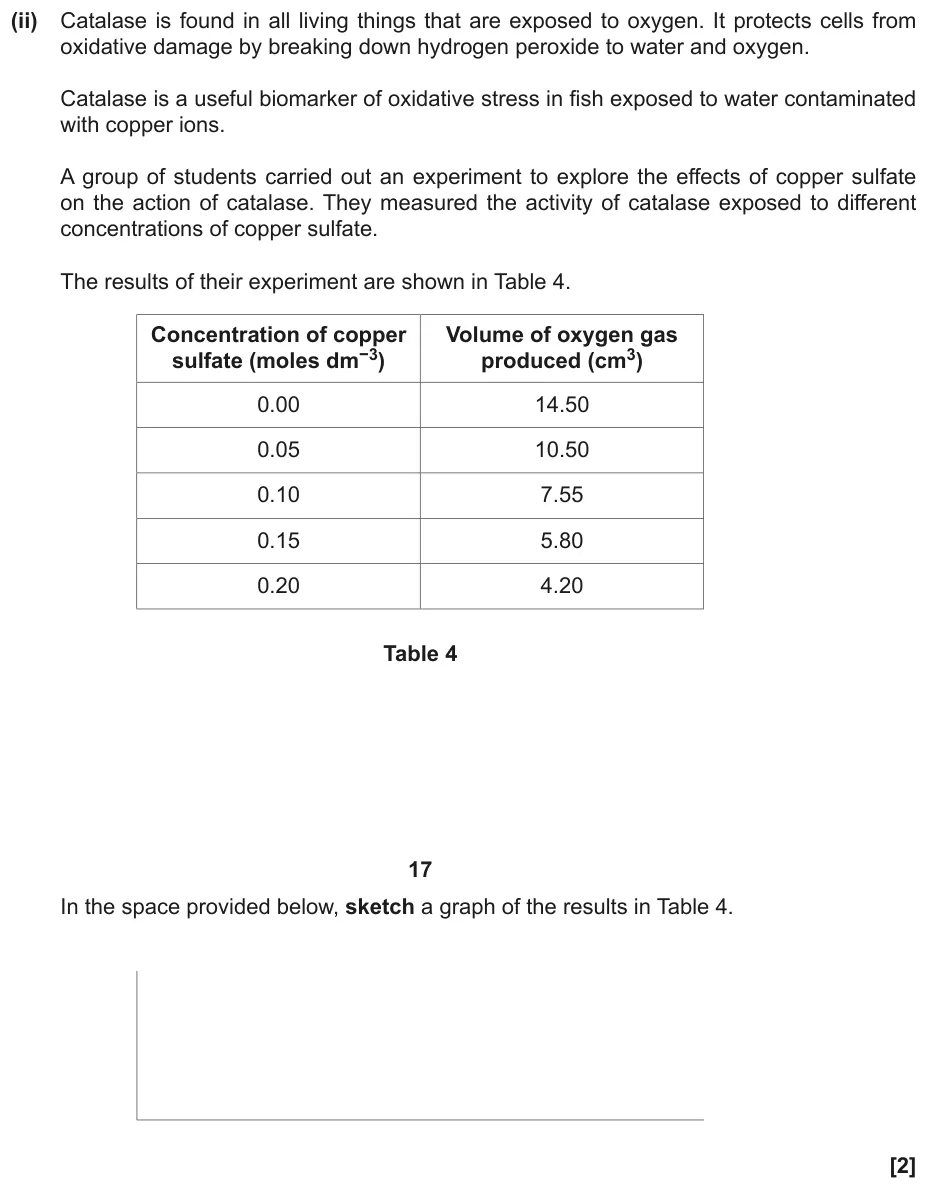
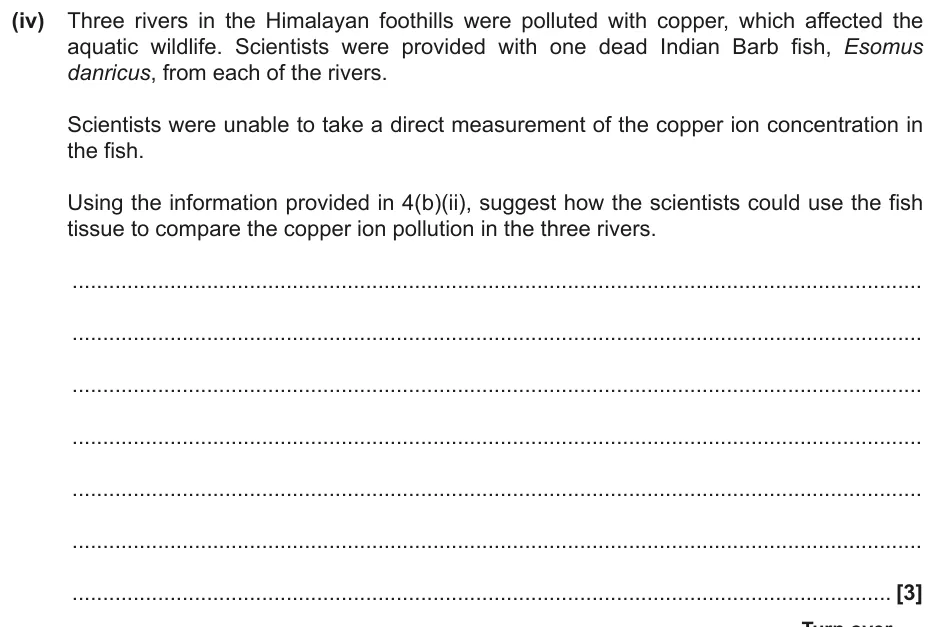
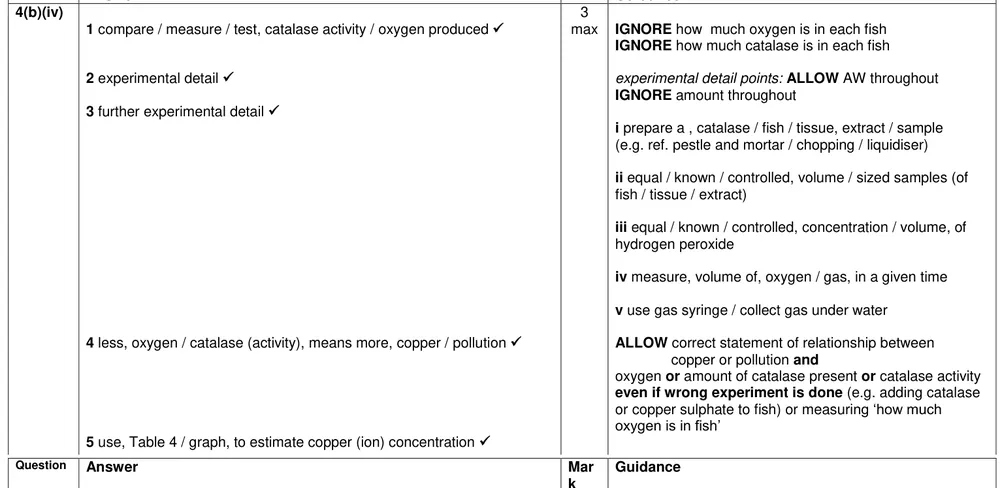
Suggest how fish tissue could be used to compare copper pollution in three rivers.
Information from earlier in this question:
Show the mark scheme
Tap an image to open it full size.
From the examiners' report: Very few students put the information together. The fish are the source of catalase, so add hydrogen peroxide to equal samples of fish tissue and measure the oxygen. Adding catalase to the fish, or measuring the oxygen in each fish, is the wrong experiment, although saying that less oxygen means more copper still scored.
Where students lose marks (from OCR examiners' reports and mark schemes)
Each point below is followed by wording that gained marks.
Name the variable, not its value: Writing '5 cm³ of alkaline solution' scored nothing, and 'a.u.', 'conc.' or 'amount' lost the mark for an independent variable.
✔ Gains credit: "Volume of 5 cm³ of alkaline solution" (1 mark, where '5 cm³ of alkaline solution' = 0 marks); "hydrogen peroxide concentration".
Know which variable you measure: Some students gave the volume of gas produced as the independent variable, and many couldn't say why pH wasn't controlled in the lipase investigation.
✔ Gains credit: "pH is the dependent variable / being measured; (pH changes as) fatty acids are produced".
Dilute in one step: Asked for an 8 a.u. solution from a 20 a.u. stock, many described a serial dilution with several steps, assuming every dilution must be 1 in 2 or 1 in 10.
✔ Gains credit: "(Mix with) distilled water; ratio of 3 (water) : 2 (stock solution)".
Surface area, in those words: Students said potato was 'easier to cut into shape' without naming the variable that affects the rate.
✔ Gains credit: "Easier to control surface area".
Buffers to vary, a meter to detect: Vague answers such as 'use indicators', 'a pH test kit' or 'H⁺ and OH⁻ solutions' gained nothing.
✔ Gains credit: "Using buffer solutions (to regulate the pH)" and "using universal indicator paper / pH probe / pH meter".
Abbreviate units properly: Students gave volume units for an area rate, wrote 'per', or used words such as 'sec' and 'minute'.
✔ Gains credit: "mm² / cm² and s⁻¹ / min⁻¹" (/s and /min allowed).
Improve what isn't already there: Suggesting a buffer or a set time period, which were already in the method, gained nothing, and many justified improvements by repeating 'validity'.
✔ Gains credit: "Temperature intervals closer together, (gives a more) accurate estimate of optimum temperature".
With and without the inhibitor: To show an inhibitor is competitive, many students just described competitive inhibition instead of planning an experiment.
✔ Gains credit: "Carry out the experiment at different concentrations of hydrogen peroxide / substrate, without inhibitor AND with inhibitor".
Download the questions
Download the PDF pack (16 questions, mark schemes at the end)
Keep practising
- Graph Skills (M3): OCR A Level Biology exam questions by topic
- PAG 5 Colorimeter and Potometer: OCR A Level Biology exam questions by topic
- OCR A Level Biology enzymes quiz
- OCR A Level Biology practical skills quiz
- Enzymes (2.1.4): OCR A Level Biology exam questions by topic
- OCR A Level Biology masterclasses
Questions, mark schemes and examiners' report extracts © OCR.