

Cloning and biotechnology is a long spec point with a practical flavour. Spec point 6.2.1 asks you to describe natural clones in plants and animals, take a plant cutting, explain micropropagation, embryo twinning and somatic cell nuclear transfer (SCNT), and weigh up the arguments for and against cloning. It then turns to microorganisms: why they're used in biotechnology and food production, aseptic technique, batch and continuous fermentation, the standard growth curve, serial dilutions and immobilised enzymes.
The examiners' reports point to the same traps. Students describe micropropagation when the question asks for a cutting, write "electroporation" for SCNT, say "quick" or "cheap" without saying why, and talk about enzyme "shape" instead of the active site. The growth curve and serial dilution questions lose marks on a missing dilution factor, on answers not in standard form, and on mixing up the viable count with the total count.
Work through the eighteen questions below in order. They start with recall, move on to cloning, fermenters and enzymes in new contexts, and finish with aseptic technique, growth curves and dilution calculations. If you'd like to go through questions like these with me each week, my OCR A masterclasses run on Wednesdays at 5.15pm for Year 12 and on Tuesdays at 6.30pm or Thursdays at 5.15pm for Year 13.
Want help with this topic? It comes up in my weekly OCR A masterclasses. See the timetable →
What you need from GCSE
Each question on this page assumes you're secure on these GCSE ideas. If any of them feels shaky, look it up before you start.
- Asexual reproduction involves only one parent and mitosis, so the offspring are genetically identical clones.
- Gardeners clone plants by taking cuttings; tissue culture grows many plants from small groups of cells.
- Embryo transplants and adult cell cloning (as used for Dolly the sheep) produce cloned animals.
- Bacteria divide by binary fission; in good conditions their numbers double every generation.
- Microorganisms are cultured on agar or in nutrient broth using sterilised equipment to prevent contamination.
Key terms
These words come up in the questions and mark schemes. Examiners expect you to use them exactly.
- Vegetative propagation: natural asexual reproduction in plants from structures such as runners, bulbs, rhizomes, tubers and suckers, which grow from meristem tissue.
- Micropropagation (tissue culture): growing many clones from a small explant of meristem tissue on sterile nutrient medium; the callus is divided and plant hormones trigger shoot and root growth.
- Explant and callus: the small piece of tissue taken from the parent plant; the mass of undifferentiated cells it grows into.
- Artificial embryo twinning: splitting an early embryo, whose cells are totipotent, into several parts, each implanted into a surrogate mother.
- Somatic cell nuclear transfer (SCNT): the nucleus of a body cell is fused with an enucleated egg cell by an electric pulse (electrofusion); the embryo is implanted into a surrogate.
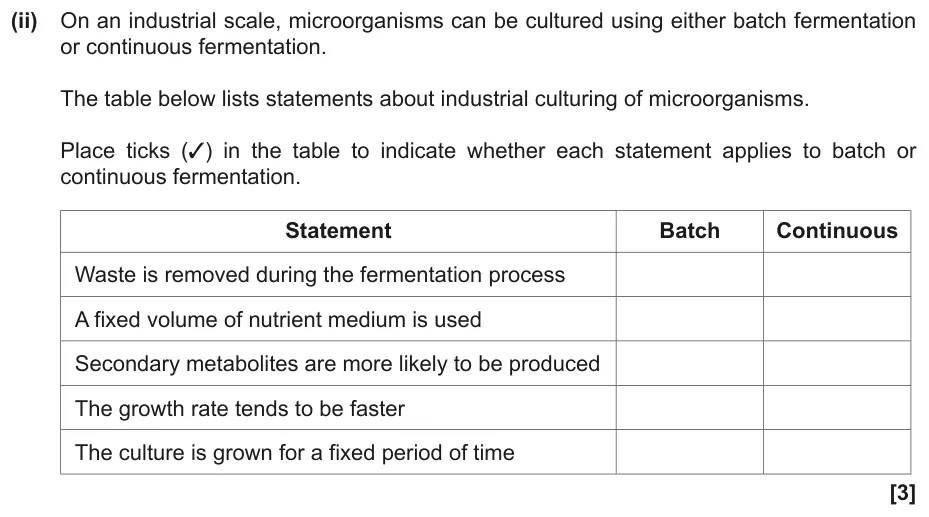
- Batch and continuous fermentation: a fixed volume of medium grown for a set time (favours secondary metabolites) versus nutrients added and product removed all the time (faster growth, primary metabolites).
- Aseptic technique: methods that stop unwanted microorganisms getting in, e.g. sterile equipment and medium, working near a Bunsen flame, flaming the neck of the flask.
- Standard growth curve: lag, log (exponential), stationary and death (decline) phases of a population in a closed culture.
- Serial dilution: diluting a culture step by step (e.g. 1 in 10 each time) so colonies can be counted, then multiplying back up by the dilution factor.
- Immobilised enzyme: an enzyme held in place by adsorption, covalent bonding, entrapment in a matrix or membrane separation, so it can be reused and doesn't contaminate the product.
What these questions cover (OCR 6.2.1)
The questions test these learning outcomes from the OCR A Level Biology A specification (H420):
- (a)(i) the production of natural clones for use in horticulture (natural clones in plants, e.g. runners, bulbs, tubers and rhizomes)
- (a)(ii) how to take plant cuttings as an example of a simple cloning technique
- (b)(i) the production of artificial clones of plants by micropropagation and tissue culture
- (b)(ii) the arguments for and against artificial cloning in plants
- (c) natural clones in animal species (e.g. twins formed by embryo splitting)
- (d)(i) artificial clones in animals can be produced by artificial embryo twinning or by enucleation and somatic cell nuclear transfer (SCNT)
- (d)(ii) the arguments for and against artificial cloning in animals
- (e) the use of microorganisms in biotechnological processes
- (f) the advantages and disadvantages of using microorganisms to make food for human consumption (bacterial and fungal sources)
- (g)(i) how to culture microorganisms effectively, using aseptic techniques
- (g)(ii) the importance of manipulating the growing conditions in batch and continuous fermentation in order to maximise the yield of product required
- (h)(i) the standard growth curve of a microorganism in a closed culture (including N = N₀ × 2ⁿ)
- (h)(ii) practical investigations into the factors affecting the growth of microorganisms (serial dilutions and broth (PAG7))
- (i) the uses of immobilised enzymes in biotechnology and the different methods of immobilisation
How to use this page
Write your answer on paper before you open the mark scheme. Allow about 1.2 minutes per mark: the 18 questions are worth 43 marks, so about 52 minutes in total. Then mark your answer strictly against the mark scheme and read the examiners' tip underneath it. If you'd rather print the questions, download the PDF pack.
Recall
Question 1
A level Paper 3 · June 2024 · Q6(a) · 4 marks · Easy
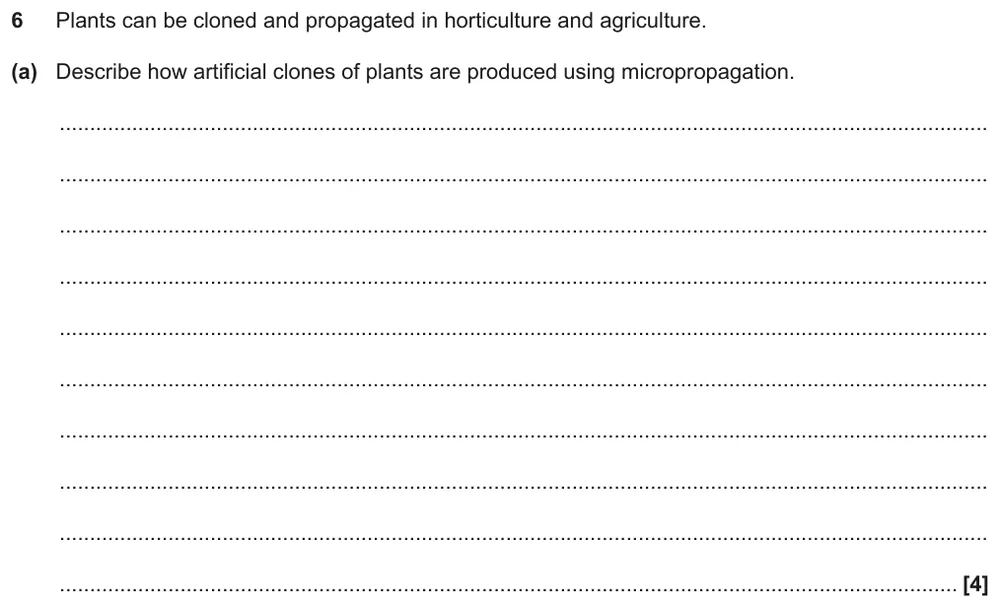
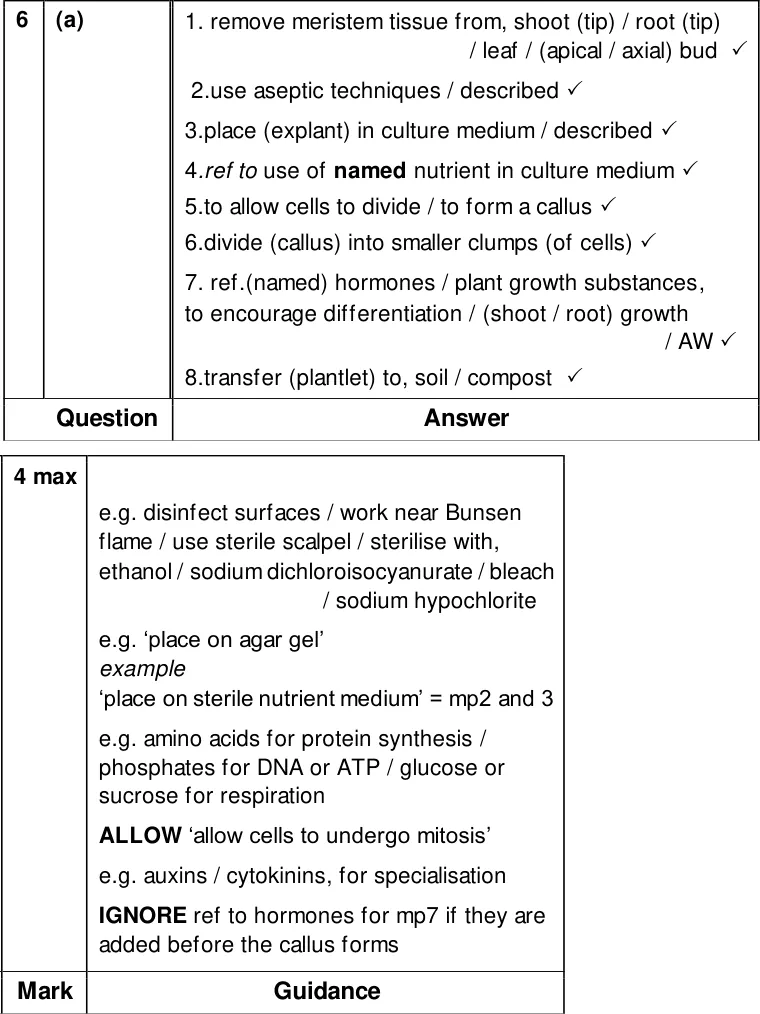
Describe how artificial clones of plants are produced by micropropagation.
Show the mark scheme
Tap an image to open it full size.
From the examiners' report: Most students scored well. Say where the meristem tissue comes from, such as a shoot tip, and give the job of each nutrient or hormone you name. Don't drift into taking cuttings.
Question 2
A level Paper 3 · June 2024 · Q6(c)(i) · 2 marks · Medium
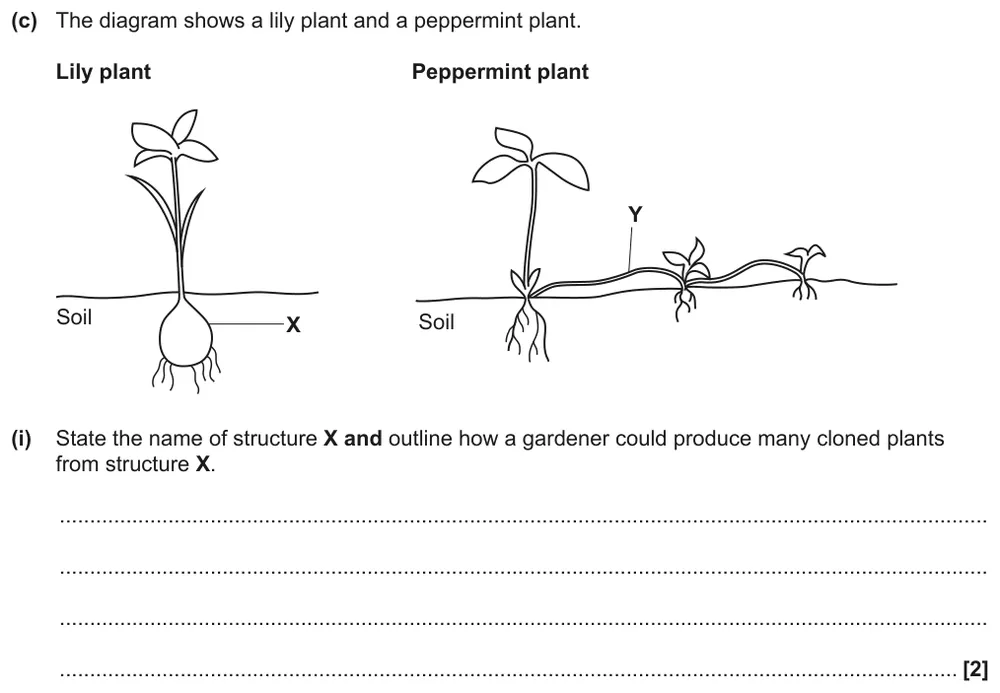
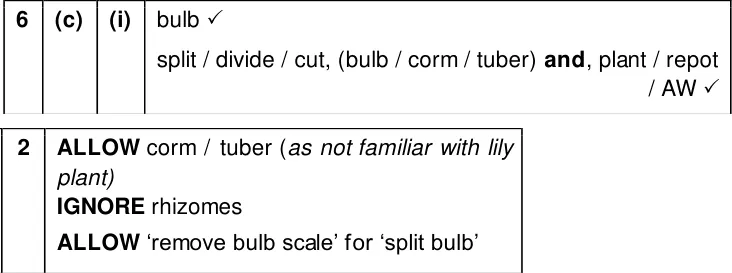
Name structure X on a lily plant and outline how a gardener could make many clones from it.
Show the mark scheme
Tap an image to open it full size.
From the examiners' report: Most named the bulb, but then replanted it whole or took a stem cutting. Say the bulb is divided first and each piece is planted. A gardener wouldn't use micropropagation.
Question 3
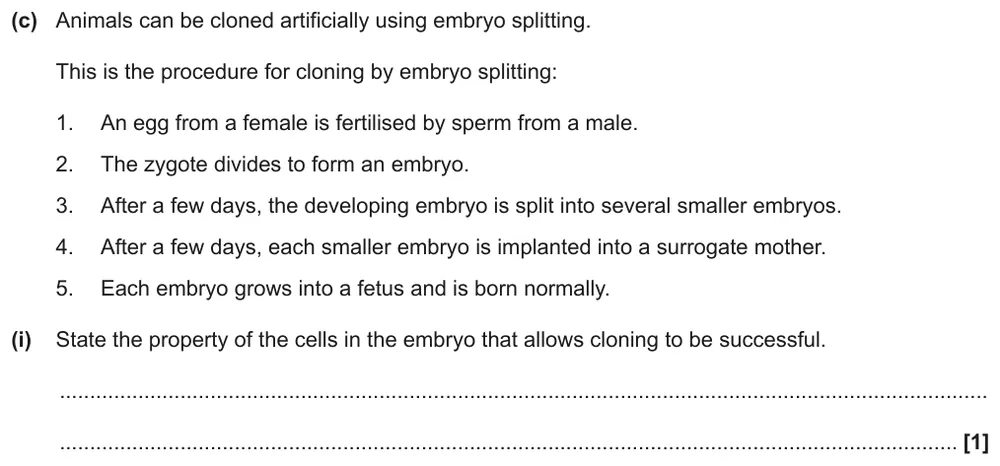
A level Paper 2 · June 2025 · Q17(c)(i) · 1 mark · Medium
State the property of embryo cells that makes cloning by embryo splitting possible.
Show the mark scheme

Tap an image to open it full size.
From the examiners' report: One word does it: totipotent. Don't give the wrong potency, and if you describe it, say the cells can become any type of cell.
Question 4
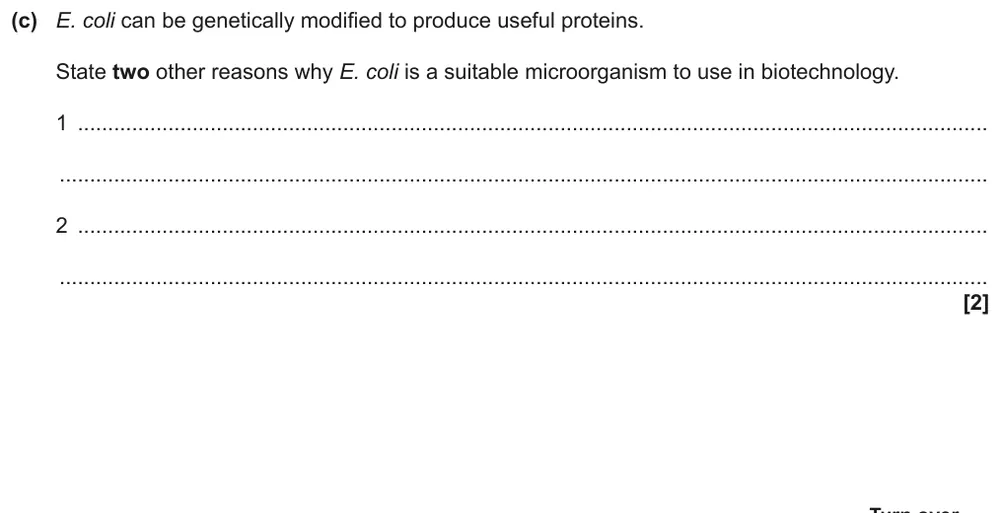
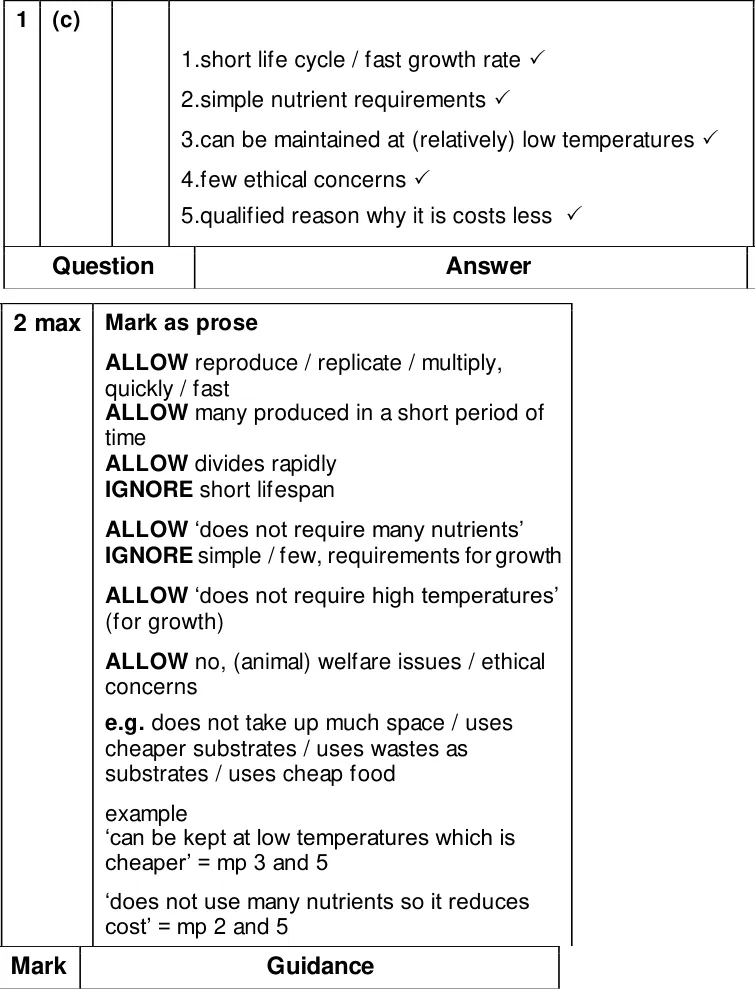
A level Paper 3 · June 2024 · Q1(c) · 2 marks · Easy
State two reasons, other than easy genetic modification, why E. coli suits biotechnology.
Show the mark scheme
Tap an image to open it full size.
From the examiners' report: Short life cycle was the most common correct answer. Qualify anything vague: "cheap" needs a reason, such as needing only low temperatures.
Question 5
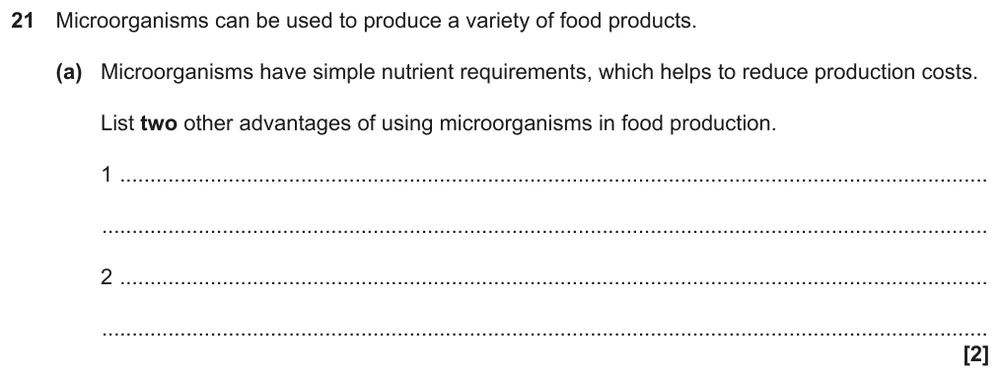
A level Paper 2 · June 2022 · Q21(a) · 2 marks · Medium
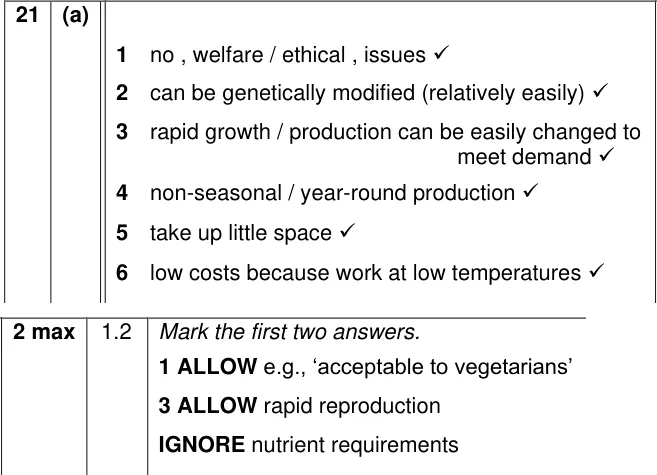
List two advantages, other than simple nutrient needs, of using microorganisms in food production.
Show the mark scheme
Tap an image to open it full size.
From the examiners' report: "Quick" and "cheap" on their own don't score. Say what is quick (rapid reproduction) or why it is cheap (works at low temperatures).
Question 6
A level Paper 3 · June 2019 · Q6(a)(ii) · 3 marks · Easy
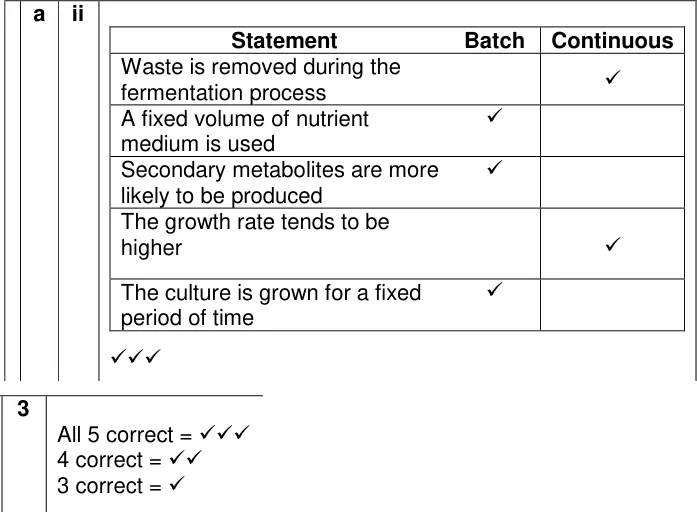
Tick whether each statement applies to batch or continuous fermentation.
Show the mark scheme
Tap an image to open it full size.
From the examiners' report: Most scored 2 or 3. Secondary metabolites are made in batch fermentation, once growth slows, and growth is faster in continuous fermentation.
Question 7
A level Paper 2 · June 2023 · Q18(a) · 1 mark · Medium
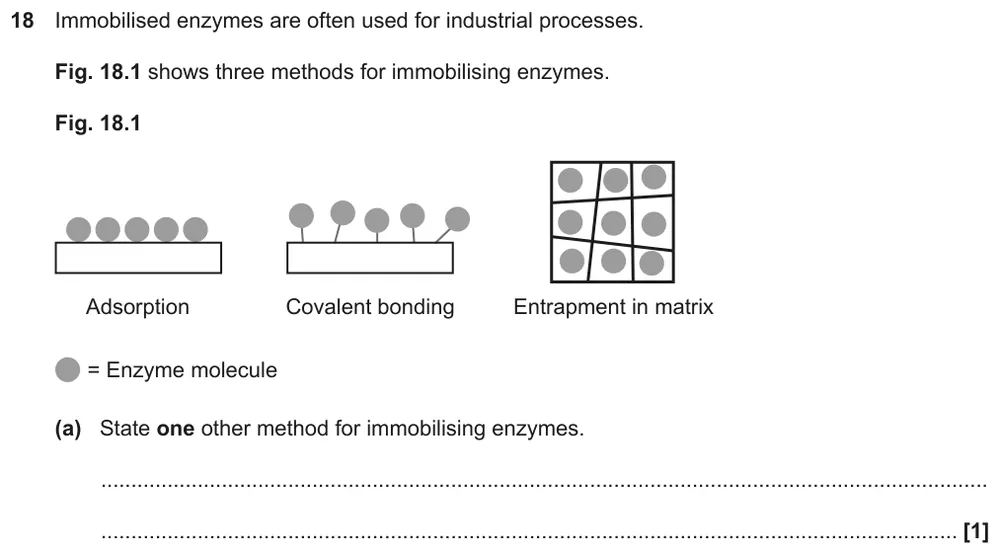
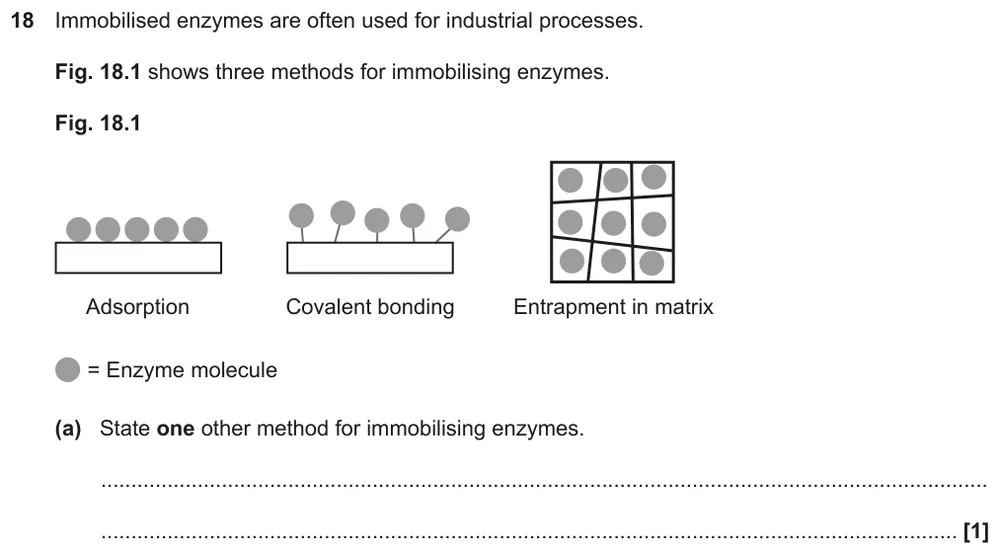
State one method of immobilising enzymes other than adsorption, covalent bonding and entrapment.
Show the mark scheme

Tap an image to open it full size.
From the examiners' report: Only about a third scored. Learn membrane separation (encapsulation) as the fourth method; entrapment in beads and ionic bonding are just versions of what's shown.
Applying what you know
Question 8
A level Paper 2 · June 2019 · Q20(a)(i) · 4 marks · Hard
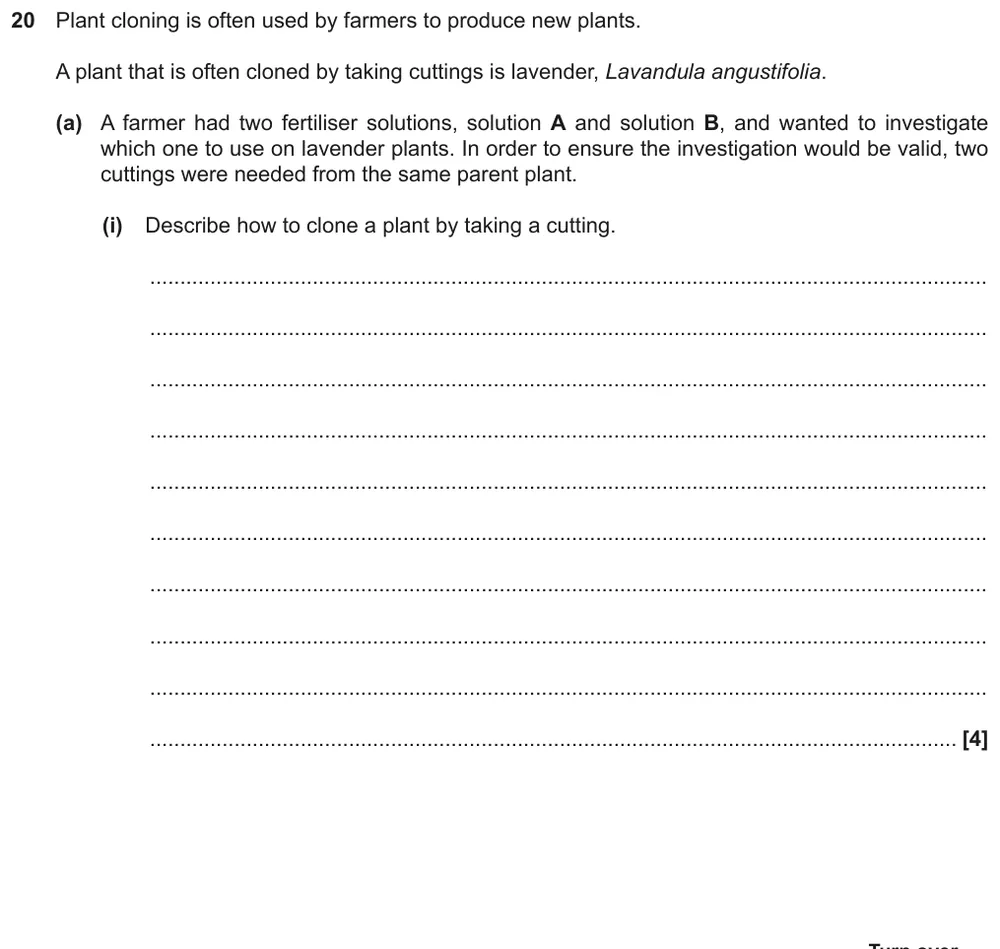
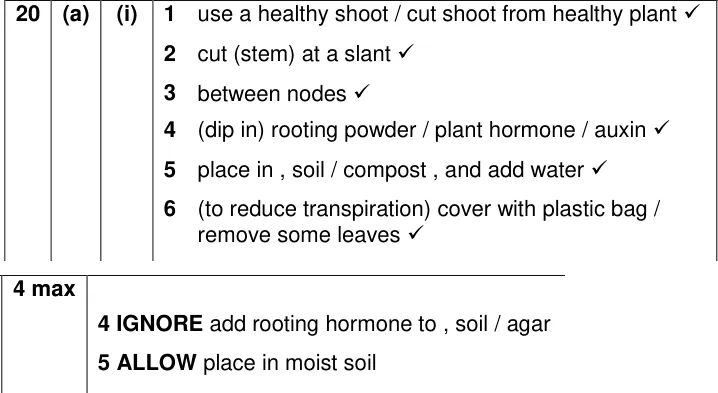
Describe how to clone a lavender plant by taking a cutting.
Show the mark scheme
Tap an image to open it full size.
From the examiners' report: Answers about micropropagation scored nothing here. Describe a cutting step by step, starting with choosing a healthy shoot and cutting at a slant between nodes.
Question 9
A level Paper 2 · June 2019 · Q20(b) · 3 marks · Hard
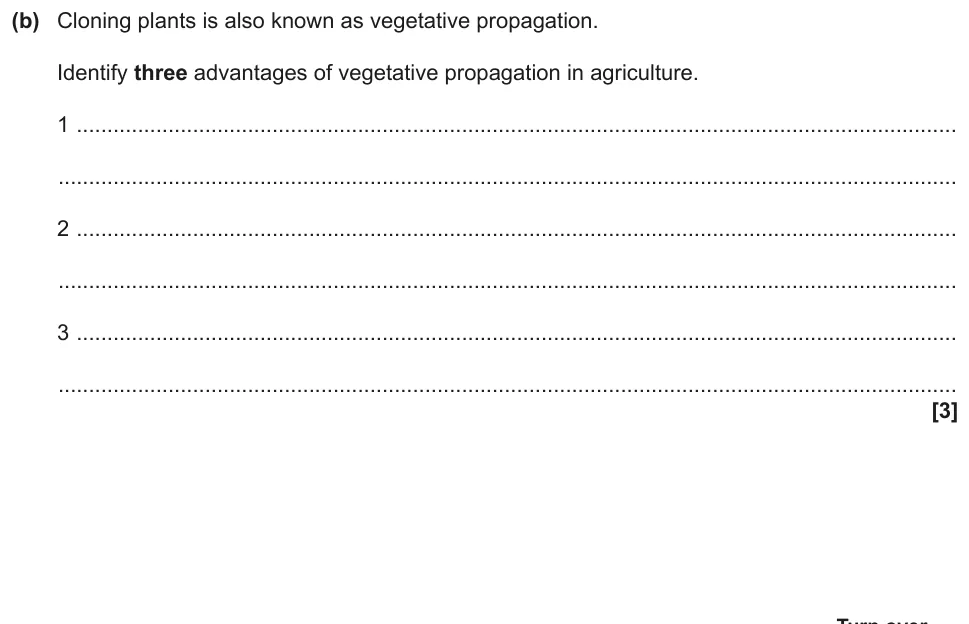
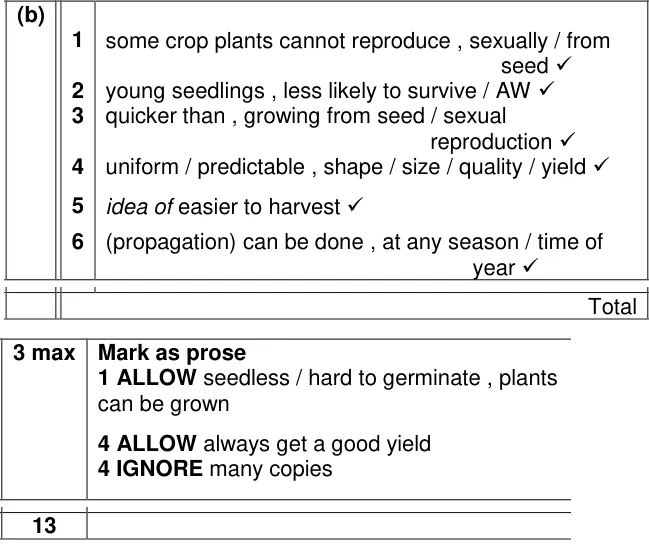
Identify three advantages of vegetative propagation in agriculture.
Show the mark scheme
Tap an image to open it full size.
From the examiners' report: Only a few scored. Improving a crop is selective breeding, not cloning. Link uniformity to a desirable quality, such as the same yield, and qualify "quick" (quicker than growing from seed).
Question 10
A level Paper 3 · June 2022 · Q4(b) · 3 marks · Medium
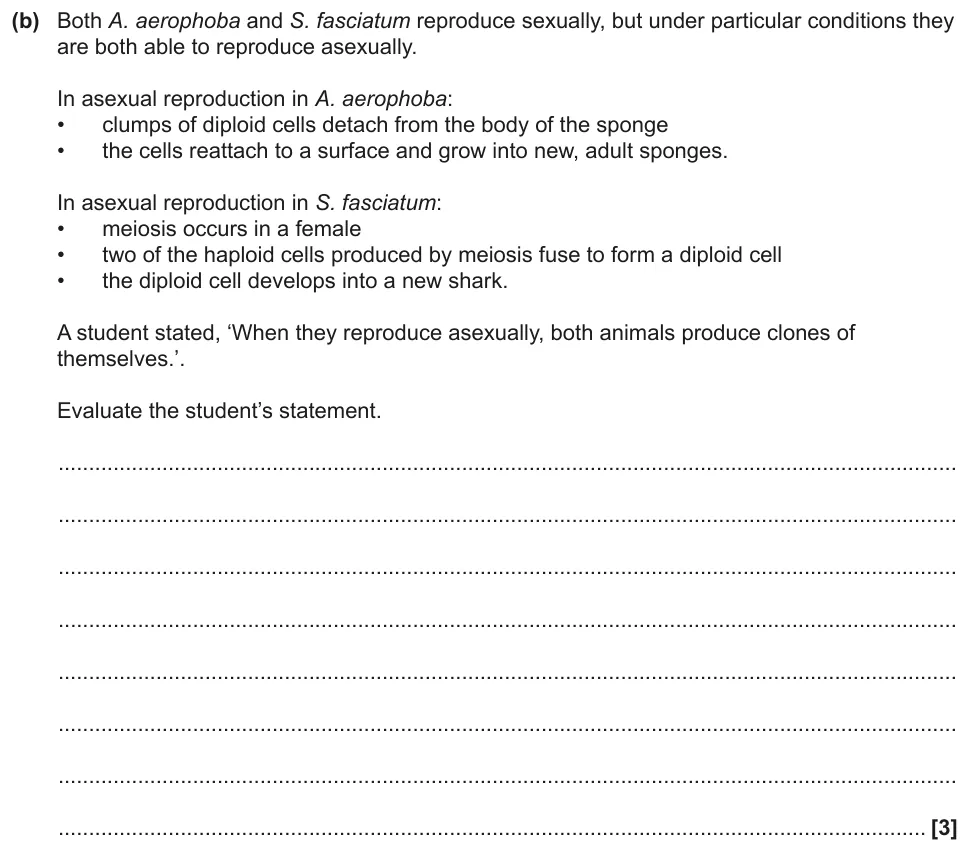
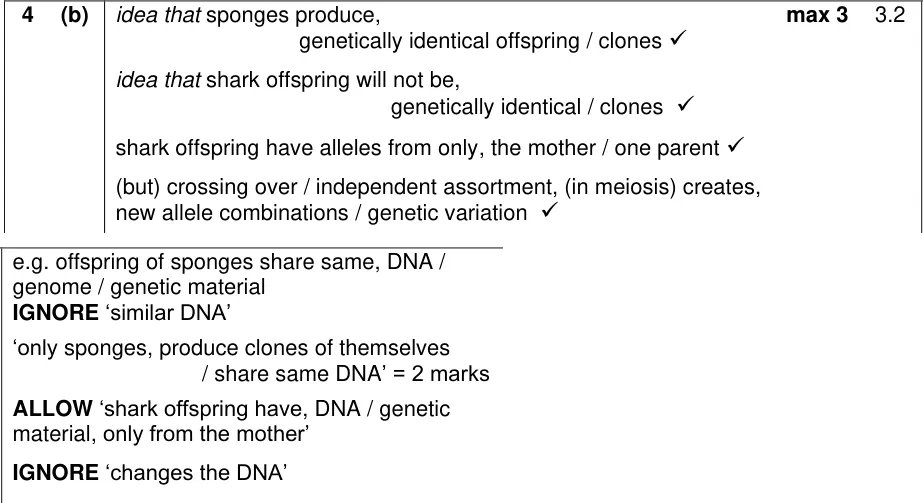
Evaluate the claim that both a sponge and a zebra shark produce clones when they reproduce asexually.
Show the mark scheme
Tap an image to open it full size.
From the examiners' report: Deal with each animal in turn. For the shark, link meiosis to crossing over or independent assortment and say this gives genetic variation, not just "variation".
Question 11
A level Paper 2 · June 2019 · Q19(a)(i) · 2 marks · Medium
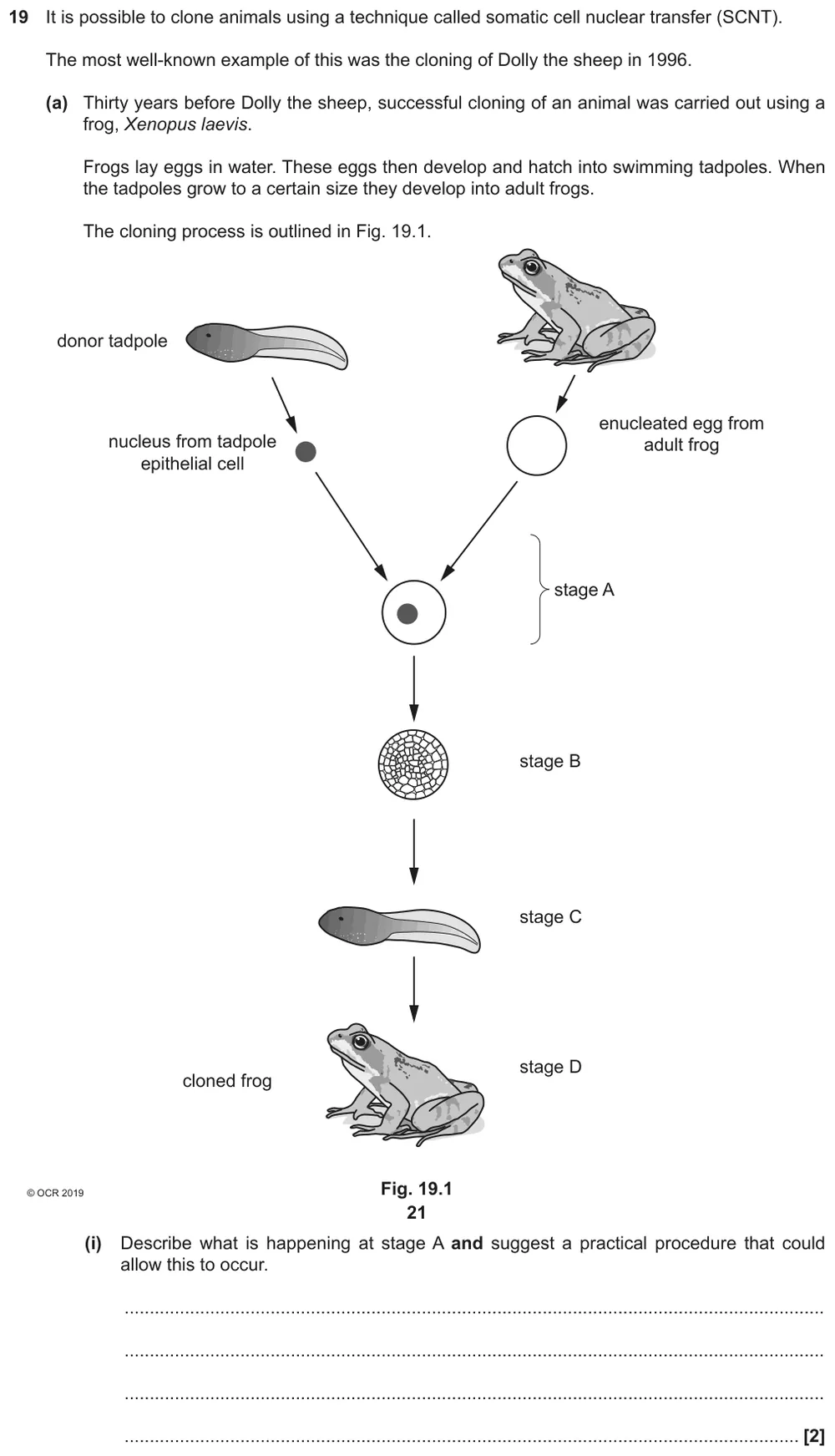
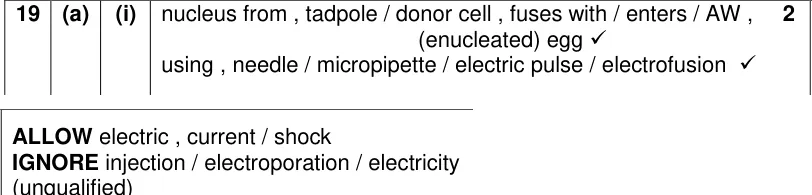
Describe stage A of cloning a frog by nuclear transfer and suggest a practical method for it.
Show the mark scheme
Tap an image to open it full size.
From the examiners' report: Say where the nucleus comes from (the tadpole cell) and where it goes (the enucleated egg). The method is electrofusion or a micropipette; electroporation was the most common wrong answer.
Question 12
A level Paper 2 · June 2025 · Q17(d)(iii) · 1 mark · Medium
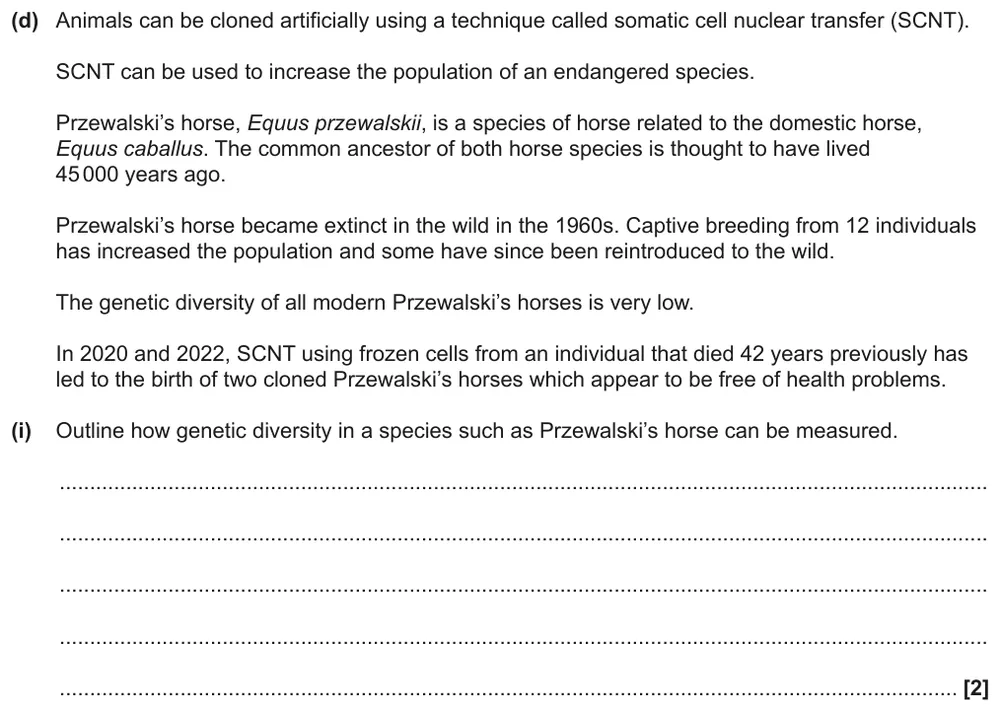
Suggest why cloned Przewalski's horses are healthier than Dolly the sheep was.
Information from earlier in this question:

Show the mark scheme

Tap an image to open it full size.
From the examiners' report: Most said the technique has improved since 1996. A sharper answer is that the donor nucleus may have come from a younger cell.
Question 13
A level Paper 2 · June 2022 · Q21(c)(ii) · 2 marks · Medium
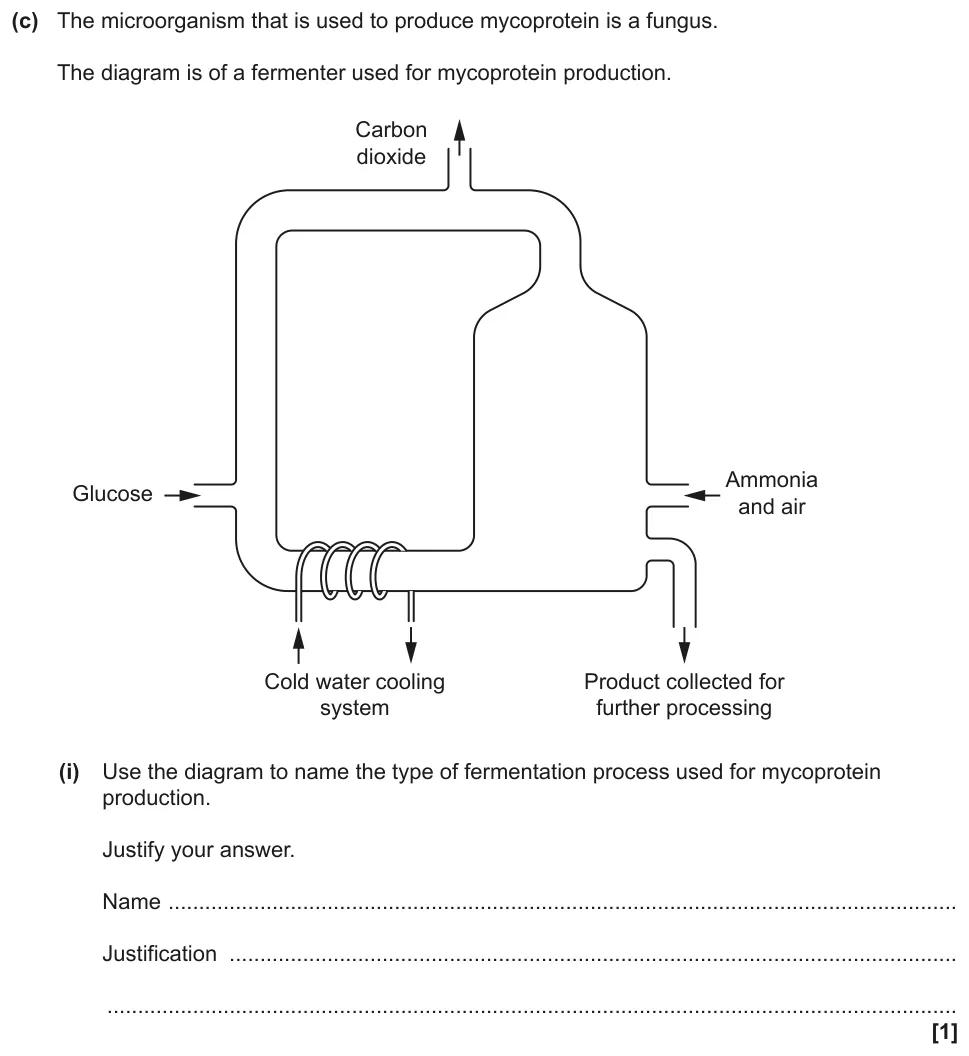
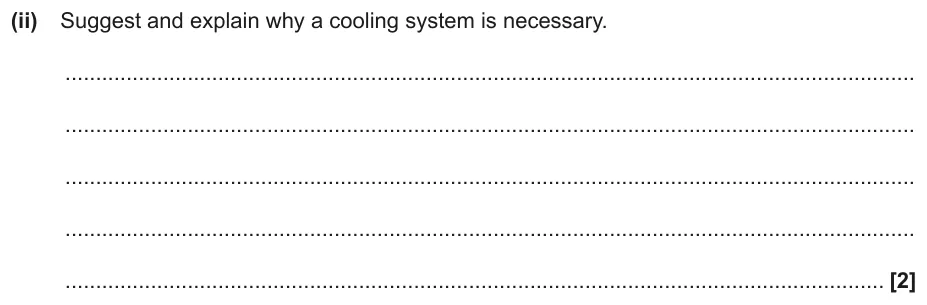
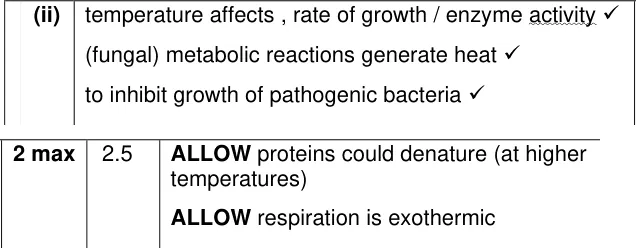
Suggest and explain why a mycoprotein fermenter needs a cooling system.
Information from earlier in this question:
Show the mark scheme
Tap an image to open it full size.
From the examiners' report: Most got one mark. Say where the heat comes from, respiration by the fungus is exothermic, and then why that matters, enzymes would denature and growth would slow.
Question 14
A level Paper 2 · June 2023 · Q18(b) · 2 marks · Hard
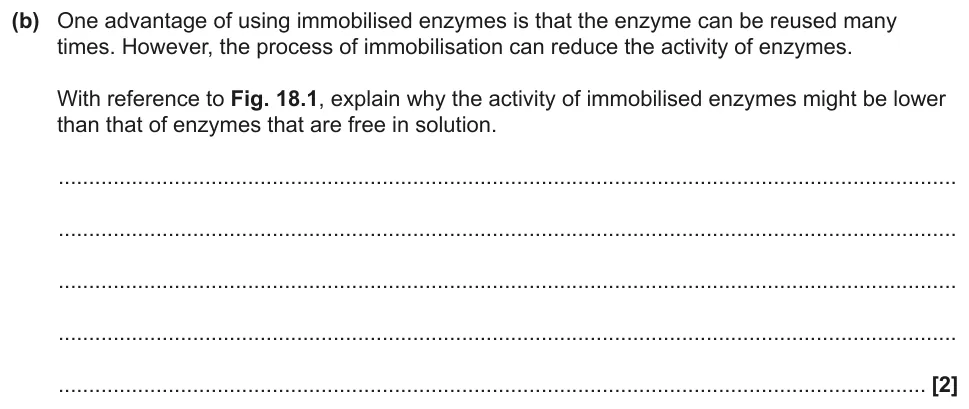
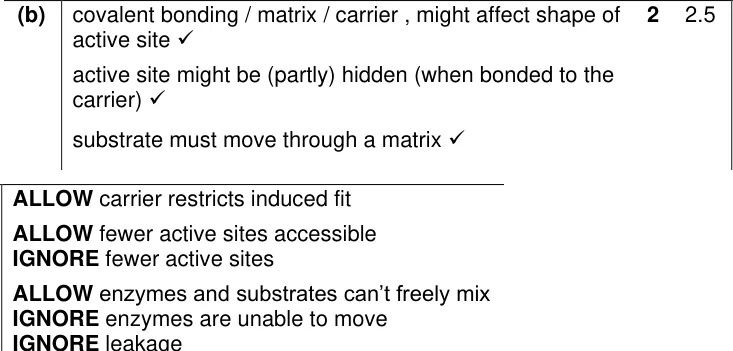
Use the diagram to explain why immobilised enzymes may be less active than free enzymes.
Information from earlier in this question:
Show the mark scheme
Tap an image to open it full size.
From the examiners' report: Mention the active site every time: its shape could change, or it could be partly hidden by the carrier. "Enzyme shape" alone, or "the enzyme can't move", didn't score.
Practical and maths
Question 15
A level Paper 3 · June 2017 · Q2(b)(ii) · 2 marks · Medium
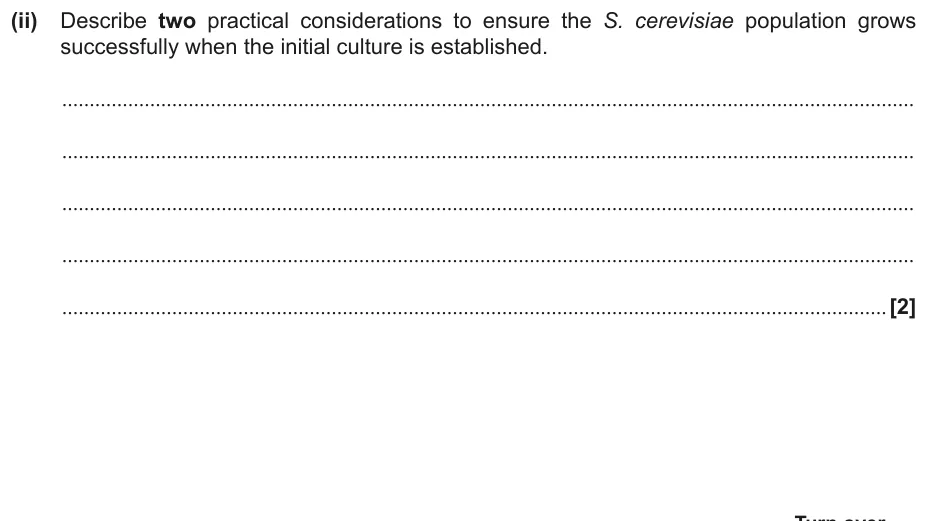
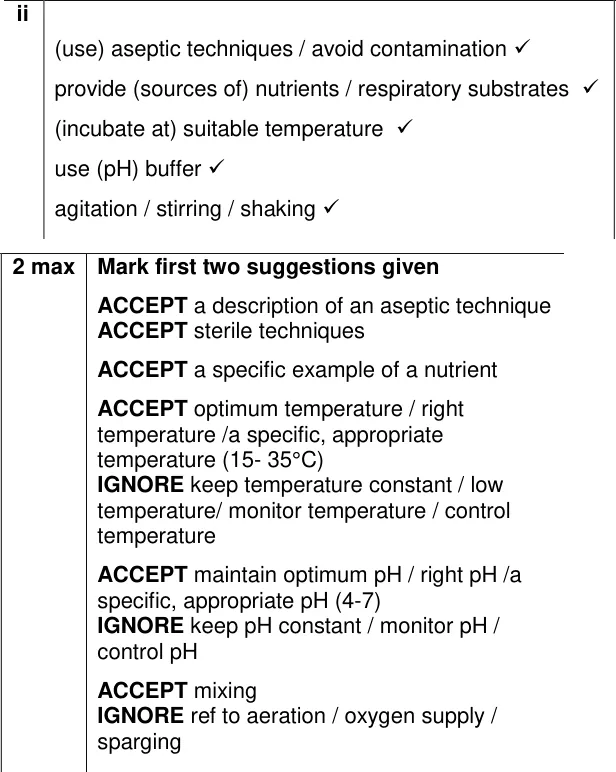
Describe two practical points that make sure a new yeast culture grows successfully.
Show the mark scheme
Tap an image to open it full size.
From the examiners' report: Aseptic technique plus a suitable temperature or pH scores both marks. Say the temperature is optimum or suitable, not just "controlled", and never sterilise the culture itself.
Question 16
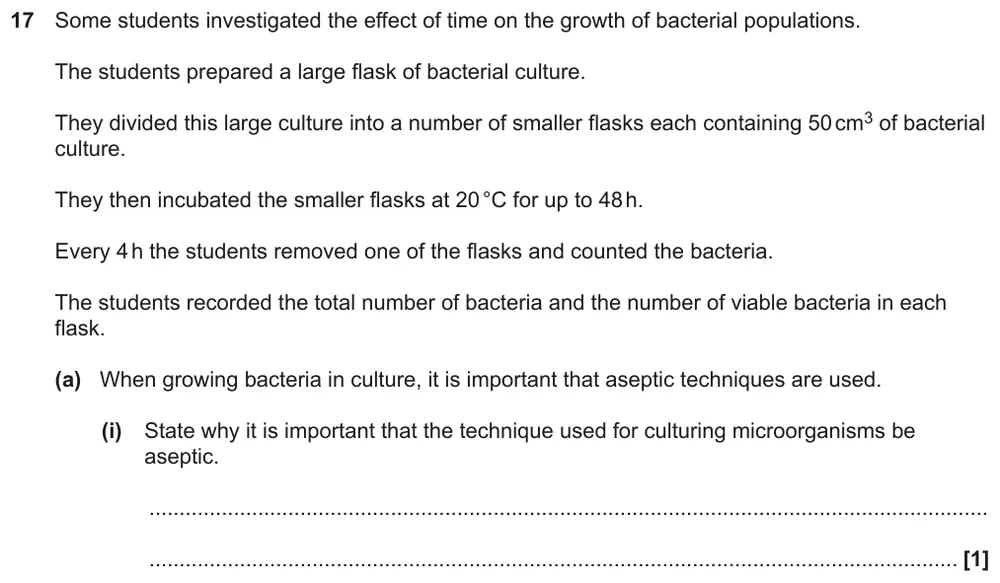
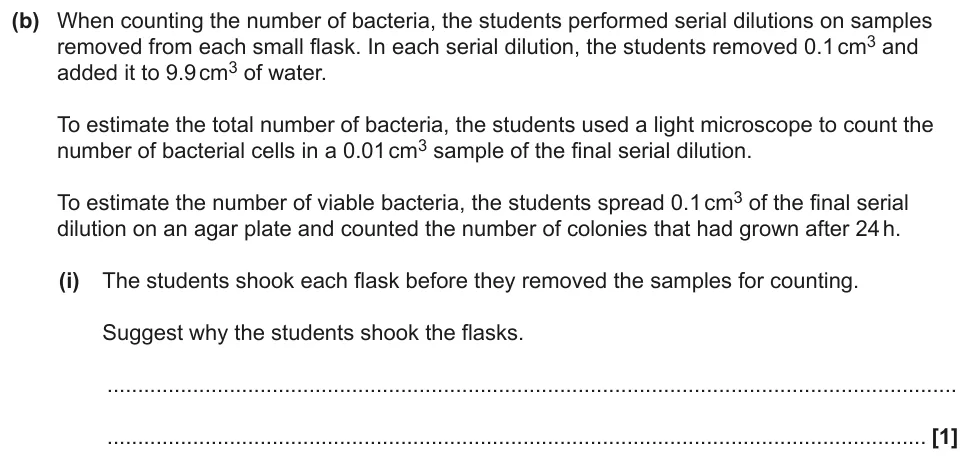
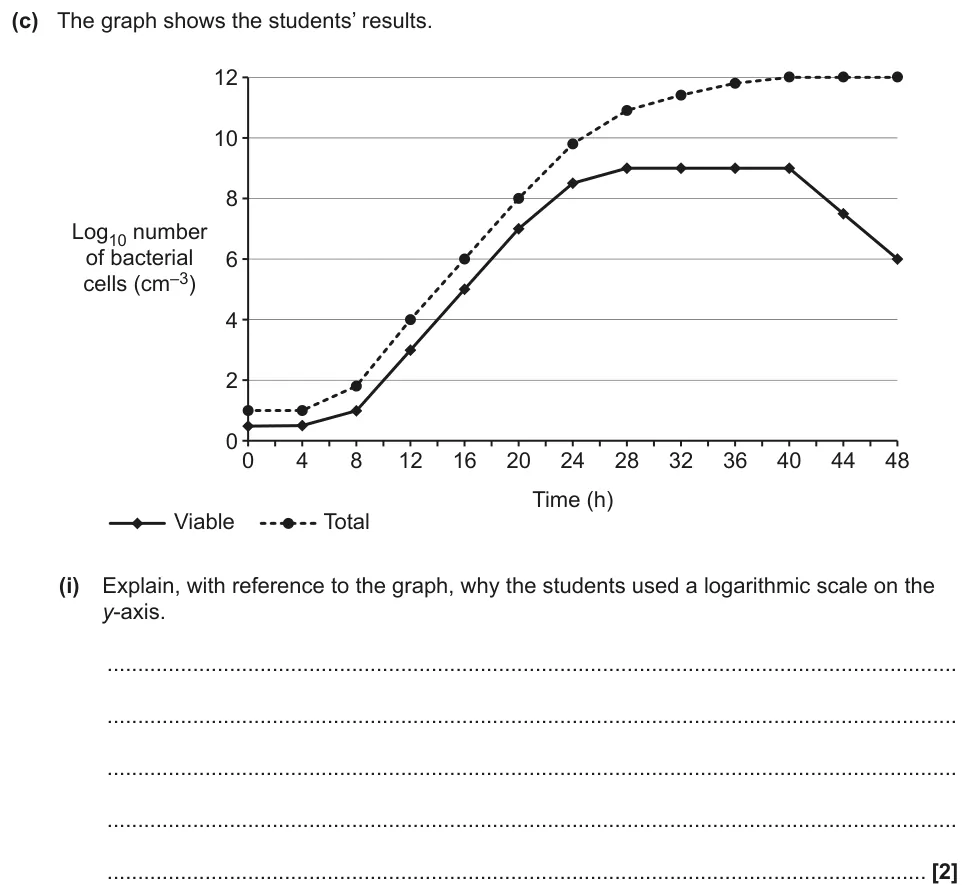
A level Paper 2 · June 2022 · Q17(d) · 4 marks · Hard
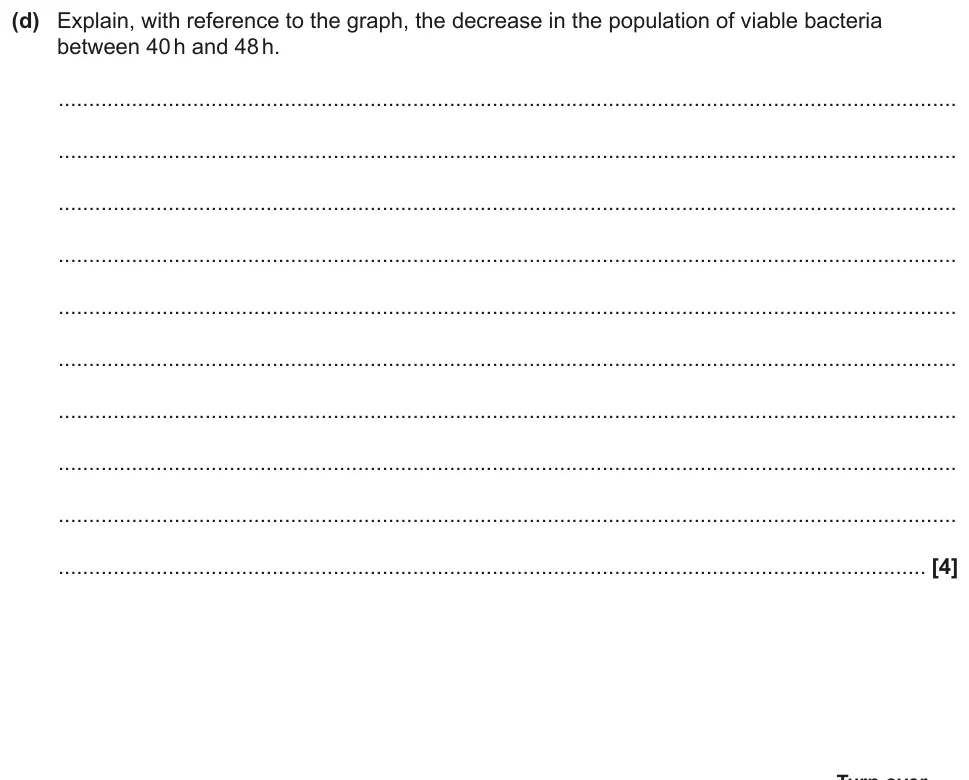
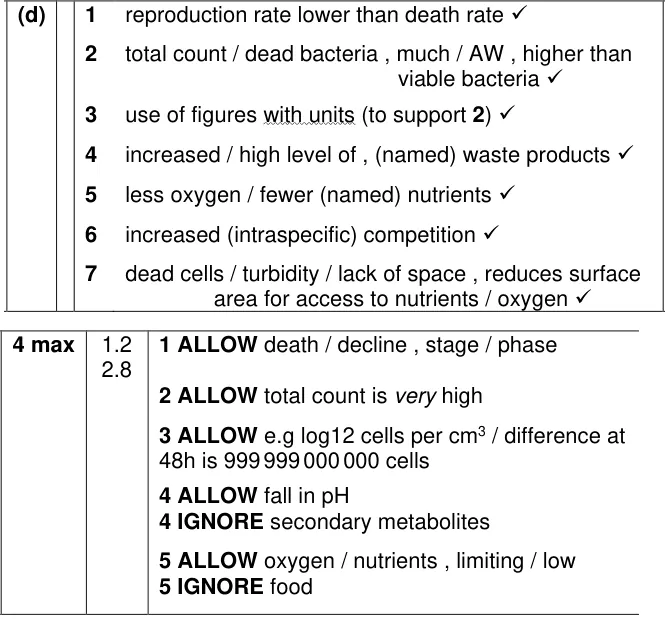
Explain, using the graph, the fall in viable bacteria between 40 h and 48 h.
Information from earlier in this question:
Show the mark scheme
Tap an image to open it full size.
From the examiners' report: Stick to 40–48 h: this is the death phase, so reproduction rate is lower than death rate as waste builds up and nutrients run out. Bacteria don't have a "birth rate", and the total count includes the dead cells.
Question 17
A level Paper 3 · November 2021 · Q2(d)(ii) · 3 marks · Medium
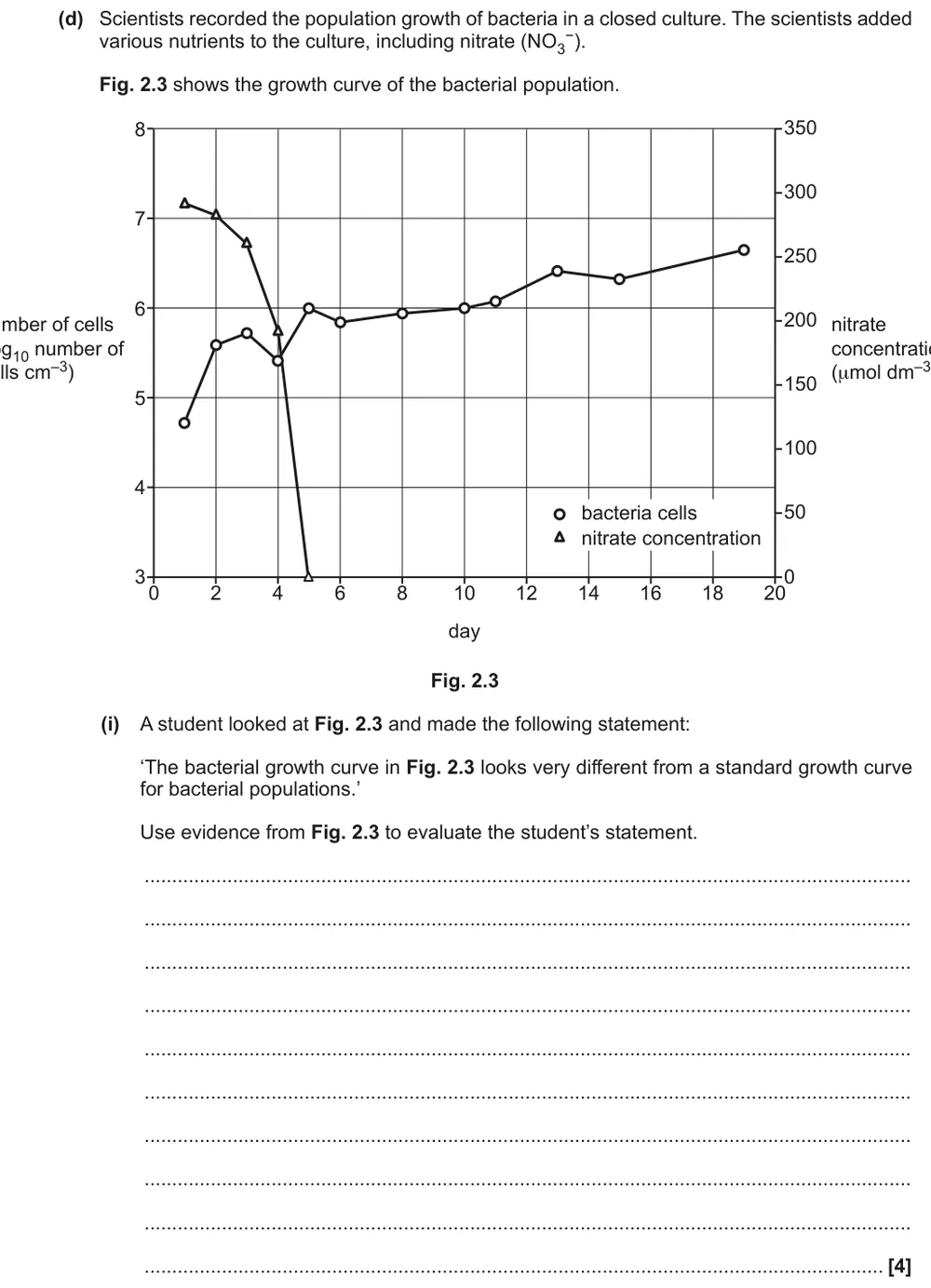
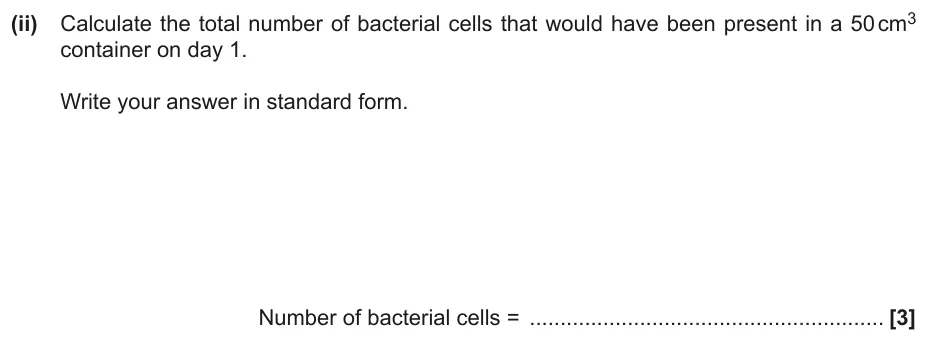
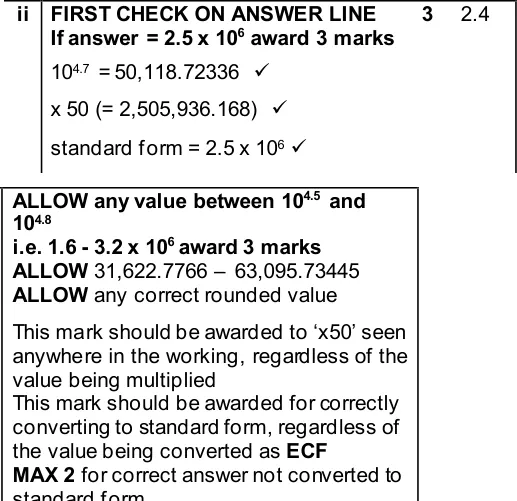
Use a log-scale growth curve to calculate the number of bacteria in 50 cm³ on day 1.
Information from earlier in this question:
Show the mark scheme
Tap an image to open it full size.
From the examiners' report: Convert the log first: 10 to the power of the reading gives cells per cm³. Then multiply by 50 cm³ and give the answer in standard form.
Question 18
A level Paper 2 · June 2018 · Q19(b)(i) · 2 marks · Medium
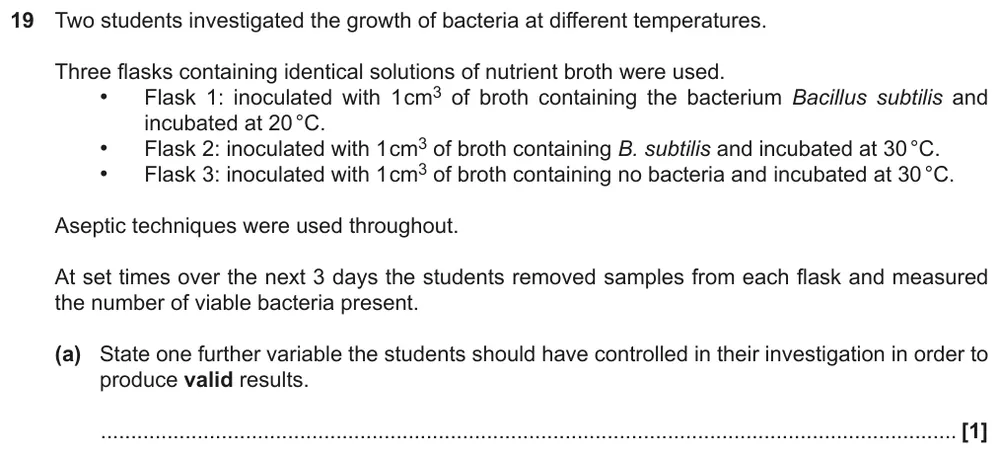
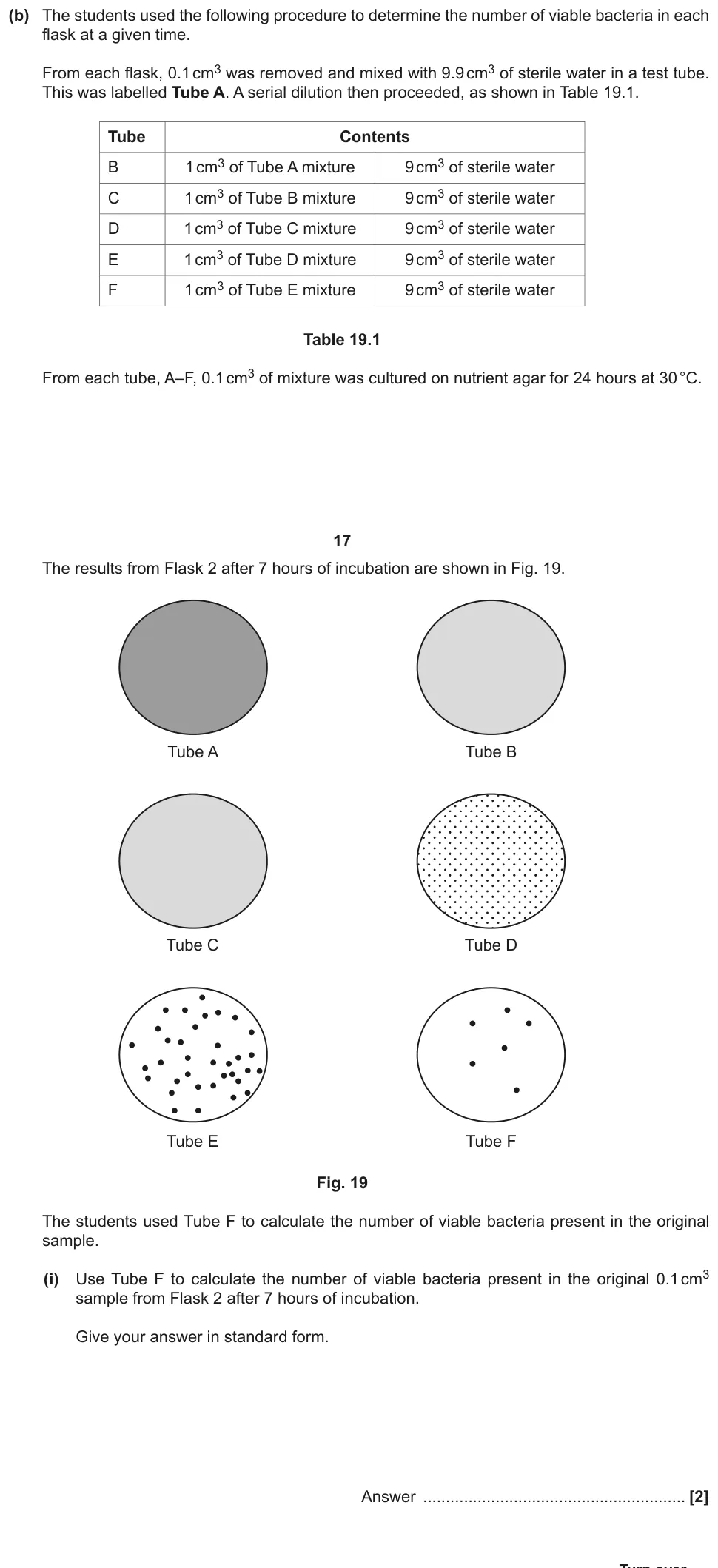
Use colonies from a serial dilution to calculate the number of viable bacteria in a sample.
Information from earlier in this question:
Show the mark scheme

Tap an image to open it full size.
From the examiners' report: Fewer than 1 in 5 got both marks; many were out by a factor of 10 or 100. Write down the total dilution of Tube F before you multiply, and give the answer in standard form.
Where students lose marks (from OCR examiners' reports and mark schemes)
Each point below is followed by wording that gained marks.
A cutting is not micropropagation: Asked how to clone lavender by taking a cutting, many students described micropropagation and scored nothing.
✔ Gains credit: "Use a healthy shoot, cut the stem at a slant between nodes, dip in rooting powder and place in moist compost".
Divide the bulb before replanting: Most students named the bulb but replanted it whole or took a stem cutting instead.
✔ Gains credit: "Bulb; split / divide the bulb and plant".
Embryo cells split because they're totipotent: Some students named the wrong potency or wrote that the cells are "undifferentiated", which is ignored.
✔ Gains credit: "The cells are totipotent / able to differentiate into any cell type".
SCNT fuses a nucleus; it doesn't electroporate: Electroporation was the most common wrong answer for getting the tadpole nucleus into the egg, and many didn't say where the nucleus came from.
✔ Gains credit: "The nucleus from the tadpole cell fuses with the enucleated egg using an electric pulse / electrofusion / micropipette".
Secondary metabolites come from batch culture: Many students thought secondary metabolites are made in continuous fermentation and that growth is faster in batch fermentation.
✔ Gains credit: "Secondary metabolites are more likely to be produced: batch" and "the growth rate tends to be faster: continuous".
Immobilisation changes the active site: Many students said immobilisation changes the "enzyme shape" or "tertiary structure", or that the enzyme can't move, without mentioning the active site.
✔ Gains credit: "Covalent bonding / the carrier might affect the shape of the active site" and "the active site might be partly hidden".
Total count includes the dead cells: Explaining the decline phase, many students wrote about a "birth rate", described the whole curve from 0 h, or treated viable and total counts as two competing species.
✔ Gains credit: "Reproduction rate is lower than death rate" and "the total count is much higher than the viable count, so the culture is full of dead cells".
Multiply back by the dilution factor: Fewer than 1 in 5 students got both marks for the colony count; many were out by a factor of 10 or 100 or ignored the standard form instruction.
✔ Gains credit: "6.0 × 10⁷" viable bacteria, in standard form.
Download the questions
Download the PDF pack (18 questions, mark schemes at the end)
Keep practising
- Cloning and Biotechnology quiz
- Cloning and biotechnology: interactive written questions (20)
- PAG 7 Microbiological Techniques: OCR A Level Biology exam questions by topic
- Manipulating Genomes (6.1.3): OCR A Level Biology exam questions by topic
- OCR A Level Biology masterclasses
Questions, mark schemes and examiners' report extracts © OCR.