

Exchange surfaces open the Year 12 module on exchange and transport. Spec point 3.1.1 asks why larger, more active organisms need specialised exchange surfaces, what makes an exchange surface efficient, and how the mammalian airways are built: cartilage, ciliated epithelium, goblet cells, smooth muscle and elastic fibres. You also need the mechanism of ventilation, how to read a spirometer trace, how fish and insects ventilate and exchange gases, and how to recognise these tissues in dissections and on microscope slides.
The examiners' reports for these questions point to the same few slips. Students write that a large organism has a large SA:V, describe a 'thin cell wall' in the alveoli, say 'cilia' instead of 'ciliated epithelial cells', or name 'muscle' when the answer is smooth muscle. On ventilation, many mix up the internal and external intercostal muscles, and on spirometer questions they describe vital capacity instead of the trace itself.
Work through the seventeen questions below in order. They start with recall of the airways and gills, move on to applying the ideas to lugworms, frogs and poisoned diaphragms, and finish with spirometer traces and dissection. If you'd like to go through questions like these with me each week, my OCR A masterclasses run on Wednesdays at 5.15pm for Year 12 and on Tuesdays at 6.30pm or Thursdays at 5.15pm for Year 13.
What you need from GCSE
Each question on this page assumes you're secure on these GCSE ideas. If any of them feels shaky, look it up before you start.
- Diffusion is the net movement of particles from a higher concentration to a lower concentration, and it is faster over a short distance and a large area.
- Air passes through the trachea, bronchi and bronchioles to the alveoli, where oxygen diffuses into the blood and carbon dioxide diffuses out.
- Alveoli are adapted for gas exchange: a large surface area, thin walls and a good blood supply.
- Larger organisms have a smaller surface area to volume ratio, so diffusion across their outer surface alone can't supply all their cells.
- Fish take in oxygen through their gills from water flowing over them.
Key terms
These words come up in the questions and mark schemes. Examiners expect you to use them exactly.
- Surface area to volume ratio (SA:V): the surface area divided by the volume, written as x : 1. Larger organisms have a smaller SA:V.
- Diffusion distance (pathway): how far a molecule has to diffuse; a short distance gives faster diffusion.
- Squamous epithelium: a single layer of flattened cells, such as the alveolar wall, giving a short diffusion distance.
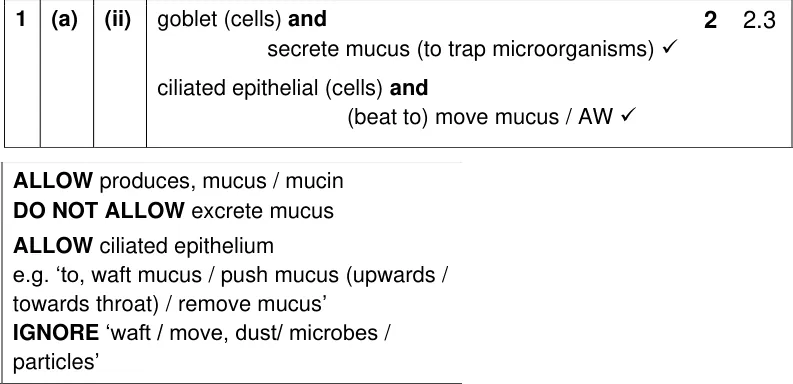
- Goblet cells and ciliated epithelium: goblet cells secrete mucus that traps microorganisms and dust; the cilia on ciliated epithelial cells beat to move the mucus up to the throat.
- Elastic fibres: fibres in the walls of the airways and alveoli that stretch when you breathe in and recoil to help push air out.
- Tidal volume: the volume of air breathed in or out in one normal breath.
- Vital capacity: the largest volume of air that can be breathed out after the deepest possible breath in.
- Ventilation rate: the volume of air breathed in per minute: tidal volume × breathing rate.
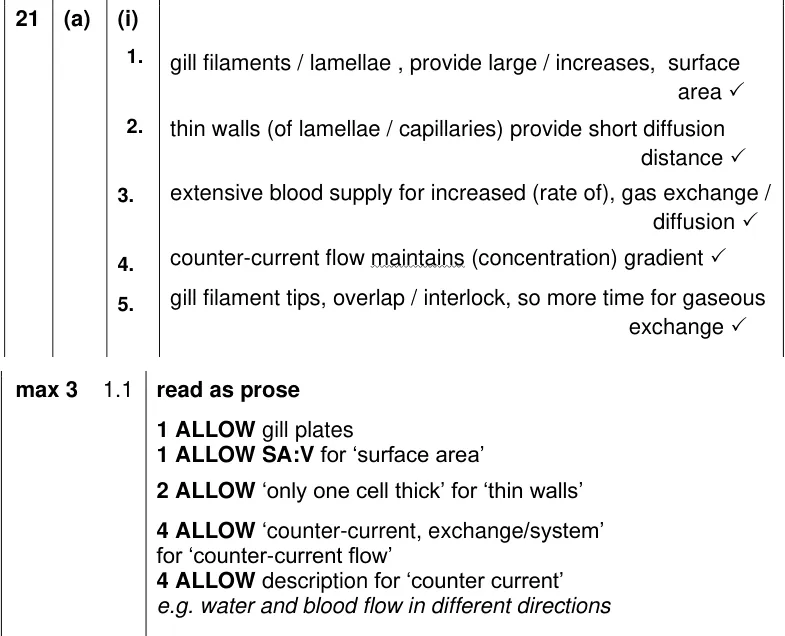
- Counter-current flow: in fish gills, blood flows through the lamellae in the opposite direction to the water, so a concentration gradient is kept along the whole lamella.
- Spiracles, tracheae and tracheoles: in insects, air enters through spiracles and moves along tracheae, which branch into tracheoles that reach the cells.
What these questions cover (OCR 3.1.1)
The questions test these learning outcomes from the OCR A Level Biology A specification (H420):
- (a) the need for specialised exchange surfaces (including SA:V and metabolic activity)
- (b) the features of an efficient exchange surface
- (c) the structures and functions of the components of the mammalian gaseous exchange system (cartilage, ciliated epithelium, goblet cells, smooth muscle and elastic fibres)
- (d) the mechanism of ventilation in mammals
- (e) the relationship between vital capacity, tidal volume, breathing rate and oxygen uptake (including spirometer traces)
- (f) the mechanisms of ventilation and gas exchange in bony fish and insects (gills, counter-current flow, spiracles and tracheae)
- (g) the dissection, examination and drawing of the gaseous exchange system of a bony fish and/or insect trachea (PAG2)
- (h) the examination of microscope slides to show the histology of exchange surfaces (PAG1)
How to use this page
Write your answer on paper before you open the mark scheme. Allow about 1.2 minutes per mark: the 17 questions are worth 33 marks, so about 40 minutes in total. Then mark your answer strictly against the mark scheme and read the examiners' tip underneath it. If you'd rather print the questions, download the PDF pack.
Recall
Question 1
AS Paper 2 · June 2025 · Q5(b) · 2 marks · Easy
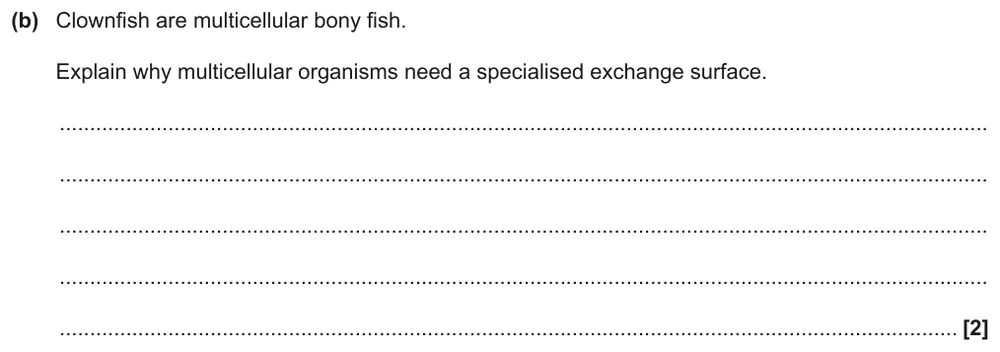
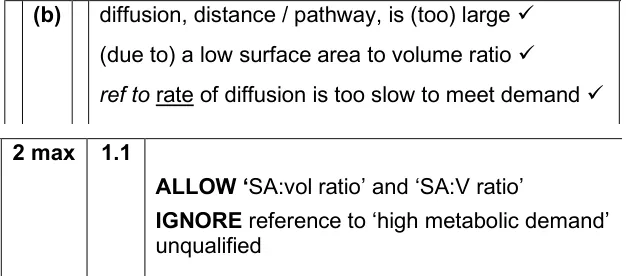
Explain why multicellular organisms such as clownfish need a specialised exchange surface.
Show the mark scheme
Tap an image to open it full size.
From the examiners' report: Many students wrote that large multicellular organisms have a large SA:V. They have a small one, so link the small SA:V and long diffusion distance to diffusion being too slow to meet the organism's needs.
Question 2
AS Paper 1 · June 2023 · Q21(a) · 1 mark · Easy
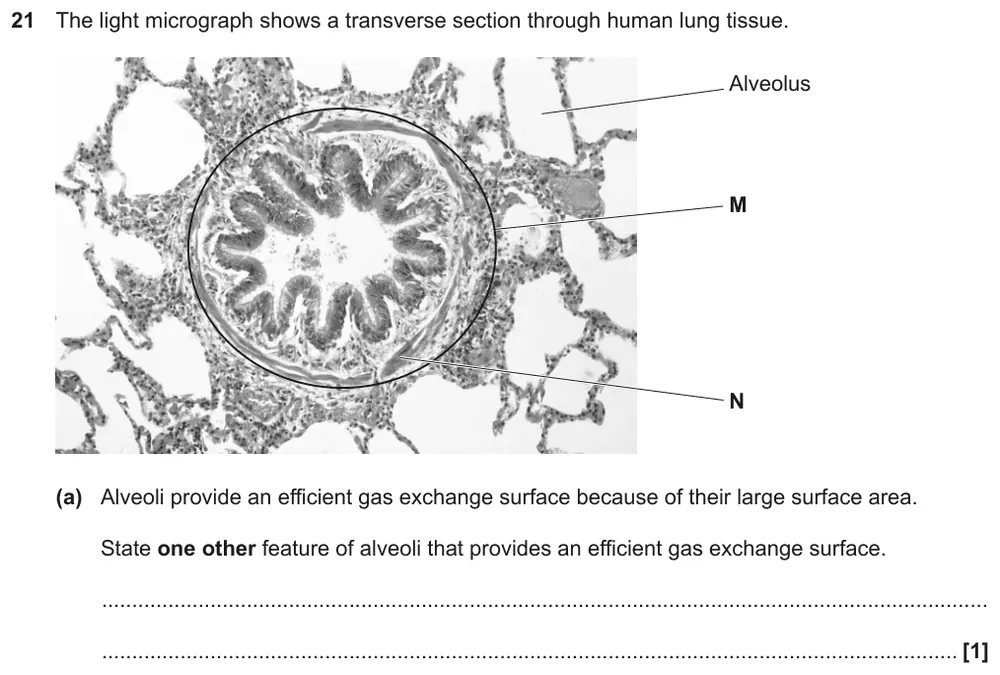
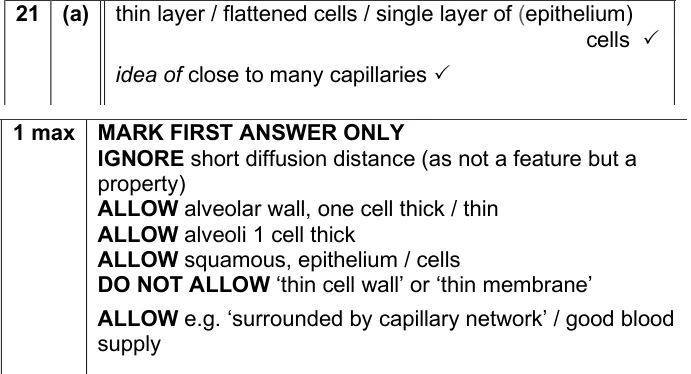
State one feature of alveoli, other than a large surface area, that makes them an efficient gas exchange surface.
Show the mark scheme
Tap an image to open it full size.
From the examiners' report: Write 'the alveolar wall is one cell thick' or 'squamous epithelium'. 'Thin cell wall' scores nothing because animal cells have no cell walls, and 'short diffusion pathway' is a result, not a feature.
Question 3
AS Paper 1 · June 2023 · Q21(c) · 2 marks · Medium
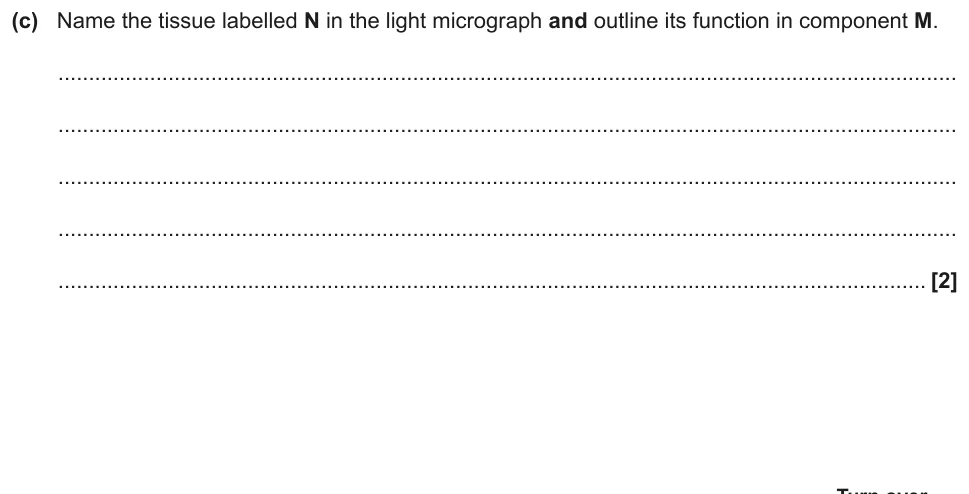
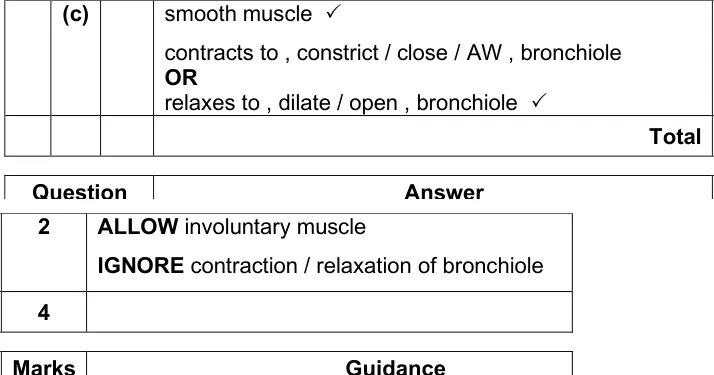
Name tissue N in the lung micrograph and outline its function in the bronchiole.
Show the mark scheme
Tap an image to open it full size.
From the examiners' report: Most students called N cartilage or elastic tissue. Learn to recognise the ring of smooth muscle around a bronchiole, and say that it contracts to narrow the lumen.
Question 4
A level Paper 3 · June 2023 · Q1(a)(i) · 2 marks · Hard
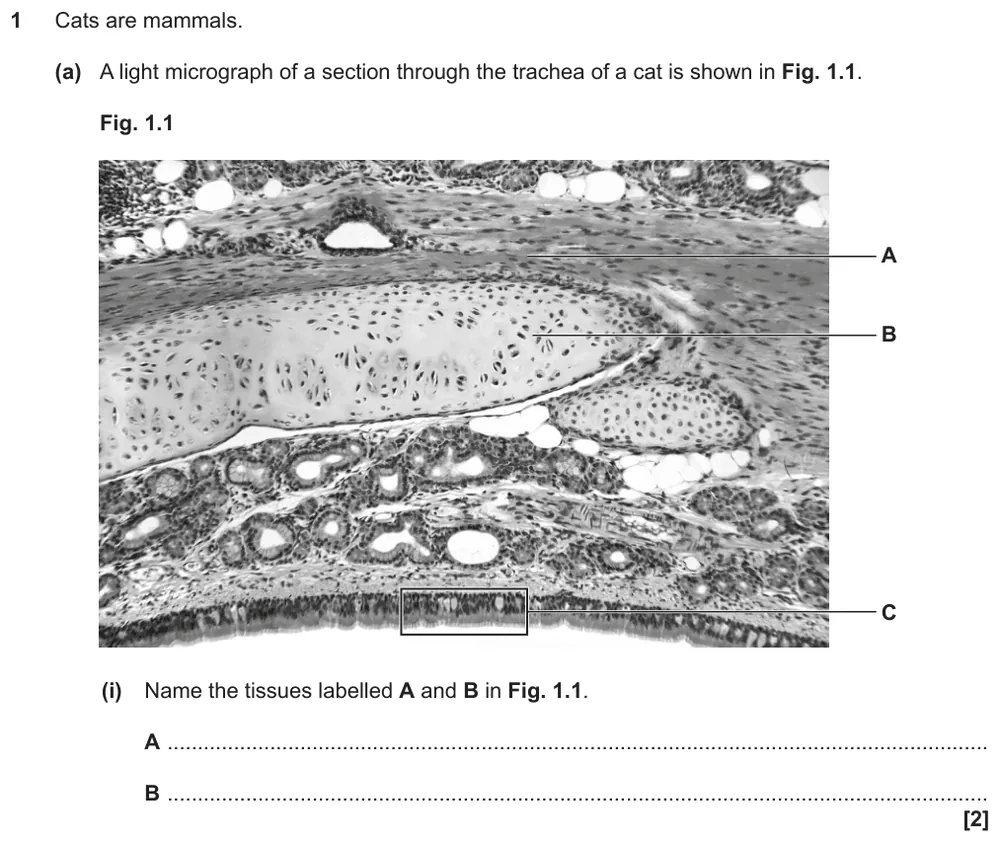
Name tissues A and B in a light micrograph of a cat's trachea.
Show the mark scheme

Tap an image to open it full size.
From the examiners' report: Only a few students named both tissues. Say 'smooth muscle', not just 'muscle' or 'striated muscle', and recognise cartilage rather than calling it collagen or elastic tissue.
Question 5
A level Paper 3 · June 2023 · Q1(a)(ii) · 2 marks · Easy
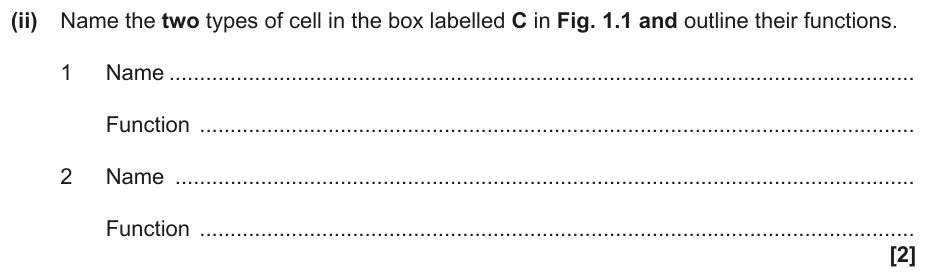
Name the two types of cell in box C of the trachea micrograph and outline their functions.
Show the mark scheme
Tap an image to open it full size.
From the examiners' report: Write 'ciliated epithelial cells', not just 'cilia' or 'ciliated cells', and say the cilia move mucus up towards the throat, not dust, and not down to the stomach.
Question 6
A level Paper 1 · June 2025 · Q21(a)(i) · 3 marks · Easy
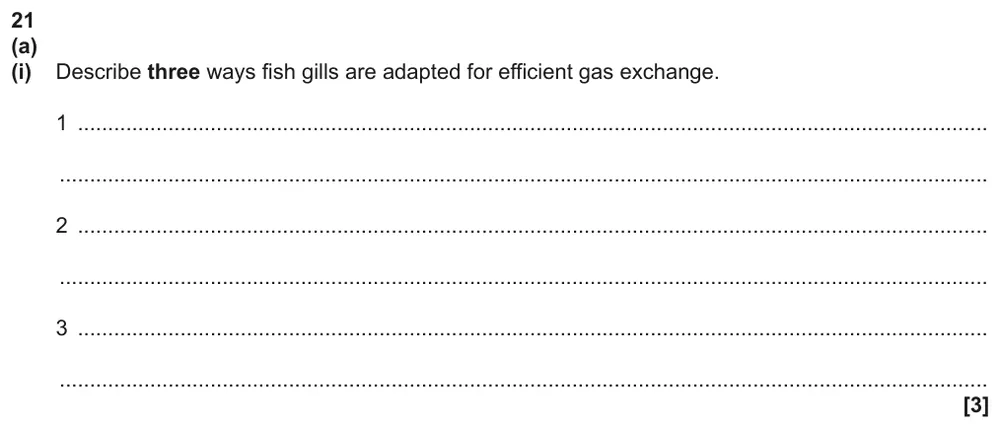
Describe three ways fish gills are adapted for efficient gas exchange.
Show the mark scheme
Tap an image to open it full size.
From the examiners' report: Most students gave lamellae and counter-current flow. Make each point a feature plus what it does, for example 'thin lamella walls give a short diffusion distance'.
Question 7
A level Paper 3 · June 2017 · Q7(a)(i) · 2 marks · Medium
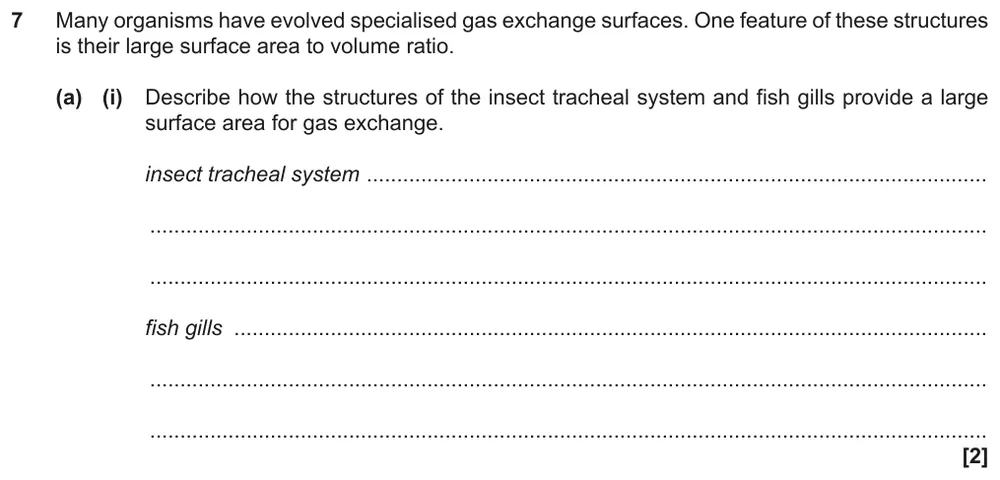
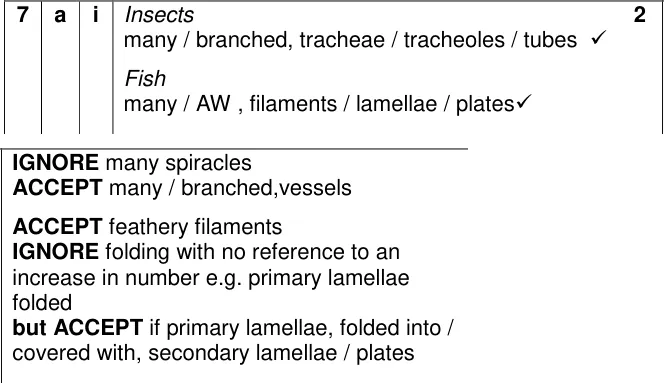
Describe how the insect tracheal system and fish gills provide a large surface area for gas exchange.
Show the mark scheme
Tap an image to open it full size.
From the examiners' report: Say 'many' or 'branched': many branched tracheoles in insects and many lamellae on the gill filaments in fish. Spiracles, tracheal fluid and counter-current flow don't explain a large surface area.
Question 8
A level Paper 3 · November 2021 · Q1(a) · 2 marks · Medium
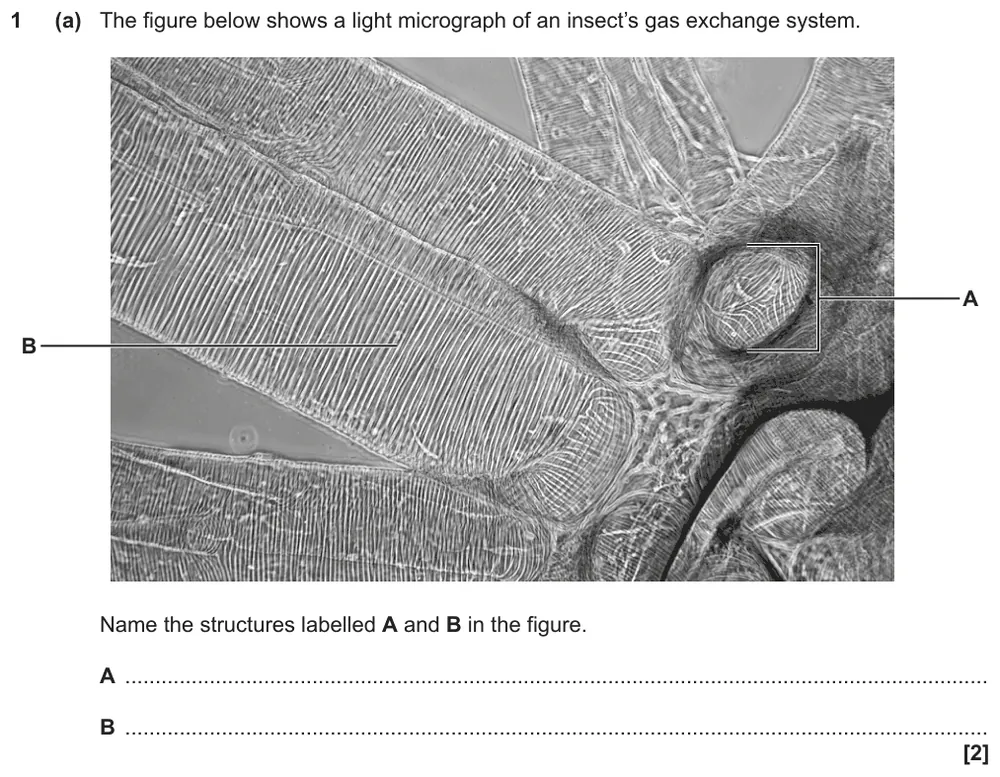
Name structures A and B on a light micrograph of an insect's gas exchange system.
Show the mark scheme

Tap an image to open it full size.
From the examiners' report: Most students spotted the spiracle, but fewer named B. A wide tube with rings of chitin is a trachea; tracheoles are the much finer branches.
Applying what you know
Question 9
A level Paper 3 · June 2017 · Q7(a)(ii) · 1 mark · Medium
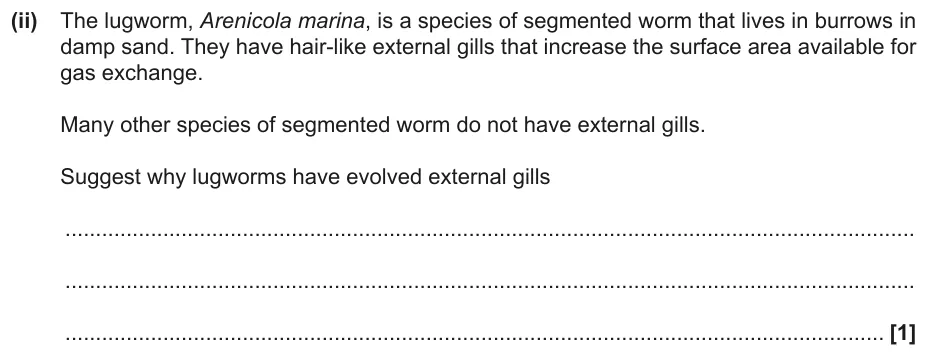
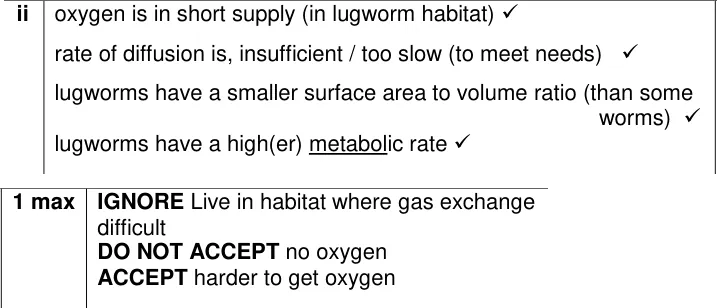
Suggest why lugworms, which live in burrows in damp sand, have evolved external gills.
Show the mark scheme
Tap an image to open it full size.
From the examiners' report: Say 'oxygen', not 'air' or 'gas', and link the gills to oxygen being in short supply in the burrow or to diffusion alone being too slow.
Question 10
AS Paper 1 · June 2018 · Q21(c)(ii) · 2 marks · Medium
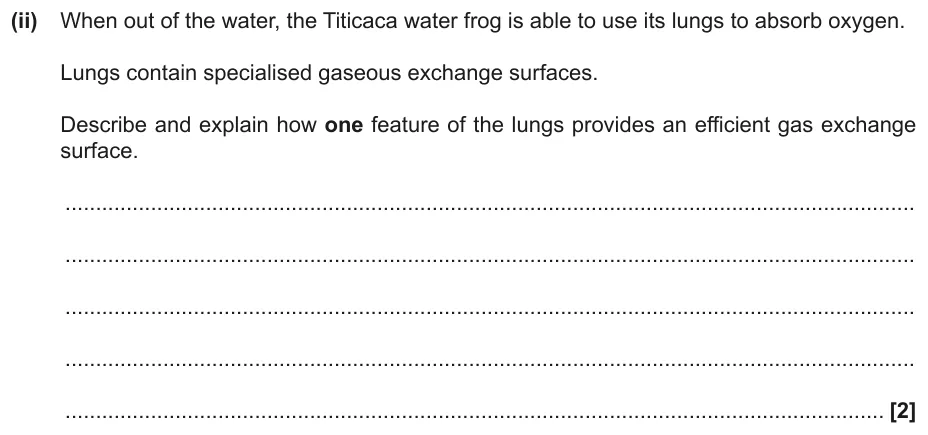
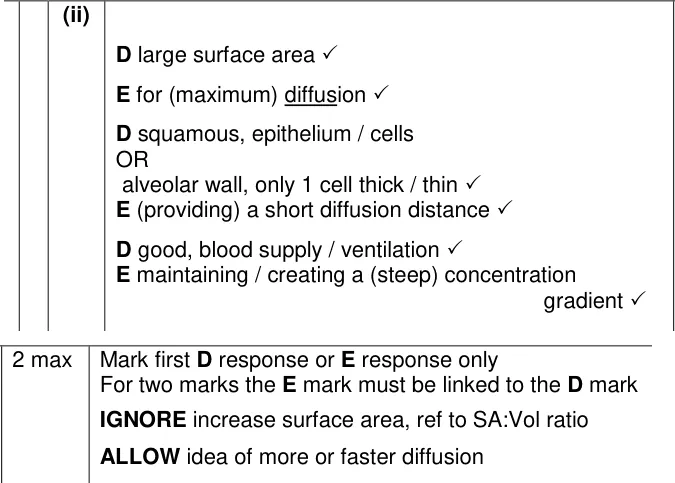
Describe and explain how one feature of the lungs provides an efficient gas exchange surface.
Show the mark scheme
Tap an image to open it full size.
From the examiners' report: Give one feature only, because the examiner marks the first one. 'Thin surface' is too vague: say the alveolar wall is one cell thick, then explain that this gives a short diffusion distance.
Question 11
A level Paper 1 · June 2018 · Q21(a)(ii) · 2 marks · Medium
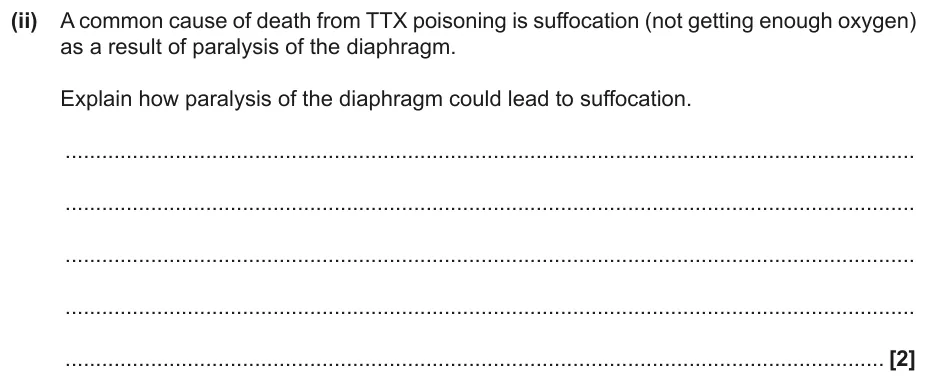
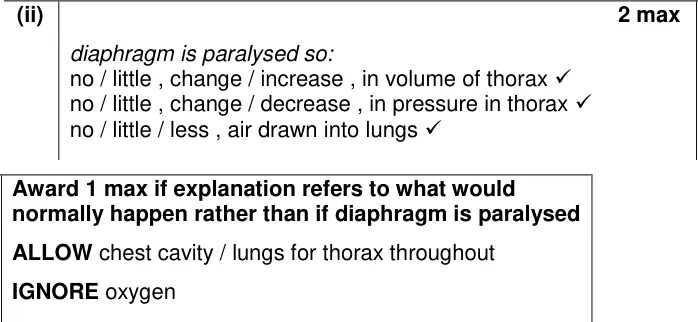
Explain how paralysis of the diaphragm by TTX could lead to suffocation.
Show the mark scheme
Tap an image to open it full size.
From the examiners' report: Describe what happens when the diaphragm can't contract (the thorax volume doesn't increase, so the pressure doesn't fall and less air is drawn in), not what happens during normal breathing.
Question 12
AS Paper 2 · June 2025 · Q5(d) · 4 marks · Medium
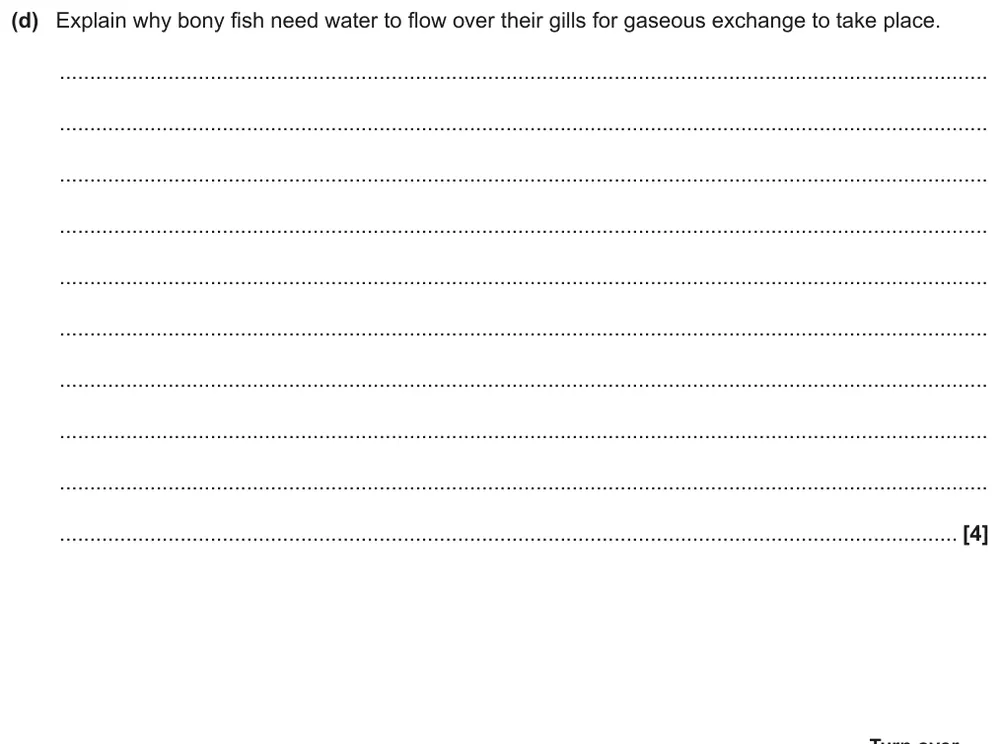
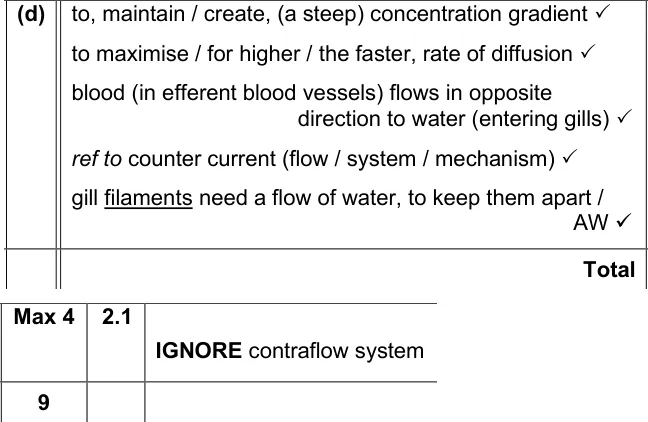
Explain why bony fish need water to flow over their gills for gas exchange.
Show the mark scheme
Tap an image to open it full size.
From the examiners' report: Answer the question asked: link the water flow to a steep concentration gradient and counter-current flow. Details of the operculum and pressure changes don't score here.
Ventilation and spirometer traces
Question 13
A level Paper 1 · June 2024 · Q20(a)(i) · 1 mark · Medium
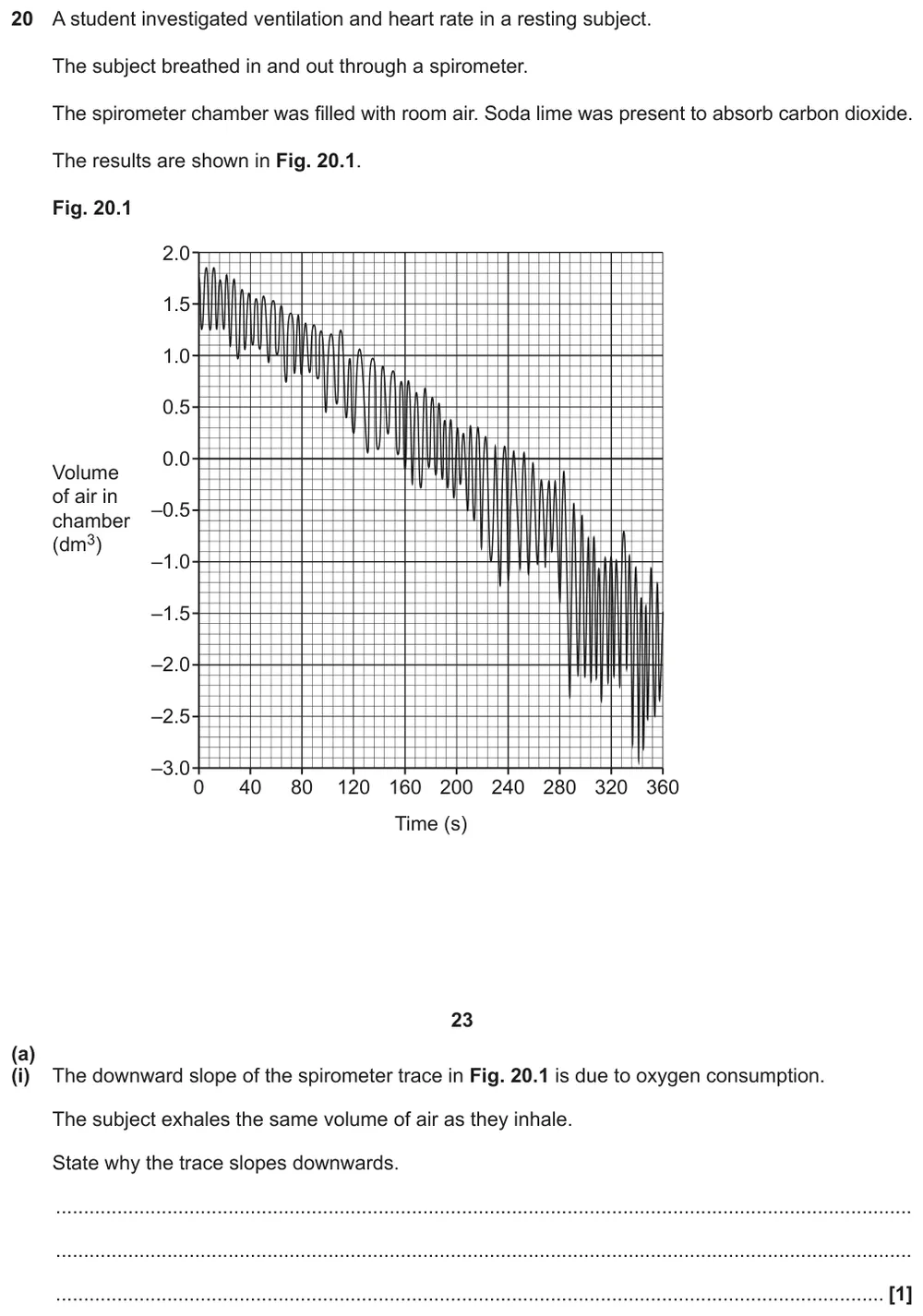
State why a spirometer trace slopes downwards when the subject breathes in and out the same volume.
Show the mark scheme

Tap an image to open it full size.
From the examiners' report: Most students scored here. Link the fall in volume to oxygen being used by the subject while the carbon dioxide they breathe out is absorbed by the soda lime.
Question 14
AS Paper 2 · June 2025 · Q6(b) · 1 mark · Hard
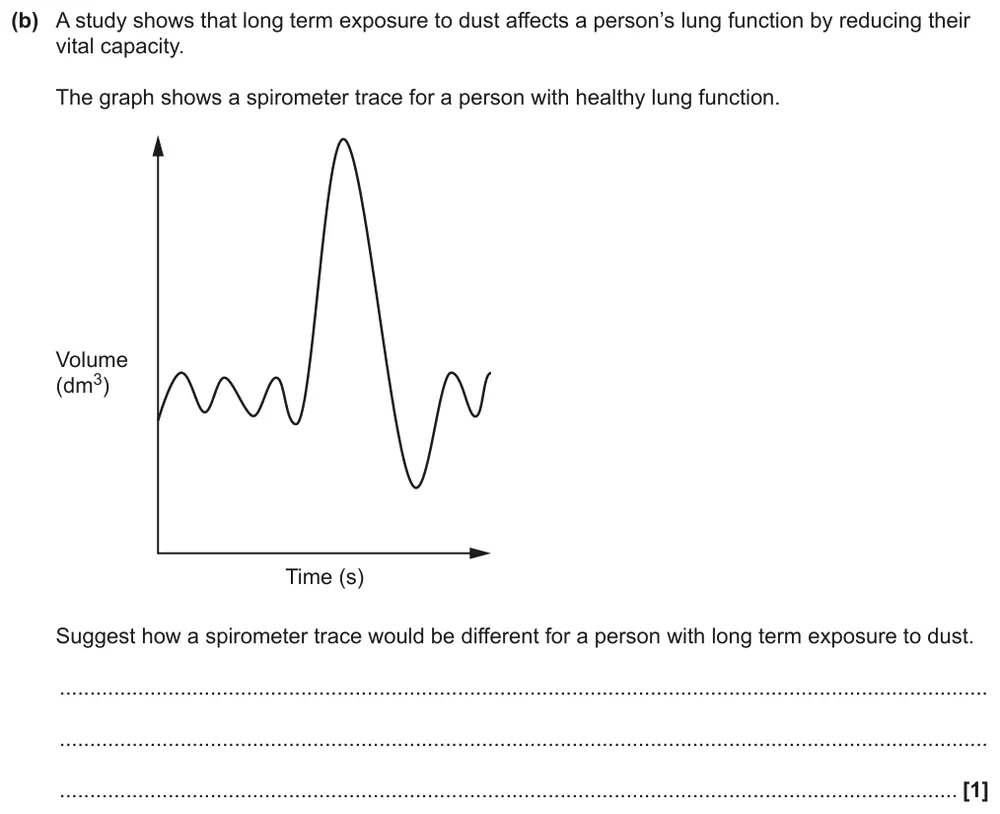
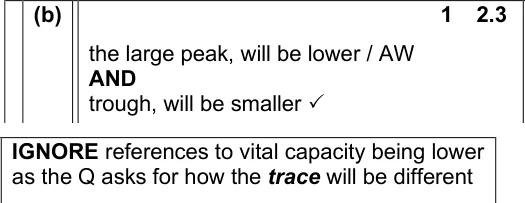
Suggest how a spirometer trace would differ for a person whose vital capacity is reduced by long-term dust exposure.
Show the mark scheme
Tap an image to open it full size.
From the examiners' report: Describe the line itself: the big peak would be lower and the deepest trough higher. Saying 'vital capacity would be lower' just repeats the question.
Question 15
AS Paper 2 · June 2025 · Q6(c) · 2 marks · Hard
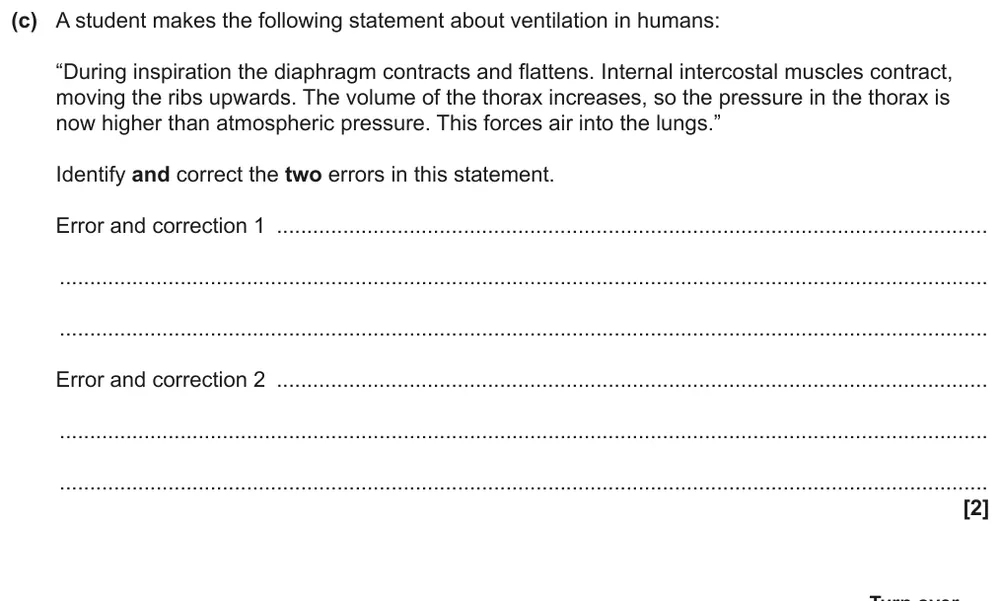
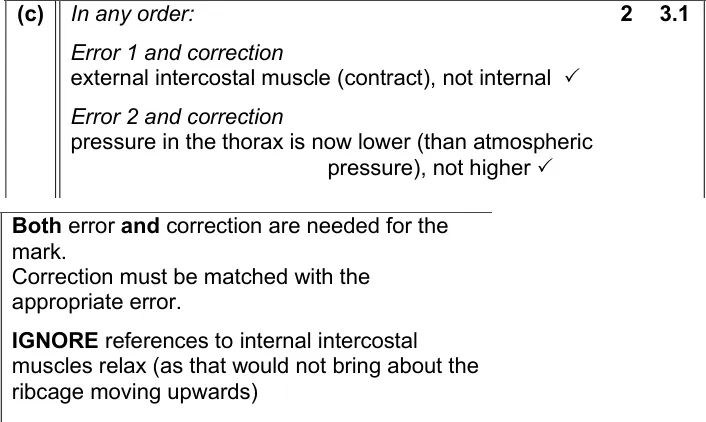
Identify and correct the two errors in a student's description of inspiration.
Show the mark scheme
Tap an image to open it full size.
From the examiners' report: Write both halves each time, for example 'internal is wrong; it is the external intercostal muscles that contract'. A correction on its own, or 'internal intercostals relax', doesn't score.
Question 16
AS Paper 2 · June 2025 · Q6(d) · 3 marks · Easy
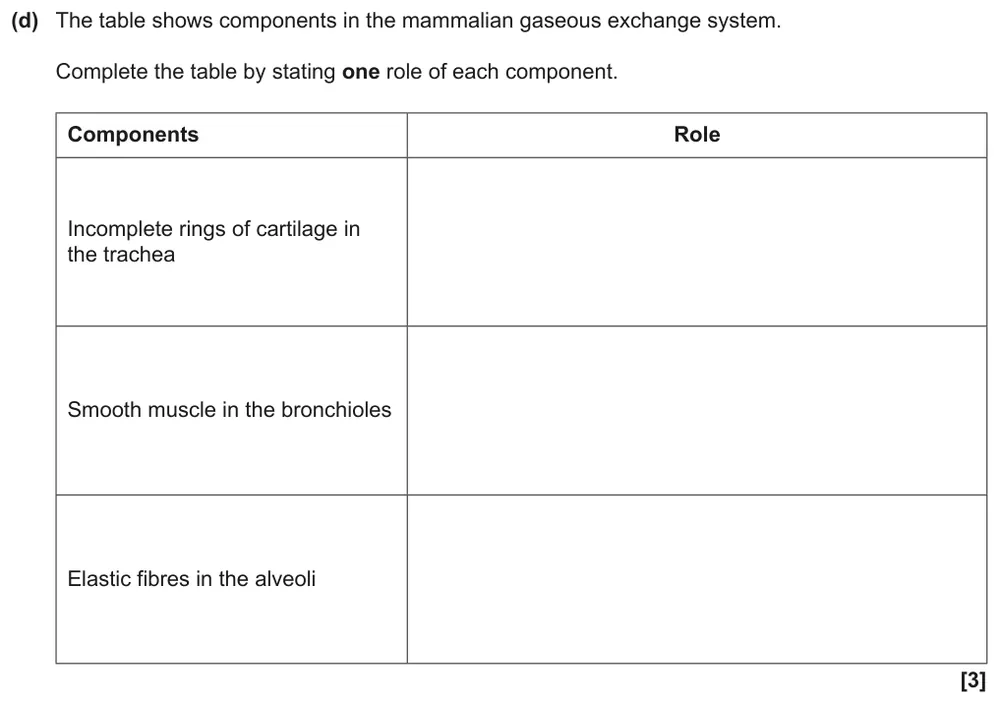
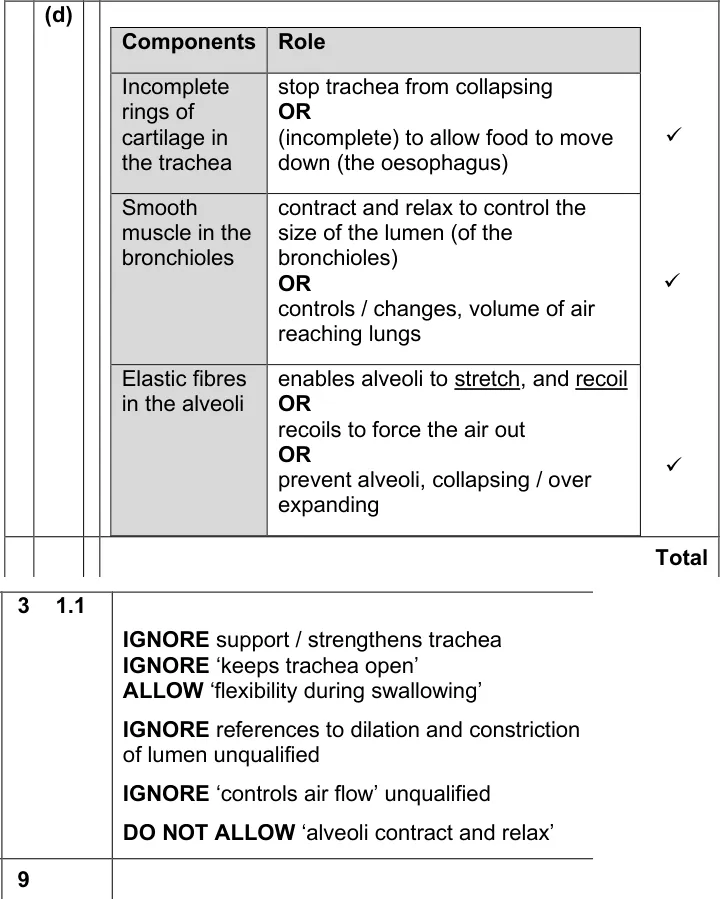
State one role of cartilage, smooth muscle and elastic fibres in the gaseous exchange system.
Show the mark scheme
Tap an image to open it full size.
From the examiners' report: Be precise: the smooth muscle (not the bronchiole) contracts and relaxes to change the lumen, and the elastic fibres let the alveoli stretch and then recoil.
Question 17
A level Paper 3 · November 2021 · Q1(b)(ii) · 1 mark · Hard
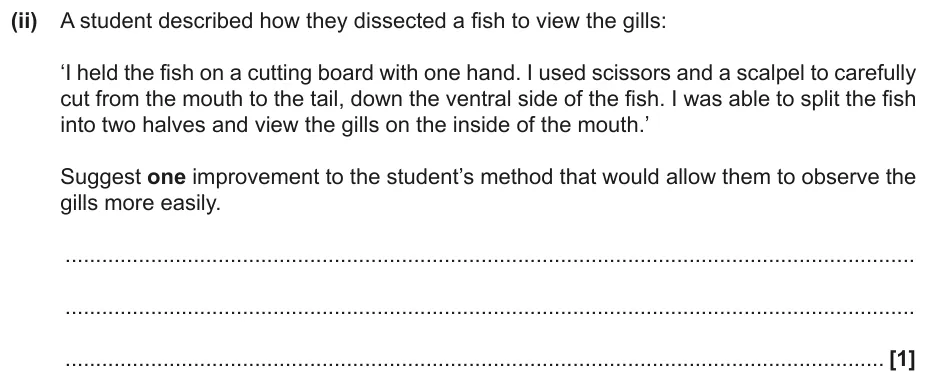
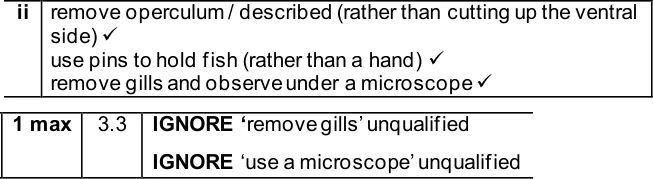
Suggest one improvement to a student's method for dissecting a fish to view the gills.
Show the mark scheme
Tap an image to open it full size.
From the examiners' report: Few students could suggest an improvement. Know the standard method: lift and cut away the operculum to expose the gills, and pin the fish down instead of holding it.
Where students lose marks (from OCR examiners' reports and mark schemes)
Each point below is followed by wording that gained marks.
Big organisms have a small SA:V: Explaining why multicellular organisms need an exchange surface, many students wrote that they have a large surface area to volume ratio, which is the wrong way round.
✔ Gains credit: "A low surface area to volume ratio, so the diffusion distance is too large and diffusion is too slow to meet demand".
Alveoli have no cell walls: "Thin cell wall" and "thin membrane" were not allowed, and "short diffusion pathway" was ignored because it is a property, not a feature of the alveoli.
✔ Gains credit: "The alveolar wall is one cell thick", "squamous epithelium" or "surrounded by a capillary network".
Smooth muscle, not just muscle: On the trachea micrograph, smooth muscle was often called skeletal or striated muscle, or just 'muscle', and cartilage was called collagen or elastic tissue.
✔ Gains credit: "A = smooth muscle (involuntary muscle); B = cartilage".
Cilia move mucus, not dust: Some students named 'cilia' or 'ciliated cells' instead of ciliated epithelial cells, said the mucus goes to the stomach, or said the cilia move dust and microbes.
✔ Gains credit: "Goblet cells secrete mucus" and "ciliated epithelial cells beat to move mucus up towards the throat".
Stretch and recoil, both words: In the table of roles, answers said the alveoli stretch without saying they recoil, or said the bronchioles themselves contract; 'alveoli contract and relax' was not allowed.
✔ Gains credit: "Elastic fibres let the alveoli stretch and recoil" and "smooth muscle contracts and relaxes to control the size of the lumen".
External intercostals lift the ribs: Correcting the inspiration statement, students wrote that the internal intercostals relax, or changed the thorax volume to 'decrease'; neither was credited, and a correction with no error named scored nothing.
✔ Gains credit: "Error: internal intercostals contract. Correction: external intercostal muscles contract" and "Error: pressure higher. Correction: pressure in the thorax is lower than atmospheric".
Many and branched, not spiracles: For a large surface area, answers mentioned spiracles, tracheal fluid or counter-current flow, or left out 'many' or 'branched'.
✔ Gains credit: "Many branched tracheae and tracheoles" in insects and "many gill filaments with lamellae" in fish.
Describe the trace, not the lung volume: Asked how a spirometer trace would differ after dust exposure, most students said vital capacity would be lower, which only repeats the question.
✔ Gains credit: "The large peak will be lower and the trough will be smaller".
Download the questions
Download the PDF pack (17 questions, mark schemes at the end)
Keep practising
- Exchange Surfaces quiz
- Geometry and SA:V (M4): OCR A Level Biology exam questions by topic
- PAG 2 Dissection: OCR A Level Biology exam questions by topic
- Transport in Animals (3.1.2): OCR A Level Biology exam questions by topic
- Exchange surfaces and ventilation: interactive written questions (20)
- OCR A Level Biology masterclasses
Questions, mark schemes and examiners' report extracts © OCR.