

Transport in animals is one of the biggest spec points in Year 12, and it turns up on every OCR A paper. Spec point 3.1.2 asks why animals need transport systems, how single, double, open and closed systems differ, and how arteries, arterioles, capillaries, venules and veins suit their jobs. It also covers tissue fluid, the structure of the heart and its dissection, the cardiac cycle, how the heartbeat is coordinated, ECG traces, and how haemoglobin carries oxygen and carbon dioxide.
The examiners' reports for these questions point to a handful of habits that cost marks. Students reverse the SA:V idea, can't say what oncotic pressure is, write 'brachycardia', or read a Bohr shift as an increase in affinity. In error-spotting questions they quote the student's text without saying what is wrong, and in calculations they divide instead of multiplying or give cardiac output in cm3/bpm.
Work through the twenty questions below in order. They start with recall of vessels, the heart and haemoglobin, move on to applying it to pressure graphs, ECGs and dissociation curves, and finish with a heart drawing and pregnancy data. If you'd like to go through questions like these with me each week, my OCR A masterclasses run on Wednesdays at 5.15pm for Year 12 and on Tuesdays at 6.30pm or Thursdays at 5.15pm for Year 13.
What you need from GCSE
Each question on this page assumes you're secure on these GCSE ideas. If any of them feels shaky, look it up before you start.
- The heart has four chambers: two atria and two ventricles. The right side pumps blood to the lungs and the left side pumps it to the body.
- Arteries carry blood away from the heart at high pressure, veins carry it back at low pressure and have valves, and capillaries are where substances are exchanged.
- Red blood cells contain haemoglobin, which carries oxygen from the lungs to the tissues.
- Larger organisms have a smaller surface area to volume ratio, so they need transport systems to move substances to and from their cells.
- The heart's natural pacemaker is a group of cells in the right atrium.
Key terms
These words come up in the questions and mark schemes. Examiners expect you to use them exactly.
- Single and double circulation: in a single circulation blood passes through the heart once per circuit of the body (fish); in a double circulation it passes through twice (mammals).
- Open and closed circulation: in a closed system blood stays inside vessels; in an open system (insects) haemolymph bathes the organs directly.
- Hydrostatic pressure: the pressure of the blood against the capillary wall, which pushes fluid out of the capillary.
- Oncotic pressure: the tendency of water to move into the blood by osmosis, because large plasma proteins give the blood a lower water potential.
- Cardiac output: the volume of blood pumped by the heart per minute: heart rate × stroke volume, in cm3 min−1.
- Myogenic: cardiac muscle contracts on its own without nervous stimulation; the beat starts at the sino-atrial node (SAN).
- SAN, AVN and Purkyne fibres: the SAN starts a wave of excitation across the atria; the AVN delays it and passes it down the bundle of His to the Purkyne fibres in the ventricle walls.
- Tachycardia, bradycardia: a resting heart rate faster than 100 beats per minute; a resting heart rate slower than 60 beats per minute.
- Affinity: how strongly haemoglobin binds oxygen. Fetal haemoglobin has a higher affinity than adult haemoglobin.
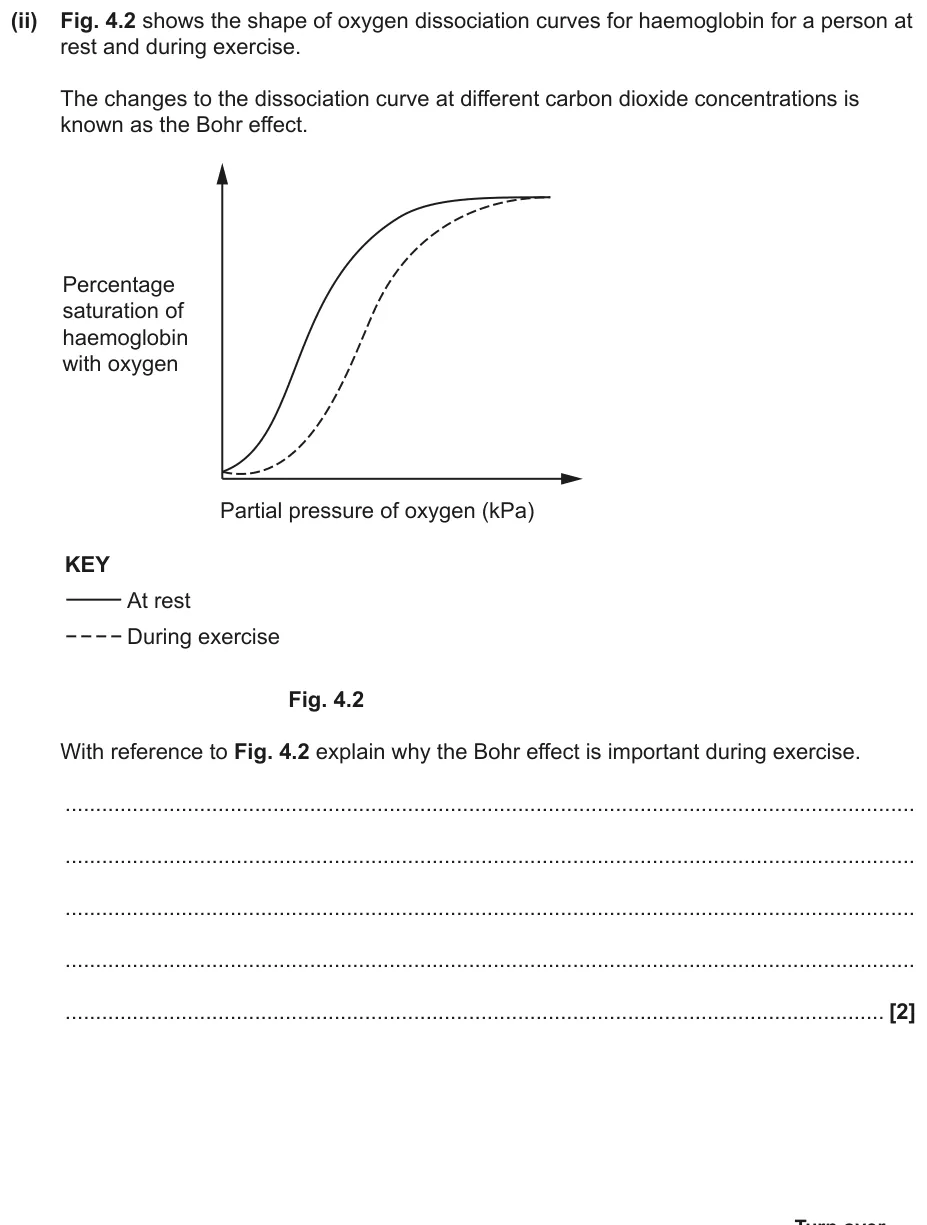
- Bohr effect: more carbon dioxide lowers haemoglobin's affinity for oxygen, shifting the dissociation curve to the right so oxygen is released more readily.
What these questions cover (OCR 3.1.2)
The questions test these learning outcomes from the OCR A Level Biology A specification (H420):
- (a) the need for transport systems in multicellular animals
- (b) the different types of circulatory systems (single, double, open and closed)
- (c) the structure and functions of arteries, arterioles, capillaries, venules and veins
- (d) the formation of tissue fluid from plasma (hydrostatic and oncotic pressure)
- (e)(i) the external and internal structure of the mammalian heart
- (e)(ii) the dissection, examination and drawing of the external and internal structure of the mammalian heart (PAG2)
- (f) the cardiac cycle (including cardiac output = heart rate × stroke volume)
- (g) how heart action is initiated and coordinated
- (h) the use and interpretation of electrocardiogram (ECG) traces (tachycardia, bradycardia, fibrillation and ectopic heartbeat)
- (i) the role of haemoglobin in transporting oxygen and carbon dioxide (including carbonic anhydrase and the chloride shift)
- (j) the oxygen dissociation curve for fetal and adult human haemoglobin (including the Bohr effect)
How to use this page
Write your answer on paper before you open the mark scheme. Allow about 1.2 minutes per mark: the 20 questions are worth 49 marks, so about 59 minutes in total. Then mark your answer strictly against the mark scheme and read the examiners' tip underneath it. If you'd rather print the questions, download the PDF pack.
Recall
Question 1
AS Paper 1 · June 2025 · Q25(a) · 2 marks · Easy
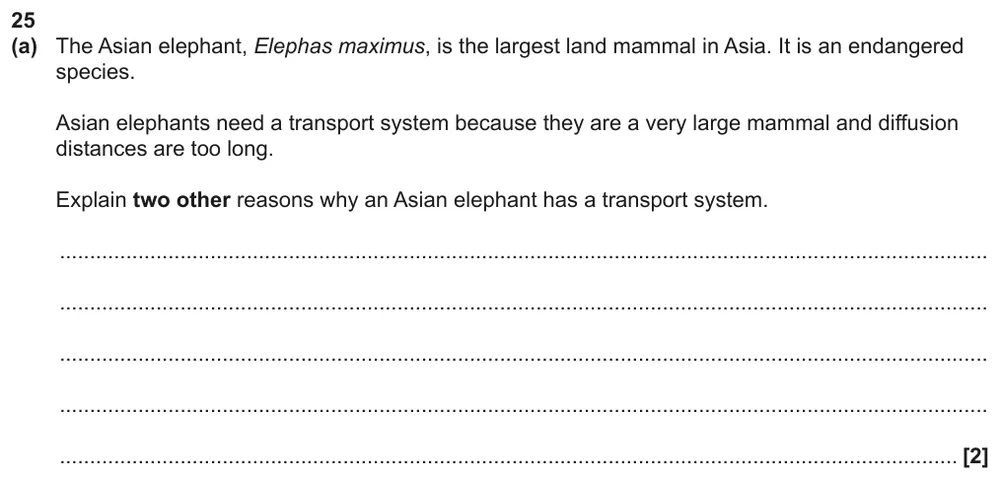
Explain two reasons, other than long diffusion distances, why an Asian elephant needs a transport system.
Show the mark scheme
Tap an image to open it full size.
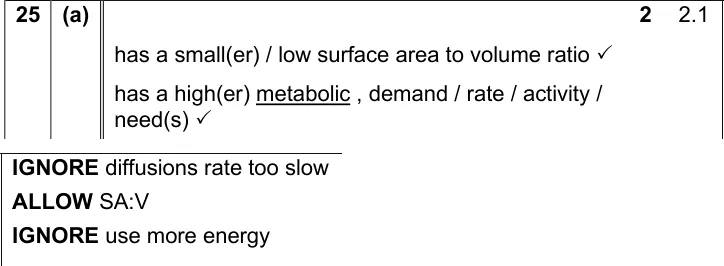
From the examiners' report: Most students scored both marks, but some wrote that a large animal has a large SA:V. It is small, and pair it with a high metabolic rate.
Question 2
A level Paper 3 · June 2022 · Q4(a)(ii) · 2 marks · Easy
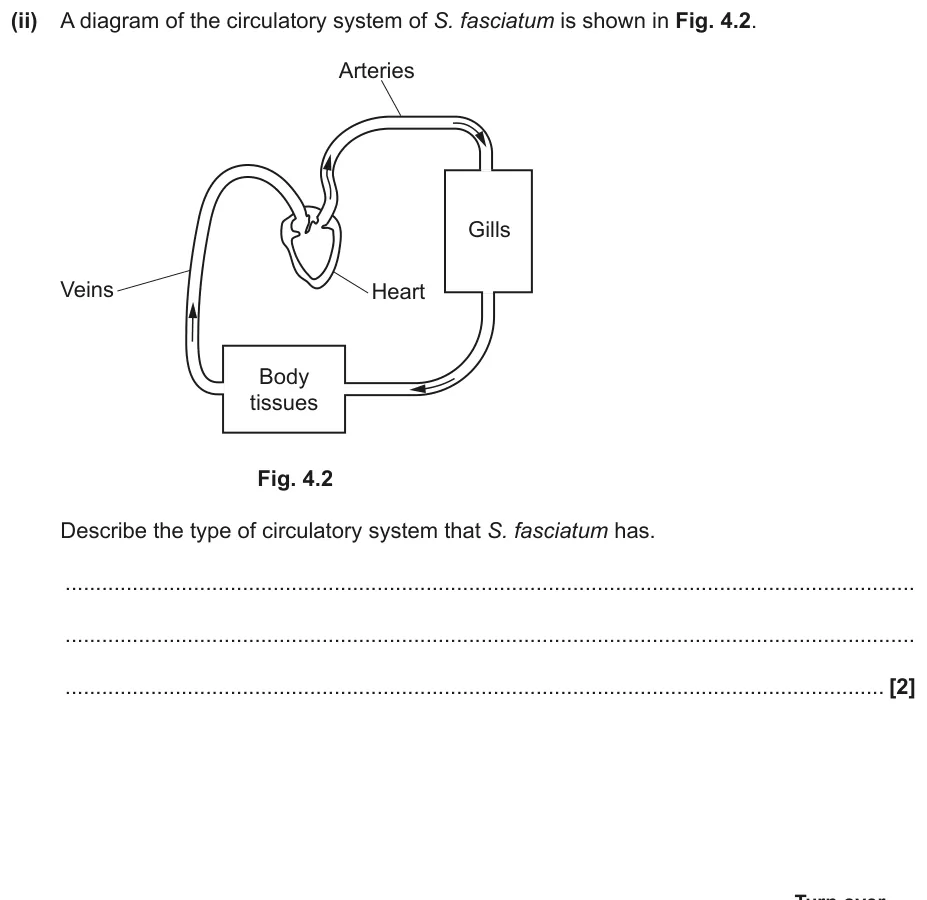
Describe the type of circulatory system shown for the zebra shark.
Show the mark scheme

Tap an image to open it full size.
From the examiners' report: Most students described it as single and closed. Give both words: single because blood passes through the heart once per circuit, and closed because it stays in vessels.
Question 3
A level Paper 3 · June 2022 · Q2(d)(i) · 2 marks · Easy
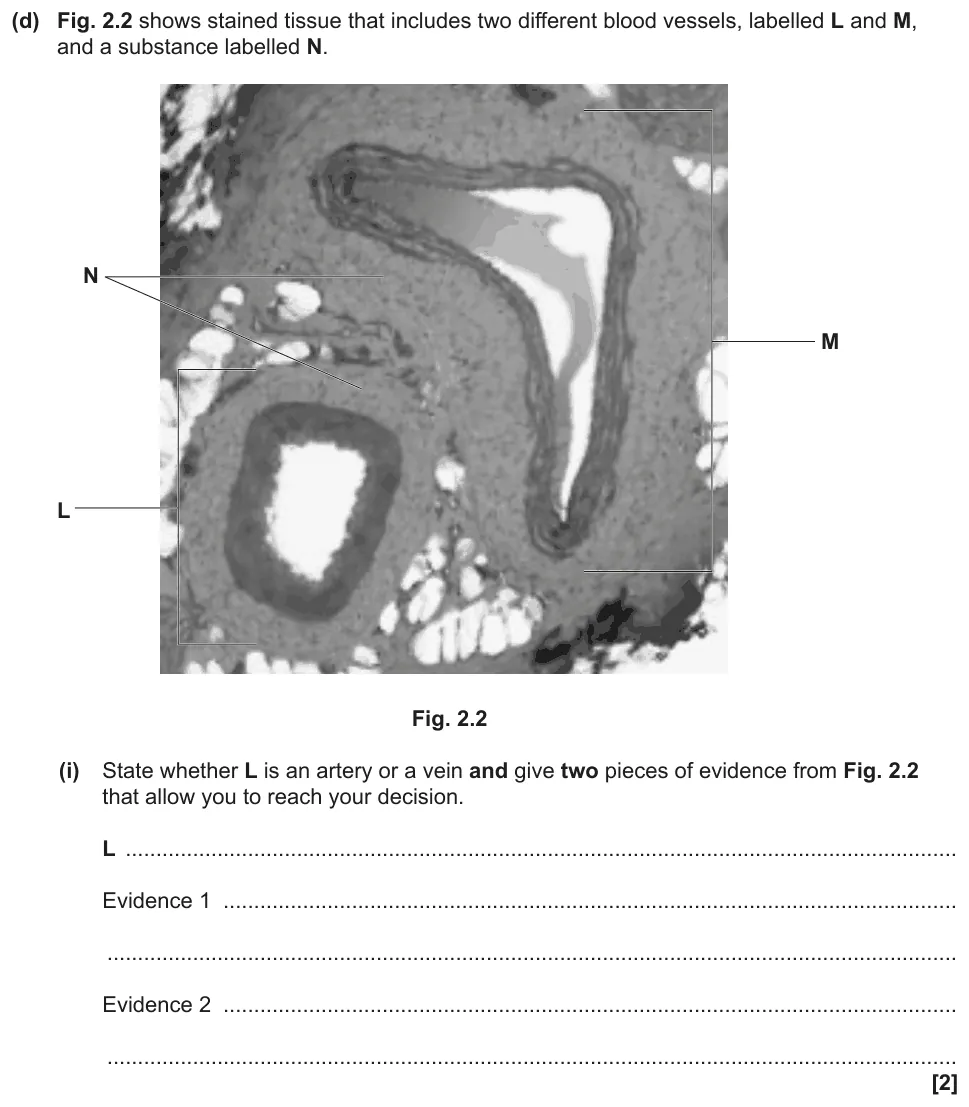
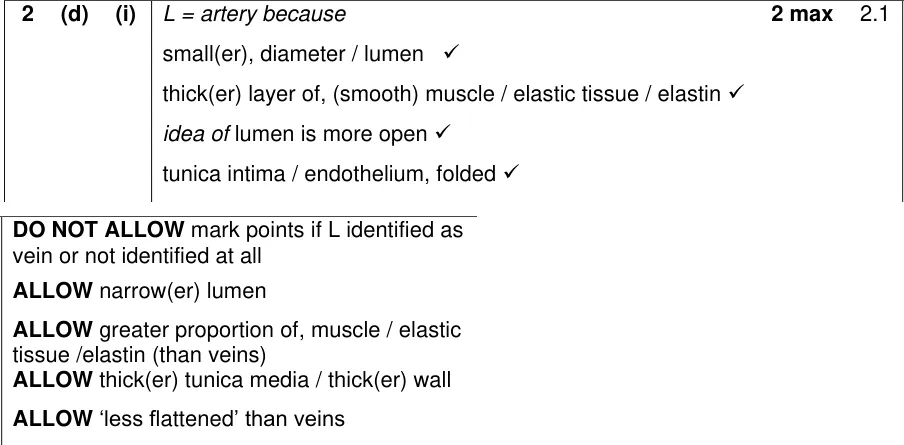
Decide whether vessel L in a stained tissue section is an artery or a vein and give two pieces of evidence.
Show the mark scheme
Tap an image to open it full size.
From the examiners' report: Say 'a thicker layer of smooth muscle' or 'a thicker wall', not just 'thick smooth muscle', and only use features you can see: valves aren't visible here.
Question 4
AS Paper 2 · June 2024 · Q4(b)(i) · 2 marks · Medium
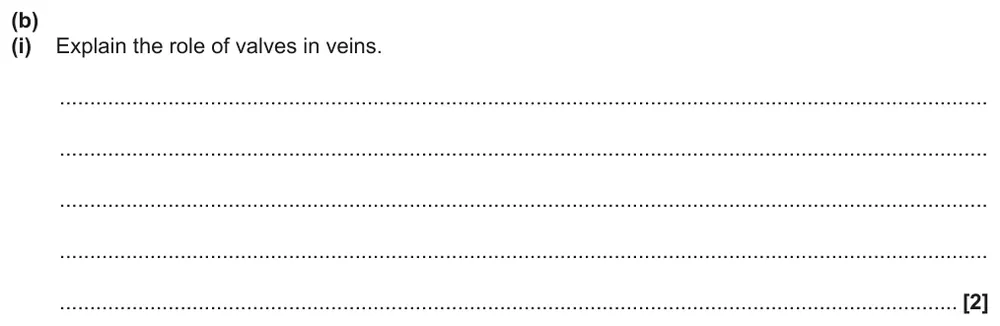
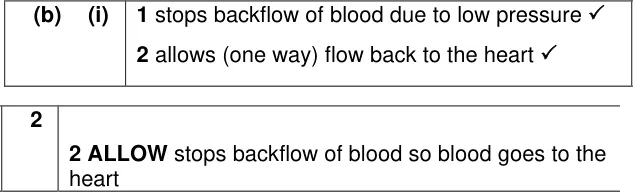
Explain the role of valves in veins.
Show the mark scheme
Tap an image to open it full size.
From the examiners' report: Don't just state that valves stop backflow. Explain it: blood in veins is at low pressure, so valves keep it flowing one way, back to the heart.
Question 5
AS Paper 1 · June 2022 · Q23(a)(iii) · 1 mark · Medium
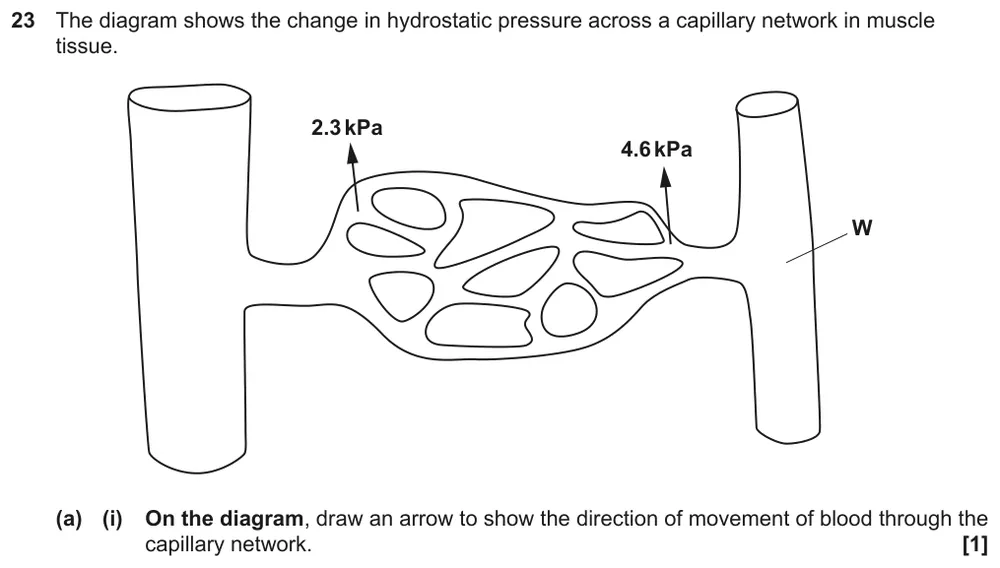
Name the vessel labelled W that carries blood into a capillary network.
Information from earlier in this question:

Show the mark scheme

Tap an image to open it full size.
From the examiners' report: Few students knew this. The small vessel leading into a capillary bed is an arteriole; 'artery', 'vein' or 'blood vessel' don't score.
Question 6
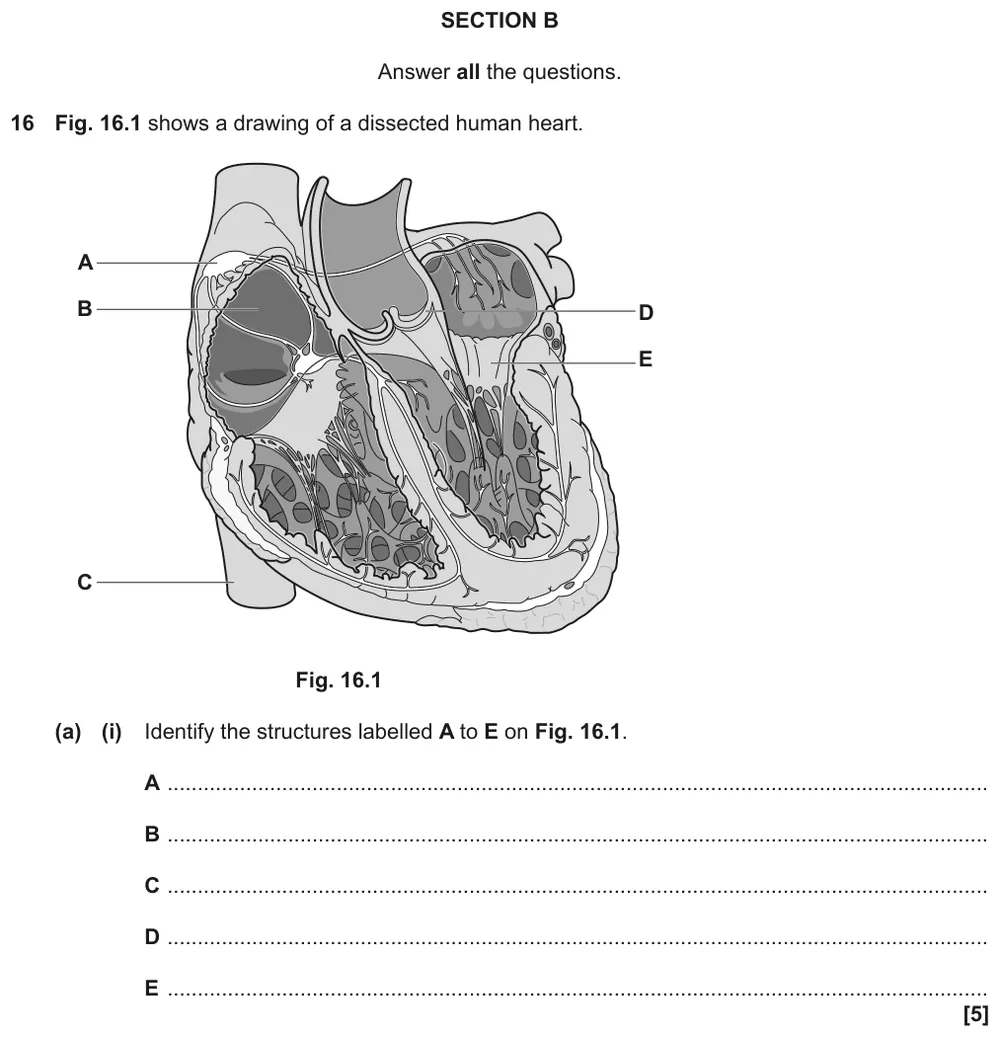
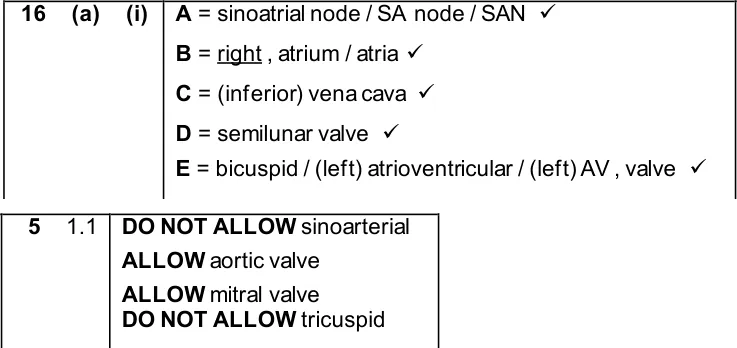
A level Paper 1 · November 2021 · Q16(a)(i) · 5 marks · Medium
Identify the structures labelled A to E on a drawing of a dissected human heart.
Show the mark scheme
Tap an image to open it full size.
Question 7
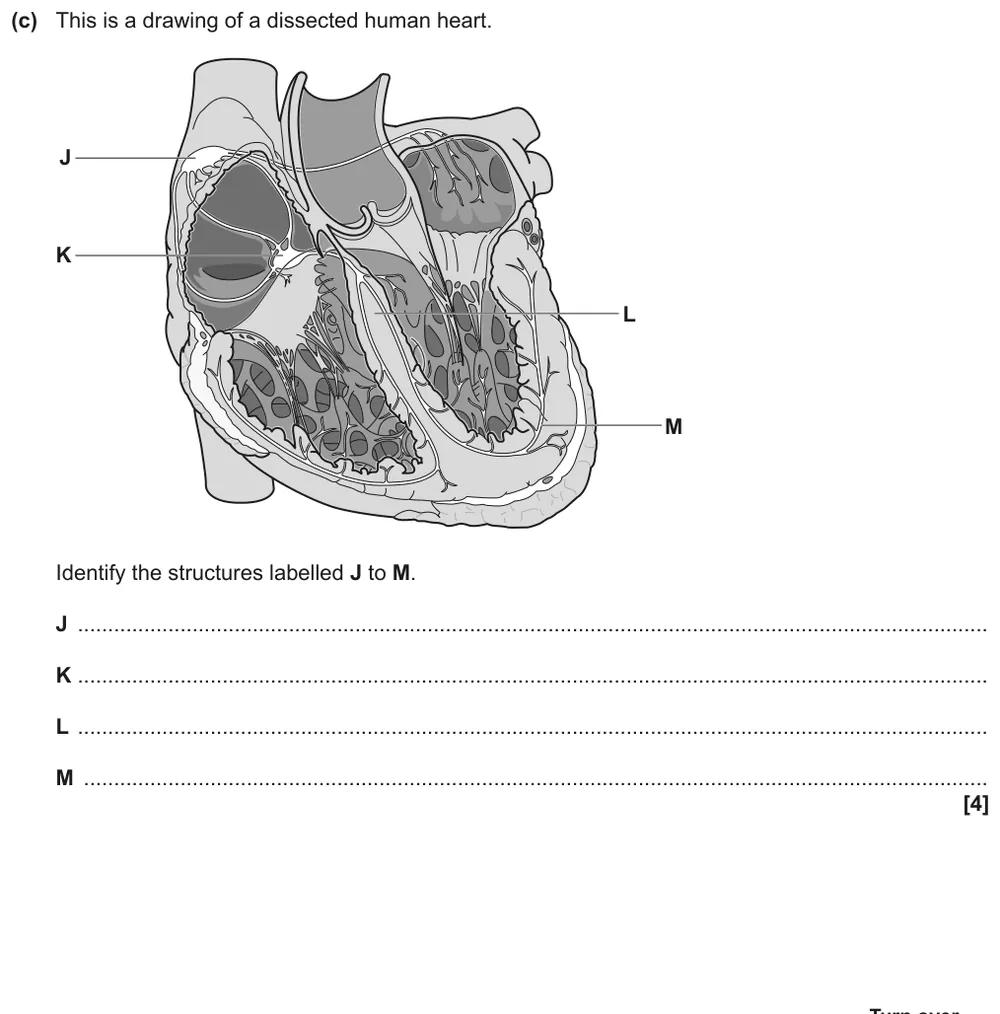
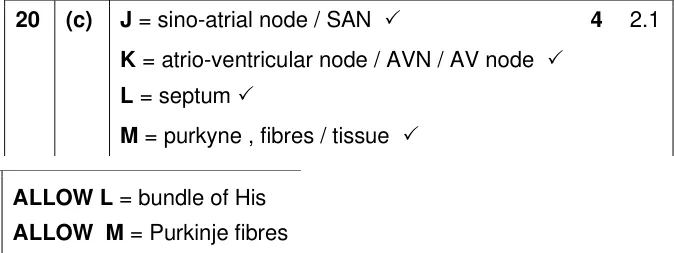
A level Paper 1 · June 2025 · Q20(c) · 4 marks · Medium
Identify the structures labelled J to M on a drawing of a dissected human heart.
Show the mark scheme
Tap an image to open it full size.
From the examiners' report: Most students named all four. Some swapped L and M: the bundle of His runs down the septum, and the Purkyne fibres spread through the ventricle walls.
Question 8
A level Paper 3 · June 2022 · Q6(b) · 3 marks · Medium
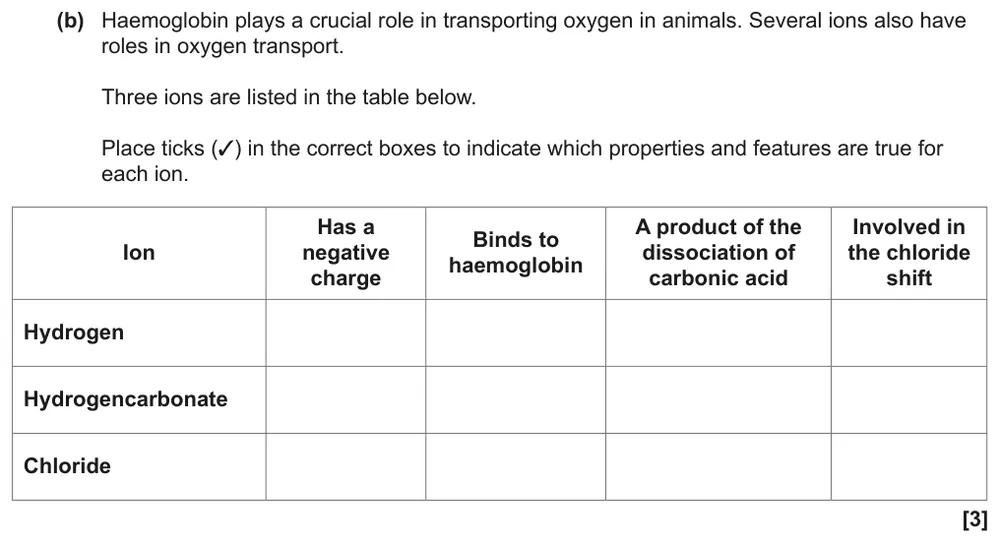
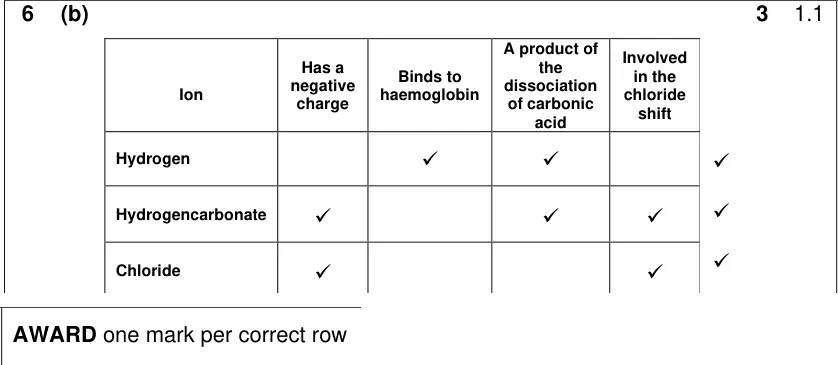
Tick which properties apply to hydrogen, hydrogencarbonate and chloride ions in oxygen transport.
Show the mark scheme
Tap an image to open it full size.
From the examiners' report: Remember that hydrogen ions bind to haemoglobin, and that hydrogencarbonate ions leaving the red blood cell are half of the chloride shift.
Applying what you know
Question 9
A level Paper 1 · June 2025 · Q21(a)(ii) · 3 marks · Medium
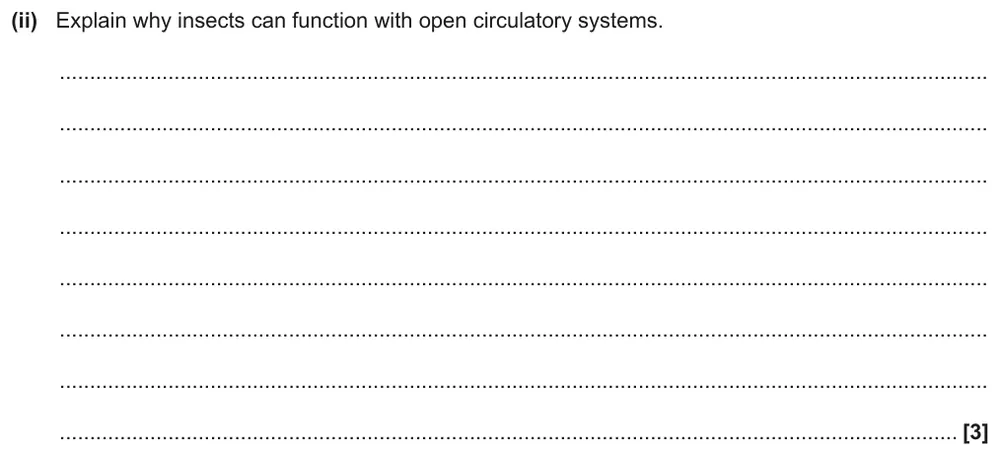
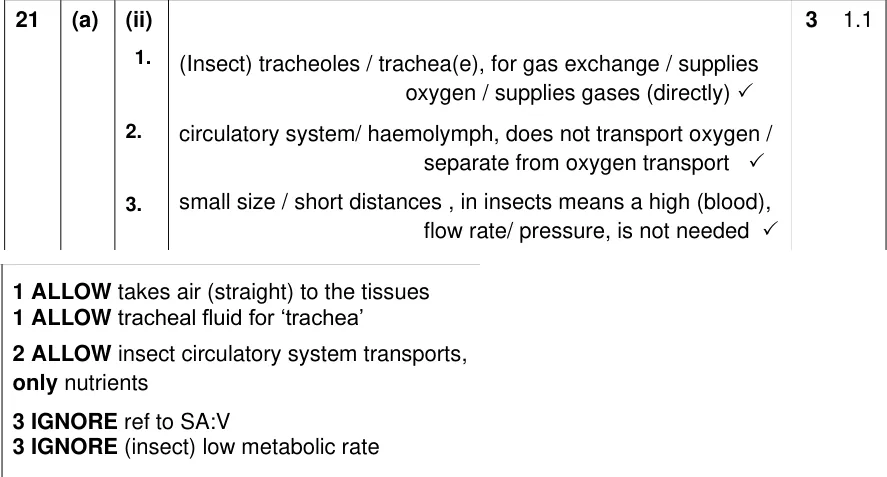
Explain why insects can function with open circulatory systems.
Show the mark scheme
Tap an image to open it full size.
From the examiners' report: The key idea is that insects get oxygen through their tracheal system, so their blood doesn't carry it. Don't say insects have a low metabolic rate: in flight it can be very high.
Question 10
AS Paper 1 · June 2022 · Q23(b) · 3 marks · Hard
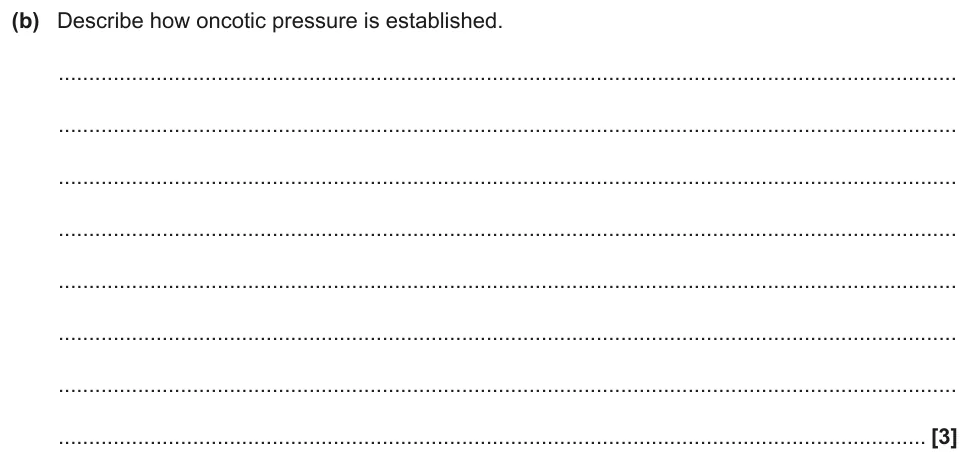
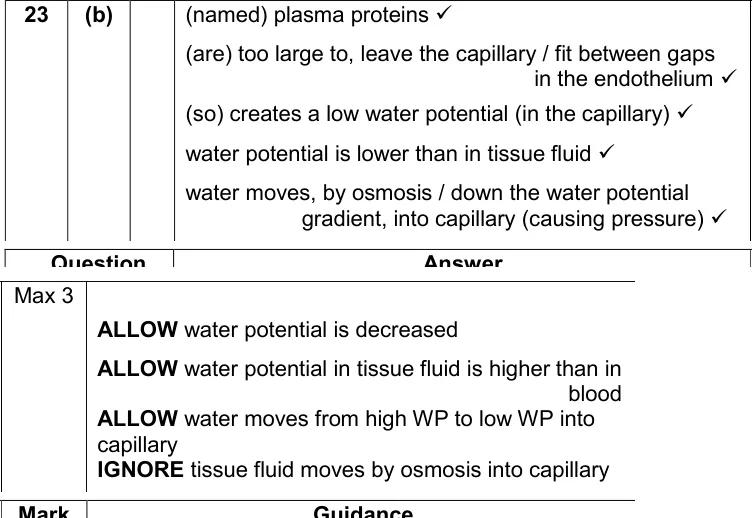
Describe how oncotic pressure is established.
Show the mark scheme
Tap an image to open it full size.
From the examiners' report: Very few students could explain oncotic pressure. Build it in steps: large plasma proteins stay in the blood, so the blood has a lower water potential than the tissue fluid, so water moves back in by osmosis.
Question 11
AS Paper 2 · June 2018 · Q4(a)(ii) · 2 marks · Medium
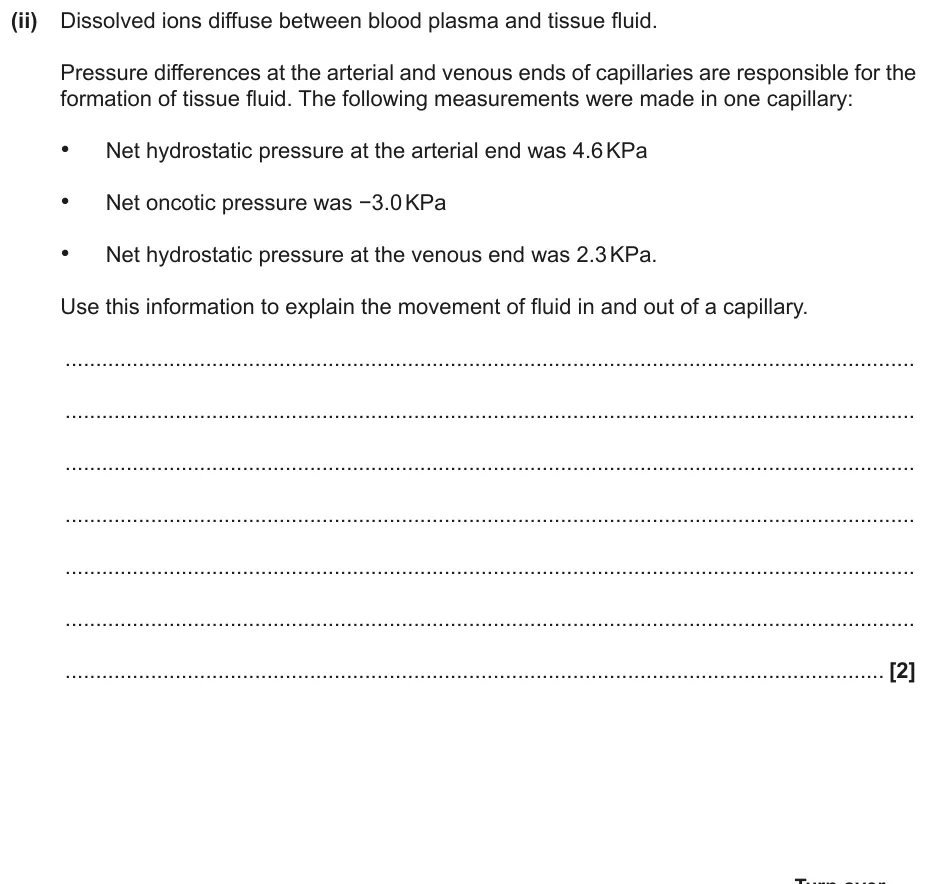
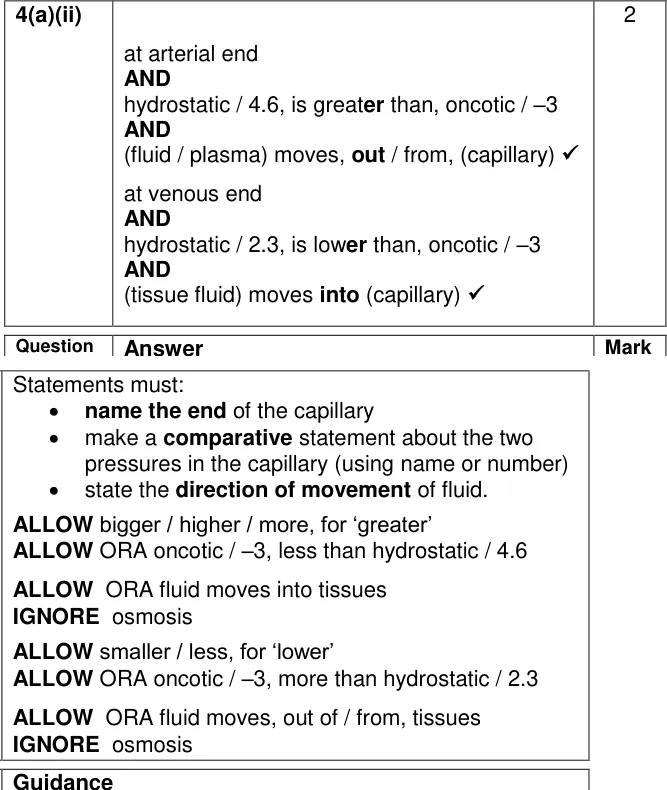
Use hydrostatic and oncotic pressure values to explain fluid movement in and out of a capillary.
Show the mark scheme
Tap an image to open it full size.
From the examiners' report: Use the numbers. For each end of the capillary, compare hydrostatic with oncotic pressure and say which way the fluid moves; ignoring oncotic pressure scored nothing.
Question 12
A level Paper 1 · June 2018 · Q21(a)(iii) · 3 marks · Medium
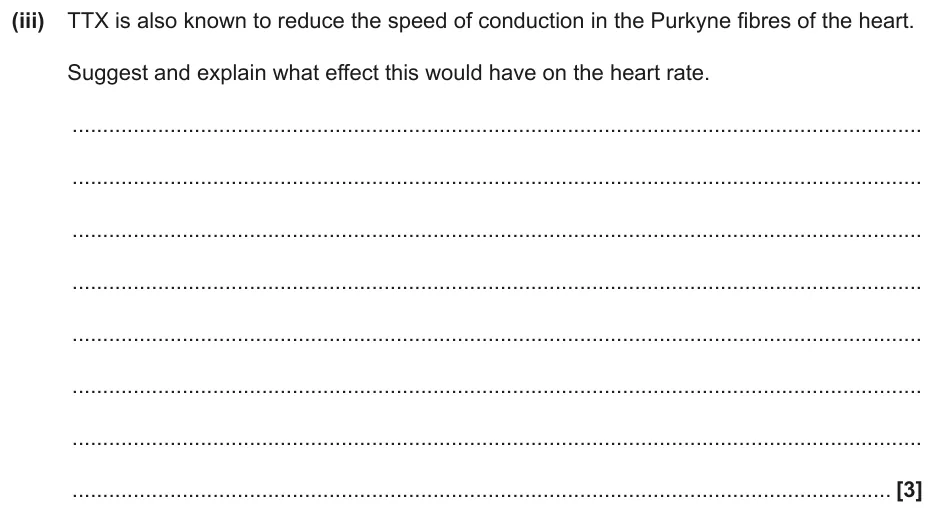
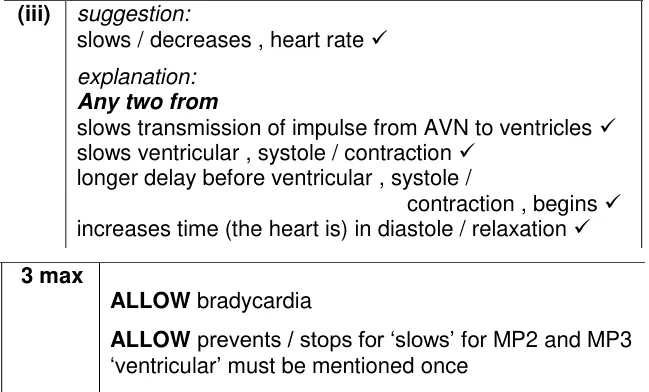
Suggest and explain the effect on heart rate of slower conduction in the Purkyne fibres.
Show the mark scheme
Tap an image to open it full size.
From the examiners' report: Say the heart rate falls, then explain it in terms of the ventricles: the impulse reaches them more slowly, so there is a longer delay before ventricular systole.
Question 13
AS Paper 2 · June 2022 · Q3(c) · 3 marks · Medium
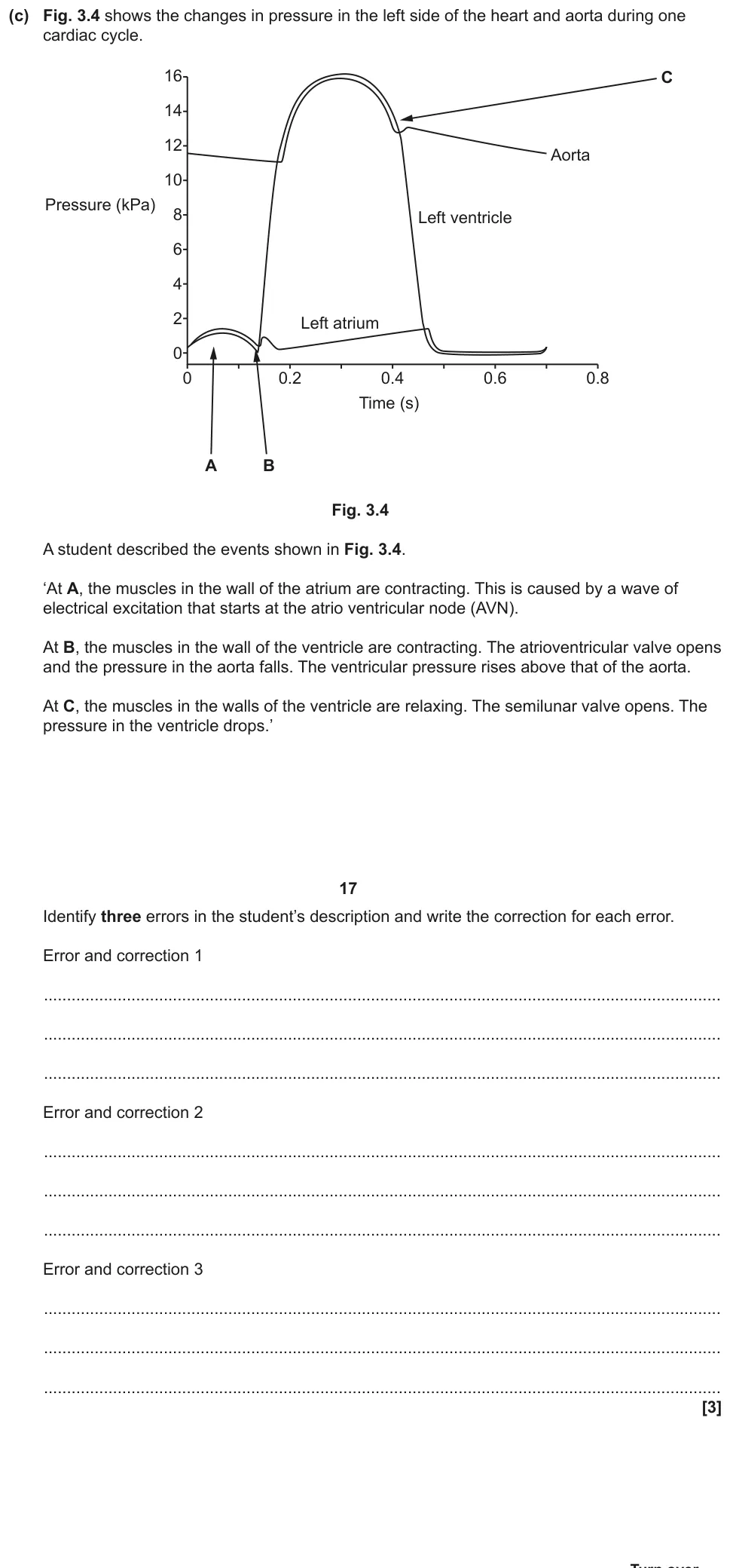
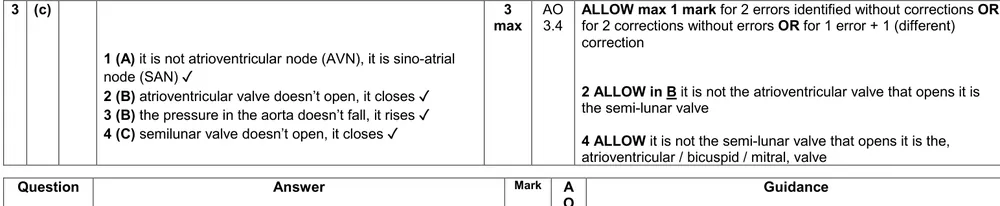
Identify and correct three errors in a student's description of a pressure graph for the cardiac cycle.
Show the mark scheme
Tap an image to open it full size.
From the examiners' report: Set each answer out as 'Error: … Correction: …'. Long quotes from the description without saying what is wrong, or a correction with no error, lost marks.
Question 14
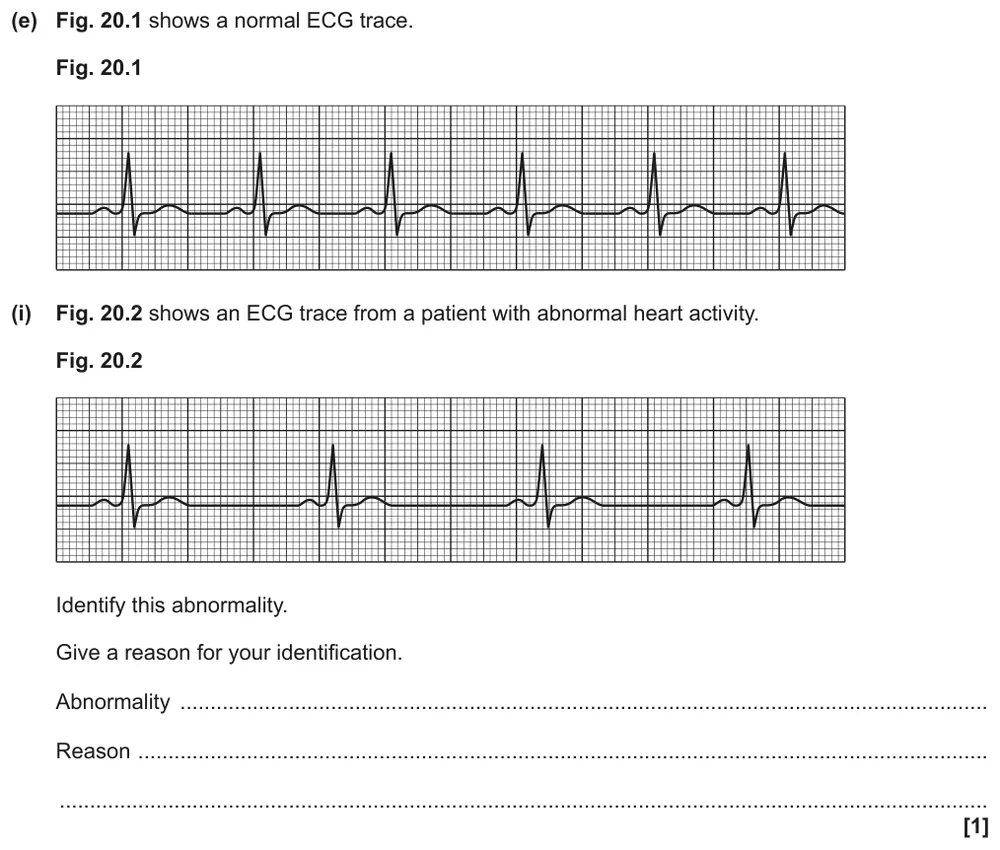
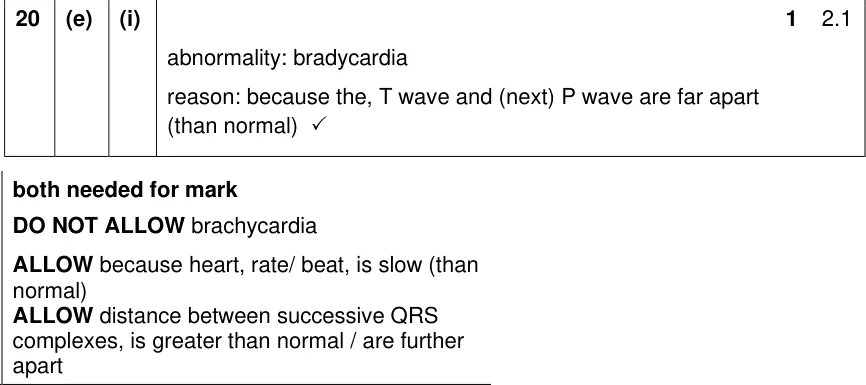
A level Paper 1 · June 2025 · Q20(e)(i) · 1 mark · Medium
Identify the abnormality shown on an ECG trace and give a reason.
Show the mark scheme
Tap an image to open it full size.
From the examiners' report: Spell it bradycardia ('brady' means slow; 'brachy' means short), and give a reason from the trace, such as the beats being further apart.
Question 15
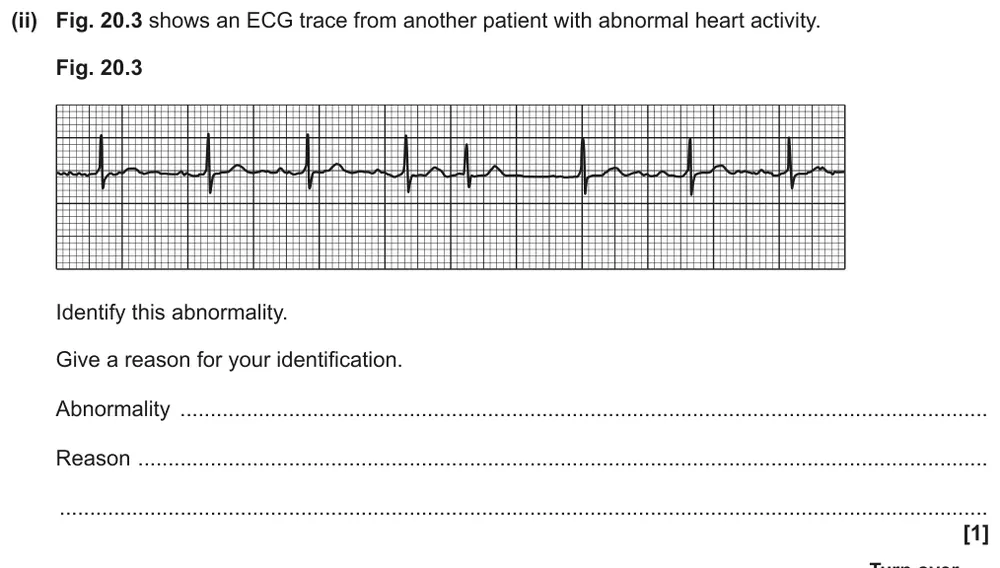
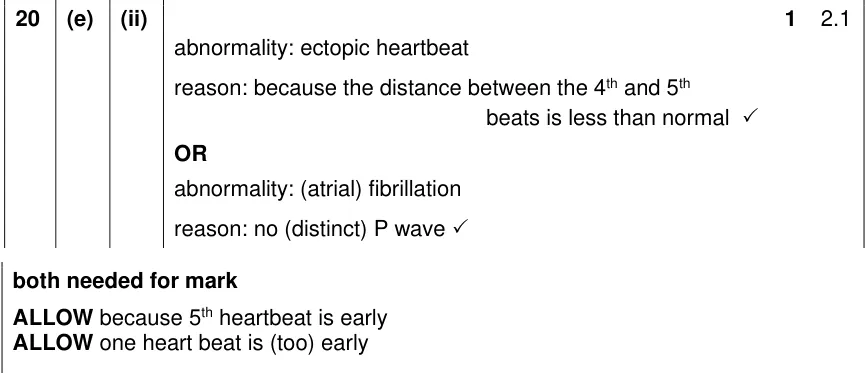
A level Paper 1 · June 2025 · Q20(e)(ii) · 1 mark · Medium
Identify a second ECG abnormality and give a reason from the trace.
Show the mark scheme
Tap an image to open it full size.
From the examiners' report: Look at the whole pattern of beats, not one wave. Many students named the abnormality but gave a wrong reason, such as too many beats or a missing T wave.
Question 16
AS Paper 2 · June 2022 · Q4(d)(ii) · 2 marks · Medium
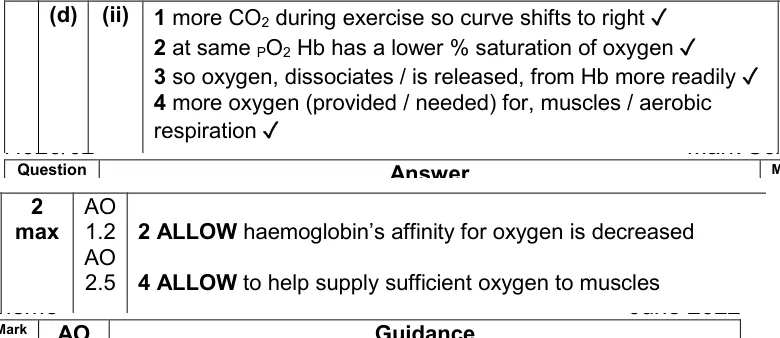
Explain why the Bohr effect is important during exercise, using dissociation curves at rest and during exercise.
Show the mark scheme
Tap an image to open it full size.
From the examiners' report: Read the graph carefully: during exercise the curve moves right, so haemoglobin's affinity for oxygen decreases, not increases, and it releases oxygen more readily to respiring muscles.
Practical, maths and data
Question 17
AS Paper 1 · June 2023 · Q26(a) · 3 marks · Hard
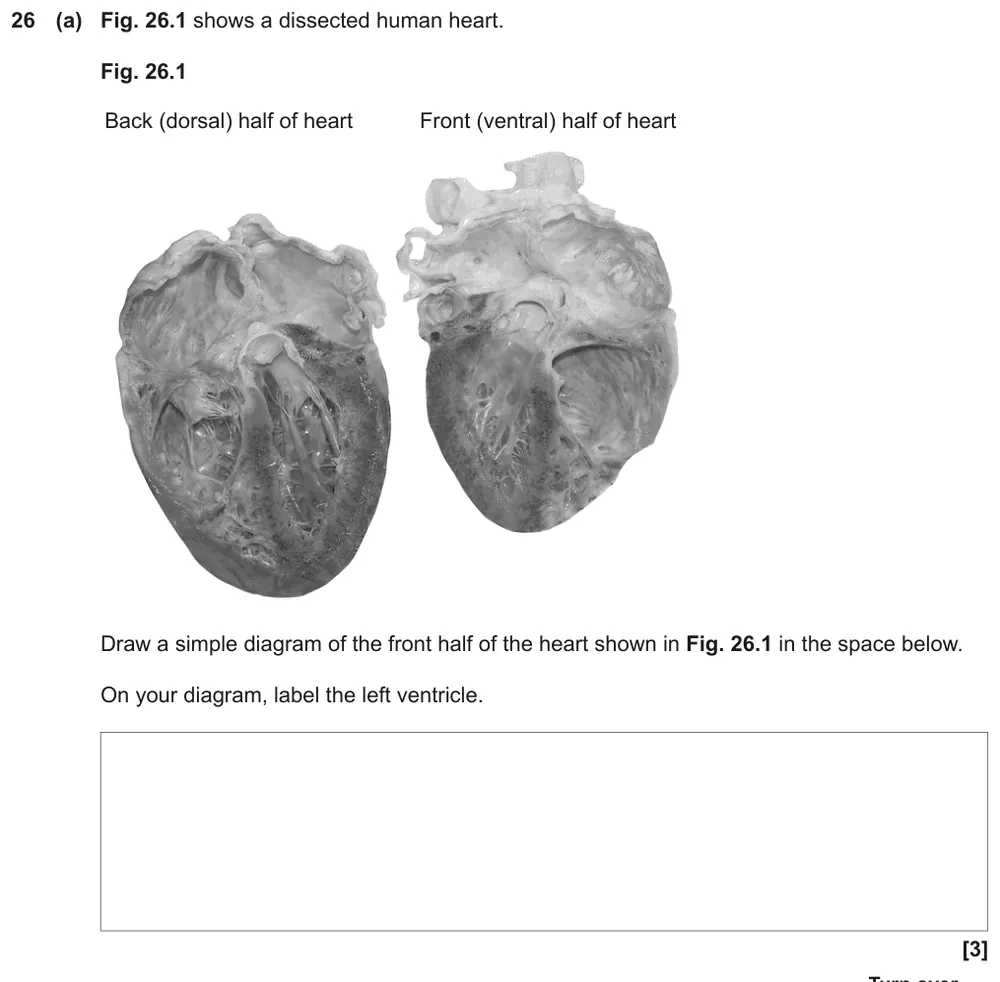
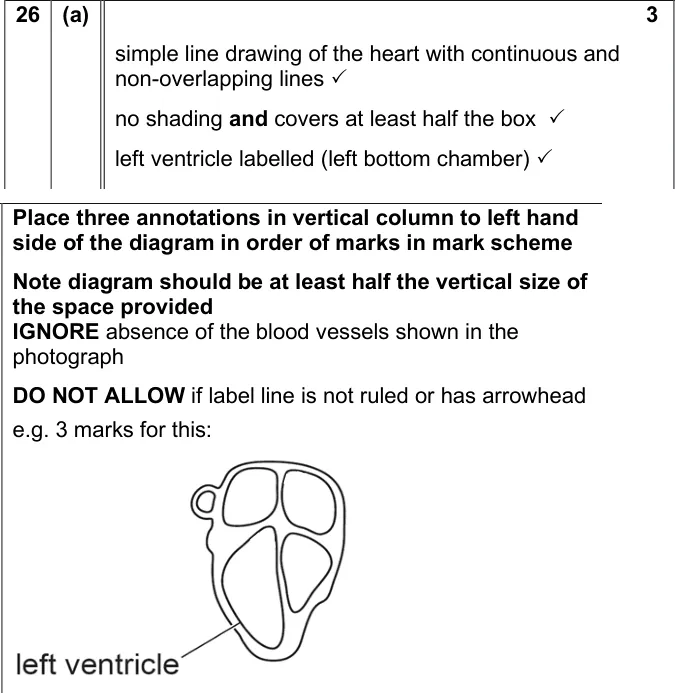
Draw a simple diagram of the front half of a dissected heart and label the left ventricle.
Show the mark scheme
Tap an image to open it full size.
From the examiners' report: Draw clean, continuous lines with no shading, rule the label line without an arrowhead, and work out the left side from the specimen: it isn't always on the right of the page.
Question 18
A level Paper 1 · June 2023 · Q16(a)(i) · 3 marks · Hard
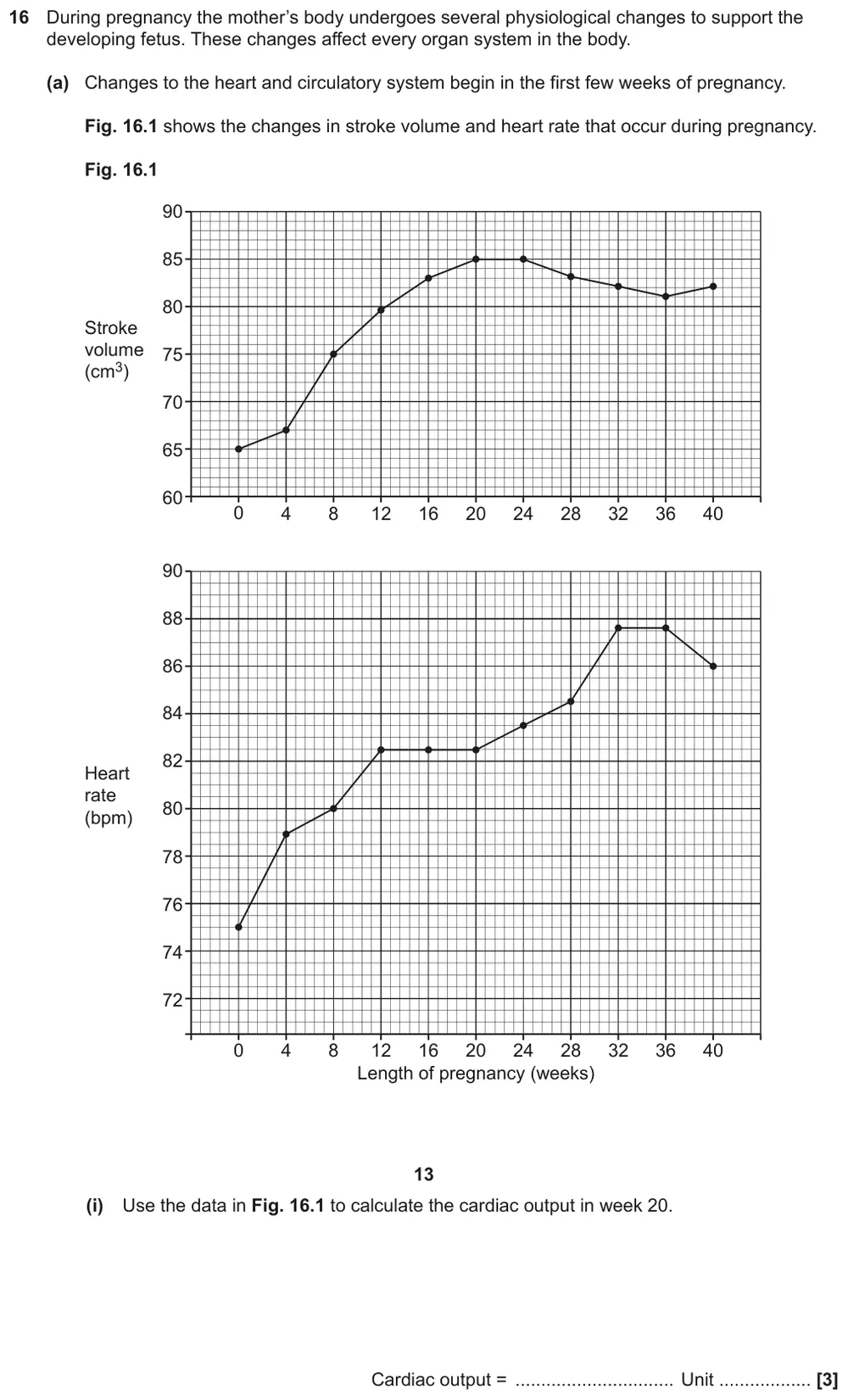
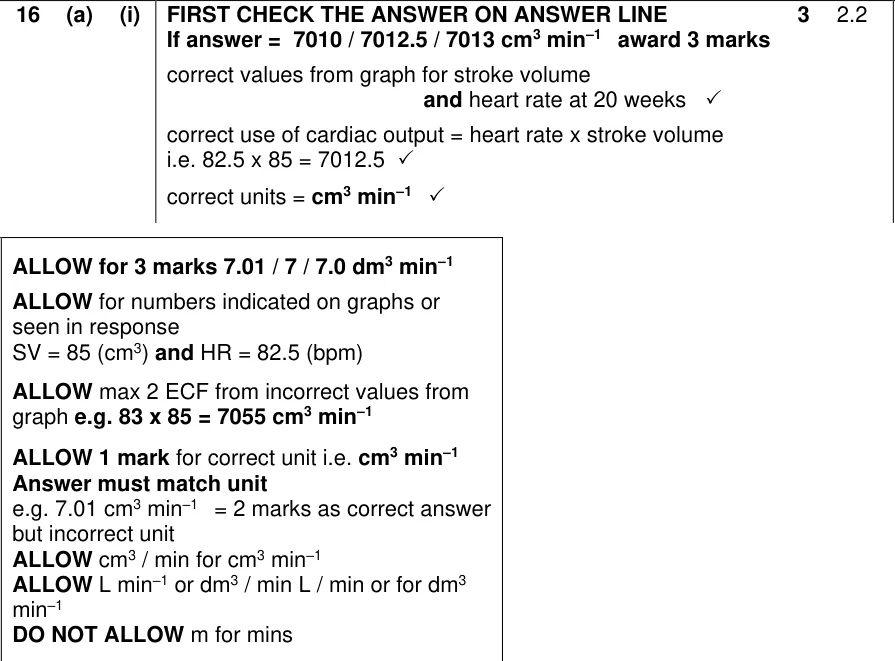
Use graphs of stroke volume and heart rate in pregnancy to calculate cardiac output at week 20.
Show the mark scheme
Tap an image to open it full size.
From the examiners' report: Multiply, don't divide: cardiac output = heart rate × stroke volume. Give the unit as cm3 min−1, not cm3/bpm.
Question 19
A level Paper 1 · June 2023 · Q16(c)(i) · 1 mark · Medium
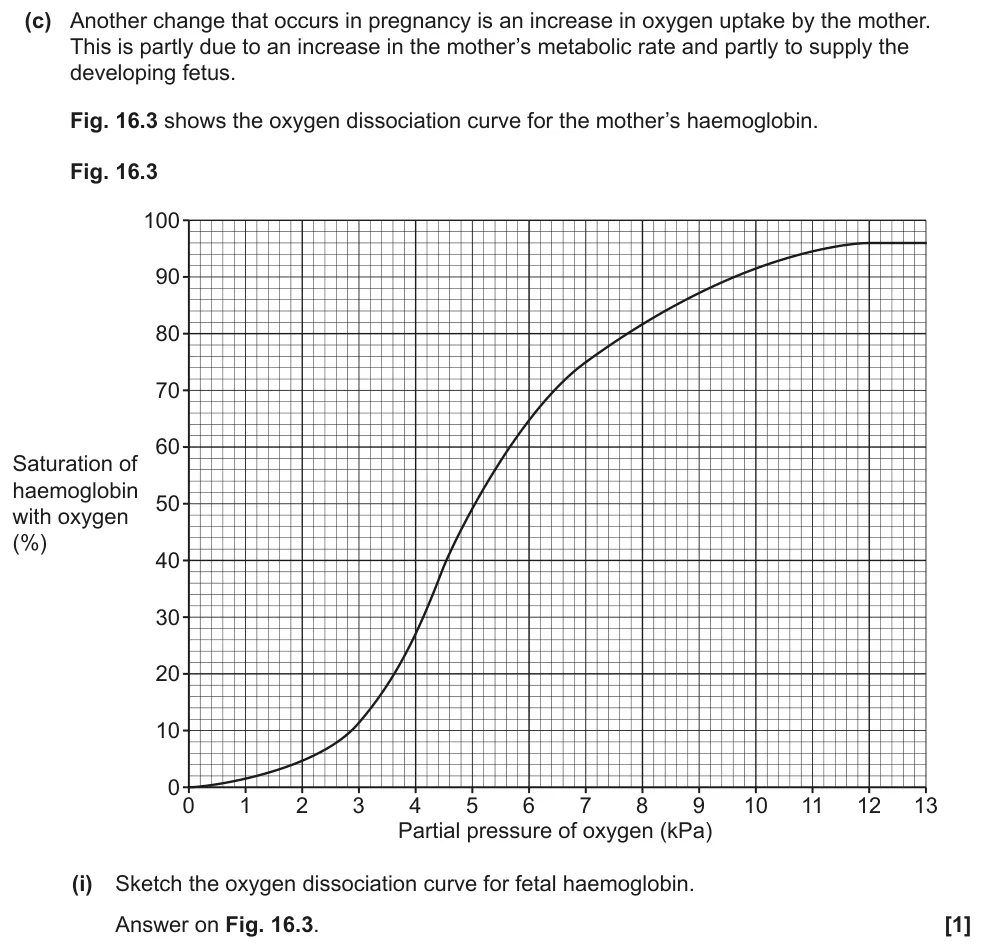
Sketch the oxygen dissociation curve for fetal haemoglobin on the mother's curve.
Show the mark scheme

Tap an image to open it full size.
From the examiners' report: Draw an S-shaped curve to the left of the mother's curve, and level it off at the same saturation: going above it was the common error.
Question 20
A level Paper 1 · June 2023 · Q16(c)(ii) · 3 marks · Easy
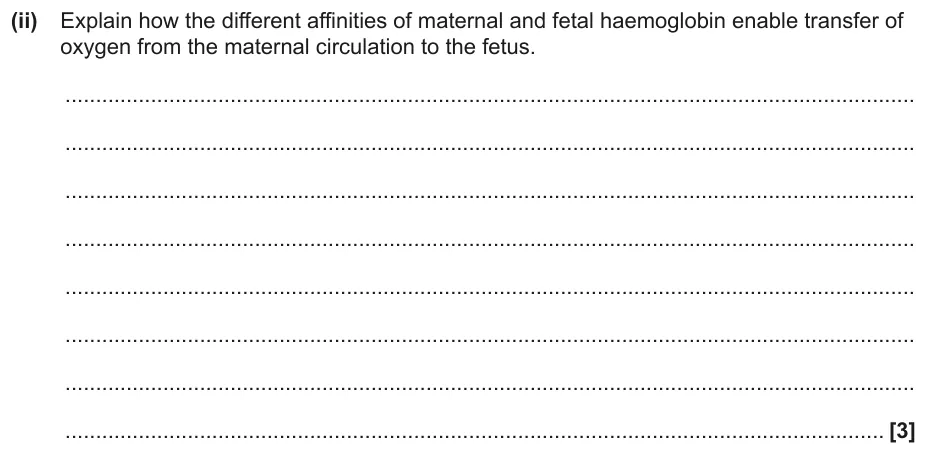
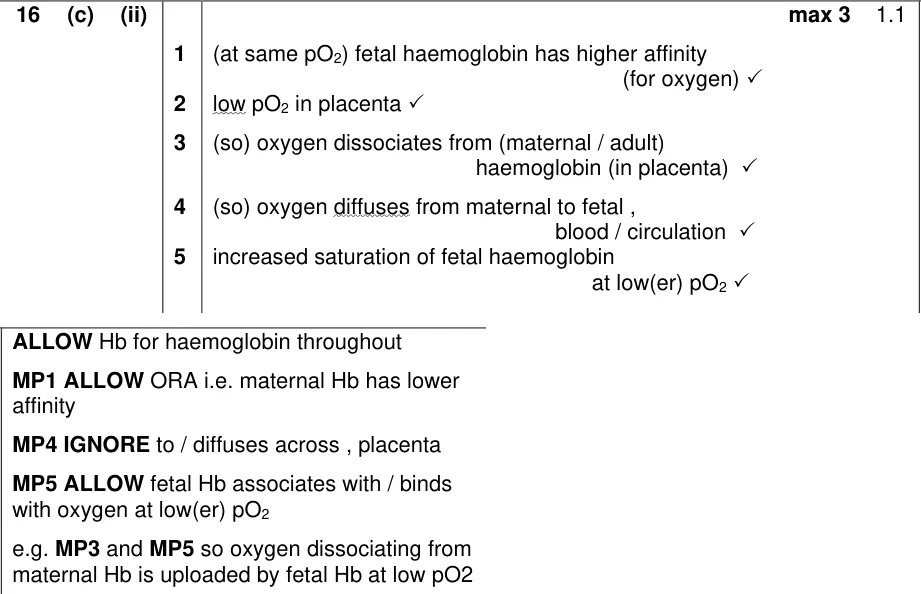
Explain how the different affinities of maternal and fetal haemoglobin let oxygen pass to the fetus.
Show the mark scheme
Tap an image to open it full size.
From the examiners' report: Most students said fetal haemoglobin has a higher affinity but few mentioned the low pO2 in the placenta. Say that at this low pO2 oxygen dissociates from maternal haemoglobin and fetal haemoglobin picks it up.
Where students lose marks (from OCR examiners' reports and mark schemes)
Each point below is followed by wording that gained marks.
Elephants have a small SA:V: Explaining why a large mammal needs a transport system, some students wrote that large organisms have a large surface area to volume ratio, so lost the mark.
✔ Gains credit: "It has a smaller surface area to volume ratio" and "it has a higher metabolic demand".
Insects breathe through tracheae, not blood: Many answers said insects can manage with an open system because they have a low metabolic rate; low metabolic rate was ignored, and few said the haemolymph doesn't carry oxygen.
✔ Gains credit: "Tracheoles supply oxygen directly to the tissues, so the circulatory system does not transport oxygen".
A thicker layer of muscle: Giving evidence that L was an artery, phrases such as 'thick smooth muscle' or 'thick elastic fibres' scored nothing without 'layer' or 'wall', and valves couldn't be seen in the image.
✔ Gains credit: "L is an artery: it has a smaller lumen and a thicker layer of smooth muscle and elastic tissue".
Oncotic pressure starts with plasma proteins: Most students left this blank or described oncotic pressure as blood pressure or hydrostatic pressure, with no mention of plasma proteins or water potential.
✔ Gains credit: "Plasma proteins are too large to leave the capillary, so they create a lower water potential in the blood than in the tissue fluid, and water moves into the capillary by osmosis".
Label each error and each fix: In the cardiac cycle question, answers copied long parts of the student's description without saying what was wrong, or gave corrections without the error; this capped the mark at 1.
✔ Gains credit: "Error: the wave starts at the AVN. Correction: it starts at the SAN" and "Error: the atrioventricular valve opens. Correction: it closes".
Brady means slow: The slow heart rhythm was often spelt 'brachycardia', which was not allowed, and the abnormality needed a reason from the trace as well.
✔ Gains credit: "Bradycardia, because the T wave and the next P wave are further apart than normal".
Bohr shift lowers affinity: Misreading the axes, some students concluded that haemoglobin's affinity for oxygen increases during exercise, when the graph shows it decreases.
✔ Gains credit: "More CO2 during exercise shifts the curve to the right, so at the same pO2 haemoglobin is less saturated and releases oxygen more readily to the muscles".
Cardiac output is per minute: Some students divided heart rate by stroke volume instead of multiplying, and many gave the unit as cm3/bpm.
✔ Gains credit: "Cardiac output = 82.5 × 85 = 7012.5 cm3 min−1".
Download the questions
Download the PDF pack (20 questions, mark schemes at the end)
Keep practising
- Animal Transport quiz
- Cardiac Cycle quiz
- Exchange Surfaces (3.1.1): OCR A Level Biology exam questions by topic
- Transport in Plants (3.1.3): OCR A Level Biology exam questions by topic
- Transport in animals: interactive written questions (20)
- OCR A Level Biology masterclasses
Questions, mark schemes and examiners' report extracts © OCR.