

OCR A PAG 2 · 9 questions · mark schemes and examiners’ tips included
PAG 2 is the dissection practical. Over the course you'll cut a plant stem to find the xylem, open up a fish head to look at the gills, and dissect a heart and a kidney. The exam questions then ask you to describe what you did, how you did it safely, and to draw what you saw.
These questions reward students who have actually held the scalpel. The examiners say that many students seem to have had little hands-on experience, and it shows: they cut a fish down the middle instead of lifting the operculum, or pick gloves to stop cuts. The biological drawing marks are lost in the same ways every year, with sketchy lines, shading, label lines with arrowheads, and structures drawn in that aren't in the photo.
Work through the nine questions below in order. They start with safety and plant stems, move on to gas exchange systems and the heart, and finish with drawing dissected organs. If you'd like to go through questions like these with me each week, my OCR A masterclasses run on Wednesdays at 5.15pm for Year 12 and on Tuesdays at 6.30pm or Thursdays at 5.15pm for Year 13.
What these questions cover (OCR PAG 2: dissection)
PAG 2 is one of the twelve practical activity groups in the OCR A Level Biology A specification (H420). The questions test these parts of the specification:
- 1.2.2(j) safe use of instruments for dissection of an animal or plant organ
- 1.2.2(e) production of scientific drawings from observations with annotations
- 3.1.3(b)(iii) the dissection of stems, both longitudinally and transversely, and their examination to demonstrate the position and structure of xylem vessels
- 3.1.1(g) the dissection, examination and drawing of the gaseous exchange system of a bony fish and/or insect trachea
- 3.1.2(e)(ii) the dissection, examination and drawing of the external and internal structure of the mammalian heart
- 5.1.2(c)(ii) the dissection, examination and drawing of the external and internal structure of the kidney
How to use this page
Write your answer on paper before you open the mark scheme. Allow about 1.2 minutes per mark: the 9 questions are worth 19 marks, so about 23 minutes in total. Then mark your answer strictly against the mark scheme and read the examiners' tip underneath it. If you'd rather print the questions, download the PDF pack.
Dissecting safely and dissecting plant stems
Question 1
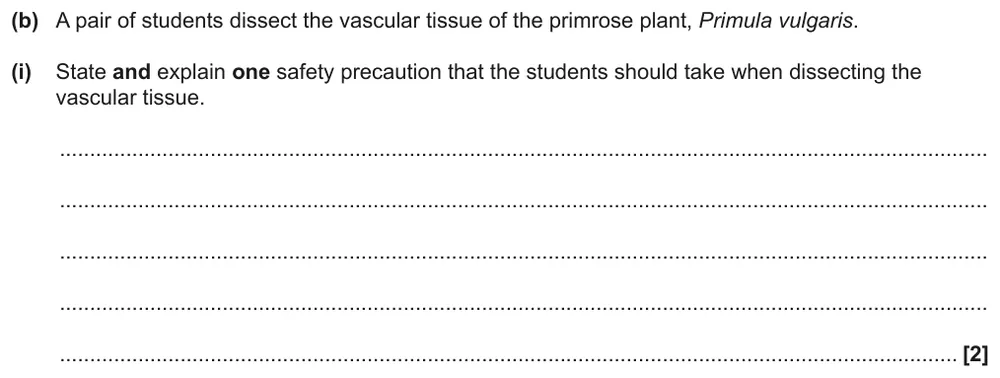
A level Paper 3 · June 2024 · Q3(b)(i) · 2 marks · Easy
State and explain one safety precaution when dissecting the vascular tissue of a plant.
Show the mark scheme
Tap an image to open it full size.
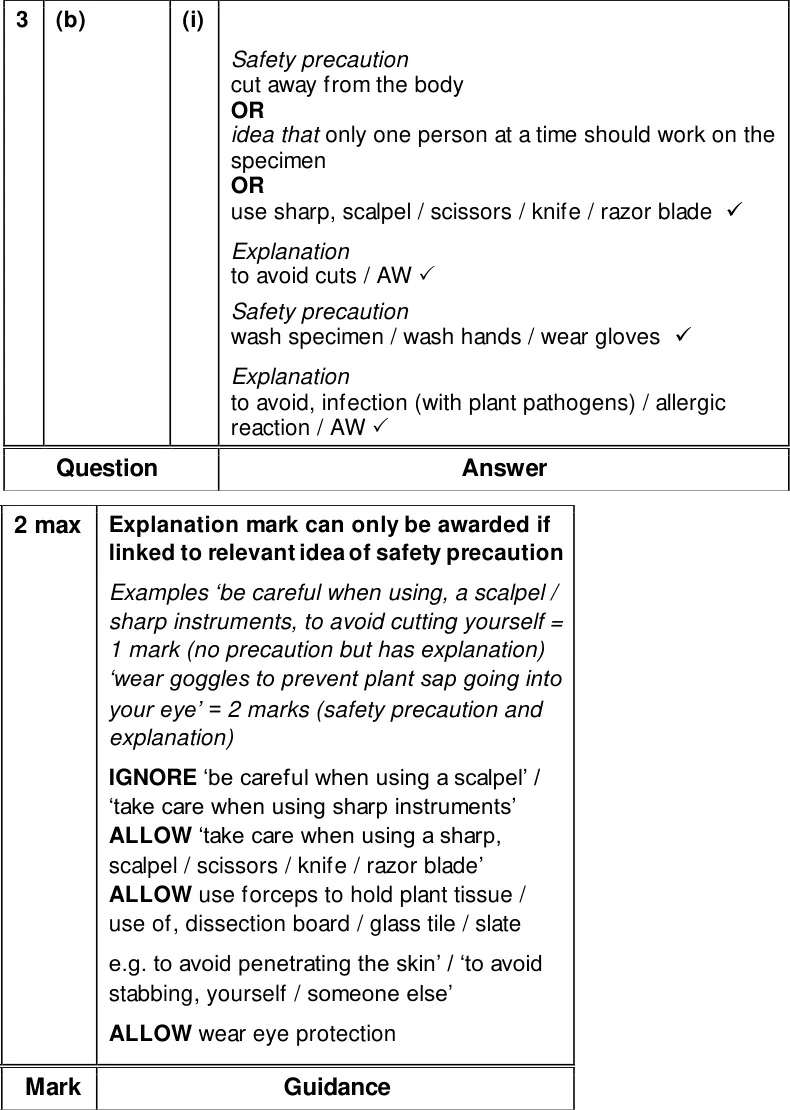
From the examiners' report: Most students got at least one mark, usually for a sharp scalpel or cutting away from the body to avoid cuts. Students who chose gloves or goggles often linked them to preventing cuts, which doesn't work; gloves and goggles protect you from plant sap, irritation or infection.
Question 2
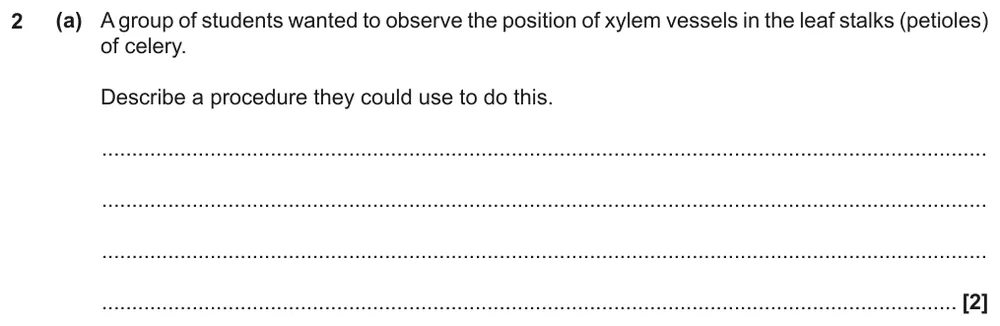
AS Paper 2 · June 2017 · Q2(a) · 2 marks · Medium
Describe a procedure to see where the xylem vessels are in a celery stalk.
Show the mark scheme
Tap an image to open it full size.
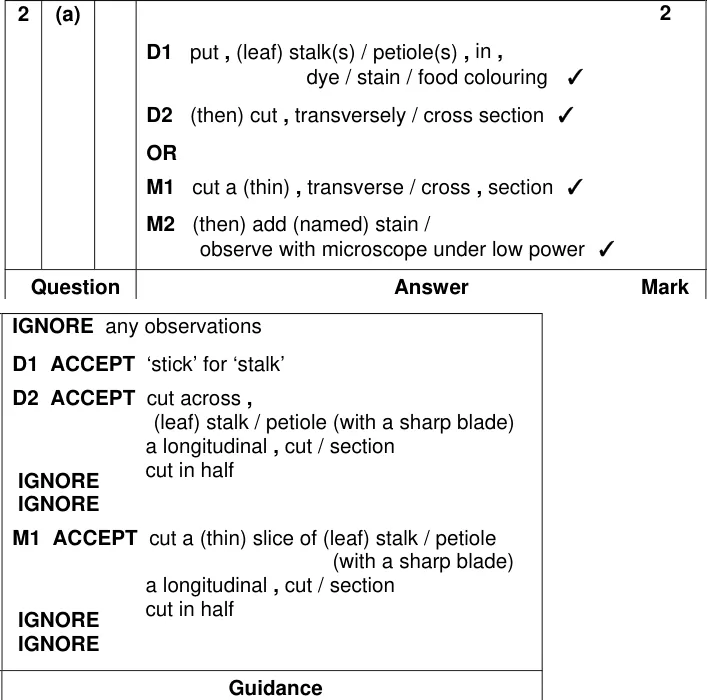
From the examiners' report: There is no examiners' report for this paper. The mark scheme wants two steps in order: dye the stalk (or stain the section) and cut across it. A longitudinal cut or 'cut it in half' is ignored.
Dissecting gas exchange systems
Question 3
AS Paper 2 · June 2017 · Q3(a) · 2 marks · Medium
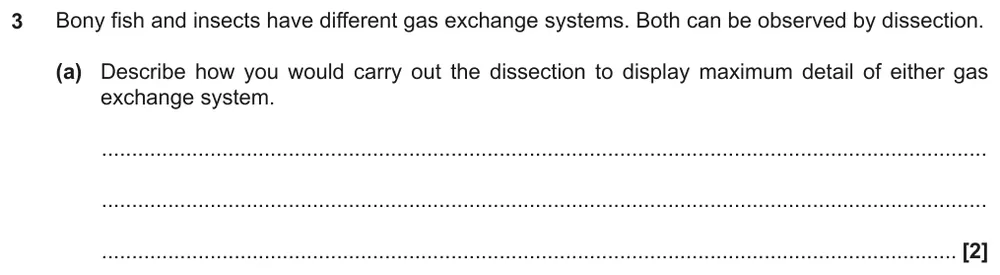
Describe how to dissect a bony fish or an insect to display its gas exchange system.
Show the mark scheme
Tap an image to open it full size.
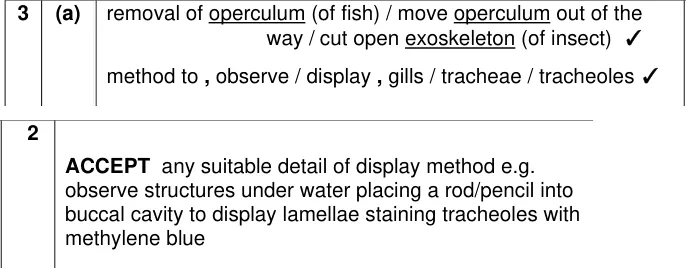
From the examiners' report: There is no examiners' report for this paper. The mark scheme wants a first cut (removing the operculum or opening the exoskeleton) and then a way of displaying the detail, such as floating the gill lamellae in water.
Question 4
A level Paper 3 · November 2021 · Q1(b)(ii) · 1 mark · Hard
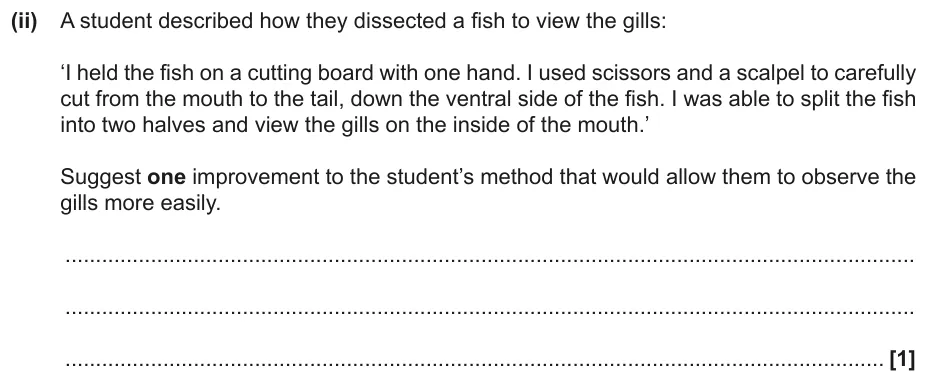
Suggest an improvement to a student's method for dissecting a fish to view the gills.
Show the mark scheme
Tap an image to open it full size.
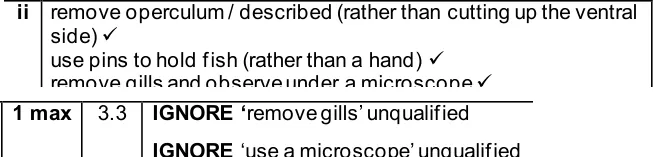
From the examiners' report: Few students could suggest an improvement, which the examiners put down to little hands-on experience of fish anatomy. The gills are under the operculum, so lift it off; and pin the fish down rather than holding it.
Heart dissection
Question 5
AS Paper 2 · November 2021 · Q2(b)(i) · 2 marks · Medium
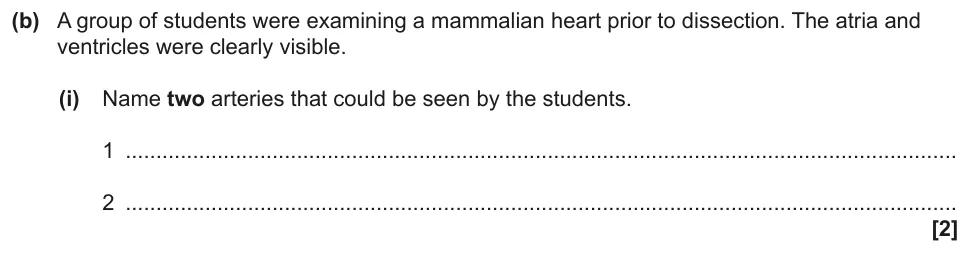
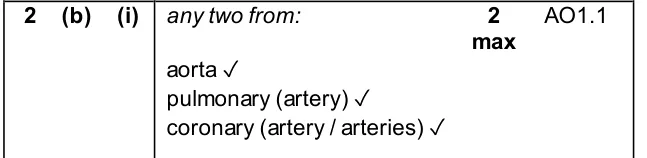
Name two arteries that could be seen on the outside of a mammalian heart before dissection.
Show the mark scheme
Tap an image to open it full size.
From the examiners' report: There is no examiners' report for this paper. The coronary arteries on the surface of the heart count, as well as the aorta and pulmonary artery; veins such as the vena cava don't.
Question 6
AS Paper 2 · November 2021 · Q2(b)(iii) · 3 marks · Medium
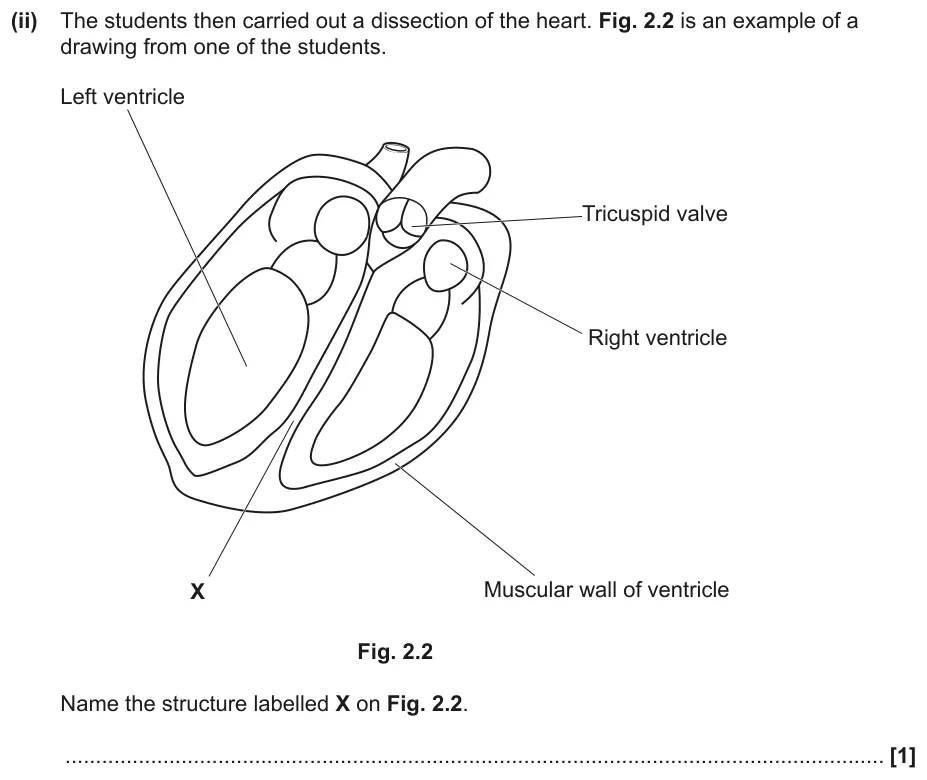
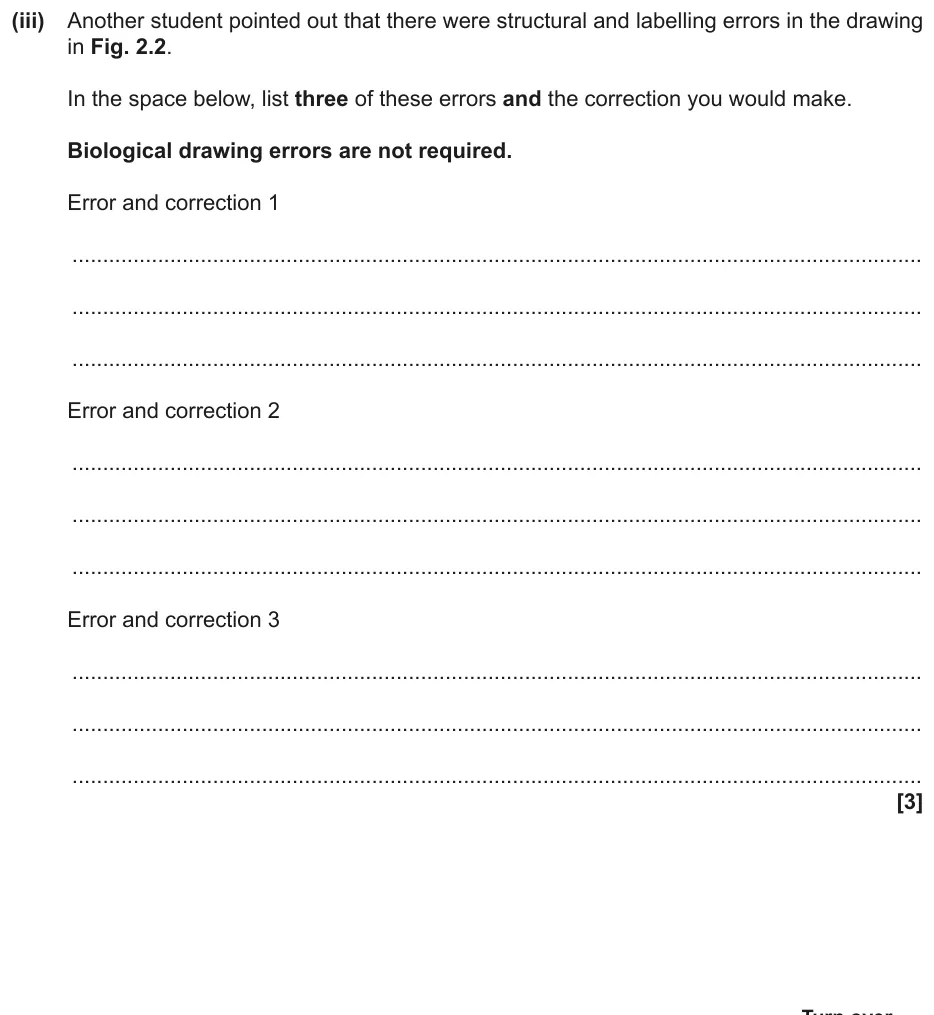
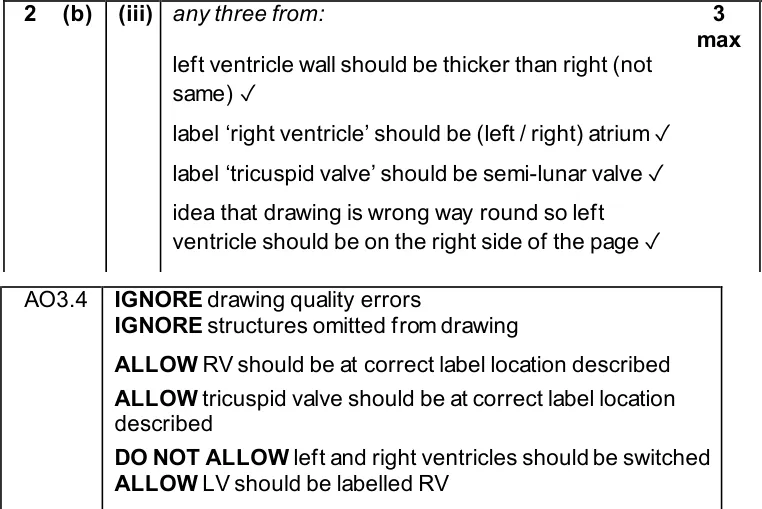
Identify three errors in a student's drawing of a dissected heart and correct them.
Information from earlier in this question:
Show the mark scheme
Tap an image to open it full size.
From the examiners' report: There is no examiners' report for this paper. The mark scheme ignores drawing technique here: it wants biology errors, such as the ventricle walls being the same thickness and structures labelled with the wrong names. In this external front view the left ventricle should be on the right of the page.
Drawing dissected organs
Question 7
A level Paper 1 · June 2017 · Q16(d) · 2 marks · Medium
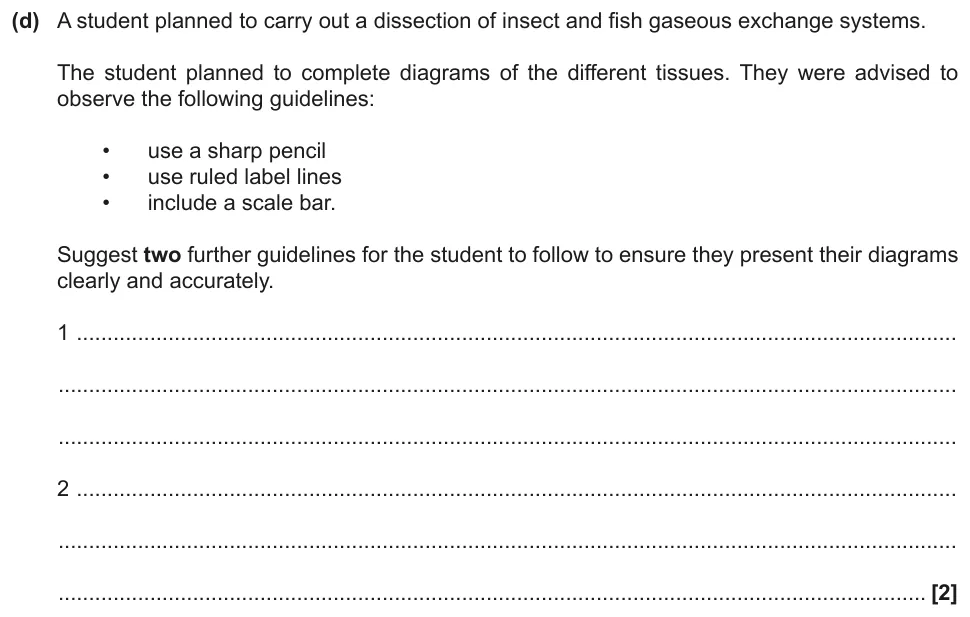
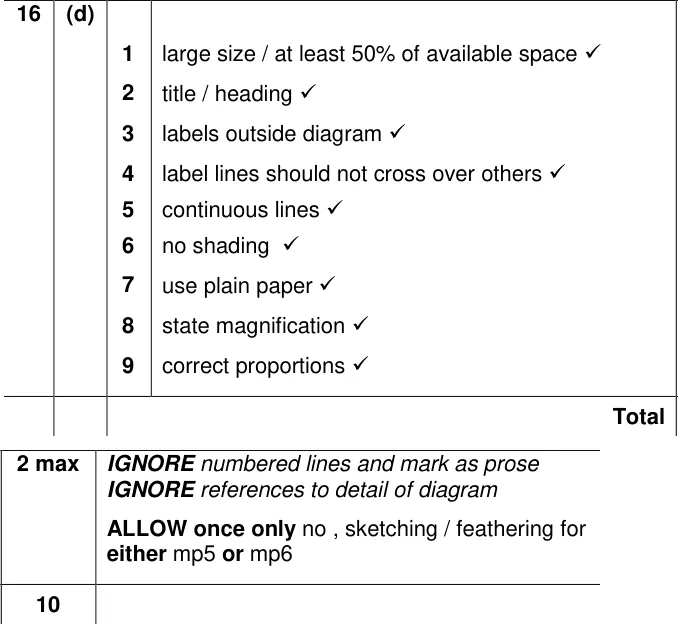
Suggest two more guidelines for drawing tissues from a dissection clearly and accurately.
Show the mark scheme
Tap an image to open it full size.
From the examiners' report: There is no examiners' report for this paper. Any two of the standard drawing rules score, but not ones already given in the question, so don't repeat sharp pencil, ruled label lines or a scale bar.
Question 8
A level Paper 3 · November 2020 · Q1(a) · 2 marks · Easy
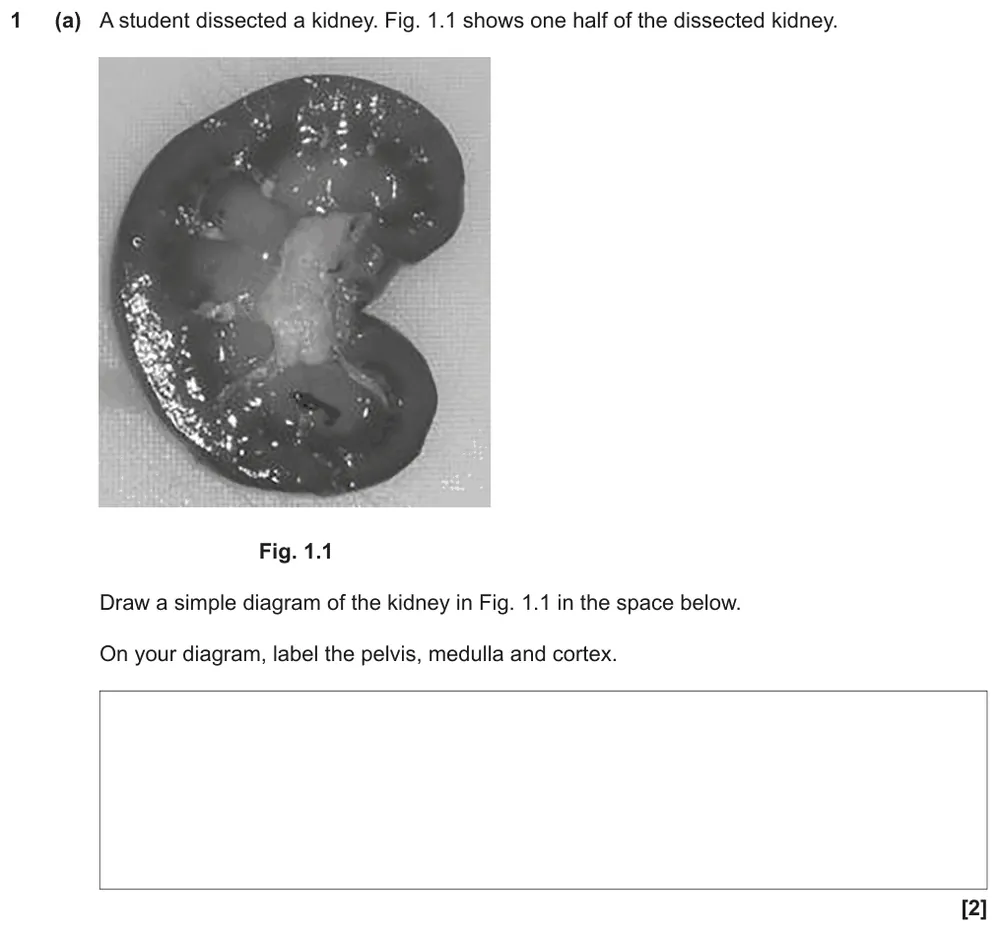
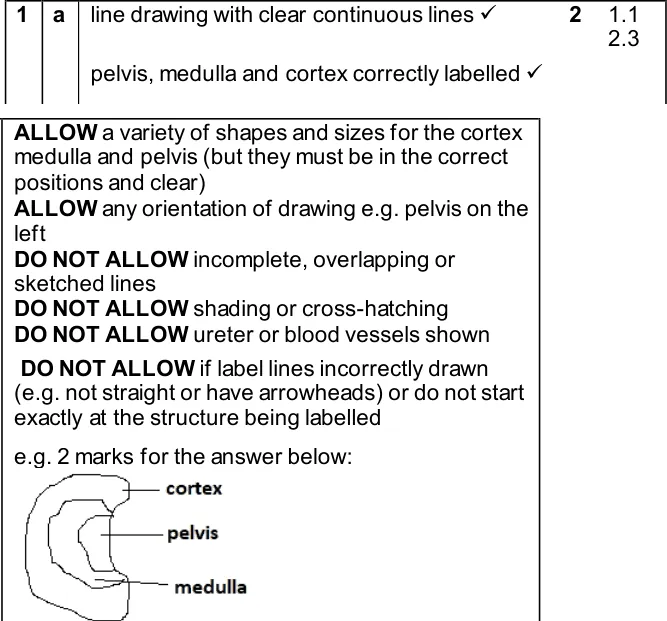
Draw a simple diagram of half a dissected kidney and label the pelvis, medulla and cortex.
Show the mark scheme
Tap an image to open it full size.
From the examiners' report: Many students didn't seem to know the rules for a biological drawing. Lines were sketchy or broken, they drew in the ureter and blood vessels that weren't visible in the photo, and label lines were drawn freehand or with arrowheads.
Question 9
AS Paper 1 · June 2023 · Q26(a) · 3 marks · Hard
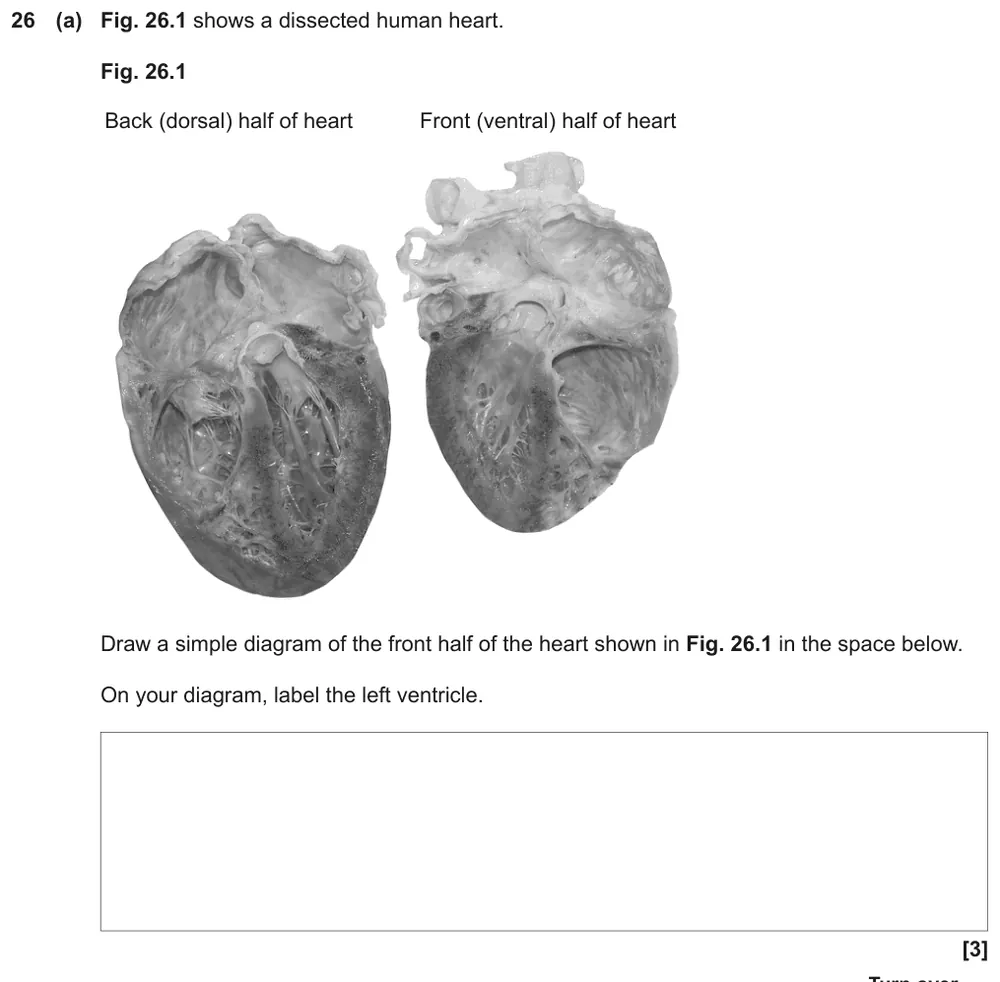
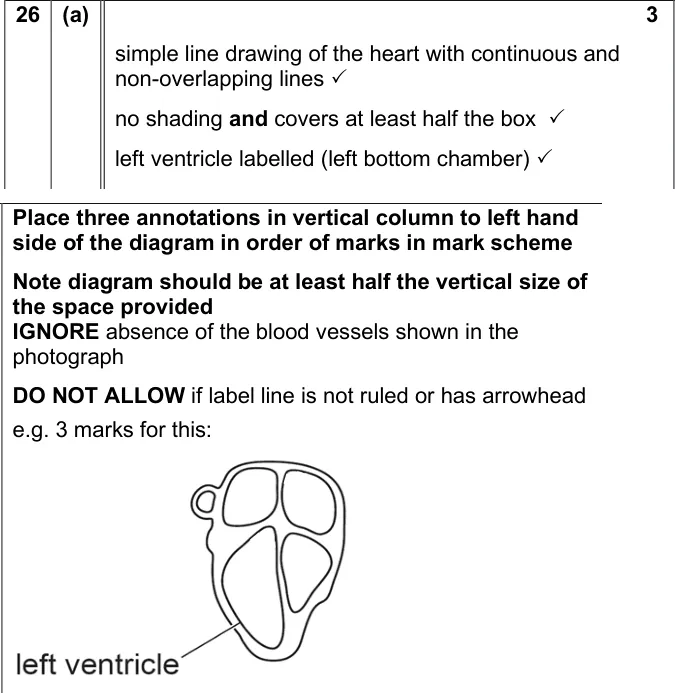
Draw a simple diagram of the front half of a dissected human heart and label the left ventricle.
Show the mark scheme
Tap an image to open it full size.
From the examiners' report: Most students got just one mark, usually for size. Lines were often broken or overlapping, and many labelled the left ventricle on the right of their drawing, as in a textbook diagram, instead of working it out from the photo.
Where students lose marks (from OCR examiners' reports and mark schemes)
Each point below is followed by wording that gained marks.
Link the precaution to the right risk: Students who chose gloves or goggles often said they would prevent cuts, rather than protecting against plant material causing irritation or infection.
✔ Gains credit: "Use a sharp scalpel, to avoid cuts" or "wear goggles to prevent plant sap going into your eye".
Dye first, then cut across: To find xylem in a stalk, the mark scheme ignores a longitudinal cut or just 'cut in half'; the section has to be transverse.
✔ Gains credit: "Put leaf stalks in dye / food colouring, (then) cut transversely / cross section".
Lift the operculum off: Few students could improve a method that cut the fish from mouth to tail while holding it by hand.
✔ Gains credit: "Remove operculum (rather than cutting up the ventral side)" and "use pins to hold fish (rather than a hand)".
Continuous lines, no shading: Drawings of dissected organs often had sketchy, broken or overlapping lines, which the mark scheme does not allow.
✔ Gains credit: "A line drawing with clear continuous lines" and "no shading and covers at least half the box".
Draw only what the photo shows: Students added the ureter and blood vessels to a kidney drawing even though they were not visible in the photograph.
✔ Gains credit: "Pelvis, medulla and cortex correctly labelled", in their correct positions, with no ureter or blood vessels drawn.
Ruled label lines, no arrowheads: Label lines drawn freehand, with arrowheads, or not touching the structure cost the labelling mark, even when the structure was named correctly.
✔ Gains credit: "Left ventricle labelled" with a straight, ruled line that starts exactly at the structure.
Find the left side from the specimen: Many students labelled the left ventricle on the right of their drawing, as in the usual textbook view, instead of working it out from the photograph.
✔ Gains credit: "Left ventricle labelled (left bottom chamber)" on a drawing of the front half of the heart.
Download the questions
Download the PDF pack (9 questions, mark schemes at the end)
Keep practising
- PAG 5 Colorimeter and Potometer: OCR A Level Biology exam questions by topic
- PAG 1 Microscopy: OCR A Level Biology exam questions by topic
- OCR A Level Biology practical skills quiz
- OCR A gas exchange quiz
- OCR A animal transport quiz
Questions, mark schemes and examiners' report extracts © OCR.