

Spec point 2.1.6 is one of the biggest in Module 2. It takes you from the cell cycle and its checkpoints, through the stages of mitosis and meiosis, to specialised cells, tissues and organs, and finishes with stem cells and how they could be used in medicine. You also need to recognise the stages of mitosis in stained root tip squashes and do calculations with the cell counts.
Most of the marks I see lost here come from loose wording rather than missing knowledge. Students write "identical" instead of "genetically identical", call homologous chromosomes identical, write "independent assortment" without saying what is assorting, or mix up pluripotent and multipotent. In the examiners' reports, the stage that follows S phase and the number of gamete combinations, 2ⁿ, tripped up many students too.
Work through the twenty questions below in order. They start with recall, move on to applying what you know to checkpoints and stem cell research, and finish with root tip micrographs and calculations. If you'd like to go through questions like these with me each week, my OCR A masterclasses run on Wednesdays at 5.15pm for Year 12 and on Tuesdays at 6.30pm or Thursdays at 5.15pm for Year 13.
What you need from GCSE
Each question on this page assumes you're secure on these GCSE ideas. If any of them feels shaky, look it up before you start.
- Mitosis makes two genetically identical cells, used for growth, repair and asexual reproduction. Before a cell divides it copies its DNA.
- Meiosis makes four gametes, each with half the number of chromosomes, and each genetically different.
- Body cells have chromosomes in pairs (46 in humans); gametes have one of each pair (23 in humans).
- Stem cells are unspecialised cells that can become other cell types. They are found in embryos, in adult bone marrow and in plant meristems.
- Cells are organised into tissues, tissues into organs and organs into organ systems. Specialised cells, such as sperm and root hair cells, have features that suit their function.
Key terms
These words come up in the questions and mark schemes. Examiners expect you to use them exactly.
- Interphase: the part of the cell cycle between divisions: G1 (growth and protein synthesis), S (DNA replication) and G2 (more growth, organelle replication and DNA checking).
- Checkpoint: a control point in the cell cycle (G1, G2 and the metaphase or spindle checkpoint) where the cell checks it is ready before it moves on.
- Chromatid and centromere: after replication each chromosome is two identical sister chromatids, held together at the centromere.
- Homologous chromosomes: a pair of chromosomes, one maternal and one paternal, with the same genes at the same loci but possibly different alleles.
- Haploid and diploid: one set of chromosomes (n, as in gametes); two sets of chromosomes (2n, as in body cells).
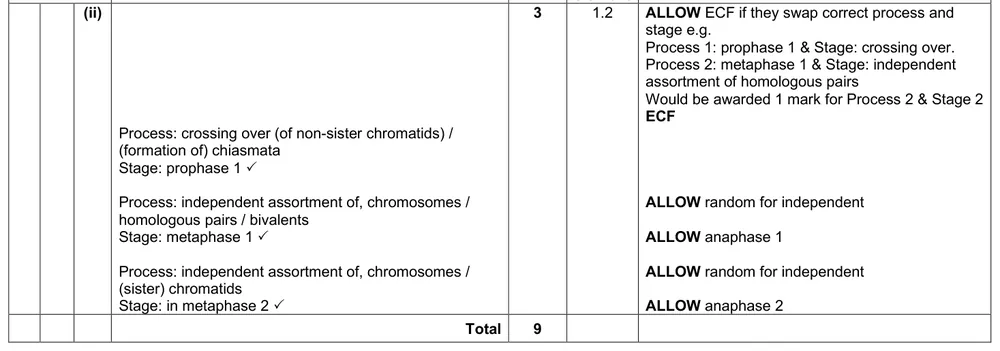
- Crossing over: exchange of sections between non-sister chromatids of homologous chromosomes in prophase 1 of meiosis.
- Independent assortment: the random way homologous pairs line up in metaphase 1, and chromatids in metaphase 2, so each gamete gets a different mix.
- Differentiation: the process by which an unspecialised cell becomes specialised for one function.
- Totipotent, pluripotent, multipotent: able to form any cell including extra-embryonic tissue; any body cell type but not a whole organism; a limited range of cell types (e.g. blood cells).
- Tissue and organ: a group of similar cells working together for a shared function; a group of different tissues working together for a function.
What these questions cover (OCR 2.1.6)
The questions test these learning outcomes from the OCR A Level Biology A specification (H420):
- (a) the cell cycle
- (b) how the cell cycle is regulated
- (c) the main stages of mitosis
- (d) sections of plant tissue showing the cell cycle and stages of mitosis (includes root tip squash calculations)
- (e) the significance of mitosis in life cycles
- (f) the significance of meiosis in life cycles (haploid cells, independent assortment and crossing over)
- (g) the main stages of meiosis
- (h) how cells of multicellular organisms are specialised for particular functions
- (i) the organisation of cells into tissues, organs and organ systems
- (j) the features and differentiation of stem cells
- (k) the production of erythrocytes and neutrophils as examples of distinct, differentiated cells derived from a common stem cell in bone marrow
- (l) the production of xylem vessels and phloem sieve tubes as examples of distinct, differentiated outcomes derived from a common stem cell in meristems
- (m) the potential uses of stem cells in research and medicine
How to use this page
Write your answer on paper before you open the mark scheme. Allow about 1.2 minutes per mark: the 20 questions are worth 31 marks, so about 37 minutes in total. Then mark your answer strictly against the mark scheme and read the examiners' tip underneath it. If you'd rather print the questions, download the PDF pack.
Recall
Question 1
AS Paper 2 · June 2022 · Q2(a)(i) · 1 mark · Medium
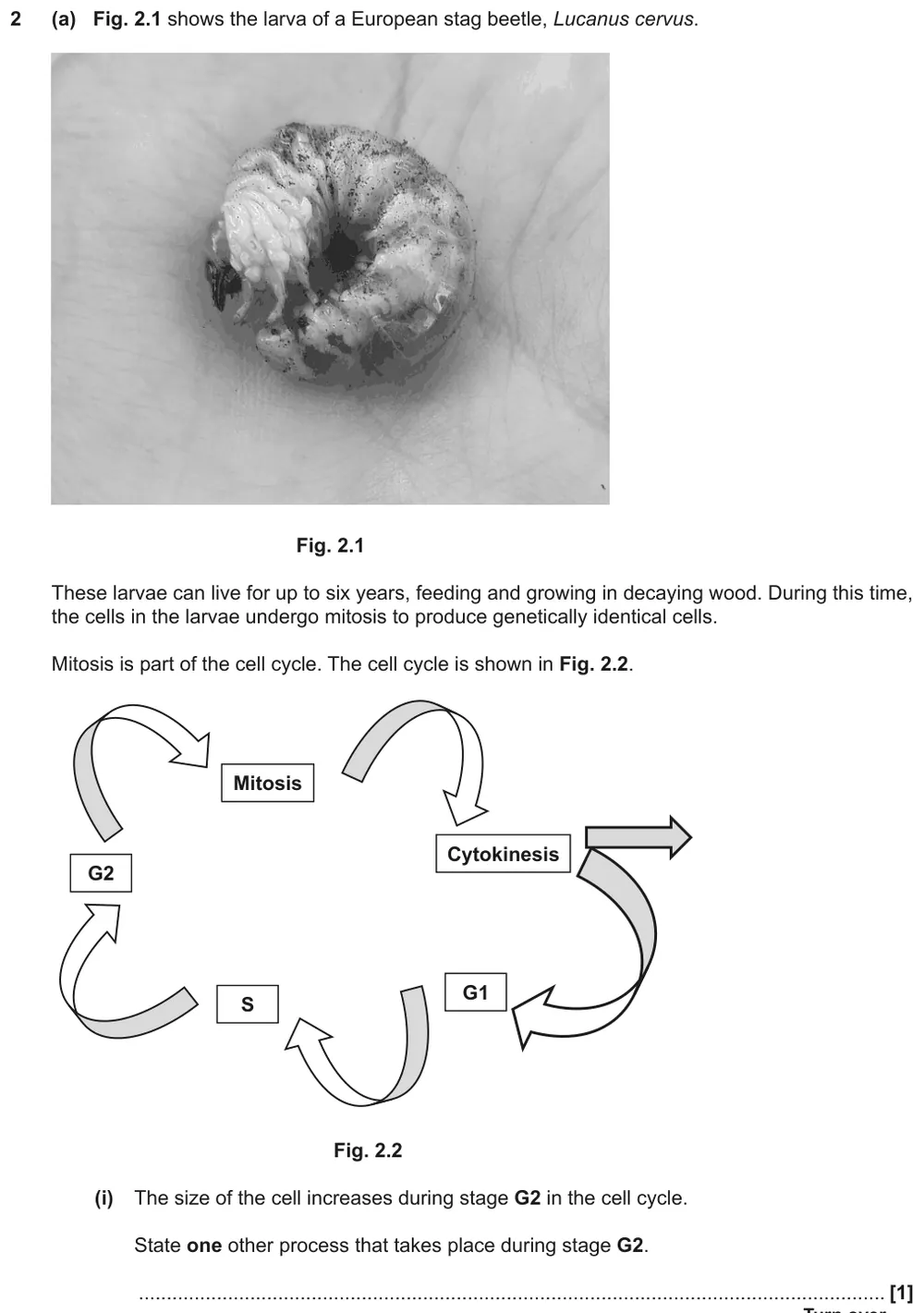
State one process, other than cell growth, that happens during G2 of the cell cycle.
Show the mark scheme
Tap an image to open it full size.
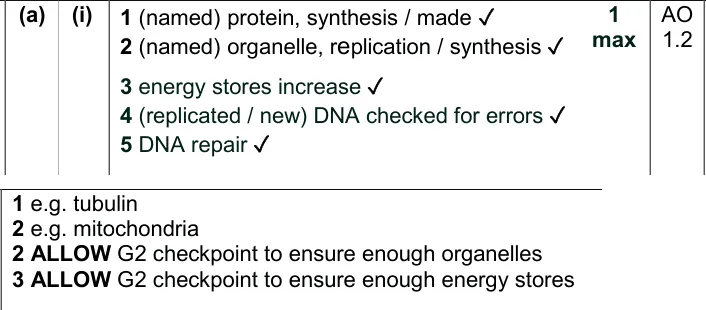
From the examiners' report: The commonest wrong answer was that DNA replicates in G2. Look at the diagram: S comes before G2, so in G2 the cell makes organelles and proteins and checks the new DNA for errors.
Question 2
AS Paper 1 · June 2019 · Q23(a)(i) · 1 mark · Easy
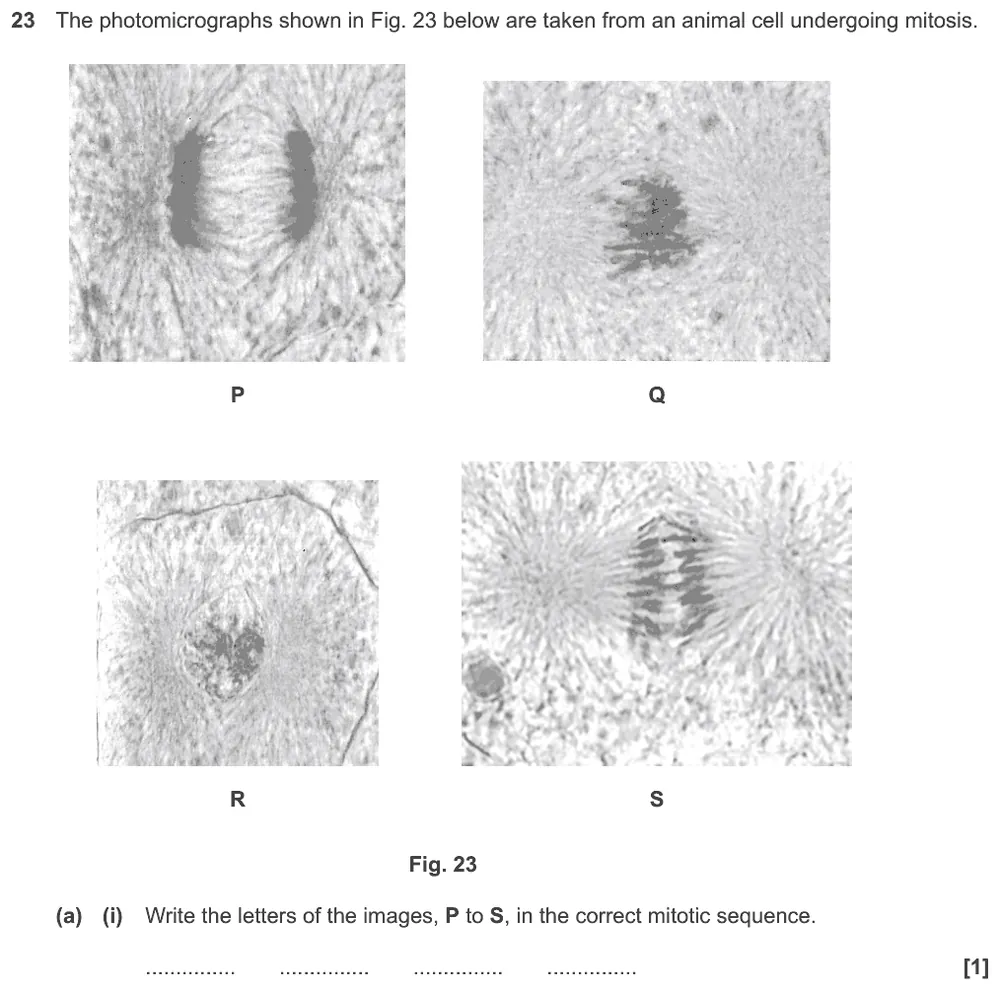
Put four photomicrographs of an animal cell in mitosis into the correct order.
Show the mark scheme

Tap an image to open it full size.
From the examiners' report: The commonest wrong order started with Q, from students who took R to be one of the daughter cells. Find prophase first: condensed chromosomes still in one rounded nucleus.
Question 3
AS Paper 1 · June 2019 · Q23(a)(ii) · 2 marks · Easy
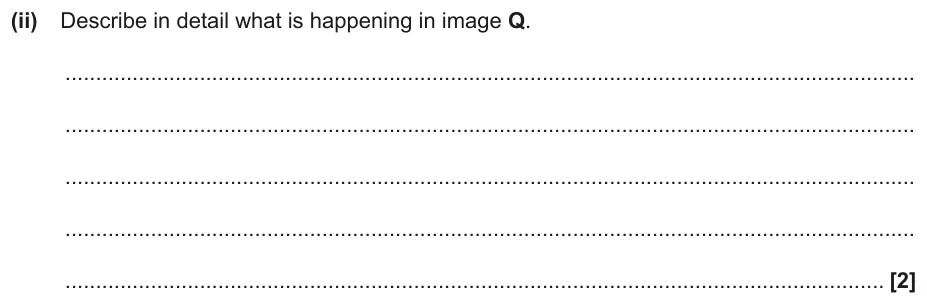
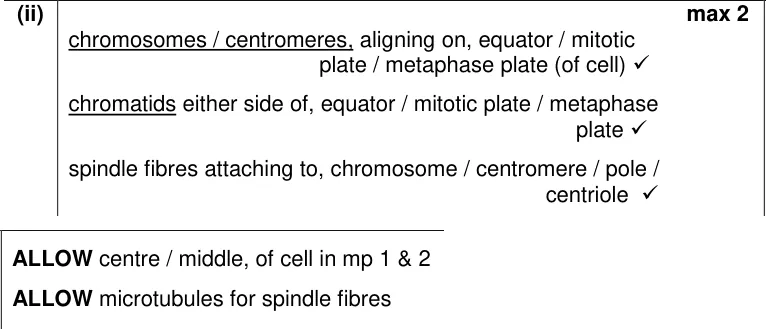
Describe in detail what is happening in image Q.
Show the mark scheme
Tap an image to open it full size.
From the examiners' report: Name the stage to yourself first. Image Q is metaphase, so describe chromosomes lining up on the equator attached to spindle fibres, not prophase events such as the nuclear envelope breaking down.
Question 4
A level Paper 2 · June 2023 · Q16(a) · 1 mark · Easy
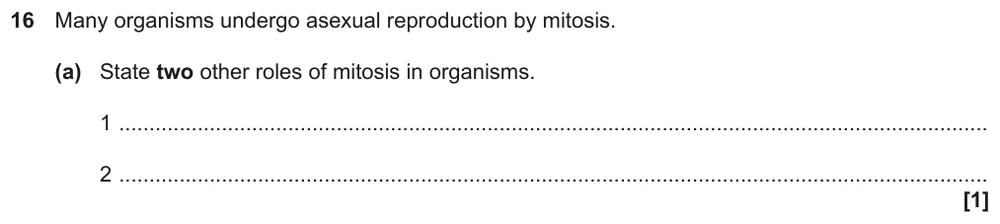
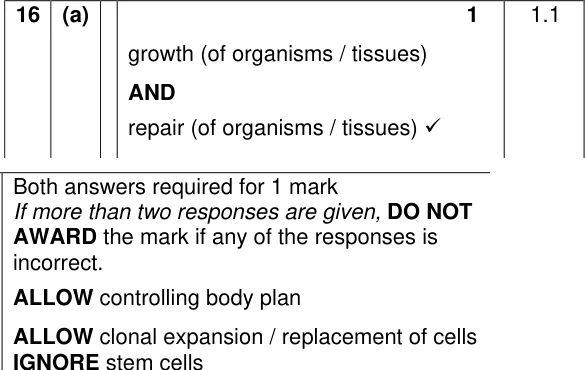
State two roles of mitosis other than asexual reproduction.
Show the mark scheme
Tap an image to open it full size.
From the examiners' report: Only about half of students got this easy mark. Keep it simple, "growth and repair of tissues", and don't write "repair of cells" or add extra ideas that could be wrong.
Question 5
A level Paper 2 · June 2023 · Q16(b)(i) · 2 marks · Medium
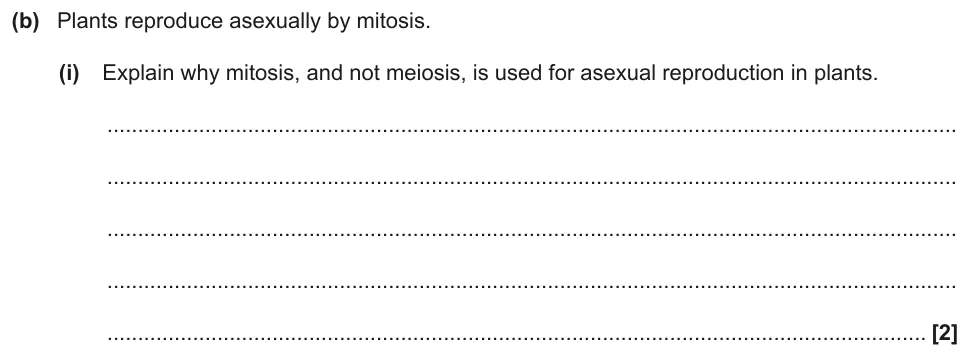
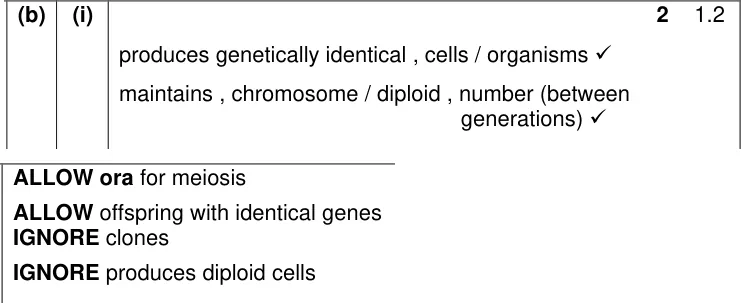
Explain why plants use mitosis, not meiosis, for asexual reproduction.
Show the mark scheme
Tap an image to open it full size.
From the examiners' report: Write "genetically identical", not just "identical", and add that mitosis keeps the chromosome number the same. Don't drift into the general benefits of asexual reproduction.
Question 6
AS Paper 1 · June 2025 · Q21(a)(ii) · 2 marks · Hard
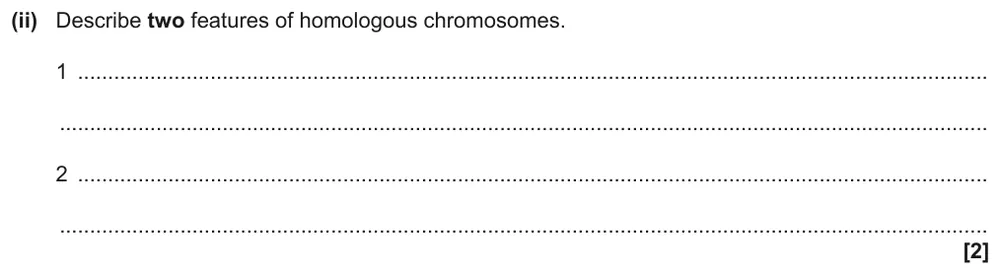
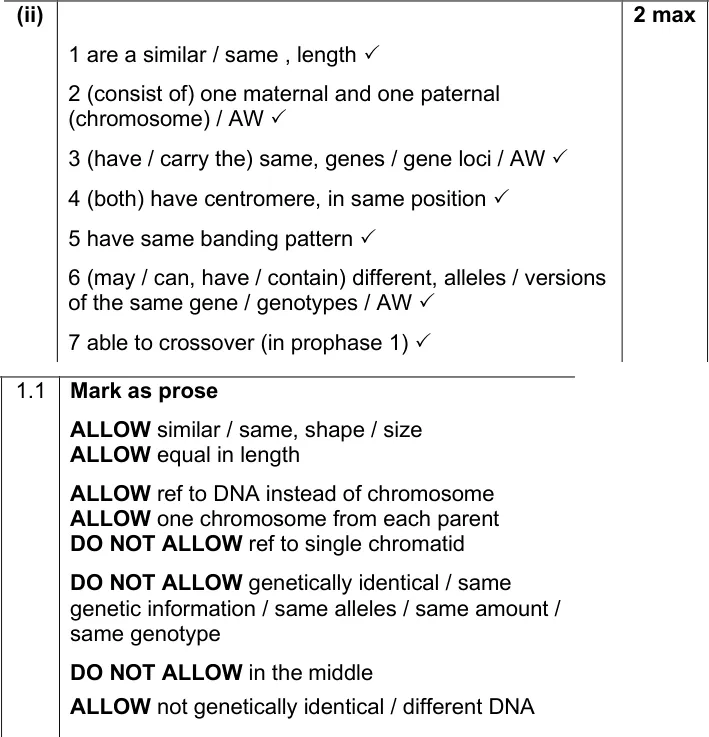
Describe two features of homologous chromosomes.
Show the mark scheme
Tap an image to open it full size.
From the examiners' report: Homologous chromosomes carry the same genes at the same loci but can have different alleles, so never call them identical. They aren't joined by a centromere: each has its own.
Question 7
AS Paper 1 · June 2025 · Q21(b)(ii) · 3 marks · Hard
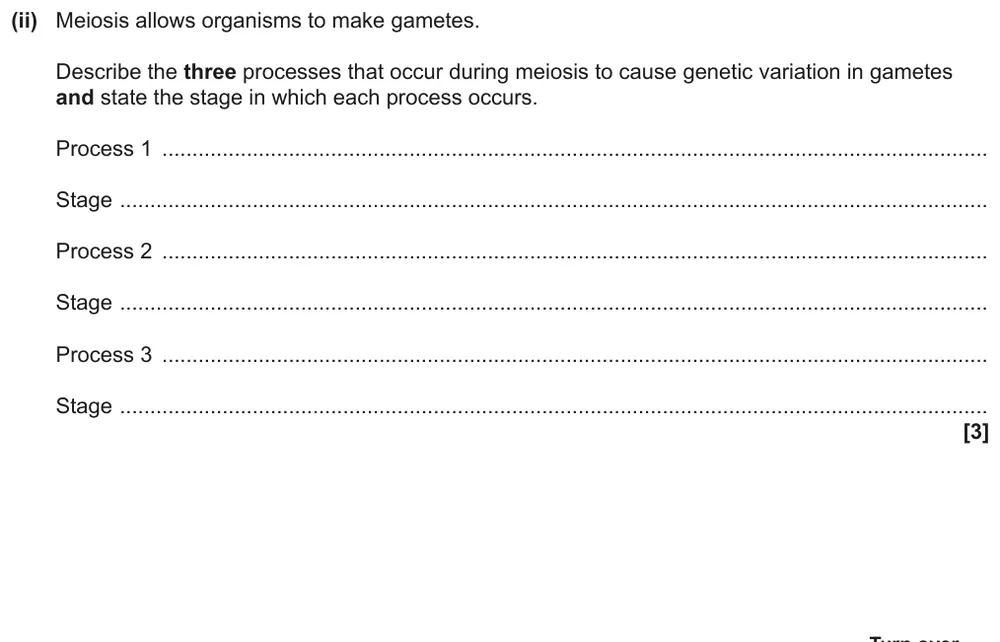
Describe the three processes in meiosis that cause genetic variation, and the stage of each.
Show the mark scheme
Tap an image to open it full size.
From the examiners' report: Crossing over in prophase 1 was well known, but many wrote "independent assortment" twice without saying what assorts. Say homologous pairs in metaphase 1 and chromatids in metaphase 2. Mutation isn't a process of meiosis, so it didn't score.
Question 8
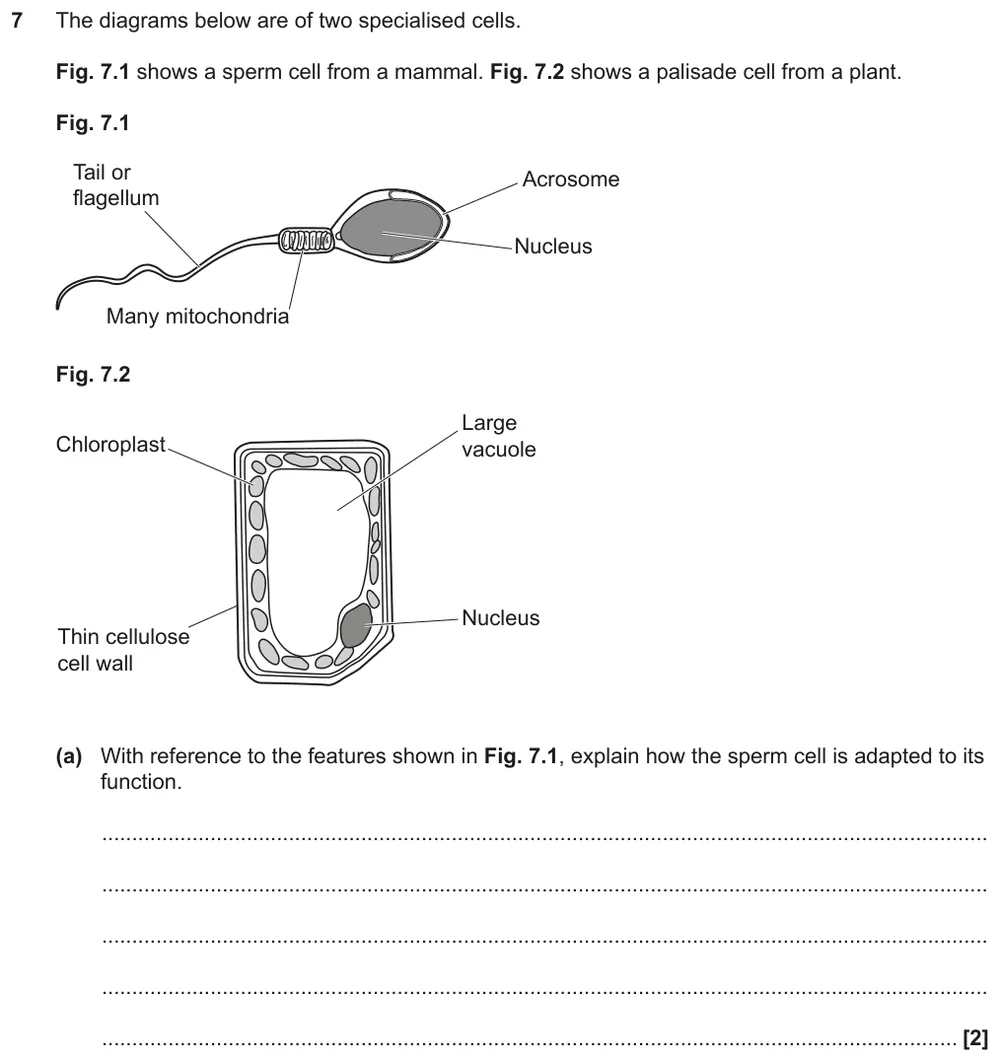
AS Paper 2 · June 2023 · Q7(a) · 2 marks · Medium
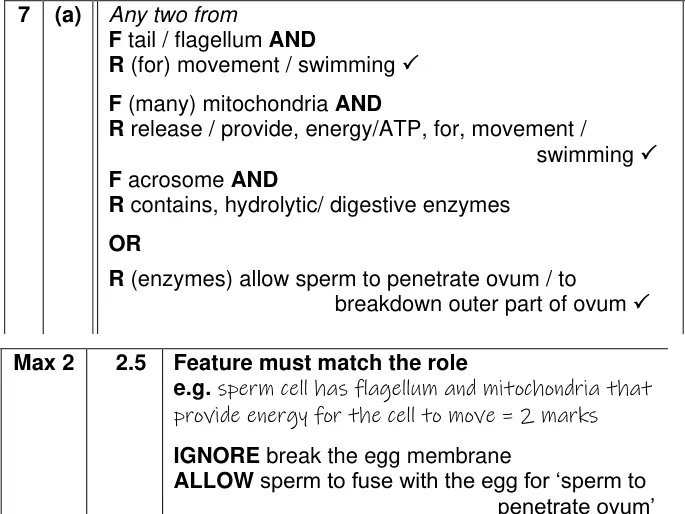
Explain how the features of a sperm cell adapt it to its function.
Show the mark scheme
Tap an image to open it full size.
From the examiners' report: Pair each feature with its role in the same sentence. The acrosome is a structure that contains enzymes, not an enzyme, and the enzymes digest the outer layer of the egg, not its membrane or cell wall.
Question 9
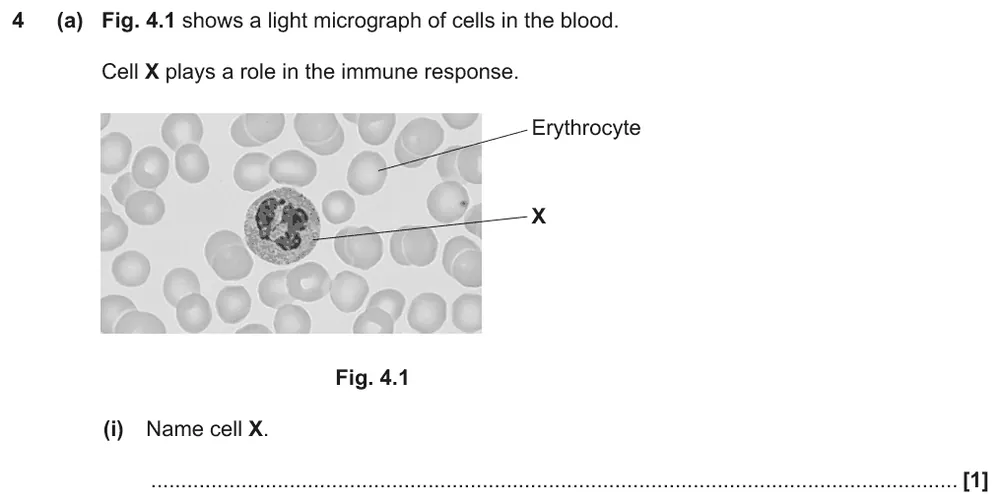
AS Paper 2 · June 2022 · Q4(a)(i) · 1 mark · Medium
Name the blood cell labelled X in a light micrograph.
Show the mark scheme

Tap an image to open it full size.
From the examiners' report: "White blood cell" was the most common answer and didn't score. Name the type: a cell with a lobed nucleus that is a little bigger than the red cells is a neutrophil.
Question 10
AS Paper 1 · June 2018 · Q23(b)(i) · 1 mark · Medium
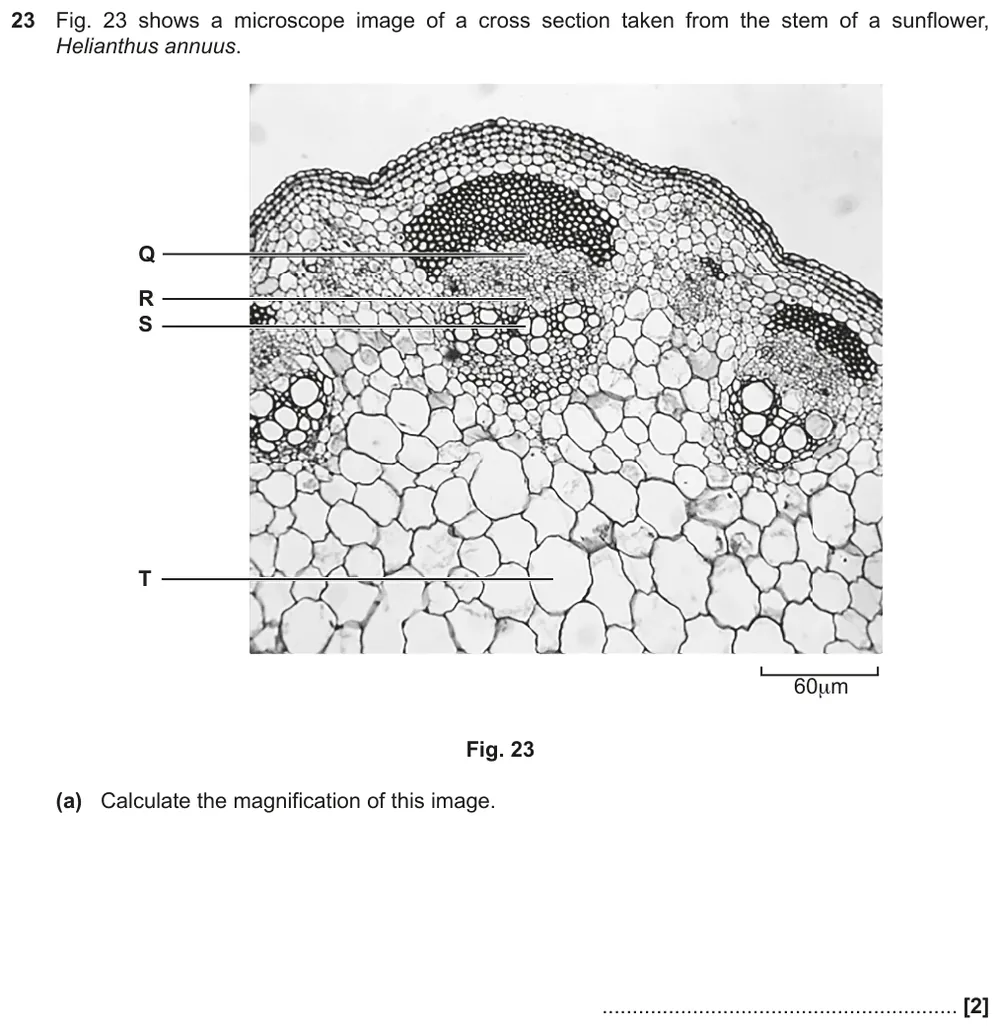
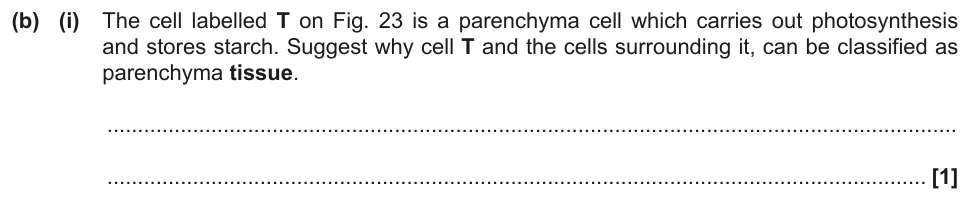
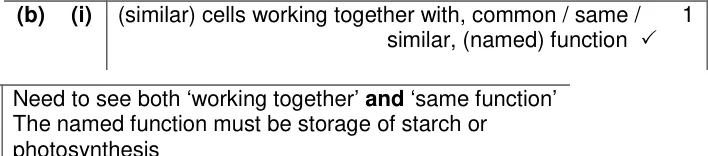
Suggest why the cells around cell T count as parenchyma tissue.
Information from earlier in this question:
Show the mark scheme
Tap an image to open it full size.
From the examiners' report: A tissue definition needs two ideas: similar cells working together, and a shared function. Many answers left out "working together"; name the function from the stem too.
Question 11
AS Paper 1 · June 2018 · Q23(c) · 1 mark · Medium
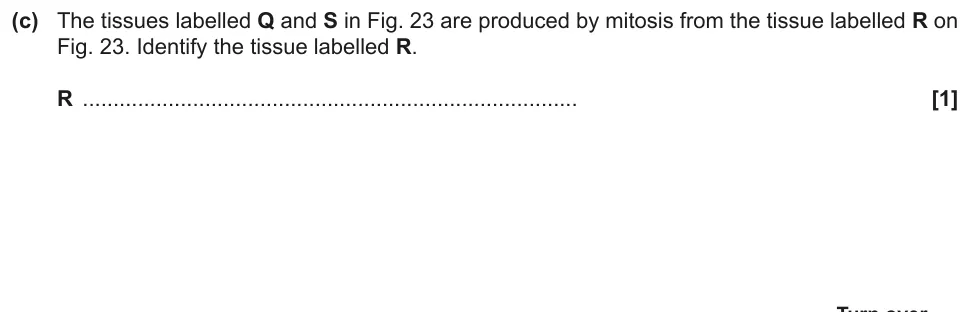
Identify tissue R, which produces tissues Q and S by mitosis.
Show the mark scheme

Tap an image to open it full size.
From the examiners' report: Most students named the cambium or meristem. Remember that xylem and phloem both come from dividing meristem cells that sit between them.
Question 12
A level Paper 2 · June 2025 · Q16(b)(i) · 2 marks · Medium
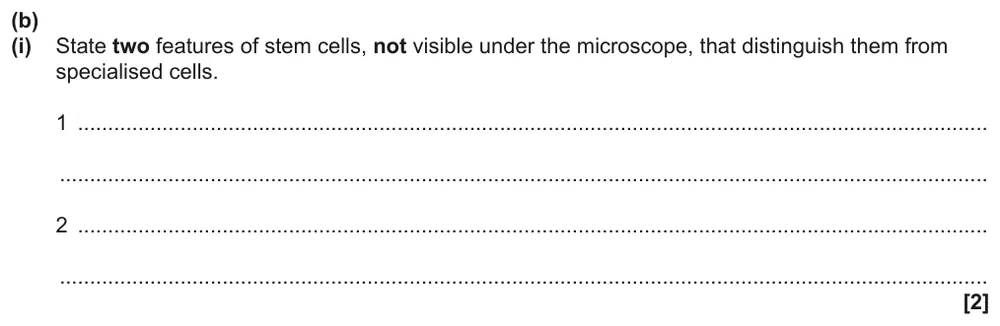
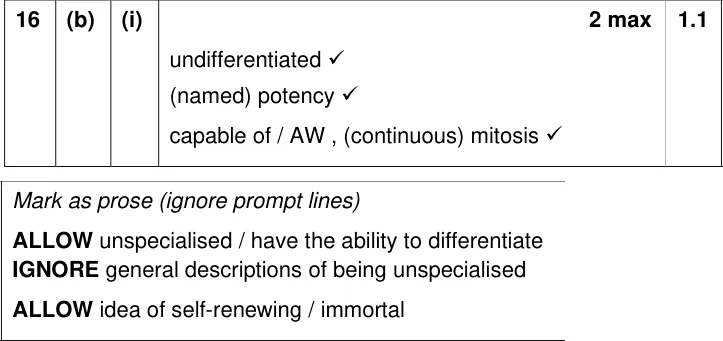
State two features of stem cells, not visible with a microscope, that set them apart from specialised cells.
Show the mark scheme
Tap an image to open it full size.
From the examiners' report: Most students said undifferentiated but missed the second mark. Add a named potency or that they keep dividing by mitosis; organelles don't count, because the question rules out anything visible.
Question 13
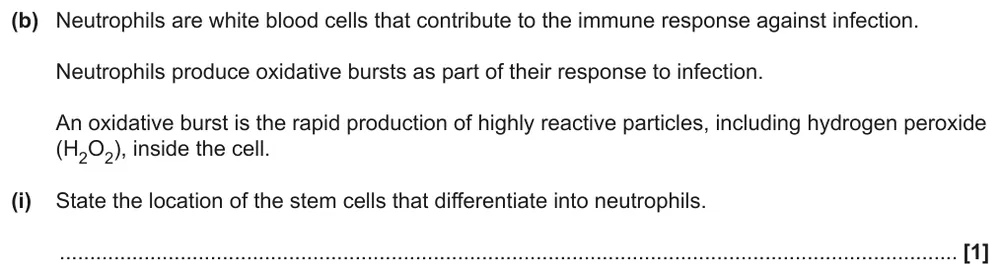
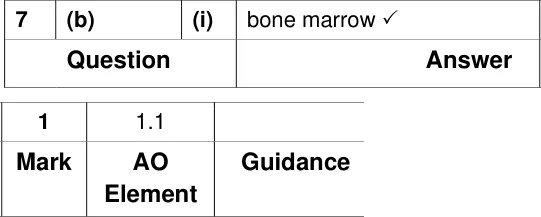
A level Paper 3 · June 2025 · Q7(b)(i) · 1 mark · Medium
State where the stem cells that produce neutrophils are found.
Show the mark scheme
Tap an image to open it full size.
From the examiners' report: Most students remembered bone marrow. Learn it alongside erythrocytes: both come from the same stem cells in the bone marrow.
Question 14
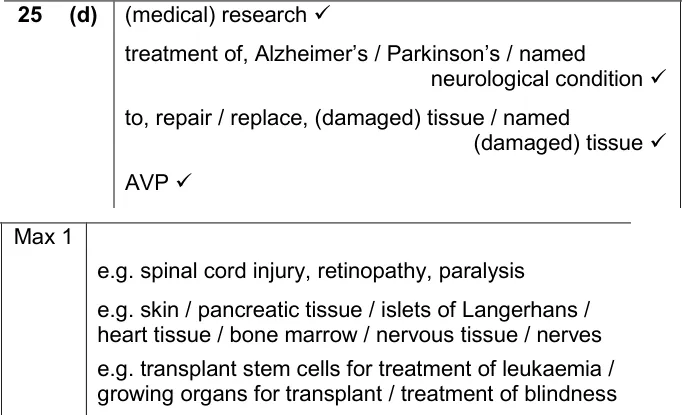
AS Paper 1 · June 2022 · Q25(d) · 1 mark · Medium
Name one potential use of stem cells in medicine.

Show the mark scheme
Tap an image to open it full size.
From the examiners' report: "Treat cancer" or "treat diabetes" was too vague. Say the stem cells would replace a damaged tissue, for example new pancreatic β-cells for type 1 diabetes.
Applying what you know
Question 15
AS Paper 1 · June 2024 · Q23(c) · 2 marks · Hard
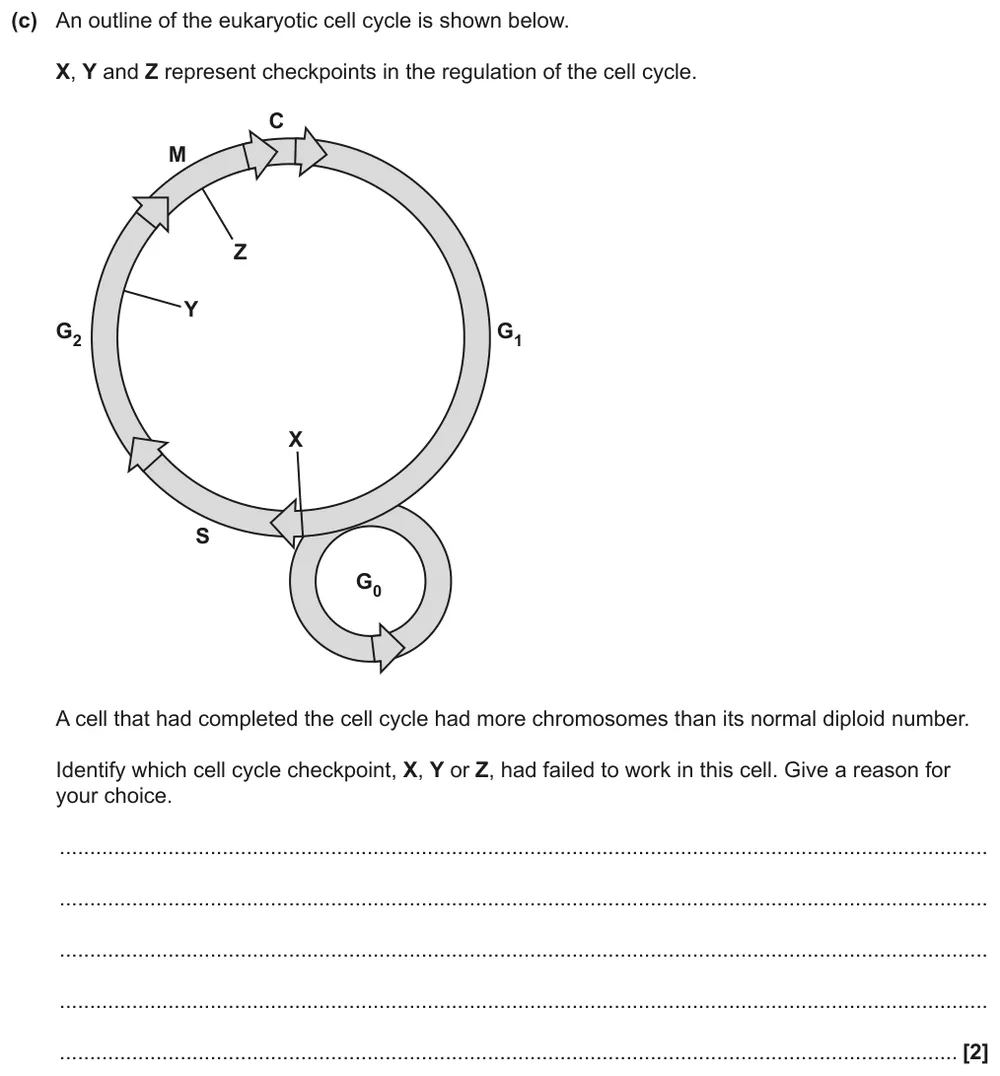
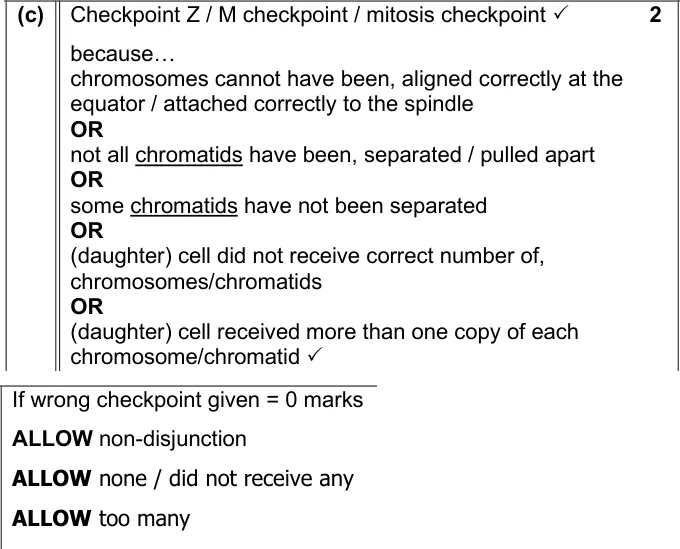
A cell ends the cycle with too many chromosomes: identify the checkpoint that failed and explain.
Show the mark scheme
Tap an image to open it full size.
From the examiners' report: Only a few students chose Z. Extra chromosomes come from chromatids failing to separate at mitosis, which the spindle checkpoint should catch; DNA can't over-replicate, so X and Y are wrong.
Question 16
A level Paper 1 · June 2022 · Q21(d)(i) · 2 marks · Hard
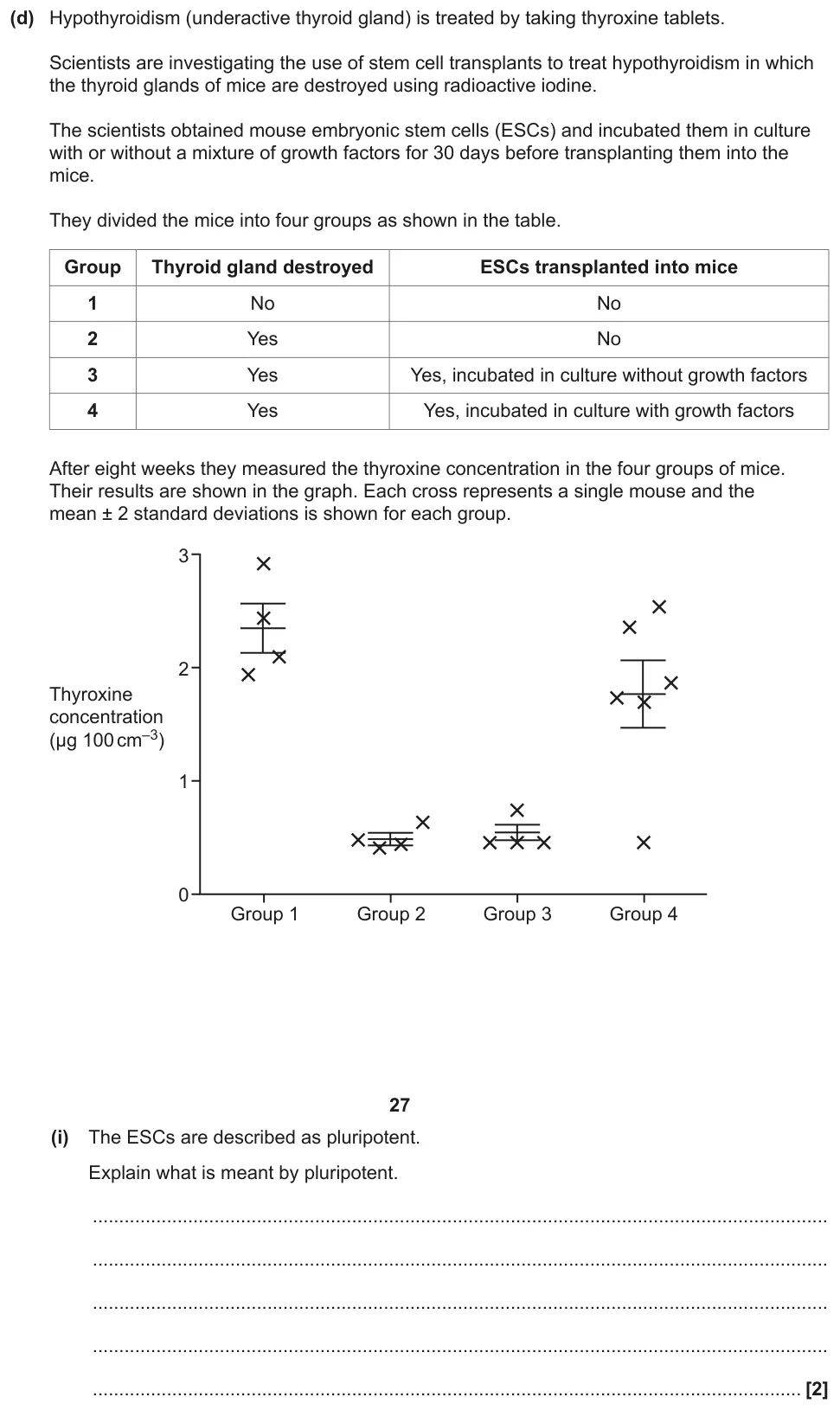
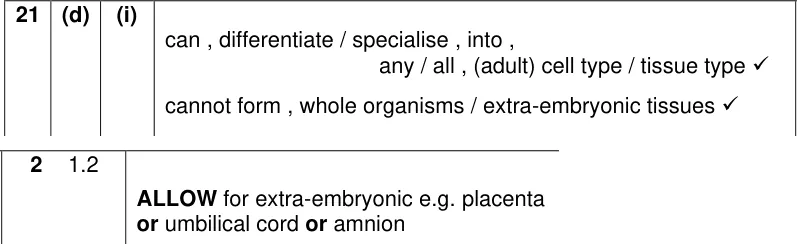
Explain what is meant by pluripotent embryonic stem cells, in a study using stem cells to treat hypothyroidism.
Show the mark scheme
Tap an image to open it full size.
From the examiners' report: Many students gave the definition of multipotent. Pluripotent cells can become any type of body cell, but not a whole organism or the placenta; say "cell types", not just "cells".
Practical and maths
Question 17
A level Paper 2 · June 2024 · Q21(a)(i) · 1 mark · Medium
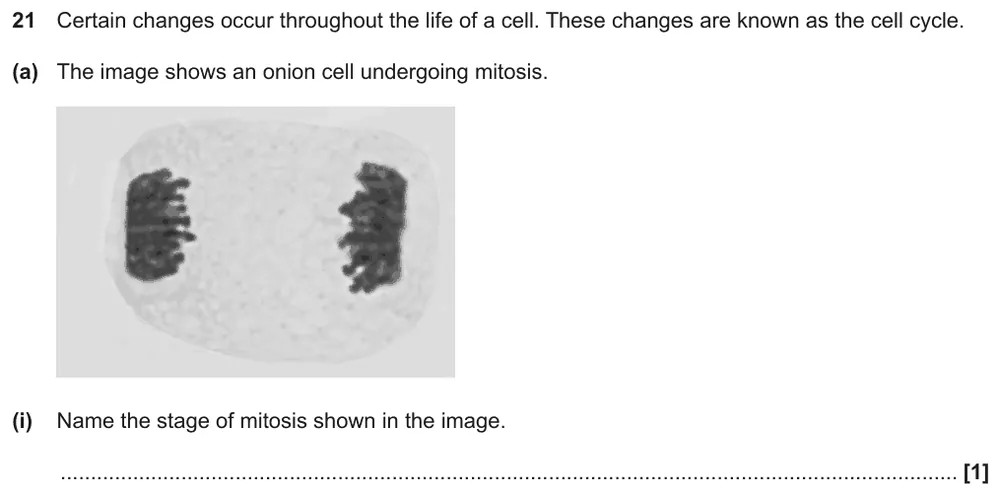
Name the stage of mitosis shown in a micrograph of an onion root cell.
Show the mark scheme

Tap an image to open it full size.
From the examiners' report: Anaphase was the more common answer, but the chromosomes have already clustered at the poles and can't be told apart. In anaphase you'd see separate chromatids being pulled apart in a V shape.
Question 18
A level Paper 2 · June 2024 · Q21(a)(iii) · 1 mark · Medium
State why root tissue is often chosen to study mitosis.

Show the mark scheme

Tap an image to open it full size.
From the examiners' report: Mitosis happens in cells, not in tissues. Write "many of the cells are dividing", not "it divides a lot".
Question 19
AS Paper 1 · June 2019 · Q23(c) · 2 marks · Medium
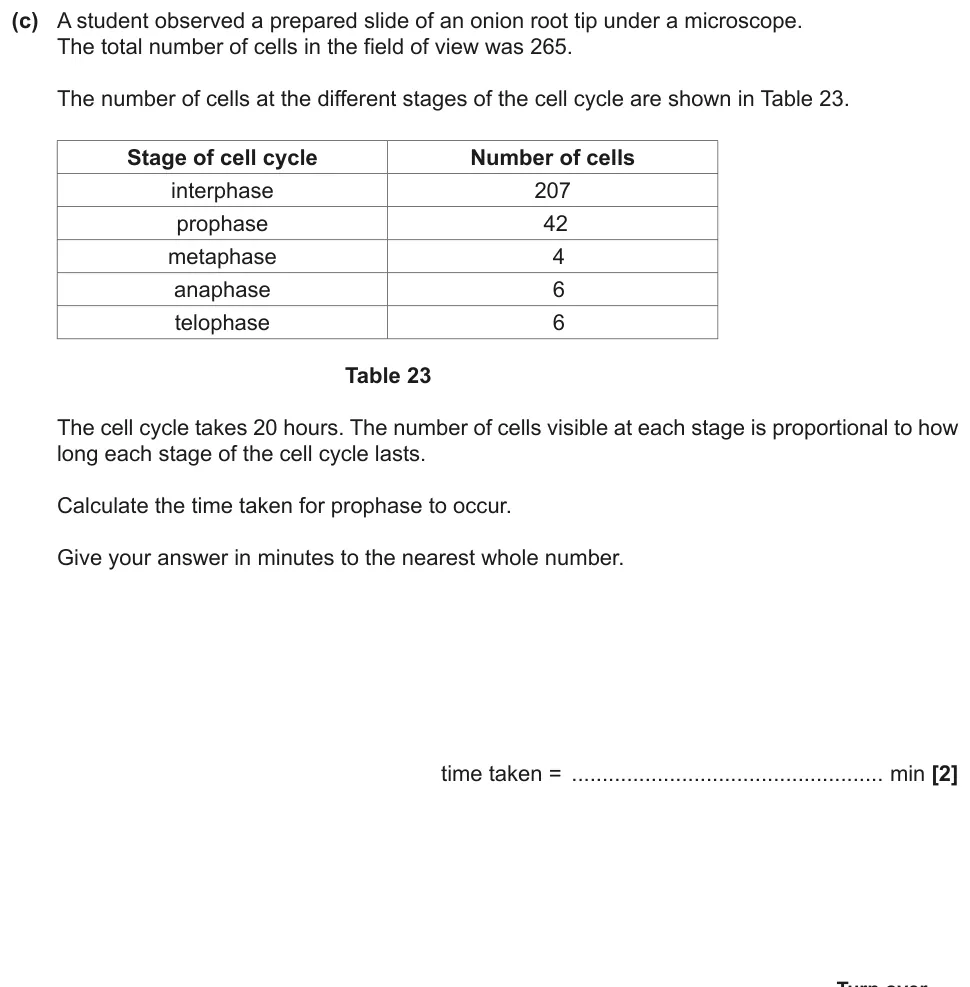
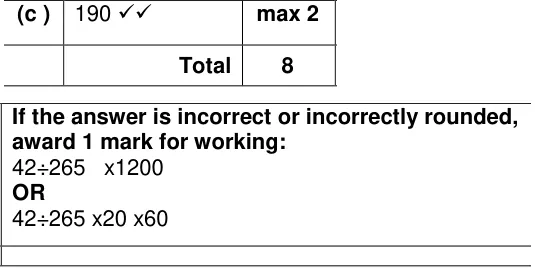
Use counts of cells at each stage in a root tip to calculate how long prophase lasts.
Show the mark scheme
Tap an image to open it full size.
From the examiners' report: Most students got 190 minutes. Convert 20 hours to 1200 minutes before you multiply, and round to the whole number the question asks for.
Question 20
A level Paper 2 · June 2023 · Q16(d) · 2 marks · Medium
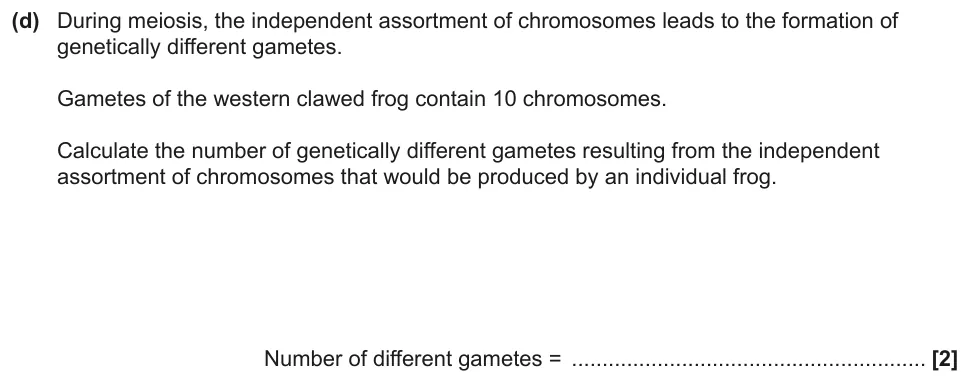
Calculate how many genetically different gametes independent assortment can give when gametes have 10 chromosomes.
Show the mark scheme

Tap an image to open it full size.
From the examiners' report: Fewer than 1 in 5 students got this. The number of combinations is 2ⁿ, where n is the haploid number (here 10), so 2¹⁰ = 1024; the commonest wrong answer was 40.
Where students lose marks (from OCR examiners' reports and mark schemes)
Each point below is followed by wording that gained marks.
S phase has already happened by G2: Asked for a process in G2, the most common wrong answer was that DNA replicates, even though the cell cycle diagram showed S before G2.
✔ Gains credit: "Organelles (such as mitochondria) are replicated" or "the replicated DNA is checked for errors".
Mitosis repairs tissues, not cells: Only about half of students scored on the roles of mitosis. "Growth and repair of cells" was not credited, and nor were extra ideas such as cloning or differentiation.
✔ Gains credit: "Growth (of organisms or tissues) and repair (of organisms or tissues)".
Identical in what way? Genetically: Explaining why plants use mitosis for asexual reproduction, many students wrote "identical" without "genetically", and few mentioned the chromosome number.
✔ Gains credit: "Mitosis produces genetically identical cells" and "it maintains the chromosome (diploid) number between generations".
Homologous is not the same as identical: Many students described homologous chromosomes as genetically identical or as having the same alleles; some thought they were joined by a centromere.
✔ Gains credit: "They carry the same genes at the same loci but may have different alleles" and "one is maternal and one is paternal".
Independent assortment happens twice: Asked for three processes that cause variation in meiosis, many students wrote "independent assortment" without saying of what or when, and mutation was not credited.
✔ Gains credit: "Crossing over in prophase 1; independent assortment of homologous chromosomes in metaphase 1; independent assortment of chromatids in metaphase 2".
The acrosome holds the enzymes: Some students called the acrosome an enzyme, or said its enzymes break down the egg's membrane or cell wall.
✔ Gains credit: "The acrosome contains digestive (hydrolytic) enzymes that allow the sperm to penetrate the outer layer of the egg".
Pluripotent: every cell type, never a whole organism: Many students gave the definition of multipotent, wrote "cells" rather than "cell types", or didn't say what pluripotent cells can't form.
✔ Gains credit: "Can differentiate into any type of (adult) cell or tissue" and "cannot form a whole organism or extra-embryonic tissues such as the placenta".
Extra chromosomes mean the spindle checkpoint failed: Many chose checkpoint X or Y, thinking DNA had over-replicated. A wrong checkpoint scored nothing for the whole part.
✔ Gains credit: "Checkpoint Z (metaphase checkpoint), because the chromatids were not separated correctly, so a daughter cell received too many chromosomes".
Download the questions
Download the PDF pack (20 questions, mark schemes at the end)
Keep practising
- Cell Division quiz
- Cell Differentiation and Stem Cells quiz
- PAG 1 Microscopy: OCR A Level Biology exam questions by topic
- Exchange Surfaces (3.1.1): OCR A Level Biology exam questions by topic
- Cell cycle, mitosis and meiosis: interactive written questions (20)
- Cell differentiation and stem cells: interactive written questions (19)
- OCR A Level Biology masterclasses
Questions, mark schemes and examiners' report extracts © OCR.