

Respiration is the other half of the energy story in Module 5, and OCR expect real detail. Spec point 5.2.2 asks why cells need to respire, the structure of a mitochondrion, and the process and site of glycolysis, the link reaction, the Krebs cycle and oxidative phosphorylation. You also need the roles of NAD, FAD and coenzyme A, the chemiosmotic theory, anaerobic respiration in mammals and yeast, the energy values of different respiratory substrates, and how to calculate and interpret the respiratory quotient (RQ).
The marks are lost on precise vocabulary. Students call every phosphorylation "substrate level", write that coenzymes "remove" hydrogen, put FAD's hydrogen into the intermembrane space, say respiration "produces energy", or decide an RQ of 0.8 means protein without looking at the rest of the graph. Chemiosmosis set in a new context catches out even strong students.
Work through the seventeen questions below in order. They start with recall, move on to applying what you know to new data, and finish with yeast practicals and RQ. If you'd like to go through questions like these with me each week, my OCR A masterclasses run on Wednesdays at 5.15pm for Year 12 and on Tuesdays at 6.30pm or Thursdays at 5.15pm for Year 13.
Want help with this topic? It comes up in my weekly OCR A masterclasses. See the timetable →
What you need from GCSE
Each question on this page assumes you're secure on these GCSE ideas. If any of them feels shaky, look it up before you start.
- Aerobic respiration: glucose + oxygen → carbon dioxide + water. It happens continuously in mitochondria and releases energy for cells.
- Anaerobic respiration in muscles: glucose → lactic acid, giving an oxygen debt. In yeast: glucose → ethanol + carbon dioxide (fermentation).
- Anaerobic respiration releases much less energy per glucose than aerobic respiration.
- Cells use the energy from respiration for muscle contraction, active transport, building large molecules and keeping warm.
- Enzymes control the reactions, so temperature and substrate concentration affect the rate of respiration.
Key terms
These words come up in the questions and mark schemes. Examiners expect you to use them exactly.
- Glycolysis: in the cytoplasm: glucose is phosphorylated to hexose bisphosphate, split into two triose phosphates, then oxidised to pyruvate; net 2 ATP and 2 reduced NAD.
- Link reaction: in the mitochondrial matrix: pyruvate is decarboxylated and dehydrogenated, and combines with coenzyme A to form acetyl CoA.
- Krebs cycle: in the matrix: acetyl group + oxaloacetate → citrate, which is reconverted to oxaloacetate by decarboxylation and dehydrogenation, making reduced NAD, reduced FAD and one ATP per turn.
- Substrate-level phosphorylation: ATP made by transferring a phosphate group directly from a substrate to ADP, as in glycolysis and the Krebs cycle.
- Coenzymes NAD and FAD: hydrogen acceptors: they are reduced in glycolysis, the link reaction and the Krebs cycle, and carry hydrogen atoms to the electron transport chain.
- Oxidative phosphorylation: on the inner mitochondrial membrane (cristae): electrons pass along carriers, protons are pumped into the intermembrane space, and oxygen is the final electron acceptor, forming water.
- Chemiosmosis: protons diffuse down their gradient through ATP synthase, providing energy to join ADP and Pi to make ATP.
- Anaerobic respiration: without oxygen, pyruvate is reduced to lactate (mammals) or decarboxylated and reduced to ethanol (yeast), regenerating NAD so glycolysis continues.
- Respiratory quotient (RQ): CO2 produced ÷ O2 consumed; about 1.0 for carbohydrate, 0.9 for protein and 0.7 for lipid.
What these questions cover (OCR 5.2.2)
The questions test these learning outcomes from the OCR A Level Biology A specification (H420):
- (a) the need for cellular respiration
- (b) the structure of the mitochondrion
- (c) the process and site of glycolysis
- (d) the link reaction and its site in the cell
- (e) the process and site of the Krebs cycle
- (f) the importance of coenzymes in cellular respiration (NAD, FAD and coenzyme A)
- (g) the process and site of oxidative phosphorylation
- (h) the chemiosmotic theory (in oxidative phosphorylation and photophosphorylation)
- (i)(i) the process of anaerobic respiration in eukaryotes
- (i)(ii) practical investigations into respiration rates in yeast, under aerobic and anaerobic conditions
- (j) the difference in relative energy values of carbohydrates, lipids and proteins as respiratory substrates
- (k) the use and interpretation of the respiratory quotient (RQ) (RQ = CO2 produced ÷ O2 consumed)
- (l) practical investigations into the effect of factors such as temperature, substrate concentration and different respiratory substrates on the rate of respiration (including the use of respirometers)
How to use this page
Write your answer on paper before you open the mark scheme. Allow about 1.2 minutes per mark: the 17 questions are worth 37 marks, so about 44 minutes in total. Then mark your answer strictly against the mark scheme and read the examiners' tip underneath it. If you'd rather print the questions, download the PDF pack.
Recall
Question 1
A level Paper 3 · June 2024 · Q4(b) · 1 mark · Easy
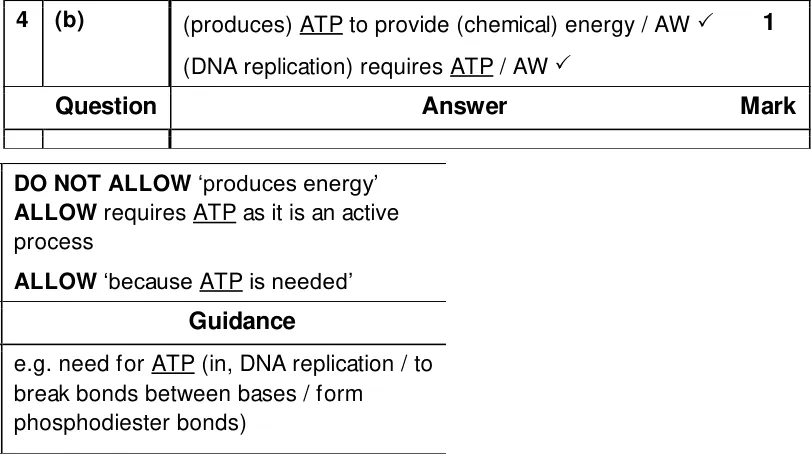
Outline why cells carrying out DNA replication need to respire.

Show the mark scheme
Tap an image to open it full size.
From the examiners' report: Say respiration makes ATP, which provides the energy DNA replication needs. Stay with replication: answers about protein synthesis, transcription or translation didn't score.
Question 2
A level Paper 1 · June 2017 · Q19(c)(i) · 3 marks · Medium
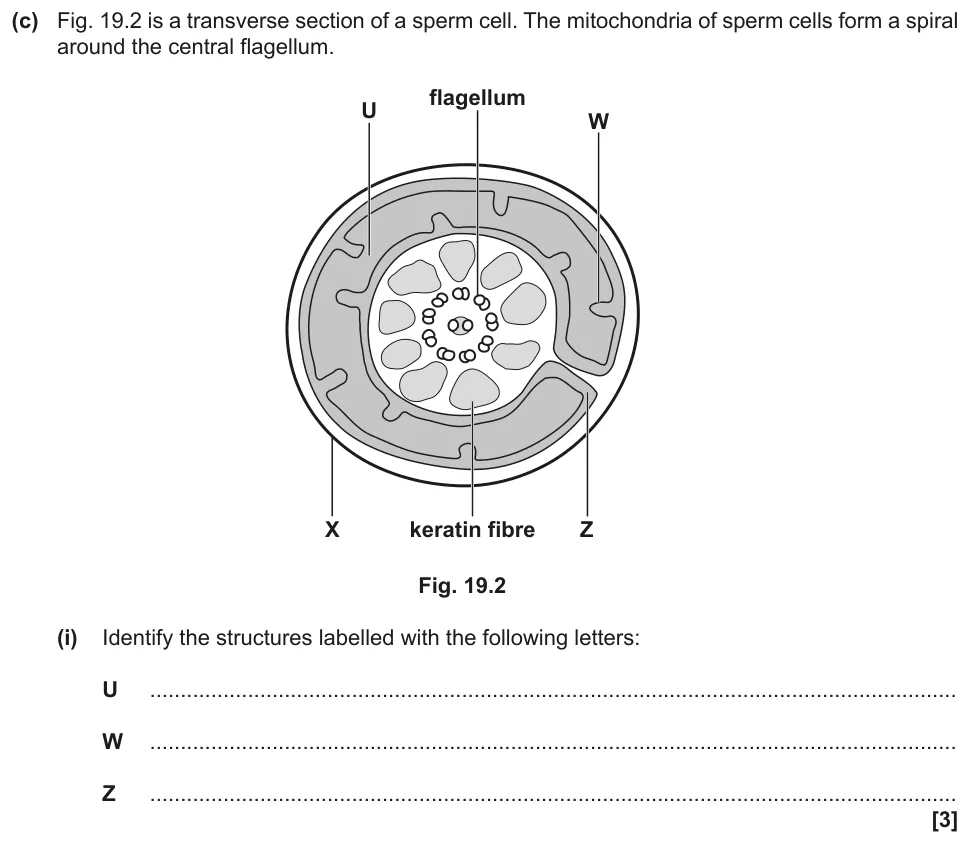
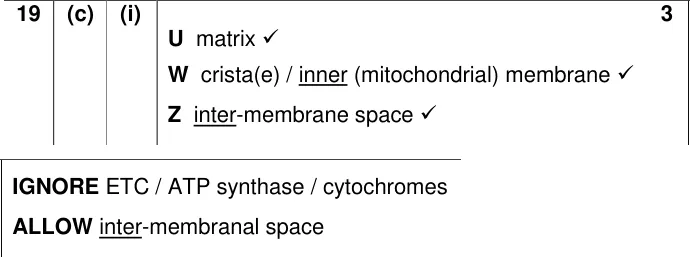
Identify three structures in a section through the mitochondria of a sperm cell.
Show the mark scheme
Tap an image to open it full size.
Question 3
A level Paper 3 · June 2018 · Q2(a) · 4 marks · Medium
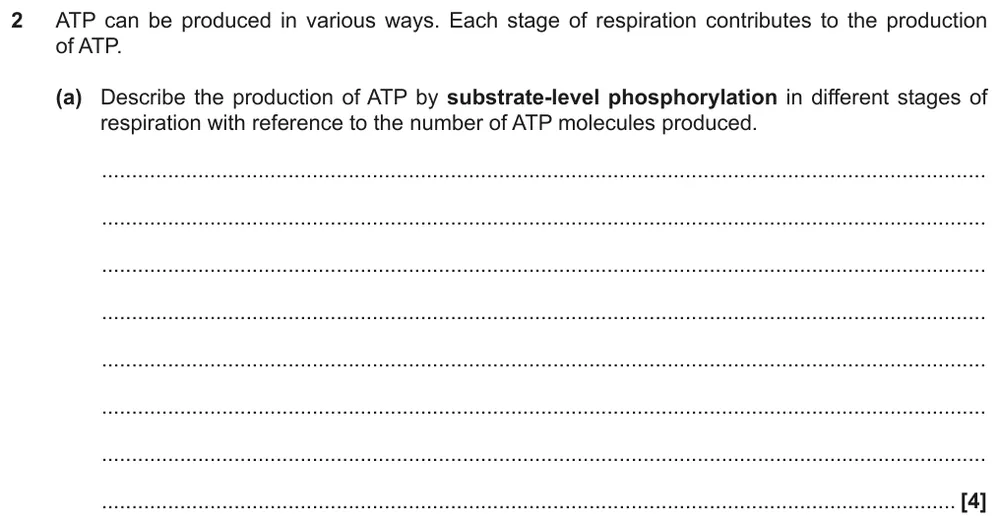
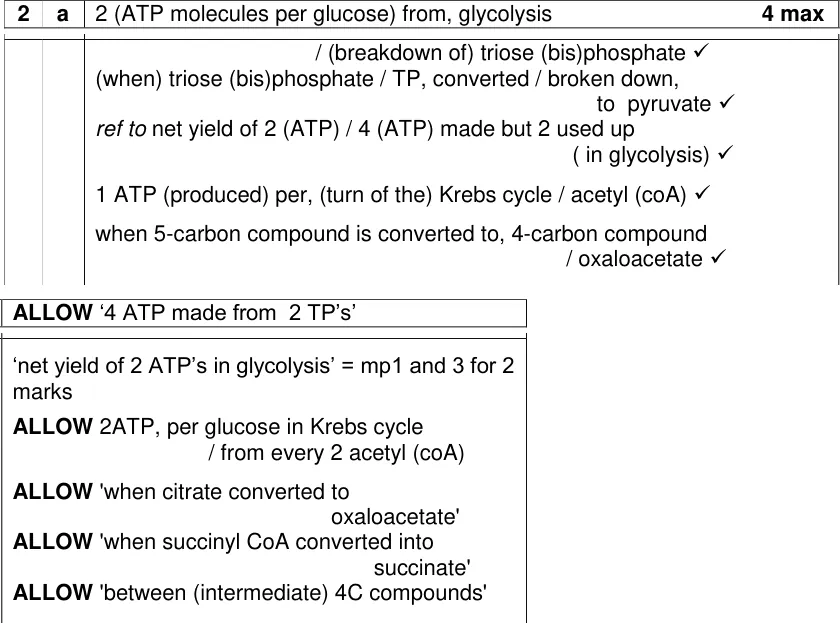
Describe ATP production by substrate-level phosphorylation in different stages of respiration, with numbers.
Show the mark scheme
Tap an image to open it full size.
From the examiners' report: Give net 2 ATP from glycolysis as triose phosphate is converted to pyruvate, then 1 ATP per turn of the Krebs cycle. No ATP is made in the link reaction, and oxidative phosphorylation isn't substrate-level, so it gains nothing here.
Question 4
A level Paper 1 · June 2025 · Q17(a)(i) · 1 mark · Medium
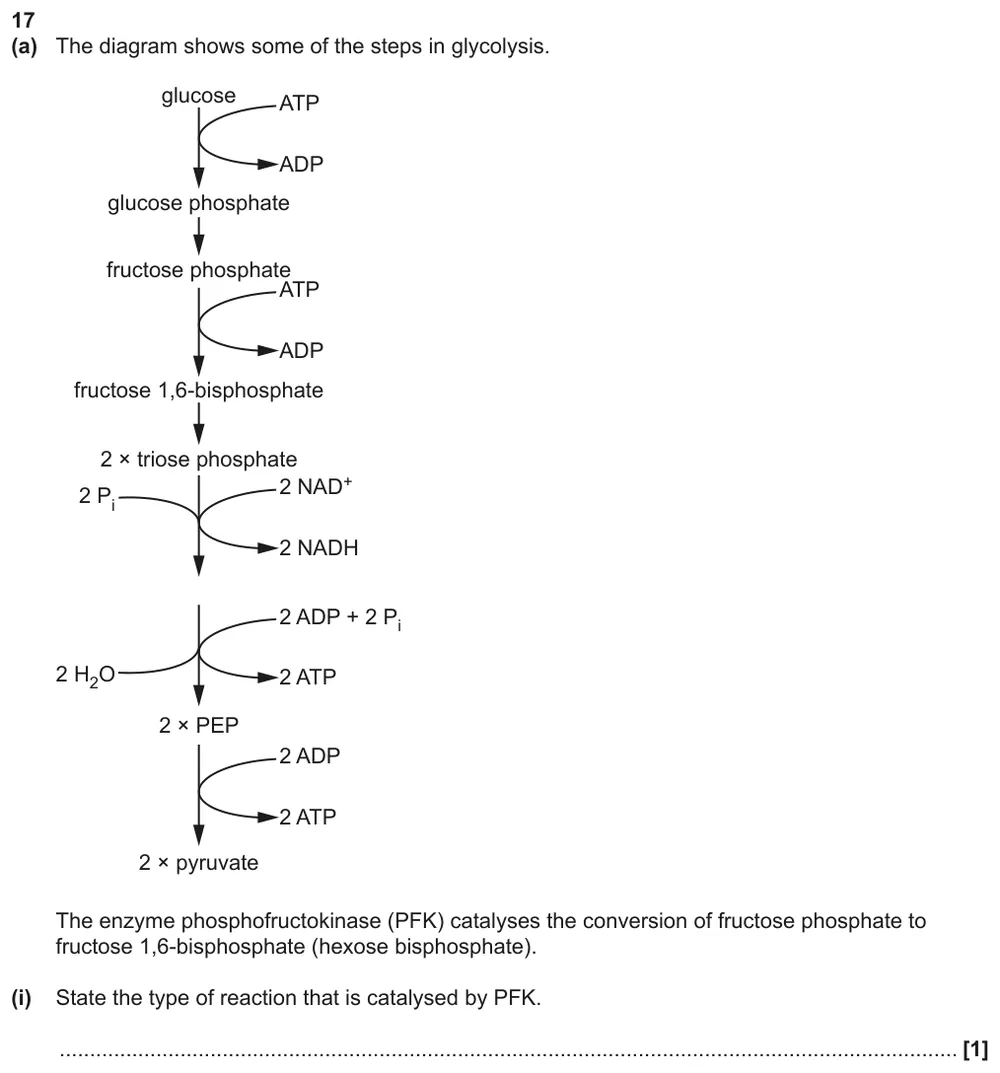
State the type of reaction catalysed by phosphofructokinase in glycolysis.
Show the mark scheme

Tap an image to open it full size.
From the examiners' report: It's phosphorylation, using ATP. Don't call it substrate-level phosphorylation: that term is for making ATP, later in glycolysis.
Question 5
A level Paper 1 · June 2025 · Q17(c)(i) · 1 mark · Medium
Name the type of reaction in aerobic respiration that produces CO2.

Show the mark scheme

Tap an image to open it full size.
From the examiners' report: Answer the question asked: the type of reaction is decarboxylation. Hydrolysis is wrong, and naming the stages belongs in the next part.
Question 6
A level Paper 1 · June 2025 · Q17(c)(ii) · 2 marks · Medium
Name the two stages of respiration that produce CO2.

Show the mark scheme

Tap an image to open it full size.
From the examiners' report: CO2 comes from the link reaction and the Krebs cycle. Glycolysis and oxidative phosphorylation don't release any.
Question 7
A level Paper 1 · June 2025 · Q17(c)(iii) · 2 marks · Hard
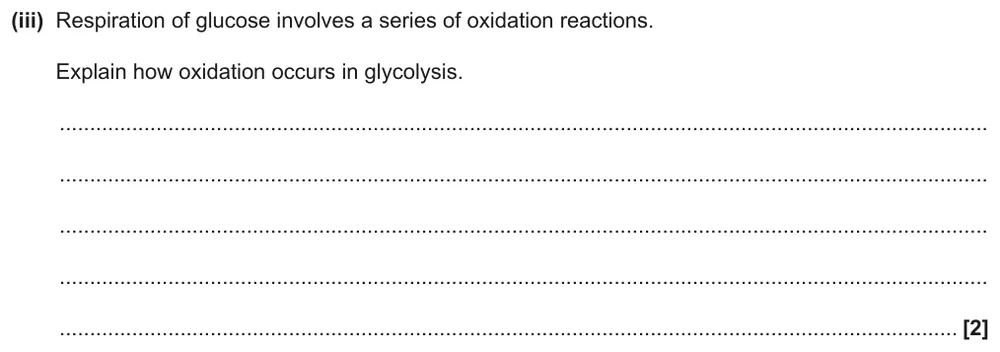
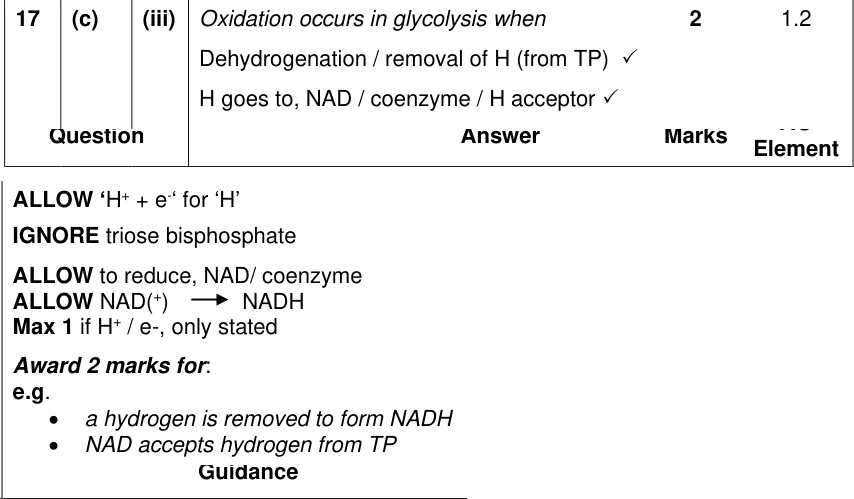
Explain how oxidation occurs in glycolysis.
Show the mark scheme
Tap an image to open it full size.
From the examiners' report: Oxidation here is the removal of hydrogen from triose phosphate, and NAD accepts it to become reduced NAD. Writing only about losing electrons doesn't explain how NADH forms.
Question 8
A level Paper 3 · November 2021 · Q4(b)(ii) · 2 marks · Medium
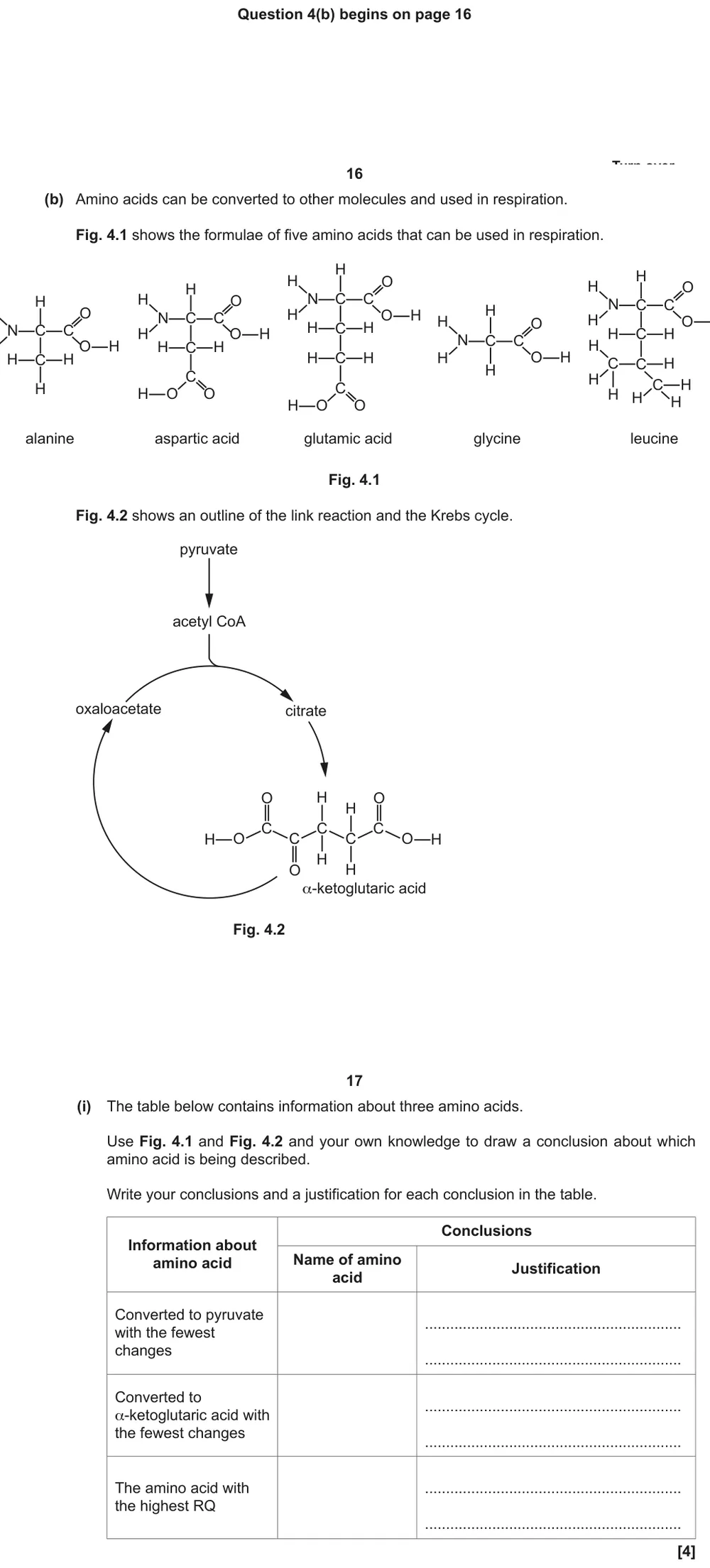
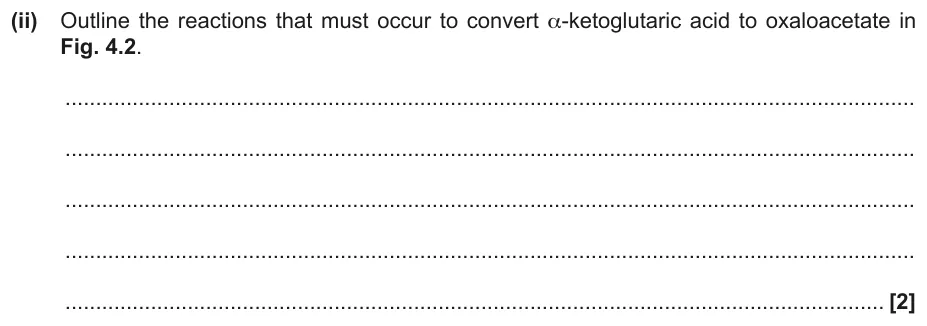
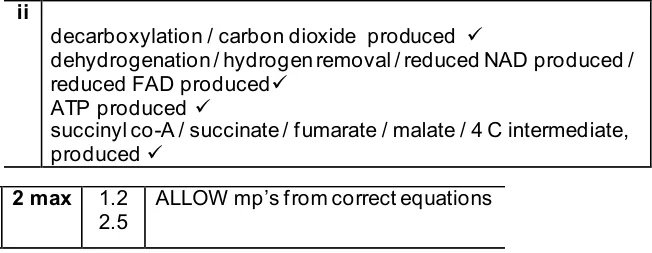
Outline the reactions that convert α-ketoglutaric acid to oxaloacetate in the Krebs cycle.
Information from earlier in this question:
Show the mark scheme
Tap an image to open it full size.
From the examiners' report: Most students did this well. Name the reaction types, decarboxylation and dehydrogenation, and say what each makes: CO2, reduced NAD and reduced FAD, plus ATP.
Question 9
A level Paper 3 · November 2021 · Q4(c) · 3 marks · Medium
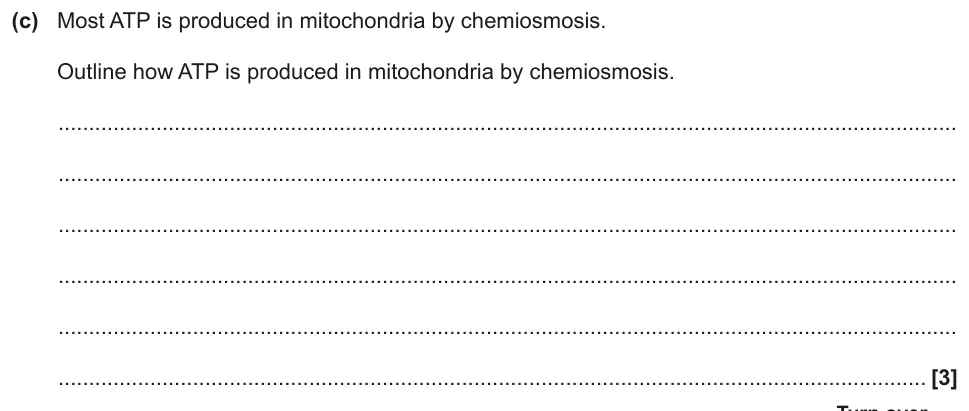
Outline how ATP is produced in mitochondria by chemiosmosis.
Show the mark scheme

Tap an image to open it full size.
From the examiners' report: Most students did well. Protons are pumped into the intermembrane space but diffuse back through ATP synthase, so don't say they are pumped through it, and say energy is provided, not produced.
Applying what you know
Question 10
A level Paper 3 · June 2018 · Q2(c)(iii) · 1 mark · Medium
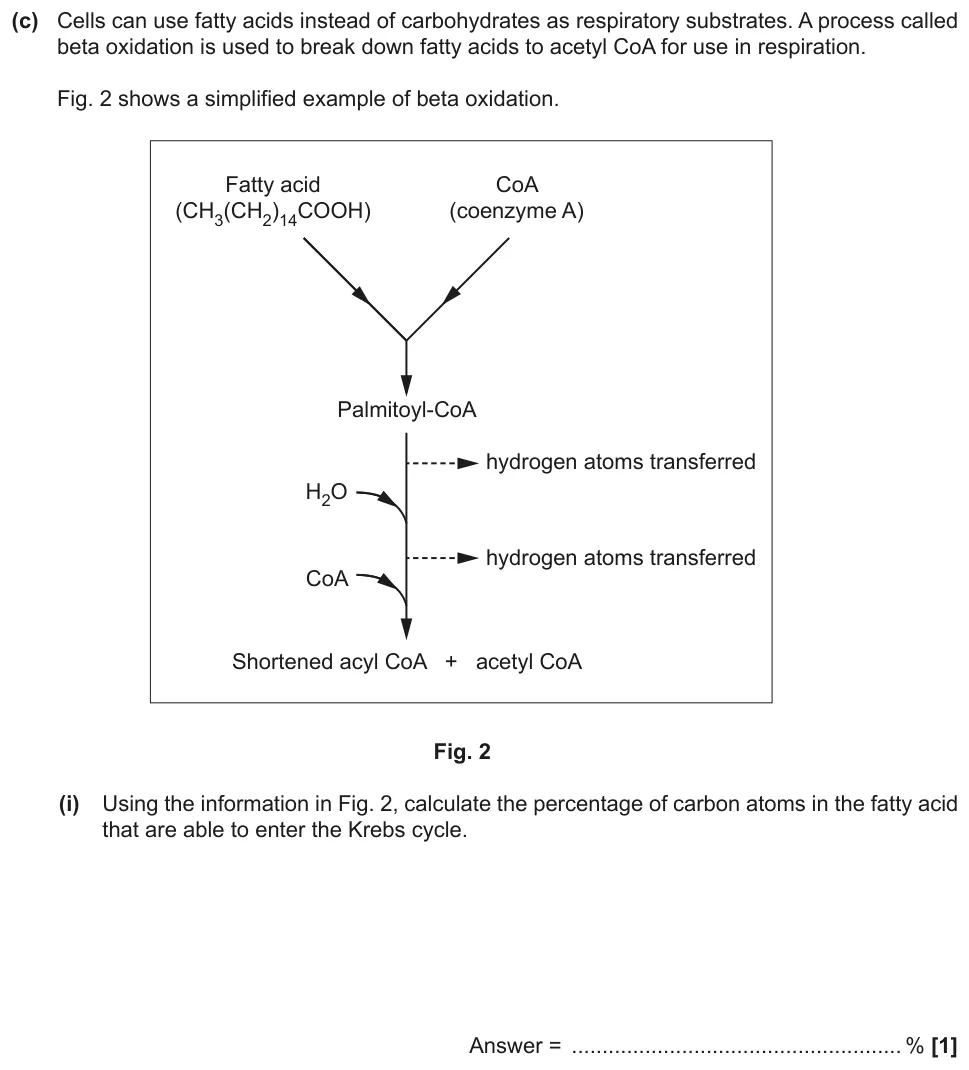
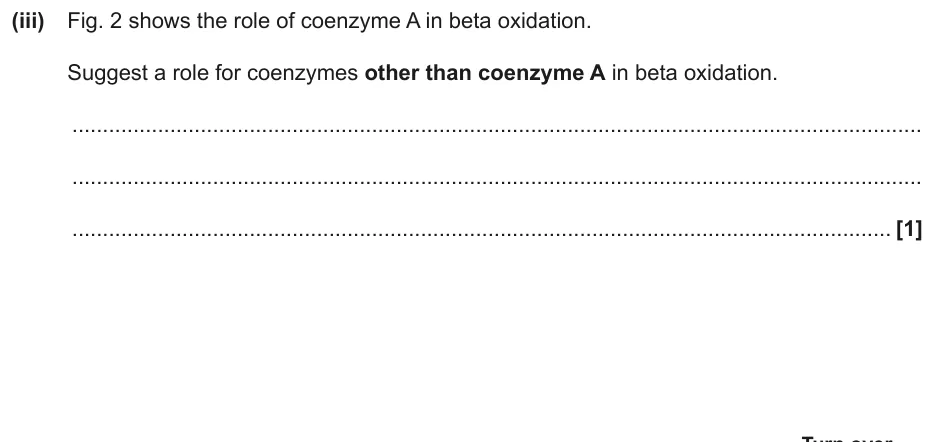
Suggest a role for coenzymes other than coenzyme A in beta oxidation of fatty acids.
Information from earlier in this question:
Show the mark scheme

Tap an image to open it full size.
From the examiners' report: Say NAD or FAD accepts and carries hydrogen atoms, becoming reduced. "Removes hydrogen" isn't enough, and hydrogen ions or molecules are wrong.
Question 11
A level Paper 3 · June 2023 · Q2(c)(i) · 2 marks · Hard
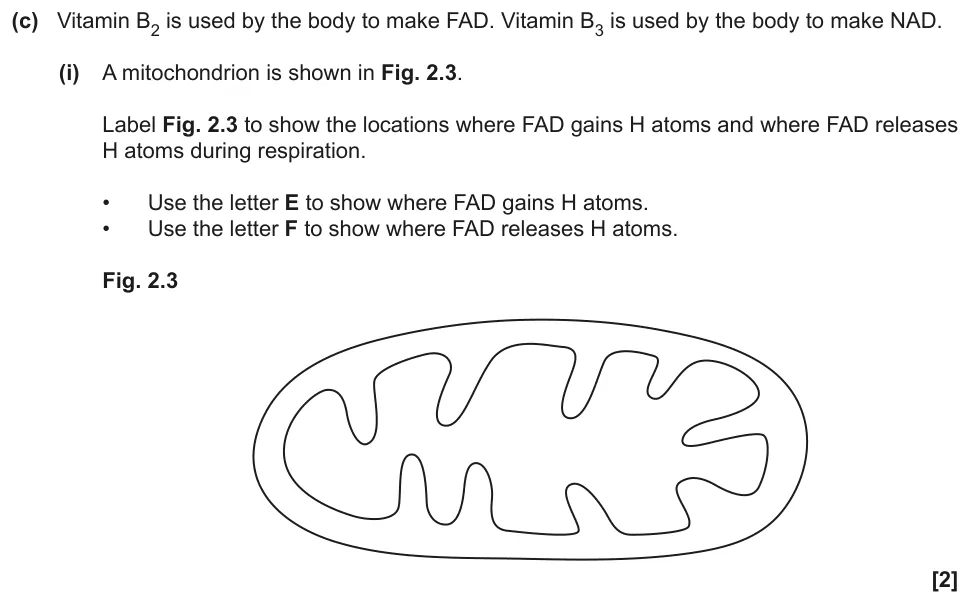
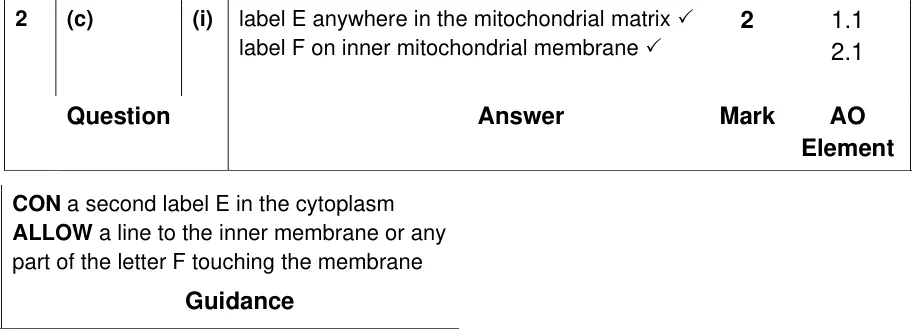
Mark on a mitochondrion where FAD gains hydrogen atoms and where it releases them.
Show the mark scheme
Tap an image to open it full size.
From the examiners' report: FAD is reduced in the matrix during the Krebs cycle and releases its hydrogen at the electron transport chain on the inner membrane, not in the intermembrane space.
Question 12
A level Paper 3 · June 2023 · Q2(c)(ii) · 2 marks · Hard
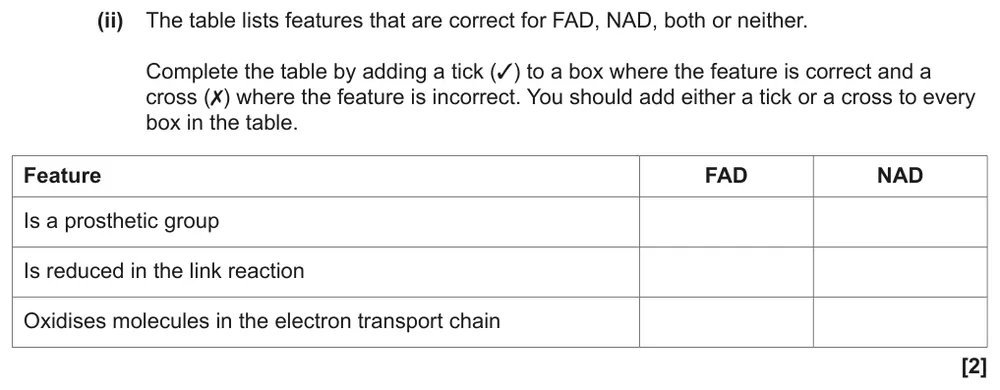
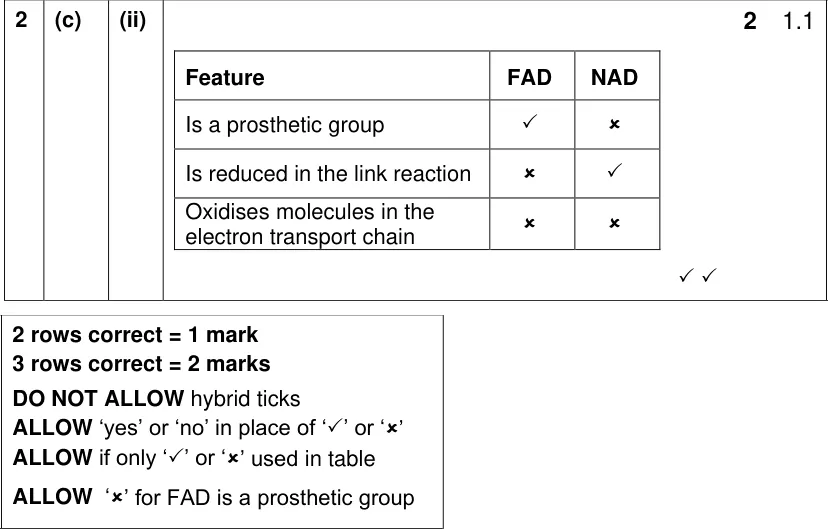
Tick or cross features of FAD and NAD in a table.
Show the mark scheme
Tap an image to open it full size.
From the examiners' report: Reduced NAD and reduced FAD reduce the carriers in the electron transport chain; they don't oxidise them. Only NAD is reduced in the link reaction.
Question 13
A level Paper 3 · June 2024 · Q4(c)(ii) · 2 marks · Hard
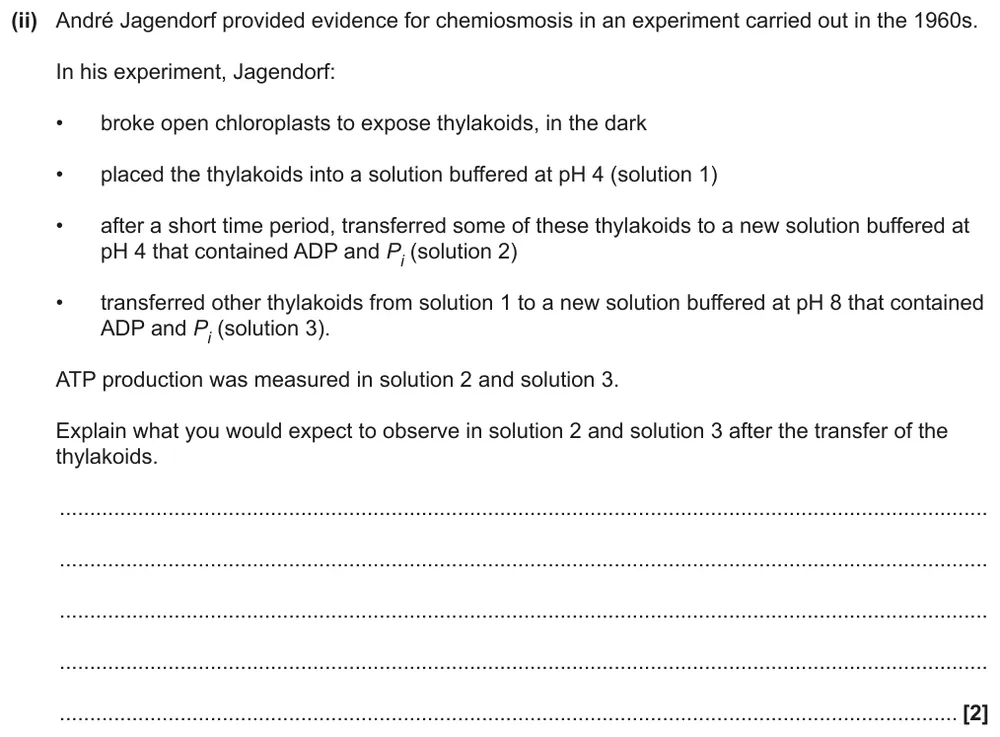
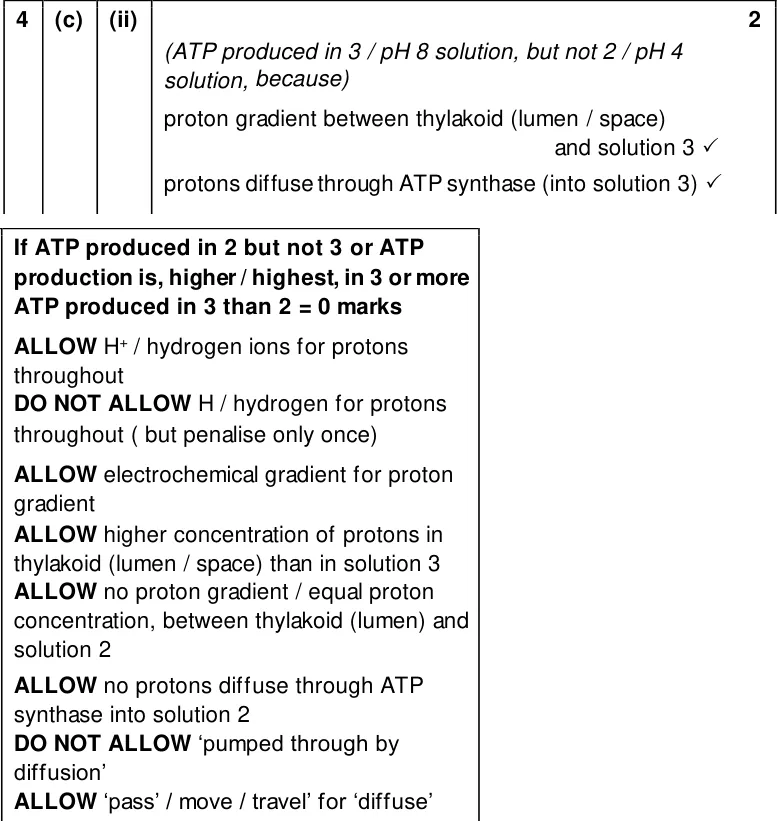
Explain where ATP is made in Jagendorf's experiment with thylakoids moved from pH 4 to pH 4 or pH 8.
Show the mark scheme
Tap an image to open it full size.
From the examiners' report: The thylakoids soaked at pH 4, so their inside is pH 4 too. In solution 2 there's no gradient; in solution 3 protons diffuse out through ATP synthase, so ATP is made only there.
Question 14
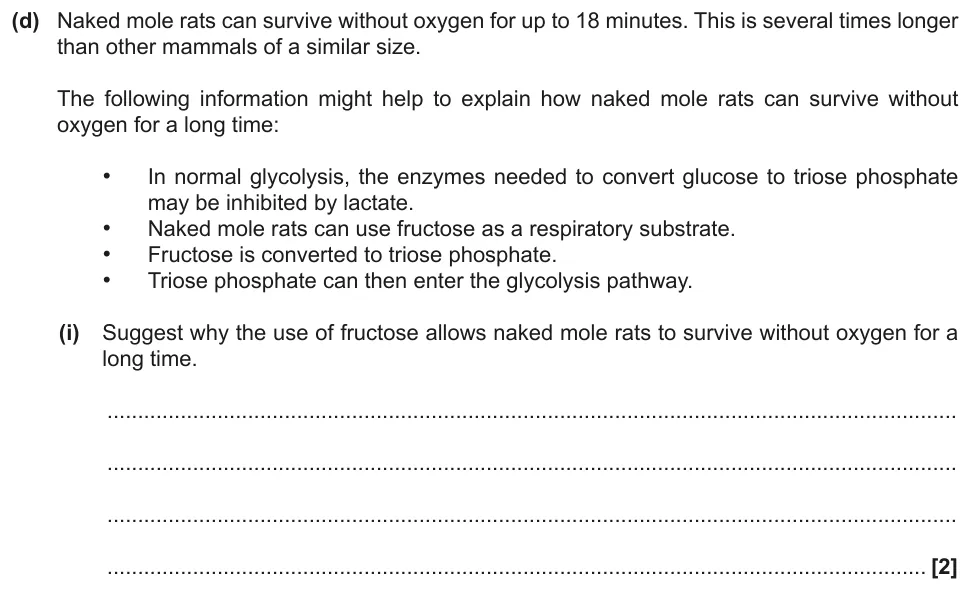
A level Paper 3 · June 2019 · Q2(d)(i) · 2 marks · Medium
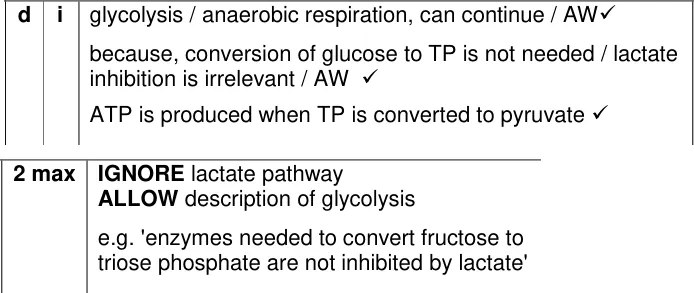
Suggest why using fructose lets naked mole rats survive without oxygen for a long time.
Show the mark scheme
Tap an image to open it full size.
From the examiners' report: Use the information: the fructose route skips the steps lactate inhibits, so glycolysis continues. Then add that ATP is still made as triose phosphate is converted to pyruvate.
Practical and maths
Question 15
A level Paper 3 · June 2023 · Q5(b)(ii) · 3 marks · Easy
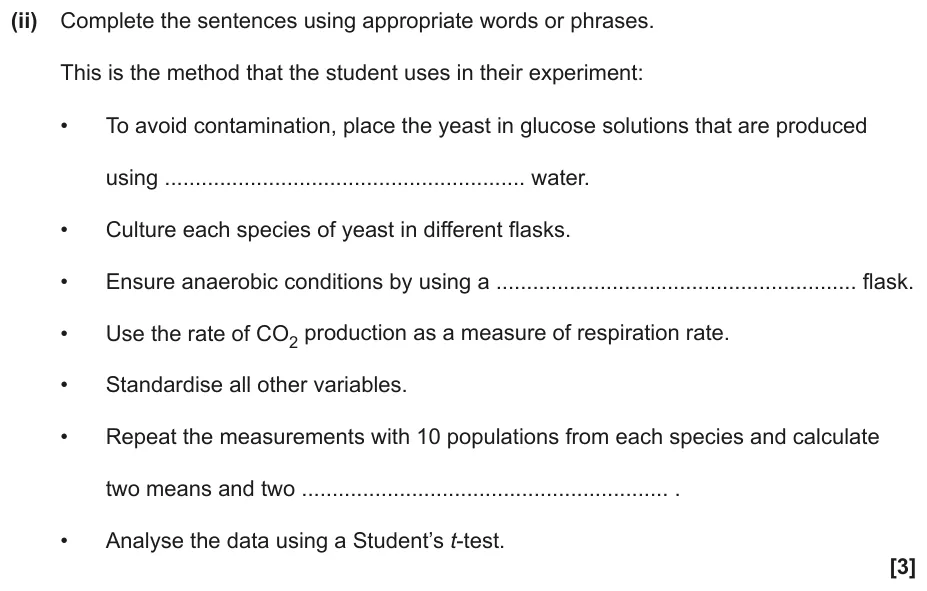
Complete a method for comparing anaerobic respiration rates in two yeast species.
Show the mark scheme

Tap an image to open it full size.
From the examiners' report: For anaerobic conditions the flask must be sealed or airtight, not just conical. The spread of the repeats is described by the standard deviation, not a mean or range.
Question 16
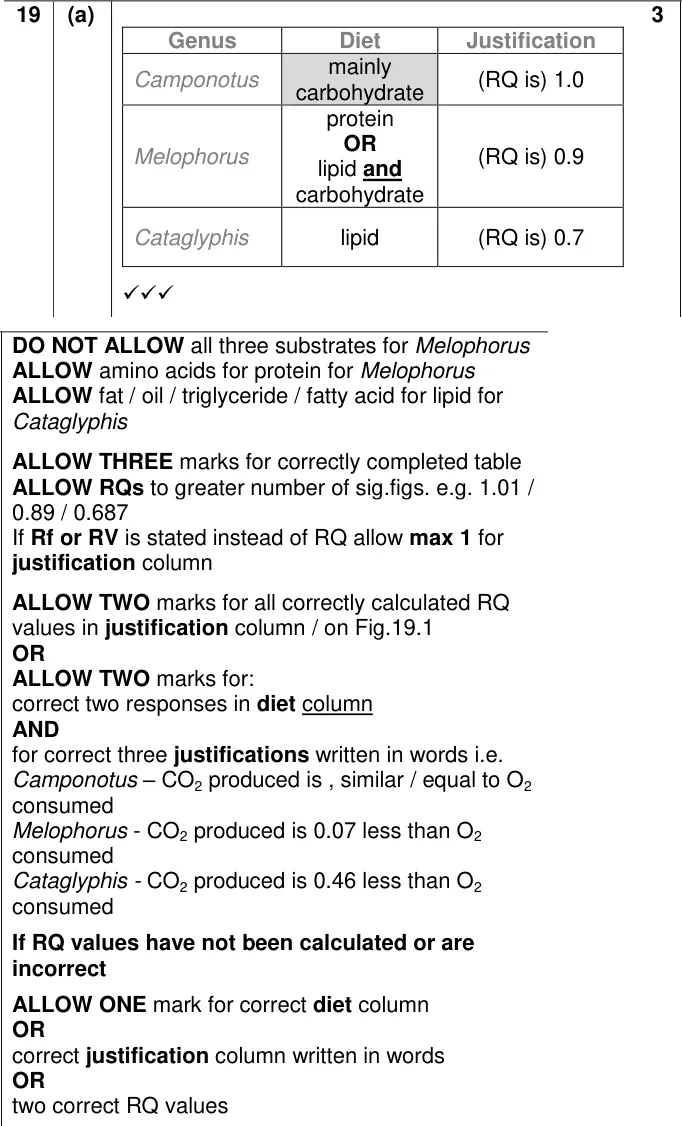
A level Paper 1 · June 2018 · Q19(a) · 3 marks · Medium
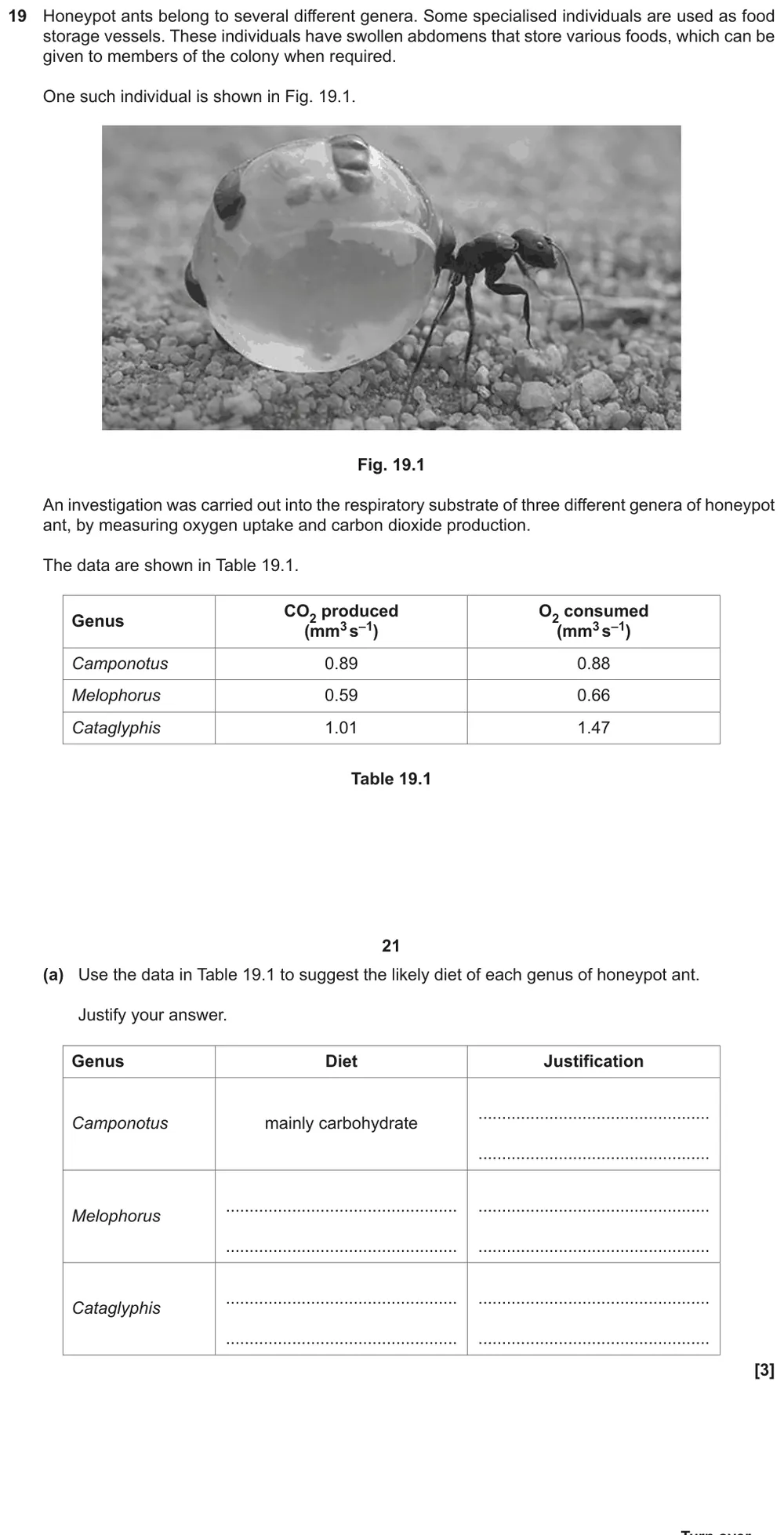
Calculate RQs to suggest the diet of three genera of honeypot ant.
Show the mark scheme
Tap an image to open it full size.
From the examiners' report: Calculate each RQ and write the number in the justification: words like "similar" without the values didn't score. Lipid is about 0.7 and protein about 0.9, so don't swap them.
Question 17
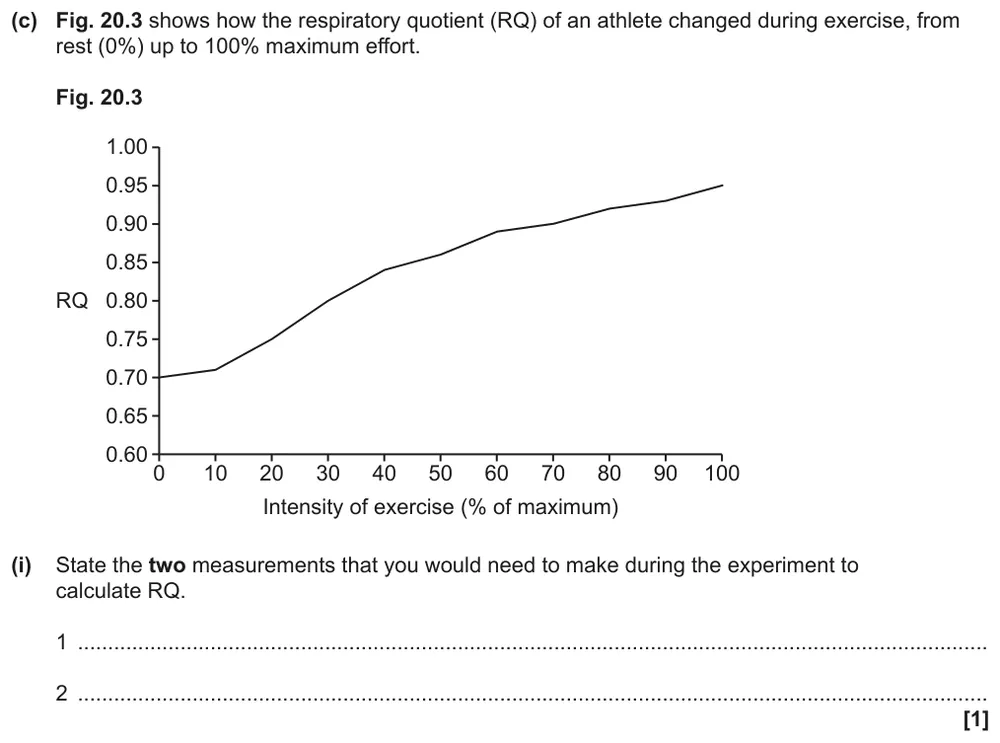
A level Paper 1 · June 2024 · Q20(c)(ii) · 3 marks · Medium
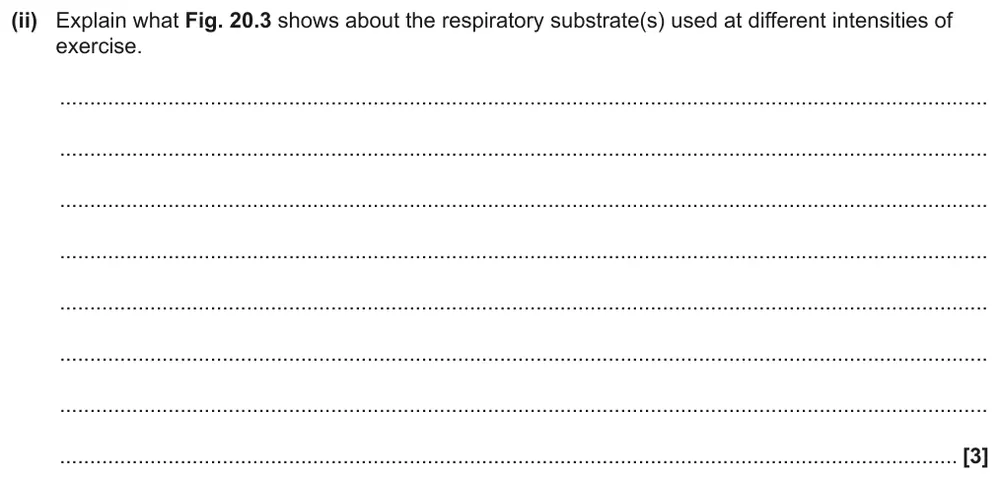
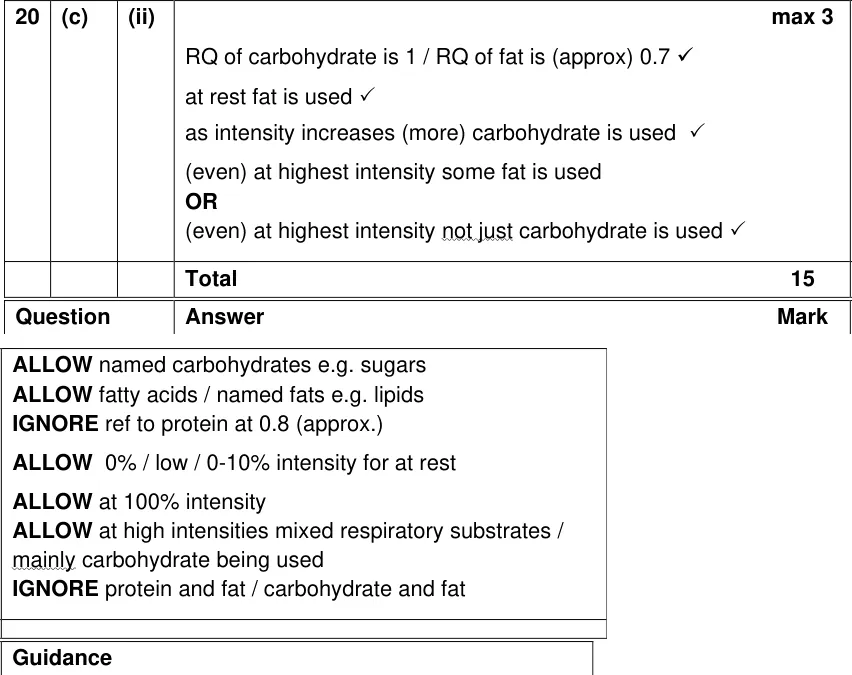
Explain what an athlete's RQ during exercise shows about the respiratory substrates used.
Information from earlier in this question:
Show the mark scheme
Tap an image to open it full size.
From the examiners' report: Start from the RQ values: lipid about 0.7 and carbohydrate 1.0. The rise to 0.8 shows more carbohydrate being used, not protein, and because RQ never reaches 1, a mixture of substrates is still used at full effort.
Where students lose marks (from OCR examiners' reports and mark schemes)
Each point below is followed by wording that gained marks.
PFK's phosphorylation isn't substrate-level: Many students named the reaction catalysed by PFK as substrate-level phosphorylation.
✔ Gains credit: "Phosphorylation".
CO2 comes from decarboxylation, not hydrolysis: Hydrolysis was a common wrong answer for the reaction that produces CO2, and some named stages instead.
✔ Gains credit: "(Oxidative) decarboxylation", in the link reaction and the Krebs cycle.
Glycolysis oxidises by taking hydrogen: Many students wrote only about the loss of electrons, which doesn't explain how NADH forms.
✔ Gains credit: "Dehydrogenation: hydrogen is removed from TP and goes to NAD".
No ATP in the link reaction; one per Krebs turn: Students were unsure how many ATP the Krebs cycle makes, put ATP in the link reaction, or described oxidative phosphorylation.
✔ Gains credit: "Net 2 ATP from glycolysis when TP is converted to pyruvate" and "1 ATP per turn of the Krebs cycle".
NAD and FAD carry hydrogen atoms: Common errors were coenzymes simply "removing" hydrogen, or carrying hydrogen ions or molecules.
✔ Gains credit: "NAD/FAD accepts, or is reduced by, hydrogen atoms and transfers them".
Reduced FAD unloads at the inner membrane: The most common misconception was that FAD releases its hydrogen atoms in the intermembrane space.
✔ Gains credit: "E anywhere in the mitochondrial matrix; F on the inner mitochondrial membrane".
Same pH inside and out, no ATP: Most students said more ATP would be made in the pH 4 solution because it had more H+ ions.
✔ Gains credit: "ATP is produced in solution 3 because there is a proton gradient between the thylakoid lumen and solution 3, and protons diffuse through ATP synthase".
Rising RQ means more carbohydrate, not protein: Many students thought an RQ near 0.8 meant protein was being respired, and few noticed RQ never reached 1.
✔ Gains credit: "At rest fat is used; as intensity increases more carbohydrate is used; even at the highest intensity some fat is used".
Download the questions
Download the PDF pack (17 questions, mark schemes at the end)
Keep practising
- Respiration quiz
- Respiration: interactive written questions (20)
- Photosynthesis (5.2.1): OCR A Level Biology exam questions by topic
- Enzymes (2.1.4): OCR A Level Biology exam questions by topic
- OCR A Level Biology masterclasses
Questions, mark schemes and examiners' report extracts © OCR.