

The brain is the first topic of Option C, Neurobiology and Behaviour, in Section B of Component 3. You need to locate and give the functions of the cerebrum, hypothalamus, hippocampus, cerebellum and medulla oblongata, explain the sympathetic and parasympathetic systems, describe the hypothalamus as the link between nerves and hormones, and use the sensory and motor cortex, the homunculi and Broca's and Wernicke's areas to explain how the brain controls the body and language.
Labelling questions come up every year, and spelling matters: a lobe name spelt so badly it isn't phonetic scores nothing. The examiners also want comparisons when you're shown two homunculi or two scans, the inhibitory step in the cortisol pathway, and Broca's and Wernicke's areas the right way round.
I don't teach the Eduqas specification myself, so for one-to-one help I recommend Sam. He teaches Eduqas A level Biology at a top-rated sixth form college and is very popular with his students. You can ask about lessons with Sam on WhatsApp using the link at the bottom of this page.
What you need from GCSE and Year 12
Each question on this page assumes you're secure on these ideas. If any of them feels shaky, look it up before you start.
- The nervous system has a central part (brain and spinal cord) and a peripheral part.
- Hormones are released into the blood and act on target organs.
- Negative feedback keeps conditions in the body steady.
- Reflexes and voluntary actions use different nerve pathways.
Key terms
These words come up in the questions and mark schemes. Examiners expect you to use them exactly.
- Cerebrum: the largest part of the brain; its cortex handles thought, senses, movement and language.
- Medulla oblongata: controls automatic functions such as heart rate and breathing.
- Hippocampus: involved in learning and turning short-term memory into long-term memory.
- Autonomic nervous system: controls involuntary functions; sympathetic speeds up, parasympathetic slows down.
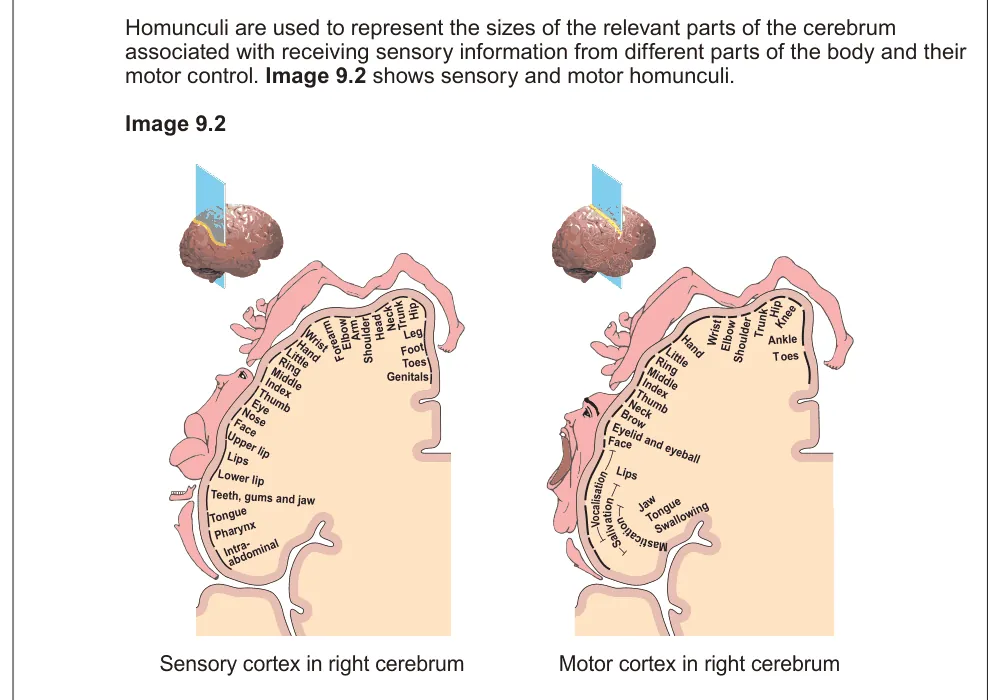
- Homunculus: a figure drawn with each body part sized by the amount of cortex that serves it.
- Broca's area: produces speech.
- Wernicke's area: understands speech and language.
What these questions cover (Eduqas OC1)
The questions test these statements from Option C (Neurobiology and Behaviour) of the Eduqas A level Biology specification (A400). Option questions are in Component 3, and you answer only one of the three options.
- (a) the structure of the human brain – the position of the cerebrum, hypothalamus, hippocampus, cerebellum and medulla oblongata
- (b) the main functions of the cerebrum, hypothalamus, cerebellum and medulla oblongata
- (c) the role of the sympathetic and parasympathetic nervous systems
- (d) the hypothalamus as the link between nervous and endocrine regulation
- (e) the role of the sensory areas and motor areas of the cortex
- (f) the relationship between the sizes of the relevant parts of the cerebrum and the complexity of innervation of the different parts of the body as illustrated by the sensor
- (g) the role of the areas of the cerebrum involved in language comprehension and speech
How to use this page
Write your answer on paper before you open the mark scheme. Allow about 1.2 minutes per mark: the 19 questions are worth 36 marks, so about 43 minutes in total. Then mark your answer strictly against the mark scheme and read the examiners' tip underneath it. If you'd rather print the questions, download the PDF pack.
Structure of the brain
Question 1
A level Component 3 · June 2017 · Q9(a)(i) · 1 mark · Hard
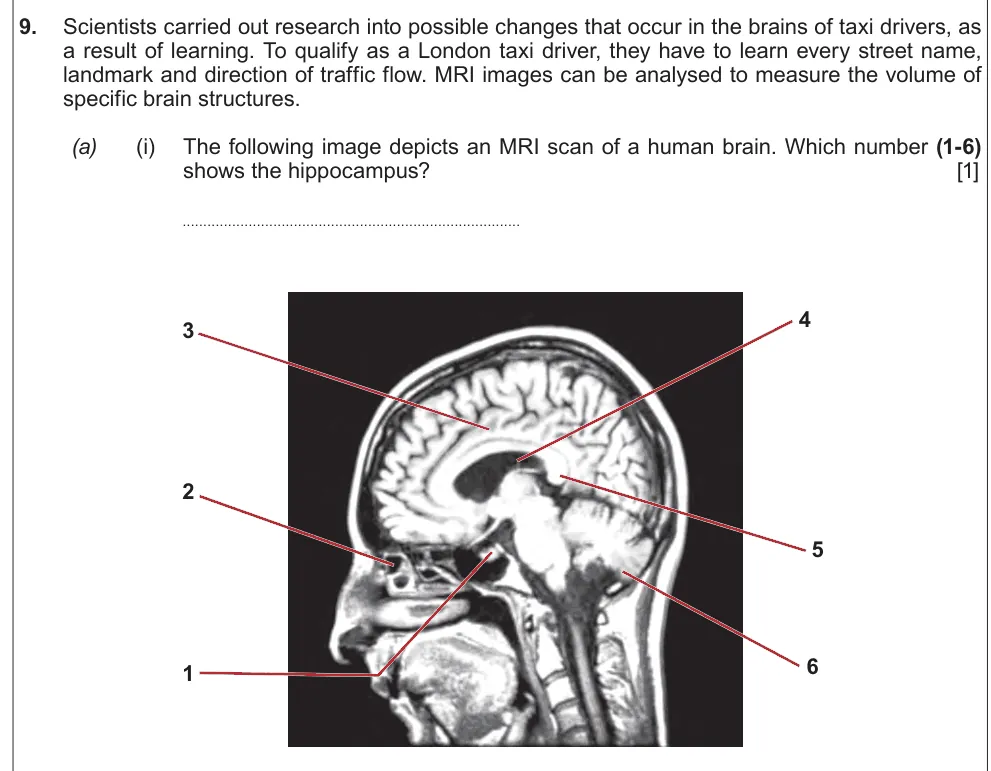
Identify the hippocampus on an MRI scan of the brain.
Show the mark scheme

Tap an image to open it full size.
From the examiners' report: Very few found it: most chose labels 4 or 5. Learn where the hippocampus sits, deep inside the temporal lobe.
Question 2
A level Component 3 · June 2017 · Q9(a)(ii) · 2 marks
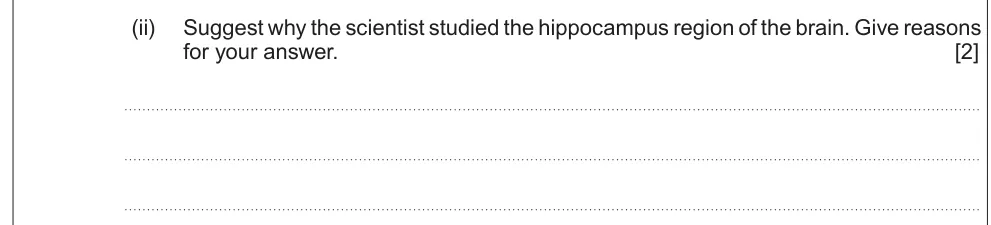
Suggest why a scientist studying taxi drivers looked at the hippocampus.
Show the mark scheme

Tap an image to open it full size.
From the examiners' report: Go beyond "memory": the hippocampus stores memories permanently and converts short-term into long-term memory.
Question 3
A level Component 3 · June 2019 · Q10(a)(i) · 2 marks
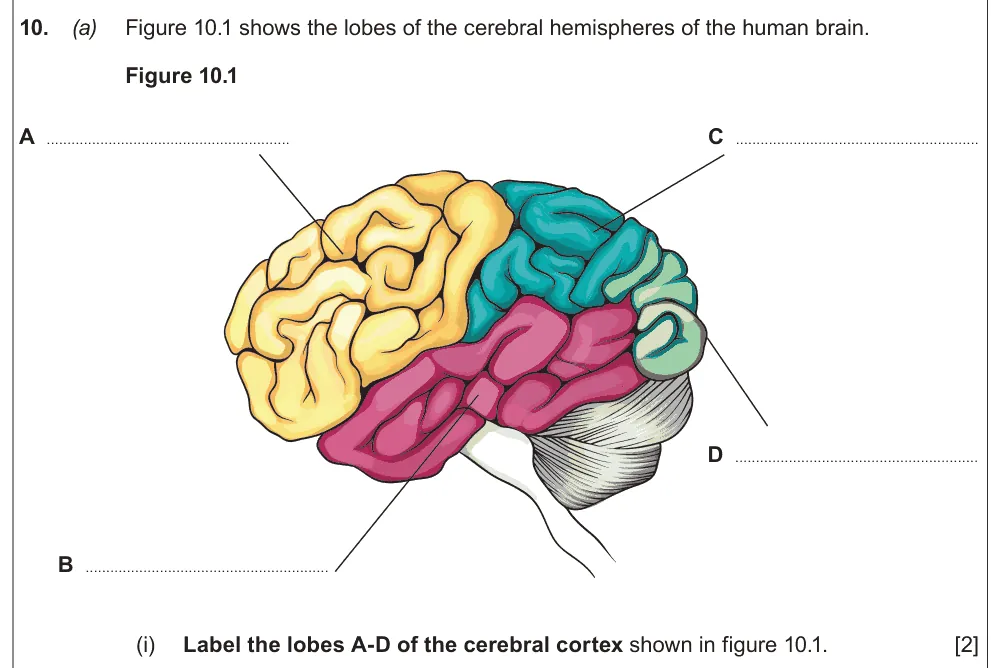
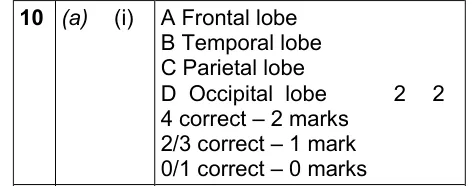
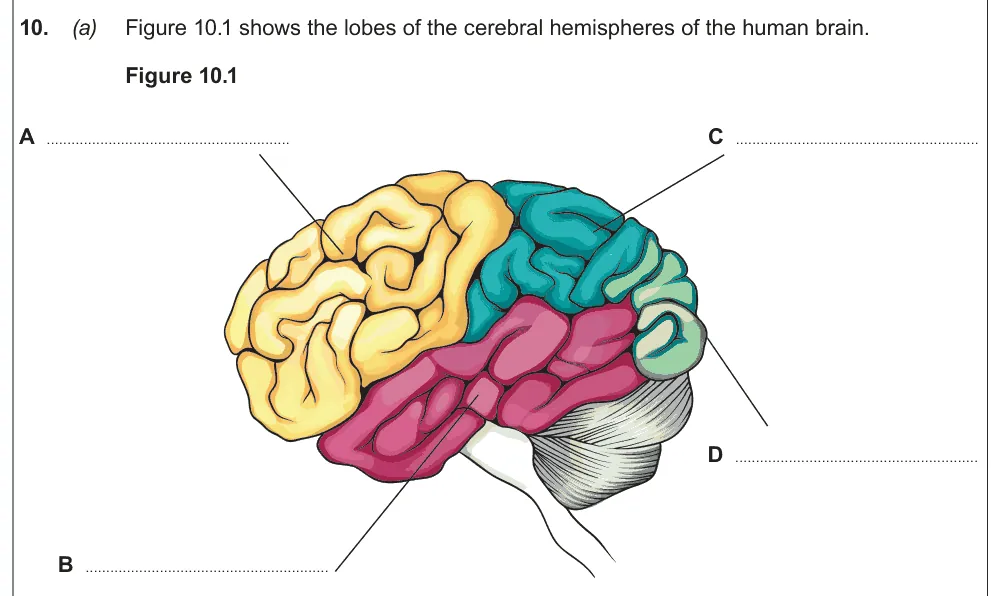
Label the four lobes of the cerebral cortex.
Show the mark scheme
Tap an image to open it full size.
From the examiners' report: This was well done, but a name spelt so badly it isn't phonetic scores nothing.
Question 4
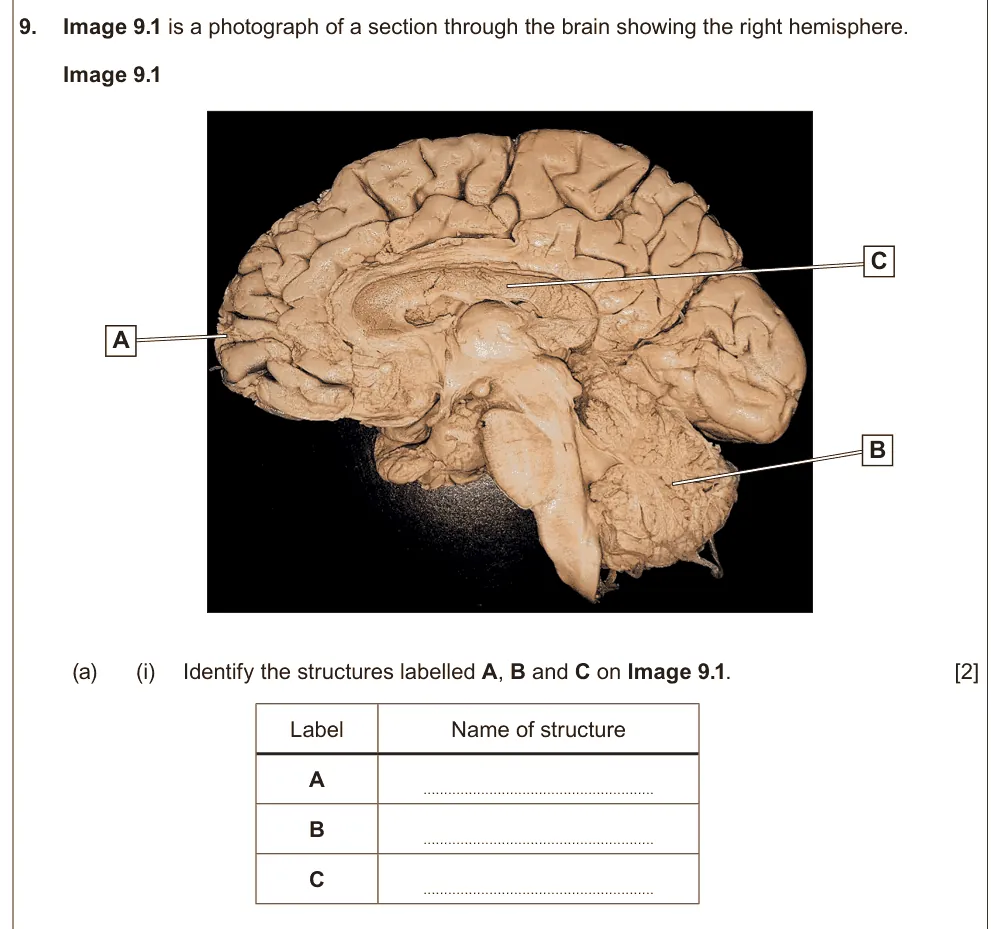
A level Component 3 · June 2023 · Q9(a)(i) · 2 marks
Identify three structures in a section of the brain.
Show the mark scheme

Tap an image to open it full size.
From the examiners' report: Most found the frontal lobe and cerebellum; learn the corpus callosum too.
Question 5
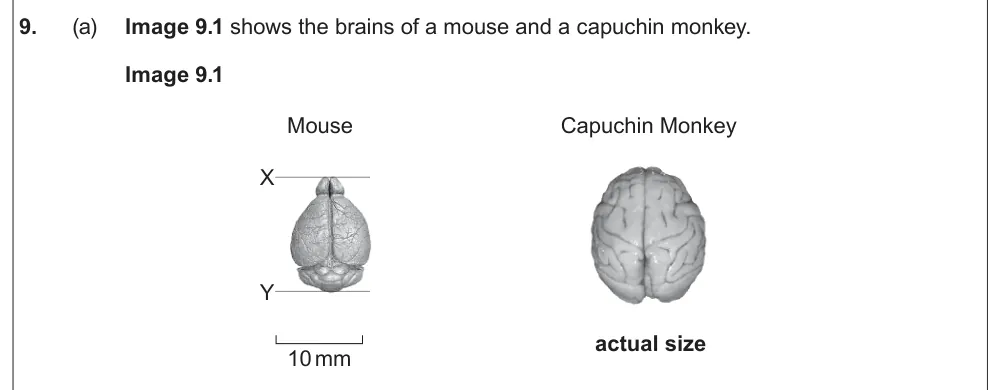
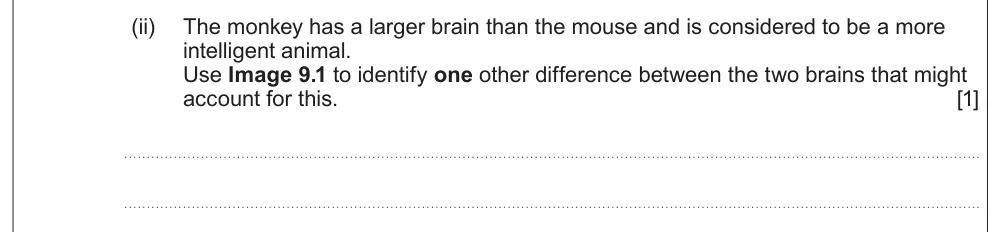
A level Component 3 · June 2025 · Q9(a)(ii) · 1 mark · Easy
Use images to identify a difference between monkey and mouse brains that could account for intelligence.
Information from earlier in this question:
Show the mark scheme

Tap an image to open it full size.
From the examiners' report: Use the image: a greater surface area of the cerebral cortex from more folding.
Functions and the autonomic nervous system
Question 6
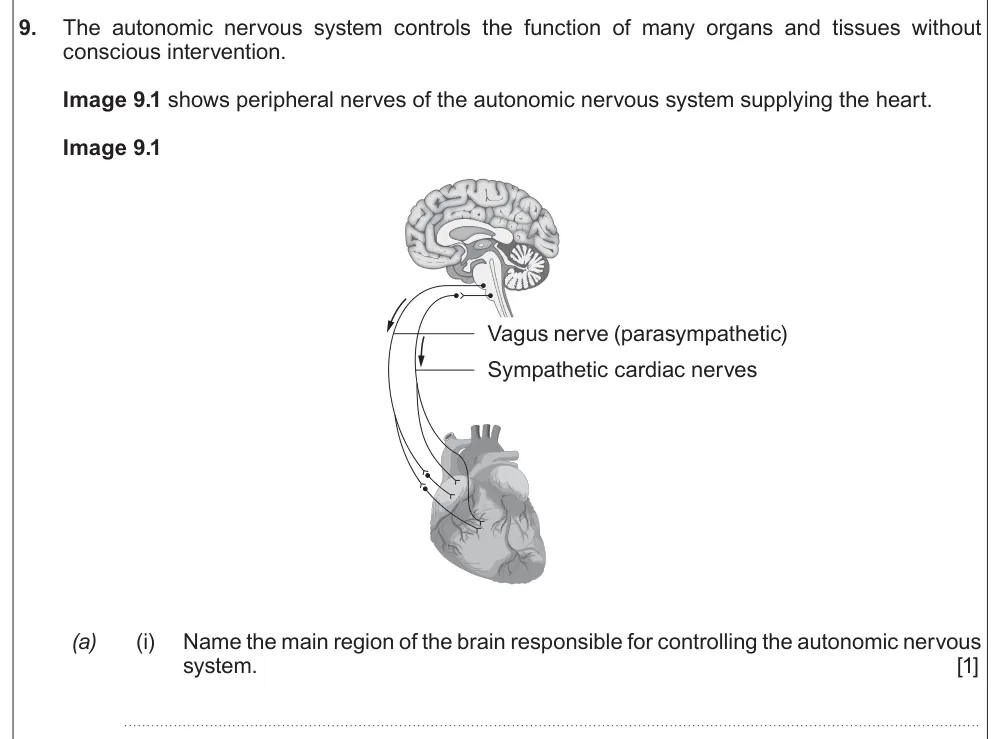
A level Component 3 · Autumn 2021 · Q9(a)(i) · 1 mark
Name the region of the brain that controls the autonomic nervous system.
Show the mark scheme

Tap an image to open it full size.
Question 7
A level Component 3 · June 2024 · Q9(a)(iii) · 1 mark · Easy
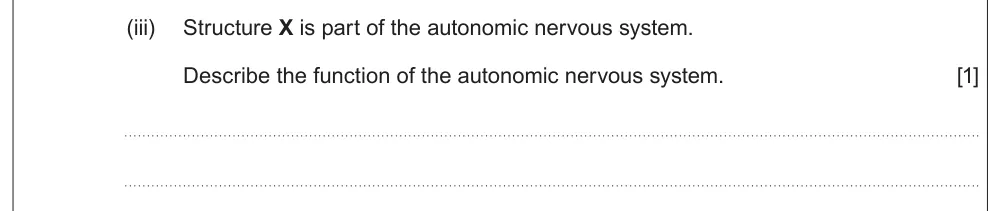
Describe the function of the autonomic nervous system.
Show the mark scheme

Tap an image to open it full size.
From the examiners' report: It controls involuntary, automatic functions of the body.
Question 8
A level Component 3 · Autumn 2021 · Q9(a)(ii)II · 1 mark
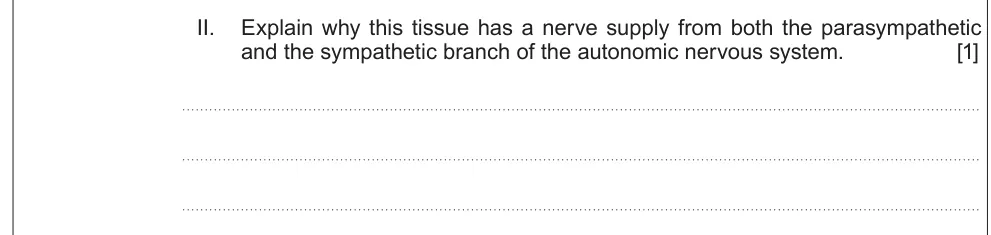
Explain why the heart has both sympathetic and parasympathetic nerves.
Information from earlier in this question:

Show the mark scheme

Tap an image to open it full size.
Question 9
A level Component 3 · June 2019 · Q10(b)(ii) · 2 marks
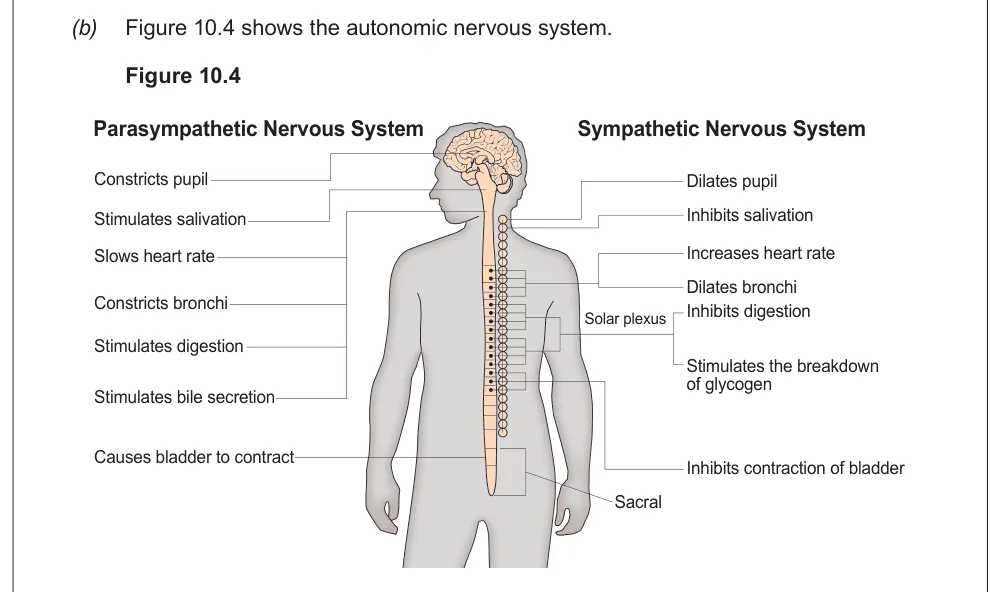
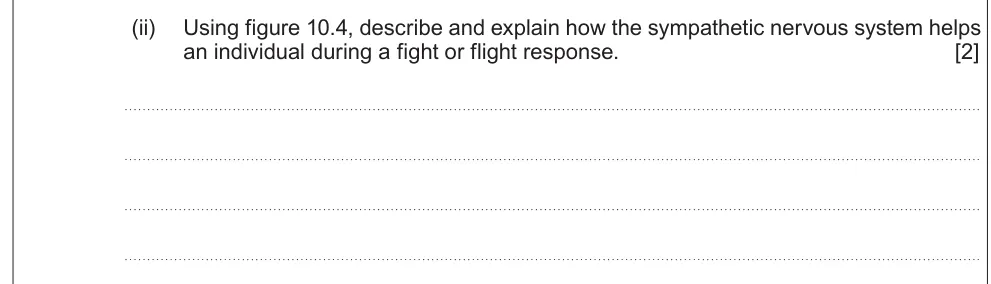
Describe and explain how the sympathetic system helps during fight or flight.
Information from earlier in this question:
Show the mark scheme

Tap an image to open it full size.
From the examiners' report: Describe a change, such as a faster heart rate, then explain it: more oxygenated blood reaches the muscles.
Question 10
A level Component 3 · June 2024 · Q9(b)(ii) · 3 marks
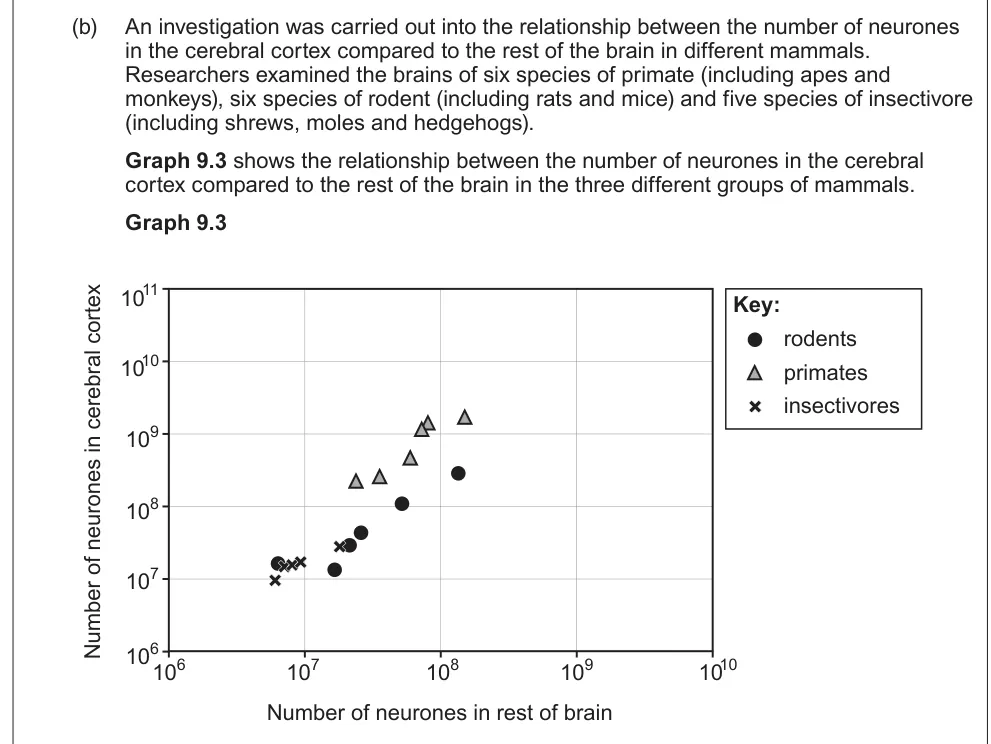
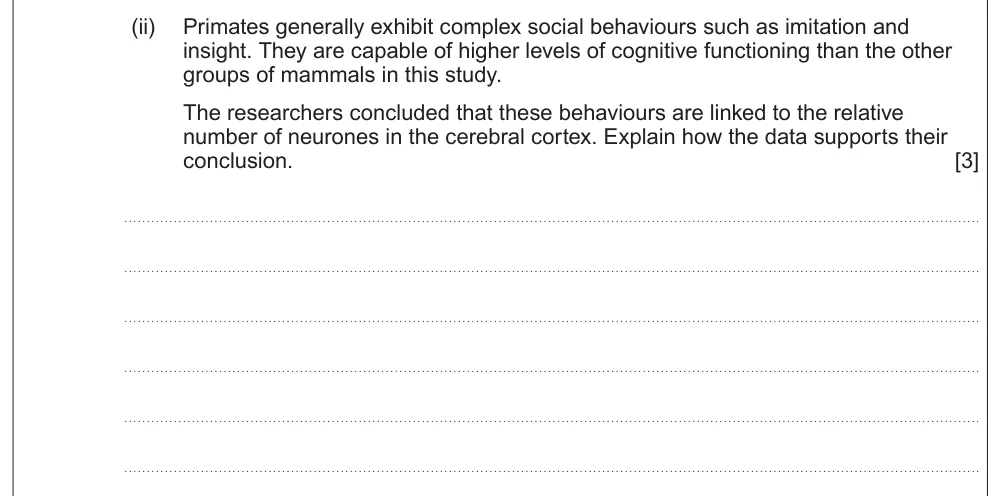
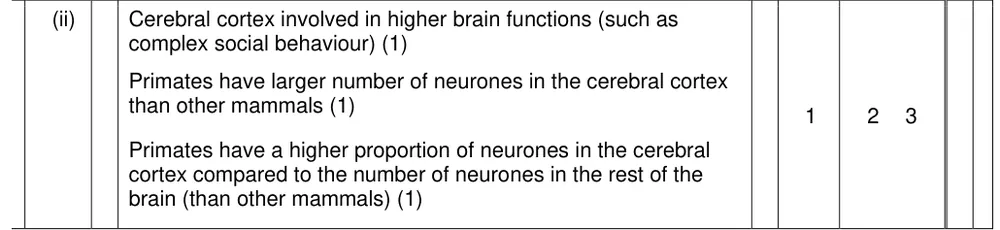
Explain how neurone data support a link between the cerebral cortex and higher cognitive functions.
Information from earlier in this question:
Show the mark scheme
Tap an image to open it full size.
From the examiners' report: The most common slip was leaving out the first point: the cerebral cortex is involved in higher brain functions.
The hypothalamus and stress
Question 11
A level Component 3 · June 2024 · Q9(c)(i) · 3 marks
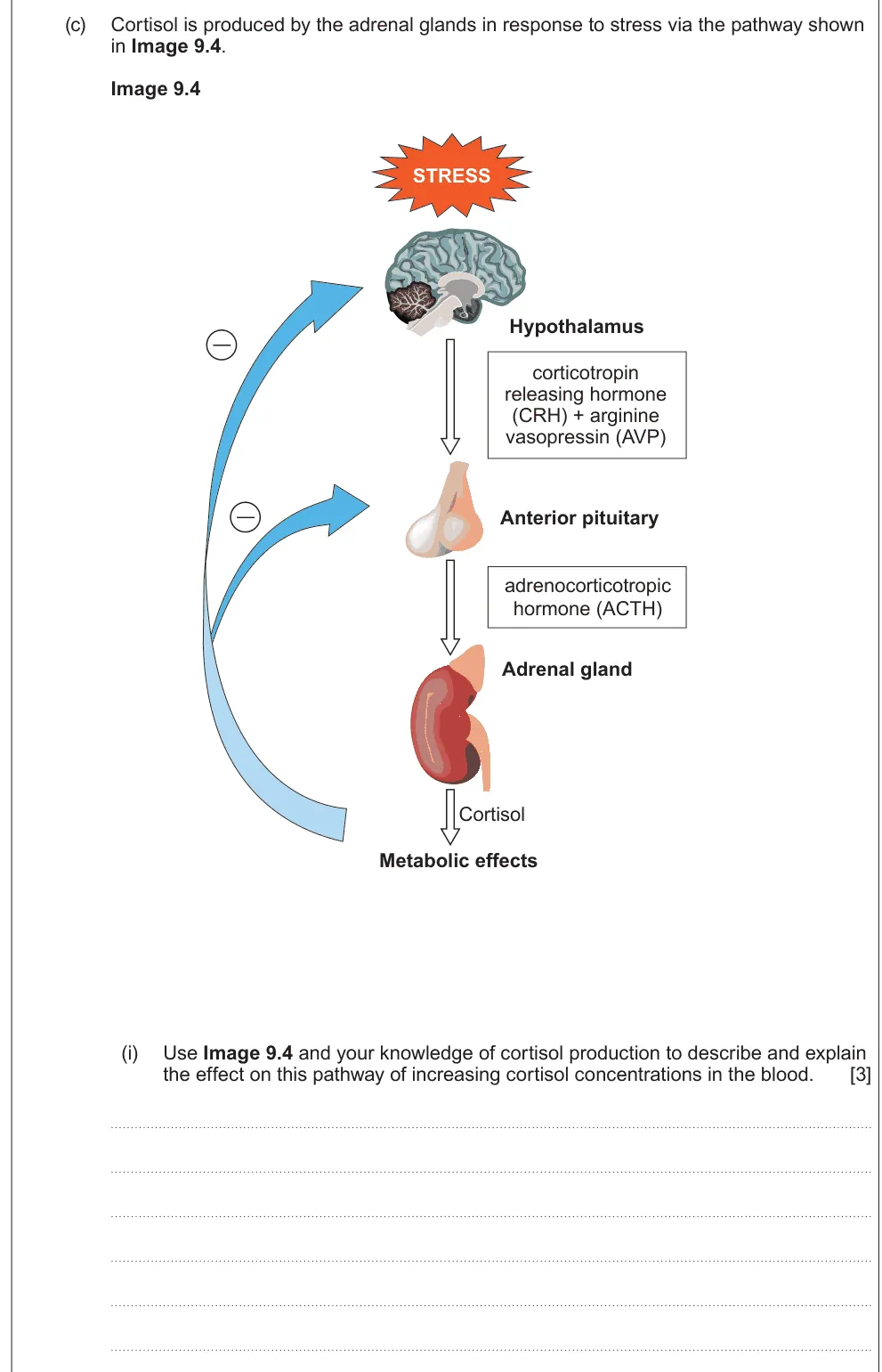
Explain the effect of rising cortisol on the stress hormone pathway.
Show the mark scheme

Tap an image to open it full size.
From the examiners' report: Don't just describe the sequence in the diagram. Explain the inhibition: cortisol acts on the hippocampus, so less CRH and ACTH are released.
The cortex
Question 12
A level Component 3 · June 2023 · Q9(a)(ii) · 2 marks
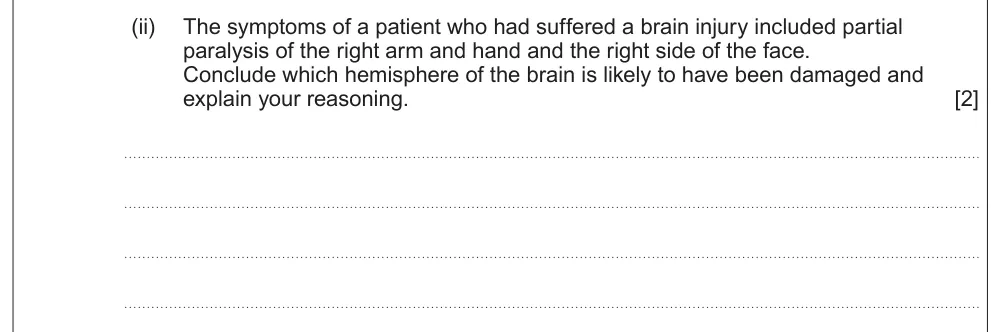
Conclude which hemisphere was damaged in a patient with paralysis on the right side.
Show the mark scheme

Tap an image to open it full size.
From the examiners' report: The left hemisphere, because each side of the brain controls the opposite side of the body.
Question 13
A level Component 3 · June 2018 · Q10(b)(iii) · 2 marks · Hard
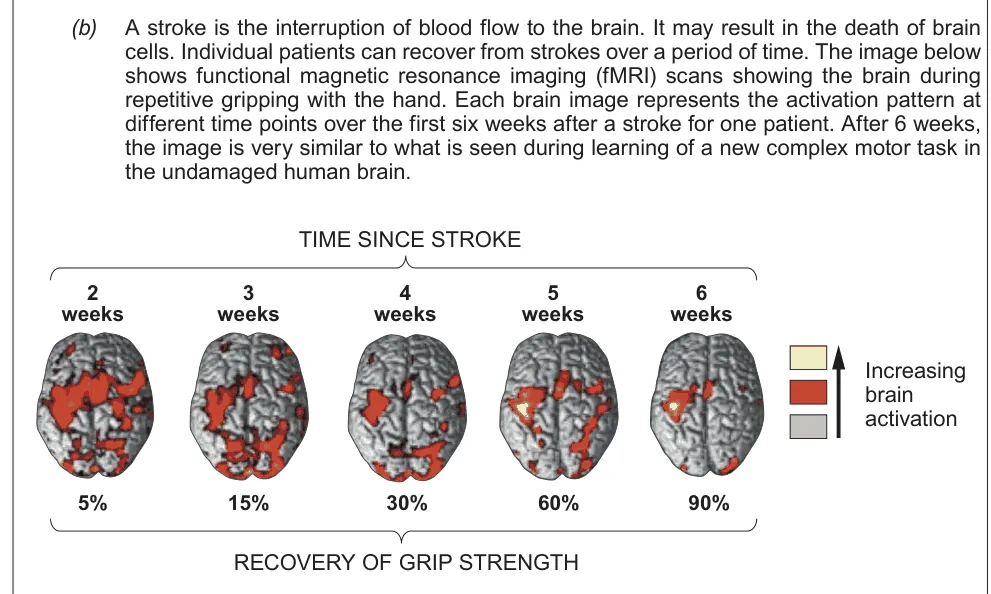
Use fMRI scans of stroke recovery to suggest which part of the brain was damaged.
Information from earlier in this question:

Show the mark scheme

Tap an image to open it full size.
From the examiners' report: Few named the left motor cortex. Use the scans to give your reason.
Question 14
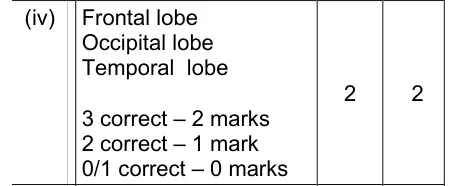
A level Component 3 · June 2019 · Q10(a)(iv) · 2 marks
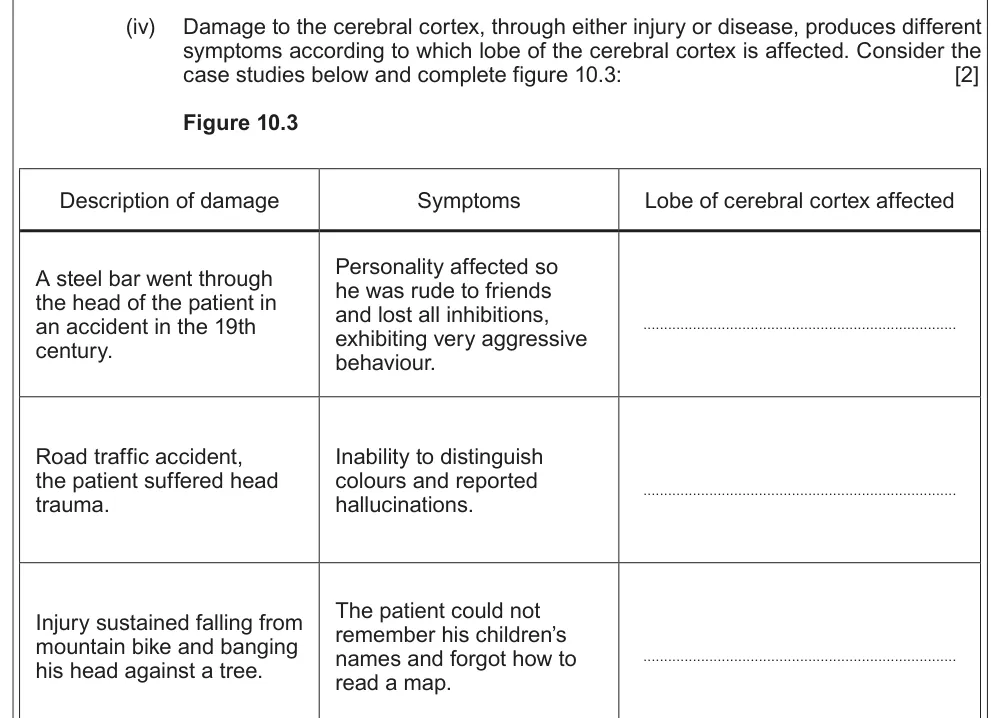
Identify the lobe damaged in each of three patients from their symptoms.
Information from earlier in this question:
Show the mark scheme
Tap an image to open it full size.
From the examiners' report: Match each symptom to the lobe's job, such as reading a map to the occipital lobe.
Homunculi
Question 15
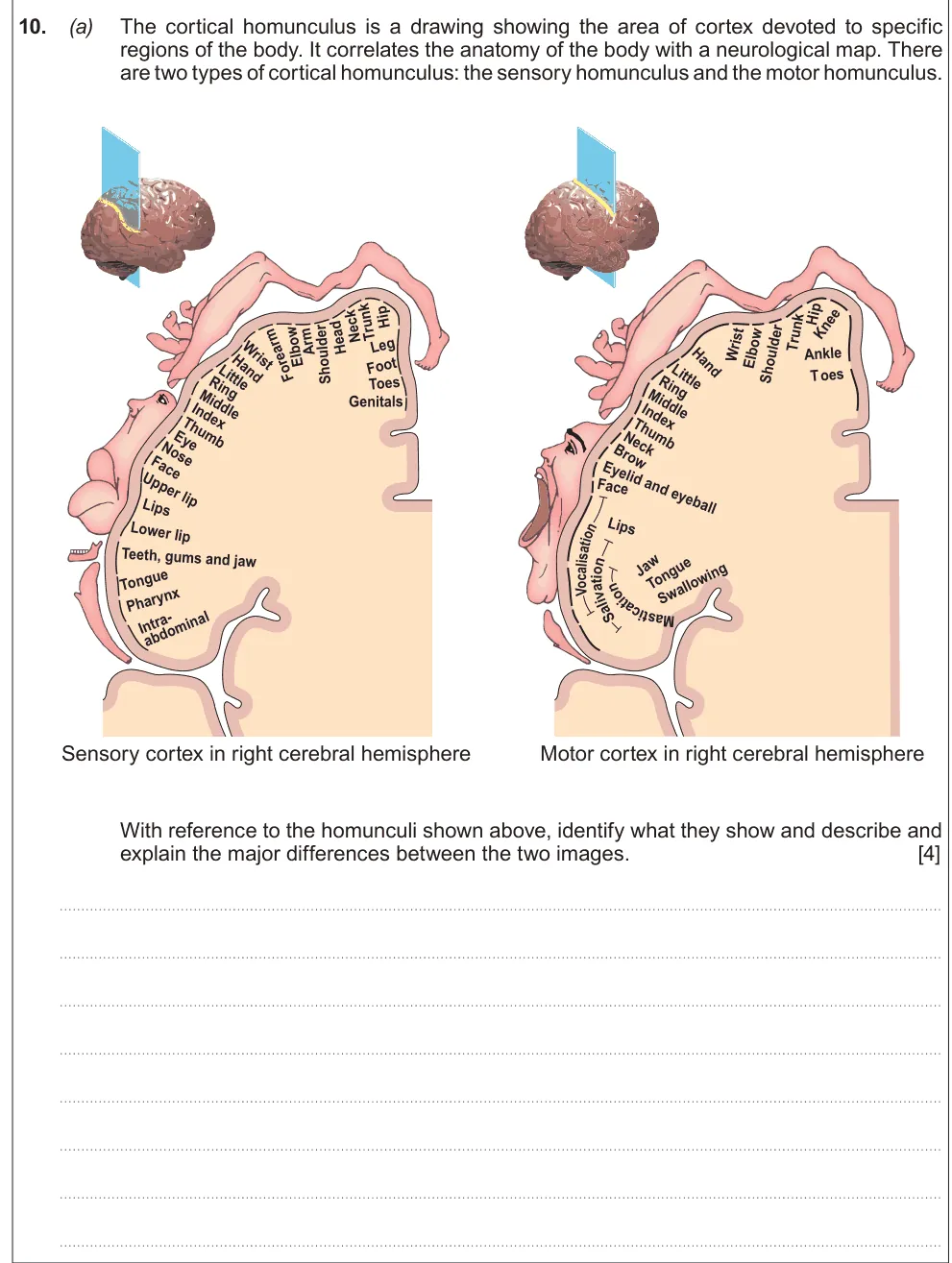
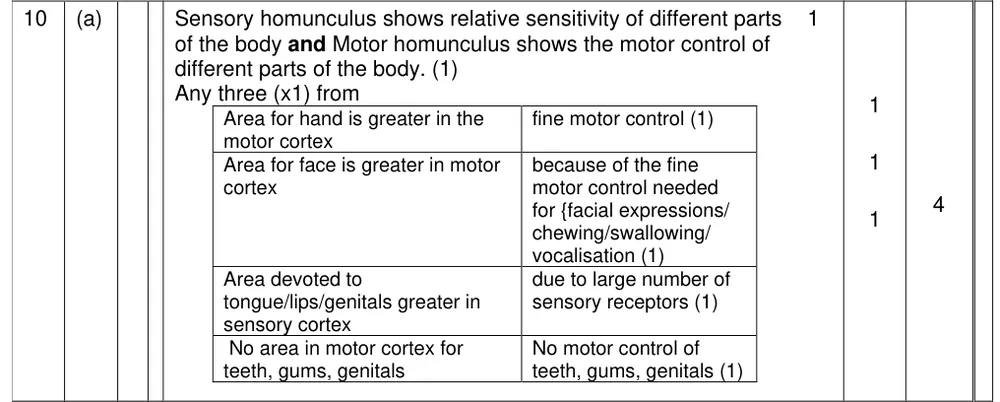
A level Component 3 · June 2018 · Q10(a) · 4 marks
Identify what the sensory and motor homunculi show and explain the main differences.
Show the mark scheme
Tap an image to open it full size.
From the examiners' report: Many identified them but didn't compare them, and the explanation of the differences was often missing.
Question 16
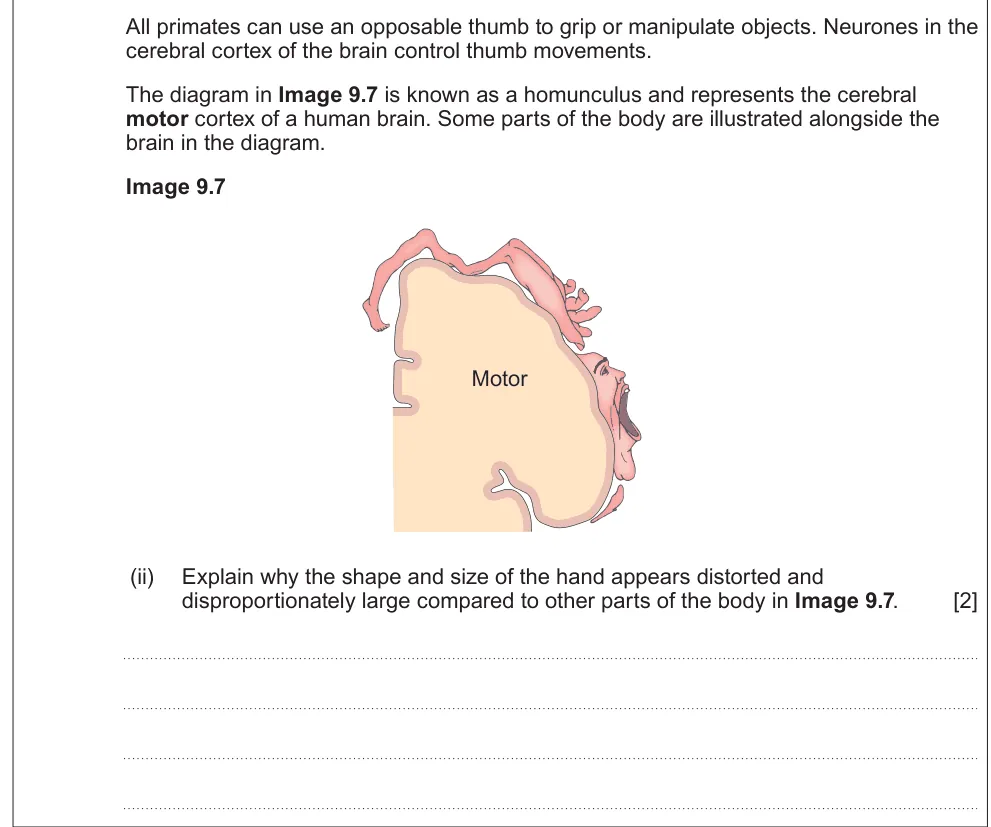
A level Component 3 · June 2022 · Q9(c)(ii) · 2 marks
Explain why the hand looks so large on the motor homunculus.
Show the mark scheme

Tap an image to open it full size.
From the examiners' report: Be precise: the hand has many muscles for fine movements, so more neurones are needed to control them. "More movement" is too vague.
Question 17
A level Component 3 · June 2025 · Q9(a)(iii)II · 2 marks · Easy
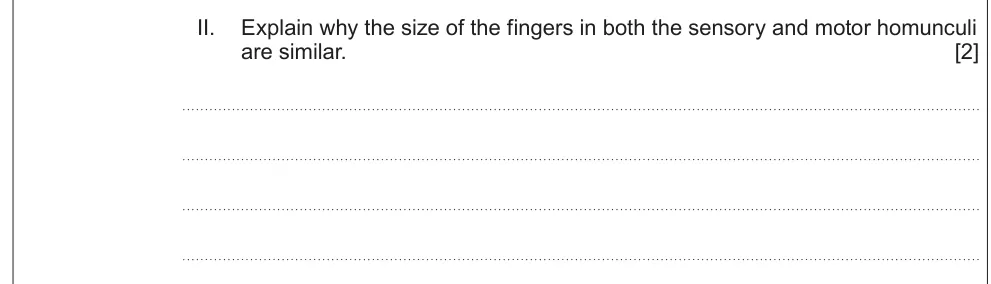
Explain why the fingers are a similar size on both the sensory and motor homunculi.
Information from earlier in this question:
Show the mark scheme

Tap an image to open it full size.
From the examiners' report: Give one reason for each: many sensory receptors in the fingertips, and fine motor control of the fingers.
Language
Question 18
A level Component 3 · June 2018 · Q10(b)(iv) · 2 marks
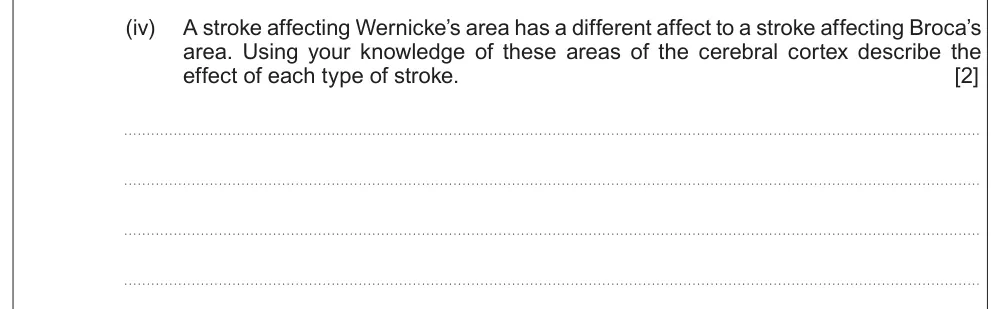
Describe the different effects of strokes in Wernicke's area and Broca's area.
Show the mark scheme

Tap an image to open it full size.
From the examiners' report: Most did well but some swapped them. Broca's area produces speech; Wernicke's area understands it.
Question 19
A level Component 3 · June 2022 · Q9(d)(iii) · 1 mark
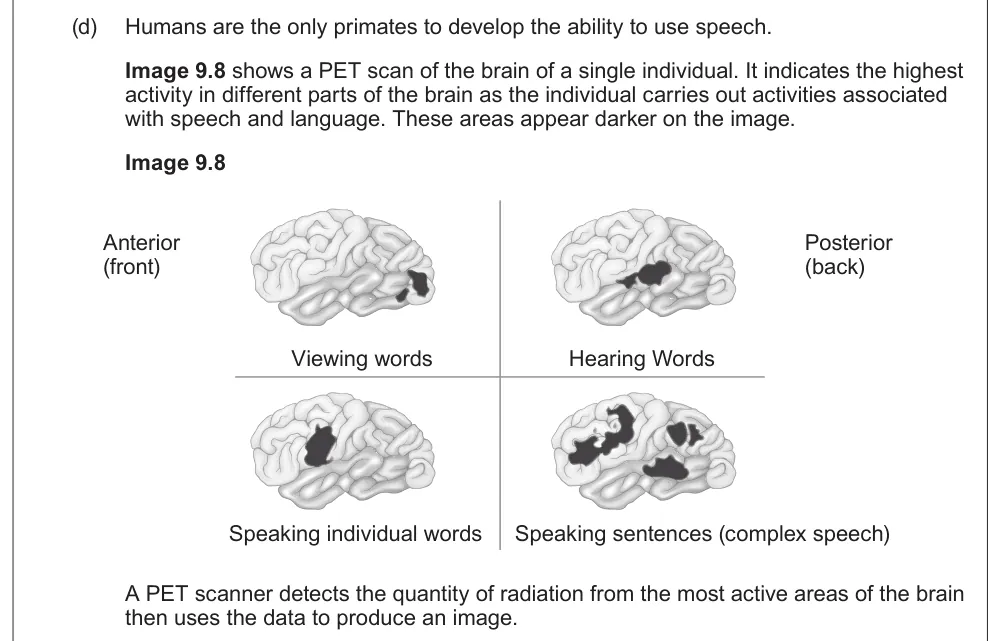
Suggest why speaking sentences uses more of the cortex than other language tasks.
Information from earlier in this question:

Show the mark scheme

Tap an image to open it full size.
From the examiners' report: Complex speech uses a wider range of thought, other brain regions and stored memory.
Where students lose marks (from Eduqas examiners' reports and mark schemes)
Each point below is followed by wording that gained marks.
Find the hippocampus: Very few could identify the hippocampus on the image; most chose labels 4 or 5.
✔ Gains credit: "Label 1".
Memory is not enough: Few showed the hippocampus's role in permanent memory storage or turning short-term into long-term memory.
✔ Gains credit: "Short term to long term memory = 2 marks".
Spell the lobe so it's recognisable: Some spellings were so wrong they weren't phonetic and didn't score.
✔ Gains credit: "Frontal", "Temporal", "Parietal", "Occipital".
Say what the cortex does first: The most common error was leaving out that the cerebral cortex is involved in higher brain functions.
✔ Gains credit: "Cerebral cortex involved in higher brain functions (such as complex social behaviour)".
Show the brake in the cortisol pathway: Students described the stress sequence from the diagram but left out the inhibitory effect of rising cortisol.
✔ Gains credit: "Cortisol binds to glucocorticoid receptors in the hippocampus", "inhibiting CRH release".
Compare the two homunculi: Many identified the homunculi but didn't compare them or explain the differences.
✔ Gains credit: "Sensory homunculus shows relative sensitivity...; motor homunculus shows the motor control of different parts".
Broca speaks, Wernicke understands: Some students got the two areas the wrong way round.
✔ Gains credit: "Broca's area – cannot produce speech"; "Wernicke's area – does not understand speech".
Download the questions
Download the PDF pack (19 questions, mark schemes at the end)
Keep practising
- Neuroscience (Option C2): Eduqas A Level Biology exam questions by topic
- Behaviour (Option C3): Eduqas A Level Biology exam questions by topic
- Eduqas A level Biology past papers, mark schemes and examiners' reports
- Eduqas A level Biology grade boundaries
- Ask about Eduqas A level Biology lessons with Sam on WhatsApp
Questions, mark schemes and examiners' report extracts © WJEC CBAC Ltd (Eduqas).