

Behaviour is the last topic of Option C, Neurobiology and Behaviour, in Section B of Component 3. It covers innate behaviour such as escape reflexes, kineses and taxes in woodlice and maggots, learned behaviours from habituation to operant conditioning, imitation and insight in primates, the caste systems and communication of social insects, dominance hierarchies, and the territorial and courtship behaviours shaped by sexual selection.
The commonest slip in the examiners' reports is mixing up a kinesis and a taxis. A kinesis changes the speed or turning rate and has no direction; describing animals heading towards or away from something loses the mark. The other marks go to naming the behaviour (operant conditioning, imitation, phototaxis) and to using the information in the stem rather than a general answer.
I don't teach the Eduqas specification myself, so for one-to-one help I recommend Sam. He teaches Eduqas A level Biology at a top-rated sixth form college and is very popular with his students. You can ask about lessons with Sam on WhatsApp using the link at the bottom of this page.
What you need from GCSE and Year 12
Each question on this page assumes you're secure on these ideas. If any of them feels shaky, look it up before you start.
- Behaviour can be inherited (innate) or learned from experience.
- A stimulus is detected by receptors and causes a response.
- Natural selection favours individuals whose alleles help them survive and reproduce.
- Many animals live in social groups with different roles.
Key terms
These words come up in the questions and mark schemes. Examiners expect you to use them exactly.
- Innate behaviour: behaviour that is inherited and doesn't need to be learned.
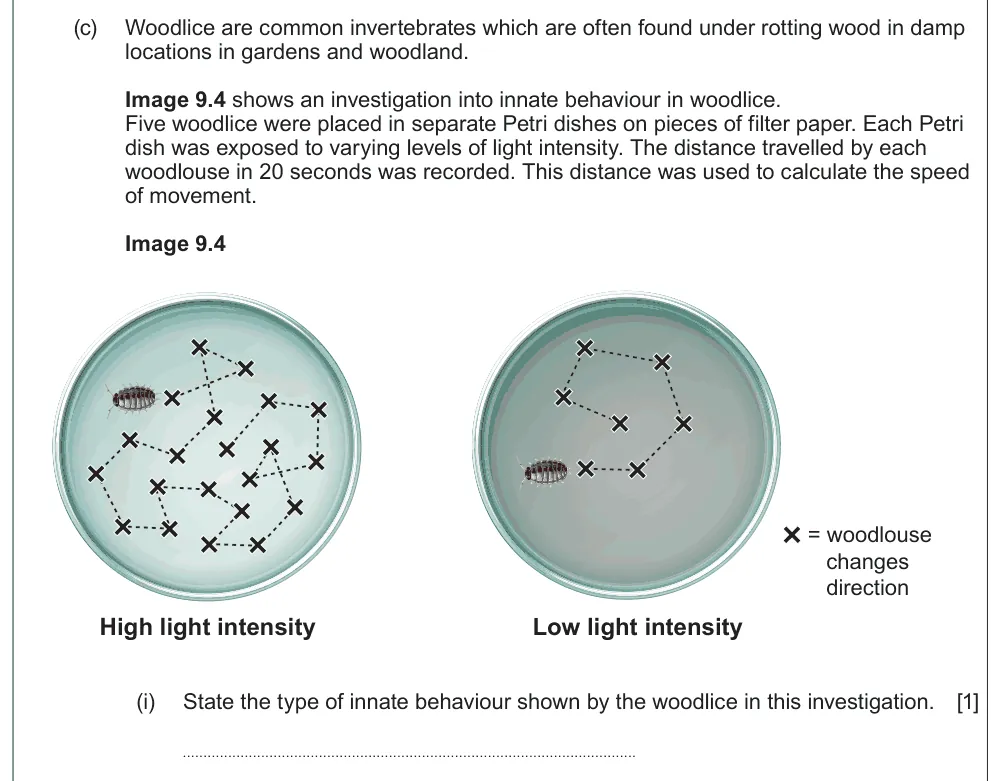
- Kinesis: a non-directional response: the rate of movement or turning changes with the stimulus.
- Taxis: a directional response towards or away from a stimulus, such as phototaxis.
- Habituation: learning to ignore a repeated, harmless stimulus.
- Operant conditioning: learning by trial and error, associating an action with a reward.
- Imitation: learning by copying the behaviour of others.
- Dominance hierarchy: a ranked social order that reduces fighting within a group.
- Sexual selection: selection for features that increase success in getting a mate.
What these questions cover (Eduqas OC3)
The questions test these statements from Option C (Neurobiology and Behaviour) of the Eduqas A level Biology specification (A400). Option questions are in Component 3, and you answer only one of the three options.
- (a) innate behaviour and the advantage to organisms of escape reflexes, kineses and taxes as exemplified by woodlice
- (b) learned behaviours
- (c) primates, including humans, living in very complex societies and exhibiting behaviours such as imitation and insight
- (d) the advantages and disadvantages of living in social groups (no past question tests this on its own)
- (e) the social structure of some insects
- (f) social structure in vertebrates achieved through dominance hierarchies in which animals are able to recognise each other as individuals and possess some abilities to lear
- (g) the advantage of territorial and courtship behaviours in increasing reproductive success (tested alongside sexual selection in OC3(h))
- (h) the role of sexual selection in the evolution of territorial and courtship behaviours
How to use this page
Write your answer on paper before you open the mark scheme. Allow about 1.2 minutes per mark: the 20 questions are worth 33 marks, so about 40 minutes in total. Then mark your answer strictly against the mark scheme and read the examiners' tip underneath it. If you'd rather print the questions, download the PDF pack.
Innate behaviour
Question 1
A level Component 3 · Autumn 2020 · Q10(a)(i) · 1 mark
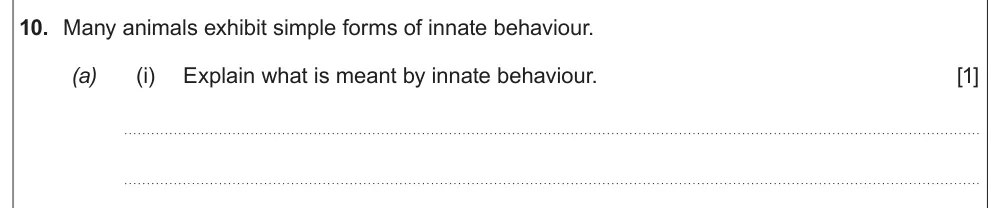
Explain what is meant by innate behaviour.
Show the mark scheme

Tap an image to open it full size.
From the examiners' report: Say it doesn't need to be learned, or is inherited. The word "inborn" on its own wasn't credited.
Question 2
A level Component 3 · Autumn 2020 · Q10(a)(iii) · 2 marks
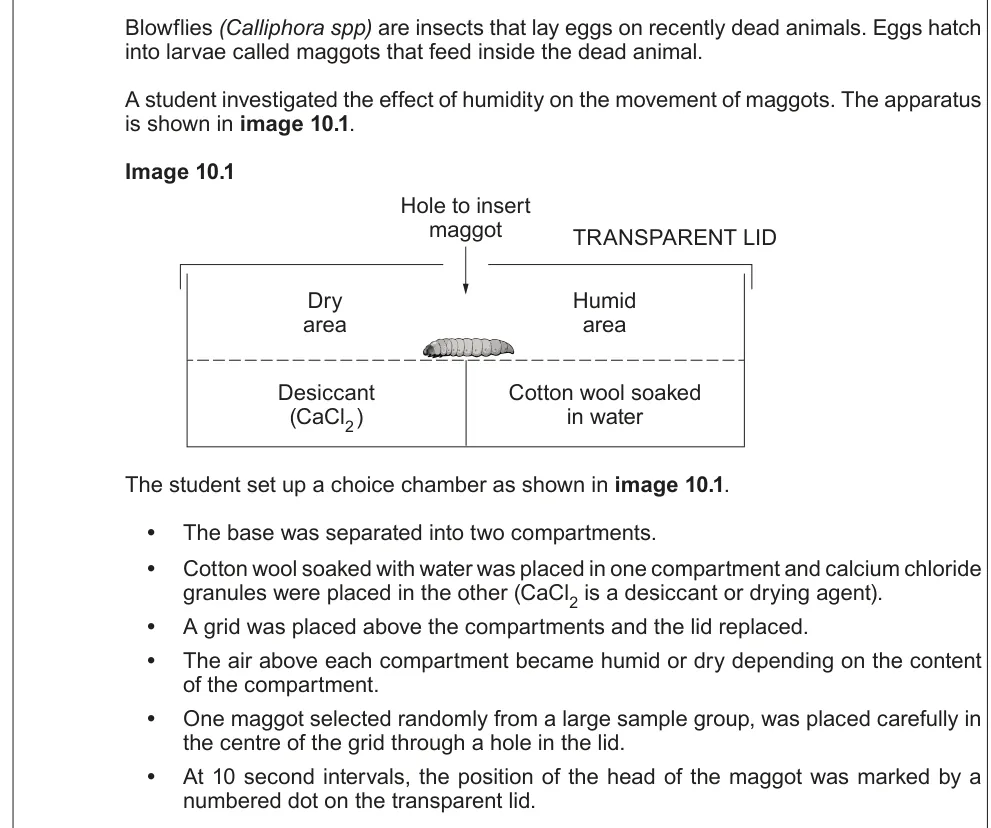
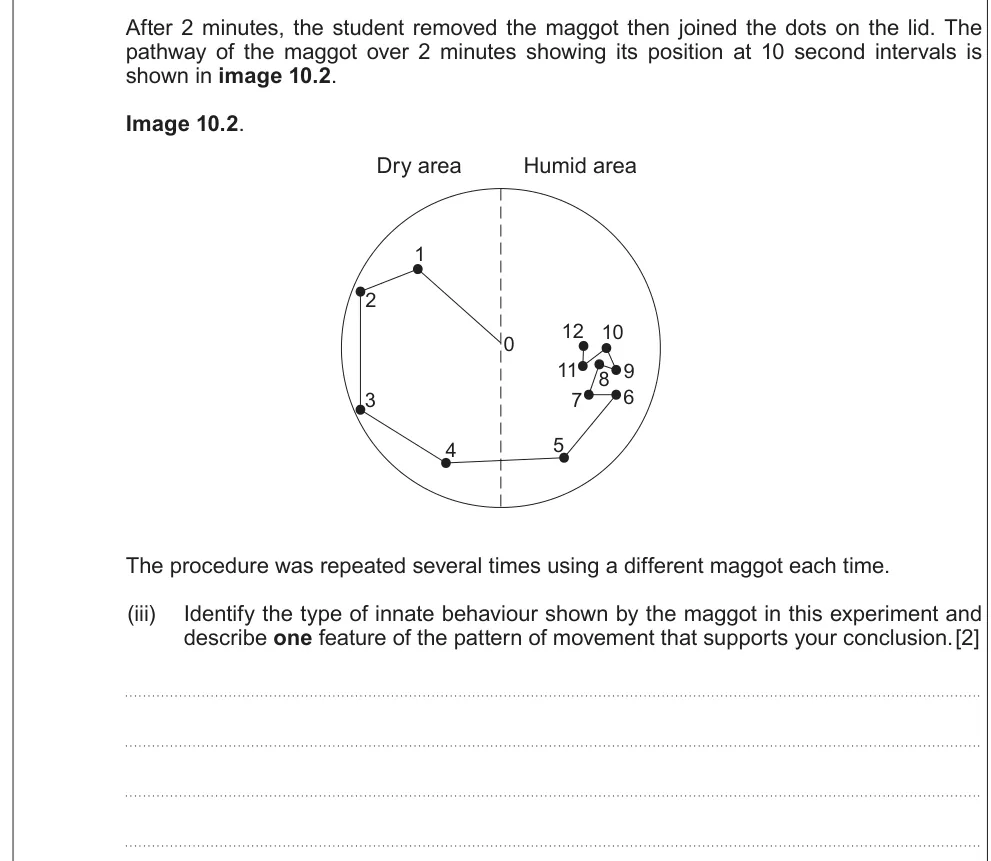
Identify the innate behaviour of a maggot in a humidity choice chamber and give evidence from its movement.
Information from earlier in this question:
Show the mark scheme

Tap an image to open it full size.
From the examiners' report: A kinesis: describe the change in speed or turning rate. Any hint that the maggot is heading somewhere makes it sound like a taxis and loses the mark.
Question 3
A level Component 3 · Autumn 2020 · Q10(a)(iv) · 2 marks
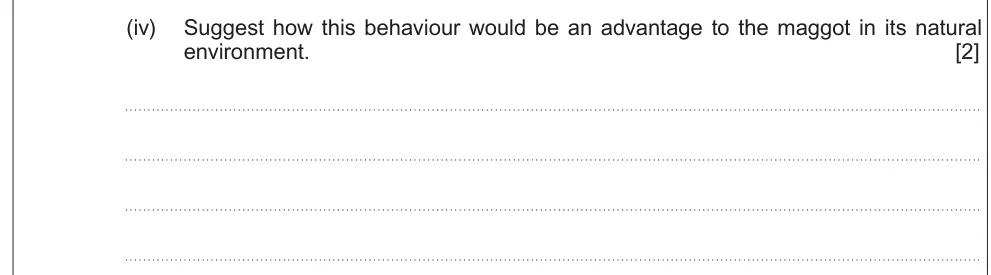
Suggest how this behaviour helps the maggot in its natural environment.
Show the mark scheme

Tap an image to open it full size.
From the examiners' report: Use the stem: inside a dead animal it's humid, and the kinesis keeps the maggot there.
Question 4
A level Component 3 · June 2023 · Q9(c)(i) · 1 mark · Easy
State the type of innate behaviour shown by woodlice in a light and dark investigation.
Show the mark scheme

Tap an image to open it full size.
Question 5
A level Component 3 · June 2023 · Q9(c)(iv) · 1 mark · Easy
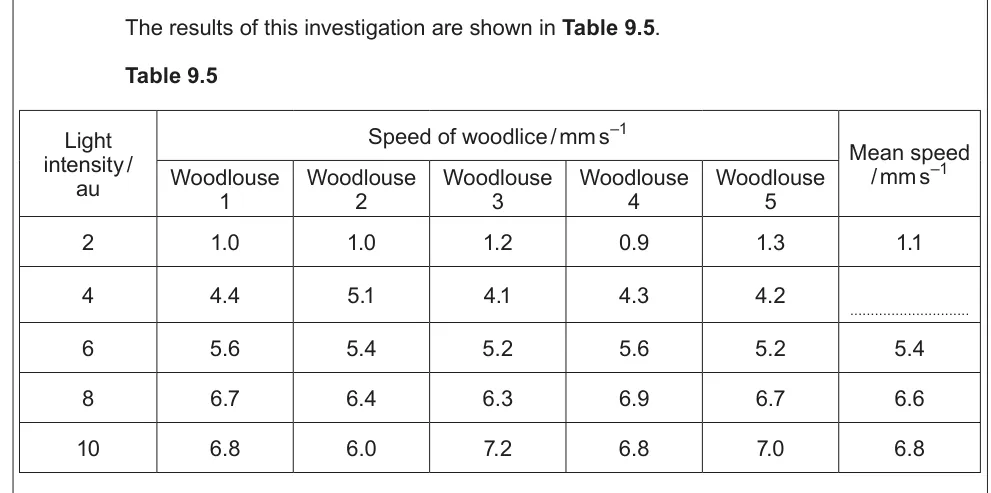
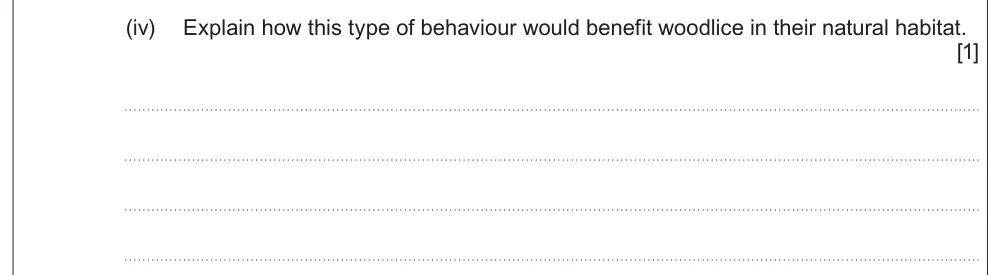
Explain how this behaviour benefits woodlice in their natural habitat.
Information from earlier in this question:
Show the mark scheme

Tap an image to open it full size.
Question 6
A level Component 3 · June 2022 · Q9(a)(ii)I · 1 mark
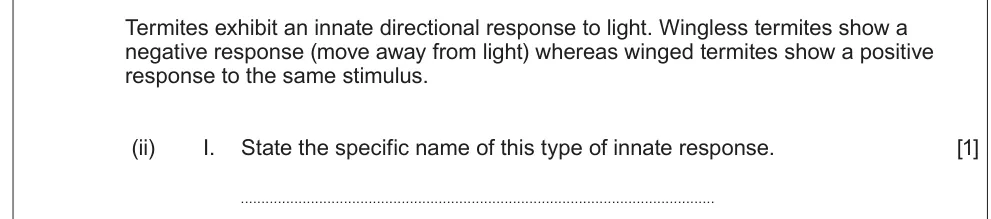
Name the innate response of termites to light.
Show the mark scheme

Tap an image to open it full size.
From the examiners' report: Be precise about the type of innate behaviour: phototaxis.
Question 7
A level Component 3 · June 2022 · Q9(a)(ii)II · 3 marks
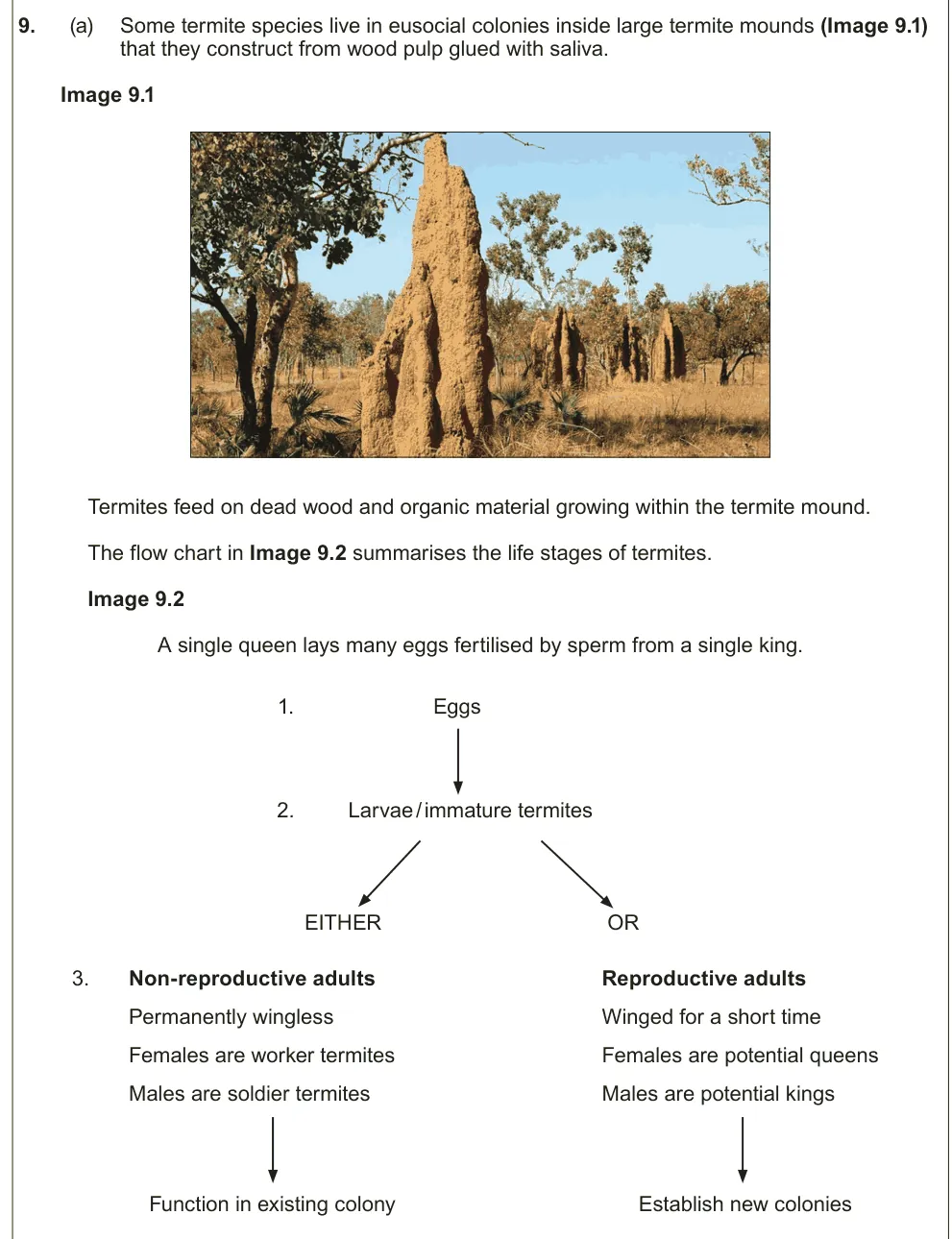
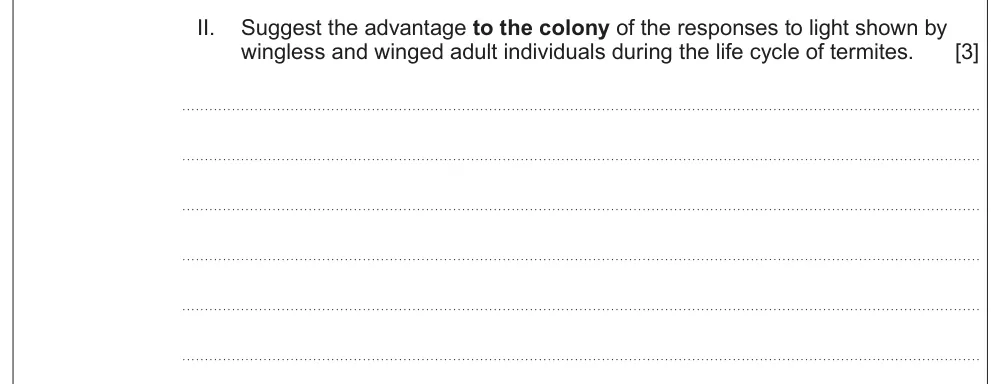
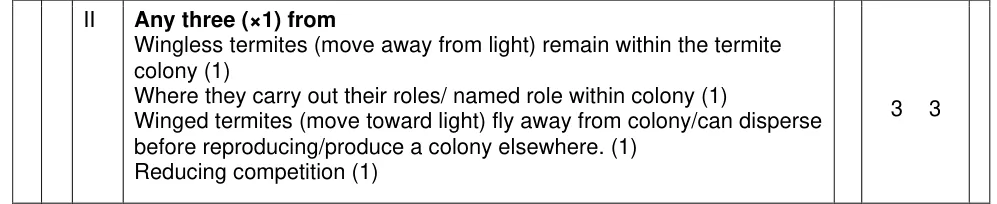
Suggest the advantage to the colony of wingless and winged termites responding differently to light.
Information from earlier in this question:
Show the mark scheme
Tap an image to open it full size.
From the examiners' report: Deal with both groups: wingless termites stay in the colony to work, winged ones fly off to set up new colonies.
Question 8
A level Component 3 · Autumn 2021 · Q9(c)(i) · 2 marks
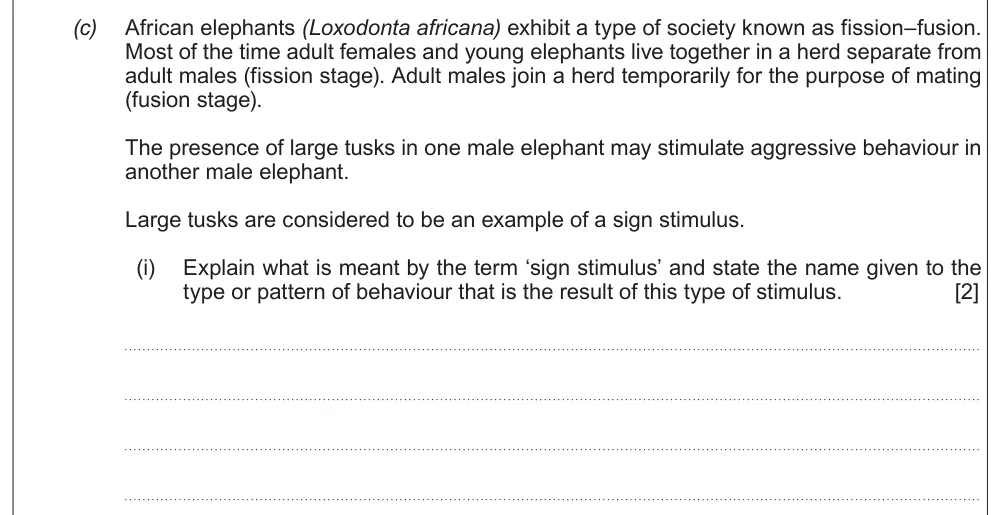
Explain what a sign stimulus is and name the behaviour it triggers.
Show the mark scheme

Tap an image to open it full size.
Learned behaviour
Question 9
A level Component 3 · June 2017 · Q9(c)(ii) · 2 marks
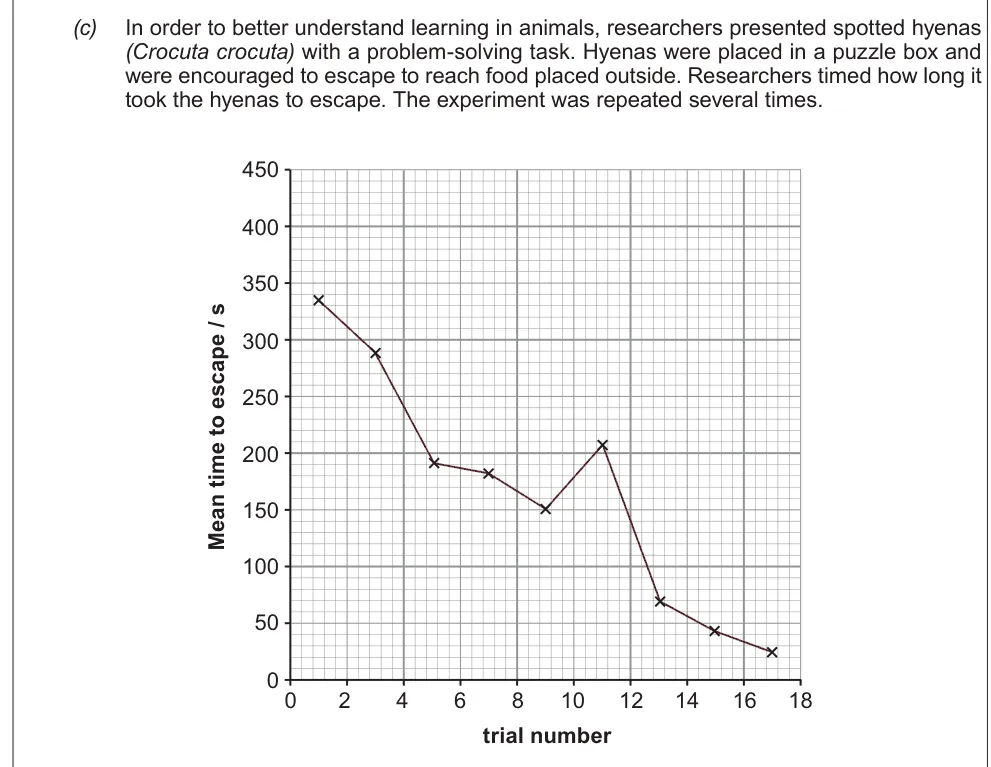
State and explain the type of learning shown by hyenas escaping from a puzzle box.
Information from earlier in this question:

Show the mark scheme

Tap an image to open it full size.
From the examiners' report: Name it: operant conditioning. Many saw the food reward but didn't name the behaviour.
Question 10
A level Component 3 · June 2017 · Q9(c)(iii) · 1 mark · Easy
Explain why the hyenas escape from the box faster over successive trials.

Show the mark scheme

Tap an image to open it full size.
From the examiners' report: Learning has taken place, reinforced by the reward.
Question 11
A level Component 3 · June 2018 · Q10(d)(i) · 1 mark
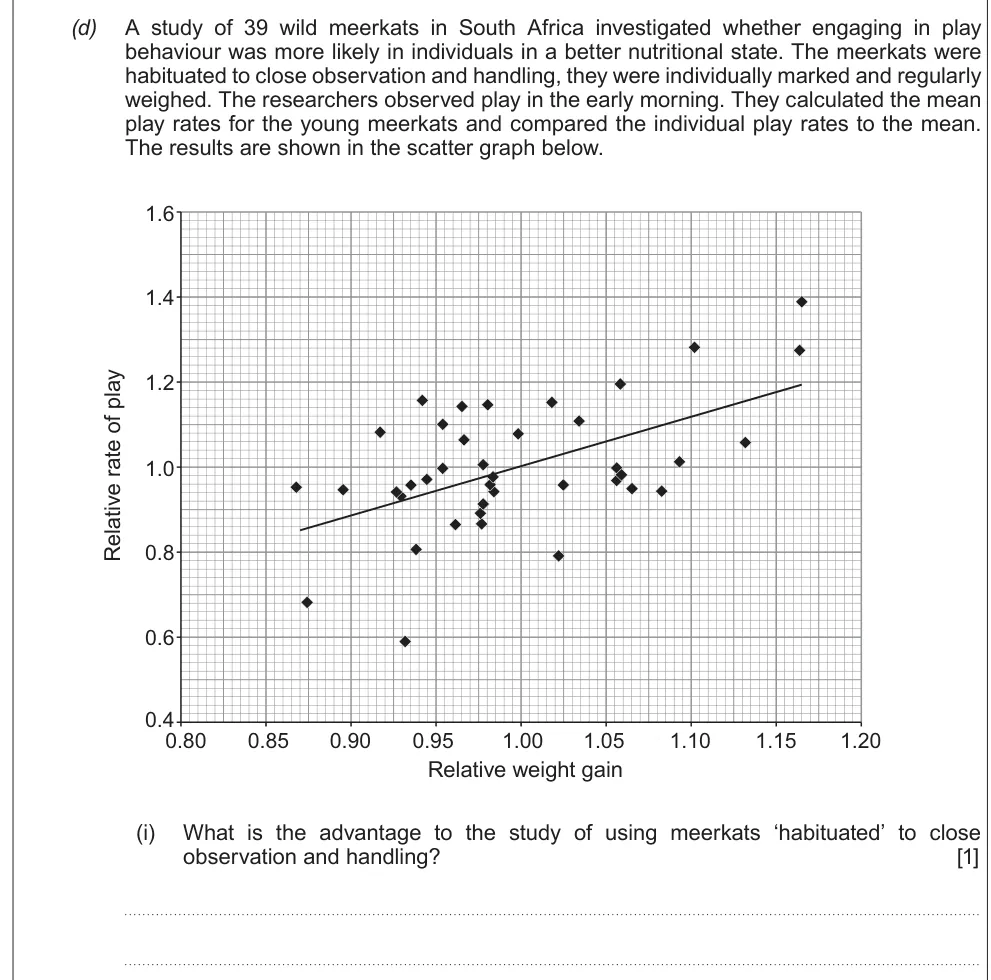
Explain the advantage of studying meerkats that are habituated to being watched and handled.
Show the mark scheme

Tap an image to open it full size.
From the examiners' report: The point is that they behave naturally, not just that they aren't scared.
Question 12
A level Component 3 · June 2022 · Q9(c)(i) · 1 mark
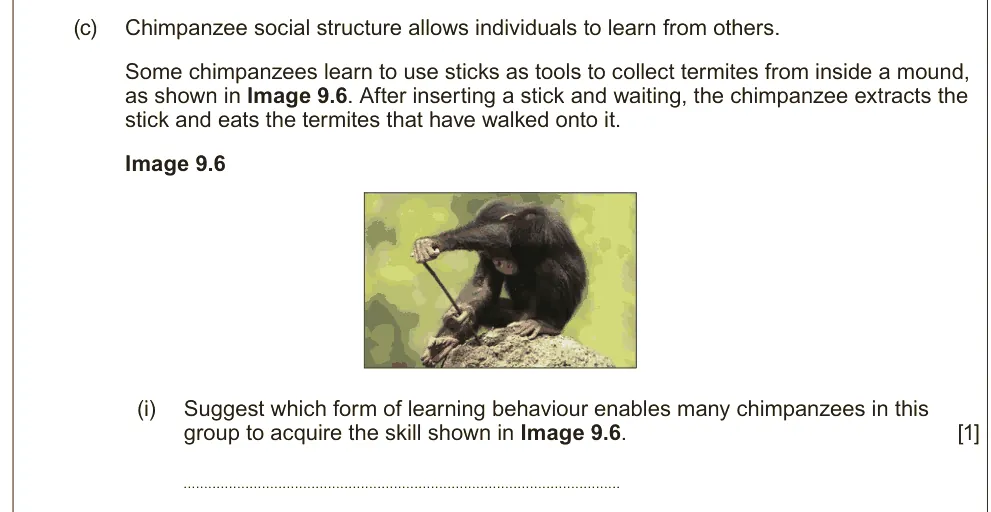
Suggest which form of learning lets many chimpanzees in a group acquire a skill.
Show the mark scheme

Tap an image to open it full size.
From the examiners' report: Imitation: copying others in the group.
Question 13
A level Component 3 · June 2019 · Q10(e) · 1 mark
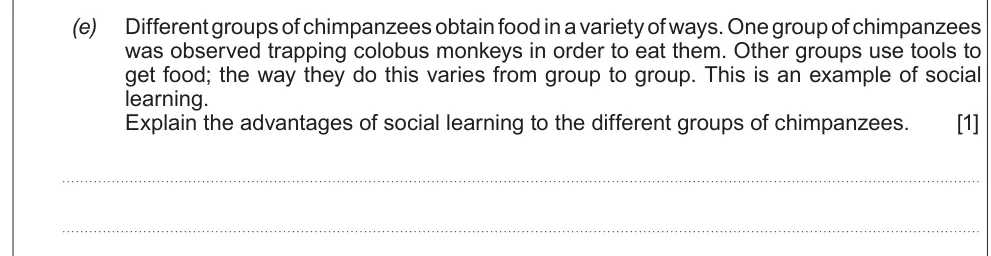
Explain the advantage of social learning to different groups of chimpanzees.
Show the mark scheme

Tap an image to open it full size.
From the examiners' report: Each group can adapt to and use the food available in its own environment.
Social insects
Question 14
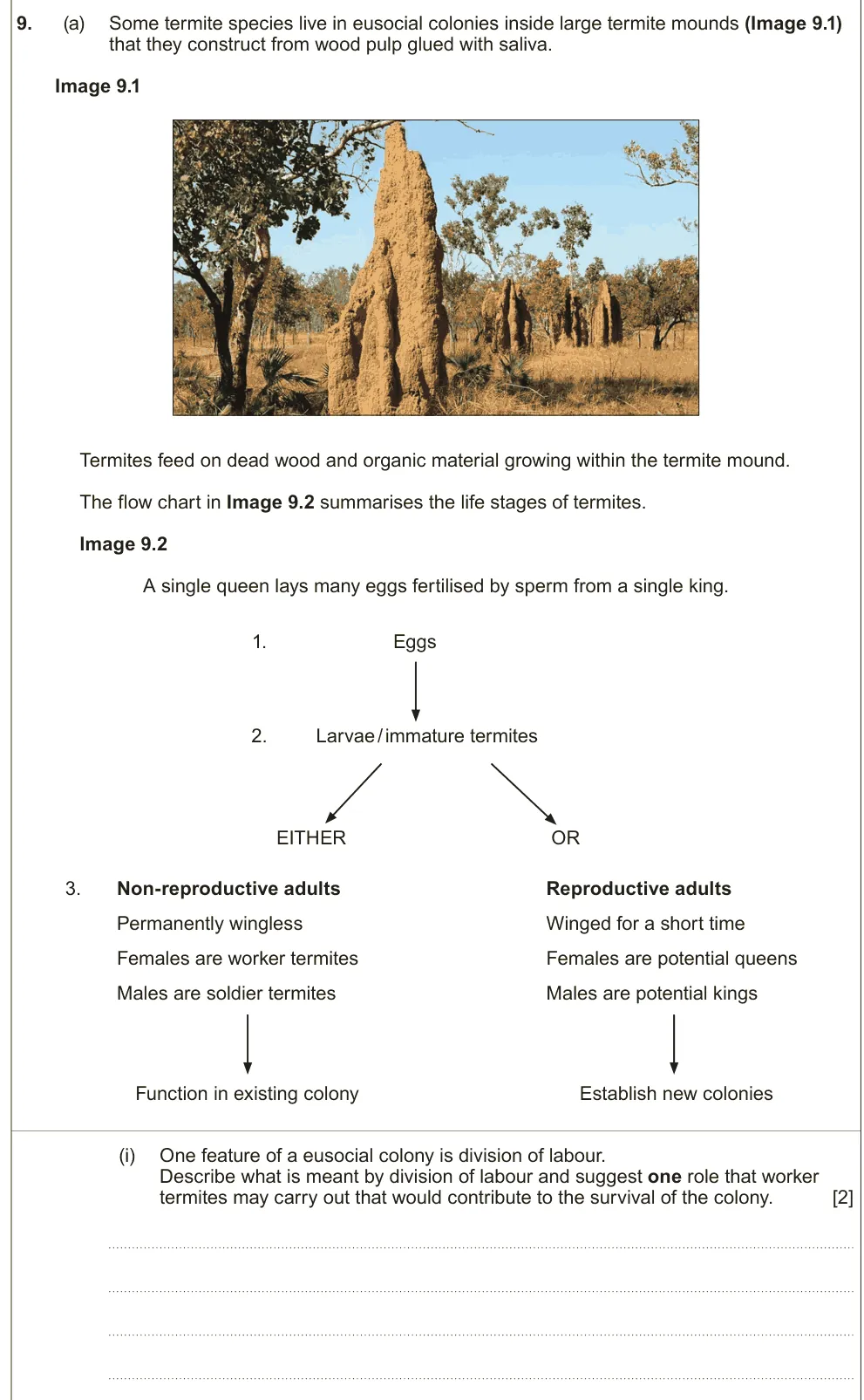
A level Component 3 · June 2022 · Q9(a)(i) · 2 marks
Describe division of labour and suggest one role of worker termites.
Show the mark scheme

Tap an image to open it full size.
From the examiners' report: Be precise: different castes carry out different tasks, then give one task such as caring for the young or collecting food.
Question 15
A level Component 3 · June 2025 · Q9(c)(iii) · 3 marks
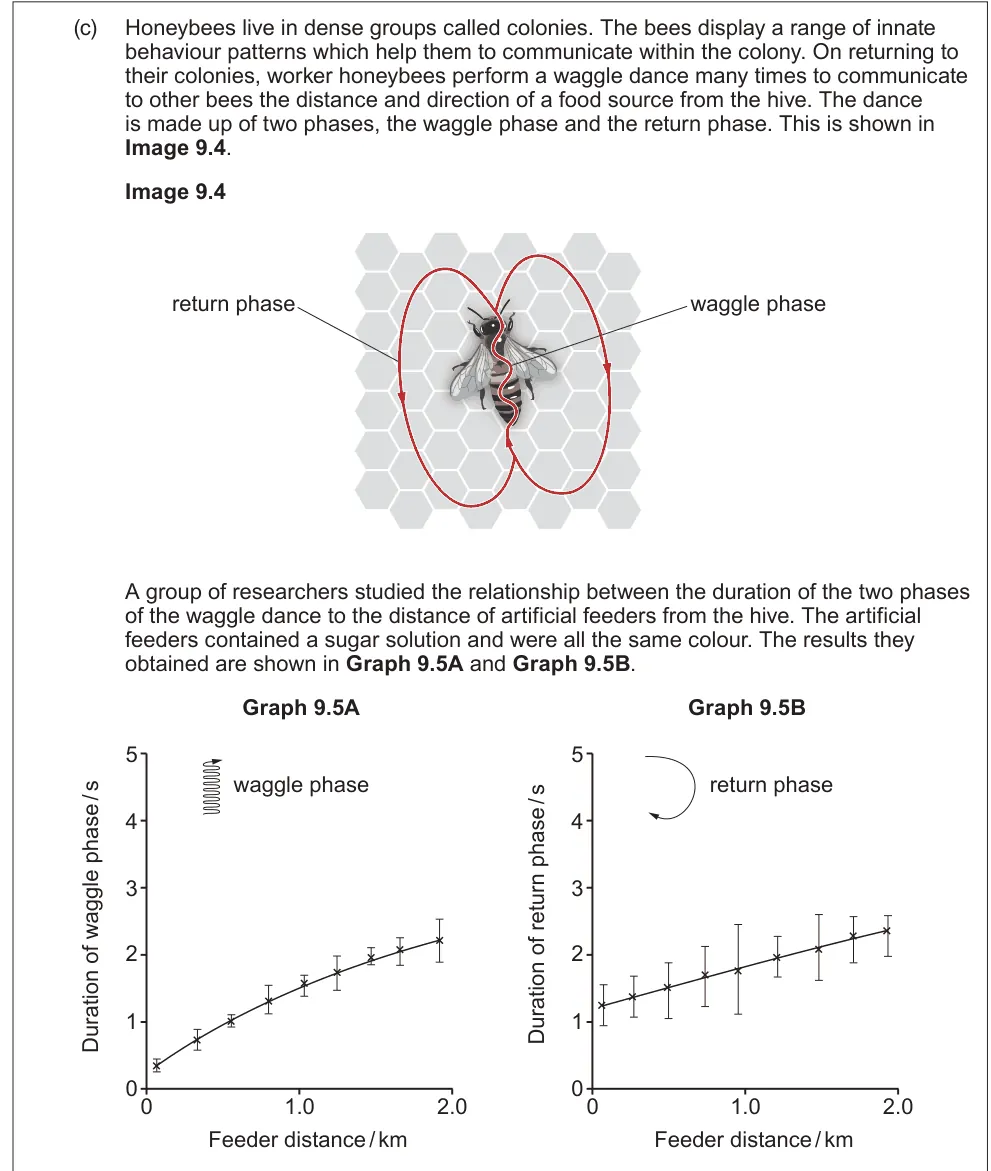
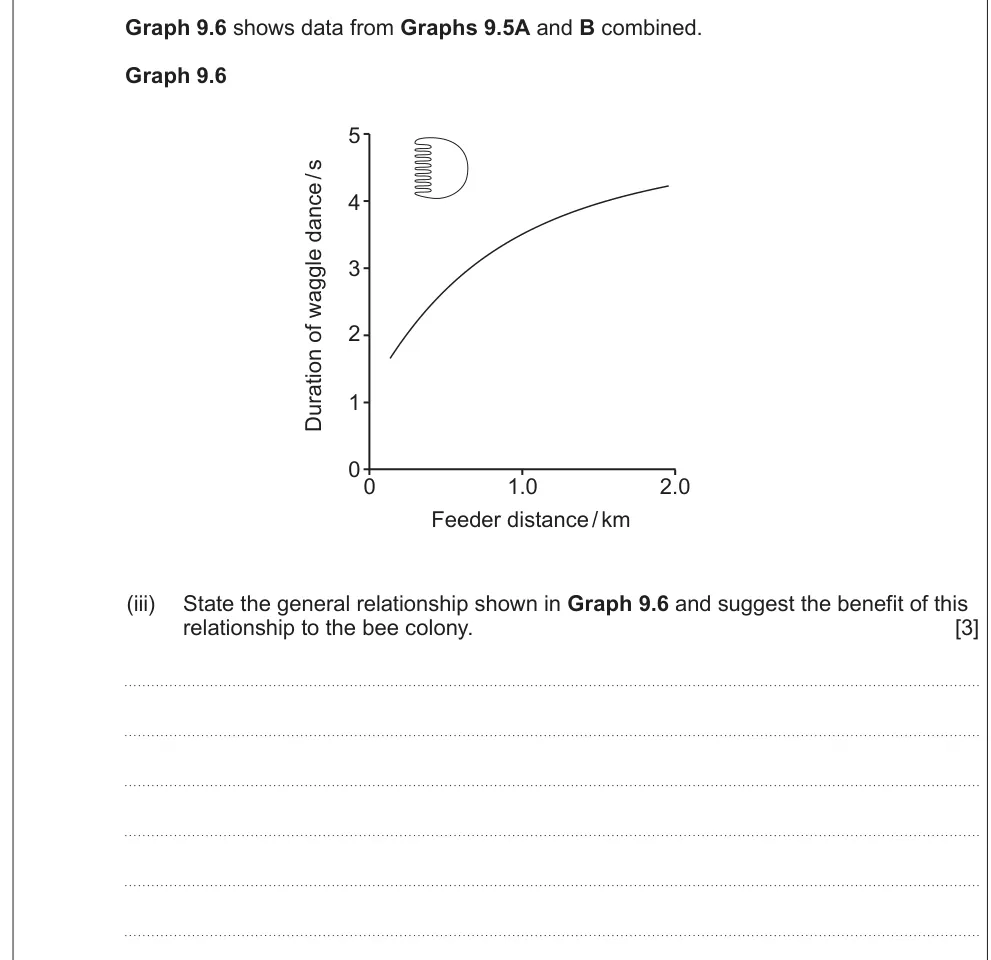
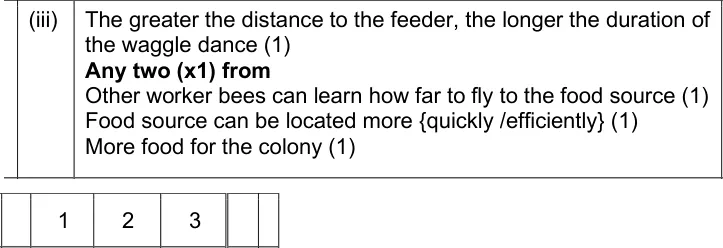
State the relationship between feeder distance and the bee waggle dance and suggest its benefit.
Information from earlier in this question:
Show the mark scheme
Tap an image to open it full size.
Social hierarchies and sexual selection
Question 16
A level Component 3 · June 2018 · Q10(c)(i) · 2 marks
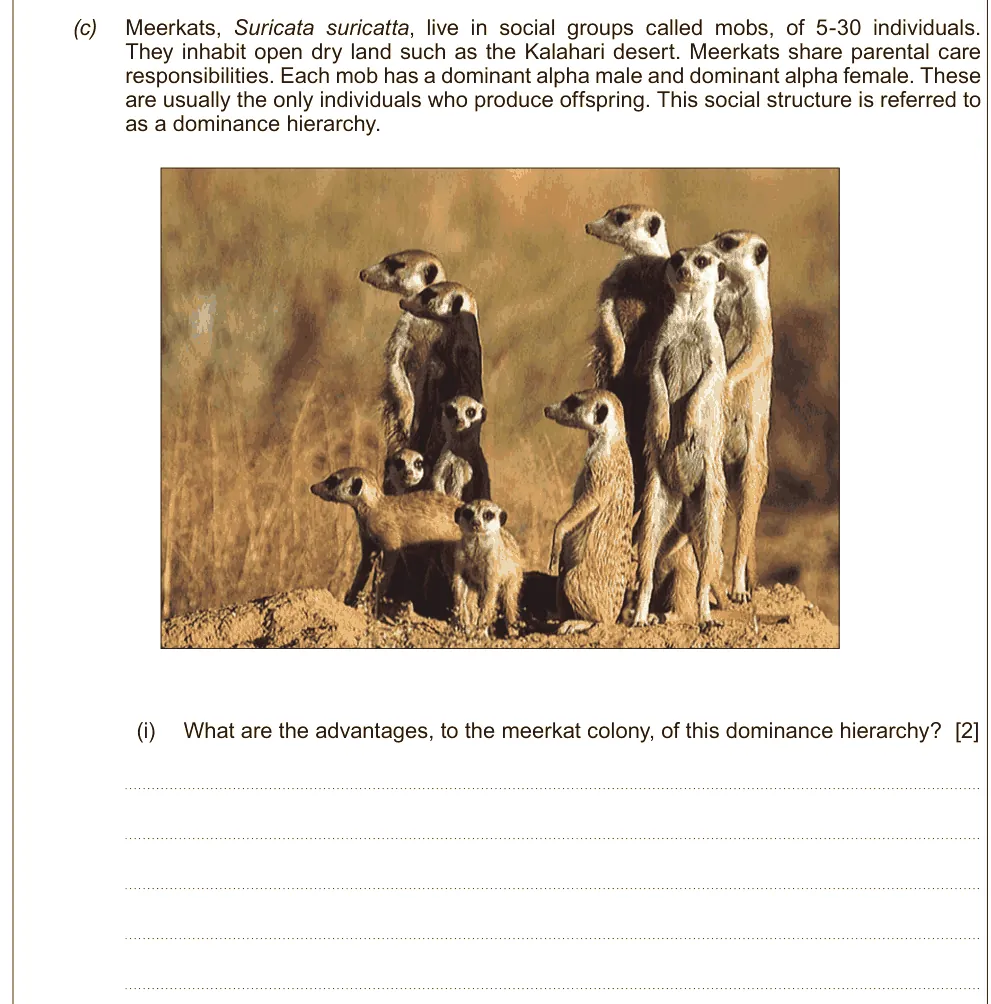
Explain the advantages of a dominance hierarchy to a meerkat colony.
Show the mark scheme

Tap an image to open it full size.
From the examiners' report: Two points: less aggression, and the dominant pair pass on advantageous alleles.
Question 17
A level Component 3 · June 2022 · Q9(b)(i) · 1 mark
Explain one advantage of a dominance hierarchy to chimpanzees.
Show the mark scheme

Tap an image to open it full size.
From the examiners' report: Fighting becomes a last resort, or dominant animals get more resources and mates.
Question 18
A level Component 3 · June 2018 · Q10(c)(ii) · 1 mark
Explain why male lions are much larger than females.
Show the mark scheme

Tap an image to open it full size.
From the examiners' report: The point is sexual selection: males fight for access to females. Saying they're bigger to catch prey misses it.
Question 19
A level Component 3 · Autumn 2021 · Q9(c)(ii) · 2 marks
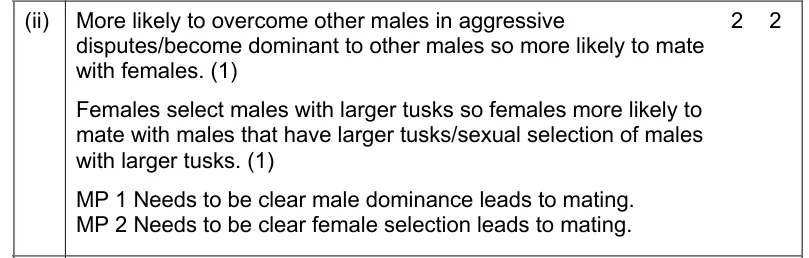
Describe two ways male elephants gain social advantage from larger tusks.
Show the mark scheme
Tap an image to open it full size.
Question 20
A level Component 3 · June 2024 · Q9(d)(ii) · 3 marks
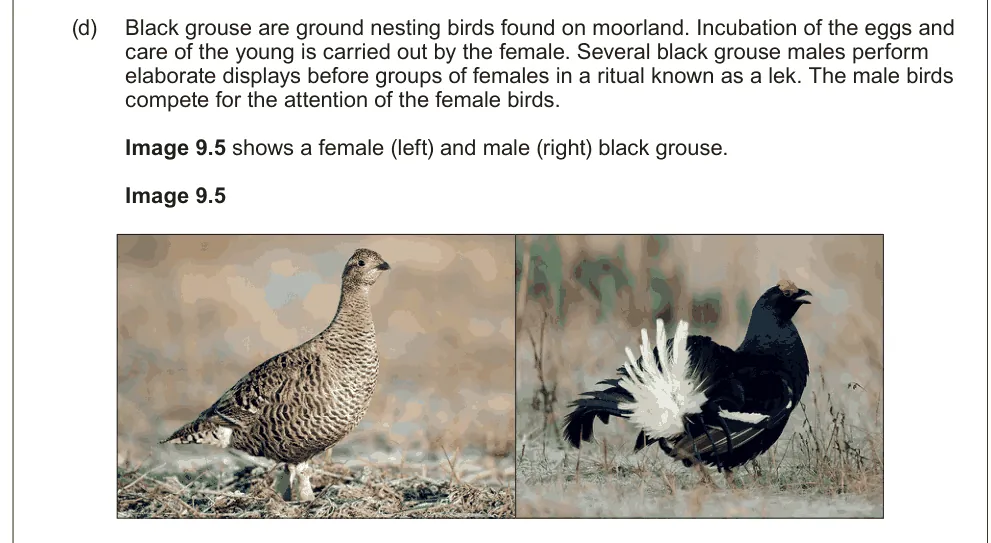
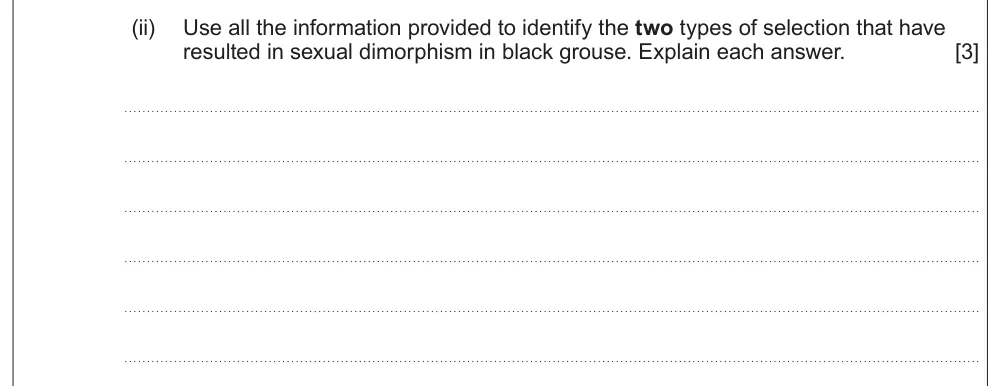
Identify the two types of selection that produced sexual dimorphism in black grouse.
Information from earlier in this question:
Show the mark scheme

Tap an image to open it full size.
From the examiners' report: Use the information given: natural selection for camouflaged females, sexual selection for showy males.
Where students lose marks (from Eduqas examiners' reports and mark schemes)
Each point below is followed by wording that gained marks.
Inherited, not just "inborn": Answers that used the word inborn with no further explanation weren't credited.
✔ Gains credit: "Behaviour that doesn't need to be learned / a response that is inherited" (reject inborn).
A kinesis has no direction: Suggestions that the maggots were heading to or from an area, which is directional movement, lost the mark.
✔ Gains credit: "Kinesis": "non-directional movement", rate of movement higher in the dry area.
The behaviour keeps the maggot there: Some noted that a dead animal is humid, but few said the behaviour keeps the maggot there.
✔ Gains credit: "Inside a dead animal will be damp... so more likely to remain there".
Name it: operant conditioning: Few identified operant conditioning even though they recognised the food reward.
✔ Gains credit: "Operant conditioning": "learning associated with a reward".
Natural behaviour, not "not scared": Answers said the meerkats wouldn't be scared instead of saying they behave normally.
✔ Gains credit: "They are used to being handled and show natural behaviour".
Bigger for mates, not prey: Some said male lions are bigger to catch prey, missing the point about sexual selection.
✔ Gains credit: "Males fight for sexual access to females / sexual selection has favoured larger males".
Download the questions
Download the PDF pack (20 questions, mark schemes at the end)
Keep practising
- The Brain (Option C1): Eduqas A Level Biology exam questions by topic
- Neuroscience (Option C2): Eduqas A Level Biology exam questions by topic
- Eduqas A level Biology past papers, mark schemes and examiners' reports
- Eduqas A level Biology grade boundaries
- Ask about Eduqas A level Biology lessons with Sam on WhatsApp
Questions, mark schemes and examiners' report extracts © WJEC CBAC Ltd (Eduqas).