

The immune response is the biggest topic in Option A, Immunology and Disease, in Section B of Component 3. It runs from the body's natural barriers, through antigen presentation, T cells, B cells and antibodies, to active and passive immunity, vaccines, antibody injections such as anti-venom, and why some immunisation programmes work better than others.
The examiners' reports keep finding the same problems: antigen, antibody and antibiotic used as if they meant the same thing, "colonial expansion" instead of clonal expansion, humoral immunity described when the question asked about cell-mediated immunity, and long answers that pour out everything about the immune response. The best answers name the cells in order and stop when the question has been answered.
I don't teach the Eduqas specification myself, so for one-to-one help I recommend Sam. He teaches Eduqas A level Biology at a top-rated sixth form college and is very popular with his students. You can ask about lessons with Sam on WhatsApp using the link at the bottom of this page.
What you need from GCSE and Year 12
Each question on this page assumes you're secure on these ideas. If any of them feels shaky, look it up before you start.
- White blood cells include phagocytes and lymphocytes.
- Antibodies are proteins with a shape complementary to one antigen.
- Vaccines contain dead or weakened pathogens, or their antigens.
- Memory cells give a faster, larger secondary response.
Key terms
These words come up in the questions and mark schemes. Examiners expect you to use them exactly.
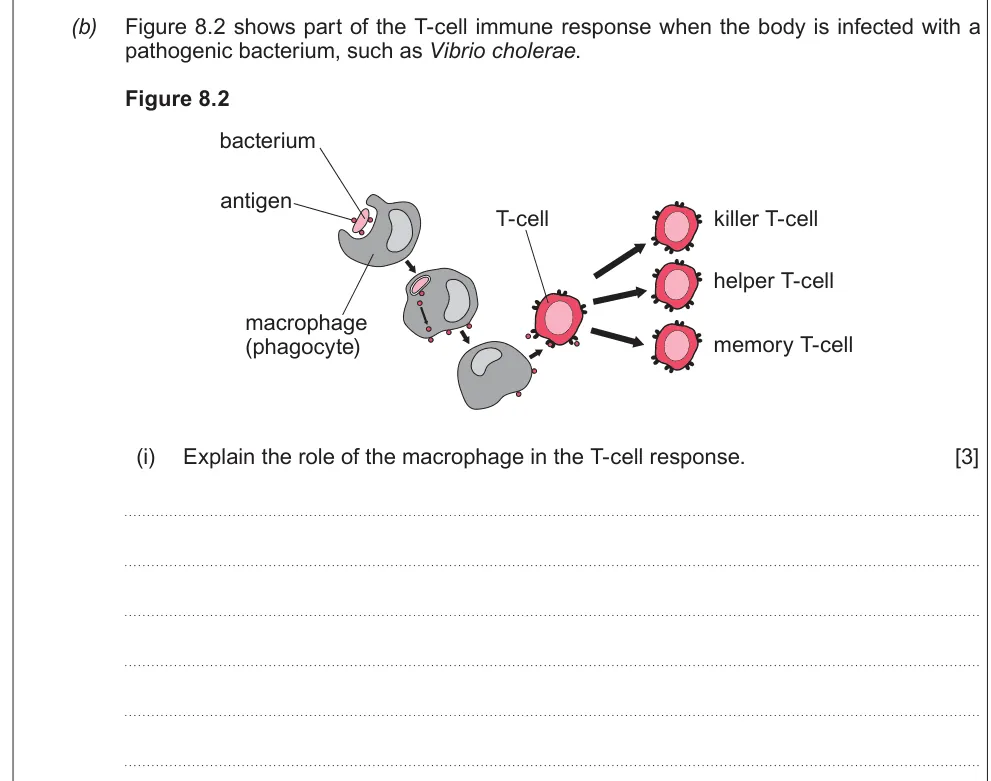
- Antigen presentation: a macrophage displays the pathogen's antigens on its surface so lymphocytes can recognise them.
- Clonal selection: the lymphocyte with the complementary receptor is activated.
- Clonal expansion: the activated lymphocyte divides by mitosis to make many identical cells.
- Plasma cell: a B cell that secretes antibodies specific to one antigen.
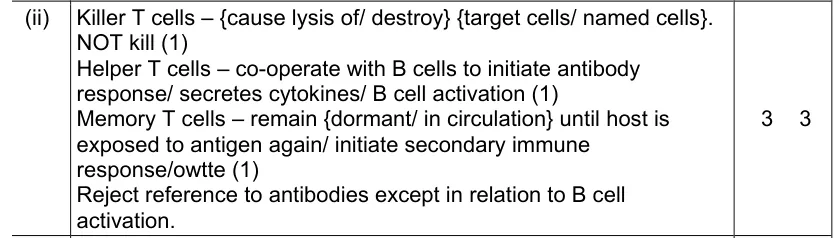
- Helper T cell: releases cytokines that activate B cells and phagocytes.
- Killer T cell: destroys infected or cancerous body cells.
- Active immunity: your own body makes antibodies and memory cells; long-lasting.
- Passive immunity: ready-made antibodies are given or passed on; short-lived, with no memory cells.
- Antigenic variation: changes in a pathogen's antigens, so memory cells no longer recognise it.
What these questions cover (Eduqas OA3)
The questions test these statements from Option A (Immunology and Disease) of the Eduqas A level Biology specification (A400). Option questions are in Component 3, and you answer only one of the three options.
- (a) the natural barriers in the body which reduce the risk of infection, including natural skin flora, connective tissue, localised inflammation, phagocytosis, clotting, tear
- (b) how specific immune responses are developed as a result of exposure to foreign antigens
- (c) humoral immune responses, involving the production and secretion of antigen-specific antibodies
- (d) cell-mediated immunity, by direct cell contact involving the destruction of pathogens, infected cells and cancerous cells
- (e) the role of T lymphocytes and B lymphocytes in cell-mediated and humoral immune responses
- (f) specific immune responses induced naturally or artificially to produce an active, long-lived response or acquired passively resulting in short-term protection
- (g) the principles of the active immune response can be used medically to immunise against disease, e.g. rubella, without infection by the pathogen
- (h) the use of injection of antibodies to provide passive, emergency treatment against an infection, e.g. the treatment of rabies
- (i) the different levels of effectiveness of immunisation programmes against different diseases
- (j) the ethics which must be taken into consideration when designing vaccination programmes
How to use this page
Write your answer on paper before you open the mark scheme. Allow about 1.2 minutes per mark: the 19 questions are worth 42 marks, so about 50 minutes in total. Then mark your answer strictly against the mark scheme and read the examiners' tip underneath it. If you'd rather print the questions, download the PDF pack.
Natural barriers
Question 1
A level Component 3 · June 2017 · Q7(a) · 1 mark
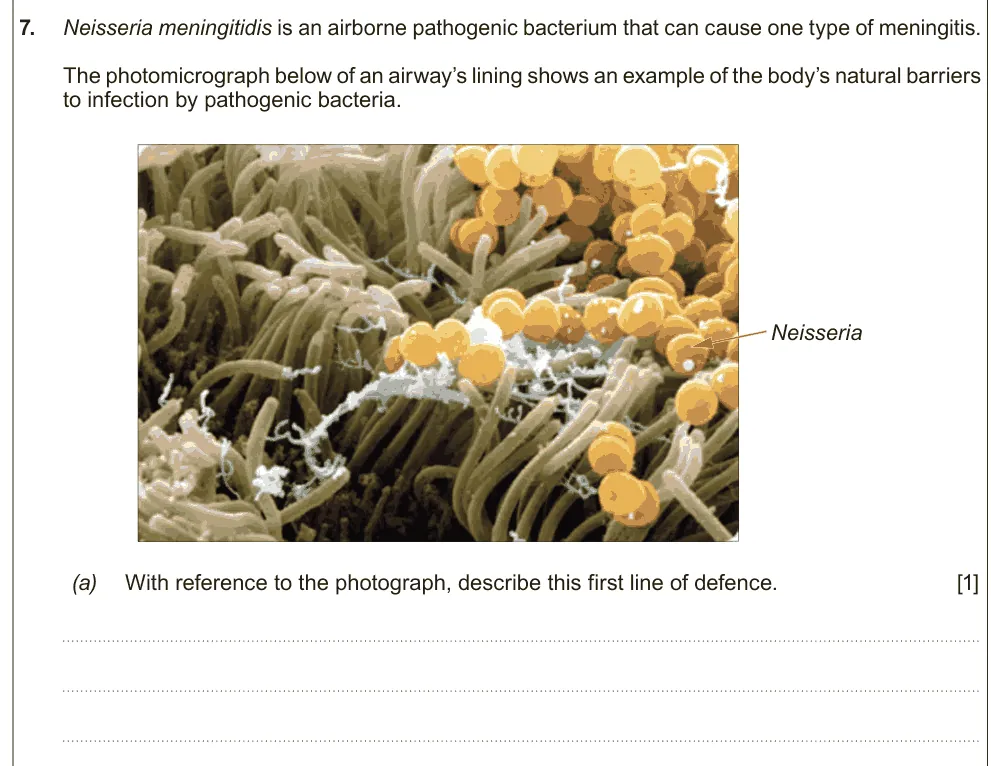
Use a photomicrograph of the airway lining to describe this first line of defence.
Show the mark scheme

Tap an image to open it full size.
From the examiners' report: Name both parts and link them: mucus traps the bacteria and cilia move the mucus away. Cilia were often misnamed as microvilli, or credited with trapping the bacteria.
Question 2
A level Component 3 · June 2019 · Q8(a) · 3 marks
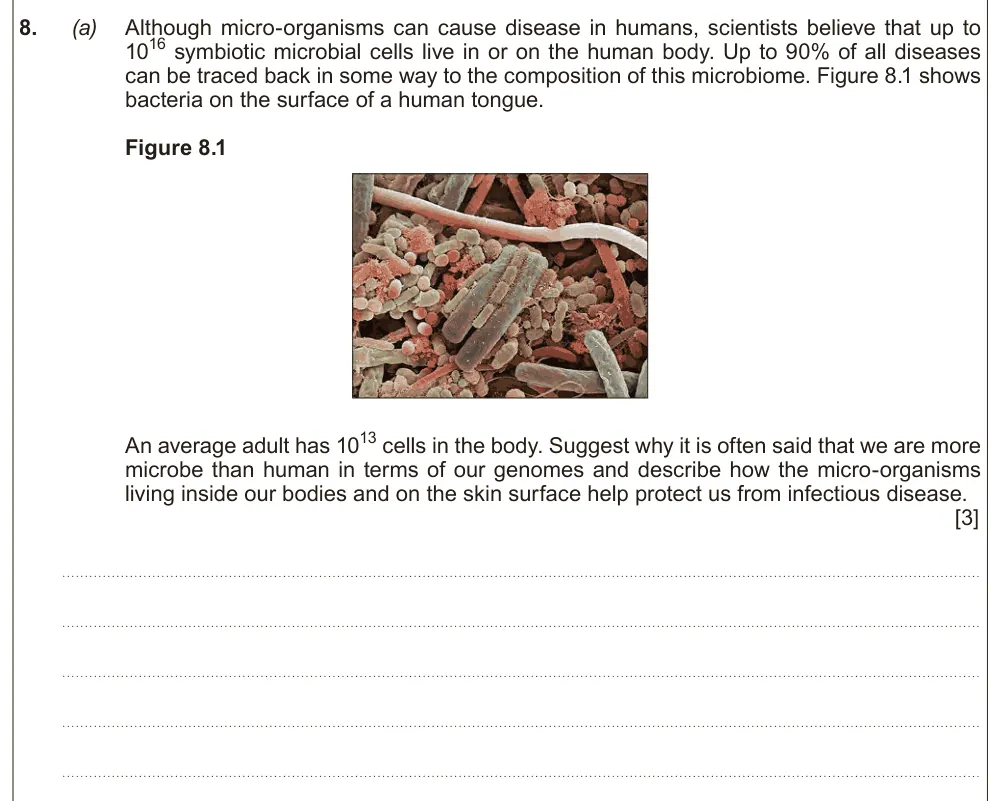
Explain why we are "more microbe than human" and how our microbes protect us from disease.
Show the mark scheme

Tap an image to open it full size.
From the examiners' report: Make both points about numbers: there are far more microbial cells than human cells and many different microbial genomes. Then explain how they keep pathogens out.
Specific immune responses
Question 3
A level Component 3 · June 2024 · Q7(a)(ii) · 2 marks · Easy
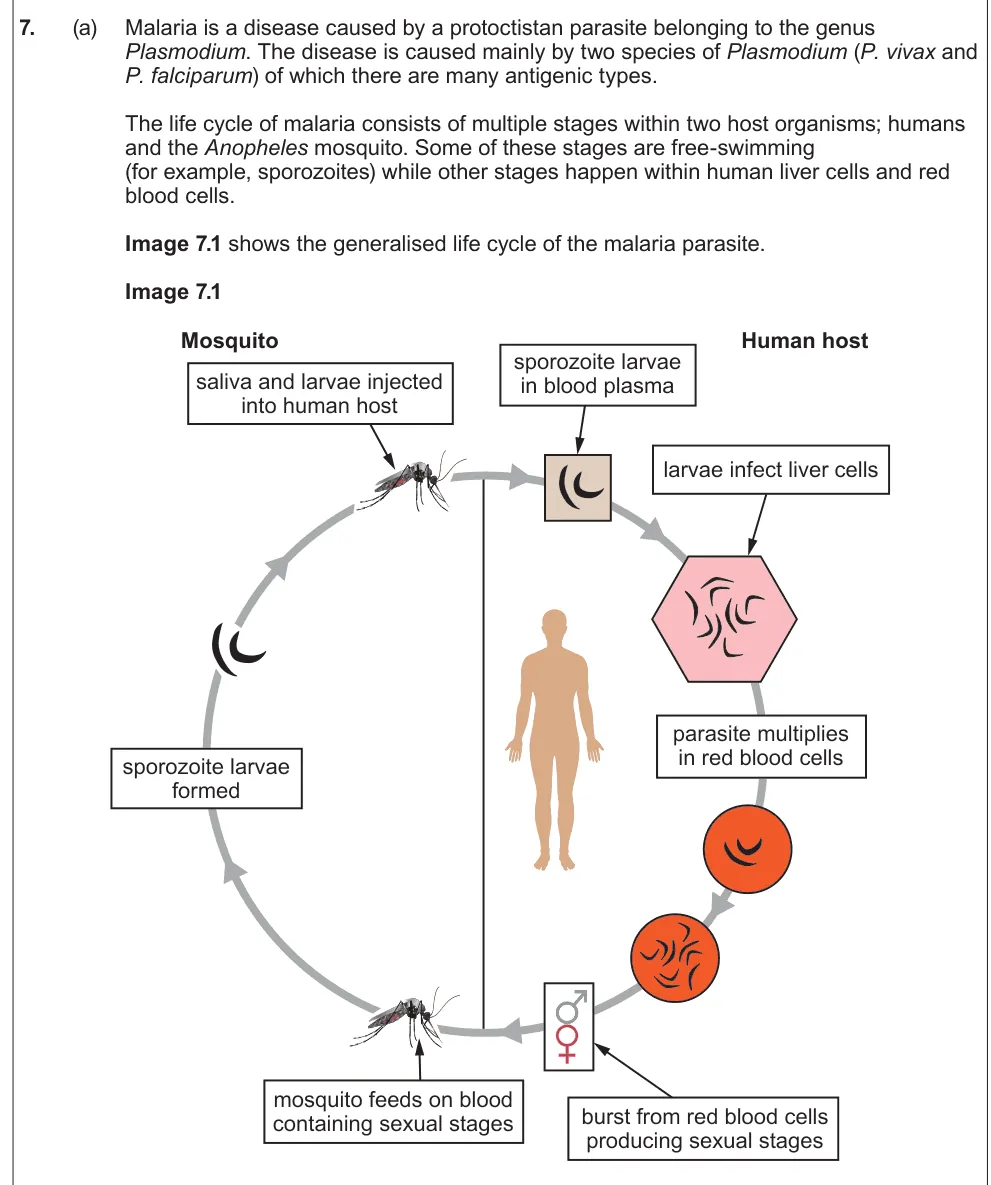
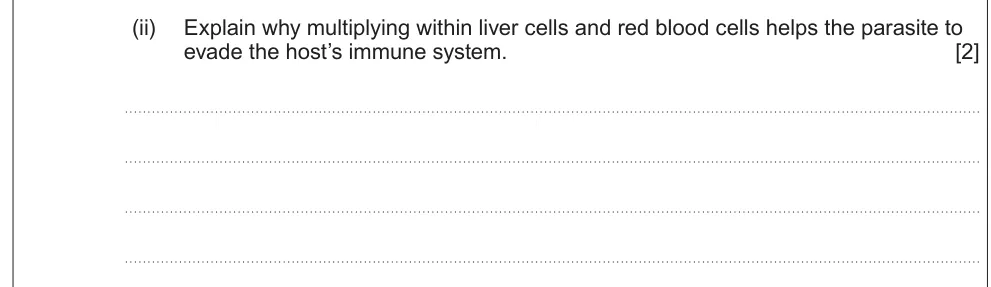
Explain why multiplying inside liver cells and red blood cells helps Plasmodium evade the immune system.
Information from earlier in this question:
Show the mark scheme

Tap an image to open it full size.
From the examiners' report: Most said the parasite avoids an immune response. Few explained why: its antigens are hidden inside host cells, not on their surface.
Question 4
A level Component 3 · June 2019 · Q8(b)(i) · 3 marks
Explain the role of the macrophage in the T cell response.
Show the mark scheme

Tap an image to open it full size.
From the examiners' report: Use the diagram in order: the macrophage engulfs the microbe and presents its antigens, then T cells recognise them and divide.
Question 5
A level Component 3 · June 2019 · Q8(b)(ii) · 3 marks
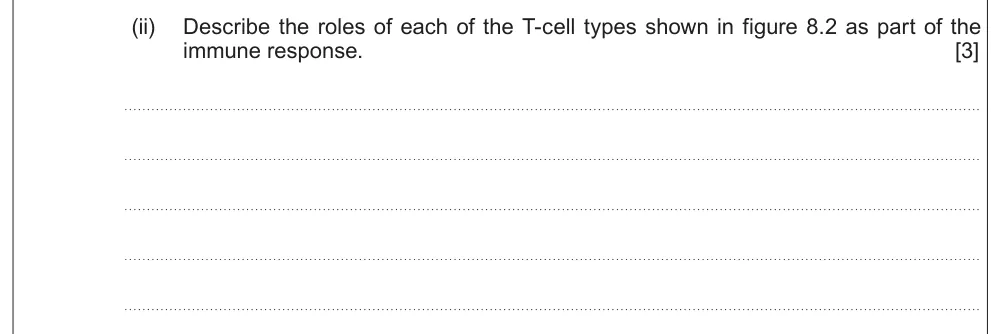
Describe the roles of killer, helper and memory T cells.
Show the mark scheme
Tap an image to open it full size.
From the examiners' report: Give one clear role for each type. Many students thought T cells make antibodies: they don't, B cells (as plasma cells) do.
Question 6
A level Component 3 · June 2022 · Q7(b)(ii) · 3 marks
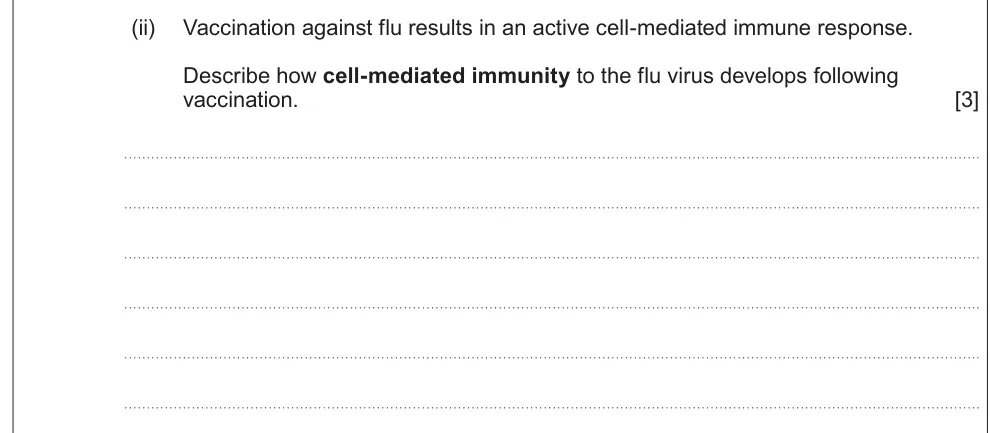
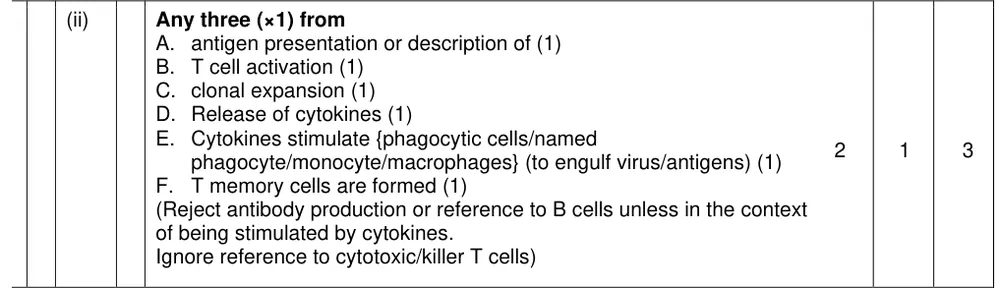
Describe how cell-mediated immunity to flu develops after vaccination.
Show the mark scheme
Tap an image to open it full size.
From the examiners' report: Stick to cell-mediated immunity: antigen presentation, T cell activation, clonal expansion and cytokines. Answers that drifted into antibodies lost marks.
Antibodies
Question 7
A level Component 3 · Autumn 2020 · Q8(c)(i) · 2 marks
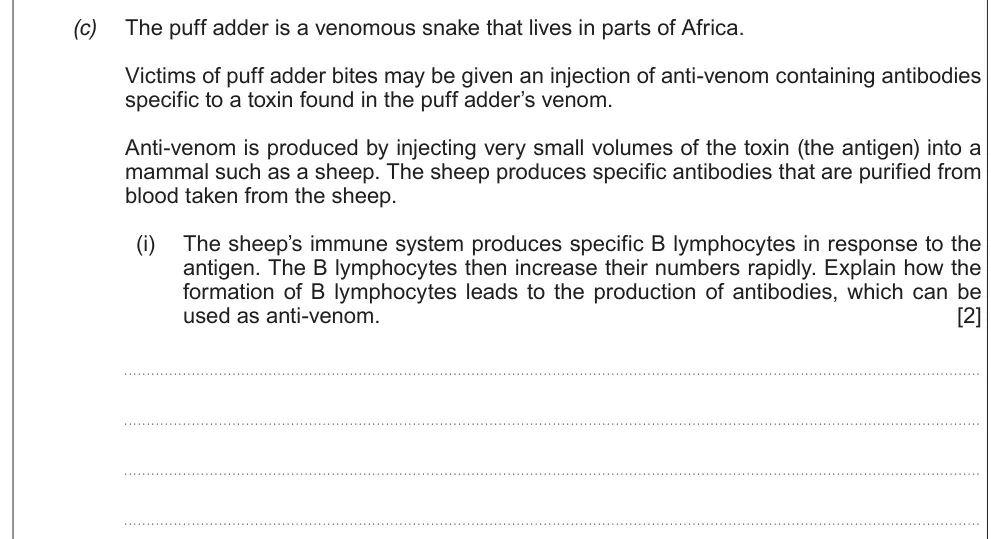
Explain how B lymphocytes in a sheep lead to antibodies that can be used as anti-venom.
Show the mark scheme

Tap an image to open it full size.
From the examiners' report: Say that B cells become plasma cells that make antibodies specific to the toxin. Plasma cells are not plasma proteins.
Question 8
A level Component 3 · June 2023 · Q7(c)(ii) · 3 marks
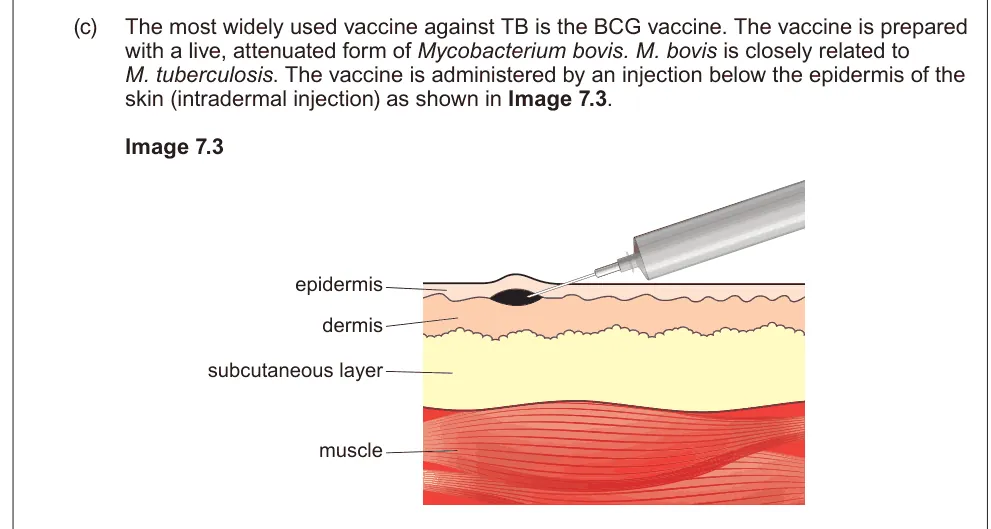
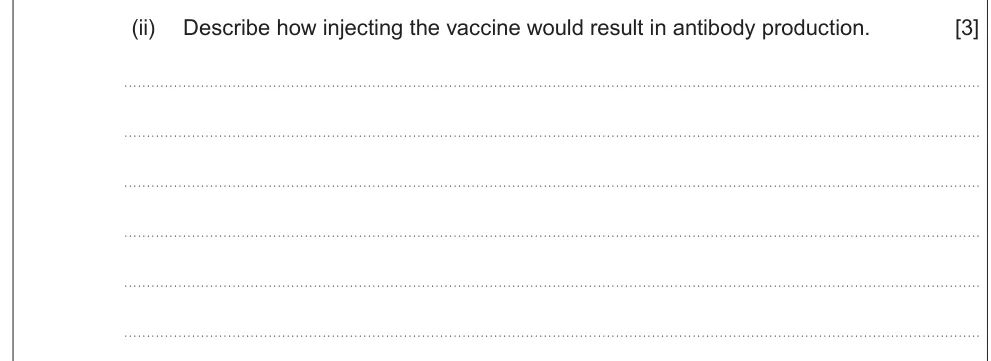
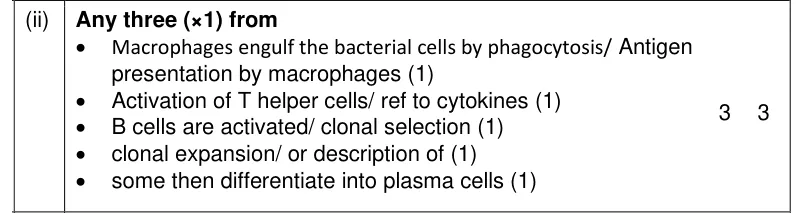
Describe how injecting the BCG vaccine leads to antibody production.
Information from earlier in this question:
Show the mark scheme
Tap an image to open it full size.
From the examiners' report: Keep it to the steps that lead to antibodies: antigen presentation, helper T cells, clonal selection and expansion of B cells, then plasma cells. Don't pour in everything you know about immunity.
Question 9
A level Component 3 · June 2019 · Q8(c)(i) · 2 marks
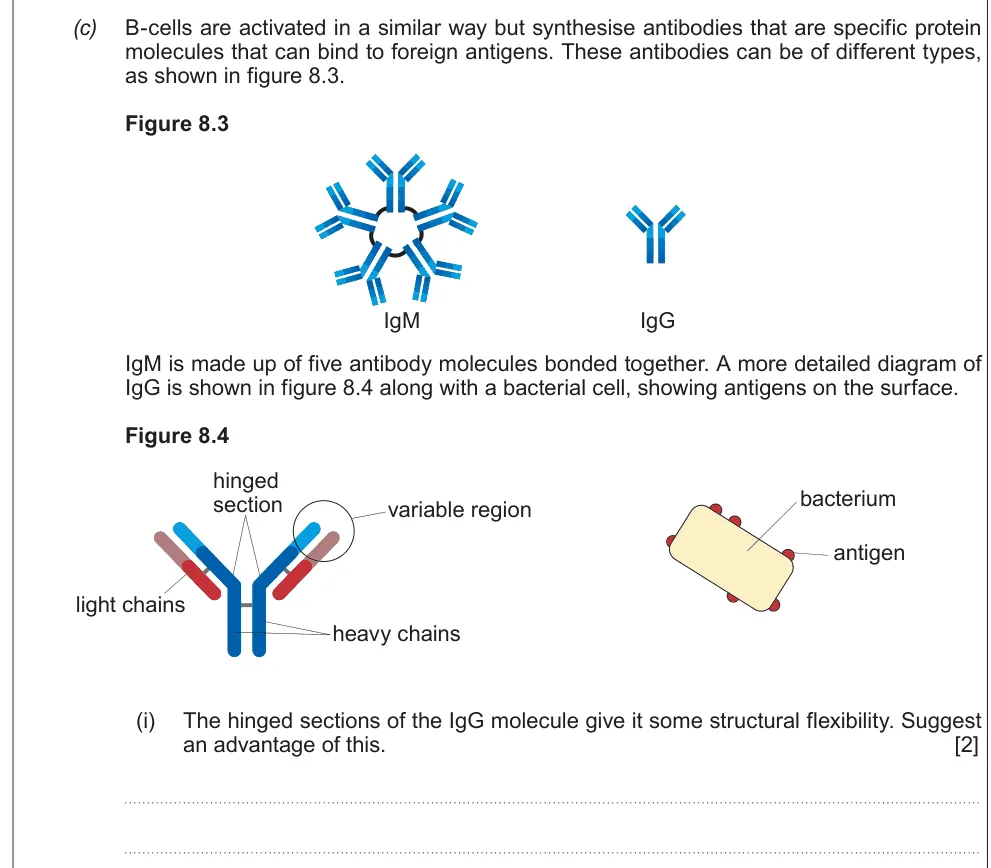
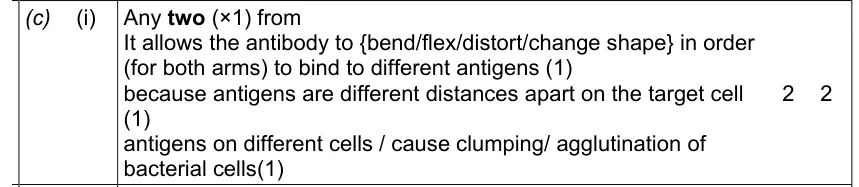
Suggest an advantage of the hinged region of an IgG antibody.
Show the mark scheme
Tap an image to open it full size.
From the examiners' report: Link flexibility to binding: the arms can reach antigens at different distances apart, so the antibody can clump them together.
Immunity and vaccination
Question 10
A level Component 3 · June 2024 · Q7(a)(iii) · 3 marks · Easy
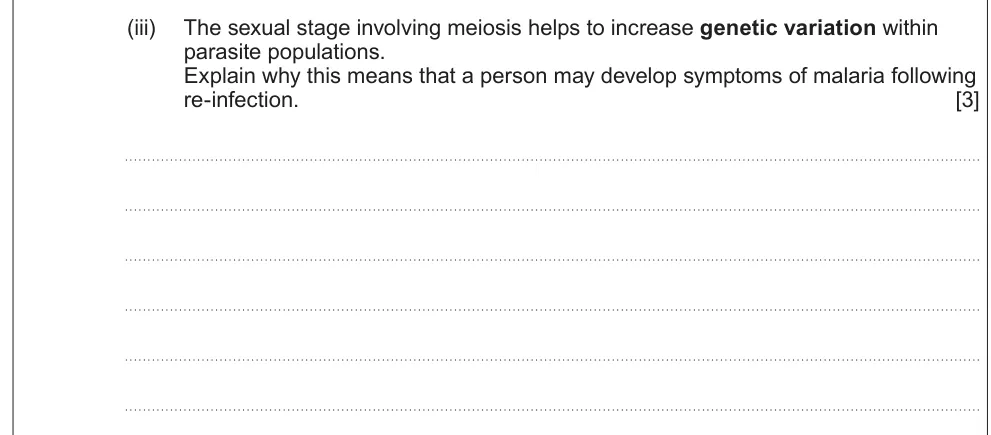
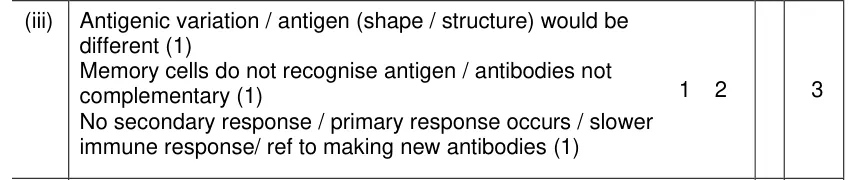
Explain why genetic variation in Plasmodium means people can get malaria symptoms again after re-infection.
Information from earlier in this question:
Show the mark scheme
Tap an image to open it full size.
From the examiners' report: Antigenic variation is the key: memory cells don't recognise the new antigen, so the body mounts a slower primary response.
Question 11
A level Component 3 · Autumn 2020 · Q8(b)(iv)II · 2 marks
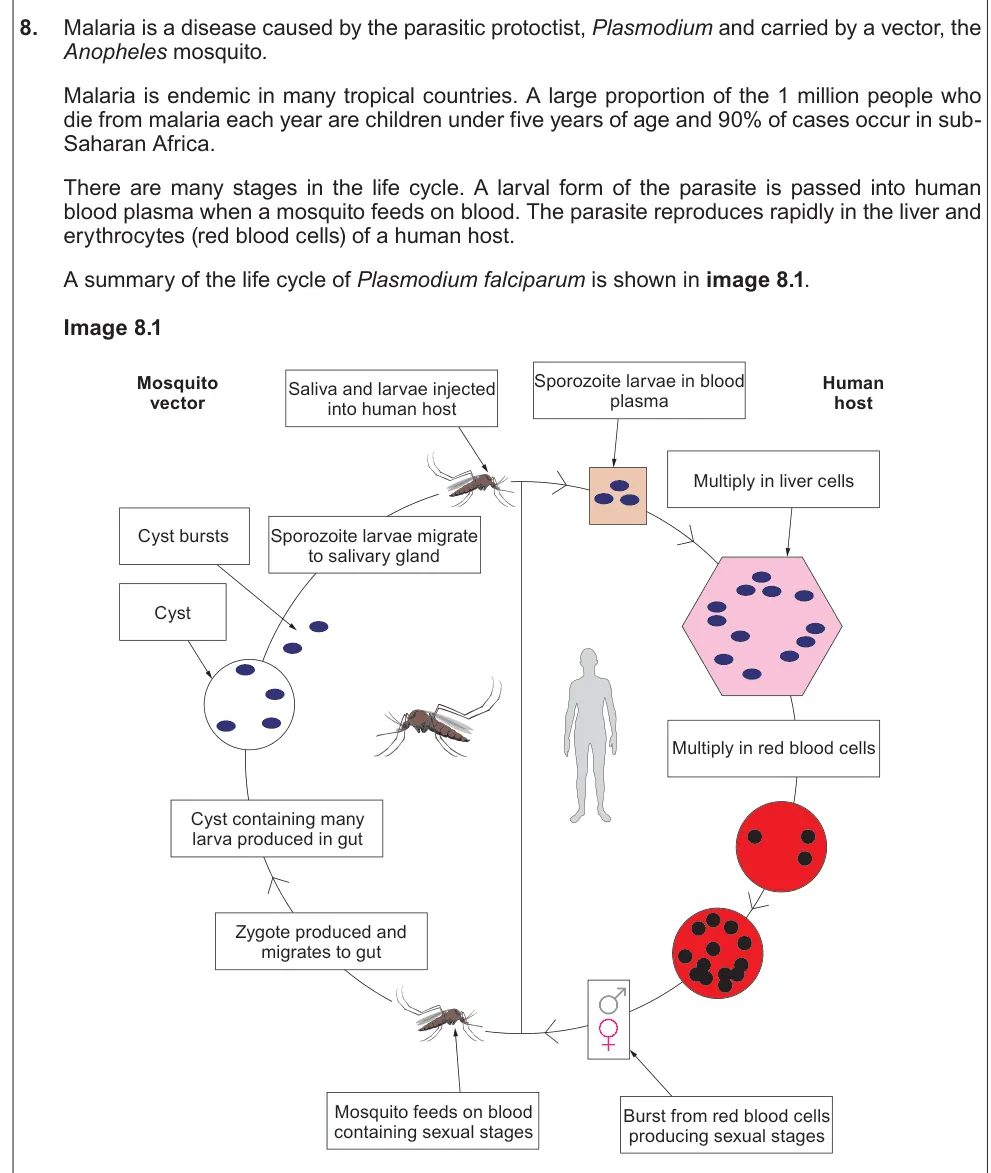
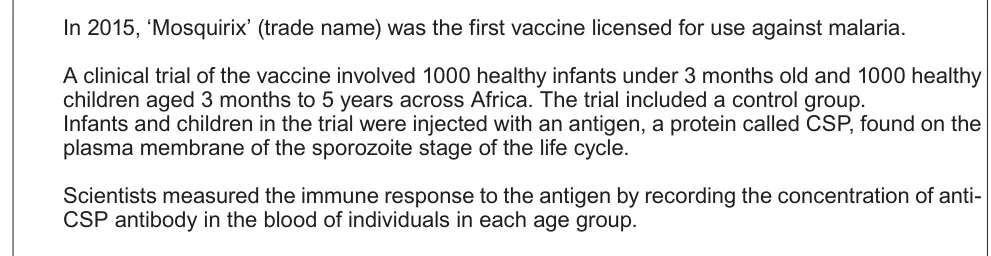
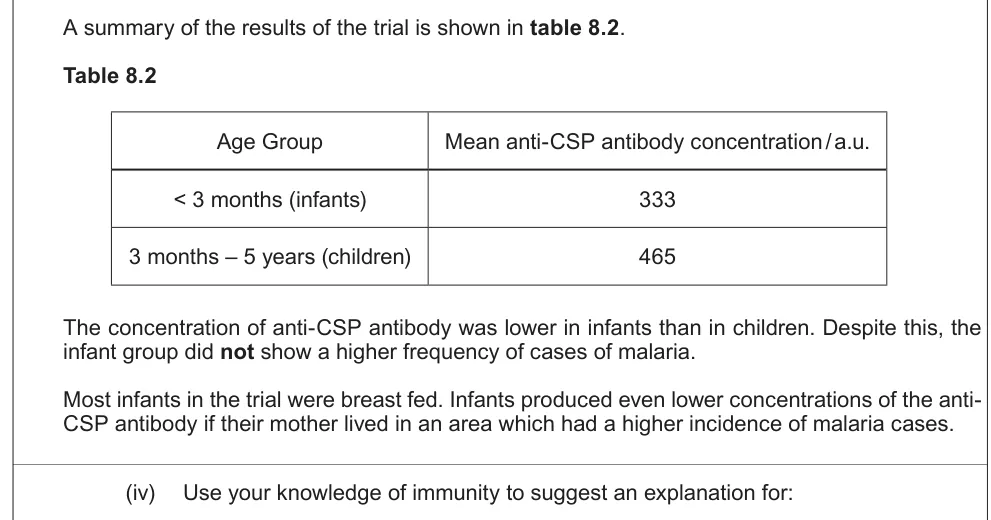
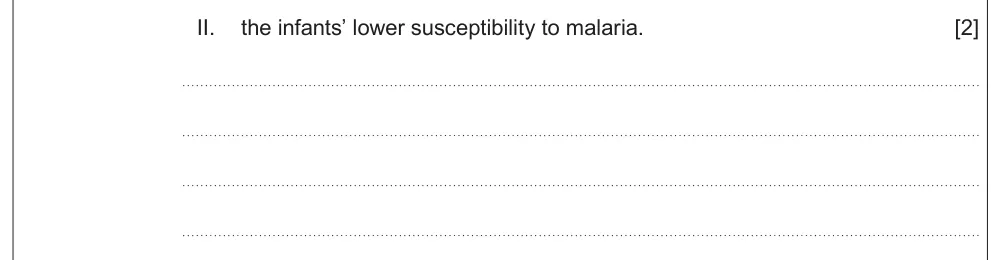
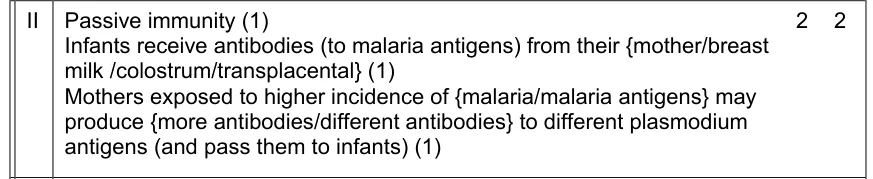
Explain why babies of mothers in high-malaria areas are less susceptible to malaria.
Information from earlier in this question:
Show the mark scheme
Tap an image to open it full size.
From the examiners' report: Name the type of immunity, passive, and say where the antibodies come from: across the placenta or in breast milk.
Question 12
A level Component 3 · June 2025 · Q7(d)(ii) · 2 marks
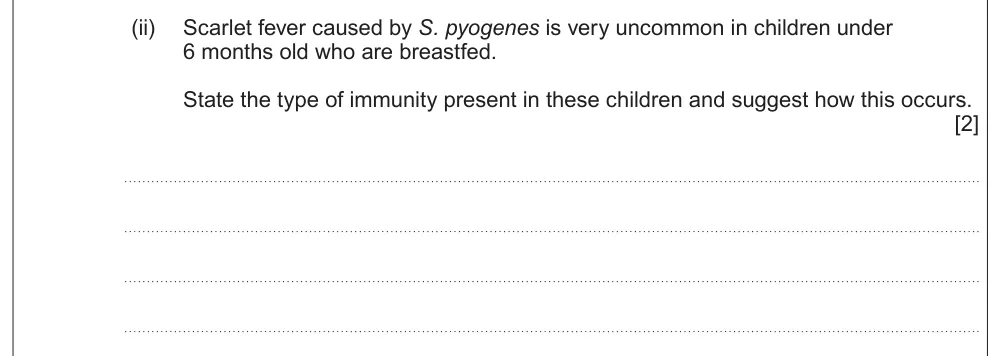
State the type of immunity in breastfed babies under six months and suggest how it arises.
Show the mark scheme

Tap an image to open it full size.
From the examiners' report: Natural passive immunity, from antibodies in breast milk or crossing the placenta. Read the context carefully before you answer.
Question 13
A level Component 3 · June 2024 · Q7(b)(v) · 2 marks
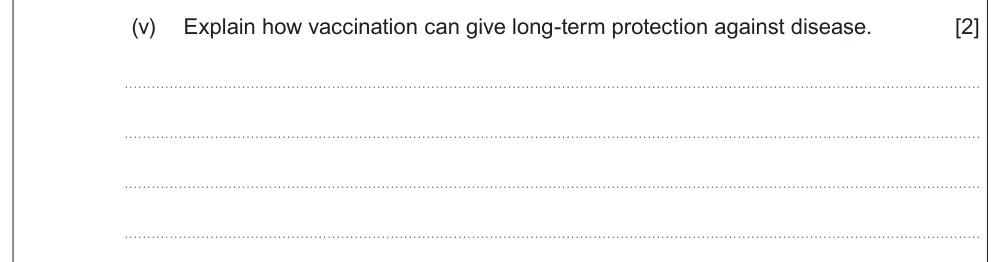
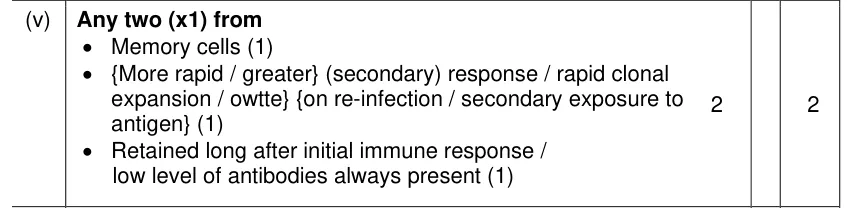
Explain how vaccination gives long-term protection against disease.
Show the mark scheme
Tap an image to open it full size.
From the examiners' report: Memory cells are the key: on re-infection they give a faster, larger secondary response.
Question 14
A level Component 3 · June 2022 · Q7(b)(i) · 1 mark
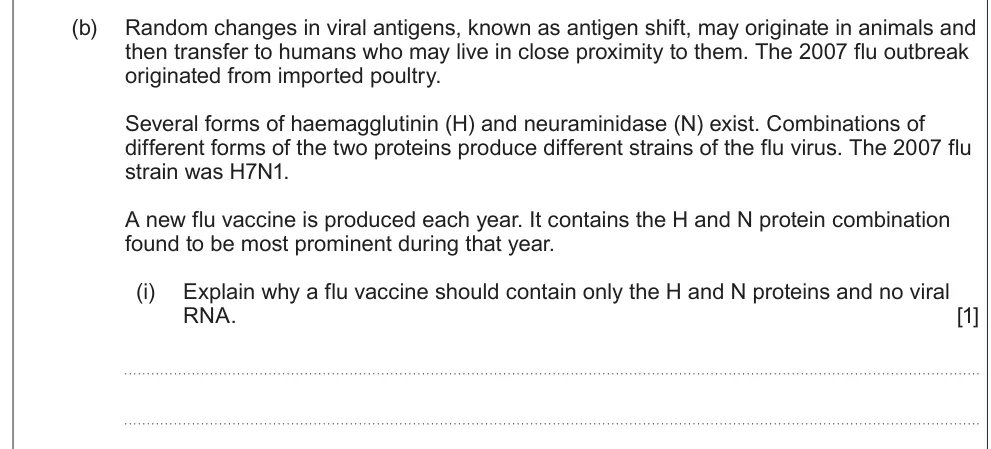
Explain why a flu vaccine contains only the H and N proteins and no viral RNA.
Show the mark scheme

Tap an image to open it full size.
From the examiners' report: Without RNA the virus can't replicate inside your cells, but the H and N antigens still trigger an immune response.
Question 15
A level Component 3 · June 2023 · Q7(c)(iii) · 2 marks · Easy
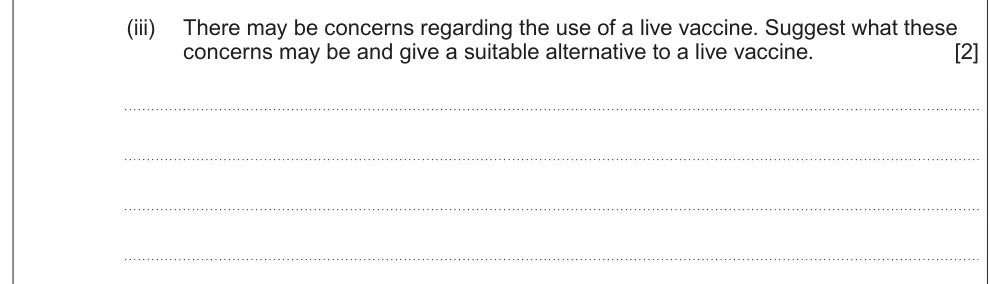
Suggest concerns about a live vaccine and give a safer alternative.
Information from earlier in this question:
Show the mark scheme

Tap an image to open it full size.
From the examiners' report: Be specific: a live pathogen could cause the disease itself. "Side effects" on its own wasn't credited.
Question 16
A level Component 3 · Autumn 2020 · Q8(c)(ii) · 1 mark
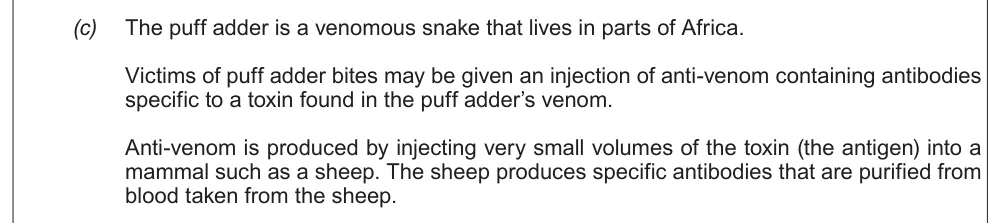
Suggest why anti-venom is given even though the person would make their own antibodies.
Information from earlier in this question:


Show the mark scheme

Tap an image to open it full size.
From the examiners' report: Finish the explanation: your own response would be too slow, and the result could be fatal.
Question 17
A level Component 3 · Autumn 2020 · Q8(b)(ii) · 1 mark
State one reason why a malaria vaccine has been hard to make.

Show the mark scheme

Tap an image to open it full size.
From the examiners' report: Link mutation to the antigen: high antigenic variation, or many different antigens at each stage of the life cycle.
Question 18
A level Component 3 · June 2018 · Q8(c) · 5 marks
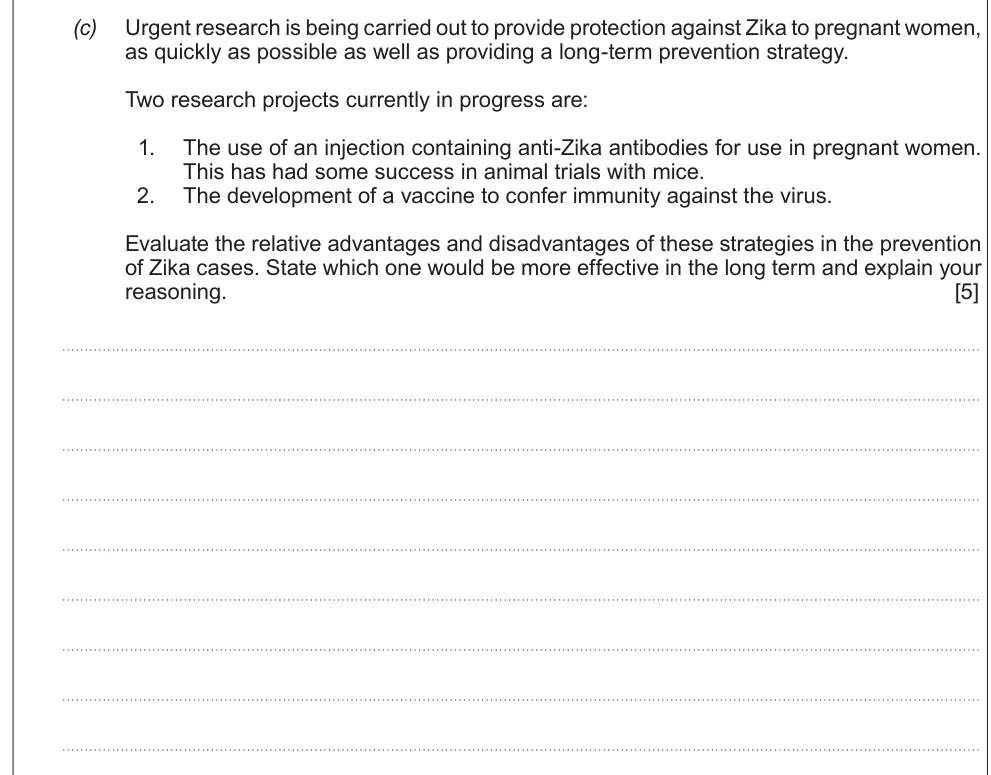
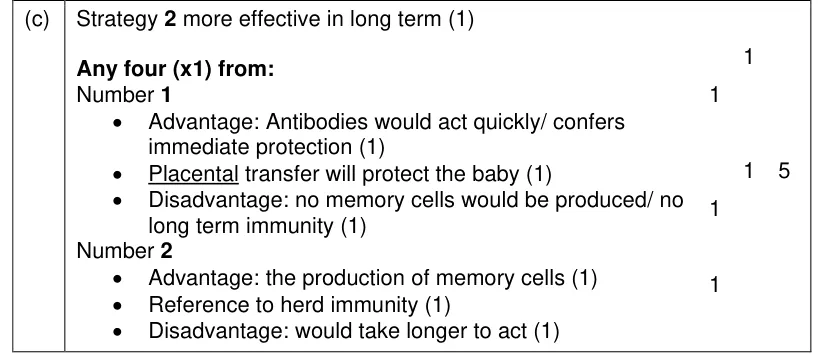
Evaluate antibody injections and a vaccine for preventing Zika, and choose the better long-term strategy.
Show the mark scheme
Tap an image to open it full size.
From the examiners' report: Be clear what an antibody injection gives: immediate but short-lived protection with no memory cells. Weigh both strategies before choosing the vaccine.
Question 19
A level Component 3 · Autumn 2021 · Q7(d)(ii) · 1 mark
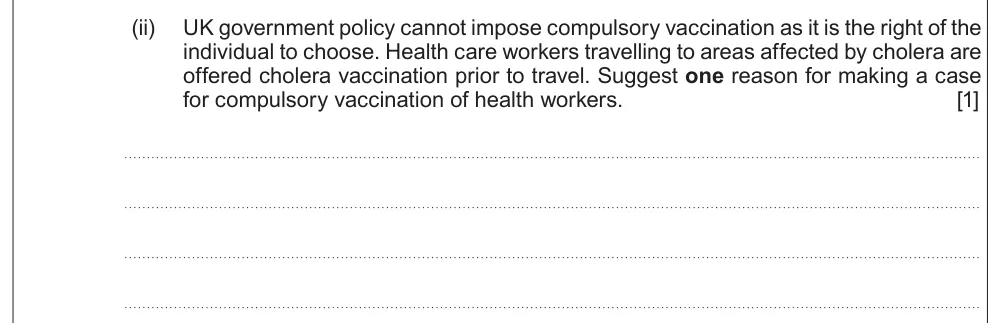
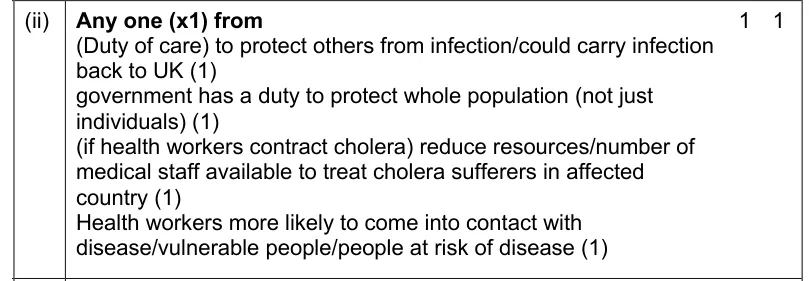
Suggest a reason for making cholera vaccination compulsory for health workers.
Show the mark scheme
Tap an image to open it full size.
Where students lose marks (from Eduqas examiners' reports and mark schemes)
Each point below is followed by wording that gained marks.
Mucus traps, cilia sweep: Many students called cilia microvilli, or said the cilia trapped the bacteria and the mucus moved them.
✔ Gains credit: "Mucus traps bacteria and cilia move it" (both for one mark; NOT microvilli).
Hidden antigens, not just hiding: Few students explained that the parasite's antigens are not detected while it is inside host cells.
✔ Gains credit: "Parasite antigens not on surface of host cells", so they avoid detection by lymphocytes.
Clonal, not colonial: Antigen, antibody and antibiotic were used interchangeably, and some wrote about colonial or colonic expansion.
✔ Gains credit: "B cell undergoes clonal expansion" and "differentiates into plasma cells" that secrete the specific antibody.
Cell-mediated means T cells: Too many answers about cell-mediated immunity meandered into humoral immunity.
✔ Gains credit: "Antigen presentation", "T cell activation", "clonal expansion", "release of cytokines".
Plasma cells, not plasma proteins: Some answers referred to plasma proteins instead of plasma cells.
✔ Gains credit: "B cells differentiate into plasma cells" which "produce antibodies specific to the toxin".
Name it: passive immunity: Many explained maternal antibodies but didn't call it passive immunity.
✔ Gains credit: "Passive immunity": "infants receive antibodies from their mother".
Too slow, and so fatal: Students said the immune response would be too slow but left out the consequence.
✔ Gains credit: "Production of the victim's own antibodies would be too slow to prevent symptoms becoming fatal".
Mutation must change the antigen: Statements about mutation with no reference to changing antigens weren't credited.
✔ Gains credit: "High antigenic variation" or "too many different types of antigen".
Download the questions
Download the PDF pack (19 questions, mark schemes at the end)
Keep practising
- Infectious Disease (Option A1): Eduqas A Level Biology exam questions by topic
- Antibiotics (Option A2): Eduqas A Level Biology exam questions by topic
- Eduqas A level Biology past papers, mark schemes and examiners' reports
- Eduqas A level Biology grade boundaries
- Ask about Eduqas A level Biology lessons with Sam on WhatsApp
Questions, mark schemes and examiners' report extracts © WJEC CBAC Ltd (Eduqas).