

Disease is the first topic of Option A, Immunology and Disease, which you meet in Section B of Component 3. You answer one option only, so this page is for students taking Option A. The topic asks you to define terms such as endemic, pandemic, antigen and vector, explain the human body as a host to other organisms, describe how diseases like cholera, malaria and TB spread and are controlled, and link the way viruses reproduce to why they cause disease.
The option questions are short, so most marks here are for exact definitions and for applying them to the organism in the stem. The examiners' reports say the same things every year: learn the definitions as they appear in the specification guidance, write about the virus when the question is about a virus, and make clear which organism "it" refers to in every sentence.
I don't teach the Eduqas specification myself, so for one-to-one help I recommend Sam. He teaches Eduqas A level Biology at a top-rated sixth form college and is very popular with his students. You can ask about lessons with Sam on WhatsApp using the link at the bottom of this page.
What you need from GCSE and Year 12
Each question on this page assumes you're secure on these ideas. If any of them feels shaky, look it up before you start.
- Pathogens include bacteria, viruses, fungi and protoctists.
- Communicable diseases spread by direct contact, by water, through the air and by vectors.
- The immune system recognises foreign antigens and produces antibodies.
- Viruses have no cytoplasm or ribosomes of their own.
Key terms
These words come up in the questions and mark schemes. Examiners expect you to use them exactly.
- Endemic: a disease always present at low levels in an area or population.
- Epidemic: a sudden rise in cases of a disease in one area.
- Pandemic: an epidemic that spreads worldwide, across international boundaries.
- Vector: an organism, such as a mosquito, that carries a pathogen from one host to another.
- Disease reservoir: a population, often without symptoms, in which a pathogen is kept going.
- Antigen: a molecule, usually a protein, that triggers an immune response and binds to antibodies.
- Toxin: a chemical made by a pathogen that harms its host.
What these questions cover (Eduqas OA1)
The questions test these statements from Option A (Immunology and Disease) of the Eduqas A level Biology specification (A400). Option questions are in Component 3, and you answer only one of the three options.
- (a) the meaning of the following terms
- (b) the human body acting as a host to other living organisms
- (c) the following diseases in terms of
- (d) the relationship between the pathogenicity of viruses and their mode of reproduction
How to use this page
Write your answer on paper before you open the mark scheme. Allow about 1.2 minutes per mark: the 14 questions are worth 26 marks, so about 31 minutes in total. Then mark your answer strictly against the mark scheme and read the examiners' tip underneath it. If you'd rather print the questions, download the PDF pack.
Key terms
Question 1
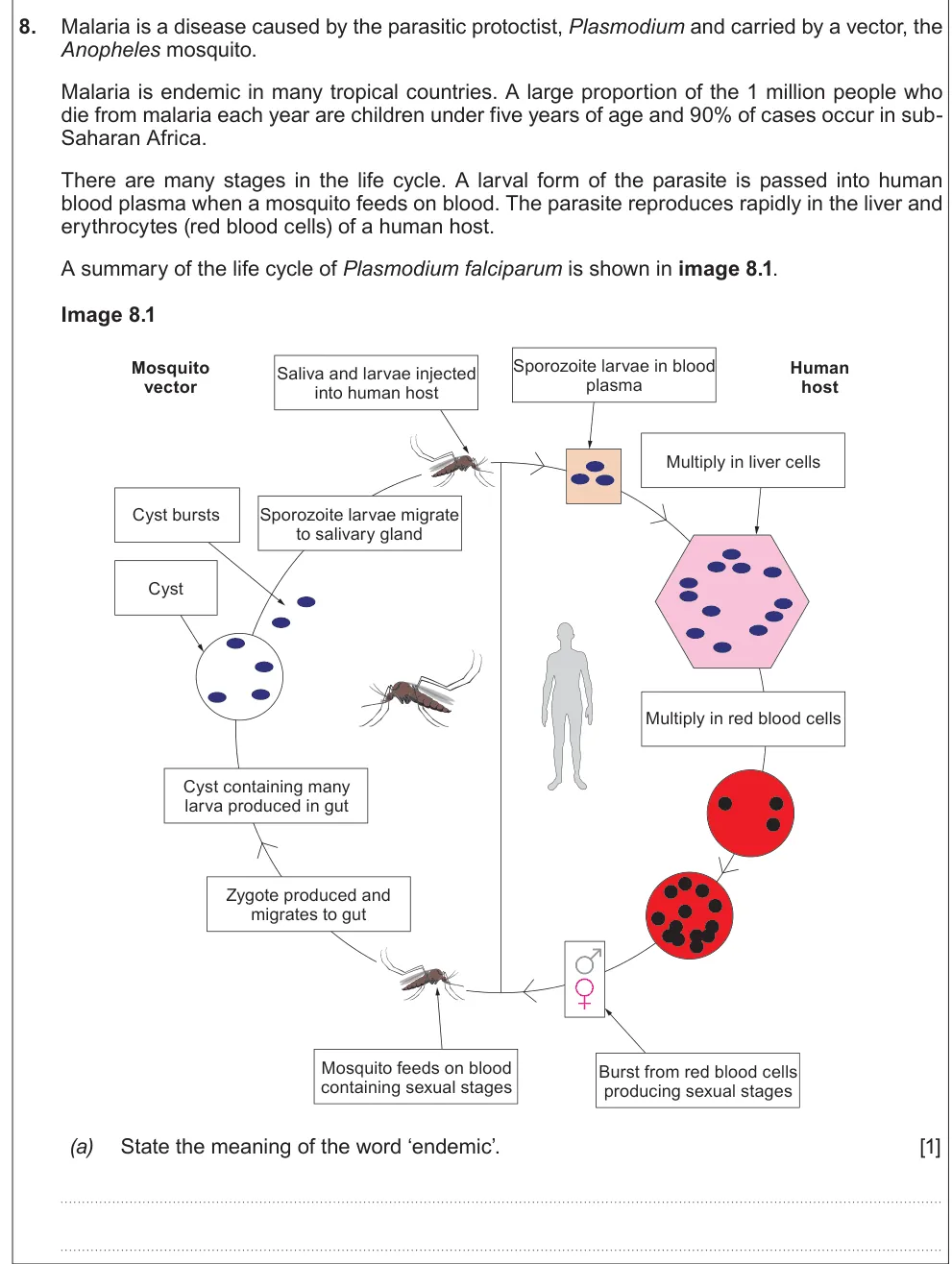
A level Component 3 · Autumn 2020 · Q8(a) · 1 mark
State the meaning of endemic.
Show the mark scheme

Tap an image to open it full size.
From the examiners' report: Learn the definition word for word: a disease always present at low levels in an area. Calling it simply a recurring disease didn't score.
Question 2
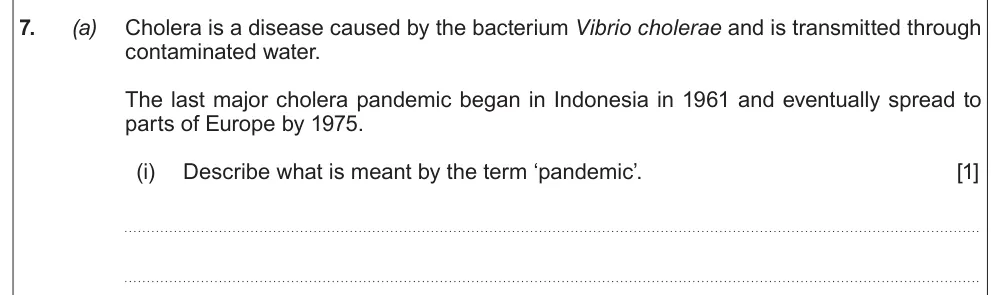
A level Component 3 · Autumn 2021 · Q7(a)(i) · 1 mark
Describe what is meant by a pandemic, using the spread of cholera.
Show the mark scheme

Tap an image to open it full size.
Question 3
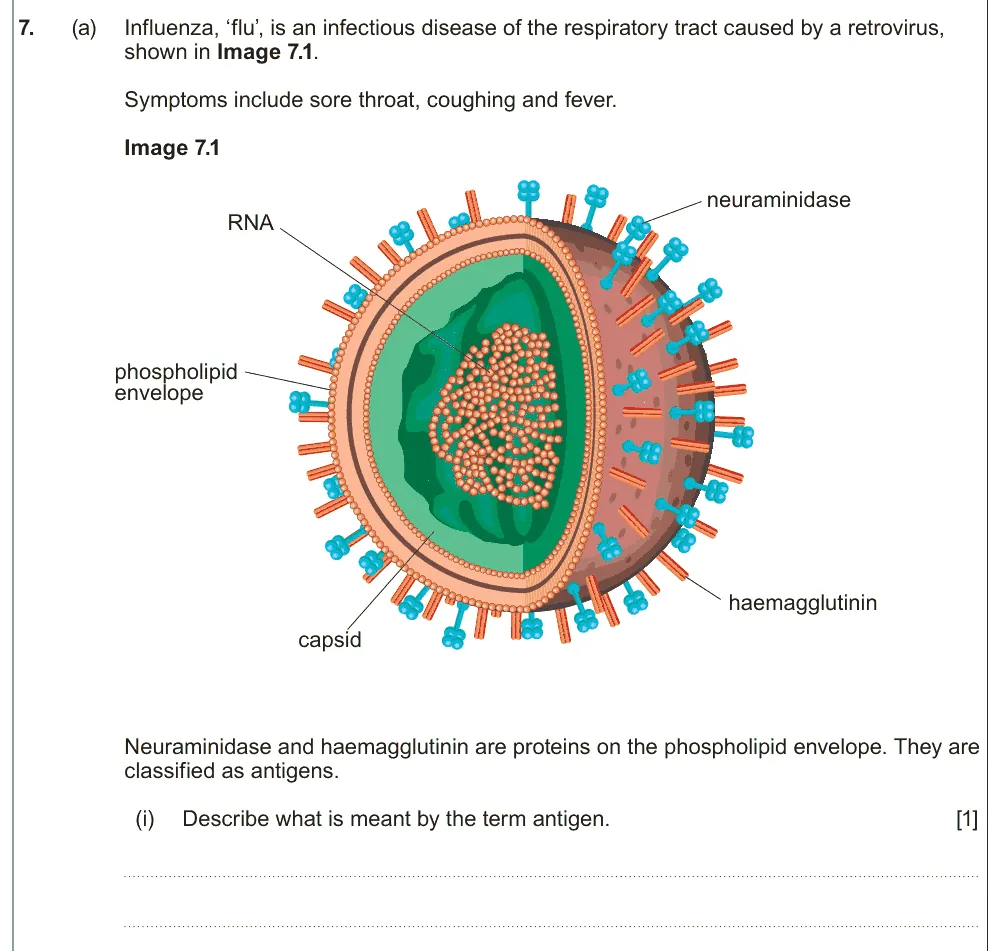
A level Component 3 · June 2022 · Q7(a)(i) · 1 mark
Describe what is meant by the term antigen, using flu virus proteins.
Show the mark scheme

Tap an image to open it full size.
From the examiners' report: A short, exact statement is enough: a molecule that causes an immune response or binds to antibodies. Long, roundabout descriptions often went wrong.
Question 4
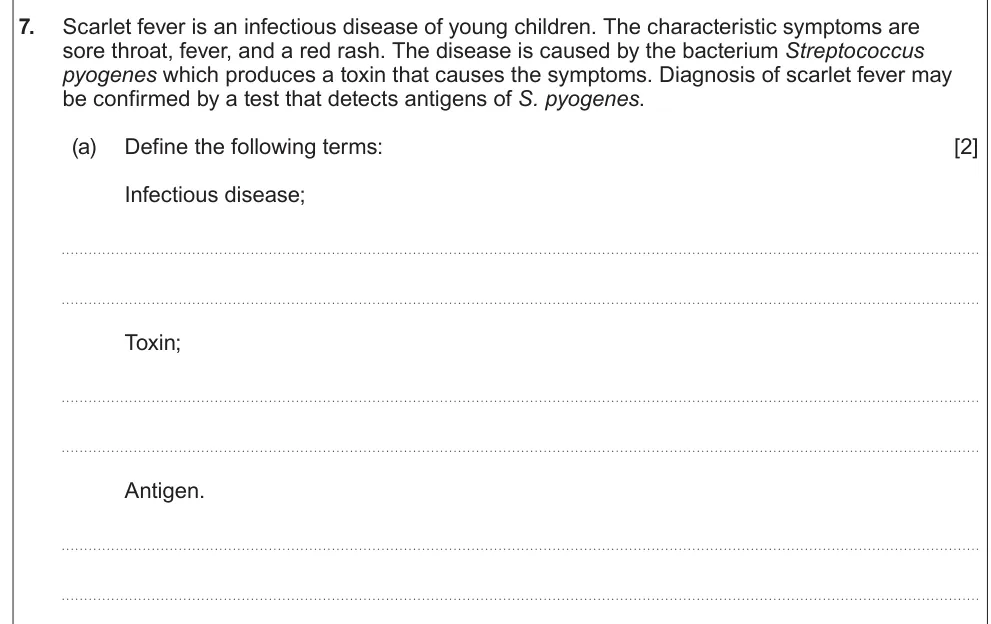
A level Component 3 · June 2025 · Q7(a) · 2 marks
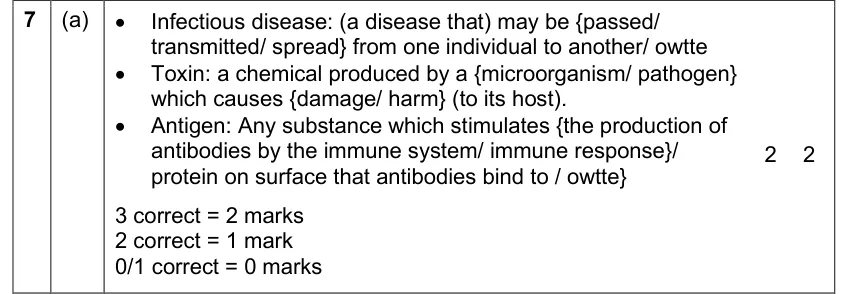
Define infectious disease, toxin and antigen for scarlet fever.
Show the mark scheme
Tap an image to open it full size.
From the examiners' report: Most students defined infectious disease, but far fewer gave correct definitions of toxin and antigen. These definitions are in the specification, so learn them exactly.
Question 5
A level Component 3 · June 2018 · Q8(e)(i) · 2 marks
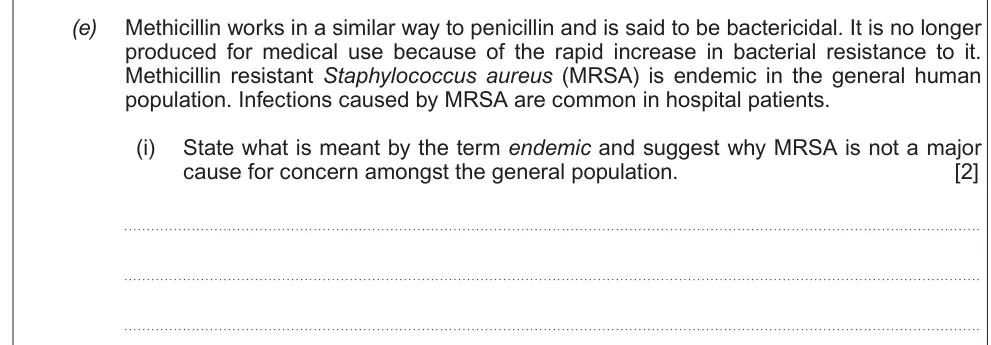
State what endemic means and suggest why MRSA is not a major worry for most people.
Show the mark scheme

Tap an image to open it full size.
From the examiners' report: Use the definition from the guidance notes, then link the risk to patients with open wounds or weak immune systems.
Hosts, transmission and prevention
Question 6
A level Component 3 · June 2024 · Q7(a)(i) · 1 mark · Easy
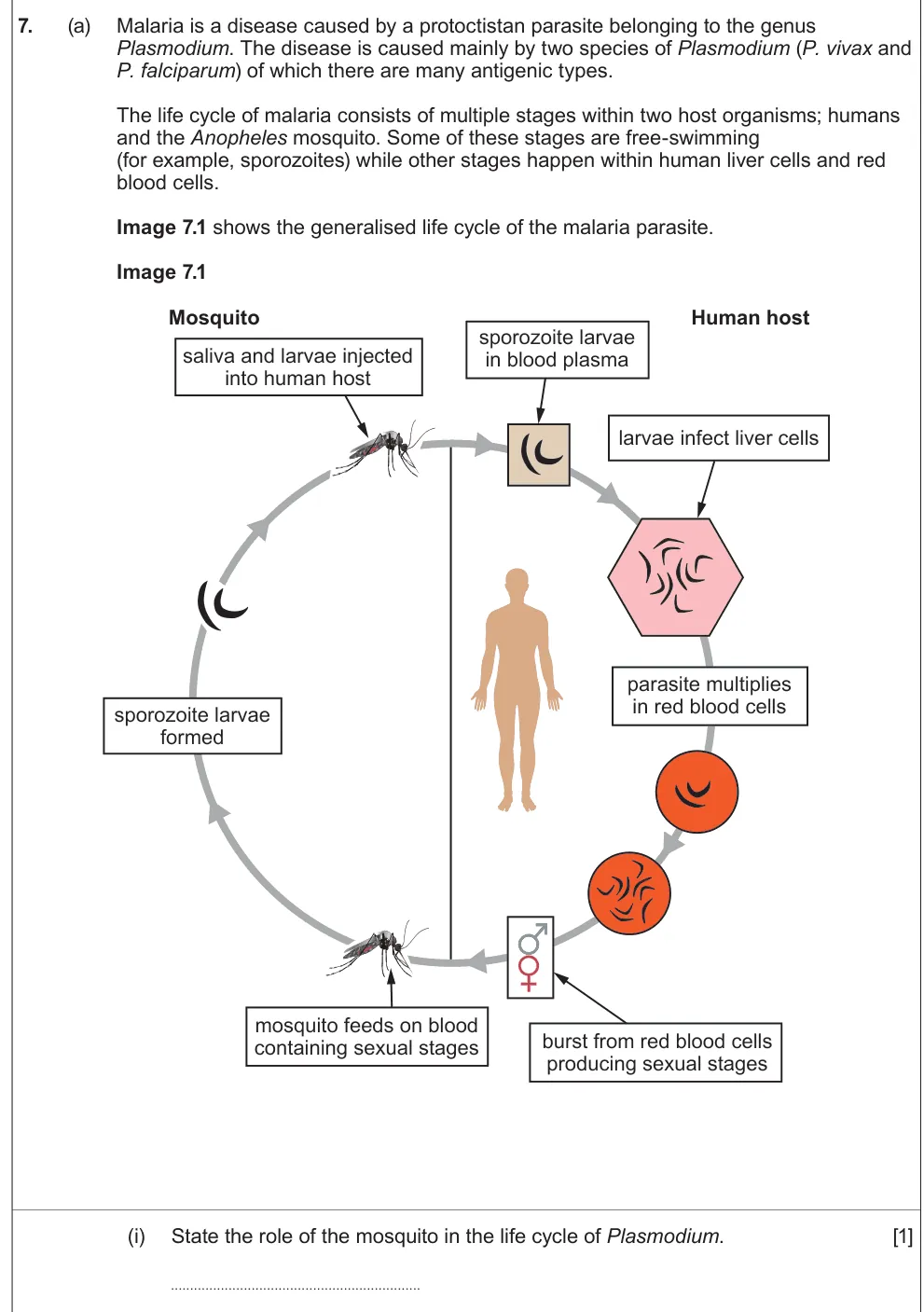
State the role of the mosquito in the life cycle of Plasmodium.
Show the mark scheme

Tap an image to open it full size.
From the examiners' report: Almost everyone knew the answer: the mosquito is a vector.
Question 7
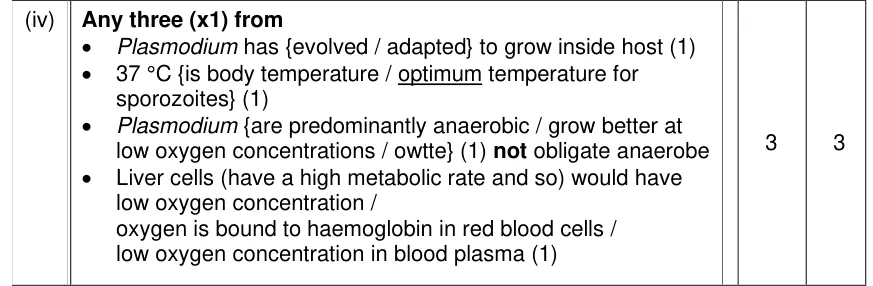
A level Component 3 · June 2024 · Q7(b)(iv) · 3 marks
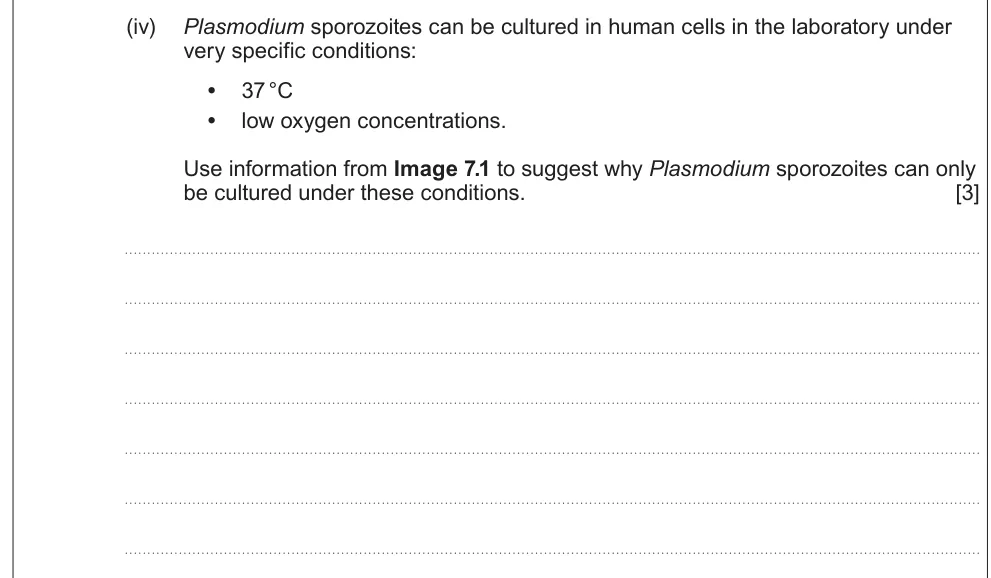
Suggest why Plasmodium sporozoites can only be grown at 37 °C and low oxygen.
Show the mark scheme
Tap an image to open it full size.
From the examiners' report: Use the life cycle in the stem: Plasmodium has adapted to live inside its human host, so it needs body temperature and low oxygen.
Question 8
A level Component 3 · June 2018 · Q8(a)(ii) · 2 marks
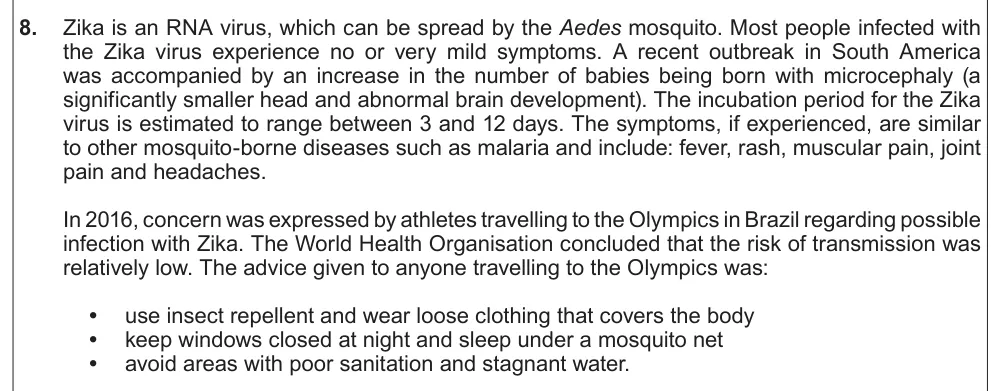
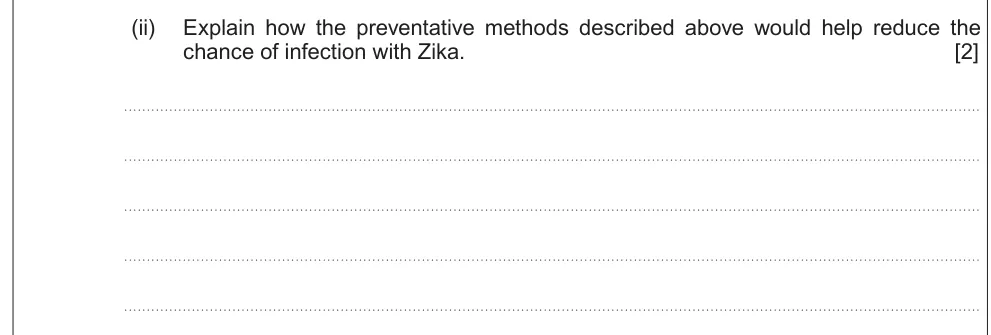
Explain how repellent, nets and avoiding stagnant water reduce the chance of Zika infection.
Information from earlier in this question:
Show the mark scheme

Tap an image to open it full size.
From the examiners' report: Apply it to Zika and its mosquito: the measures stop mosquitoes biting or keep you away from where they breed. Answers about malaria didn't score.
Question 9
A level Component 3 · Autumn 2021 · Q7(a)(ii) · 1 mark
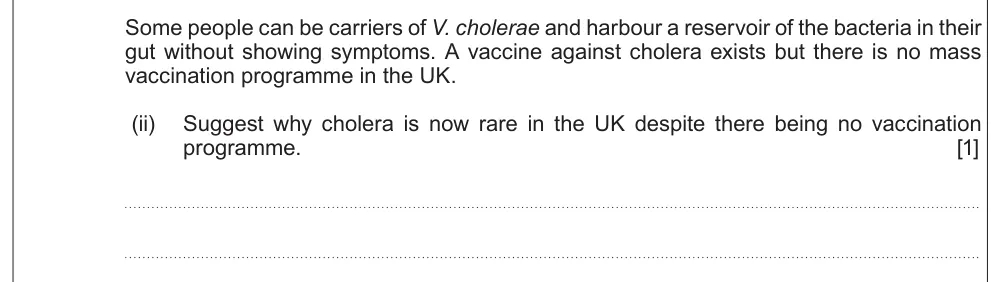
Suggest why cholera is rare in the UK without a vaccination programme.
Information from earlier in this question:

Show the mark scheme

Tap an image to open it full size.
Question 10
A level Component 3 · June 2022 · Q7(b)(iii) · 2 marks
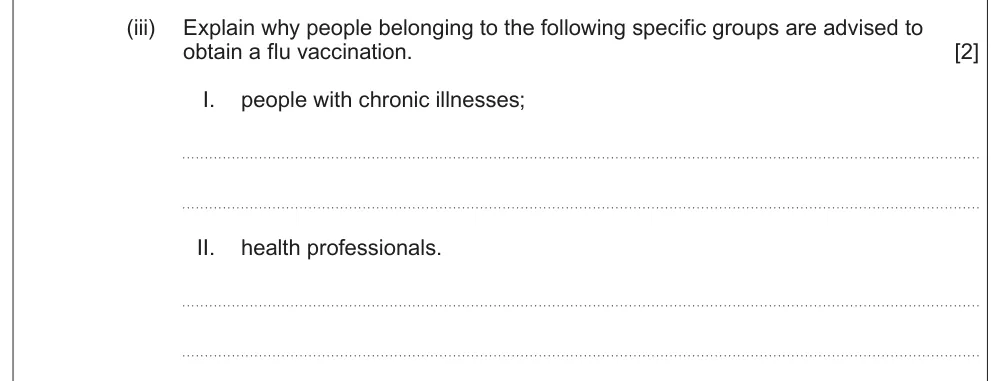
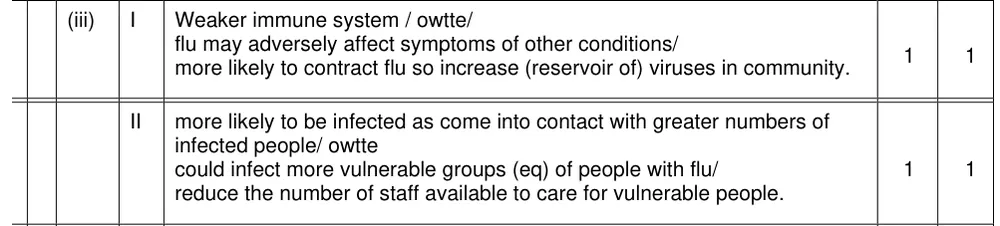
Explain why people with chronic illnesses and health professionals are advised to have a flu vaccine.
Show the mark scheme
Tap an image to open it full size.
From the examiners' report: Give a separate reason for each group: weaker immunity for the chronically ill, and contact with many infected people for health workers.
Viruses and disease
Question 11
A level Component 3 · June 2017 · Q7(d) · 2 marks · Easy
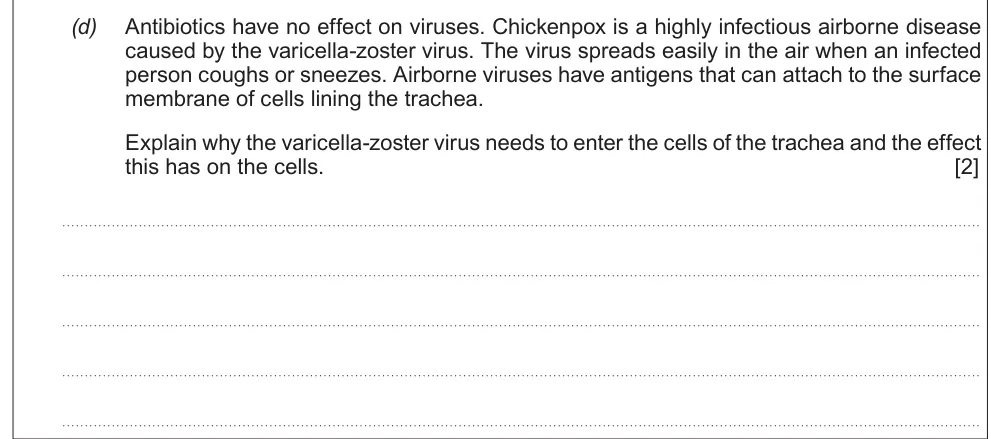
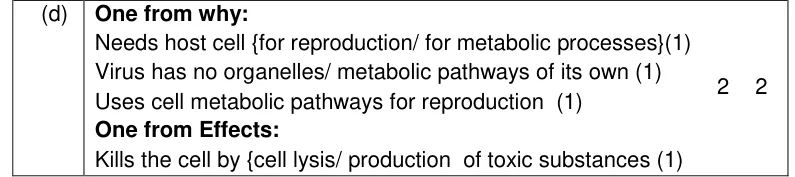
Explain why the varicella-zoster virus must enter cells of the trachea and the effect on those cells.
Show the mark scheme
Tap an image to open it full size.
From the examiners' report: Read the stem: this is a virus, yet many answers wrote about bacteria. A virus needs the host cell's metabolism to reproduce, and the cell is killed when new viruses burst out.
Question 12
A level Component 3 · June 2022 · Q7(a)(ii) · 2 marks
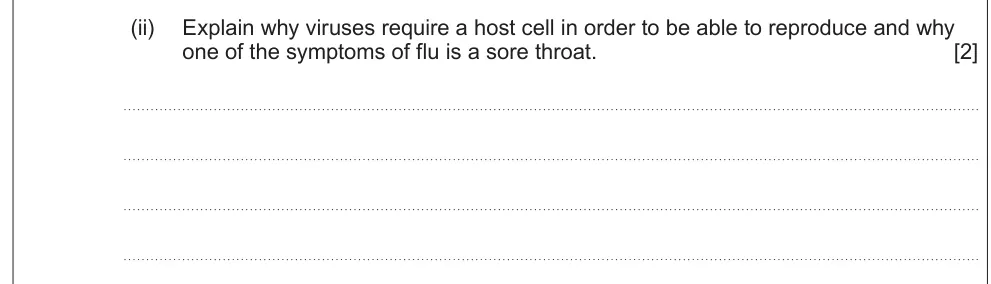
Explain why viruses need a host cell to reproduce and why flu causes a sore throat.
Show the mark scheme

Tap an image to open it full size.
From the examiners' report: Say what the virus lacks (ribosomes and enzymes for protein synthesis and copying nucleic acid), then link the sore throat to cells bursting and inflammation.
Question 13
A level Component 3 · June 2022 · Q7(a)(iii) · 3 marks
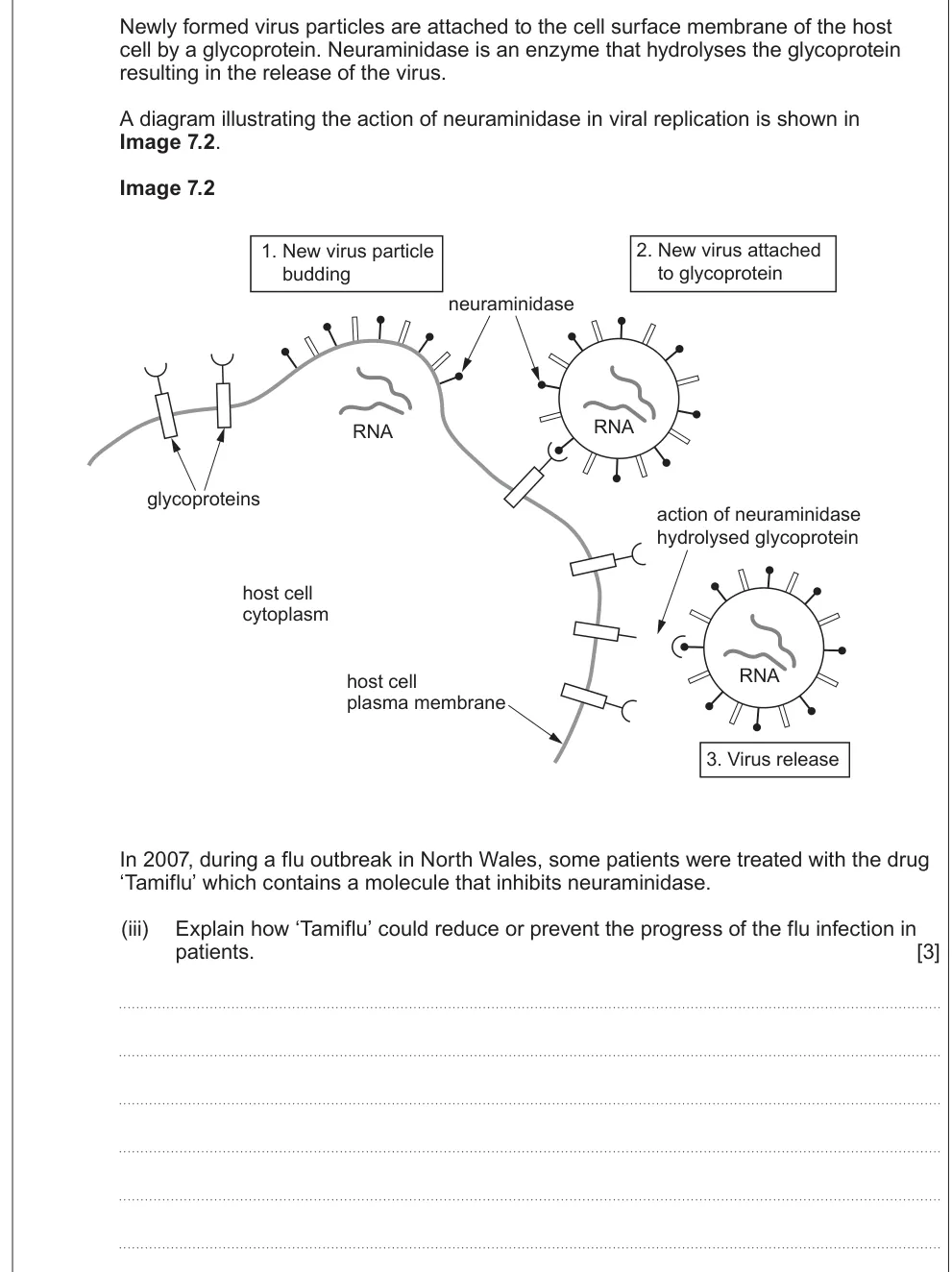
Explain how Tamiflu, a neuraminidase inhibitor, could slow a flu infection.
Show the mark scheme

Tap an image to open it full size.
From the examiners' report: Follow the chain: neuraminidase can't work, so new virus particles stay stuck to the host cell and can't infect other cells.
Question 14
A level Component 3 · June 2018 · Q8(b)(i) · 3 marks · Hard
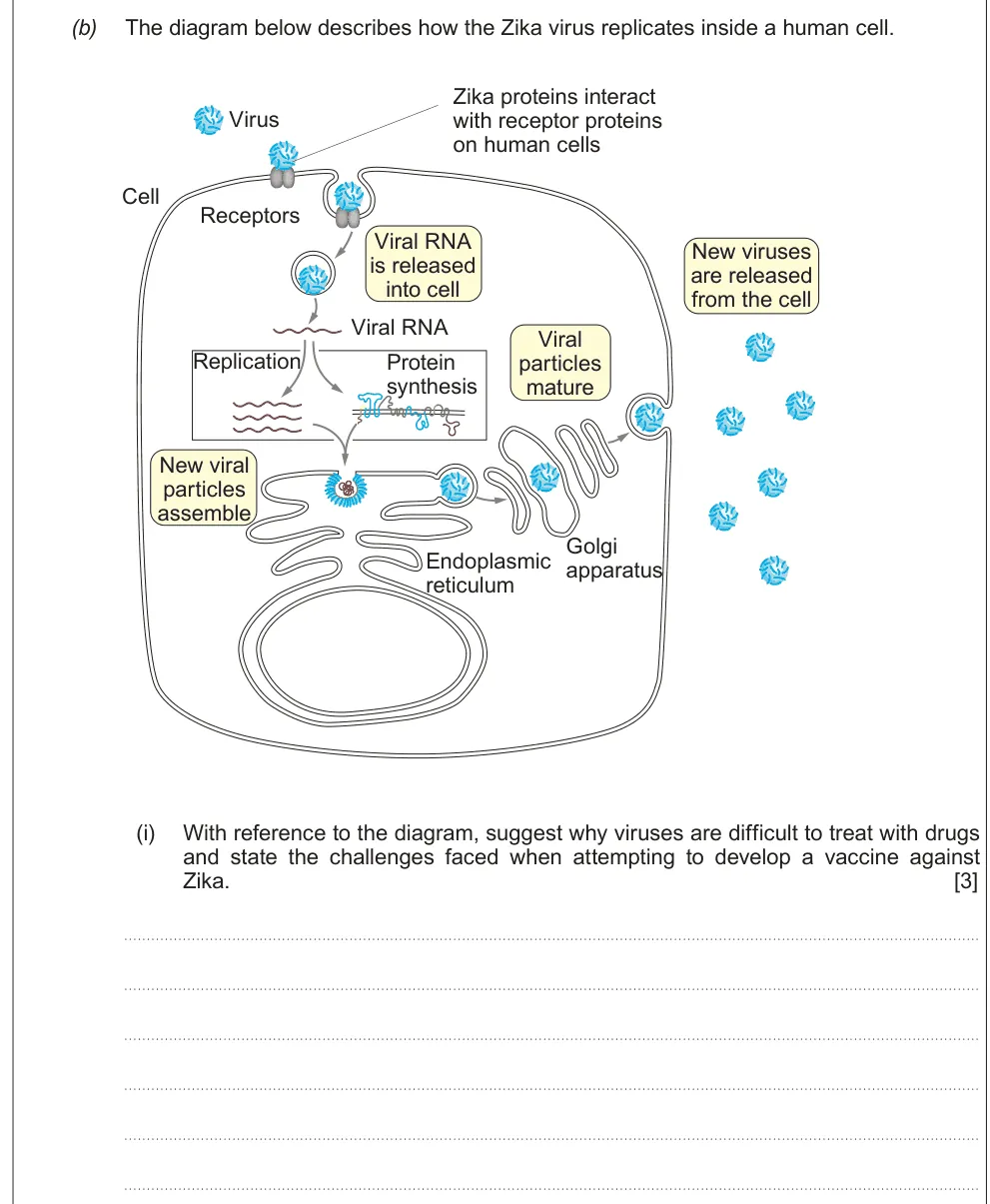
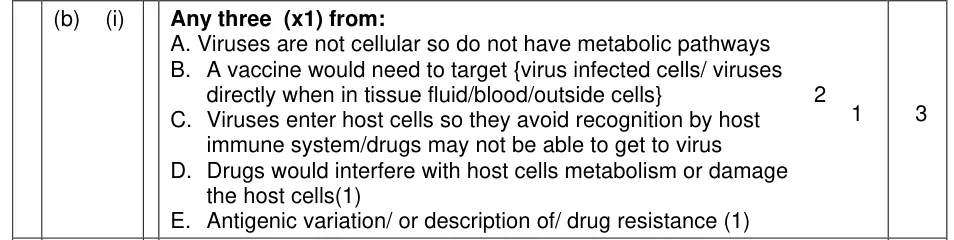
Use a diagram of Zika replication to explain why viruses are hard to treat with drugs or vaccines.
Show the mark scheme
Tap an image to open it full size.
From the examiners' report: Name the virus and the host cell instead of writing "it" and "they". Unclear answers were the main reason marks were lost.
Where students lose marks (from Eduqas examiners' reports and mark schemes)
Each point below is followed by wording that gained marks.
Endemic needs "at low levels": Answers that called endemic "a recurring disease" weren't enough.
✔ Gains credit: "A disease which is always present at low levels in an area".
Pandemic means worldwide: Key details were left out of definitions.
✔ Gains credit: "An epidemic occurring worldwide, crossing international boundaries".
Toxin and antigen are definitions too: Far fewer students could define toxin and antigen than infectious disease.
✔ Gains credit: "Toxin: a chemical produced by a pathogen which causes harm to its host".
The mosquito is a vector, not a carrier: A few students called the mosquito a carrier.
✔ Gains credit: "Vector" (the mark scheme says NOT carrier).
Bite and breed, not feed and hatch: Students didn't explain that the measures stop mosquitoes biting or keep people away from breeding sites, and wrote about malaria instead of Zika.
✔ Gains credit: "Prevent mosquitoes biting" and "avoiding areas where mosquitoes breed".
A virus question needs a virus answer: Many students wrote about bacteria even though the question was about a virus.
✔ Gains credit: "Needs a host cell for reproduction" because "the virus has no organelles or metabolic pathways of its own".
Say who "it" is: Heavy use of "it" and "they" made it impossible to tell the virus from the host.
✔ Gains credit: "Viruses enter host cells so they avoid recognition by the host's immune system".
Download the questions
Download the PDF pack (14 questions, mark schemes at the end)
Keep practising
- Antibiotics (Option A2): Eduqas A Level Biology exam questions by topic
- Immune Response (Option A3): Eduqas A Level Biology exam questions by topic
- Eduqas A level Biology past papers, mark schemes and examiners' reports
- Eduqas A level Biology grade boundaries
- Ask about Eduqas A level Biology lessons with Sam on WhatsApp
Questions, mark schemes and examiners' report extracts © WJEC CBAC Ltd (Eduqas).