

Antibiotics is the second topic of Option A, Immunology and Disease, in Section B of Component 3, and you only answer it if you take Option A. It covers bactericidal and bacteriostatic antibiotics, broad- and narrow-spectrum drugs, how penicillin and tetracycline work, why the outer layer of a Gram negative cell wall protects it from penicillin, and how overuse of antibiotics spreads resistance.
Nearly every question here comes back to two mechanisms. Penicillin stops the cross-links forming between peptidoglycan molecules, so the wall is weak and water entering by osmosis bursts the cell. Tetracycline binds to the bacterial ribosome and stops translation. The examiners keep seeing penicillin described as "breaking" bonds, mixed up with the drugs that act on ribosomes, and accounts of resistance that never say how the resistant bacteria become more common.
I don't teach the Eduqas specification myself, so for one-to-one help I recommend Sam. He teaches Eduqas A level Biology at a top-rated sixth form college and is very popular with his students. You can ask about lessons with Sam on WhatsApp using the link at the bottom of this page.
What you need from GCSE and Year 12
Each question on this page assumes you're secure on these ideas. If any of them feels shaky, look it up before you start.
- Bacteria are prokaryotes with a cell wall made of peptidoglycan and 70S ribosomes.
- Water moves into a cell with a lower water potential by osmosis.
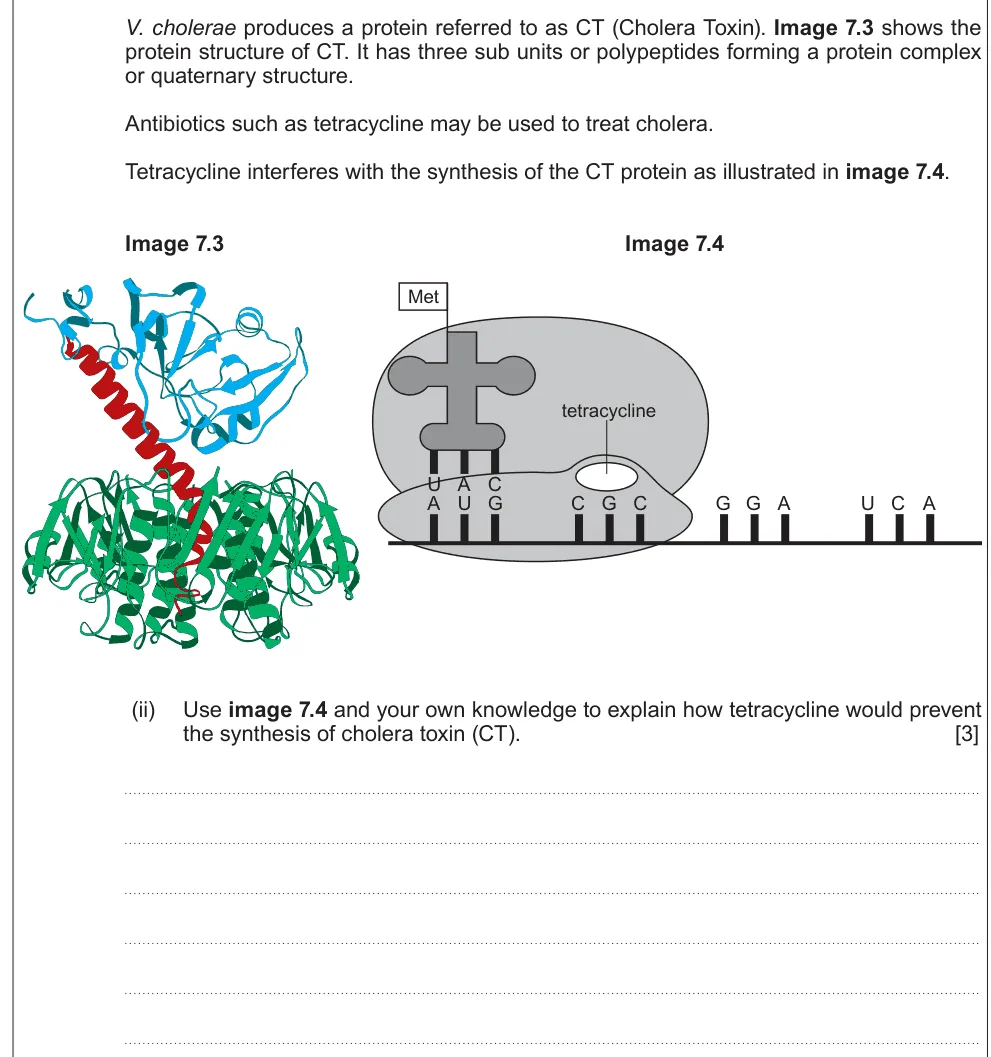
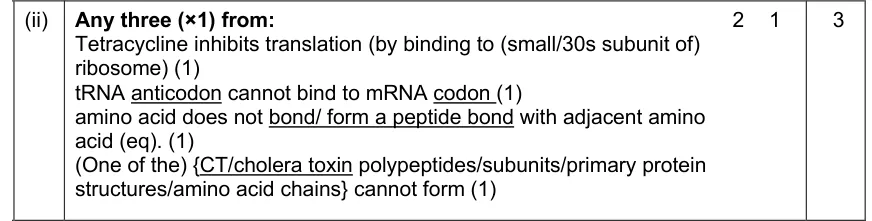
- Translation happens at ribosomes, where tRNA anticodons pair with mRNA codons.
- Mutations produce new alleles, and natural selection changes allele frequencies.
Key terms
These words come up in the questions and mark schemes. Examiners expect you to use them exactly.
- Bactericidal: an antibiotic that kills bacteria.
- Bacteriostatic: an antibiotic that stops bacteria growing and dividing without killing them.
- Broad-spectrum: acting on many types of bacteria, both Gram positive and Gram negative.
- Peptidoglycan: the polymer of the bacterial cell wall, strengthened by cross-links.
- Gram negative: bacteria with a thin peptidoglycan wall covered by an outer layer of lipopolysaccharide.
- Antibiotic resistance: an allele that lets a bacterium survive an antibiotic, passed on to its offspring or to other bacteria on plasmids.
What these questions cover (Eduqas OA2)
The questions test these statements from Option A (Immunology and Disease) of the Eduqas A level Biology specification (A400). Option questions are in Component 3, and you answer only one of the three options.
- (a) the control of bacterial infections by antibiotics which can be bacteriostatic or bactericidal in their mode of action and that antibiotics can be broad or narrow spectru
- (b) the modes of action of penicillin and tetracycline and how the structure of the bacterial cell wall in Gram negative bacteria affords protection against many antibiotics
- (c) how the overuse of antibiotics has resulted in the spread of antibiotic resistance amongst pathogenic bacteria
How to use this page
Write your answer on paper before you open the mark scheme. Allow about 1.2 minutes per mark: the 15 questions are worth 31 marks, so about 37 minutes in total. Then mark your answer strictly against the mark scheme and read the examiners' tip underneath it. If you'd rather print the questions, download the PDF pack.
How antibiotics act
Question 1
A level Component 3 · June 2017 · Q7(c)(iii) · 2 marks
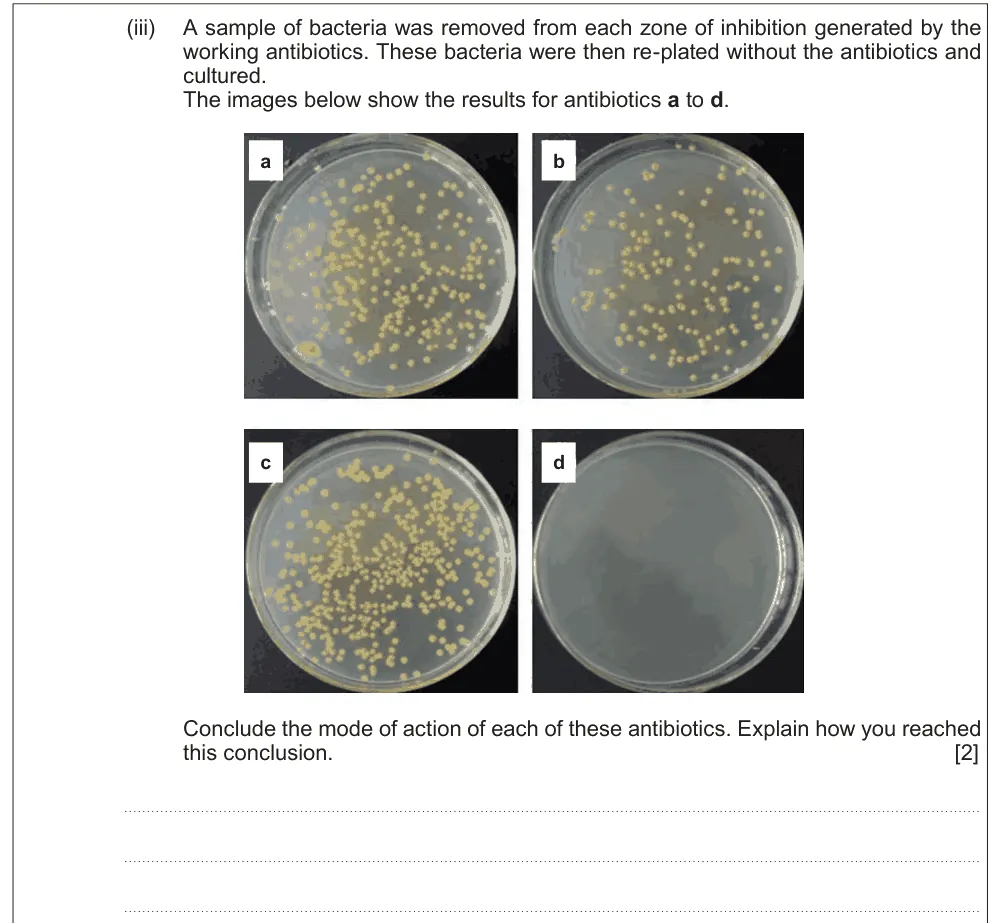
Use re-plating results to conclude whether four antibiotics are bacteriostatic or bactericidal.
Show the mark scheme

Tap an image to open it full size.
Question 2
A level Component 3 · Autumn 2021 · Q7(c)(iii) · 1 mark
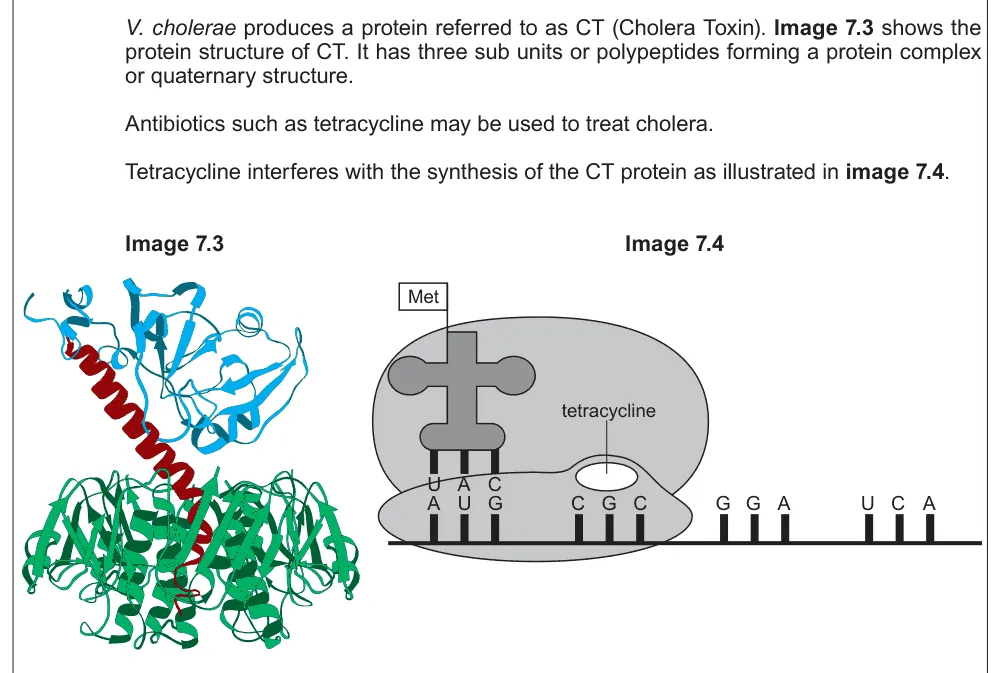
Name the mode of action of an antibiotic that doesn't kill the bacterium.
Information from earlier in this question:

Show the mark scheme

Tap an image to open it full size.
Question 3
A level Component 3 · June 2022 · Q7(c)(ii) · 2 marks
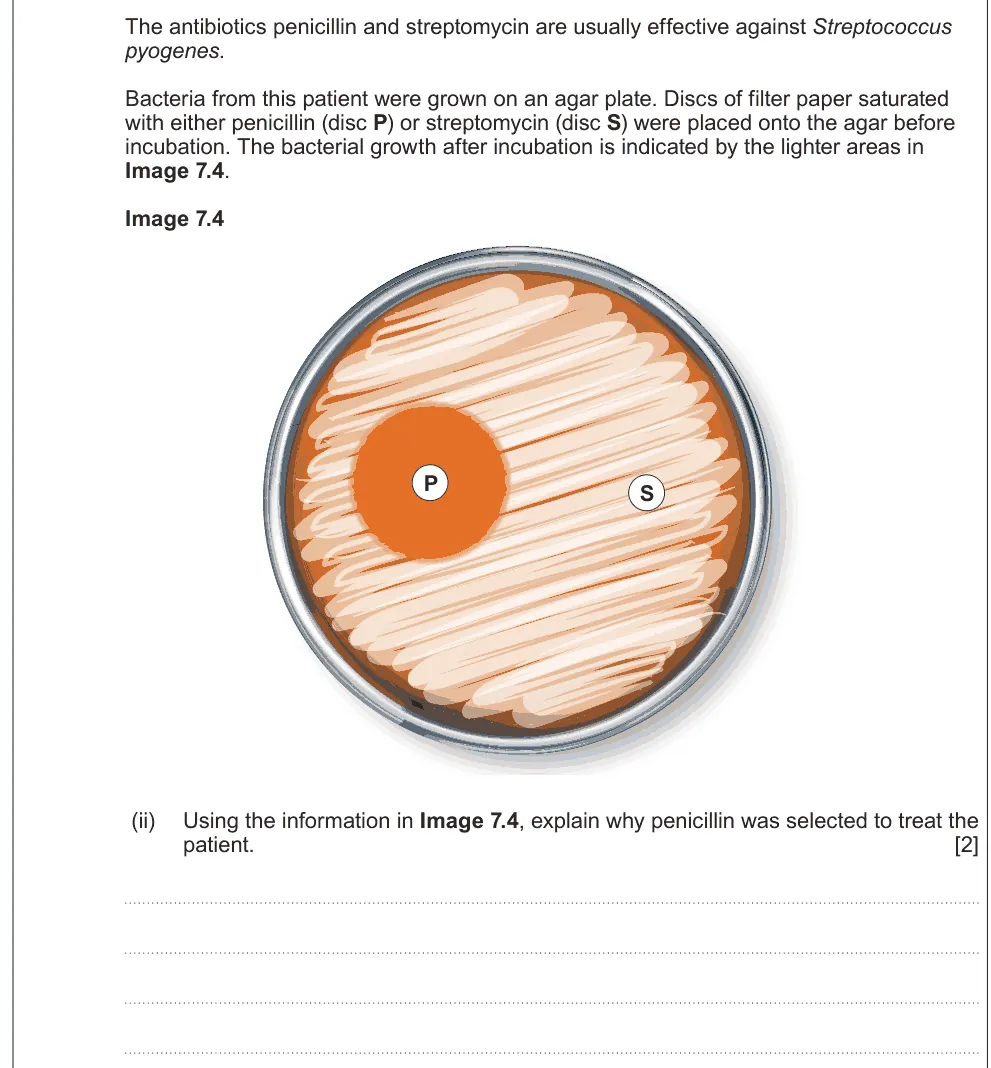
Use an antibiotic disc plate to explain why penicillin was chosen to treat a patient.
Show the mark scheme

Tap an image to open it full size.
From the examiners' report: Point to the clear zone around disc P, then say the bacteria are not resistant to penicillin.
Penicillin and the cell wall
Question 4
A level Component 3 · Autumn 2020 · Q8(d)(i) · 2 marks
Explain how inhibiting a cell wall enzyme makes bacterial cells die.
Show the mark scheme

Tap an image to open it full size.
From the examiners' report: Make the direction of water movement clear: water enters the cell by osmosis and the weakened wall bursts. Avoid "exploding" cells.
Question 5
A level Component 3 · Autumn 2020 · Q8(d)(ii) · 2 marks
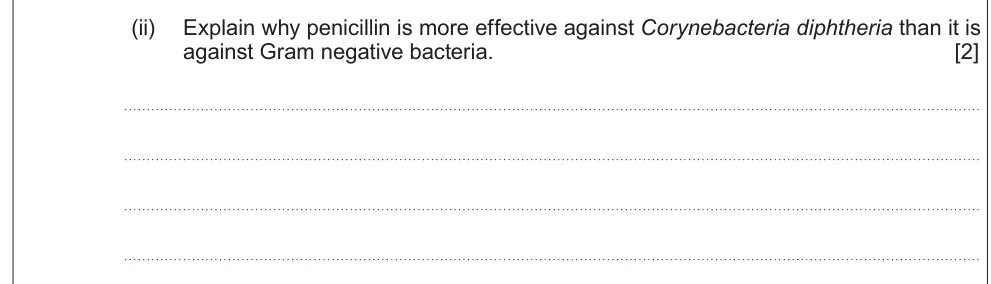
Explain why penicillin works better against Corynebacterium than against Gram negative bacteria.
Show the mark scheme

Tap an image to open it full size.
From the examiners' report: Describe the extra lipopolysaccharide layer of the Gram negative wall and say that it protects the peptidoglycan from penicillin.
Question 6
A level Component 3 · June 2017 · Q7(b) · 3 marks · Easy
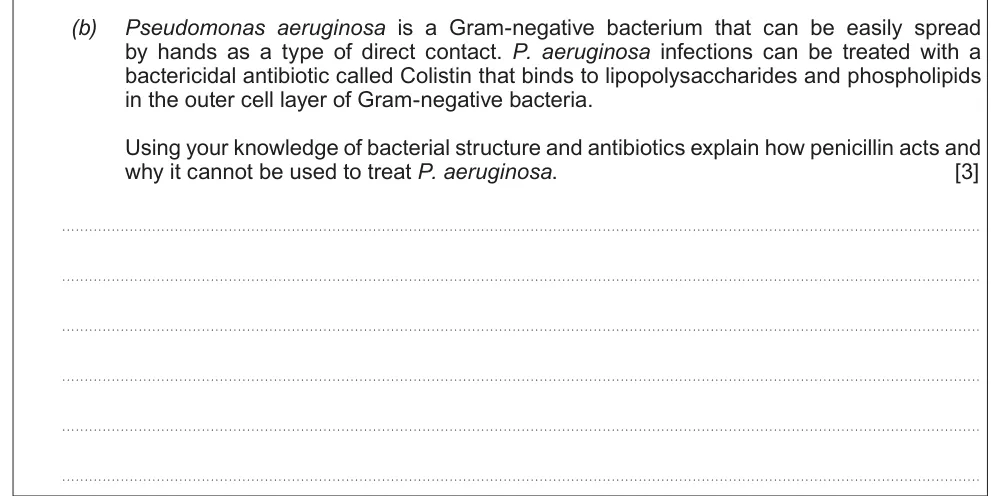
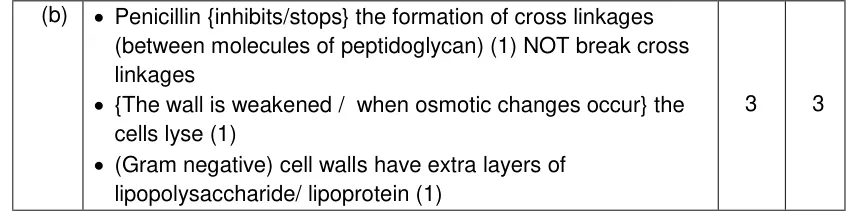
Explain how penicillin acts and why it can't treat Pseudomonas aeruginosa.
Show the mark scheme
Tap an image to open it full size.
From the examiners' report: Penicillin stops the cross-links forming between peptidoglycan molecules. It doesn't break bonds that are already there.
Question 7
A level Component 3 · June 2023 · Q7(b)(i) · 2 marks
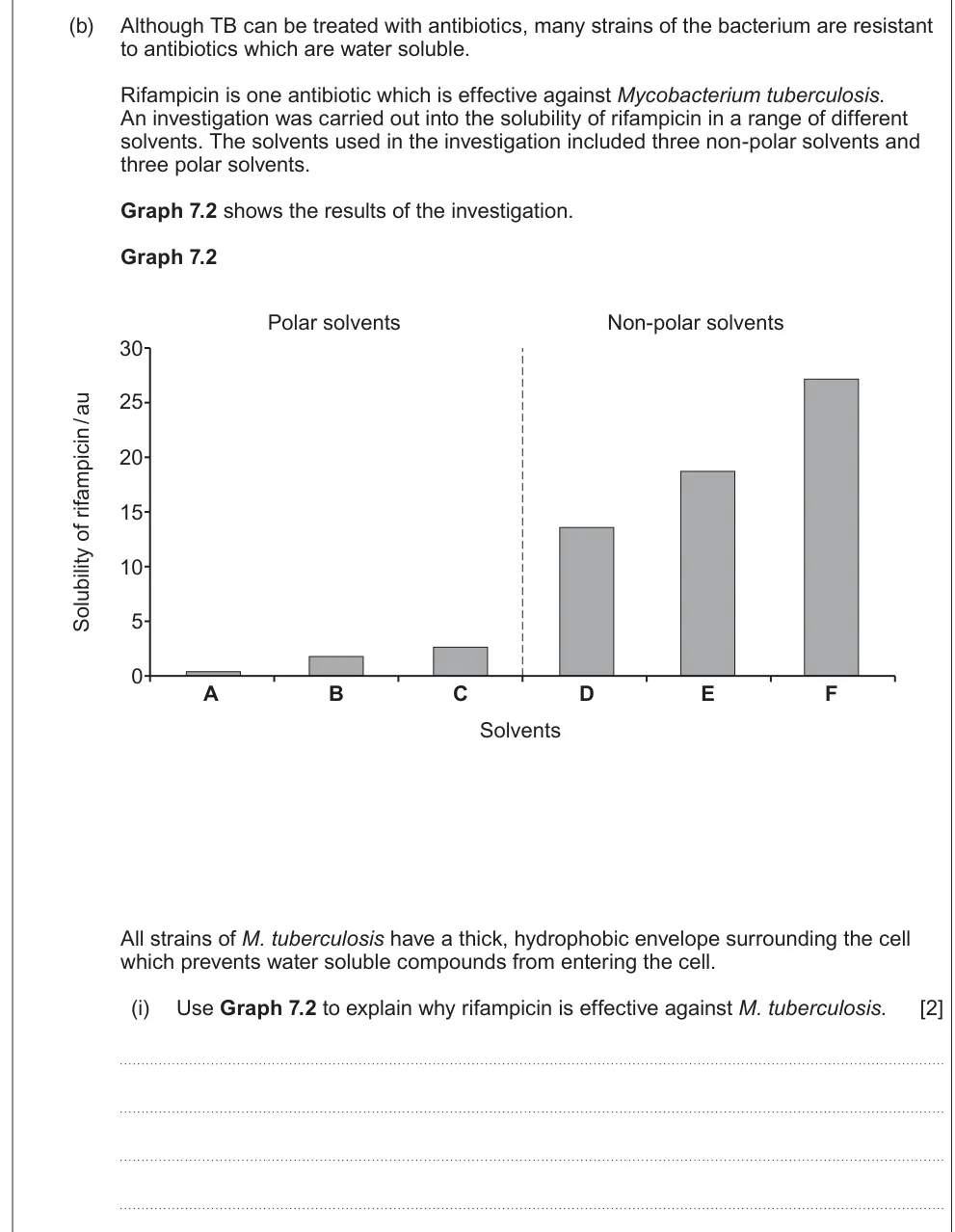
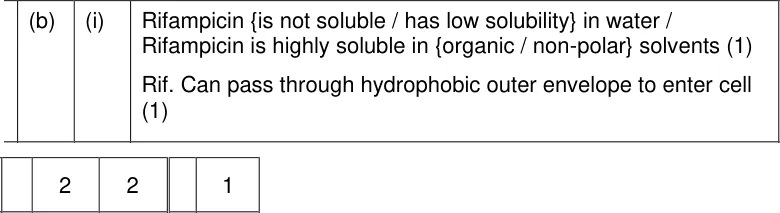
Use solubility data to explain why rifampicin works against Mycobacterium tuberculosis.
Show the mark scheme
Tap an image to open it full size.
From the examiners' report: Link the graph to the stem: rifampicin dissolves in non-polar solvents, so it can pass through the hydrophobic envelope.
Question 8
A level Component 3 · June 2024 · Q7(c)(ii) · 1 mark
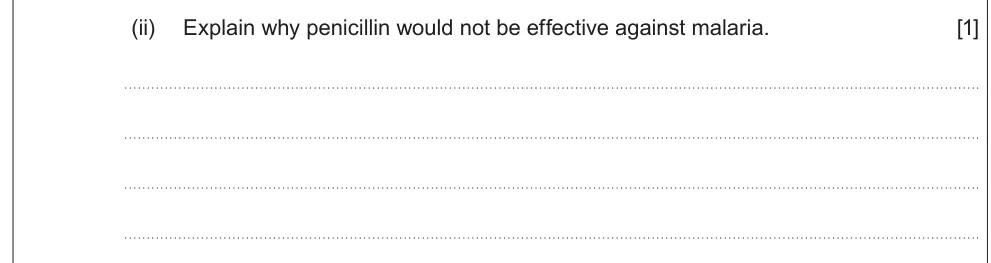
Explain why penicillin would not work against malaria.
Show the mark scheme

Tap an image to open it full size.
From the examiners' report: Say it plainly: Plasmodium is a eukaryotic protoctist with no peptidoglycan cell wall for penicillin to act on.
Tetracycline and the ribosome
Question 9
A level Component 3 · Autumn 2021 · Q7(c)(ii) · 3 marks
Use a diagram to explain how tetracycline prevents synthesis of cholera toxin.
Show the mark scheme
Tap an image to open it full size.
Question 10
A level Component 3 · June 2018 · Q8(e)(ii) · 2 marks
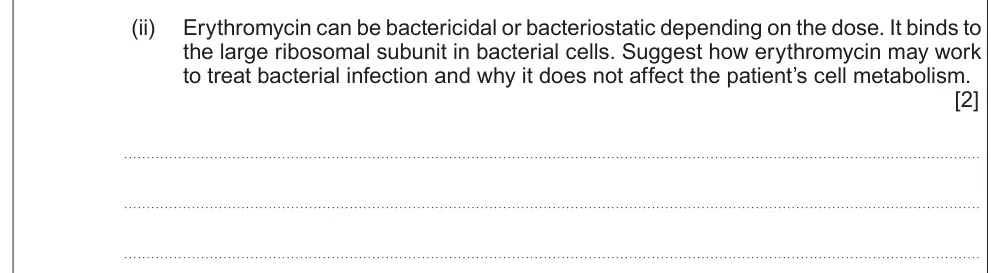
Suggest how erythromycin works and why it doesn't affect the patient's own cells.
Show the mark scheme

Tap an image to open it full size.
From the examiners' report: Erythromycin acts on ribosomes, not the cell wall, so don't mix it up with penicillin. Human ribosomes are different from bacterial ones.
Question 11
A level Component 3 · June 2025 · Q7(c)(i) · 1 mark · Easy
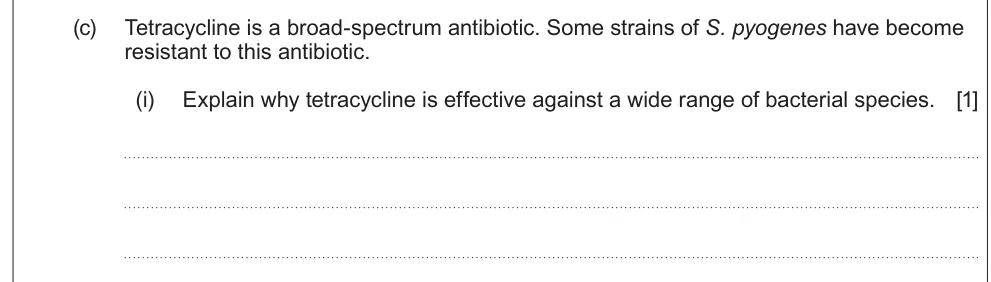
Explain why tetracycline works against many species of bacteria.
Show the mark scheme

Tap an image to open it full size.
From the examiners' report: Every bacterium needs to make proteins, and tetracycline blocks translation at the ribosome.
Question 12
A level Component 3 · June 2025 · Q7(c)(ii) · 3 marks · Easy
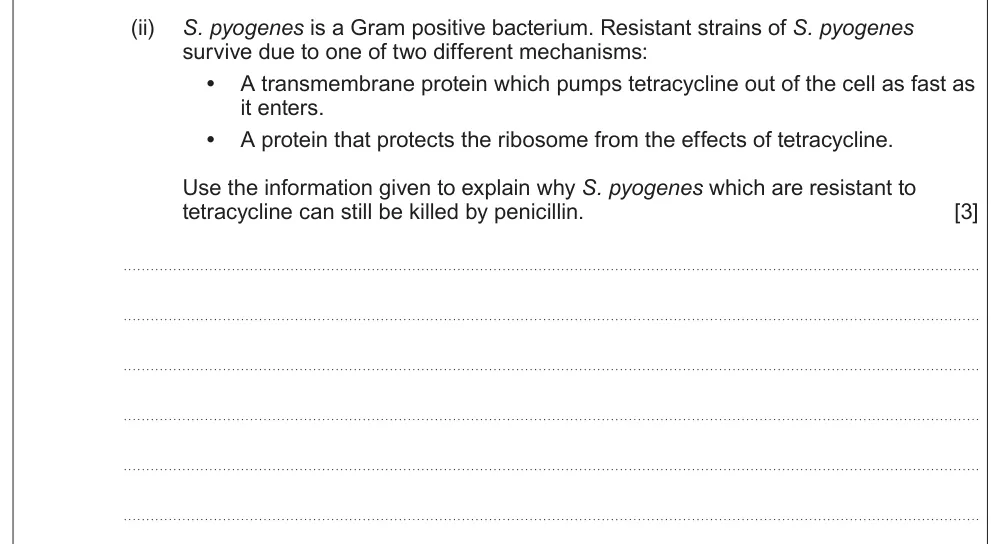
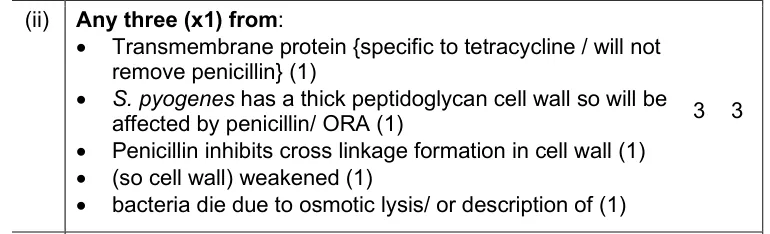
Explain why tetracycline-resistant S. pyogenes can still be killed by penicillin.
Show the mark scheme
Tap an image to open it full size.
From the examiners' report: Compare the two drugs' targets: the resistance proteins only deal with tetracycline, while penicillin still stops cross-links forming in the thick peptidoglycan wall.
Antibiotic resistance
Question 13
A level Component 3 · June 2022 · Q7(c)(iii) · 2 marks
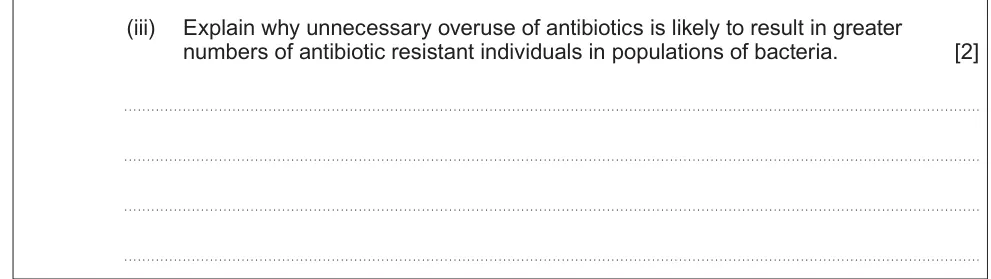
Explain why overusing antibiotics leads to more resistant bacteria.
Show the mark scheme

Tap an image to open it full size.
From the examiners' report: Don't stop at "resistance develops". Explain how resistant bacteria become more common: mutation or plasmids, a selective advantage, then reproduction.
Question 14
A level Component 3 · June 2025 · Q7(c)(iii) · 3 marks
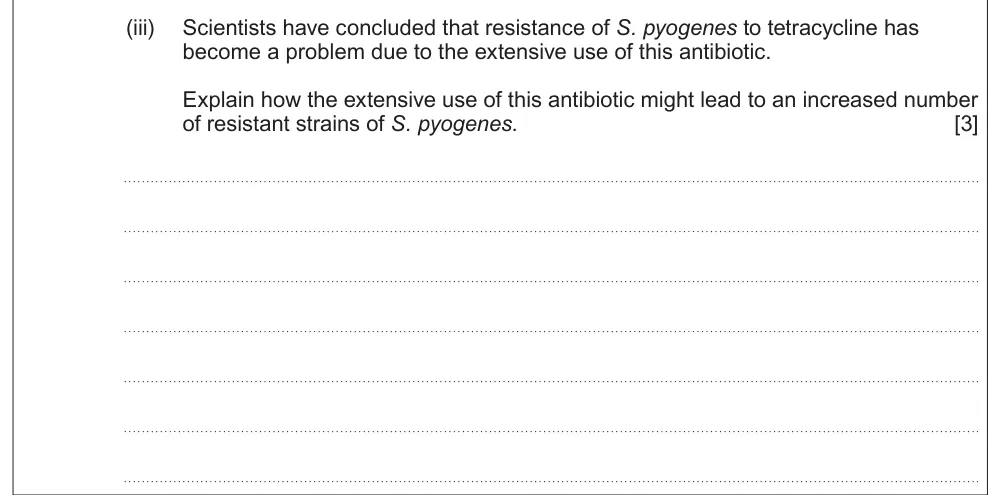
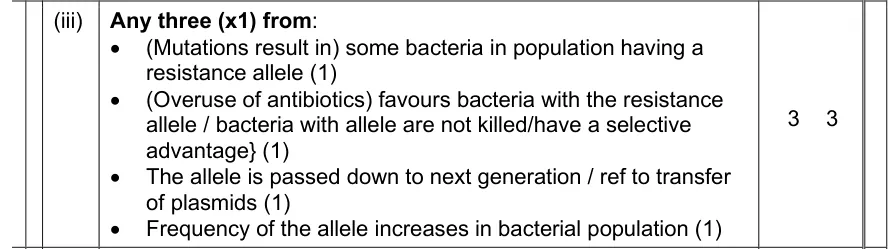
Explain how heavy use of tetracycline could increase the number of resistant strains of S. pyogenes.
Show the mark scheme
Tap an image to open it full size.
From the examiners' report: Build the full natural selection sequence: a resistance allele from mutation, survival when the antibiotic is used, and the allele passed on.
Question 15
A level Component 3 · June 2019 · Q8(d)(iv) · 2 marks
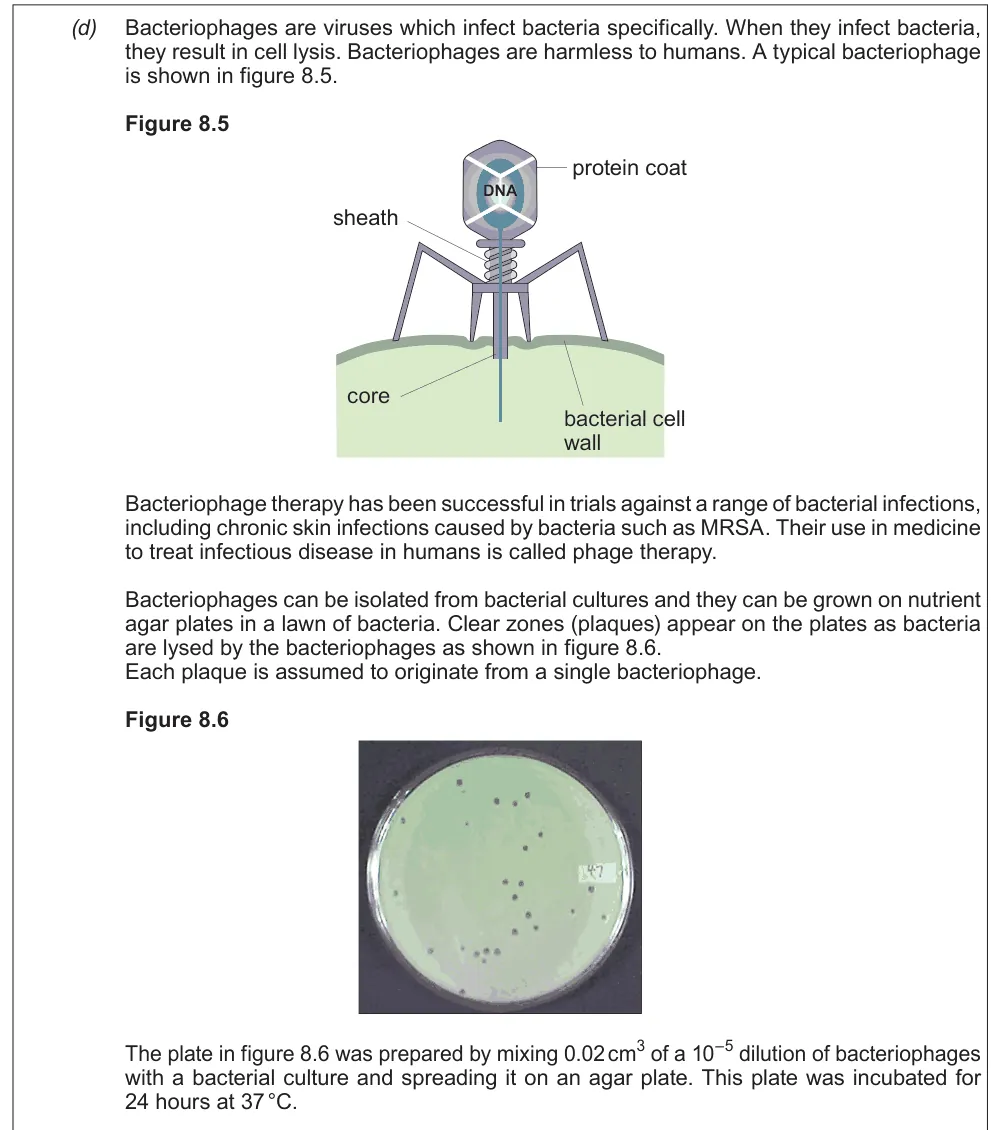
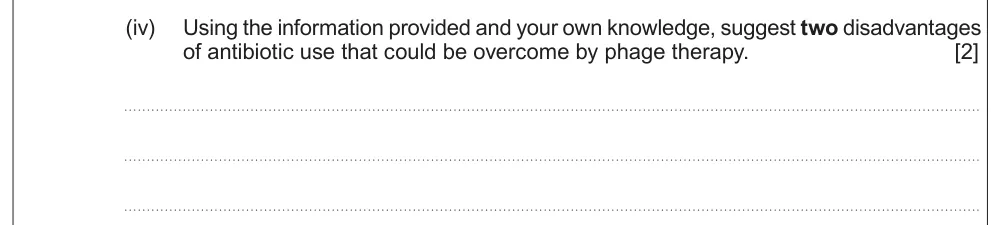
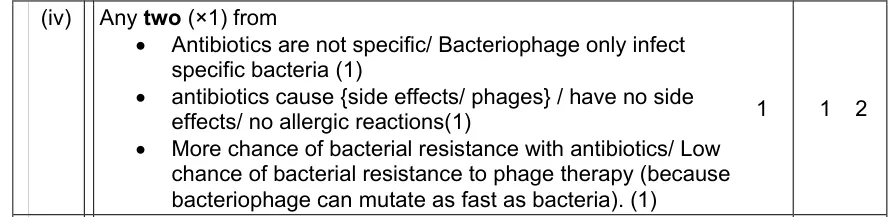
Suggest two disadvantages of antibiotics that phage therapy could overcome.
Information from earlier in this question:
Show the mark scheme
Tap an image to open it full size.
From the examiners' report: Most could suggest uses of phage therapy. Compare it directly with antibiotics: phages are specific to one type of bacterium and have fewer side effects.
Where students lose marks (from Eduqas examiners' reports and mark schemes)
Each point below is followed by wording that gained marks.
Penicillin stops cross-links forming: Students wrote that penicillin breaks the cross-links between peptidoglycan molecules.
✔ Gains credit: "Penicillin inhibits the formation of cross linkages" (NOT break cross linkages).
Show which way the water moves: The water-uptake mark was often lost because the direction of water flow wasn't clear, and some wrote about cells exploding.
✔ Gains credit: "Water uptake by osmosis causes cells to burst".
The outer layer protects the peptidoglycan: Answers described Gram negative walls without linking the structure to protection.
✔ Gains credit: "Lipopolysaccharide layer of Gram negative bacteria protects the peptidoglycan from the antibiotic".
Erythromycin isn't penicillin: Many students confused erythromycin's action with penicillin's and gave vague reasons for human cells being unaffected.
✔ Gains credit: "Inhibits translation" and "humans have different ribosomes to bacteria".
Explain how resistant bacteria become more common: Most students knew resistance matters, but many couldn't explain how resistant numbers rise in a population.
✔ Gains credit: "Resistant bacteria have a selective advantage", survive and pass on the resistance allele.
No cell wall, no target: Some answers about malaria were let down by unclear wording or wrongly called the parasite Gram negative.
✔ Gains credit: "Plasmodium does not have a cell wall" (reject Gram negative).
Download the questions
Download the PDF pack (15 questions, mark schemes at the end)
Keep practising
- Infectious Disease (Option A1): Eduqas A Level Biology exam questions by topic
- Immune Response (Option A3): Eduqas A Level Biology exam questions by topic
- Eduqas A level Biology past papers, mark schemes and examiners' reports
- Eduqas A level Biology grade boundaries
- Ask about Eduqas A level Biology lessons with Sam on WhatsApp
Questions, mark schemes and examiners' report extracts © WJEC CBAC Ltd (Eduqas).