

From Organoids to Gastruloids explains how scientists are finding alternatives to mice for studying how embryos develop. It describes embryonic stem cells that can be guided into particular tissues, 3D organoids such as mini-brains that were used to show how the Zika virus causes microcephaly, and gastruloids: small balls of mouse stem cells that go through early embryo-like patterning and form the three germ layers. This was the scientific article for the June 2019 A level Paper 3 (9BN0/03), and Question 8 on it was worth 31 marks. Its parts test biology from across the specification: stem cells and gene expression, inheritance, viruses and the immune response, and practical skills in tissue culture. Read the article, linked just below, before you try the questions.
The examiners' report warns that stem cell answers need self-renewal as well as differentiation, and that 'cell division' is no substitute for mitosis. In the genetics part, many described a single cross and ignored how hard it is to identify carriers. In the immune parts, candidates confused cell types, described non-specific responses, or wrote about the Zika virus infecting T cells instead of neural cells. The tissue culture investigation caught out many: apply what you know about culturing microorganisms, and say exactly how temperature is controlled and growth measured. For iPSCs, 'no rejection' is not enough without a reason.
Studying Edexcel SNAB and want more help? If you'd like to arrange one-to-one Edexcel tutoring, or to register your interest in an Edexcel group class, message Tom on WhatsApp using the link at the bottom of this page.
Read the article first: From Organoids to Gastruloids (June 2019). It is Pearson's copy of the article (PDF).
What you need first
Each question on this page assumes you're secure on these ideas. If any of them feels shaky, look it up before you start.
- Stem cells can divide and differentiate into specialised cells; embryonic stem cells can give rise to many cell types.
- Different genes are switched on in different cells, so each cell type makes different proteins.
- Monohybrid inheritance: dominant and recessive alleles, homozygous and heterozygous genotypes.
- The specific immune response: antigens, antigen-presenting cells, T helper cells, T killer cells and B cells.
Key terms
These words come up in the article, the questions and the mark schemes. Examiners expect you to use them exactly.
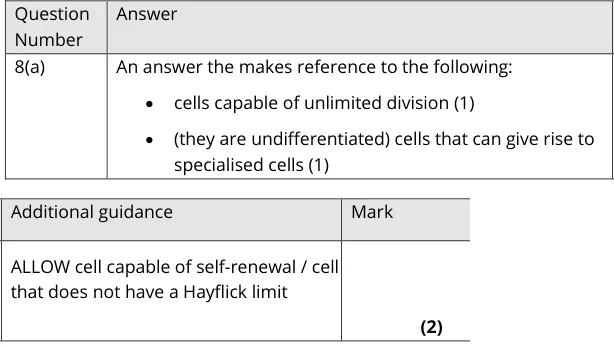
- Stem cell: an undifferentiated cell that can divide without limit (self-renew) and give rise to specialised cells.
- Pluripotent: able to give rise to all the cell types of the body, but not the placenta.
- Embryonic stem cells (ESCs): pluripotent stem cells taken from an early embryo (blastocyst).
- Induced pluripotent stem cells (iPSCs): adult cells reprogrammed back to an embryonic-like, pluripotent state.
- Organoid: a small 3D structure grown from stem cells or tissue that resembles a real organ, such as a mini-brain.
- Gastruloid: a small aggregate of embryonic stem cells that develops the three germ layers and a body axis, like an early embryo.
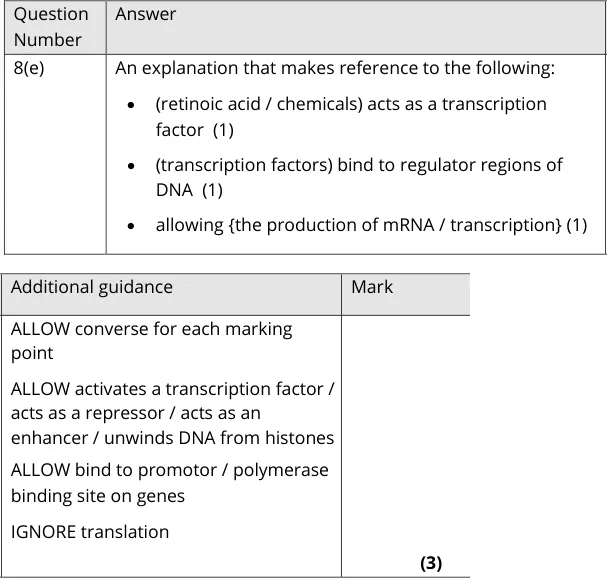
- Transcription factor: a protein that binds to regulatory regions of DNA and switches transcription of a gene on or off.
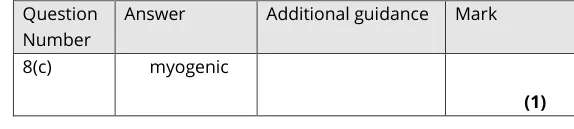
- Myogenic: able to contract without nervous stimulation, as cardiac muscle does.
What these questions cover
The article questions draw on biology from across the specification. These are the statements of the Pearson Edexcel A level Biology A (Salters-Nuffield) specification (9BN0) that they test.
- 2.13i Know the meaning of the terms
- 2.13ii Understand patterns of inheritance, including the interpretation of genetic pedigree diagrams, in the context of monohybrid inheritance.
- 3.11i Understand what is meant by the terms ‘stem cell, pluripotency and totipotency’.
- 3.11ii Be able to discuss the way society uses scientific knowledge to make decisions about the use of stem cells in medical therapies.
- 3.12 Understand how cells become specialised through differential gene expression, producing active mRNA leading to synthesis of proteins, which in turn control cell processes
- 6.6 Understand how Mycobacterium tuberculosis (TB) and Human Immunodeficiency Virus (HIV) infect human cells, causing a sequence of symptoms that may result in death.
- 6.9 Understand the differences between the roles of B cells (B memory and B effector cells) and T cells (T helper, T killer and T memory cells) in the body’s immune response.
- 7.8i Know the myogenic nature of cardiac muscle.
- 7.16 Understand how genes can be switched on and off by DNA transcription factors including hormones.
How to use this page
Write your answer on paper before you open the mark scheme. Allow about 1.2 minutes per mark: the 11 questions are worth 31 marks, so about 37 minutes in total. Then mark your answer strictly against the mark scheme and read the examiners' tip underneath it. If you'd rather print the questions, download the PDF pack.
Stem cells and differentiation (article paragraphs 1–2)
Question 1
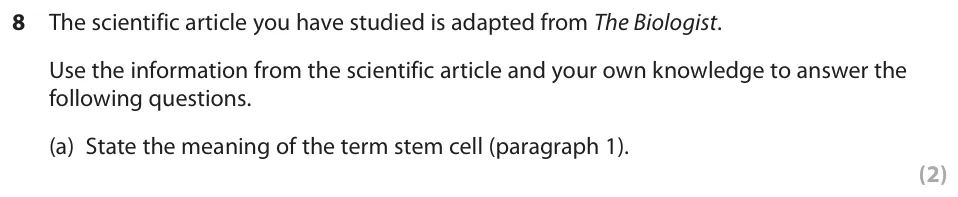
A level Paper 3 · June 2019 · Q8(a) · 2 marks
State the meaning of the term stem cell.
Show the mark scheme
Tap an image to open it full size.
From the examiners' report: Many described the ability of stem cells to differentiate but forgot to mention that stem cells can self-renew. You need both ideas.
Question 2
A level Paper 3 · June 2019 · Q8(b) · 3 marks
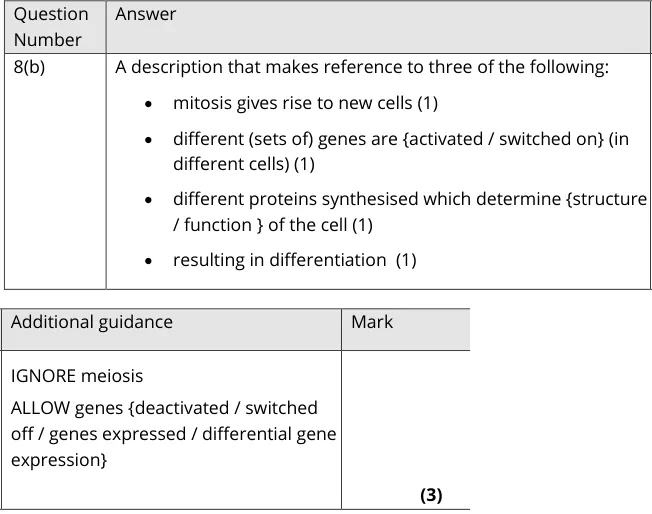
Describe how a single fertilised egg can produce many different cell types.

Show the mark scheme
Tap an image to open it full size.
From the examiners' report: Name mitosis: just describing cell division was not enough. 'Different proteins are made' was not sufficient either; say that the proteins determine the cell's structure or function.
Heart muscle and breeding mice (article paragraphs 6–15)
Question 3
A level Paper 3 · June 2019 · Q8(c) · 1 mark
Name the property shown by spontaneously beating regions in cardiac muscle.

Show the mark scheme
Tap an image to open it full size.
From the examiners' report: The majority of candidates correctly stated myogenic.
Question 4
A level Paper 3 · June 2019 · Q8(d) · 3 marks
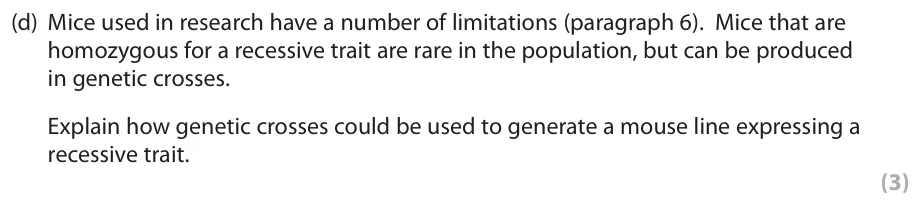
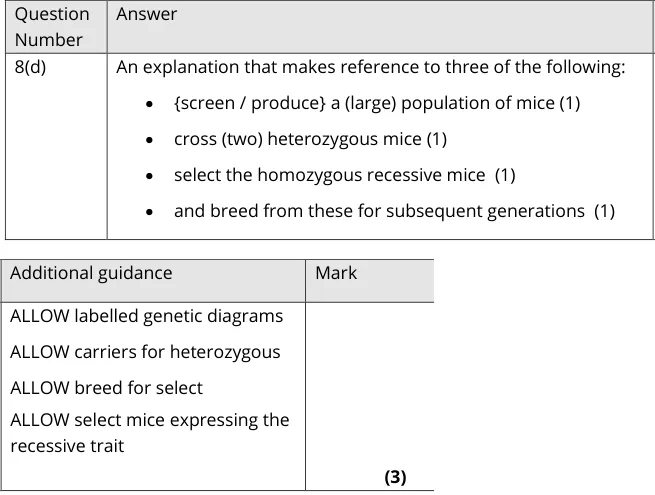
Explain how genetic crosses could be used to generate a mouse line expressing a recessive trait.
Show the mark scheme
Tap an image to open it full size.
From the examiners' report: Many ignored how hard it is to identify heterozygous (carrier) mice and simply described a cross. For the last mark, make clear that only homozygous recessive offspring are bred from for all later generations, not just a single cross.
Gene expression and the Zika virus (article paragraphs 11–21)
Question 5
A level Paper 3 · June 2019 · Q8(e) · 3 marks
Explain how chemicals such as retinoic acid could affect gene expression.

Show the mark scheme
Tap an image to open it full size.
From the examiners' report: Many gave complete answers. The chemical acts as (or activates) a transcription factor, which binds to regulatory regions of DNA, allowing transcription to produce mRNA.
Question 6
A level Paper 3 · June 2019 · Q8(f) · 3 marks
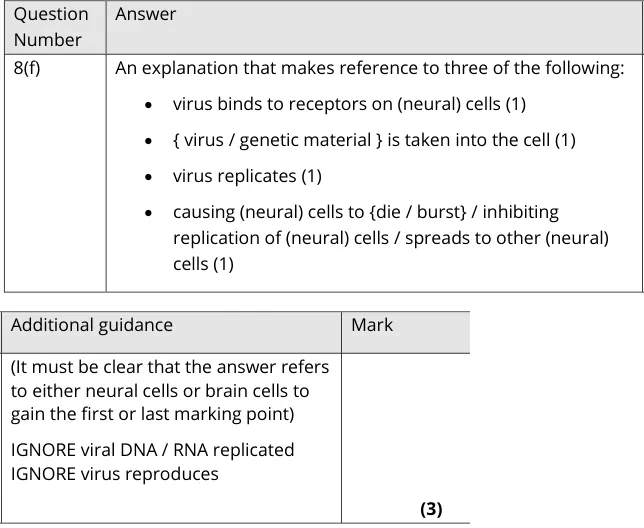
Explain how the Zika virus can cause microcephaly.

Show the mark scheme
Tap an image to open it full size.
From the examiners' report: Realise that the virus infects neural cells. Answers describing infection of T cells could not gain the first or last marks, though they could still gain marks for the virus entering the cell and replicating.
Transplants and the immune system (article paragraph 22)
Question 7
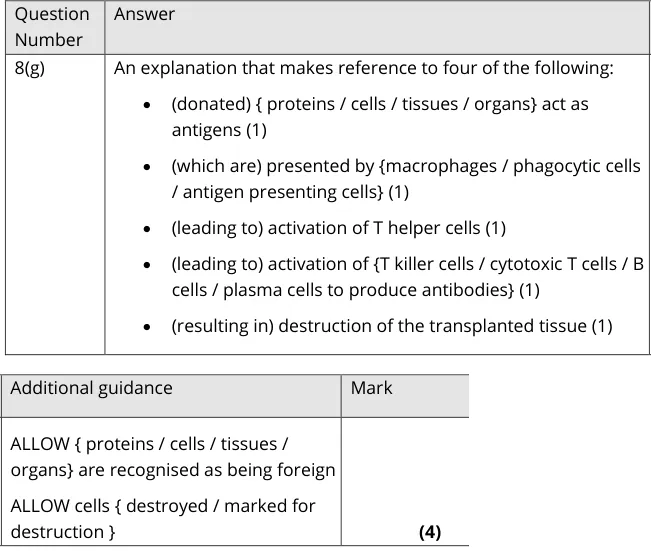
A level Paper 3 · June 2019 · Q8(g) · 4 marks
Explain how the immune system is involved in tissue rejection.

Show the mark scheme
Tap an image to open it full size.
From the examiners' report: Many confused the cell types, for example 'antigen presenting T cells' or 'phagocytic B cells'. Some described non-specific or inflammatory responses rather than a specific immune response to the transplanted tissue.
Tissue culture, organoids and gastruloids (Figure 1 and paragraphs 21–28)
Question 8
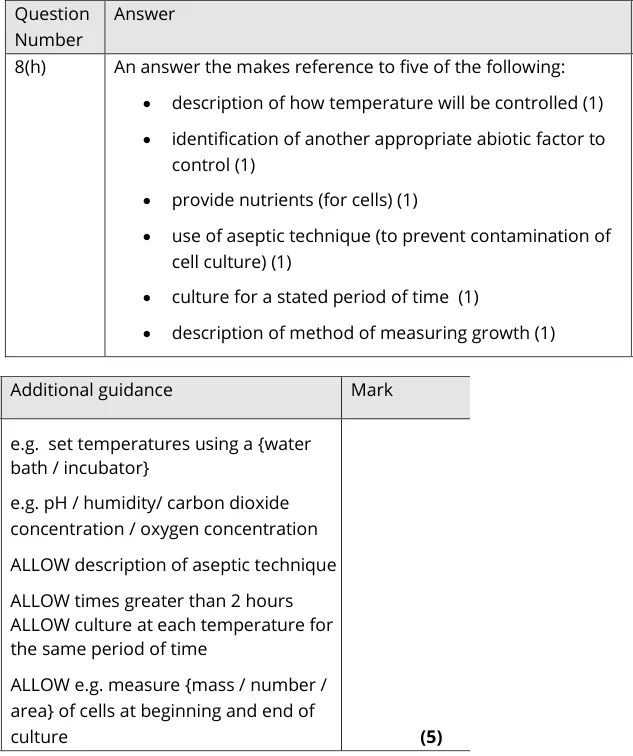
A level Paper 3 · June 2019 · Q8(h) · 5 marks
Devise a procedure to investigate the effect of temperature on the growth rate of a monolayer of human cells.

Show the mark scheme
Tap an image to open it full size.
From the examiners' report: Apply what you know about culturing microorganisms. Say how temperature is controlled ('keep cultures at a set temperature in an incubator', not just 'incubate'), and measure growth at the start and end or at intervals; counting cells only at the end was not enough.
Question 9
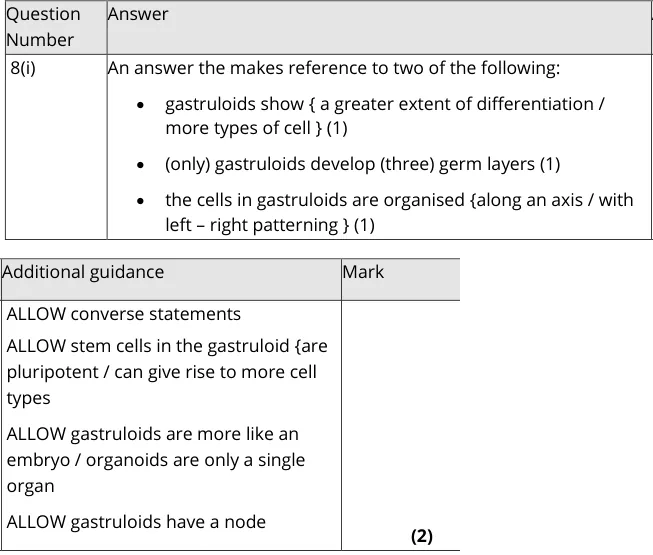
A level Paper 3 · June 2019 · Q8(i) · 2 marks
Describe how a gastruloid differs from an organoid.

Show the mark scheme
Tap an image to open it full size.
Embryonic stem cells and iPSCs (article paragraphs 32–34)
Question 10
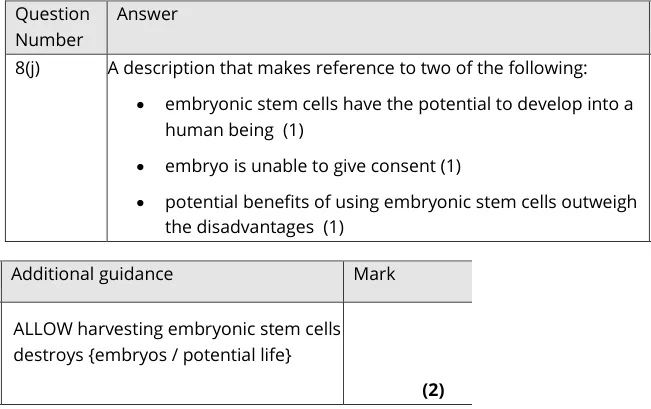
A level Paper 3 · June 2019 · Q8(j) · 2 marks
Describe two ethical issues concerning the use of human embryonic stem cells in research.

Show the mark scheme
Tap an image to open it full size.
From the examiners' report: Many found this straightforward and gained both marks, usually for the embryo's potential to develop into a human being and its inability to give consent.
Question 11
A level Paper 3 · June 2019 · Q8(k) · 3 marks
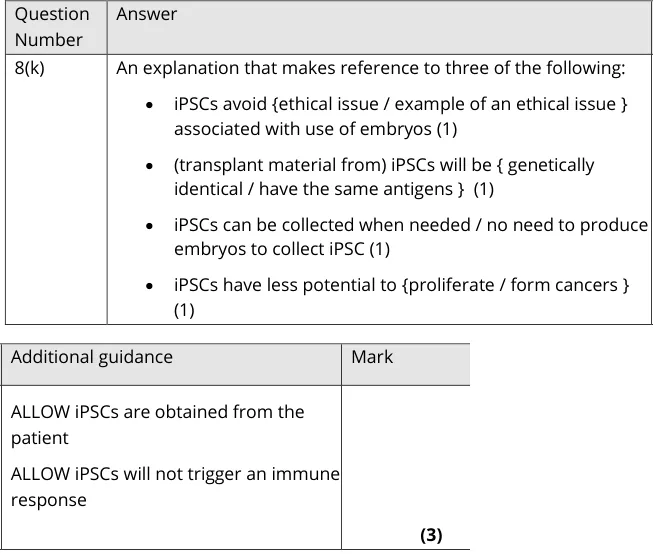
Explain the advantages of using iPSCs compared to ESCs for the production of transplant material.

Show the mark scheme
Tap an image to open it full size.
From the examiners' report: Many repeated their answer to 8(j) and gained only 1 mark. 'The transplant will not be rejected' was not enough: say the material is genetically identical or has the same antigens, or at least will not trigger an immune response. Very few mentioned how easily iPSCs are obtained or the cancer risk of embryonic cells.
Where students lose marks (from Pearson examiners' reports and mark schemes)
Each point below comes from the examiners' report and mark scheme, and is followed by wording that gained marks.
Stem cells self-renew as well as differentiate. Many described differentiation but forgot to mention that stem cells can self-renew.
✔ Gains credit: 'Cells capable of unlimited division' that 'can give rise to specialised cells'.
Write mitosis, not just cell division. Describing cell division without naming mitosis did not gain the first mark.
✔ Gains credit: 'Mitosis gives rise to new cells.'
Link the new proteins to the cell. A simple statement that different proteins are synthesised was not sufficient.
✔ Gains credit: 'Different proteins synthesised which determine the structure or function of the cell.'
Breed only from homozygous recessive mice. Many described a single cross between heterozygous mice and ignored later generations.
✔ Gains credit: 'Select the homozygous recessive mice and breed from these for subsequent generations.'
Zika targets neural cells. A number described the virus infecting T cells, which was not accepted.
✔ Gains credit: 'Virus binds to receptors on neural cells', 'causing neural cells to die'.
Keep the immune cells in their roles. Cell types were confused, for example 'antigen presenting T cells' or 'phagocytic B cells'.
✔ Gains credit: 'Presented by macrophages', 'leading to activation of T helper cells'.
Measure the cells at the start too. Counting the number of cells at the end was not enough unless the start was also counted.
✔ Gains credit: 'Measure mass, number or area of cells at beginning and end of culture.'
Give a reason there is no rejection. Many simply said the transplant would not be rejected.
✔ Gains credit: 'Transplant material from iPSCs will be genetically identical' or 'have the same antigens'.
Download the questions
Download the PDF pack (11 questions, mark schemes at the end)
Keep practising
- Read the June 2019 scientific article: From Organoids to Gastruloids
- How the Edexcel SNAB Paper 3 scientific article works, and what examiners want
- Edexcel SNAB A level Biology revision resources by topic
- Craving Control: How Food Messes with Your Mind (June 2018 Paper 3 Scientific Article): Edexcel SNAB A Level Biology Exam Questions
- The Seventh Sense (October 2020 Paper 3 Scientific Article): Edexcel SNAB A Level Biology Exam Questions
- All Edexcel SNAB exam questions by topic
- Edexcel SNAB A level Biology past papers, mark schemes and examiners' reports
- Edexcel SNAB A level Biology grade boundaries
- Message Tom on WhatsApp about one-to-one Edexcel SNAB tutoring or an Edexcel group class
Questions, mark schemes and examiners' report extracts © Pearson Education Ltd.