

Principles of Genetic Technology (19.1): Cambridge (CIE) A Level Biology 9700 Exam Questions by Topic
Principles of genetic technology is sub-topic 19.1 of Topic 19, Genetic technology, in the Cambridge International AS & A Level Biology syllabus (9700). You need to define recombinant DNA, explain what genetic engineering and gene editing are, explain how the gene to be transferred is obtained and the roles of restriction endonucleases, DNA ligase, plasmids, DNA polymerase and reverse transcriptase, and explain why a promoter and a marker gene may be needed. You also need to describe the polymerase chain reaction (PCR) and gel electrophoresis, and outline the use of microarrays and databases. This is A level content, examined on Paper 4.
The examiners' reports return to the same points. Reverse transcriptase uses mRNA as a template to make cDNA; do not write that mRNA is 'converted'. Say where a gene comes from, and finish an outline of genetic engineering with the gene being expressed. A promoter is where RNA polymerase and transcription factors bind. Genes do not fluoresce: a marker gene codes for a protein that fluoresces under UV light. In PCR, say that the primers anneal and that Taq polymerase synthesises a complementary strand. With microarrays, the intensity of fluorescence indicates the level of gene expression.
Studying Cambridge International A level Biology and want more help? Tom teaches CIE students one-to-one online, including students in the UAE, Saudi Arabia, Hong Kong, India and Indonesia, and every lesson is recorded. You can book a one-to-one lesson or a free 15-minute discovery chat, or register your interest in a CIE group class starting in September 2027, using the links at the bottom of this page.
What you need from AS Level
Each question on this page assumes you're secure on these ideas. If any of them feels shaky, look it up before you start.
- DNA is a double helix of two antiparallel polynucleotide strands, held together by hydrogen bonds between the complementary base pairs A with T and C with G.
- In semi-conservative replication, DNA polymerase adds nucleotides to make a new strand complementary to the template strand, and DNA ligase joins fragments by forming phosphodiester bonds.
- In transcription, RNA polymerase uses one DNA strand as a template to make mRNA; in translation the mRNA is used to make a polypeptide.
- Enzymes have an optimum temperature and most are denatured at high temperatures.
Key terms
These words come up in the questions and mark schemes. Examiners expect you to use them exactly.
- Recombinant DNA: DNA made by joining DNA from two different sources or organisms.
- Restriction endonuclease: an enzyme that cuts DNA at a specific sequence (its restriction site); used to cut a gene out of DNA and to cut a plasmid.
- DNA ligase: an enzyme that joins the gene to the plasmid by forming phosphodiester bonds in the sugar-phosphate backbone.
- Reverse transcriptase: an enzyme that uses mRNA as a template to make single-stranded complementary DNA (cDNA).
- Plasmid: a small circular piece of DNA in bacteria that replicates independently; used as a vector to carry a gene into a cell.
- Promoter: a sequence of DNA where RNA polymerase and transcription factors bind so that a gene is transcribed.
- Primer: a short length of single-stranded DNA that anneals to a complementary sequence on the target DNA in PCR, allowing Taq polymerase to bind.
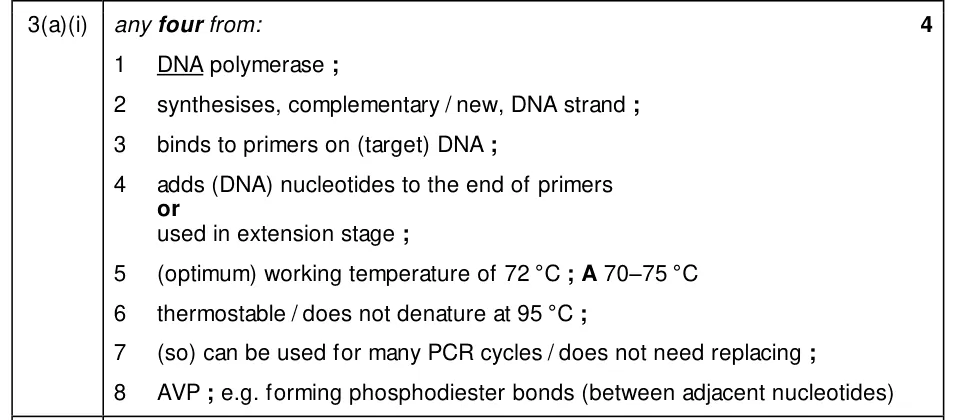
- Taq polymerase: a thermostable DNA polymerase that is not denatured at 95 °C and works at about 72 °C, so it can be used for many cycles of PCR.
What these questions cover (Cambridge 9700 Topic 19: Genetic technology)
The questions test these learning outcomes from sub-topic 19.1 of the Cambridge International AS & A Level Biology syllabus (9700) for 2025 to 2027.
- 19.1.1 define the term recombinant DNA
- 19.1.2 explain that genetic engineering is the deliberate manipulation of genetic material to modify specific characteristics of an organism and that this may involve transferring a gene into an or
- 19.1.3 explain that genes to be transferred into an organism may be
- 19.1.4 explain the roles of restriction endonucleases, DNA ligase, plasmids, DNA polymerase and reverse transcriptase in the transfer of a gene into an organism
- 19.1.5 explain why a promoter may have to be transferred into an organism as well as the desired gene
- 19.1.6 explain how gene expression may be confirmed by the use of marker genes coding for fluorescent products
- 19.1.7 explain that gene editing is a form of genetic engineering involving the insertion, deletion or replacement of DNA at specific sites in the genome
- 19.1.8 describe and explain the steps involved in the polymerase chain reaction
- 19.1.9 describe and explain how gel electrophoresis is used to separate DNA fragments of different lengths
- 19.1.10 outline how microarrays are used in the analysis of genomes and in detecting mRNA in studies of gene expression
- 19.1.11 outline the benefits of using databases that provide information about nucleotide sequences of genes and genomes, and amino acid sequences of proteins and protein structures
How to use this page
Write your answer on paper before you open the mark scheme. Allow about 1.2 minutes per mark: the 22 questions are worth 60 marks, so about 72 minutes in total. Then mark your answer strictly against the mark scheme and read the examiners' tip underneath it. If you'd rather print the questions, download the PDF pack.
Recombinant DNA (19.1.1)
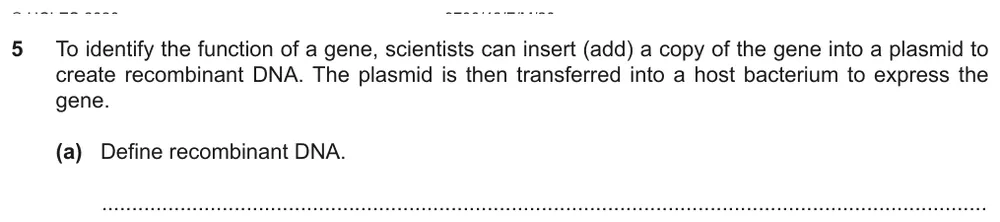
Question 1
Paper 4 · February/March 2020 (42) · Q5(a) · 1 mark
Define recombinant DNA.
Show the mark scheme

Tap an image to open it full size.
From the examiners' report: Many students defined recombinant DNA correctly. Some simply described the plasmid example given in the question; the definition has to give the features of recombinant DNA in general.
Genetic engineering (19.1.2)
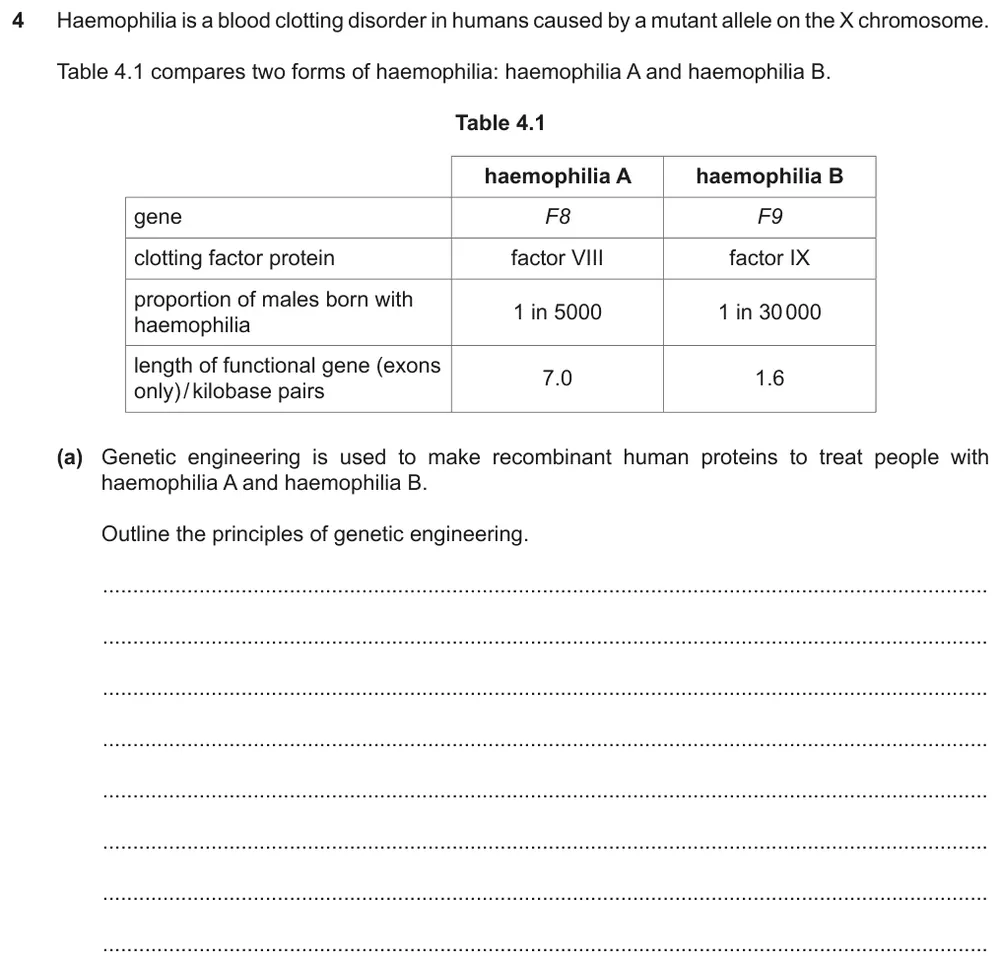
Question 2
Paper 4 · October/November 2022 (42) · Q4(a) · 4 marks · Easy
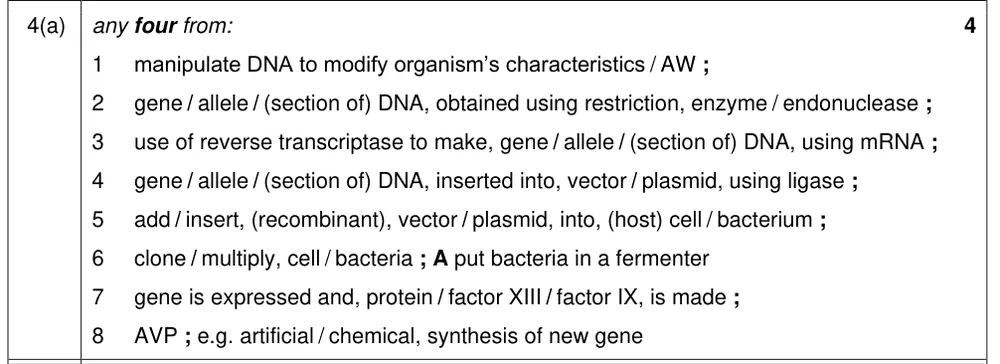
Outline the principles of genetic engineering.
Show the mark scheme
Tap an image to open it full size.
From the examiners' report: Most marks came from the use of restriction enzymes and ligase, and inserting the vector into a host cell. Many left out cloning the bacteria and the expression of the new gene to make the protein. Write that a gene is 'obtained' or 'cut out', not 'cut', and that mRNA is used as a template, not 'converted' into cDNA.
Obtaining the gene to be transferred (19.1.3 and 19.1.4)
Question 3
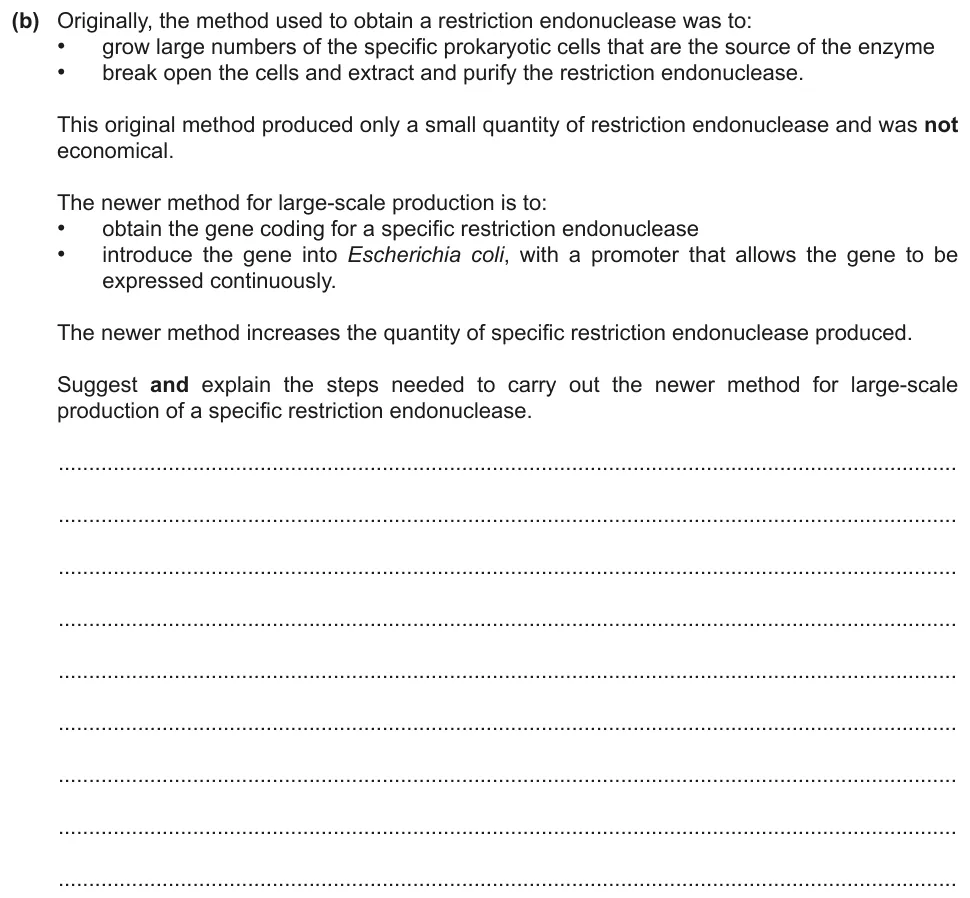
Paper 4 · May/June 2023 (42) · Q4(b) · 4 marks · Easy
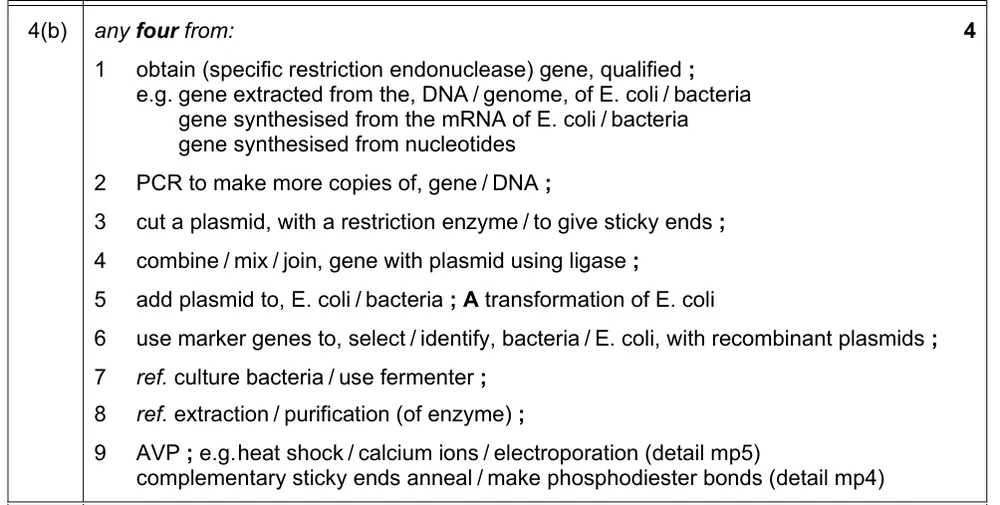
Suggest and explain the steps needed to produce a restriction endonuclease on a large scale using E. coli.
Information from earlier in this question:

Show the mark scheme
Tap an image to open it full size.
From the examiners' report: Say where the gene is extracted from: the DNA or genome of the bacteria. mRNA is used as a template to make cDNA; it is not 'converted' into DNA. Do not use 'gene' and 'enzyme' as if they mean the same thing, and do not call E. coli the vector.
Question 4
Paper 4 · February/March 2022 (42) · Q5(b)(i) · 1 mark
Name the enzyme that uses mRNA as a template to produce complementary DNA.
Information from earlier in this question:


Show the mark scheme

Tap an image to open it full size.
From the examiners' report: Many students correctly named reverse transcriptase. The most frequent wrong answers were DNA ligase and DNA polymerase.
Question 5
Paper 4 · February/March 2022 (42) · Q5(b)(ii) · 2 marks · Easy
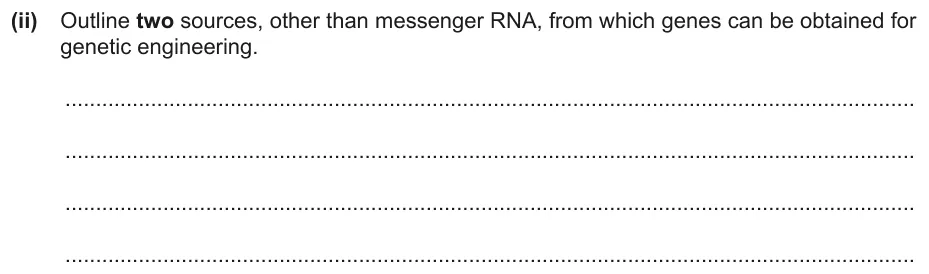
Outline two sources, other than mRNA, from which genes can be obtained for genetic engineering.
Show the mark scheme

Tap an image to open it full size.
From the examiners' report: Most students gave vague references to obtaining DNA from a nucleus or from mitochondria. Few seemed familiar with the syllabus statement that this question tests.
Enzymes and plasmids in gene transfer (19.1.4)
Question 6
Paper 4 · May/June 2024 (43) · Q4(a)(i) · 4 marks
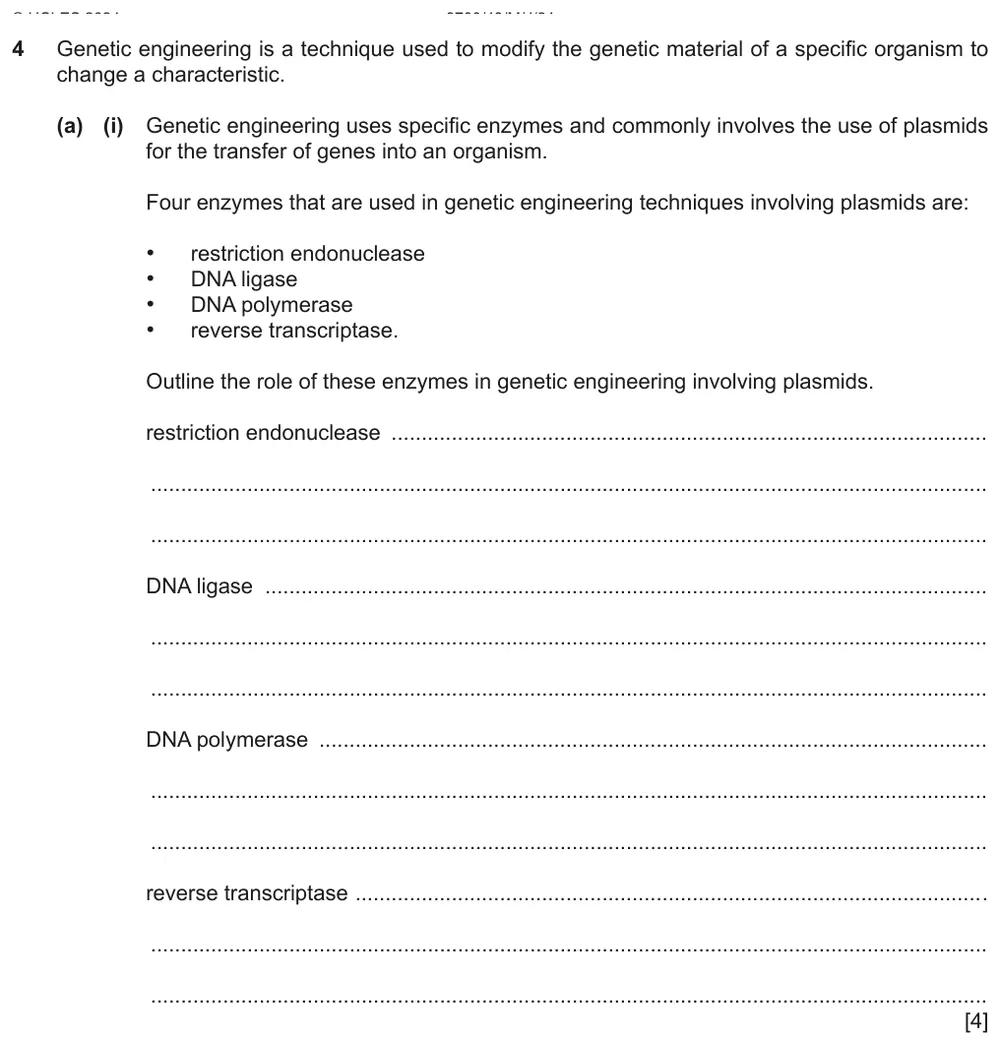
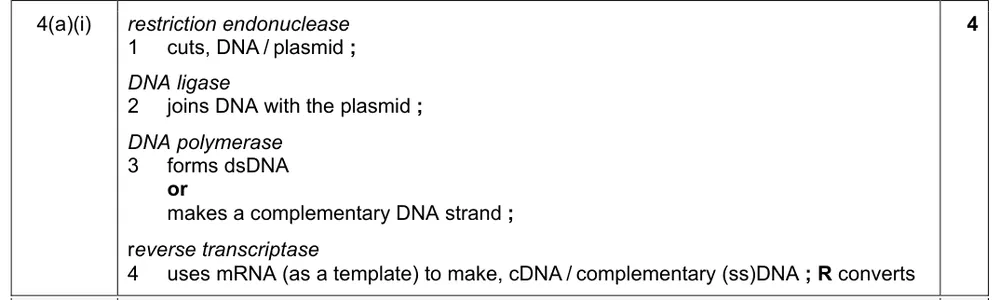
Outline the roles of restriction endonuclease, DNA ligase, DNA polymerase and reverse transcriptase in genetic engineering.
Show the mark scheme
Tap an image to open it full size.
From the examiners' report: Restriction endonuclease cuts DNA, not mRNA. For DNA ligase, mention the plasmid as well as the phosphodiester bonds. For DNA polymerase, say that the strand made is complementary. Reverse transcriptase uses mRNA to make cDNA; it does not 'convert' mRNA into cDNA.
Question 7
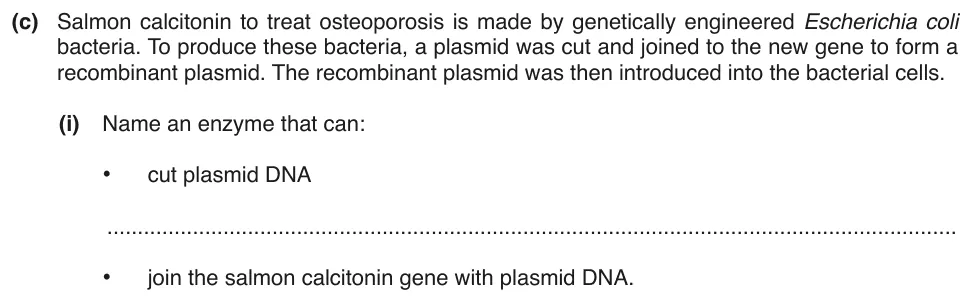
Paper 4 · October/November 2019 (42) · Q3(c)(i) · 2 marks · Easy
Name an enzyme that cuts plasmid DNA and an enzyme that joins a gene with plasmid DNA.
Show the mark scheme

Tap an image to open it full size.
From the examiners' report: Most students knew restriction endonuclease and ligase. Wrong answers included 'recombinant enzyme' or reverse transcriptase for the first, and DNA polymerase for the second. Occasionally the two answers were the wrong way round.
Question 8
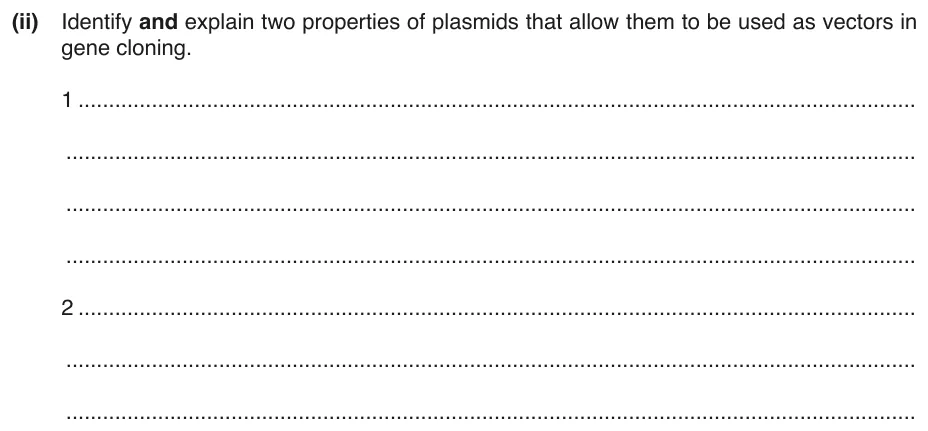
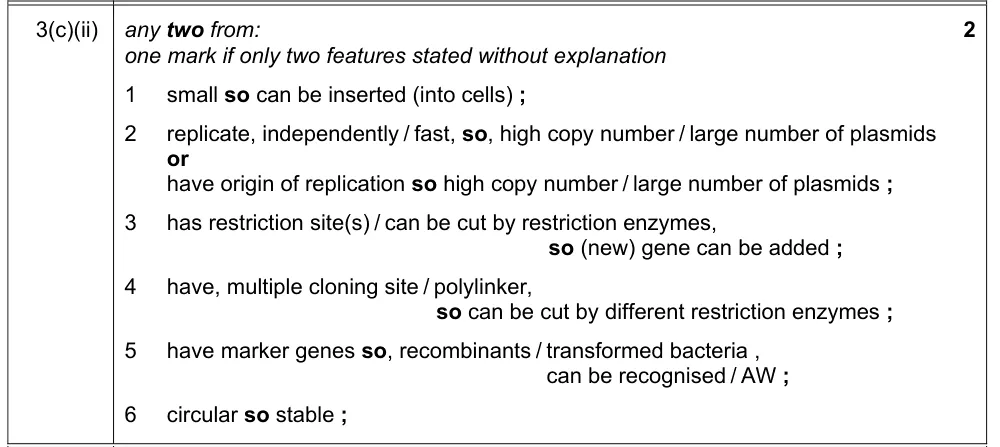
Paper 4 · October/November 2019 (42) · Q3(c)(ii) · 2 marks
Identify and explain two properties of plasmids that allow them to be used as vectors.
Show the mark scheme
Tap an image to open it full size.
From the examiners' report: Naming the properties was straightforward; explaining them was harder. Plasmids are small, so they are easily taken up by cells, and have restriction sites, so a gene can be inserted. Circular DNA was seldom linked to stability. Marker genes are there to recognise the transformed cell, not the plasmid.
Promoters (19.1.5)
Question 9
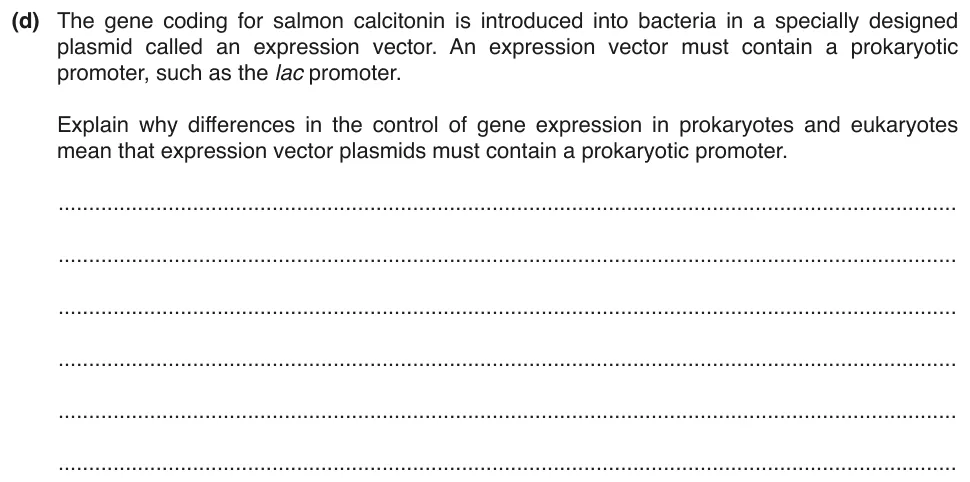
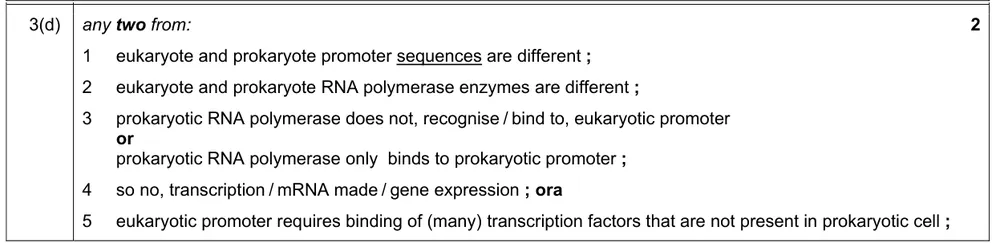
Paper 4 · October/November 2019 (42) · Q3(d) · 2 marks
Explain why an expression vector used in bacteria must contain a prokaryotic promoter.
Show the mark scheme
Tap an image to open it full size.
From the examiners' report: Most students found this difficult. Very few referred to the differences between eukaryotic and prokaryotic promoter sequences or RNA polymerases. Many gained credit for saying that, without binding, there is no transcription or gene expression.
Question 10
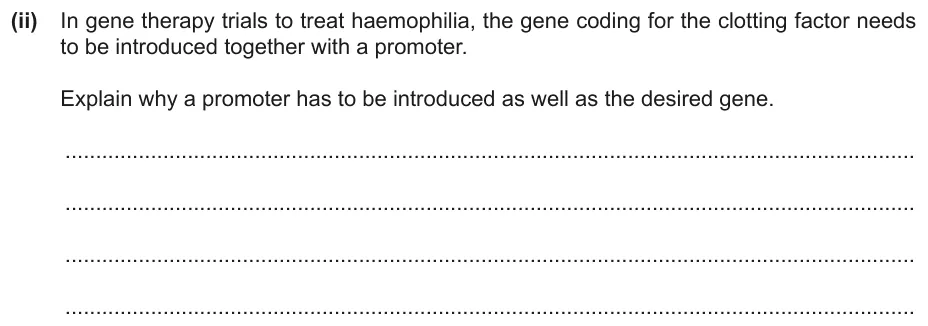
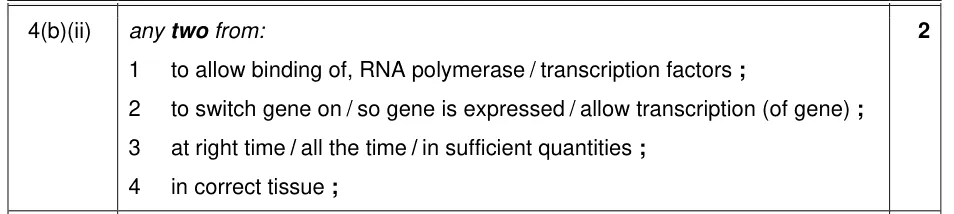
Paper 4 · October/November 2022 (42) · Q4(b)(ii) · 2 marks · Easy
Explain why a promoter has to be introduced as well as the desired gene.
Information from earlier in this question:

Show the mark scheme
Tap an image to open it full size.
From the examiners' report: Most students knew that a promoter is needed for gene expression, and many added that it is where RNA polymerase or transcription factors bind. Few explained that a promoter allows the gene to be expressed at the right time, in the right quantities and in the right tissue.
Marker genes coding for fluorescent products (19.1.6)
Question 11
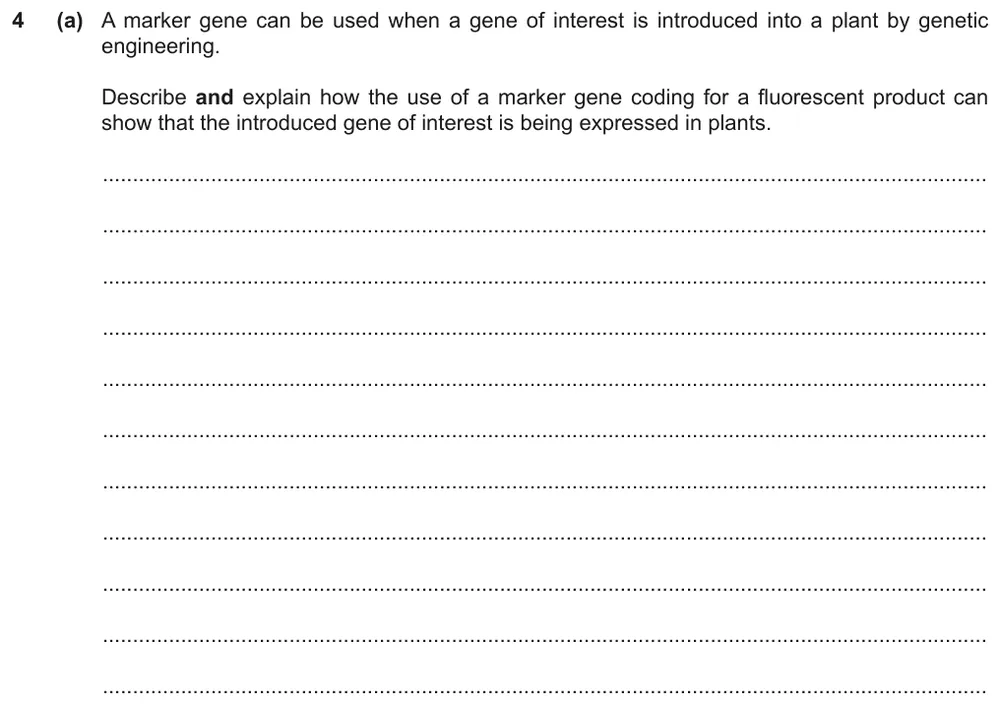
Paper 4 · October/November 2023 (42) · Q4(a) · 4 marks
Describe and explain how a marker gene coding for a fluorescent product shows that an introduced gene is being expressed.
Show the mark scheme

Tap an image to open it full size.
From the examiners' report: The marker gene is not a fluorescent tag, and genes do not fluoresce: the fluorescence is due to a protein, which shows under UV light. Few said that the gene of interest and the marker gene are both transcribed, so both proteins are produced, and very few that they use the same promoter. Do not confuse marker genes with microarrays.
Gene editing (19.1.7)
Question 12
Paper 4 · October/November 2022 (42) · Q4(c) · 2 marks · Hard
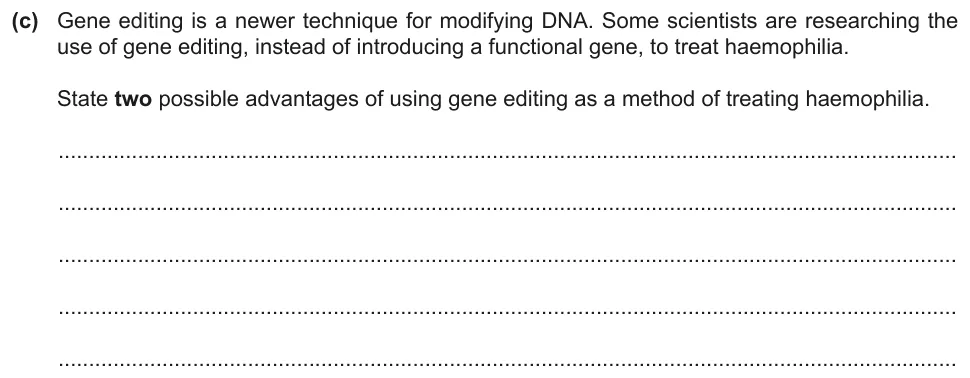
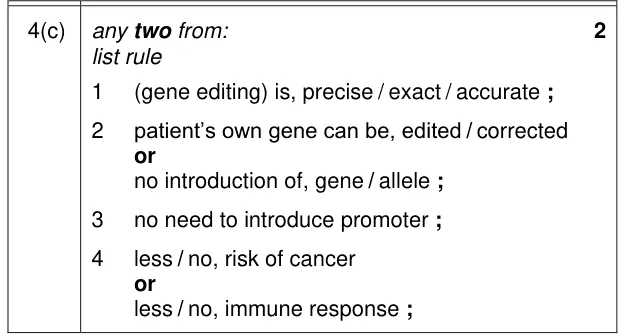
State two possible advantages of using gene editing to treat haemophilia.
Show the mark scheme
Tap an image to open it full size.
From the examiners' report: General statements about gene editing were not enough. Stronger answers said that it is more precise and carries fewer risks, such as an immune response or cancer. Very few said that the patient's own gene is edited, so no gene or allele has to be inserted and a promoter is no longer needed.
Question 13
Paper 4 · May/June 2022 (42) · Q4(a) · 5 marks
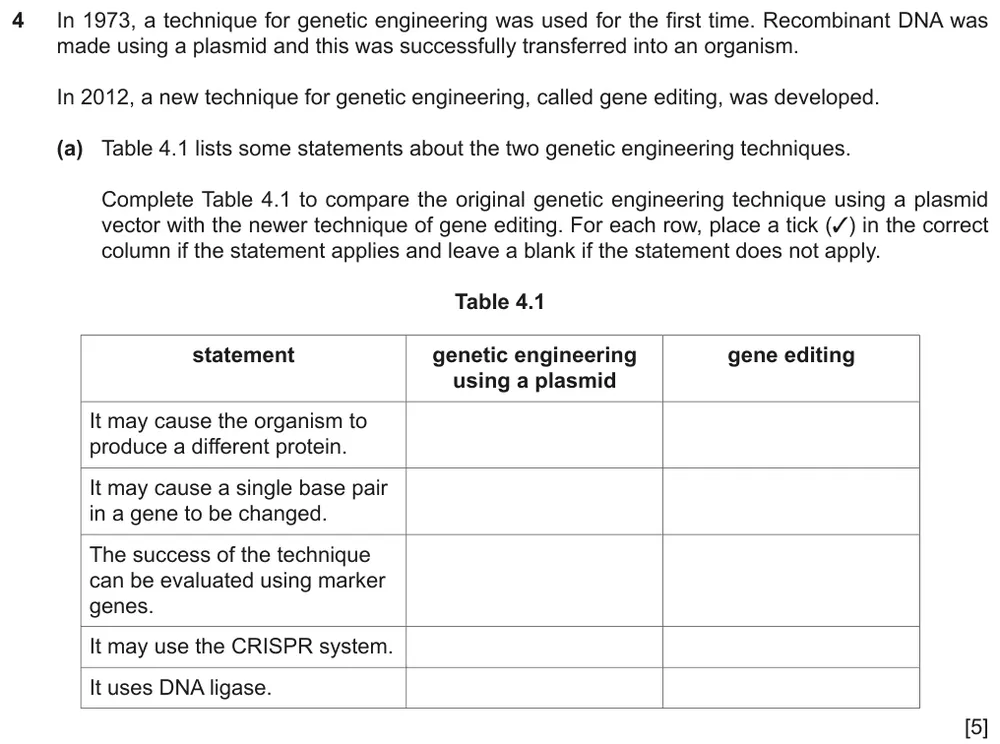
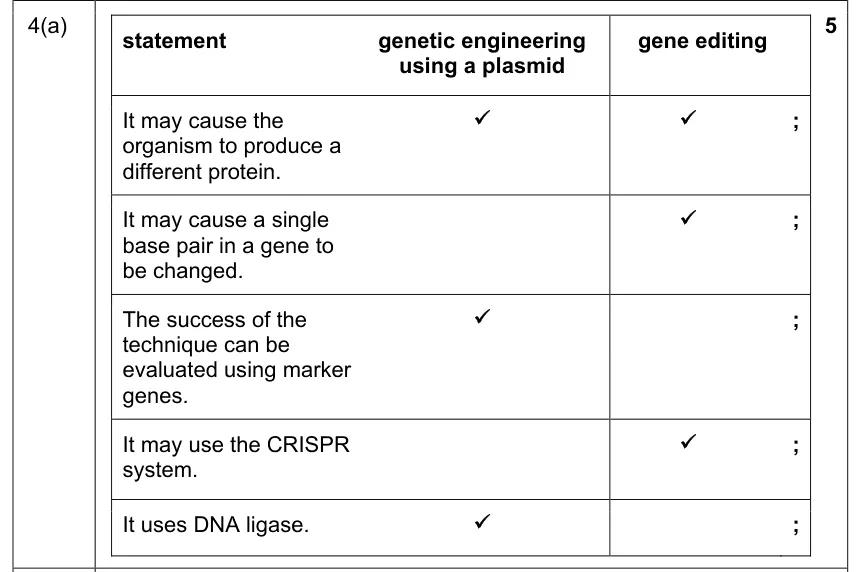
Complete the table to compare genetic engineering using a plasmid with gene editing.
Show the mark scheme
Tap an image to open it full size.
From the examiners' report: Many students matched the statements well. The statement about CRISPR was found difficult to place, and many did not recognise that both techniques can cause the organism to produce a different protein.
The polymerase chain reaction (19.1.8)
Question 14
Paper 4 · October/November 2022 (42) · Q5(a) · 3 marks · Easy
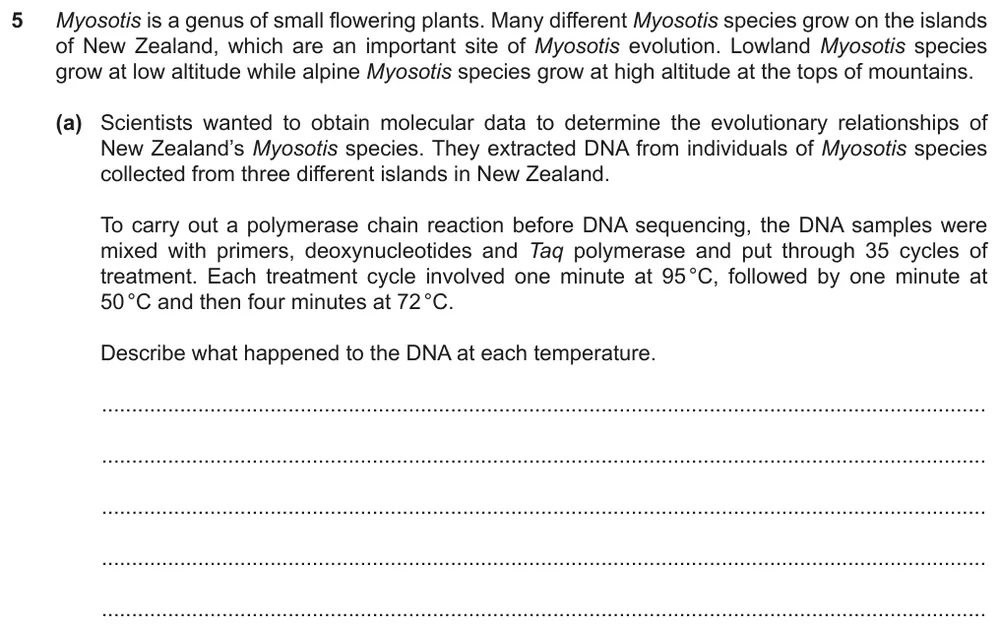
Describe what happens at each of the three temperatures used in PCR.
Show the mark scheme

Tap an image to open it full size.
From the examiners' report: Most students said that at 95 °C the hydrogen bonds between the DNA strands break. Say that the primers anneal or bind at 50 °C, not just that they are added. At 72 °C, say that Taq polymerase synthesises a new complementary strand; 'strand elongation' alone was a weaker answer.
Question 15
Paper 4 · October/November 2020 (42) · Q4(b)(ii) · 3 marks · Hard
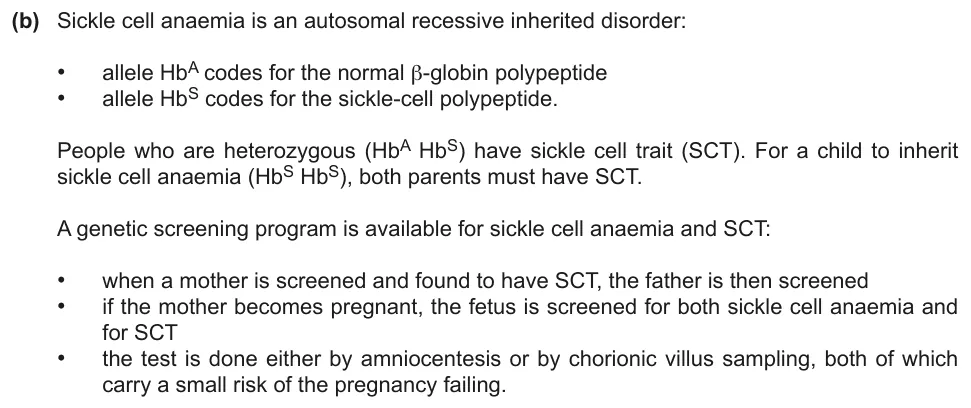
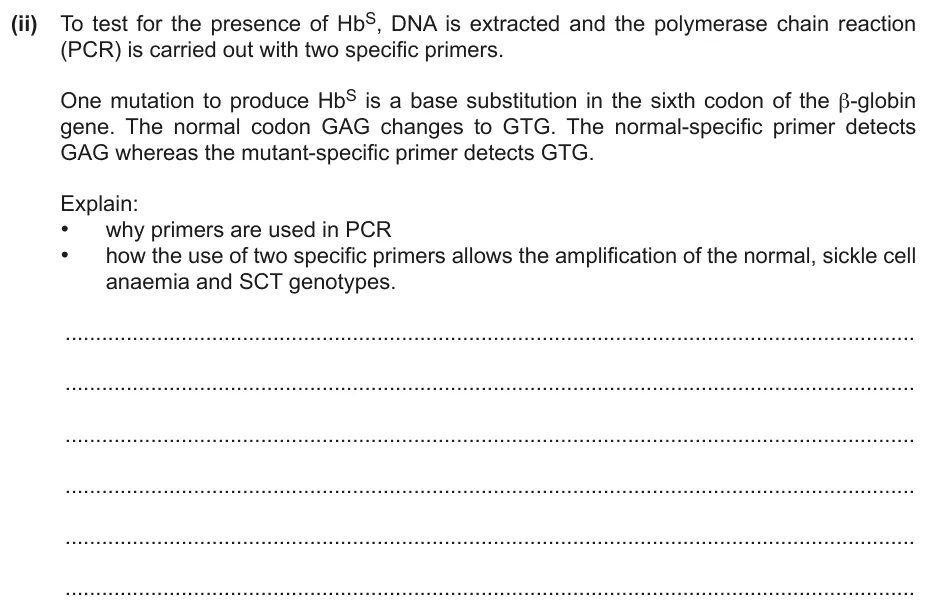
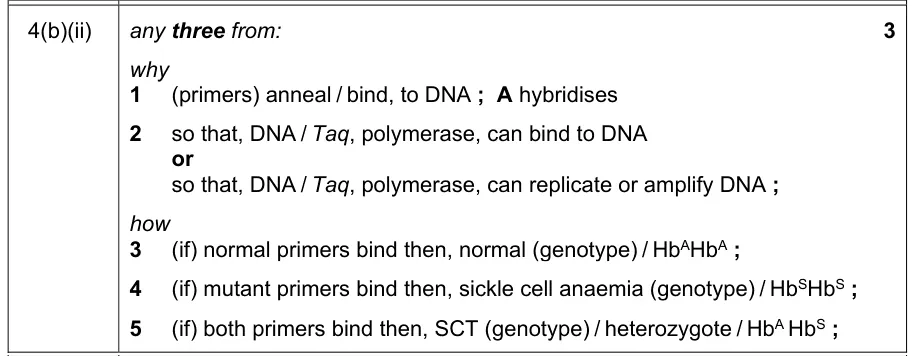
Explain why primers are used in PCR and how two specific primers allow three genotypes to be amplified.
Information from earlier in this question:
Show the mark scheme
Tap an image to open it full size.
From the examiners' report: Many students knew what a primer is but did not say that it binds to DNA, or that it allows DNA polymerase to bind to DNA. Very few explained how the two specific primers allow the three genotypes to be amplified. A few recognised that when both primers bind the genotype is SCT.
Question 16
Paper 4 · February/March 2025 (42) · Q3(a)(i) · 4 marks · Easy
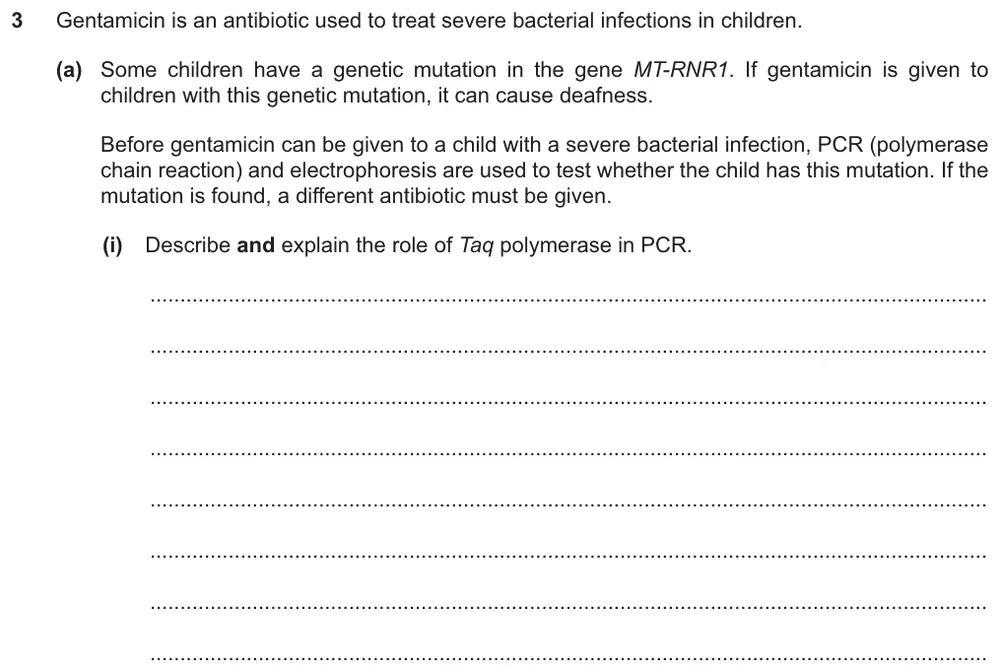
Describe and explain the role of Taq polymerase in PCR.
Show the mark scheme
Tap an image to open it full size.
From the examiners' report: Most students said that Taq polymerase withstands high temperatures. Fewer knew its optimum temperature, or explained that this tolerance keeps it active through repeated PCR cycles. Describe it as a DNA polymerase that works with specific primers; many answers wrongly referred to transcription instead of DNA synthesis.
Gel electrophoresis (19.1.9)
Question 17
Paper 4 · February/March 2025 (42) · Q3(a)(ii) · 1 mark
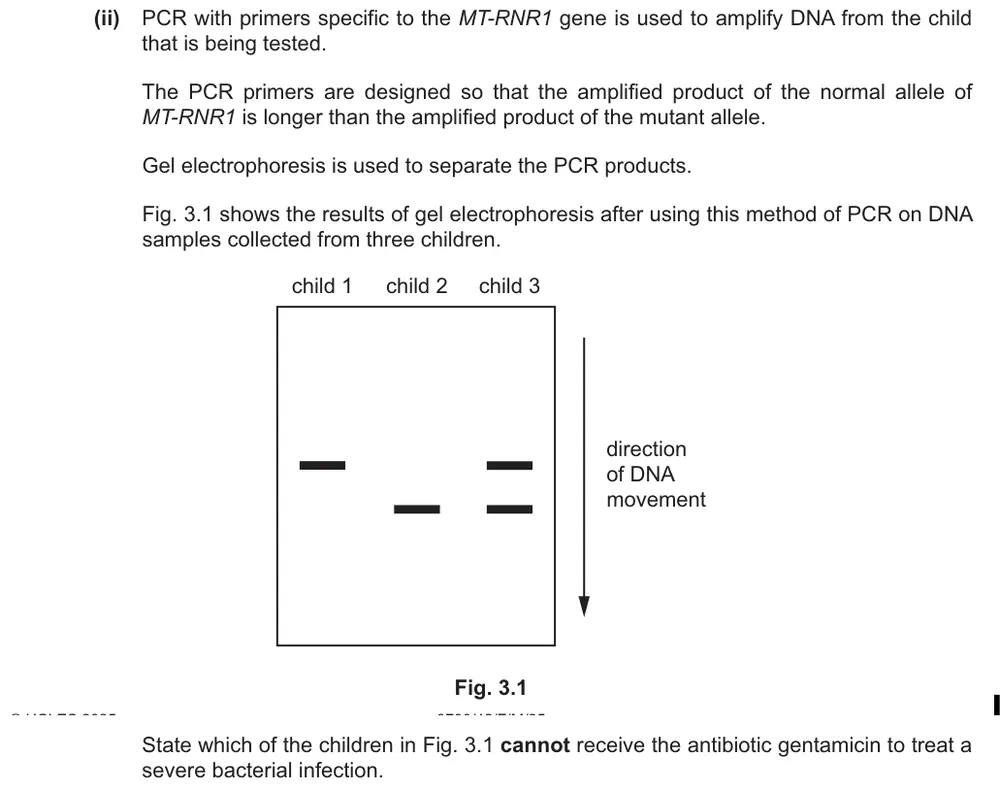
Use the gel electrophoresis results to state which children should not be given gentamicin.
Show the mark scheme

Tap an image to open it full size.
From the examiners' report: Many students interpreted the gel correctly for one child but missed another. The information in the question shows that any child with the mutated allele would be affected by gentamicin, not just homozygotes.
Question 18
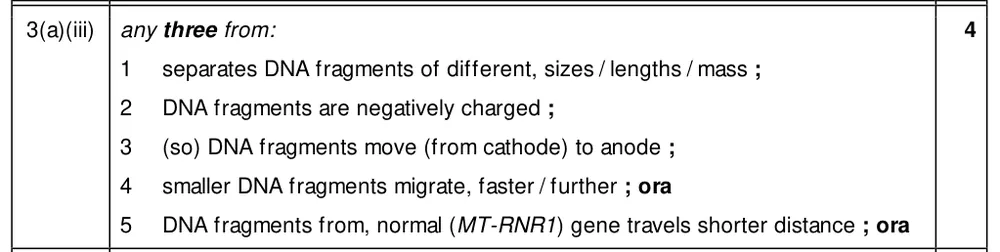
Paper 4 · February/March 2025 (42) · Q3(a)(iii) · 4 marks
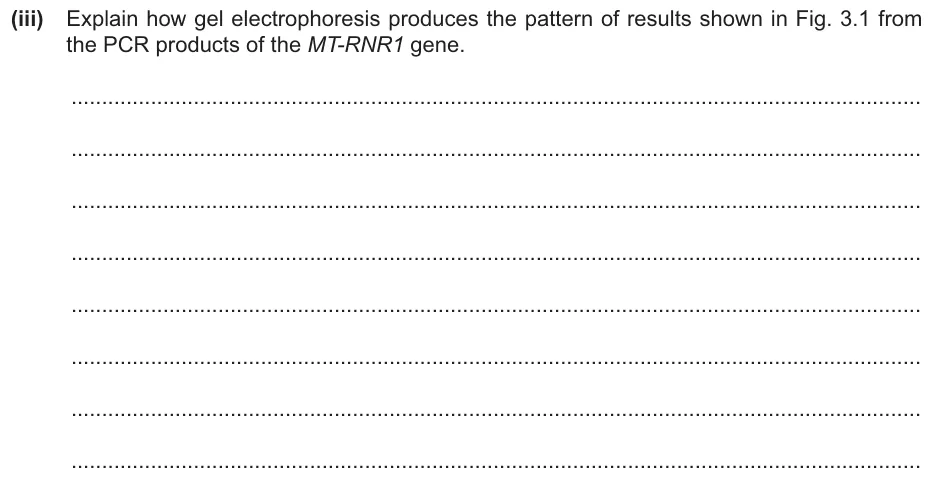
Explain how gel electrophoresis produces the pattern of results shown for the PCR products.
Show the mark scheme
Tap an image to open it full size.
From the examiners' report: Many answers said that DNA fragments are negatively charged, so move to the anode, and that smaller fragments move more quickly. Fewer went on to use the details of the different PCR products to explain the pattern of results in the figure.
Microarrays (19.1.10)
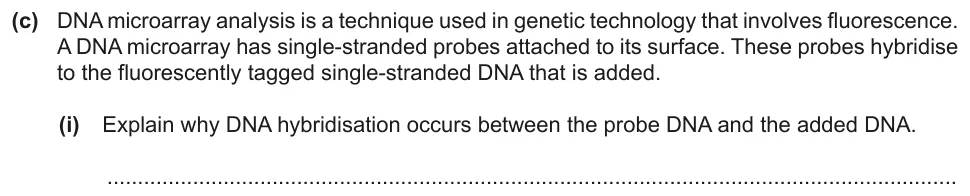
Question 19
Paper 4 · October/November 2023 (42) · Q4(c)(i) · 1 mark · Easy
Explain why DNA hybridisation occurs between the probe DNA and the added DNA.
Show the mark scheme

Tap an image to open it full size.
From the examiners' report: Most students gave complementary base pairing. A minority wrongly suggested sticky ends or negative charges.
Question 20
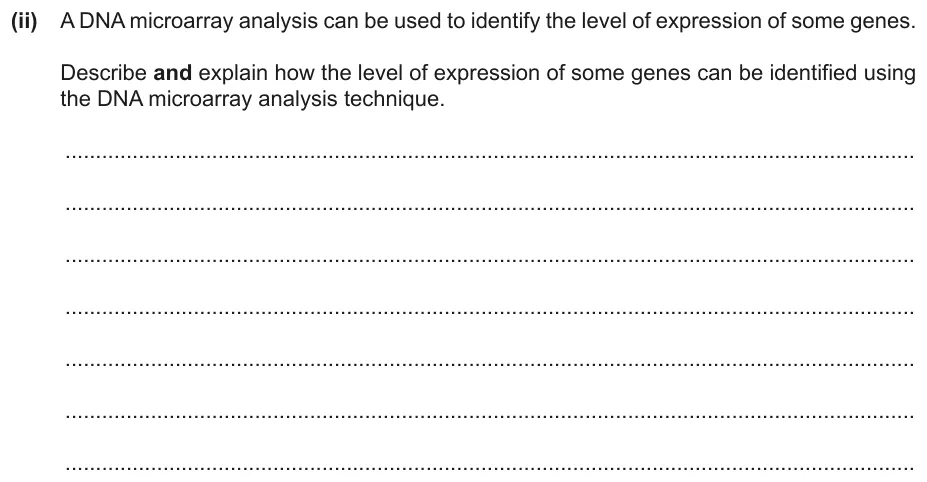
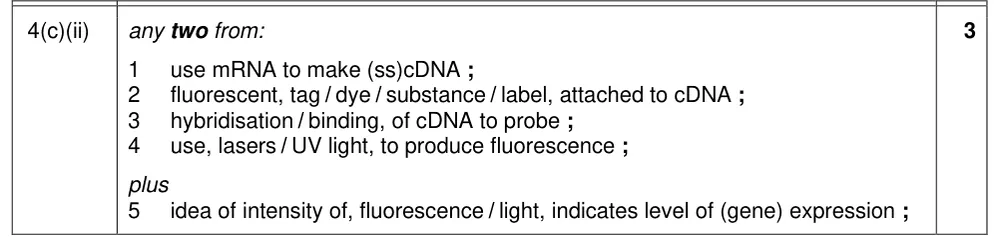
Paper 4 · October/November 2023 (42) · Q4(c)(ii) · 3 marks
Describe and explain how a DNA microarray can identify the level of expression of genes.
Show the mark scheme
Tap an image to open it full size.
From the examiners' report: State that the intensity of fluorescence indicates the level of gene expression. Credit was often lost by not saying that it is cDNA that is involved, or by writing that mRNA is 'converted' to cDNA. Different colours of fluorescence belong to a different use of microarrays: finding which genes are present.
Question 21
Paper 4 · October/November 2021 (42) · Q4(a)(i) · 4 marks
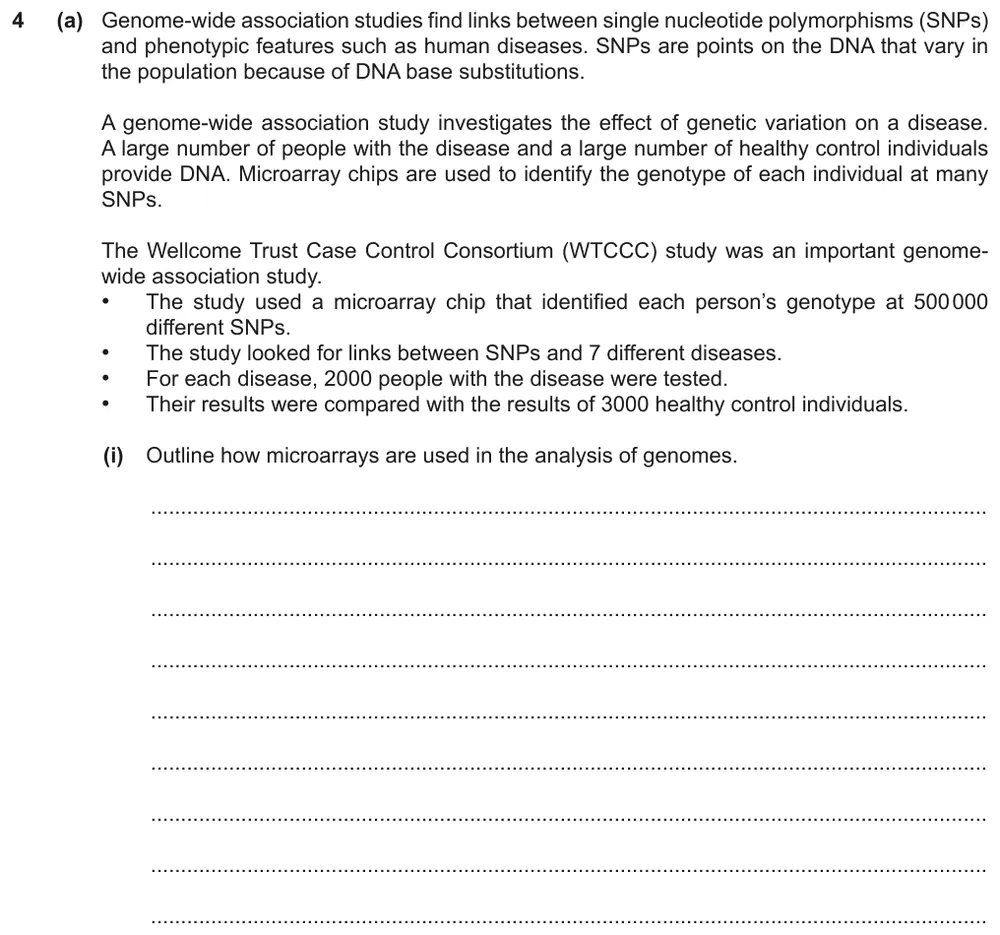
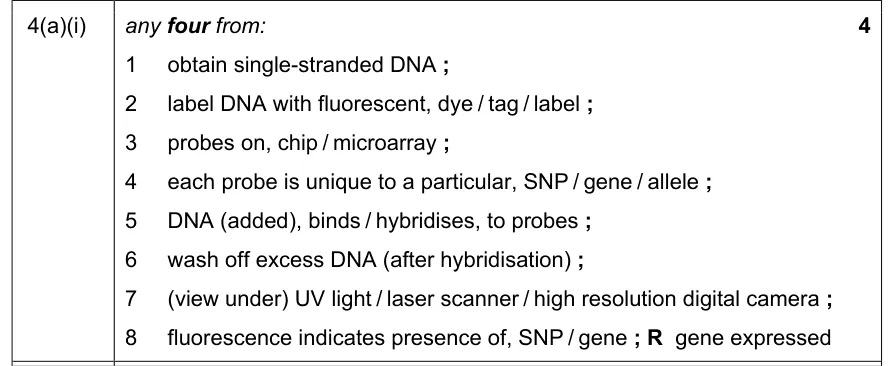
Outline how microarrays are used in the analysis of genomes.
Show the mark scheme
Tap an image to open it full size.
From the examiners' report: Good answers said that single-stranded DNA is tagged with fluorescent dye, hybridises with complementary probes, the unbound DNA is washed off and the chip is viewed under UV light. Make it clear that the DNA is single-stranded: double-stranded DNA would not hybridise with the probes. Do not spend time on different methods of obtaining the DNA.
Databases and bioinformatics (19.1.11)
Question 22
Paper 4 · October/November 2021 (42) · Q4(a)(ii) · 2 marks
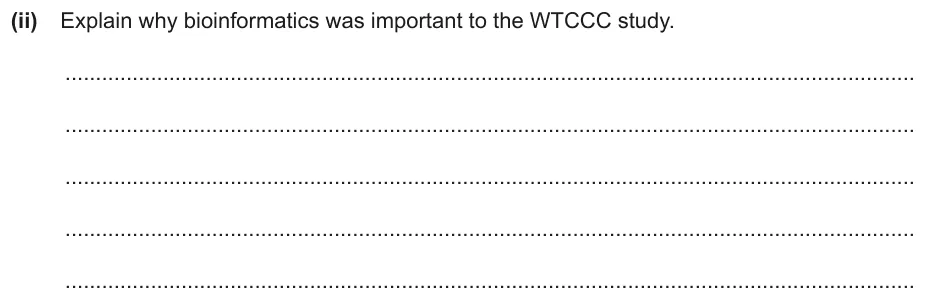
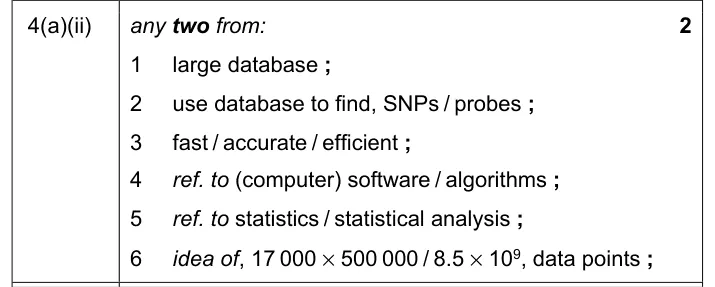
Explain why bioinformatics was important to a genome-wide association study.
Show the mark scheme
Tap an image to open it full size.
From the examiners' report: The most common correct answers were that bioinformatics stores a large amount of data using computer software, and that it is fast, accurate and efficient.
Where students lose marks (from Cambridge examiners' reports and mark schemes)
Each point below comes from the examiners' reports and mark schemes, and is followed by wording that gained marks.
A template, not a conversion. Students wrote that reverse transcriptase 'converts' mRNA into cDNA, or that restriction endonuclease cuts mRNA.
✔ Gains credit: restriction endonuclease 'cuts DNA / plasmid', and reverse transcriptase 'uses mRNA (as a template) to make cDNA'.
Finish with the gene being expressed. Students stopped at inserting the vector into the host cell, and wrote that genes are 'cut' instead of 'obtained' or 'cut out'.
✔ Gains credit: the gene is 'obtained using restriction enzyme', 'inserted into vector / plasmid using ligase', then 'clone / multiply bacteria' and the 'gene is expressed and protein is made'.
Say where the gene comes from. Students did not say where the gene or the mRNA would be extracted from, and used 'gene' and 'enzyme' as if they mean the same thing.
✔ Gains credit: 'gene extracted from the DNA / genome of bacteria', 'gene synthesised from the mRNA' or 'gene synthesised from nucleotides'.
Give each property its reason. Students named properties of plasmids without explaining them, or said that marker genes are there to recognise the plasmid.
✔ Gains credit: 'small so can be inserted (into cells)', 'has restriction site(s) so (new) gene can be added', 'have marker genes so transformed bacteria can be recognised' and 'circular so stable'.
Right time, right tissue. Students said that a promoter is needed for gene expression and stopped there.
✔ Gains credit: the promoter is needed 'to allow binding of RNA polymerase / transcription factors', 'so gene is expressed', 'at right time / in sufficient quantities' and 'in correct tissue'.
Genes do not fluoresce. Students described the marker gene as a fluorescent tag, wrote that genes fluoresce, or confused marker genes with microarrays.
✔ Gains credit: 'marker gene added with gene of interest', 'use same promoter', so 'both genes transcribed / expressed' and 'both proteins are produced'; 'use UV light'.
Primers anneal; a new strand is made. Students wrote that primers are added to the DNA without saying that they bind, or that Taq polymerase causes strand elongation without saying that a new strand is made.
✔ Gains credit: 'at 95 °C (DNA) denatures / H bonds break', 'at 50 °C primers anneal / bind' and 'at 72 °C complementary (DNA) strand is made'.
Intensity shows the level of expression. Students left out cDNA, wrote that mRNA is converted to cDNA, or described different colours of fluorescence instead of its intensity.
✔ Gains credit: 'use mRNA to make cDNA', 'fluorescent tag attached to cDNA', 'hybridisation of cDNA to probe' and 'intensity of fluorescence indicates level of (gene) expression'.
Download the questions
Download the PDF pack (22 questions, mark schemes at the end)
Keep practising
- Genetic Technology Applied to Medicine (19.2): Cambridge (CIE) exam questions by topic
- Genetically Modified Organisms in Agriculture (19.3): Cambridge (CIE) exam questions by topic
- Cambridge (CIE) A level Biology 9700 past papers, mark schemes and examiners' reports
- Cambridge (CIE) A level Biology grade thresholds
- Book a one-to-one CIE lesson or a free 15-minute discovery chat with Tom
- Register your interest in a CIE A level Biology group class
Questions, mark schemes and examiners' report extracts © Cambridge University Press & Assessment.