

Genetically Modified Organisms in Agriculture (19.3): Cambridge (CIE) A Level Biology 9700 Exam Questions by Topic
Genetically modified organisms in agriculture is sub-topic 19.3 of Topic 19, Genetic technology, in the Cambridge International AS & A Level Biology syllabus (9700). You need to explain how genetic engineering may help to solve the global demand for food by improving the quality and productivity of farmed animals and crop plants, using GM salmon, herbicide resistance in soybean and insect resistance in cotton as examples, and discuss the ethical and social implications of using genetically modified organisms (GMOs) in food production. Questions often use unfamiliar examples, such as Bt maize, GM rice or gene-edited crops. This is A level content, examined on Paper 4.
The examiners' reports return to the same points. A herbicide-resistant crop is still sprayed: resistance lets the farmer use herbicide to kill the weeds, which reduces competition and increases yield, so do not write that less herbicide is needed. Do not confuse herbicide resistance with insect resistance. In Bt crops it is the toxin, a protein, that harms the insects, not the gene. Genetic modification is not selective breeding. When a question gives a table or graph, use it: name the varieties, compare the treatment with the control and say what a change in yield means for food supply and cost. Vague points such as 'superweeds' or moral beliefs need explaining.
Studying Cambridge International A level Biology and want more help? Tom teaches CIE students one-to-one online, including students in the UAE, Saudi Arabia, Hong Kong, India and Indonesia, and every lesson is recorded. You can book a one-to-one lesson or a free 15-minute discovery chat, or register your interest in a CIE group class starting in September 2027, using the links at the bottom of this page.
What you need from AS Level
Each question on this page assumes you're secure on these ideas. If any of them feels shaky, look it up before you start.
- A gene is a sequence of nucleotides in DNA that codes for a polypeptide; it is transcribed and translated to make a protein (Topic 6).
- Proteins have specific shapes and functions, and enzymes are proteins (Topics 2 and 3).
- Bacteria are prokaryotes, and many carry small circular DNA molecules called plasmids (Topic 1).
- Plants take up water and mineral ions from the soil through their roots (Topic 7).
Key terms
These words come up in the questions and mark schemes. Examiners expect you to use them exactly.
- Genetically modified organism (GMO): an organism whose DNA has been changed by genetic engineering, for example by inserting a gene from another species.
- Herbicide: a chemical that kills plants; farmers use it to kill the weeds that compete with a crop.
- Herbicide resistance: a trait of a GM crop, such as soybean, that is not killed by a herbicide, so the field can be sprayed to kill the weeds.
- Insect resistance: a trait of a GM crop, such as Bt cotton or Bt maize, that makes a toxin harmful to the insects that feed on it.
- Bt toxin: a protein coded for by a gene from the bacterium Bacillus thuringiensis; it kills insects that eat the crop.
- Yield: the mass of crop or food produced, for example per hectare.
- Gene flow: the transfer of genes from one population to another, for example by pollen from a GM crop reaching wild relatives or non-GM crops.
What these questions cover (Cambridge 9700 Topic 19: Genetic technology)
The questions test these learning outcomes from sub-topic 19.3 of the Cambridge International AS & A Level Biology syllabus (9700) for 2025 to 2027.
- 19.3.1 explain that genetic engineering may help to solve the global demand for food by improving the quality and productivity of farmed animals and crop plants
- 19.3.2 discuss the ethical and social implications of using genetically modified organisms
How to use this page
Write your answer on paper before you open the mark scheme. Allow about 1.2 minutes per mark: the 22 questions are worth 59 marks, so about 71 minutes in total. Then mark your answer strictly against the mark scheme and read the examiners' tip underneath it. If you'd rather print the questions, download the PDF pack.
GM salmon (19.3.1)
Question 1
Paper 4 · February/March 2020 (42) · Q4(d) · 2 marks · Easy
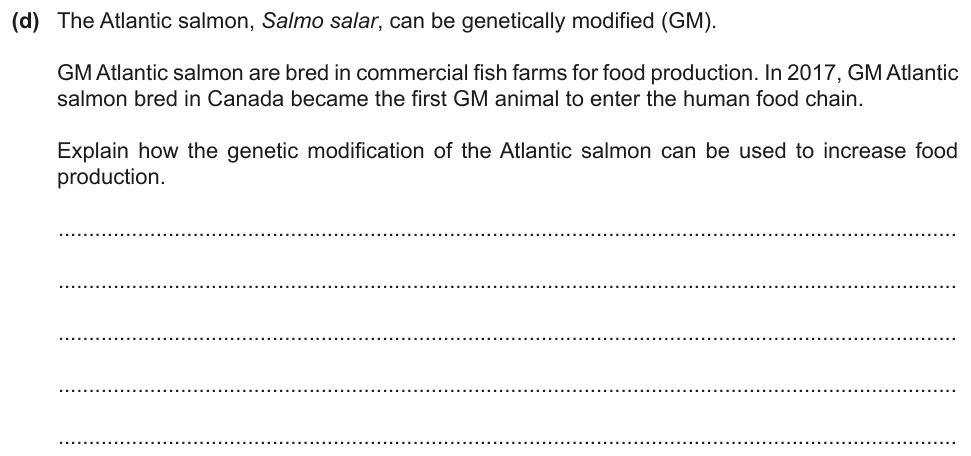
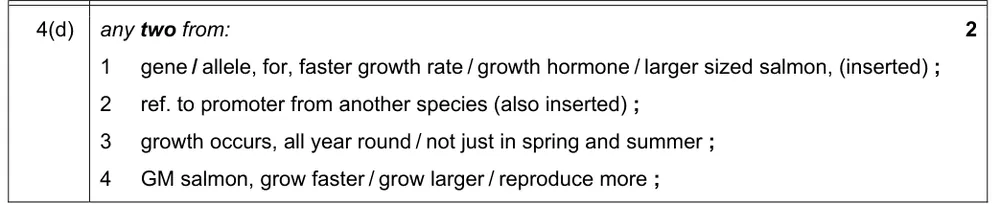
Explain how the genetic modification of Atlantic salmon can be used to increase food production.
Show the mark scheme
Tap an image to open it full size.
From the examiners' report: Most gave effects on the salmon that would increase food production. Fewer described the gene that has to be inserted to achieve this. Several wrote about selective breeding instead of genetic modification.
Question 2
Paper 4 · February/March 2023 (42) · Q3(b)(iii) · 1 mark · Easy
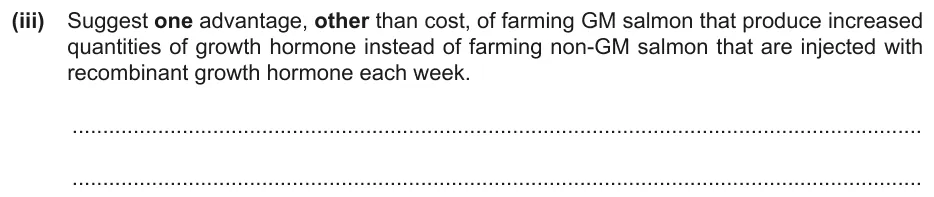
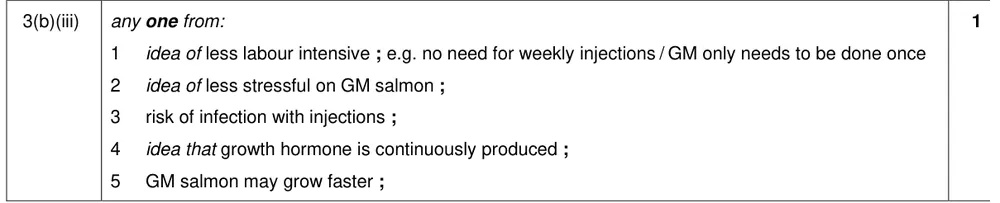
Suggest one advantage, other than cost, of farming GM salmon instead of injecting non-GM salmon with growth hormone each week.
Information from earlier in this question:

Show the mark scheme
Tap an image to open it full size.
From the examiners' report: Most saw that weekly injections are much more labour intensive and time consuming than using GM salmon. Some wrongly said that the GM salmon grow larger, for which there was no evidence.
Herbicide resistance (19.3.1)
Question 3
Paper 4 · October/November 2023 (42) · Q4(b) · 2 marks · Easy
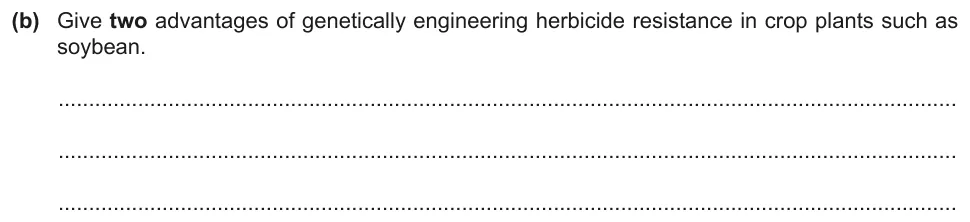
Give two advantages of genetically engineering herbicide resistance in crop plants such as soybean.
Show the mark scheme
Tap an image to open it full size.
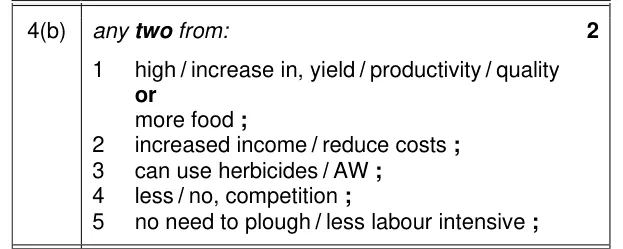
From the examiners' report: Resistance lets the farmer use herbicides, which reduces competition and increases yield. The commonest error was to say that no herbicide is needed, so money is saved. Others wrote about pests, misunderstanding what a herbicide does.
Question 4
Paper 4 · October/November 2025 (41) · Q8(a) · 4 marks
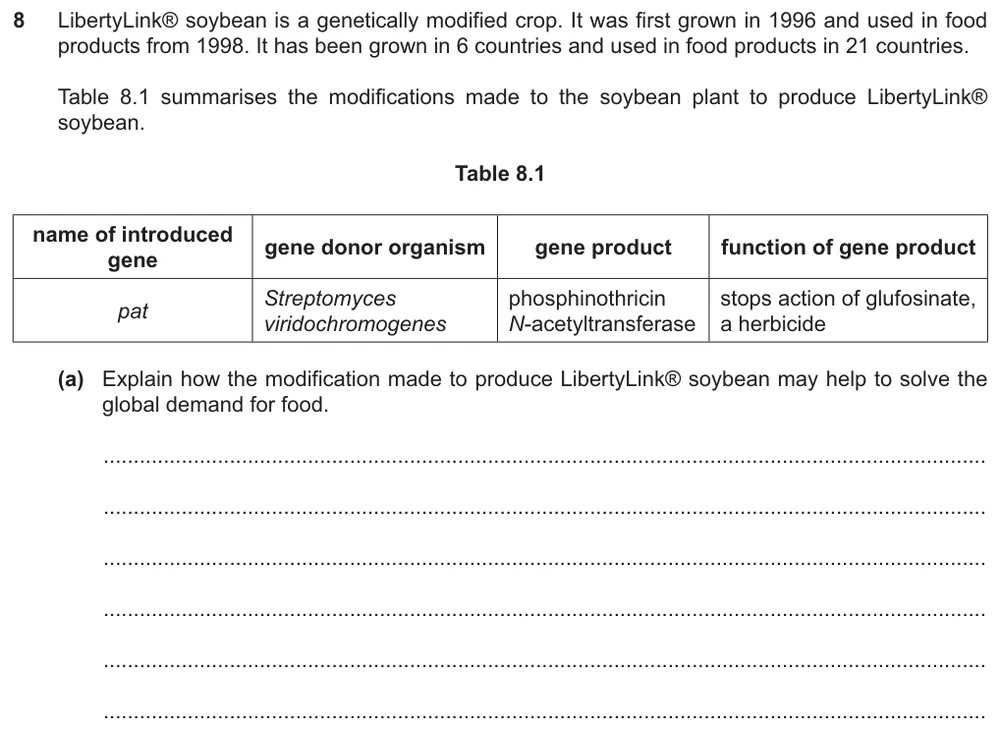
Explain how the modification made to produce LibertyLink soybean may help to solve the global demand for food.
Show the mark scheme

Tap an image to open it full size.
Question 5
Paper 4 · May/June 2019 (42) · Q3(a) · 4 marks · Hard
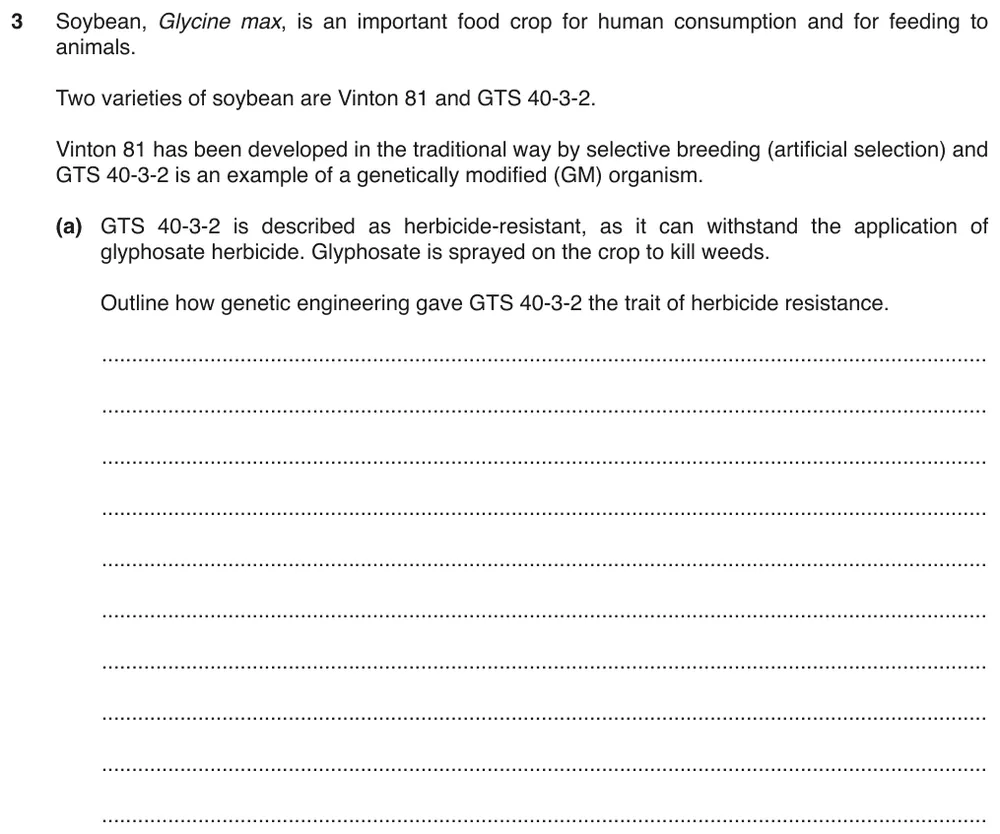
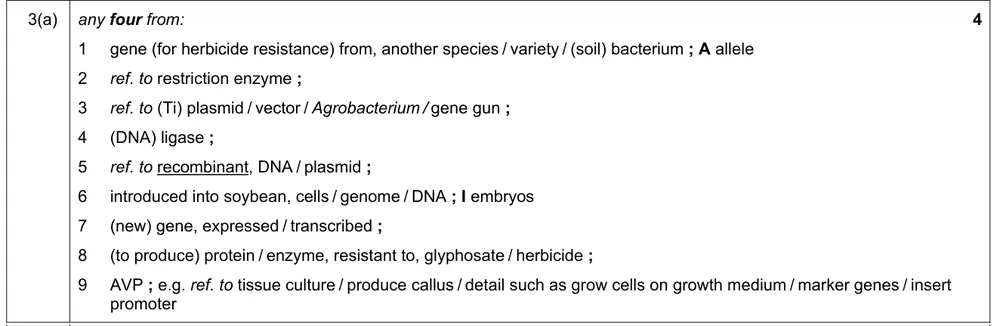
Outline how genetic engineering gave a soybean variety the trait of herbicide resistance.
Show the mark scheme
Tap an image to open it full size.
From the examiners' report: Few said where the gene came from or how it was introduced into the soybean genome. Few finished with the gene being expressed. Describing selective breeding was not relevant.
Question 6
Paper 4 · May/June 2022 (42) · Q4(b)(ii) · 3 marks · Hard
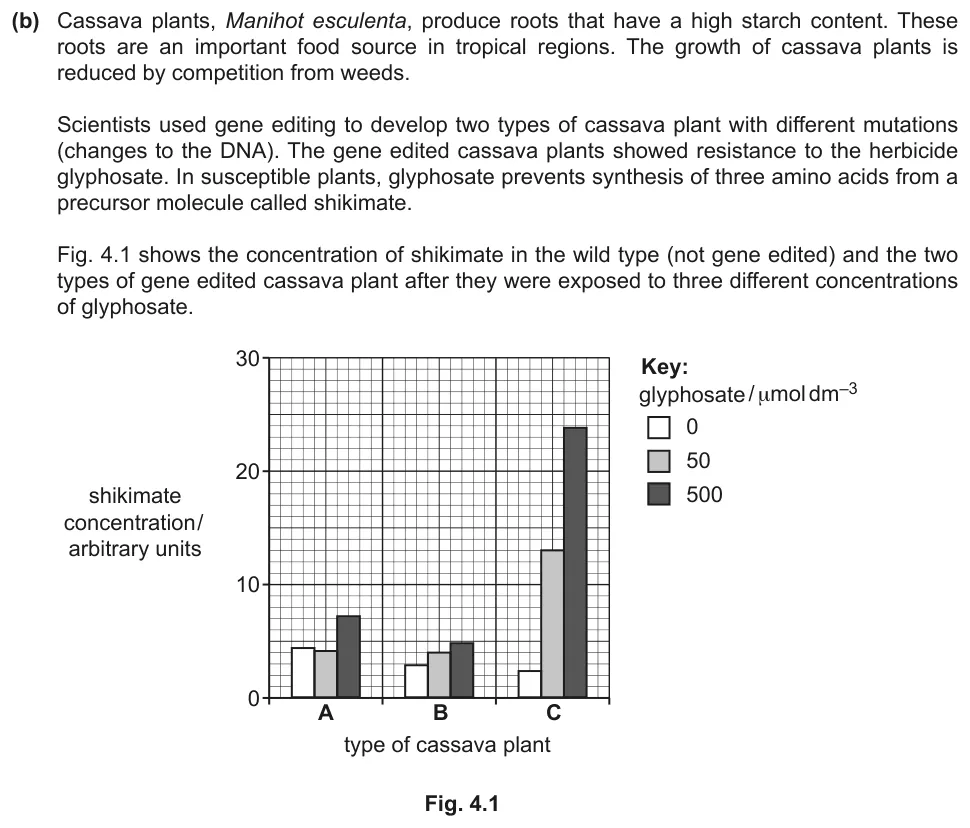
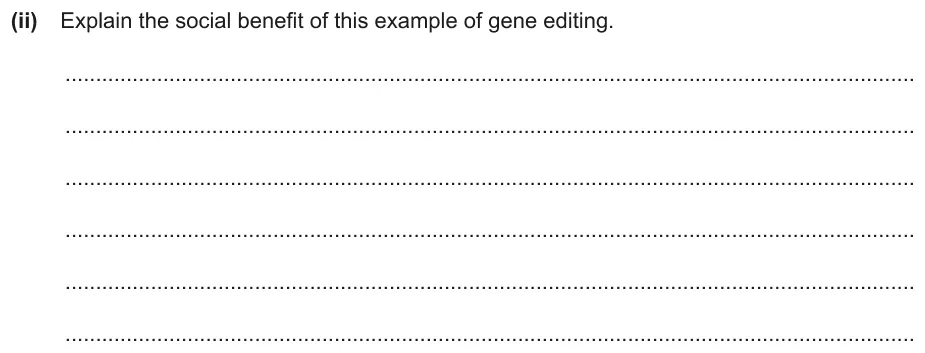
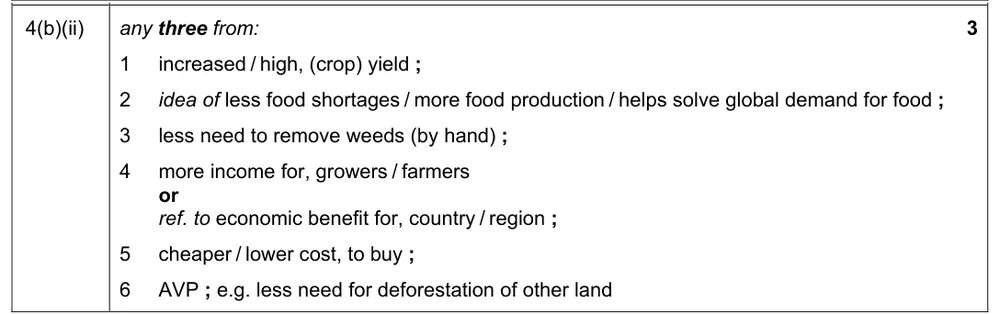
Explain the social benefit of gene editing cassava plants to be resistant to glyphosate.
Information from earlier in this question:

Show the mark scheme
Tap an image to open it full size.
From the examiners' report: A common misconception was that less weed killer would be needed: this gene editing lets herbicide be used, because the crop is now resistant to it. The question asked for social benefits, so ethical issues and effects on biodiversity did not answer it.
Insect resistance (19.3.1)
Question 7
Paper 4 · February/March 2019 (42) · Q5(b)(i) · 2 marks · Easy
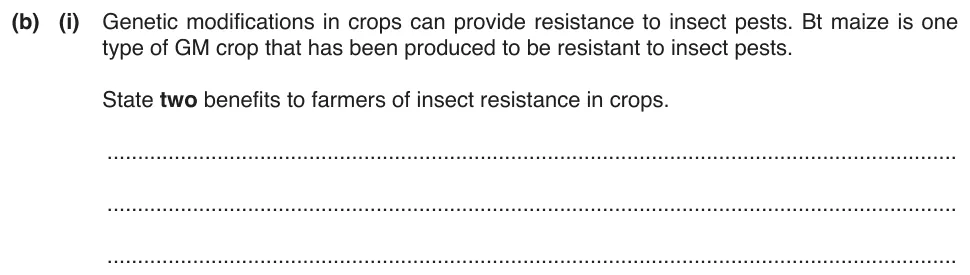
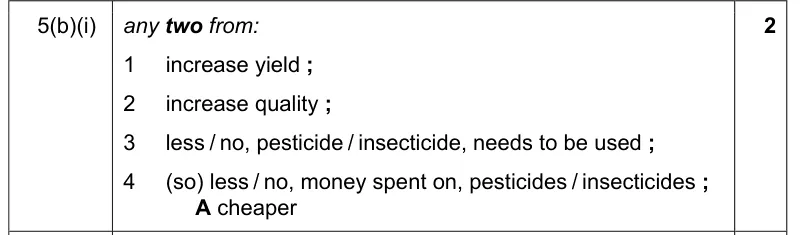
State two benefits to farmers of insect resistance in crops.
Show the mark scheme
Tap an image to open it full size.
From the examiners' report: Nearly all could recall the benefits. A few said that herbicides would not be needed, confusing insect resistance with herbicide resistance.
Question 8
Paper 4 · February/March 2019 (42) · Q5(b)(ii) · 2 marks · Easy
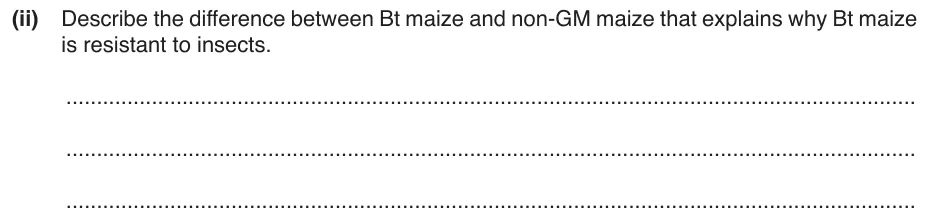
Describe the difference between Bt maize and non-GM maize that makes Bt maize resistant to insects.
Show the mark scheme

Tap an image to open it full size.
From the examiners' report: Most only reworded the question, or implied that the gene is toxic: it is the protein the gene codes for that harms insects. Very few knew the source of the inserted gene.
Question 9
Paper 4 · May/June 2021 (42) · Q3(b)(ii) · 2 marks
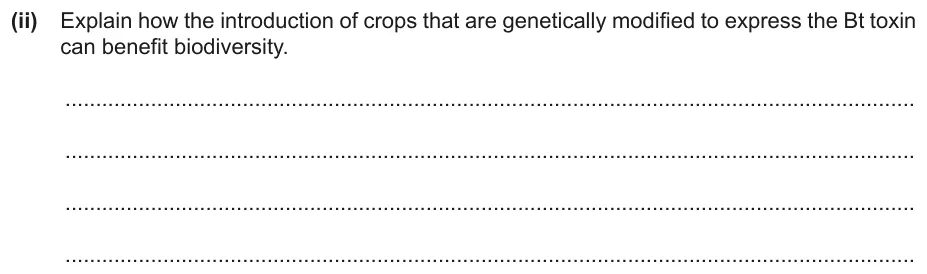
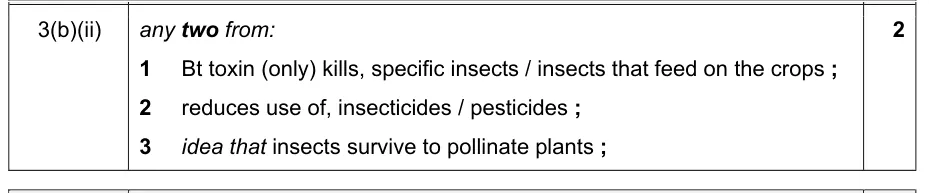
Explain how crops genetically modified to express the Bt toxin can benefit biodiversity.
Information from earlier in this question:

Show the mark scheme
Tap an image to open it full size.
From the examiners' report: Only the insect pests that eat the crop are killed by the Bt toxin, so pesticides are not needed. Many answers were wrongly about the survival of the crop plants, or their hybridisation with other plants. Very few mentioned that insect pollinators survive.
Question 10
Paper 4 · October/November 2023 (41) · Q4(b) · 3 marks
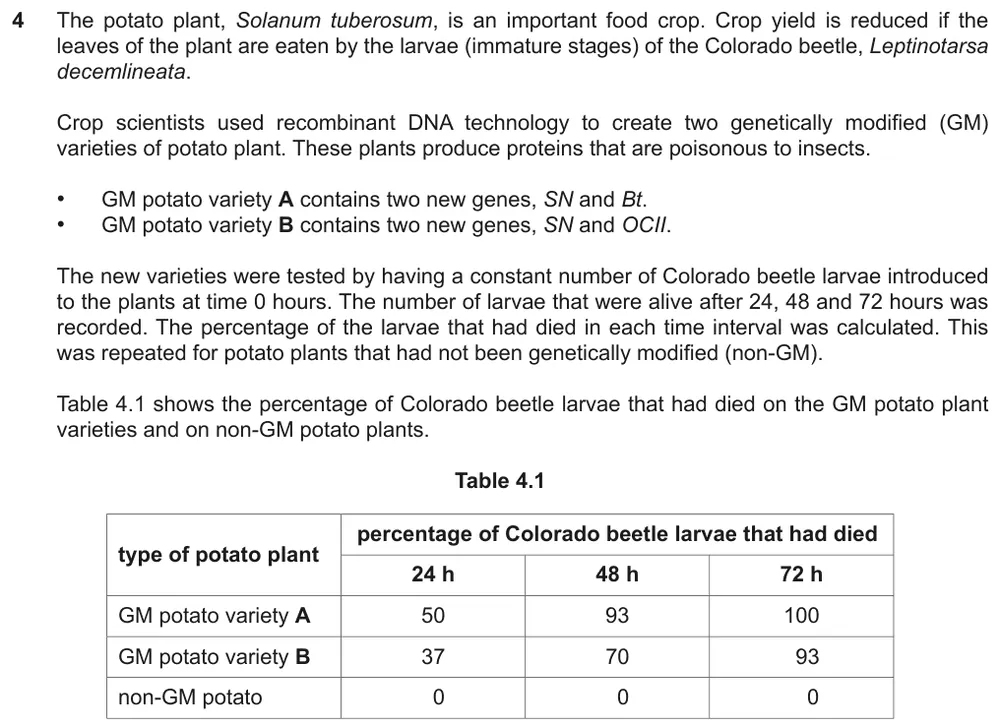
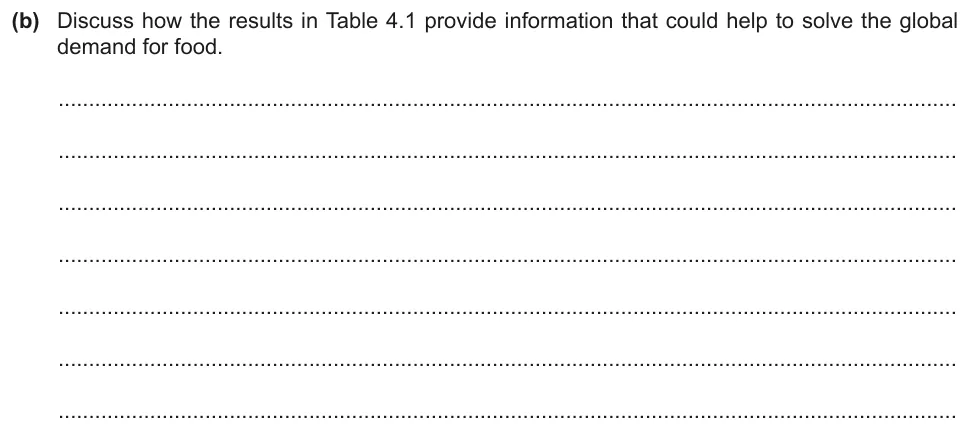
Discuss how the results for two GM potato varieties could help to solve the global demand for food.
Information from earlier in this question:
Show the mark scheme

Tap an image to open it full size.
From the examiners' report: Use Table 4.1: refer to varieties A and B and say that they are GM. Most answers covered only one or two of the three points. The weakest ignored the table and listed benefits of GM from memory.
Other GM and gene-edited crops (19.3.1)
Question 11
Paper 4 · May/June 2022 (43) · Q4(b)(ii) · 3 marks · Hard
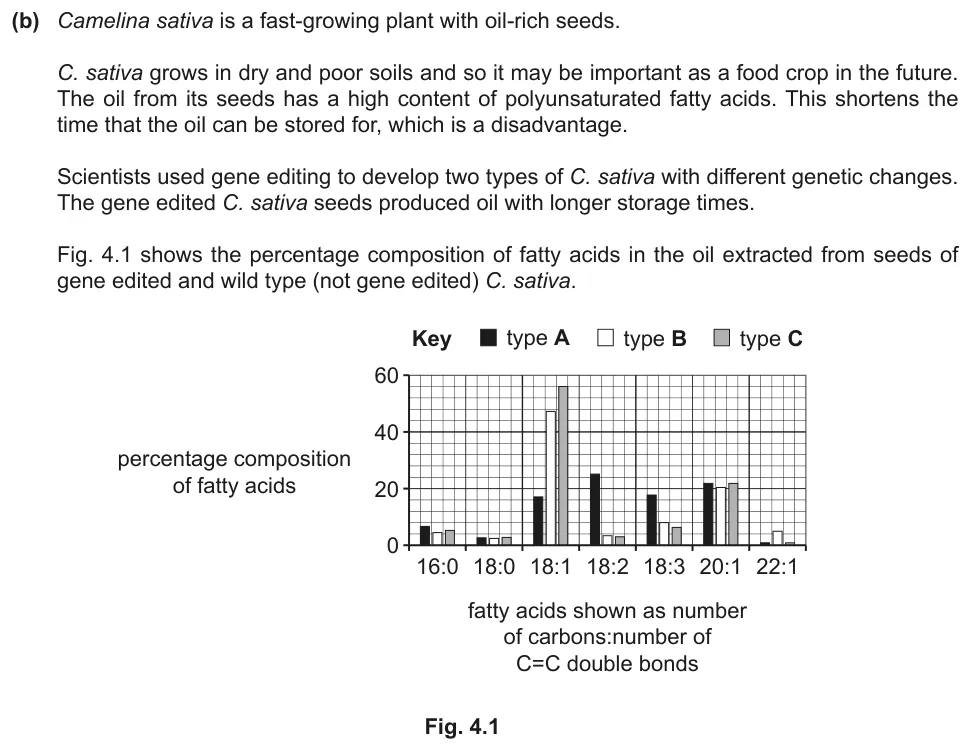
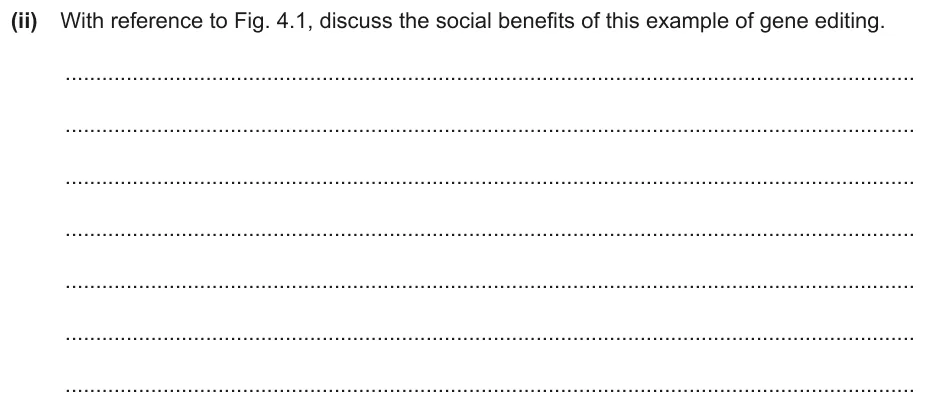
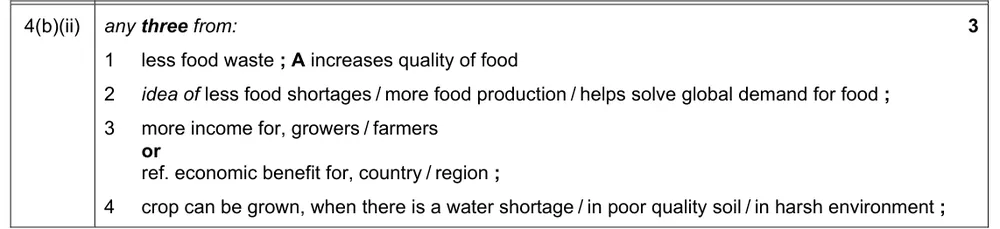
Use the graph to discuss the social benefits of gene editing an oil-seed crop.
Information from earlier in this question:

Show the mark scheme
Tap an image to open it full size.
From the examiners' report: Students of all abilities found this difficult. Most said the crop could be grown in harsh environments, such as areas short of water. Few said that longer storage times mean less food waste, or that the crop would help to solve the global demand for food.
Ethical and social implications of GMOs (19.3.2)
Question 12
Paper 4 · February/March 2019 (42) · Q5(a)(i) · 2 marks · Easy
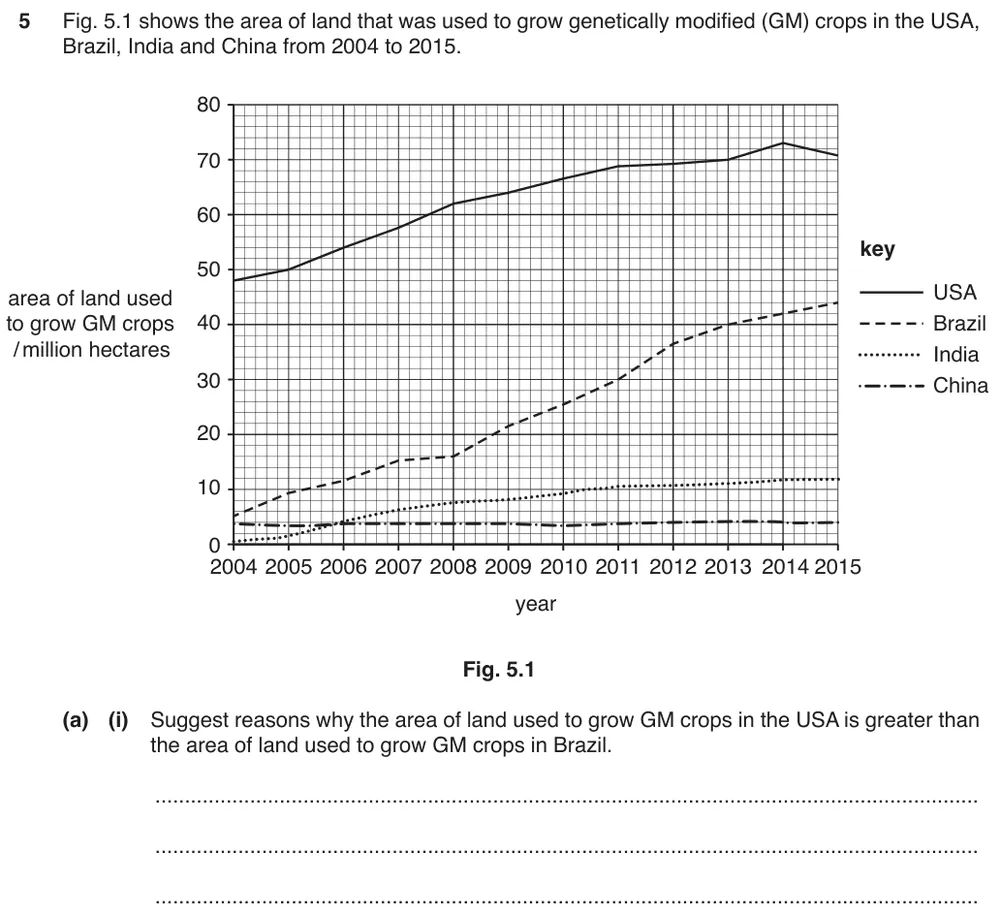
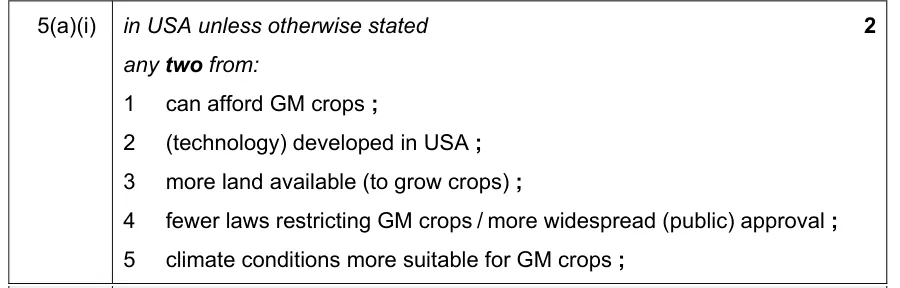
Suggest reasons why more land is used to grow GM crops in the USA than in Brazil.
Show the mark scheme
Tap an image to open it full size.
From the examiners' report: Most suggested at least one valid reason. A few described the trend in the graph instead of answering the question.
Question 13
Paper 4 · February/March 2019 (42) · Q5(c)(i) · 2 marks
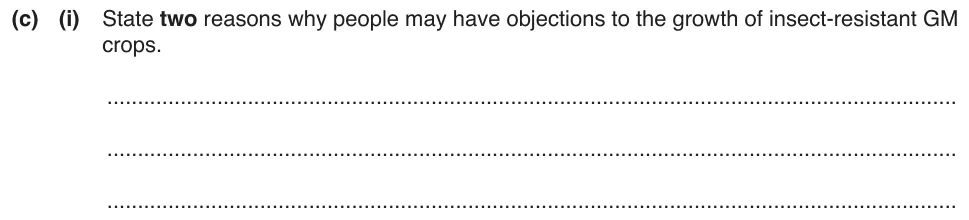
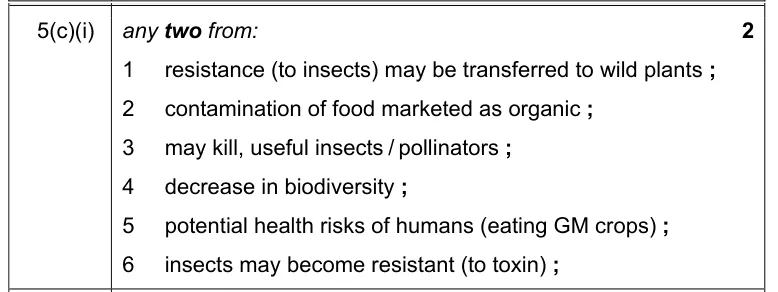
State two reasons why people may object to the growth of insect-resistant GM crops.
Show the mark scheme
Tap an image to open it full size.
From the examiners' report: Most gave a concern about human health, but few had a second reason. 'Superweeds', undesirable effects on the crop and moral beliefs were too vague on their own: say what the problem is.
Question 14
Paper 4 · February/March 2019 (42) · Q5(c)(ii) · 1 mark · Easy
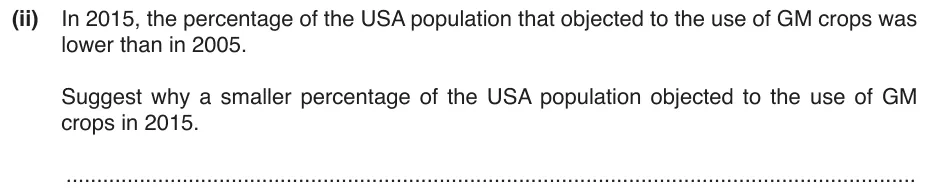
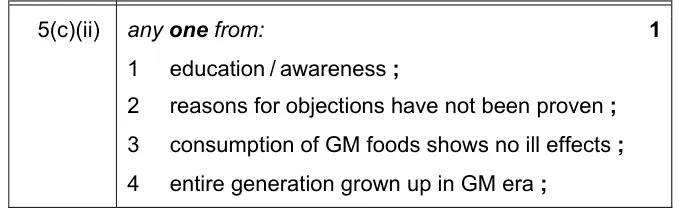
Suggest why fewer people in the USA objected to GM crops in 2015 than in 2005.
Show the mark scheme
Tap an image to open it full size.
From the examiners' report: Most made reasonable suggestions, often about the benefits of GM crops. A few repeated their answer to (c)(i), which did not answer the question.
Question 15
Paper 4 · May/June 2019 (42) · Q3(b) · 5 marks
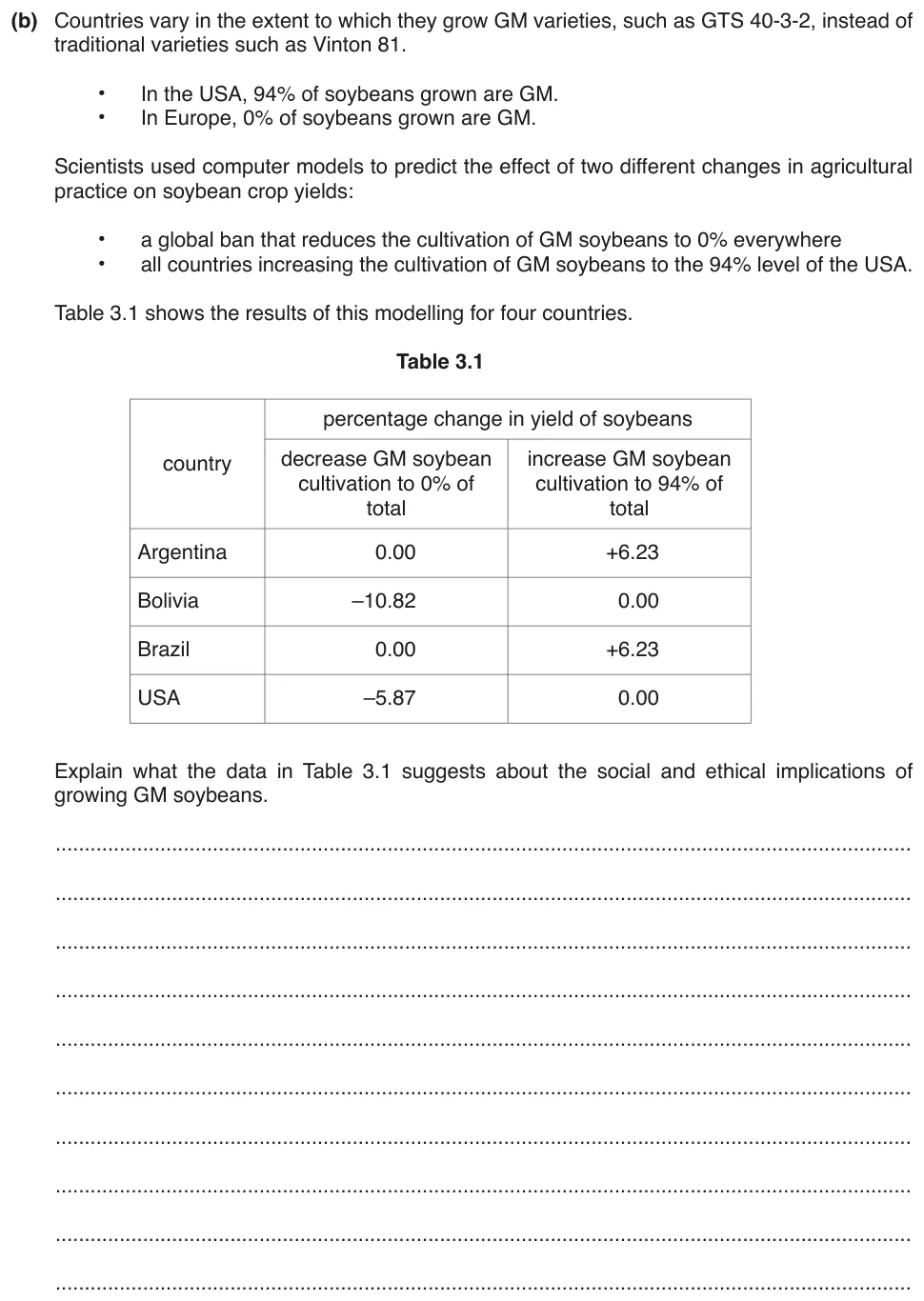
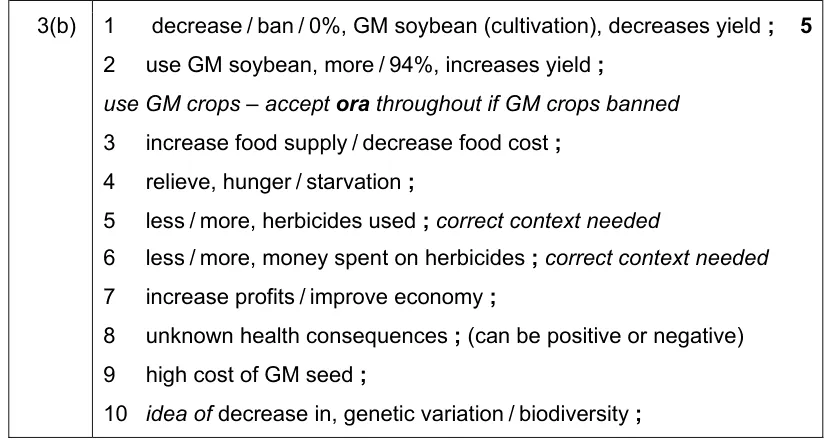
Explain what the modelled yields suggest about the social and ethical implications of growing GM soybeans.
Information from earlier in this question:

Show the mark scheme
Tap an image to open it full size.
From the examiners' report: This was found demanding, and the table was often misread. Do not try to explain the figures: say what a higher or lower yield means for food supply, cost, profit or herbicide use. Other answers ignored the data and discussed the topic in general.
Question 16
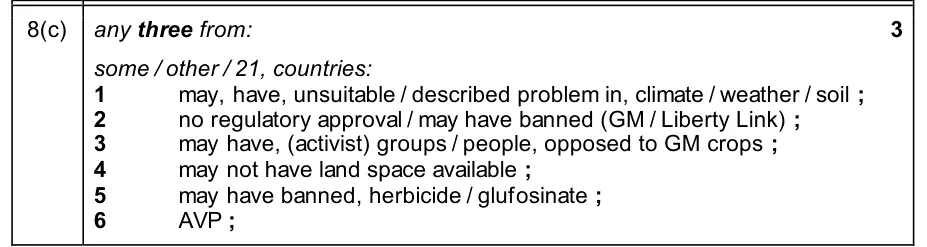
Paper 4 · October/November 2025 (41) · Q8(c) · 3 marks
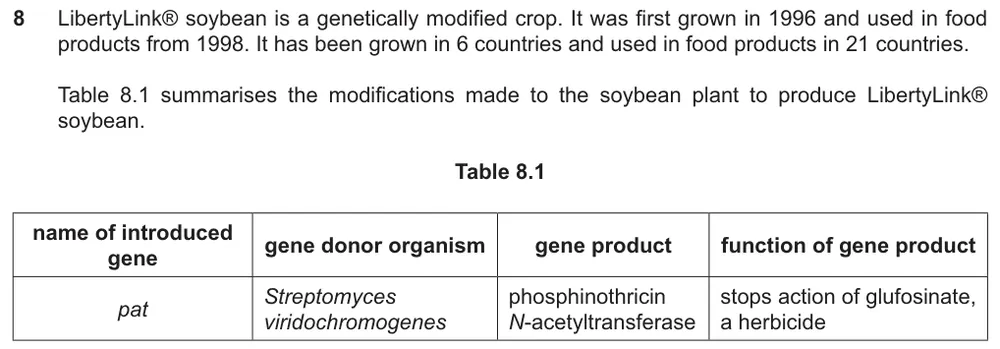
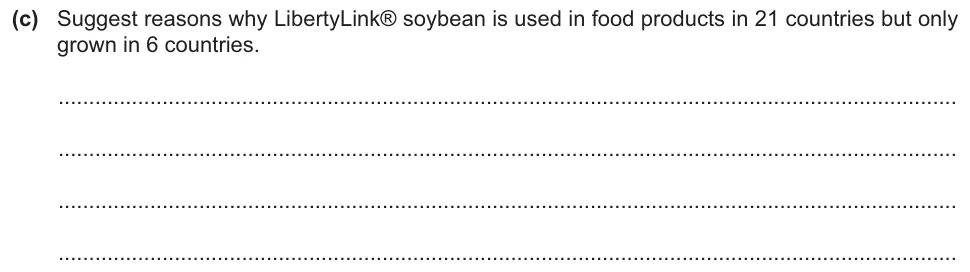
Suggest why LibertyLink soybean is used in food products in 21 countries but grown in only 6.
Information from earlier in this question:
Show the mark scheme
Tap an image to open it full size.
Question 17
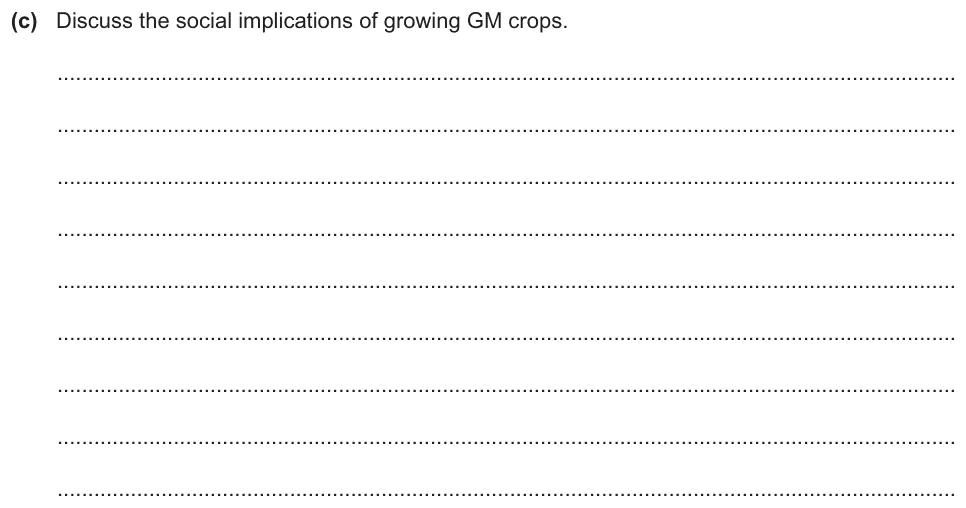
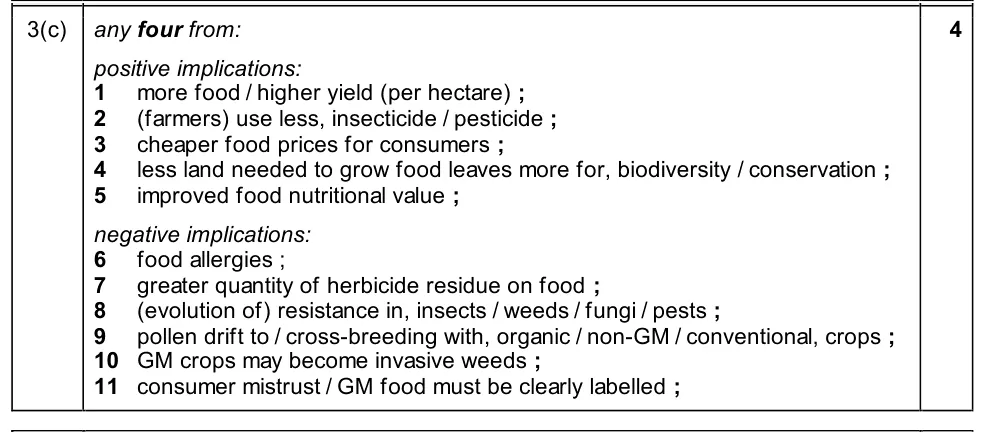
Paper 4 · October/November 2025 (44) · Q3(c) · 4 marks
Discuss the social implications of growing GM crops.
Show the mark scheme
Tap an image to open it full size.
Question 18
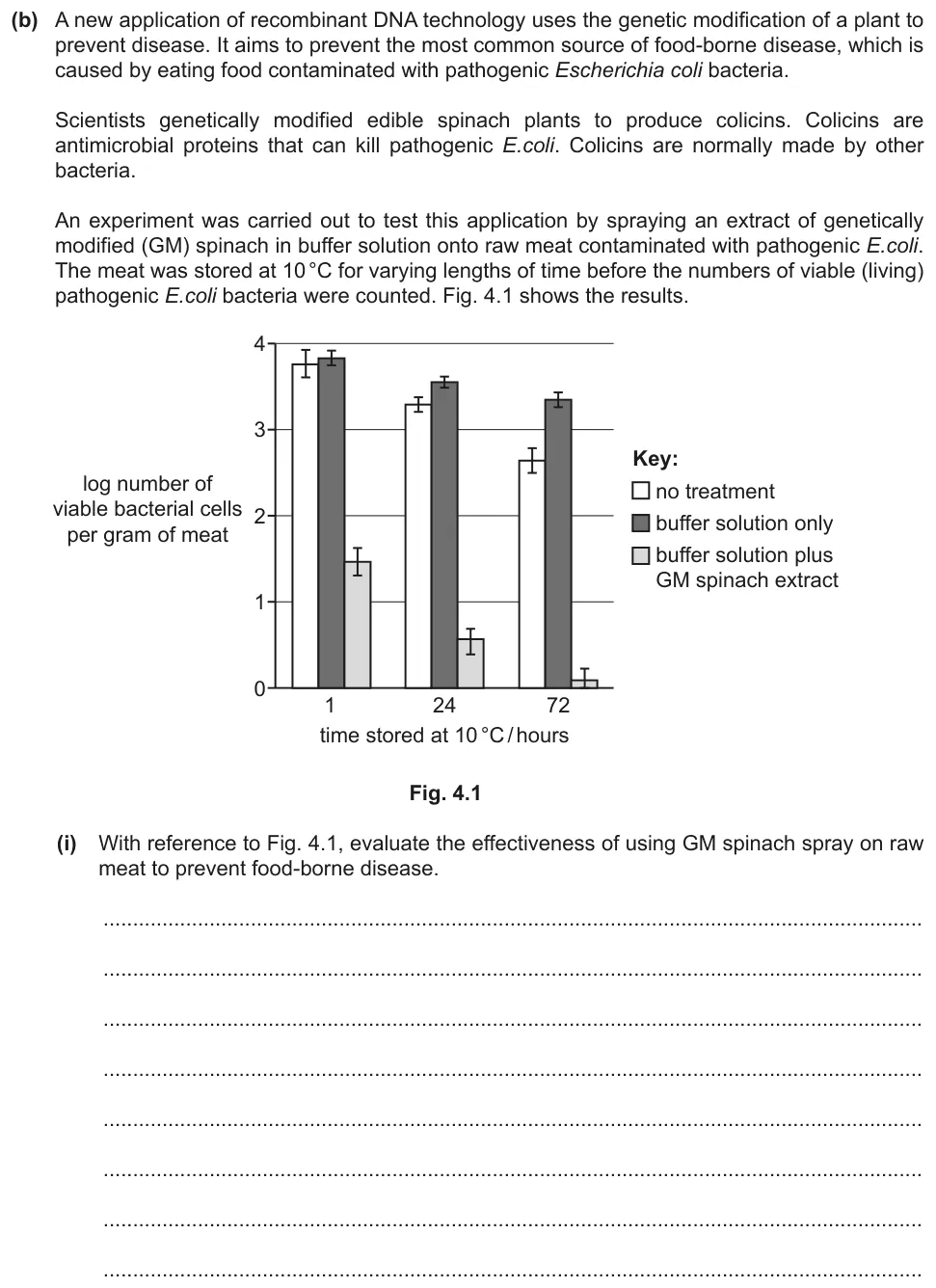
Paper 4 · May/June 2021 (42) · Q4(b)(i) · 4 marks
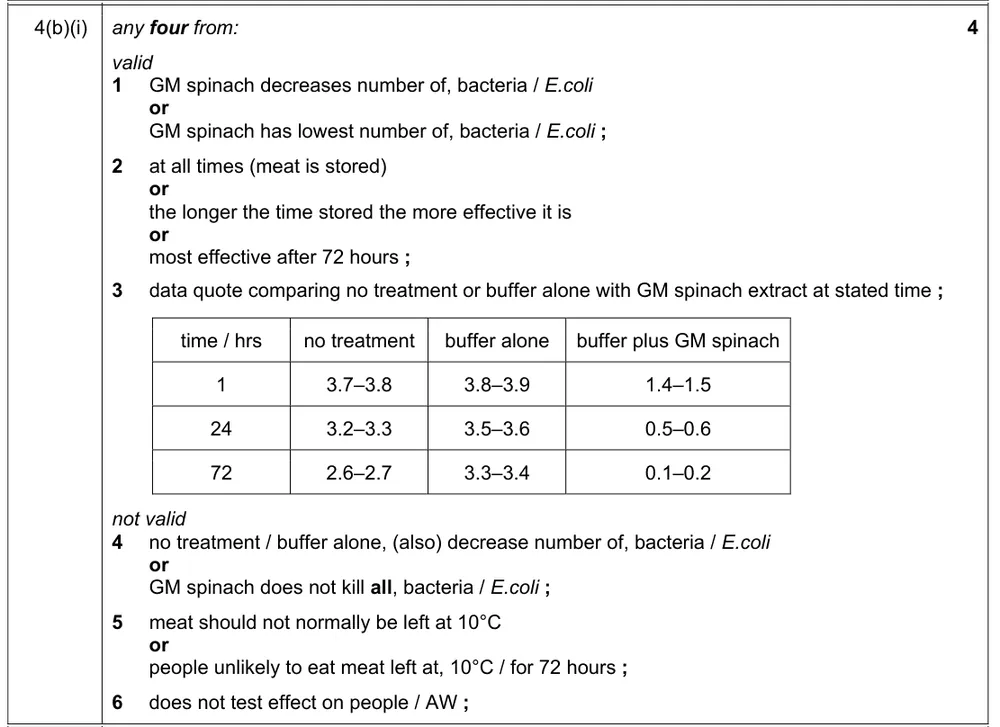
Use the graph to evaluate how effective GM spinach spray is at preventing food-borne disease.
Show the mark scheme
Tap an image to open it full size.
From the examiners' report: Compare the GM spinach extract with no treatment or buffer alone at a stated time: many quoted only the spinach figures over time. Few gave reasons why the results may not be valid, such as the number of bacteria also falling with no treatment, or the effect on people not being tested.
Question 19
Paper 4 · May/June 2021 (42) · Q4(b)(ii) · 3 marks
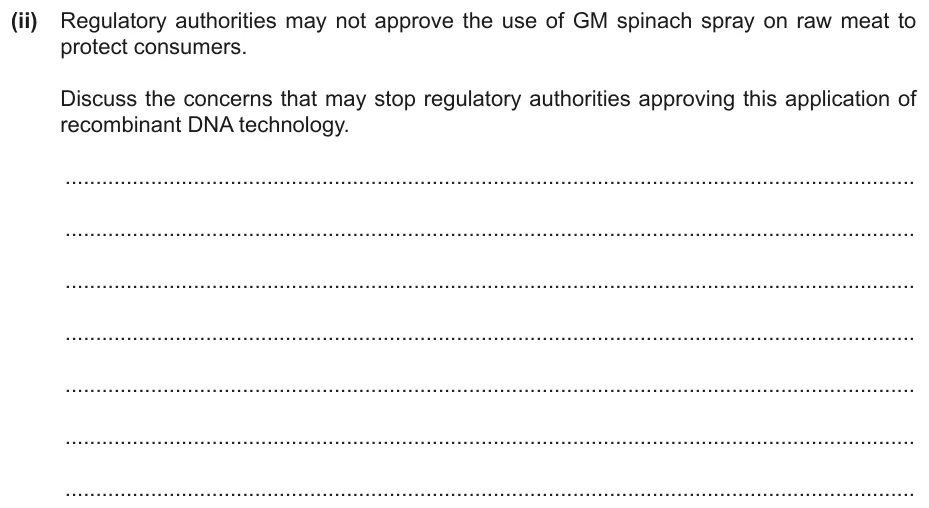
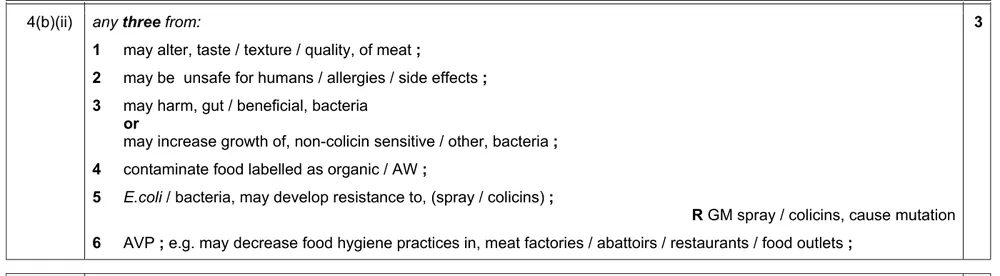
Discuss the concerns that may stop regulatory authorities approving the GM spinach spray.
Show the mark scheme
Tap an image to open it full size.
From the examiners' report: Most gave allergies or side effects, and many said the bacteria could become resistant to colicins. Fewer mentioned the taste or quality of the meat, or the effect on beneficial bacteria in the gut. Religious or moral objections with no context, and the cost of the treatment, gained no credit.
Question 20
Paper 4 · February/March 2021 (42) · Q3(b) · 4 marks · Easy
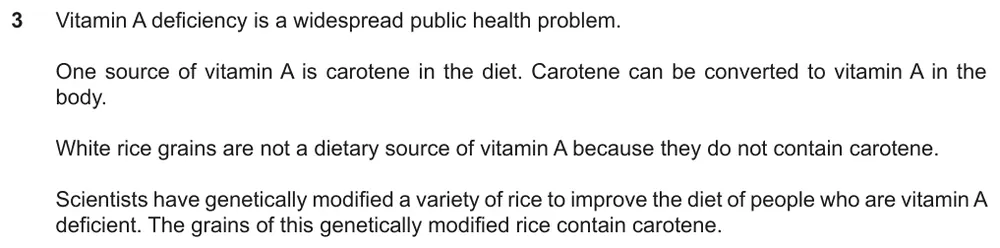
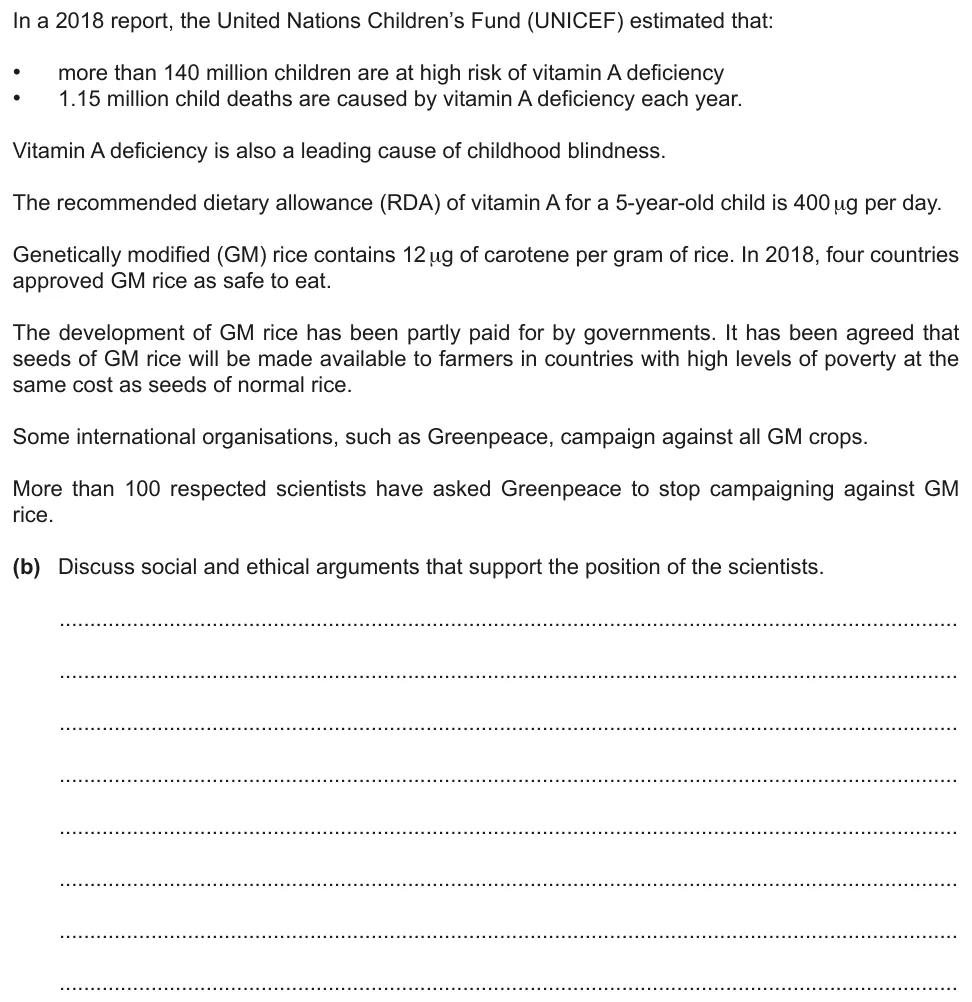
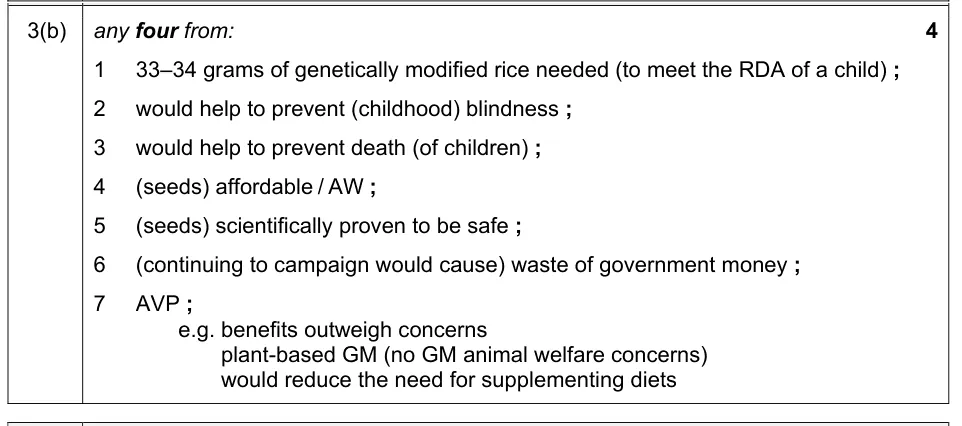
Discuss social and ethical arguments that support the scientists who want campaigning against GM rice to stop.
Information from earlier in this question:
Show the mark scheme
Tap an image to open it full size.
From the examiners' report: The question asks for arguments that support the scientists; some wrote only about concerns over GM crops. A simple calculation showed that a small quantity of GM rice can provide a child's recommended dietary allowance.
Question 21
Paper 4 · October/November 2020 (42) · Q2(d) · 2 marks
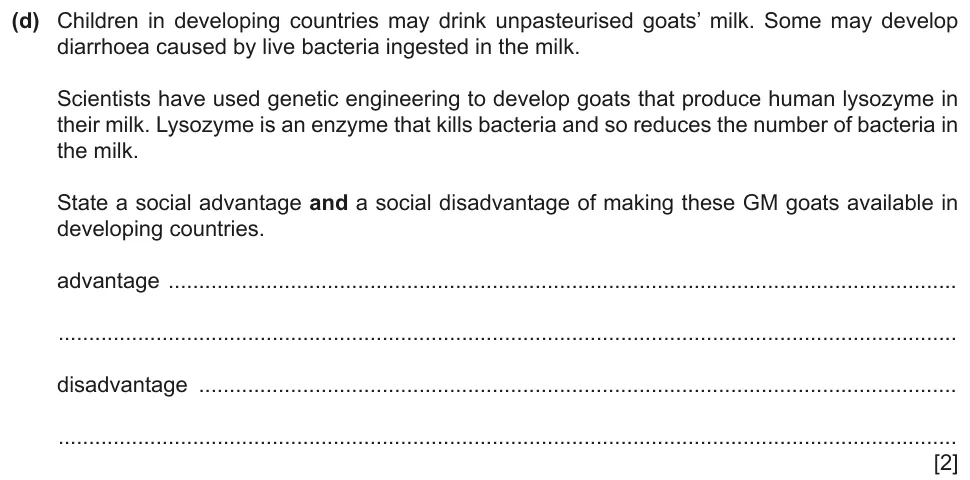
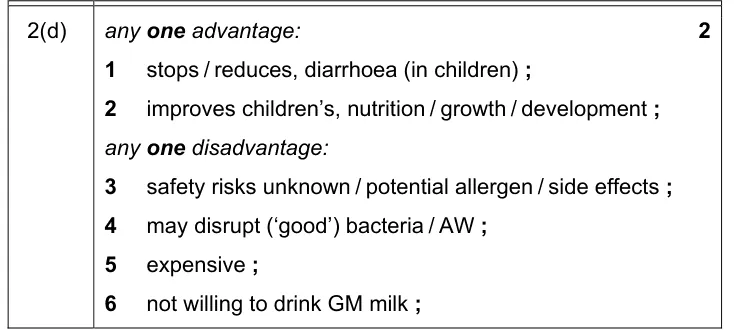
State a social advantage and a social disadvantage of making GM goats available in developing countries.
Show the mark scheme
Tap an image to open it full size.
From the examiners' report: 'Reducing infections and diseases' was too vague: say that it reduces diarrhoea. The disadvantage should be one caused by the milk; some mistakenly said that the goats were too expensive.
Question 22
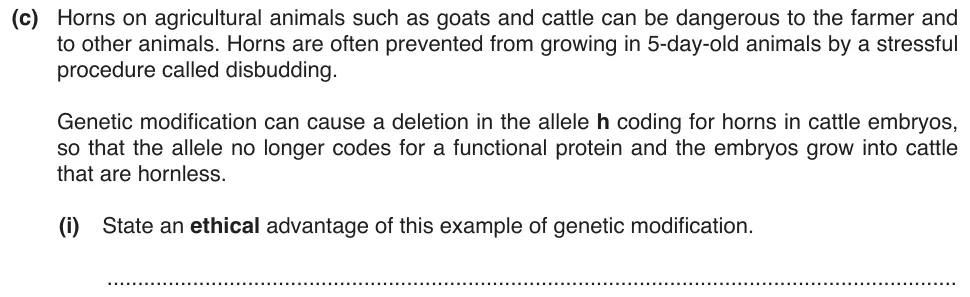
Paper 4 · October/November 2018 (42) · Q3(c)(i) · 1 mark
State an ethical advantage of genetically modifying cattle to be hornless.
Show the mark scheme

Tap an image to open it full size.
From the examiners' report: Many said that it removes the need for the stressful disbudding procedure on young animals. Some instead suggested that it would protect the farmer or other animals from injury.
Where students lose marks (from Cambridge examiners' reports and mark schemes)
Each point below comes from the examiners' reports and mark schemes, and is followed by wording that gained marks.
Resistant crops are still sprayed. Students said that a herbicide-resistant crop needs no herbicide, so the farmer saves money, or wrote about pests.
✔ Gains credit: the farmer 'can use herbicides', so there is 'less competition' and an 'increase in yield'.
Insect resistance is not herbicide resistance. Students said that herbicides would not be needed for an insect-resistant crop.
✔ Gains credit: 'increase yield', 'increase quality', and 'less insecticide needs to be used', so 'less money spent on insecticides'.
The toxin is a protein, not the gene. Students reworded the question, or implied that the inserted gene itself is toxic, and did not know where the gene came from.
✔ Gains credit: Bt maize 'contains gene from Bacillus thuringiensis' and 'produces Bt toxin' that is 'harmful to insects'.
Genetic engineering is not selective breeding. Students described selective breeding, or left out the source of the gene, how it was introduced and the fact that it is expressed.
✔ Gains credit: 'gene from another species', 'restriction enzyme', 'plasmid' or 'vector', 'introduced into soybean cells', then the 'gene' is 'expressed' to produce a 'protein resistant to glyphosate'.
Bt toxin kills only the pests. Students wrote about the survival of the crop plants, or about the crop forming hybrids with other plants.
✔ Gains credit: 'Bt toxin only kills insects that feed on the crops', which 'reduces use of insecticides', so 'insects survive to pollinate plants'.
Name the varieties in the table. Students ignored the table and listed general benefits of GM crops from memory, without referring to A or B.
✔ Gains credit: 'A and B kill larvae', 'GM increases yield of potatoes' and 'A is best' or 'kills most'.
Say what the yield change means. Students tried to explain the figures in the table, misread them, or ignored the data.
✔ Gains credit: a ban on 'GM soybean' 'decreases yield'; growing more would 'increase food supply', 'decrease food cost', 'relieve hunger' and 'increase profits'.
Quote the treatment against no treatment. Students quoted figures for the GM spinach extract over time without comparing them with no treatment or buffer alone, and gave no reasons why the results might not be valid.
✔ Gains credit: 'GM spinach has lowest number of bacteria' 'at all times', with a 'data quote comparing no treatment or buffer alone with GM spinach extract at stated time'; but it 'does not kill all bacteria' and 'does not test effect on people'.
Download the questions
Download the PDF pack (22 questions, mark schemes at the end)
Keep practising
- Principles of Genetic Technology (19.1): Cambridge (CIE) exam questions by topic
- Genetic Technology Applied to Medicine (19.2): Cambridge (CIE) exam questions by topic
- Cambridge (CIE) A level Biology 9700 past papers, mark schemes and examiners' reports
- Cambridge (CIE) A level Biology grade thresholds
- Book a one-to-one CIE lesson or a free 15-minute discovery chat with Tom
- Register your interest in a CIE A level Biology group class
Questions, mark schemes and examiners' report extracts © Cambridge University Press & Assessment.