

Genetic Technology Applied to Medicine (19.2): Cambridge (CIE) A Level Biology 9700 Exam Questions by Topic
Genetic technology applied to medicine is sub-topic 19.2 of Topic 19, Genetic technology, in the Cambridge International AS & A Level Biology syllabus (9700). You need to explain the advantages of treating disease with recombinant human proteins (insulin, factor VIII and adenosine deaminase), outline the advantages of genetic screening for breast cancer (BRCA1 and BRCA2), Huntington's disease and cystic fibrosis, outline how gene therapy is used to treat severe combined immunodeficiency (SCID) and inherited eye diseases, and discuss the social and ethical considerations of screening and gene therapy. This is A level content, examined on Paper 4.
The examiners' reports return to the same points. A recombinant human protein is identical to the human one, so write that there is no immune response and no risk of disease transmission, not 'less'. Gene therapy adds a normal allele to chosen cells, such as stem cells that are removed, treated and returned; it does not replace an allele, and the virus is not simply given to the patient. Link the risks of a viral vector to DNA being inserted at random into the host cell's DNA. For screening, give specific actions that follow a result, and remember that Huntington's disease has no treatment. In ethics questions, write about the disease in the question and avoid vague comments about 'playing God'.
Studying Cambridge International A level Biology and want more help? Tom teaches CIE students one-to-one online, including students in the UAE, Saudi Arabia, Hong Kong, India and Indonesia, and every lesson is recorded. You can book a one-to-one lesson or a free 15-minute discovery chat, or register your interest in a CIE group class starting in September 2027, using the links at the bottom of this page.
What you need from AS Level
Each question on this page assumes you're secure on these ideas. If any of them feels shaky, look it up before you start.
- A gene is a sequence of nucleotides in DNA that codes for a polypeptide, and a gene mutation can change the amino acid sequence and so the structure and function of the protein (Topic 6).
- Stem cells divide by mitosis, and each daughter cell receives an identical copy of the DNA (Topic 5).
- Non-self antigens trigger an immune response, in which antibodies are produced (Topic 11).
- A virus is not a cell: it has a nucleic acid core surrounded by a protein coat (Topic 1).
Key terms
These words come up in the questions and mark schemes. Examiners expect you to use them exactly.
- Recombinant human protein: a human protein, such as insulin, made by genetically modified cells (for example bacteria or yeast) that carry the human gene.
- Factor VIII: a blood-clotting protein; recombinant human factor VIII is used to treat haemophilia.
- Adenosine deaminase (ADA): an enzyme that is especially active in lymphocytes; a mutation in the ADA gene is one cause of SCID.
- Severe combined immunodeficiency (SCID): a genetic disease in which a person has too few working lymphocytes, so they suffer repeated infections.
- Genetic screening: testing a person's DNA, or an embryo's or fetus's DNA, for a particular allele, such as a mutation in BRCA1 or BRCA2.
- Gene therapy: treating a genetic disease by delivering a normal (functional) allele into the target cells of the person.
- Vector: something that carries DNA into a cell; in gene therapy it is usually a virus.
- Tumour suppressor protein: a protein, such as the product of BRCA1, that helps to repair damaged DNA or triggers the death of a cell whose DNA cannot be repaired.
What these questions cover (Cambridge 9700 Topic 19: Genetic technology)
The questions test these learning outcomes from sub-topic 19.2 of the Cambridge International AS & A Level Biology syllabus (9700) for 2025 to 2027.
- 19.2.1 explain the advantages of using recombinant human proteins to treat disease, using the examples insulin, factor VIII and adenosine deaminase
- 19.2.2 outline the advantages of genetic screening, using the examples of breast cancer
- 19.2.3 outline how genetic diseases can be treated with gene therapy, using the examples severe combined immunodeficiency
- 19.2.4 discuss the social and ethical considerations of using genetic screening and gene therapy in medicine
How to use this page
Write your answer on paper before you open the mark scheme. Allow about 1.2 minutes per mark: the 22 questions are worth 63 marks, so about 76 minutes in total. Then mark your answer strictly against the mark scheme and read the examiners' tip underneath it. If you'd rather print the questions, download the PDF pack.
Recombinant human proteins (19.2.1)
Question 1
Paper 4 · October/November 2019 (42) · Q3(a) · 4 marks
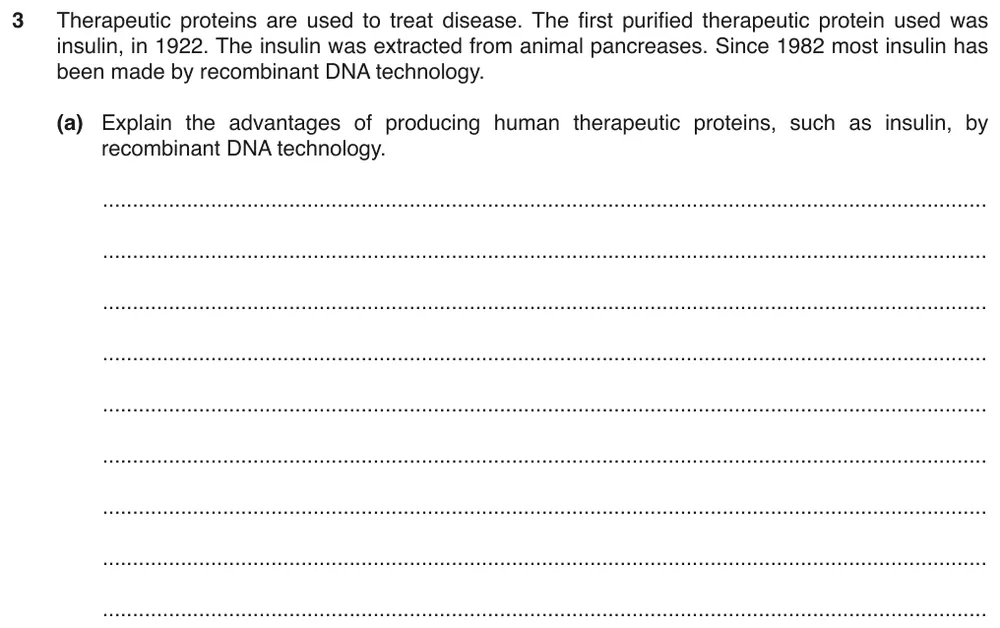
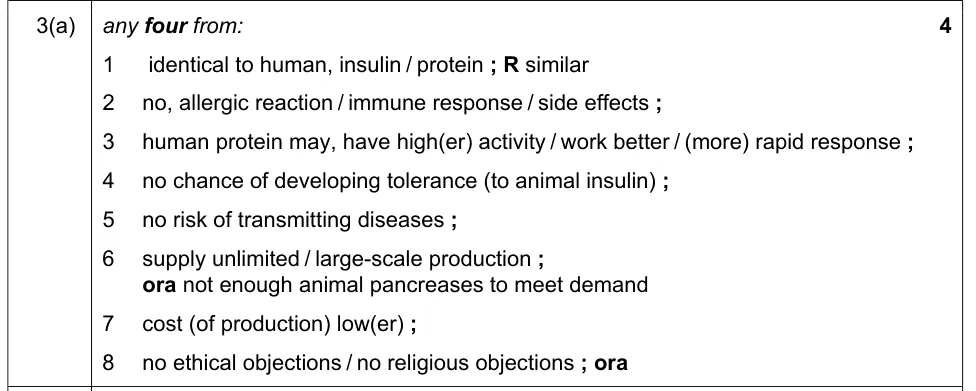
Explain the advantages of producing human therapeutic proteins, such as insulin, by recombinant DNA technology.
Show the mark scheme
Tap an image to open it full size.
From the examiners' report: 'Less immune response' and 'less risk of disease transmission' were not credited, because with the recombinant protein there is none. Few mentioned that tolerance does not develop. Describing how the insulin gene is inserted into plasmids was not required.
Question 2
Paper 4 · February/March 2022 (42) · Q5(a)(i) · 1 mark · Easy
Name the disease that is treated with recombinant human factor VIII.

Show the mark scheme

Tap an image to open it full size.
From the examiners' report: Most named the disease correctly. A few wrongly gave Huntington's disease.
Question 3
Paper 4 · February/March 2022 (42) · Q5(a)(ii) · 2 marks · Easy
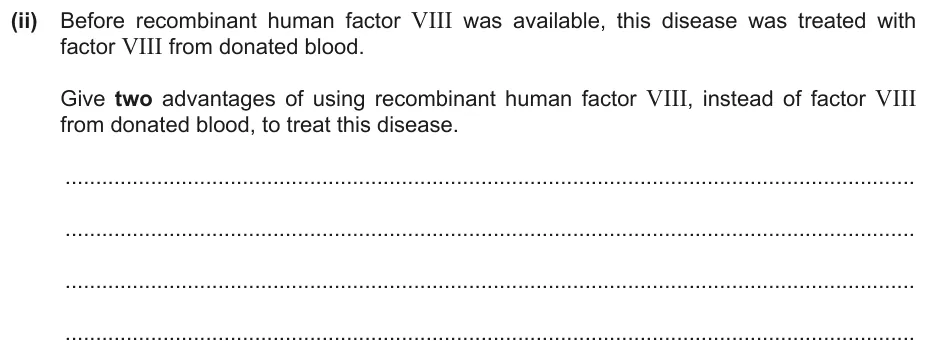
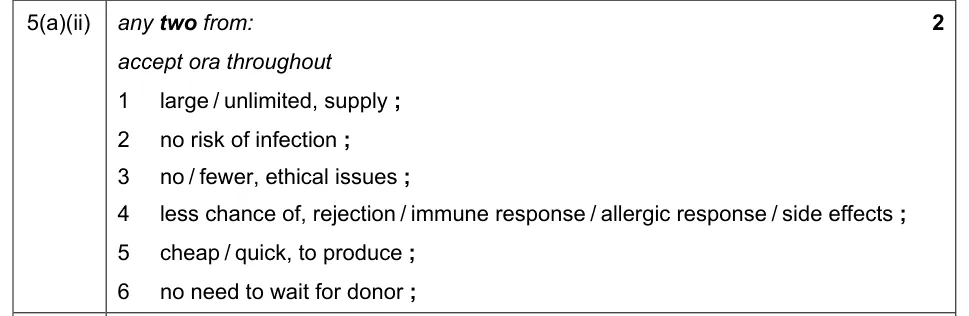
Give two advantages of recombinant human factor VIII over factor VIII from donated blood.
Show the mark scheme
Tap an image to open it full size.
From the examiners' report: Most gave medical reasons, such as a lower risk of disease transmission or fewer problems with immune responses. Some answers were too vague, only saying that it could be produced in large quantities or was easily available.
Question 4
Paper 4 · May/June 2023 (43) · Q4(a) · 3 marks · Easy
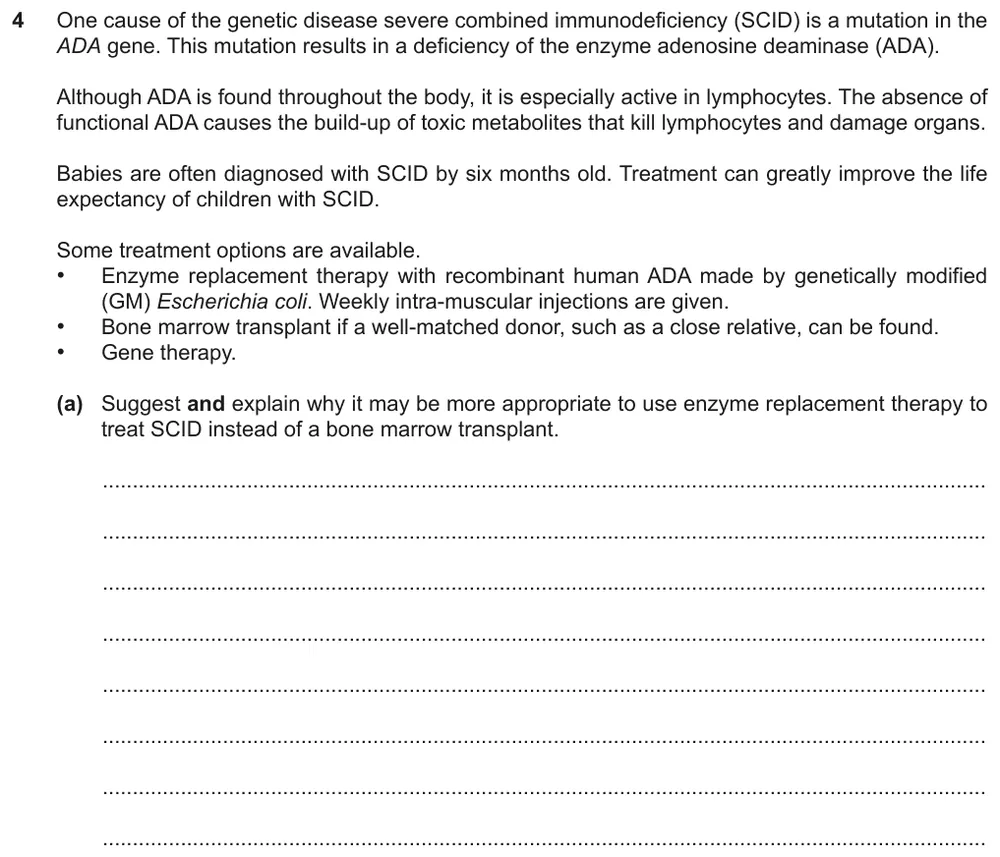
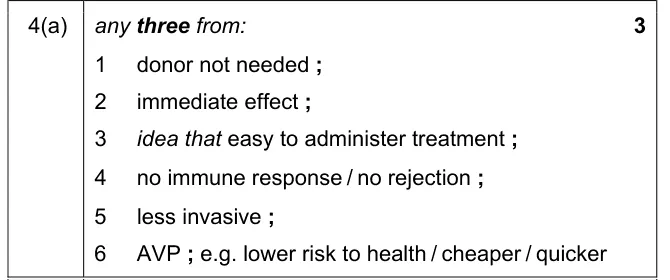
Suggest and explain why enzyme replacement therapy with recombinant ADA may be more appropriate than a bone marrow transplant.
Show the mark scheme
Tap an image to open it full size.
Question 5
Paper 4 · May/June 2021 (42) · Q4(a) · 2 marks · Hard
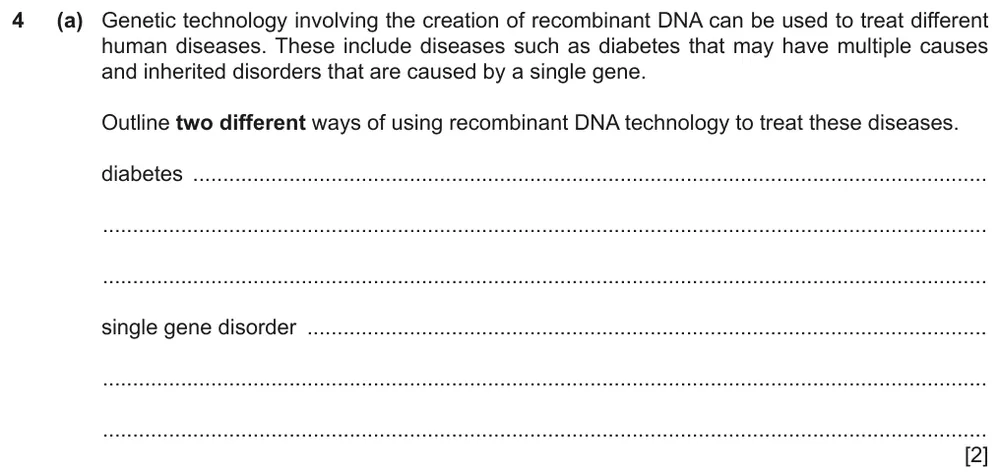
Outline how recombinant DNA technology is used to treat diabetes and to treat a single gene disorder.
Show the mark scheme

Tap an image to open it full size.
From the examiners' report: For diabetes, describing vectors was not enough: say that the insulin is made by genetically modified bacteria. For the single gene disorder, 'gene therapy' gained the mark, but many lost it by adding wrong detail, such as a functional allele replacing a gene or allele.
Genetic technology in medicine (19.2.1, 19.2.2 and 19.2.3)
Question 6
Paper 4 · October/November 2023 (41) · Q10 · 7 marks
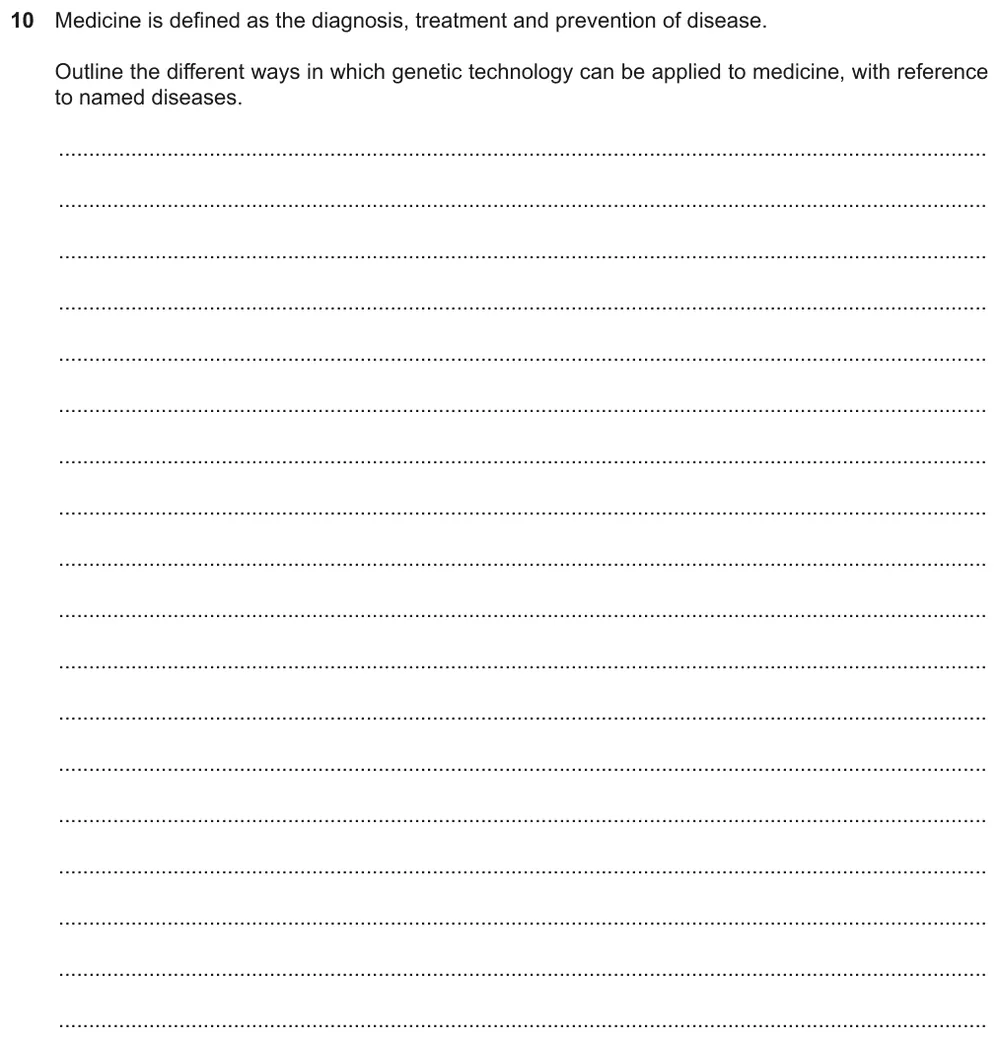
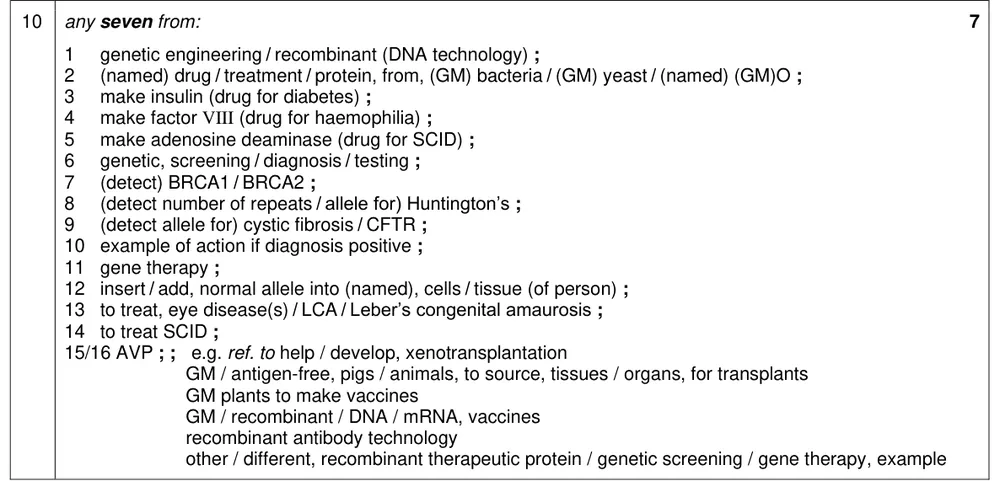
Outline the different ways in which genetic technology can be applied to medicine, with named diseases.
Show the mark scheme
Tap an image to open it full size.
From the examiners' report: Most credit came from naming diseases that can be screened for and saying what people might do after a positive test. Be specific about gene therapy: say which human cells receive the normal allele. Many wrongly assumed that any or all cells in the body, or in an unborn fetus, can simply be edited.
Genetic screening (19.2.2)
Question 7
Paper 4 · May/June 2024 (42) · Q5(a) · 4 marks · Hard
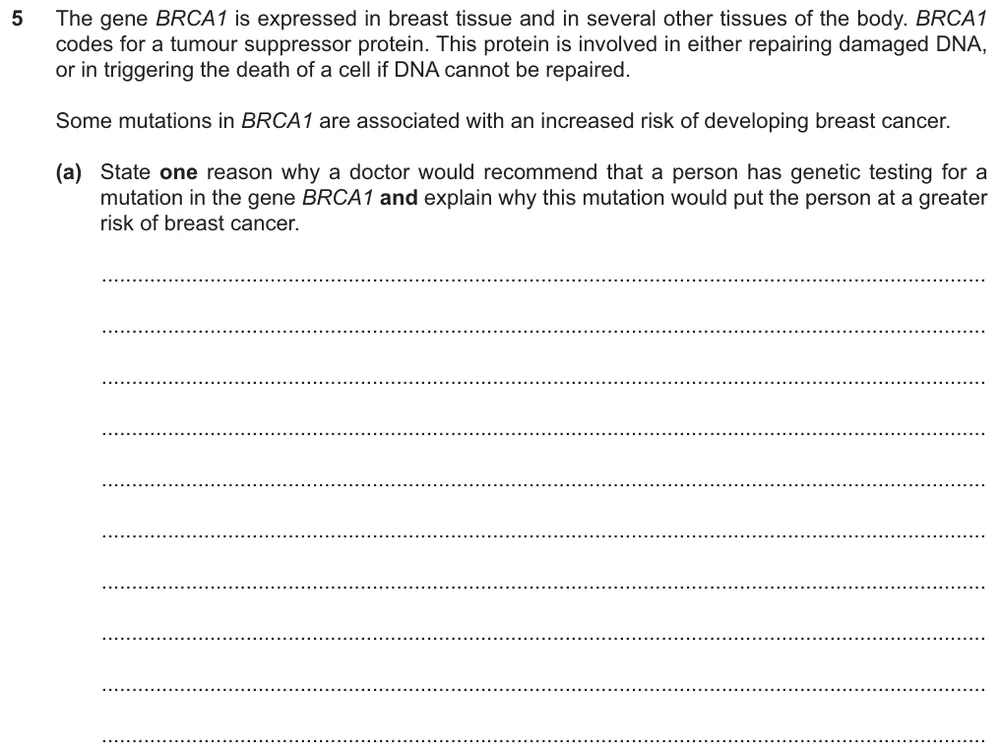
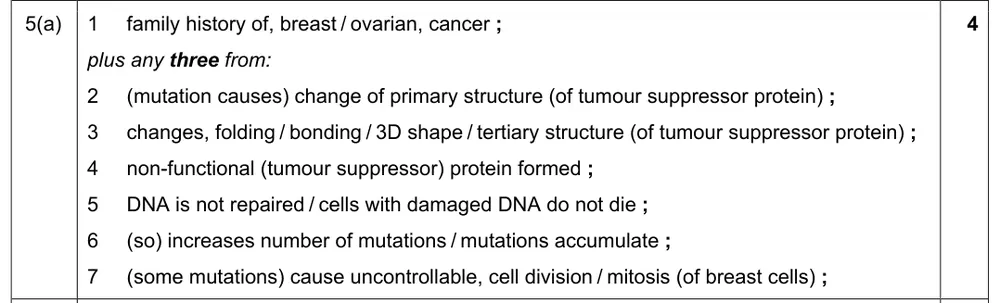
State why a doctor would recommend testing for a BRCA1 mutation and explain why the mutation increases the risk of breast cancer.
Show the mark scheme
Tap an image to open it full size.
From the examiners' report: Very few gave a family history of breast cancer as the reason for testing; most wrote about preparing for treatment or starting it early. Most then explained that DNA is not repaired, and many linked this to uncontrolled cell division.
Question 8
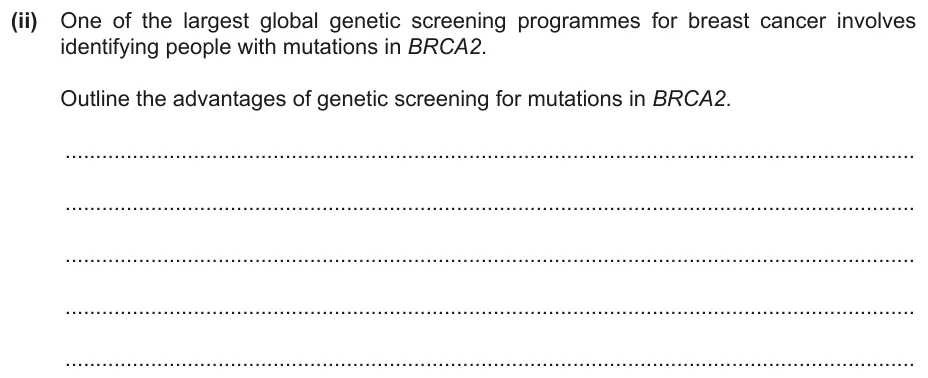
Paper 4 · May/June 2024 (43) · Q5(b)(ii) · 3 marks
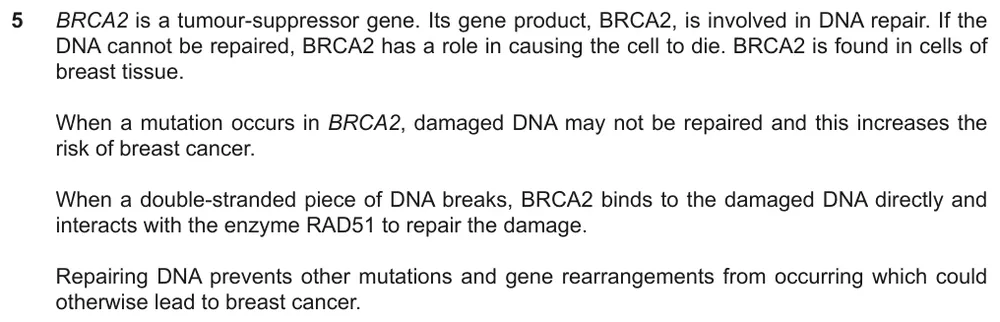
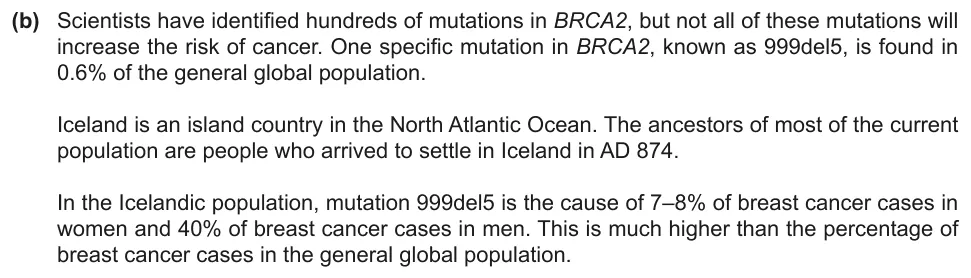
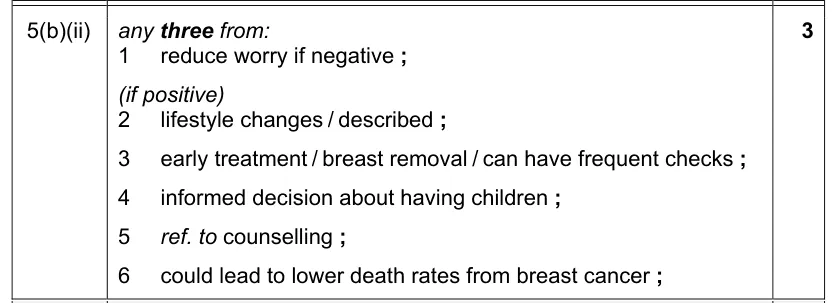
Outline the advantages of genetic screening for mutations in BRCA2.
Information from earlier in this question:
Show the mark scheme
Tap an image to open it full size.
From the examiners' report: Weak descriptions of preventative measures were not credited, such as 'allowing gene therapy to be carried out' or 'preventing getting the mutation'. Only a minority gained all three marks.
Question 9
Paper 4 · May/June 2024 (43) · Q5(b)(iii) · 1 mark · Hard
Suggest one advantage to a country of screening its population for specific BRCA2 mutations.

Show the mark scheme

Tap an image to open it full size.
From the examiners' report: Very few used the information that BRCA2 has hundreds of mutations and that not all of them increase the risk of cancer. Screening programmes are expensive, so it is more cost effective to test only for mutations that are common in the population and known to increase the risk.
Question 10
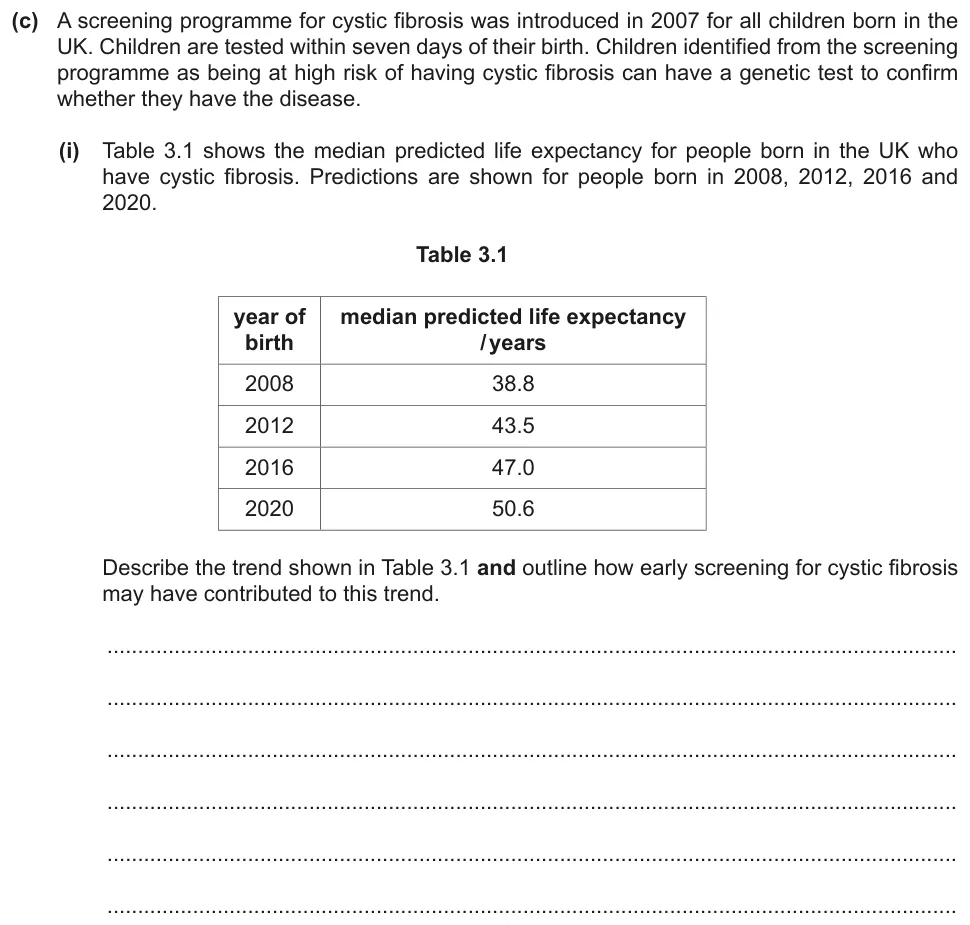
Paper 4 · February/March 2024 (42) · Q3(c)(i) · 3 marks
Describe the trend in predicted life expectancy and outline how early screening for cystic fibrosis may have contributed to it.
Information from earlier in this question:

Show the mark scheme
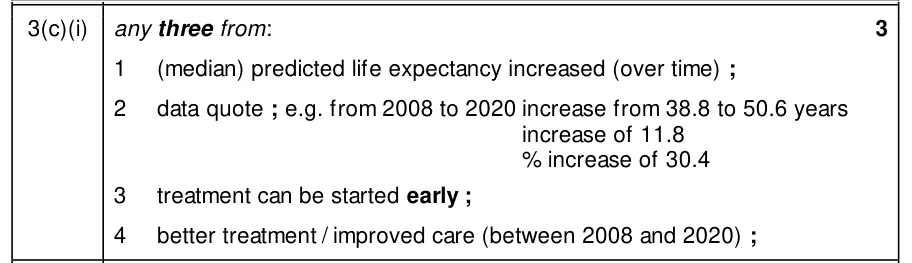
Tap an image to open it full size.
Question 11
Paper 4 · October/November 2017 (42) · Q5(b)(ii) · 2 marks
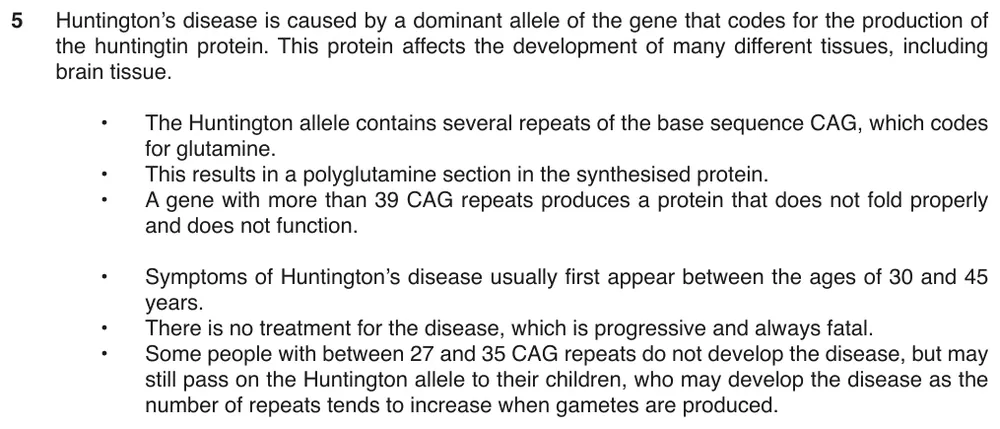
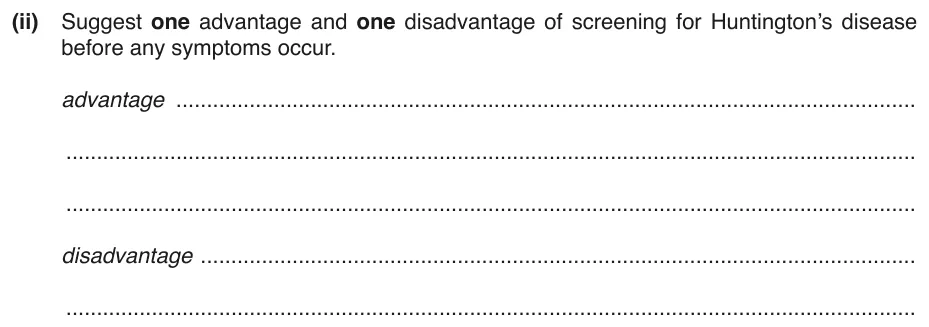
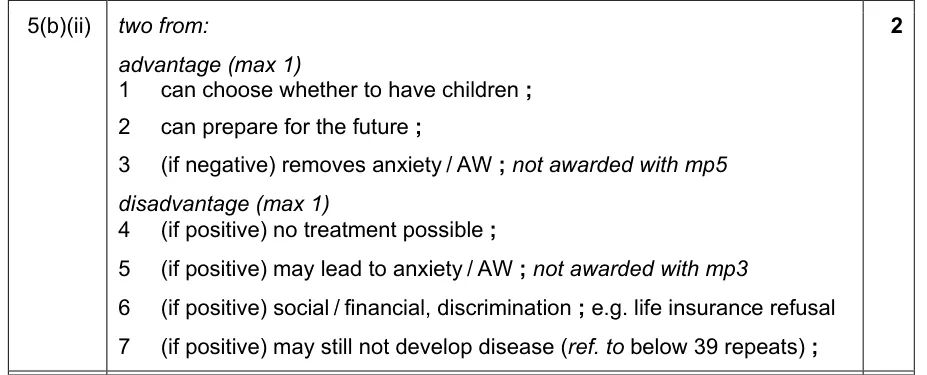
Suggest one advantage and one disadvantage of screening for Huntington's disease before any symptoms occur.
Information from earlier in this question:

Show the mark scheme
Tap an image to open it full size.
From the examiners' report: The commonest advantage was being able to decide whether to have children. Early treatment was not credited, because no treatment is possible. Few mentioned that a negative result removes anxiety, or that a positive result may lead to discrimination, such as being refused life insurance.
Gene therapy (19.2.3)
Question 12
Paper 4 · May/June 2023 (43) · Q4(b) · 4 marks
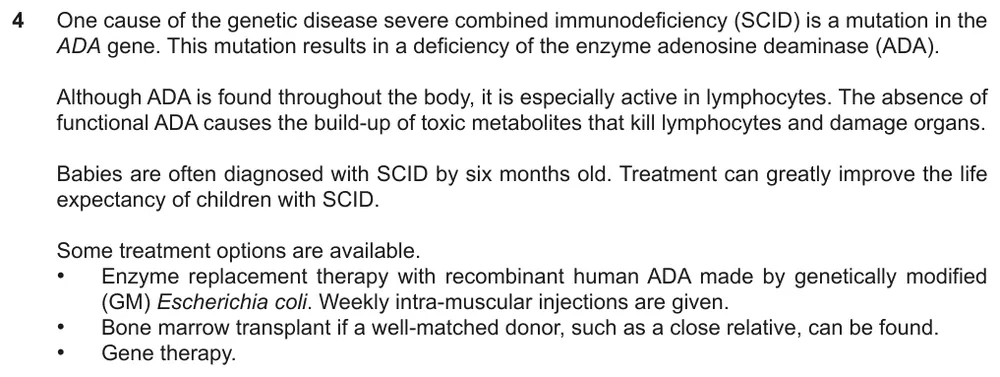
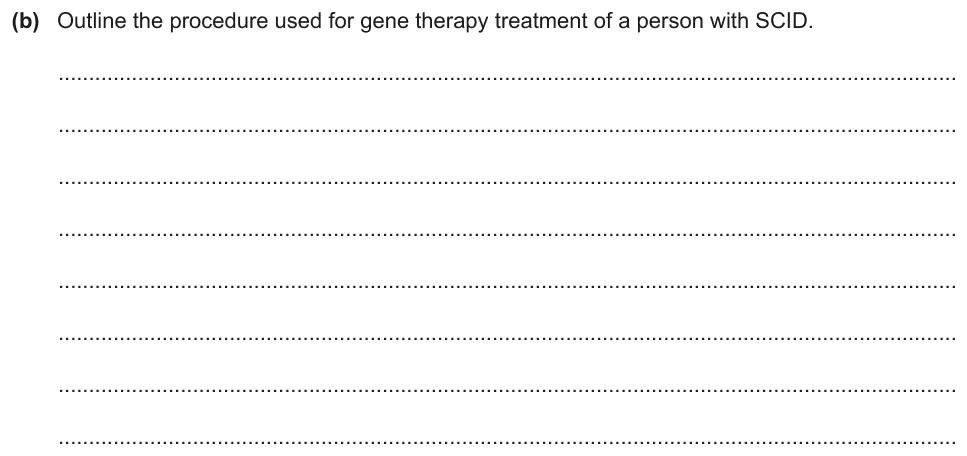
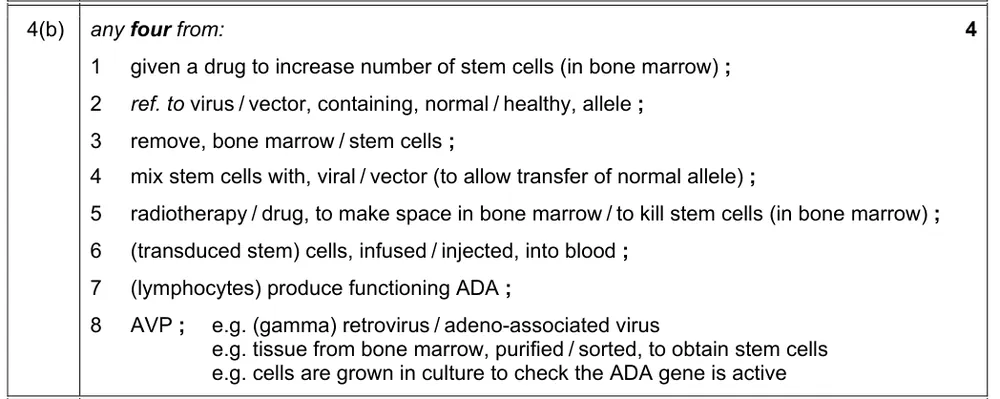
Outline the procedure used for gene therapy treatment of a person with SCID.
Information from earlier in this question:
Show the mark scheme
Tap an image to open it full size.
From the examiners' report: This was found very difficult, and some students wrote nothing. The main misconception was that the vector carrying the normal allele would insert the gene into a bacterium.
Question 13
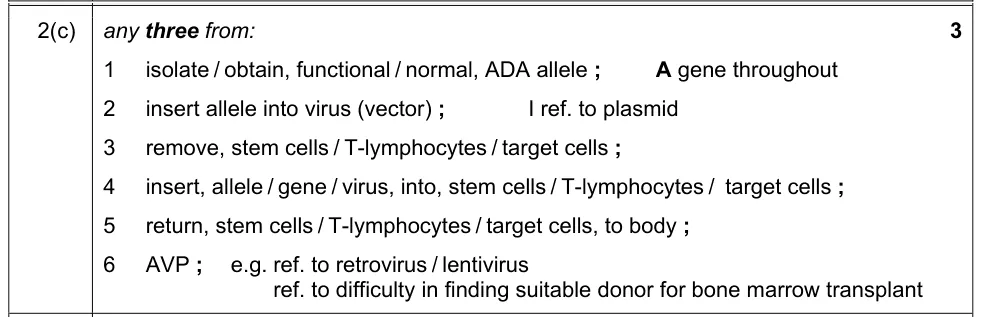
Paper 4 · February/March 2020 (42) · Q2(c) · 3 marks · Hard
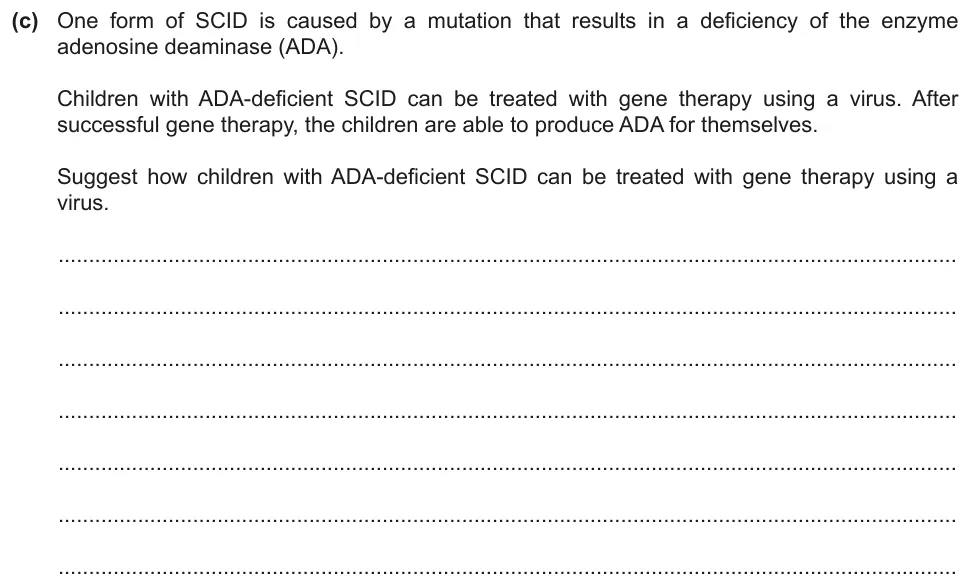
Suggest how children with ADA-deficient SCID can be treated with gene therapy using a virus.
Show the mark scheme
Tap an image to open it full size.
From the examiners' report: Many knew that the ADA allele has to be inserted into the virus, but few said how the allele is obtained. Most suggested infecting the child with the virus, instead of targeting cells of the immune system. Inhalation suits respiratory disorders such as cystic fibrosis, not SCID.
Question 14
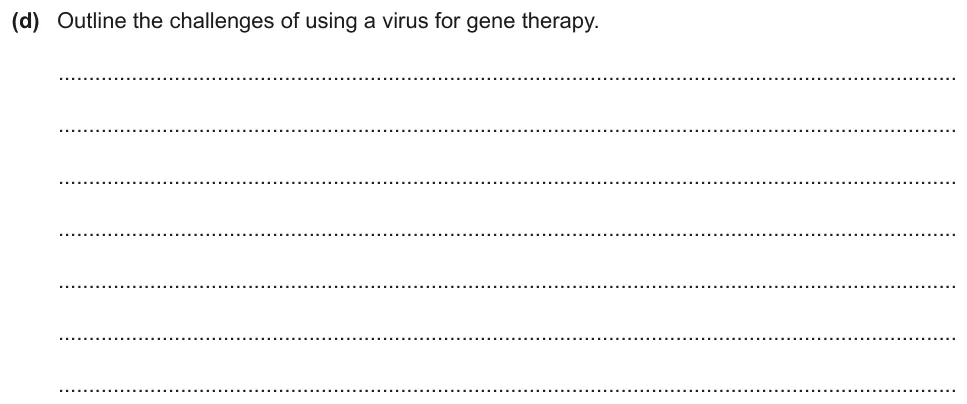
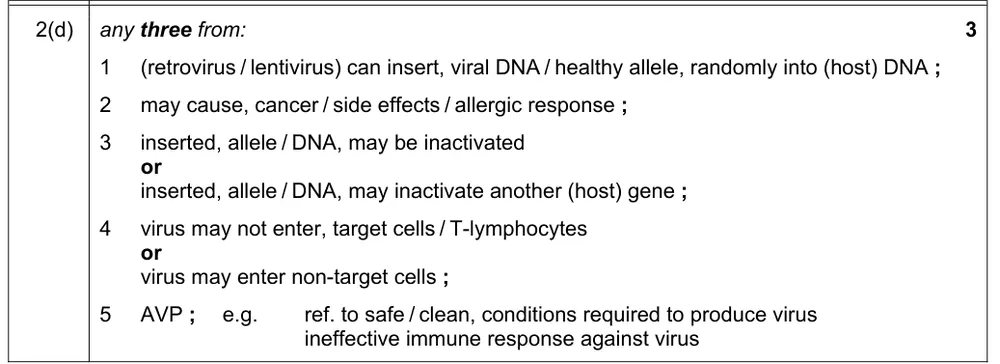
Paper 4 · February/March 2020 (42) · Q2(d) · 3 marks · Hard
Outline the challenges of using a virus for gene therapy.
Show the mark scheme
Tap an image to open it full size.
From the examiners' report: Many mentioned side effects, and some named leukaemia. Fewer linked these risks to viral DNA being inserted at random into the host cell's DNA. Some recognised the difficulty of targeting the right cells, and that the patient's immune system may destroy the virus.
Question 15
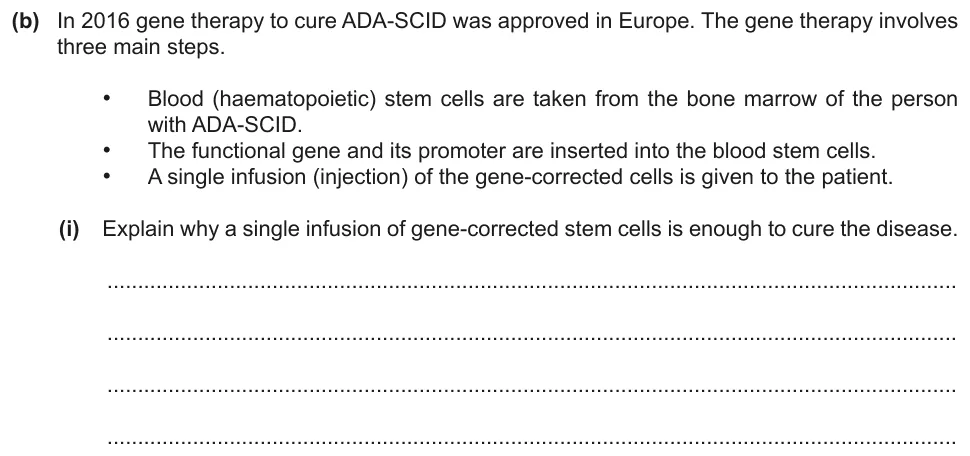
Paper 4 · October/November 2022 (41) · Q4(b)(i) · 2 marks · Easy
Explain why a single infusion of gene-corrected stem cells is enough to cure ADA-SCID.
Information from earlier in this question:

Show the mark scheme

Tap an image to open it full size.
From the examiners' report: Most referred to mitosis or cell division increasing the number of stem cells. Some went on to say clearly that the functional gene is inherited by the daughter cells.
Question 16
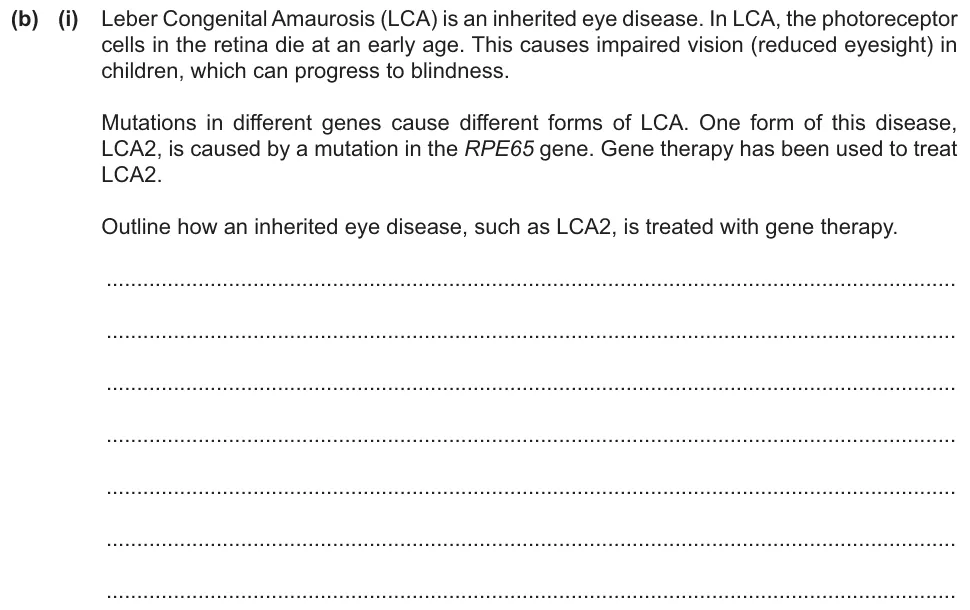
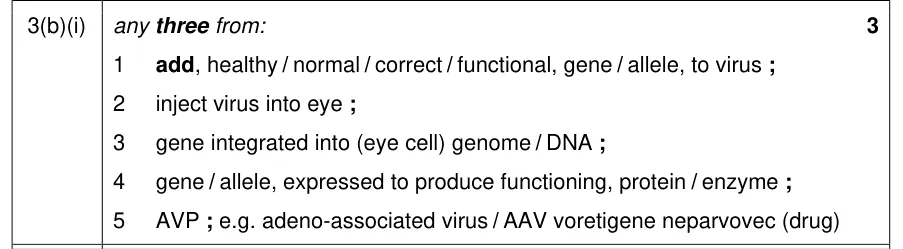
Paper 4 · October/November 2024 (42) · Q3(b)(i) · 3 marks
Outline how an inherited eye disease, such as LCA2, is treated with gene therapy.
Show the mark scheme
Tap an image to open it full size.
Question 17
Paper 4 · October/November 2024 (42) · Q3(b)(ii) · 1 mark
Suggest why the eye is a suitable organ for gene therapy.

Show the mark scheme

Tap an image to open it full size.
Question 18
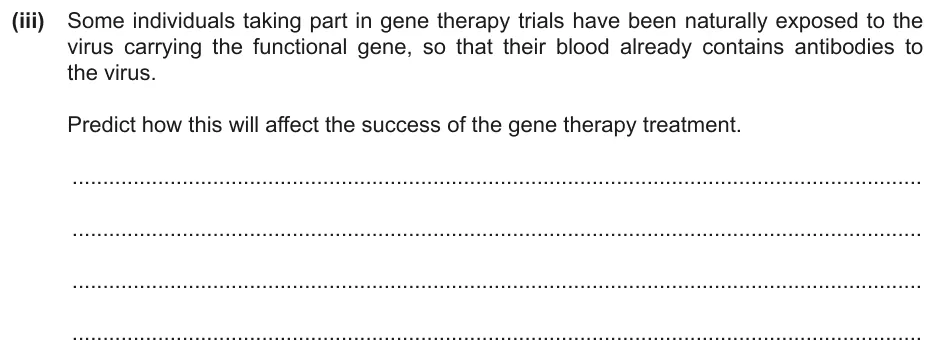
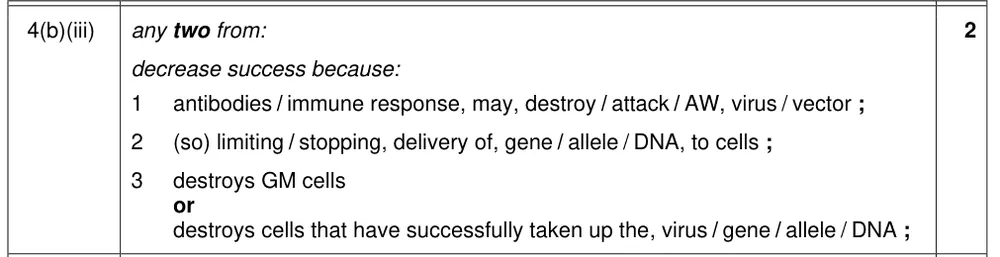
Paper 4 · October/November 2022 (42) · Q4(b)(iii) · 2 marks · Easy
Predict how antibodies to the virus already in the blood will affect the success of the gene therapy.
Information from earlier in this question:

Show the mark scheme
Tap an image to open it full size.
From the examiners' report: Most knew that the immune response would destroy the virus. Many stopped there: go on to say that the gene is then not delivered to the target cells.
Social and ethical considerations (19.2.4)
Question 19
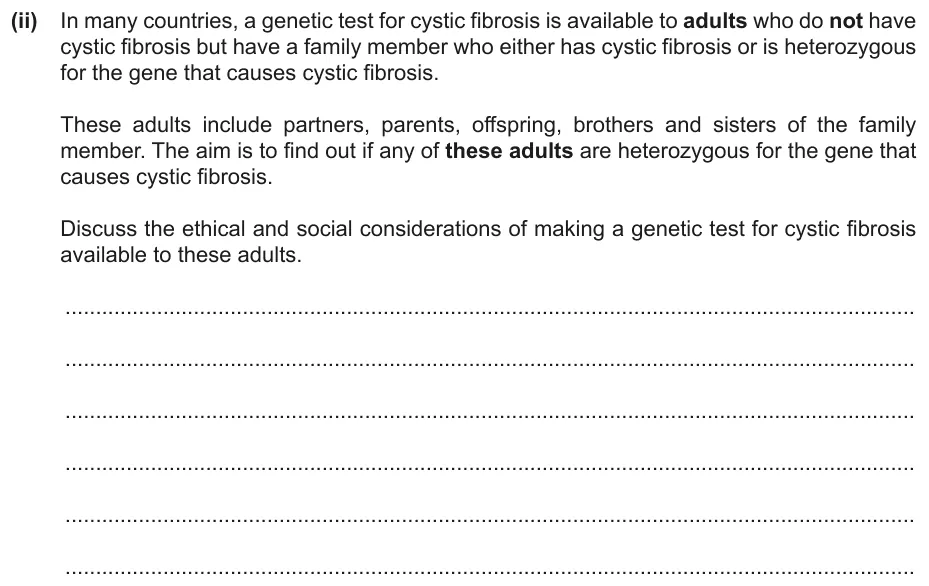
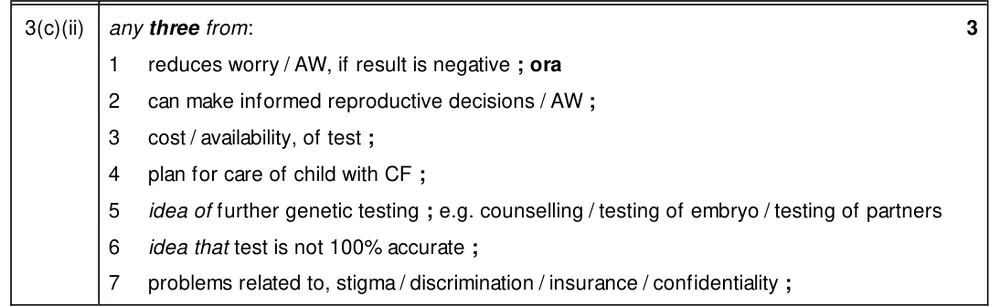
Paper 4 · February/March 2024 (42) · Q3(c)(ii) · 3 marks
Discuss the ethical and social considerations of offering a genetic test for cystic fibrosis to adult relatives.
Information from earlier in this question:

Show the mark scheme
Tap an image to open it full size.
Question 20
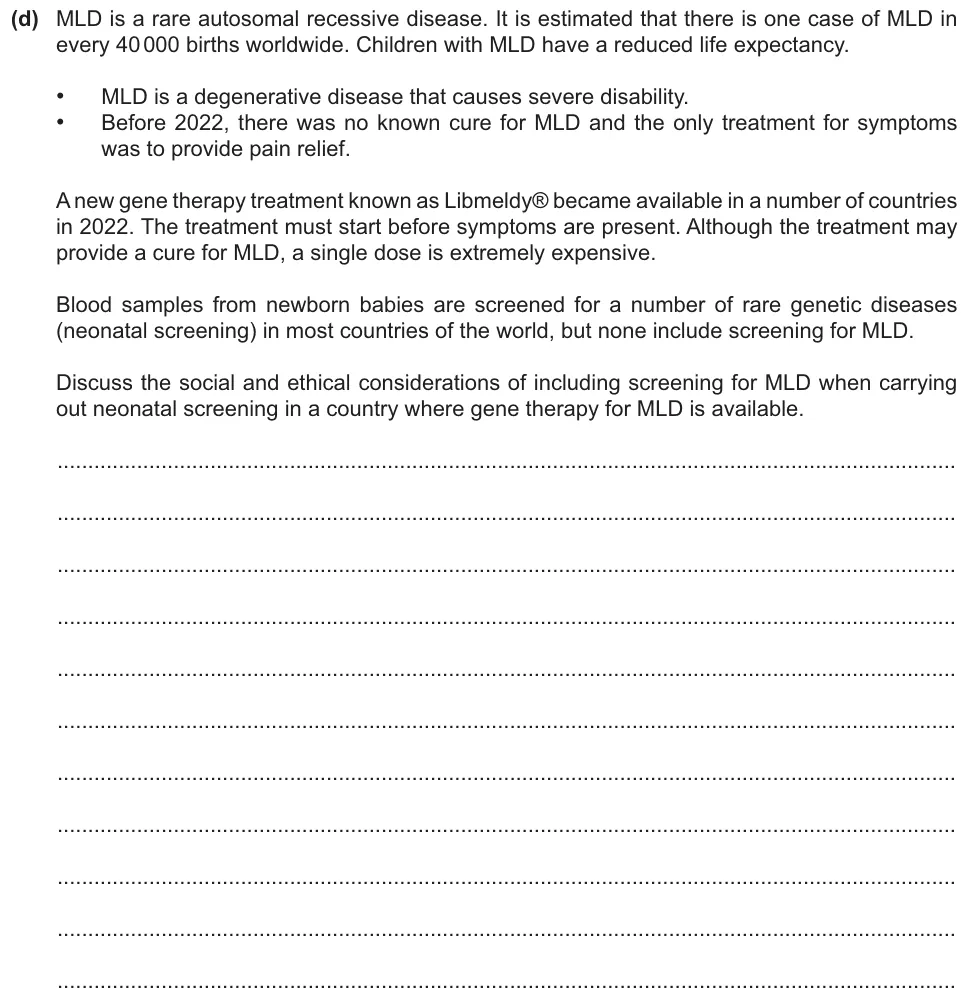
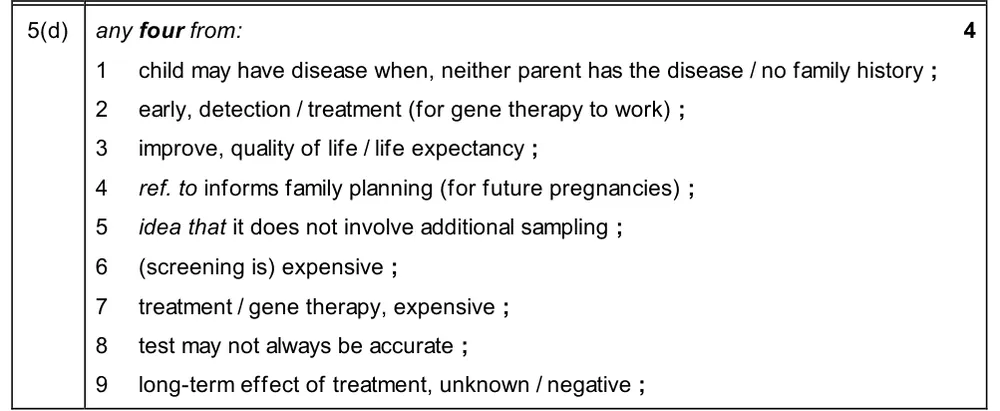
Paper 4 · October/November 2025 (42) · Q5(d) · 4 marks
Discuss the social and ethical considerations of adding screening for MLD to neonatal screening.
Show the mark scheme
Tap an image to open it full size.
Question 21
Paper 4 · October/November 2021 (42) · Q4(c) · 3 marks · Easy
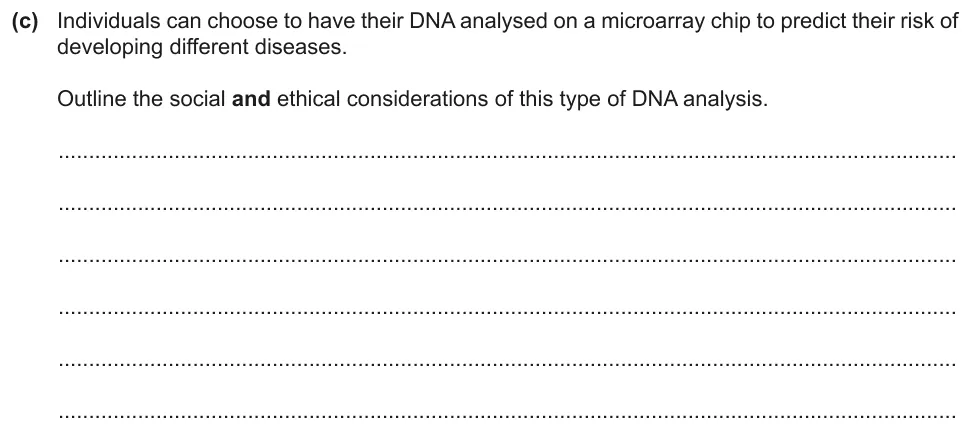
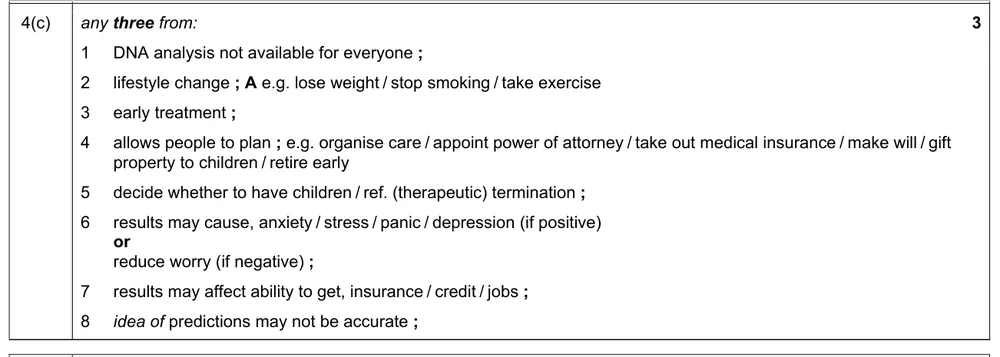
Outline the social and ethical considerations of having your DNA analysed to predict your risk of disease.
Show the mark scheme
Tap an image to open it full size.
From the examiners' report: Common correct points were early treatment, decisions about having a family, and stress or worry. If you mention cost, go on to say that the test would not be available to everyone. The results may also affect jobs or life insurance.
Question 22
Paper 4 · May/June 2023 (43) · Q4(c) · 3 marks
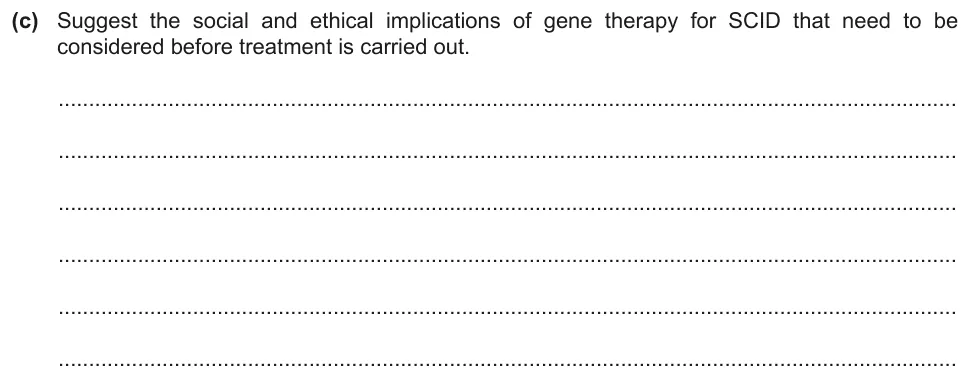
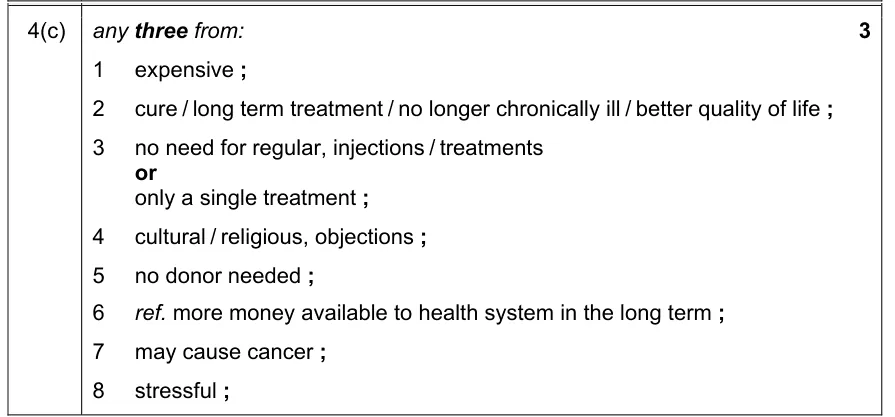
Suggest the social and ethical implications of gene therapy for SCID that need to be considered before treatment.
Information from earlier in this question:
Show the mark scheme
Tap an image to open it full size.
From the examiners' report: Write about SCID, not gene therapy in general. Vague comments about 'playing God' or being unnatural gained nothing. This gene therapy is a cure, not a temporary treatment, and it is not germ-line gene therapy, so the new gene is not inherited.
Where students lose marks (from Cambridge examiners' reports and mark schemes)
Each point below comes from the examiners' reports and mark schemes, and is followed by wording that gained marks.
No immune response, not less. Students wrote that a recombinant human protein causes less of an immune response, or carries less risk of disease transmission.
✔ Gains credit: the protein is 'identical to human insulin', so there is 'no immune response', 'no risk of transmitting diseases' and 'no chance of developing tolerance'.
Gene therapy adds an allele. Students described vectors without saying how the insulin is made, or said that gene therapy uses a functional allele to replace a gene or allele.
✔ Gains credit: 'insulin from GM bacteria' for diabetes; for a single gene disorder, 'gene therapy', or 'insert' a 'functional' 'allele into' 'target' 'cells'.
Family history is the reason to test. Students said a person would be tested so that they could prepare for treatment or start it early.
✔ Gains credit: 'family history of breast cancer'; then a 'non-functional' tumour suppressor 'protein formed', so 'DNA is not repaired' and 'mutations accumulate'.
Screening does not prevent the mutation. Students gave weak preventative measures, such as 'allowing gene therapy to be carried out' or 'preventing getting the mutation'.
✔ Gains credit: 'reduce worry if negative'; if positive, 'lifestyle changes', 'early treatment', 'frequent checks' and an 'informed decision about having children'.
Huntington's disease has no treatment. Students gave early treatment as an advantage of screening for Huntington's disease.
✔ Gains credit: advantage: 'can choose whether to have children' or 'can prepare for the future'; disadvantage: 'no treatment possible' or 'financial discrimination'.
Treat the cells, not the whole child. Students suggested infecting the child with the recombinant virus, or inhaling it, and did not say how the allele is obtained.
✔ Gains credit: 'isolate' the 'functional' 'ADA allele', 'insert allele into virus', 'remove' 'stem cells', 'insert' the 'virus into' the 'stem cells' and 'return' them 'to body'.
Random insertion explains the risk. Students listed side effects of using a virus without saying what causes them.
✔ Gains credit: a virus 'can insert' 'viral DNA' 'randomly into' host 'DNA', which 'may cause cancer' or 'may inactivate another' 'gene'; the 'virus may not enter target cells'.
SCID gene therapy is a cure. Students wrote about 'playing God', designer characteristics or consent from the baby, or thought the treatment was temporary or that the new gene would be inherited.
✔ Gains credit: 'expensive', but a 'cure' with a 'better quality of life', 'only a single treatment' and 'no donor needed'; it 'may cause cancer'.
Download the questions
Download the PDF pack (22 questions, mark schemes at the end)
Keep practising
- Principles of Genetic Technology (19.1): Cambridge (CIE) exam questions by topic
- Genetically Modified Organisms in Agriculture (19.3): Cambridge (CIE) exam questions by topic
- Cambridge (CIE) A level Biology 9700 past papers, mark schemes and examiners' reports
- Cambridge (CIE) A level Biology grade thresholds
- Book a one-to-one CIE lesson or a free 15-minute discovery chat with Tom
- Register your interest in a CIE A level Biology group class
Questions, mark schemes and examiners' report extracts © Cambridge University Press & Assessment.