

Passage of Information from Parents to Offspring (16.1): Cambridge (CIE) A Level Biology 9700 Exam Questions by Topic
Passage of information from parents to offspring is sub-topic 16.1 of Topic 16, Inheritance, in the Cambridge International AS & A Level Biology syllabus (9700). You need to explain the terms haploid, diploid and homologous pairs of chromosomes, explain why a reduction division is needed when gametes are made, describe how the chromosomes, the nuclear envelope and the spindle behave in each stage of meiosis, and identify the stages in photomicrographs and diagrams. You also need to explain how crossing over, random orientation of homologous pairs and random fusion of gametes produce genetically different offspring. This is A level content, examined on Paper 4.
The examiners' reports return to the same points. Define haploid as one set of chromosomes and diploid as two sets; 'n and 2n' or 'half a set' is not enough. Homologous chromosomes are the same length, not 'similar'. Say that bivalents, or homologous pairs, line up on the equator in metaphase I, and that crossing over is between non-sister chromatids, which exchange alleles. Do not write about crossing over when the question asks about random assortment. When you explain reduction division, write about chromosome number, gametes and the zygote, not genetic variation.
Studying Cambridge International A level Biology and want more help? Tom teaches CIE students one-to-one online, including students in the UAE, Saudi Arabia, Hong Kong, India and Indonesia, and every lesson is recorded. You can book a one-to-one lesson or a free 15-minute discovery chat, or register your interest in a CIE group class starting in September 2027, using the links at the bottom of this page.
What you need from AS Level
Each question on this page assumes you're secure on these ideas. If any of them feels shaky, look it up before you start.
- After DNA replication, a chromosome is made of two identical sister chromatids joined at the centromere.
- Mitosis produces two genetically identical daughter cells with the same number of chromosomes as the parent cell.
- The main stages of mitosis are prophase, metaphase, anaphase and telophase; you describe the behaviour of the chromosomes, the nuclear envelope and the spindle in each.
- A gene is a sequence of nucleotides that forms part of a DNA molecule and codes for a polypeptide.
Key terms
These words come up in the questions and mark schemes. Examiners expect you to use them exactly.
- Haploid (n): having one set of chromosomes.
- Diploid (2n): having two sets of chromosomes.
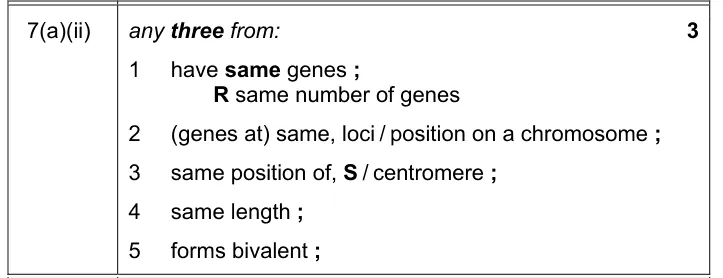
- Homologous chromosomes: a pair of chromosomes, one maternal and one paternal, with the same genes at the same loci, the same length and the same centromere position.
- Bivalent: a pair of homologous chromosomes lying together in prophase I and metaphase I of meiosis.
- Reduction division: meiosis I: the homologous chromosomes separate, so the chromosome number is halved.
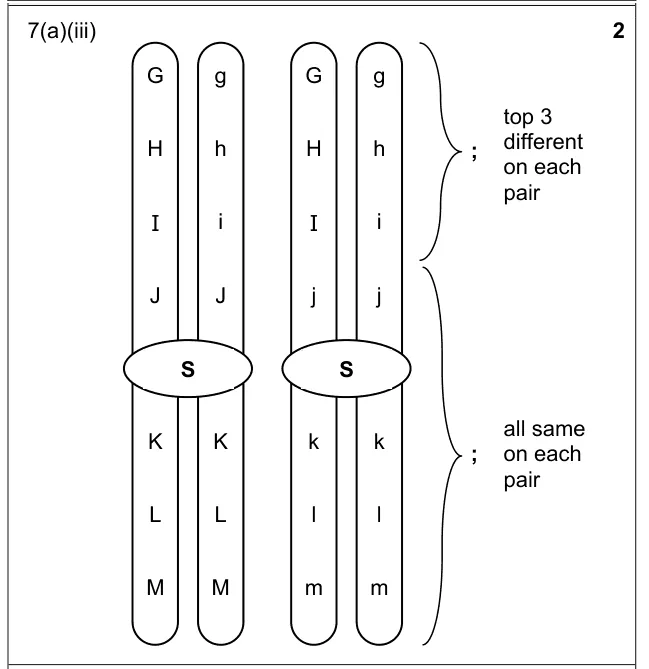
- Crossing over: the exchange of alleles between non-sister chromatids of a pair of homologous chromosomes in prophase I.
- Chiasma: a point where non-sister chromatids stay joined after crossing over (plural: chiasmata).
- Independent assortment: each pair of homologous chromosomes lines up on the equator in metaphase I independently of the other pairs, giving different combinations of chromosomes in the daughter cells.
What these questions cover (Cambridge 9700 Topic 16: Inheritance)
The questions test these learning outcomes from sub-topic 16.1 of the Cambridge International AS & A Level Biology syllabus (9700) for 2025 to 2027.
- 16.1.1 explain the meanings of the terms haploid (n) and diploid (2n)
- 16.1.2 explain what is meant by homologous pairs of chromosomes
- 16.1.3 explain the need for a reduction division during meiosis in the production of gametes
- 16.1.4 describe the behaviour of chromosomes in plant and animal cells during meiosis and the associated behaviour of the nuclear envelope, the cell surface membrane and the spindle
- 16.1.5 interpret photomicrographs and diagrams of cells in different stages of meiosis and identify the main stages of meiosis
- 16.1.6 explain that crossing over and random orientation (independent assortment) of pairs of homologous chromosomes and sister chromatids during meiosis produces genetically different gametes
- 16.1.7 explain that the random fusion of gametes at fertilisation produces genetically different individuals
How to use this page
Write your answer on paper before you open the mark scheme. Allow about 1.2 minutes per mark: the 22 questions are worth 65 marks, so about 78 minutes in total. Then mark your answer strictly against the mark scheme and read the examiners' tip underneath it. If you'd rather print the questions, download the PDF pack.
Haploid and diploid (16.1.1)
Question 1
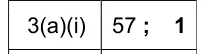
Paper 4 · October/November 2018 (42) · Q3(a)(i) · 1 mark
Calculate the diploid chromosome number of the hybrid offspring of a sheep and a goat.

Show the mark scheme
Tap an image to open it full size.
From the examiners' report: Many were correct. Some added the diploid numbers of the two species together instead of the haploid numbers.
Haploid, diploid and meiosis I (16.1.1 and 16.1.4)
Question 2
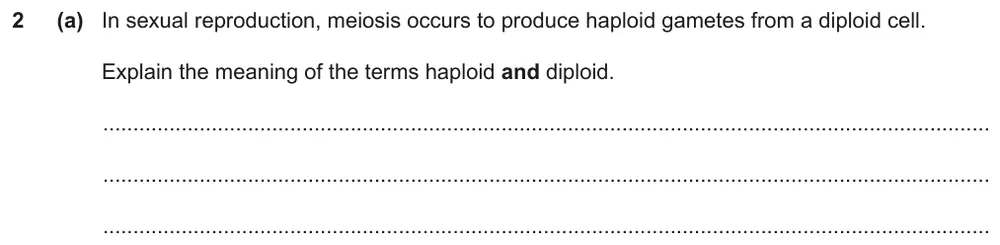
Paper 4 · May/June 2023 (42) · Q2(a) · 2 marks · Easy
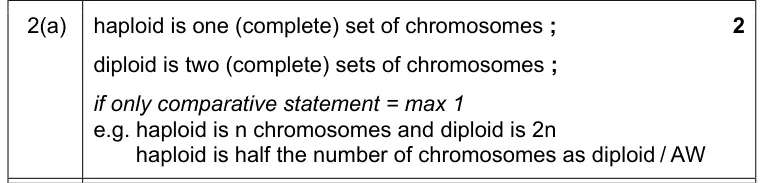
Explain the meaning of the terms haploid and diploid.
Show the mark scheme
Tap an image to open it full size.
From the examiners' report: Many did not say that haploid means one set of chromosomes and diploid means two sets. A comparison only, such as n and 2n or haploid is 'half', did not gain full marks. The question is about all organisms, so 23 and 46 is not an answer, and you must refer to chromosomes.
Question 3
Paper 4 · May/June 2023 (42) · Q2(b) · 4 marks · Easy
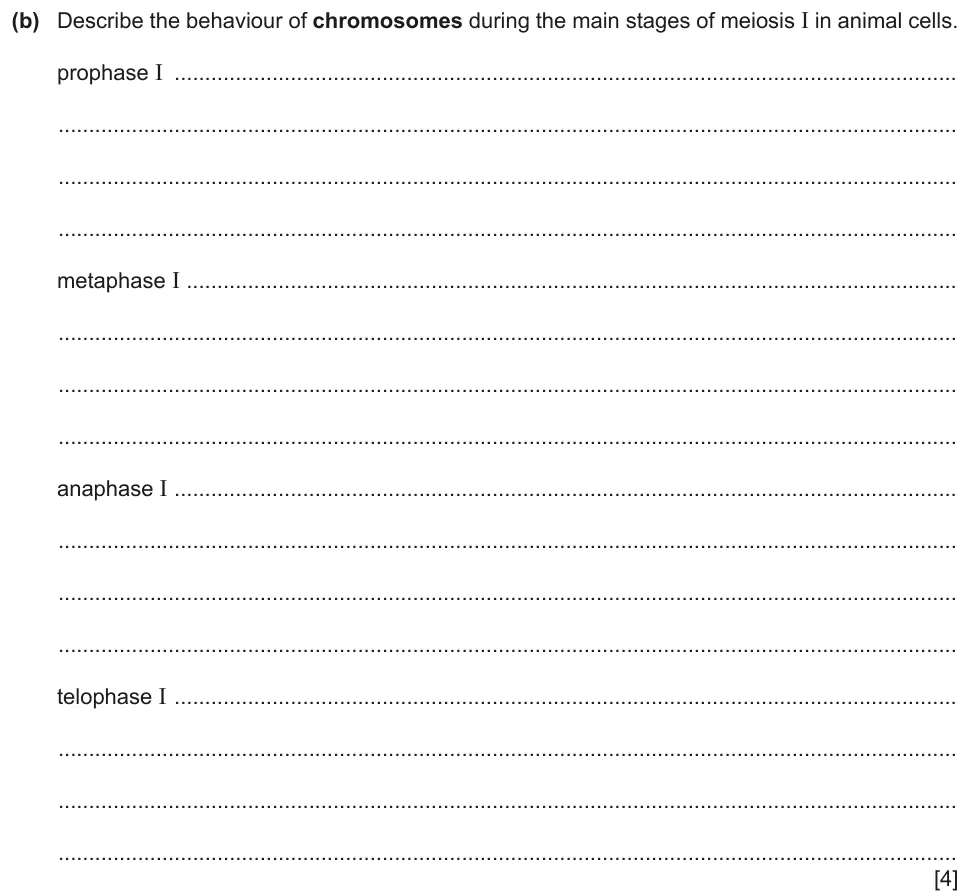
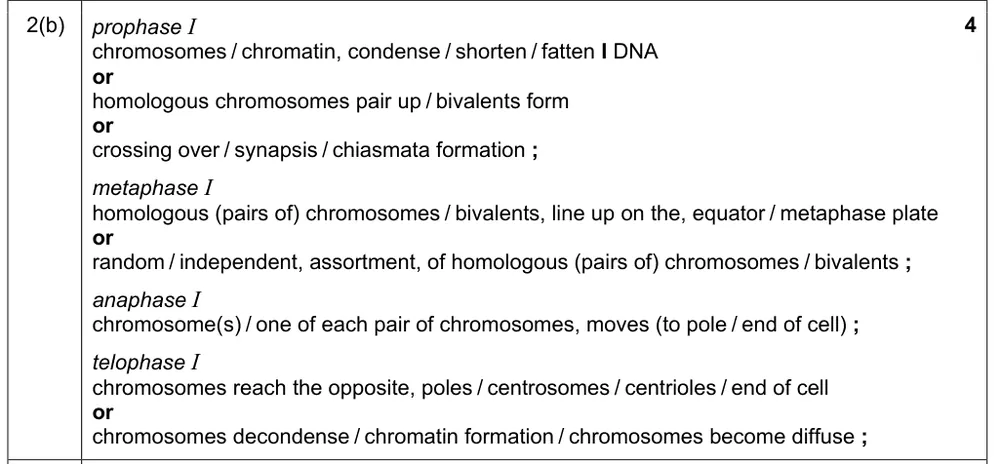
Describe the behaviour of chromosomes in prophase I, metaphase I, anaphase I and telophase I in animal cells.
Show the mark scheme
Tap an image to open it full size.
From the examiners' report: For metaphase I, say that it is the bivalents or homologous chromosomes that line up on the equator. Telophase I was answered least well: the question is about chromosomes, so say that they have reached the poles, not that daughter cells form or the nuclear membrane re-forms. Weaker answers confused chromatids with chromosomes.
A life cycle with haploid and diploid cells (16.1.1 and 16.1.6)
Question 4
Paper 4 · October/November 2023 (42) · Q2(a) · 5 marks
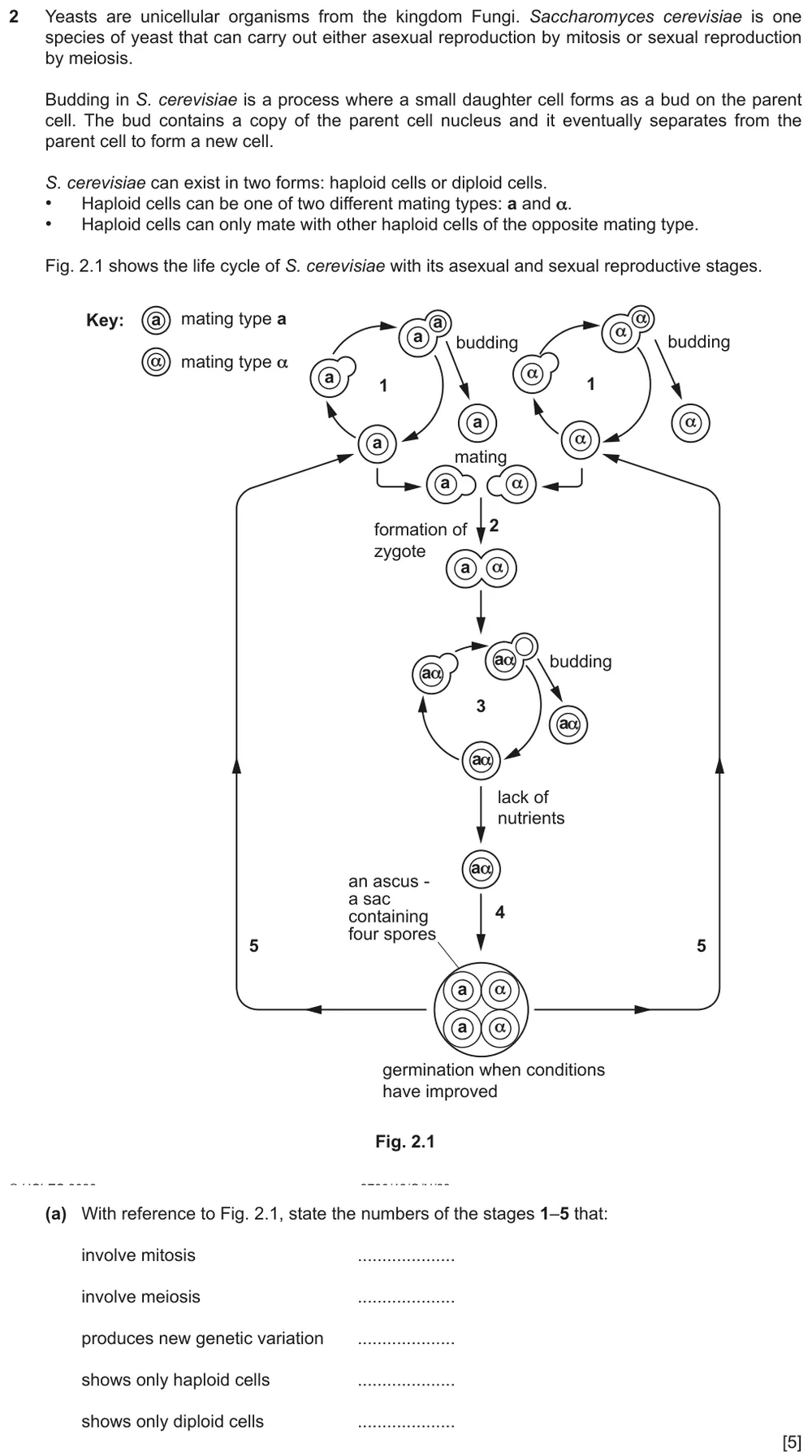
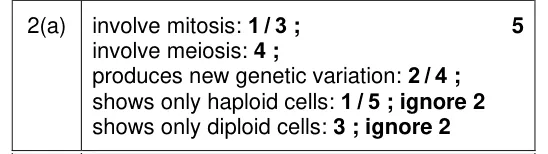
Use the life cycle of yeast to identify the stages that involve mitosis and meiosis, produce genetic variation and show only haploid or only diploid cells.
Show the mark scheme
Tap an image to open it full size.
From the examiners' report: Many were not familiar with haploid individuals existing on their own. Mitosis takes place in both the haploid cycle and the diploid cycle. The stage that involves meiosis, where the diploid number is reduced to the haploid number, was the part most often wrong.
Question 5
Paper 4 · October/November 2023 (42) · Q2(b) · 4 marks
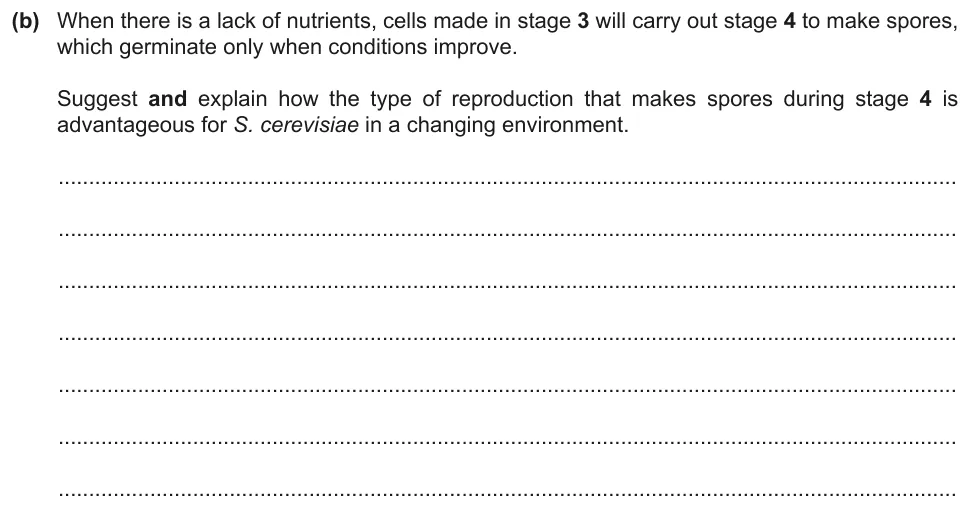
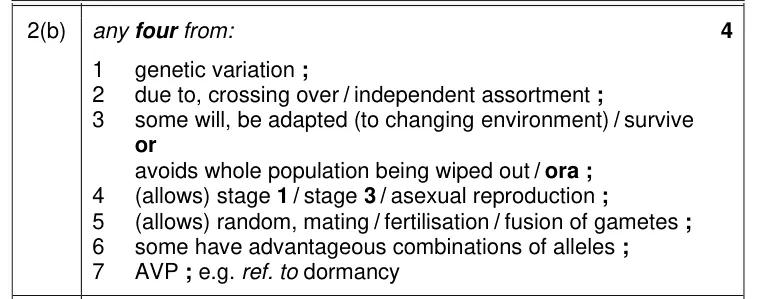
Suggest and explain how making spores by meiosis is an advantage for yeast in a changing environment.
Show the mark scheme
Tap an image to open it full size.
From the examiners' report: The spores are made by sexual reproduction, so the answer is about meiosis. Give crossing over or independent assortment as the reason for the genetic variation. Many wrote about the whole species being adapted or surviving, when it is some individuals that are adapted or survive.
Homologous chromosomes (16.1.2)
Question 6
Paper 4 · May/June 2024 (41) · Q6(a)(i) · 1 mark · Easy
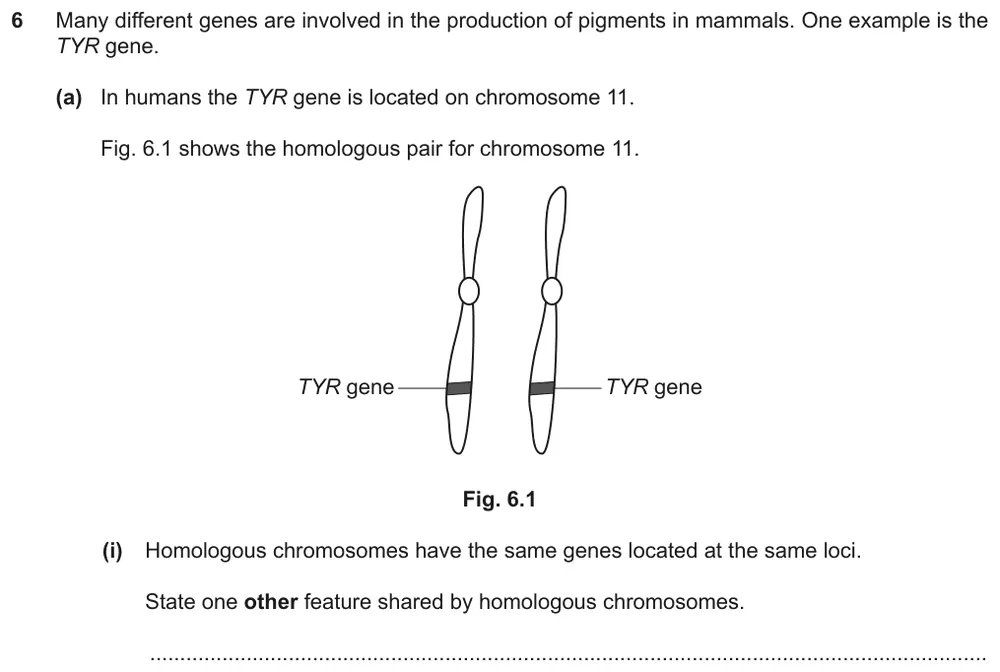
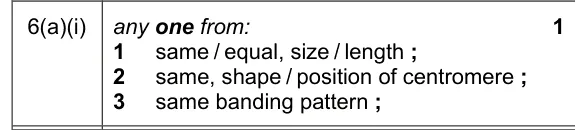
State one feature shared by homologous chromosomes, other than having the same genes at the same loci.
Show the mark scheme
Tap an image to open it full size.
From the examiners' report: Most gave the same length, the same shape or centromeres in the same position. Some lost the mark by giving genetic features, which the question had ruled out. 'Similar' was not accepted in place of 'same' or 'equal'.
Homologous chromosomes, crossing over and random assortment (16.1.2 and 16.1.6)
Question 7
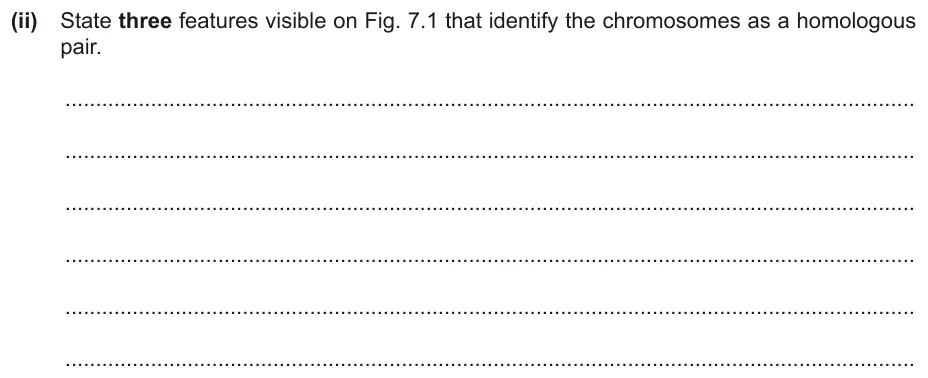
Paper 4 · February/March 2021 (42) · Q7(a)(ii) · 3 marks
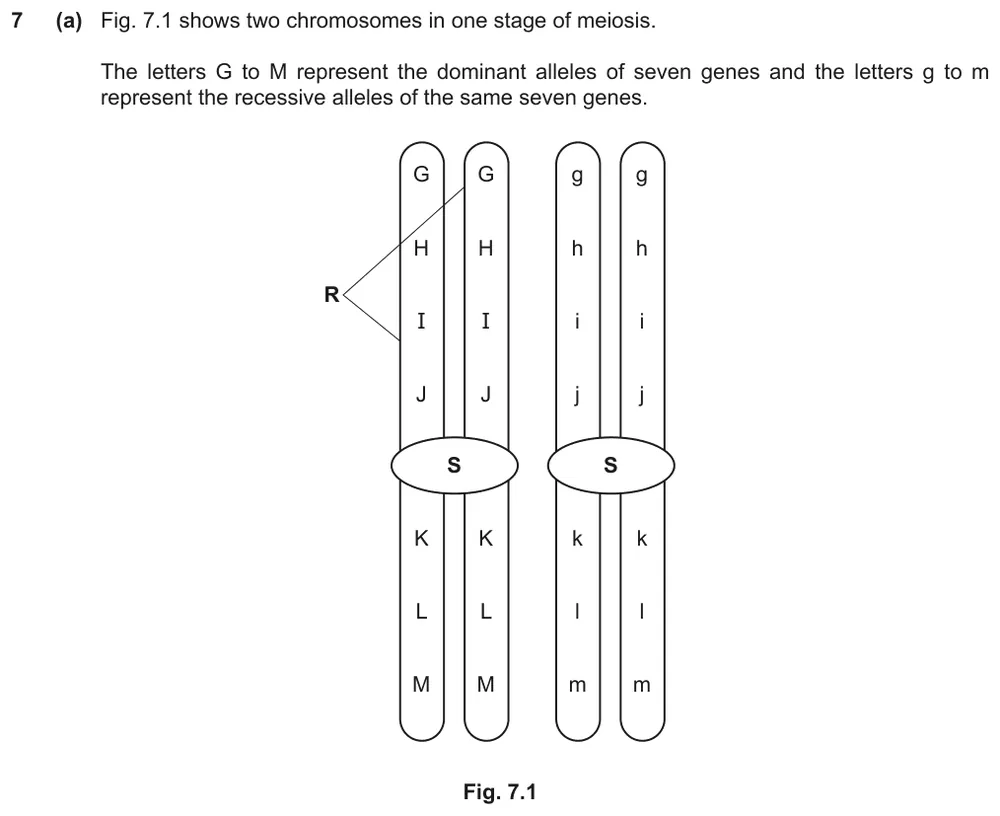
State three features visible in the figure that identify the chromosomes as a homologous pair.
Information from earlier in this question:
Show the mark scheme
Tap an image to open it full size.
From the examiners' report: Many noted that the two chromosomes had the same genes at the same loci and were the same length. Some used the word 'similar' instead of 'same'.
Question 8
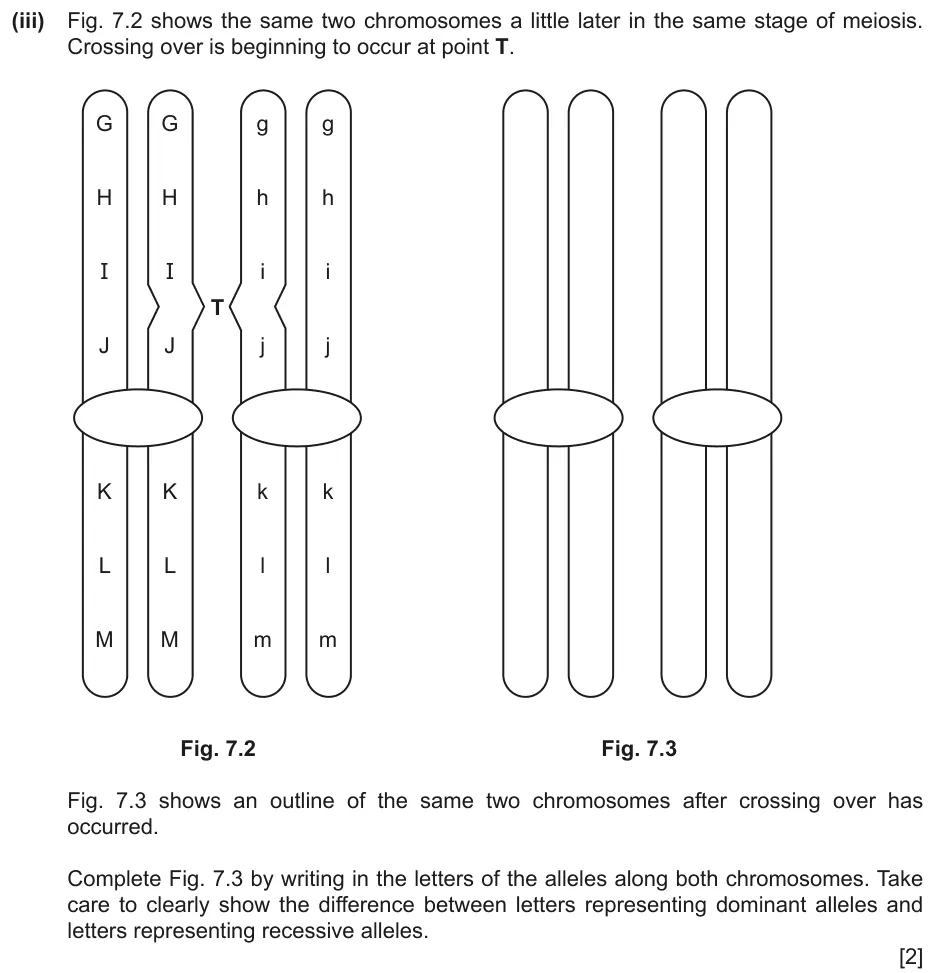
Paper 4 · February/March 2021 (42) · Q7(a)(iii) · 2 marks · Hard
Complete the figure to show the alleles along both chromosomes after crossing over.
Show the mark scheme
Tap an image to open it full size.
Question 9
Paper 4 · February/March 2021 (42) · Q7(c) · 3 marks · Easy
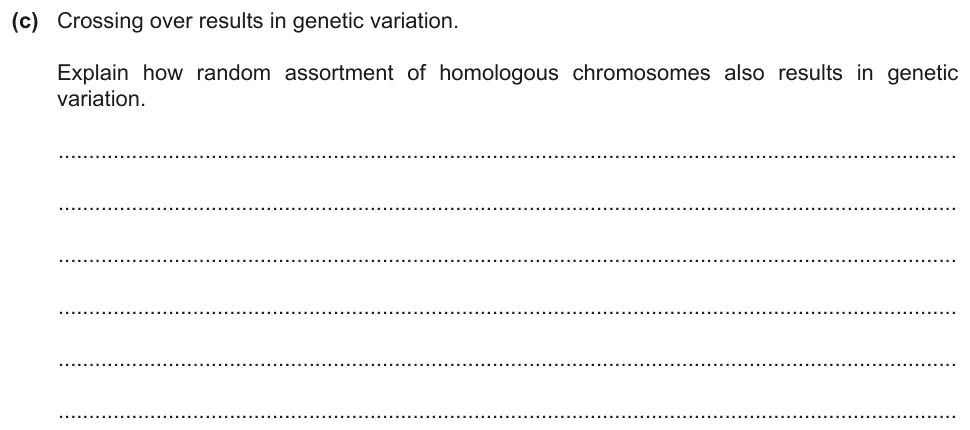
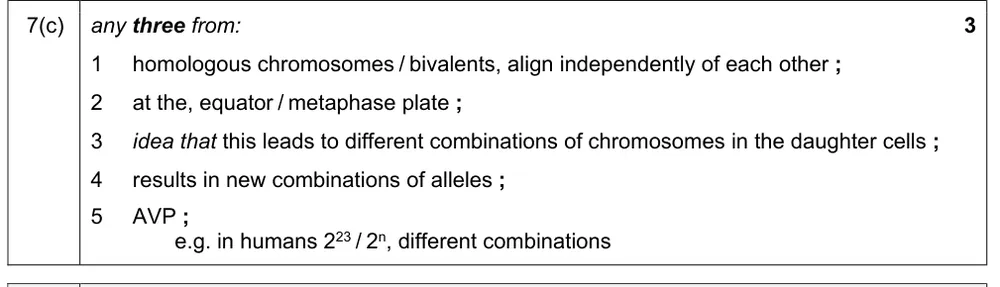
Explain how random assortment of homologous chromosomes results in genetic variation.
Show the mark scheme
Tap an image to open it full size.
From the examiners' report: Most wrote about crossing over, which was not what the question asked. Describe the paired chromosomes lining up independently, which leads to new combinations of chromosomes in the daughter cells.
The spindle and reduction division (16.1.3 and 16.1.4)
Question 10
Paper 4 · February/March 2023 (42) · Q5(a) · 4 marks · Hard
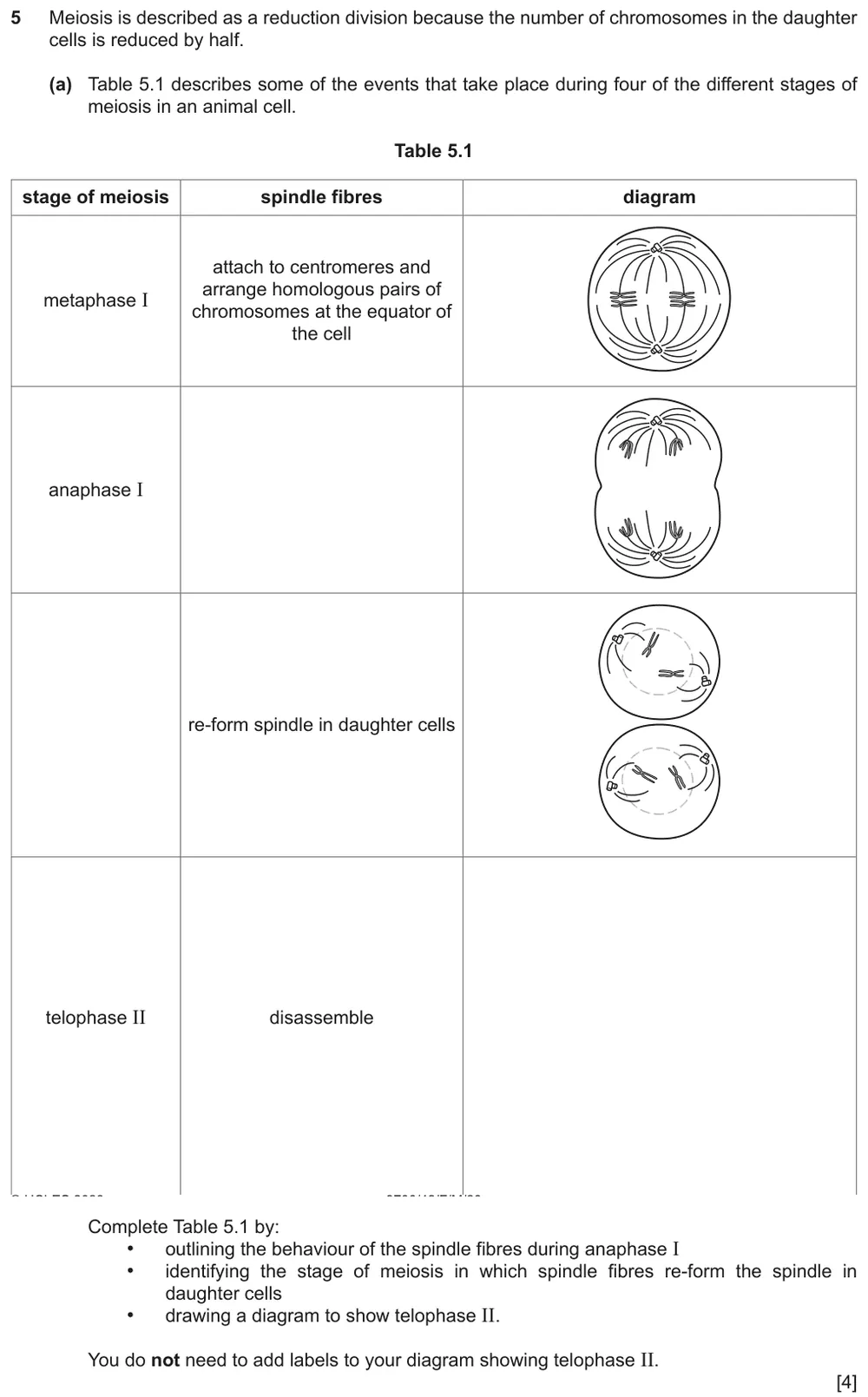
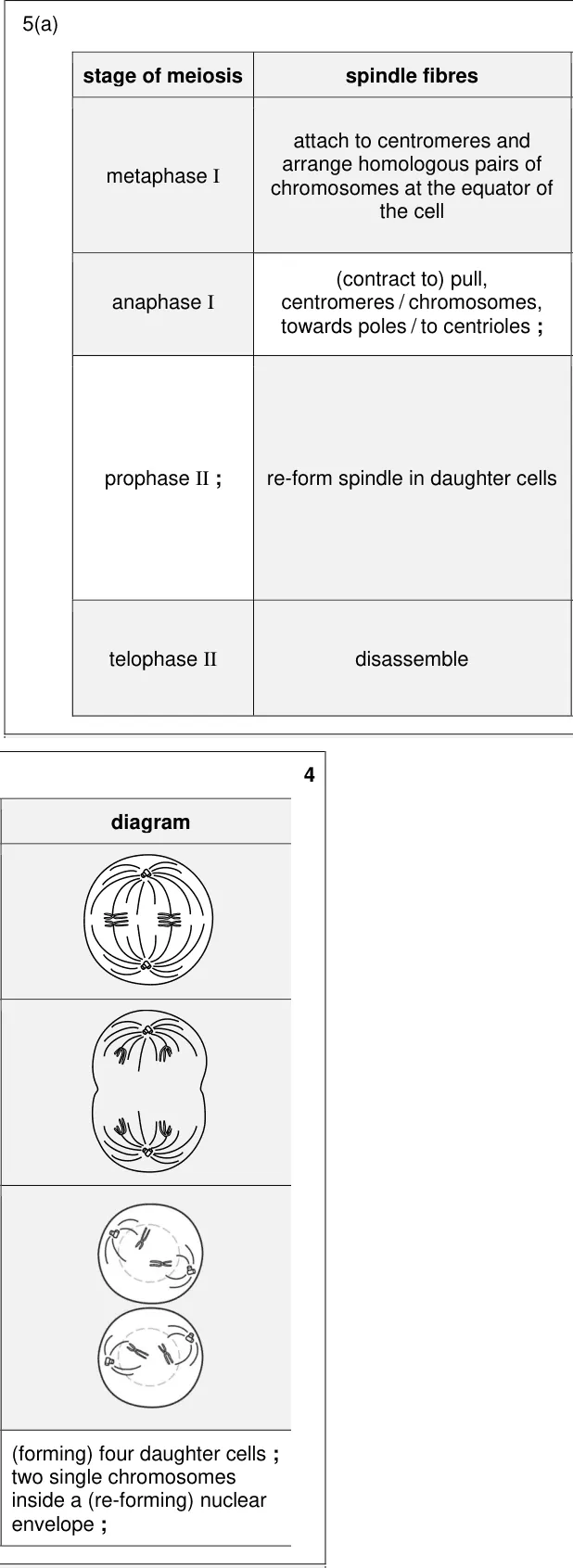
Complete the table on spindle fibres in meiosis and draw a diagram of telophase II.
Show the mark scheme
Tap an image to open it full size.
From the examiners' report: Describe what the spindle fibres do, not just the movement of the chromosomes, and write 'poles', not 'ends of the cell'. It is wrong to say that bivalents are pulled to the poles. Few showed four daughter cells in telophase II, and most drew chromosomes with two chromatids, although the chromatids separate in anaphase II.
Question 11
Paper 4 · February/March 2023 (42) · Q5(b) · 4 marks
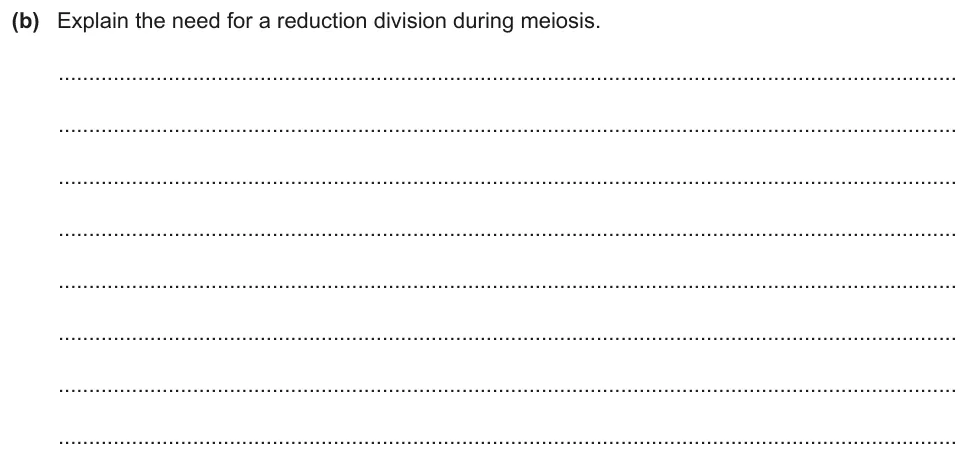
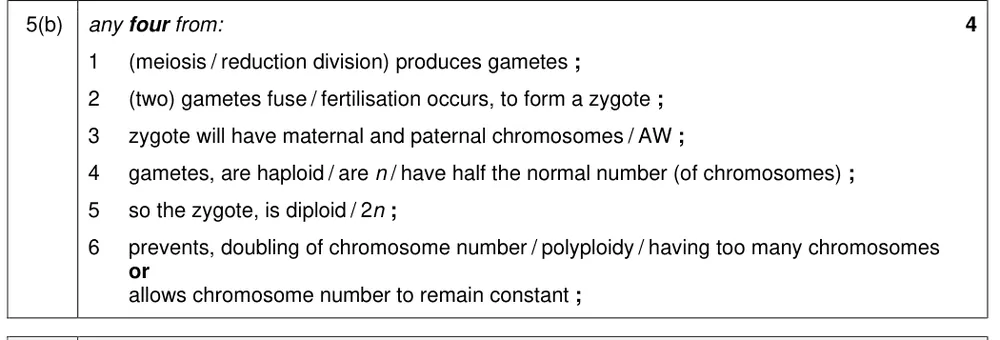
Explain the need for a reduction division during meiosis.
Show the mark scheme
Tap an image to open it full size.
From the examiners' report: Weaker answers were about meiosis producing genetic variation, not the reduction in chromosome number. They also left out terms such as gamete and zygote.
Prophase I (16.1.4)
Question 12
Paper 4 · May/June 2023 (41) · Q8 · 4 marks · Easy
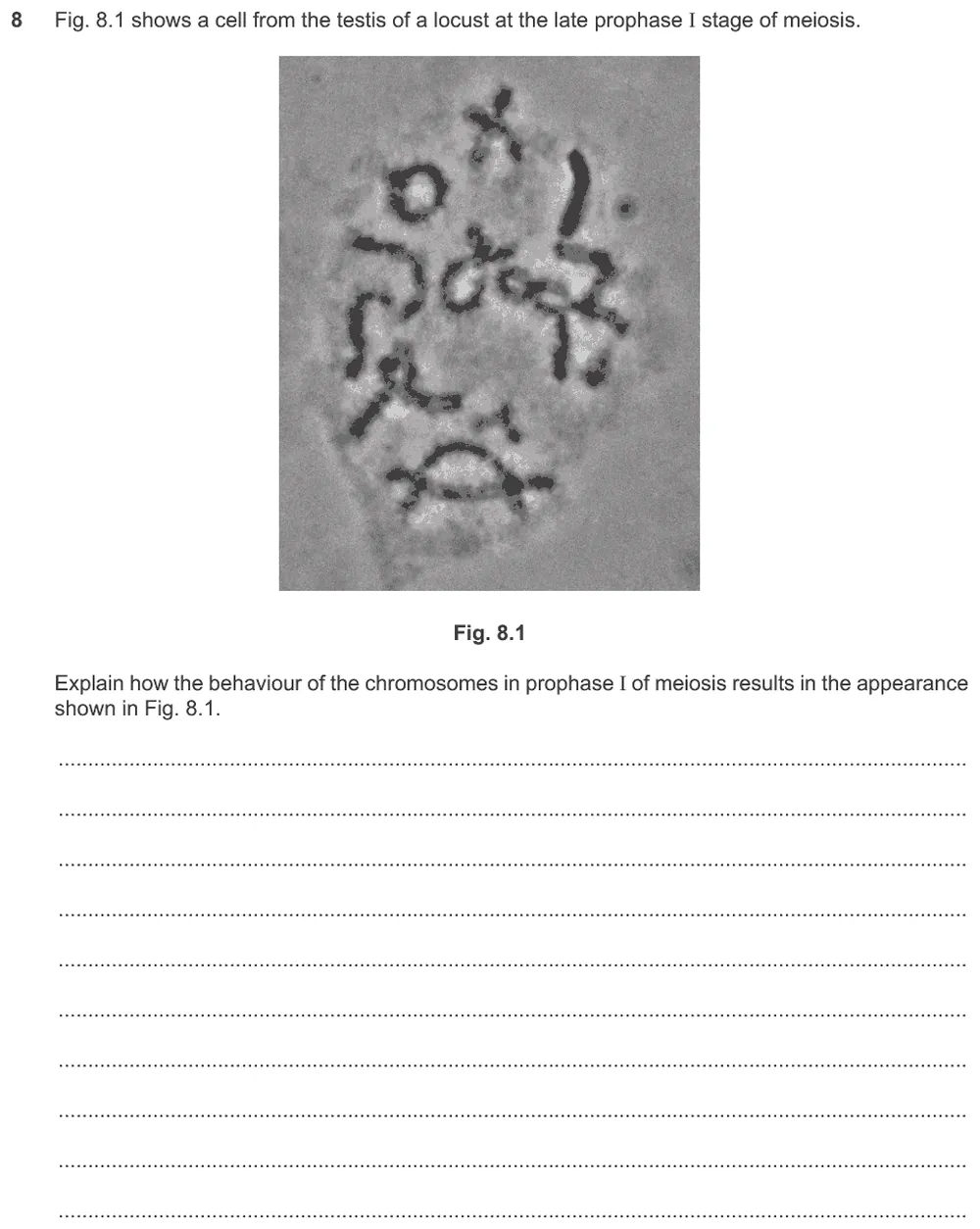
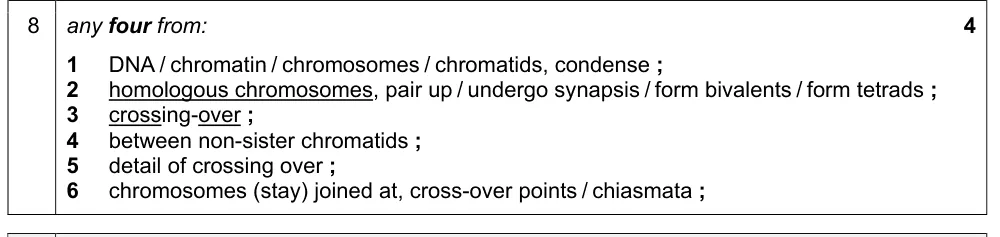
Explain how the behaviour of chromosomes in prophase I gives the appearance shown in the photomicrograph.
Show the mark scheme
Tap an image to open it full size.
From the examiners' report: Common mistakes were confusing chromosomes with chromatids and sister with non-sister chromatids, and misusing the terms bivalent and synapsis. Few pointed out that the chiasmata in the photomicrograph show where crossing over has taken place.
Prophase I and independent assortment (16.1.4 and 16.1.6)
Question 13
Paper 4 · May/June 2018 (42) · Q3(a)(i) · 4 marks · Easy
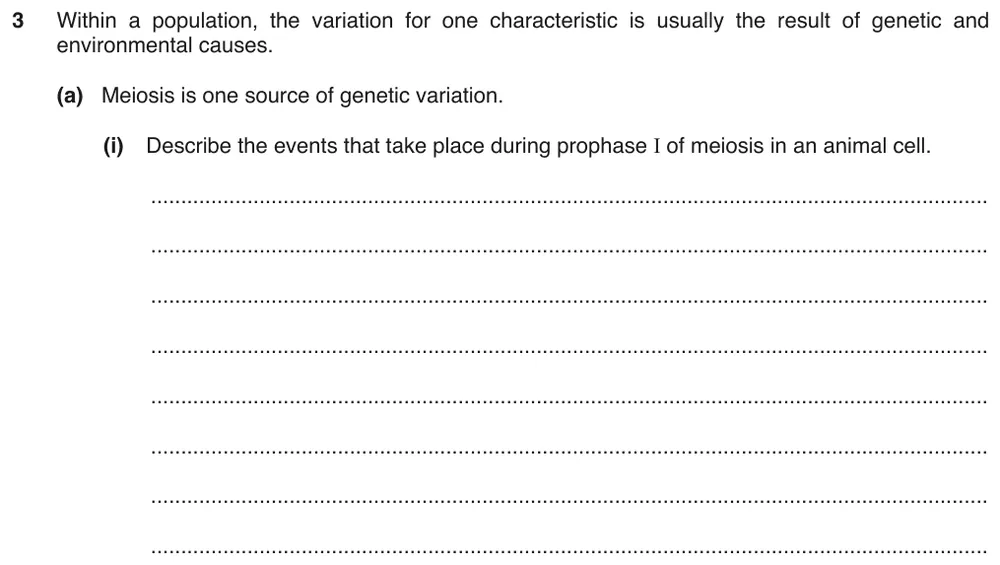
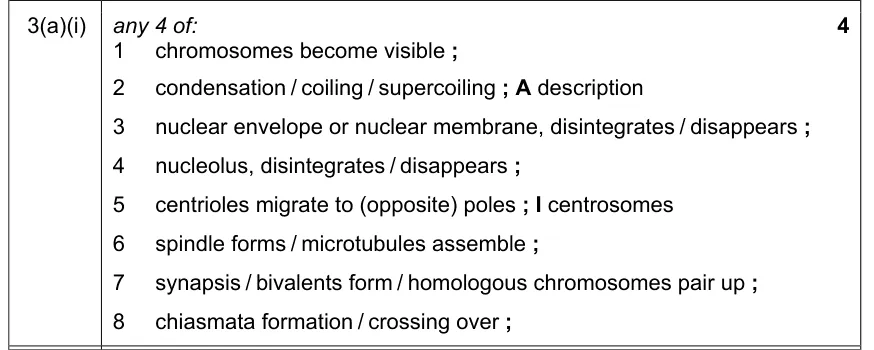
Describe the events that take place during prophase I of meiosis in an animal cell.
Show the mark scheme
Tap an image to open it full size.
From the examiners' report: A minority wrongly wrote that the nuclear membrane dissolves or that the nucleus breaks down. Few said that the chromosomes become visible, and a significant number wrongly wrote that centrosomes migrate to opposite poles. Answers only about genetic variation missed the other marks.
Question 14
Paper 4 · May/June 2018 (42) · Q3(a)(ii) · 2 marks
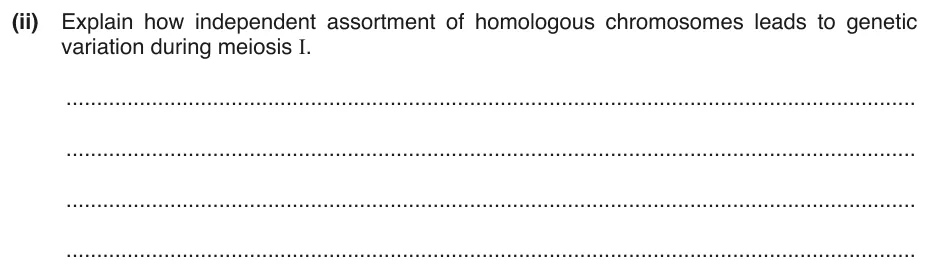
Explain how independent assortment of homologous chromosomes leads to genetic variation during meiosis I.
Show the mark scheme

Tap an image to open it full size.
From the examiners' report: Many repeated the wording of the question and did not explain what 'independent' means here: the random alignment of the chromosomes. New combinations of alleles needed a reference to the parents. Some wrongly described chromatids pairing up at random.
Crossing over (16.1.4 and 16.1.6)
Question 15
Paper 4 · February/March 2022 (42) · Q4(a)(i) · 1 mark · Easy
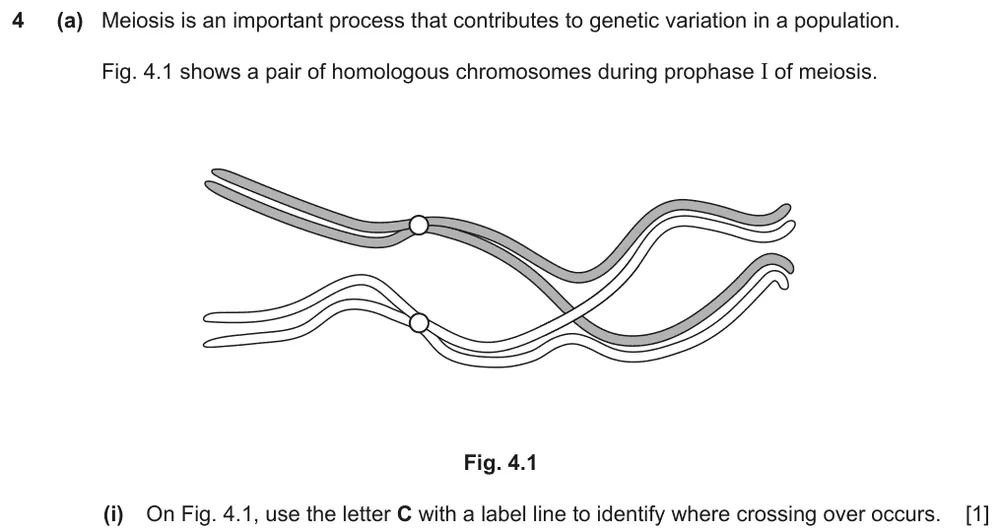
Label the point on the pair of homologous chromosomes where crossing over occurs.
Show the mark scheme

Tap an image to open it full size.
From the examiners' report: Nearly all were correct. Wrong answers labelled the centromere, or a point where non-sister chromatids were lined up but not crossing over. Some did not use a label line, as the question required.
Question 16
Paper 4 · February/March 2022 (42) · Q4(a)(ii) · 4 marks
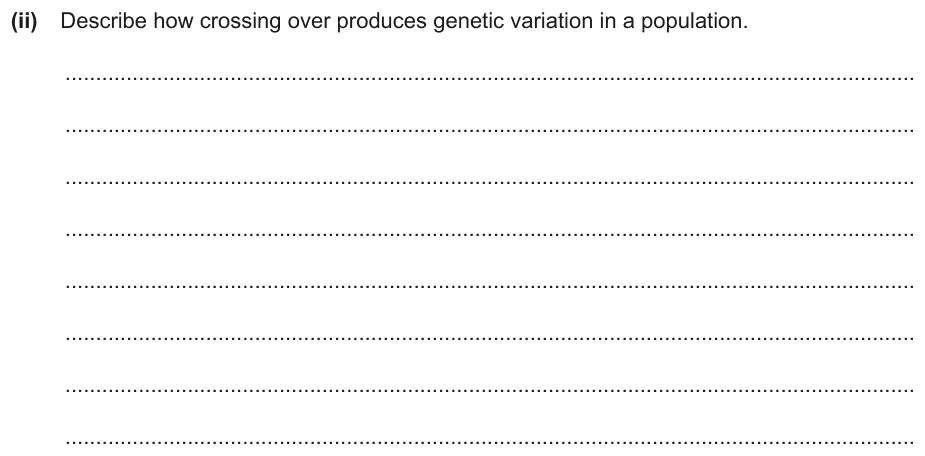
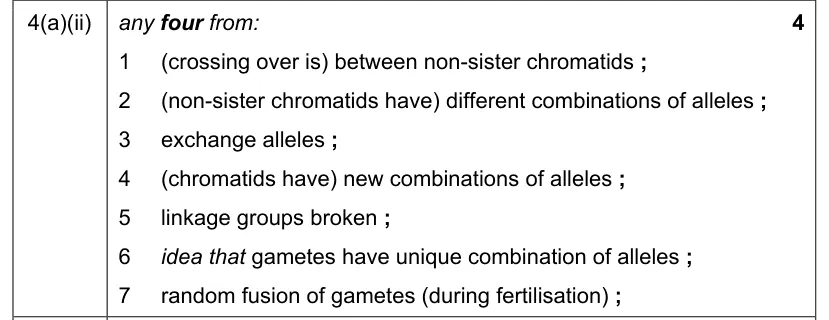
Describe how crossing over produces genetic variation in a population.
Show the mark scheme
Tap an image to open it full size.
From the examiners' report: Say that crossing over is between non-sister chromatids and that alleles are exchanged; 'genetic information' is vague and 'genes' is wrong. Few linked the genetically different gametes made by meiosis to variation in the population. A few strong answers said that crossing over breaks up linkage groups.
Stages of meiosis in photomicrographs and diagrams (16.1.4 and 16.1.5)
Question 17
Paper 4 · February/March 2025 (42) · Q5 · 5 marks · Hard
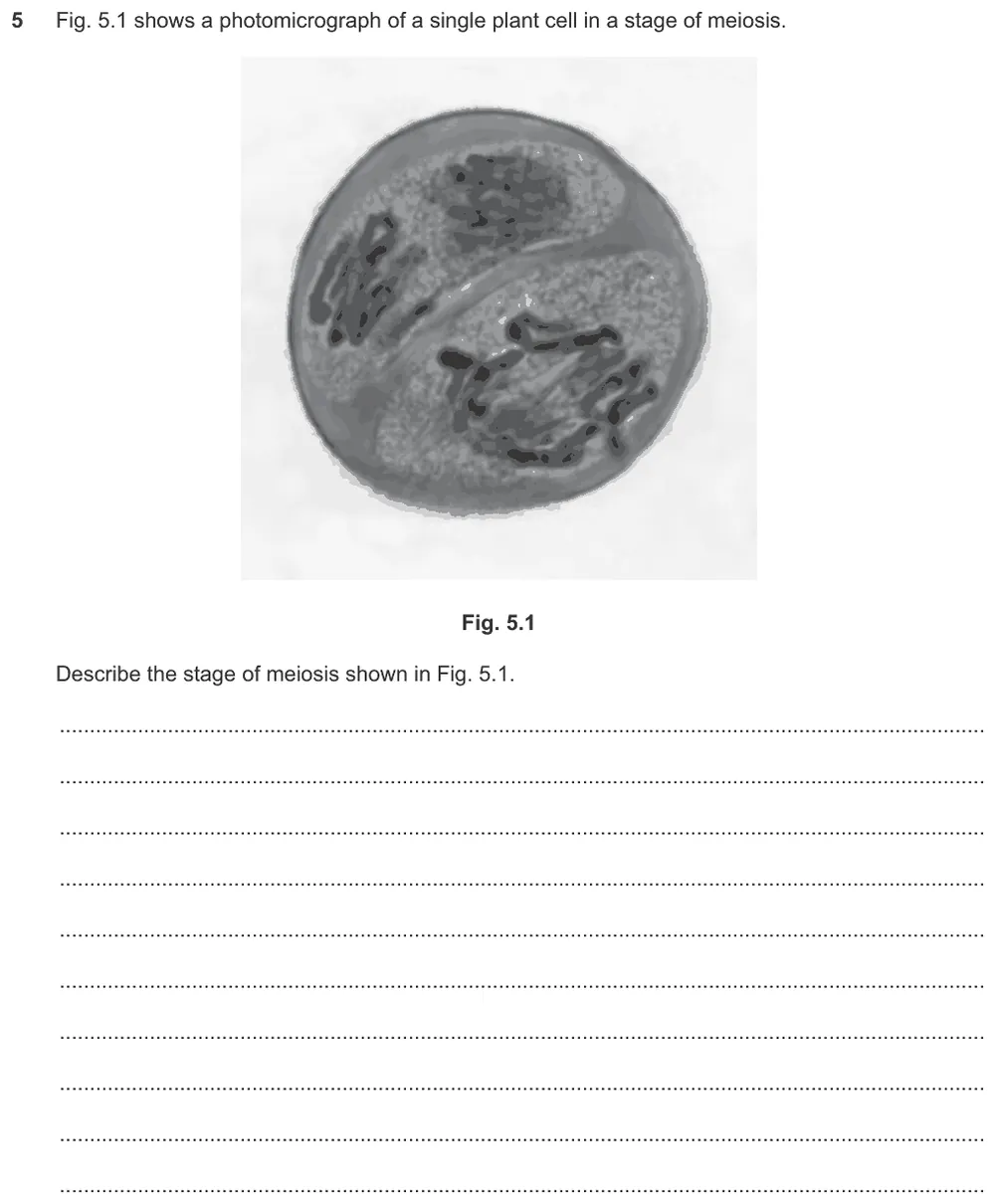
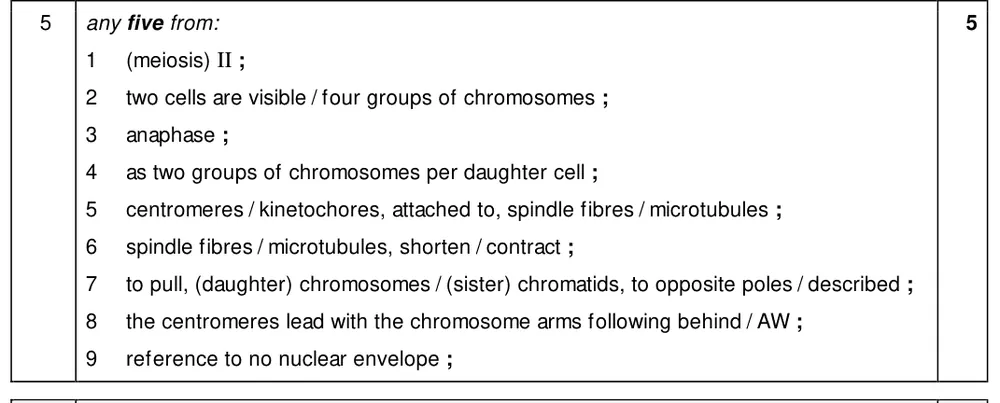
Describe the stage of meiosis shown in a photomicrograph of a single plant cell.
Show the mark scheme
Tap an image to open it full size.
From the examiners' report: Many missed the statement that this is a single plant cell and read the image as two cells in meiosis I. Others thought it showed telophase II. Those who recognised anaphase II often wrote only that the chromatids are pulled to opposite poles.
Question 18
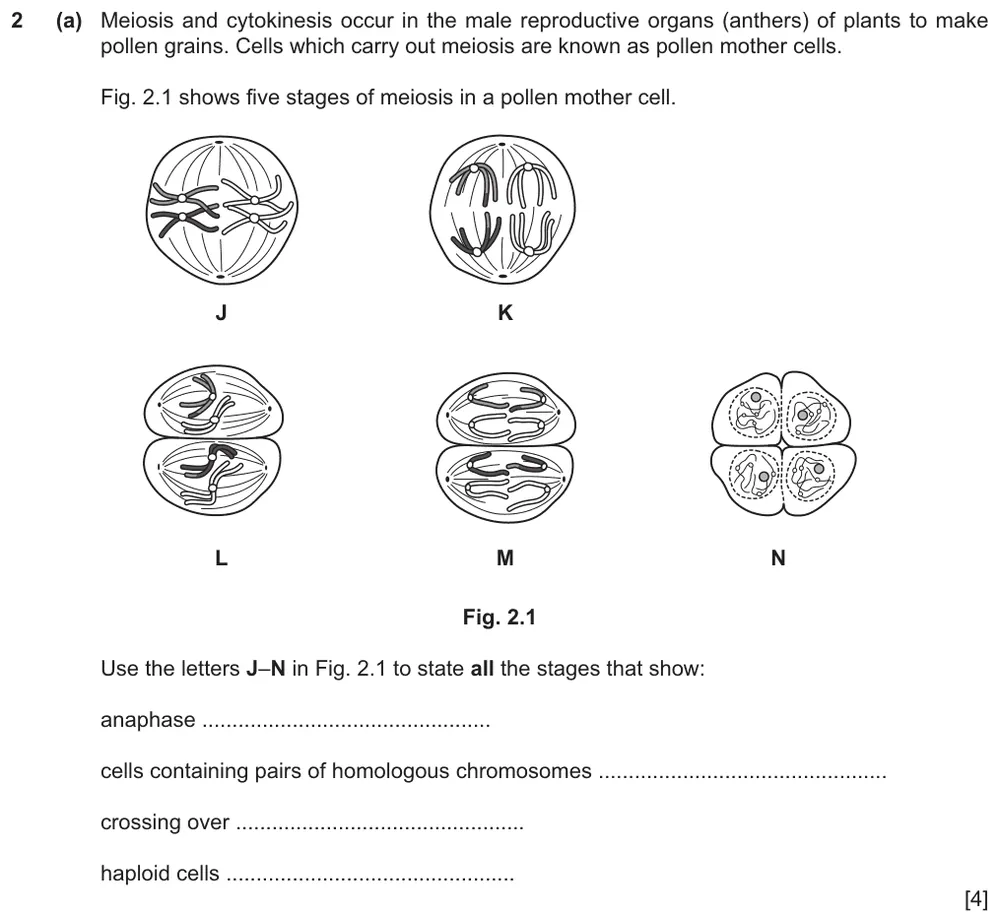
Paper 4 · October/November 2025 (44) · Q2(a) · 4 marks
Use the diagrams of five stages of meiosis to identify anaphase, homologous pairs, crossing over and haploid cells.
Show the mark scheme

Tap an image to open it full size.
Fertilisation, reduction division and stages of meiosis (16.1.4, 16.1.5 and 16.1.7)
Question 19
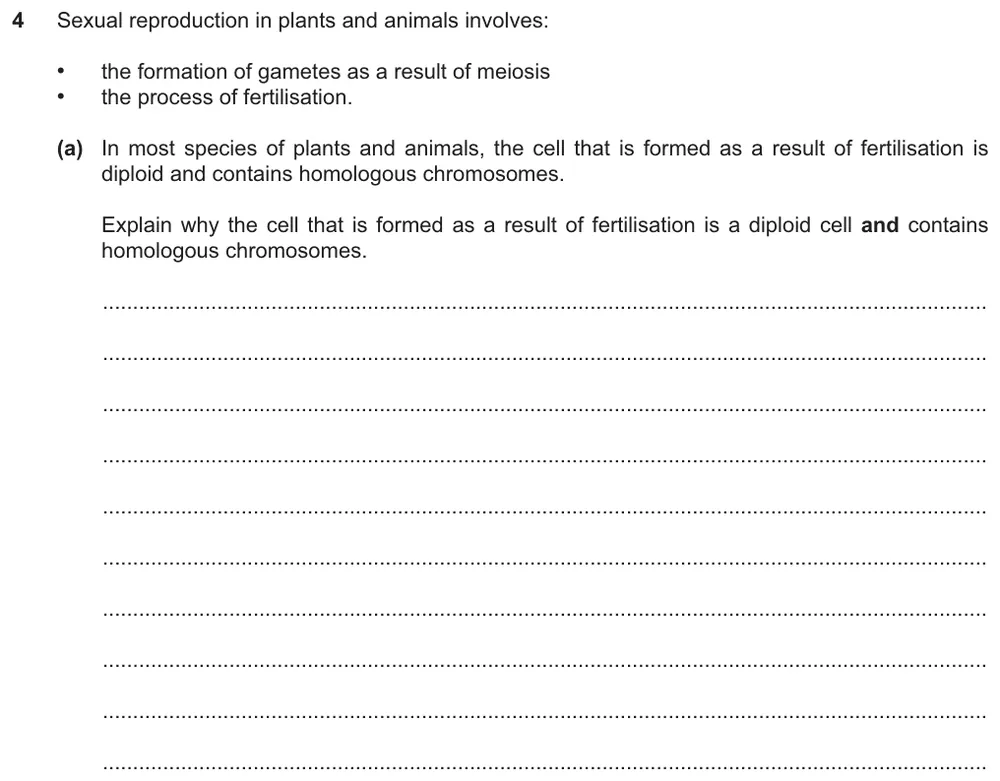
Paper 4 · May/June 2025 (42) · Q4(a) · 3 marks
Explain why the cell formed at fertilisation is diploid and contains homologous chromosomes.
Show the mark scheme

Tap an image to open it full size.
Question 20
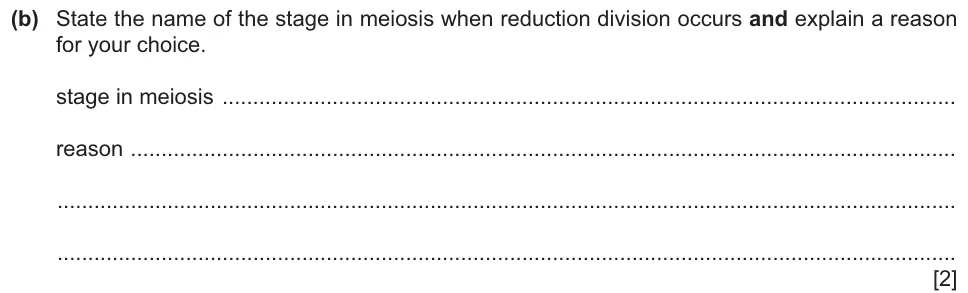
Paper 4 · May/June 2025 (42) · Q4(b) · 2 marks
Name the stage of meiosis in which reduction division occurs and give a reason.
Show the mark scheme

Tap an image to open it full size.
Question 21
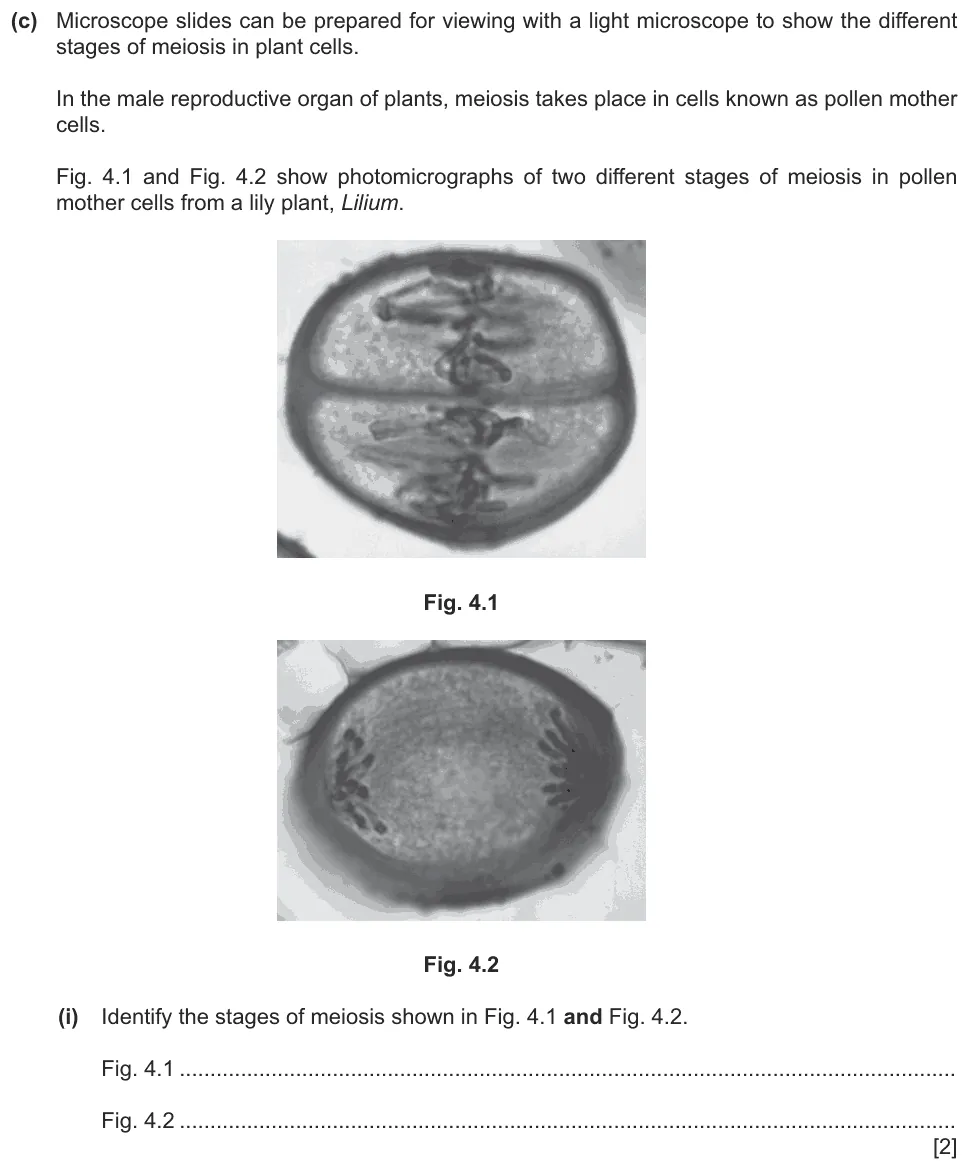
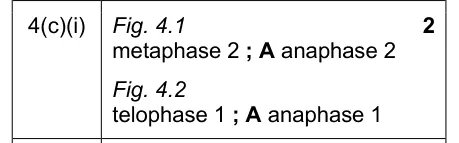
Paper 4 · May/June 2025 (42) · Q4(c)(i) · 2 marks
Identify the stages of meiosis shown in two photomicrographs of lily pollen mother cells.
Show the mark scheme
Tap an image to open it full size.
Question 22
Paper 4 · May/June 2025 (42) · Q4(c)(ii) · 1 mark
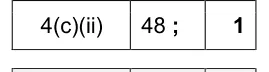
State the number of sister chromatids in a lily pollen mother cell at the start of meiosis.

Show the mark scheme
Tap an image to open it full size.
Where students lose marks (from Cambridge examiners' reports and mark schemes)
Each point below comes from the examiners' reports and mark schemes, and is followed by wording that gained marks.
One set, not half a set. Students gave only a comparison, such as n and 2n or haploid is 'half', or used the human numbers 23 and 46.
✔ Gains credit: 'haploid is one (complete) set of chromosomes' and 'diploid is two (complete) sets of chromosomes'.
Same, not similar. Students wrote that homologous chromosomes are 'similar' in length or shape, or gave genetic features when the question asked for another feature.
✔ Gains credit: 'same length', 'same shape', 'same position of centromere' or 'same banding pattern'.
Reduction division is about chromosome number. Students explained how meiosis produces genetic variation and left out the terms gamete and zygote.
✔ Gains credit: 'gametes are haploid', 'gametes fuse to form a zygote', 'so the zygote is diploid', which 'prevents doubling of chromosome number'.
Bivalents line up in metaphase I. Students did not say what lines up on the equator in metaphase I, and for telophase I wrote about daughter cells or the nuclear membrane instead of the chromosomes.
✔ Gains credit: 'homologous (pairs of) chromosomes' or 'bivalents' 'line up on the equator'; in telophase I 'chromosomes reach the opposite poles'.
Say what the spindle fibres do. Students described chromosomes moving to the ends of the cell, or bivalents being pulled to the poles, and drew telophase II chromosomes with two chromatids.
✔ Gains credit: spindle fibres 'contract to pull centromeres towards poles' in anaphase I; telophase II shows 'four daughter cells' with 'single chromosomes' 'inside a (re-forming) nuclear envelope'.
A single cell with four groups is meiosis II. Students missed that the photomicrograph was of a single plant cell and read it as two cells in meiosis I, or called it telophase II.
✔ Gains credit: 'meiosis II', 'anaphase', 'four groups of chromosomes', 'spindle fibres shorten' 'to pull chromatids to opposite poles'.
Non-sister chromatids exchange alleles. Students did not say that crossing over is between non-sister chromatids, or wrote that genes or 'genetic information' are exchanged.
✔ Gains credit: crossing over is 'between non-sister chromatids', which 'exchange alleles', giving 'new combinations of alleles'; 'linkage groups broken'.
Random assortment is not crossing over. Students wrote about crossing over when the question asked how random assortment of homologous chromosomes gives variation.
✔ Gains credit: 'homologous chromosomes align independently of each other' 'at the equator', which 'leads to different combinations of chromosomes in the daughter cells'.
Download the questions
Download the PDF pack (22 questions, mark schemes at the end)
Keep practising
- The Roles of Genes in Determining the Phenotype (16.2): Cambridge (CIE) exam questions by topic
- Gene Control (16.3): Cambridge (CIE) exam questions by topic
- Cambridge (CIE) A level Biology 9700 past papers, mark schemes and examiners' reports
- Cambridge (CIE) A level Biology grade thresholds
- Book a one-to-one CIE lesson or a free 15-minute discovery chat with Tom
- Register your interest in a CIE A level Biology group class
Questions, mark schemes and examiners' report extracts © Cambridge University Press & Assessment.