

The Roles of Genes in Determining the Phenotype (16.2): Cambridge (CIE) A Level Biology 9700 Exam Questions by Topic
The roles of genes in determining the phenotype is sub-topic 16.2 of Topic 16, Inheritance, in the Cambridge International AS & A Level Biology syllabus (9700). You need to explain genetic terms such as allele, dominant, recessive, codominant, linkage and test cross, and construct genetic diagrams for monohybrid and dihybrid crosses that involve codominance, multiple alleles, sex linkage, autosomal linkage and epistasis. You also need to use the chi-squared test, explain how genes, proteins and phenotype are linked in albinism, sickle cell anaemia, haemophilia and Huntington's disease, and explain the role of gibberellin and the Le gene in stem elongation. This is A level content, examined on Paper 4.
The examiners' reports return to the same points. In a genetic diagram, link every offspring genotype to its phenotype and write superscripts clearly. In a sex-linked cross, show the sex chromosomes in your symbols and put the allele on the correct chromosome. A chi-squared value greater than the critical value means that the difference is significant and not due to chance. When genes are linked, it is alleles, not genes, that are inherited together. Name the gene and its protein correctly, such as the F8 gene and factor VIII, and describe the mutation before its effects.
Studying Cambridge International A level Biology and want more help? Tom teaches CIE students one-to-one online, including students in the UAE, Saudi Arabia, Hong Kong, India and Indonesia, and every lesson is recorded. You can book a one-to-one lesson or a free 15-minute discovery chat, or register your interest in a CIE group class starting in September 2027, using the links at the bottom of this page.
What you need from AS Level
Each question on this page assumes you're secure on these ideas. If any of them feels shaky, look it up before you start.
- A gene is a sequence of nucleotides that forms part of a DNA molecule and codes for a polypeptide.
- A gene mutation is a change in the sequence of base pairs in a DNA molecule that may result in an altered polypeptide.
- The sequence of amino acids in a polypeptide determines the three-dimensional shape of the protein, and so its function.
- Enzymes are globular proteins that catalyse reactions; a change in the shape of an enzyme can make it non-functional.
Key terms
These words come up in the questions and mark schemes. Examiners expect you to use them exactly.
- Allele: one of two or more forms of a gene.
- Locus: the position of a gene on a chromosome.
- Homozygous: having two identical alleles of a gene.
- Heterozygous: having two different alleles of a gene.
- Codominant: describes alleles that both have an effect on the phenotype of a heterozygote.
- Linkage: two or more genes on the same chromosome, so that their alleles are inherited together unless crossing over separates them.
- Test cross: a cross between an organism showing the dominant phenotype and a homozygous recessive organism, used to find the genotype of the first organism.
- Epistasis: the interaction of two genes at different loci, where one gene affects the expression of the other.
What these questions cover (Cambridge 9700 Topic 16: Inheritance)
The questions test these learning outcomes from sub-topic 16.2 of the Cambridge International AS & A Level Biology syllabus (9700) for 2025 to 2027.
- 16.2.1 explain the terms gene, locus, allele, dominant, recessive, codominant, linkage, test cross, F1, F2, phenotype, genotype, homozygous and heterozygous
- 16.2.2 interpret and construct genetic diagrams, including Punnett squares, to explain and predict the results of monohybrid crosses and dihybrid crosses that involve dominance, codominance, multip
- 16.2.3 interpret and construct genetic diagrams, including Punnett squares, to explain and predict the results of dihybrid crosses that involve autosomal linkage and epistasis
- 16.2.4 interpret and construct genetic diagrams, including Punnett squares, to explain and predict the results of test crosses
- 16.2.5 use the chi-squared test to test the significance of differences between observed and expected results
- 16.2.6 explain the relationship between genes, proteins and phenotype
- 16.2.7 explain the role of gibberellin in stem elongation including the role of the dominant allele, Le, that codes for a functional enzyme in the gibberellin synthesis pathway, and the recessive allele, le, that codes for a non-functional enzyme
How to use this page
Write your answer on paper before you open the mark scheme. Allow about 1.2 minutes per mark: the 22 questions are worth 64 marks, so about 77 minutes in total. Then mark your answer strictly against the mark scheme and read the examiners' tip underneath it. If you'd rather print the questions, download the PDF pack.
Dominant and recessive alleles, sex linkage and a test cross (16.2.1, 16.2.2 and 16.2.4)
Question 1
Paper 4 · October/November 2022 (42) · Q7(a) · 2 marks · Easy
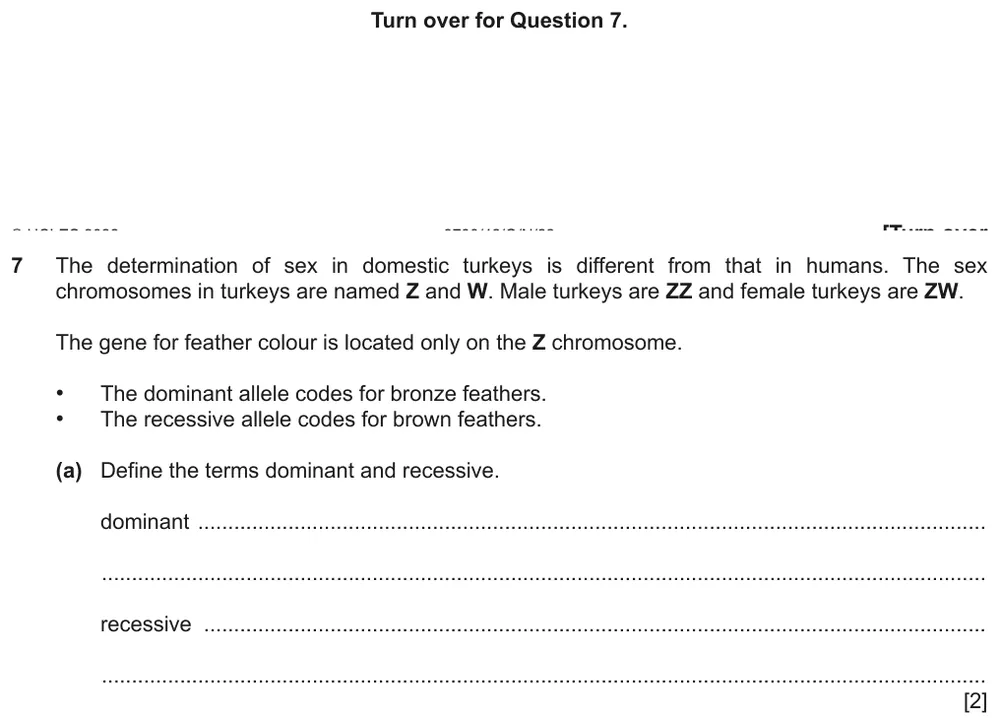
Define the terms dominant and recessive.
Show the mark scheme

Tap an image to open it full size.
From the examiners' report: Most gave clear definitions. Many said that a dominant allele always has an effect on the phenotype and that a recessive allele only has an effect on the phenotype if the dominant allele is absent.
Question 2
Paper 4 · October/November 2022 (42) · Q7(b) · 5 marks · Hard
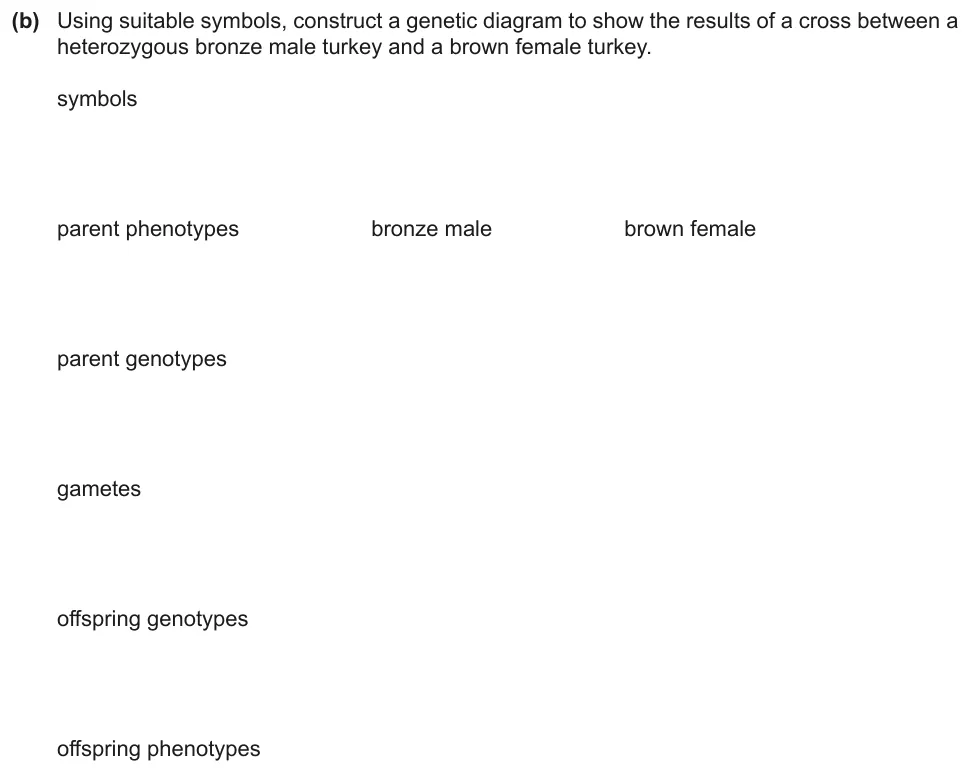
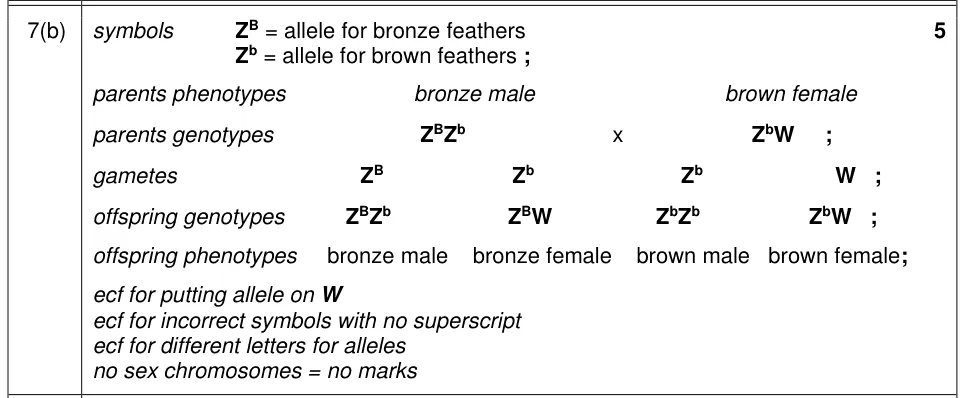
Construct a genetic diagram for a sex-linked cross between a heterozygous bronze male turkey and a brown female turkey.
Show the mark scheme
Tap an image to open it full size.
From the examiners' report: Many found this sex-linked cross difficult. The sex chromosome Z was often left out of the key to the symbols. Write the allele symbols as superscripts on the Z chromosome, and do not add a symbol to the W chromosome.
Question 3
Paper 4 · October/November 2022 (42) · Q7(c) · 3 marks · Easy
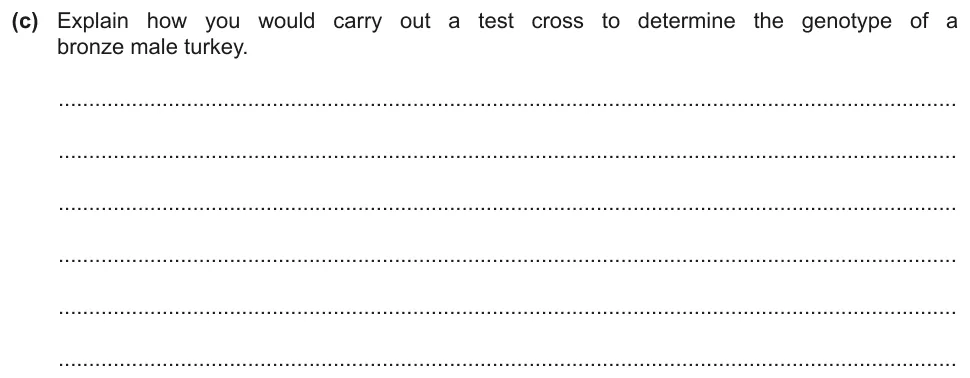
Explain how to carry out a test cross to find the genotype of a bronze male turkey.
Show the mark scheme

Tap an image to open it full size.
From the examiners' report: The cross is with a brown female. The most common mistake was to call her a homozygous recessive female. Some crossed two male turkeys together.
Monohybrid cross (16.2.2)
Question 4
Paper 4 · February/March 2025 (42) · Q4(a) · 3 marks · Easy
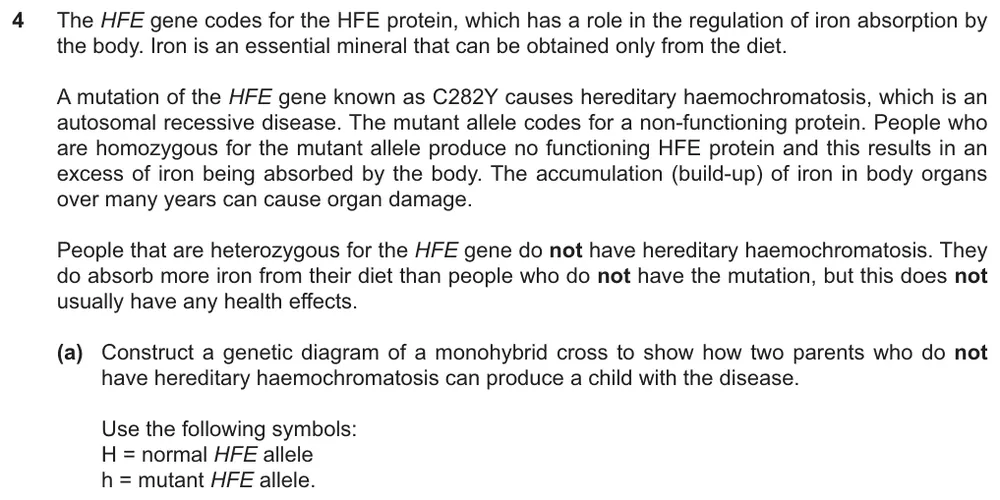
Construct a genetic diagram to show how two parents without hereditary haemochromatosis can have a child with the disease.
Show the mark scheme

Tap an image to open it full size.
From the examiners' report: Say which of the offspring genotypes gives a child with the disease; stating a 25% probability is not enough. 'Carrier' describes a genotype, not a phenotype. The question says the disease is autosomal recessive, so an answer based on X-linkage is wrong.
Multiple alleles and codominance (16.2.2)
Question 5
Paper 4 · May/June 2024 (42) · Q3(a) · 1 mark
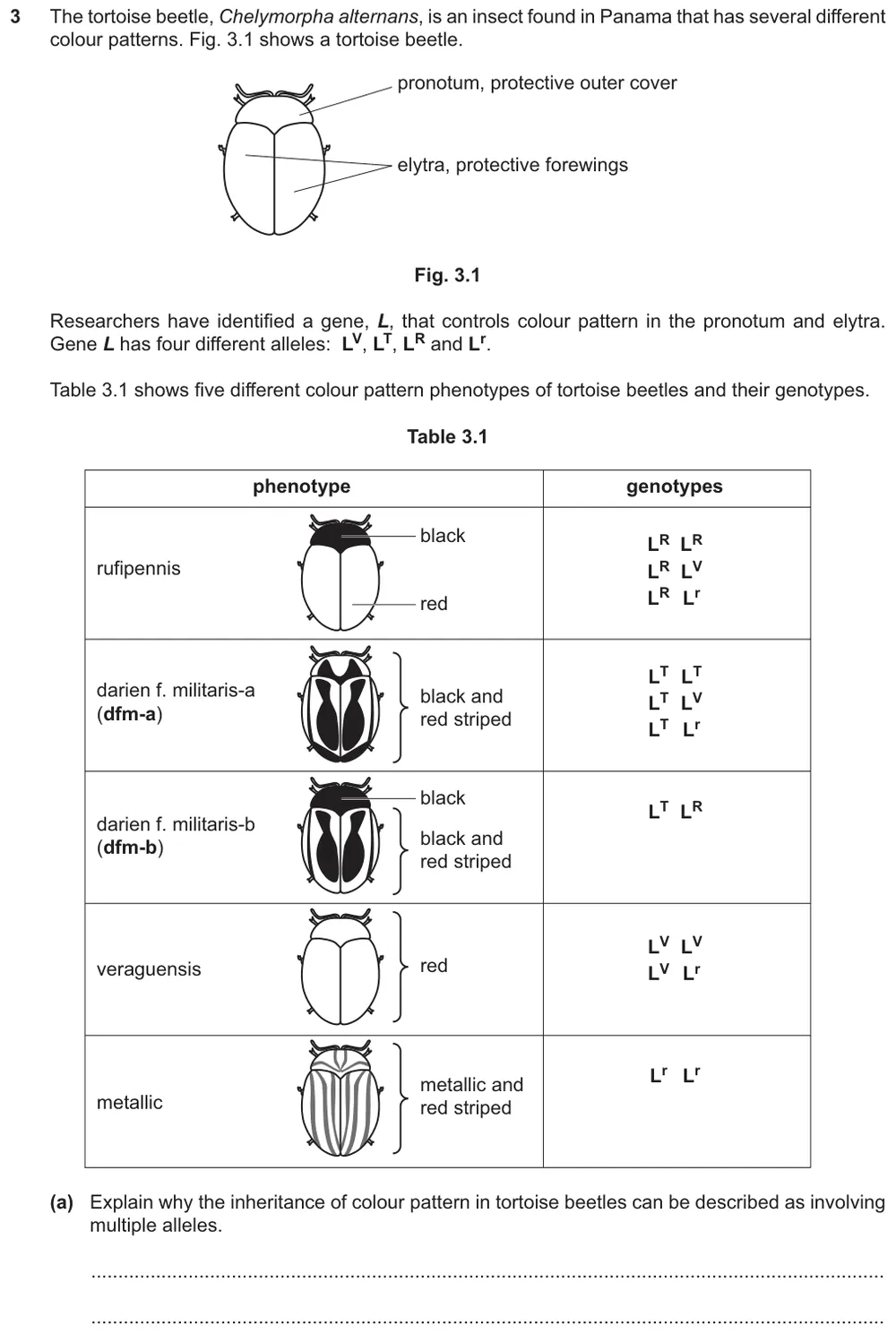
Explain why the inheritance of colour pattern in tortoise beetles involves multiple alleles.
Show the mark scheme

Tap an image to open it full size.
From the examiners' report: Say that gene L has four alleles, or list them. Most had the right idea but did not say how many alleles there were, or left out the reference to a gene. Using the phrase 'multiple alleles' from the question, or repeating the phenotypes, did not explain it.
Question 6
Paper 4 · May/June 2024 (42) · Q3(b) · 4 marks · Easy
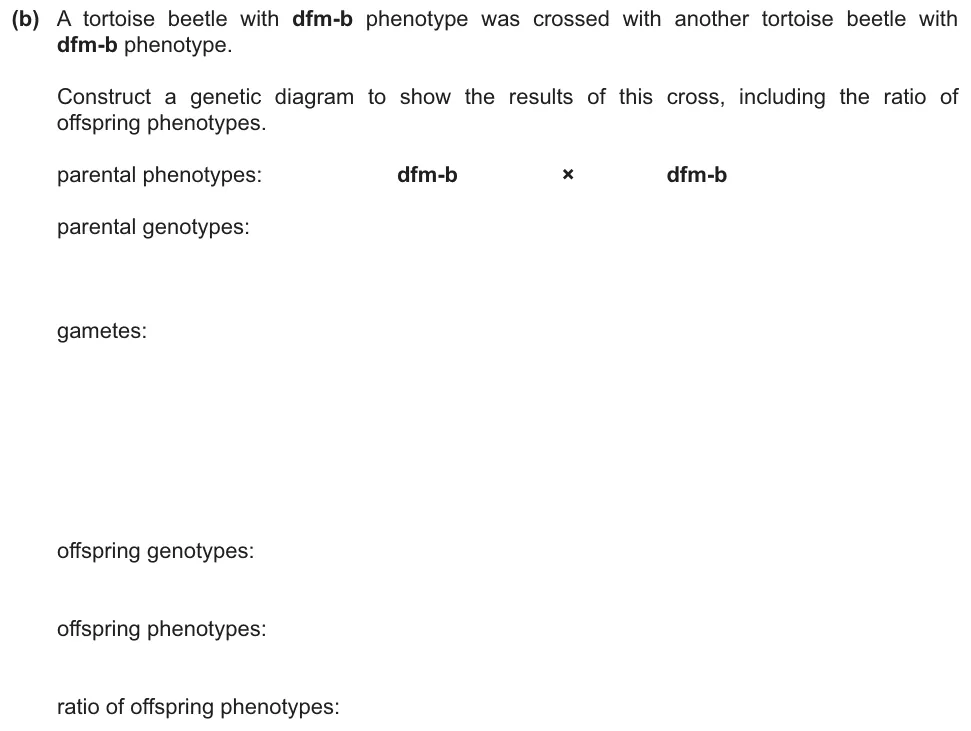
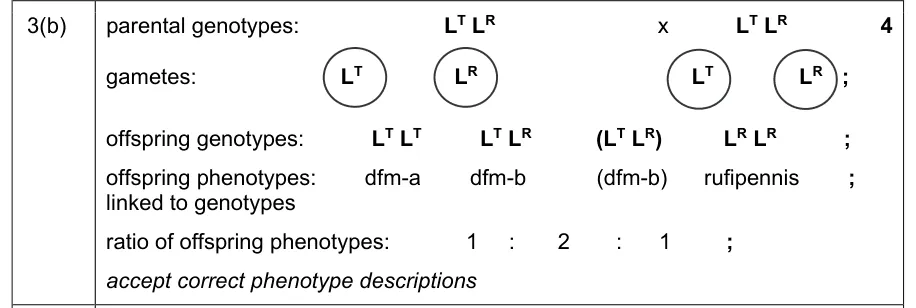
Construct a genetic diagram for a cross between two beetles with the dfm-b phenotype, including the ratio of offspring phenotypes.
Show the mark scheme
Tap an image to open it full size.
From the examiners' report: Link the offspring genotypes clearly to their phenotypes, and write the phenotypes in the same order as the ratio. Write the superscript smaller than the letter for the allele.
Question 7
Paper 4 · May/June 2024 (42) · Q3(c) · 2 marks
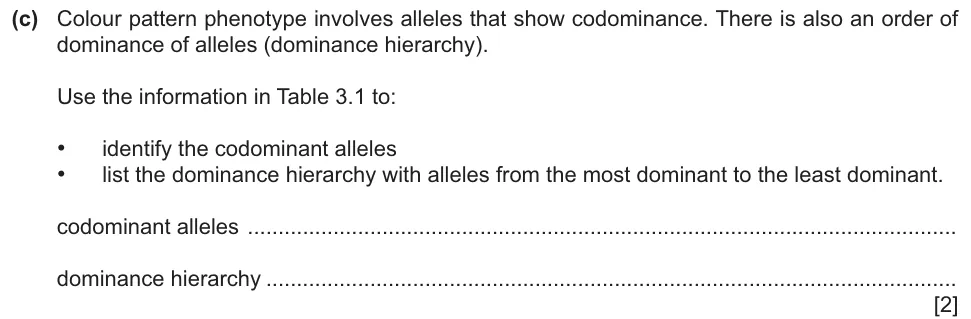
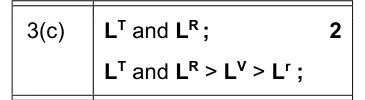
Use the table to identify the codominant alleles and list the dominance hierarchy of the alleles.
Show the mark scheme
Tap an image to open it full size.
From the examiners' report: Give alleles, not phenotypes or genotypes. Only a few showed the two codominant alleles together in the dominance hierarchy, and a significant number wrote all four alleles as codominant.
Question 8
Paper 4 · May/June 2024 (42) · Q3(d)(i) · 2 marks · Hard
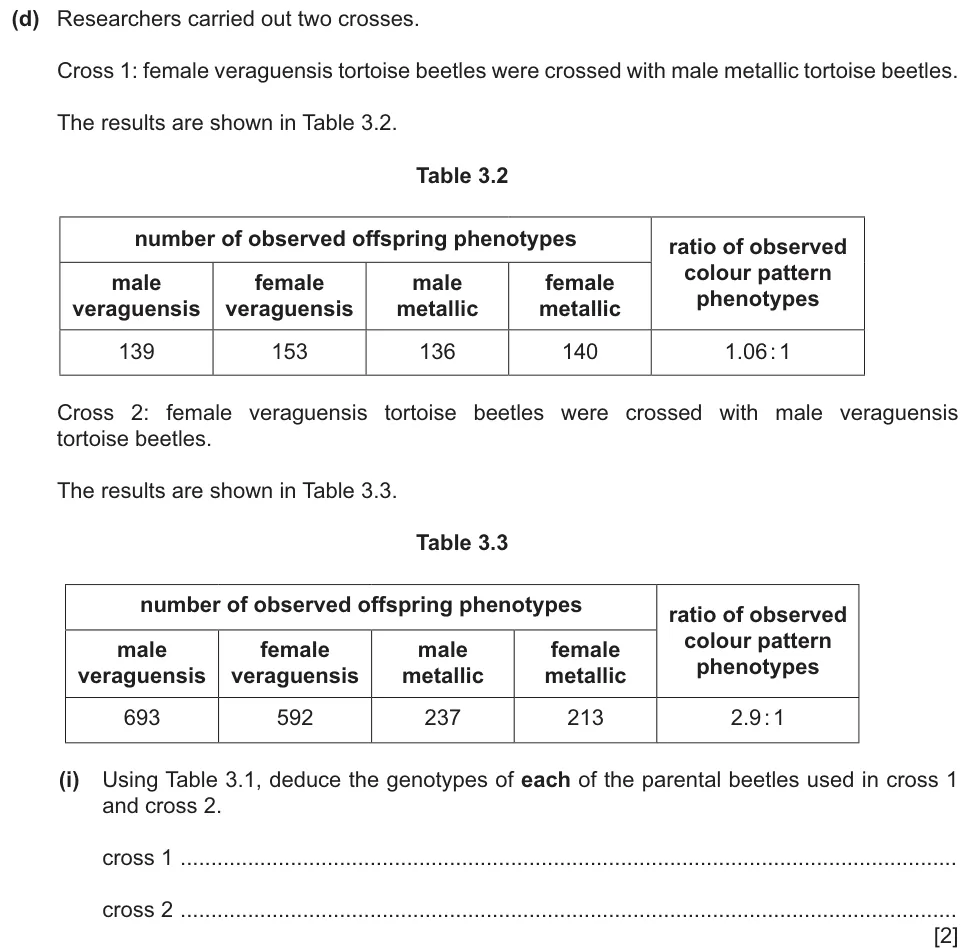
Deduce the genotypes of the parent beetles used in two crosses.
Show the mark scheme

Tap an image to open it full size.
From the examiners' report: Label which genotype is the female and which is the male. On many scripts the superscripts V and r could not be told apart, and ambiguous answers cannot be credited.
Question 9
Paper 4 · May/June 2024 (42) · Q3(d)(ii) · 1 mark · Hard
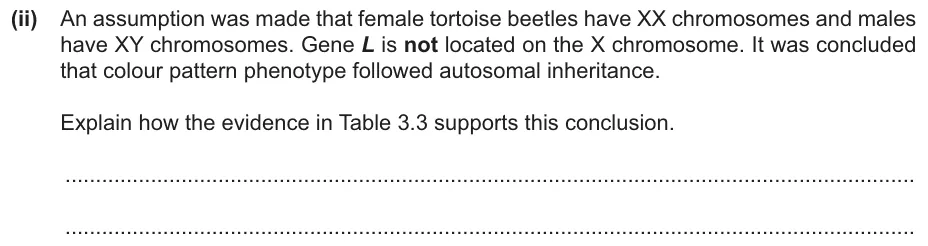
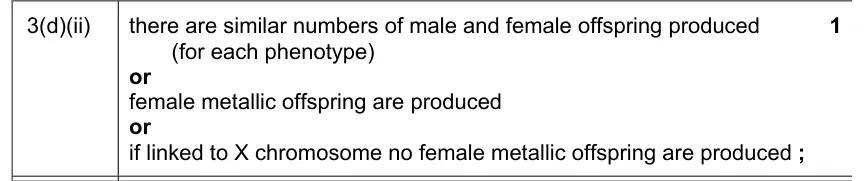
Explain how the results of cross 2 support autosomal inheritance of colour pattern.
Show the mark scheme
Tap an image to open it full size.
From the examiners' report: Only the strongest answers gained this mark. Compare the numbers of males and females for each phenotype, or note that female metallic offspring are produced. Many wrote about the ratio of phenotypes instead.
Dihybrid cross with two genes for one characteristic (16.2.3)
Question 10
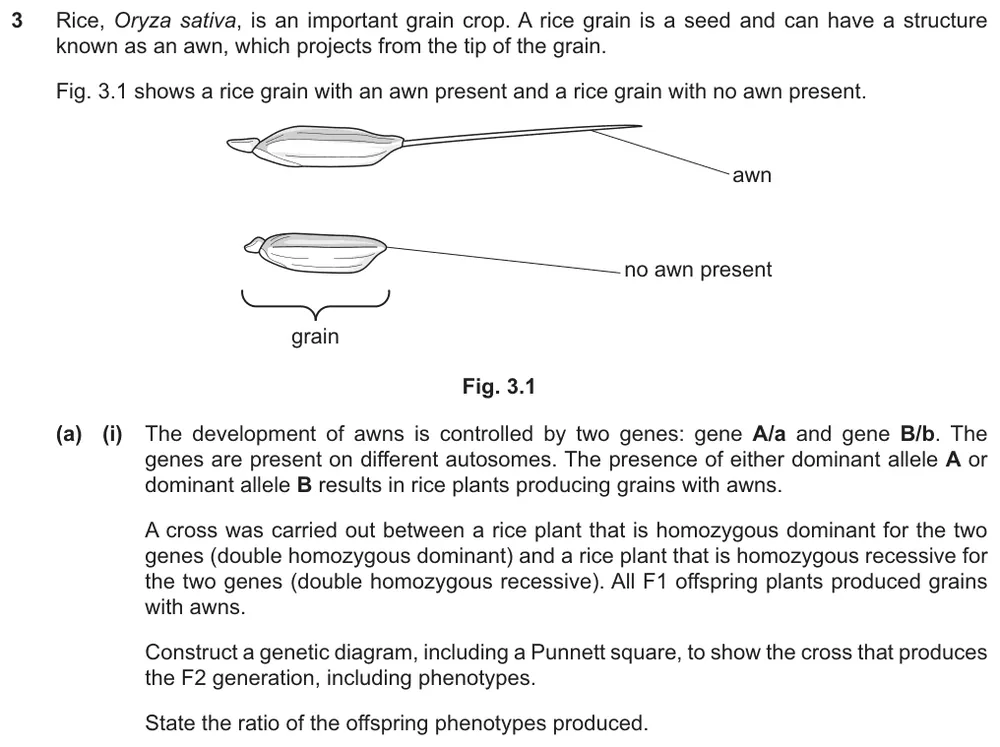
Paper 4 · May/June 2025 (42) · Q3(a)(i) · 5 marks
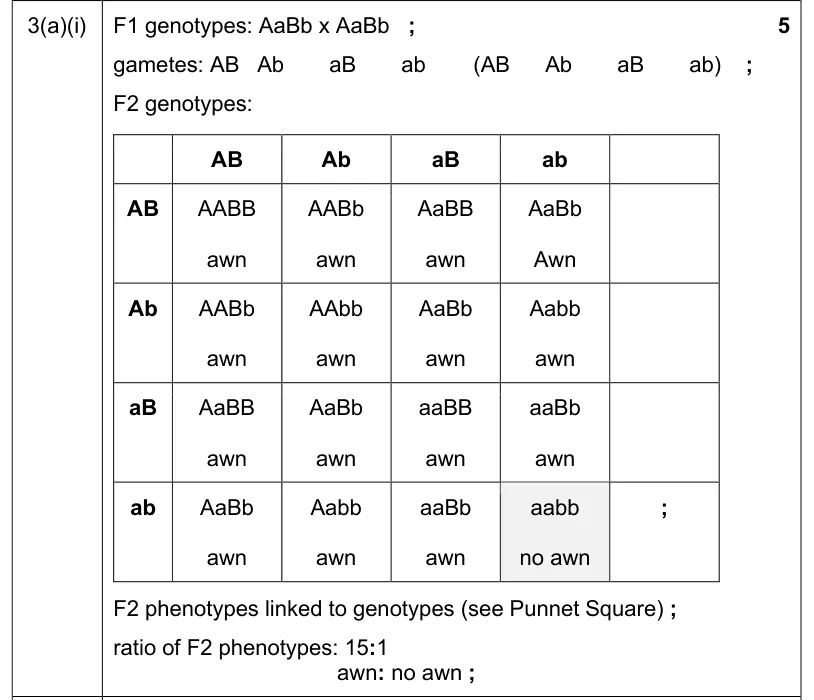
Construct a genetic diagram with a Punnett square for a cross that produces the F2 generation, and state the ratio of offspring phenotypes.
Show the mark scheme
Tap an image to open it full size.
Question 11
Paper 4 · May/June 2025 (42) · Q3(a)(ii) · 1 mark
Deduce the type of inheritance shown by the ratio of offspring phenotypes.

Show the mark scheme

Tap an image to open it full size.
Dihybrid test cross, chi-squared test and autosomal linkage (16.2.3, 16.2.4 and 16.2.5)
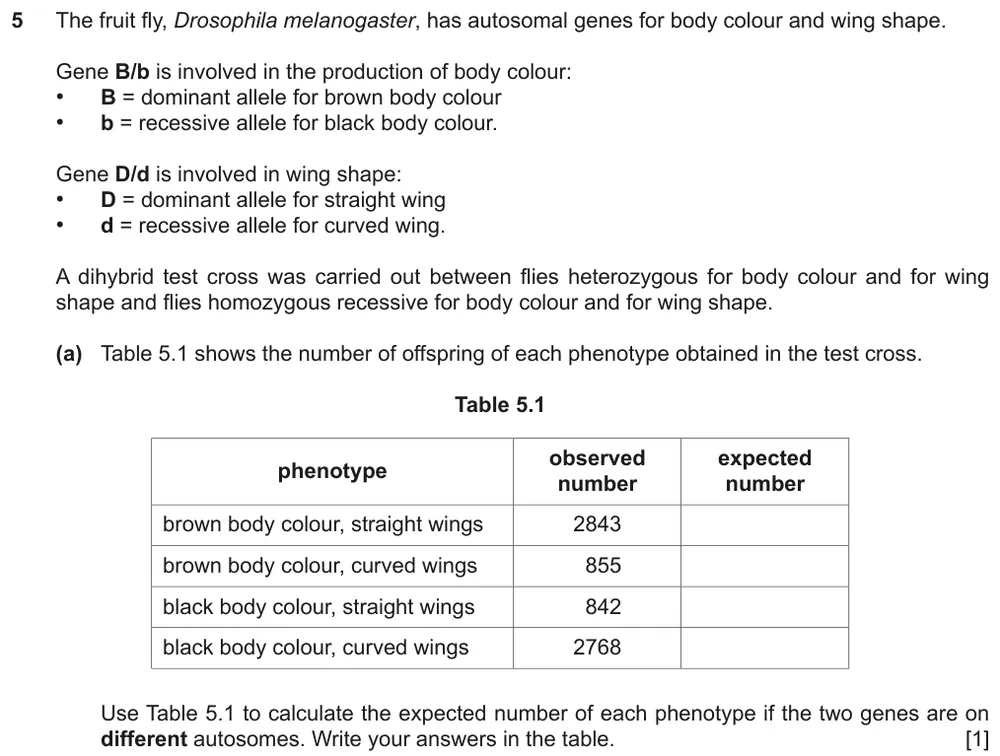
Question 12
Paper 4 · October/November 2023 (42) · Q5(a) · 1 mark
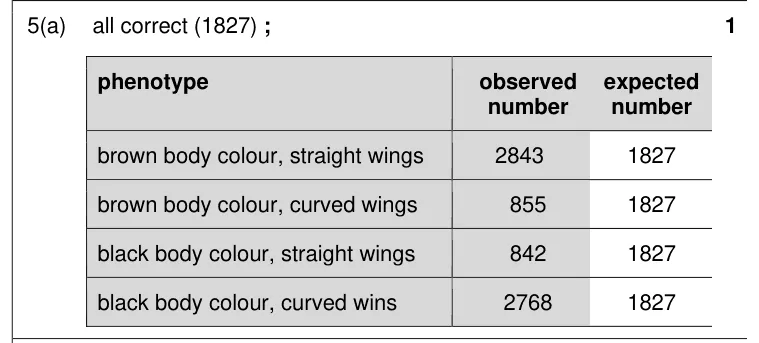
Calculate the expected number of each phenotype in a dihybrid test cross if the two genes are on different autosomes.
Show the mark scheme
Tap an image to open it full size.
From the examiners' report: This is a test cross, so do not give the numbers expected from a cross between two heterozygotes. The question asks for expected numbers, not a ratio such as 1:1:1:1 or 9:3:3:1.
Question 13
Paper 4 · October/November 2023 (42) · Q5(b) · 4 marks
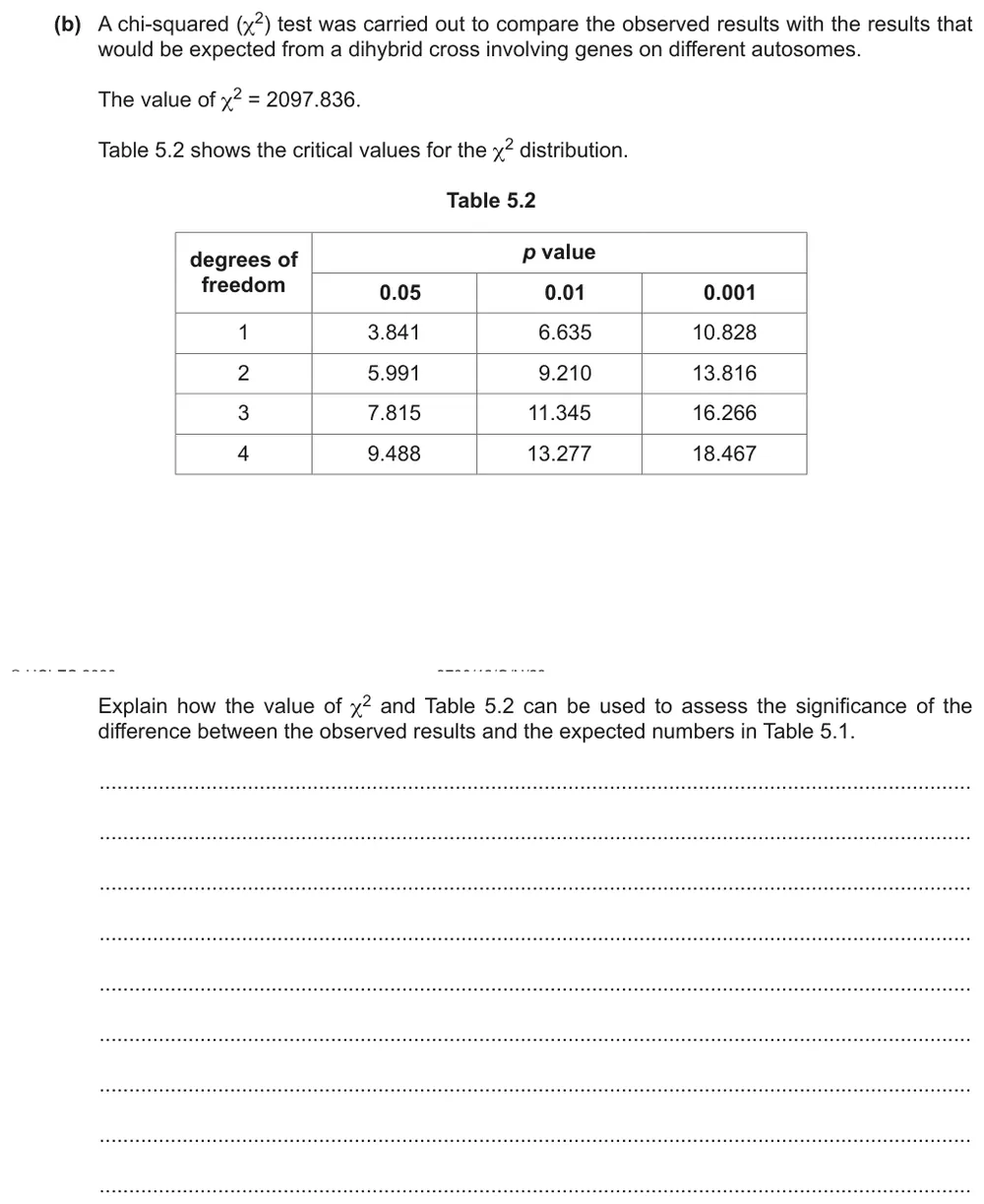
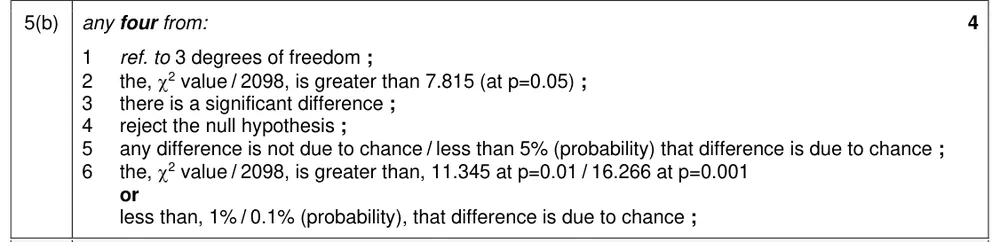
Explain how the chi-squared value and the table of critical values are used to assess the significance of the difference between observed and expected results.
Show the mark scheme
Tap an image to open it full size.
From the examiners' report: Strong answers said that the chi-squared value is greater than the critical value at 3 degrees of freedom, that the results are significantly different from those expected and not due to chance, and that the null hypothesis is rejected. Apply your answer to this question; some only explained what a higher or lower value would mean.
Question 14
Paper 4 · October/November 2023 (42) · Q5(c) · 4 marks · Hard
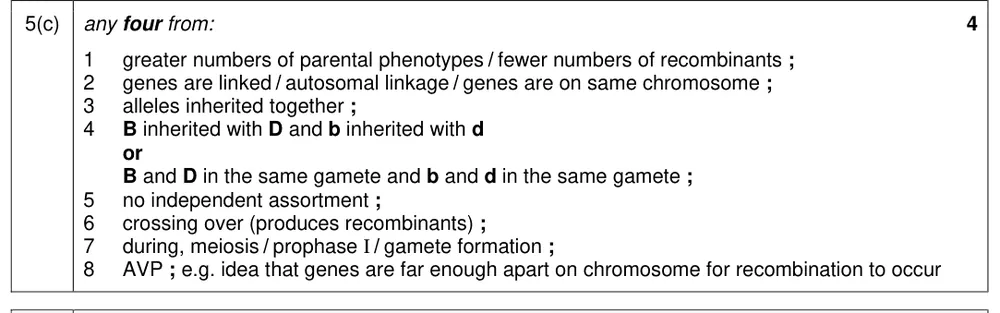
Suggest explanations for the observed results of the dihybrid test cross.
Show the mark scheme
Tap an image to open it full size.
From the examiners' report: Write that alleles, not genes, are inherited together. A common mistake was to suggest that independent assortment had taken place. Only a minority stated that there were more parental phenotypes than recombinants.
F1 generation, chi-squared test and unexpected ratios (16.2.1, 16.2.3 and 16.2.5)
Question 15
Paper 4 · February/March 2022 (42) · Q4(b)(i) · 2 marks
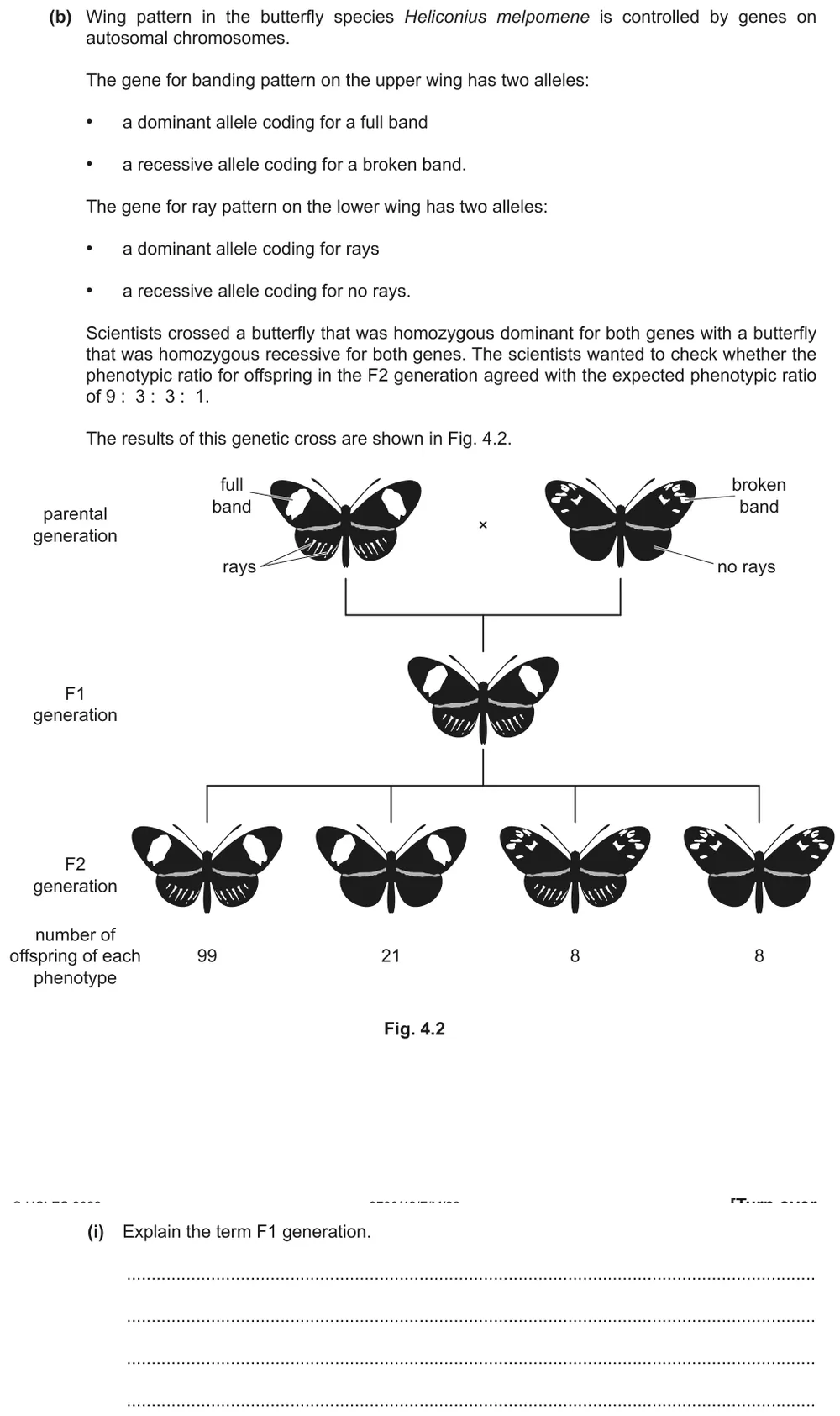
Explain the term F1 generation.
Show the mark scheme

Tap an image to open it full size.
From the examiners' report: Most only referred to the offspring of a parental generation. Fewer said that the parents must be homozygous or that the F1 offspring are heterozygous. Individuals are crossed, not genes.
Question 16
Paper 4 · February/March 2022 (42) · Q4(b)(ii) · 3 marks · Easy
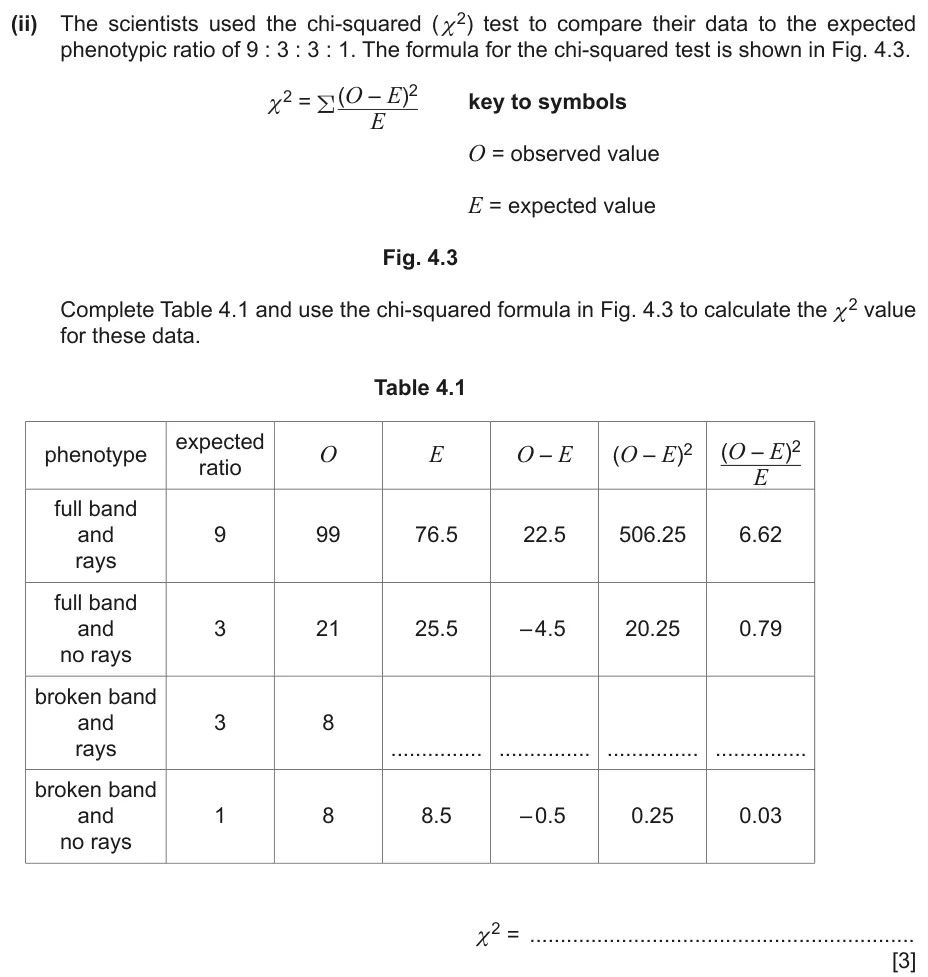
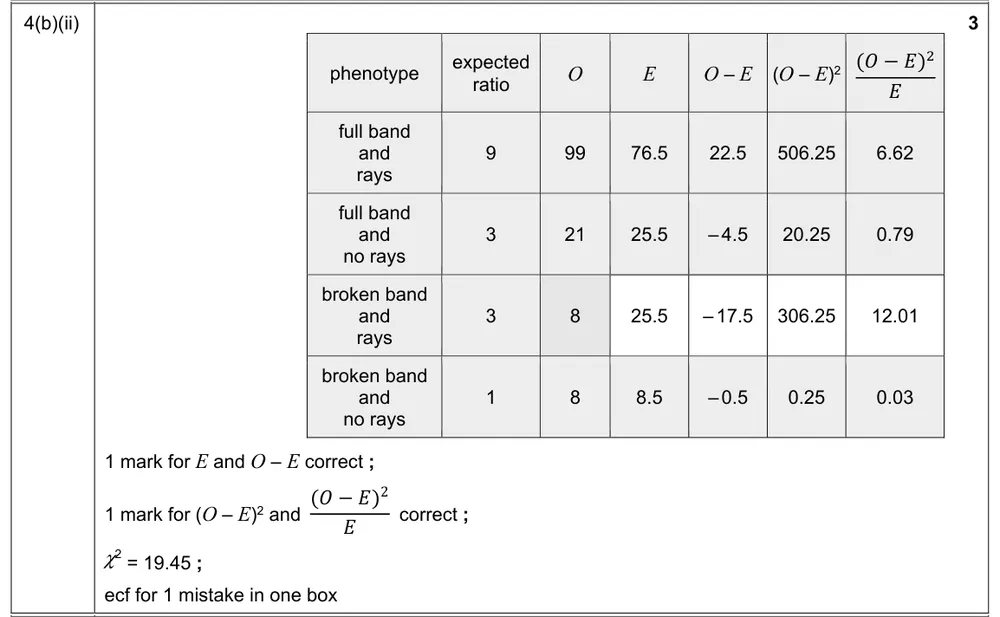
Complete the table and calculate the chi-squared value.
Show the mark scheme
Tap an image to open it full size.
From the examiners' report: Most completed the table correctly. The more frequent errors were rounding the final column wrongly, copying the fourth row into the empty spaces in the third row because the observed numbers are the same, and not adding up the four values in the final column.
Question 17
Paper 4 · February/March 2022 (42) · Q4(b)(iii) · 3 marks
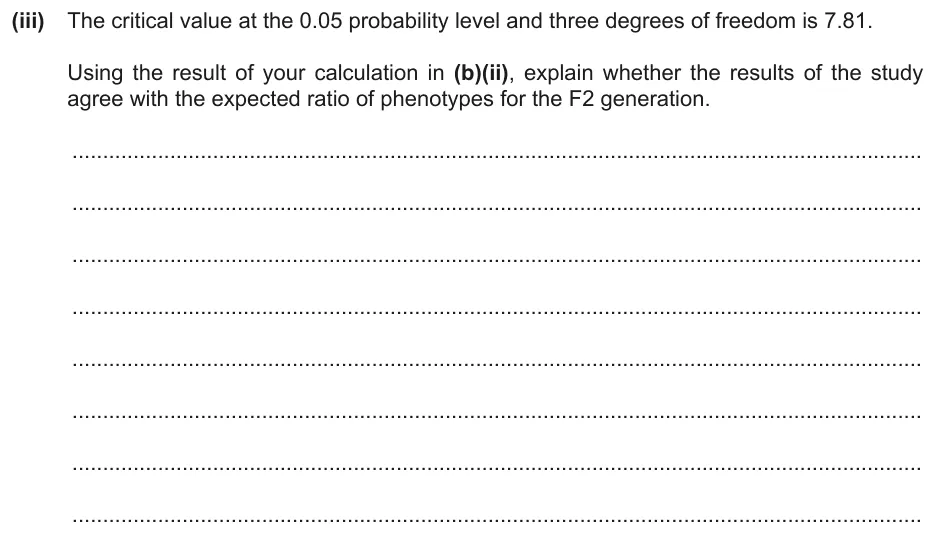
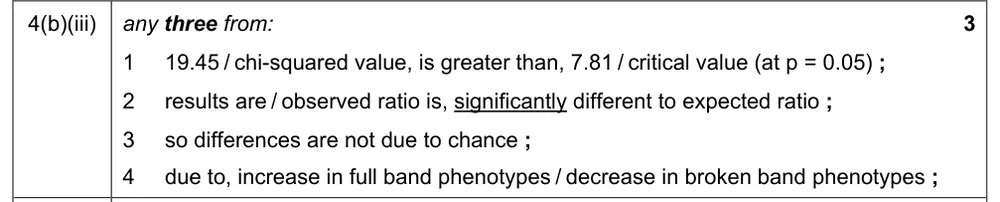
Use the chi-squared value and the critical value to explain whether the results agree with the expected ratio.
Show the mark scheme
Tap an image to open it full size.
From the examiners' report: Some thought that a calculated value greater than the critical value means there is no significant difference; it means the opposite. Compare the chi-squared value with the critical value, and avoid ambiguous comments about the number of degrees of freedom.
Question 18
Paper 4 · February/March 2022 (42) · Q4(b)(iv) · 2 marks · Easy
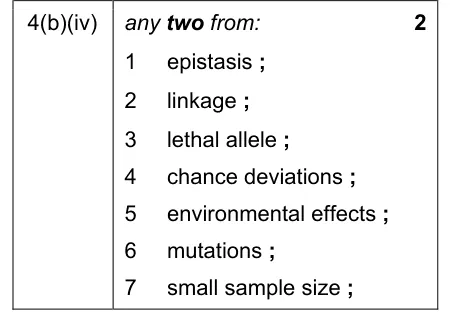
Suggest two reasons why phenotypic ratios in the F2 generation do not always match the expected ratios.

Show the mark scheme
Tap an image to open it full size.
From the examiners' report: The most likely genetic reasons, autosomal linkage and epistasis, were rarely given; most wrote about mutations. Small numbers of offspring and effects of the environment on the phenotype were also correct.
Genes, proteins and phenotype (16.2.6)
Question 19
Paper 4 · February/March 2025 (42) · Q10(b) · 3 marks · Easy
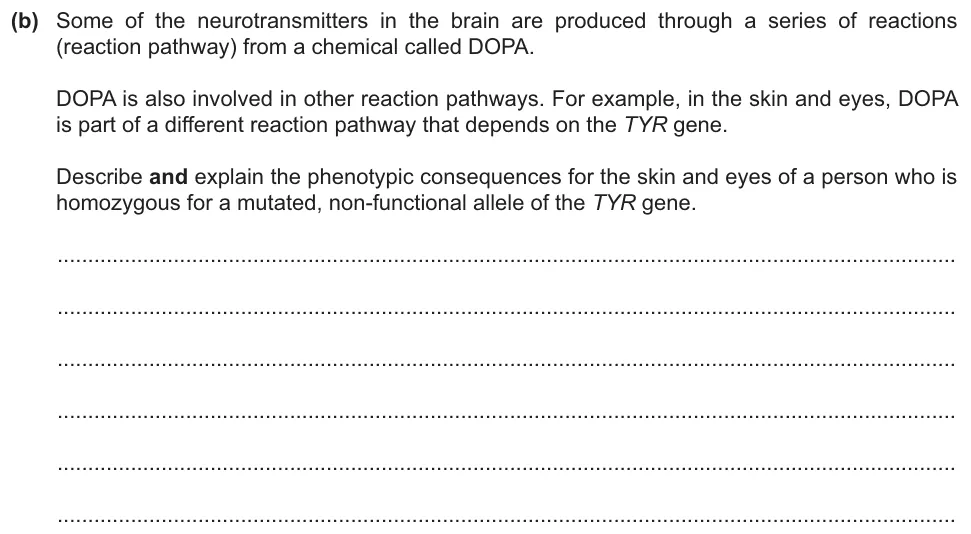
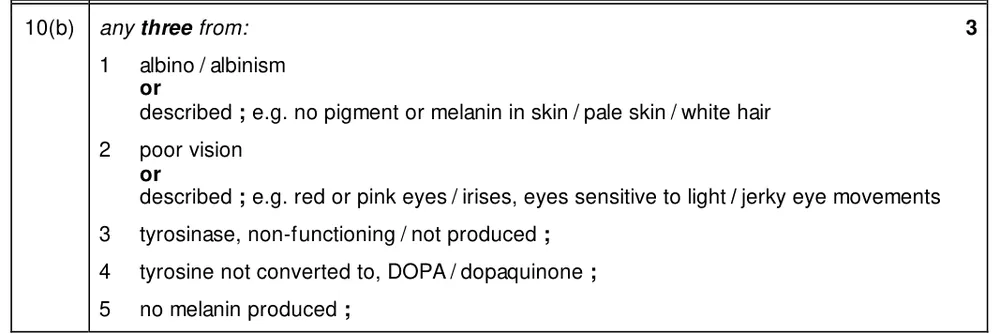
Describe and explain the effects on the skin and eyes of being homozygous for a non-functional allele of the TYR gene.
Show the mark scheme
Tap an image to open it full size.
Question 20
Paper 4 · February/March 2022 (42) · Q3(a) · 5 marks
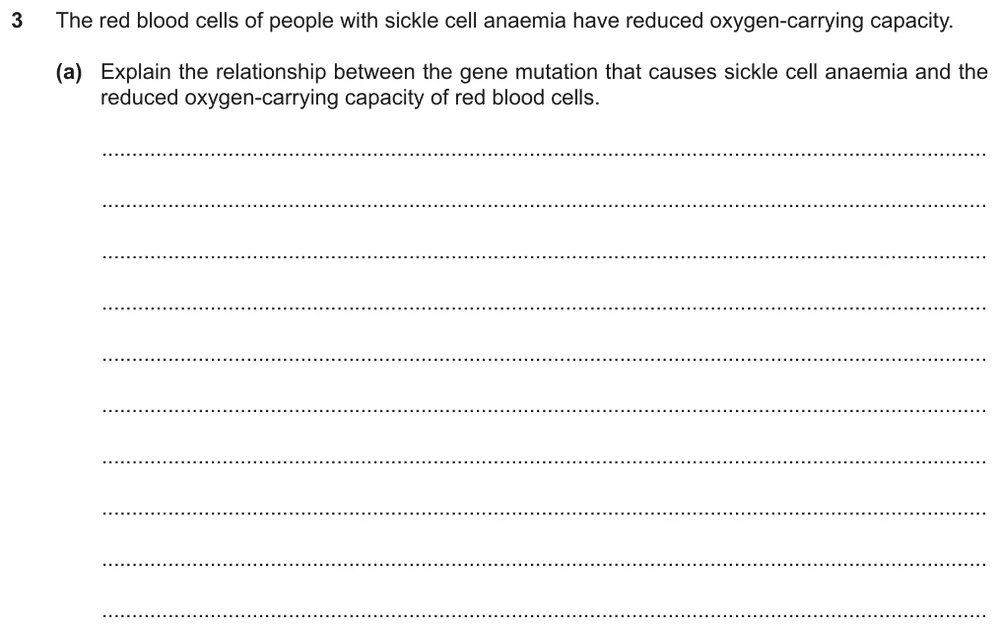
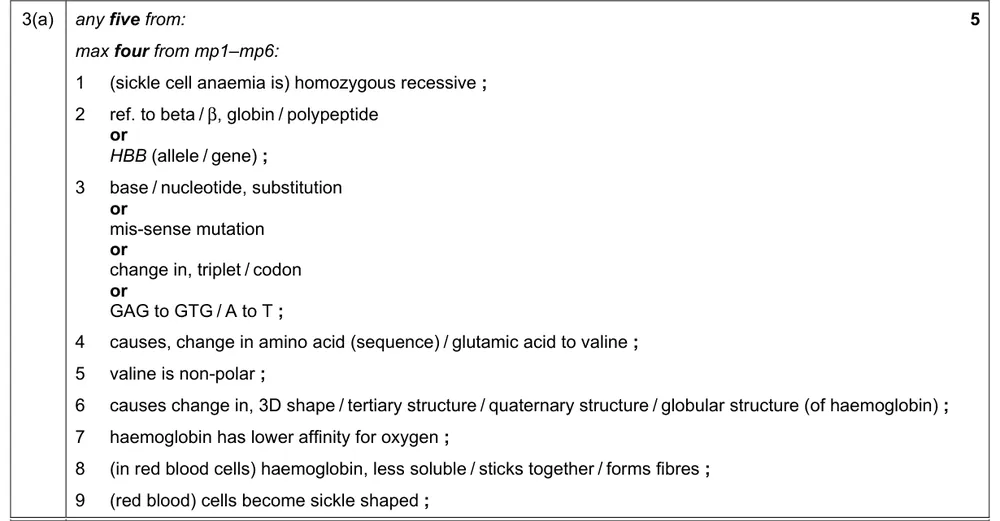
Explain how the gene mutation that causes sickle cell anaemia reduces the oxygen-carrying capacity of red blood cells.
Show the mark scheme
Tap an image to open it full size.
From the examiners' report: Describe the gene mutation and then link it to its effects; many only described the effects of the disease. The gene does not code for red blood cells directly. Keep the nucleotide sequence in DNA separate from the amino acid sequence in the primary structure of the protein.
Haemophilia and the Le gene (16.2.6 and 16.2.7)
Question 21
Paper 4 · May/June 2024 (42) · Q4(a) · 5 marks
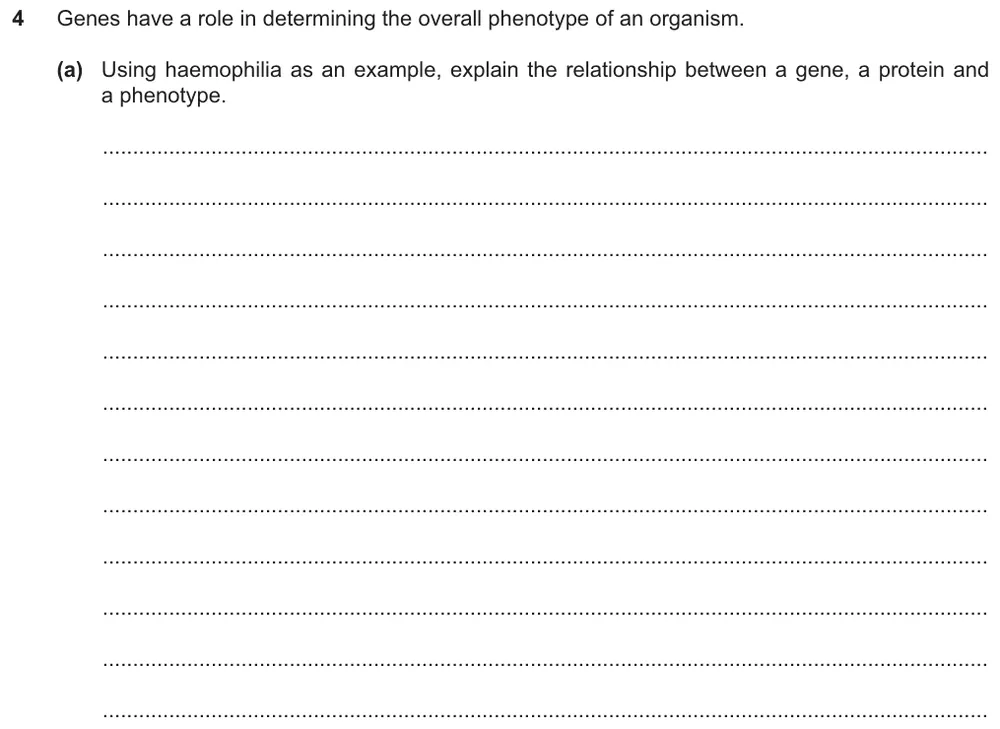
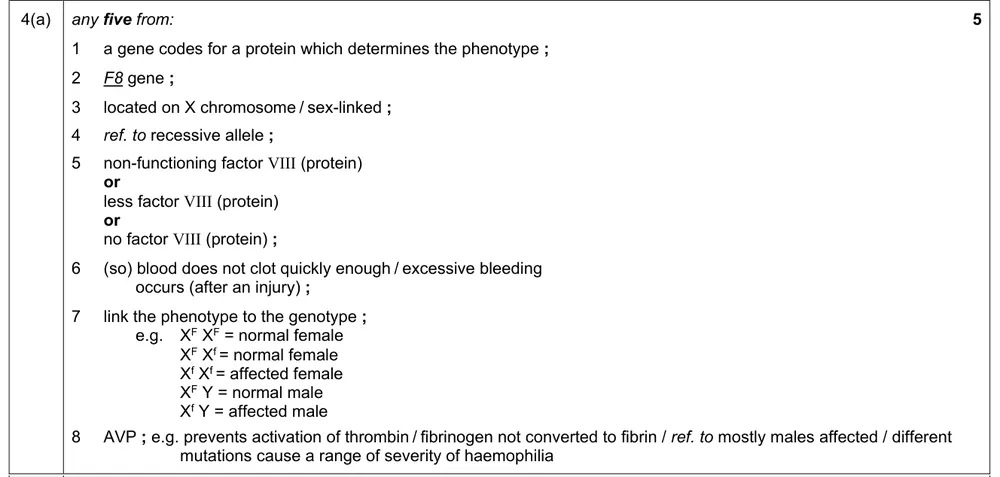
Use haemophilia to explain the relationship between a gene, a protein and a phenotype.
Show the mark scheme
Tap an image to open it full size.
From the examiners' report: The gene is F8 and the protein is factor VIII; the two were often mixed up. Relatively few said that the allele is recessive, and weaker answers wrote about recessive genes, not alleles. The F8 gene is always present: say that the factor VIII protein is non-functional because of a mutation.
Question 22
Paper 4 · May/June 2024 (42) · Q4(b) · 3 marks · Easy
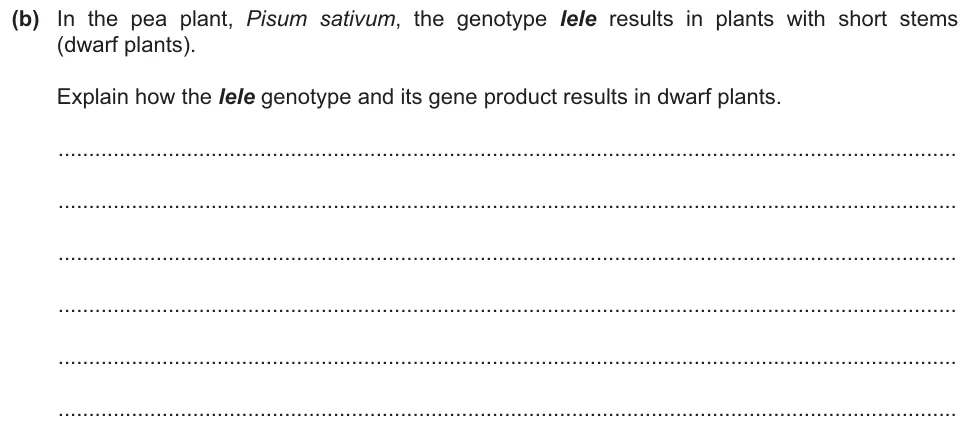
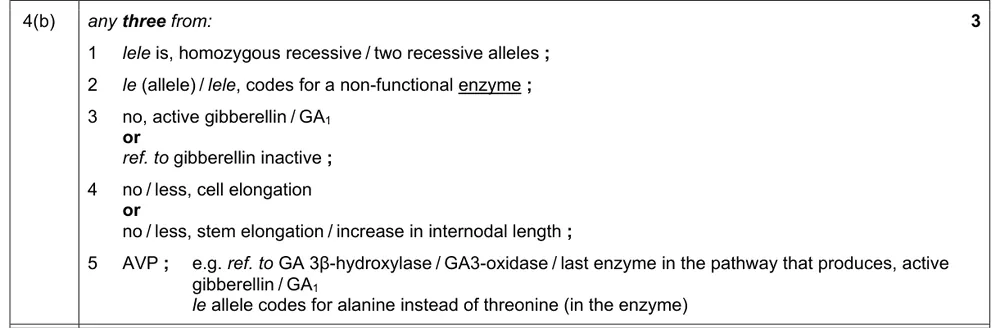
Explain how the lele genotype and its gene product result in dwarf pea plants.
Show the mark scheme
Tap an image to open it full size.
From the examiners' report: Many knew that no active gibberellin is produced but missed out the non-functional enzyme. Relatively few said that the genotype is homozygous recessive. Link your answer to stem elongation, not germination.
Where students lose marks (from Cambridge examiners' reports and mark schemes)
Each point below comes from the examiners' reports and mark schemes, and is followed by wording that gained marks.
Alleles go on the Z, not the W. Students left the sex chromosome Z out of their symbols, did not write the allele symbols as superscripts, or added a symbol to the W chromosome.
✔ Gains credit: 'ZB = allele for bronze feathers' and 'Zb = allele for brown feathers', with B and b written as superscripts; parent genotypes 'ZBZb x ZbW'.
A test cross uses the recessive phenotype. Students crossed the bronze male with a 'homozygous recessive female', or crossed two males.
✔ Gains credit: 'cross with brown female'; 'if all offspring bronze then male is homozygous'; 'if some are brown then male is heterozygous'.
Carrier is not a phenotype. Students gave a 25% probability without saying which offspring genotype has the disease, or used 'carrier' as a phenotype.
✔ Gains credit: gametes 'H h H h', offspring genotypes 'HH Hh Hh hh', offspring phenotypes 'no disease' and 'disease / haemochromatosis'.
Expected numbers, not a ratio. Students gave the numbers expected from crossing two heterozygotes, or wrote a ratio such as 1:1:1:1 or 9:3:3:1.
✔ Gains credit: '1827' for each of the four phenotypes.
Greater than the critical value is significant. Students thought a chi-squared value above the critical value meant no significant difference, or wrote about degrees of freedom instead of the critical value.
✔ Gains credit: 'chi-squared value is greater than critical value', the 'observed ratio is significantly different to expected ratio', 'so differences are not due to chance'.
Linked alleles are inherited together. Students wrote that genes, not alleles, are inherited together, or said that independent assortment had taken place.
✔ Gains credit: 'greater numbers of parental phenotypes', 'genes are linked', 'alleles inherited together', 'no independent assortment', 'crossing over (produces recombinants)'.
F8 gene, factor VIII protein. Students mixed up the names of the gene and the protein, wrote about recessive genes, or said that the gene is not coded for.
✔ Gains credit: 'F8 gene', 'located on X chromosome', 'recessive allele', 'non-functioning factor VIII (protein)', so 'blood does not clot quickly enough'.
Start with the mutation. Students described the effects of sickle cell anaemia without describing the gene mutation, or wrote as if the gene codes for red blood cells.
✔ Gains credit: 'HBB' gene, 'base substitution', 'change in amino acid', 'glutamic acid to valine', which 'causes change in tertiary structure', so 'haemoglobin less soluble' and 'cells become sickle shaped'.
Download the questions
Download the PDF pack (22 questions, mark schemes at the end)
Keep practising
- Passage of Information from Parents to Offspring (16.1): Cambridge (CIE) exam questions by topic
- Gene Control (16.3): Cambridge (CIE) exam questions by topic
- Cambridge (CIE) A level Biology 9700 past papers, mark schemes and examiners' reports
- Cambridge (CIE) A level Biology grade thresholds
- Book a one-to-one CIE lesson or a free 15-minute discovery chat with Tom
- Register your interest in a CIE A level Biology group class
Questions, mark schemes and examiners' report extracts © Cambridge University Press & Assessment.