

Gene Control (16.3): Cambridge (CIE) A Level Biology 9700 Exam Questions by Topic
Gene control is sub-topic 16.3 of Topic 16, Inheritance, in the Cambridge International AS & A Level Biology syllabus (9700). You need to describe the differences between structural genes and regulatory genes, and between repressible enzymes and inducible enzymes. You need to explain how the lac operon controls protein production in a prokaryote, state that transcription factors are proteins that bind to DNA and decrease or increase the rate of transcription in eukaryotes, and explain how gibberellin activates genes by causing the breakdown of DELLA protein repressors. This is A level content, examined on Paper 4.
The examiners' reports return to the same points. Keep prokaryotes and eukaryotes apart: operons, operators and repressor proteins belong to bacteria, while eukaryotes use transcription factors that bind to the promoter. In the lac operon the repressor binds to the operator and RNA polymerase binds to the promoter, and lacI is a regulatory gene that is not part of the operon. A regulatory gene codes for a protein that controls gene expression; the gene does not do the controlling itself. Name lactose permease in full, not just 'permease'. Gibberellin does not break down DELLA proteins directly, and DELLA binds to the transcription factor, not to the promoter.
Studying Cambridge International A level Biology and want more help? Tom teaches CIE students one-to-one online, including students in the UAE, Saudi Arabia, Hong Kong, India and Indonesia, and every lesson is recorded. You can book a one-to-one lesson or a free 15-minute discovery chat, or register your interest in a CIE group class starting in September 2027, using the links at the bottom of this page.
What you need from AS Level
Each question on this page assumes you're secure on these ideas. If any of them feels shaky, look it up before you start.
- A gene is a sequence of nucleotides in DNA that codes for a polypeptide.
- In transcription, RNA polymerase uses one strand of DNA as a template to make mRNA.
- The shape of a protein depends on its tertiary structure, so a molecule that binds to a protein can change its shape.
- A gene mutation is a change in the sequence of base pairs in DNA and may result in an altered polypeptide.
Key terms
These words come up in the questions and mark schemes. Examiners expect you to use them exactly.
- Structural gene: a gene that codes for a protein with a job in the cell, such as an enzyme or a structural protein, and not for a protein that controls other genes.
- Regulatory gene: a gene that codes for a protein, such as a repressor protein or a transcription factor, that controls the expression of other genes.
- Inducible enzyme: an enzyme that is only produced when its substrate (the inducer) is present, such as β-galactosidase when lactose is present.
- Repressible enzyme: an enzyme whose production is switched off when the end product of its pathway is present, such as tryptophan synthase.
- Operon: a section of DNA in a prokaryote with a promoter, an operator and a group of structural genes that are transcribed together.
- Repressor protein: the product of a regulatory gene; in the lac operon it binds to the operator and stops RNA polymerase binding to the promoter.
- Transcription factor: a protein that binds to DNA in a eukaryote and decreases or increases the rate of transcription of a gene.
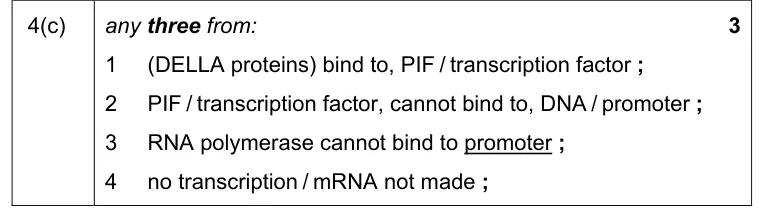
- DELLA protein: a repressor in plant cells that binds to a transcription factor (PIF) and stops it binding to the promoter; it is broken down when gibberellin is present.
What these questions cover (Cambridge 9700 Topic 16: Inheritance)
The questions test these learning outcomes from sub-topic 16.3 of the Cambridge International AS & A Level Biology syllabus (9700) for 2025 to 2027.
- 16.3.1 describe the differences between structural genes and regulatory genes and the differences between repressible enzymes and inducible enzymes
- 16.3.2 explain genetic control of protein production in a prokaryote using the lac operon
- 16.3.3 state that transcription factors are proteins that bind to DNA and are involved in the control of gene expression in eukaryotes by decreasing or increasing the rate of transcription
- 16.3.4 explain how gibberellin activates genes by causing the breakdown of DELLA protein repressors, which normally inhibit factors that promote transcription
How to use this page
Write your answer on paper before you open the mark scheme. Allow about 1.2 minutes per mark: the 22 questions are worth 60 marks, so about 72 minutes in total. Then mark your answer strictly against the mark scheme and read the examiners' tip underneath it. If you'd rather print the questions, download the PDF pack.
Structural and regulatory genes (16.3.1)
Question 1
Paper 4 · May/June 2025 (44) · Q2(d) · 3 marks
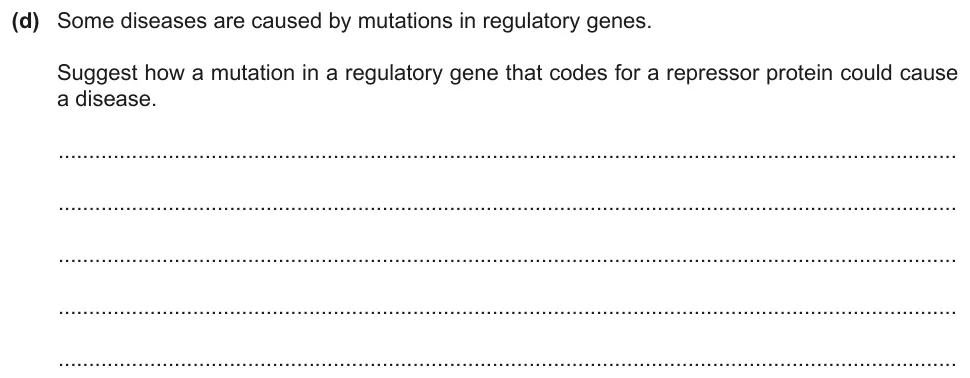
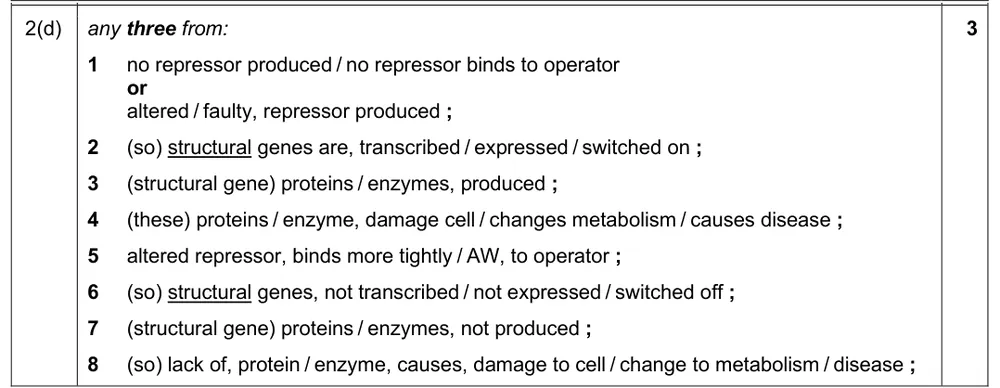
Suggest how a mutation in a regulatory gene that codes for a repressor protein could cause a disease.
Show the mark scheme
Tap an image to open it full size.
The lac operon (16.3.1 and 16.3.2)
Question 2
Paper 4 · May/June 2022 (42) · Q7(a) · 2 marks · Easy
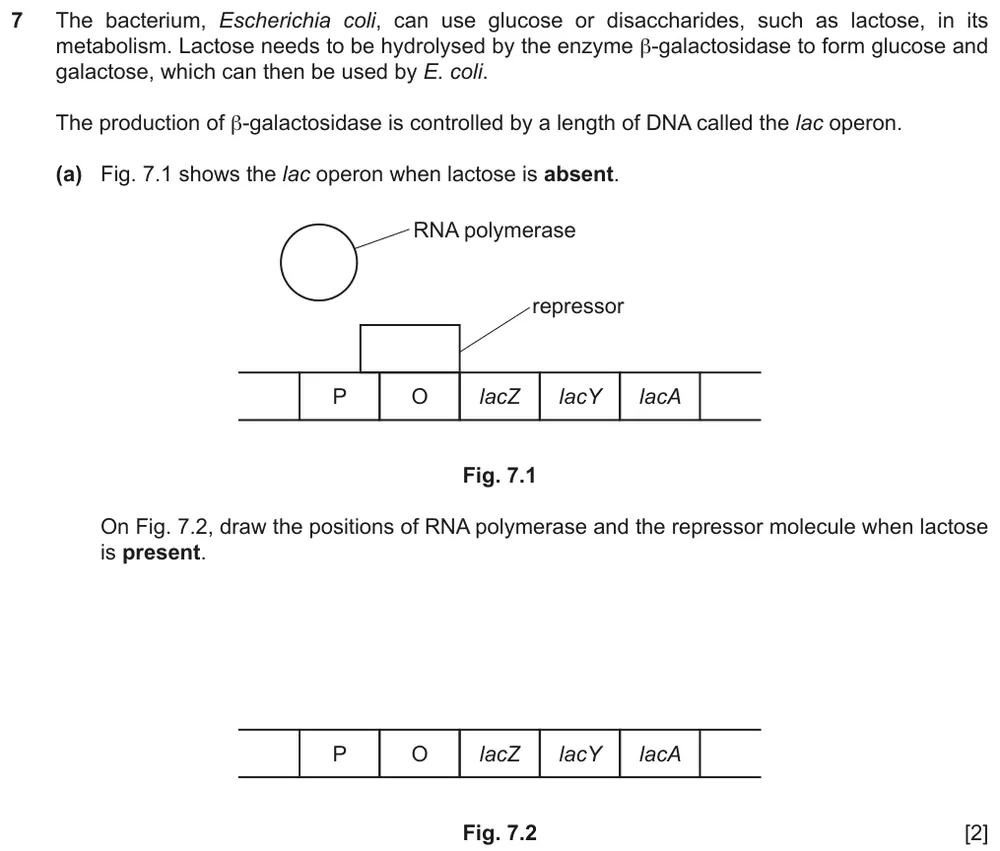
Draw the positions of RNA polymerase and the repressor on the lac operon when lactose is present.
Show the mark scheme

Tap an image to open it full size.
From the examiners' report: Most drew RNA polymerase on the promoter and the repressor detached from the operon. The usual mistake was to put RNA polymerase over the operator (O), or halfway between the promoter (P) and O.
Question 3
Paper 4 · May/June 2022 (42) · Q7(b)(i) · 1 mark
Name the type of gene represented by lacY.

Show the mark scheme

Tap an image to open it full size.
From the examiners' report: This is straight recall of the difference between a structural gene and a regulatory gene. Wrong answers gave the type of product, such as enzyme, or named the protein, lactose permease.
Question 4
Paper 4 · May/June 2022 (42) · Q7(b)(ii) · 2 marks
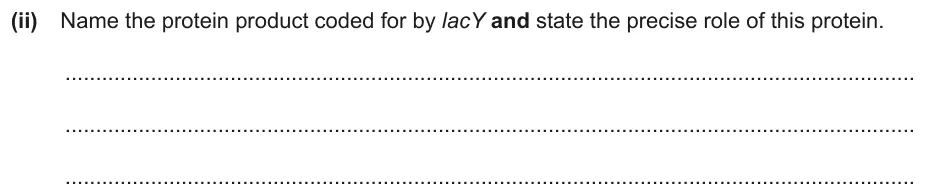
Name the protein coded for by lacY and state its precise role.
Show the mark scheme

Tap an image to open it full size.
From the examiners' report: 'Permease' alone was not enough: name the molecule, lactose. Say that the protein moves lactose into the cell, or makes the cell surface membrane (not just 'the cell') more permeable to lactose. It does not break lactose down.
Question 5
Paper 4 · May/June 2022 (42) · Q7(c) · 4 marks
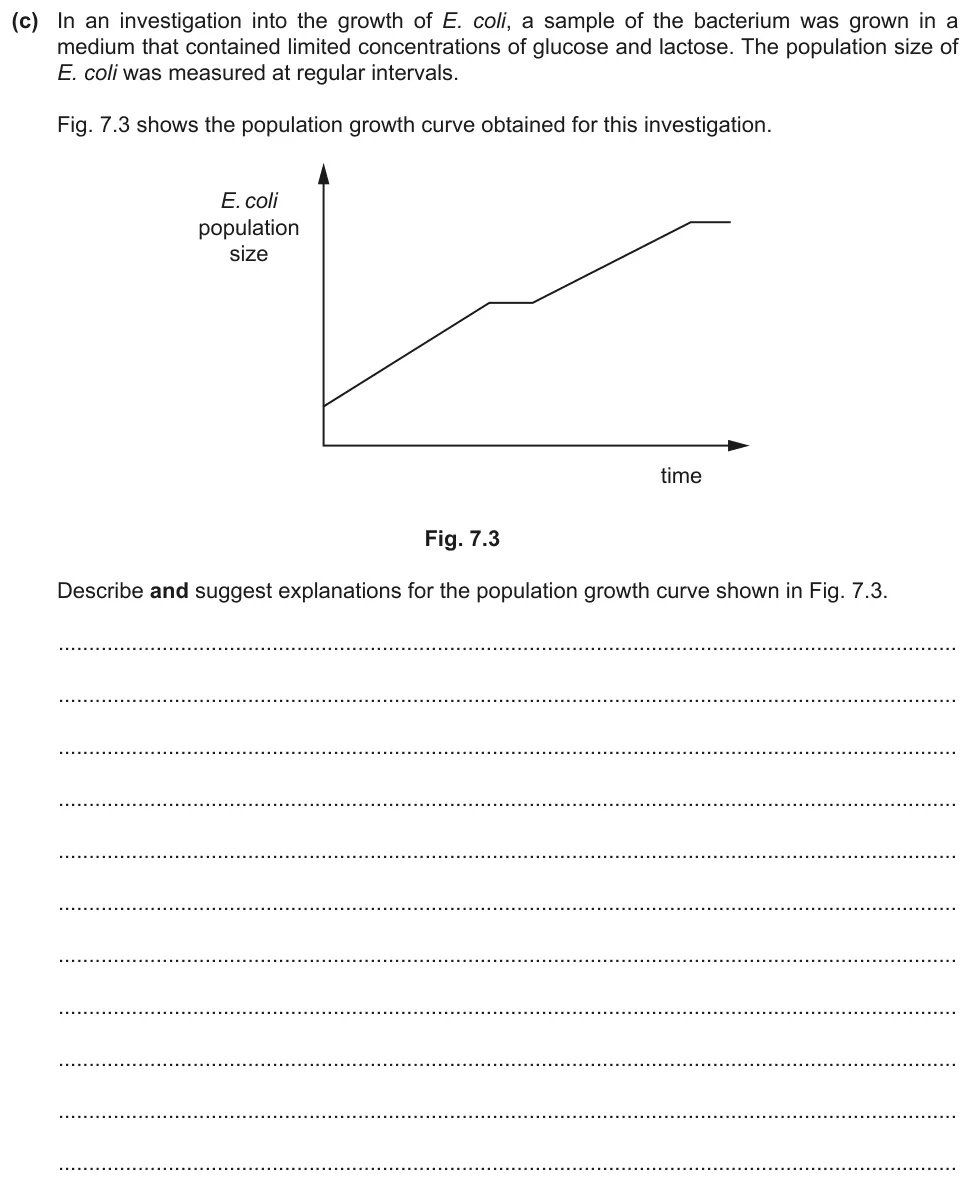
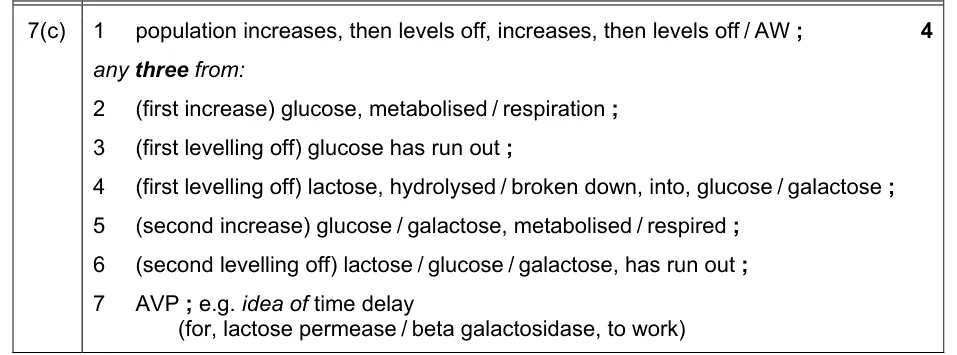
Describe and suggest explanations for the population growth curve of E. coli grown with limited glucose and lactose.
Show the mark scheme
Tap an image to open it full size.
From the examiners' report: Answer both command words. Describe the shape as increase, level, increase, level. Then explain that E. coli respires glucose first, and then the glucose and galactose from the hydrolysis of lactose. Say that glucose has run out, not that it is a limiting factor.
Question 6
Paper 4 · May/June 2023 (43) · Q3(a)(i) · 3 marks · Hard
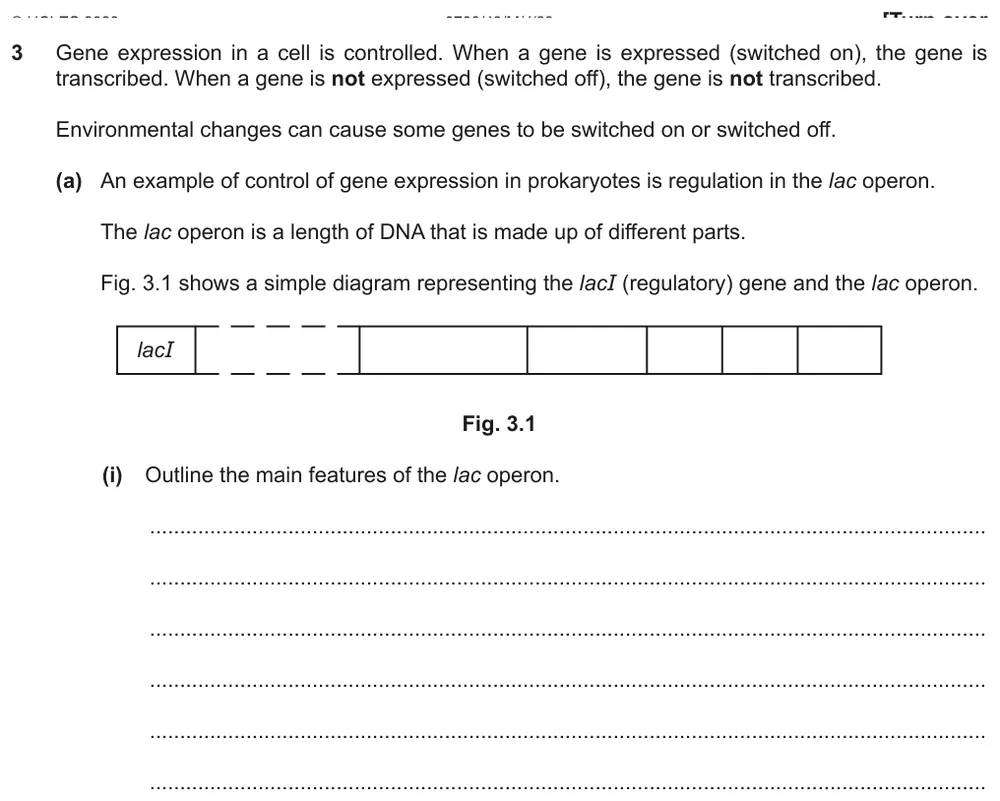
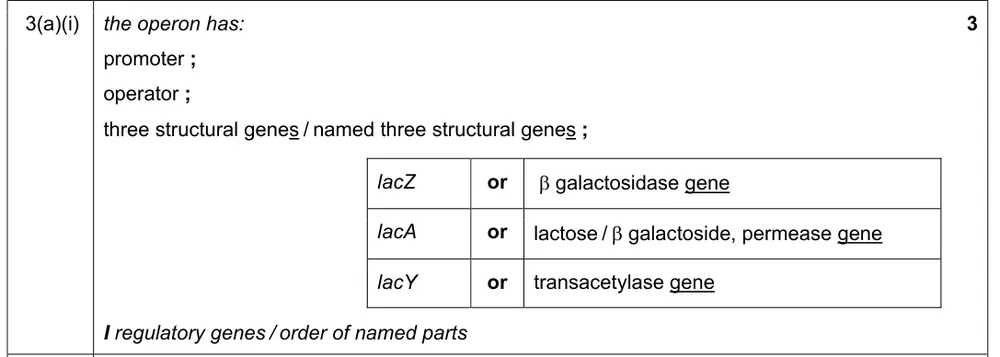
Outline the main features of the lac operon.
Show the mark scheme
Tap an image to open it full size.
From the examiners' report: Very few gave the promoter, the operator and three structural genes. Many described how the operon is regulated, or wrote about lacI, which is not part of the operon. If you name the structural genes, name all three correctly.
Question 7
Paper 4 · May/June 2023 (43) · Q3(a)(ii) · 4 marks
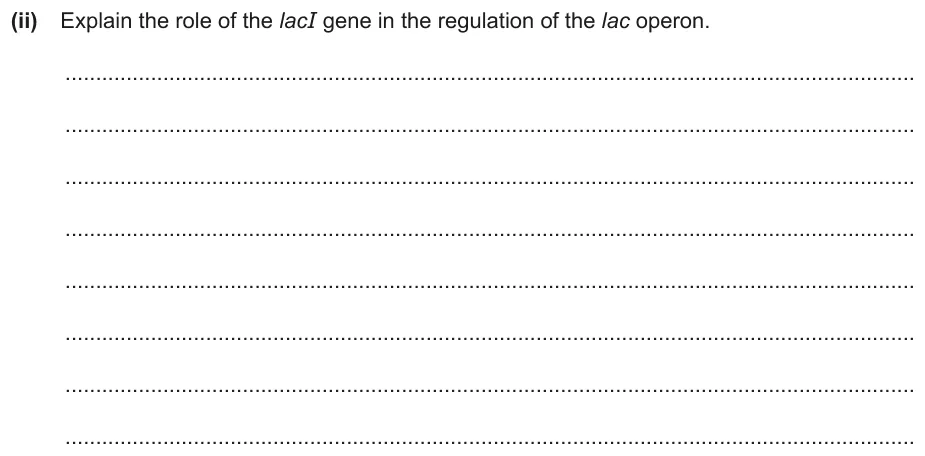
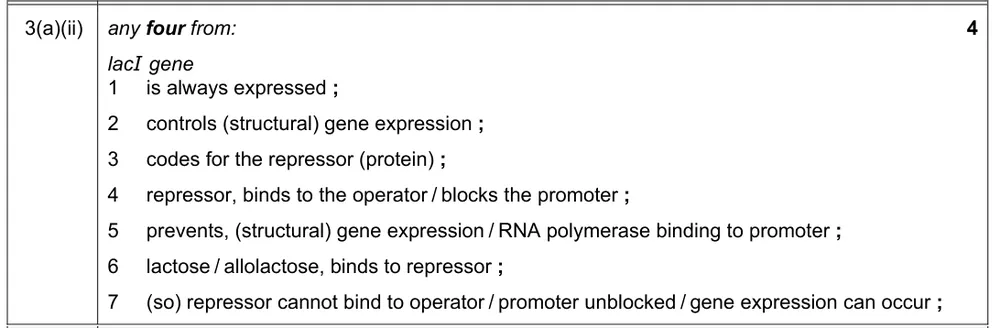
Explain the role of the lacI gene in the regulation of the lac operon.
Show the mark scheme
Tap an image to open it full size.
From the examiners' report: lacI codes for the repressor protein; it does not 'make' it. The repressor binds to the operator, and RNA polymerase (not DNA polymerase or 'mRNA polymerase') binds to the promoter. Lactose binds to the repressor, not to the promoter.
Question 8
Paper 4 · May/June 2023 (43) · Q3(b) · 3 marks · Hard
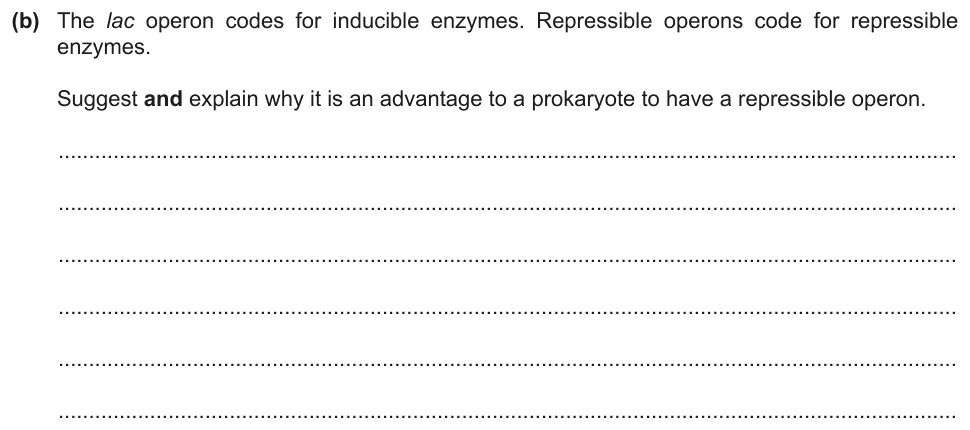
Suggest and explain why a repressible operon is an advantage to a prokaryote.
Show the mark scheme

Tap an image to open it full size.
From the examiners' report: Few gained full credit. Most wrote about the lac operon, which is inducible. Some knew that the trp operon is repressible but did not explain why this is an advantage.
Question 9
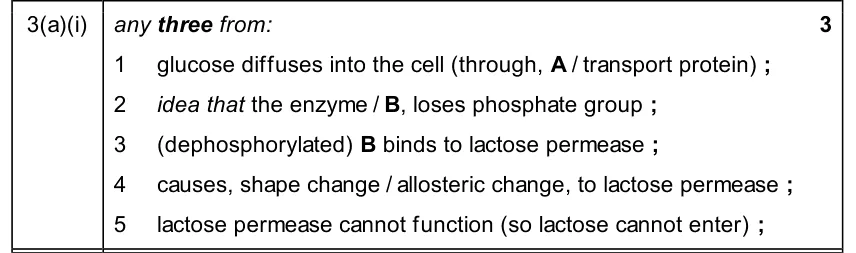
Paper 4 · October/November 2025 (42) · Q3(a)(i) · 3 marks
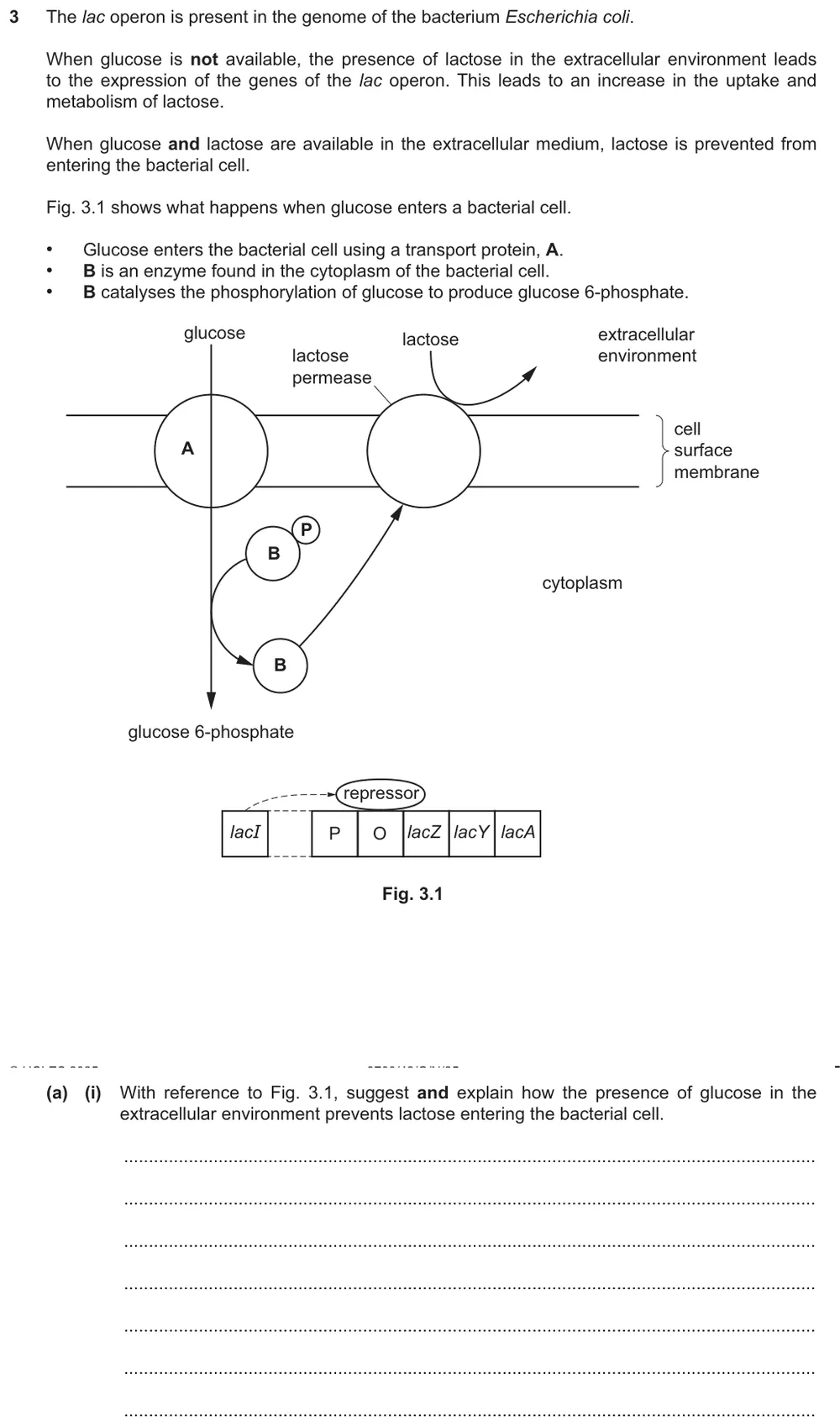
Use the diagram to explain how glucose entering the cell prevents lactose from entering.
Show the mark scheme
Tap an image to open it full size.
Question 10
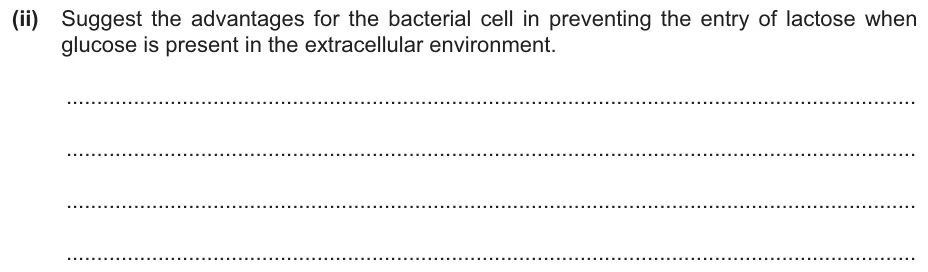
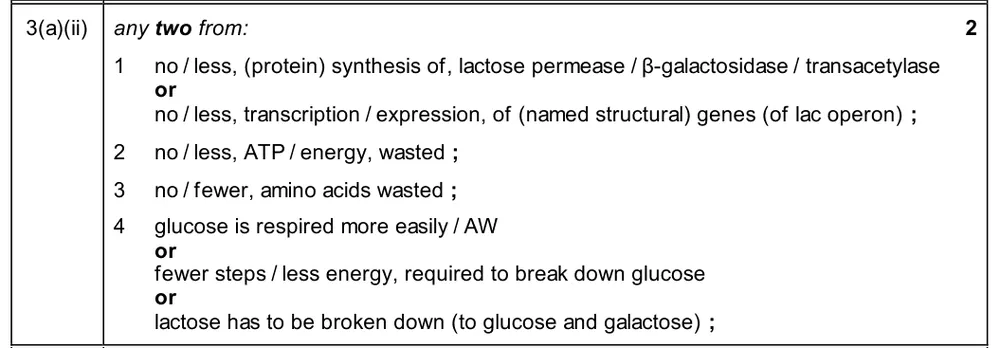
Paper 4 · October/November 2025 (42) · Q3(a)(ii) · 2 marks
Suggest the advantages to the bacterium of preventing the entry of lactose when glucose is present.
Show the mark scheme
Tap an image to open it full size.
The lac and trp operons compared (16.3.1 and 16.3.2)
Question 11
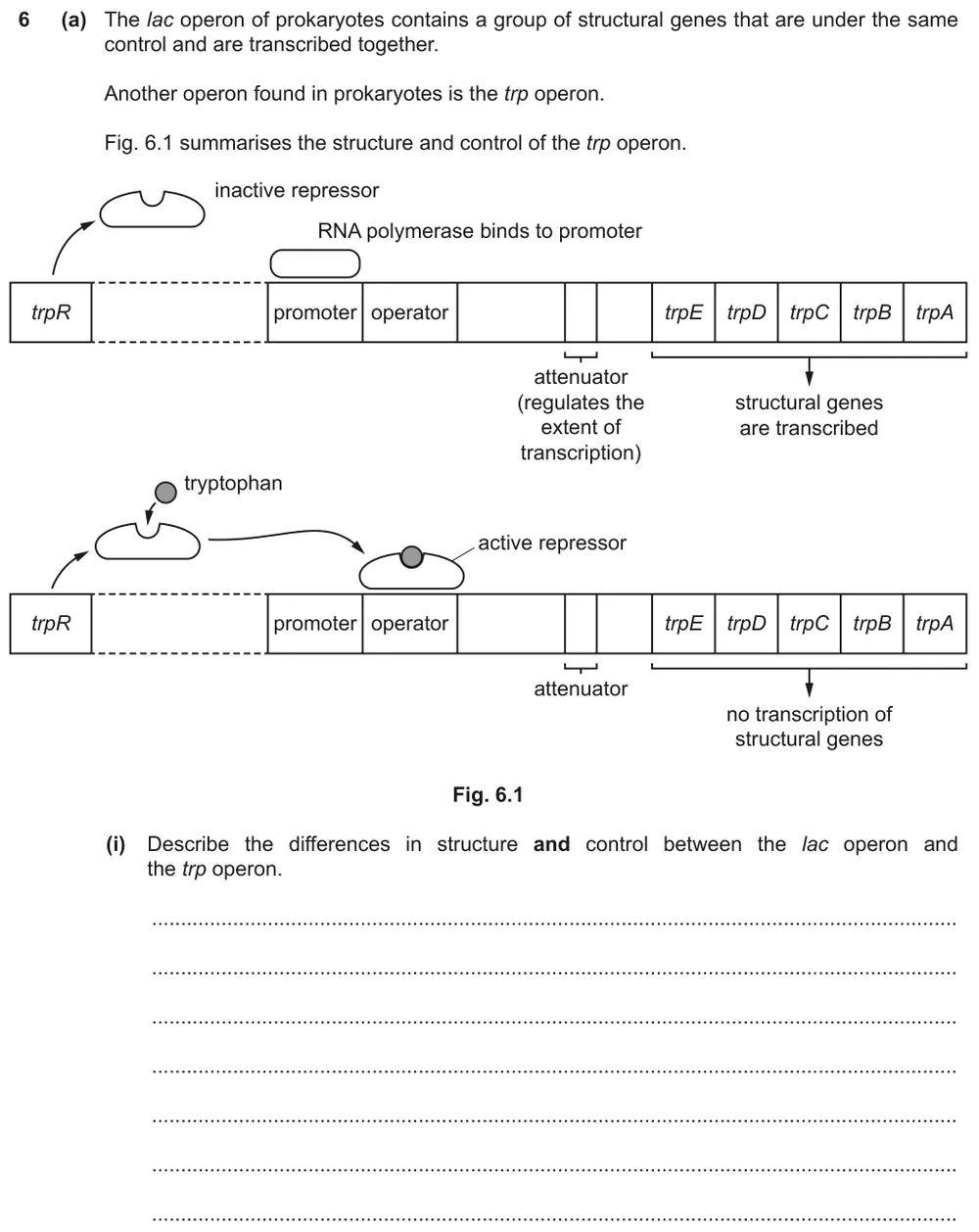
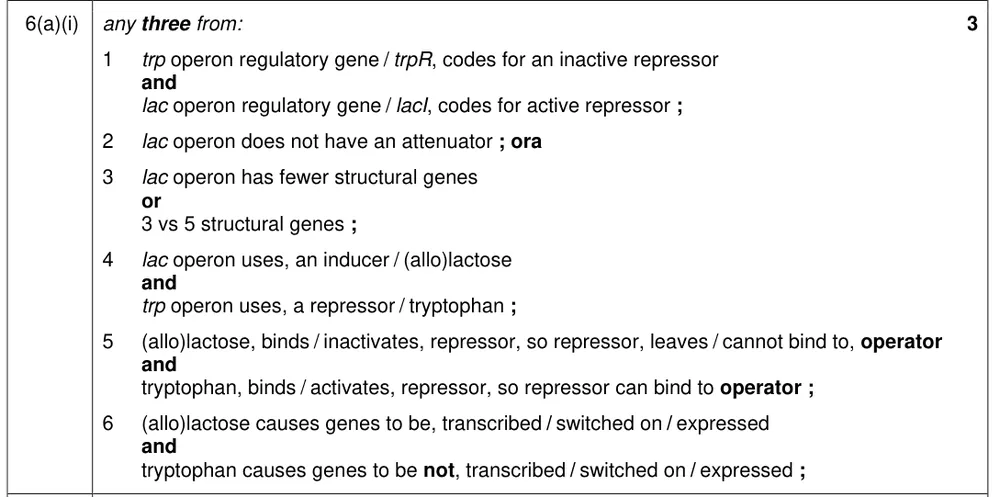
Paper 4 · October/November 2022 (42) · Q6(a)(i) · 3 marks
Describe the differences in structure and control between the lac operon and the trp operon.
Show the mark scheme
Tap an image to open it full size.
From the examiners' report: Differences in structure (the number of genes and the attenuator) were found easier than differences in control. Name lactose and tryptophan; do not write 'substrate'. Compare the two operons: do not describe only one of them.
Question 12
Paper 4 · October/November 2022 (42) · Q6(a)(ii) · 1 mark
Suggest why structural genes in operons are transcribed together.

Show the mark scheme

Tap an image to open it full size.
From the examiners' report: The strongest answers said that there is only one promoter. A few added that all the products work together.
Question 13
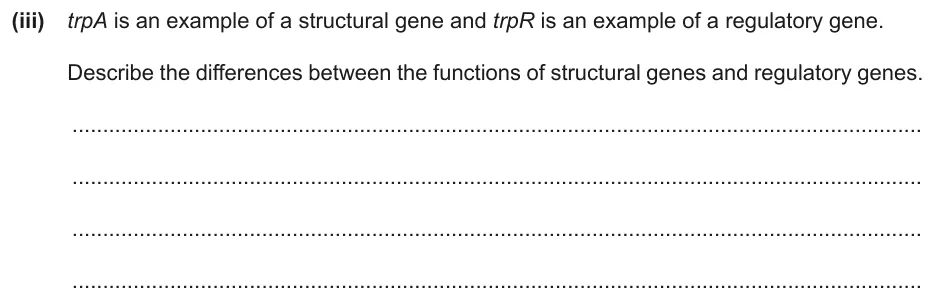
Paper 4 · October/November 2022 (42) · Q6(a)(iii) · 2 marks · Hard
Describe the differences between the functions of structural genes and regulatory genes.
Show the mark scheme

Tap an image to open it full size.
From the examiners' report: A common wrong answer was that structural genes code for proteins that work inside cells. For regulatory genes, many said that the gene itself controls gene expression: it is the product of the gene that does this.
Question 14
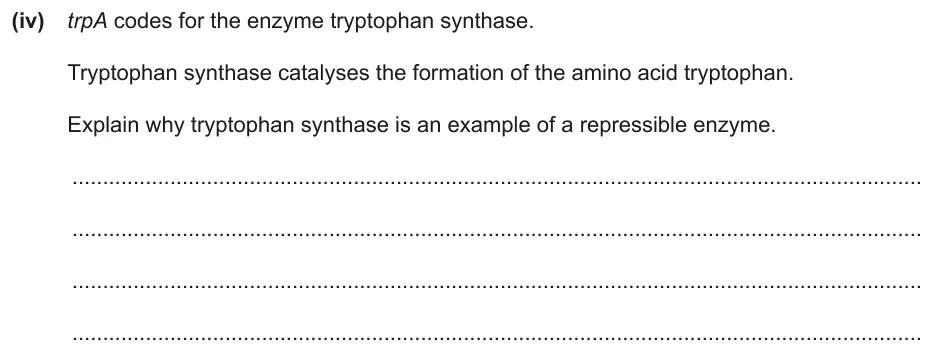
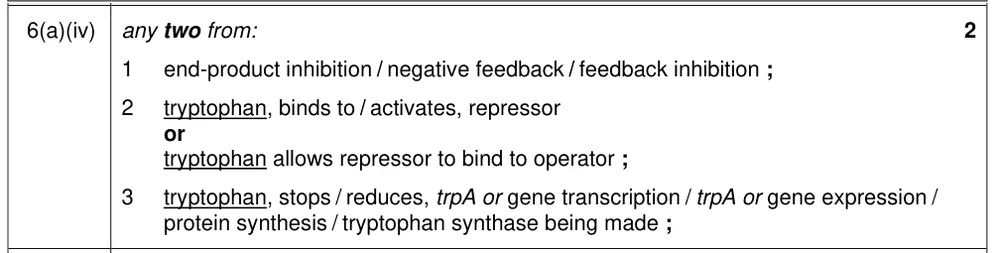
Paper 4 · October/November 2022 (42) · Q6(a)(iv) · 2 marks · Hard
Explain why tryptophan synthase is an example of a repressible enzyme.
Show the mark scheme
Tap an image to open it full size.
From the examiners' report: Many wrote about the enzyme when the answer needed tryptophan itself. Very few mentioned end-product inhibition or negative feedback.
Transcription factors in eukaryotes (16.3.3)
Question 15
Paper 4 · May/June 2019 (42) · Q2(c)(ii) · 4 marks
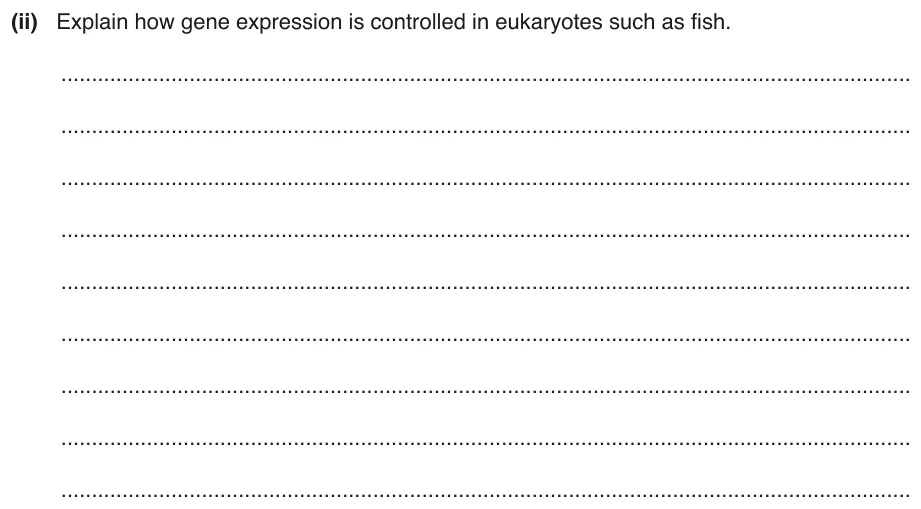
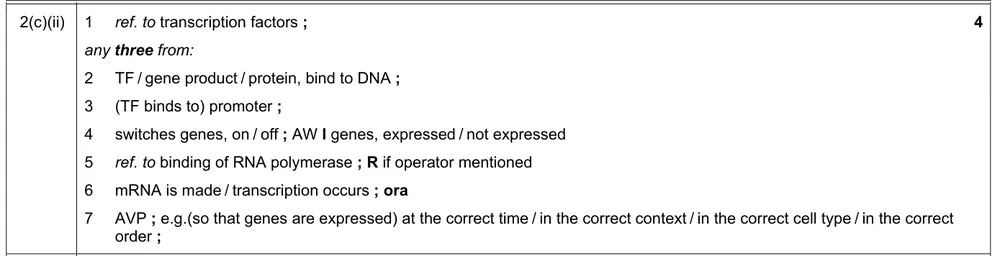
Explain how gene expression is controlled in eukaryotes such as fish.
Show the mark scheme
Tap an image to open it full size.
From the examiners' report: Most confused eukaryotic and prokaryotic gene control and used the lac operon as their example. Some knew the term transcription factor but could not describe how it works with the promoter and the binding of RNA polymerase. Gibberellin and DELLA proteins are not relevant to fish.
Question 16
Paper 4 · February/March 2019 (42) · Q3(a) · 3 marks · Easy
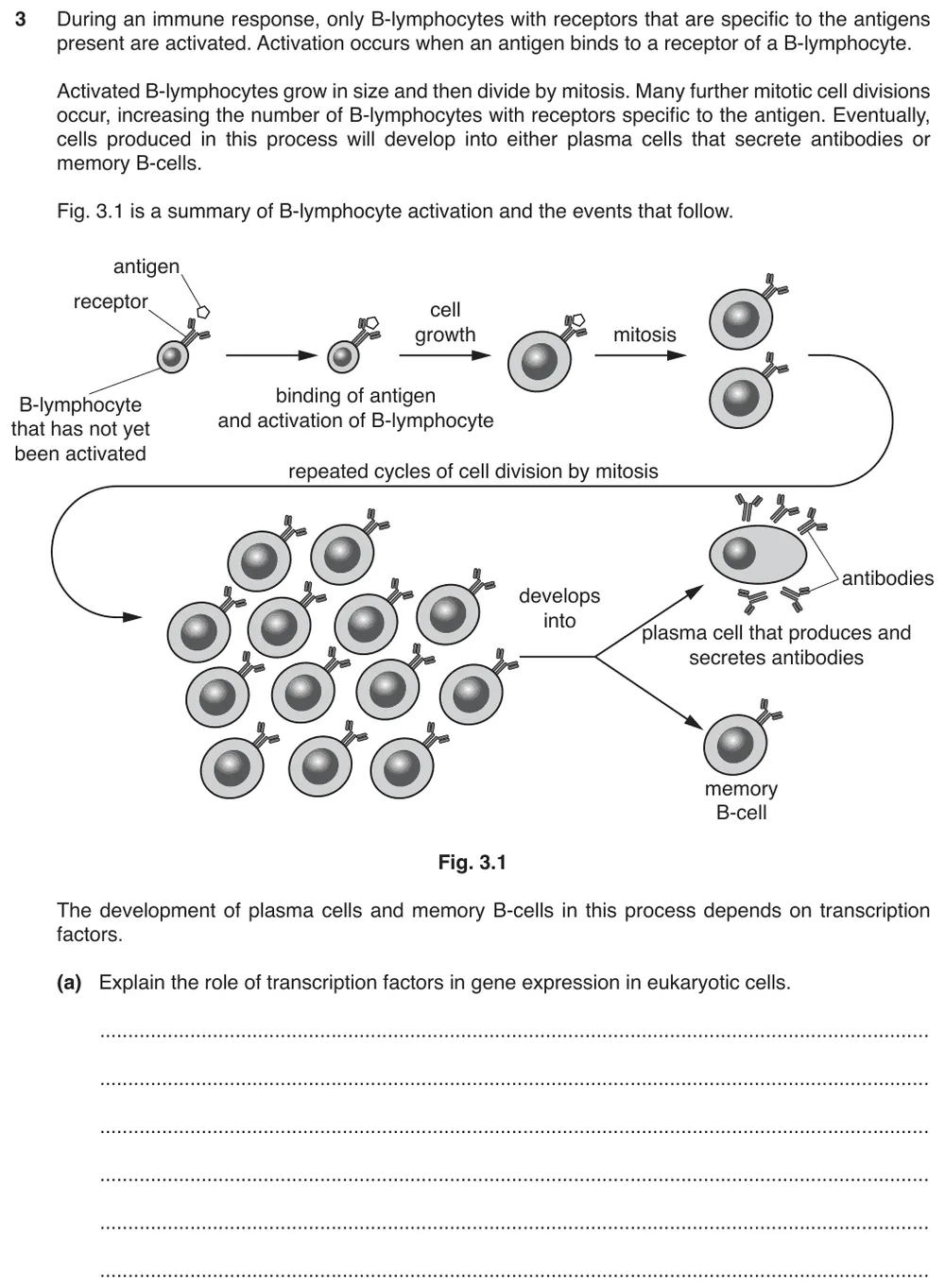
Explain the role of transcription factors in gene expression in eukaryotic cells.
Show the mark scheme

Tap an image to open it full size.
From the examiners' report: Most knew that transcription factors regulate transcription. Fewer said that they work by binding to DNA at specific places, such as the promoter. Some described the lac operon, which is how bacteria control gene expression.
Question 17
Paper 4 · May/June 2024 (41) · Q3(c) · 1 mark
State where transcription factors bind to increase the rate of transcription.

Show the mark scheme

Tap an image to open it full size.
From the examiners' report: Most gave DNA or promoter. Wrong answers included RNA polymerase and operator.
Question 18
Paper 4 · October/November 2021 (42) · Q7(b)(ii) · 1 mark
State the term for a protein that is involved in the control of gene expression in eukaryotes.

Show the mark scheme

Tap an image to open it full size.
From the examiners' report: Some confused eukaryotes with prokaryotes and wrote about repressor proteins. Others wrongly suggested regulatory genes.
Question 19
Paper 4 · May/June 2025 (42) · Q3(c)(ii) · 3 marks
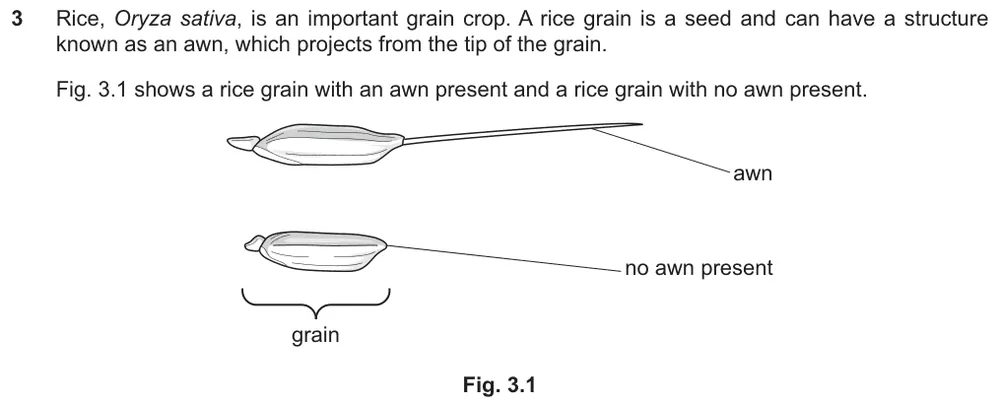
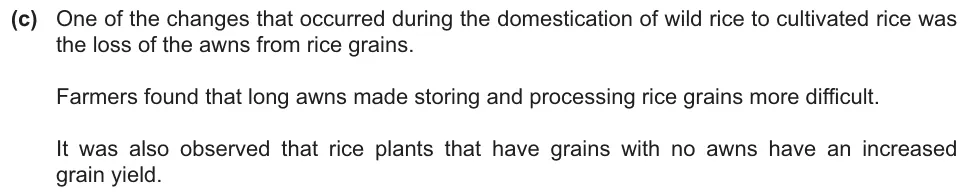
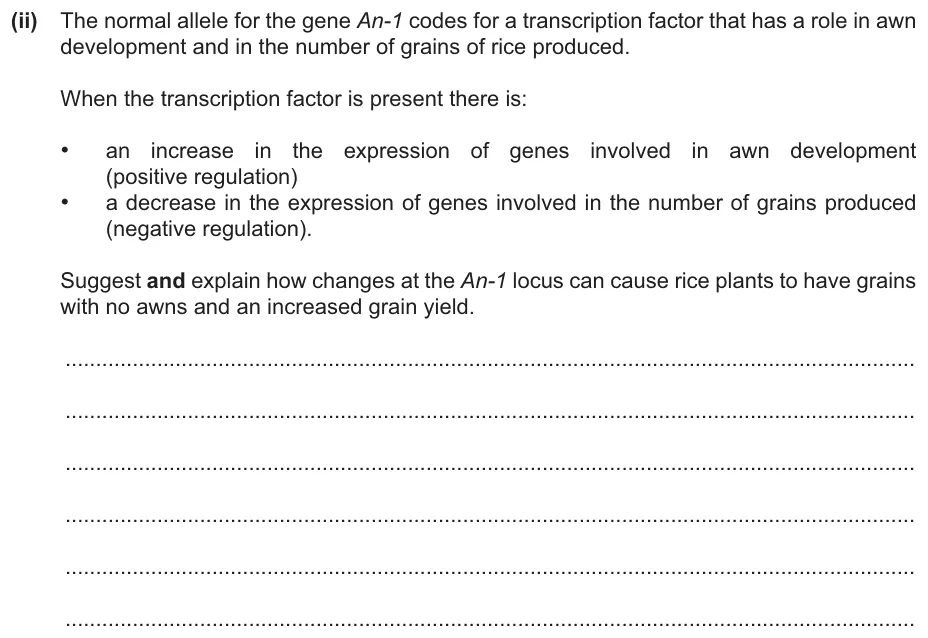
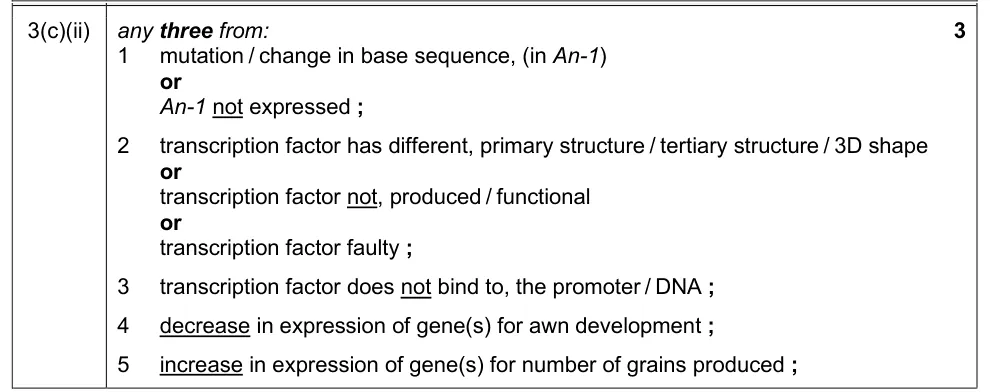
Suggest and explain how changes at the An-1 locus give rice plants with no awns and a higher grain yield.
Information from earlier in this question:
Show the mark scheme
Tap an image to open it full size.
Gibberellin and DELLA proteins (16.3.4)
Question 20
Paper 4 · October/November 2022 (42) · Q6(b)(i) · 4 marks · Easy
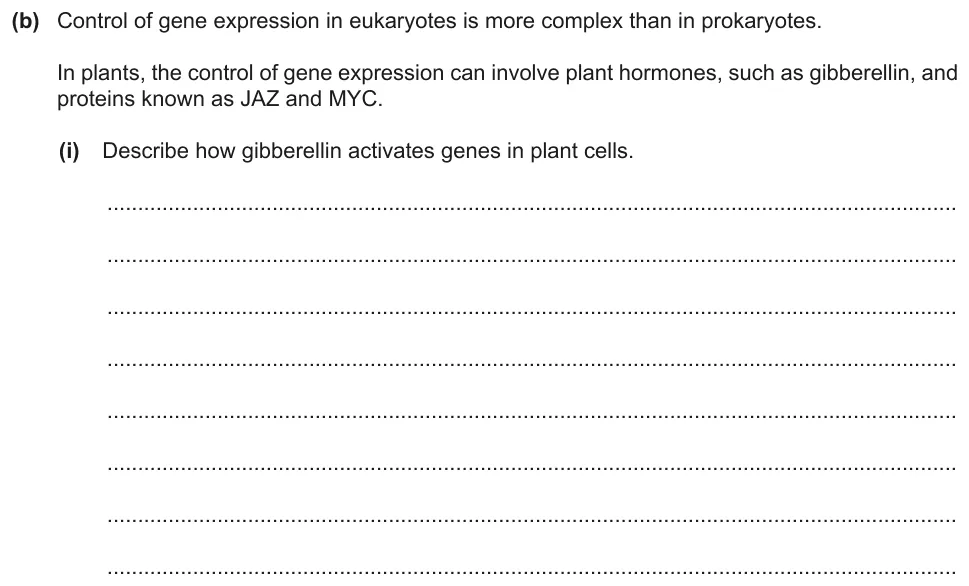
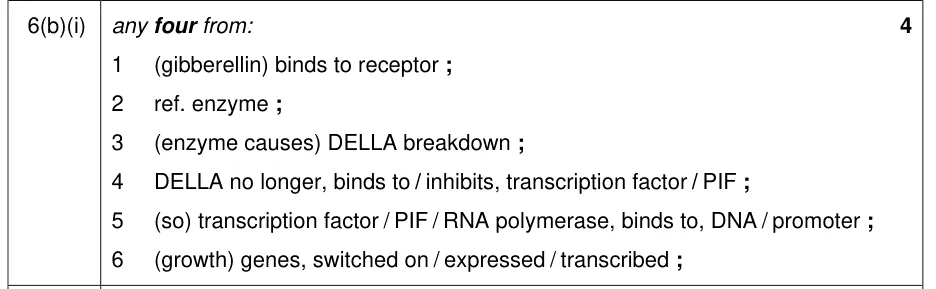
Describe how gibberellin activates genes in plant cells.
Show the mark scheme
Tap an image to open it full size.
From the examiners' report: The most common errors were to say that gibberellin itself breaks down DELLA, or that the gene expressed codes for amylase. The role of enzymes in germination was not needed.
Question 21
Paper 4 · May/June 2024 (42) · Q4(c) · 3 marks · Easy
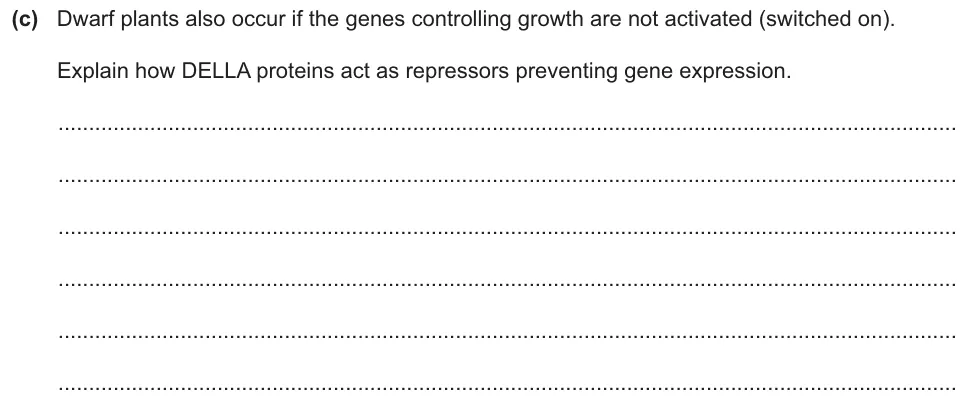
Explain how DELLA proteins act as repressors that prevent gene expression.
Show the mark scheme
Tap an image to open it full size.
From the examiners' report: Some confused this with repressor proteins binding to the operator in prokaryotes, or said that DELLA proteins bind to the promoter directly. The lack of gene expression was already in the question, and the breakdown of DELLA by gibberellin was not asked for.
Question 22
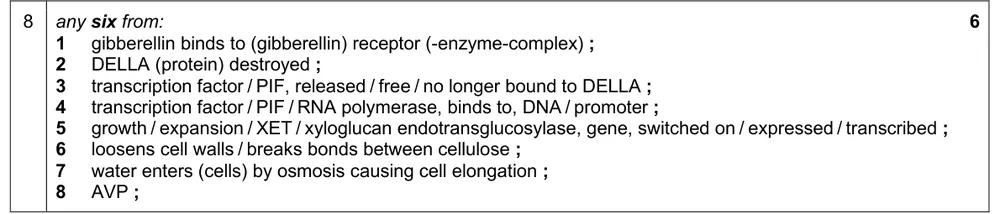
Paper 4 · May/June 2025 (41) · Q8 · 6 marks
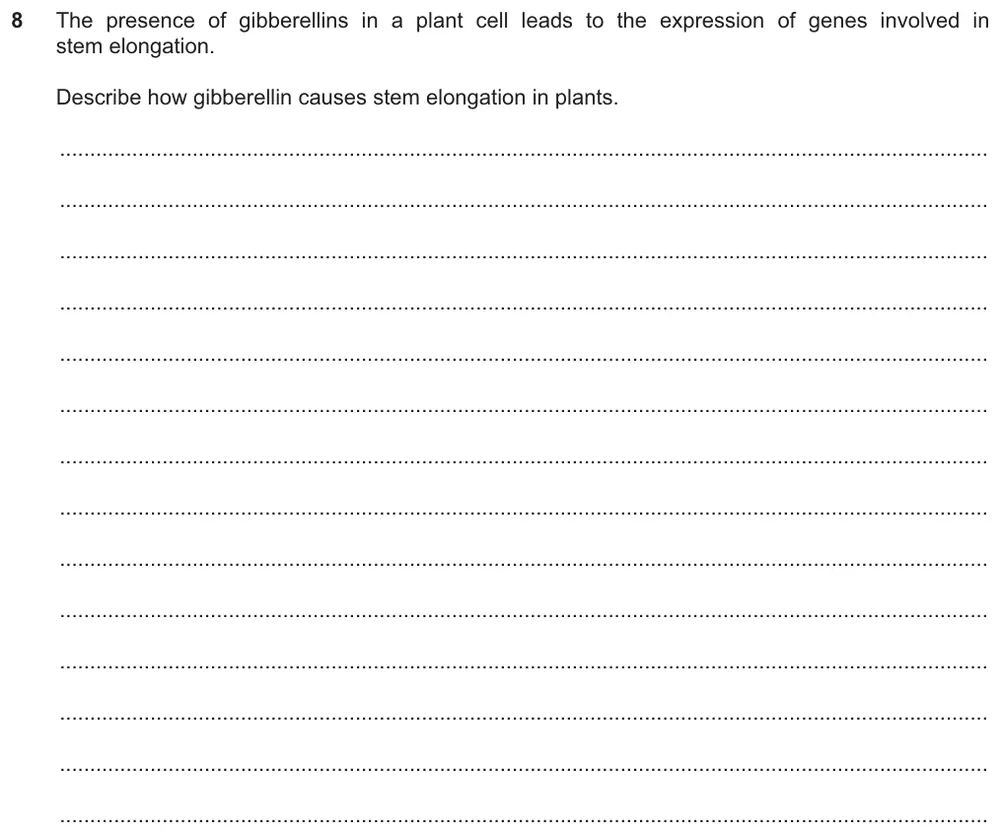
Describe how gibberellin causes stem elongation in plants.
Show the mark scheme
Tap an image to open it full size.
Where students lose marks (from Cambridge examiners' reports and mark schemes)
Each point below comes from the examiners' reports and mark schemes, and is followed by wording that gained marks.
lacI is not part of the operon. Students described how the operon is regulated, wrote about lacI, or named only some of the structural genes.
✔ Gains credit: the operon has a 'promoter', an 'operator' and 'three structural genes'.
The repressor binds to the operator. Students wrote that the repressor or lactose binds to the promoter, that RNA polymerase binds to the operator, or that DNA polymerase is involved.
✔ Gains credit: lacI 'codes for the repressor'; the 'repressor binds to the operator' and 'prevents RNA polymerase binding to promoter'; 'lactose / allolactose binds to repressor'.
Lactose permease, not permease. Students named the protein only as permease, invented a hybrid enzyme name, or said that it breaks down lactose.
✔ Gains credit: 'lactose permease', for 'transport of lactose into cell'.
Glucose is used first, then lactose. Students wrote about a general increase in growth without the two plateaus, or called glucose a limiting factor when it had run out.
✔ Gains credit: 'population increases, then levels off, increases, then levels off'; first 'glucose metabolised', then 'glucose has run out' and 'lactose hydrolysed into glucose / galactose'.
The gene's product does the controlling. Students said that regulatory genes, not their products, control gene expression.
✔ Gains credit: structural genes 'code for enzymes / structural proteins'; regulatory genes 'code for proteins that control gene expression', such as 'transcription factors / repressor proteins'.
Repressible: write about the end product. Students wrote about the enzyme tryptophan synthase and very few mentioned end-product inhibition.
✔ Gains credit: 'end-product inhibition' or 'negative feedback': 'tryptophan binds to / activates repressor' and 'tryptophan stops trpA transcription'.
Eukaryotes use transcription factors, not operons. Students used the lac operon to explain gene control in a eukaryote, or named transcription factors without saying what they do.
✔ Gains credit: 'transcription factors' 'bind to DNA' at the 'promoter', which 'switches genes on / off', with a reference to 'binding of RNA polymerase'.
Gibberellin does not break down DELLA itself. Students said that gibberellin breaks down DELLA, or that the gene switched on codes for amylase.
✔ Gains credit: gibberellin 'binds to receptor'; an enzyme causes 'DELLA breakdown'; 'DELLA no longer inhibits transcription factor / PIF', so the 'transcription factor binds to DNA / promoter'.
Download the questions
Download the PDF pack (22 questions, mark schemes at the end)
Keep practising
- Passage of Information from Parents to Offspring (16.1): Cambridge (CIE) exam questions by topic
- The Roles of Genes in Determining the Phenotype (16.2): Cambridge (CIE) exam questions by topic
- Cambridge (CIE) A level Biology 9700 past papers, mark schemes and examiners' reports
- Cambridge (CIE) A level Biology grade thresholds
- Book a one-to-one CIE lesson or a free 15-minute discovery chat with Tom
- Register your interest in a CIE A level Biology group class
Questions, mark schemes and examiners' report extracts © Cambridge University Press & Assessment.