

Conservation (18.3): Cambridge (CIE) A Level Biology 9700 Exam Questions by Topic
Conservation is sub-topic 18.3 of Topic 18, Classification, biodiversity and conservation, in the Cambridge International AS & A Level Biology syllabus (9700). You need to explain why populations and species become extinct as a result of climate change, competition, hunting by humans and the degradation and loss of habitats, and to outline the reasons for maintaining biodiversity. You also need to outline the roles of zoos, botanic gardens, conserved areas, 'frozen zoos' and seed banks, describe assisted reproduction (IVF, embryo transfer and surrogacy), explain why invasive alien species are controlled, and outline the roles of the IUCN and CITES. This is A level content, examined on Paper 4.
The examiners' reports return to the same points. Read the question for what it rules out: describing captive breeding gained nothing when the question asked for other ways to conserve a species. Disease is only credited as a reason for a species becoming endangered if it is a new disease. In IVF answers, write 'ova' or 'oocytes' rather than 'eggs', and say that the embryo, not the zygote, is placed in the uterus. Do not repeat the information in the question, and avoid neutral words such as 'affects'. Keep the IUCN and CITES apart: many students confused their roles.
Studying Cambridge International A level Biology and want more help? Tom teaches CIE students one-to-one online, including students in the UAE, Saudi Arabia, Hong Kong, India and Indonesia, and every lesson is recorded. You can book a one-to-one lesson or a free 15-minute discovery chat, or register your interest in a CIE group class starting in September 2027, using the links at the bottom of this page.
What you need from AS Level
Each question on this page assumes you're secure on these ideas. If any of them feels shaky, look it up before you start.
- Mitosis produces genetically identical cells; it is how a zygote grows into an embryo.
- A pathogen is an organism that causes an infectious disease, and infectious diseases are transmitted from one organism to another.
- A gene mutation is a change in the sequence of base pairs in a DNA molecule that may result in an altered polypeptide.
Key terms
These words come up in the questions and mark schemes. Examiners expect you to use them exactly.
- Invasive alien species: a species that has been moved into an ecosystem where it is not native, increases rapidly in number and has a negative effect on the ecosystem, for example by competing with or feeding on native species.
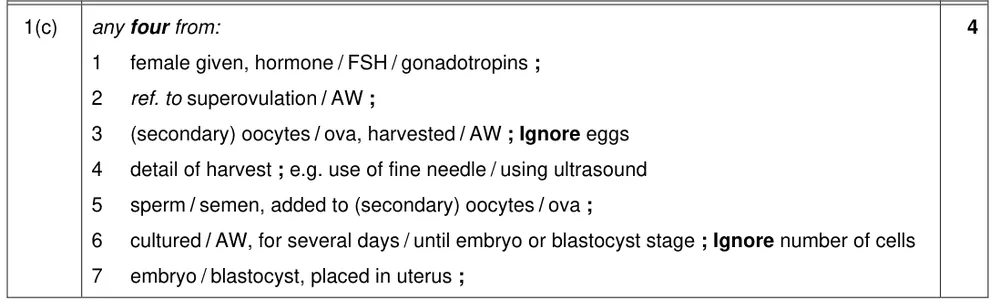
- IVF (in vitro fertilisation): assisted reproduction in which oocytes are harvested from a female that has been given hormones, sperm is added to them outside the body, and an embryo is placed in the uterus.
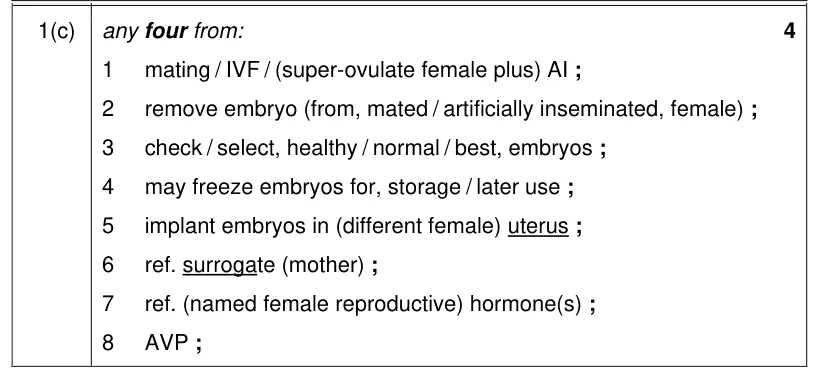
- Embryo transfer: an embryo is removed from one female, or produced by IVF, and placed in the uterus of another female.
- Surrogacy: a female (the surrogate mother) carries to birth an embryo that did not come from her own oocyte.
- Frozen zoo: a store of frozen sperm, oocytes and embryos from endangered animals, kept for later use.
- IUCN: the International Union for Conservation of Nature. It assesses the conservation status of species, publishes the Red List of Threatened Species and advises governments.
- CITES: the Convention on International Trade in Endangered Species of Wild Fauna and Flora, an agreement between governments that regulates trade in endangered species using bans and permits.
What these questions cover (Cambridge 9700 Topic 18: Classification, biodiversity and conservation)
The questions test these learning outcomes from sub-topic 18.3 of the Cambridge International AS & A Level Biology syllabus (9700) for 2025 to 2027.
- 18.3.1 explain why populations and species can become extinct as a result of
- 18.3.2 outline reasons for the need to maintain biodiversity
- 18.3.3 outline the roles of zoos, botanic gardens, conserved areas
- 18.3.4 describe methods of assisted reproduction used in the conservation of endangered mammals, limited to IVF, embryo transfer and surrogacy
- 18.3.5 explain reasons for controlling invasive alien species
- 18.3.6 outline the role in conservation of the International Union for Conservation of Nature
How to use this page
Write your answer on paper before you open the mark scheme. Allow about 1.2 minutes per mark: the 22 questions are worth 74 marks, so about 89 minutes in total. Then mark your answer strictly against the mark scheme and read the examiners' tip underneath it. If you'd rather print the questions, download the PDF pack.
Why species become extinct (18.3.1)
Question 1
Paper 4 · February/March 2025 (42) · Q2(c) · 2 marks
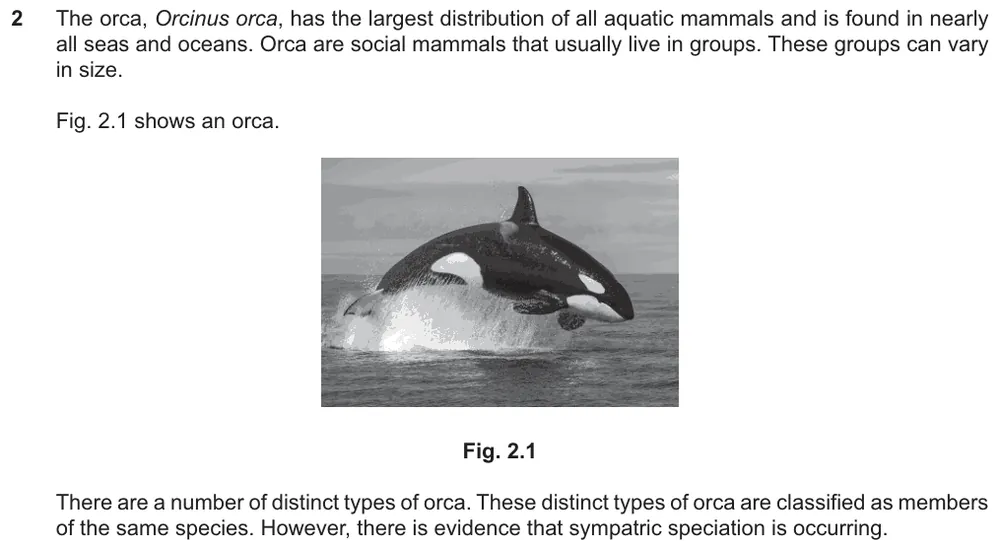
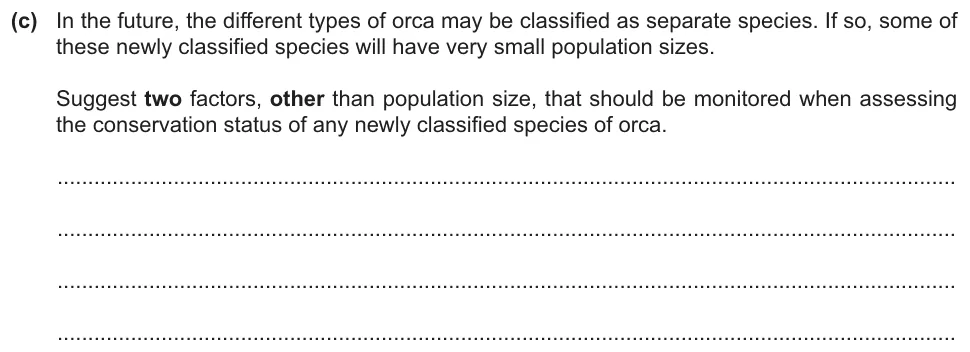
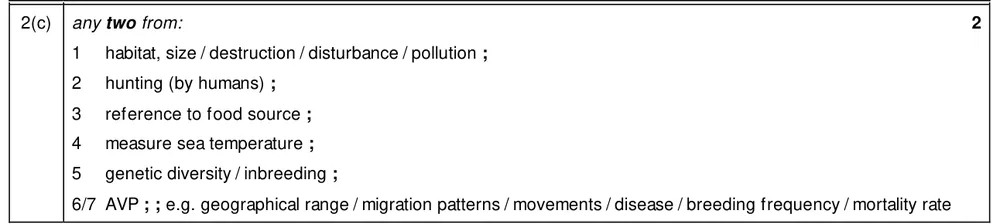
Suggest two factors, other than population size, to monitor when assessing the conservation status of a species of orca.
Information from earlier in this question:
Show the mark scheme
Tap an image to open it full size.
Question 2
Paper 4 · February/March 2023 (42) · Q10(b)(ii) · 4 marks
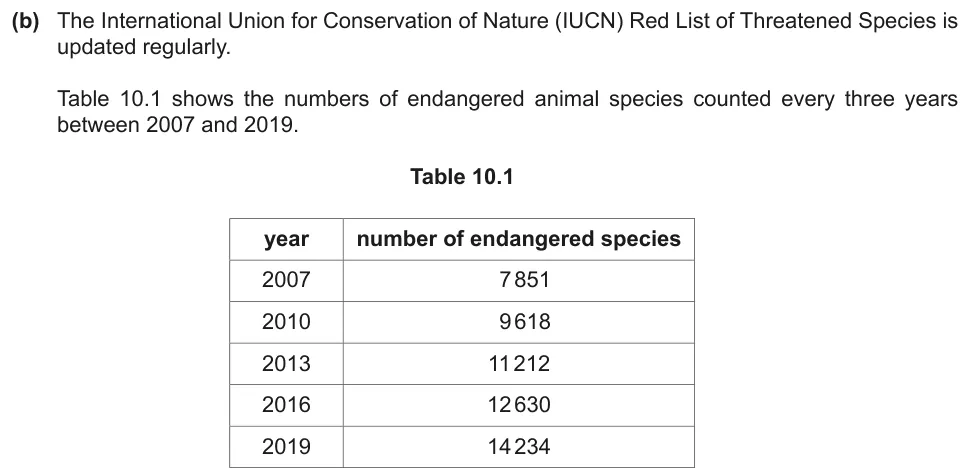
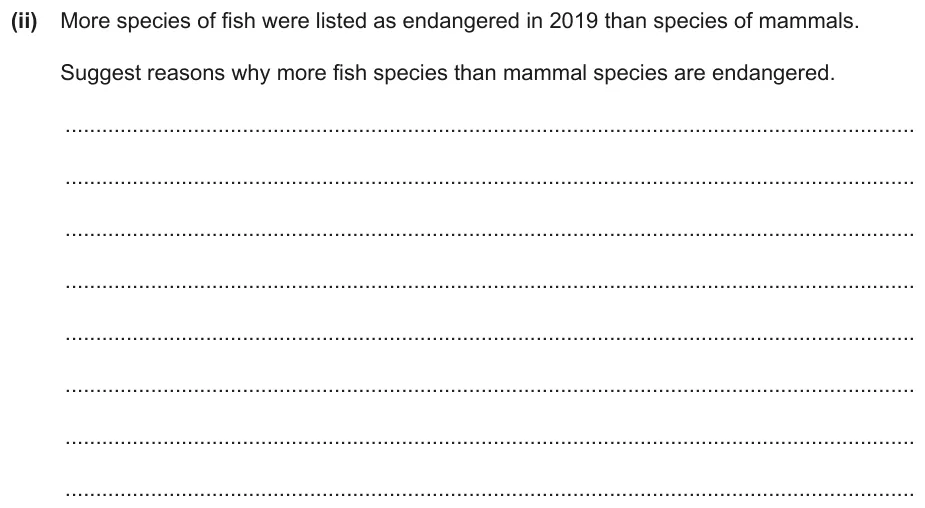
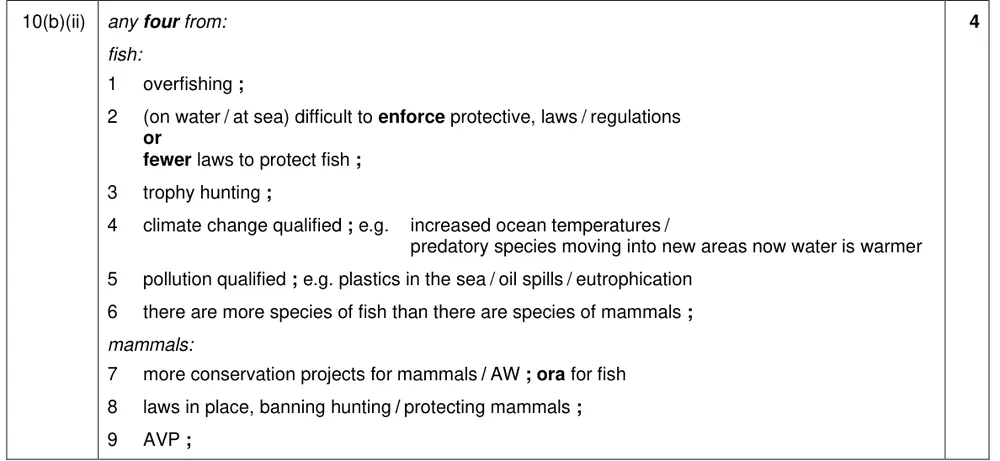
Suggest reasons why more species of fish than species of mammals are endangered.
Information from earlier in this question:
Show the mark scheme
Tap an image to open it full size.
From the examiners' report: Overfishing was the most common reason given. Pollution and climate change were often mentioned but, without further explanation, they could not account for the difference between fish and mammals.
Question 3
Paper 4 · May/June 2022 (42) · Q10(b) · 3 marks · Easy
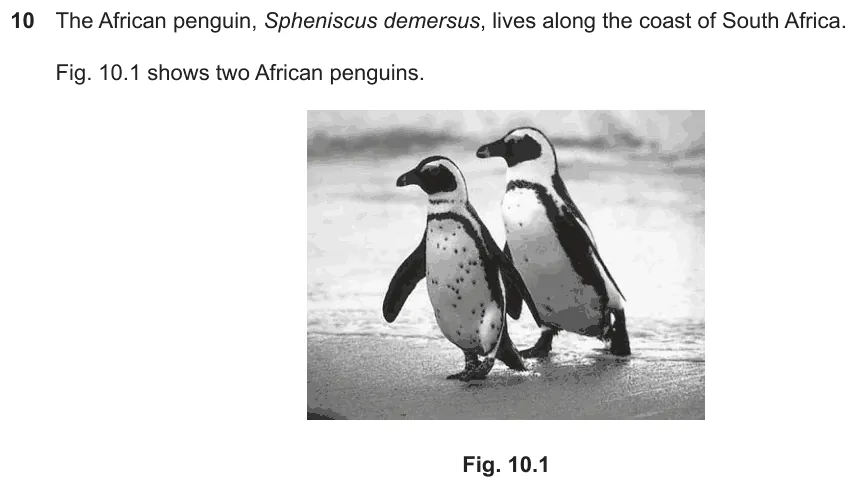
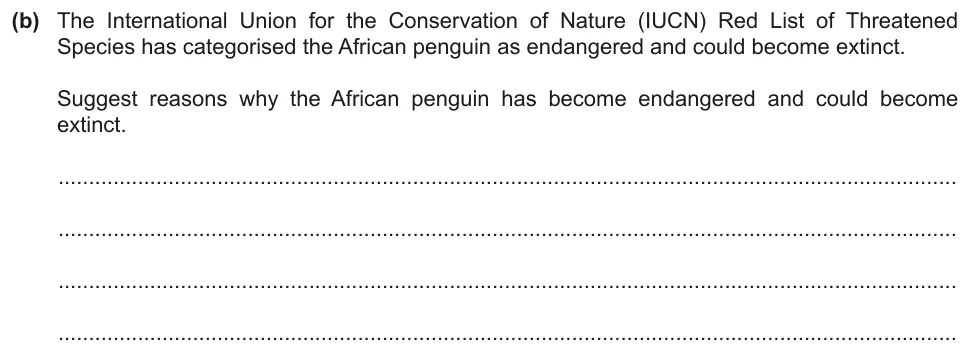
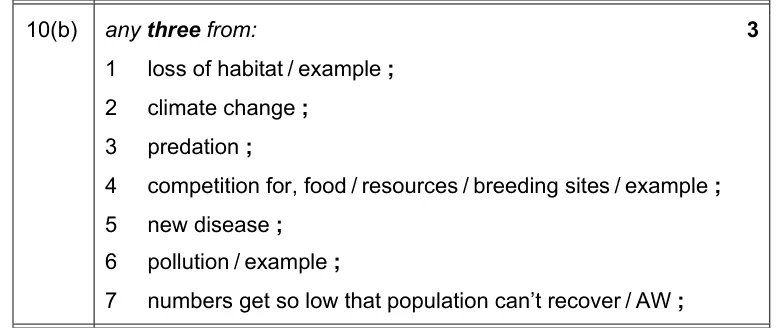
Suggest reasons why the African penguin has become endangered and could become extinct.
Information from earlier in this question:
Show the mark scheme
Tap an image to open it full size.
From the examiners' report: Most students gave habitat loss, and many added climate change, predation, poaching, loss of food supply or competition for other resources. Disease was only credited if it was a new disease, not an existing one.
Question 4
Paper 4 · October/November 2023 (41) · Q2(d)(i) · 3 marks · Hard
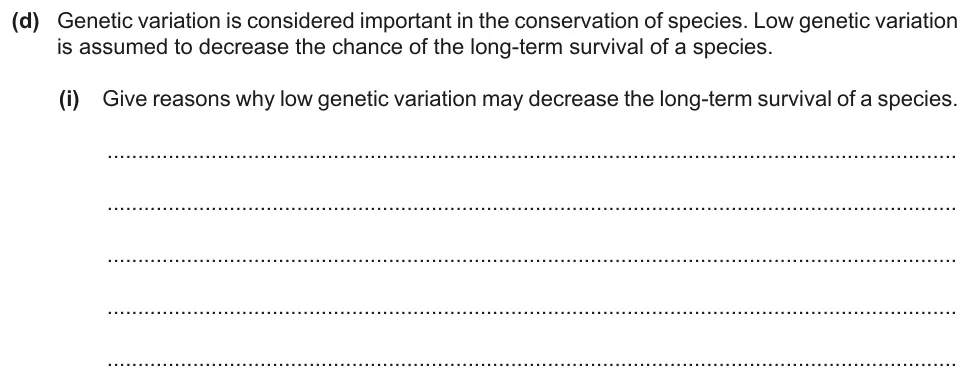
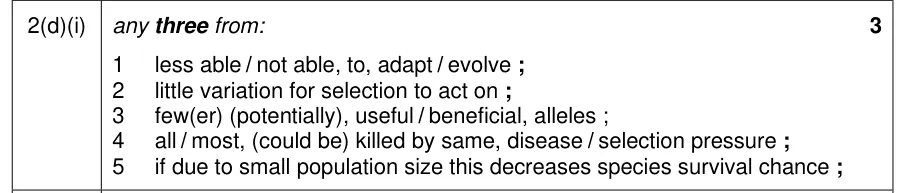
Give reasons why low genetic variation may decrease the long-term survival of a species.
Information from earlier in this question:

Show the mark scheme
Tap an image to open it full size.
From the examiners' report: Low genetic variation means that only a small number of alleles exist at a gene locus; it does not mean that one allele has a low frequency. Strong answers said that variation is needed for selection to act on, so the species is less able to adapt to change. Do not confuse low genetic variation with inbreeding, or explain how it arises.
Question 5
Paper 4 · May/June 2021 (42) · Q3(b)(i) · 2 marks · Easy
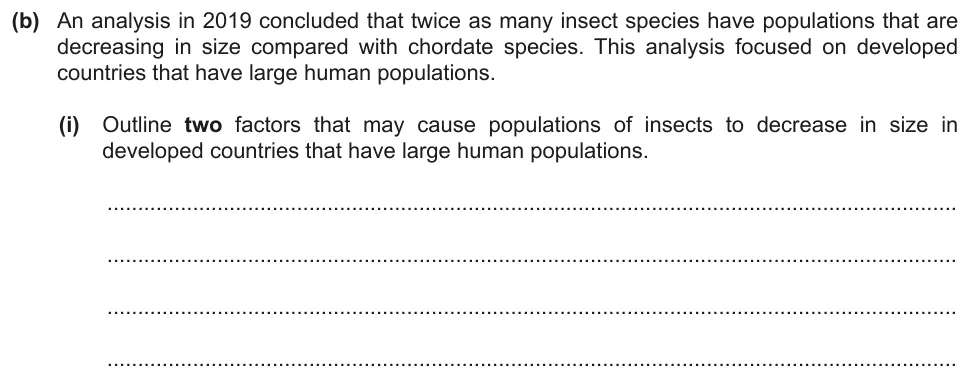
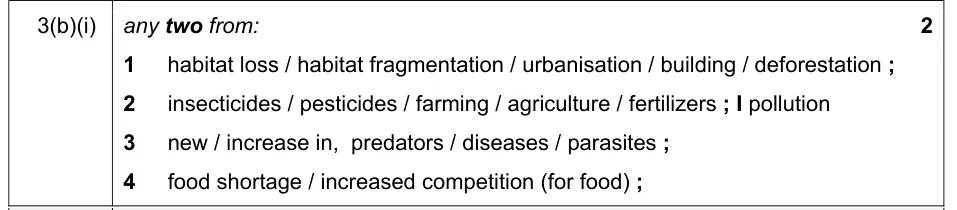
Outline two factors that may cause insect populations to decrease in developed countries with large human populations.
Show the mark scheme
Tap an image to open it full size.
From the examiners' report: Loss of habitat or deforestation was the most common answer, and many students also gave the use of pesticides or insecticides. Disease and predation were mentioned occasionally; a few referred to a new disease or an increase in predation.
Reasons for maintaining biodiversity (18.3.2)
Question 6
Paper 4 · May/June 2024 (43) · Q9(b) · 4 marks · Easy
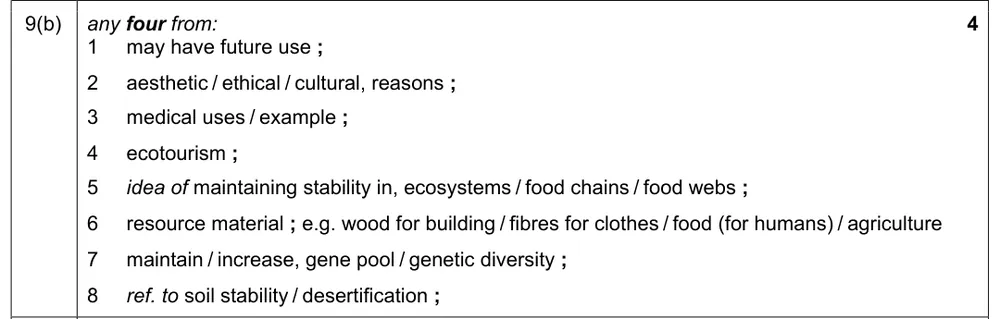
Outline reasons for maintaining plant biodiversity.
Show the mark scheme
Tap an image to open it full size.
From the examiners' report: Strong answers referred to aesthetic, cultural or ethical reasons. Many described the importance of plants for medicine, as resource materials and for soil stability. Ecotourism, stable ecosystems and genetic diversity were also credited.
Question 7
Paper 4 · February/March 2021 (42) · Q2(a)(ii) · 3 marks · Easy
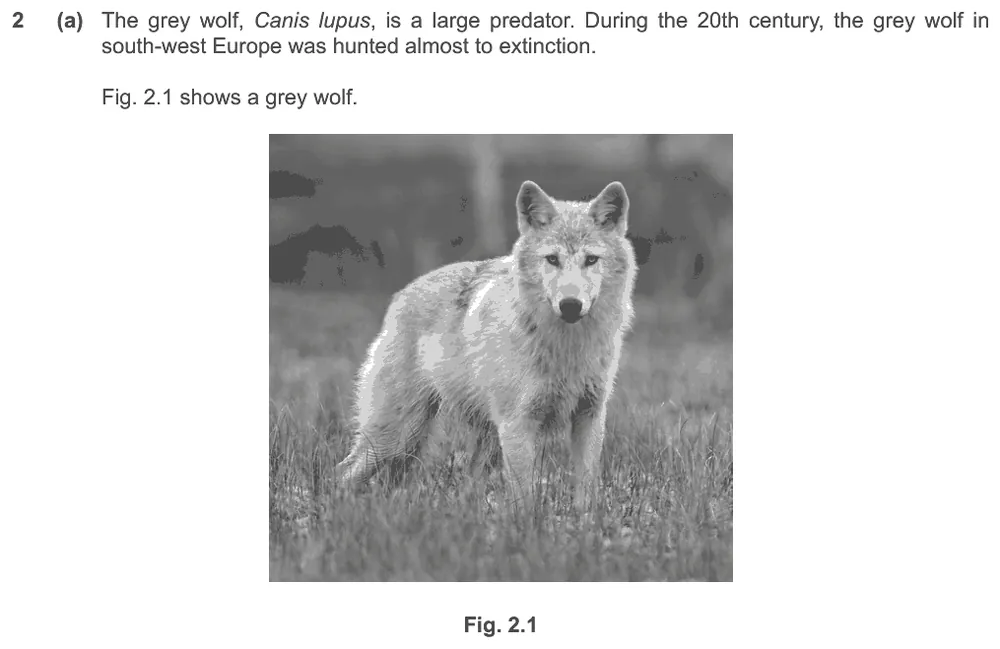
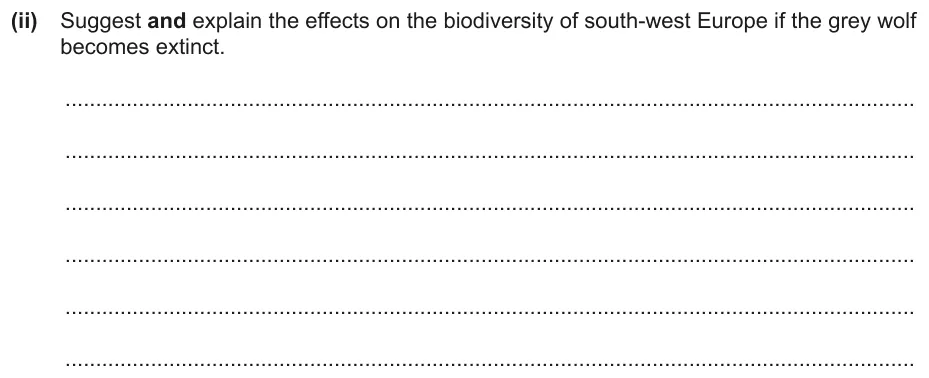
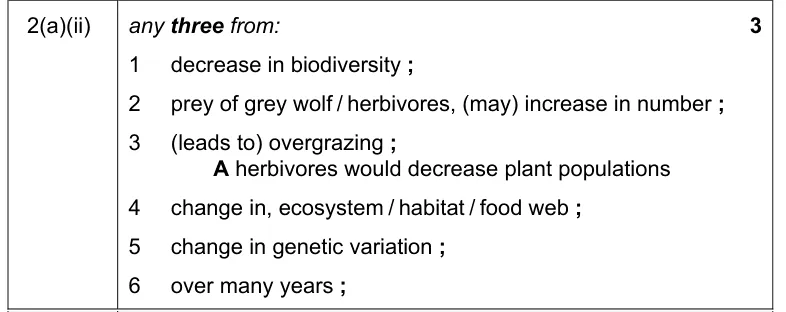
Suggest and explain the effects on biodiversity if the grey wolf becomes extinct in south-west Europe.
Information from earlier in this question:
Show the mark scheme
Tap an image to open it full size.
From the examiners' report: Most answers only gave the immediate effect on the grey wolf's prey. Better answers went on to the wider effects on biodiversity and the local ecosystem or food web. Few described the effect on genetic variation or the time scale of the changes.
Question 8
Paper 4 · May/June 2022 (41) · Q8(b) · 7 marks
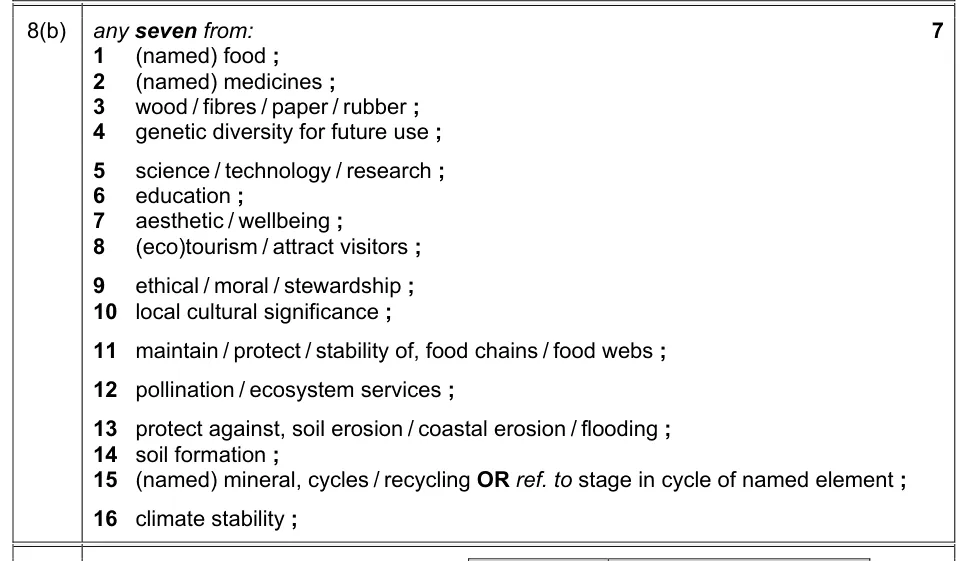
Explain why it is important to maintain biodiversity (7 marks).
Show the mark scheme
Tap an image to open it full size.
From the examiners' report: Well-prepared students had a list of reasons: resources such as medicines, food and wood; science, education and tourism; stable food webs, mineral cycling, preventing soil erosion and climate stability. 'Ethical' and 'aesthetic' gained credit, but few students showed that they knew what these words mean.
Zoos, captive breeding and conserved areas (18.3.3)
Question 9
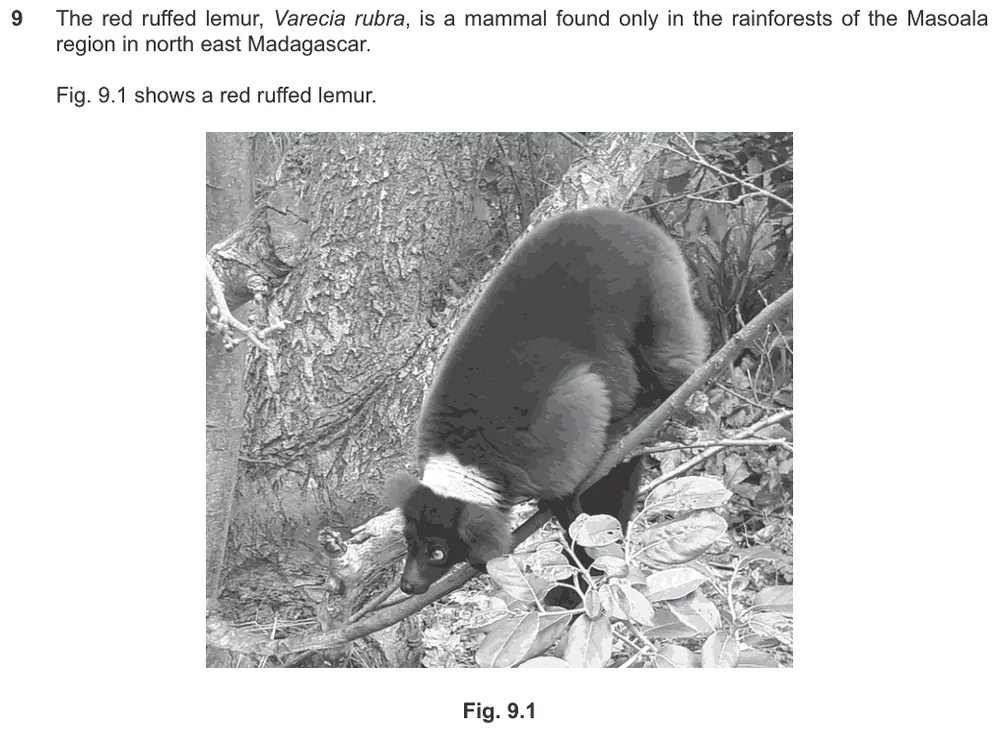
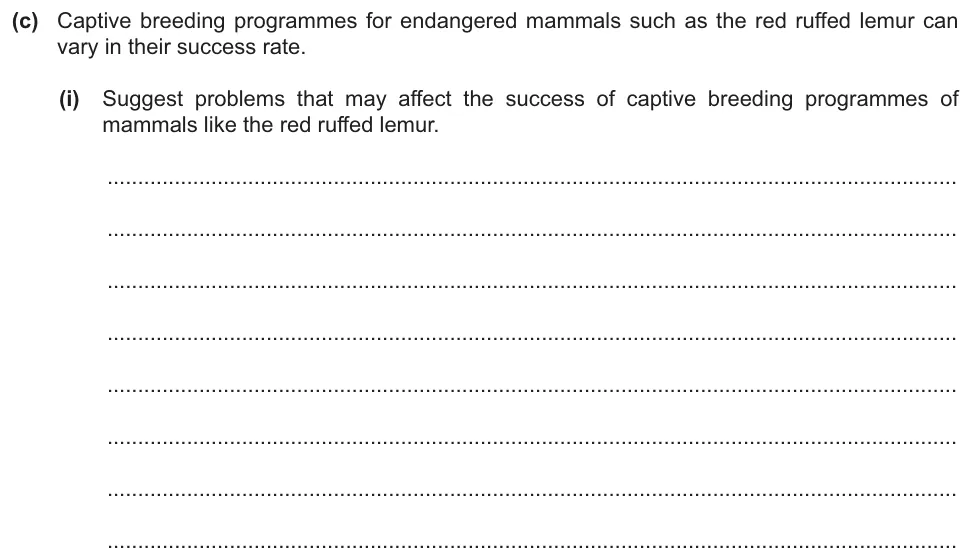
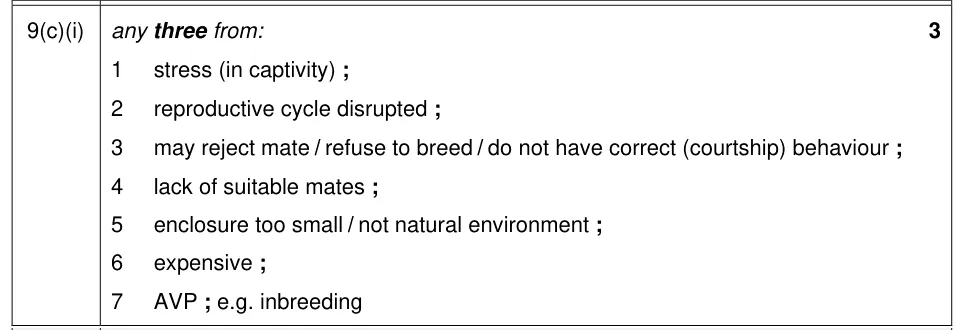
Paper 4 · October/November 2024 (42) · Q9(c)(i) · 3 marks
Suggest problems that may affect the success of captive breeding programmes for mammals.
Information from earlier in this question:
Show the mark scheme
Tap an image to open it full size.
Question 10
Paper 4 · October/November 2024 (42) · Q9(c)(ii) · 1 mark
Suggest why wild-caught red ruffed lemurs are sometimes introduced into captive breeding programmes.

Show the mark scheme

Tap an image to open it full size.
Question 11
Paper 4 · May/June 2018 (42) · Q1(b) · 3 marks · Easy
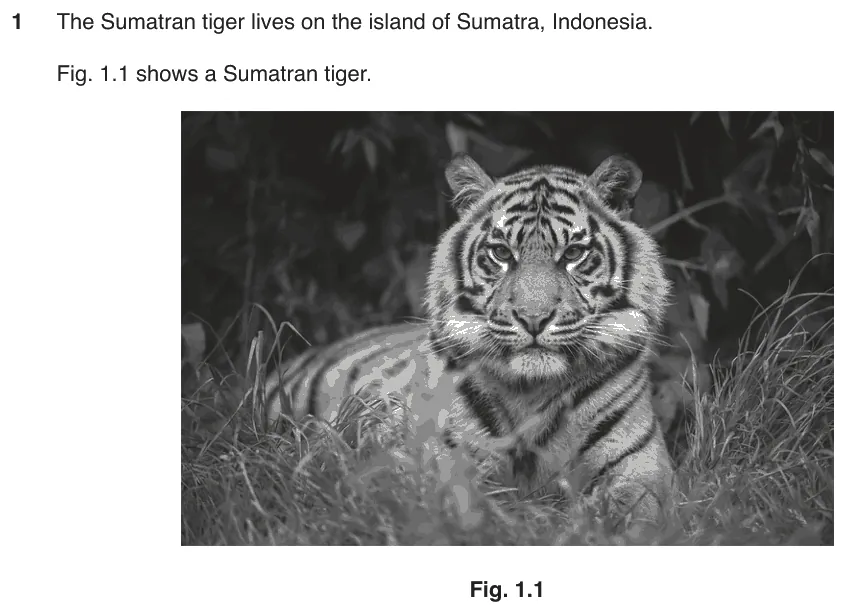
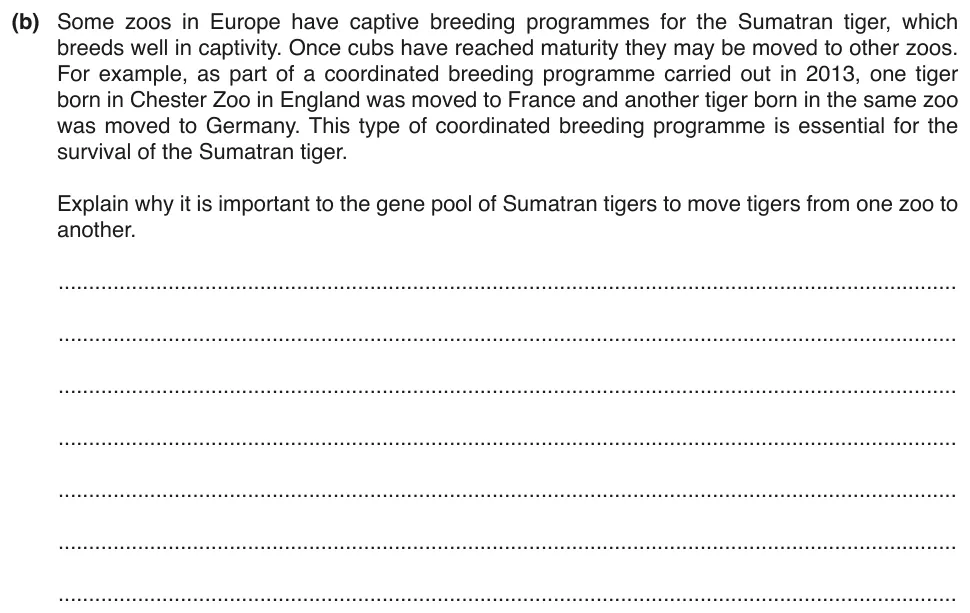
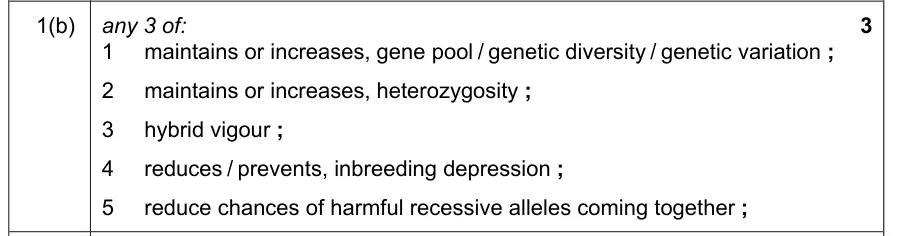
Explain why moving tigers from one zoo to another is important to the gene pool of Sumatran tigers.
Information from earlier in this question:
Show the mark scheme
Tap an image to open it full size.
From the examiners' report: Almost all students said that moving tigers maintains or increases the gene pool. Many added that it increases heterozygosity and prevents inbreeding depression. Hybrid vigour was given less often.
Question 12
Paper 4 · May/June 2023 (42) · Q10(a) · 3 marks
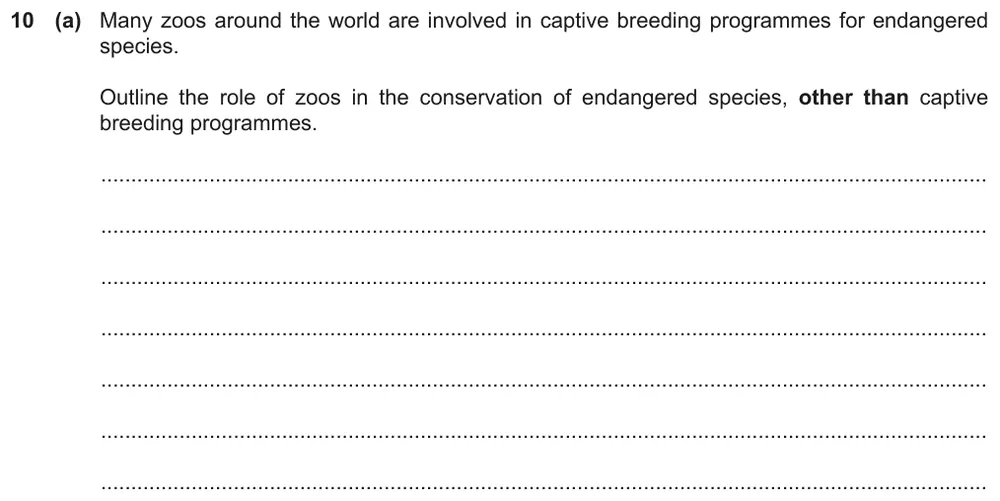
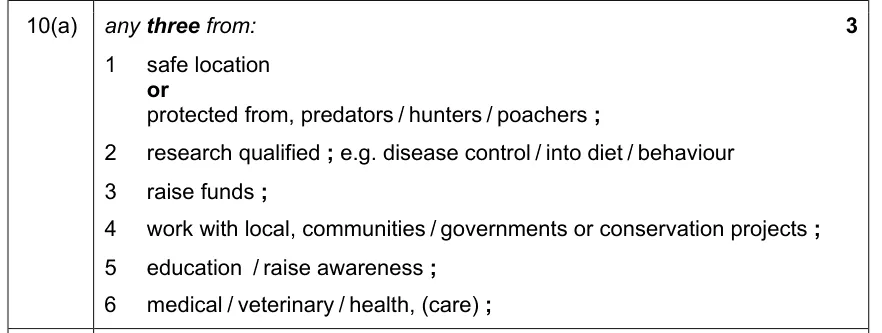
Outline the role of zoos in conserving endangered species, other than captive breeding programmes.
Show the mark scheme
Tap an image to open it full size.
From the examiners' report: Often well answered: zoos provide a safe environment, raise public awareness and provide veterinary care. Research was often mentioned, but only a few students gained the mark by giving the type of research, such as behaviour or habitats.
Question 13
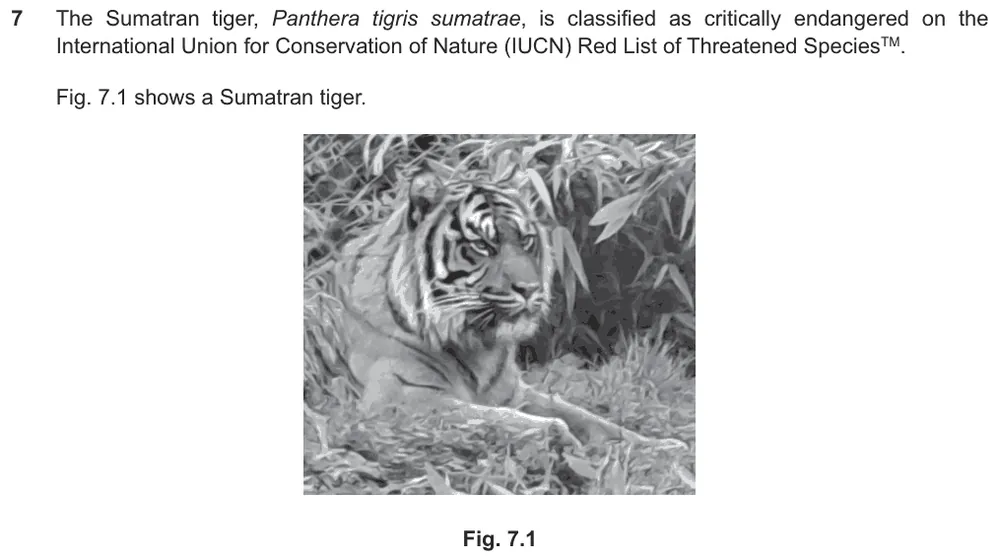
Paper 4 · February/March 2025 (42) · Q7(a)(ii) · 3 marks · Easy
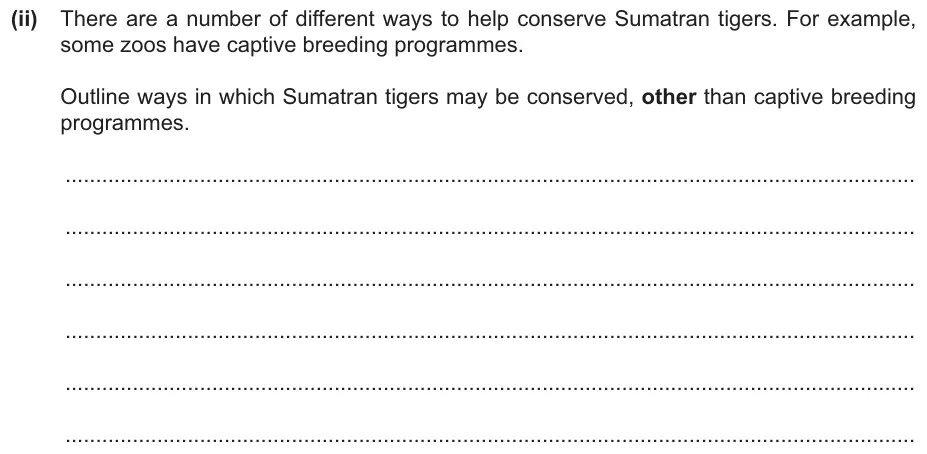
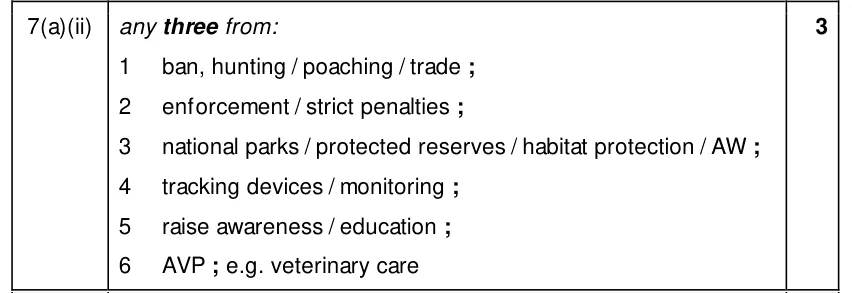
Outline ways in which Sumatran tigers may be conserved, other than captive breeding programmes.
Information from earlier in this question:
Show the mark scheme
Tap an image to open it full size.
From the examiners' report: Most answers covered the control of hunting and trade, and many added national reserves and education programmes. A significant minority described captive breeding programmes, which the question ruled out. Read the question carefully.
Assisted reproduction: IVF, embryo transfer and surrogacy (18.3.4)
Question 14
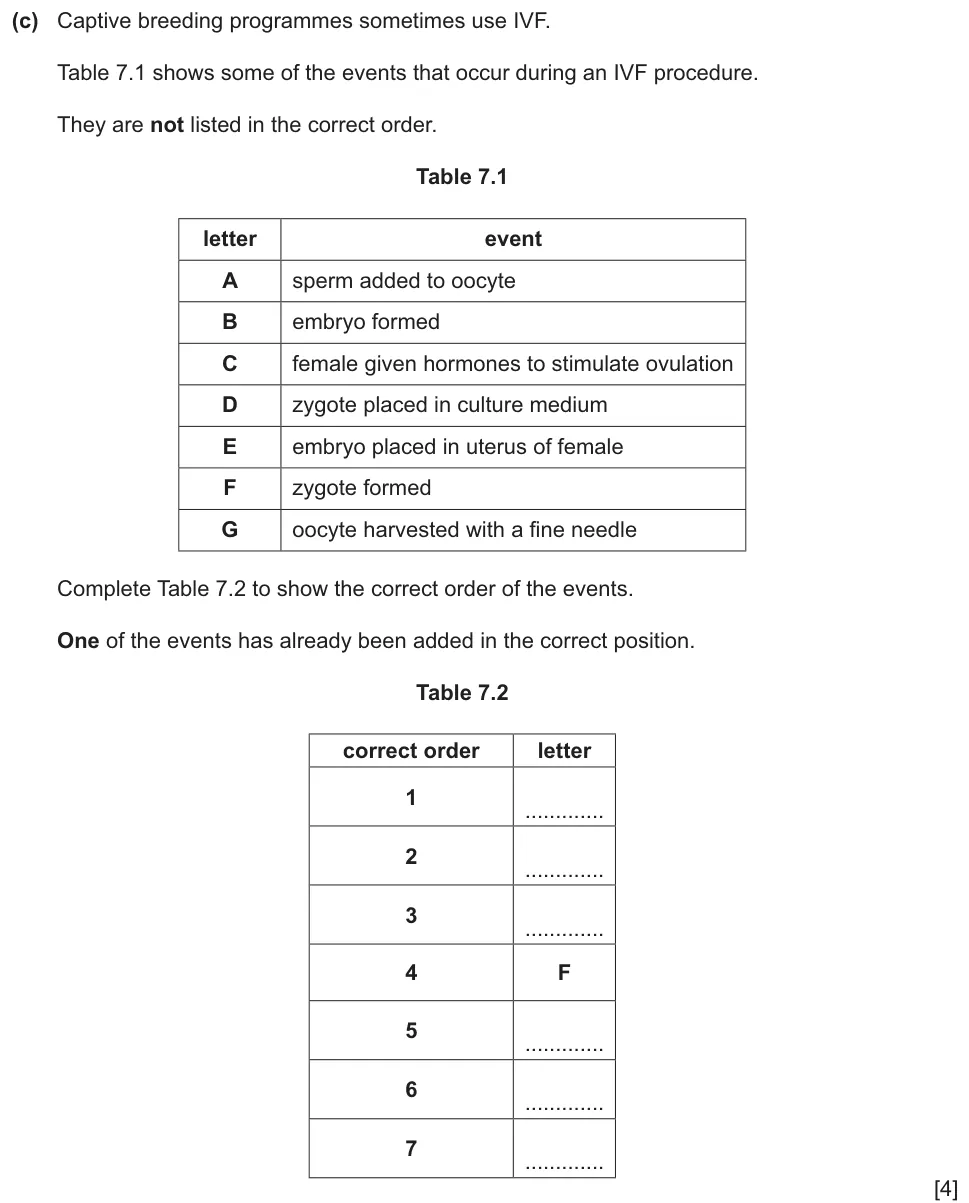
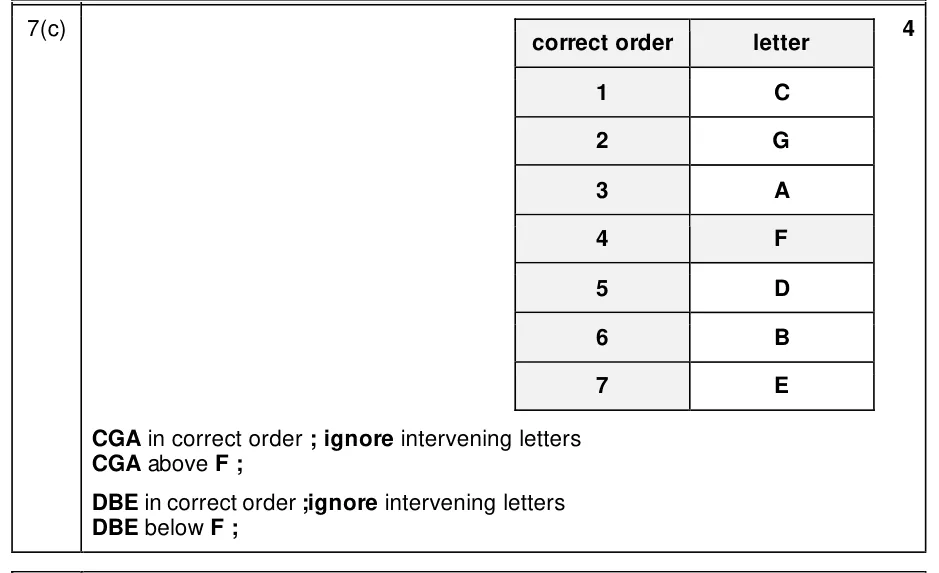
Paper 4 · February/March 2025 (42) · Q7(c) · 4 marks · Easy
Put the events of an IVF procedure into the correct order.
Show the mark scheme
Tap an image to open it full size.
Question 15
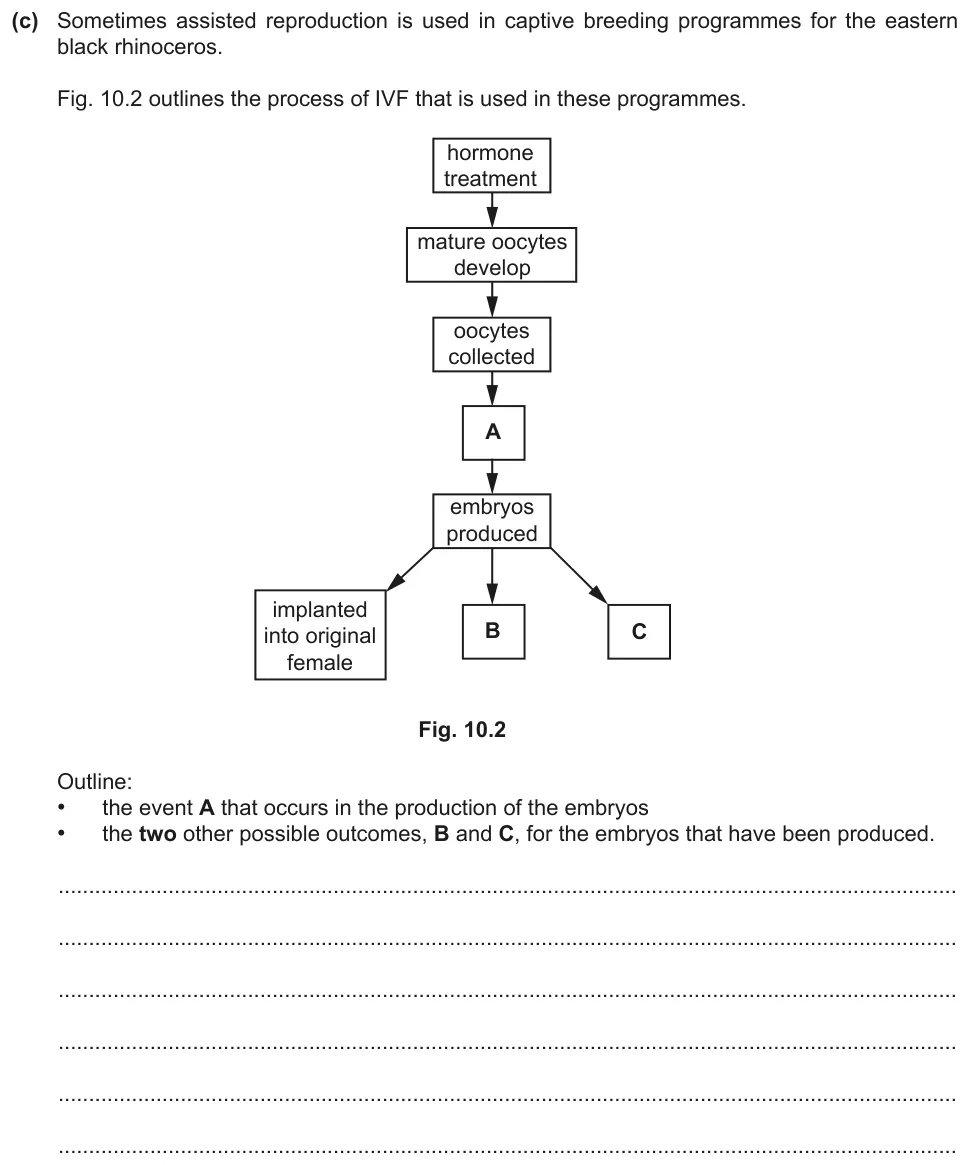
Paper 4 · May/June 2023 (42) · Q10(c) · 3 marks
Outline the event that produces the embryos in IVF and two other possible outcomes for the embryos.
Show the mark scheme

Tap an image to open it full size.
From the examiners' report: Event A needed a mention of fertilisation; some long descriptions contradicted themselves. For B and C, many said the embryo could be placed in another or surrogate female. Storing the embryo needed a reference to freezing or cryopreservation.
Question 16
Paper 4 · October/November 2022 (42) · Q1(c) · 4 marks
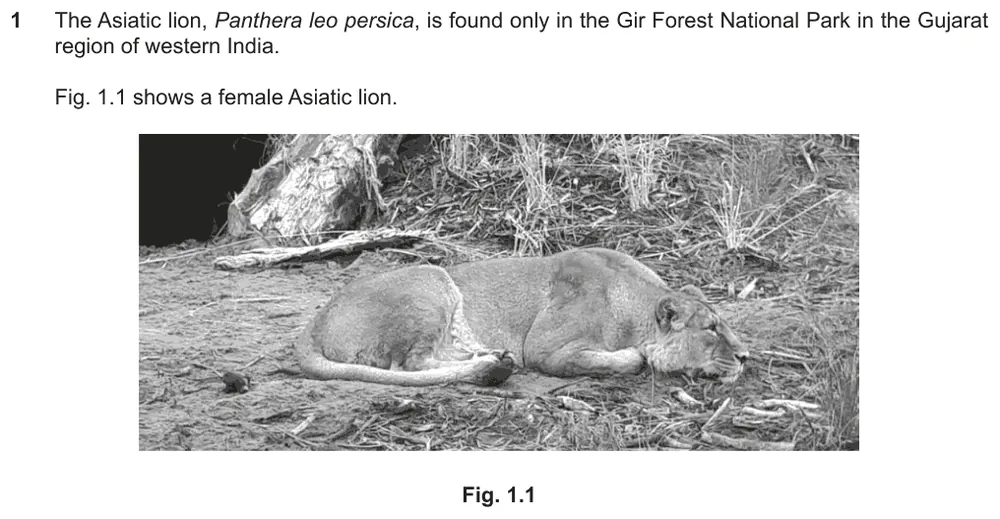
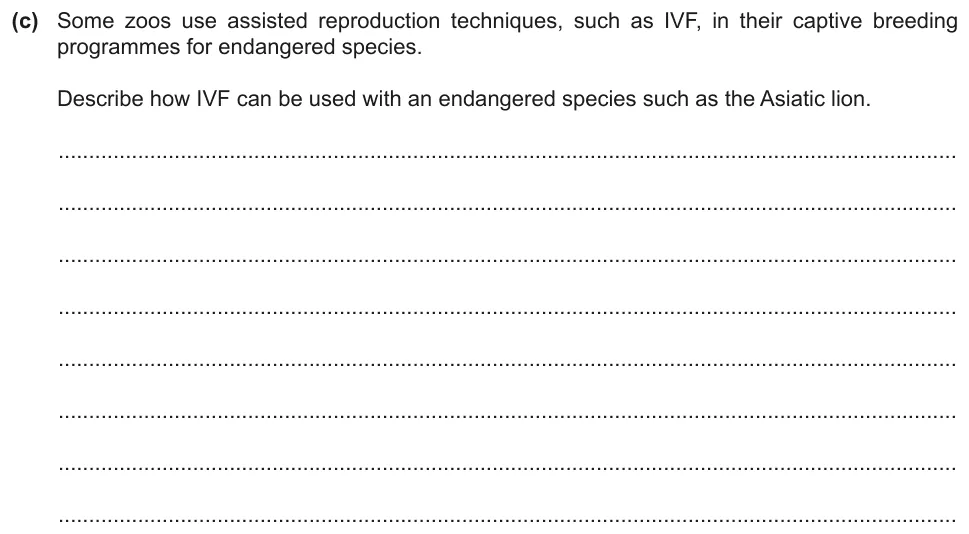
Describe how IVF can be used with an endangered species such as the Asiatic lion.
Information from earlier in this question:
Show the mark scheme
Tap an image to open it full size.
From the examiners' report: Do not confuse IVF with artificial insemination. Very few mentioned giving hormones to cause superovulation, or how the ova are harvested. Write 'ova' rather than 'eggs', and say that the embryo, not the zygote, is placed in the uterus.
Question 17
Paper 4 · October/November 2022 (41) · Q1(c) · 4 marks
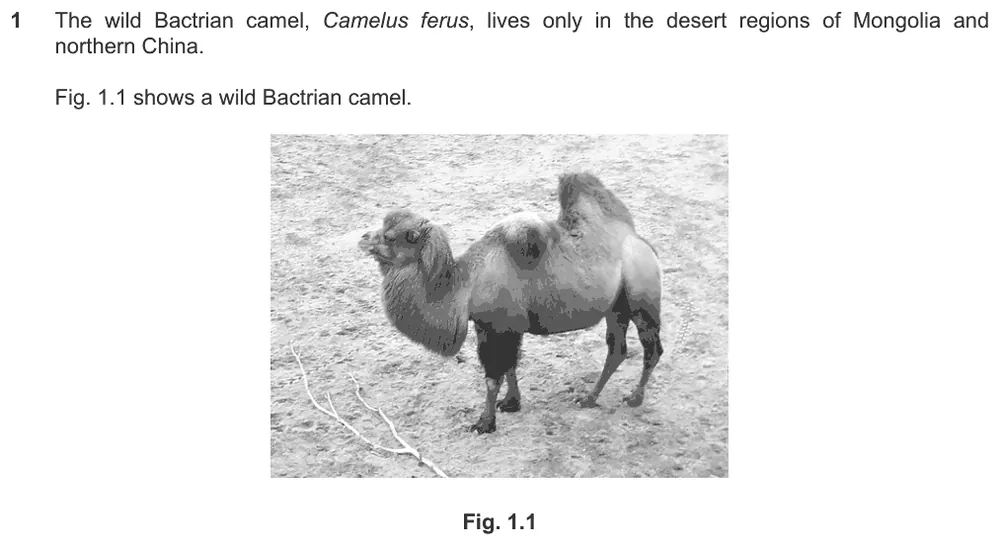
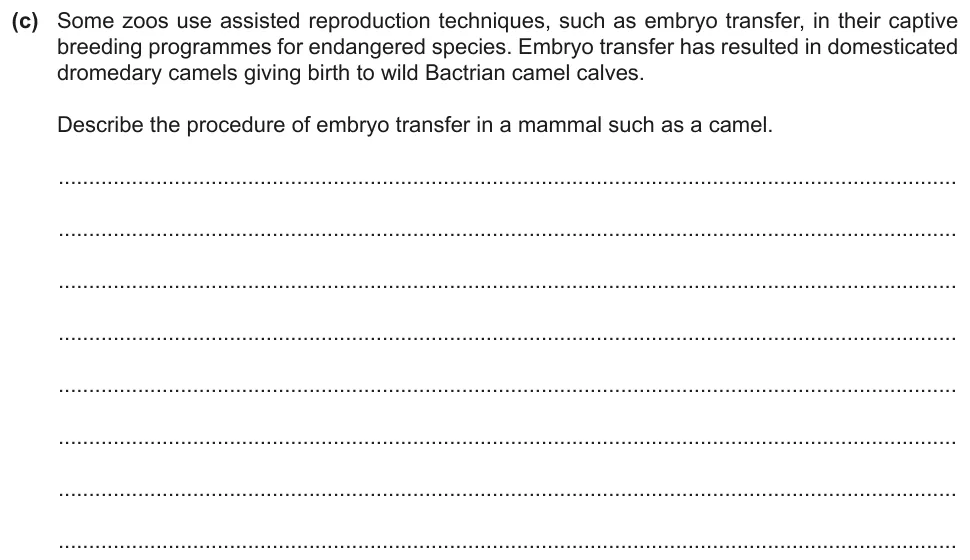
Describe the procedure of embryo transfer in a mammal such as a camel.
Information from earlier in this question:
Show the mark scheme
Tap an image to open it full size.
From the examiners' report: Many students misused terms, confusing IVF with artificial insemination, ovum or zygote with embryo, and uterus with ovary. Many correctly referred to surrogacy. Few mentioned screening the embryos or freezing them for later use.
Invasive alien species (18.3.5)
Question 18
Paper 4 · May/June 2024 (42) · Q9(a) · 4 marks
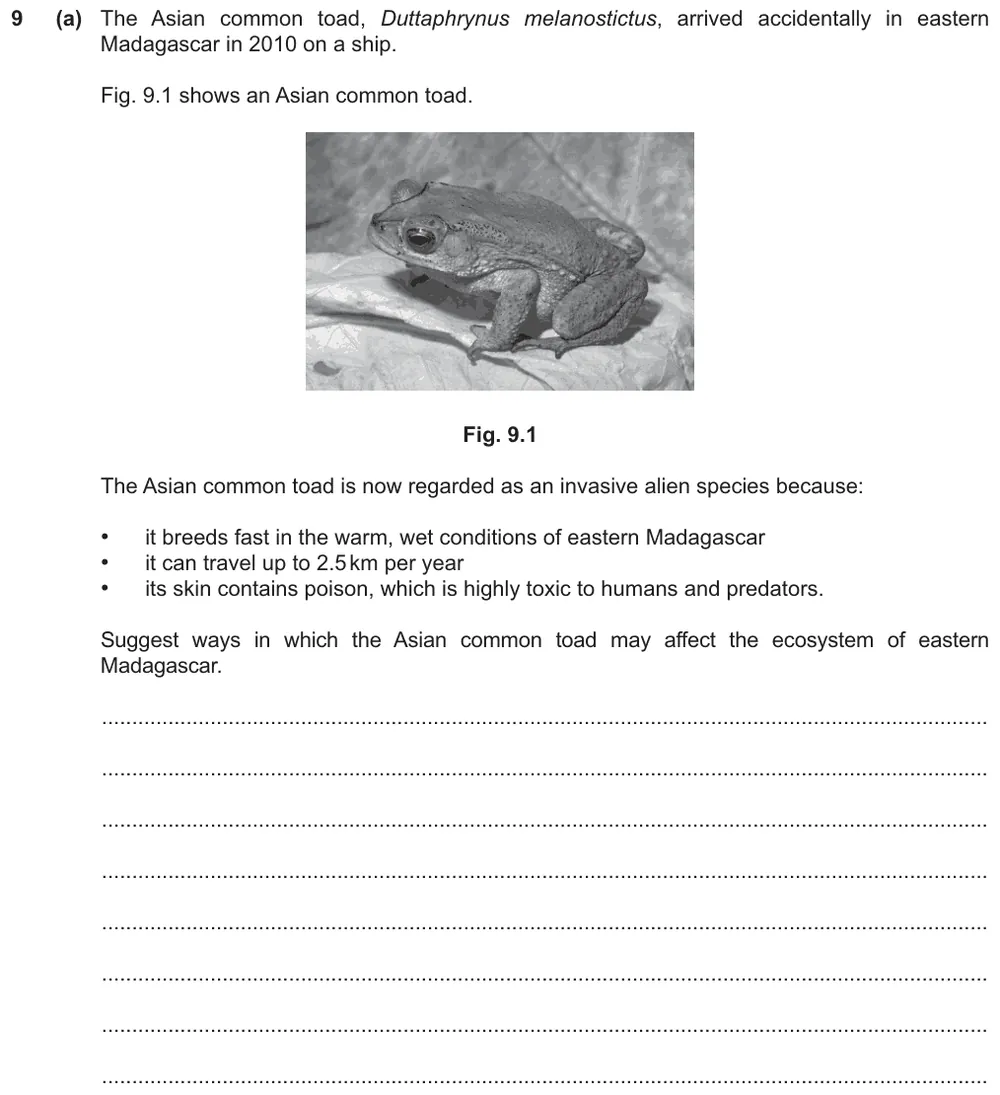
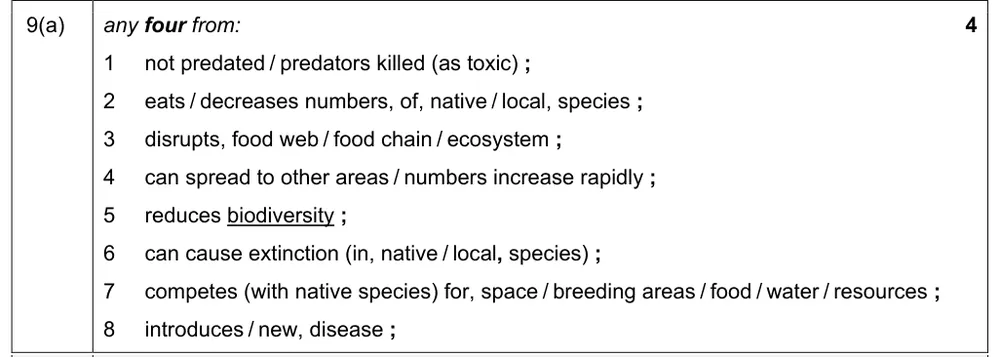
Suggest ways in which the Asian common toad may affect the ecosystem of eastern Madagascar.
Show the mark scheme
Tap an image to open it full size.
From the examiners' report: Do not just repeat the information in the question; add what follows from it. Vague statements such as 'animals would die' lost credit. Avoid neutral words such as 'affects': 'this affects the food web' is not creditworthy because it does not say whether the effect is positive or negative.
Question 19
Paper 4 · October/November 2023 (42) · Q10(b) · 4 marks · Easy
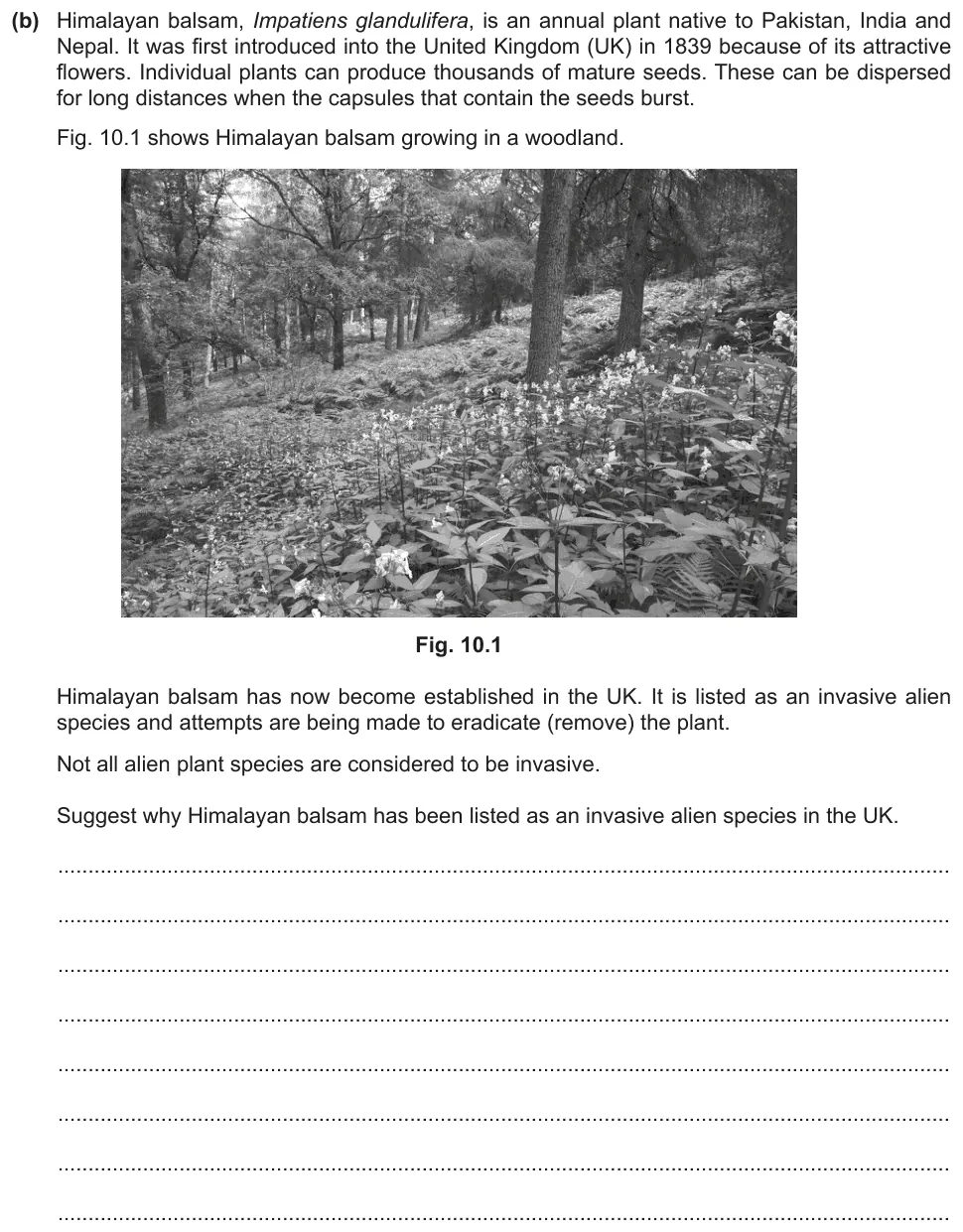
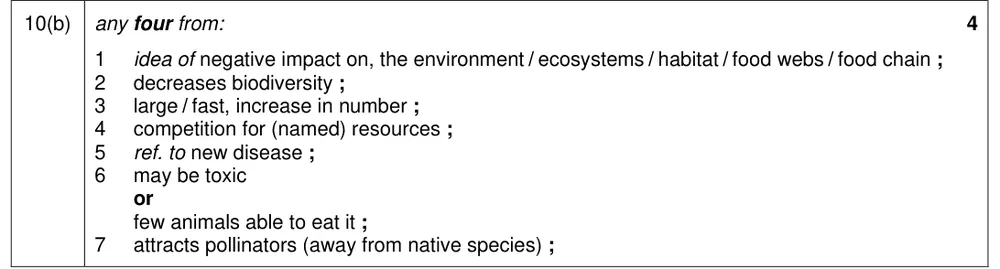
Suggest why Himalayan balsam has been listed as an invasive alien species in the UK.
Show the mark scheme
Tap an image to open it full size.
From the examiners' report: Most students gave competition with native species for resources such as light, space or mineral ions. Some did not say what the balsam competes for, or simply wrote 'food'. Weaker answers repeated the stem of the question without adding anything to it.
Question 20
Paper 4 · February/March 2022 (42) · Q1(b) · 4 marks
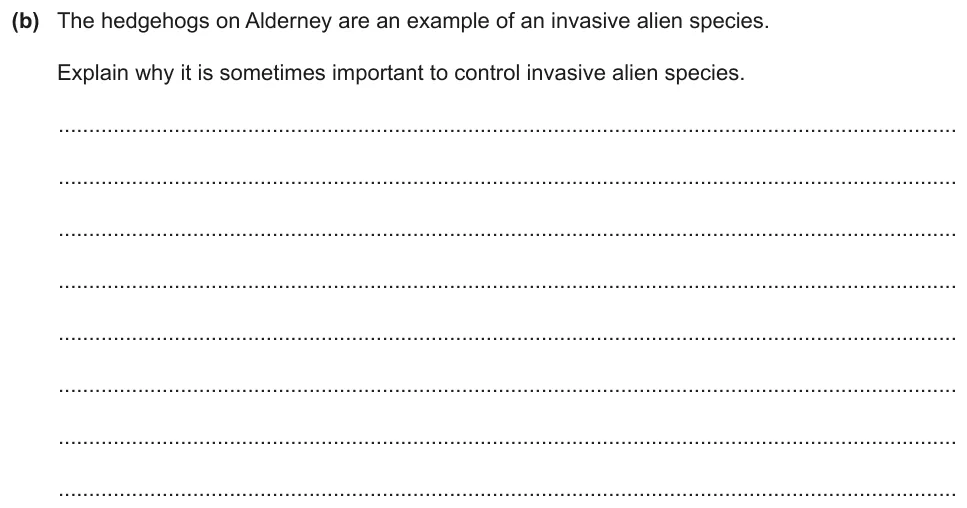
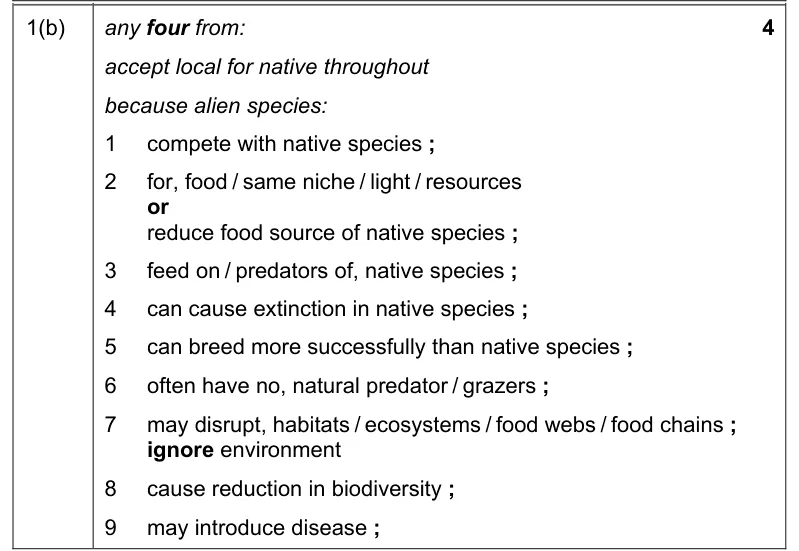
Explain why it is sometimes important to control invasive alien species.
Show the mark scheme
Tap an image to open it full size.
From the examiners' report: Competition with native species for food and other resources, and predation on native species, were the usual answers. Others said that alien species may have no predators or may reproduce more successfully than native species. Some went on to the consequence: a reduction in biodiversity.
The IUCN and CITES (18.3.6)
Question 21
Paper 4 · May/June 2024 (41) · Q8(a) · 3 marks
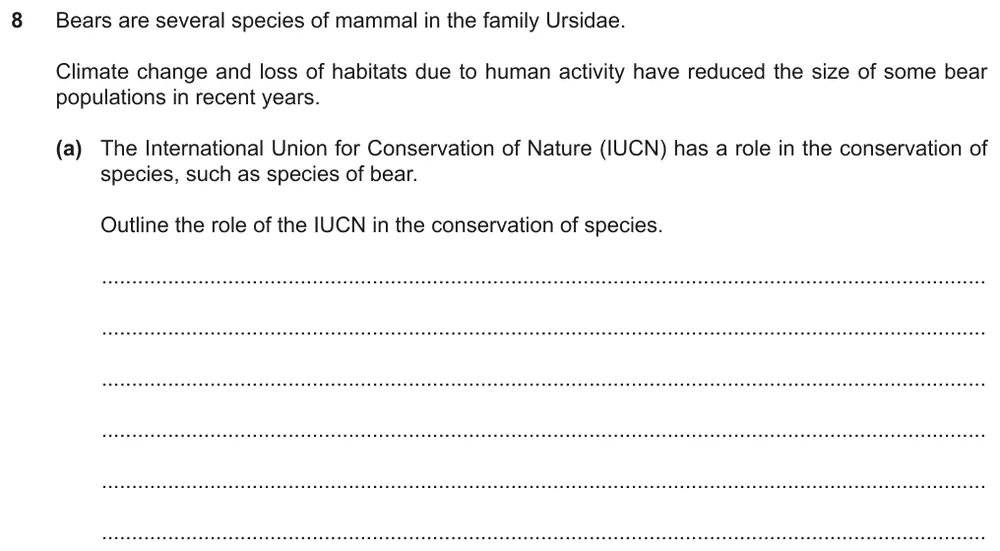
Outline the role of the IUCN in the conservation of species.
Show the mark scheme

Tap an image to open it full size.
From the examiners' report: Students were confused about what the IUCN is. Zoos, captive breeding programmes and setting up trading laws (which is what CITES does) are not its role. Accurate ideas were assessing conservation status, the Red List, education and influencing governments.
Question 22
Paper 4 · May/June 2022 (43) · Q8(b) · 3 marks · Hard
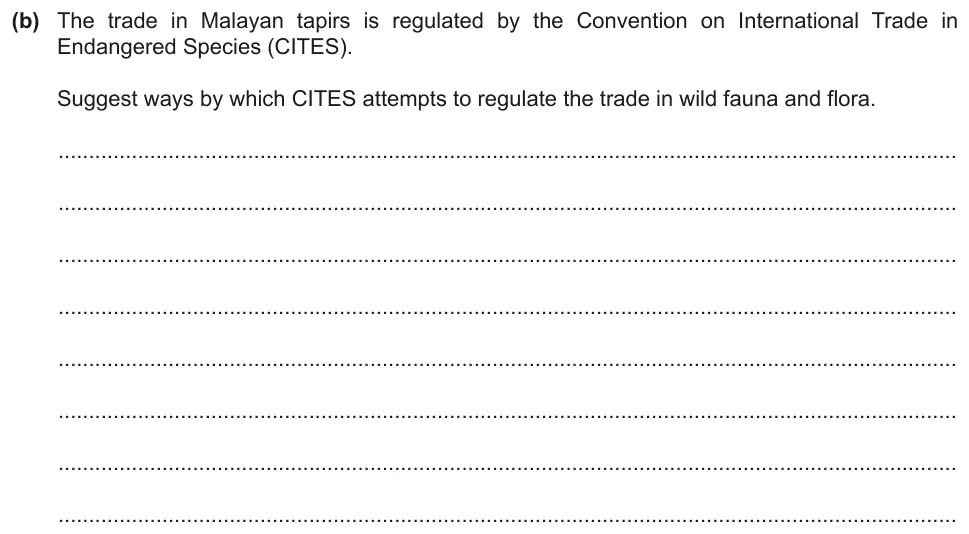
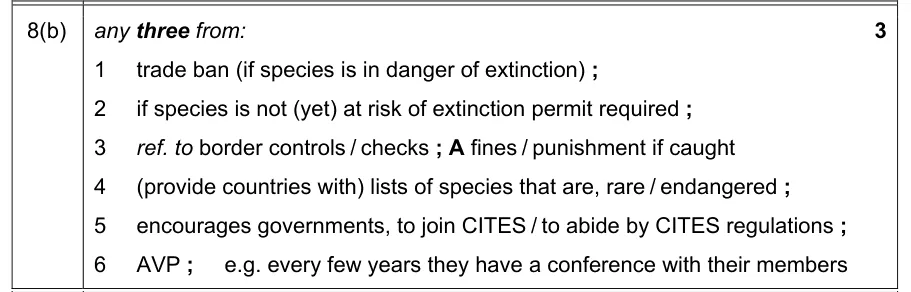
Suggest ways by which CITES attempts to regulate the trade in wild fauna and flora.
Show the mark scheme
Tap an image to open it full size.
From the examiners' report: Many students confused the role of CITES with the roles of zoos and conserved areas. The usual marks were for a list of rare or endangered species and for trade bans. Very few mentioned permits for trade in species not yet at risk of extinction; border checks and punishments were also credited.
Where students lose marks (from Cambridge examiners' reports and mark schemes)
Each point below comes from the examiners' reports and mark schemes, and is followed by wording that gained marks.
Pollution alone explains nothing. Students gave pollution and climate change as reasons why more fish than mammals are endangered, without the further explanation needed to account for the difference.
✔ Gains credit: 'overfishing', 'difficult to enforce protective laws' at sea, pollution qualified such as 'plastics in the sea', and 'more conservation projects for mammals'.
The disease must be new. Students gave disease as a reason why a species has become endangered without saying that it is a new disease.
✔ Gains credit: 'new disease', along with 'loss of habitat', 'climate change', 'predation' and 'competition for food / resources / breeding sites'.
Few alleles, not a rare allele. Students described low genetic variation as an allele with a low frequency, confused it with inbreeding, or explained how it arises.
✔ Gains credit: the species is 'less able to adapt', there is 'little variation for selection to act on', and 'all / most could be killed by same disease / selection pressure'.
Check what the question rules out. Students described captive breeding programmes when the question asked for other ways to conserve Sumatran tigers.
✔ Gains credit: 'ban hunting / poaching / trade', 'enforcement / strict penalties', 'national parks / protected reserves' and 'raise awareness / education'.
Say what the research is on. Students wrote that zoos carry out research without giving the type of research.
✔ Gains credit: 'research' qualified, such as 'disease control', 'diet' or 'behaviour'; also 'protected from predators / hunters / poachers', 'education / raise awareness' and 'veterinary care'.
IVF is not artificial insemination. Students described putting sperm into the female, wrote 'eggs', or said that the zygote is implanted.
✔ Gains credit: 'female given hormone / FSH', 'superovulation', 'oocytes / ova harvested', 'sperm added to oocytes / ova' and 'embryo placed in uterus'.
'Affects' gains no credit. Students repeated the information in the question, or wrote neutral statements such as 'this affects the food web' and 'animals would die'.
✔ Gains credit: the toad is 'not predated' or 'predators killed', it 'decreases numbers of native species', 'disrupts food web', 'reduces biodiversity' and 'competes with native species for food'.
The IUCN is not CITES. Students gave the IUCN the work of zoos and captive breeding programmes, or the trading laws of CITES.
✔ Gains credit: the IUCN will 'assess / categorise species conservation status', publish the 'Red List', 'influence / advise governments' and 'educate / raise awareness'.
Download the questions
Download the PDF pack (22 questions, mark schemes at the end)
Keep practising
- Classification (18.1): Cambridge (CIE) exam questions by topic
- Biodiversity (18.2): Cambridge (CIE) exam questions by topic
- Cambridge (CIE) A level Biology 9700 past papers, mark schemes and examiners' reports
- Cambridge (CIE) A level Biology grade thresholds
- Book a one-to-one CIE lesson or a free 15-minute discovery chat with Tom
- Register your interest in a CIE A level Biology group class
Questions, mark schemes and examiners' report extracts © Cambridge University Press & Assessment.