

Classification (18.1): Cambridge (CIE) A Level Biology 9700 Exam Questions by Topic
Classification is sub-topic 18.1 of Topic 18, Classification, biodiversity and conservation, in the Cambridge International AS & A Level Biology syllabus (9700). You need to discuss the biological, morphological and ecological species concepts, describe the three domains Archaea, Bacteria and Eukarya and the differences between the two prokaryotic domains, place eukaryotes in the taxonomic hierarchy from kingdom to species, outline the characteristic features of the kingdoms Protoctista, Fungi, Plantae and Animalia, and outline how viruses are classified. This is A level content, examined on Paper 4.
The examiners' reports return to the same points. Learn the names of the three domains and spell them correctly: 'eukaryotes' is not accepted for Eukarya, and the names of kingdoms are not the names of domains. When a question asks for a genus, give the genus name alone. When you compare Archaea with Bacteria, or Animalia with Plantae, write paired statements that say what the difference is, not just which feature differs. Give features that animals have instead of features they lack, and do not describe only mammals or vertebrates. When a question gives you information about two organisms, apply each species concept to that information and reach a decision.
Studying Cambridge International A level Biology and want more help? Tom teaches CIE students one-to-one online, including students in the UAE, Saudi Arabia, Hong Kong, India and Indonesia, and every lesson is recorded. You can book a one-to-one lesson or a free 15-minute discovery chat, or register your interest in a CIE group class starting in September 2027, using the links at the bottom of this page.
What you need from AS Level
Each question on this page assumes you're secure on these ideas. If any of them feels shaky, look it up before you start.
- Prokaryotic cells have no nucleus and no membrane-bound organelles; they have circular DNA and 70S ribosomes. Eukaryotic cells have a nucleus, membrane-bound organelles and 80S ribosomes.
- The cell walls of bacteria are made of peptidoglycan; the cell walls of plants are made of cellulose.
- Viruses are not cells: each has a core of nucleic acid, either DNA or RNA, inside a protein coat called a capsid.
- Starch is the storage polysaccharide of plants and glycogen is the storage polysaccharide of animals.
Key terms
These words come up in the questions and mark schemes. Examiners expect you to use them exactly.
- Biological species concept: a species is a group of organisms that can breed together to produce fertile offspring and that is reproductively isolated from other species.
- Morphological species concept: a species is a group of organisms that share the same appearance or observable characteristics.
- Ecological species concept: a species is a group of organisms that occupy the same niche.
- Domain: the largest group in classification. There are three: Archaea, Bacteria and Eukarya.
- Taxonomic hierarchy: the series of groups used to classify organisms, in which large groups divide into smaller groups: domain, kingdom, phylum, class, order, family, genus, species.
- Binomial name: the scientific name of a species, made up of its genus and its species, such as Panthera tigris.
- Heterotrophic: describes an organism that gets its organic compounds by feeding on other organisms, as animals and fungi do.
- Autotrophic: describes an organism that makes its own organic compounds, for example by photosynthesis, as plants do.
What these questions cover (Cambridge 9700 Topic 18: Classification, biodiversity and conservation)
The questions test these learning outcomes from sub-topic 18.1 of the Cambridge International AS & A Level Biology syllabus (9700) for 2025 to 2027.
- 18.1.1 discuss the meaning of the term species, limited to the biological species concept, morphological species concept and ecological species concept
- 18.1.2 describe the classification of organisms into three domains: Archaea, Bacteria and Eukarya
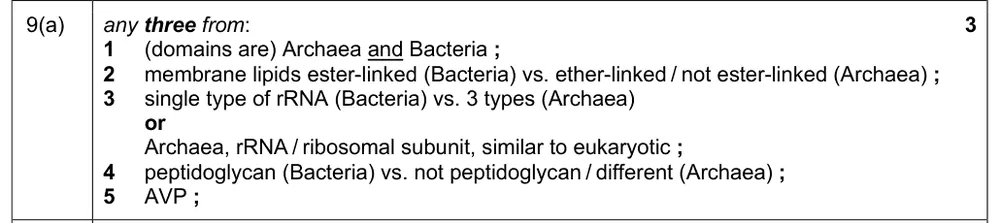
- 18.1.3 state that Archaea and Bacteria are prokaryotes and that there are differences between them, limited to differences in membrane lipids, ribosomal RNA and composition of cell walls
- 18.1.4 describe the classification of organisms in the Eukarya domain into the taxonomic hierarchy of kingdom, phylum, class, order, family, genus and species
- 18.1.5 outline the characteristic features of the kingdoms Protoctista, Fungi, Plantae and Animalia
- 18.1.6 outline how viruses are classified, limited to the type of nucleic acid (RNA or DNA) and whether this is single stranded or double stranded
How to use this page
Write your answer on paper before you open the mark scheme. Allow about 1.2 minutes per mark: the 22 questions are worth 57 marks, so about 68 minutes in total. Then mark your answer strictly against the mark scheme and read the examiners' tip underneath it. If you'd rather print the questions, download the PDF pack.
Species concepts (18.1.1)
Question 1
Paper 4 · February/March 2022 (42) · Q9(a) · 3 marks
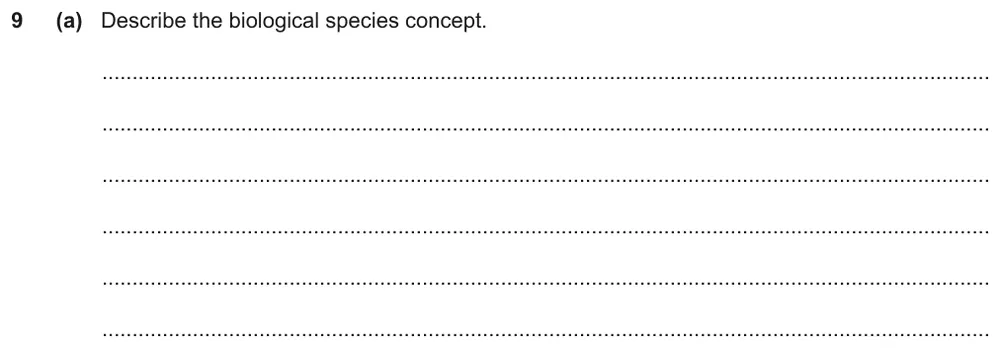
Describe the biological species concept.
Show the mark scheme

Tap an image to open it full size.
From the examiners' report: Many students did not keep to the question and described the different species concepts vaguely. Write only about the biological species concept.
Question 2
Paper 4 · February/March 2022 (42) · Q9(b) · 1 mark · Hard
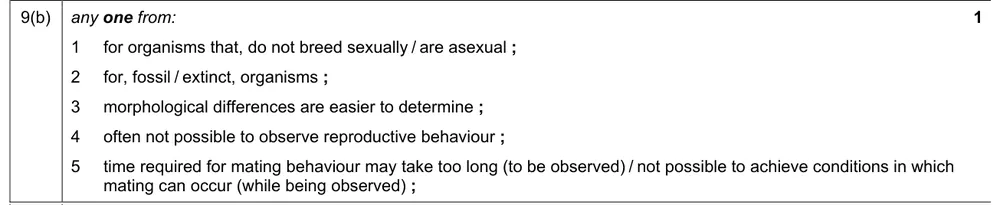
Suggest when the morphological species concept is more useful than the biological species concept.

Show the mark scheme
Tap an image to open it full size.
From the examiners' report: Only a minority made a correct suggestion. The mark scheme accepts organisms that do not breed sexually, and fossil or extinct organisms.
Question 3
Paper 4 · May/June 2024 (41) · Q8(b) · 6 marks
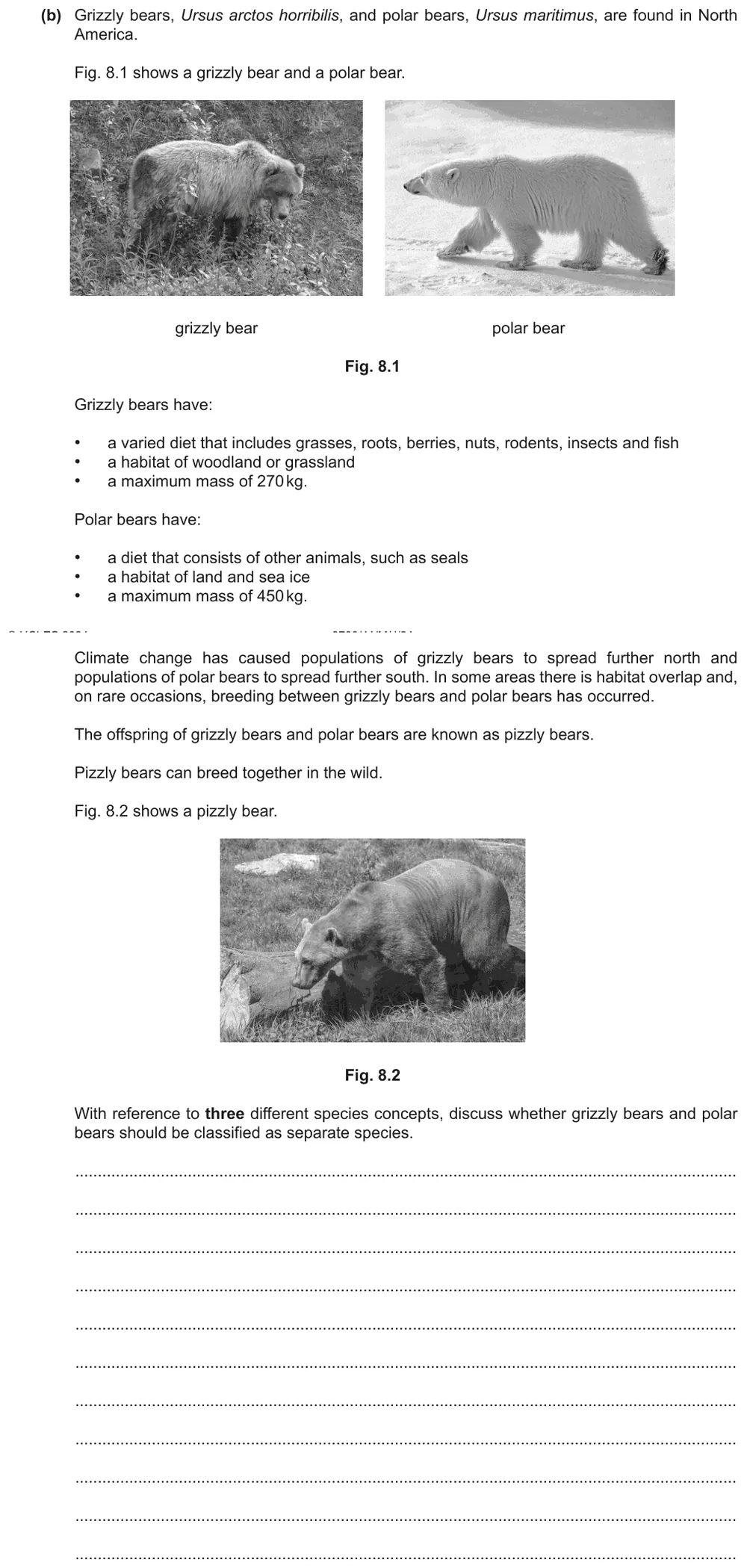
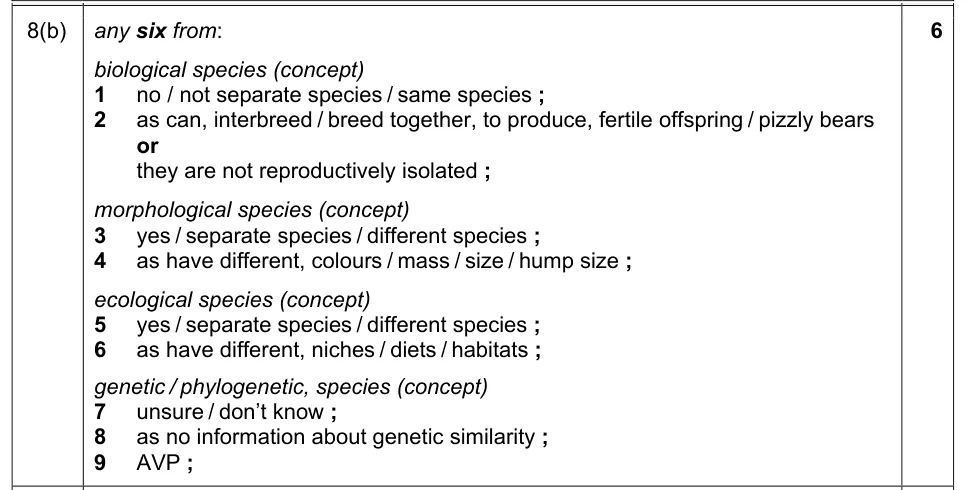
Use three species concepts to discuss whether grizzly bears and polar bears should be classified as separate species.
Information from earlier in this question:

Show the mark scheme
Tap an image to open it full size.
From the examiners' report: Most answers did not name the biological, morphological and ecological species concepts. Use the information you are given: for each concept, decide whether the two bears are the same species or different species, and give the reason. Name the bears instead of writing 'they'.
Question 4
Paper 4 · May/June 2023 (42) · Q3(a)(iii) · 3 marks
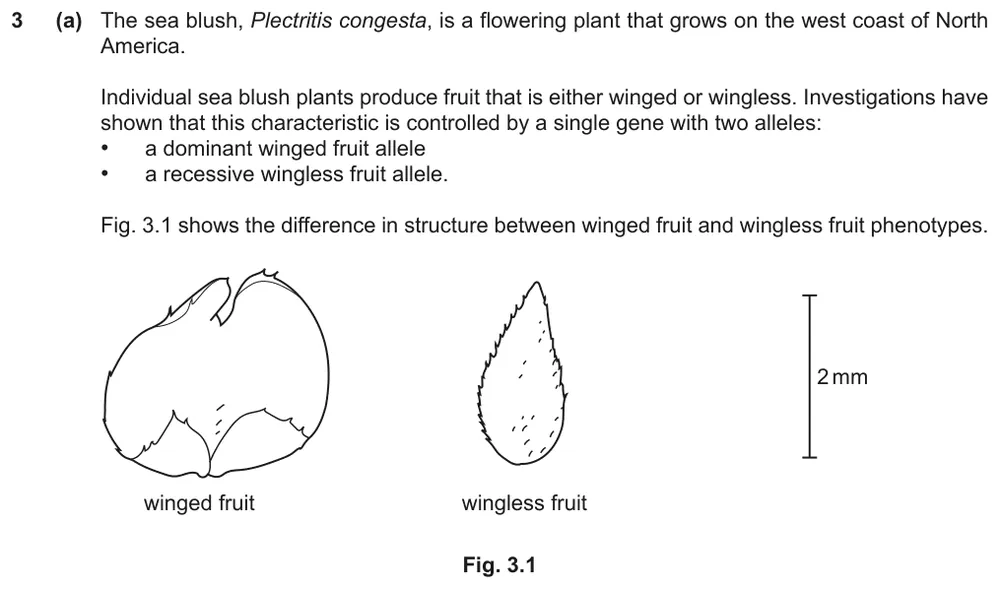
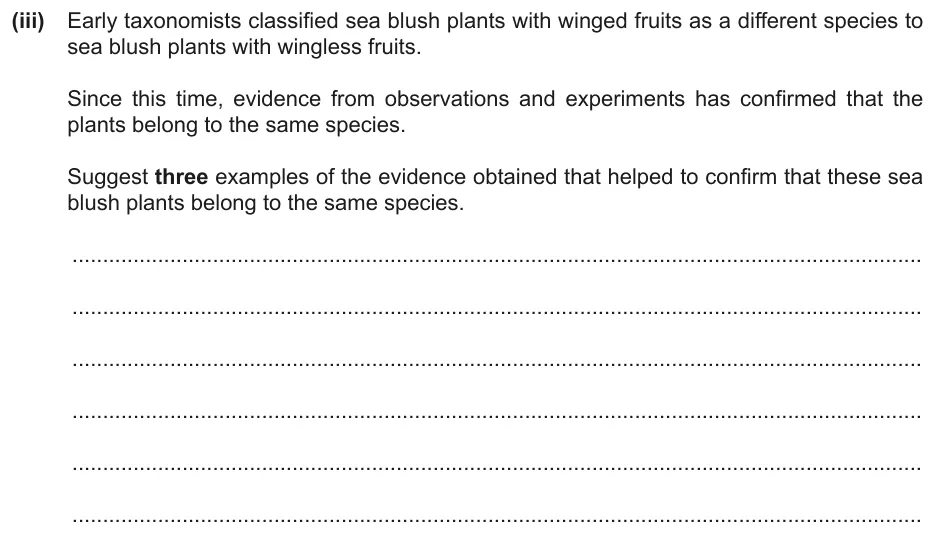
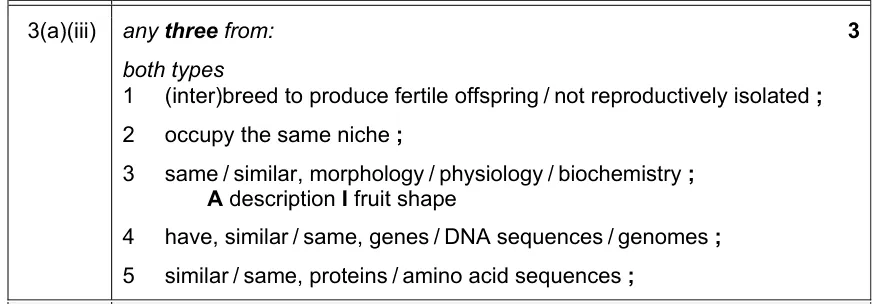
Suggest three kinds of evidence that helped to confirm that the two forms of sea blush belong to the same species.
Information from earlier in this question:
Show the mark scheme
Tap an image to open it full size.
From the examiners' report: Breeding together to produce fertile offspring and having the same morphology were the usual correct answers. 'DNA' on its own was not enough: write 'DNA sequence'. Few mentioned that the plants occupy the same niche.
Question 5
Paper 4 · October/November 2018 (42) · Q1(b) · 3 marks · Hard
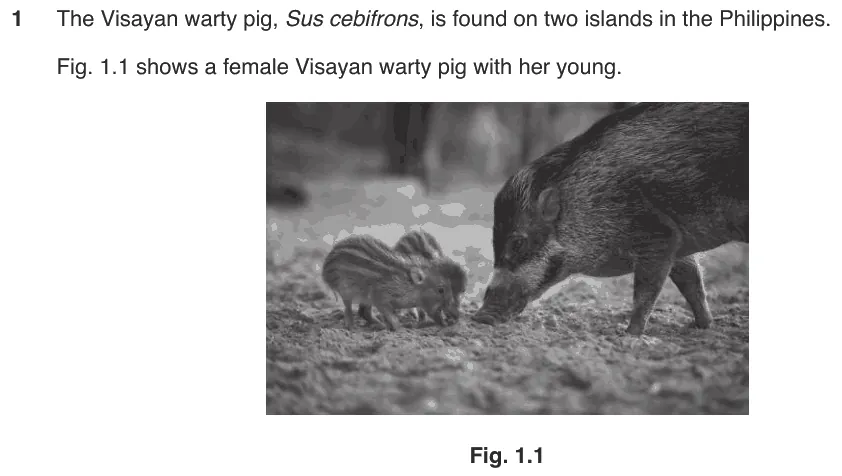
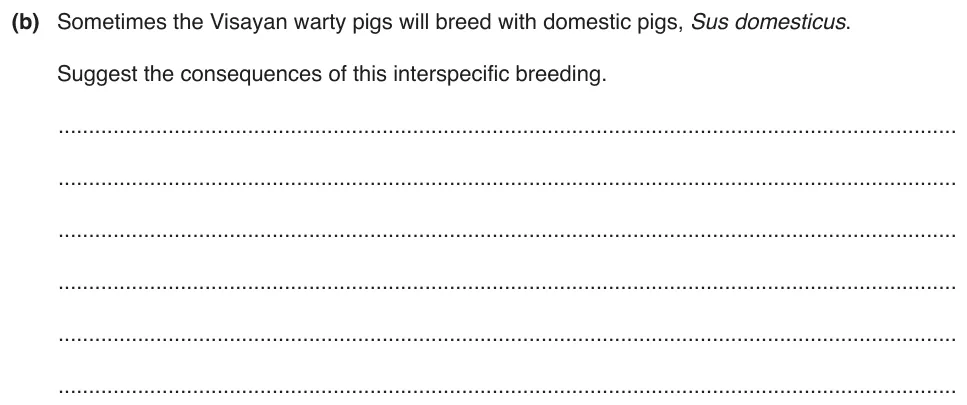
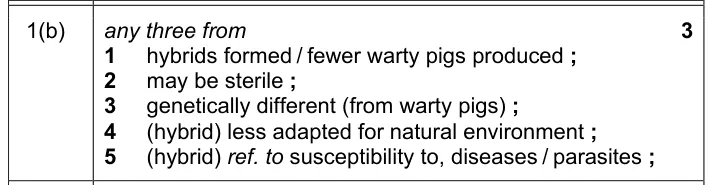
Suggest the consequences of Visayan warty pigs breeding with domestic pigs.
Information from earlier in this question:
Show the mark scheme
Tap an image to open it full size.
From the examiners' report: Very few gained full marks. Answers about outbreeding gained no credit. Most knew that the offspring may be sterile; few said that the hybrids are genetically different from warty pigs or less well adapted to the environment.
The three domains (18.1.2)
Question 6
Paper 4 · May/June 2022 (41) · Q1(a)(i) · 2 marks · Easy
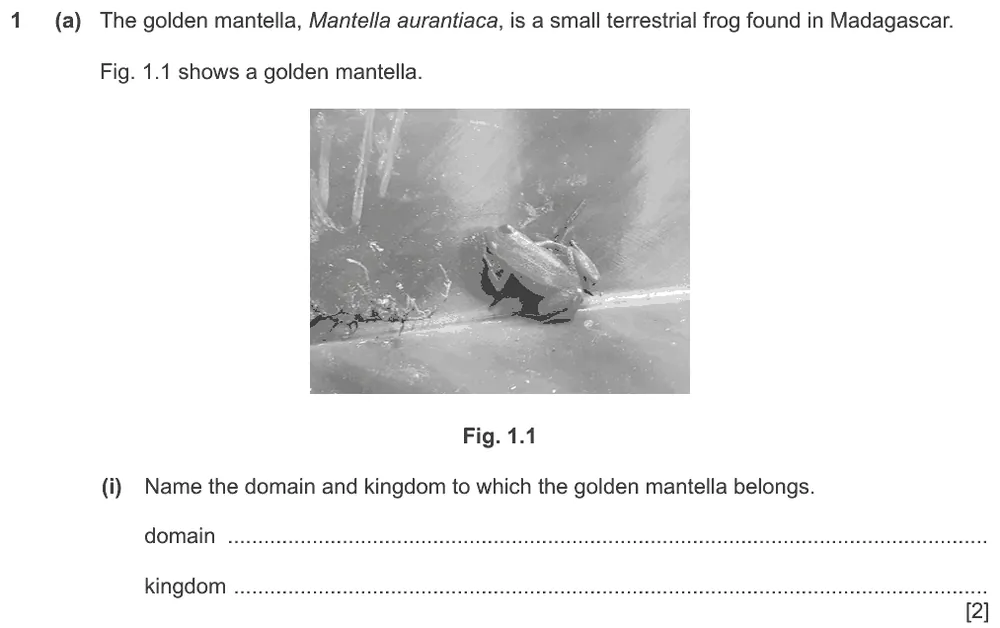
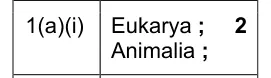
Name the domain and the kingdom to which a frog, the golden mantella, belongs.
Show the mark scheme
Tap an image to open it full size.
Question 7
Paper 4 · May/June 2023 (42) · Q4(a) · 1 mark · Hard
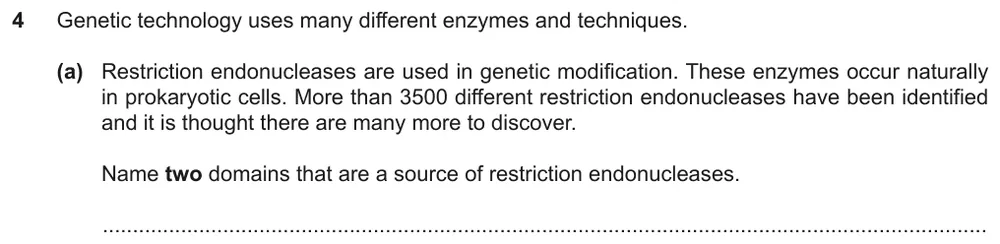
Name the two domains that are a source of restriction endonucleases, which occur naturally in prokaryotic cells.
Show the mark scheme

Tap an image to open it full size.
From the examiners' report: Weaker answers could not recall the names of the two prokaryotic domains, and many gave the names of kingdoms. Common wrong answers were Eukarya, Prokaryote, Eukaryote, Protoctista, Animalia, Fungi and viruses.
Question 8
Paper 4 · February/March 2024 (42) · Q8(c) · 4 marks
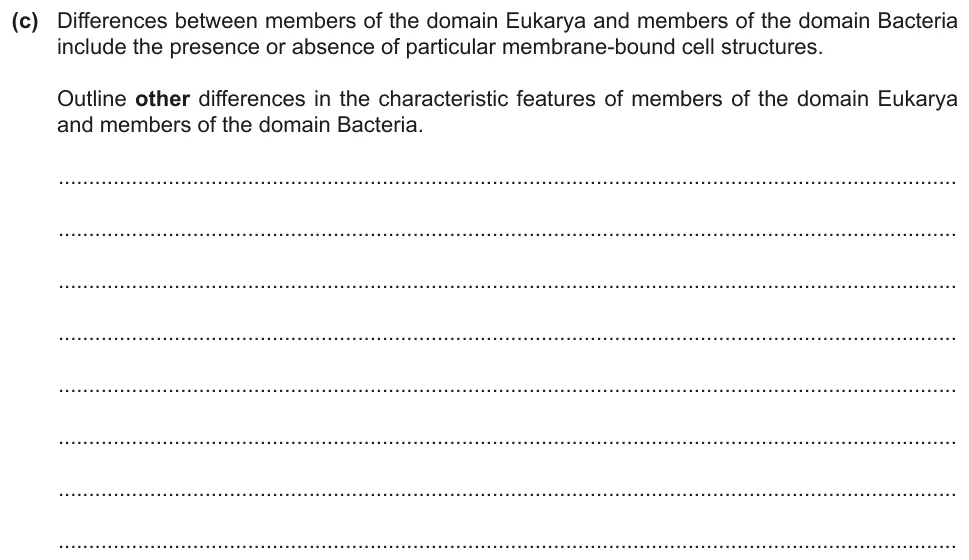
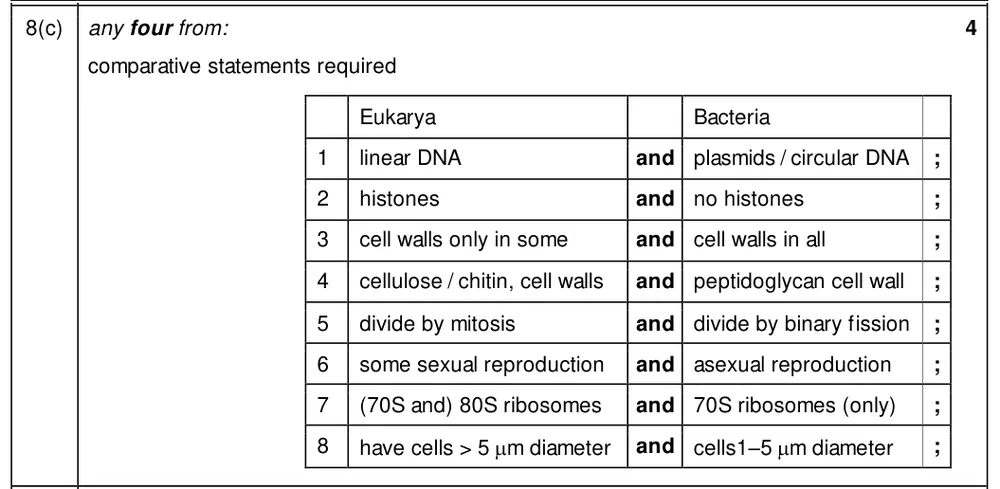
Outline differences between members of the domain Eukarya and members of the domain Bacteria, other than their membrane-bound structures.
Show the mark scheme
Tap an image to open it full size.
Archaea and Bacteria (18.1.3)
Question 9
Paper 4 · February/March 2022 (42) · Q9(c) · 4 marks
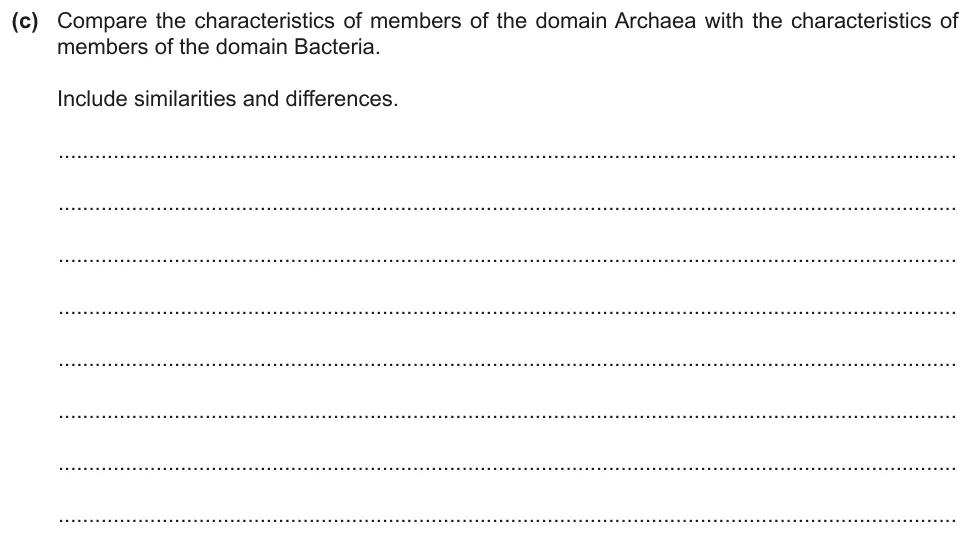
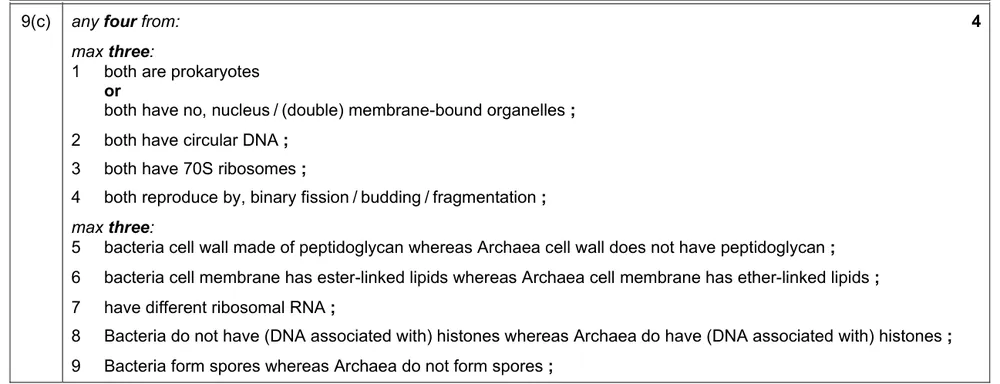
Compare the characteristics of Archaea and Bacteria, giving similarities and differences.
Show the mark scheme
Tap an image to open it full size.
From the examiners' report: Many students did not seem to know this part of the syllabus, and answers often did not pick out similarities and differences. Naming a feature that differs, such as the cell wall or the cell surface membrane, is not enough: say what the difference is.
Question 10
Paper 4 · May/June 2025 (41) · Q9(a) · 3 marks
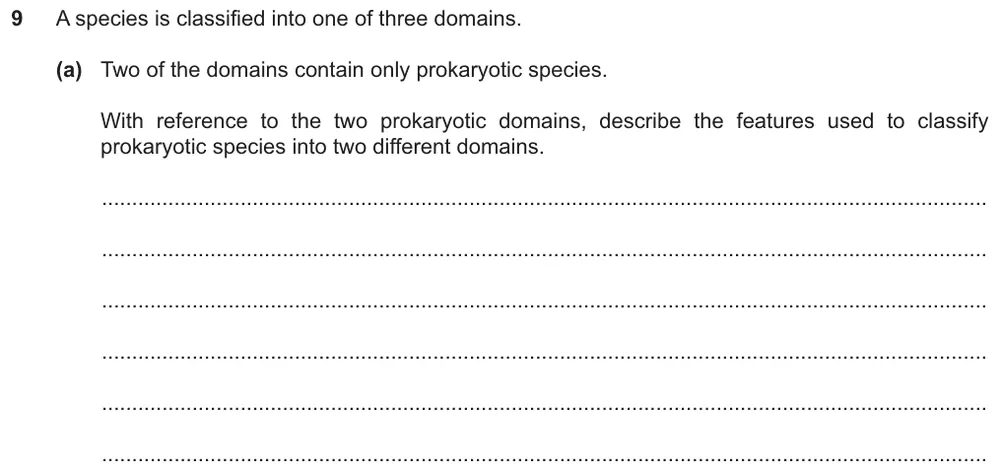
Describe the features used to classify prokaryotic species into two different domains.
Show the mark scheme
Tap an image to open it full size.
The taxonomic hierarchy (18.1.4)
Question 11
Paper 4 · February/March 2024 (42) · Q8(a)(ii) · 2 marks
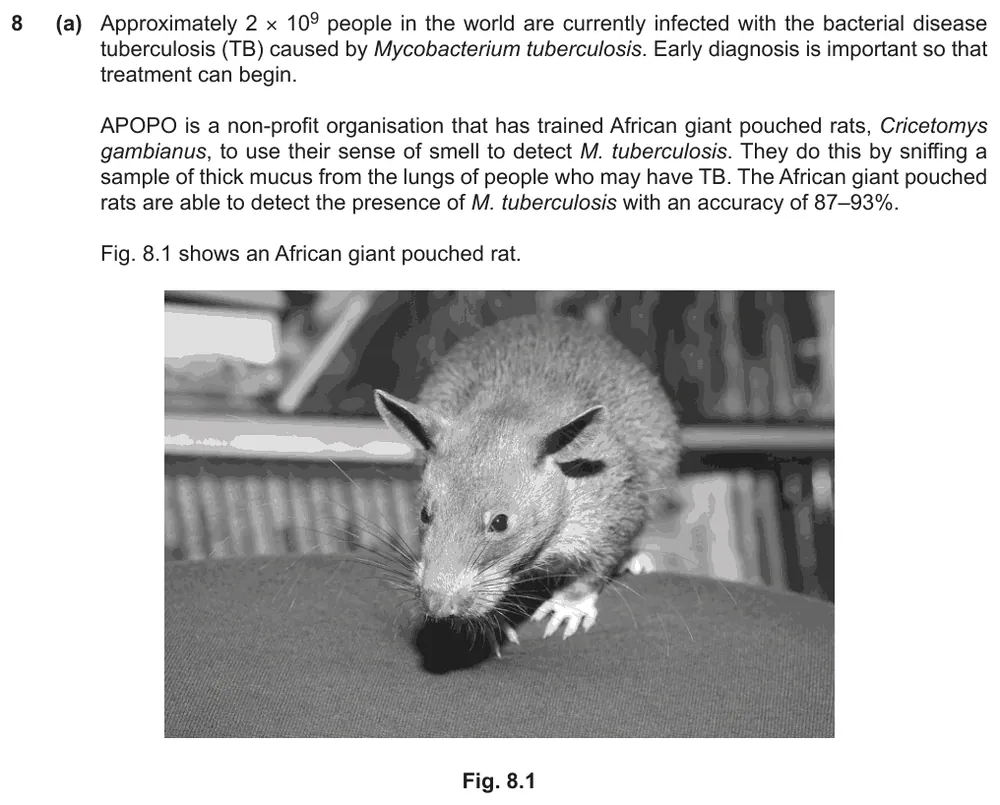
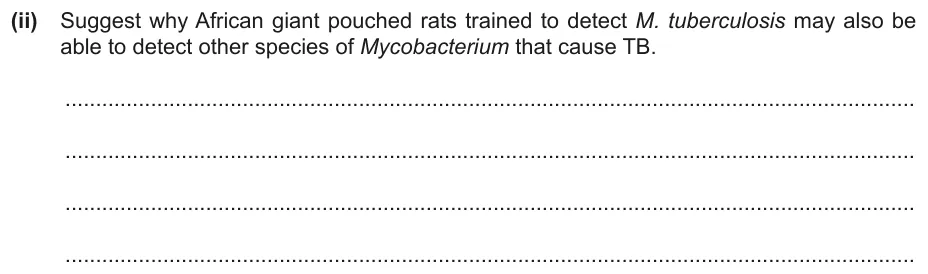
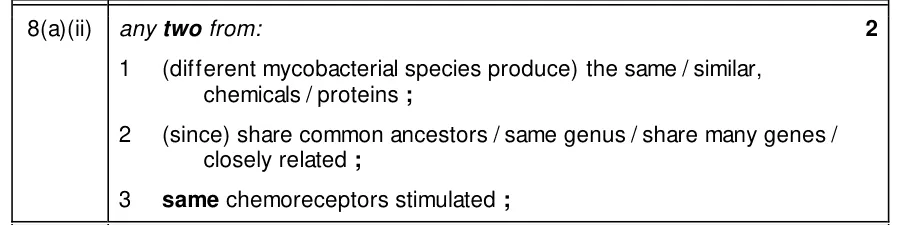
Suggest why rats trained to detect Mycobacterium tuberculosis may also detect other species of Mycobacterium.
Information from earlier in this question:
Show the mark scheme
Tap an image to open it full size.
Question 12
Paper 4 · February/March 2024 (42) · Q8(b) · 2 marks
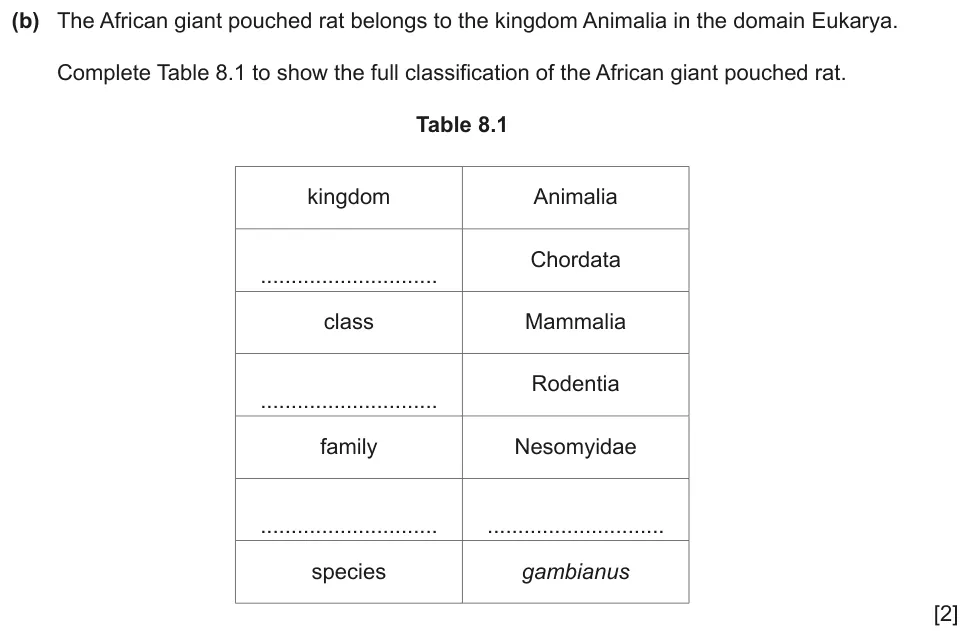
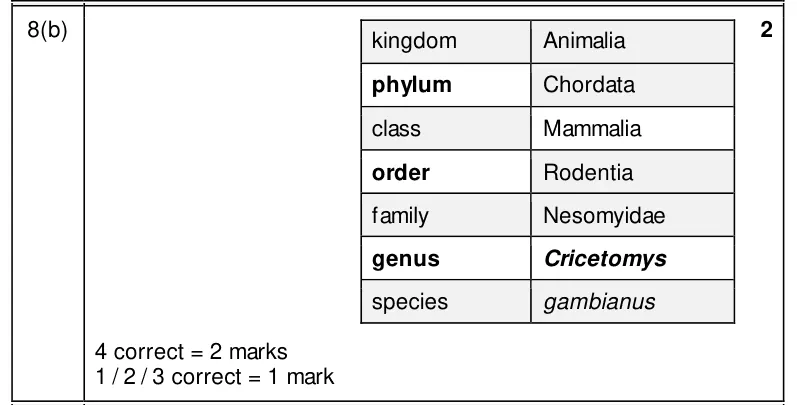
Complete the table to show the full classification of the African giant pouched rat.
Show the mark scheme
Tap an image to open it full size.
Question 13
Paper 4 · February/March 2020 (42) · Q6(a) · 2 marks · Easy
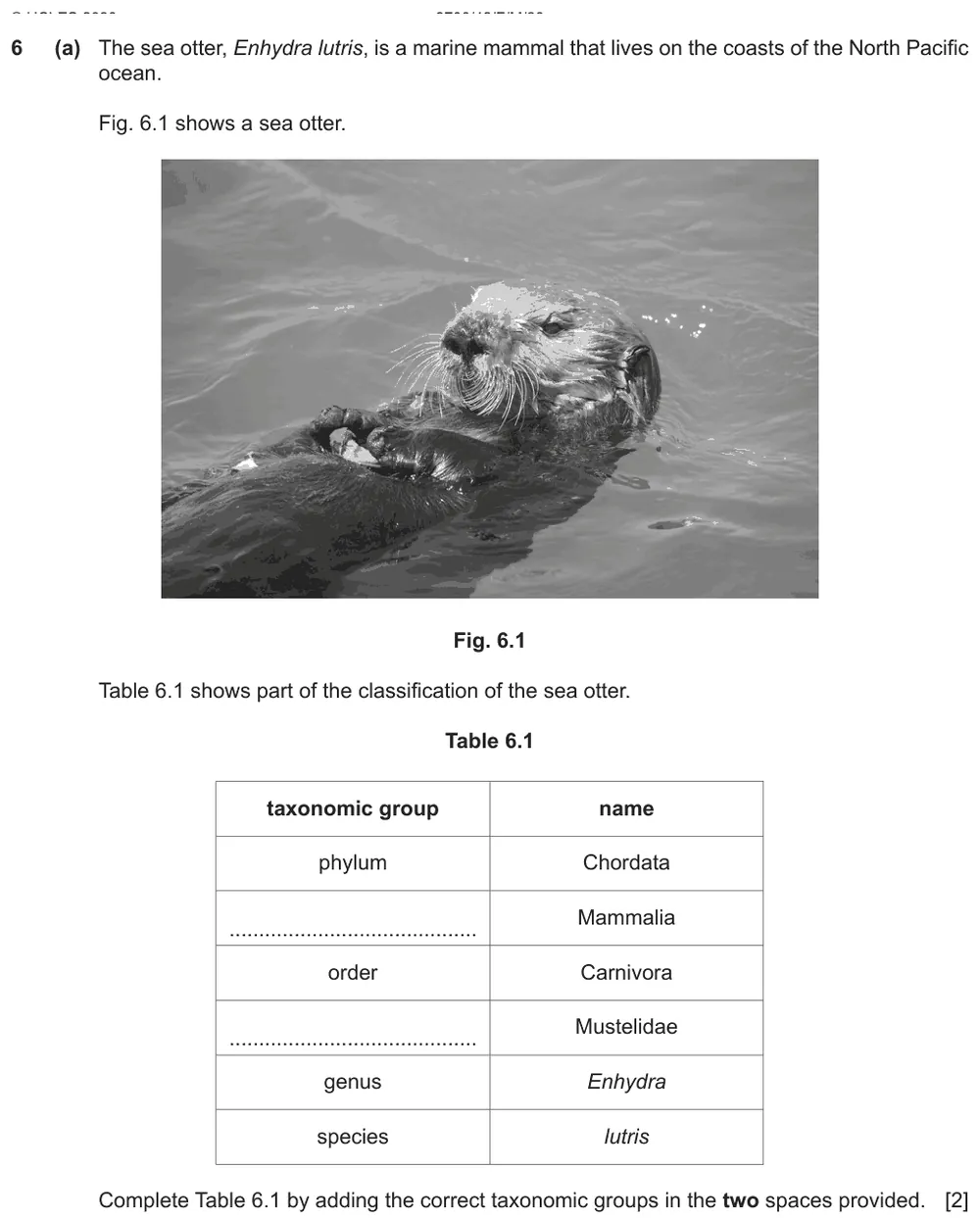
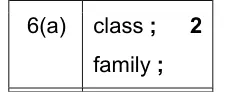
Add the two missing taxonomic groups to the classification of the sea otter.
Show the mark scheme
Tap an image to open it full size.
Question 14
Paper 4 · October/November 2018 (42) · Q1(c) · 2 marks · Hard
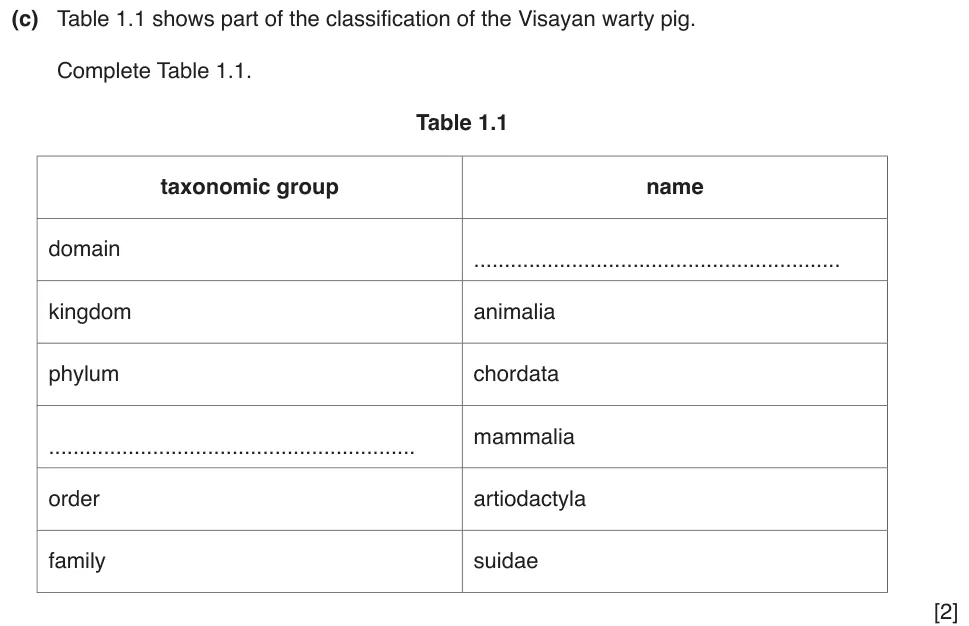
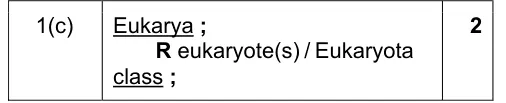
Complete the table showing part of the classification of the Visayan warty pig.
Show the mark scheme
Tap an image to open it full size.
From the examiners' report: Many found this difficult. Eukarya had to be spelt correctly, and the mark scheme rejects 'eukaryote' and 'Eukaryota'. The weakest answers got both the domain and the missing taxonomic group wrong, or left the table blank.
Question 15
Paper 4 · February/March 2021 (42) · Q2(a)(i) · 1 mark · Easy
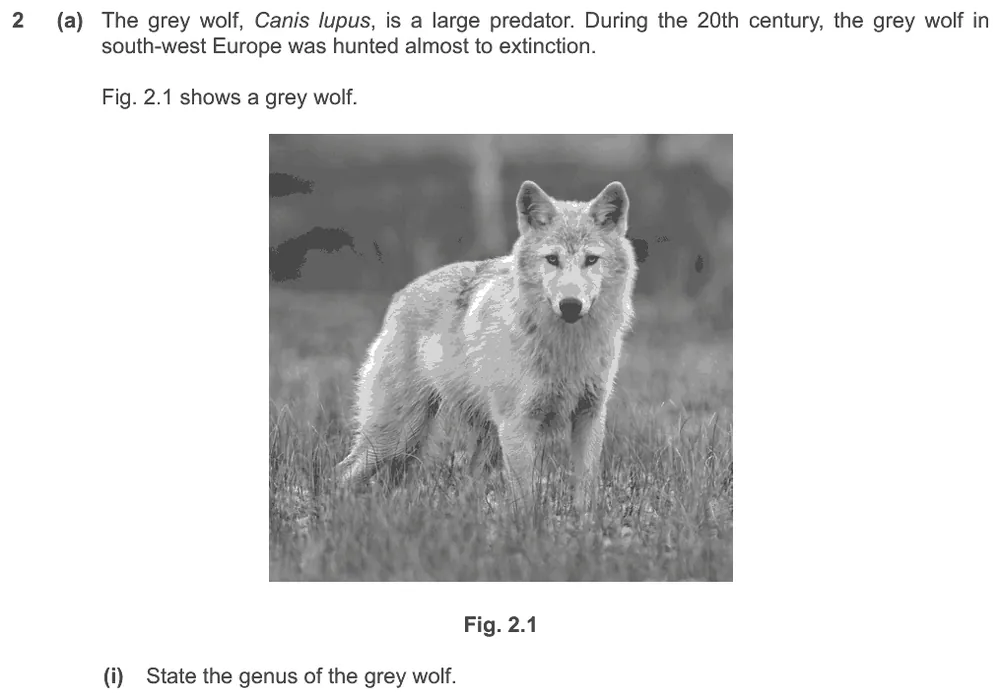
State the genus of the grey wolf, Canis lupus.
Show the mark scheme
Tap an image to open it full size.
From the examiners' report: Nearly always correct. The occasional wrong answers were lupus, Animalia and Eukarya.
Question 16
Paper 4 · October/November 2018 (42) · Q3(a)(ii) · 1 mark · Hard
Outline why the classification of sheep and goats suggests that hybridisation between them is unlikely.
Information from earlier in this question:


Show the mark scheme

Tap an image to open it full size.
From the examiners' report: Many only said that the chromosome numbers of the two animals are different, or that they differ in behaviour or physiology. The question is about classification: sheep and goats are different species and belong to different genera.
Question 17
Paper 4 · May/June 2021 (42) · Q3(a)(ii) · 3 marks · Hard
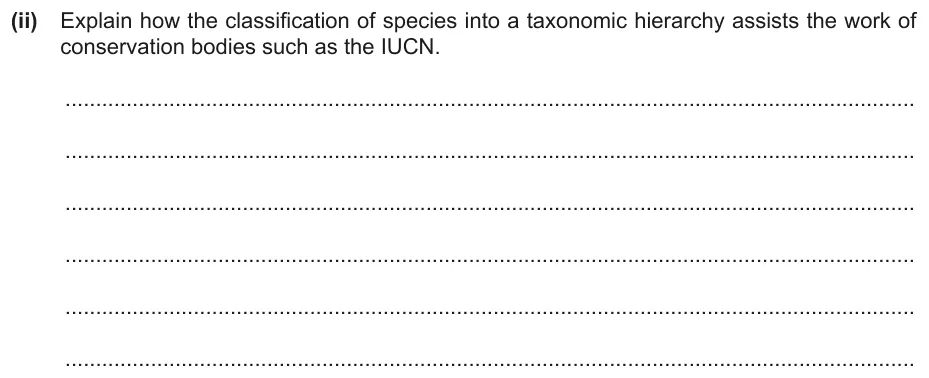
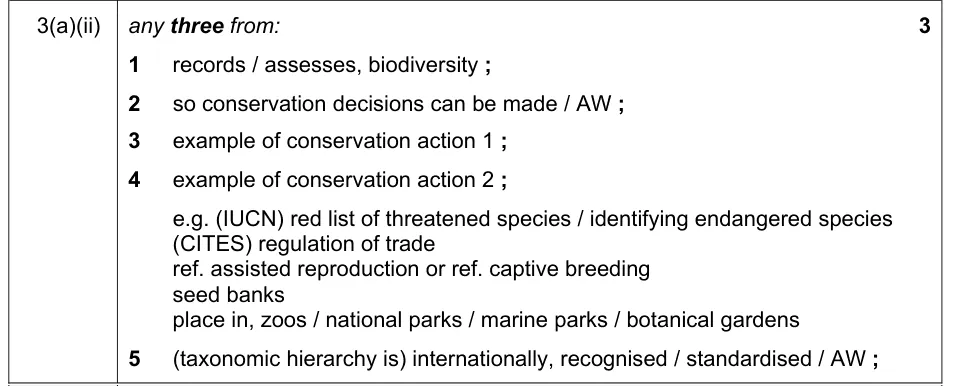
Explain how classifying species into a taxonomic hierarchy helps the work of conservation bodies such as the IUCN.
Show the mark scheme
Tap an image to open it full size.
From the examiners' report: Explanations were often vague, and some just described how organisms are classified. Few said that classification records biodiversity, and very few that the taxonomic hierarchy is internationally standardised. More recognised that endangered species can be identified and then protected, for example by captive breeding or in national parks.
Features of the kingdoms (18.1.5)
Question 18
Paper 4 · May/June 2022 (42) · Q10(d) · 4 marks
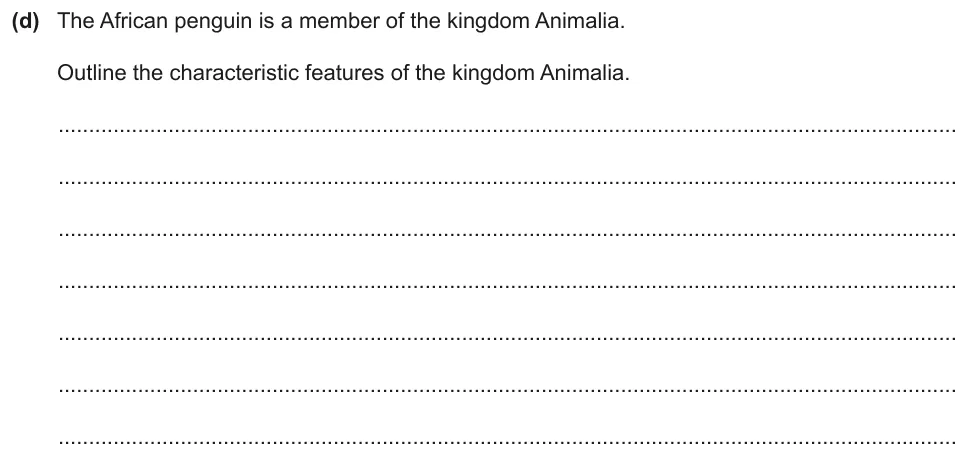
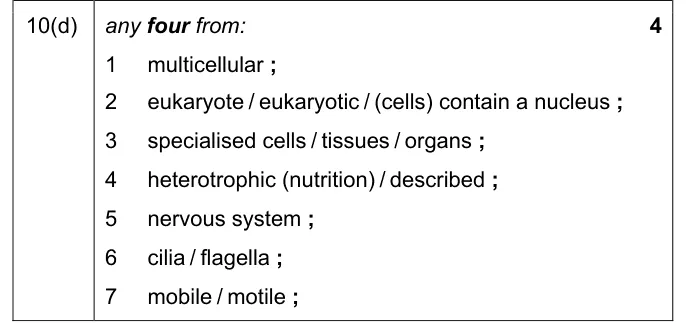
Outline the characteristic features of the kingdom Animalia.
Show the mark scheme
Tap an image to open it full size.
From the examiners' report: A significant number only described the features of eukaryotic cells in detail. Give features that animals have, not features they lack, such as the absence of a cell wall. The kingdom is not just mammals or vertebrates, so a vertebral column, lungs and hair are not features of all animals.
Question 19
Paper 4 · May/June 2023 (43) · Q10(a) · 4 marks
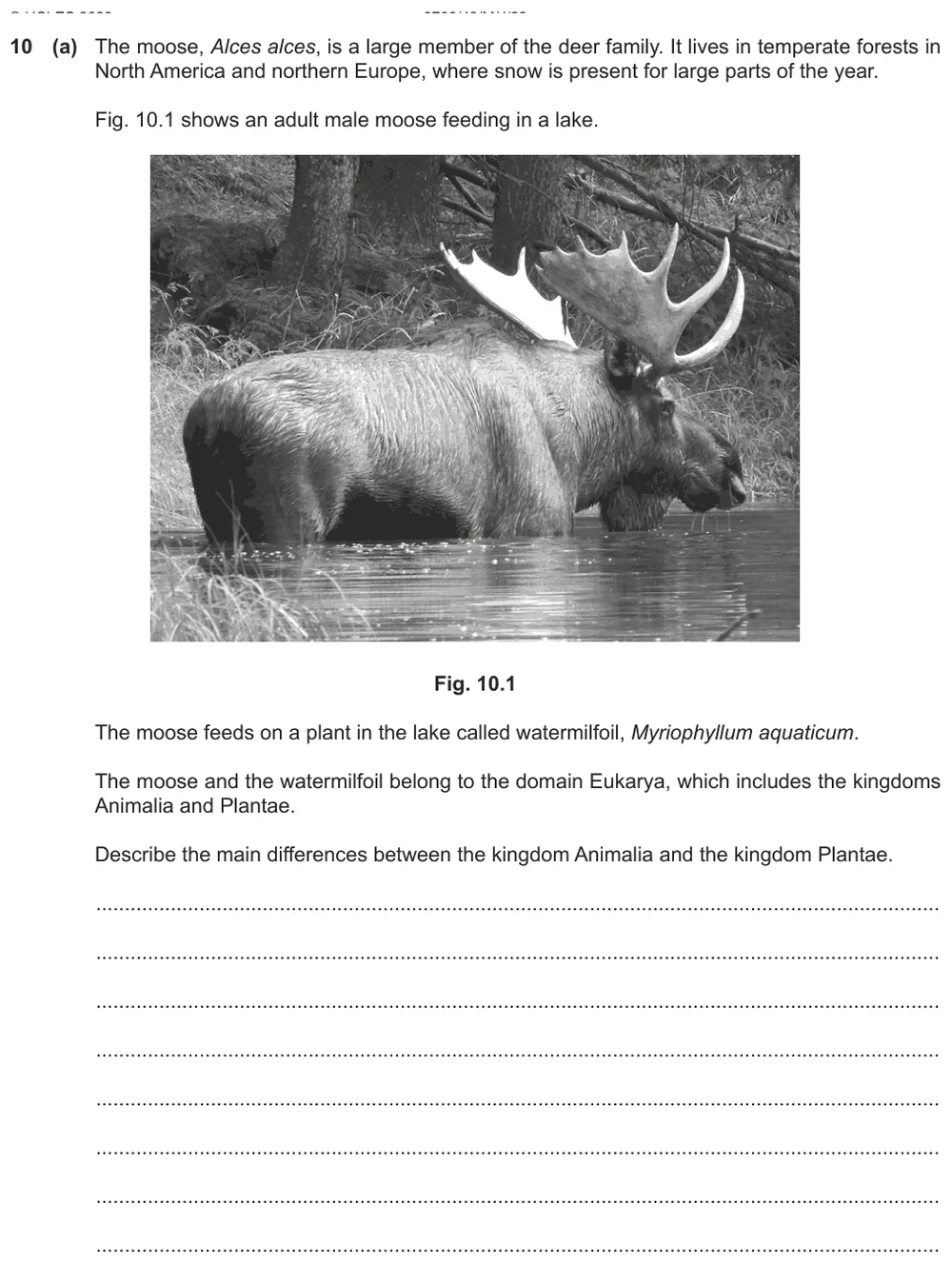
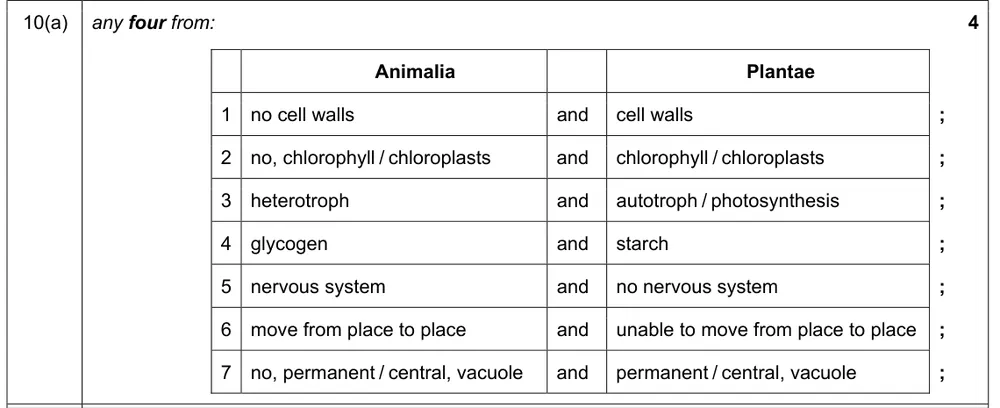
Describe the main differences between the kingdom Animalia and the kingdom Plantae.
Show the mark scheme
Tap an image to open it full size.
From the examiners' report: Many listed correct differences. Where marks were lost, it was usually because the answers were not paired: for each feature, say what animals have and what plants have.
Question 20
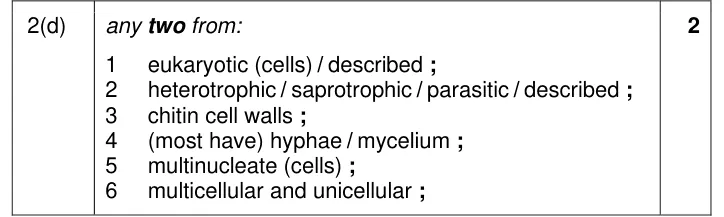
Paper 4 · October/November 2023 (42) · Q2(d) · 2 marks · Easy
State two features of the kingdom Fungi, other than reproduction using spores.

Show the mark scheme
Tap an image to open it full size.
From the examiners' report: Answered well, most often with heterotrophic nutrition and a cell wall made of chitin. Some thought fungi are prokaryotic. 'Decomposer' is too general for the feeding type, as it also covers detritivores and scavengers: write heterotrophic or saprotrophic.
Question 21
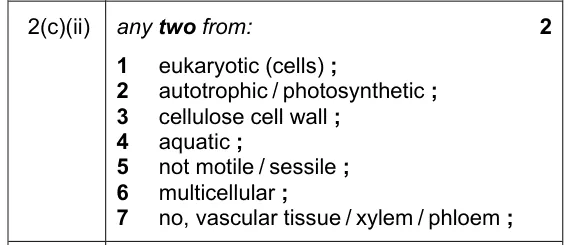
Paper 4 · May/June 2023 (41) · Q2(c)(ii) · 2 marks · Hard
Outline the features of the kingdom Protoctista that are shown by seaweeds.
Show the mark scheme
Tap an image to open it full size.
From the examiners' report: About half chose the features of the Protoctista that apply to seaweeds. A few confused Protoctista with prokaryotes. Many answers contradicted themselves, for example by saying that seaweeds are both autotrophic and heterotrophic.
Classification of viruses (18.1.6)
Question 22
Paper 4 · February/March 2024 (42) · Q8(d) · 2 marks
Describe, with reference to the structure of viruses, how viruses are classified.
Show the mark scheme
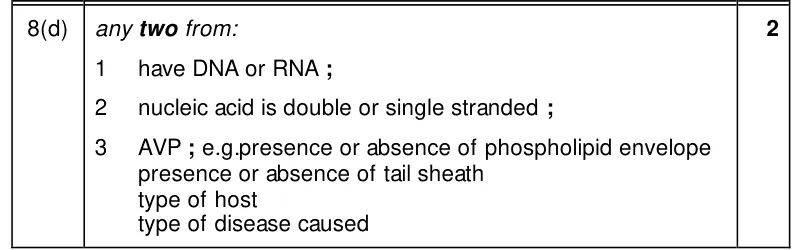
Tap an image to open it full size.
Where students lose marks (from Cambridge examiners' reports and mark schemes)
Each point below comes from the examiners' reports and mark schemes, and is followed by wording that gained marks.
Apply each species concept. Students recalled what the species concepts mean, or listed differences between the two bears, without deciding for each concept whether the bears are one species or two.
✔ Gains credit: biological species concept: 'same species' as they 'breed together to produce fertile offspring'; morphological: 'separate species' as they have 'different colours / mass'; ecological: 'separate species' as they have 'different niches / diets / habitats'.
Hybrids, not outbreeding. Students wrote about outbreeding, and few went beyond saying that the offspring would be sterile.
✔ Gains credit: 'hybrids formed', which 'may be sterile', are 'genetically different' from warty pigs and 'less adapted for natural environment'.
Kingdoms are not domains. Students asked for the two prokaryotic domains gave Eukarya, Prokaryote, Eukaryote, Protoctista, Animalia, Fungi or viruses.
✔ Gains credit: 'Bacteria and Archaea'.
Say what the difference is. Students named a feature that differs between Archaea and Bacteria, such as the cell wall, without saying how it differs.
✔ Gains credit: 'bacteria cell wall made of peptidoglycan whereas Archaea cell wall does not have peptidoglycan'; 'bacteria cell membrane has ester-linked lipids whereas Archaea cell membrane has ether-linked lipids'.
Spell Eukarya correctly. Students misspelt the name of the domain, or could not give the missing taxonomic group.
✔ Gains credit: 'Eukarya' for the domain (the mark scheme rejects 'eukaryote' and 'Eukaryota') and 'class' for the group Mammalia.
Classification means species and genus. Students said that sheep and goats have different chromosome numbers, behaviour or physiology when the question asked about their classification.
✔ Gains credit: they are a 'different species' and in a different 'genus'.
Features that animals have. Students described eukaryotic cells in detail, listed features that animals lack, or gave features of mammals and vertebrates only.
✔ Gains credit: 'multicellular', 'specialised cells / tissues / organs', 'heterotrophic', 'nervous system', 'mobile / motile'.
Decomposer is too general. Students called fungi prokaryotic, or gave 'decomposer' as the feeding type.
✔ Gains credit: 'eukaryotic', 'heterotrophic / saprotrophic / parasitic', 'chitin cell walls', 'hyphae / mycelium'.
Download the questions
Download the PDF pack (22 questions, mark schemes at the end)
Keep practising
- Biodiversity (18.2): Cambridge (CIE) exam questions by topic
- Conservation (18.3): Cambridge (CIE) exam questions by topic
- Cambridge (CIE) A level Biology 9700 past papers, mark schemes and examiners' reports
- Cambridge (CIE) A level Biology grade thresholds
- Book a one-to-one CIE lesson or a free 15-minute discovery chat with Tom
- Register your interest in a CIE A level Biology group class
Questions, mark schemes and examiners' report extracts © Cambridge University Press & Assessment.