

Species and taxonomy (AQA 3.4.5) is a short section, but it turns up on both Year 12 and A-level papers, often as quick one- and two-mark parts that are easy to drop. You need to define a species by fertile offspring, explain why courtship is needed before mating and how it lets animals recognise their own species, describe a phylogenetic classification as a hierarchy of groups based on evolutionary relationships, list the taxa from domain to species, use binomial names, and appreciate how genome sequencing and immunology clarify how organisms are related.
The examiners' reports point to the same slips each year. Students leave 'fertile' out of the species definition, describe groups within groups without saying there's no overlap, spot a family on a diagram but don't write the word, say courtship songs are 'different' without giving the difference, and write about 'comparing DNA' or 'new technology' instead of base sequences.
Start with species and courtship, then the hierarchy and the taxa, then binomial names, and finish with how molecular evidence clarifies relationships. Answer each question on paper before you open the mark scheme. If you'd like help with this topic, my AQA masterclasses run online on Tuesdays at 5.15pm for Year 12 and on Wednesdays or Thursdays at 6.30pm for Year 13.
What you need from GCSE and Year 12
Each question on this page assumes you're secure on these GCSE and Year 12 ideas. If any of them feels shaky, revise it before you start.
- GCSE: a species is a group of organisms that can breed together to produce fertile offspring.
- GCSE: Linnaeus classified living things into kingdom, phylum, class, order, family, genus and species, and named each species with a binomial: genus then species.
- GCSE: evolutionary trees show how closely related organisms are, and new evidence from chemical analysis changed how organisms are classified.
- Year 12 (AQA 3.4.4): natural selection results in species that are better adapted to their environment, and adaptations may be behavioural.
- Year 12 (AQA 3.4.1): a gene is a base sequence of DNA that codes for the amino acid sequence of a polypeptide or for a functional RNA, such as ribosomal RNA.
Key terms
These words come up in the questions and mark schemes. Examiners expect you to use them exactly.
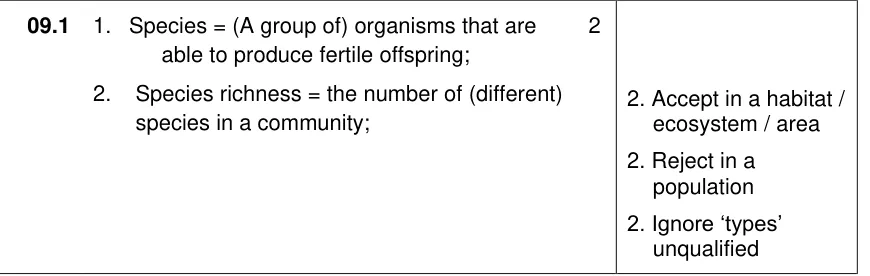
- Species: a group of organisms that are able to produce fertile offspring.
- Courtship behaviour: behaviour that is a necessary precursor to successful mating; it lets individuals recognise members of their own species and stimulates mating.
- Phylogenetic classification: arranging species into groups based on their evolutionary origins and relationships.
- Hierarchy: smaller groups placed within larger groups, with no overlap between groups.
- Taxon: each group in a classification hierarchy (plural taxa).
- The taxa, in order: domain, kingdom, phylum, class, order, family, genus and species.
- Genus: the taxon above species; its name is the first word of a binomial, and species in the same genus are closely related.
- Binomial: the universal two-part name of a species: the genus name followed by the species name, eg Homo sapiens.
- Common ancestor: the ancestral species from which two or more species evolved; more closely related species share a more recent common ancestor.
- Genome sequencing: finding the base sequence of DNA; the more similar the base sequences, the more closely related the species.
What these questions cover (AQA 3.4.5)
The questions test these statements from the AQA AS and A-level Biology specification (7401/7402):
- Species and courtship: Two organisms belong to the same species if they are able to produce fertile offspring. Courtship behaviour as a necessary precursor to successful mating. The role of courtship in species recognition.
- Phylogenetic classification: A phylogenetic classification system attempts to arrange species into groups based on their evolutionary origins and relationships. It uses a hierarchy in which smaller groups are placed within larger groups, with no overlap between groups. Each group is called a taxon (plural taxa).
- The taxa: One hierarchy comprises the taxa: domain, kingdom, phylum, class, order, family, genus and species.
- Binomial names: Each species is universally identified by a binomial consisting of the name of its genus and species, eg, Homo sapiens.
- Immunology and genome sequencing: Students should be able to appreciate that advances in immunology and genome sequencing help to clarify evolutionary relationships between organisms. (both questions here are about sequencing; none of the written questions available asks about immunological comparisons)
How to use this page
Write your answer on paper before you open the mark scheme. Allow about 1.3 minutes per mark: the 18 questions are worth 27 marks, so about 35 minutes in total. Then mark your answer strictly against the mark scheme and read the examiners' tip underneath it. If you'd rather print the questions, download the PDF pack.
Species and courtship (3.4.5)
Question 1
AS Paper 1 · June 2017 · Q09.1 · 2 marks
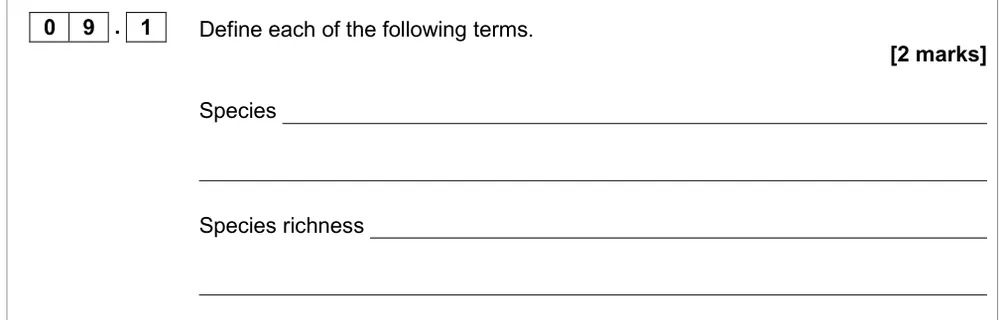
Define the terms species and species richness.
Show the mark scheme
Tap an image to open it full size.
From the examiners' report: Most defined a species, but 'can make offspring' isn't enough: it must be fertile offspring. Species richness is the number of species in a community, not a population.
Question 2
A level Paper 1 · June 2019 · Q07.3 · 2 marks
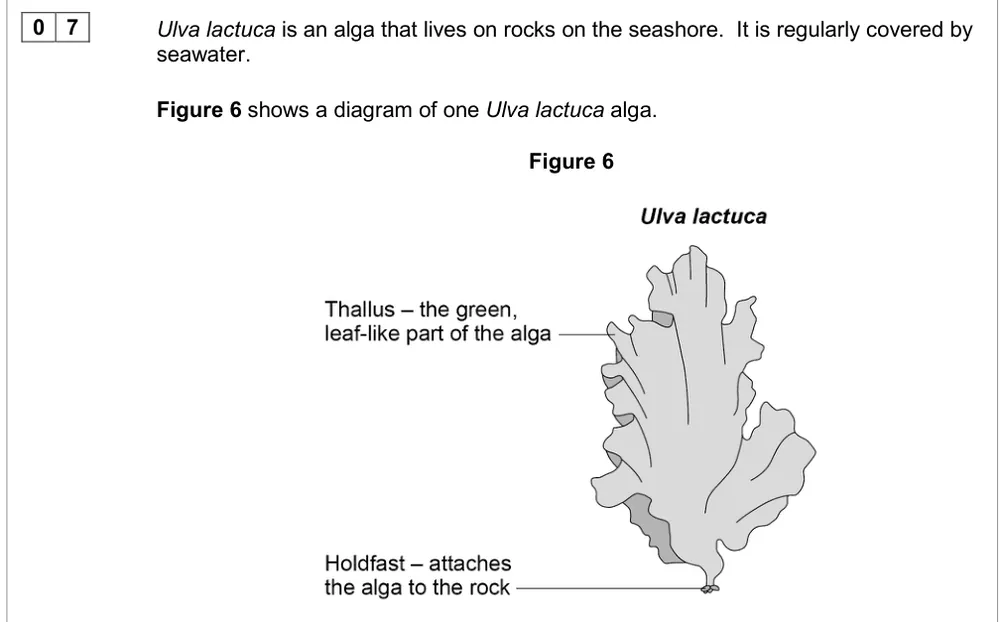
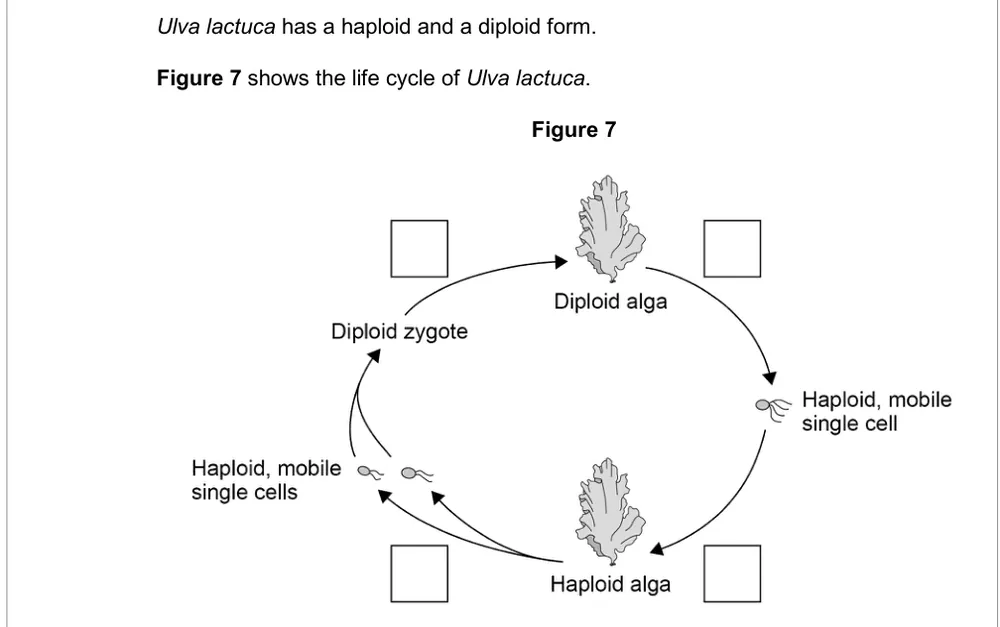
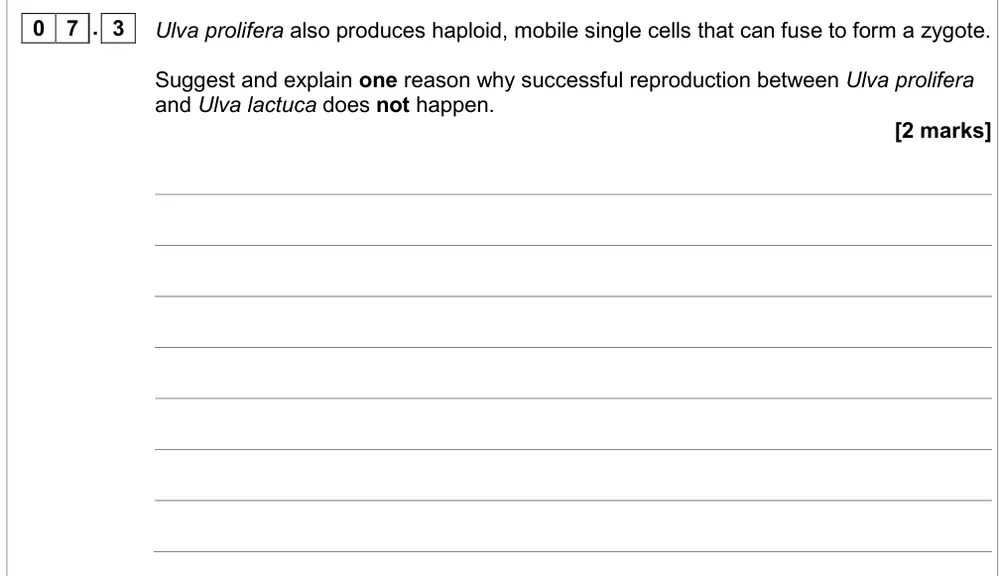
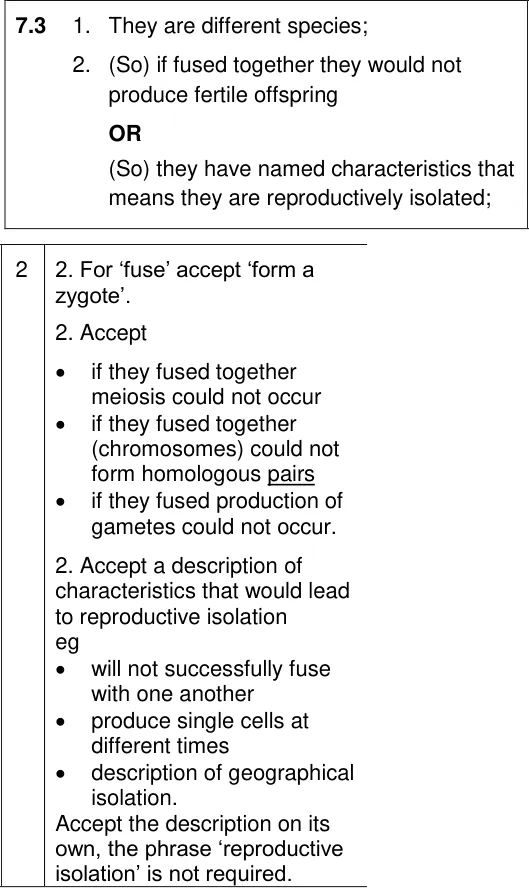
Suggest and explain why successful reproduction between two species of Ulva doesn't happen.
Information from earlier in this question:
Show the mark scheme
Tap an image to open it full size.
From the examiners' report: No examiners' report for this part. Say they are different species, then explain: even if the cells fused they wouldn't produce fertile offspring. A reason for reproductive isolation also scores.
Question 3
AS Paper 2 · June 2022 · Q08.1 · 1 mark · Medium
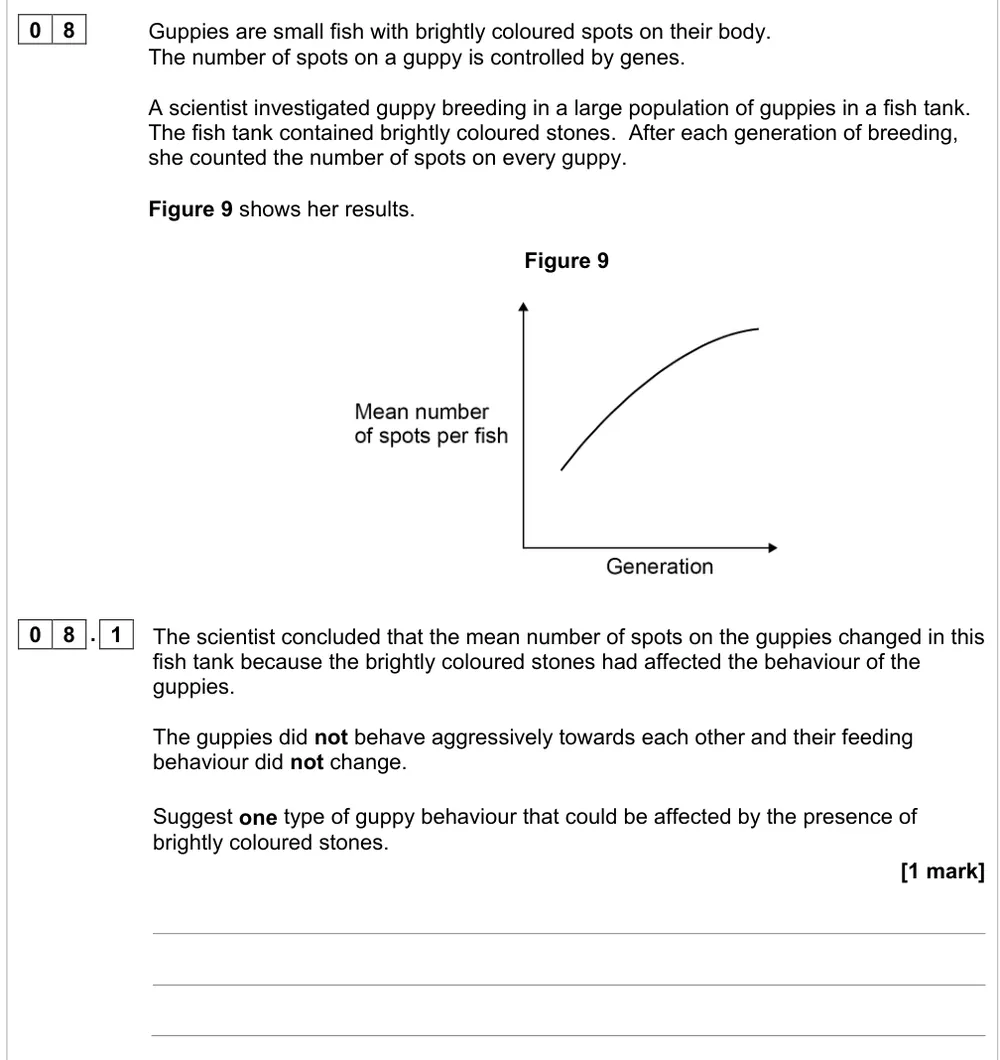
Suggest which type of guppy behaviour could be affected by brightly coloured stones in the tank.
Show the mark scheme

Tap an image to open it full size.
From the examiners' report: 50% said mating or courtship. Swimming, being happier or playful, or less aggressive didn't score; the stem has already ruled out aggression and feeding.
Question 4
A level Paper 2 · June 2017 · Q02.3 · 1 mark · Hard
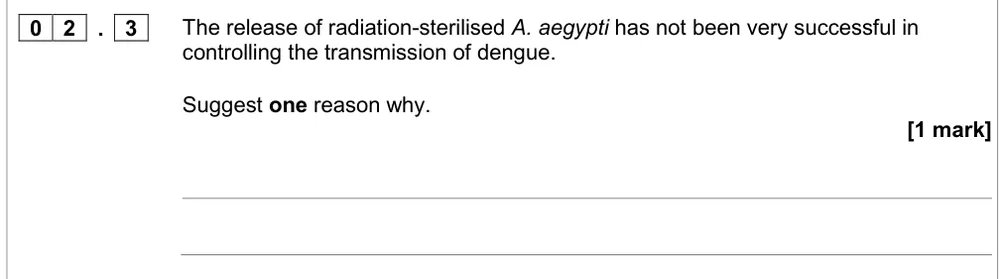
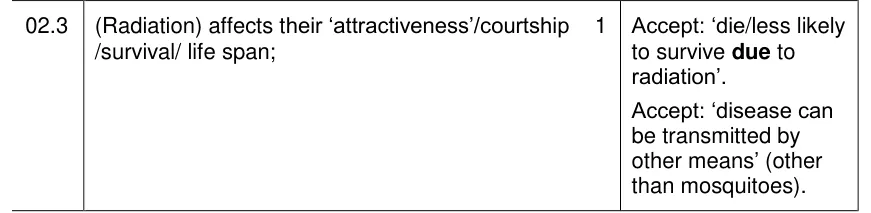
Suggest why releasing radiation-sterilised male mosquitoes hasn't controlled dengue well.
Information from earlier in this question:

Show the mark scheme
Tap an image to open it full size.
From the examiners' report: Very few scored. Credited answers said the radiation shortened the males' lives or made them less attractive to females. 'Sterile mosquitoes still carry the virus' didn't score.
Question 5
AS Paper 1 · June 2018 · Q06.3 · 2 marks · Easy
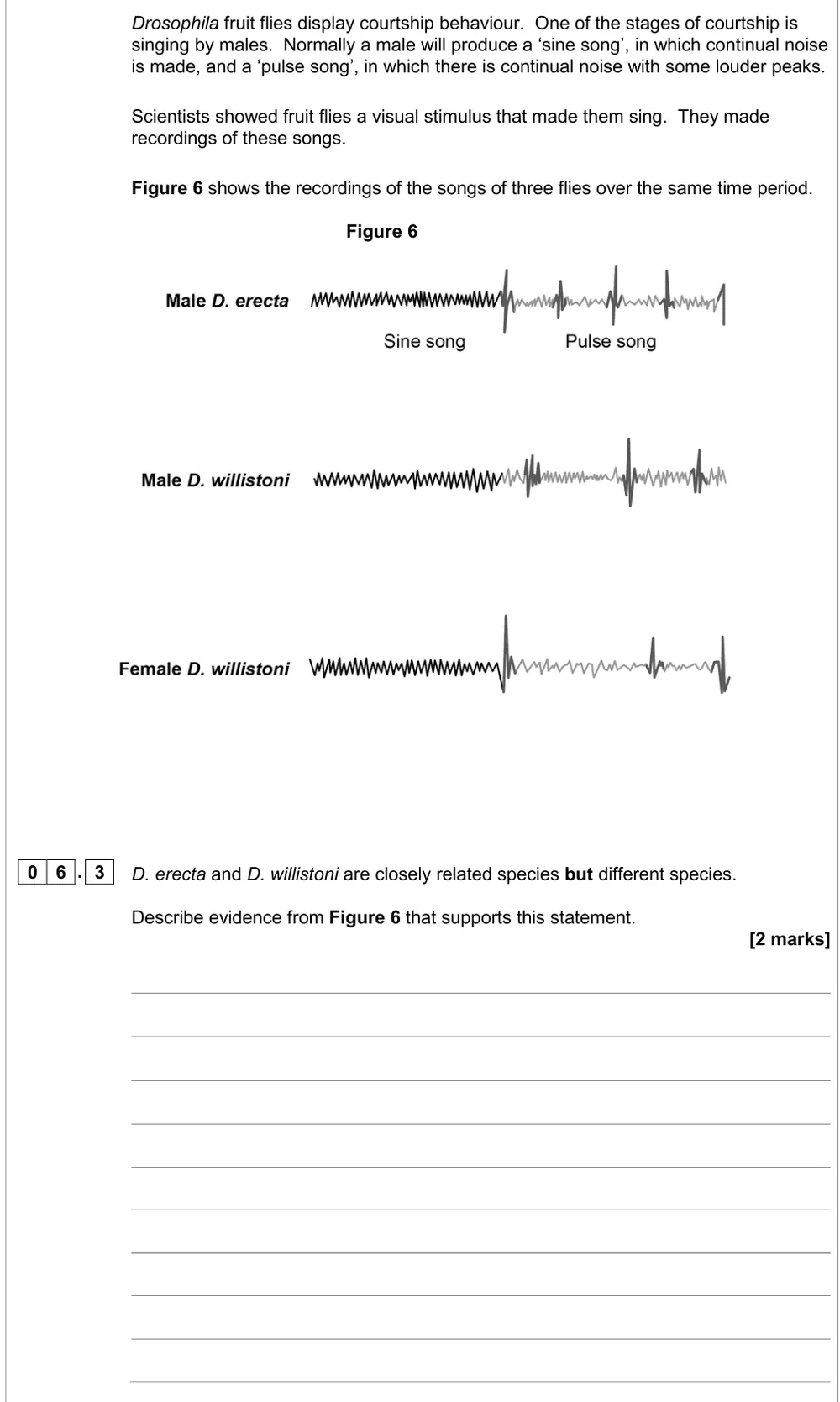
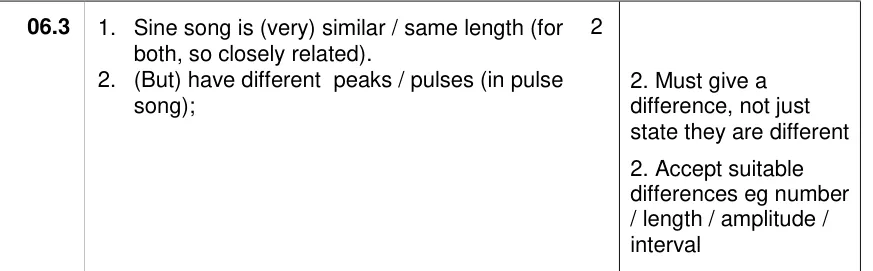
Describe evidence from courtship song recordings that two fruit flies are closely related but different species.
Show the mark scheme
Tap an image to open it full size.
From the examiners' report: 85.8% scored at least 1. Use Figure 6: the sine songs are similar, then give an actual difference in the pulse song, such as the number of peaks, not just 'they're different'.
Question 6
AS Paper 1 · June 2018 · Q06.4 · 2 marks · Hard
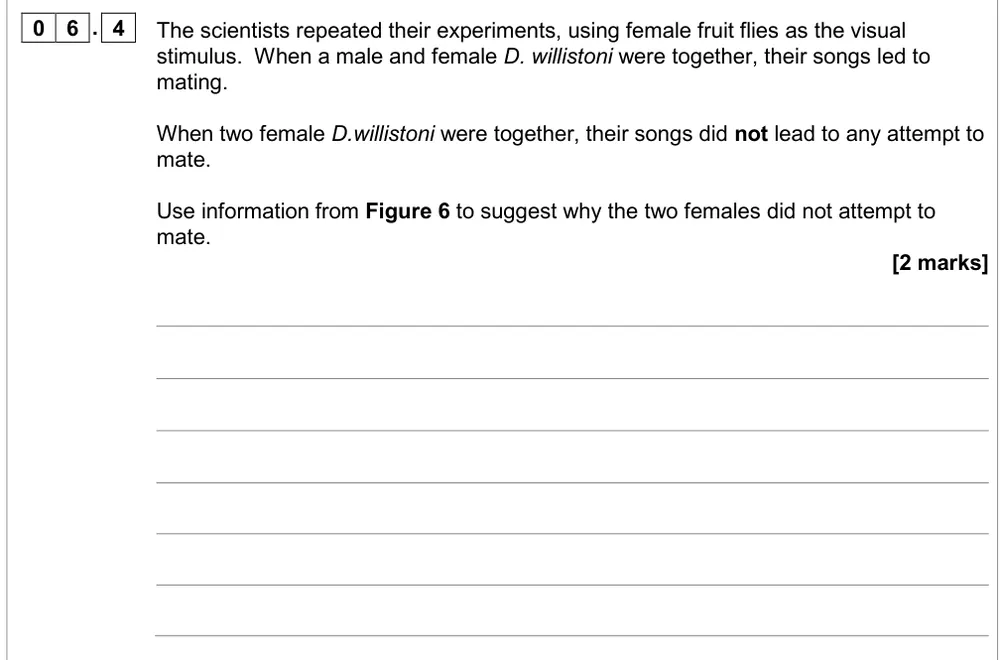
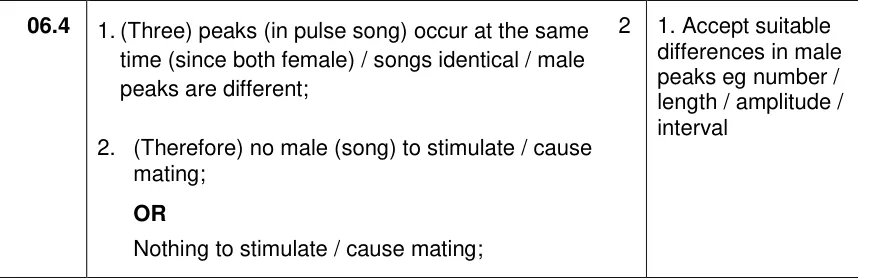
Use the song recordings to suggest why two female fruit flies didn't attempt to mate.
Show the mark scheme
Tap an image to open it full size.
From the examiners' report: Only 3.4% got both. Use Figure 6 to show the two female songs match, then say there's no male song to stimulate mating. 'The female knew it was another female' doesn't score.
Phylogenetic classification and taxa (3.4.5)
Question 7
AS Paper 2 · June 2022 · Q05.1 · 2 marks · Hard
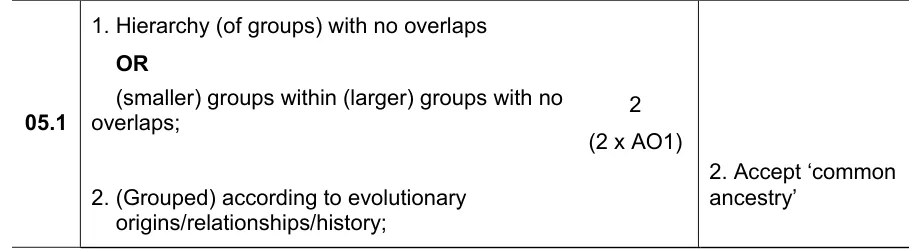
Describe how organisms are grouped in a phylogenetic classification system.
Show the mark scheme
Tap an image to open it full size.
From the examiners' report: Just over 40% got 1 mark and only 5% got 2. Groups within groups isn't enough: say there's no overlap, and that grouping is by evolutionary relationships.
Question 8
AS Paper 1 · June 2018 · Q06.1 · 2 marks · Hard
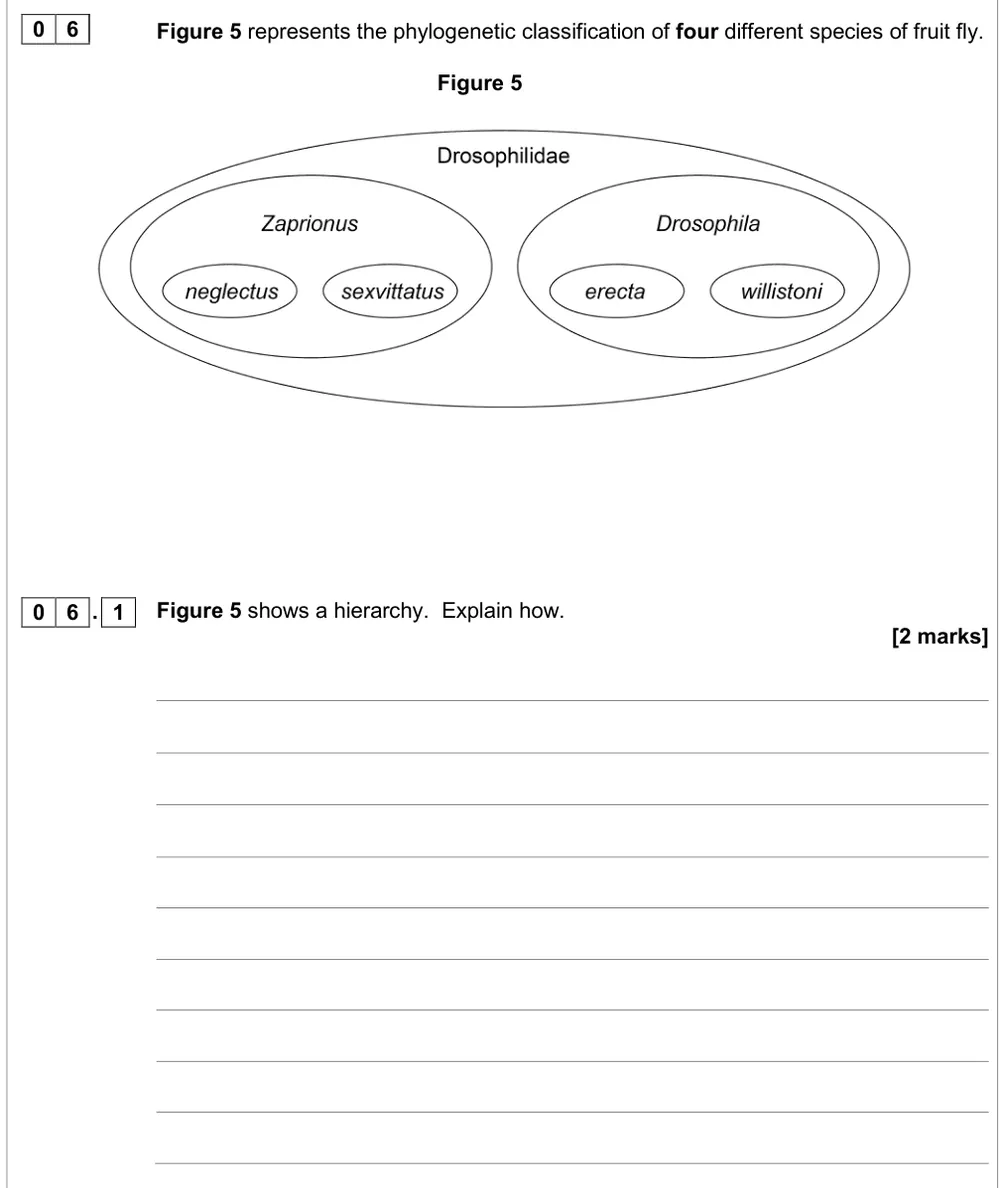
Explain how a diagram of the classification of four fruit fly species shows a hierarchy.
Show the mark scheme

Tap an image to open it full size.
From the examiners' report: Just under 60% scored zero: students had either learned what a hierarchy is or they hadn't. Say smaller groups sit inside larger groups, with no overlap.
Question 9
AS Paper 1 · June 2018 · Q06.2 · 1 mark
Name the taxon to which Drosophilidae belongs.

Show the mark scheme

Tap an image to open it full size.
From the examiners' report: About half got it. Many spotted the levels on the diagram but didn't turn them into a taxon name: the answer is family.
Question 10
AS Paper 2 · June 2022 · Q05.2 · 1 mark · Easy
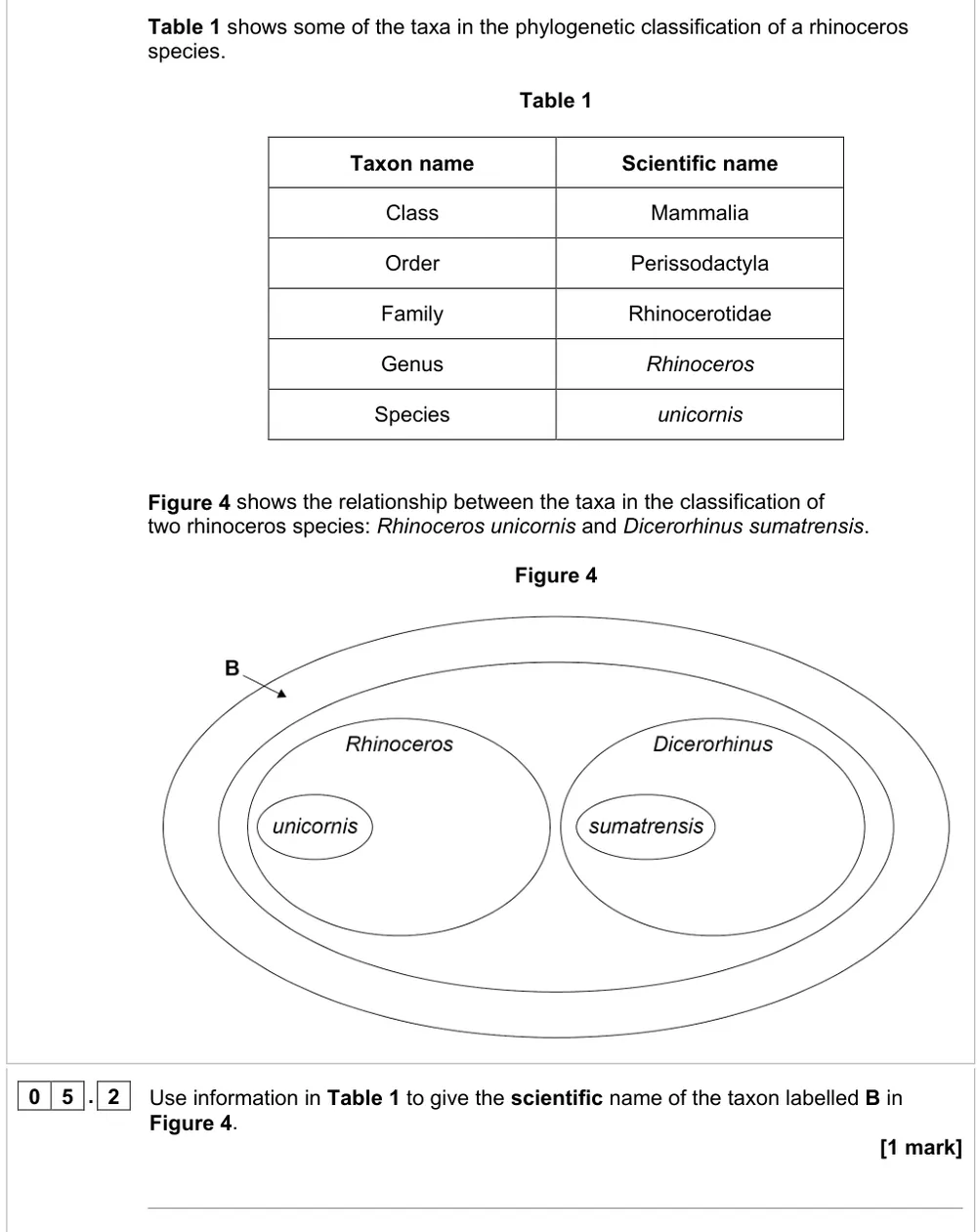
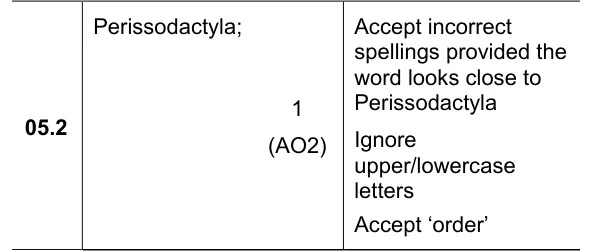
Use a table of taxa to give the scientific name of a taxon labelled on a diagram of two rhinoceros species.
Show the mark scheme
Tap an image to open it full size.
From the examiners' report: 72% got it. Count outwards from the genus ovals: the next oval is the family, so B is the order, Perissodactyla.
Question 11
AS Paper 2 · June 2023 · Q09.4 · 2 marks · Easy
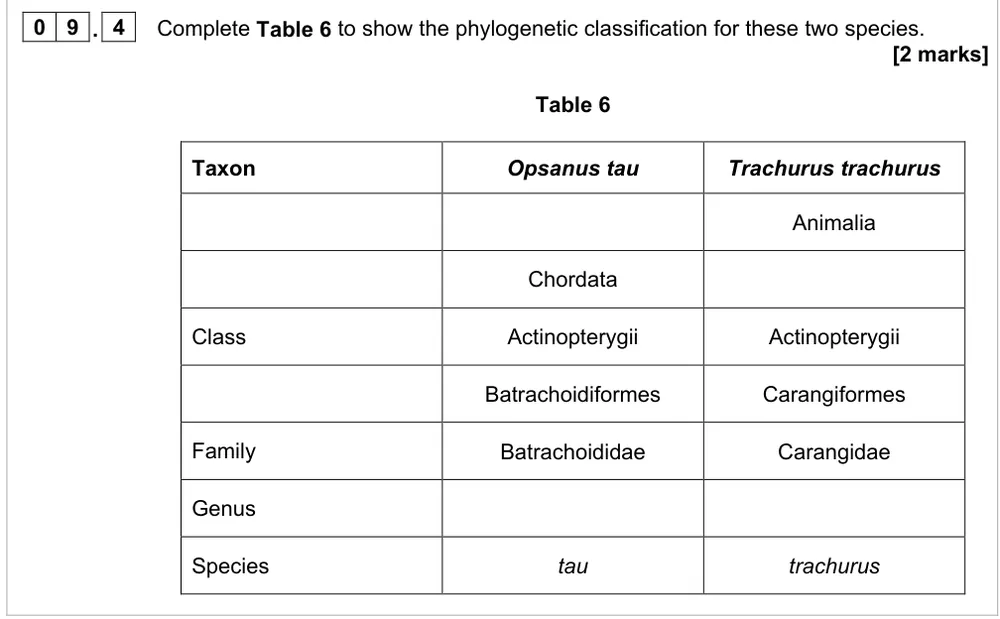
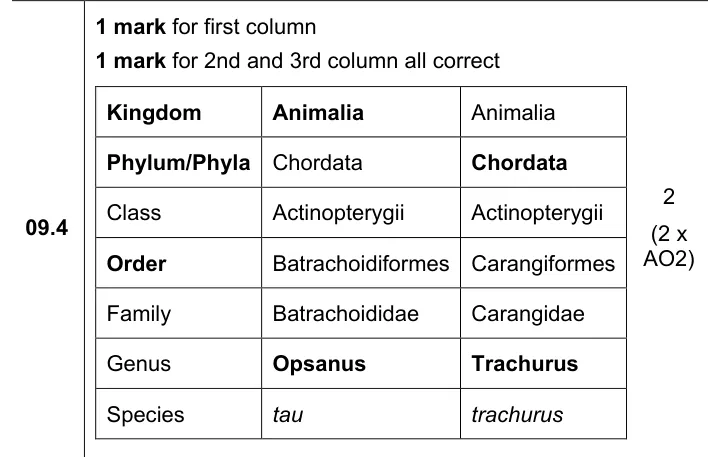
Complete a table of the phylogenetic classification of two fish species.
Show the mark scheme
Tap an image to open it full size.
From the examiners' report: About 50% got full marks. Learn the order of the taxa, and take the genus from the first word of each binomial: Opsanus and Trachurus.
Binomial names (3.4.5)
Question 12
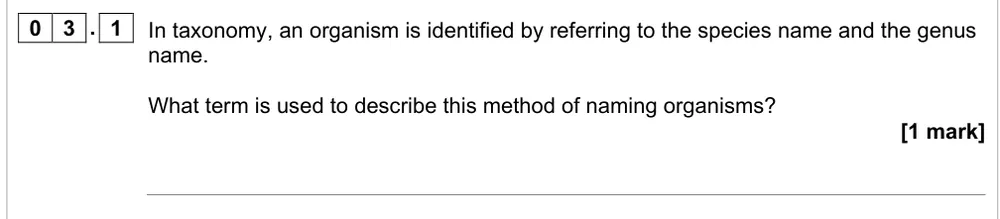
AS Paper 2 · November 2021 · Q03.1 · 1 mark
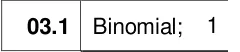
Name the system of identifying an organism by its genus and species names.
Show the mark scheme
Tap an image to open it full size.
From the examiners' report: No examiners' report for this part. The answer is binomial: the genus name followed by the species name, as in Homo sapiens.
Question 13
AS Paper 2 · November 2020 · Q01.3 · 1 mark
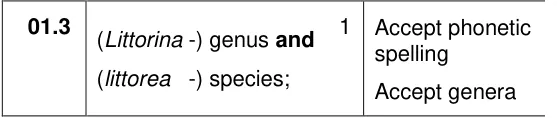
Name the taxa represented by Littorina and littorea.

Show the mark scheme
Tap an image to open it full size.
From the examiners' report: Most got this. In a binomial the first word is the genus and the second is the species; you need both for the mark.
Question 14
A level Paper 1 · June 2017 · Q08.3 · 1 mark
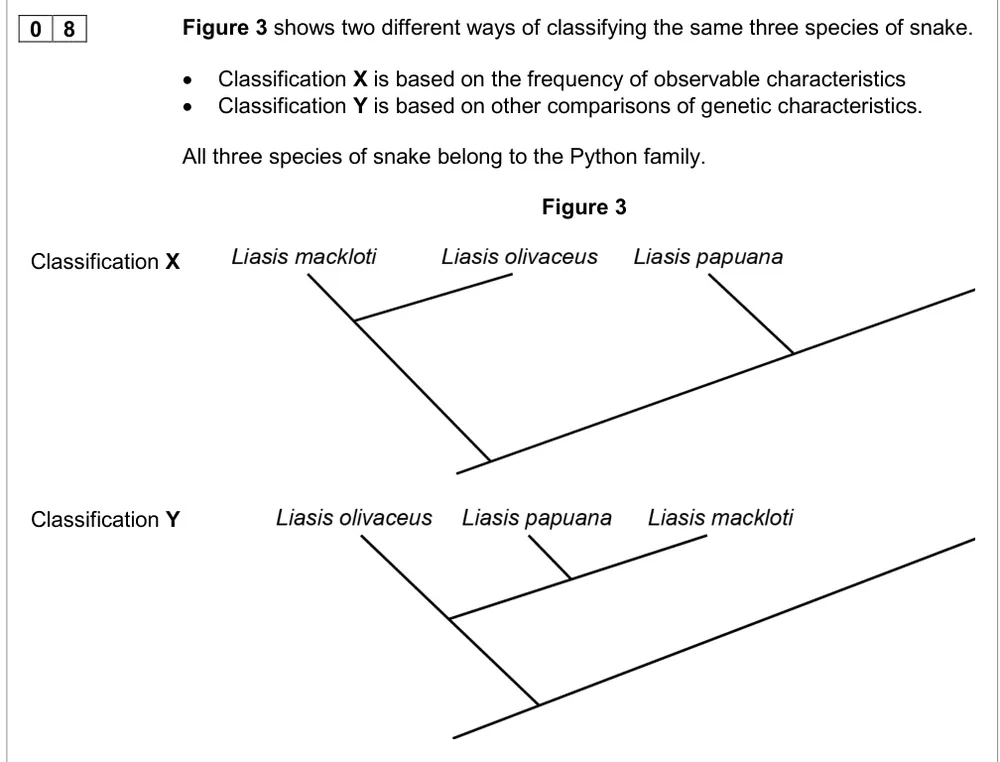
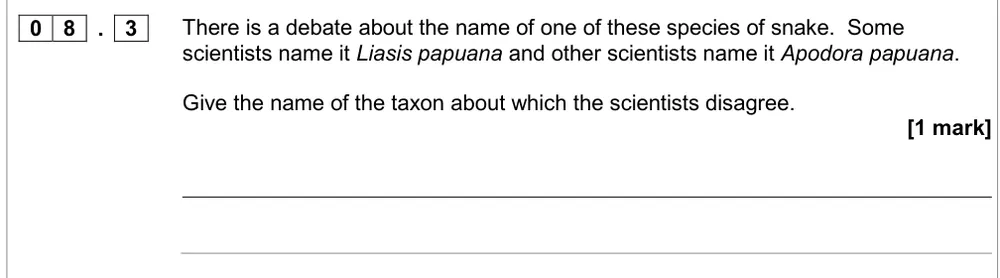
Name the taxon scientists disagree about when one snake is called Liasis papuana or Apodora papuana.
Information from earlier in this question:
Show the mark scheme

Tap an image to open it full size.
From the examiners' report: No examiners' report for this part. Only the first word of the binomial changes, so the disagreement is about the genus. Give one answer only: two answers score zero.
Question 15
A level Paper 1 · June 2018 · Q03.5 · 2 marks · Easy
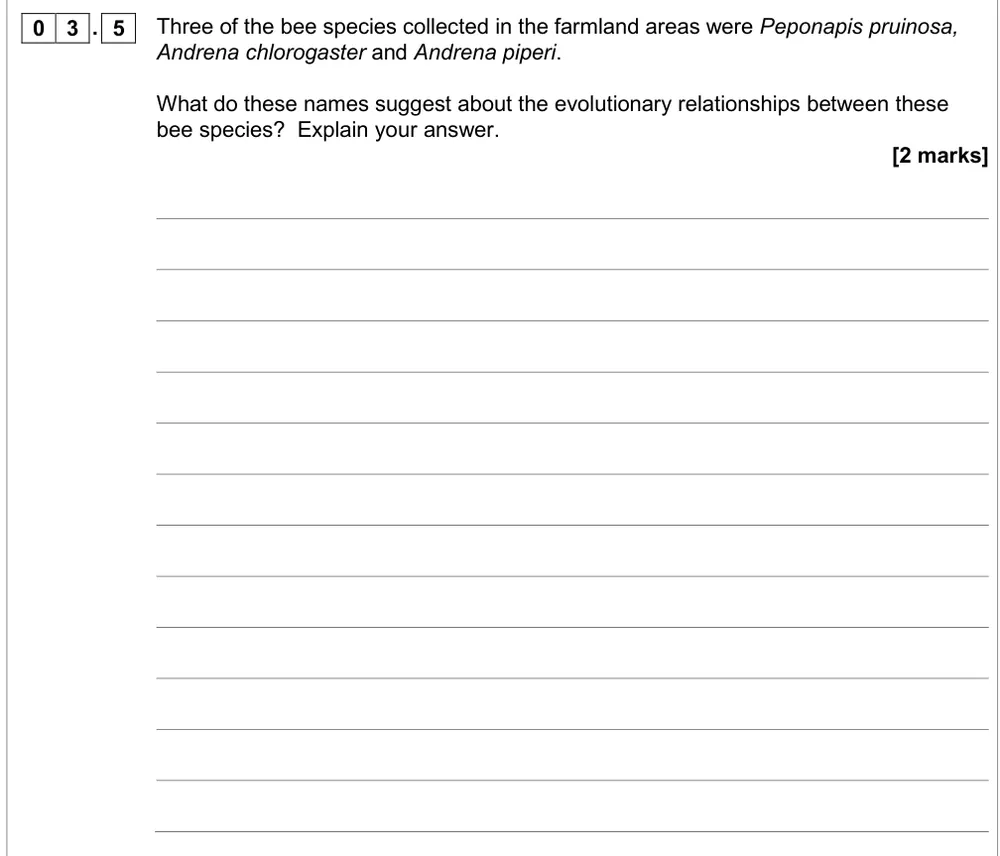
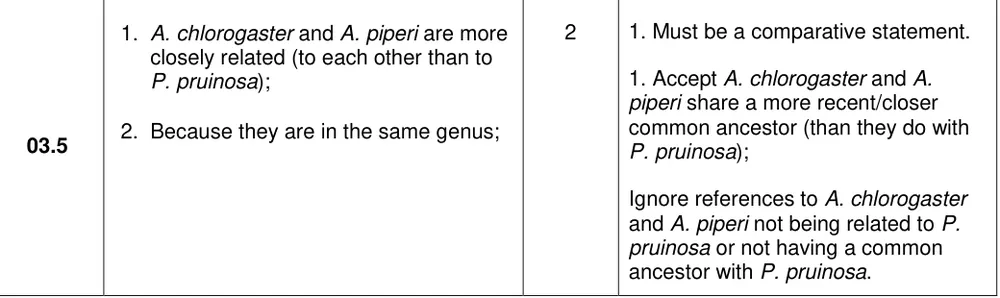
Explain what the names of three bee species suggest about their evolutionary relationships.
Show the mark scheme
Tap an image to open it full size.
From the examiners' report: 62.1% scored. Make it comparative: the two Andrena species are more closely related because they share a genus. Don't say they're unrelated to P. pruinosa.
Question 16
A level Paper 3 · June 2025 · Q03.1 · 1 mark · Medium
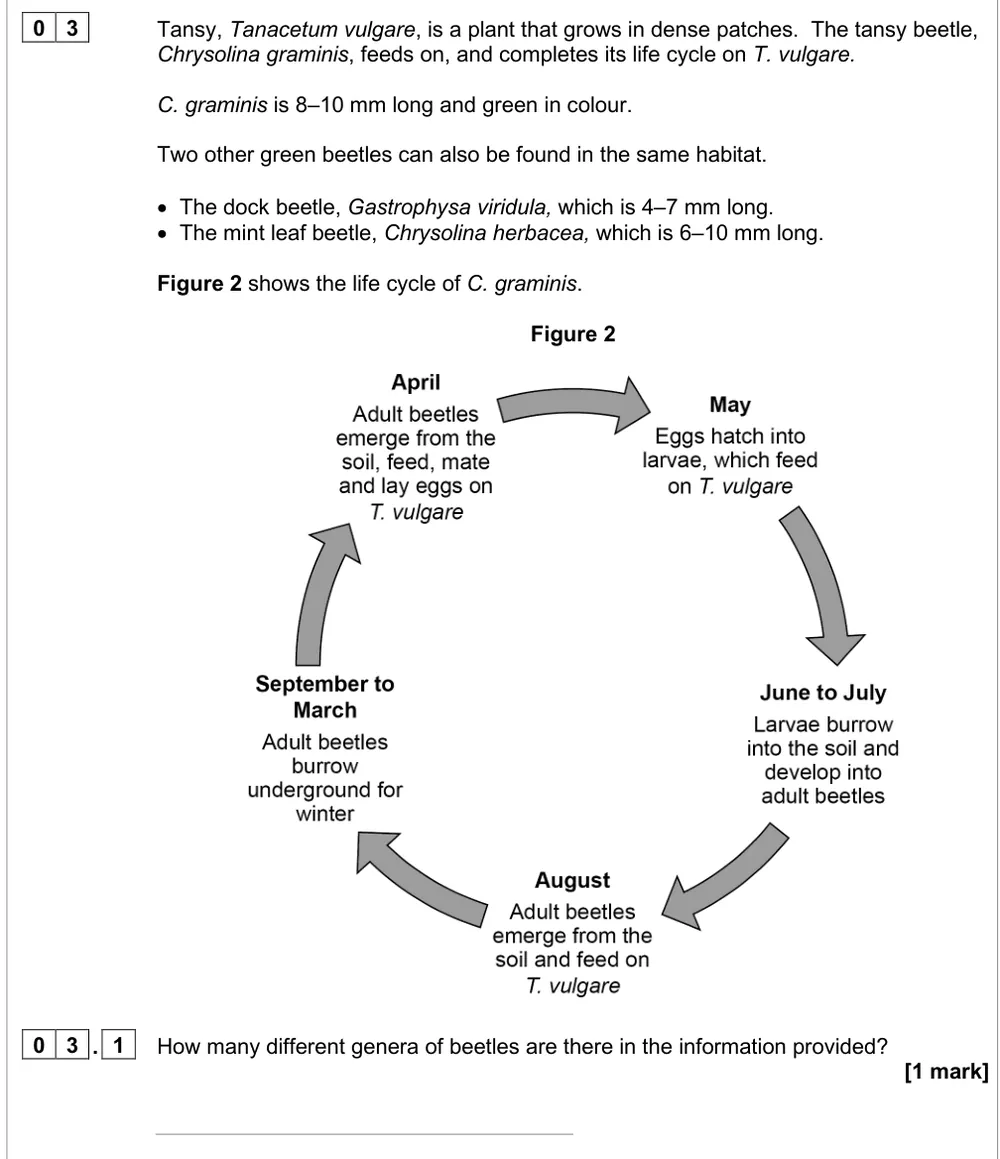
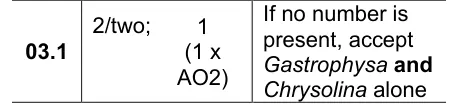
Count the different genera of beetles named in a passage about tansy beetles.
Show the mark scheme
Tap an image to open it full size.
From the examiners' report: Just over half got it. Look at the first word of each beetle's binomial: the answer is 2. 3 is the number of beetle species, and 4 the number of all species.
Clarifying evolutionary relationships (3.4.5)
Question 17
AS Paper 2 · June 2024 · Q05.1 · 2 marks
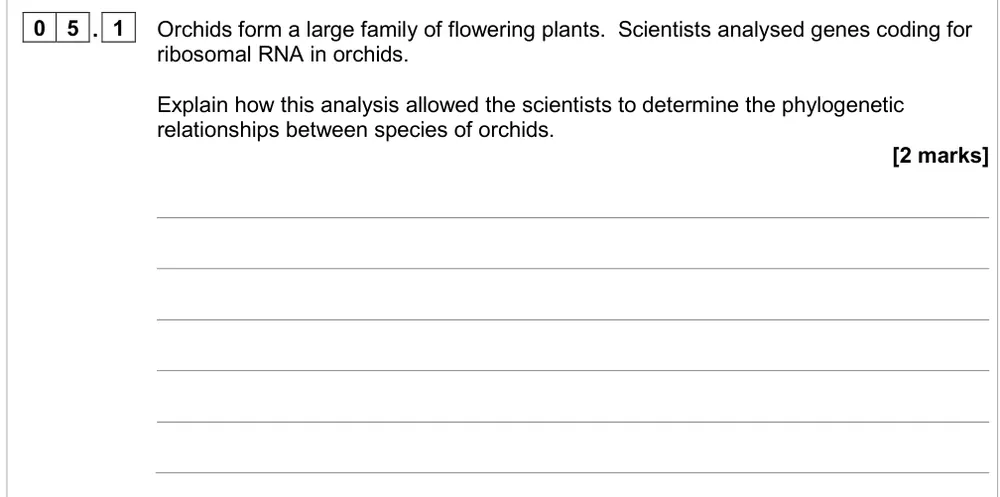
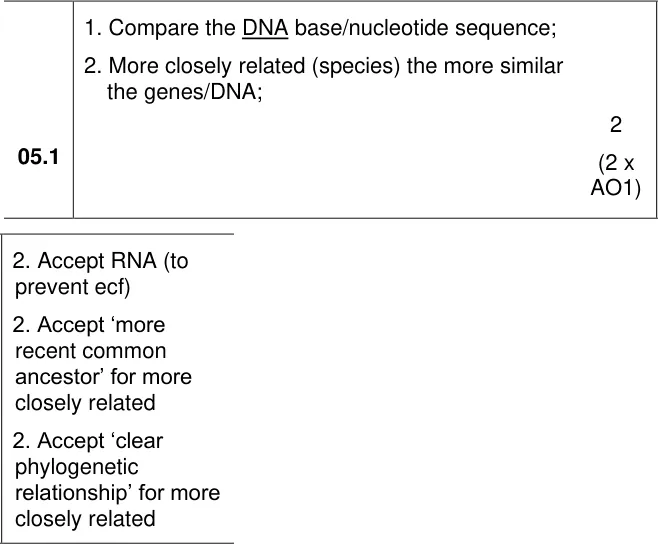
Explain how analysing ribosomal RNA genes let scientists work out phylogenetic relationships between orchids.
Show the mark scheme
Tap an image to open it full size.
From the examiners' report: Vague answers about 'comparing the DNA' or the 'genetic code' missed the first mark: compare base sequences. Then say more similar sequences mean more closely related species.
Question 18
A level Paper 1 · June 2023 · Q06.3 · 1 mark
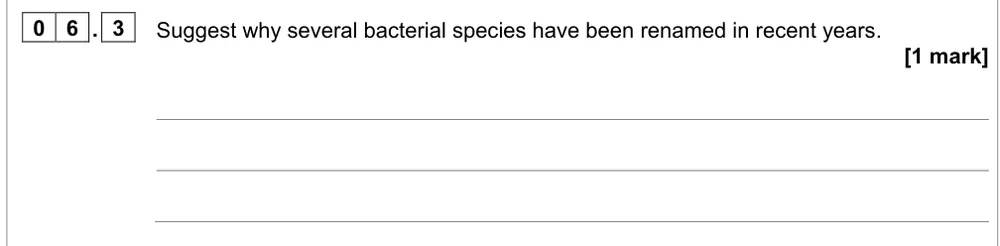
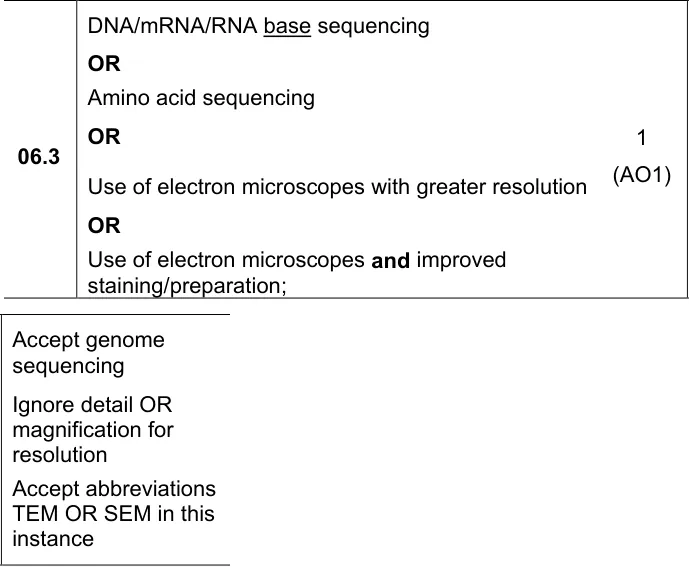
Suggest why several bacterial species have been renamed in recent years.
Information from earlier in this question:

Show the mark scheme
Tap an image to open it full size.
From the examiners' report: 'New technology' didn't score, and the bacteria hadn't evolved or mutated. Name a technique: DNA base sequencing, amino acid sequencing, or electron microscopes with greater resolution.
Where students lose marks (from AQA examiners' reports and mark schemes)
Each point below is followed by wording that gained marks.
Fertile offspring, not just offspring: Most students could define a species, but simpler answers just said organisms 'can make offspring'. In the same question, many gave species richness as the number of species in a population.
✔ Gains credit: "A group of organisms that are able to produce fertile offspring."
Groups within groups, with no overlap: On describing a phylogenetic classification, just over 40% got 1 mark and only 5% got 2; the common error was writing about groups within groups without the lack of overlap. On explaining the hierarchy in Figure 5, just under 60% scored zero.
✔ Gains credit: "Smaller groups within larger groups with no overlaps"; "grouped according to evolutionary origins / relationships".
Turn the letter into the taxon name: Only about half named the taxon Drosophilidae belongs to. Many identified the taxonomic groups using the letters f, g and s on the diagram, but didn't convert the 'f' into family.
✔ Gains credit: "Family."
Courtship stimulates mating: Only 3.4% scored both marks on why two female fruit flies didn't attempt to mate. Few used Figure 6 or understood that courtship is a behaviour that stimulates mating; most said the female 'knew' it was another female.
✔ Gains credit: "The peaks in the songs are identical (both female)"; "so there is no male song to stimulate mating".
Name a difference you can see in the song: 85.8% scored at least 1 mark on the fruit fly songs. Marks were lost by not using Figure 6, by saying the songs were different without giving a difference, and by confusing frequency with amplitude.
✔ Gains credit: "The sine songs are very similar"; "but the pulse songs have different peaks (number, length, amplitude or interval)".
Compare base sequences, not 'the DNA': On the orchid ribosomal RNA genes question, too many missed the first mark with vague references to 'comparing the DNA' or the 'genetic code', and then missed the second by only writing about comparing the DNA.
✔ Gains credit: "Compare the DNA base / nucleotide sequence"; "the more similar the DNA, the more closely related the species".
Name the technique, not 'new technology': On why bacteria have been renamed, many answers said only 'new technology' or 'scientists are better at classification', or thought the bacteria had evolved or mutated. Some left 'base' out of DNA sequencing, or named a microscope without its resolution.
✔ Gains credit: "DNA / RNA base sequencing", "amino acid sequencing" or "electron microscopes with greater resolution".
Count genera, not species: Just over half got the number of beetle genera right. The common wrong answers were 3, the number of beetle species, and 4, the number of all the species in the information.
✔ Gains credit: "2" (Gastrophysa and Chrysolina).
Download the questions
Download the PDF pack (18 questions, mark schemes at the end)
Keep practising
- Genetic diversity and adaptation: AQA A Level Biology exam questions by topic
- Biodiversity within a community: AQA A Level Biology exam questions by topic
- Investigating diversity: AQA A Level Biology exam questions by topic
- DNA, genes and chromosomes: AQA A Level Biology exam questions by topic
- AQA A Level Biology masterclasses
Questions, mark schemes and examiners' report extracts © AQA.