

Photosynthesis (AQA 3.5.1) is A-level only, so it is examined on Paper 2 and Paper 3. You need the light-dependent reaction, from chlorophyll absorbing light and photoionisation to the production of ATP and reduced NADP, and the light-independent reaction: carbon dioxide reacting with RuBP, catalysed by rubisco, GP being reduced to triose phosphate, and triose phosphate regenerating RuBP or becoming useful organic substances. You also need to identify the factors that limit the rate.
The examiners' reports show the same slips every year. Students write reduced NAD or NADP instead of reduced NADP, call GP glucose phosphate, shorten triose phosphate to TP, say ATP provides phosphate rather than energy, and say reduced NADP oxidises GP. On application questions many say 'the Calvin cycle stops' or 'less glucose' without naming the products of the light-dependent reaction, and they write 'amount of light' when examiners want light intensity.
Start with the light-dependent reaction, then the Calvin cycle, then the questions on inhibitors, wavelengths and limiting factors. Write every compound out in full. If you'd like help with this topic, my AQA masterclasses run online on Tuesdays at 5.15pm for Year 12 and on Wednesdays or Thursdays at 6.30pm for Year 13.
What you need from GCSE and Year 12
Each question on this page assumes you're secure on these GCSE and Year 12 ideas. If any of them feels shaky, revise it before you start.
- GCSE: photosynthesis is carbon dioxide + water → glucose + oxygen, an endothermic reaction that takes place in chloroplasts using light absorbed by chlorophyll.
- GCSE: light intensity, carbon dioxide concentration and temperature can each limit the rate of photosynthesis.
- Year 12 (AQA 3.2.1.1): the structure of a chloroplast, with thylakoids stacked into grana inside a fluid stroma.
- Year 12 (AQA 3.1.6): ATP is hydrolysed by ATP hydrolase to release energy, and made from ADP and Pi by ATP synthase. See the ATP page.
- Year 12 (AQA 3.1.4.2): enzymes such as rubisco lower activation energy, and high temperatures can denature them. See the Enzymes page.
Key terms
These words come up in the questions and mark schemes. Examiners expect you to use them exactly.
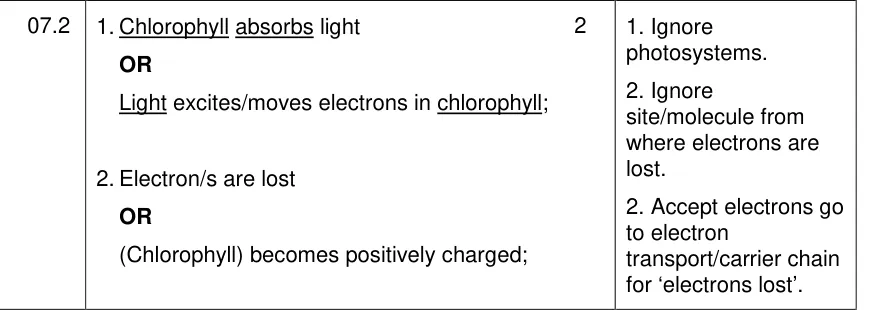
- Photoionisation: chlorophyll absorbs light, which excites electrons so that they are lost from the chlorophyll, leaving it positively charged.
- Light-dependent reaction: the stage on the thylakoid membranes that produces ATP and reduced NADP for the light-independent reaction.
- Reduced NADP: the reduced coenzyme from the light-dependent reaction that reduces GP to triose phosphate; not reduced NAD.
- Light-independent reaction: the Calvin cycle in the stroma, which uses ATP and reduced NADP to form a simple sugar from carbon dioxide.
- Rubisco: the enzyme in the stroma that catalyses the reaction of carbon dioxide with RuBP.
- RuBP: ribulose bisphosphate, the 5-carbon compound that reacts with carbon dioxide to give two molecules of GP.
- GP: glycerate 3-phosphate; it is reduced to triose phosphate using reduced NADP and energy from ATP.
- Triose phosphate: the product of reducing GP; some regenerates RuBP and some is converted to useful organic substances such as glucose, starch or cellulose. Write it in full, not 'TP'.
- Wavelength: the colour of light; different pigments absorb different wavelengths, giving a wider range for photosynthesis.
- Limiting factor: an environmental factor, such as light intensity, carbon dioxide concentration or temperature, that limits the rate of photosynthesis.
What these questions cover (AQA 3.5.1)
The questions test these statements from the AQA AS and A-level Biology specification (7401/7402):
- Photoionisation: chlorophyll absorbs light, leading to photoionisation of chlorophyll
- ATP and reduced NADP: some of the energy from electrons released during photoionisation is conserved in the production of ATP and reduced NADP
- Chemiosmotic theory: the production of ATP involves electron transfer associated with the transfer of electrons down the electron transfer chain and passage of protons across chloroplast membranes and is catalysed by ATP synthase embedded in these membranes (no available part asks about the electron transfer chain, protons crossing the chloroplast membranes or ATP synthase)
- Photolysis: photolysis of water produces protons, electrons and oxygen. (no available part asks about the photolysis of water)
- The light-independent reaction: The light-independent reaction uses reduced NADP from the light-dependent reaction to form a simple sugar. The hydrolysis of ATP, also from the light-dependent reaction, provides the additional energy for this reaction.
- Rubisco and GP: carbon dioxide reacts with ribulose bisphosphate (RuBP) to form two molecules of glycerate 3-phosphate (GP). This reaction is catalysed by the enzyme rubisco
- Reducing GP: ATP and reduced NADP from the light-dependent reaction are used to reduce GP to triose phosphate
- Regenerating RuBP: some of the triose phosphate is used to regenerate RuBP in the Calvin cycle (tested by the 6-mark question, where triose phosphate converted to RuBP is one mark point)
- Useful organic substances: some of the triose phosphate is converted to useful organic substances.
- Limiting factors: identify environmental factors that limit the rate of photosynthesis
- Agricultural practices: evaluate data relating to common agricultural practices used to overcome the effect of these limiting factors. (no available part gives data on agricultural practices such as glasshouses, lighting or carbon dioxide enrichment)
How to use this page
Write your answer on paper before you open the mark scheme. Allow about 1.3 minutes per mark: the 12 questions are worth 27 marks, so about 35 minutes in total. Then mark your answer strictly against the mark scheme and read the examiners' tip underneath it. If you'd rather print the questions, download the PDF pack.
The light-dependent reaction (3.5.1)
Question 1
A level Paper 2 · June 2019 · Q07.2 · 2 marks · Easy
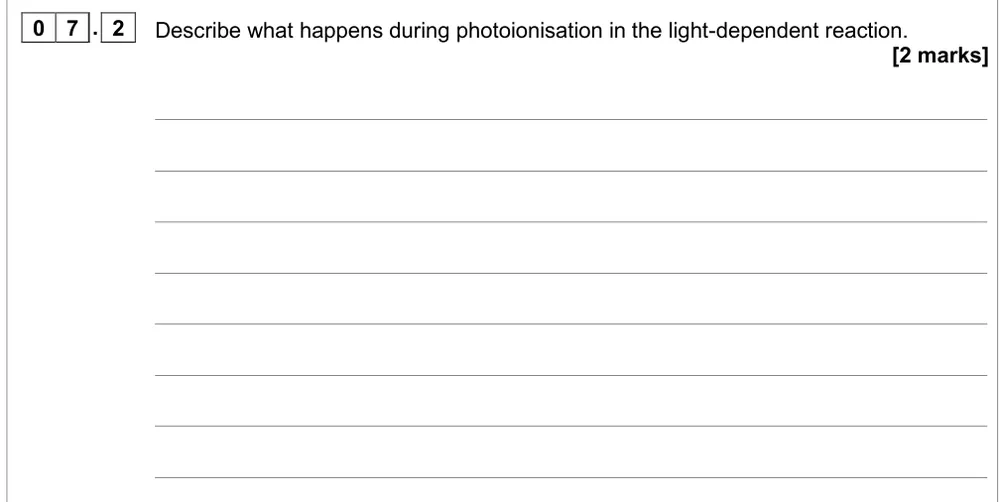
Describe what happens during photoionisation.
Show the mark scheme
Tap an image to open it full size.
From the examiners' report: 44% got both. Don't describe photolysis. Say chlorophyll absorbs light, then that electrons are lost and the chlorophyll becomes positively charged.
Question 2
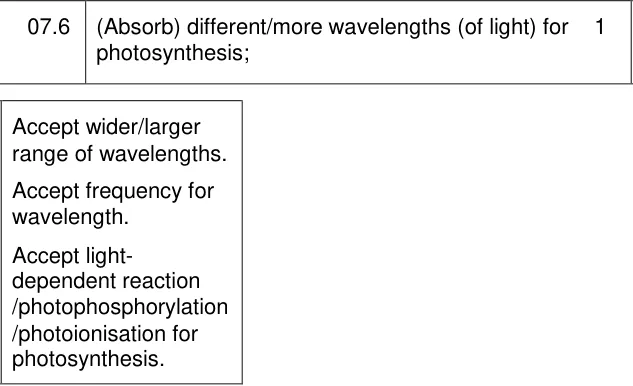
A level Paper 2 · June 2019 · Q07.6 · 1 mark · Medium
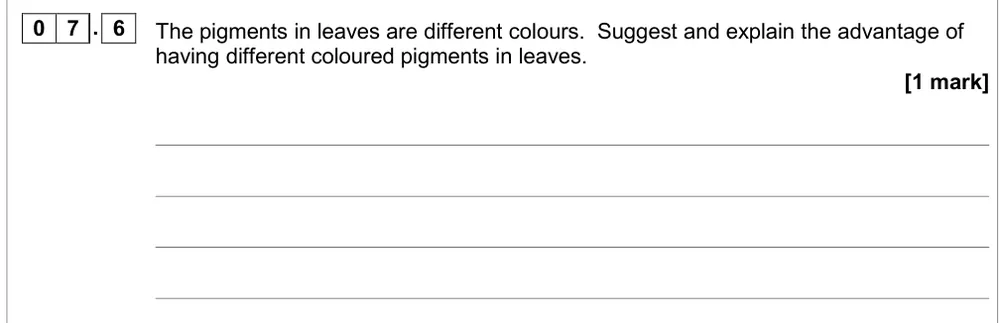
Suggest the advantage of leaves having different coloured pigments.
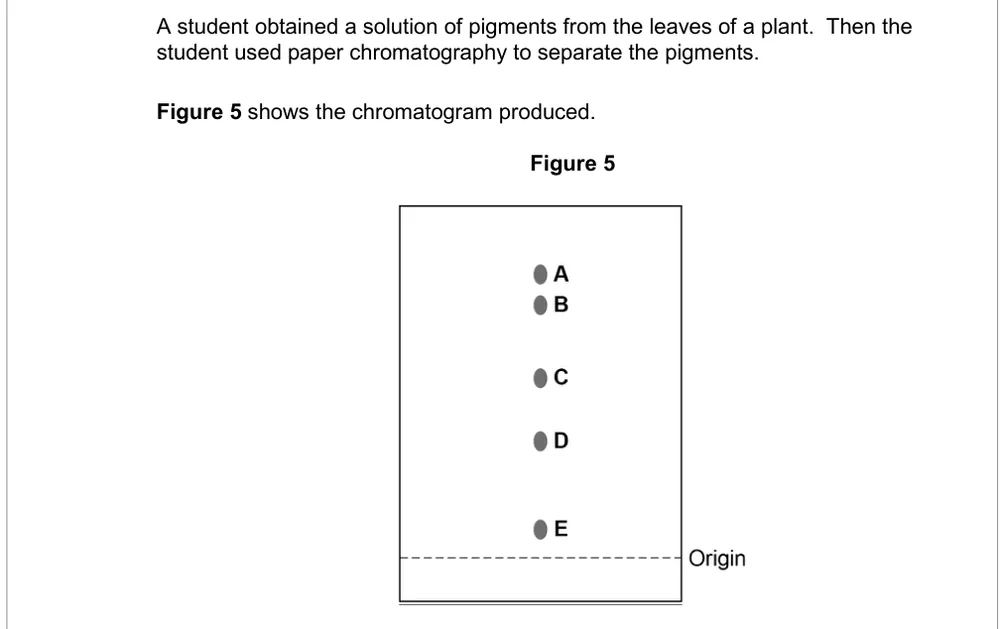
Information from earlier in this question:
Show the mark scheme
Tap an image to open it full size.
From the examiners' report: About 46% got it. Name both wavelengths of light and photosynthesis; being able to identify pigments on a chromatogram isn't an advantage to the plant.
Question 3
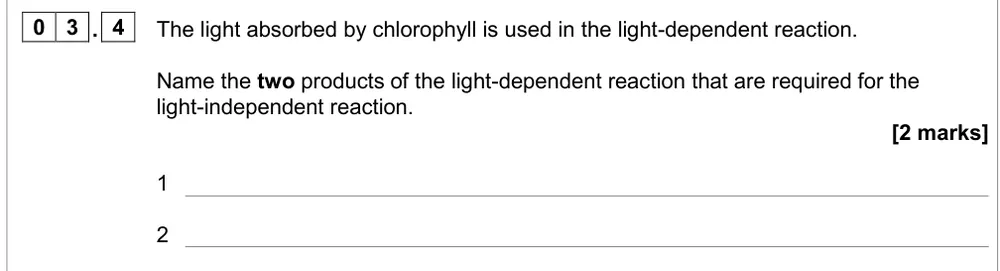
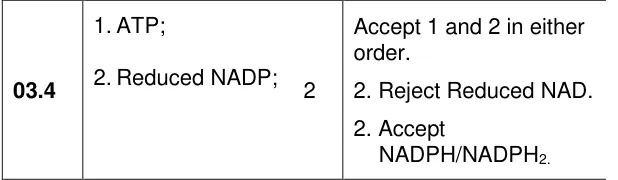
A level Paper 2 · November 2020 · Q03.4 · 2 marks · Easy
Name the two products of the light-dependent reaction needed for the light-independent reaction.
Show the mark scheme
Tap an image to open it full size.
From the examiners' report: Almost 91% got at least one mark, usually for ATP, but almost 30% didn't name reduced NADP. Reduced NAD, NAD and NADP are all wrong.
Question 4
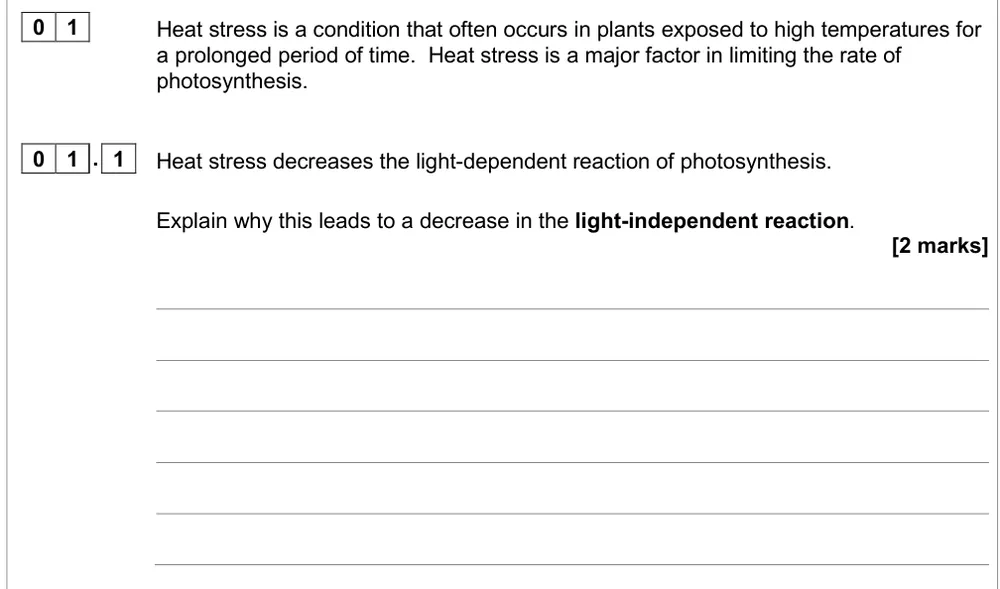
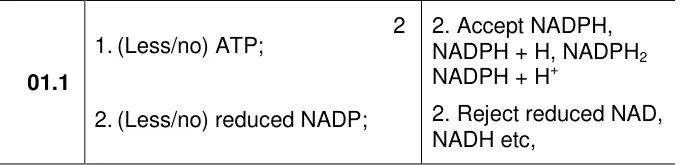
A level Paper 2 · June 2018 · Q01.1 · 2 marks · Medium
Explain why heat stress on the light-dependent reaction slows the light-independent reaction.
Show the mark scheme
Tap an image to open it full size.
From the examiners' report: About 41% got both and nearly a third scored zero. Name the two products: less ATP and less reduced NADP. Stomata closing or rubisco denaturing doesn't answer this question.
The light-independent reaction (3.5.1)
Question 5
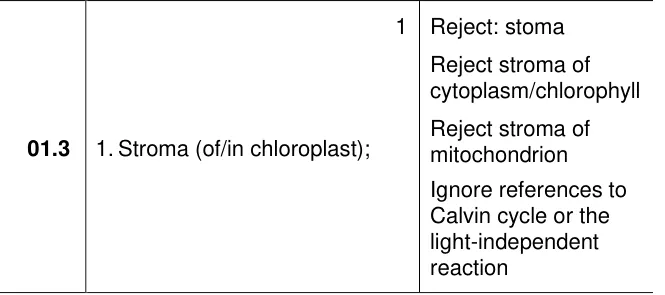
A level Paper 2 · June 2018 · Q01.3 · 1 mark · Easy
State precisely where rubisco is found in a cell.

Show the mark scheme
Tap an image to open it full size.
From the examiners' report: Almost two-thirds got it. The thylakoids, cristae and matrix were common wrong answers; spell stroma carefully, as stoma is rejected.
Question 6
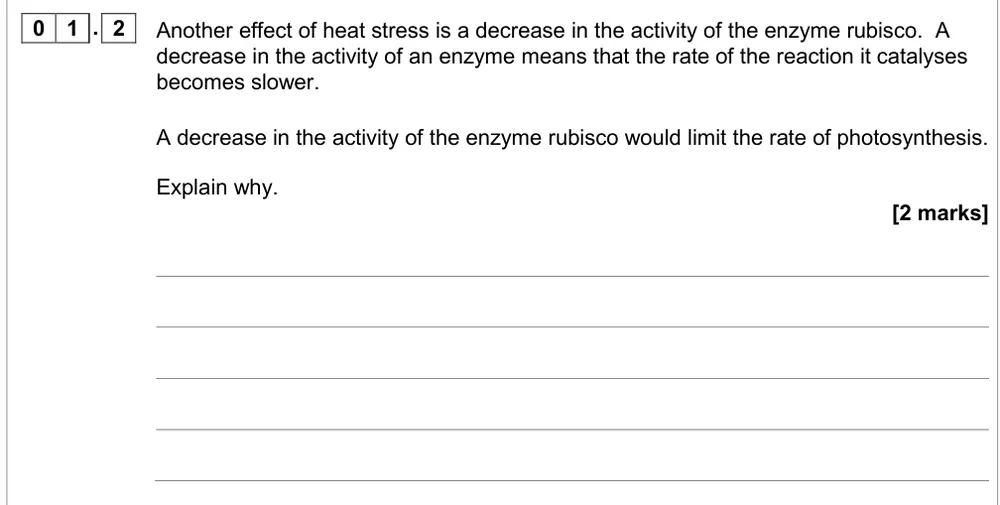
A level Paper 2 · June 2018 · Q01.2 · 2 marks · Medium
Explain why lower rubisco activity limits the rate of photosynthesis.
Show the mark scheme

Tap an image to open it full size.
From the examiners' report: About 41% got both and one in four scored zero, mostly by describing denaturation. Give the reaction: carbon dioxide with RuBP, forming GP, which is glycerate 3-phosphate, not glucose phosphate.
Question 7
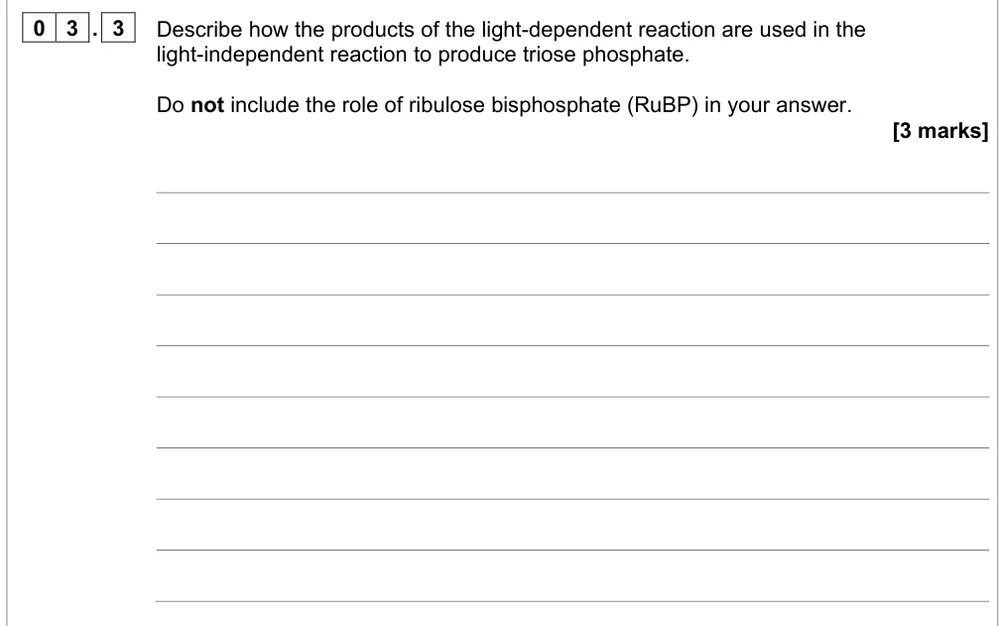
A level Paper 2 · June 2024 · Q03.3 · 3 marks · Medium
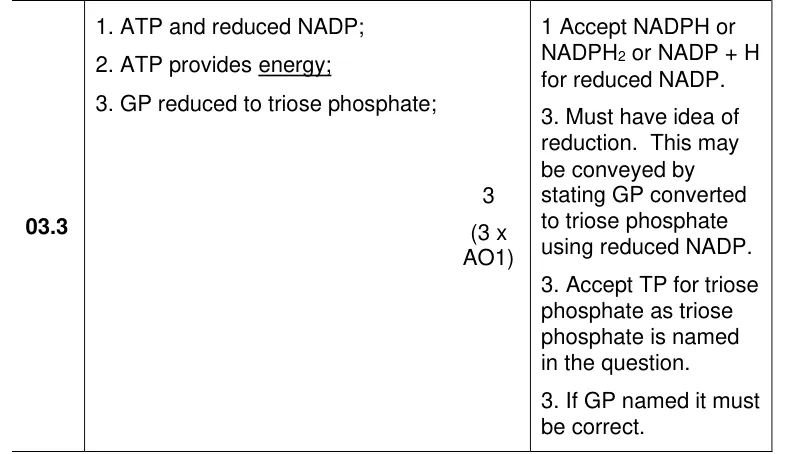
Describe how ATP and reduced NADP are used to make triose phosphate.
Show the mark scheme
Tap an image to open it full size.
From the examiners' report: About a third got all three. ATP provides energy, not phosphate, and reduced NADP reduces GP; it doesn't oxidise it. Keep glycolysis and the link reaction out of it.
Question 8
A level Paper 2 · June 2022 · Q01.2 · 6 marks · Medium
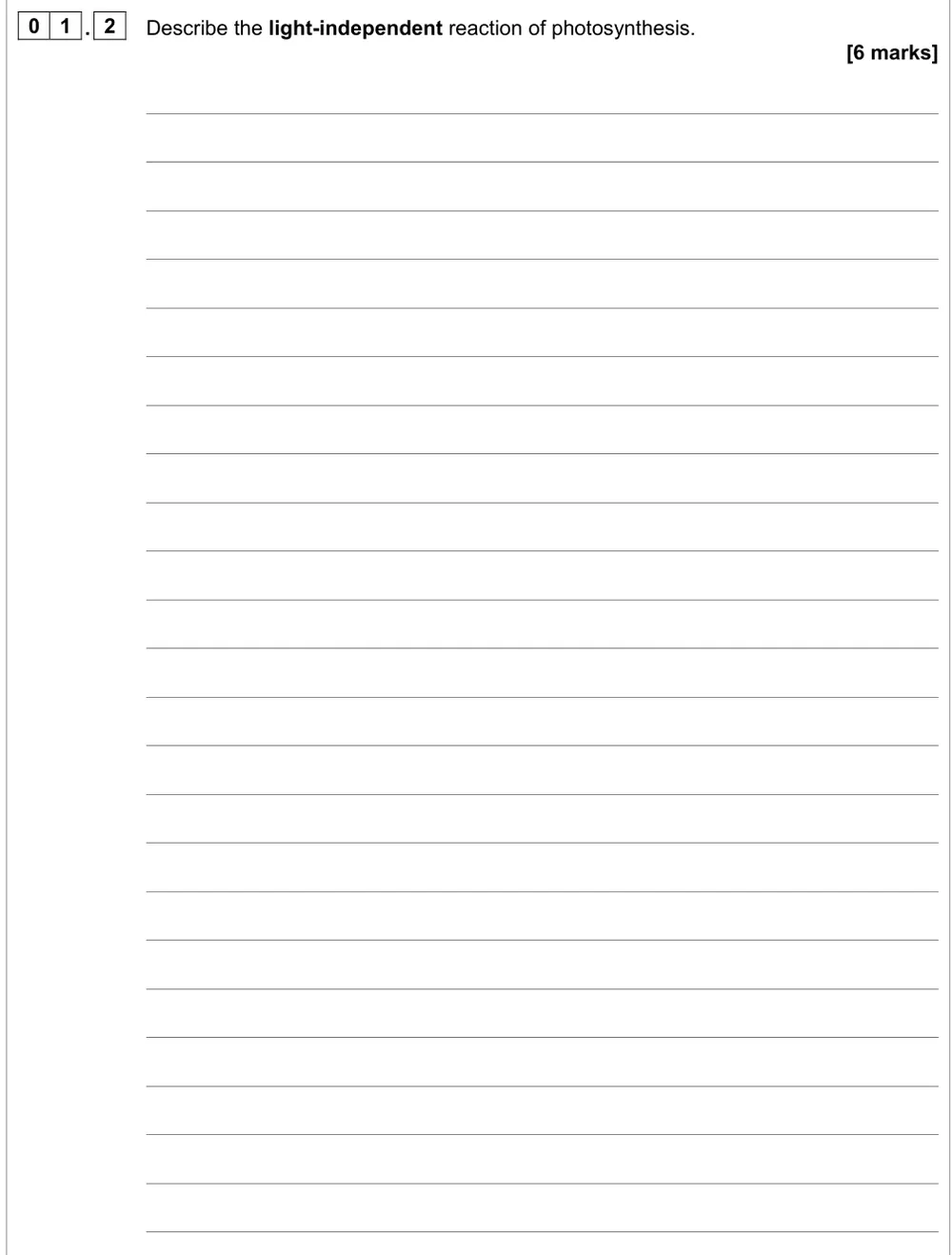
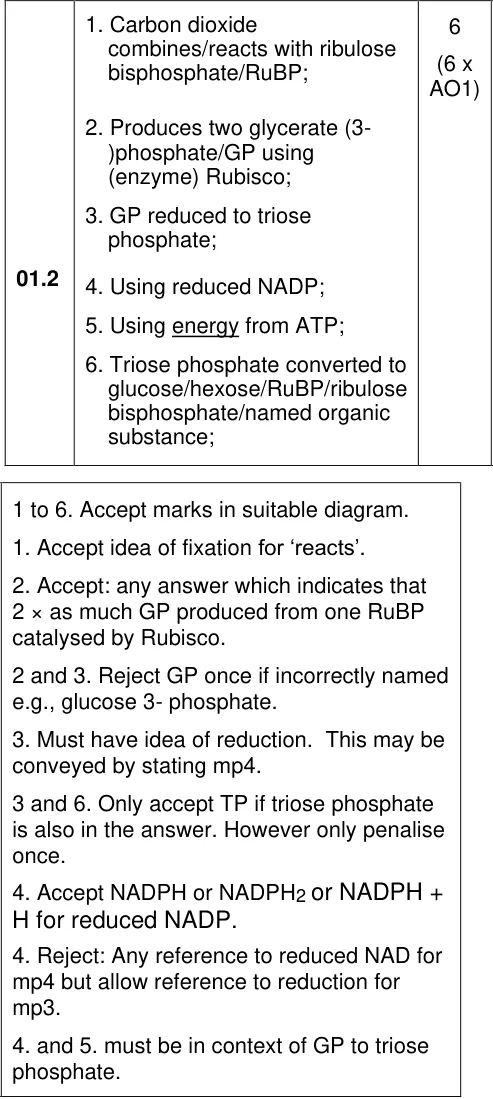
Describe the light-independent reaction of photosynthesis.
Show the mark scheme
Tap an image to open it full size.
From the examiners' report: Fewer than one in ten got all six and 27% scored zero. Write triose phosphate in full, not TP, give the energy from ATP, and don't confuse it with the Krebs cycle or the light-dependent reaction.
Question 9
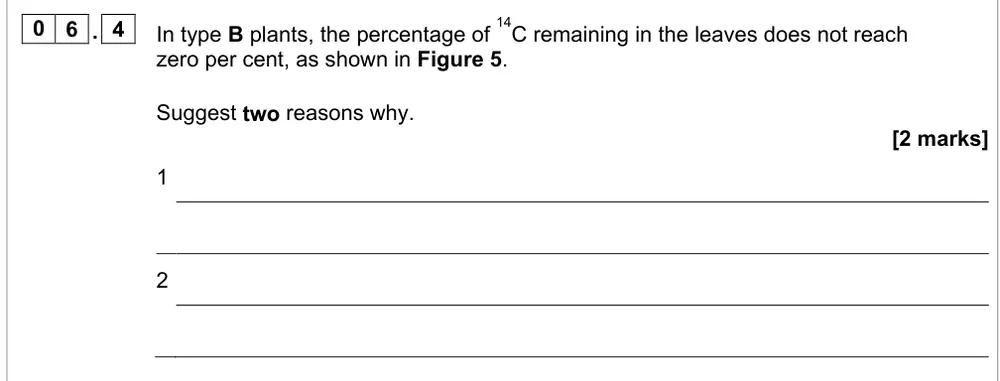
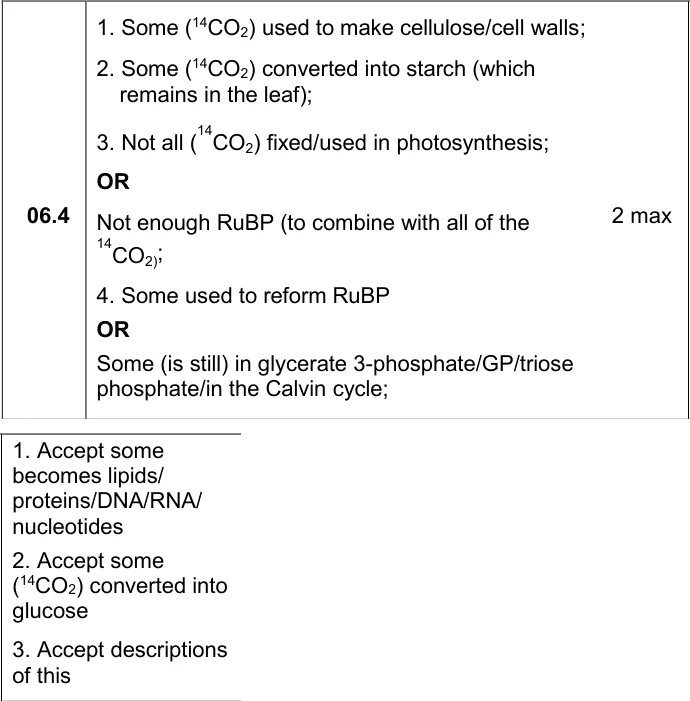
A level Paper 3 · November 2021 · Q06.4 · 2 marks
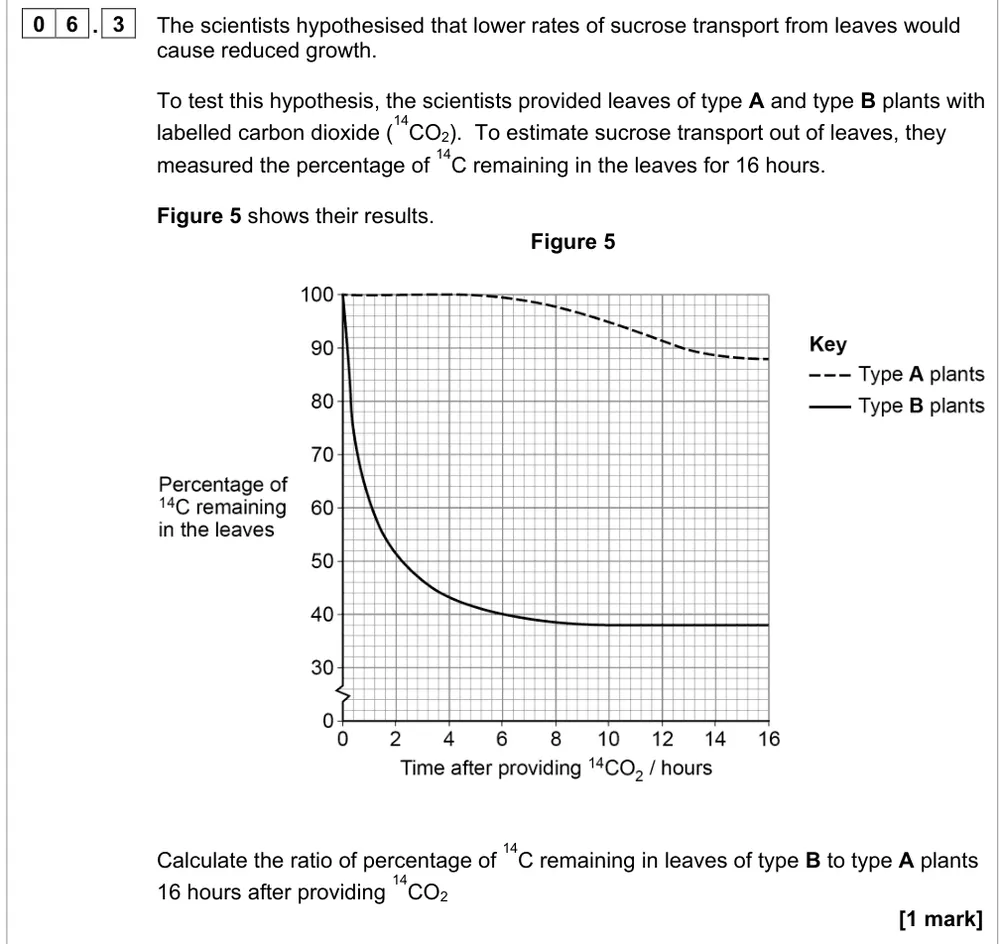
Suggest why some 14C stays in tobacco leaves after they are given 14CO2.
Information from earlier in this question:

Show the mark scheme
Tap an image to open it full size.
From the examiners' report: Many students missed that the graph shows 14C, not 14CO2. Follow the carbon: once fixed, it becomes GP and triose phosphate, then starch or cellulose that stays in the leaf.
Applying it: inhibitors, light and limiting factors (3.5.1)
Question 10
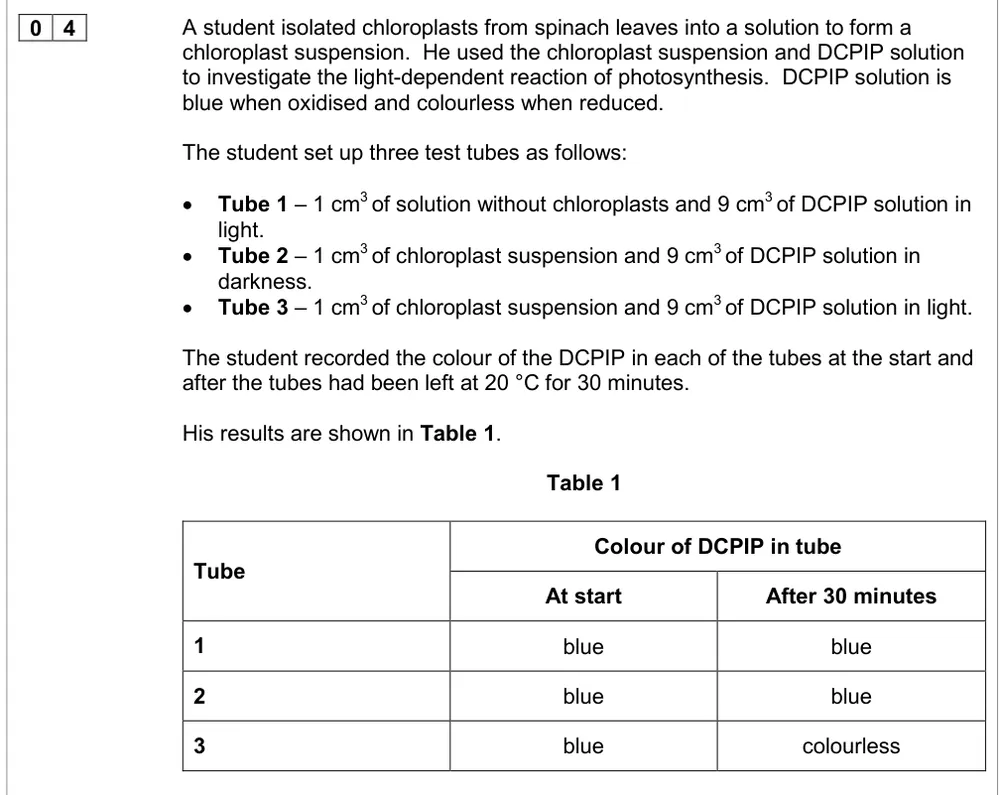
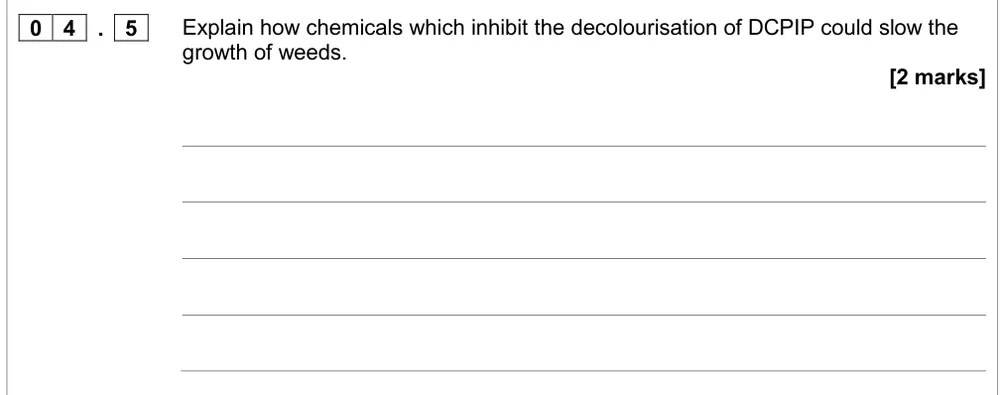
A level Paper 2 · June 2017 · Q04.5 · 2 marks · Medium
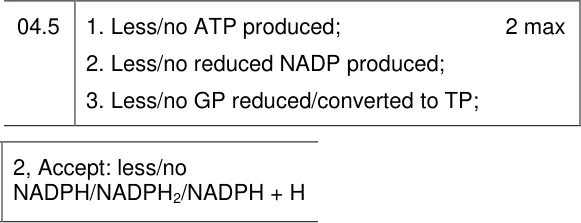
Explain how chemicals that stop DCPIP decolourising could slow the growth of weeds.
Information from earlier in this question:
Show the mark scheme
Tap an image to open it full size.
From the examiners' report: Almost 50% scored zero. 'No light-independent reaction, so less glucose' isn't enough: name ATP and reduced NADP, and say less GP is reduced to triose phosphate.
Question 11
A level Paper 2 · June 2024 · Q03.1 · 2 marks · Easy
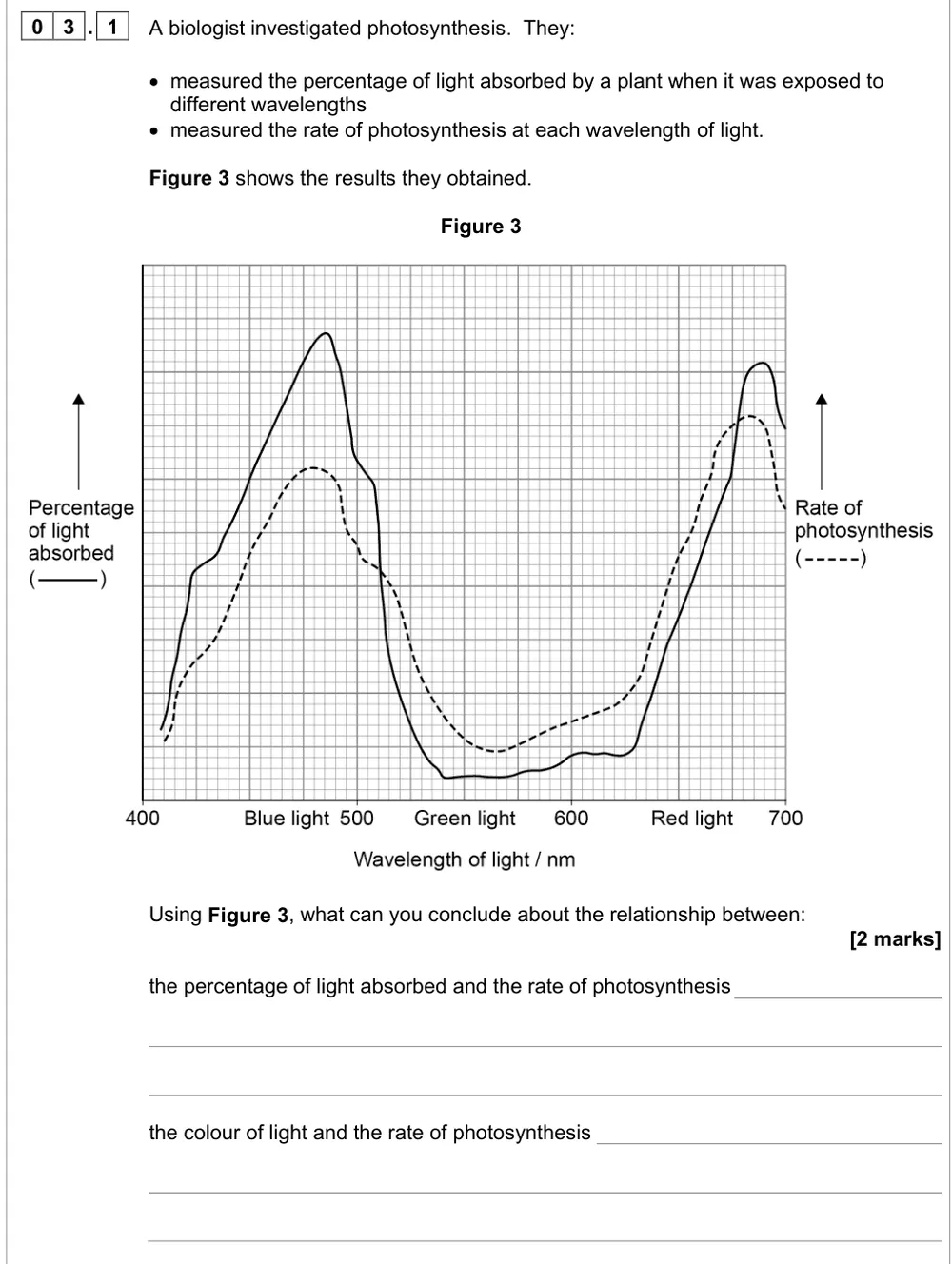
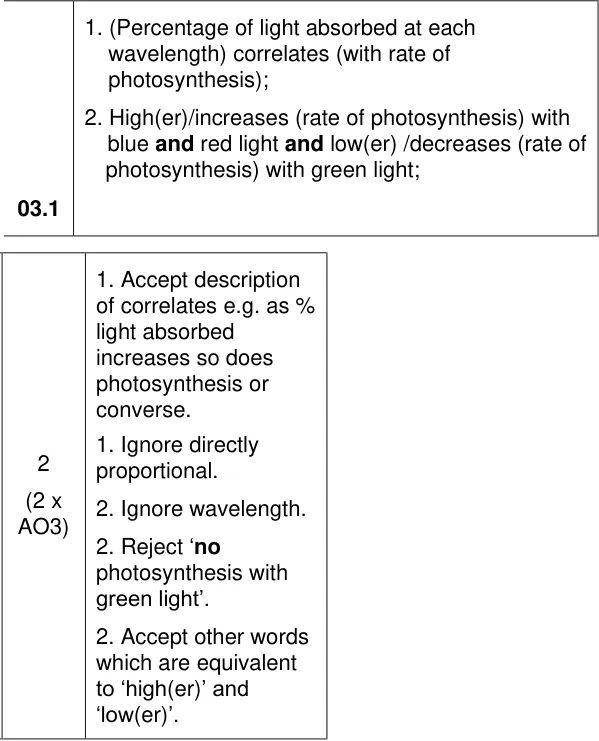
Use an absorption spectrum and action spectrum to relate light absorbed and colour to the rate.
Show the mark scheme
Tap an image to open it full size.
From the examiners' report: About 93% got at least one mark but only 43% both. Name all three colours, including green, and talk about the rate of photosynthesis, not just which light is reflected.
Question 12
A level Paper 2 · June 2024 · Q03.2 · 2 marks · Easy
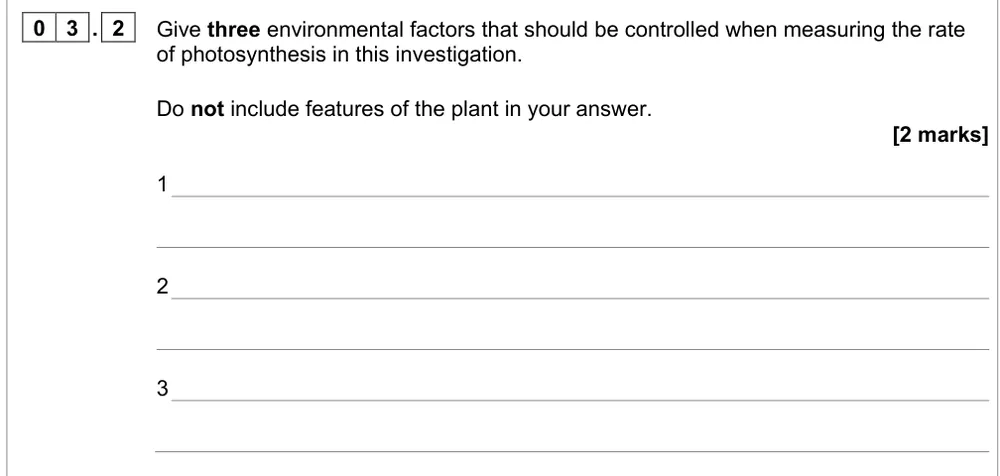
Give three environmental factors to control when measuring the rate of photosynthesis.
Show the mark scheme
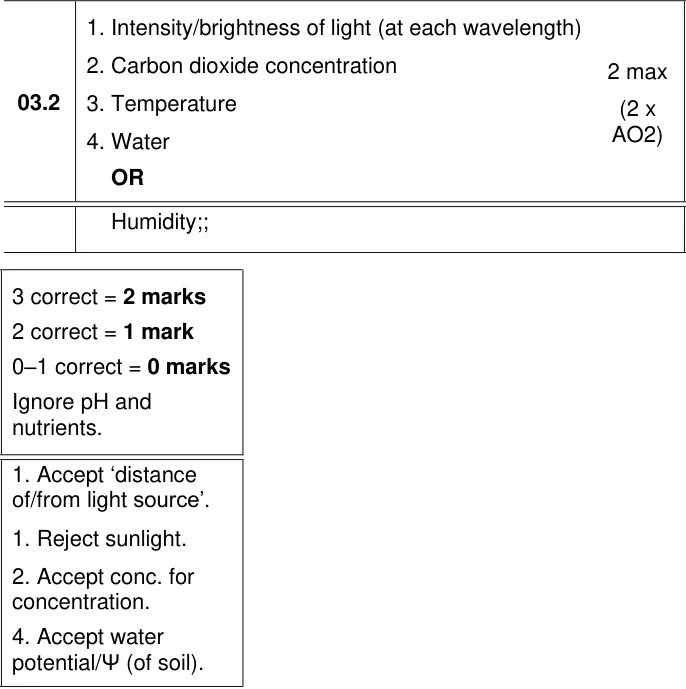
Tap an image to open it full size.
From the examiners' report: About 57% got both. Write light intensity and carbon dioxide concentration, not 'amount'. Soil pH, nutrients, air movement and oxygen concentration don't score.
Where students lose marks (from AQA examiners' reports and mark schemes)
Each point below is followed by wording that gained marks.
Reduced NADP, not reduced NAD or NADP: Almost 30% of students failed to name reduced NADP as the second product of the light-dependent reaction; reduced NAD, NAD and NADP were the most frequent wrong answers. On the heat stress question, many who got one mark wrote less NADP or less reduced NAD.
✔ Gains credit: "ATP; Reduced NADP" (NADPH accepted; reduced NAD rejected).
Name ATP and reduced NADP, not just 'no Calvin cycle': Almost 50% scored zero on how DCPIP inhibitors slow weed growth. Many said the light-independent reaction wouldn't happen and less glucose would be made for growth, but didn't name the products of the light-dependent reaction.
✔ Gains credit: "Less/no ATP produced; Less/no reduced NADP produced; Less/no GP reduced/converted to TP."
Photoionisation is not photolysis: 44% got both marks for photoionisation and about 77% at least one. Some described photolysis and scored nothing; answers about chloroplasts or photosystems instead of chlorophyll lost the first mark, and few said chlorophyll becomes positively charged.
✔ Gains credit: "Chlorophyll absorbs light OR Light excites/moves electrons in chlorophyll; Electron/s are lost OR (Chlorophyll) becomes positively charged."
Rubisco joins carbon dioxide to RuBP: About 41% got both marks for why less rubisco activity limits photosynthesis, and one in four scored zero, mostly by describing denaturation. Others left out RuBP or carbon dioxide, wrote about a six-carbon product without GP, or called GP glucose phosphate.
✔ Gains credit: "(Less/no) carbon dioxide (reacts) with RuBP; (Less/no) GP."
ATP gives energy; reduced NADP reduces GP: On how the products of the light-dependent reaction make triose phosphate, a significant number said ATP provided phosphate, and a surprising number said reduced NADP oxidised GP. Some wrote about pyruvate and acetyl coenzyme A from respiration.
✔ Gains credit: "ATP and reduced NADP; ATP provides energy; GP reduced to triose phosphate."
Write triose phosphate in full: 27% scored zero on describing the light-independent reaction and fewer than one in ten got all six. 'TP' is not an abbreviation in the specification, so students who only wrote TP lost a mark; others confused it with the Krebs cycle or left out the energy from ATP.
✔ Gains credit: "GP reduced to triose phosphate; Using reduced NADP; Using energy from ATP; Triose phosphate converted to glucose/hexose/RuBP/named organic substance."
Rubisco is in the stroma: Almost two-thirds named the stroma as where rubisco is found. The thylakoids, cristae and matrix were common wrong answers, and 'stoma' was rejected.
✔ Gains credit: "Stroma (of/in chloroplast)."
Light intensity and CO2 concentration, not 'how much': About 57% gave three controlled environmental factors. 'Amount of light' and 'amount of carbon dioxide' weren't accepted, and pH, soil nutrients, air movement and oxygen concentration didn't score.
✔ Gains credit: "Intensity/brightness of light; Carbon dioxide concentration; Temperature; Water OR Humidity" (any three for 2 marks).
Download the questions
Download the PDF pack (12 questions, mark schemes at the end)
Keep practising
- Required practicals 7 and 8, photosynthesis: AQA A Level Biology exam questions
- Respiration: AQA A Level Biology exam questions by topic
- Energy and ecosystems: AQA A Level Biology exam questions by topic
- ATP: AQA A Level Biology exam questions by topic
- AQA 3.5.1 photosynthesis: self-marking quiz
- AQA A Level Biology masterclasses
Questions, mark schemes and examiners' report extracts © AQA.