

Inheritance (AQA 3.7.1) opens topic 7 and it's A-level only, so it's Year 13 content. You need to define genotype and phenotype, use dominant, recessive, codominant, homozygous and heterozygous accurately, and draw fully labelled genetic diagrams for monohybrid and dihybrid crosses, including sex linkage, autosomal linkage, multiple alleles and epistasis. You also need the chi-squared test to compare observed and expected ratios.
The examiners' reports find the same slips every year. Students leave the environment out of phenotype, drop the sex from the phenotypes in a sex-linked cross, and keep offspring that die as embryos in the ratio. Linkage is the hardest area: only 1% got full marks explaining the fruit fly results, because answers didn't link the missing phenotypes to a lack of crossing over or to the gametes made. Only 44% named the chi-squared test and gave the right degrees of freedom.
Start with the definitions and pedigree questions, then work through the crosses and finish with probability and chi-squared. Draw each genetic diagram in full, with gametes, before you open the mark scheme. If you'd like help with this topic, my AQA masterclasses run online on Tuesdays at 5.15pm for Year 12 and on Wednesdays or Thursdays at 6.30pm for Year 13.
What you need from GCSE and Year 12
Each question on this page assumes you're secure on these GCSE and Year 12 ideas. If any of them feels shaky, revise it before you start.
- GCSE: a Punnett square predicts the offspring of a monohybrid cross, and a dominant allele is expressed when only one copy is present.
- GCSE: human females are XX and males are XY, so a father passes his X chromosome to every daughter and his Y chromosome to every son.
- Year 12 (AQA 3.4.1): a gene occupies a fixed position, its locus, on a chromosome, and alleles are different forms of the same gene.
- Year 12 (AQA 3.4.3): meiosis makes haploid gametes, and independent segregation and crossing over produce new combinations of alleles.
Key terms
These words come up in the questions and mark schemes. Examiners expect you to use them exactly.
- Genotype: the genetic constitution of an organism: the alleles it has for a gene.
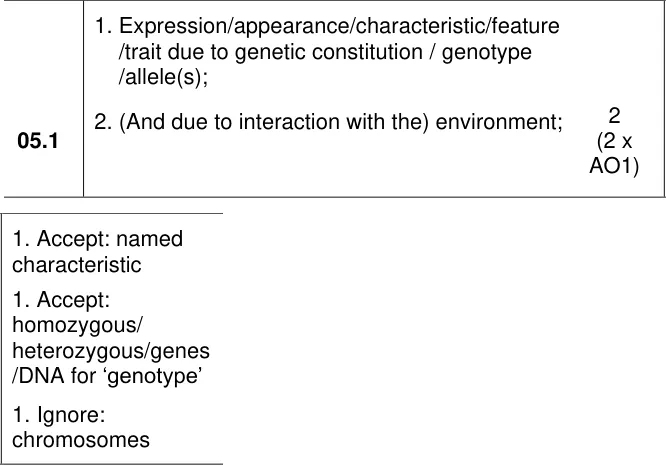
- Phenotype: the expression of the genotype and its interaction with the environment.
- Allele: a different form of a gene, found at the same locus on a chromosome.
- Homozygous and heterozygous: two identical alleles at a locus, or two different alleles at a locus.
- Dominant and recessive: a dominant allele is always expressed when present; a recessive allele is only expressed when no dominant allele is present.
- Codominant: both alleles are expressed in the heterozygote, as with the IA and IB blood group alleles.
- Multiple alleles: a gene with more than two alleles, such as IA, IB and IO for the ABO blood groups.
- Sex-linked: a gene carried on the X chromosome, so males have only one allele of it.
- Autosomal linkage: two genes on the same autosome, inherited together unless crossing over separates their alleles.
- Epistasis: one gene affecting, or masking, the expression of another gene.
- Chi-squared test: a statistical test of whether observed numbers differ significantly from expected numbers; degrees of freedom are the number of categories minus one.
What these questions cover (AQA 3.7.1)
The questions test these statements from the AQA AS and A-level Biology specification (7401/7402):
- Genotype: The genotype is the genetic constitution of an organism. (no written question asks for the definition of genotype, but you write genotypes in the ABO, pedigree and genetic diagram questions)
- Phenotype: The phenotype is the expression of this genetic constitution and its interaction with the environment.
- Alleles: There may be many alleles of a single gene. Alleles may be dominant, recessive or codominant. (the ABO blood group question covers multiple alleles, and the flower colour and cat fur crosses cover codominance)
- Homozygous and heterozygous: In a diploid organism, the alleles at a specific locus may be either homozygous or heterozygous.
- The use of fully labelled genetic diagrams to interpret, or predict, the results of: monohybrid and dihybrid crosses involving dominant, recessive and codominant alleles
- The use of fully labelled genetic diagrams to interpret, or predict, the results of: crosses involving sex-linkage, autosomal linkage, multiple alleles and epistasis.
- The chi-squared test: Use of the chi-squared (χ²) test to compare the goodness of fit of observed phenotypic ratios with expected ratios. (the 2n gametes question asks for expected numbers under a null hypothesis, the first step of a chi-squared test)
How to use this page
Write your answer on paper before you open the mark scheme. Allow about 1.3 minutes per mark: the 18 questions are worth 40 marks, so about 52 minutes in total. Then mark your answer strictly against the mark scheme and read the examiners' tip underneath it. If you'd rather print the questions, download the PDF pack.
Genotype, phenotype and alleles (3.7.1)
Question 1
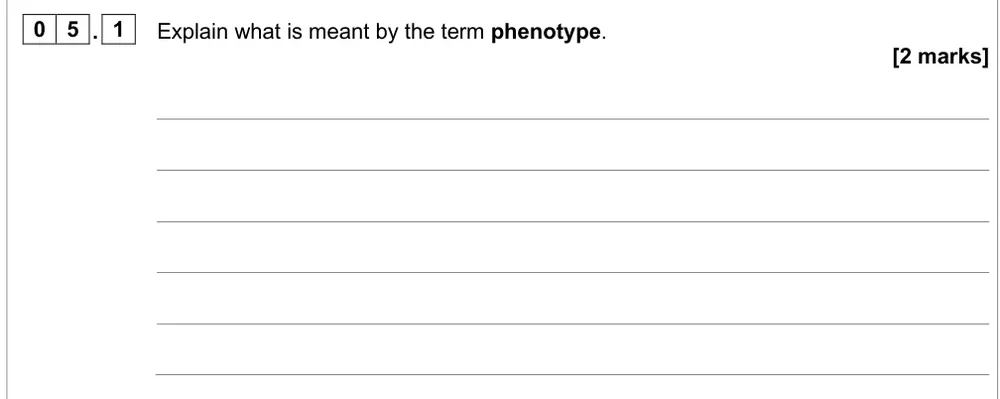
A level Paper 2 · June 2025 · Q05.1 · 2 marks · Easy
Explain what is meant by the term phenotype.
Show the mark scheme
Tap an image to open it full size.
From the examiners' report: About 95% got a mark but only 60% got both. Give the genetic part (expression of the genotype) and the environment; 'the appearance of a characteristic' alone scored nothing.
Question 2
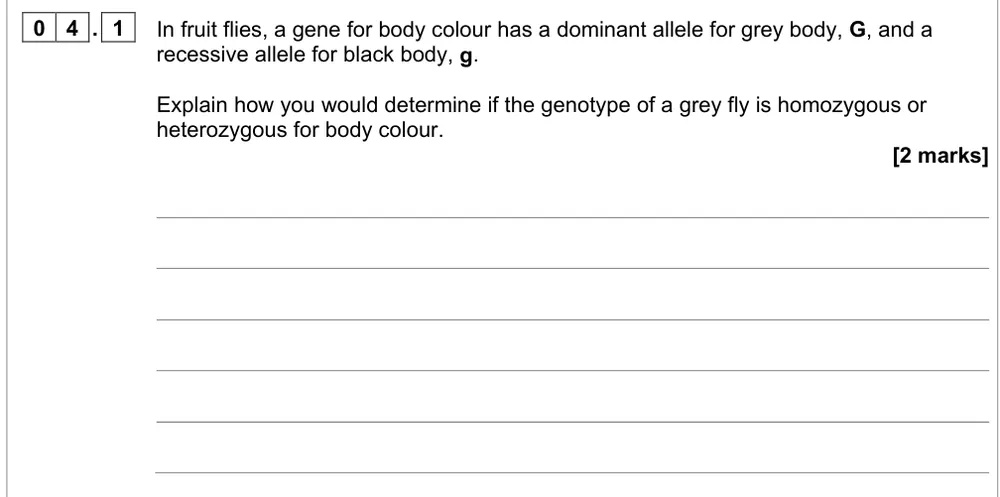
A level Paper 2 · June 2024 · Q04.1 · 2 marks · Medium
Explain how to find out whether a grey fruit fly is homozygous or heterozygous.
Show the mark scheme
Tap an image to open it full size.
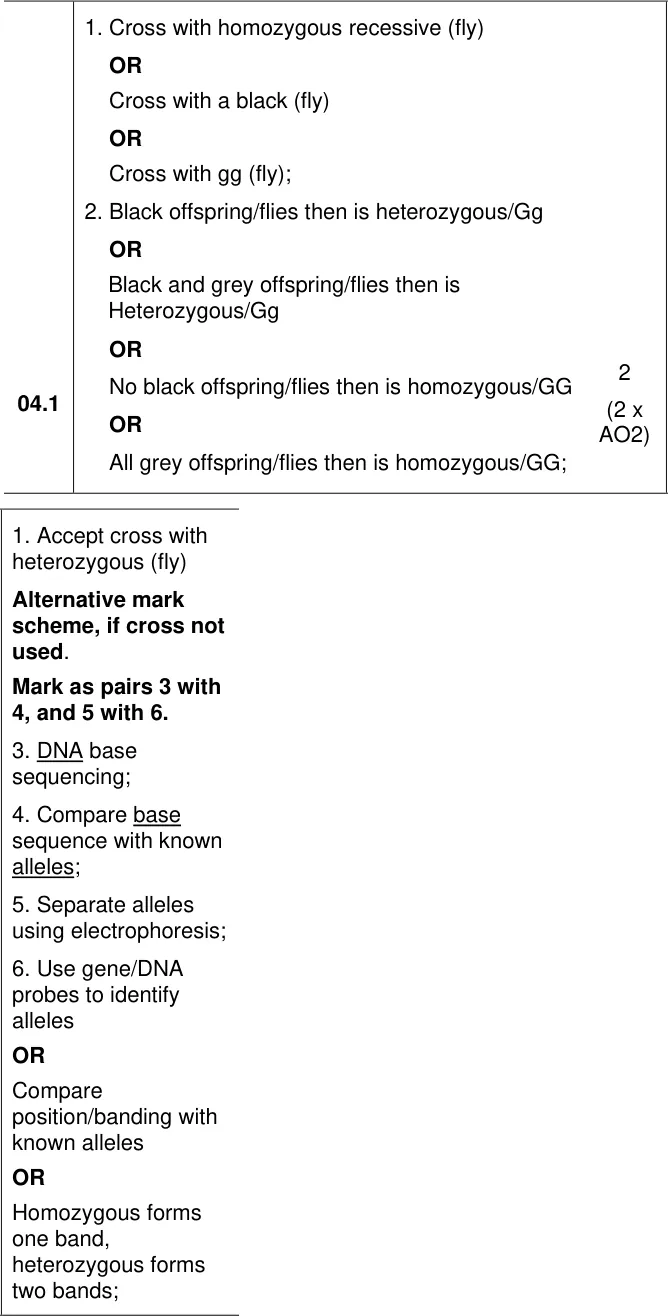
From the examiners' report: 46% got both marks. Cross the grey fly with a black (gg) fly, not another grey one, and say what each result would tell you: any black offspring means Gg.
Question 3
A level Paper 2 · June 2022 · Q06.1 · 1 mark · Medium
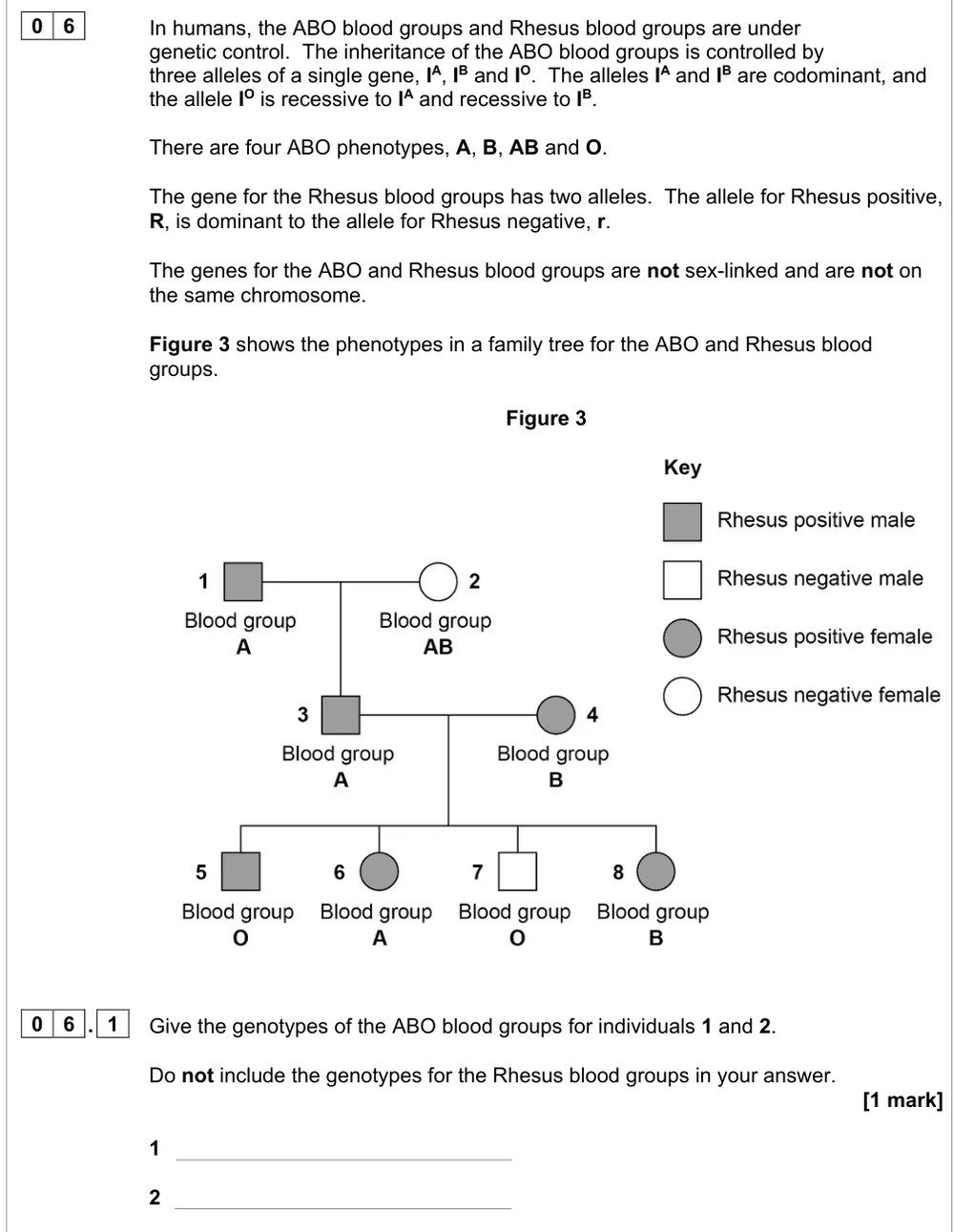
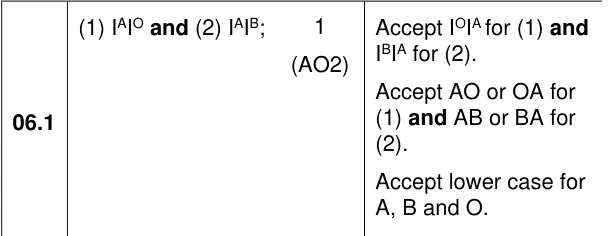
Give the ABO genotypes of two people from a family tree.
Show the mark scheme
Tap an image to open it full size.
From the examiners' report: About 54% got this. Individual 1 must be IAIO, not IAIA: work back from the group O grandchildren, who need an IO allele from 3 and so from 1.
Question 4
A level Paper 2 · June 2022 · Q06.2 · 2 marks · Hard
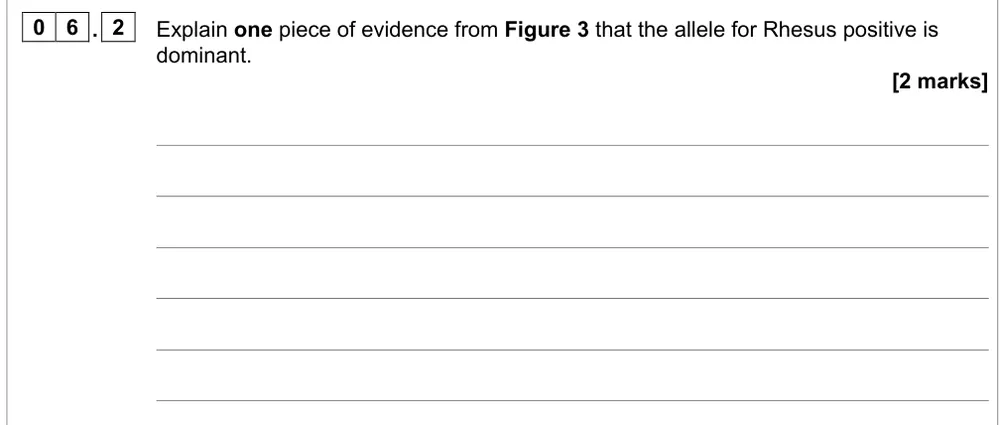
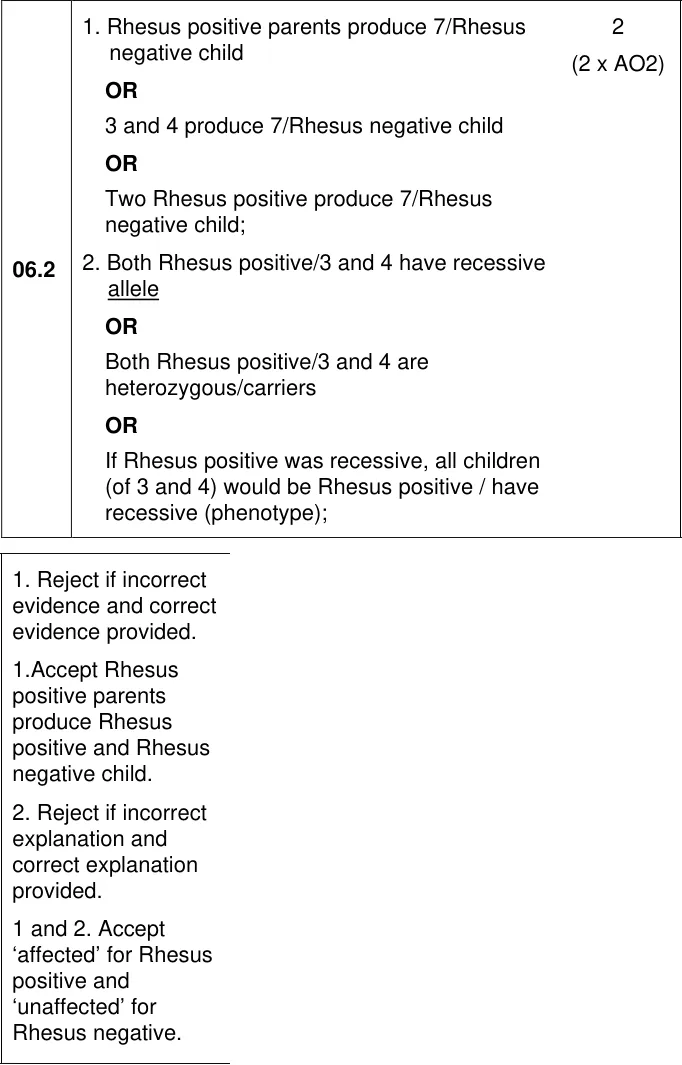
Use a family tree to show that the Rhesus positive allele is dominant.
Show the mark scheme
Tap an image to open it full size.
From the examiners' report: 62% scored zero and about one in four got both. Use 3, 4 and 7, not 1 and 2, and say both parents must be heterozygous, not just one of them.
Monohybrid and dihybrid crosses (3.7.1)
Question 5
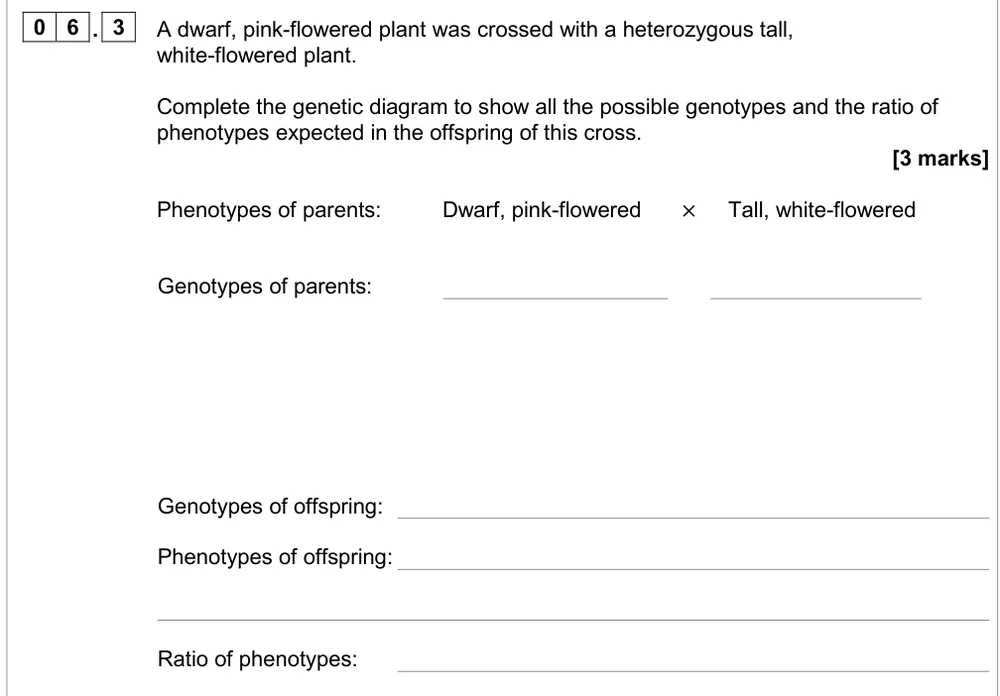
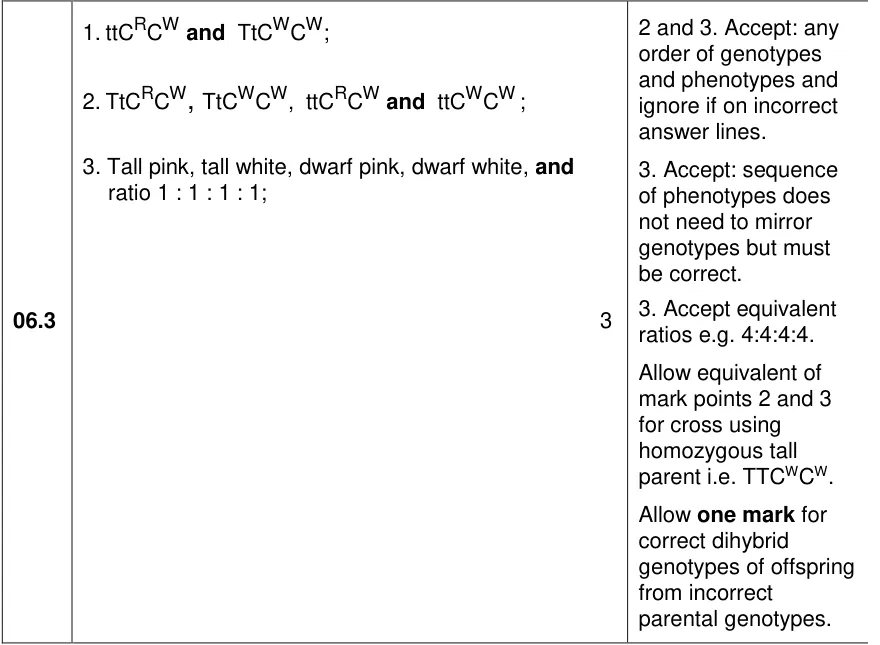
A level Paper 2 · November 2020 · Q06.3 · 3 marks · Easy
Complete a dihybrid cross with one dominant gene and one codominant gene.
Information from earlier in this question:

Show the mark scheme
Tap an image to open it full size.
From the examiners' report: About 59% got all three. The tall parent is heterozygous (Tt), as the question says, and don't write 9 : 3 : 3 : 1 out of habit when your own diagram gives 1 : 1 : 1 : 1.
Question 6
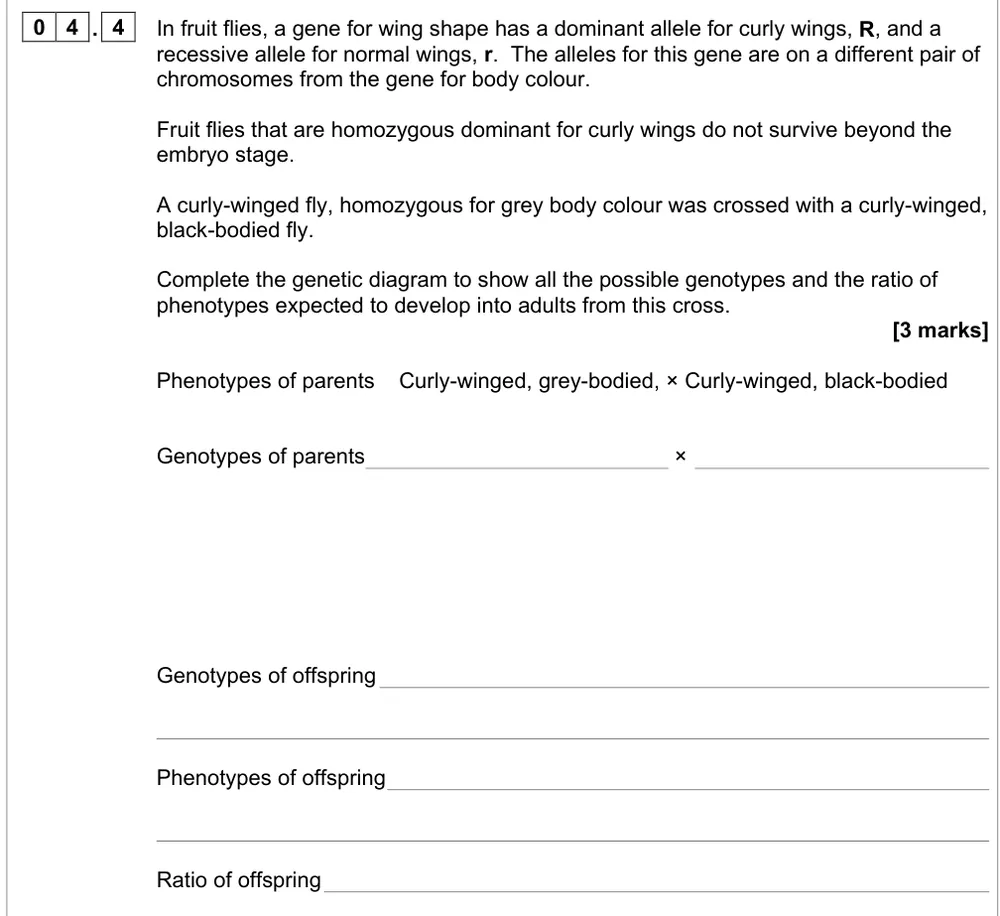
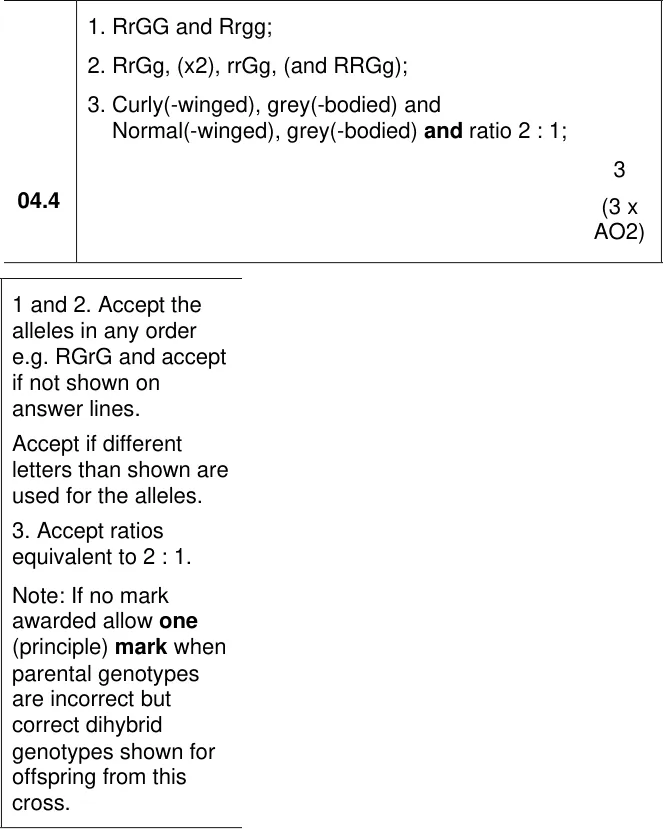
A level Paper 2 · June 2024 · Q04.4 · 3 marks · Medium
Complete a dihybrid cross in which one genotype dies as an embryo.
Show the mark scheme
Tap an image to open it full size.
From the examiners' report: About 65% got two marks but only 25% got all three. Remove the RRGg embryos before you write the ratio: it's 2 : 1, not 3 : 1 or 1 : 2 : 1.
Sex linkage (3.7.1)
Question 7
A level Paper 2 · November 2021 · Q04.1 · 2 marks · Easy
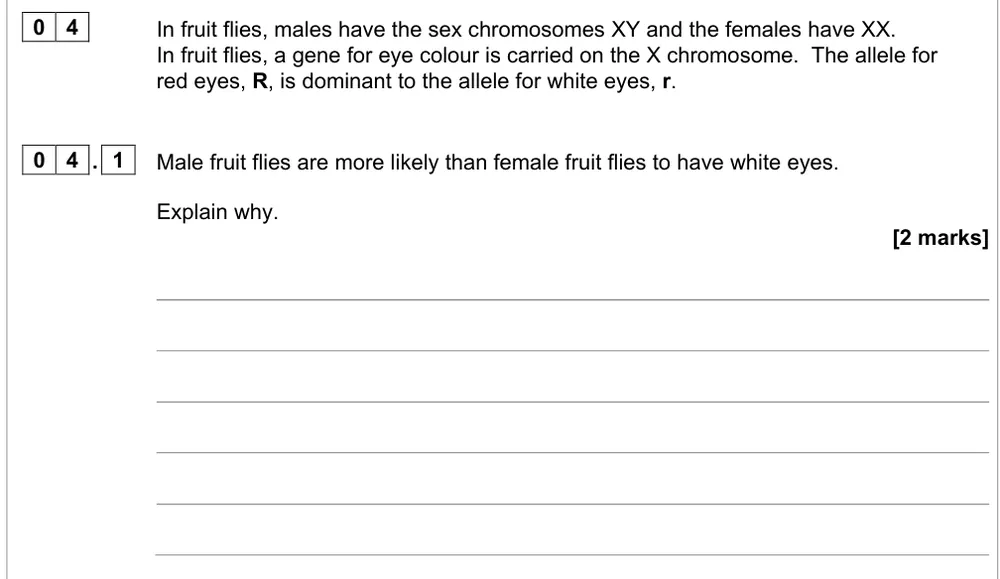
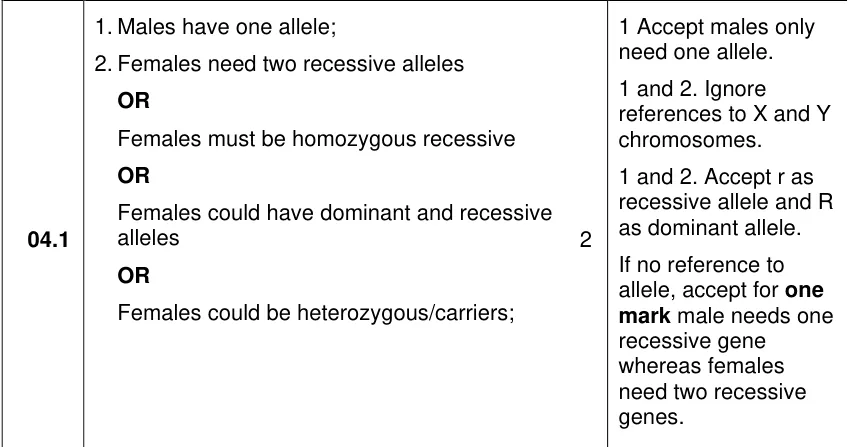
Explain why male fruit flies are more likely than females to have white eyes.
Show the mark scheme
Tap an image to open it full size.
From the examiners' report: 52% got both marks. Talk about alleles, not just X and Y chromosomes: males need only one recessive allele, while females need two, or can be heterozygous carriers.
Question 8
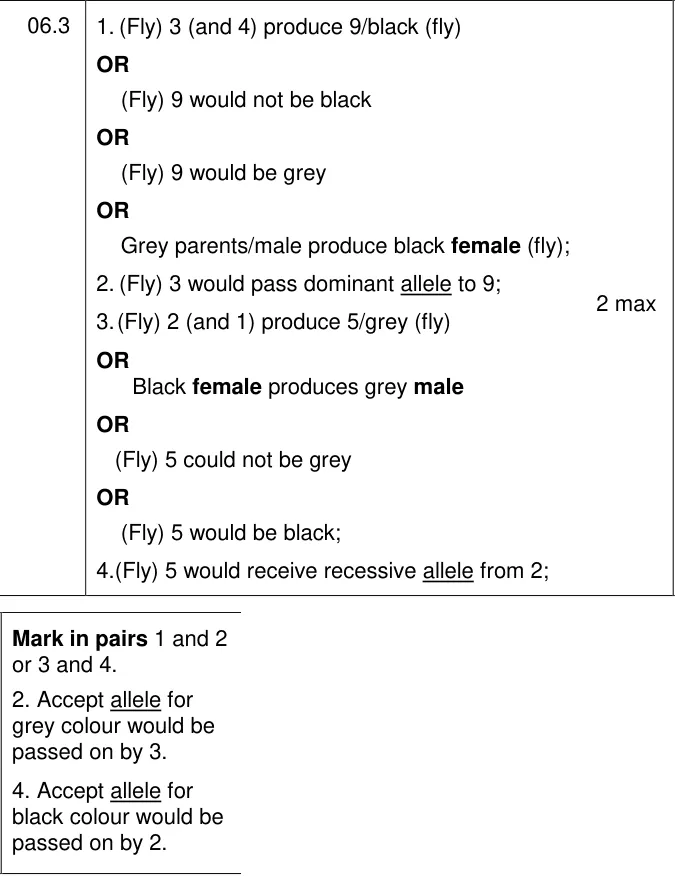
A level Paper 2 · June 2019 · Q06.3 · 2 marks · Hard
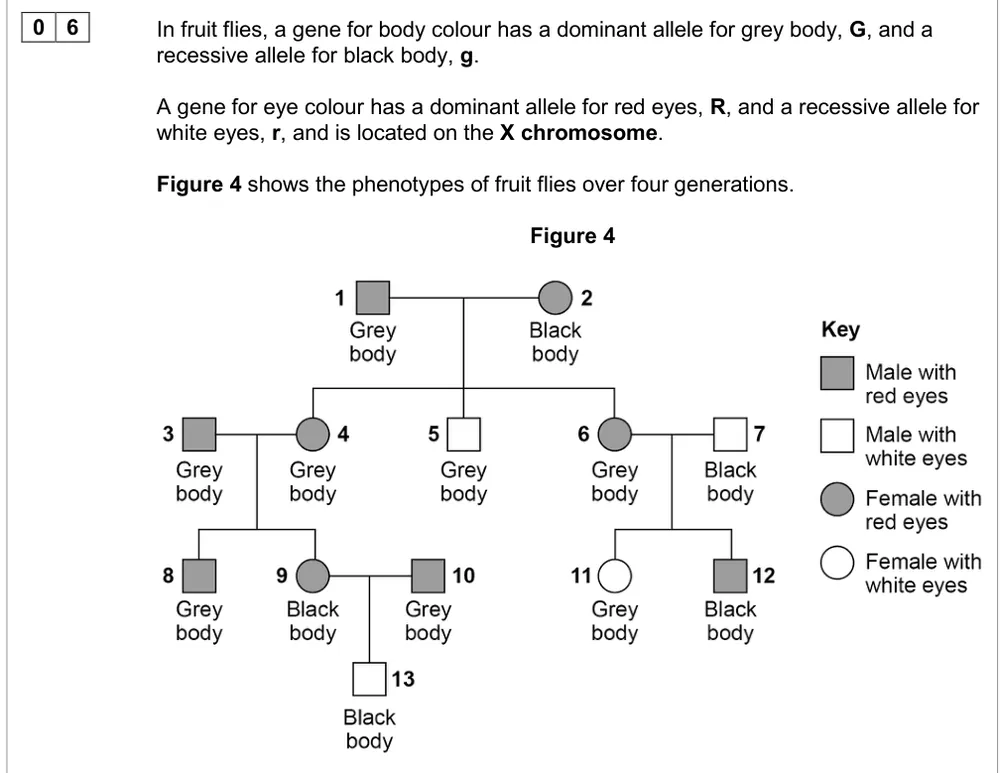
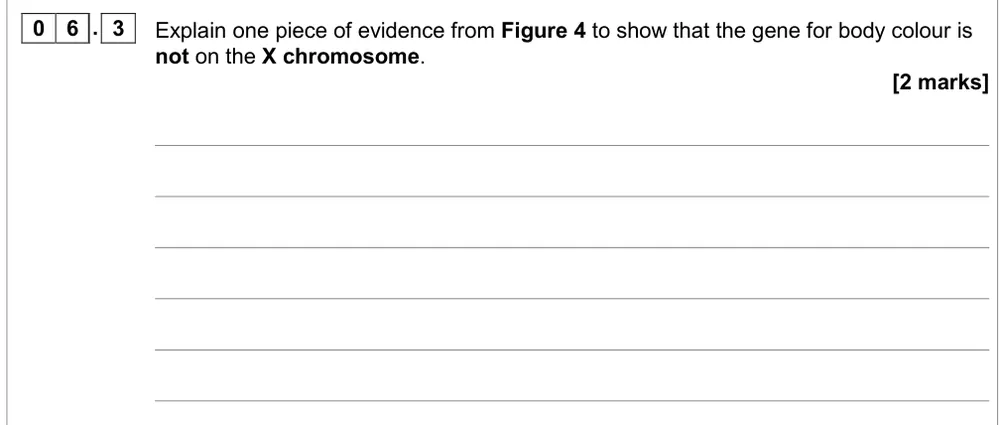
Use a fruit fly pedigree to show the body colour gene is not on the X chromosome.
Information from earlier in this question:
Show the mark scheme
Tap an image to open it full size.
From the examiners' report: Only 5% got both marks. Pick a pair of flies that breaks the X-linked pattern, such as grey male 3 having black daughter 9, then explain it with alleles: 3 would have to pass his dominant allele to every daughter.
Question 9
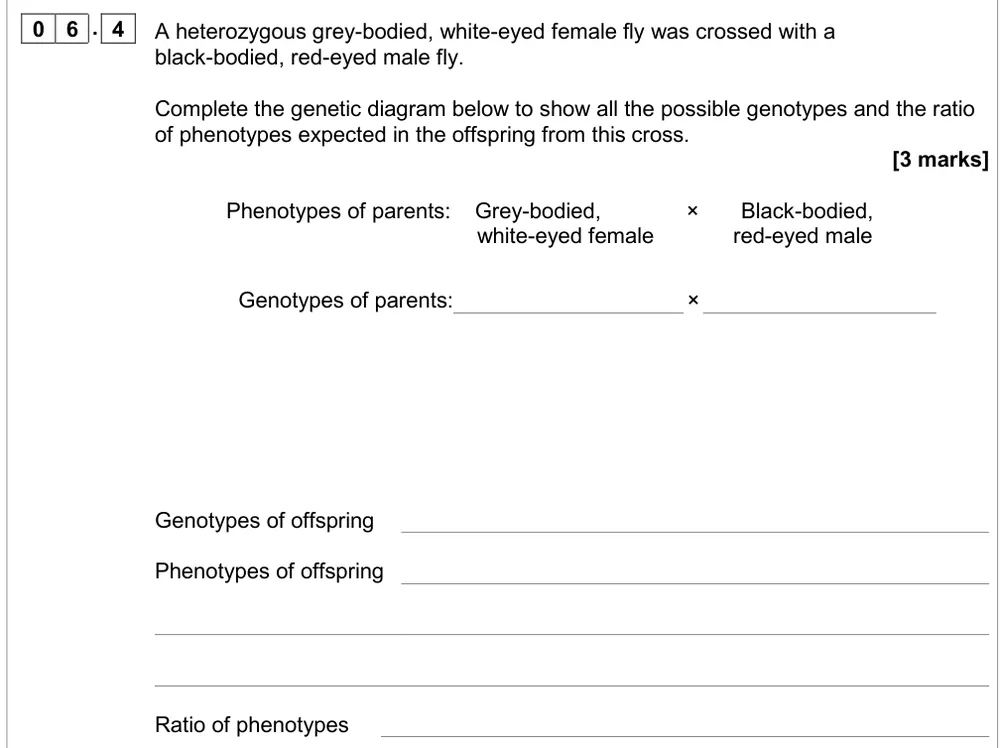
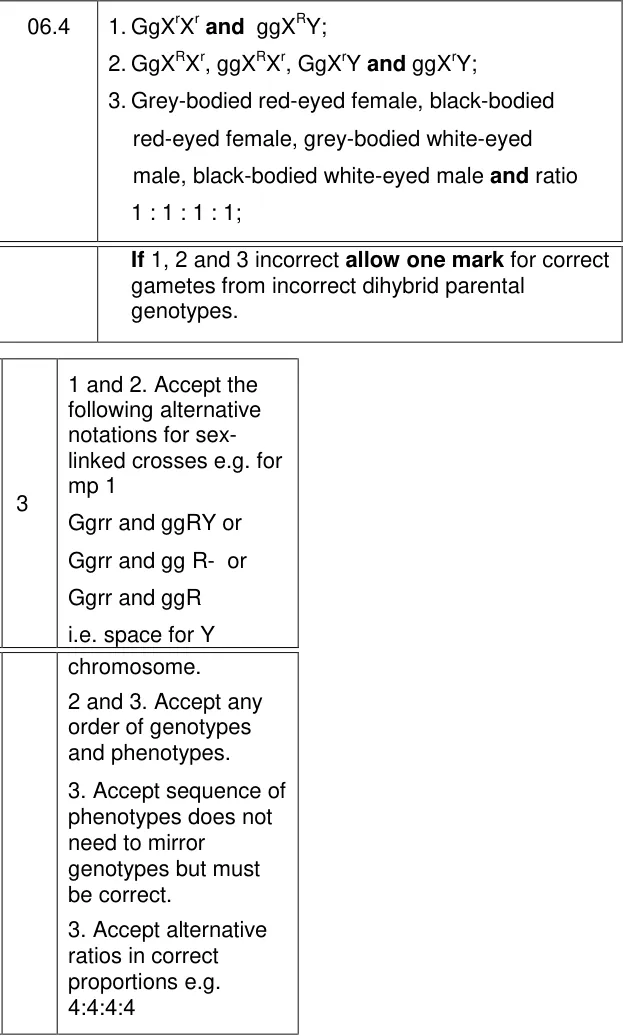
A level Paper 2 · June 2019 · Q06.4 · 3 marks · Hard
Complete a dihybrid cross with one autosomal gene and one sex-linked gene.
Show the mark scheme
Tap an image to open it full size.
From the examiners' report: About 28% got all three. Write the eye colour alleles on X chromosomes, give the male a Y, and include the sex in every offspring phenotype, since all daughters here are red-eyed and all sons white-eyed.
Epistasis (3.7.1)
Question 10
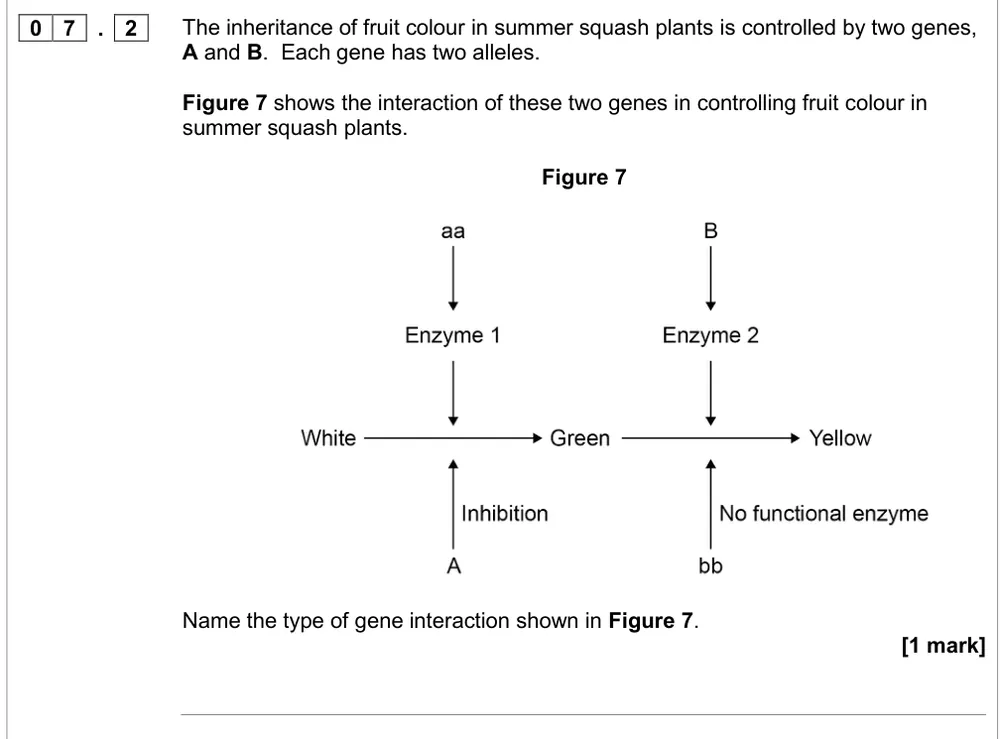
A level Paper 2 · June 2017 · Q07.2 · 1 mark · Easy
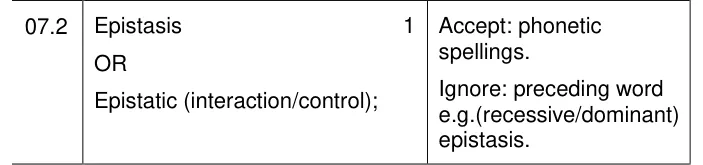
Name the type of gene interaction controlling summer squash fruit colour.
Show the mark scheme
Tap an image to open it full size.
From the examiners' report: Almost 60% named epistasis. Dihybrid and codominance were the usual wrong answers: when one gene controls whether another gene's effect can show, it's epistasis.
Question 11
A level Paper 2 · June 2017 · Q07.4 · 3 marks · Easy
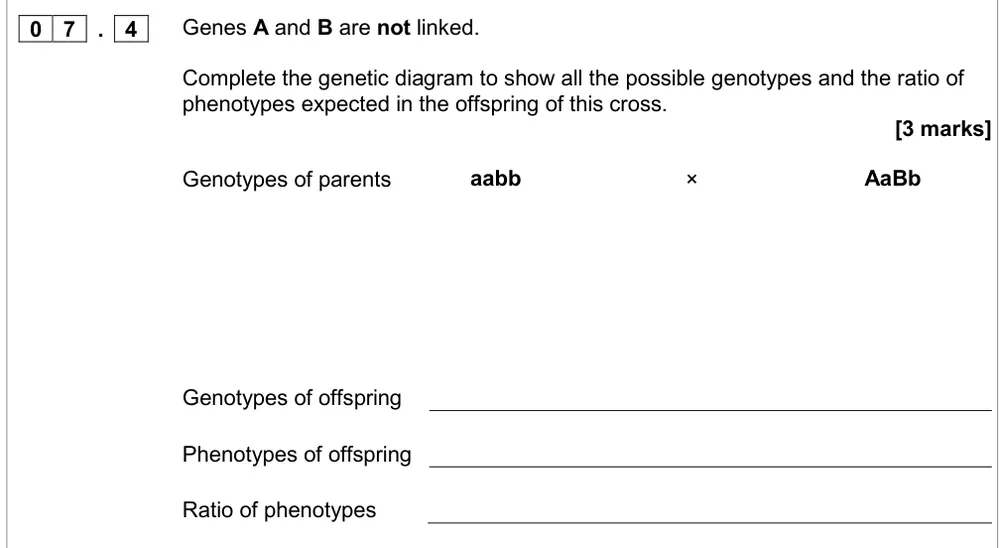
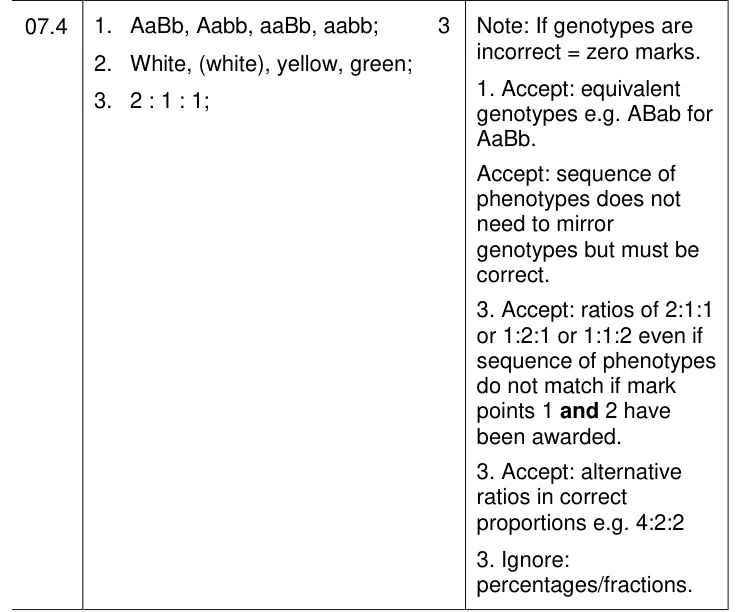
Complete an epistasis cross for summer squash fruit colour.
Show the mark scheme
Tap an image to open it full size.
From the examiners' report: Over 55% got all three, but over 25% scored zero. Use Figure 7 for each genotype: both Aa offspring are white, so the ratio is 2 white : 1 yellow : 1 green, not 1 : 1 : 1 : 1 or 9 : 3 : 3 : 1.
Question 12
A level Paper 2 · June 2023 · Q04.3 · 3 marks · Medium
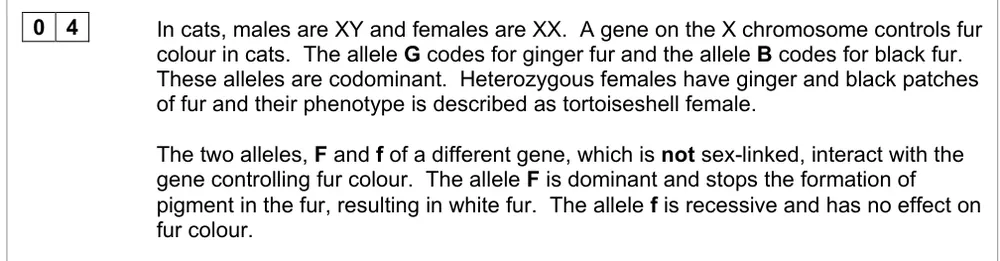
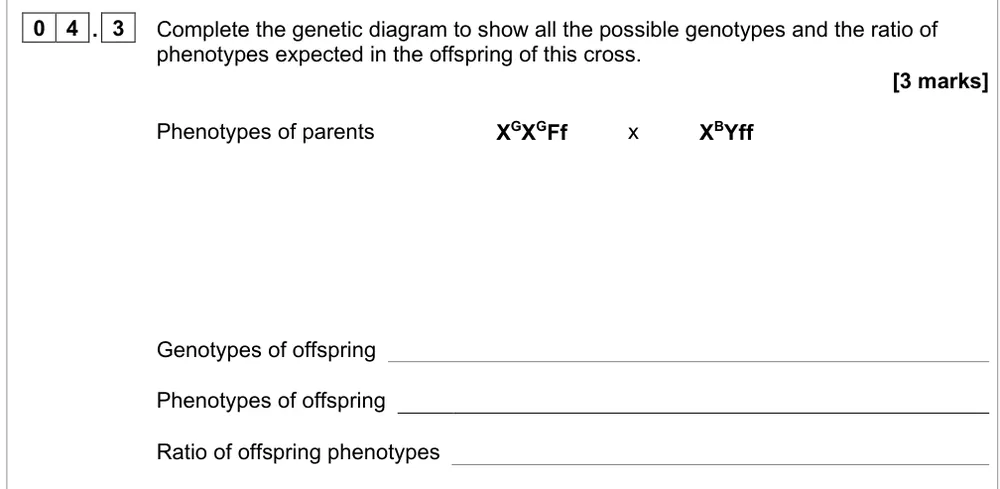
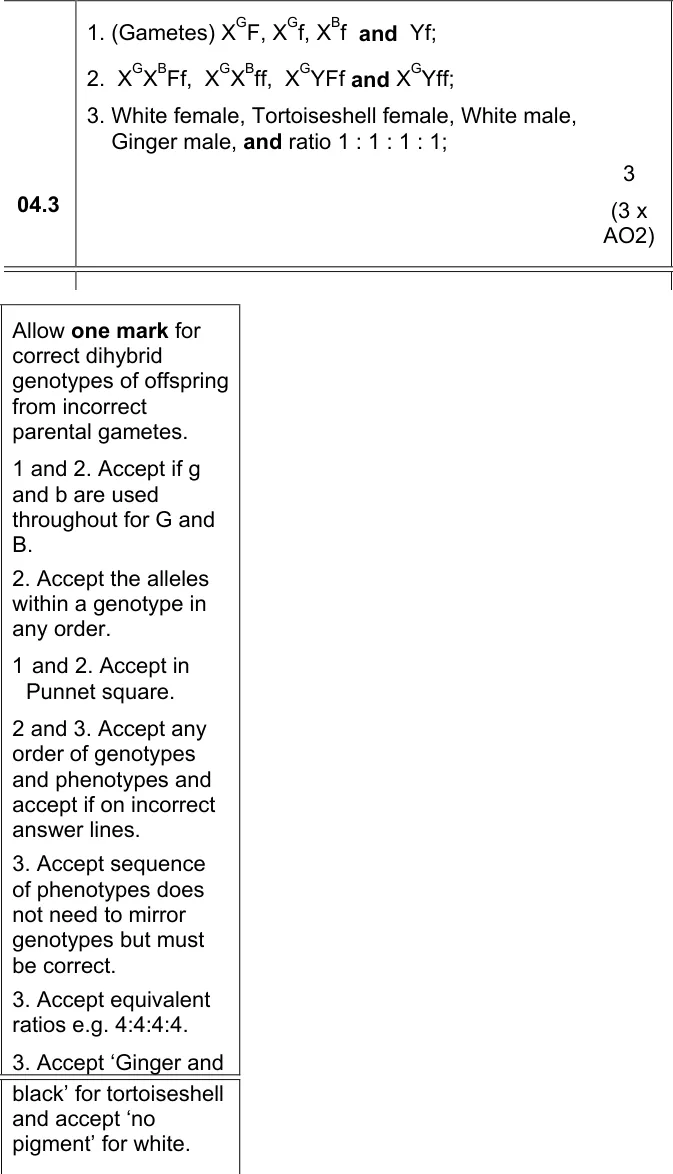
Complete a cross for cat fur colour with a sex-linked gene and an epistatic gene.
Information from earlier in this question:
Show the mark scheme
Tap an image to open it full size.
From the examiners' report: 44% got all three and 28% got two, usually because they left out the sex or combined white males with white females to give 2 : 1 : 1. Keep males and females separate in the phenotypes and the ratio.
Autosomal linkage (3.7.1)
Question 13
A level Paper 2 · November 2021 · Q04.3 · 3 marks · Hard
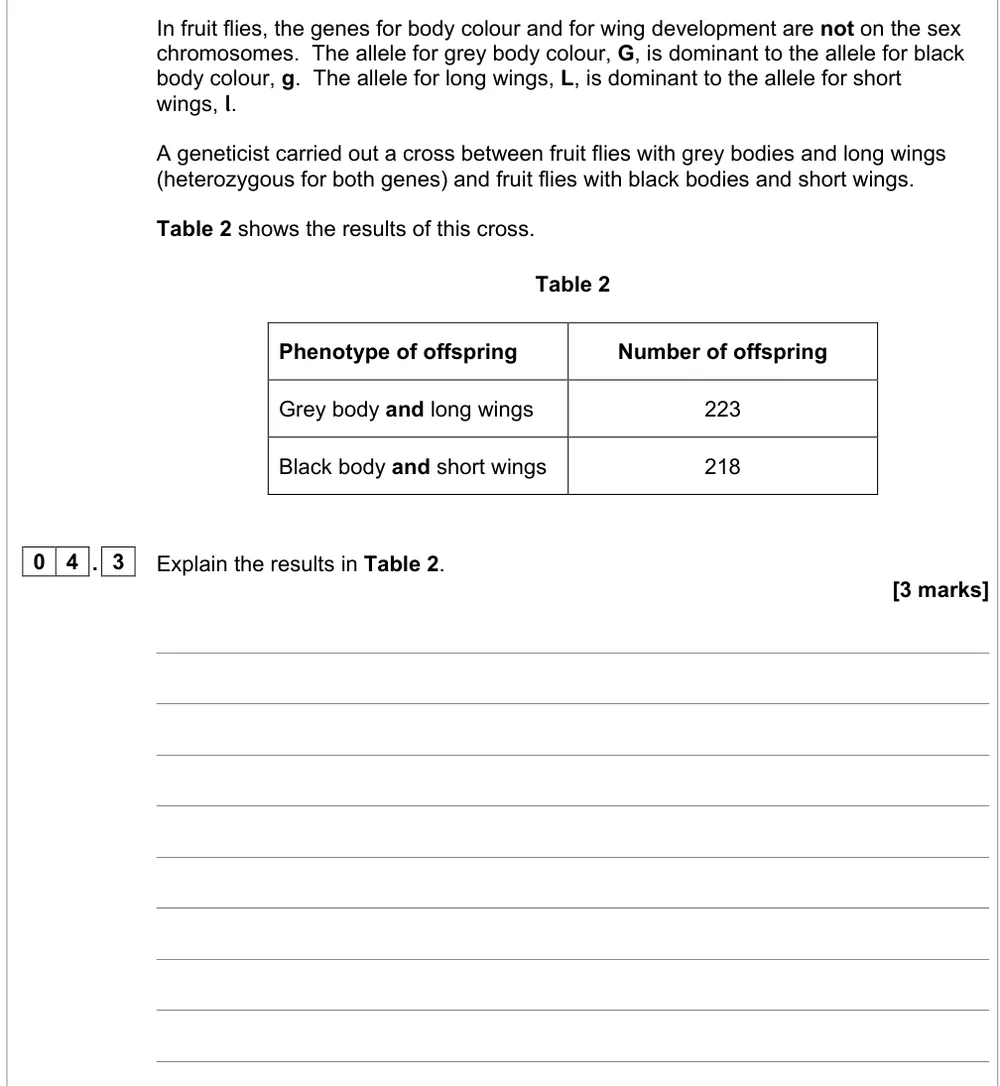
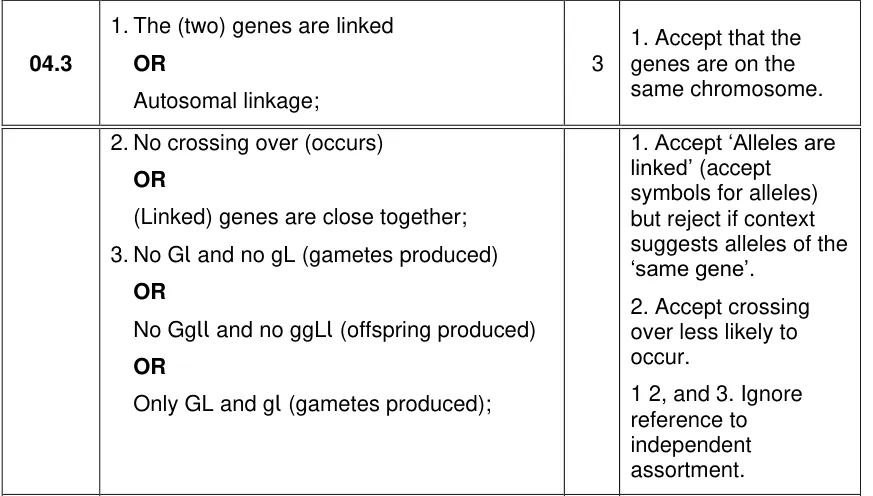
Explain why a dihybrid test cross produced only two phenotypes.
Show the mark scheme
Tap an image to open it full size.
From the examiners' report: Only 1% got all three. Explain why you get 1 : 1, not 1 : 1 : 1 : 1: the genes are on the same chromosome, no crossing over happened, so only GL and gl gametes were made.
Question 14
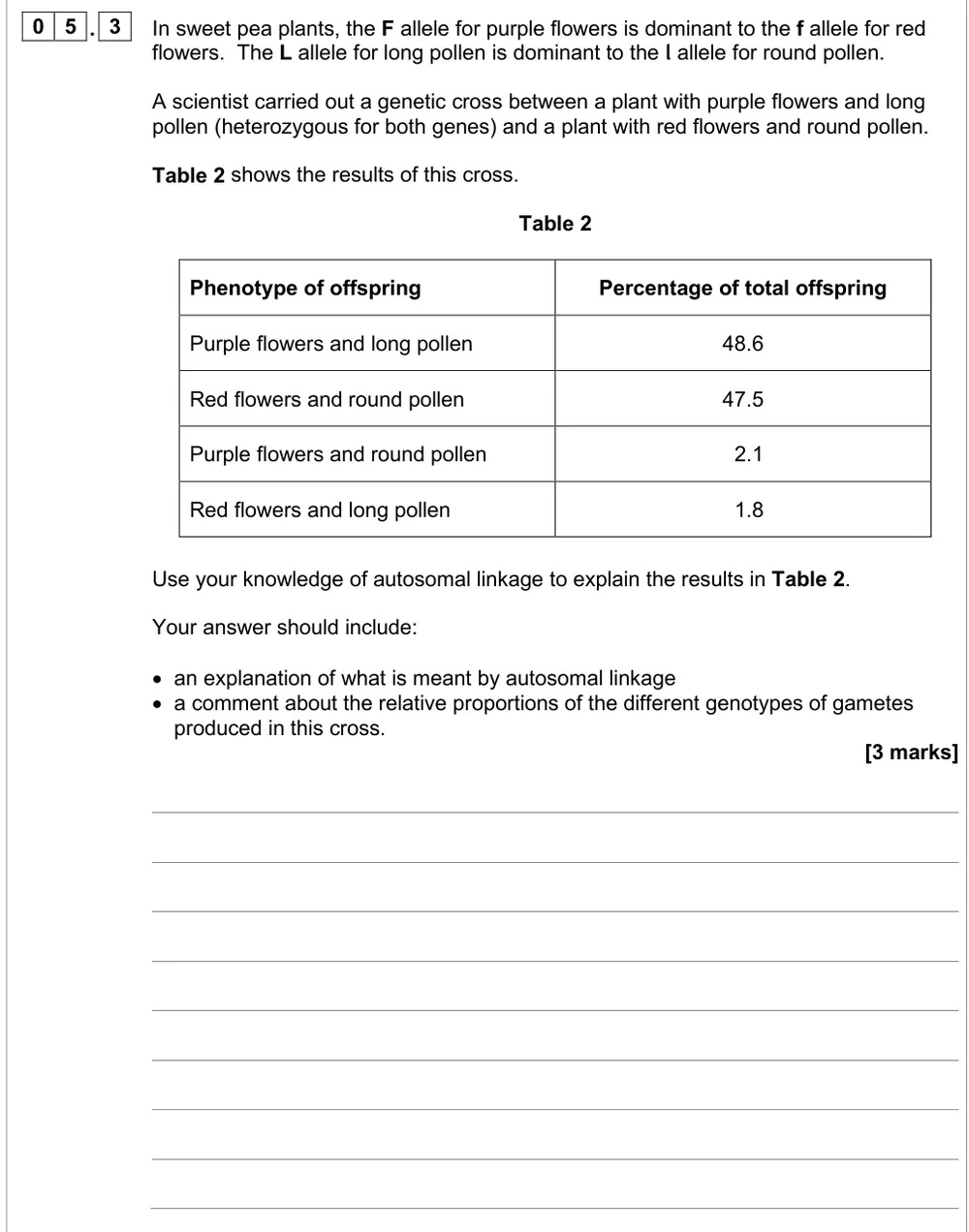
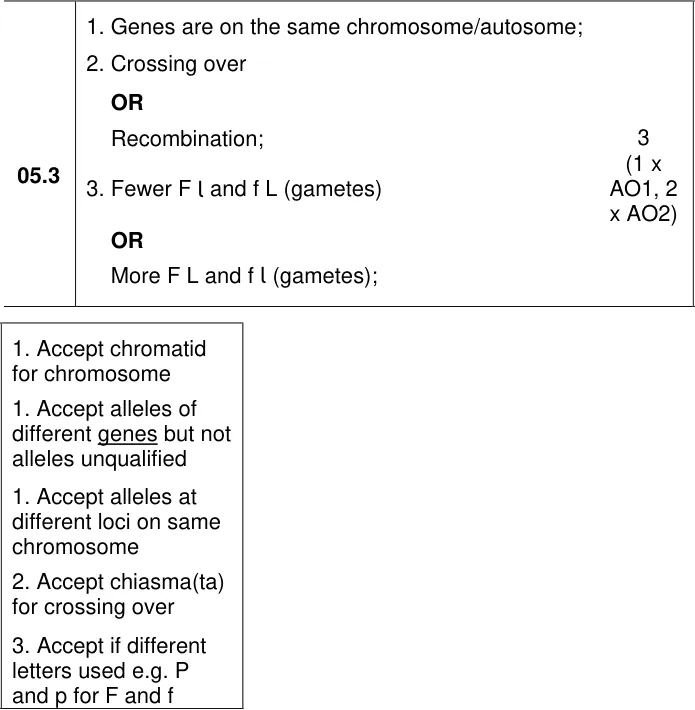
A level Paper 2 · June 2025 · Q05.3 · 3 marks · Hard
Use autosomal linkage to explain the percentages of four phenotypes from a cross.
Show the mark scheme
Tap an image to open it full size.
From the examiners' report: Only 10% got all three. Define linkage as different genes on the same autosome, name crossing over, and then write about the gametes, Fl and fL being rare, not just the offspring.
Probability and the chi-squared test (3.7.1)
Question 15
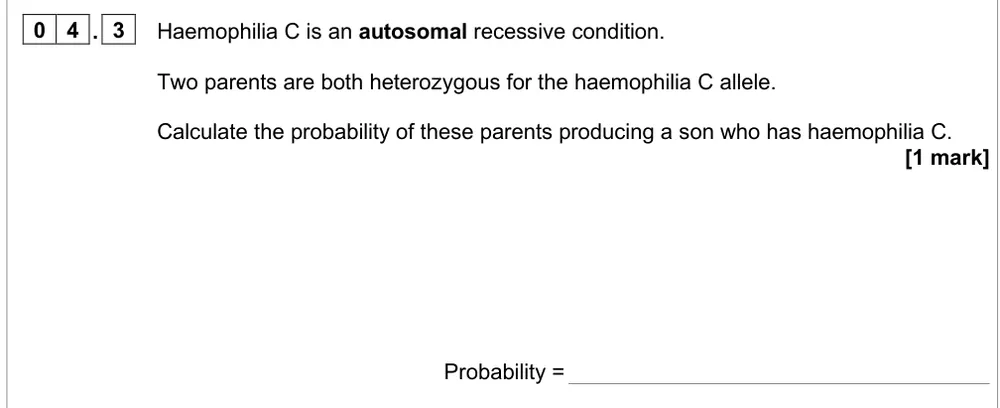
A level Paper 2 · June 2025 · Q04.3 · 1 mark · Hard
Calculate the chance that two carrier parents have a son with haemophilia C.
Show the mark scheme

Tap an image to open it full size.
From the examiners' report: Only about 30% got this. The usual answer was 0.25, the chance of an affected child; the question wants a son, so multiply by the 0.5 chance of a boy.
Question 16
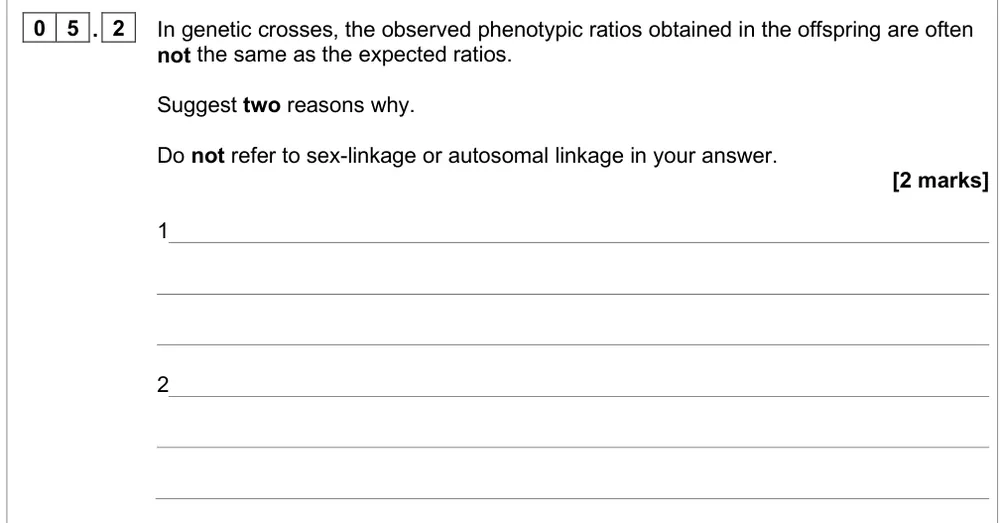
A level Paper 2 · June 2025 · Q05.2 · 2 marks · Medium
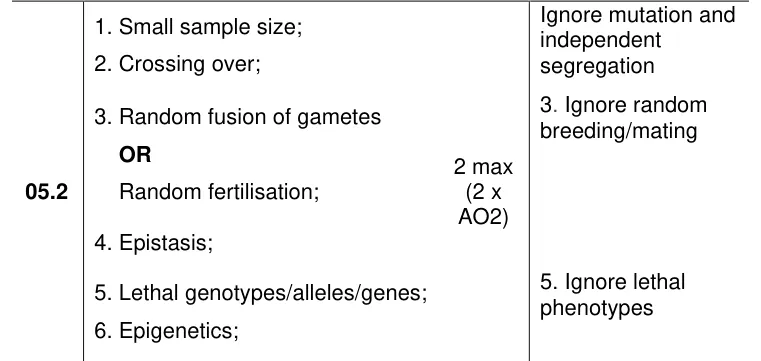
Suggest two reasons why observed ratios differ from the expected ratios.
Show the mark scheme
Tap an image to open it full size.
From the examiners' report: Over a third got both and almost 80% got one. Mutation was the most common wrong answer: it's far too rare to change a ratio. Random fertilisation, crossing over and small samples scored.
Question 17
A level Paper 2 · June 2022 · Q06.5 · 2 marks · Easy
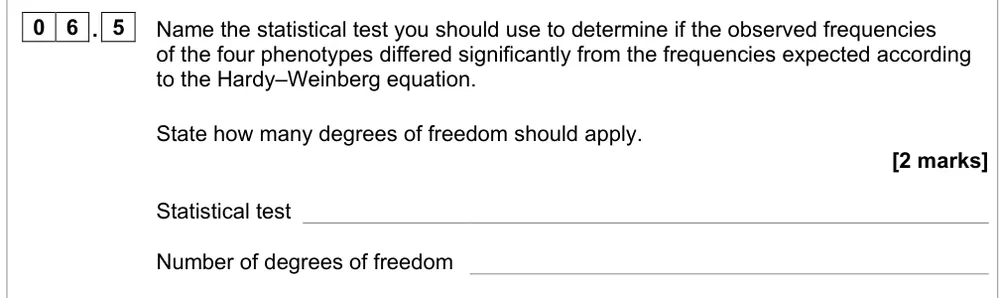
Name the test that compares observed and expected phenotype frequencies and give the degrees of freedom.
Information from earlier in this question:

Show the mark scheme

Tap an image to open it full size.
From the examiners' report: 88% named chi-squared but only 44% got both marks. Degrees of freedom are the number of categories minus one: four phenotypes give 3, not 2, 4 or 0.05.
Question 18
A level Paper 1 · June 2018 · Q06.2 · 2 marks · Medium
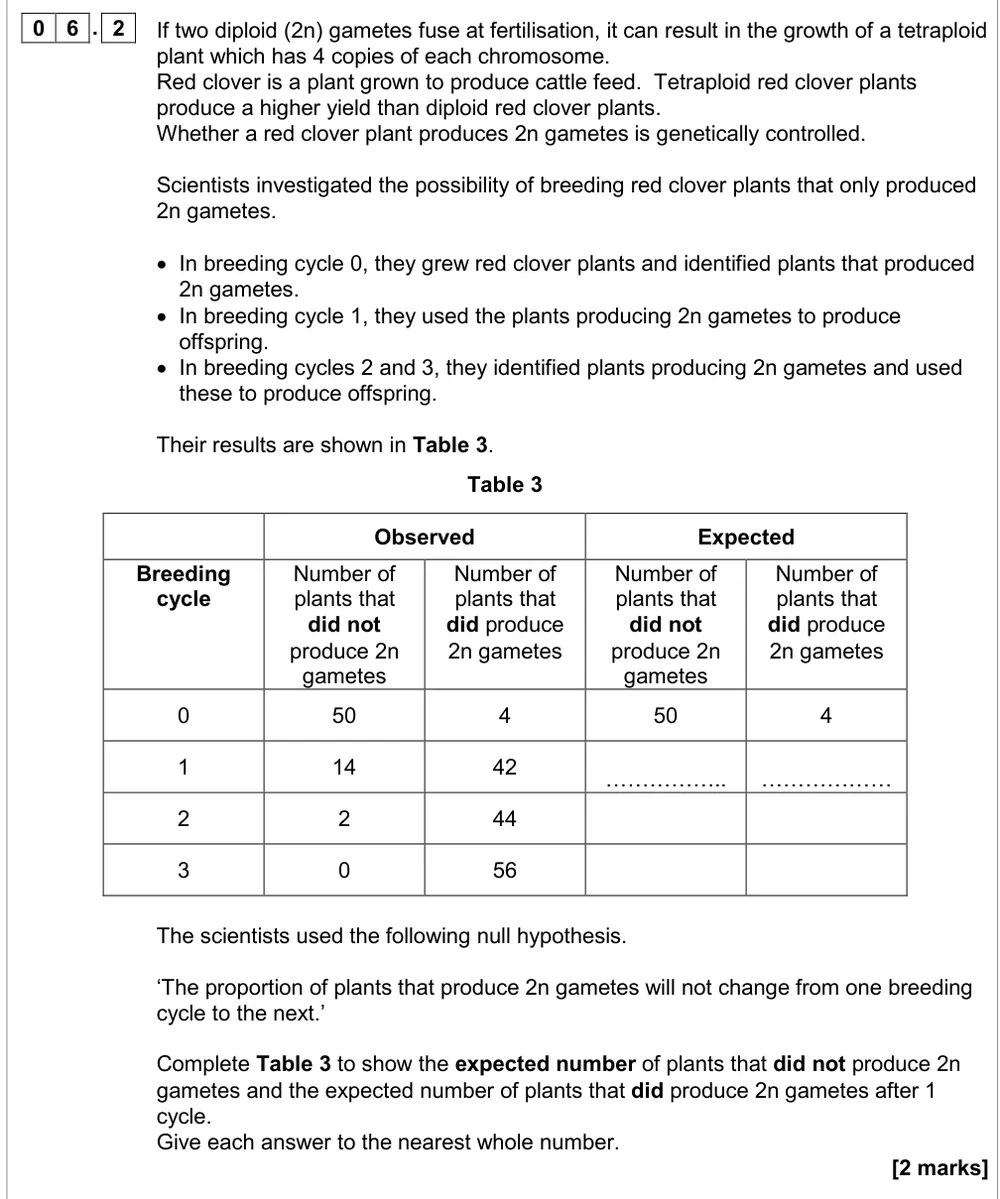
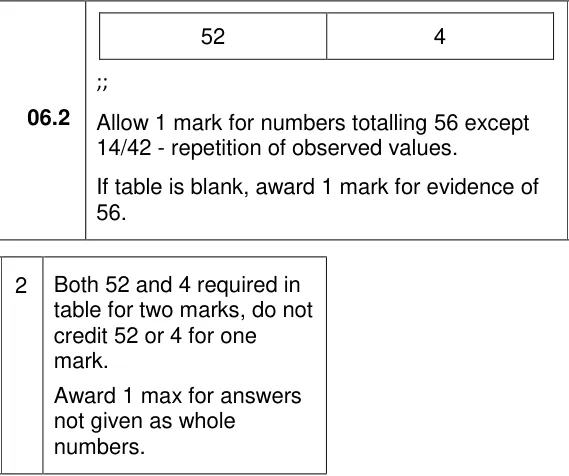
Calculate expected numbers of plants under a null hypothesis for a chi-squared test.
Show the mark scheme
Tap an image to open it full size.
From the examiners' report: Only 22.3% got both marks. Keep the cycle 0 proportions (50/54 and 4/54) and apply them to the new total of 56 plants in cycle 1.
Where students lose marks (from AQA examiners' reports and mark schemes)
Each point below is followed by wording that gained marks.
Phenotype needs the genotype and the environment: About 95% got a mark for phenotype but only 60% got both. Answers that just said 'appearance of a characteristic' scored nothing, and many left out the environment.
✔ Gains credit: "Expression or characteristic due to the genotype or alleles; and due to interaction with the environment."
Cross with the recessive and read the offspring: 46% got both marks for testing a grey fly. Crossing two grey flies didn't score, and many said the offspring would show the genotype without saying how.
✔ Gains credit: "Cross with a black (gg) fly; any black offspring means the grey fly is heterozygous, all grey offspring means it's homozygous."
Both parents carry the recessive allele: 62% failed to score on the Rhesus pedigree. Some used individuals 1, 2 and 3, and many who chose 3, 4 and 7 said only one of the parents was heterozygous.
✔ Gains credit: "3 and 4 (Rhesus positive) produce 7 (Rhesus negative); both 3 and 4 have the recessive allele or are heterozygous."
Males have one allele; females need two: 52% got both marks on white-eyed flies. Answers that talked only about X and Y chromosomes, never mentioning alleles, scored nothing, and some wrote 'an X allele' or put the allele on the Y chromosome.
✔ Gains credit: "Males have one allele; females need two recessive alleles or could be heterozygous (carriers)."
Every sex-linked phenotype needs a sex: On the cat cross 28% got two marks because they left the sex out of the phenotypes or lumped white males with white females, giving 2 : 1 : 1. The fruit fly cross lost marks the same way.
✔ Gains credit: "White female, tortoiseshell female, white male, ginger male, and ratio 1 : 1 : 1 : 1."
Offspring that die as embryos leave the ratio: Around 65% had the right genotypes for the curly-winged cross, but only 25% got all three because many kept the homozygous curly flies and gave 3 : 1 or 1 : 2 : 1.
✔ Gains credit: "RrGg (×2), rrGg (and RRGg); curly-winged grey and normal-winged grey in a ratio of 2 : 1."
Linkage means genes on one chromosome, then explain the gametes: Only 1% got all three on the 1 : 1 fruit fly results and 10% on the sweet peas. Many wrote 'alleles are linked' with no genes, and talked about offspring instead of the gametes made with or without crossing over.
✔ Gains credit: "Genes are on the same chromosome (autosome); crossing over; fewer Fl and fL gametes, or more FL and fl gametes."
Degrees of freedom are categories minus one: 88% named the chi-squared test but only 44% also gave the degrees of freedom. Common wrong answers were 2, 4, 5 and even 0.05.
✔ Gains credit: "Chi-squared; 3" (four phenotypes, so 4 − 1).
Download the questions
Download the PDF pack (18 questions, mark schemes at the end)
Keep practising
- Populations and the Hardy-Weinberg principle: AQA A Level Biology exam questions by topic
- AQA 3.7.1 inheritance: self-marking quiz
- Mutation and meiosis: AQA A Level Biology exam questions by topic
- DNA, genes and chromosomes: AQA A Level Biology exam questions by topic
- AQA A Level Biology masterclasses
Questions, mark schemes and examiners' report extracts © AQA.