

Mutation and meiosis (AQA 3.4.3) explains where genetic diversity comes from, and it is examined on both AS and A-level papers, often with a diagram to complete. You need to describe gene mutations as changes in the base sequence, explain why some base substitutions don't change the amino acid sequence, explain non-disjunction, show how meiosis gives four haploid cells that are genetically different through independent segregation and crossing over, complete chromosome diagrams, compare mitosis and meiosis, and explain how random fertilisation adds more variation.
The examiners' reports keep picking up the same problems. Students forget that a mutation is a change in the DNA base sequence, quote mRNA bases when asked for the DNA change, think the second meiotic division halves the chromosome number, write 'homologous chromosomes' when the question is about the second division, mix up chromosomes and chromatids, and name crossing over without saying it happens between homologous chromosomes.
Start with gene and chromosome mutations, then the meiosis and variation questions, and finish with the diagrams and data. Answer each question on paper before you open the mark scheme. If you'd like help with this topic, my AQA masterclasses run online on Tuesdays at 5.15pm for Year 12 and on Wednesdays or Thursdays at 6.30pm for Year 13.
What you need from GCSE and Year 12
Each question on this page assumes you're secure on these GCSE and Year 12 ideas. If any of them feels shaky, revise it before you start.
- GCSE: meiosis makes gametes with half the number of chromosomes, and the four gametes are genetically different from each other.
- GCSE: a mutation is a change in DNA; most have no effect on the phenotype, but some change the protein made.
- Year 12 (AQA 3.2.2): DNA replicates in interphase, and mitosis produces two genetically identical daughter cells.
- Year 12 (AQA 3.4.1): the genetic code is a triplet code that is degenerate, and genes contain exons and introns.
- Year 12 (AQA 3.4.2): mRNA codons are complementary to the DNA template, and a codon table links each codon to an amino acid.
Key terms
These words come up in the questions and mark schemes. Examiners expect you to use them exactly.
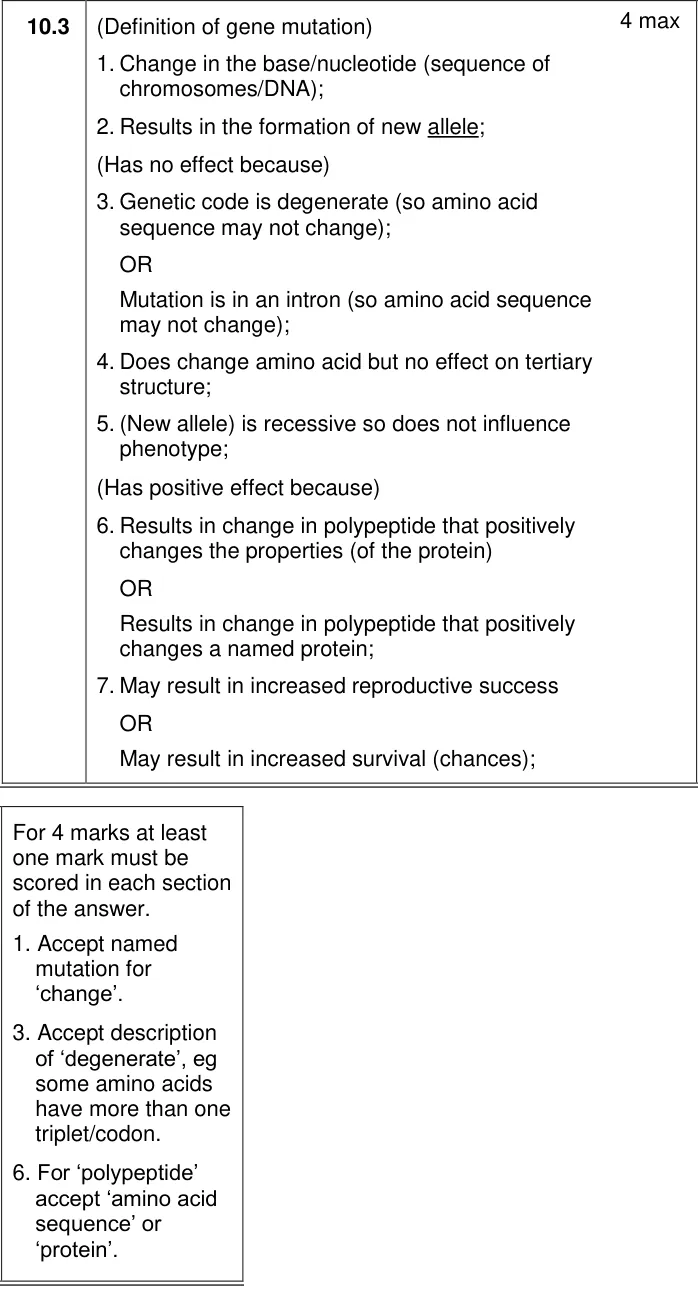
- Gene mutation: a change in the base sequence of DNA (chromosomes), such as base substitution or base deletion, which forms a new allele.
- Base substitution: one base in the DNA is replaced by a different base; because the code is degenerate, the amino acid may not change.
- Base deletion: a base is lost from the DNA, causing a frameshift so every triplet after it changes.
- Mutagenic agent: a factor that increases the rate of gene mutation.
- Non-disjunction: homologous chromosomes or sister chromatids fail to separate in meiosis, so a gamete has an extra or missing chromosome.
- Haploid: having one set of chromosomes, one from each homologous pair (n).
- Homologous chromosomes: a pair of chromosomes that carry the same genes at the same loci, one maternal and one paternal.
- Independent segregation: the random arrangement and separation of homologous chromosomes in the first meiotic division, giving new combinations of maternal and paternal chromosomes.
- Crossing over: exchange of parts of chromatids (alleles) between homologous chromosomes in the first meiotic division.
- Random fertilisation: the random fusion of haploid gametes, producing new combinations of alleles.
What these questions cover (AQA 3.4.3)
The questions test these statements from the AQA AS and A-level Biology specification (7401/7402):
- Gene mutations: Gene mutations involve a change in the base sequence of chromosomes. They can arise spontaneously during DNA replication and include base deletion and base substitution. Due to the degenerate nature of the genetic code, not all base substitutions cause a change in the sequence of encoded amino acids. Mutagenic agents can increase the rate of gene mutation.
- Chromosome mutations: Mutations in the number of chromosomes can arise spontaneously by chromosome non-disjunction during meiosis.
- Meiosis: Meiosis produces daughter cells that are genetically different from each other. (tested through the meiosis and genetic variation questions below rather than on its own)
- The process of meiosis only in sufficient detail to show how: two nuclear divisions result usually in the formation of four haploid daughter cells from a single diploid parent cell
- The process of meiosis only in sufficient detail to show how: genetically different daughter cells result from the independent segregation of homologous chromosomes
- The process of meiosis only in sufficient detail to show how: crossing over between homologous chromosomes results in further genetic variation among daughter cells.
- Students should be able to: complete diagrams showing the chromosome content of cells after the first and second meiotic division, when given the chromosome content of the parent cell
- Students should be able to: explain the different outcome of mitosis and meiosis
- Students should be able to: recognise where meiosis occurs when given information about an unfamiliar life cycle (no written part in this set is a full life-cycle question; the Neurospora spore question asks you to apply meiosis to an unfamiliar fungus)
- Students should be able to: explain how random fertilisation of haploid gametes further increases genetic variation within a species.
How to use this page
Write your answer on paper before you open the mark scheme. Allow about 1.3 minutes per mark: the 18 questions are worth 49 marks, so about 64 minutes in total. Then mark your answer strictly against the mark scheme and read the examiners' tip underneath it. If you'd rather print the questions, download the PDF pack.
Gene mutations (3.4.3)
Question 1
A level Paper 1 · November 2020 · Q10.3 · 4 marks · Hard
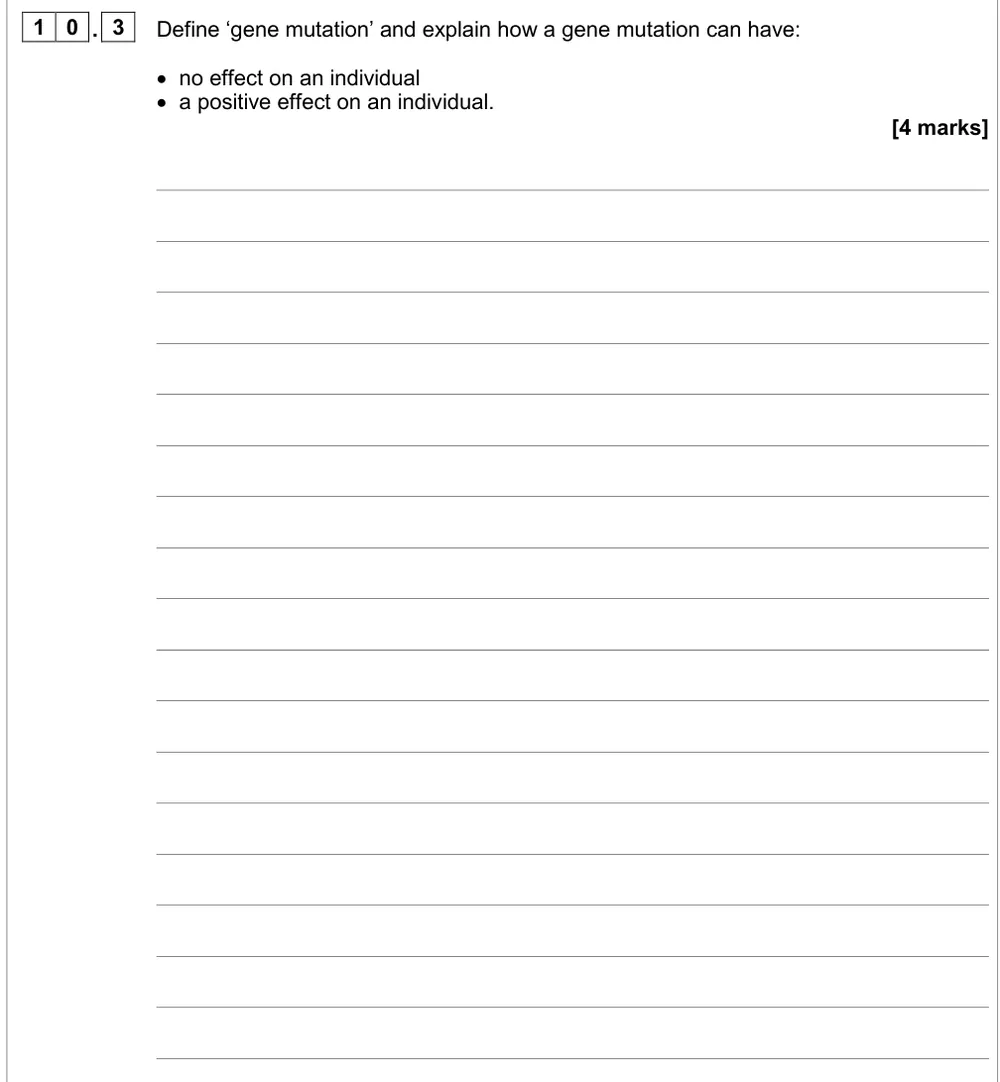
Define gene mutation and explain how one can have no effect or a positive effect.
Show the mark scheme
Tap an image to open it full size.
From the examiners' report: Don't say a mutation always changes the amino acid sequence. Every gene mutation forms a new allele, and a positive effect should end with increased survival or reproductive success.
Question 2
AS Paper 2 · November 2021 · Q03.2 · 1 mark
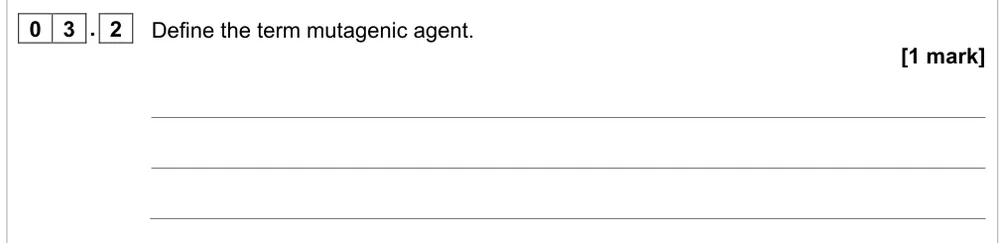
Define the term mutagenic agent.
Show the mark scheme

Tap an image to open it full size.
From the examiners' report: No examiners' report for this paper. The mark scheme wants the idea of increasing the rate of mutation, not just 'causes mutations'.
Question 3
AS Paper 2 · June 2016 · Q07.1 · 4 marks · Medium
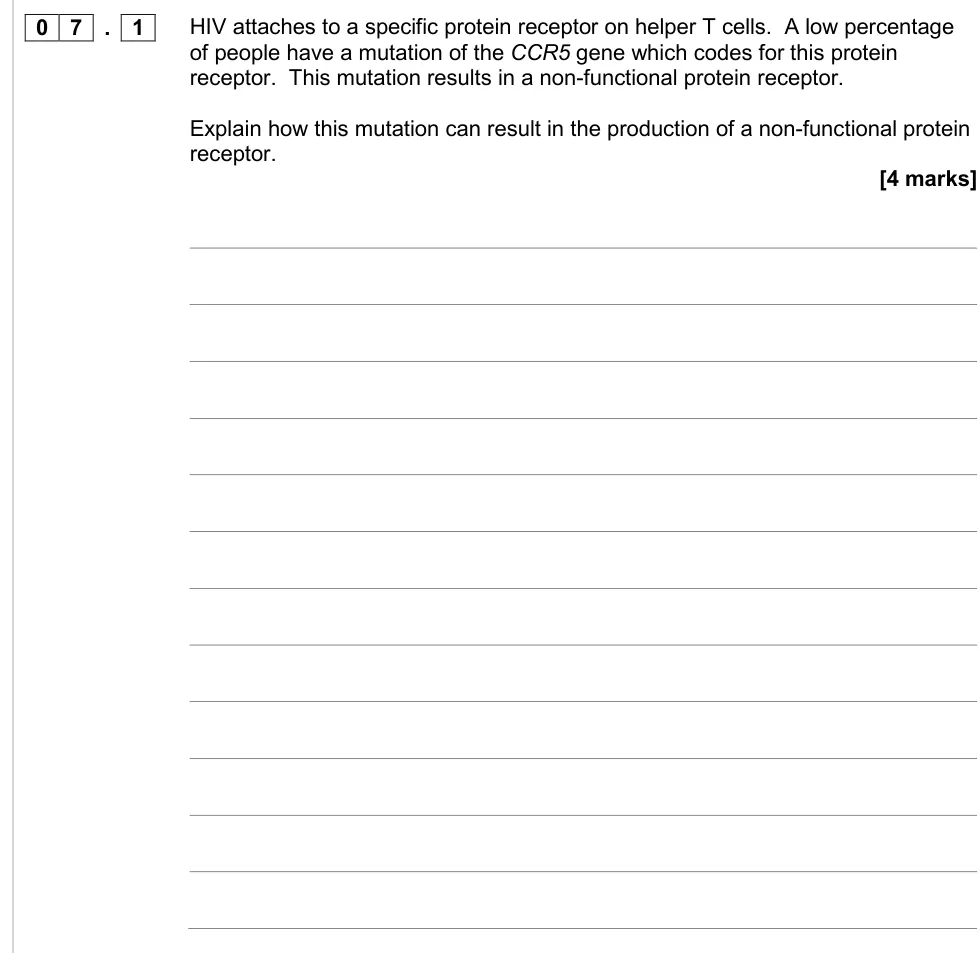
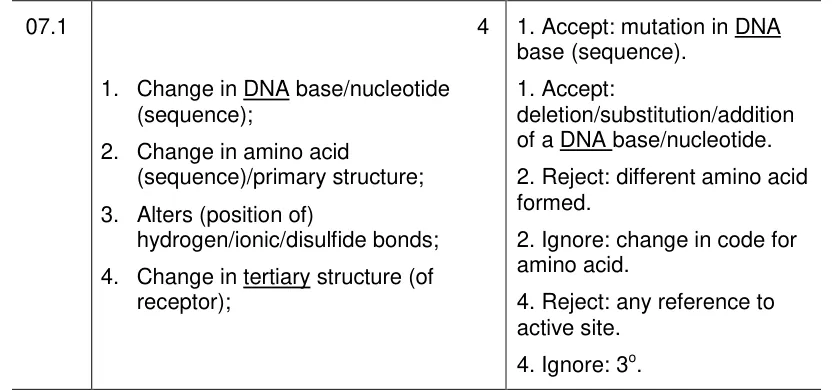
Explain how a mutation in the CCR5 gene can produce a non-functional receptor protein.
Show the mark scheme
Tap an image to open it full size.
From the examiners' report: Fewer than half scored 2 or more. Start with the change in DNA base sequence, then amino acid sequence, bonds and tertiary structure. A receptor has no active site.
Question 4
A level Paper 1 · June 2024 · Q06.3 · 4 marks · Easy
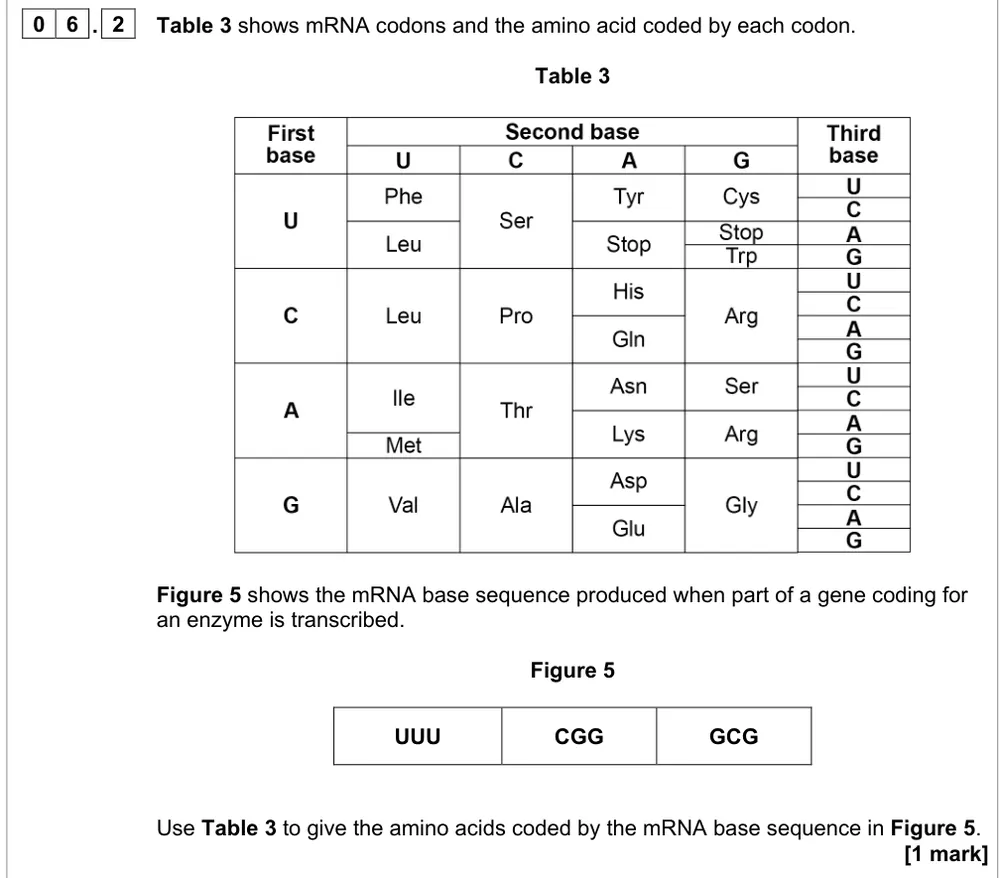
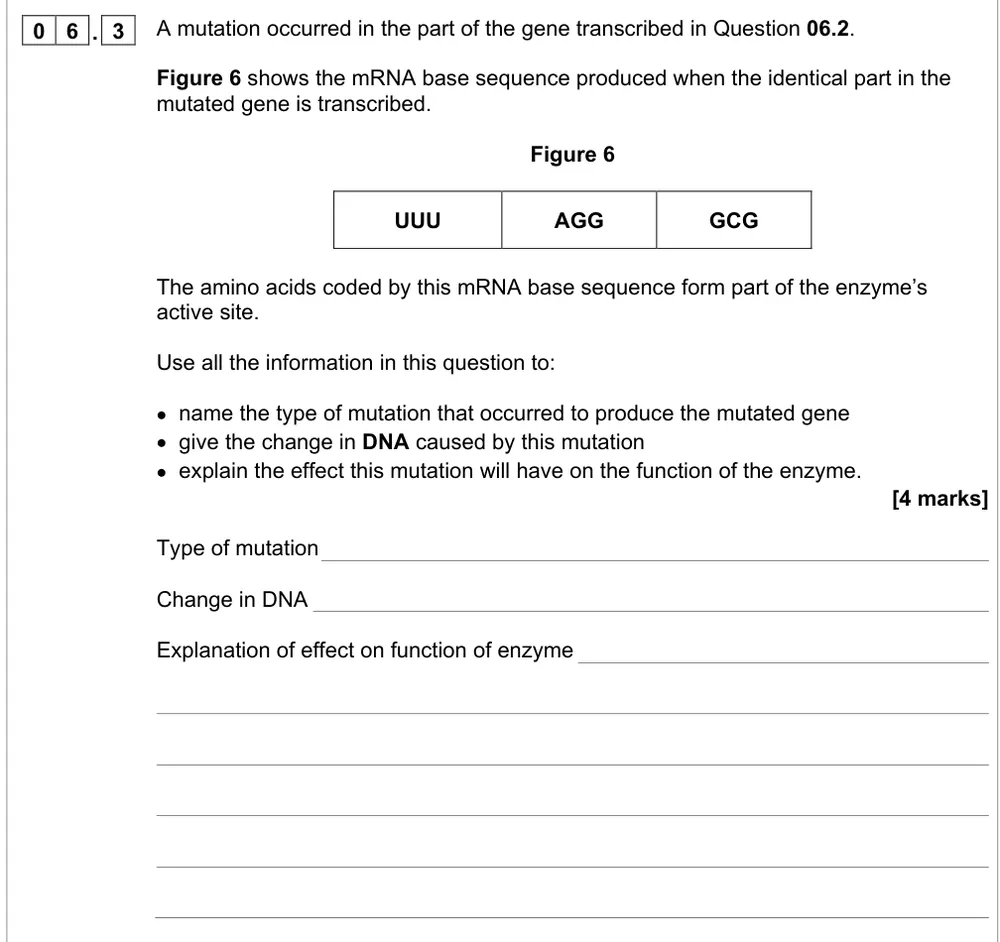
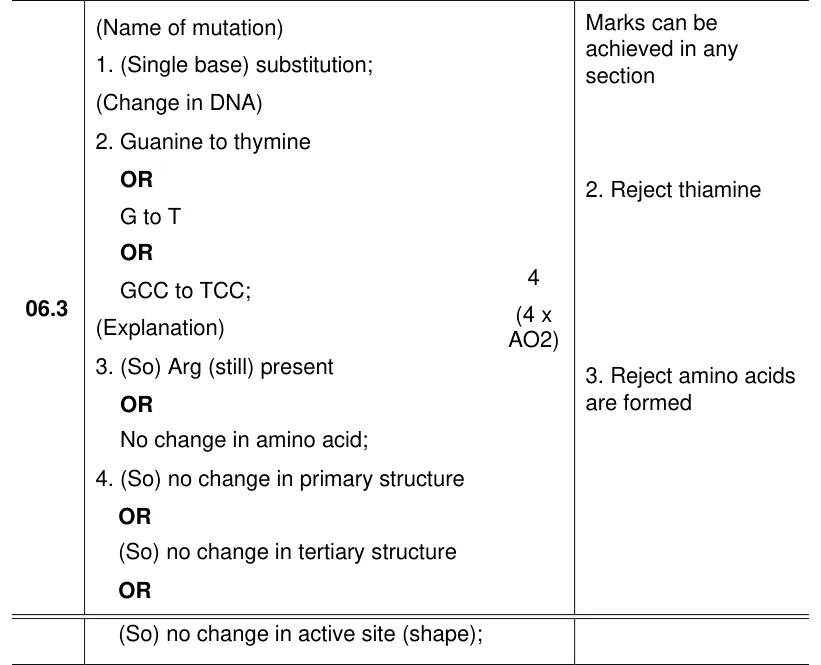
Name a mutation from mRNA sequences, give the DNA change and explain its effect on an enzyme.
Information from earlier in this question:
Show the mark scheme
Tap an image to open it full size.
From the examiners' report: Many did well. The DNA change must be in DNA bases (GCC to TCC), not mRNA. Say the base sequence codes for Arg, and that the genetic code, not the amino acid, is degenerate.
Question 5
AS Paper 1 · November 2020 · Q06.4 · 2 marks
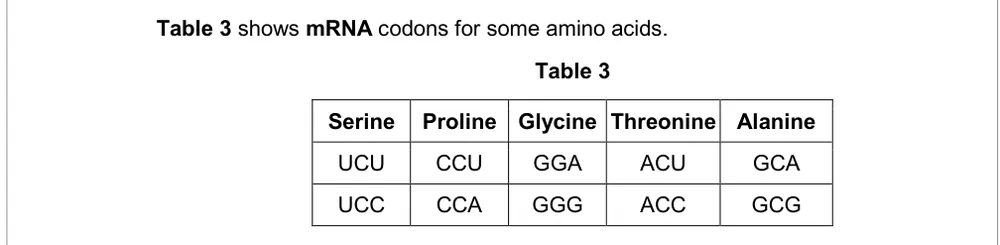
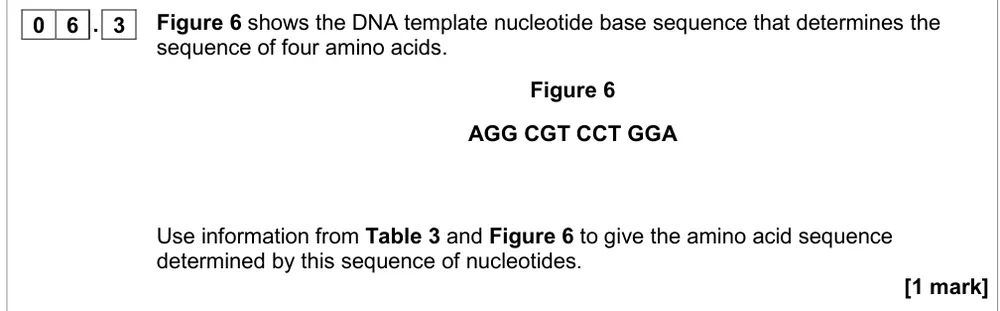
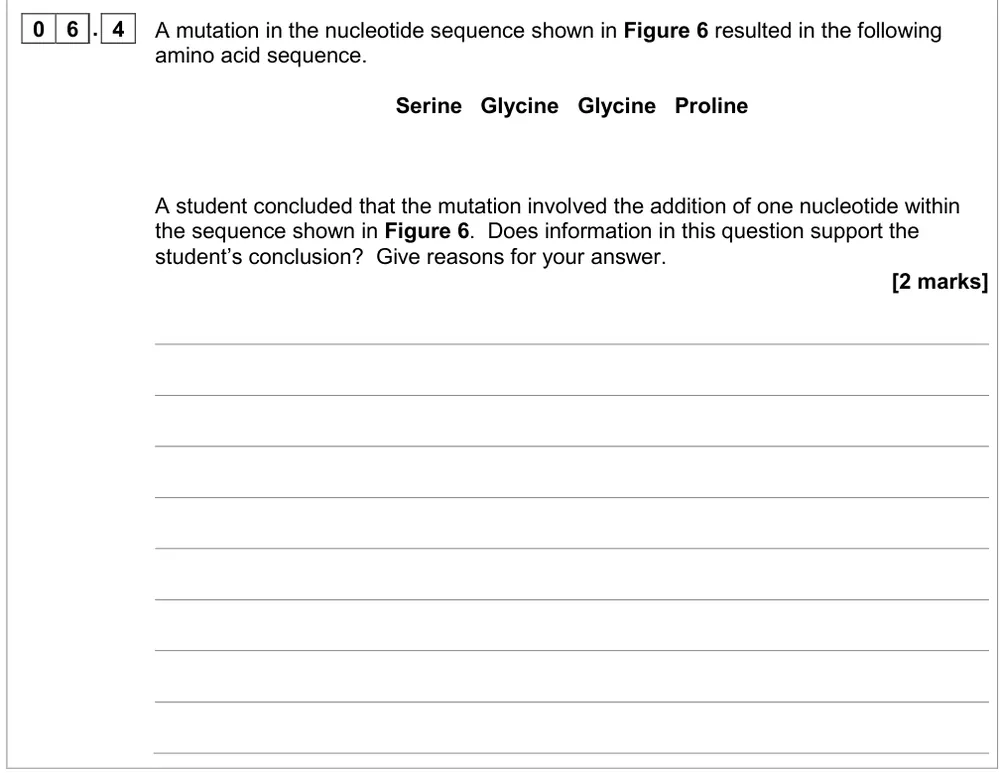
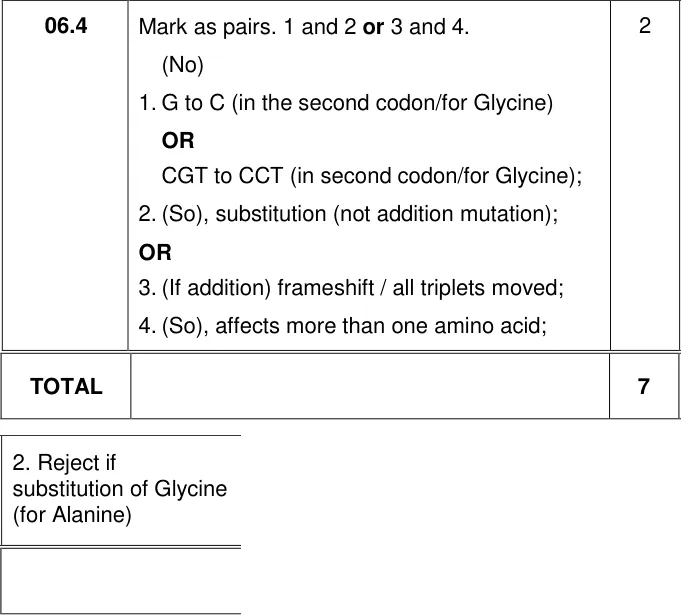
Decide whether an amino acid change is caused by adding one nucleotide, and give reasons.
Information from earlier in this question:
Show the mark scheme
Tap an image to open it full size.
From the examiners' report: Well attempted. Only one amino acid changed, so it's a substitution; an addition would cause a frameshift and change every amino acid after it.
Chromosome mutations (3.4.3)
Question 6
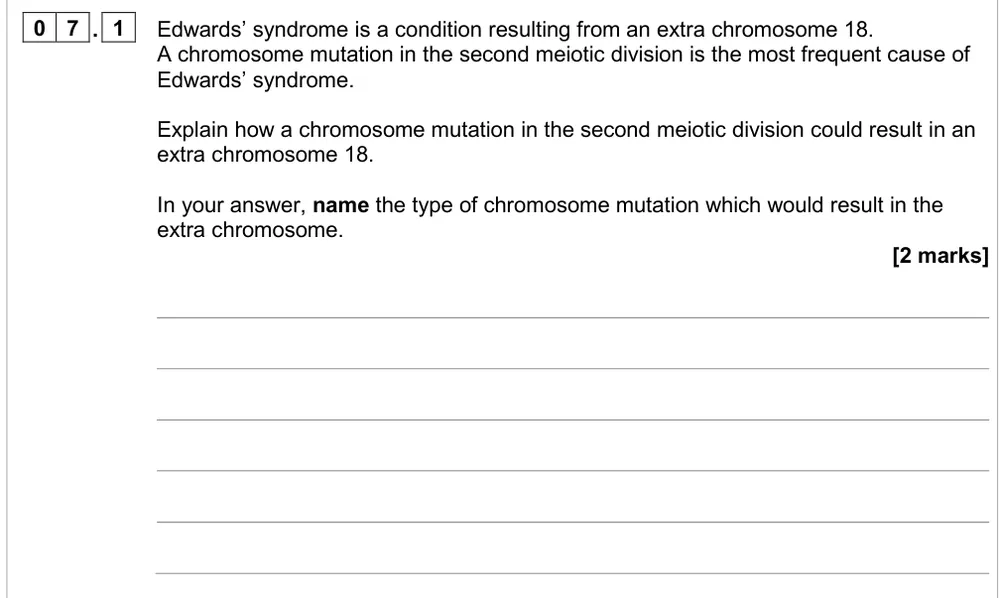
AS Paper 2 · June 2024 · Q07.1 · 2 marks
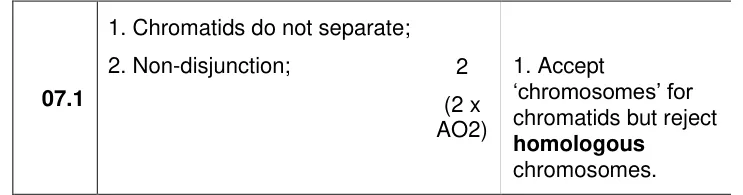
Explain how a mutation in the second meiotic division can give an extra chromosome 18.
Show the mark scheme
Tap an image to open it full size.
From the examiners' report: Almost half scored zero. In the second division it's sister chromatids that fail to separate, not homologous chromosomes. Name it: non-disjunction.
Question 7
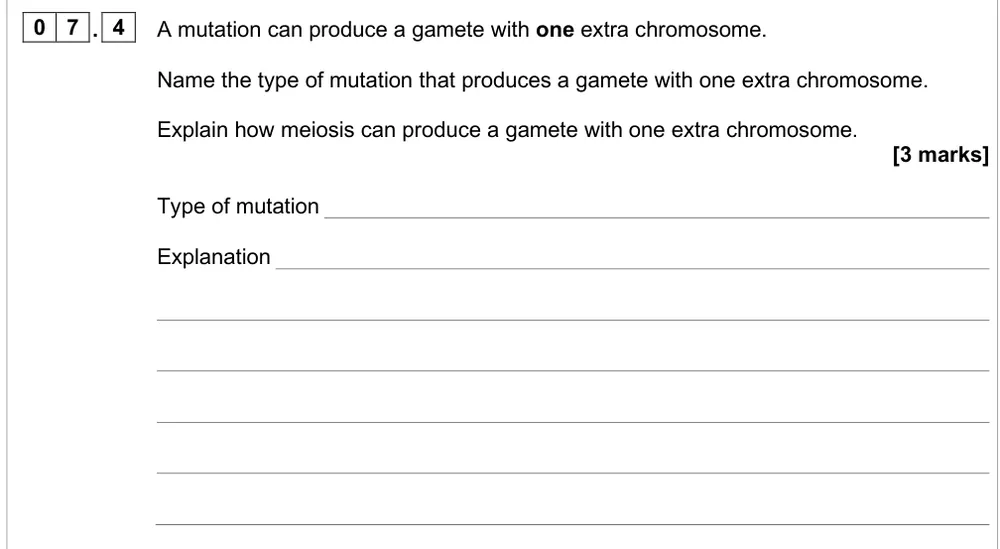
A level Paper 1 · June 2025 · Q07.4 · 3 marks · Medium
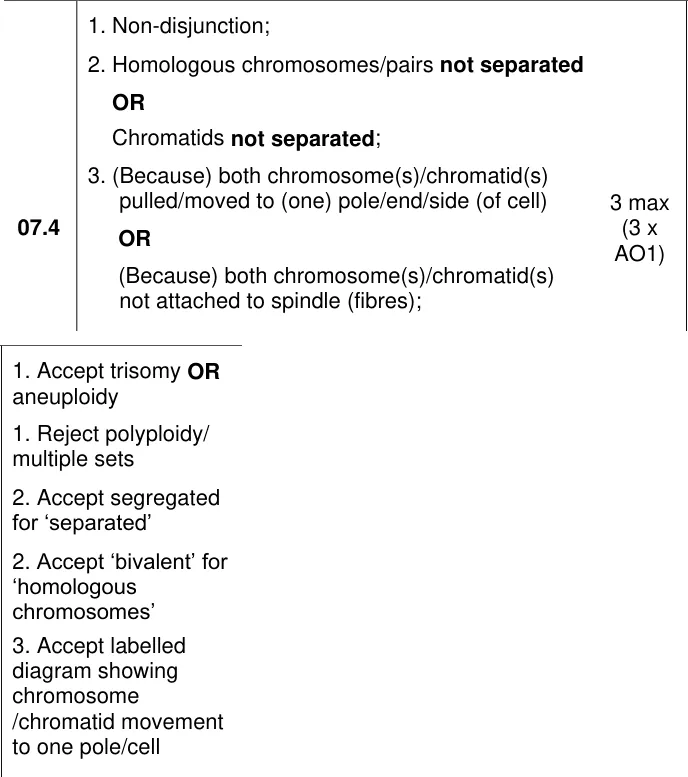
Name the mutation and explain how meiosis can produce a gamete with one extra chromosome.
Show the mark scheme
Tap an image to open it full size.
From the examiners' report: About 5% got all 3. Spell non-disjunction correctly, say what fails to separate, then say both move to one pole. Don't just restate that there's an extra chromosome.
Question 8
AS Paper 2 · November 2020 · Q06.5 · 2 marks · Hard
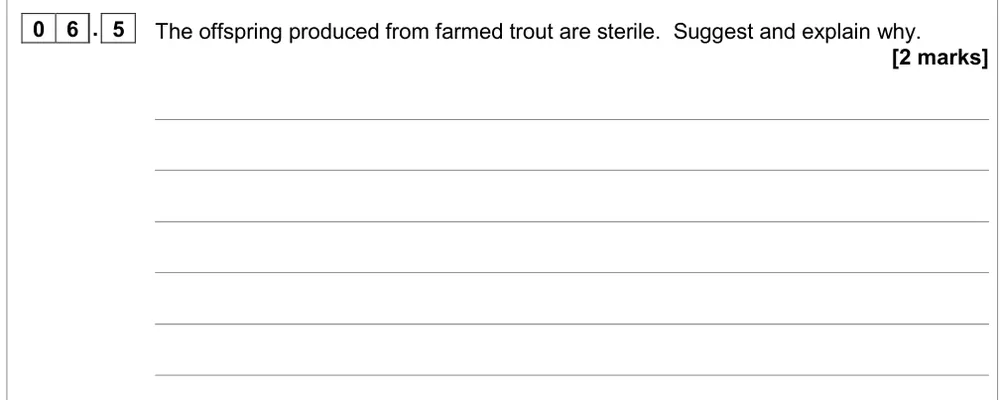
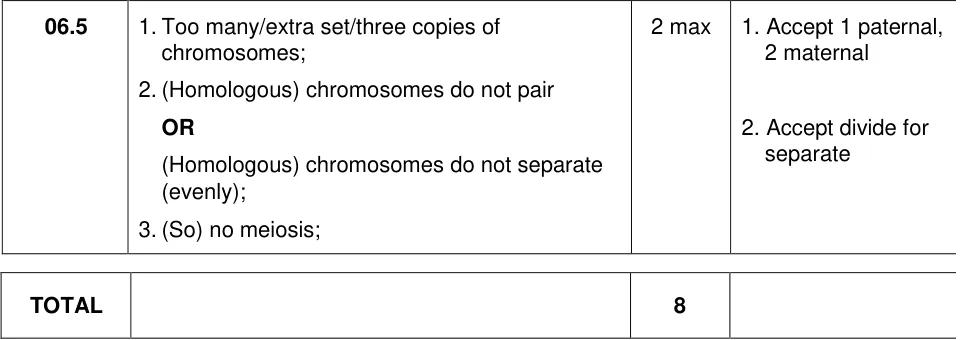
Suggest and explain why triploid farmed trout are sterile.
Information from earlier in this question:

Show the mark scheme
Tap an image to open it full size.
From the examiners' report: Many spotted the extra set of chromosomes but stopped there. Go on to meiosis: the homologous chromosomes can't pair up and separate, so no gametes form.
Question 9
A level Paper 1 · June 2022 · Q04.3 · 2 marks · Medium
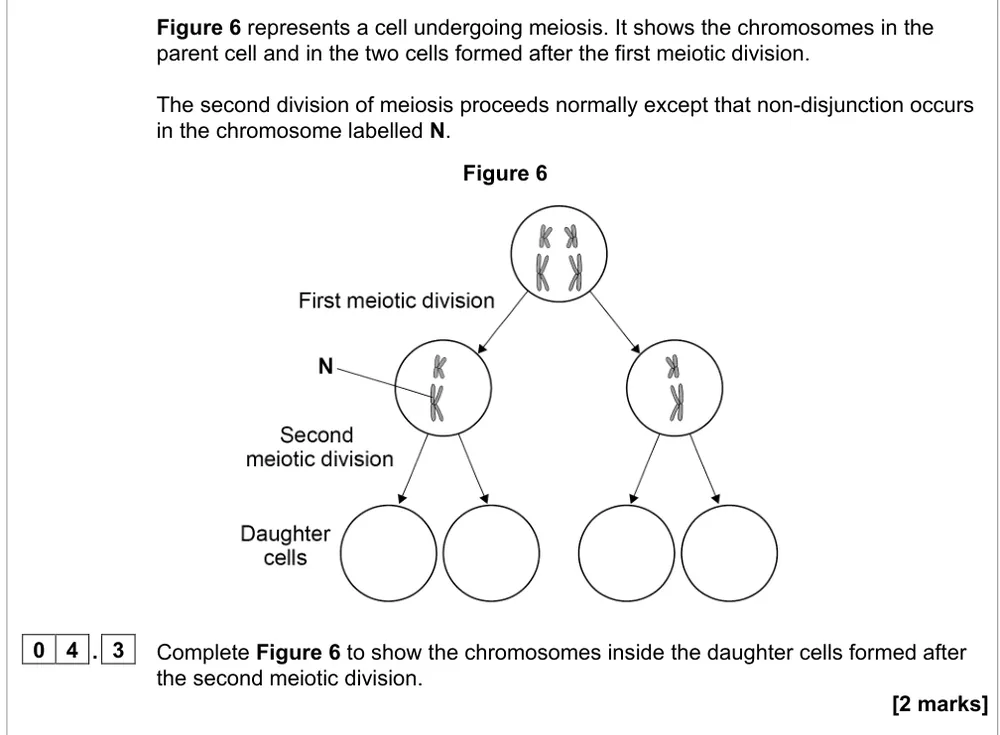
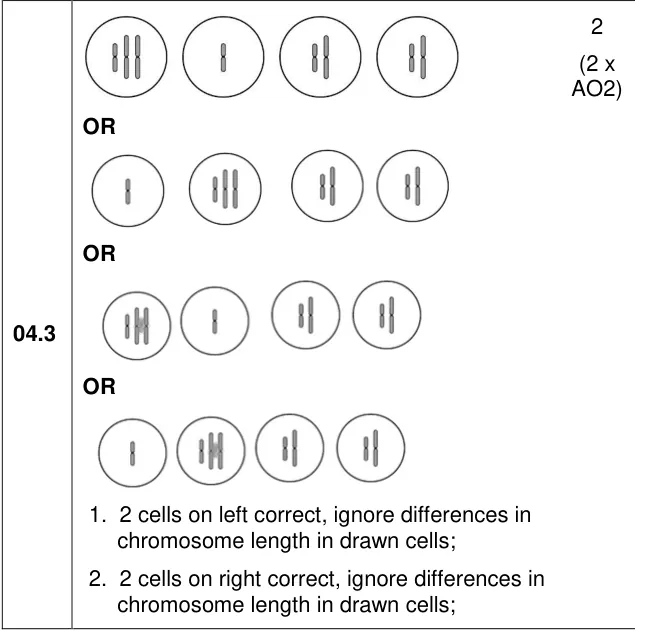
Complete a diagram to show the daughter cells after non-disjunction in the second meiotic division.
Show the mark scheme
Tap an image to open it full size.
From the examiners' report: Over 60% scored at least 1. Separate the chromatids in the normal cell; with non-disjunction one cell gets both chromatids of N and the other gets none of N, but it still has its other chromosome.
Meiosis and genetic variation (3.4.3)
Question 10
AS Paper 1 · June 2017 · Q06.2 · 2 marks
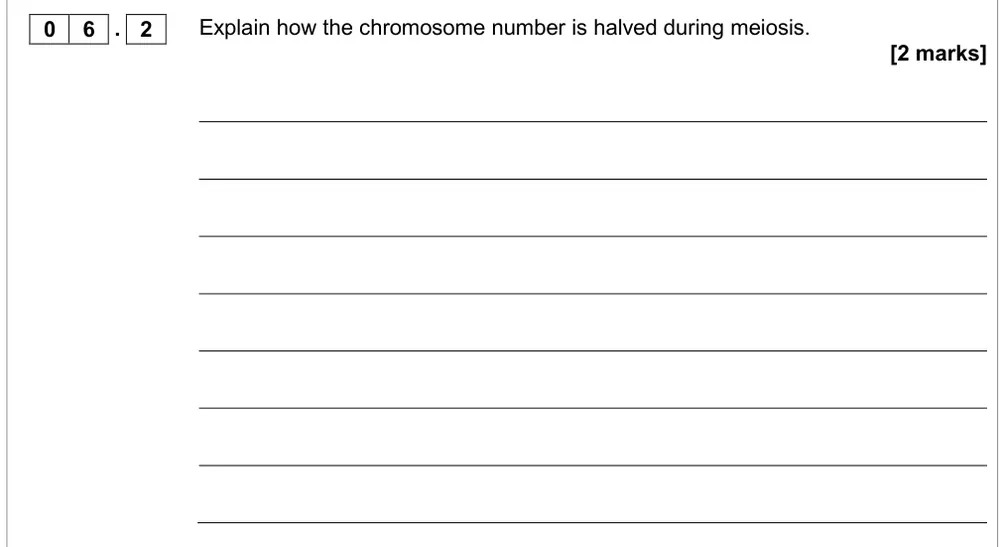
Explain how the chromosome number is halved during meiosis.
Show the mark scheme

Tap an image to open it full size.
From the examiners' report: Most wrongly described the second division or mitosis. It's the first division that halves the number: homologous pairs separate, one of each pair to each cell.
Question 11
AS Paper 2 · June 2025 · Q09.1 · 5 marks · Medium
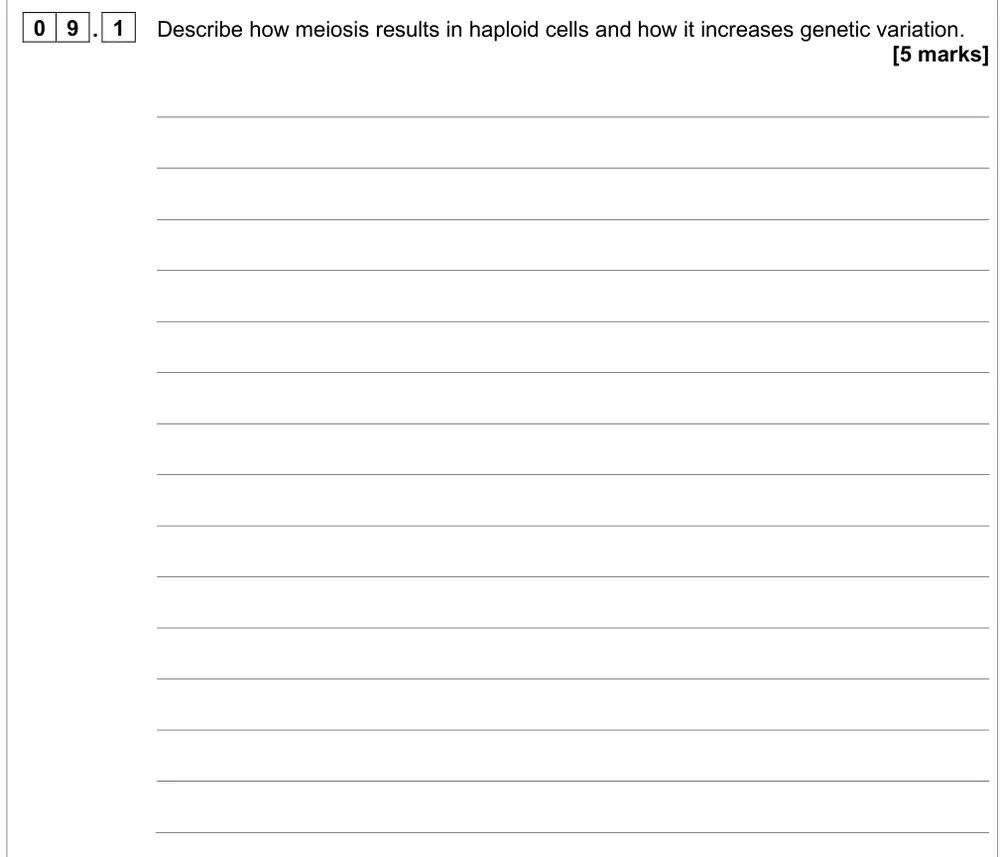
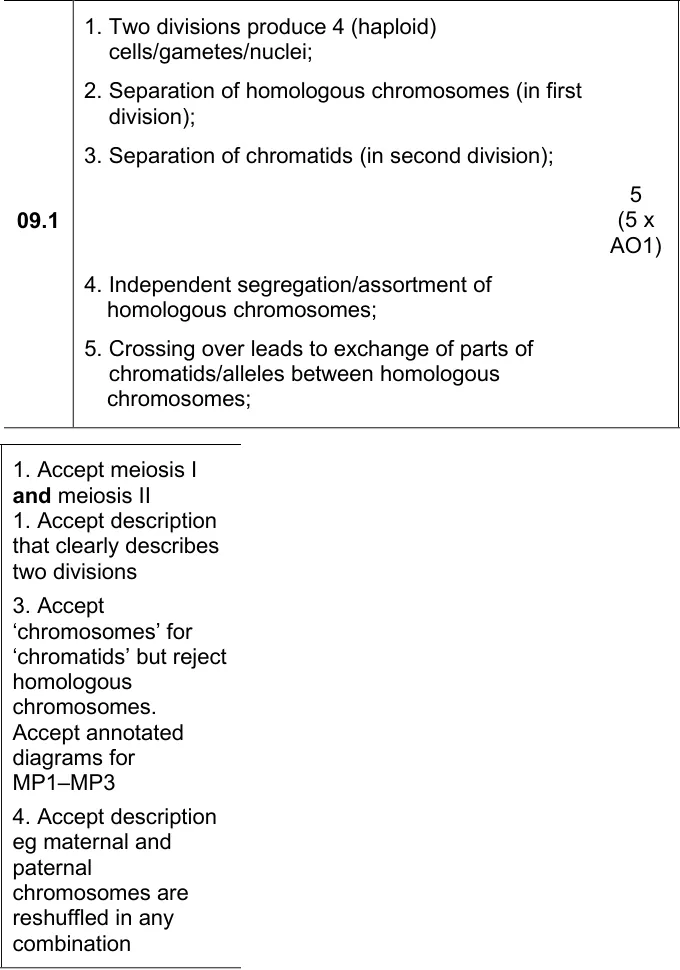
Describe how meiosis produces haploid cells and increases genetic variation.
Show the mark scheme
Tap an image to open it full size.
From the examiners' report: About 10% got all 5. Naming independent segregation and crossing over isn't enough: explain each, and keep chromosomes and chromatids straight.
Question 12
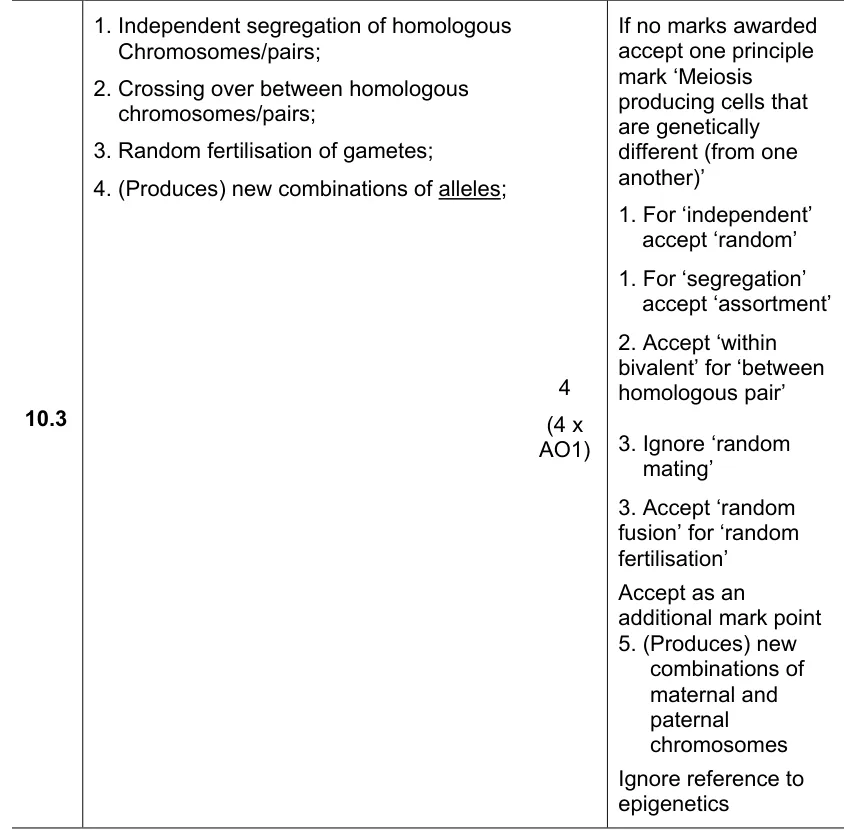
A level Paper 1 · June 2023 · Q10.3 · 4 marks · Hard
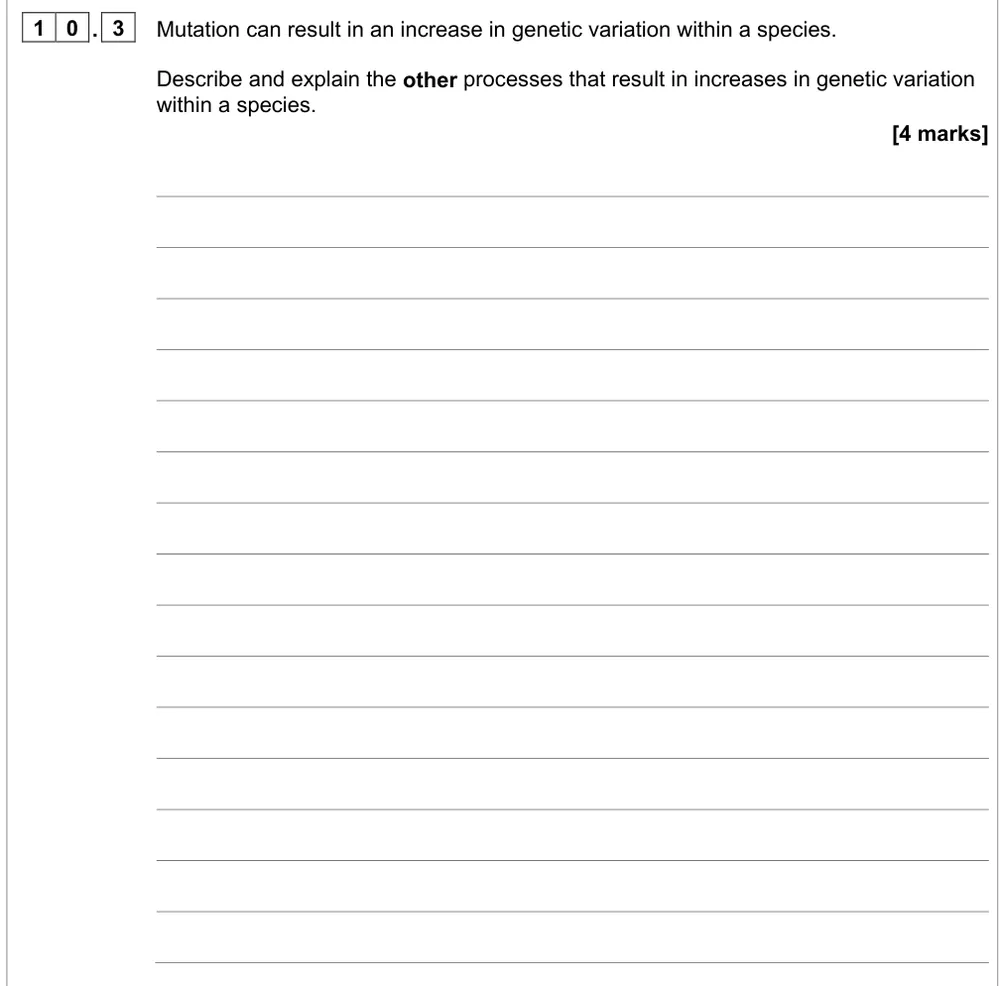
Describe and explain the processes other than mutation that increase genetic variation.
Show the mark scheme
Tap an image to open it full size.
From the examiners' report: Few got all 4. Mention homologous pairs, say fertilisation of gametes is random, and finish with 'new combinations of alleles'. Natural selection and migration don't score.
Question 13
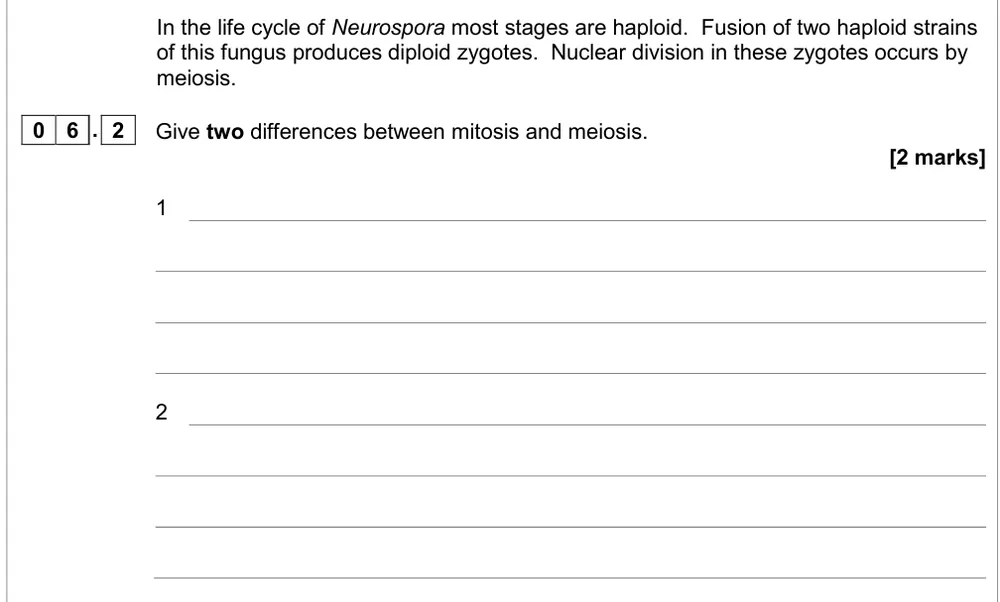
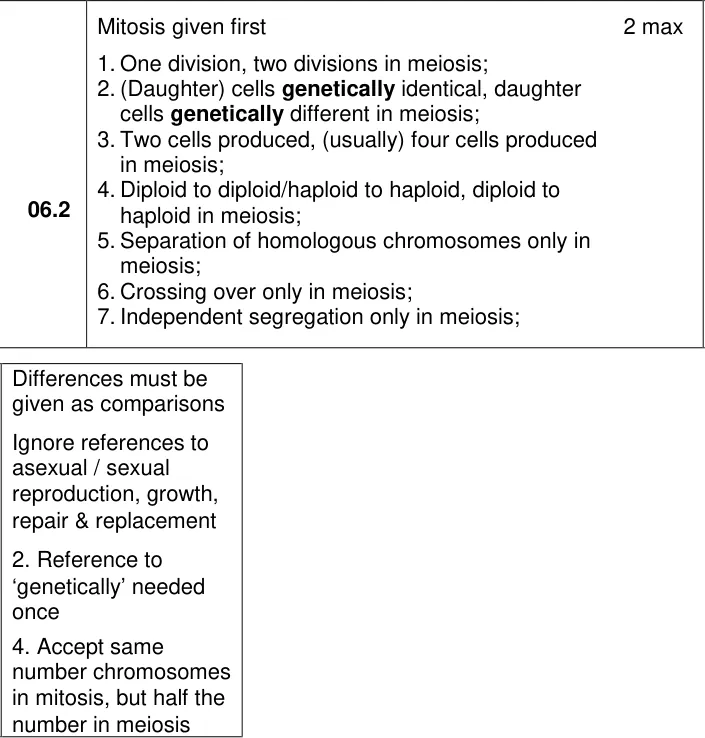
AS Paper 2 · June 2019 · Q06.2 · 2 marks · Easy
Give two differences between mitosis and meiosis.
Show the mark scheme
Tap an image to open it full size.
From the examiners' report: More than half got both. Compare divisions, not 'stages', and avoid 'mitosis is asexual' or 'mitosis makes diploid cells', which aren't true of every life cycle.
Chromosome diagrams and data (3.4.3)
Question 14
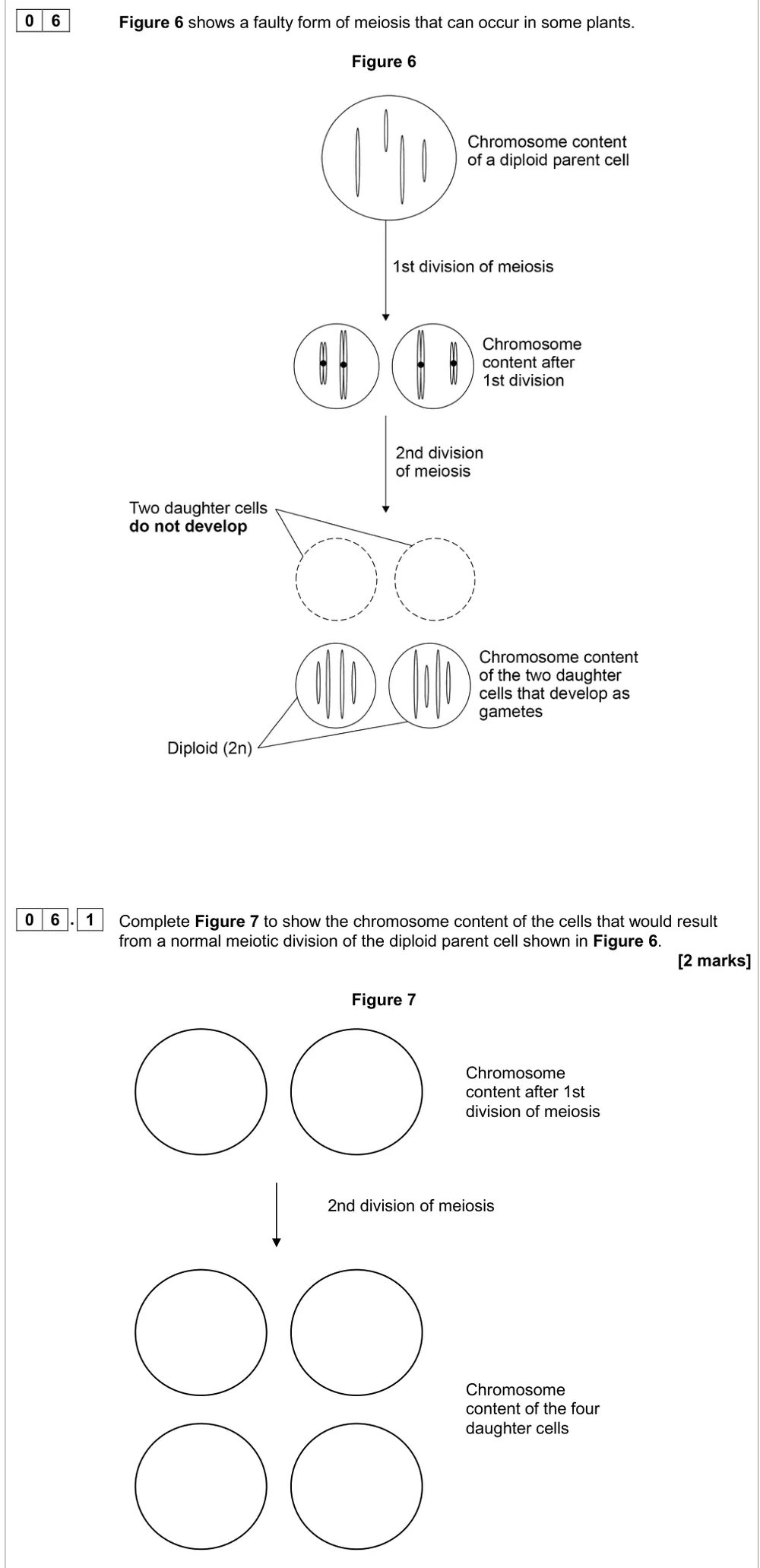
A level Paper 1 · June 2018 · Q06.1 · 2 marks · Easy
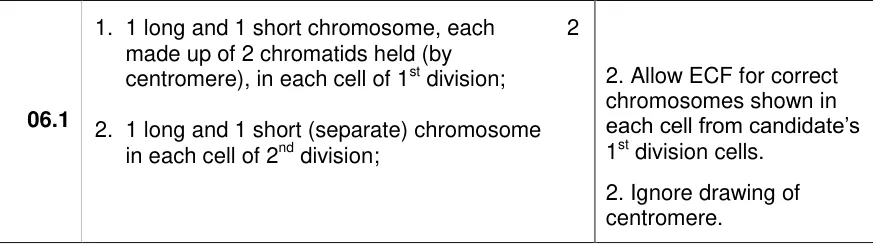
Complete a diagram to show the chromosomes after each division of normal meiosis.
Show the mark scheme
Tap an image to open it full size.
From the examiners' report: 47.2% got both marks. Start from the parent cell in Figure 6: each cell keeps one long and one short chromosome, with two chromatids after the first division.
Question 15
A level Paper 1 · June 2025 · Q07.3 · 1 mark · Medium
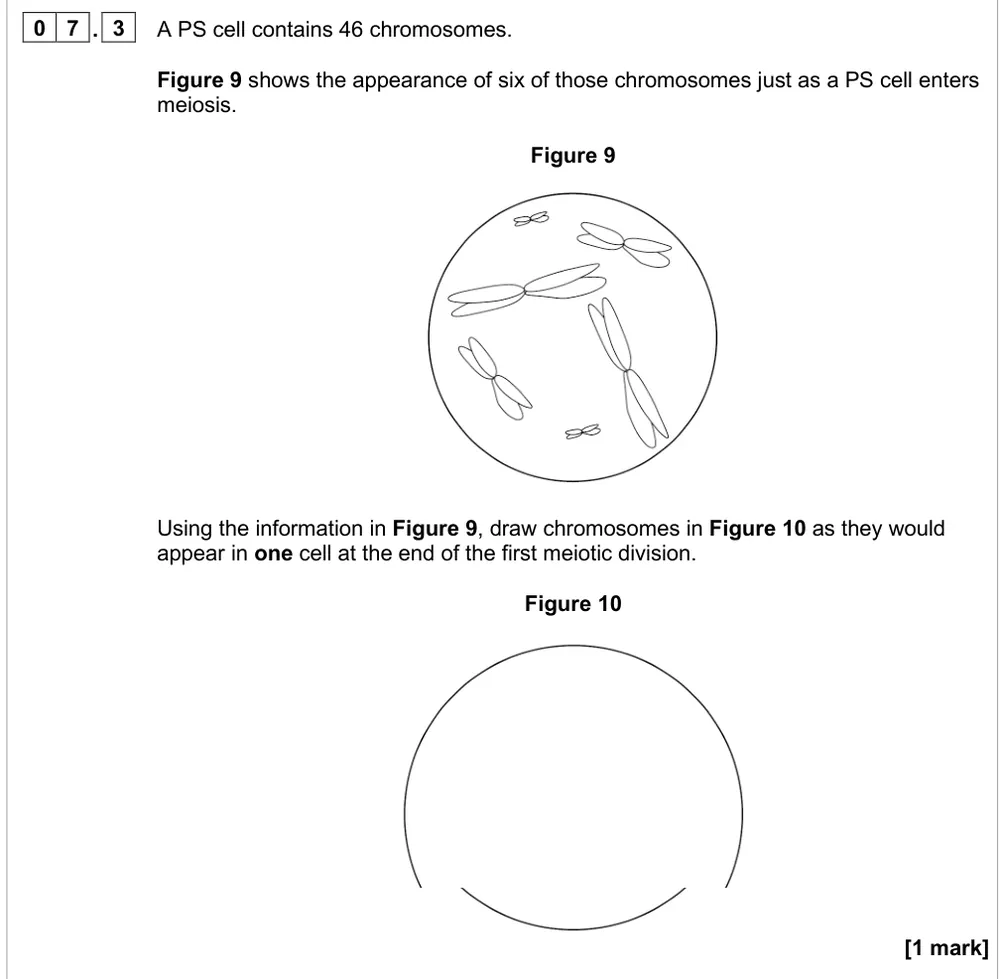
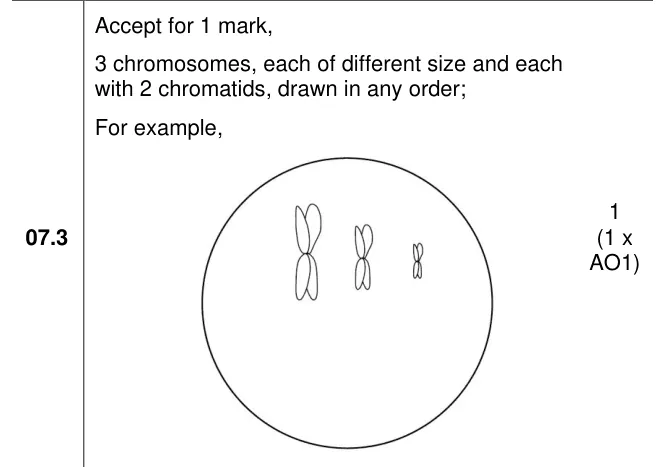
Draw the chromosomes in one cell at the end of the first meiotic division.
Show the mark scheme
Tap an image to open it full size.
From the examiners' report: About 50% scored. Six chromatids is mitosis, six double chromosomes is no reduction, and three single chromatids is after the second division: draw one double chromosome from each pair.
Question 16
AS Paper 2 · November 2020 · Q06.2 · 2 marks · Hard
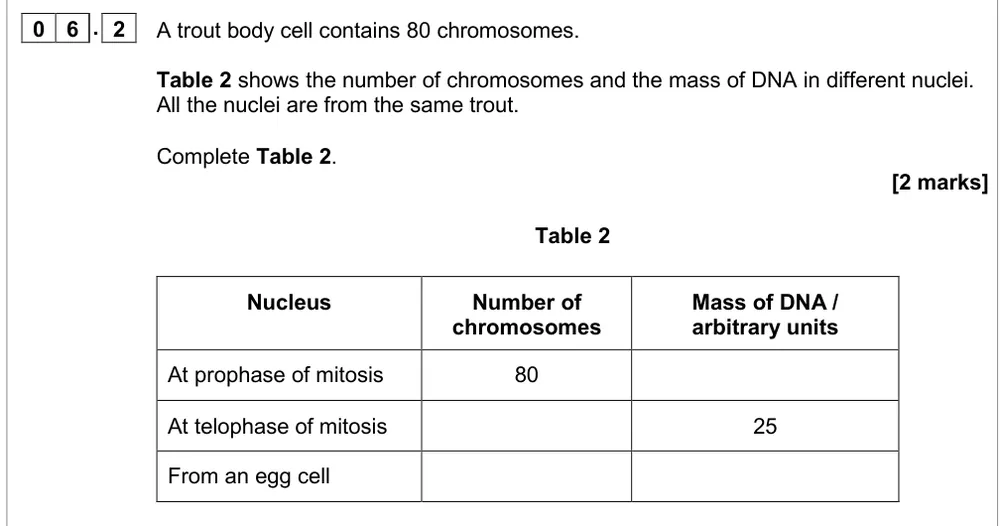
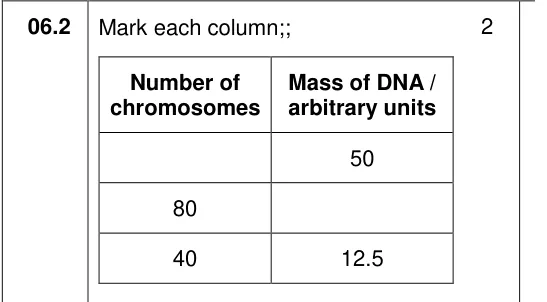
Complete a table of chromosome numbers and DNA mass in trout nuclei.
Show the mark scheme
Tap an image to open it full size.
From the examiners' report: Only 40% scored. DNA doubles in interphase, so prophase has twice the telophase mass; an egg is haploid, with half the chromosomes and half the telophase DNA.
Question 17
A level Paper 1 · June 2017 · Q10.2 · 4 marks
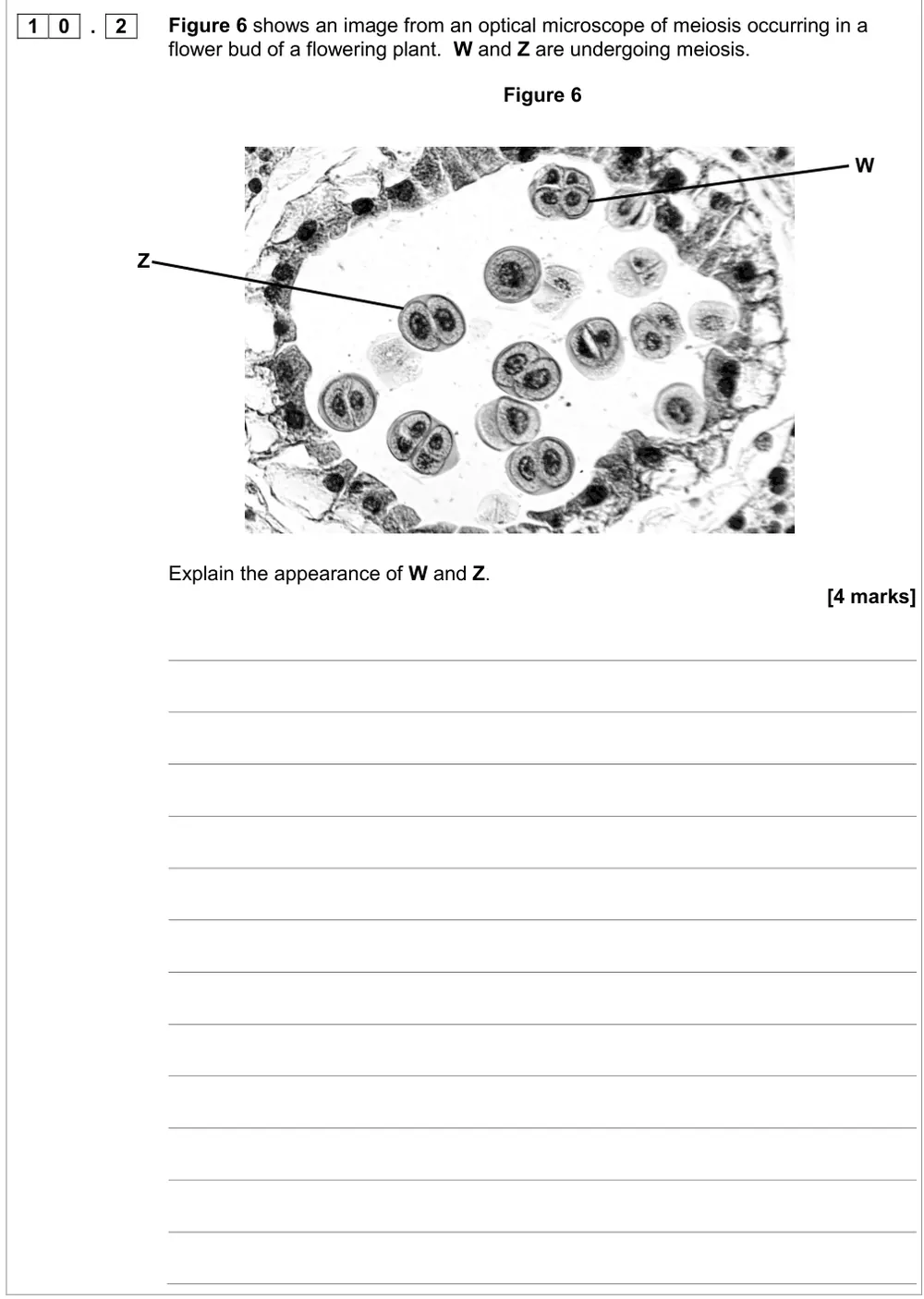
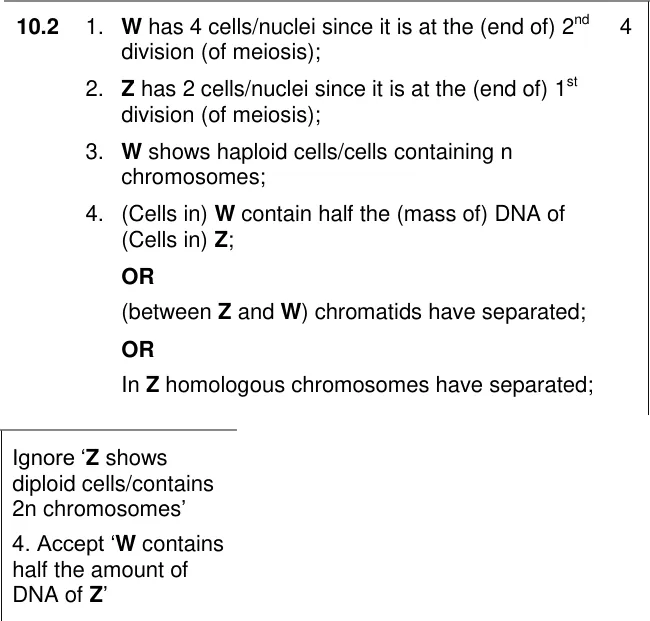
Explain the appearance of two groups of cells undergoing meiosis in a flower bud.
Show the mark scheme
Tap an image to open it full size.
From the examiners' report: No examiners' report for this paper. Count the cells: two means the first division is done, four means the second. Then compare the DNA or chromosomes in each.
Question 18
AS Paper 2 · June 2019 · Q06.4 · 3 marks · Hard
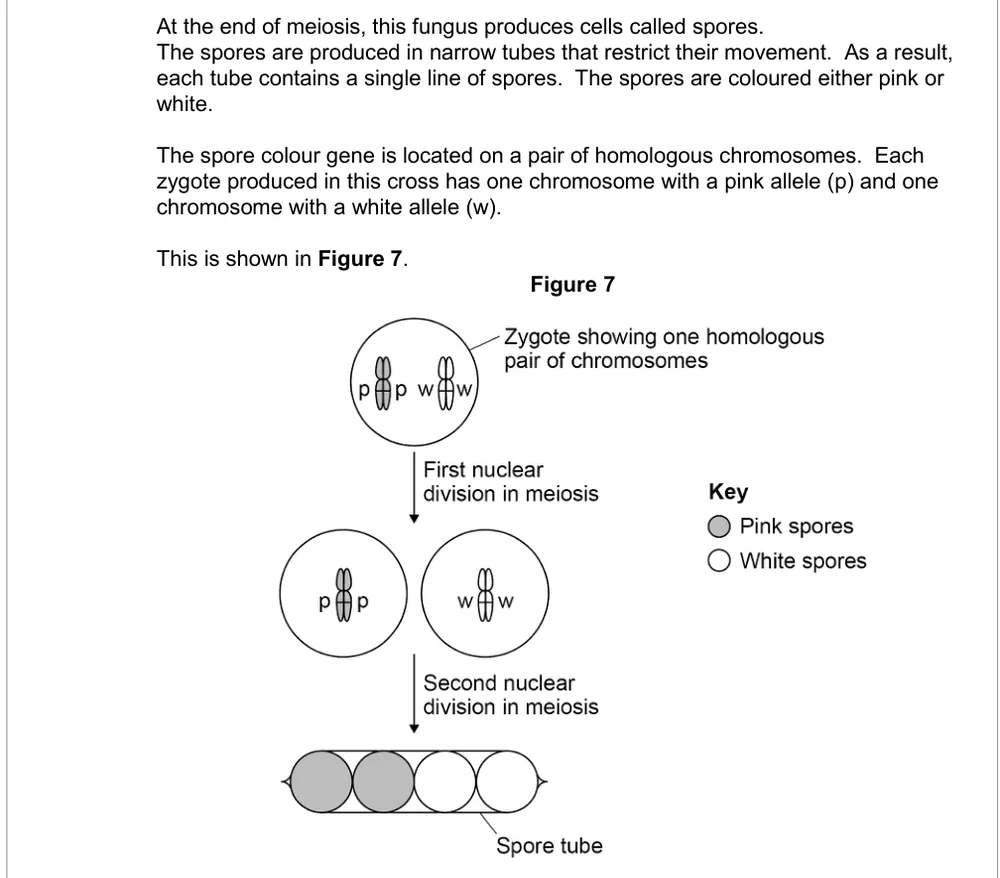
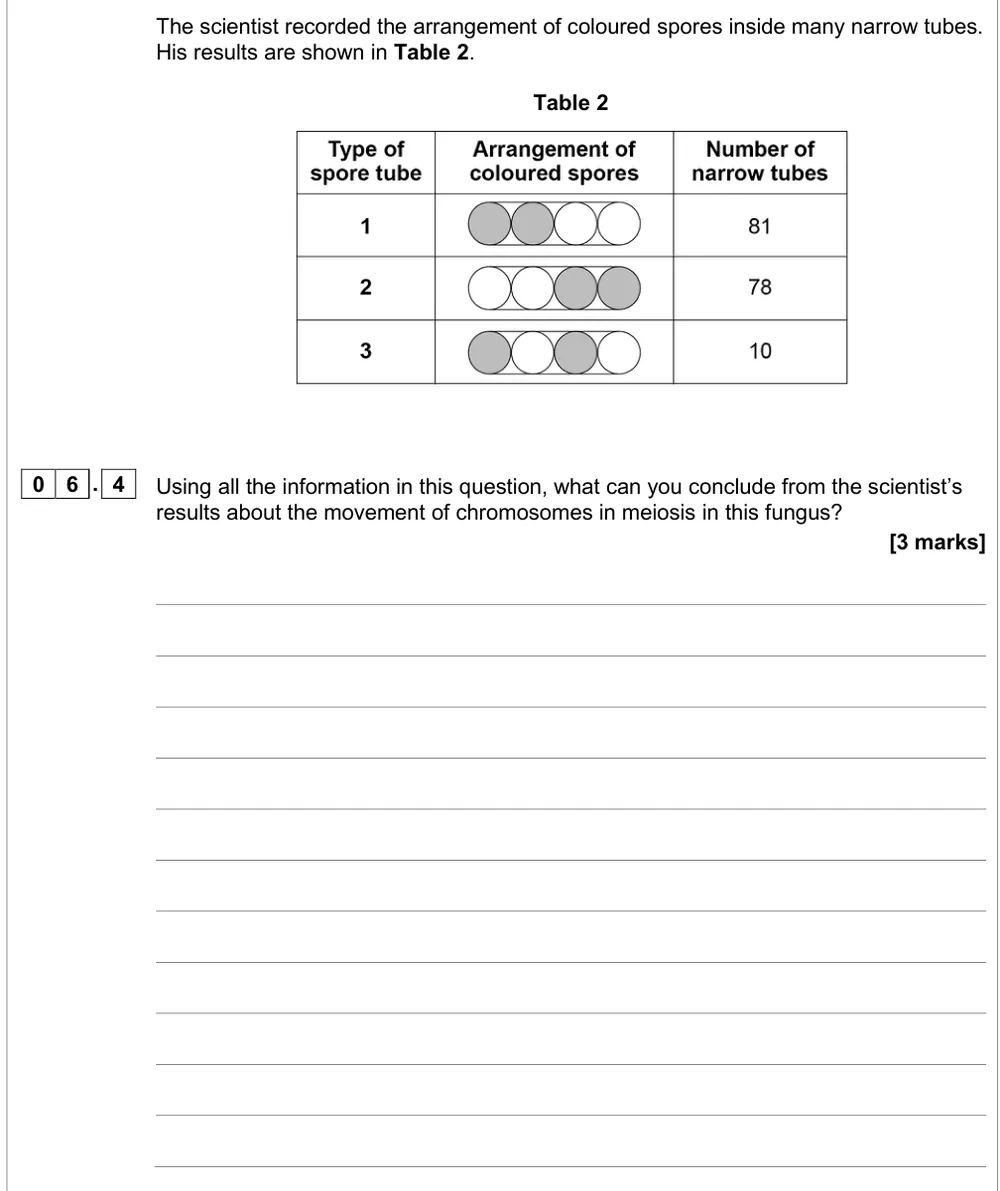
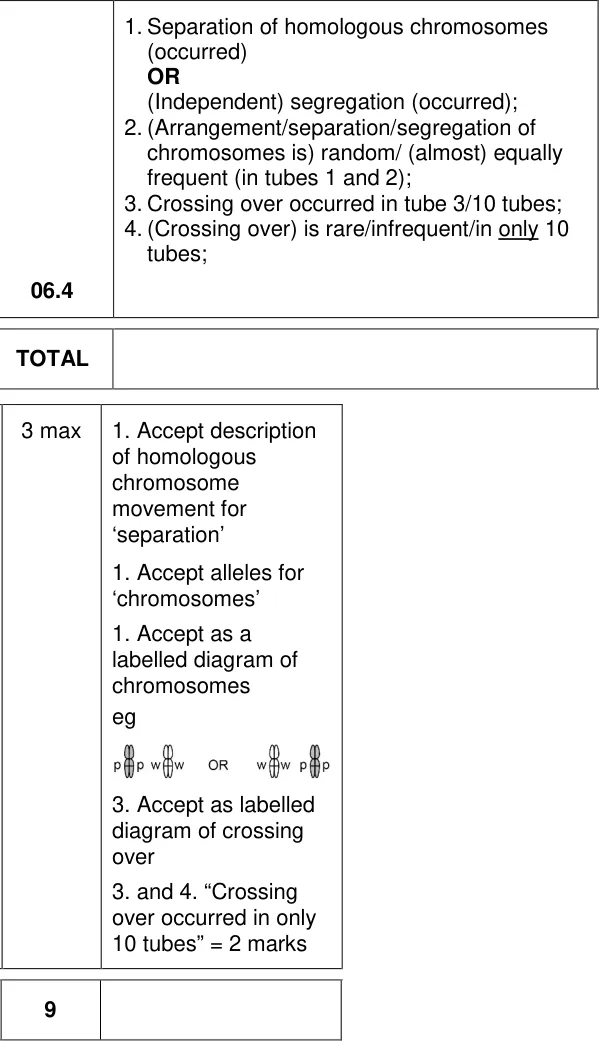
Conclude what spore arrangements in Neurospora show about chromosome movement in meiosis.
Information from earlier in this question:

Show the mark scheme
Tap an image to open it full size.
From the examiners' report: Around 60% scored zero. Link the numbers to meiosis: tubes 1 and 2 show random segregation of the homologous pair, tube 3 shows crossing over, and it's rare. Write about chromosomes, not spores.
Where students lose marks (from AQA examiners' reports and mark schemes)
Each point below is followed by wording that gained marks.
Start with the DNA base sequence: Fewer than half got 2 or more of the 4 marks on the CCR5 receptor mutation, and 30% scored zero. Only a minority said a mutation changes the DNA base sequence; some wrote that different amino acids are 'formed', and many lost the last mark by giving a receptor an 'active site'.
✔ Gains credit: "Change in DNA base sequence; change in amino acid sequence (primary structure); alters the position of hydrogen, ionic or disulfide bonds; change in tertiary structure of the receptor."
Give the DNA triplet, not the mRNA codon: Naming the substitution was easy, but many then quoted mRNA bases such as CGG and AGG, or 'C is changed to A', for the change in DNA. Others wrote that base sequences 'produced' amino acids or that the 'amino acid code' is degenerate.
✔ Gains credit: "G to T (GCC to TCC); Arg is still coded for, so no change in primary or tertiary structure."
A mutation always makes a new allele: Definitions of gene mutation were generally good, but some said a mutation always changes the amino acid sequence, and few realised that any gene mutation forms a new allele. Positive effects were often vague, with no link to survival or reproduction.
✔ Gains credit: "Change in the base sequence of DNA; results in a new allele; may increase survival or reproductive success."
Second division means chromatids: Almost half scored zero on how a mutation in the second meiotic division gives an extra chromosome 18. Marks were lost for writing about homologous chromosomes, even though the question said it was the second division.
✔ Gains credit: "Chromatids do not separate; non-disjunction."
Both go to one pole: Only about 5% got all 3 marks on how meiosis produces a gamete with an extra chromosome. 'Addition' and 'non-disfunction' were common errors, and very few explained that both chromosomes or chromatids move to one pole.
✔ Gains credit: "Non-disjunction; homologous chromosomes or chromatids not separated; both pulled to one pole, or not attached to spindle fibres."
The first division halves the number: Most students thought the second meiotic division halves the chromosome number, so their answers described that division or mitosis.
✔ Gains credit: "Homologous chromosomes pair; one of each pair goes to each daughter cell."
Finish with new combinations of alleles: Few scored all 4 marks on the processes that increase genetic variation. Many left out homologous pairs, wrote 'fertilisation is random' without gametes, or described meiosis well but never said it produces new allele combinations.
✔ Gains credit: "Independent segregation of homologous chromosomes; crossing over between homologous chromosomes; random fertilisation of gametes; produces new combinations of alleles."
Draw from the parent cell you're given: 47.2% got both marks for completing the meiosis diagram. Many didn't use the parent cell as their starting point, so their cells didn't contain one long and one short chromosome.
✔ Gains credit: "One long and one short chromosome, each of two chromatids, in each cell after the first division; one long and one short single chromosome in each cell after the second."
Download the questions
Download the PDF pack (18 questions, mark schemes at the end)
Keep practising
- DNA and protein synthesis: AQA A Level Biology exam questions by topic
- Cell division: AQA A Level Biology exam questions by topic
- Genetic diversity and adaptation: AQA A Level Biology exam questions by topic
- Mastering AQA A Level Biology 3.4.3: genetic diversity via mutation and meiosis
- AQA A Level Biology masterclasses
Questions, mark schemes and examiners' report extracts © AQA.