

Populations and the Hardy–Weinberg principle (AQA 3.7.2) are A-level only, so they're Year 13 content. You need the definitions of a population and a gene pool, the idea of allele frequency, the conditions under which the Hardy–Weinberg principle holds, and how to use p² + 2pq + q² = 1 to calculate allele, genotype and phenotype frequencies.
These should be reliable marks, yet the examiners' reports show they're often lost. Only 5% got both marks for defining a population, because answers described a community or left out time. In the calculations most students start from the wrong phenotype: if 36% show the dominant feature, the other 64% are homozygous recessive, and that's your q². Others work out pq and forget to double it, or give crossing over and linked genes when asked why Hardy–Weinberg doesn't hold.
Begin with the definitions and the conditions, then work through the calculations from the easier ones to the harder ones. Write out every step, because showing 2pq for the heterozygotes usually earns a mark even when the final answer is wrong. If you'd like help with this topic, my AQA masterclasses run online on Tuesdays at 5.15pm for Year 12 and on Wednesdays or Thursdays at 6.30pm for Year 13.
What you need from GCSE and Year 12
Each question on this page assumes you're secure on these GCSE and Year 12 ideas. If any of them feels shaky, revise it before you start.
- GCSE: a dominant allele is expressed in heterozygotes, so only homozygous recessive individuals show the recessive phenotype.
- GCSE: a population is all the organisms of one species living in a habitat.
- Year 12 (AQA 3.4.3): mutations in the base sequence of DNA produce new alleles.
- Year 12 (AQA 3.4.4): natural selection makes advantageous alleles more frequent in a population over generations.
Key terms
These words come up in the questions and mark schemes. Examiners expect you to use them exactly.
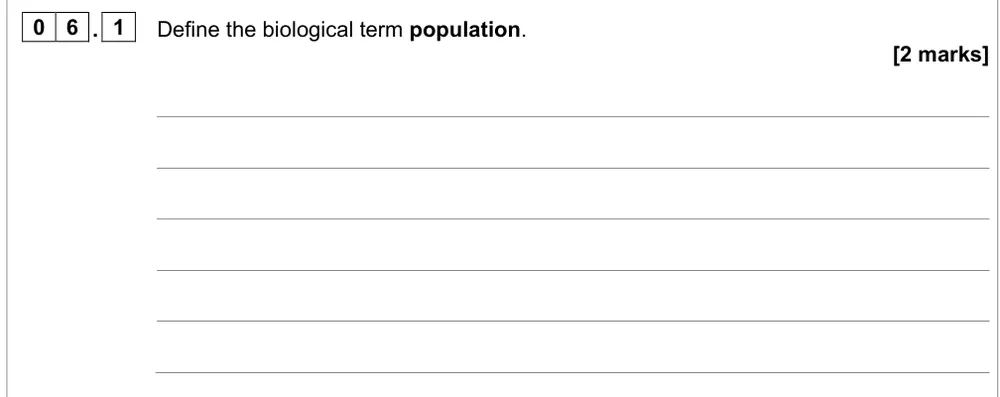
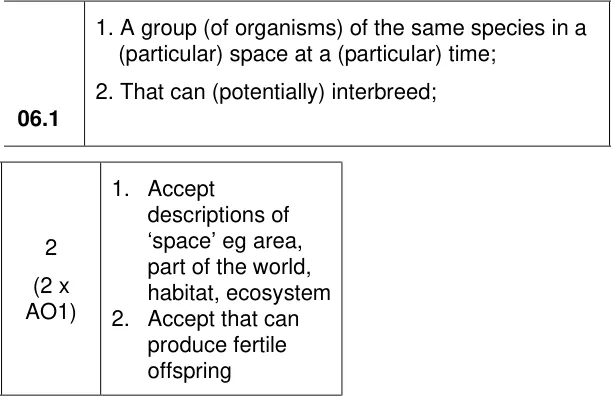
- Population: a group of organisms of the same species occupying a particular space at a particular time that can potentially interbreed.
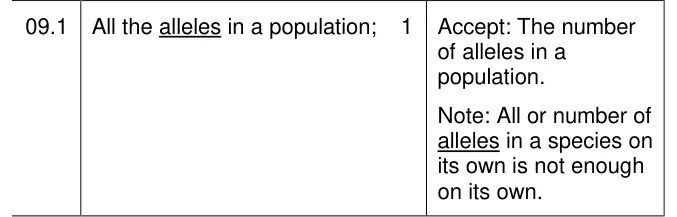
- Gene pool: all the alleles of all the genes in a population.
- Allele frequency: the proportion of all the alleles of a gene in a population that are one particular allele, given as a decimal from 0 to 1.
- Hardy–Weinberg principle: a mathematical model predicting that allele frequencies will not change from generation to generation.
- Conditions for Hardy–Weinberg: a large population with random mating, no mutation, no immigration or emigration, and no selection.
- p + q = 1: the frequencies of the two alleles of a gene add up to 1; with more alleles, all the frequencies add up to 1.
- p² + 2pq + q² = 1: the frequencies of the homozygous dominant, heterozygous and homozygous recessive genotypes add up to 1.
- q²: the frequency of the homozygous recessive genotype, the only genotype you can always read straight from the recessive phenotype.
- 2pq: the frequency of heterozygotes (carriers), never just pq.
What these questions cover (AQA 3.7.2)
The questions test these statements from the AQA AS and A-level Biology specification (7401/7402):
- Species and populations: Species exist as one or more populations. (no written question tests this point on its own; the Faroe Islands question is about one isolated population of a species)
- Population: A population as a group of organisms of the same species occupying a particular space at a particular time that can potentially interbreed.
- Gene pool and allele frequency: The concepts of gene pool and allele frequency.
- The Hardy–Weinberg principle: The Hardy–Weinberg principle provides a mathematical model, which predicts that allele frequencies will not change from generation to generation. The conditions under which the principle applies.
- The Hardy–Weinberg equation: The frequency of alleles, genotypes and phenotypes in a population can be calculated using the Hardy–Weinberg equation: p² + 2pq + q² = 1 where p is the frequency of one (usually the dominant) allele and q is the frequency of the other (usually recessive) allele of the gene. (the Faroe Islands question works out phenotype frequencies in a population without the equation)
How to use this page
Write your answer on paper before you open the mark scheme. Allow about 1.3 minutes per mark: the 14 questions are worth 26 marks, so about 34 minutes in total. Then mark your answer strictly against the mark scheme and read the examiners' tip underneath it. If you'd rather print the questions, download the PDF pack.
Populations, gene pools and allele frequency (3.7.2)
Question 1
A level Paper 3 · June 2024 · Q06.1 · 2 marks · Hard
Define the biological term population.
Show the mark scheme
Tap an image to open it full size.
From the examiners' report: 64% scored nothing and only 5% got both marks. Learn the spec definition word for word: same species, same space, same time, and able to interbreed. Don't describe a community.
Question 2
A level Paper 2 · June 2017 · Q09.1 · 1 mark · Medium
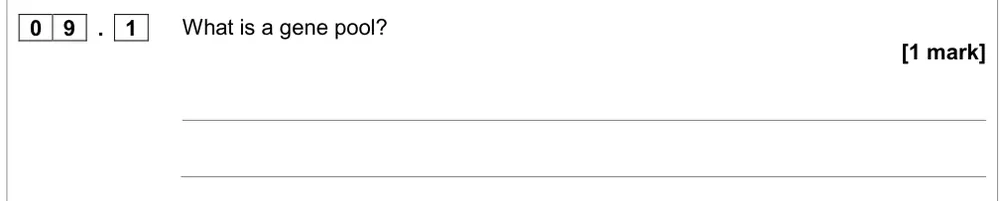
State what is meant by a gene pool.
Show the mark scheme
Tap an image to open it full size.
From the examiners' report: Fewer than 50% got this. Say alleles, not genes, and say population, not species: all the alleles in a population.
Question 3
A level Paper 2 · June 2022 · Q06.4 · 1 mark · Easy
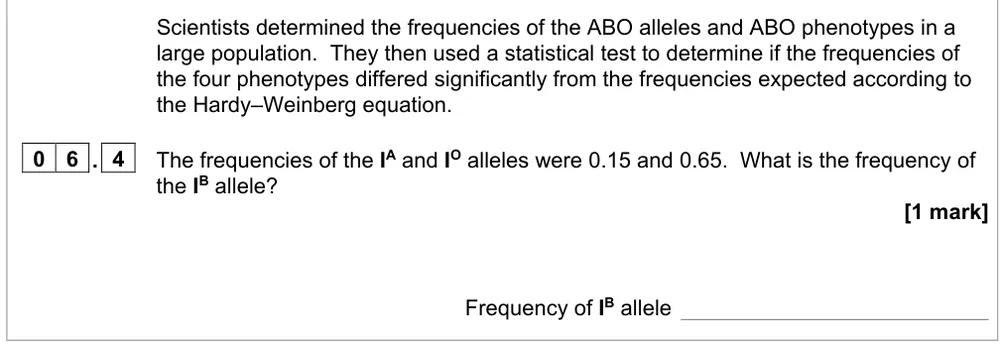
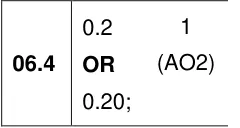
Work out the frequency of the third ABO allele from the other two.
Show the mark scheme
Tap an image to open it full size.
From the examiners' report: About 82% got 0.2. The frequencies of all the alleles of a gene add up to 1, so 1 − 0.15 − 0.65 = 0.2; the usual slip was 0.02.
The Hardy–Weinberg principle and its conditions (3.7.2)
Question 4
A level Paper 2 · June 2022 · Q06.6 · 2 marks · Easy
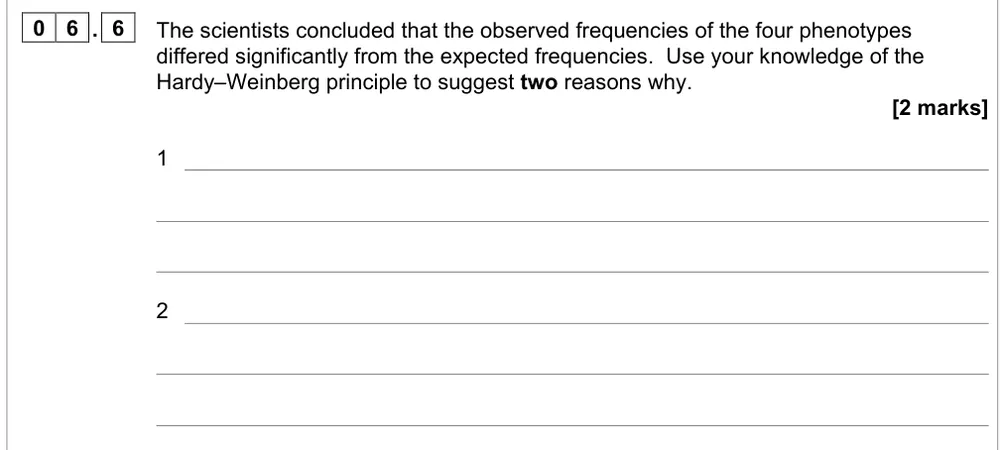
Suggest why observed ABO phenotype frequencies differed from Hardy–Weinberg predictions.
Show the mark scheme
Tap an image to open it full size.
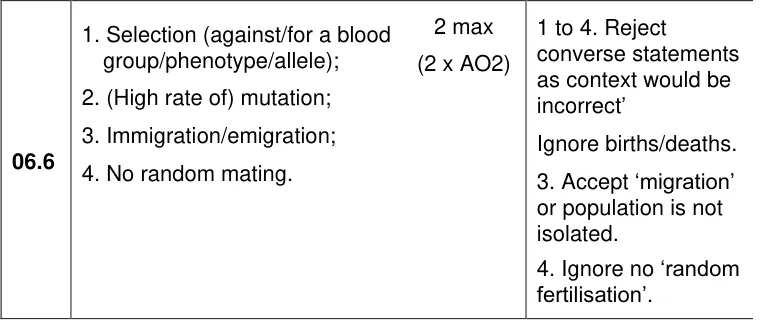
From the examiners' report: Only 9% got both and almost 80% scored zero. Give conditions that have been broken here: selection, mutation, migration or non-random mating. Crossing over, linkage or 'small population' don't apply, as the population was large.
Question 5
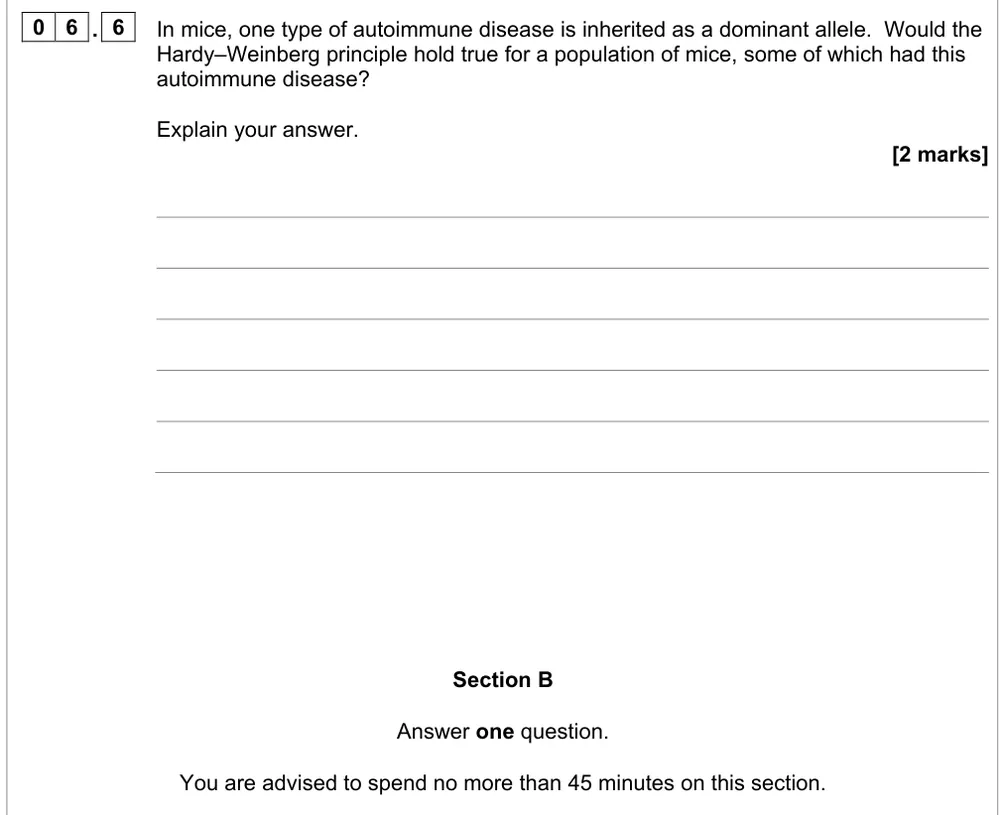
A level Paper 3 · June 2023 · Q06.6 · 2 marks
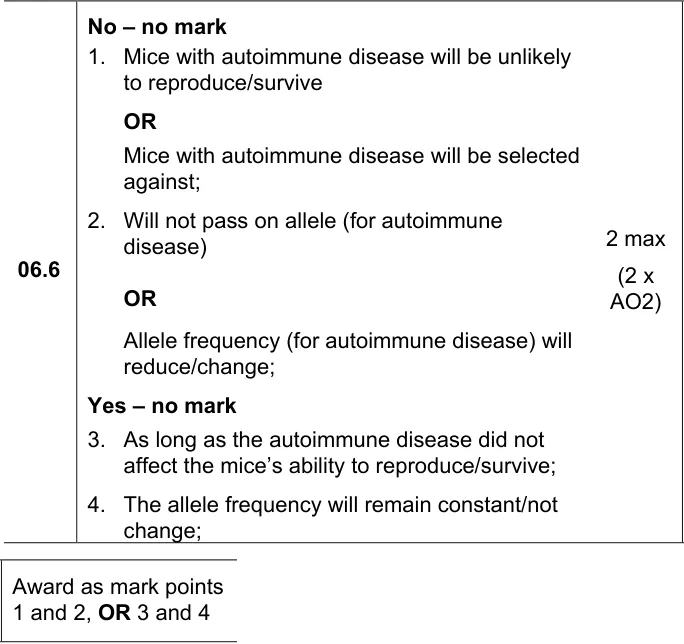
Decide whether Hardy–Weinberg holds for mice carrying a dominant allele for autoimmune disease.
Show the mark scheme
Tap an image to open it full size.
From the examiners' report: Either answer can score, but the 'yes' or 'no' itself gets no mark. Link the disease to survival or reproduction (selection) and then say what happens to the allele frequency.
Question 6
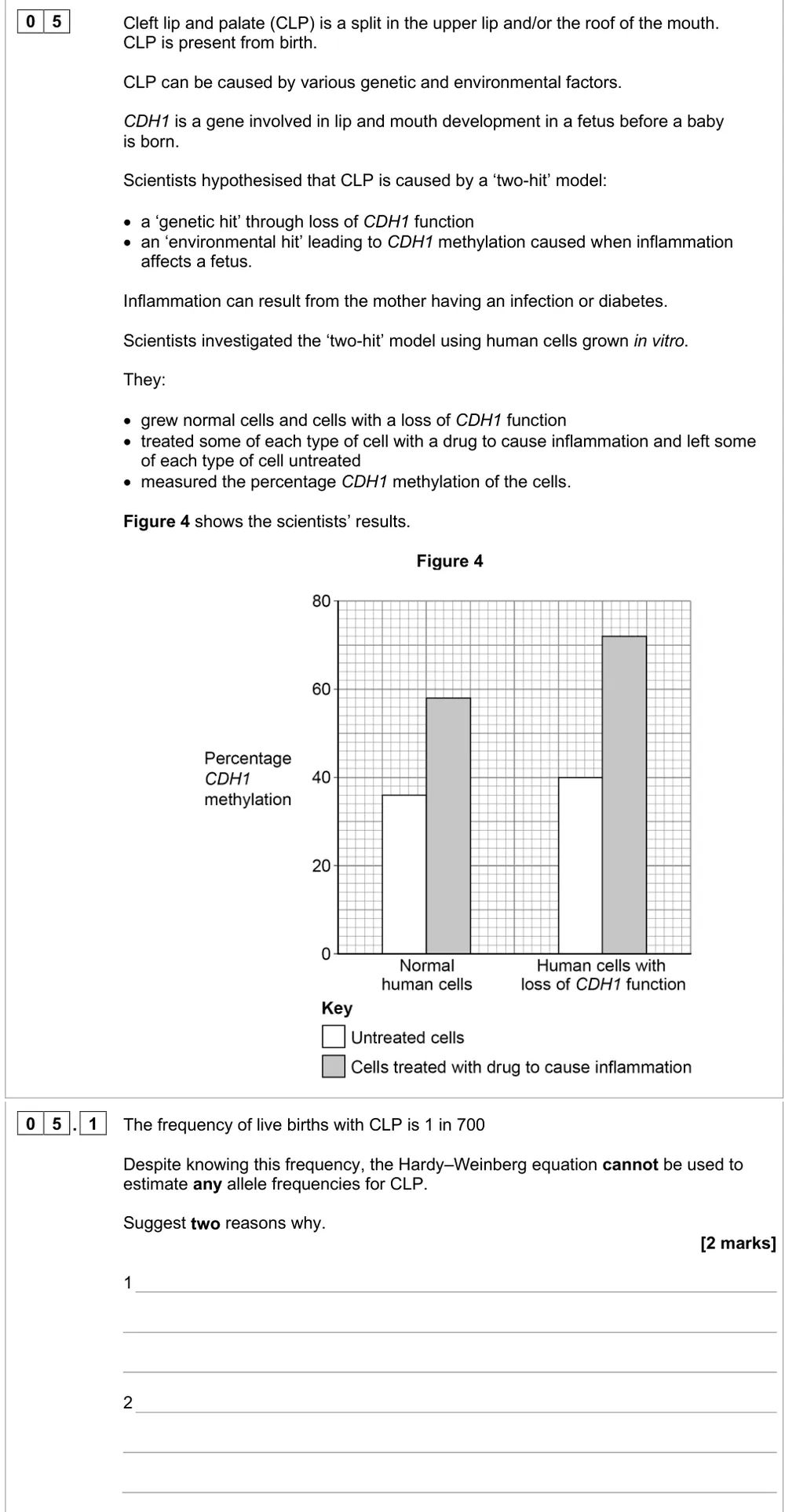
A level Paper 3 · June 2025 · Q05.1 · 2 marks · Medium
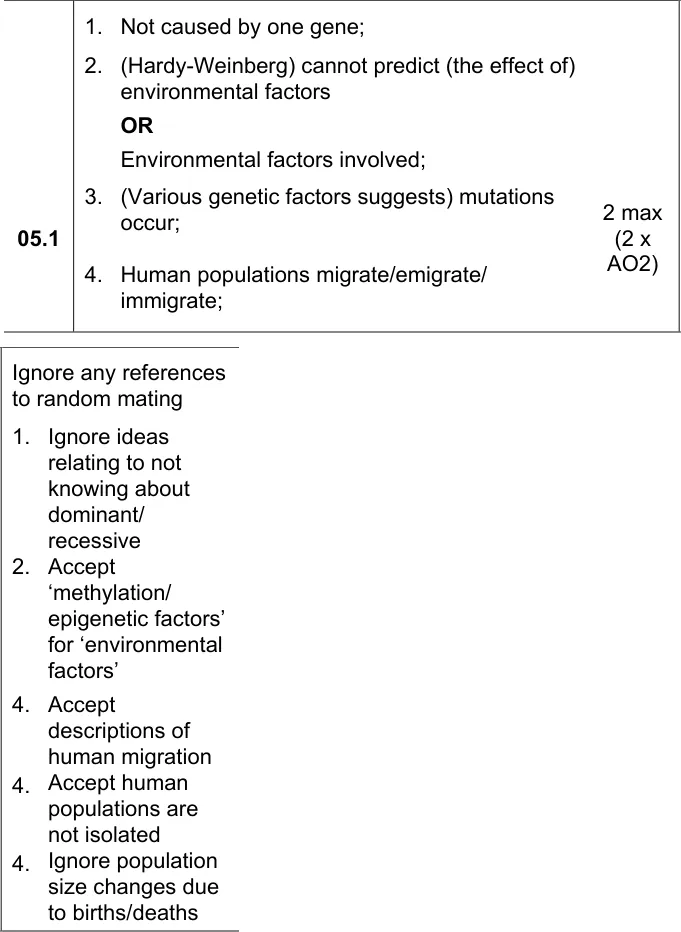
Suggest why Hardy–Weinberg can't be used to estimate allele frequencies for cleft lip and palate.
Show the mark scheme
Tap an image to open it full size.
From the examiners' report: About 15% got both marks. Use the passage: CLP has various genetic causes, not one gene, and environmental factors such as methylation. 'We don't know if it's dominant' and 'the sample is too small' didn't score.
Hardy–Weinberg calculations (3.7.2)
Question 7
A level Paper 2 · June 2019 · Q06.5 · 2 marks · Medium
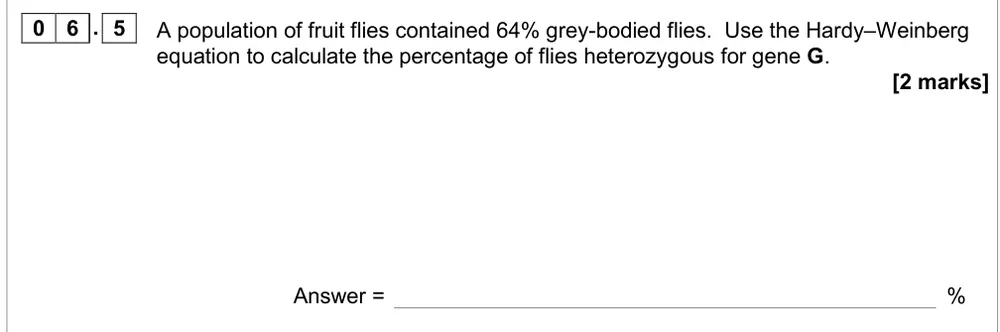
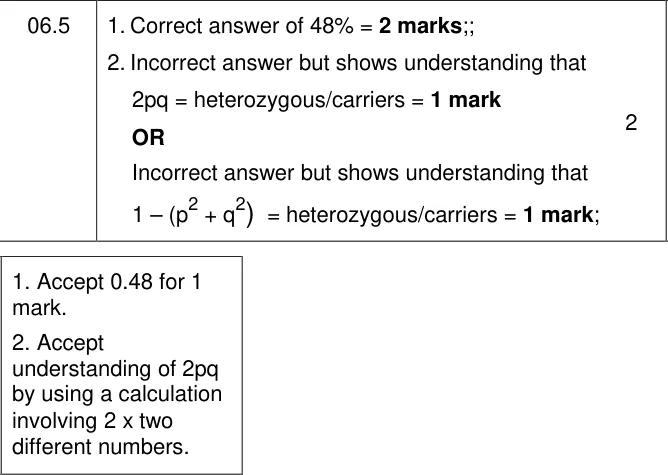
Use Hardy–Weinberg to find the percentage of heterozygous flies when 64% are grey.
Show the mark scheme
Tap an image to open it full size.
From the examiners' report: About 27% got both marks. The 36% black flies are q², so q = 0.6 and p = 0.4; heterozygotes are 2pq = 48%. Many scored zero by stopping at pq.
Question 8
A level Paper 2 · June 2017 · Q07.5 · 2 marks · Easy
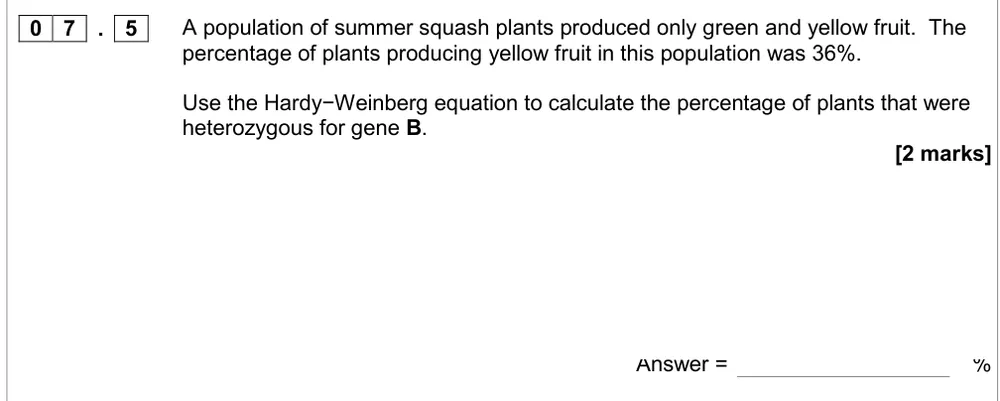
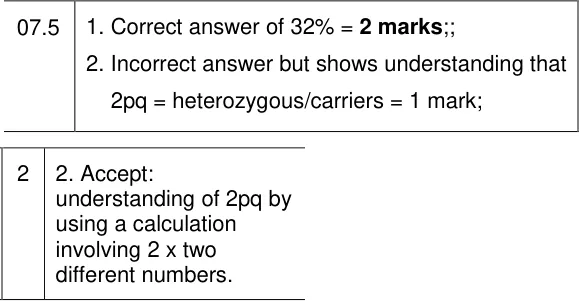
Use Hardy–Weinberg to find the percentage heterozygous for gene B in summer squash.
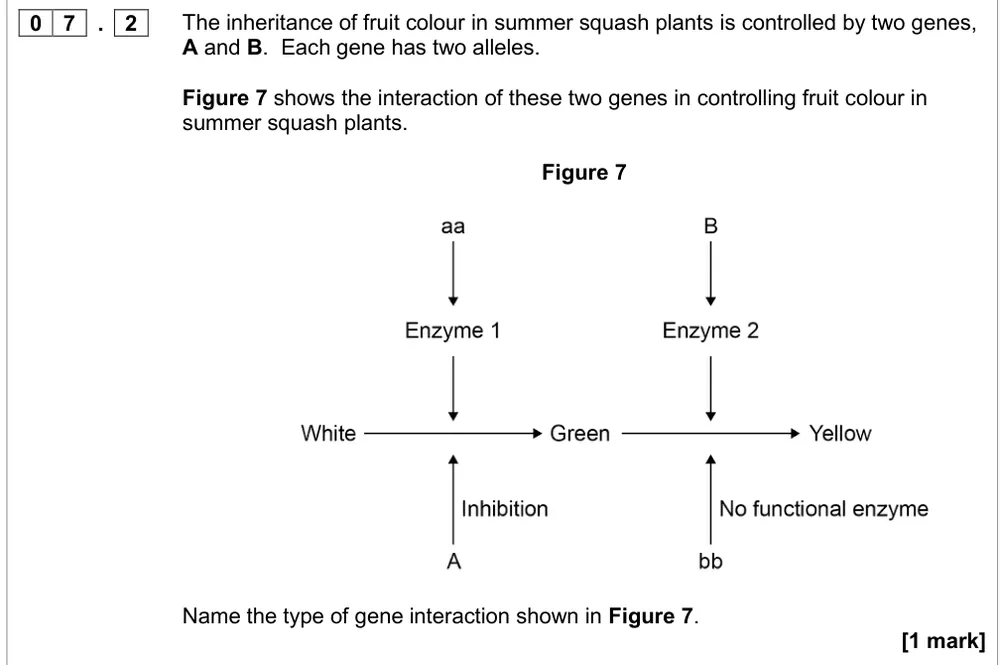
Information from earlier in this question:
Show the mark scheme
Tap an image to open it full size.
From the examiners' report: Only about one in six got both. Yellow needs a B allele, so the 64% green plants are bb (q² = 0.64); most took 36% as q² and got 48%. Give a percentage, not 0.32.
Question 9
A level Paper 2 · June 2024 · Q04.3 · 2 marks · Hard
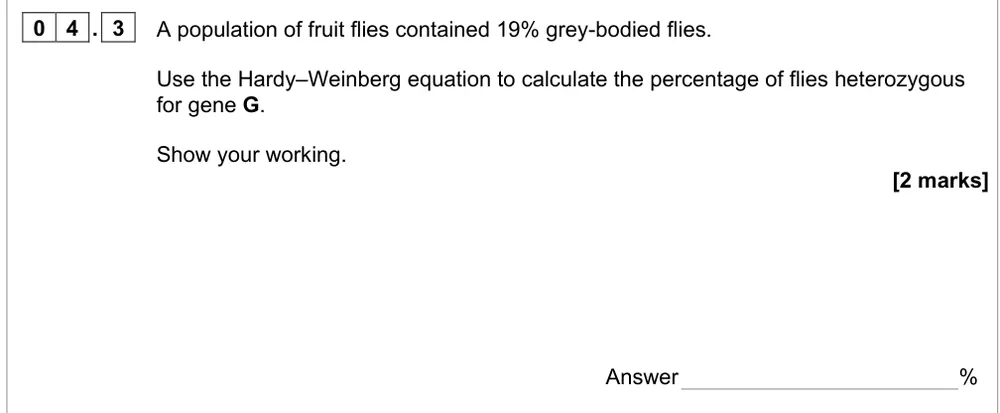
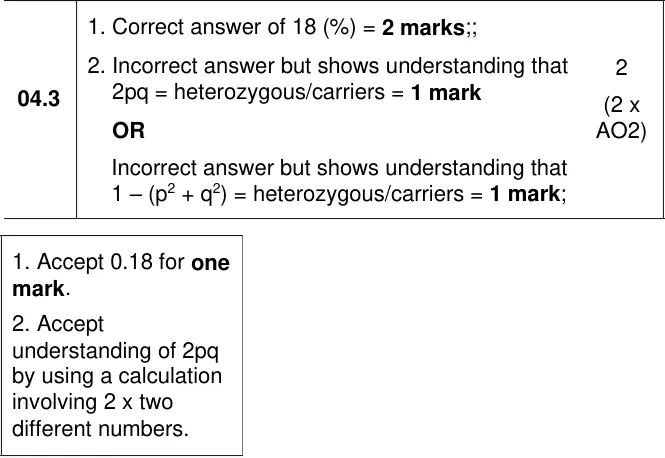
Use Hardy–Weinberg to find the percentage of heterozygous flies when 19% are grey.
Show the mark scheme
Tap an image to open it full size.
From the examiners' report: About a third got both marks. Start from the 81% black flies: q² = 0.81, q = 0.9, p = 0.1, so 2pq = 18%. 2 × 0.19 × 0.81 and dividing 2pq by 2 were common errors.
Question 10
A level Paper 2 · June 2023 · Q04.4 · 2 marks · Hard
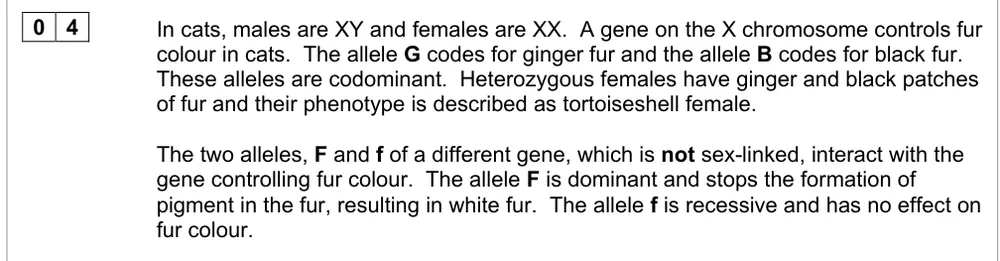
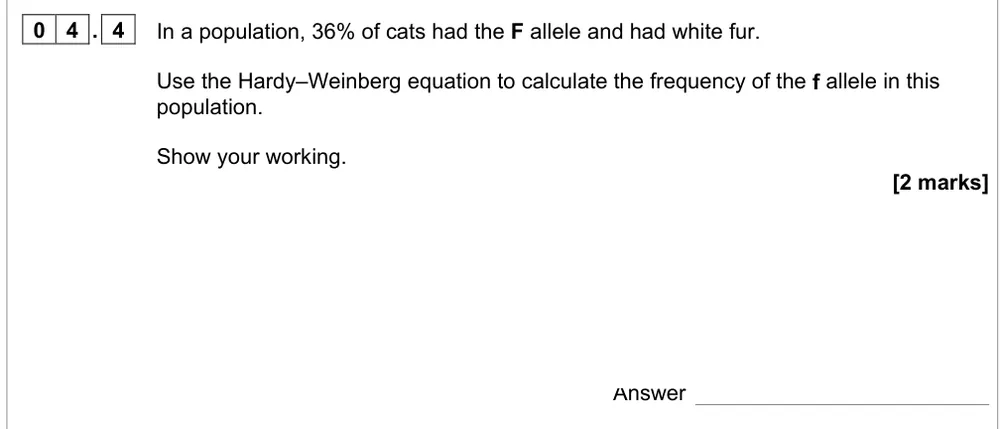
Use Hardy–Weinberg to find the frequency of the recessive f allele in cats.
Information from earlier in this question:
Show the mark scheme
Tap an image to open it full size.
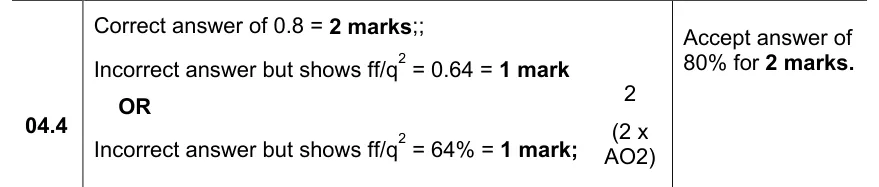
From the examiners' report: About 70% scored zero, mostly by taking 36% as p or p². White cats have at least one F allele, so the other 64% are ff: q² = 0.64 and q = 0.8.
Question 11
A level Paper 2 · November 2020 · Q06.4 · 2 marks · Hard
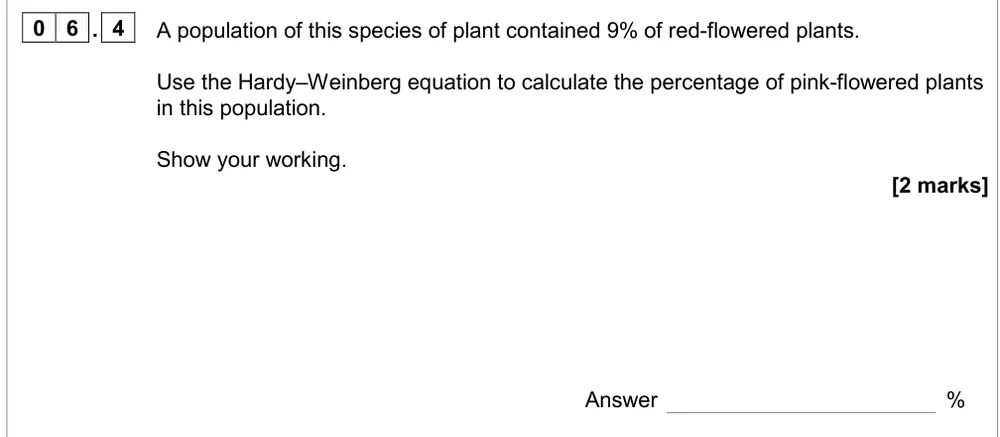
Use Hardy–Weinberg to find the percentage of pink-flowered plants when 9% are red.
Information from earlier in this question:

Show the mark scheme
Tap an image to open it full size.
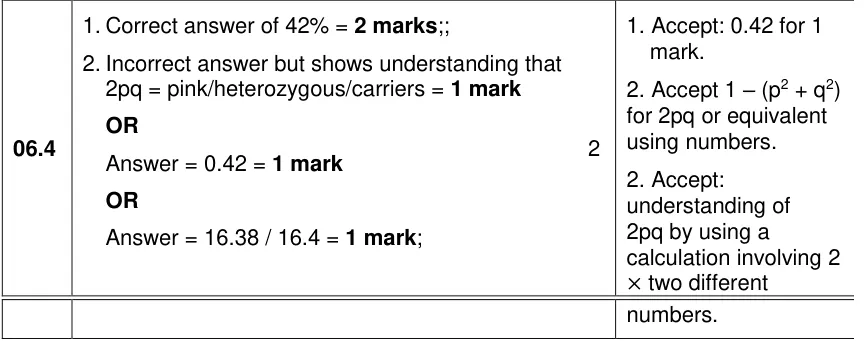
From the examiners' report: About 38% got both. Red plants are one homozygote, so 0.09 is a squared frequency: the red allele is 0.3, the white allele 0.7, and pink = 2 × 0.3 × 0.7 = 42%.
Question 12
A level Paper 3 · November 2021 · Q01.1 · 2 marks · Medium
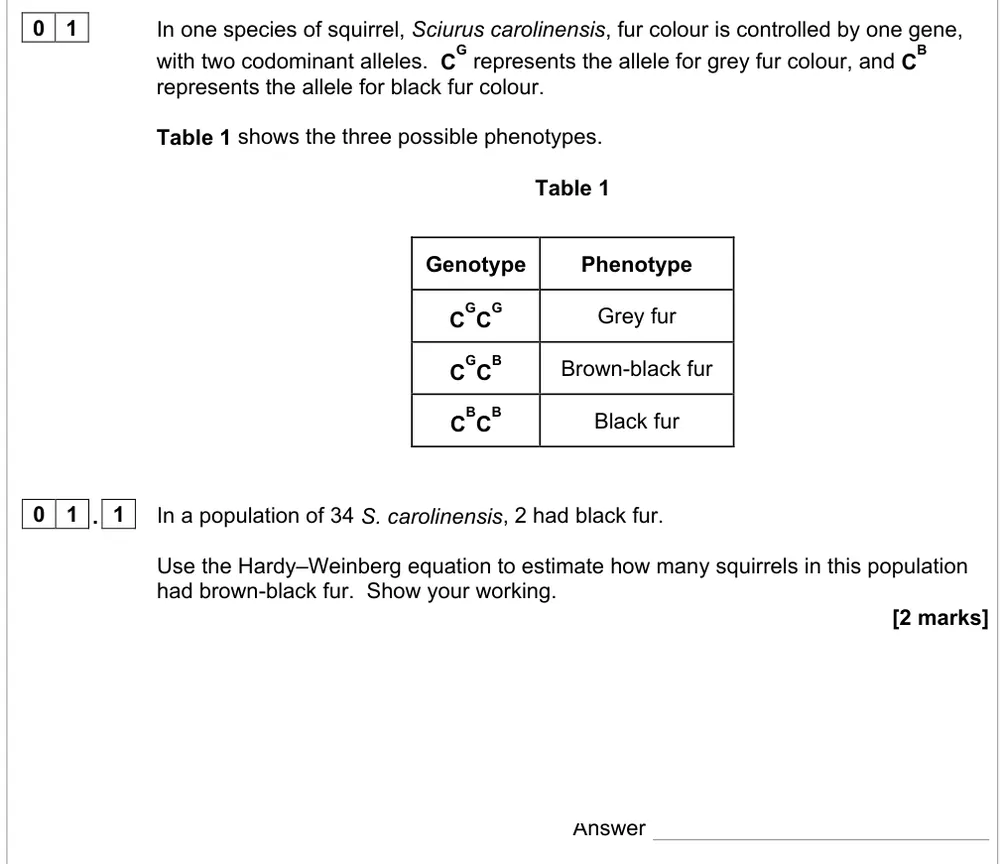
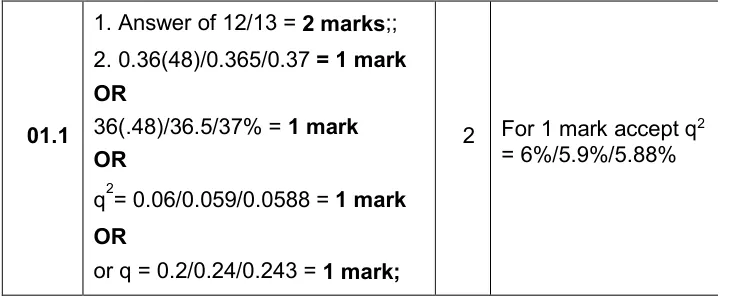
Estimate the number of brown-black squirrels in a population of 34 using Hardy–Weinberg.
Show the mark scheme
Tap an image to open it full size.
From the examiners' report: Only 27.49% got both marks and over half scored zero, often because they didn't know where to start. Start with the black squirrels: q² = 2 ÷ 34, then find q, p and 2pq × 34.
Question 13
A level Paper 3 · November 2021 · Q01.2 · 1 mark · Hard
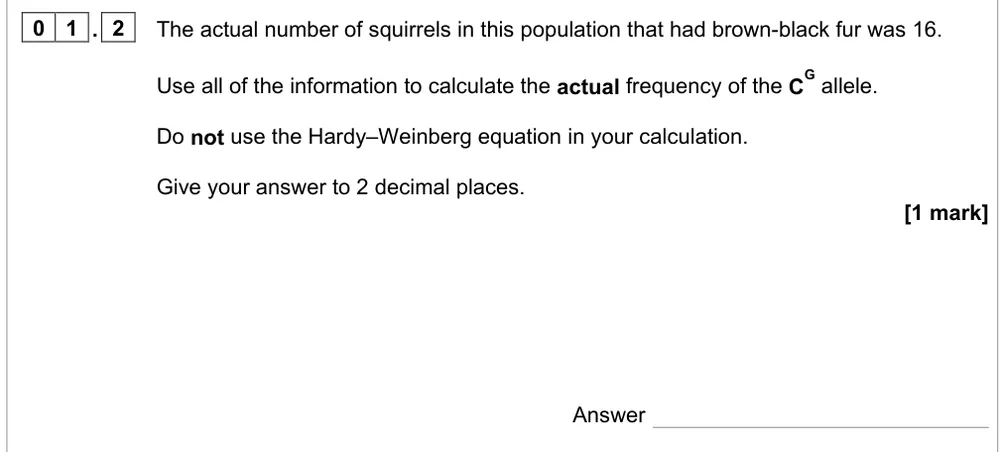
Calculate the actual frequency of the grey allele from the squirrel counts, without Hardy–Weinberg.
Show the mark scheme
Tap an image to open it full size.
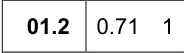
From the examiners' report: Only 11.51% got this. Count alleles: 34 squirrels carry 68 alleles; 16 grey squirrels give 32 CG and 16 brown-black give 16 more, so 48 ÷ 68 = 0.71.
Question 14
A level Paper 3 · June 2024 · Q05.2 · 3 marks · Medium
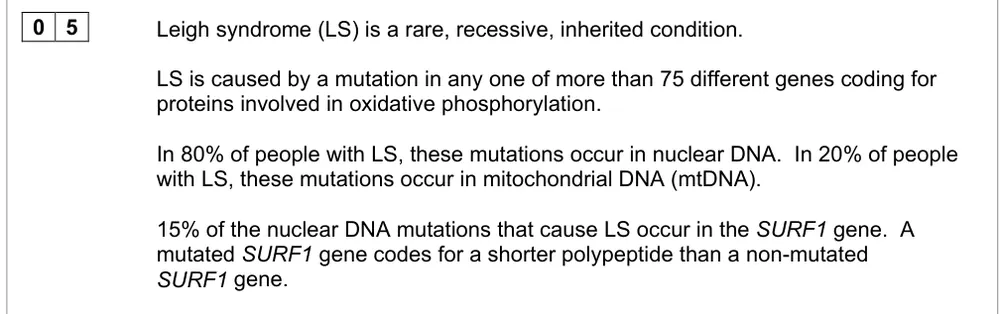
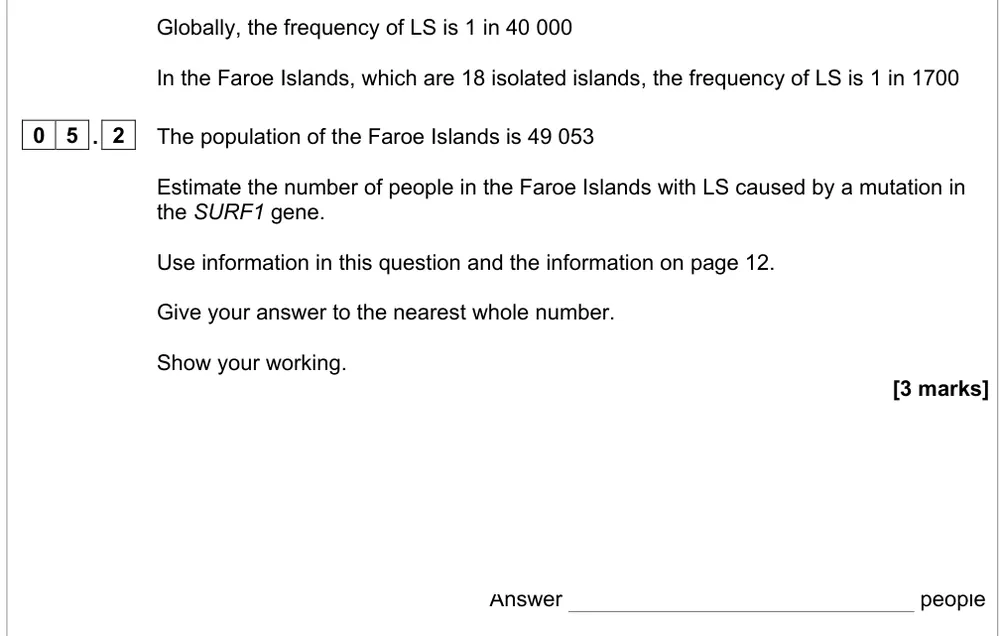
Estimate how many people in the Faroe Islands have Leigh syndrome caused by SURF1.
Information from earlier in this question:
Show the mark scheme
Tap an image to open it full size.
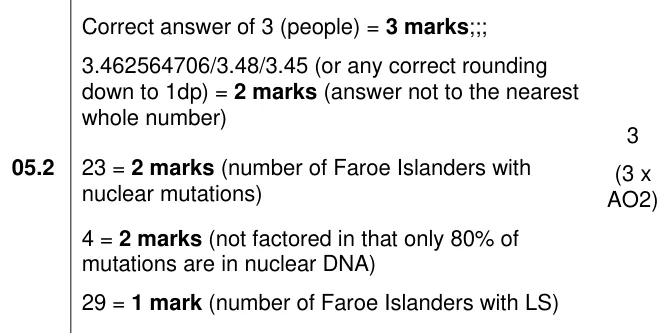
From the examiners' report: 59% got all three. Work through each step: 49 053 ÷ 1700 = 29 with LS, × 0.8 for nuclear DNA, × 0.15 for SURF1. Most who dropped a mark forgot the 80%.
Where students lose marks (from AQA examiners' reports and mark schemes)
Each point below is followed by wording that gained marks.
Same species, same place, same time: 64% scored zero on defining a population and only 5% got both marks. Many described a community, left out time, or forgot that the organisms can interbreed.
✔ Gains credit: "A group of organisms of the same species in a particular space at a particular time; that can potentially interbreed."
Gene pool: every allele in one population: Fewer than 50% got the gene pool mark. Common errors were 'genes' instead of alleles, describing the frequency of an allele, or naming a species with no population.
✔ Gains credit: "All the alleles in a population."
Find q² from the recessive phenotype first: Only about one in six got both marks for summer squash, because most took 36% yellow (a dominant phenotype) as the homozygous recessives. On white cats about 70% scored zero by taking 36% as p or p².
✔ Gains credit: "ff or q² = 0.64"; "correct answer of 0.8" for the f allele.
Heterozygotes are 2pq, so double it: A significant number scored zero on the grey flies by calculating pq instead of 2pq. Others worked out 2pq and then divided by 2, or wrote 2pq² instead of 2pq.
✔ Gains credit: "Shows understanding that 2pq = heterozygous or carriers"; "correct answer of 48%".
Give conditions that the scenario breaks: Only 9% got both marks and almost four out of five scored zero. Crossing over, linked genes, codominance and random fertilisation were common, and some said the population was small when the stem said it was large.
✔ Gains credit: "Selection (against or for a blood group); mutation; immigration or emigration; no random mating."
Hardy–Weinberg needs a single gene: About 15% got both marks for cleft lip and palate. Most said 'we don't know if the allele is dominant or recessive' or that 1 in 700 was too small, instead of using the context.
✔ Gains credit: "Not caused by one gene; environmental factors are involved" (accept methylation or epigenetic factors); "human populations migrate".
Count the alleles when the question bans the equation: Only 11.51% got the actual allele frequency for the squirrels. Many answers weren't frequencies at all, and many used the Hardy–Weinberg equation after being told not to.
✔ Gains credit: "0.71": the grey allele count from the 16 grey and 16 brown-black squirrels, divided by the 68 alleles in the 34 squirrels.
Download the questions
Download the PDF pack (14 questions, mark schemes at the end)
Keep practising
- Inheritance: AQA A Level Biology exam questions by topic
- AQA 3.7.2 Hardy-Weinberg: self-marking quiz
- Genetic diversity and adaptation: AQA A Level Biology exam questions by topic
- Algebra (MS 2): AQA A Level Biology exam questions by topic
- AQA A Level Biology masterclasses
Questions, mark schemes and examiners' report extracts © AQA.