

Enzymes (AQA 3.1.4.2) are tested on every AS and A-level paper, often in an unfamiliar context such as ATP synthase, a cancer drug or a bacterial toxin. You need the induced-fit model and how enzymes lower activation energy, how the tertiary structure of the active site makes an enzyme specific, how enzyme and substrate concentration, pH, temperature and competitive and non-competitive inhibitors change the rate, and how models of enzyme action have changed over time.
The examiners' reports show the marks go on precise wording. Students say the 'enzyme' changes shape instead of the active site, write 'specific' or 'same shape' instead of complementary, abbreviate enzyme-substrate complex to 'E-S' without ever writing it in full, leave out tertiary structure, or describe a non-competitive inhibitor without saying where it binds.
Start with how enzymes work, then active sites and specificity, then rates and inhibitors. Answer each on paper before you open the mark scheme. If you'd like help with this topic, my AQA masterclasses run online on Tuesdays at 5.15pm for Year 12 and on Wednesdays or Thursdays at 6.30pm for Year 13.
What you need from GCSE and Year 12
Each question on this page assumes you're secure on these GCSE and Year 12 ideas. If any of them feels shaky, revise it before you start.
- GCSE: enzymes are biological catalysts that speed up reactions without being used up.
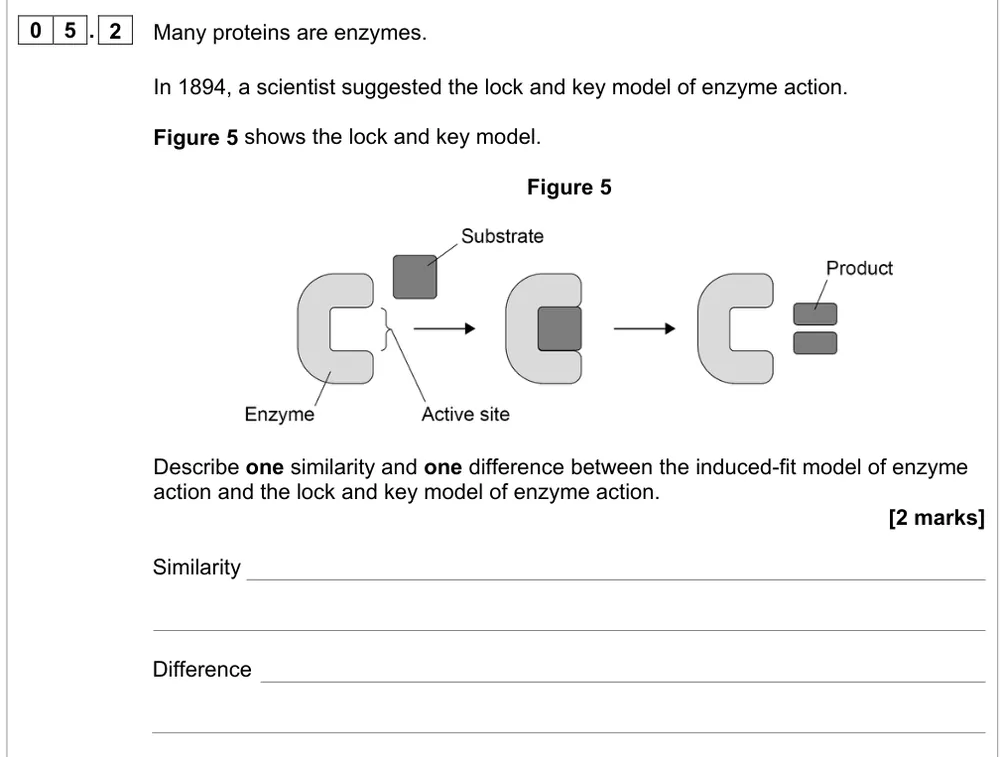
- GCSE: the lock and key model: the substrate fits the active site, so each enzyme is specific.
- GCSE: temperature and pH have an optimum; too high a temperature or the wrong pH denatures the enzyme.
- Year 12 (AQA 3.1.4.1): enzymes are proteins, and their active site depends on their tertiary structure, held by hydrogen bonds, ionic bonds and disulfide bridges. See the Proteins page.
Key terms
These words come up in the questions and mark schemes. Examiners expect you to use them exactly.
- Catalyst: a substance that speeds up a reaction without being used up.
- Activation energy: the minimum energy needed for a reaction to start. Enzymes lower it.
- Active site: the part of an enzyme, with a specific tertiary structure, where the substrate binds.
- Substrate: the molecule an enzyme acts on.
- Enzyme-substrate complex: the enzyme with its substrate bound to the active site. Write it in full: examiners don't accept 'E-S' on its own.
- Induced fit: the model in which the active site changes shape slightly as the substrate binds, putting strain on the substrate's bonds.
- Specificity: an enzyme usually catalyses only one type of reaction, because only a substrate with a complementary shape can bind to its active site.
- Denatured: the tertiary structure, and so the active site, has changed shape so the substrate can no longer bind. It is not 'killed'.
- Competitive inhibitor: a molecule with a similar shape to the substrate that binds to the active site; adding more substrate reduces its effect.
- Non-competitive inhibitor: a molecule that binds somewhere other than the active site (an allosteric site), changing the active site's shape; more substrate doesn't reduce its effect.
What these questions cover (AQA 3.1.4.2)
The questions test these statements from the AQA AS and A-level Biology specification (7401/7402):
- Activation energy and induced fit: Each enzyme lowers the activation energy of the reaction it catalyses. The induced-fit model of enzyme action.
- Active site: The properties of an enzyme relate to the tertiary structure of its active site and its ability to combine with complementary substrate(s) to form an enzyme-substrate complex.
- Specificity: The specificity of enzymes
- Factors affecting rate: The effects of the following factors on the rate of enzyme-controlled reactions – enzyme concentration, substrate concentration, concentration of competitive and of non-competitive inhibitors, pH and temperature. (the practical side of this is on the Required practical 1 page)
- Students should be able to appreciate how models of enzyme action have changed over time
- Students should be able to appreciate that enzymes catalyse a wide range of intracellular and extracellular reactions that determine structures and functions from cellular to whole-organism level.
How to use this page
Write your answer on paper before you open the mark scheme. Allow about 1.3 minutes per mark: the 18 questions are worth 44 marks, so about 57 minutes in total. Then mark your answer strictly against the mark scheme and read the examiners' tip underneath it. If you'd rather print the questions, download the PDF pack.
How enzymes work (3.1.4.2)
Question 1
AS Paper 1 · June 2022 · Q05.2 · 2 marks · Medium
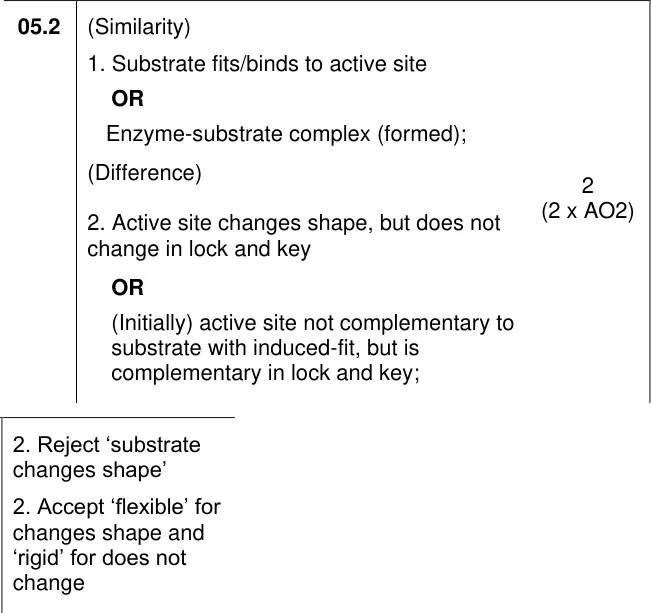
Give one similarity and one difference between the lock and key and induced-fit models.
Show the mark scheme
Tap an image to open it full size.
From the examiners' report: Most got the similarity. For the difference, say the active site changes shape, not 'the enzyme'.
Question 2
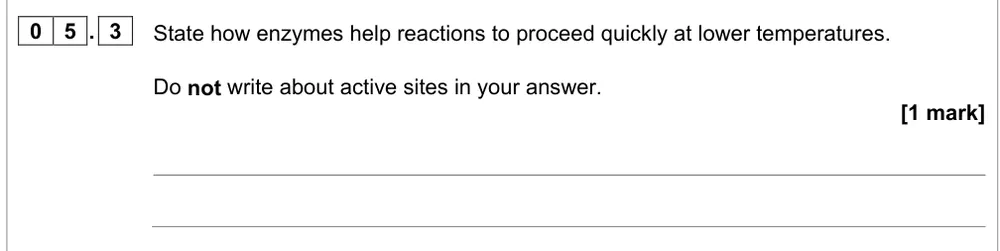
AS Paper 1 · June 2022 · Q05.3 · 1 mark
State how enzymes let reactions go quickly at lower temperatures.
Show the mark scheme

Tap an image to open it full size.
From the examiners' report: 60% got this. 'Alternative pathway' or just 'catalysing the reaction' didn't score.
Question 3
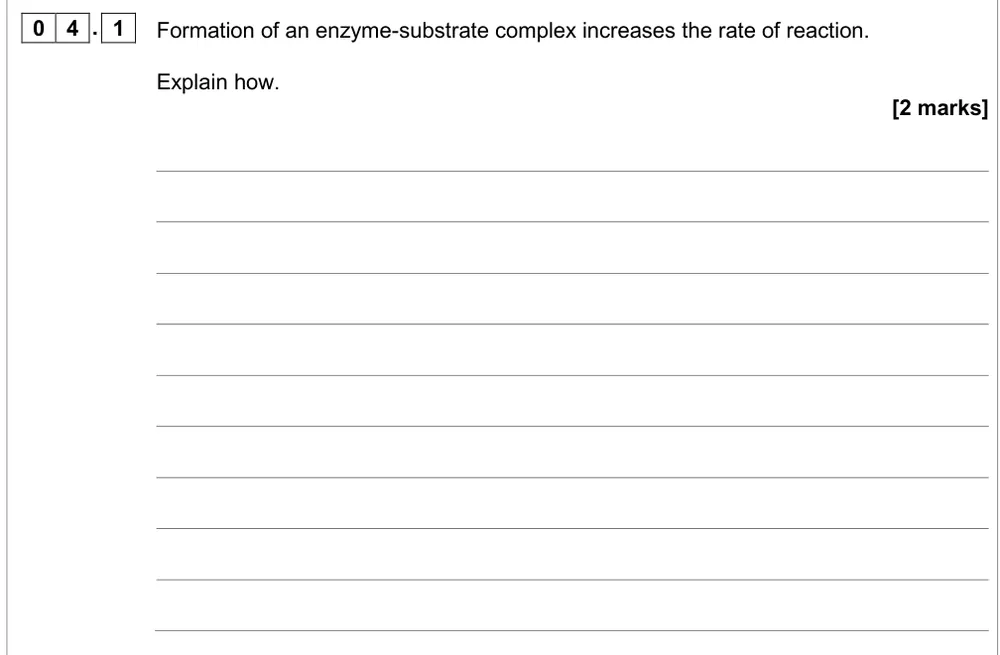
A level Paper 1 · June 2018 · Q04.1 · 2 marks
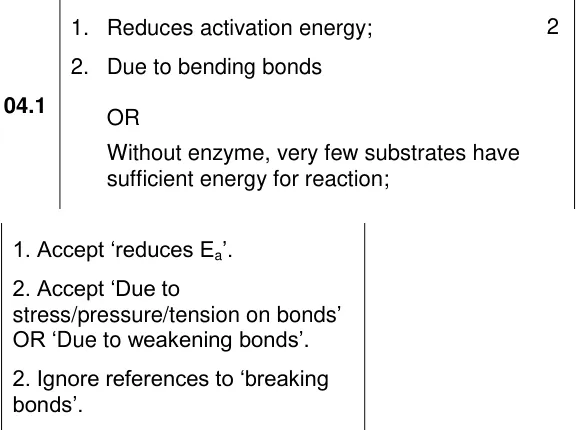
Explain how forming an enzyme-substrate complex increases the rate of reaction.
Show the mark scheme
Tap an image to open it full size.
From the examiners' report: Many knew activation energy is lowered, but only 18% explained it by bending the bonds in the substrate.
Question 4
AS Paper 2 · June 2025 · Q06.1 · 3 marks · Medium
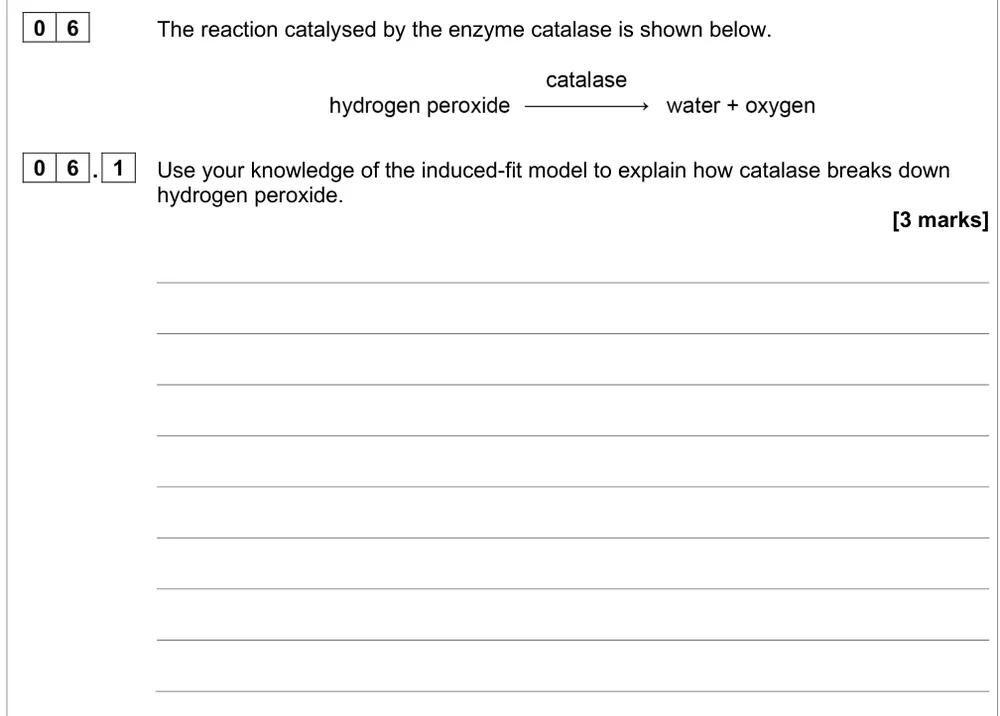
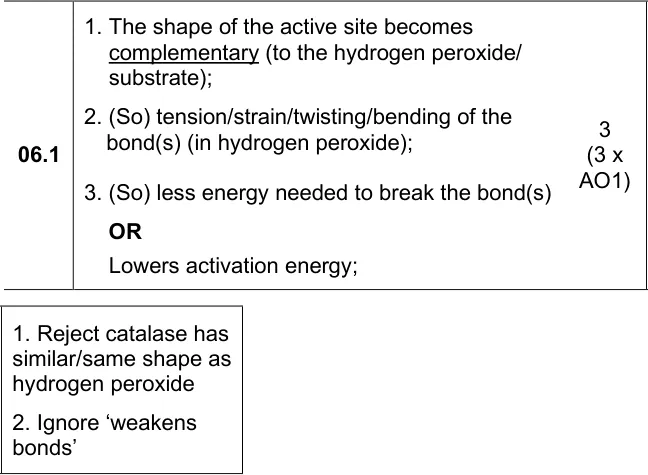
Use the induced-fit model to explain how catalase breaks down hydrogen peroxide.
Show the mark scheme
Tap an image to open it full size.
From the examiners' report: Good answers described induced fit, the strain on bonds and the lower activation energy. Weaker ones just rewrote the equation.
Question 5
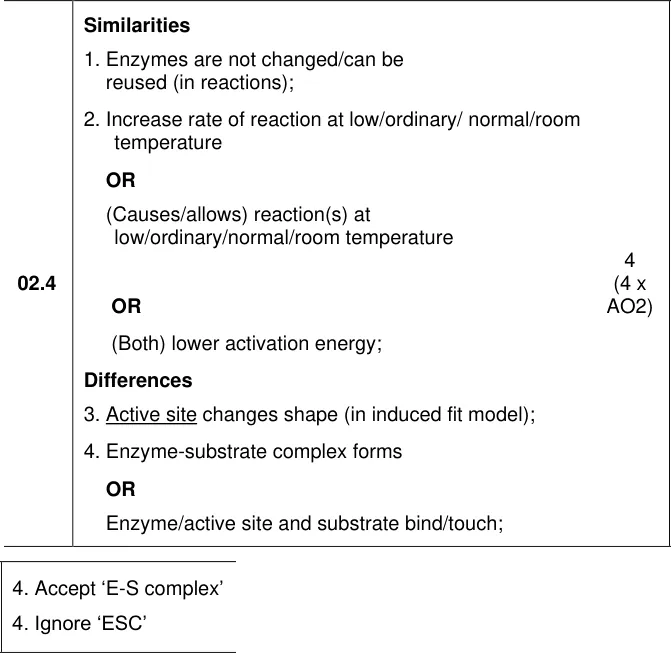
A level Paper 1 · June 2025 · Q02.4 · 4 marks · Medium
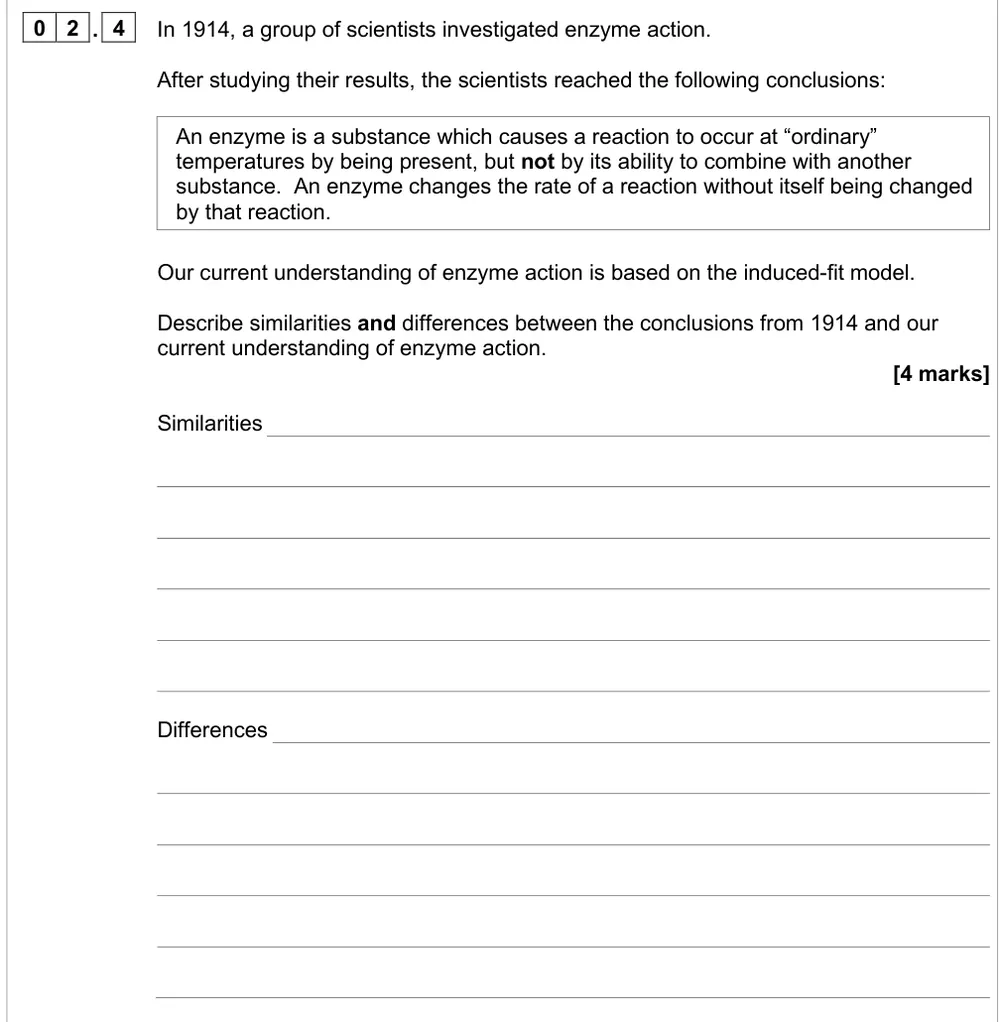
Compare a 1914 description of enzymes with the induced-fit model.
Show the mark scheme
Tap an image to open it full size.
From the examiners' report: Fewer than 10% got all four. Be precise about the active site changing shape, and say substrate, not 'substance'.
Question 6
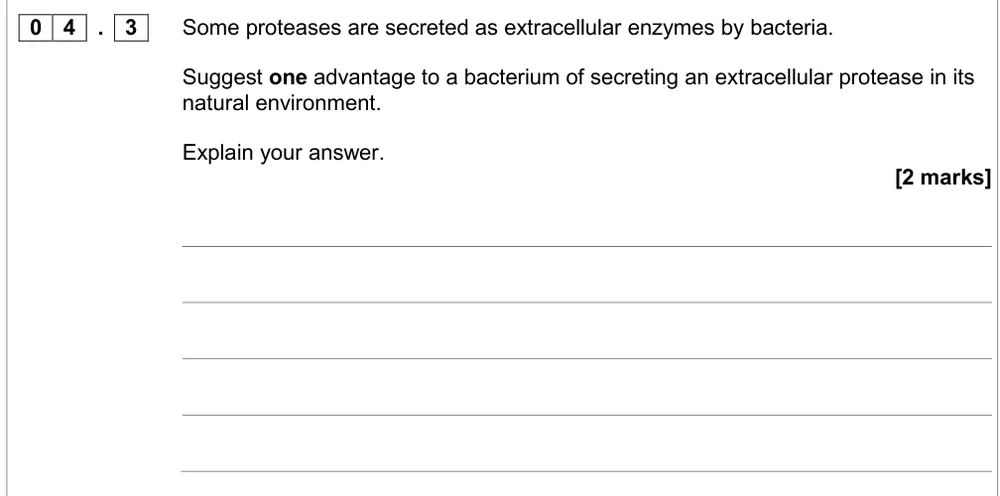
A level Paper 1 · June 2017 · Q04.3 · 2 marks
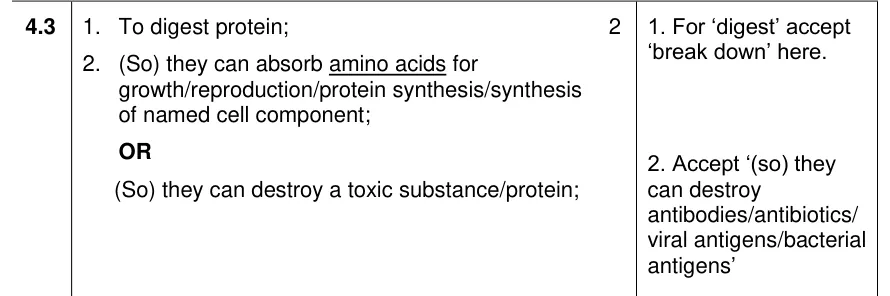
Suggest an advantage to a bacterium of secreting an extracellular protease.
Show the mark scheme
Tap an image to open it full size.
From the examiners' report: There's no examiners' report for this paper, so this tip comes from the mark scheme. Say what the enzyme digests and what the bacterium then gains.
Active sites and specificity (3.1.4.2)
Question 7
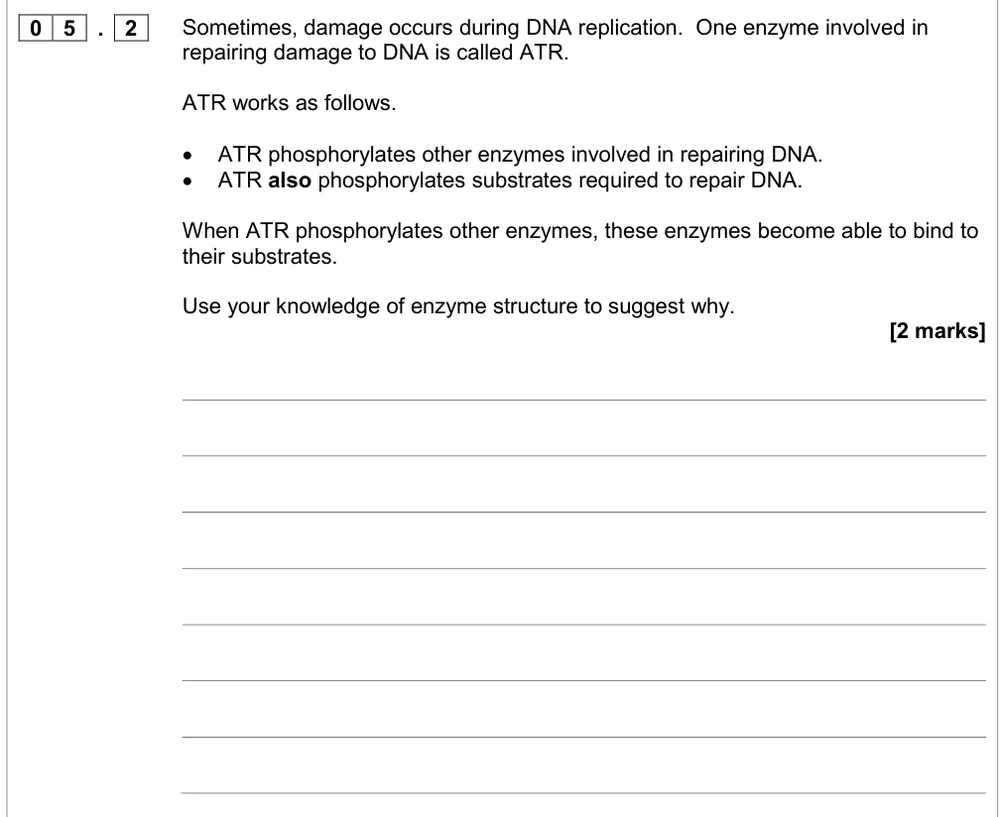
A level Paper 3 · June 2017 · Q05.2 · 2 marks · Medium
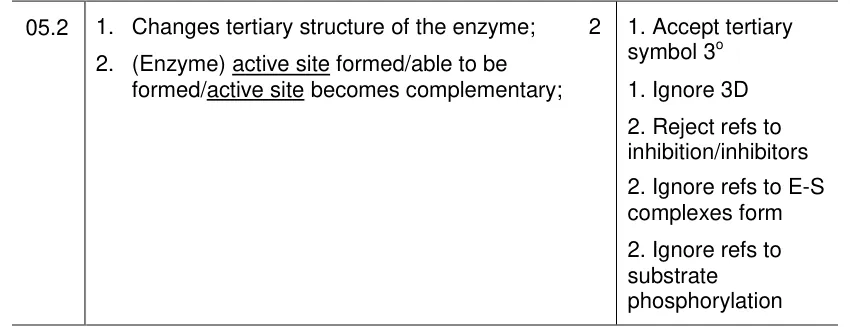
Suggest why phosphorylation lets enzymes bind to their substrates.
Show the mark scheme
Tap an image to open it full size.
From the examiners' report: About 38% got both marks. Link the change in tertiary structure to the active site becoming complementary.
Question 8
A level Paper 1 · June 2022 · Q05.2 · 2 marks
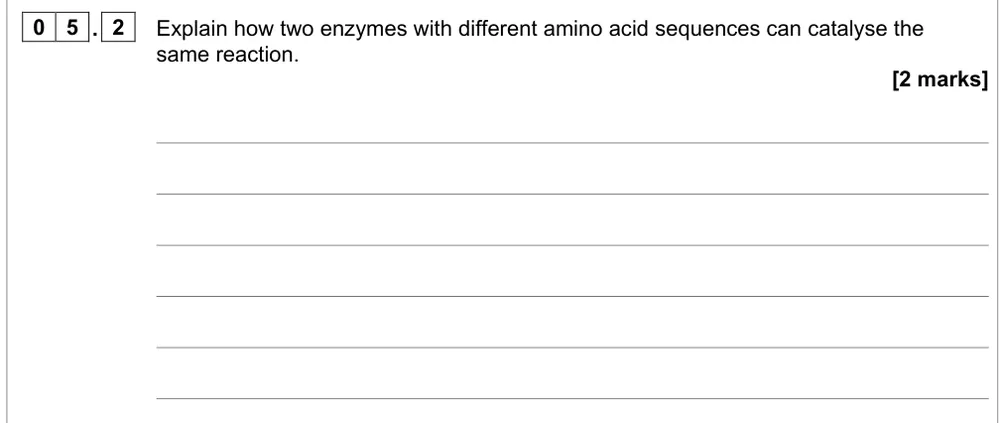
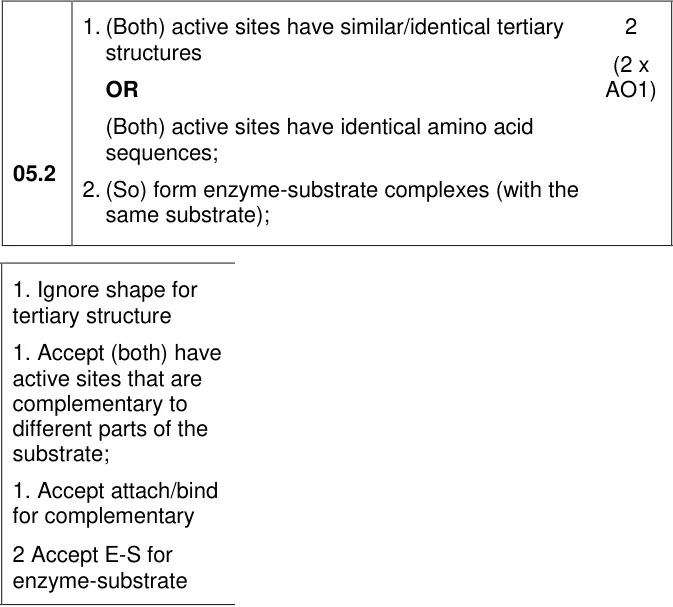
Explain how two enzymes with different amino acid sequences can catalyse the same reaction.
Information from earlier in this question:

Show the mark scheme
Tap an image to open it full size.
From the examiners' report: Many scored nothing, writing about the degenerate code or mutations. Talk about the active sites' tertiary structure, and write enzyme-substrate complex in full.
Question 9
AS Paper 2 · June 2023 · Q03.3 · 2 marks
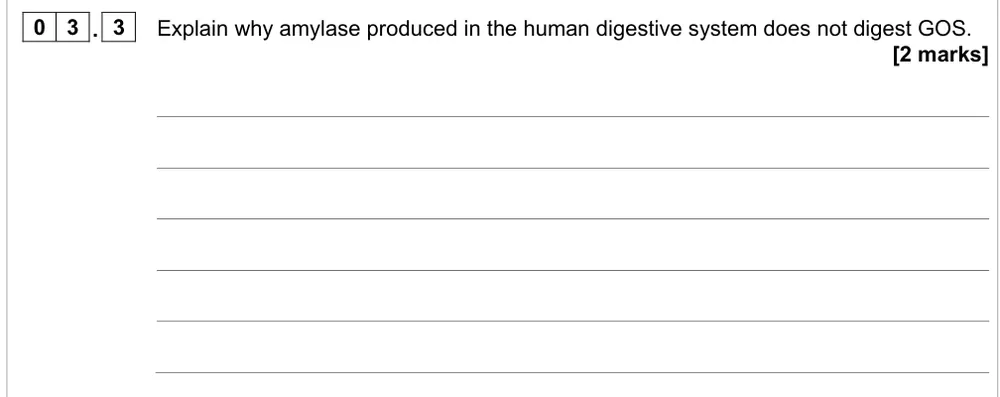
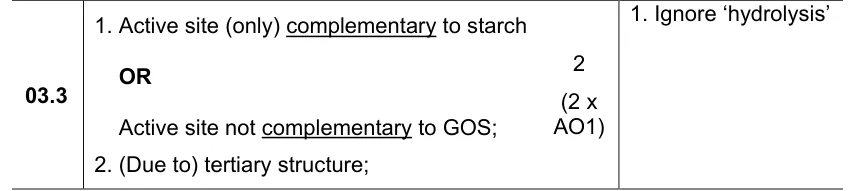
Explain why human amylase does not digest GOS.
Information from earlier in this question:

Show the mark scheme
Tap an image to open it full size.
From the examiners' report: Marks were lost for vague claims that 'amylase is not complementary to GOS'. 'Same shape' and 'binding sites' got no credit.
Question 10
AS Paper 2 · June 2023 · Q02.2 · 4 marks · Hard
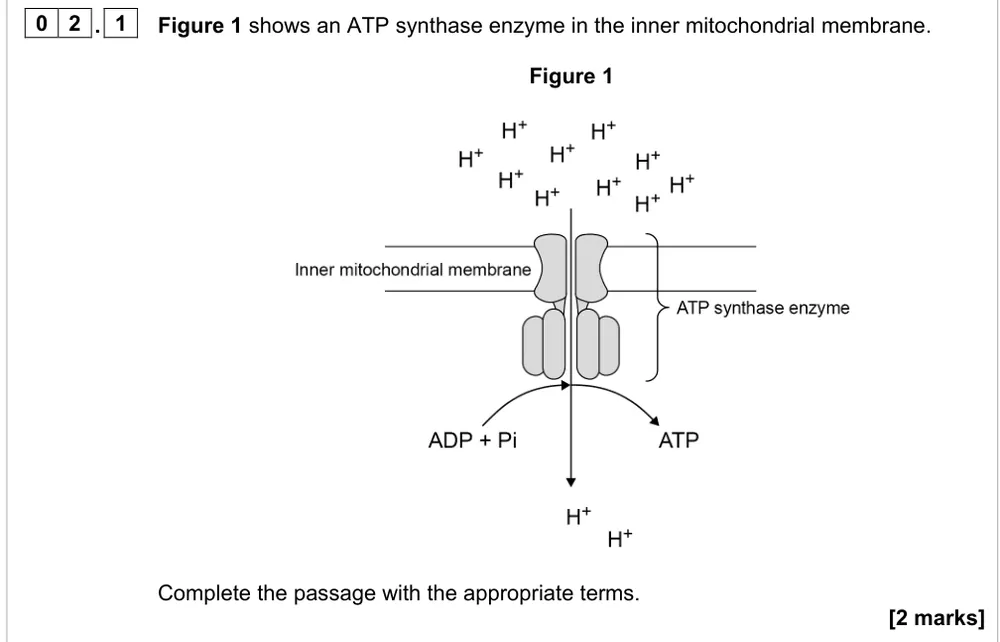
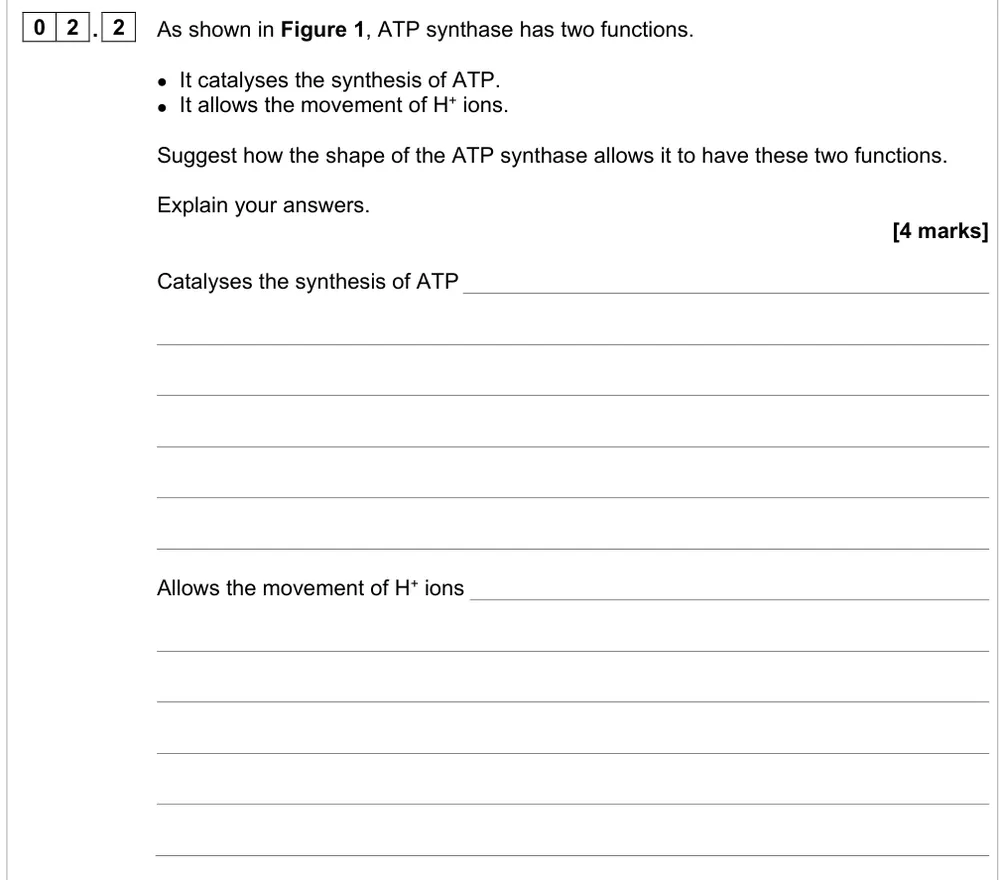
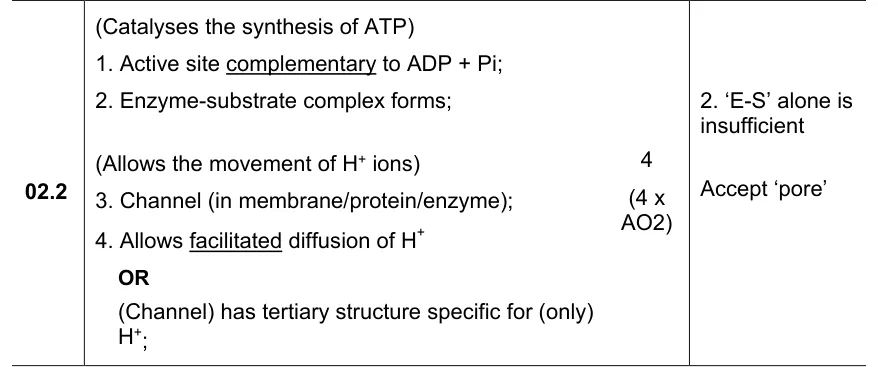
Suggest how the shape of ATP synthase lets it make ATP and let H+ ions through.
Information from earlier in this question:
Show the mark scheme
Tap an image to open it full size.
From the examiners' report: Only about 25% got 2 or more. Too many said 'enzymes are complementary to substrates' with no active site, and 'E-S' alone wasn't accepted.
Factors affecting the rate and inhibitors (3.1.4.2)
Question 11
A level Paper 1 · November 2020 · Q02.2 · 2 marks · Easy
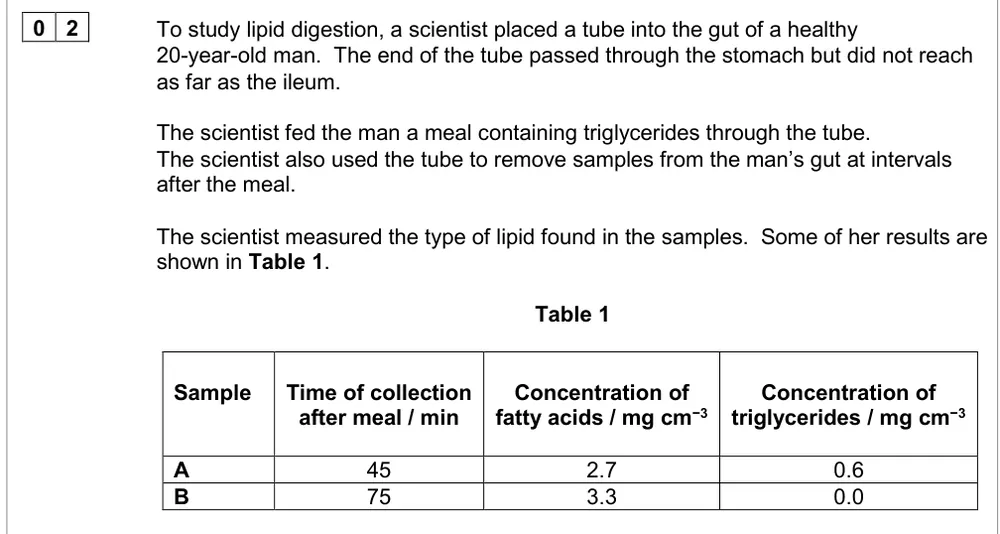
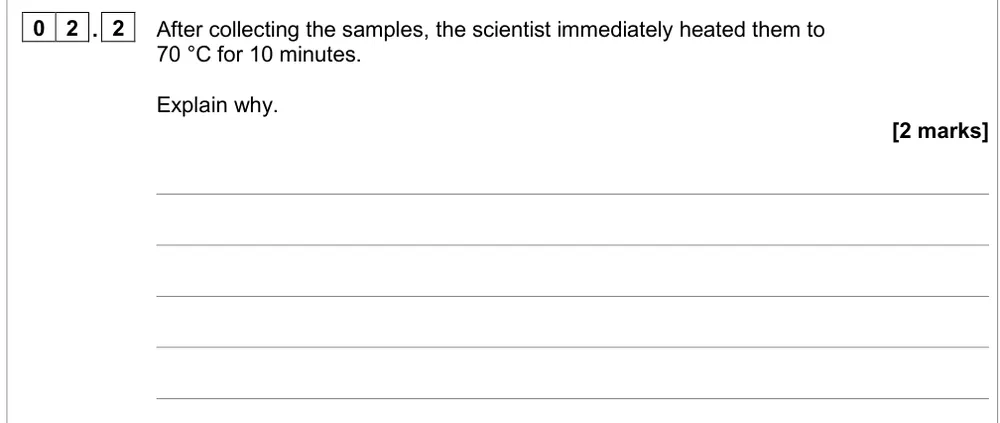
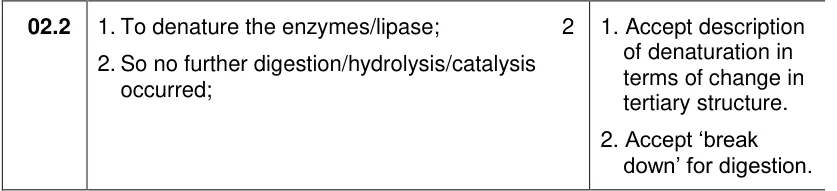
Explain why gut samples were heated to 70 °C straight after collection.
Information from earlier in this question:
Show the mark scheme
Tap an image to open it full size.
From the examiners' report: 53% got both marks. Relate it to this investigation: no more lipid is digested. Enzymes are denatured, not 'killed'.
Question 12
A level Paper 1 · November 2021 · Q01.4 · 2 marks
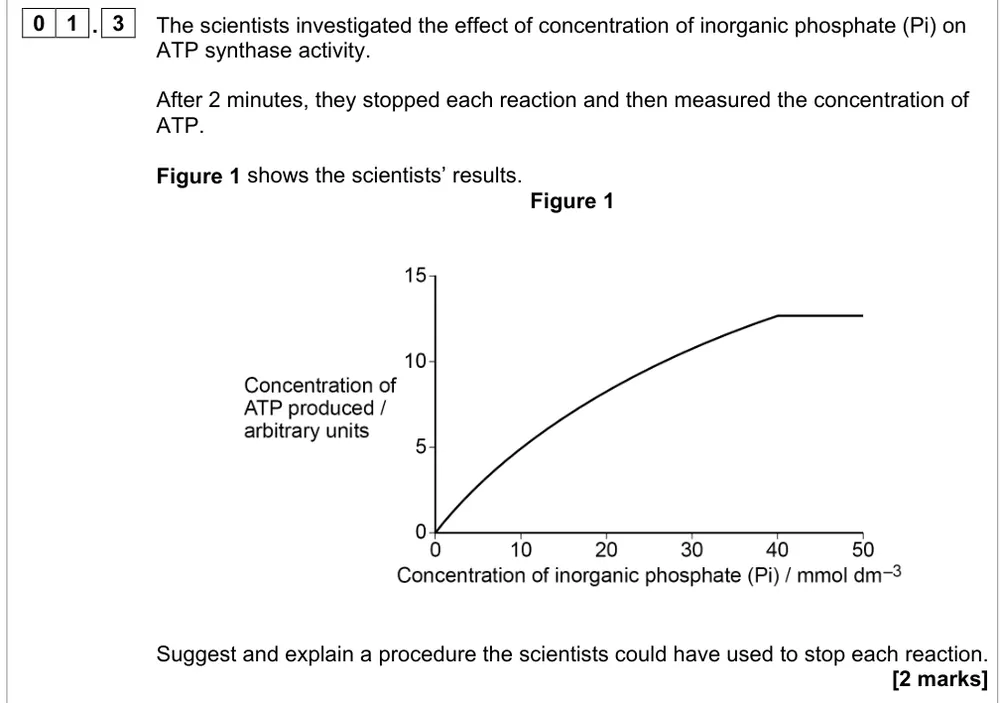
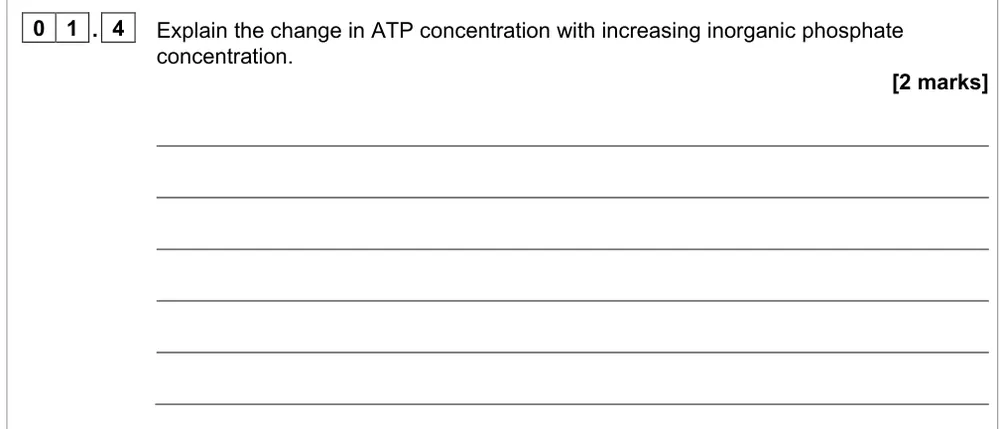
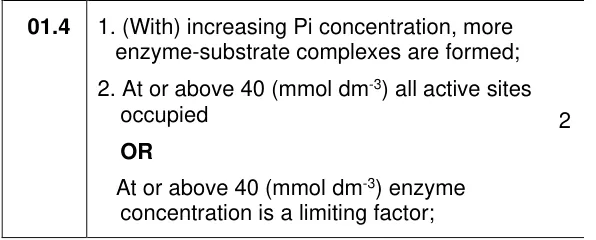
Explain how ATP production changes as phosphate concentration rises.
Information from earlier in this question:
Show the mark scheme
Tap an image to open it full size.
From the examiners' report: Answers naming ADP as the limiting factor didn't score: in this investigation all the other substrates were in excess.
Question 13
AS Paper 2 · November 2020 · Q05.3 · 3 marks
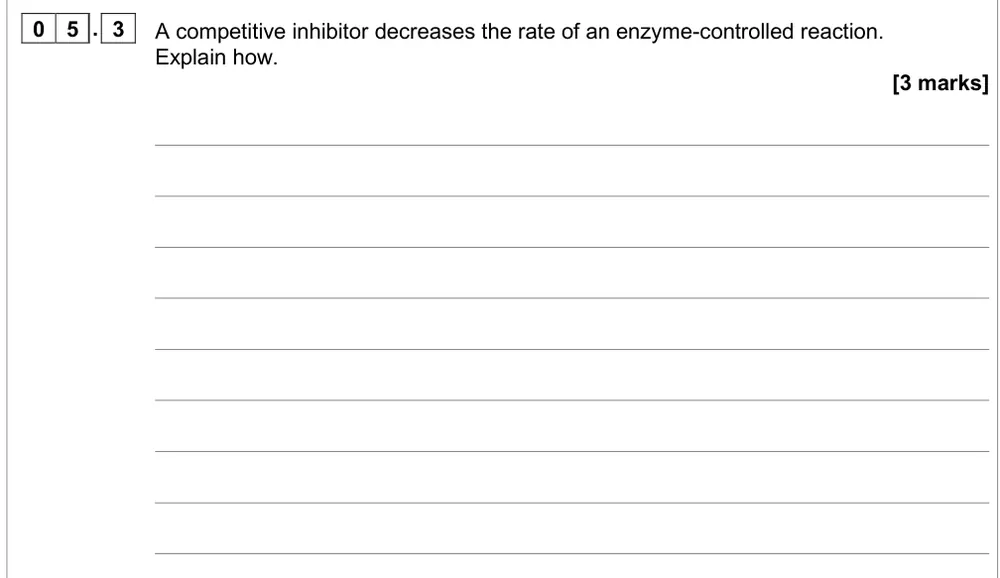
Explain how a competitive inhibitor decreases the rate of reaction.
Show the mark scheme

Tap an image to open it full size.
From the examiners' report: Many good answers. Marks were lost for saying 'identical' or 'same shape', or for describing non-competitive inhibition.
Question 14
A level Paper 1 · June 2023 · Q08.2 · 3 marks · Easy
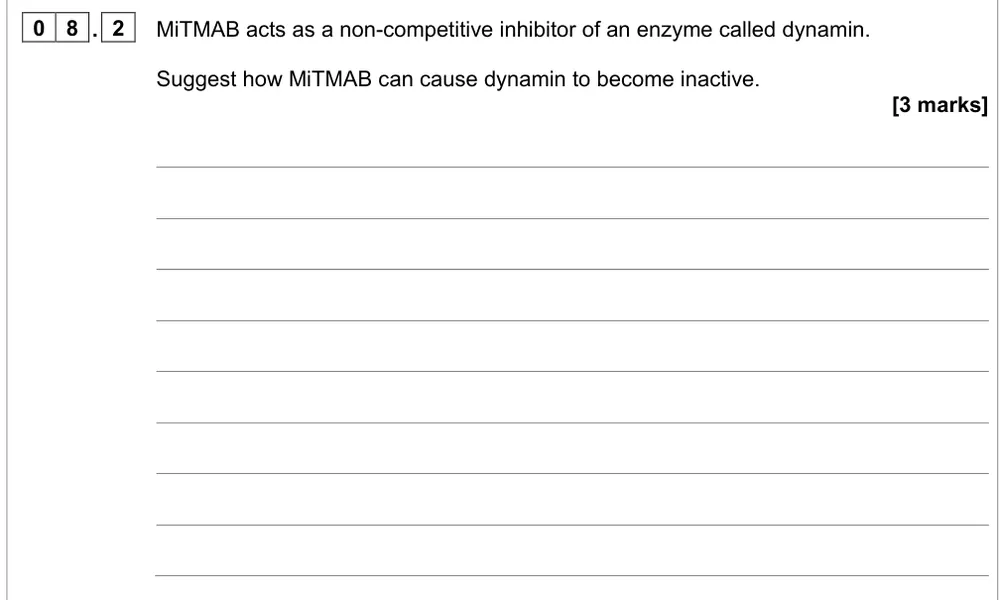
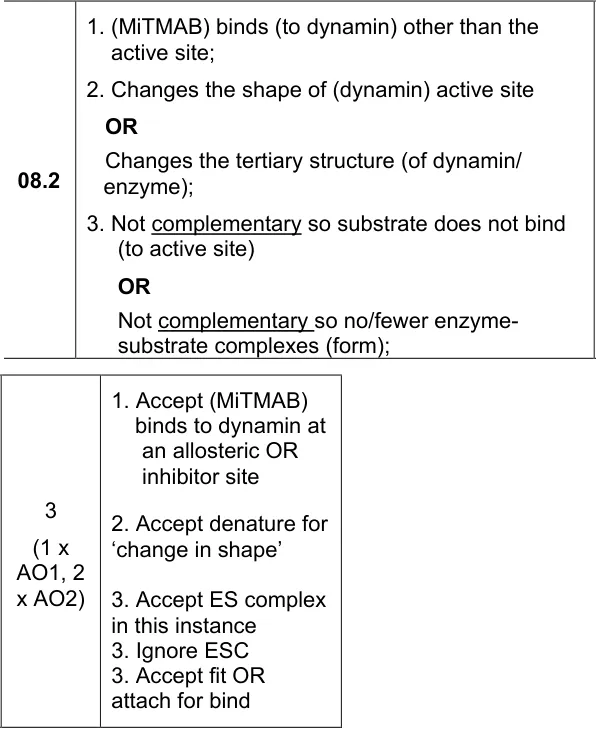
Suggest how a non-competitive inhibitor makes dynamin inactive.
Show the mark scheme
Tap an image to open it full size.
From the examiners' report: Over 50% got full marks. Mark point 3 was missed by not saying the substrate can no longer bind because the active site isn't complementary.
Question 15
A level Paper 1 · June 2025 · Q03.3 · 4 marks · Medium
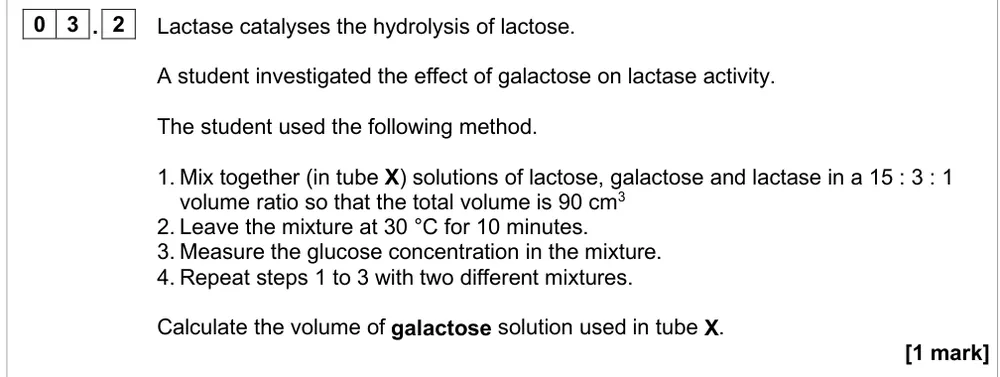
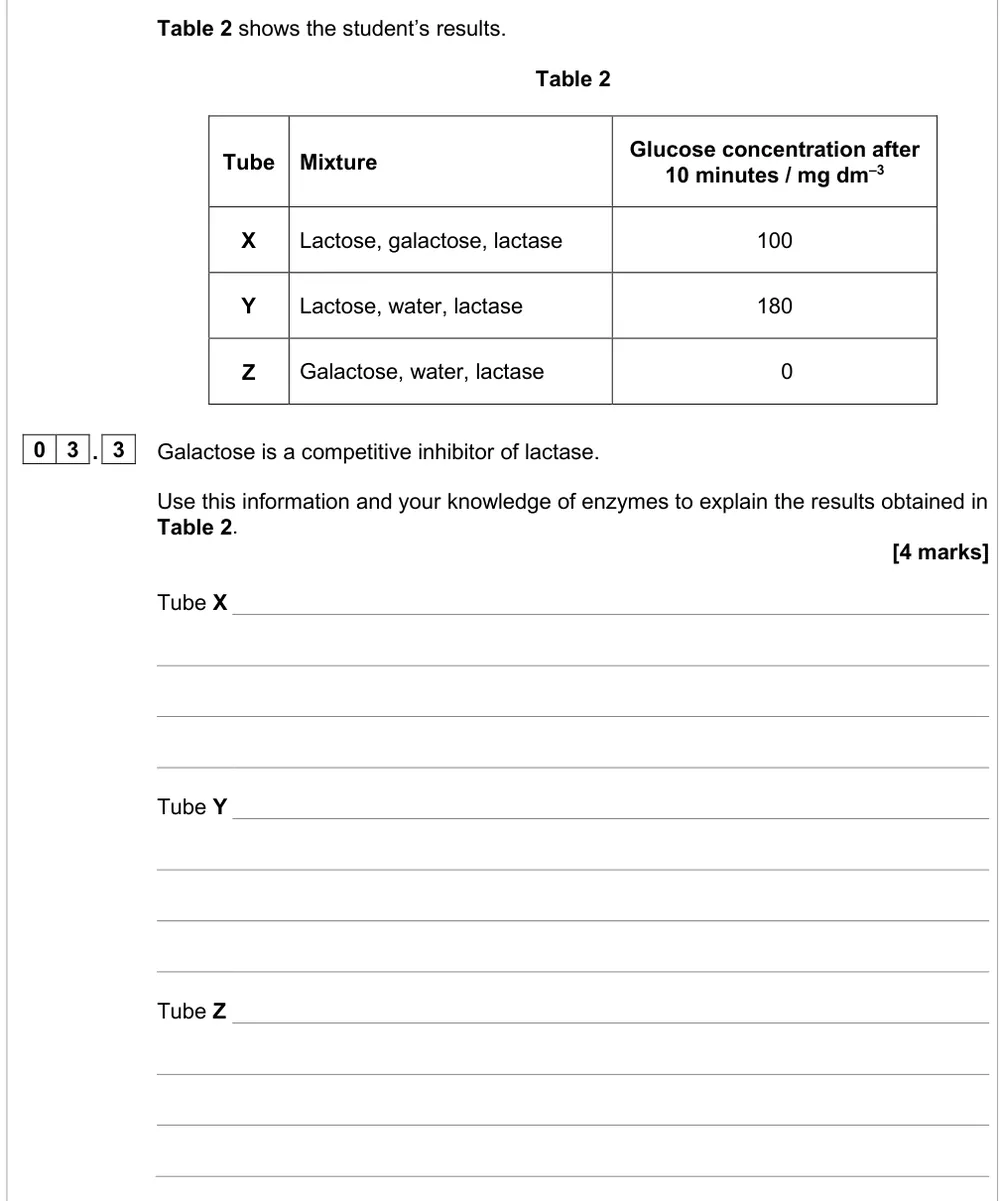
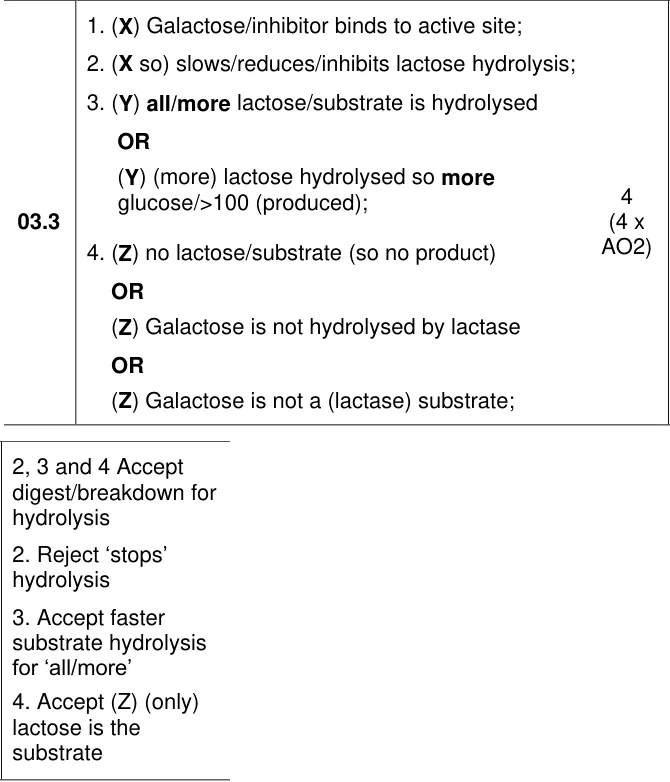
Use results with lactose, galactose and lactase to explain competitive inhibition.
Information from earlier in this question:
Show the mark scheme
Tap an image to open it full size.
From the examiners' report: About 15% got all four. Say galactose binds to the active site (not just 'a site'), and use 'hydrolysis'.
Question 16
A level Paper 1 · June 2025 · Q03.4 · 2 marks · Hard
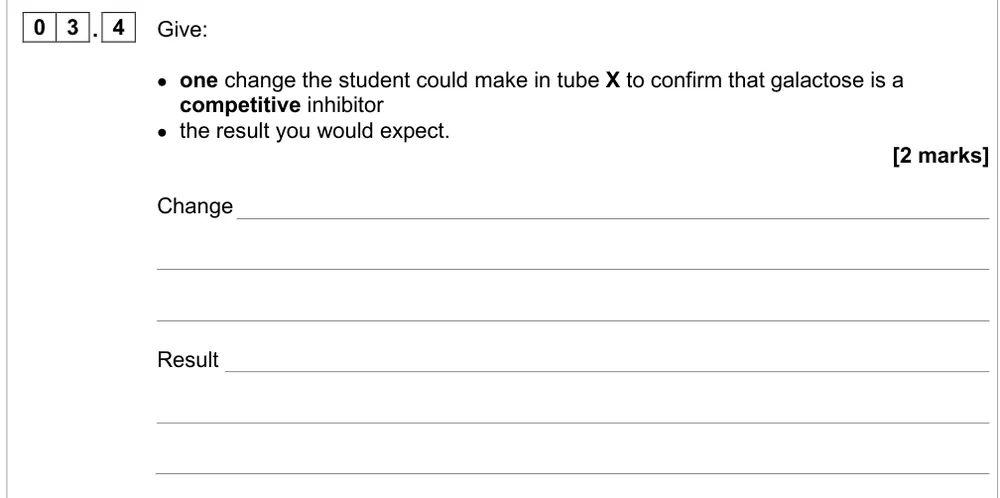
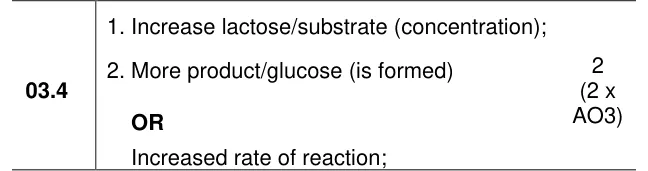
Give a change to the experiment that would confirm galactose is a competitive inhibitor.
Show the mark scheme
Tap an image to open it full size.
From the examiners' report: About 25% got both. Changing only the galactose concentration changes the amount of inhibition, not its type.
Question 17
AS Paper 2 · November 2020 · Q05.4 · 3 marks · Hard
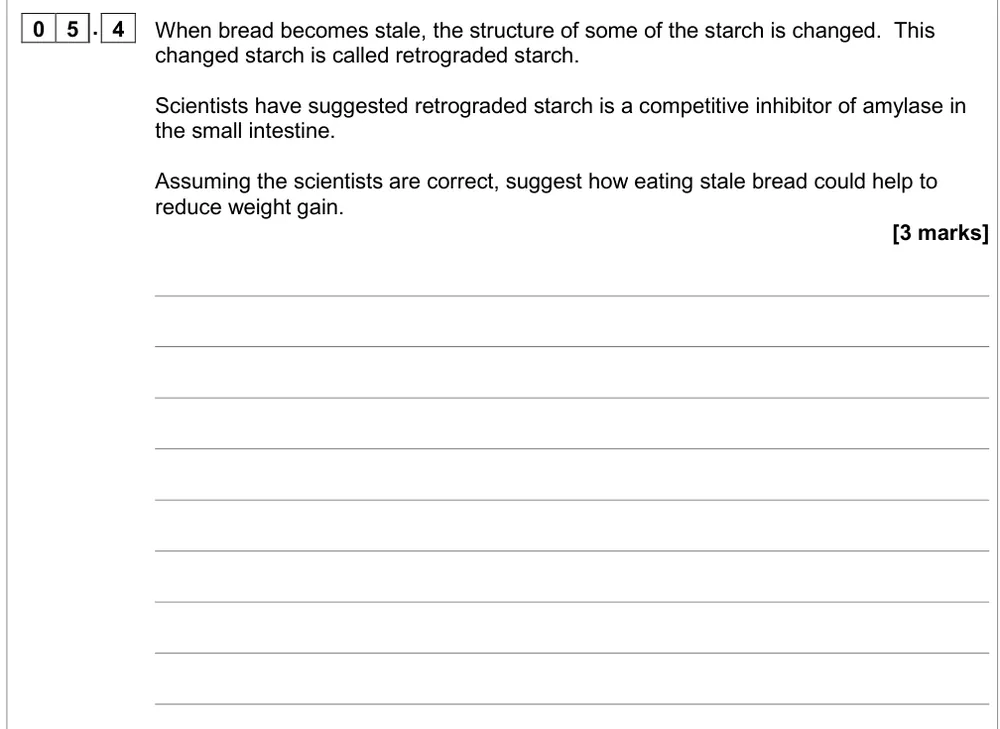
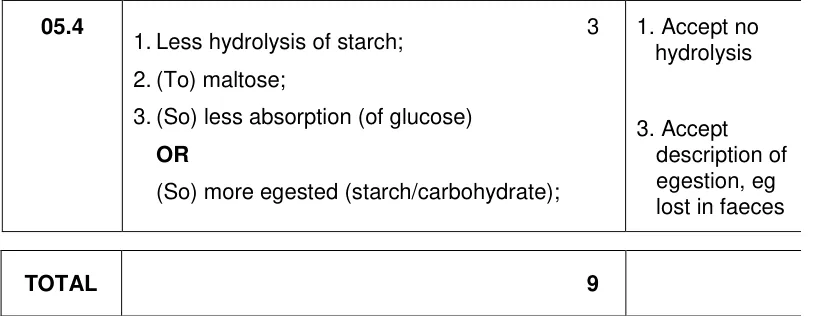
Suggest how a competitive inhibitor of amylase in stale bread could reduce weight gain.
Show the mark scheme
Tap an image to open it full size.
From the examiners' report: Over 50% scored, usually for less absorption. Few named maltose as the product of amylase, or used the word hydrolysis.
Question 18
AS Paper 2 · June 2025 · Q06.5 · 1 mark · Hard
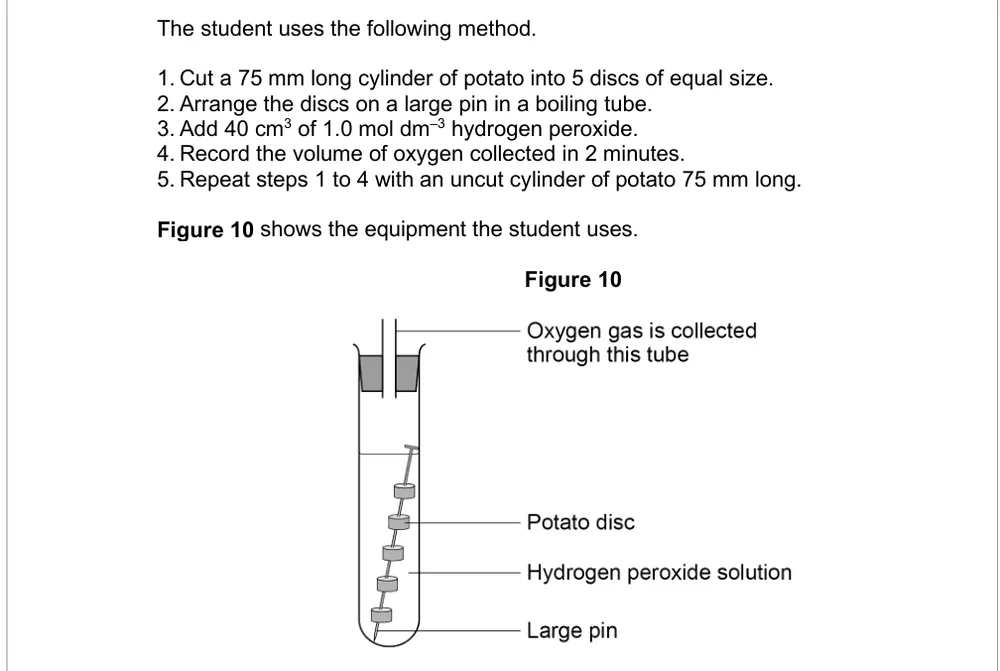
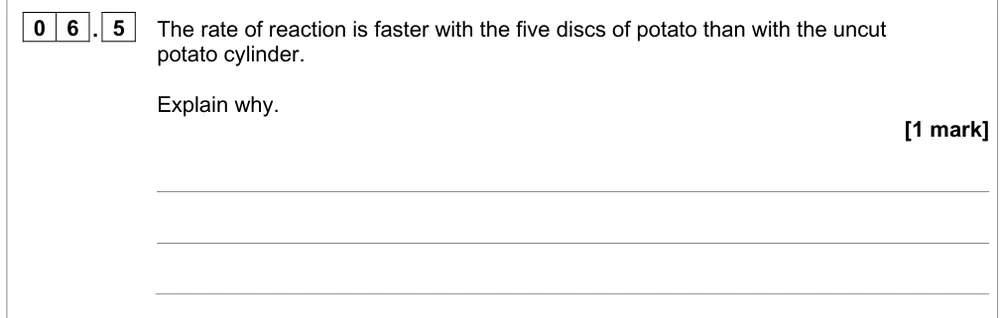
Explain why potato discs release oxygen faster than a whole cylinder.
Information from earlier in this question:

Show the mark scheme

Tap an image to open it full size.
From the examiners' report: Only about 5% got this. Most just said the surface area was bigger; link it to more enzyme-substrate complexes forming.
Where students lose marks (from AQA examiners' reports and mark schemes)
Each point below is followed by wording that gained marks.
The active site changes shape: Many wrote that in induced fit 'the enzyme changes shape', or said the active site is complementary in both models, which isn't true of induced fit.
✔ Gains credit: "In induced fit the active site changes shape as the substrate binds; in lock and key the active site is already complementary and doesn't change."
Bend the bonds, lower the energy: Many said enzymes lower activation energy, but only 18% explained it by the enzyme putting strain on the substrate's bonds.
✔ Gains credit: "Reduces activation energy, by bending/stressing the bonds in the substrate."
Write enzyme-substrate complex in full: Examiners repeatedly penalised 'E-S' used on its own: the abbreviation isn't in the specification.
✔ Gains credit: "…so more enzyme-substrate complexes form" (write it in full at least once).
Complementary because of tertiary structure: Answers made vague claims that amylase is 'not complementary to GOS', or used 'same shape' and 'binding sites', without linking the active site to tertiary structure.
✔ Gains credit: "The active site is only complementary to starch, because of its tertiary structure."
Similar shape, not the same shape: Some said a competitive inhibitor has the same shape as the substrate, or the same shape as the active site, and some described non-competitive inhibition instead.
✔ Gains credit: "The inhibitor has a similar shape to the substrate, binds to the active site and reduces enzyme-substrate complex formation."
Say where a non-competitive inhibitor binds: Errors included the inhibitor binding to the enzyme without saying where, or the enzyme changing shape without mentioning its active site, or a vague 'loss of specificity'.
✔ Gains credit: "Binds at a site other than the active site, changes the tertiary structure so the active site is no longer complementary, so fewer enzyme-substrate complexes."
More substrate tests competitive inhibition: To confirm competitive inhibition, some only changed the inhibitor concentration, which changes the amount of inhibition but not its type.
✔ Gains credit: "Increase the lactose (substrate) concentration; more glucose is produced."
Surface area means more complexes: Only about 5% explained why potato discs worked faster than a cylinder; most just repeated that the surface area was bigger.
✔ Gains credit: "Greater total surface area, so more enzyme-substrate complexes form."
Download the questions
Download the PDF pack (18 questions, mark schemes at the end)
Keep practising
- Required practical 1, enzyme rates: AQA A Level Biology exam questions
- Proteins: AQA A Level Biology exam questions by topic
- Enzymes: test your understanding
- AQA A Level Biology masterclasses
Questions, mark schemes and examiners' report extracts © AQA.