

DNA and protein synthesis (AQA 3.4.2) is where the genetic code turns into real proteins, and it turns up on almost every AS and A-level paper, often as a 5- or 6-mark description. You need to define the genome and the proteome, compare the structure of mRNA and tRNA, describe transcription and the role of RNA polymerase, explain how pre-mRNA is spliced in eukaryotes but not in prokaryotes, describe translation with the roles of ribosomes, tRNA and ATP, and use a codon table to link base sequences to amino acids.
The examiners' reports show the same slips every year. Students define the proteome as 'all the proteins in a cell' instead of the proteins a cell can produce, say the genome belongs to a species, write that RNA polymerase joins complementary bases or forms hydrogen bonds, describe transcription when the question asks only for translation, forget that tRNA carries a specific amino acid, and think prokaryotic DNA is single-stranded.
Start with the definitions and RNA structure, then transcription and splicing, then translation, and finish with the codon tables and the experimental data. Answer each question on paper before you open the mark scheme. If you'd like help with this topic, my AQA masterclasses run online on Tuesdays at 5.15pm for Year 12 and on Wednesdays or Thursdays at 6.30pm for Year 13.
What you need from GCSE and Year 12
Each question on this page assumes you're secure on these GCSE and Year 12 ideas. If any of them feels shaky, revise it before you start.
- GCSE: a gene codes for a particular sequence of amino acids, and proteins are made on ribosomes in the cytoplasm.
- Year 12 (AQA 3.1.5.1): an RNA nucleotide has ribose, a phosphate group and one of the bases adenine, uracil, cytosine or guanine, and nucleotides are joined by phosphodiester bonds.
- Year 12 (AQA 3.4.1): a triplet of DNA bases codes for a specific amino acid, the genetic code is degenerate, and genes contain exons separated by introns.
- Year 12 (AQA 3.1.4.1): amino acids join by peptide bonds in condensation reactions, and the primary structure determines the tertiary structure.
- Year 12 (AQA 3.1.6): ATP is hydrolysed to release energy for energy-requiring reactions in cells.
Key terms
These words come up in the questions and mark schemes. Examiners expect you to use them exactly.
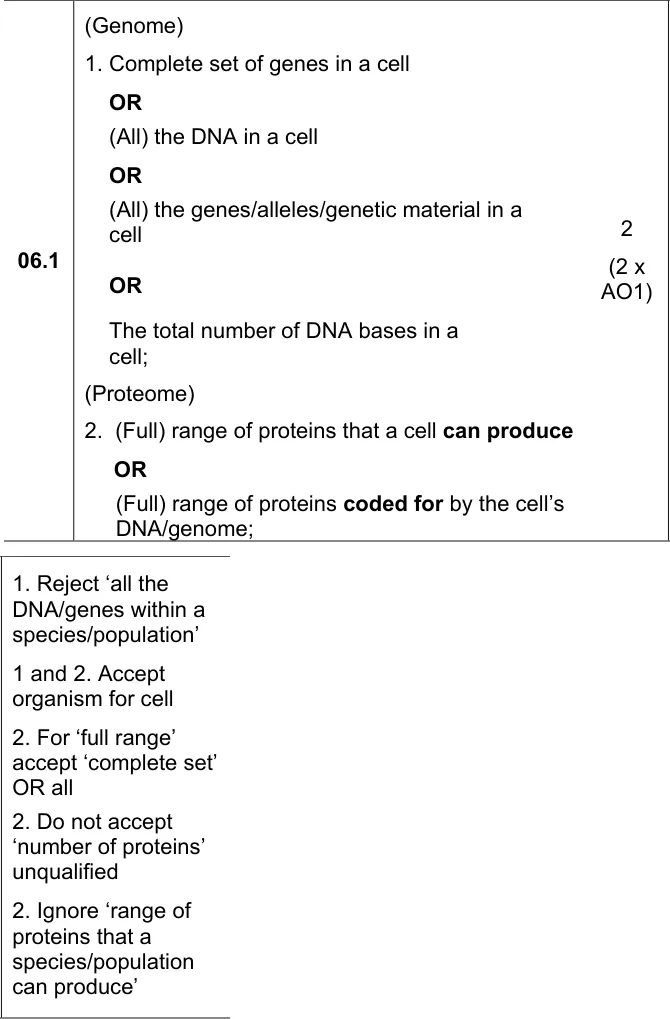
- Genome: the complete set of genes in a cell.
- Proteome: the full range of proteins that a cell is able to produce.
- Codon: a sequence of three bases on mRNA that codes for a specific amino acid.
- Anticodon: the three bases on a tRNA molecule that are complementary to a codon on mRNA.
- Transcription: the production of mRNA from DNA, using one DNA strand as a template.
- RNA polymerase: the enzyme that joins RNA nucleotides by phosphodiester bonds during transcription.
- Pre-mRNA: the RNA made by transcription in eukaryotes, which still contains introns.
- Splicing: removing introns from pre-mRNA and joining the exons to form mRNA.
- Translation: the production of a polypeptide from the sequence of codons carried by mRNA, at a ribosome.
- Peptide bond: the bond formed between amino acids in a condensation reaction, using energy from ATP during translation.
What these questions cover (AQA 3.4.2)
The questions test these statements from the AQA AS and A-level Biology specification (7401/7402):
- Genome and proteome: The concept of the genome as the complete set of genes in a cell and of the proteome as the full range of proteins that a cell is able to produce.
- mRNA and tRNA: The structure of molecules of messenger RNA (mRNA) and of transfer RNA (tRNA).
- Transcription: Transcription as the production of mRNA from DNA. The role of RNA polymerase in joining mRNA nucleotides.
- Transcription: In prokaryotes, transcription results directly in the production of mRNA from DNA. (the adenovirus question asks how the hybrid DNA would look with prokaryotic DNA)
- Transcription: In eukaryotes, transcription results in the production of pre-mRNA; this is then spliced to form mRNA.
- Translation: Translation as the production of polypeptides from the sequence of codons carried by mRNA. The roles of ribosomes, tRNA and ATP.
- Students should be able to: relate the base sequence of nucleic acids to the amino acid sequence of polypeptides, when provided with suitable data about the genetic code (each question gives you the codons you need; you don't have to learn which codon codes for which amino acid)
- Students should be able to: interpret data from experimental work investigating the role of nucleic acids.
How to use this page
Write your answer on paper before you open the mark scheme. Allow about 1.3 minutes per mark: the 18 questions are worth 39 marks, so about 51 minutes in total. Then mark your answer strictly against the mark scheme and read the examiners' tip underneath it. If you'd rather print the questions, download the PDF pack.
Genome and proteome (3.4.2)
Question 1
A level Paper 1 · June 2023 · Q06.1 · 2 marks · Medium
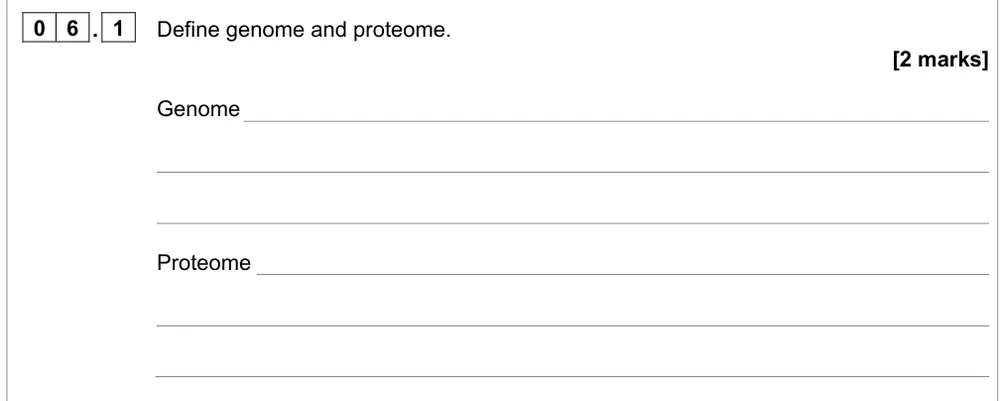
Define genome and proteome.
Show the mark scheme
Tap an image to open it full size.
From the examiners' report: 70% knew at least one definition. 'All the genetic information' doesn't score for genome, and for proteome you must say the proteins a cell can produce, not just the proteins in a cell.
Question 2
AS Paper 1 · November 2020 · Q09.1 · 2 marks · Hard
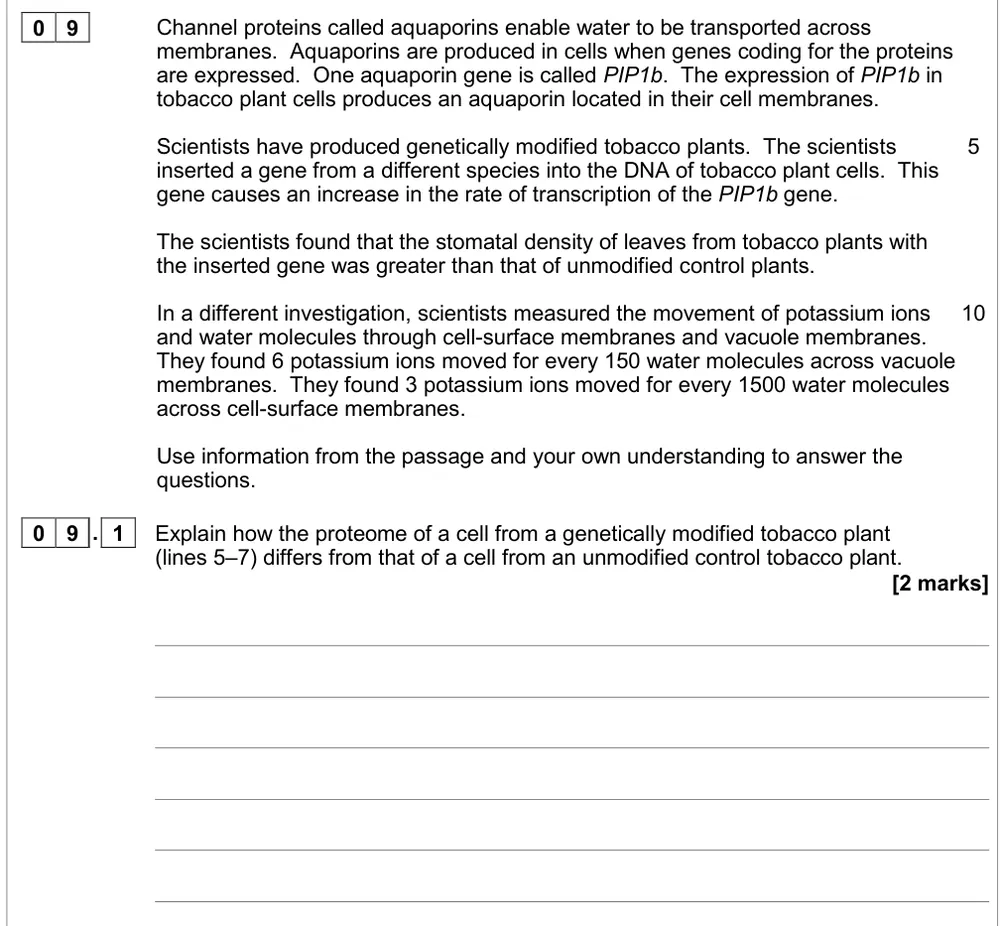
Explain how the proteome of a genetically modified tobacco cell differs from a control cell.
Show the mark scheme

Tap an image to open it full size.
From the examiners' report: Few students saw that adding a gene from another species means one new protein is expressed. Link the proteome to the range of proteins, not just to more aquaporins.
mRNA and tRNA (3.4.2)
Question 3
AS Paper 1 · June 2018 · Q07.2 · 2 marks · Easy
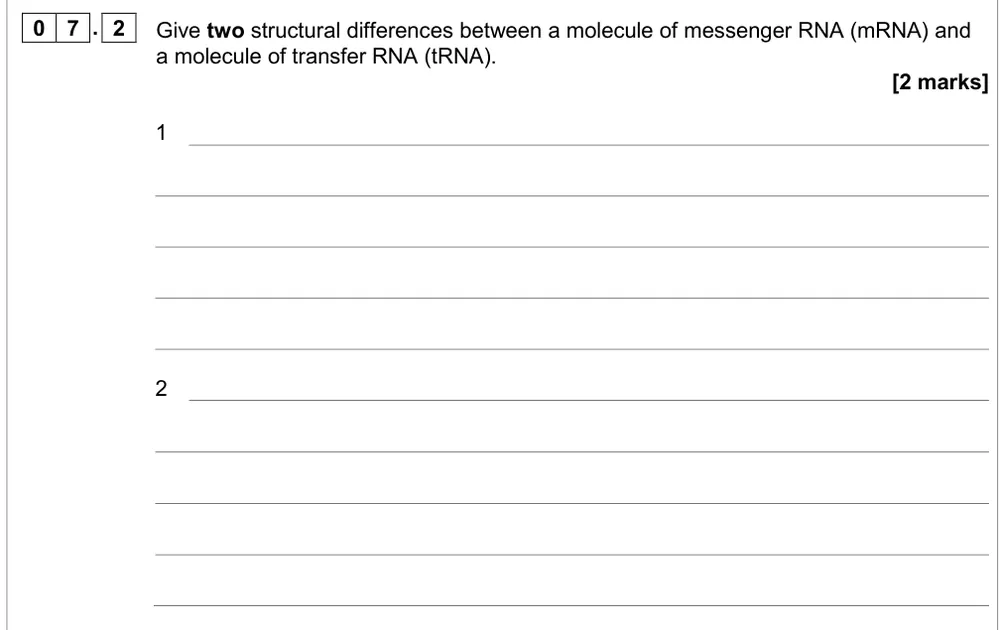
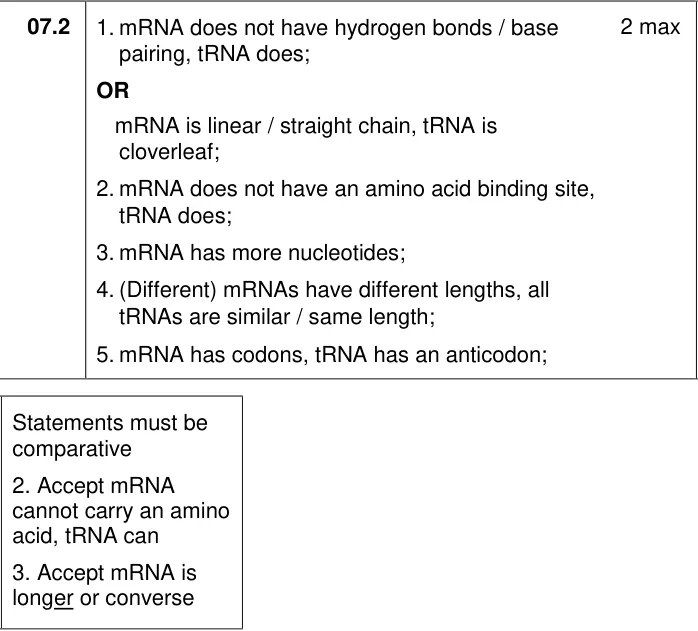
Give two structural differences between mRNA and tRNA.
Show the mark scheme
Tap an image to open it full size.
From the examiners' report: Generally well answered. Write each difference as a clear comparison, such as 'tRNA is clover leaf, mRNA is linear'. tRNA isn't double-stranded.
Question 4
AS Paper 1 · June 2019 · Q01.3 · 1 mark
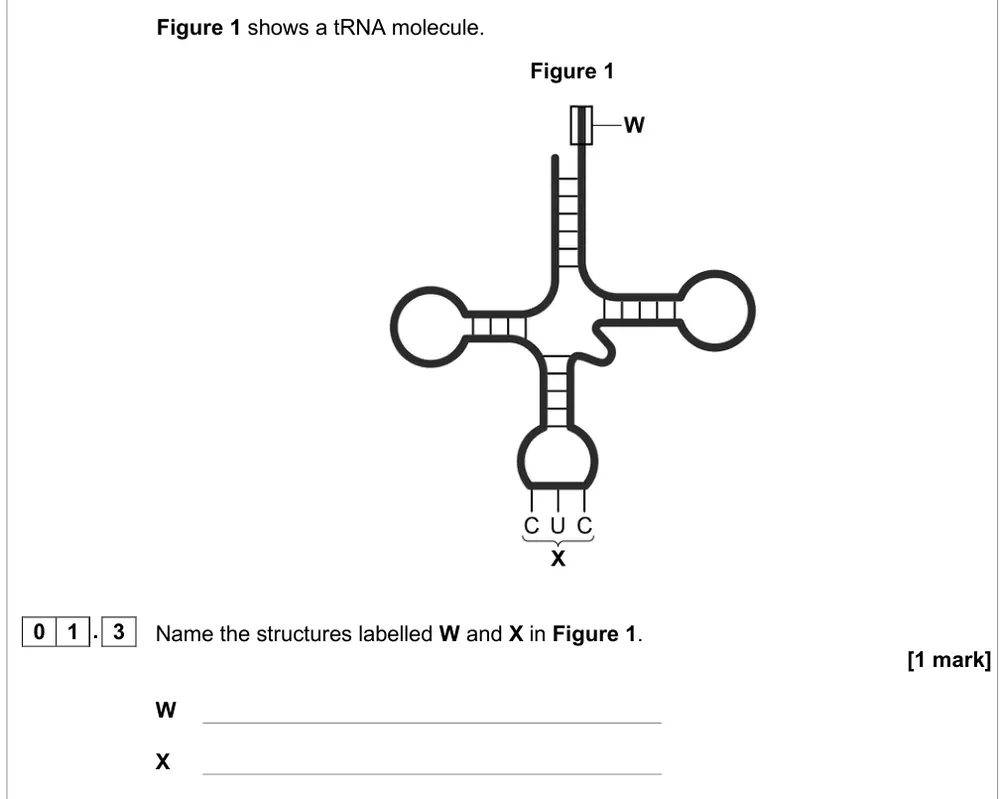
Name the structures labelled W and X on a tRNA molecule.
Show the mark scheme

Tap an image to open it full size.
From the examiners' report: No examiners' report for this paper. The mark scheme wants 'amino acid binding site' for W, not just 'amino acid', and 'anticodon' for X.
Transcription and splicing (3.4.2)
Question 5
AS Paper 2 · June 2024 · Q04.1 · 1 mark · Easy
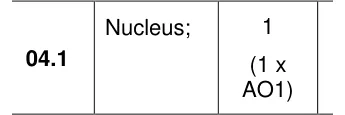
State where transcription occurs in a eukaryotic cell.

Show the mark scheme
Tap an image to open it full size.
From the examiners' report: Most got this. Ribosomes and rough endoplasmic reticulum are where translation happens, not transcription.
Question 6
A level Paper 1 · November 2020 · Q10.1 · 5 marks
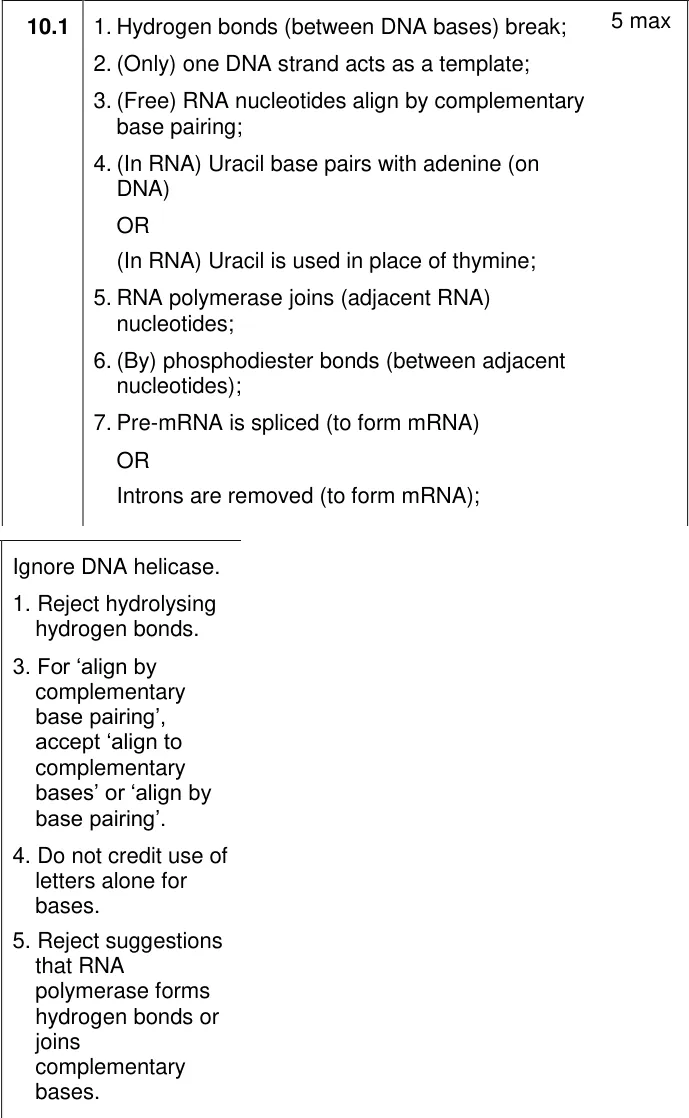
Describe how mRNA is formed by transcription in eukaryotes.
Show the mark scheme
Tap an image to open it full size.
From the examiners' report: Say RNA nucleotides and RNA polymerase. Marks were lost for writing that RNA polymerase forms hydrogen bonds, pairs complementary bases or joins bases rather than nucleotides.
Question 7
A level Paper 1 · June 2025 · Q02.1 · 1 mark
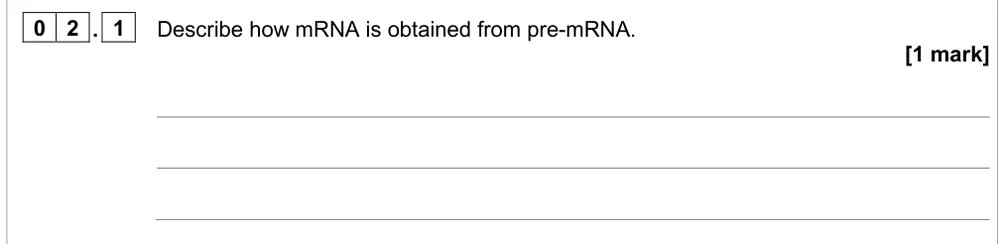
Describe how mRNA is obtained from pre-mRNA.
Show the mark scheme

Tap an image to open it full size.
From the examiners' report: Most said introns are removed. 'Pre-mRNA is spliced' on its own was too vague: say what splicing removes.
Question 8
A level Paper 1 · June 2025 · Q02.2 · 2 marks
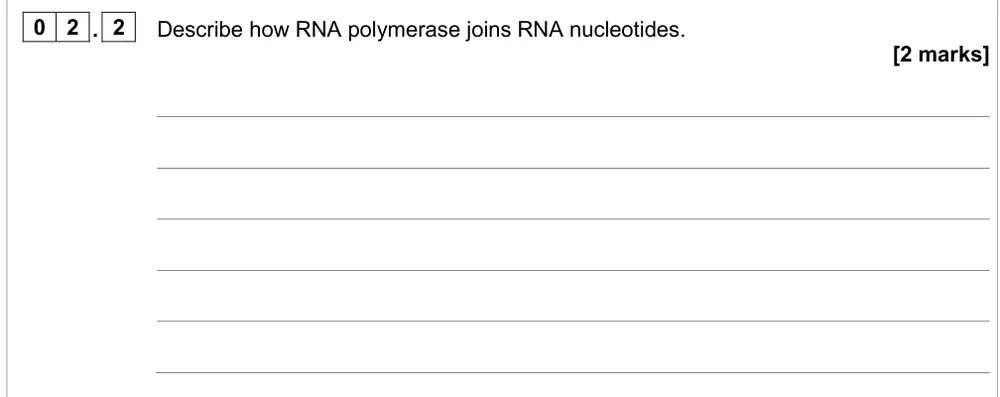
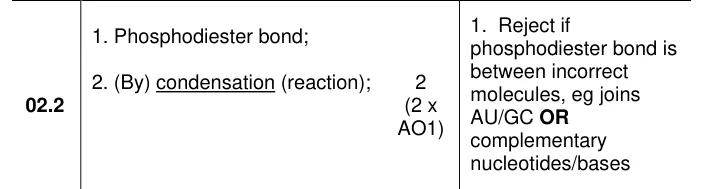
Describe how RNA polymerase joins RNA nucleotides.
Show the mark scheme
Tap an image to open it full size.
From the examiners' report: A good discriminator. Name phosphodiester bonds between adjacent nucleotides, formed by condensation; bonds between bases, or hydrogen bonds, don't score.
Question 9
AS Paper 2 · June 2022 · Q01.3 · 2 marks · Hard
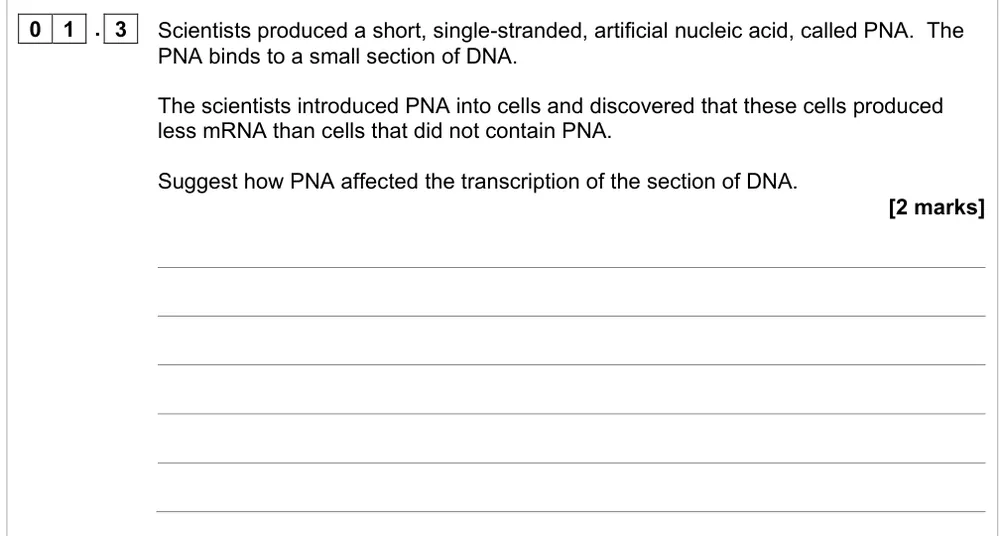
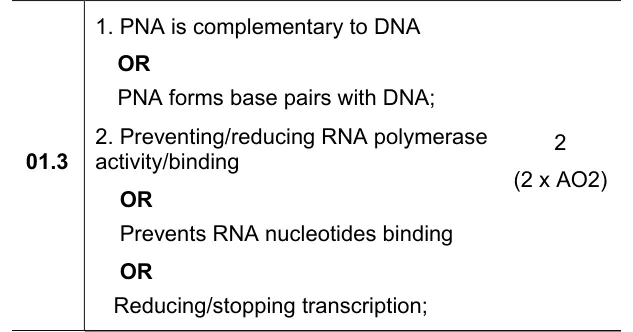
Suggest how an artificial nucleic acid that binds to DNA reduces transcription.
Show the mark scheme
Tap an image to open it full size.
From the examiners' report: Only 2% got both marks. Use the stem: PNA pairs with the DNA, so RNA polymerase or RNA nucleotides can't bind there. Helicase isn't the point.
Question 10
A level Paper 3 · June 2022 · Q04.3 · 1 mark · Hard
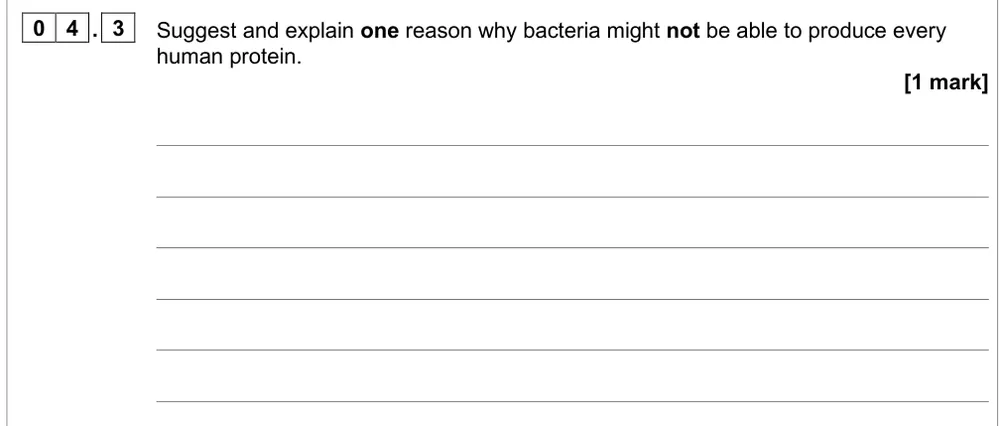
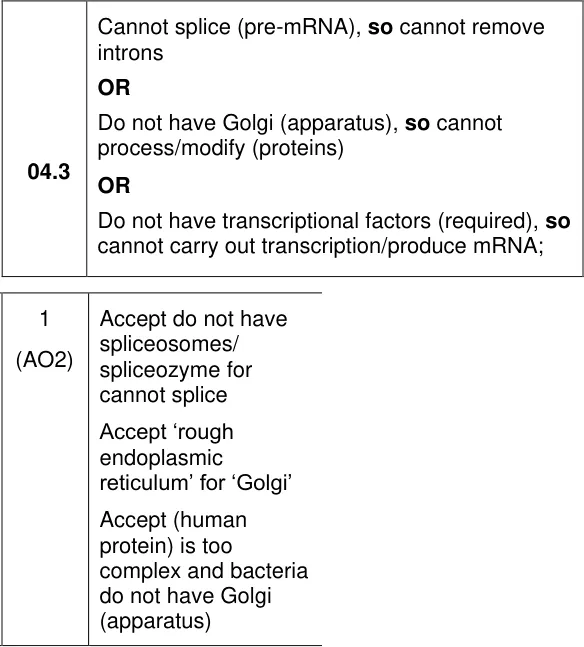
Suggest and explain one reason why bacteria might not be able to produce every human protein.
Information from earlier in this question:

Show the mark scheme
Tap an image to open it full size.
From the examiners' report: Only 10% scored. You must suggest and explain: 'bacteria can't splice' needs 'so the introns can't be removed'. Bacteria do have thymine and amino acids.
Translation (3.4.2)
Question 11
AS Paper 1 · June 2018 · Q07.3 · 5 marks · Medium
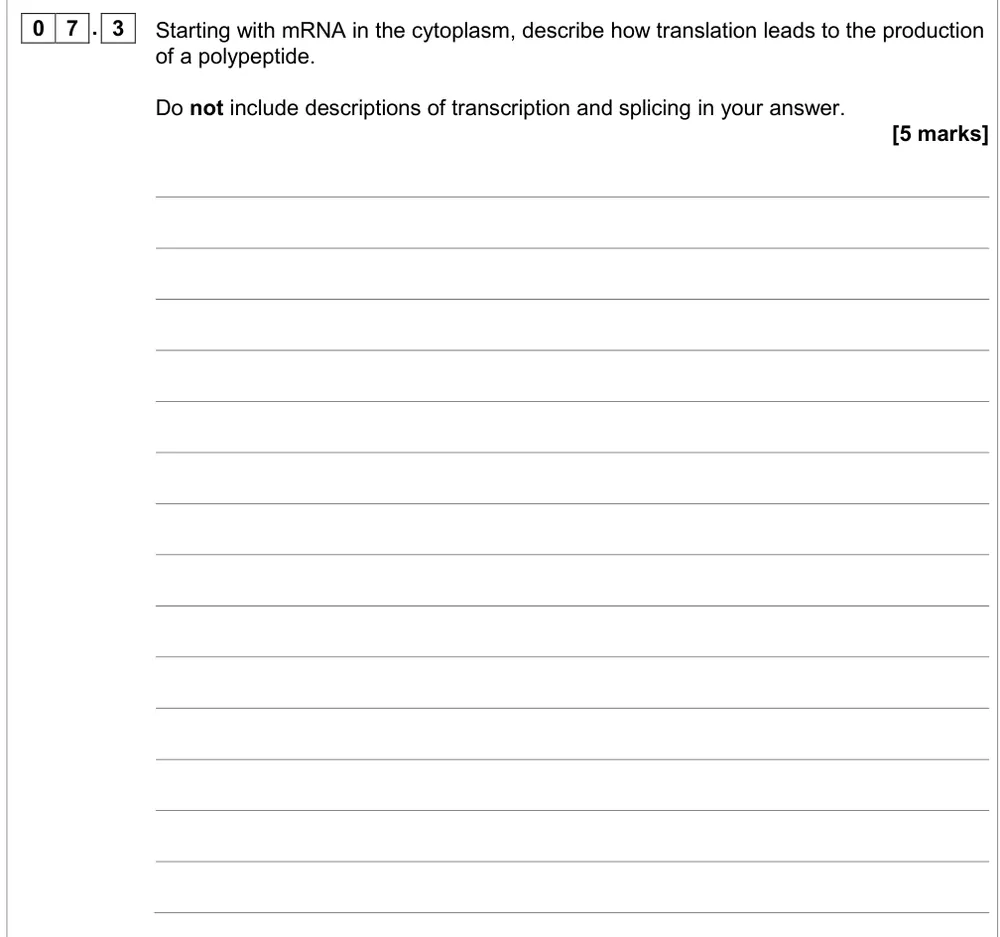
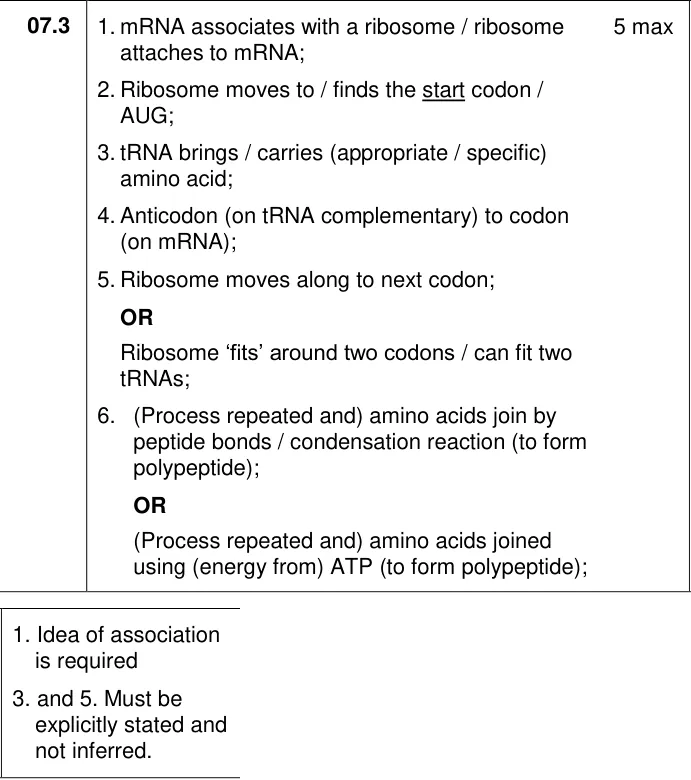
Starting with mRNA in the cytoplasm, describe how translation produces a polypeptide.
Show the mark scheme
Tap an image to open it full size.
From the examiners' report: Only 8.4% got all 5. Don't describe transcription, mRNA doesn't leave the cell, and RNA polymerase doesn't join amino acids. The start codon is not just 'the first codon'.
Question 12
AS Paper 1 · June 2023 · Q04.4 · 2 marks · Hard
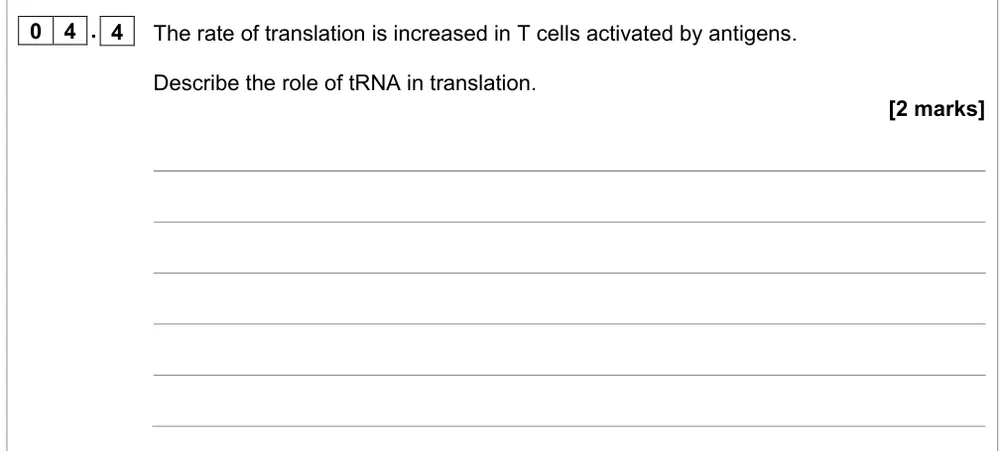
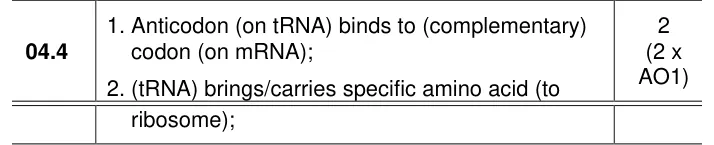
Describe the role of tRNA in translation.
Show the mark scheme
Tap an image to open it full size.
From the examiners' report: Many answers were incomplete. Say the anticodon binds to the codon, not just 'complementary base pairing', and that tRNA carries a specific amino acid.
Question 13
AS Paper 2 · June 2017 · Q03.2 · 3 marks
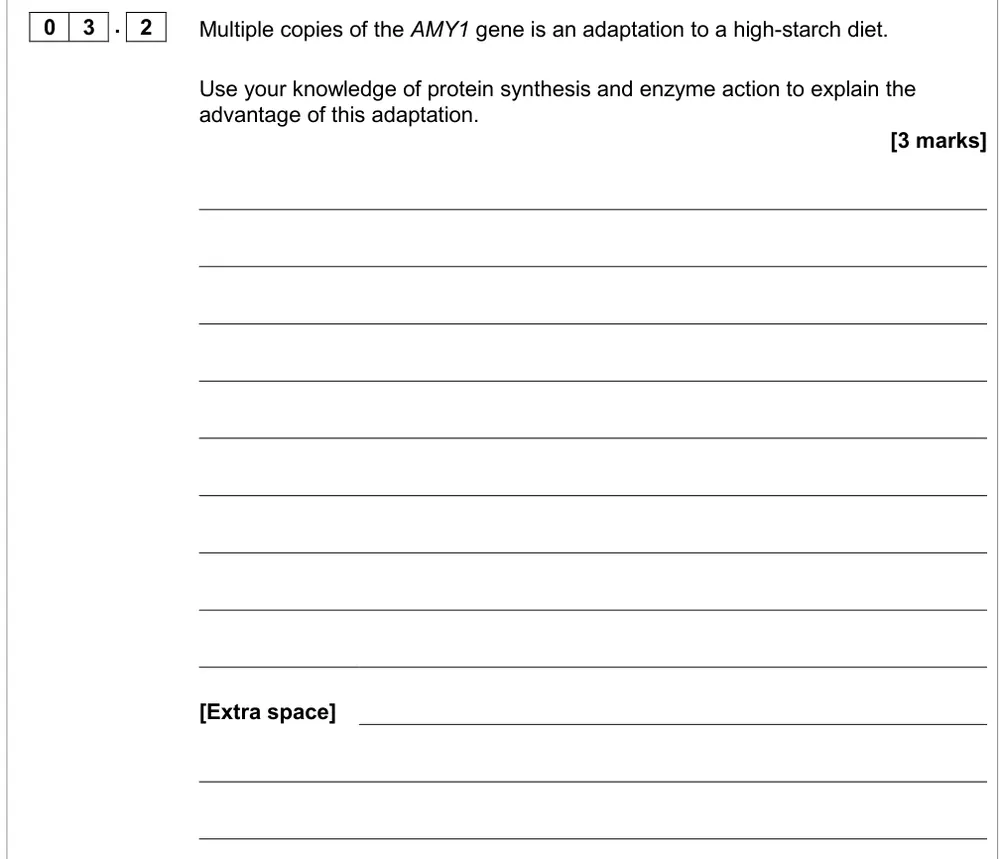
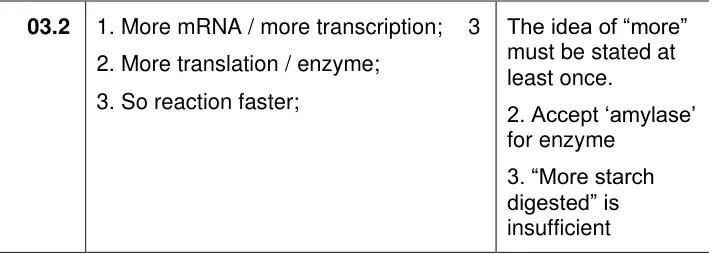
Explain the advantage of having many copies of the amylase gene on a high-starch diet.
Show the mark scheme
Tap an image to open it full size.
From the examiners' report: No examiners' report for this part. Follow the chain: more copies, more transcription, more translation, more amylase, faster starch hydrolysis.
Using the genetic code and data (3.4.2)
Question 14
AS Paper 1 · June 2025 · Q04.2 · 2 marks · Easy
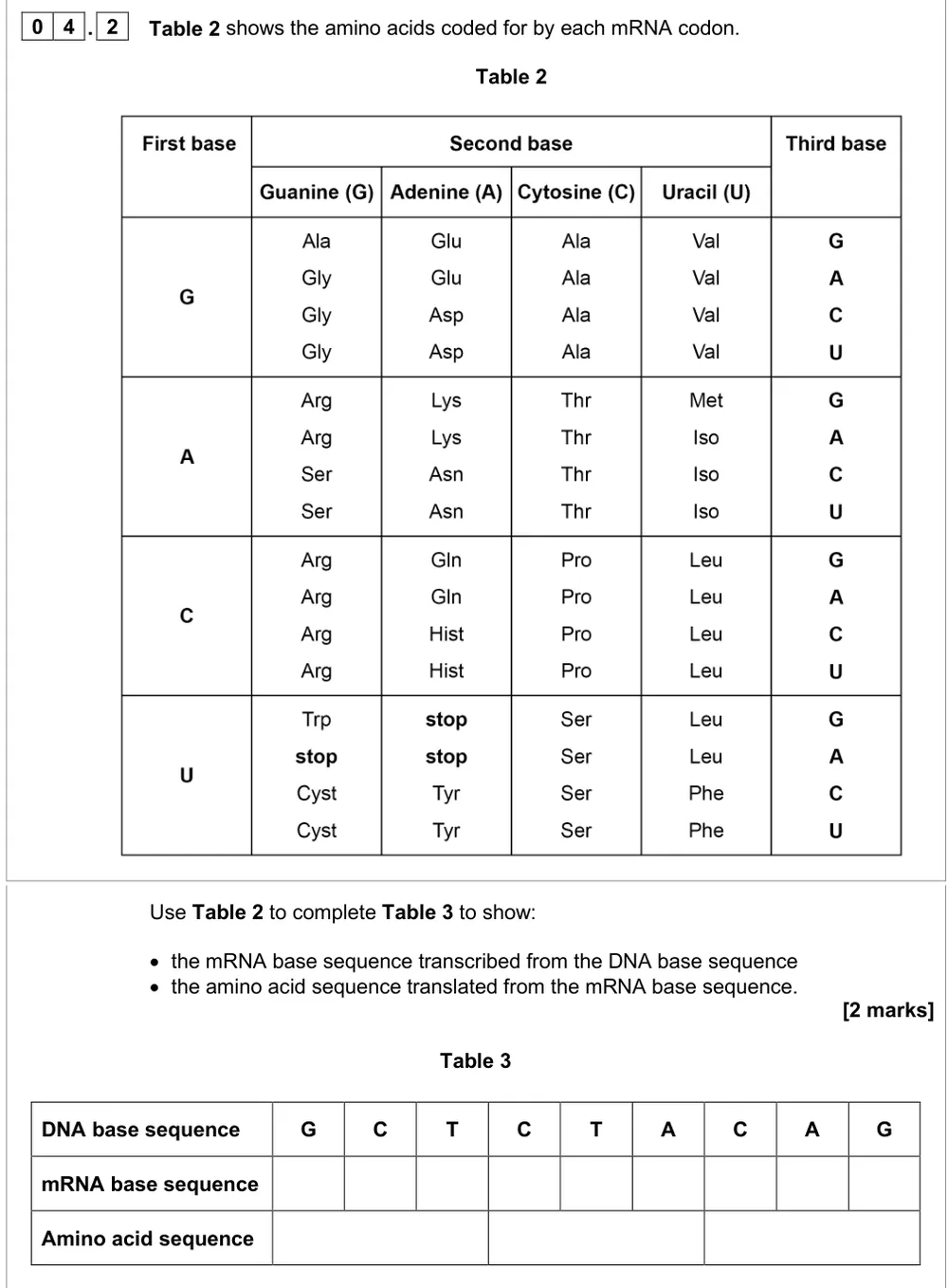
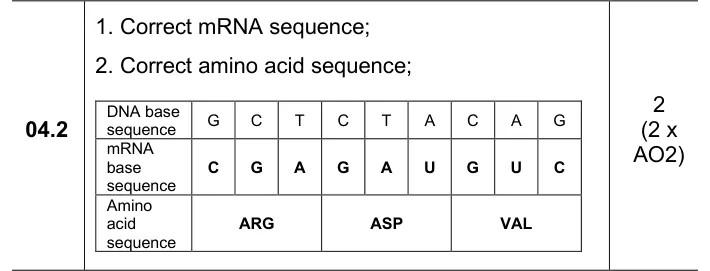
Use a codon table to give the mRNA sequence and amino acids for a DNA base sequence.
Information from earlier in this question:

Show the mark scheme
Tap an image to open it full size.
From the examiners' report: Over two thirds got both marks. Swap T for U when you write the mRNA, then read the amino acids from the table in triplets.
Question 15
AS Paper 1 · November 2020 · Q06.3 · 1 mark
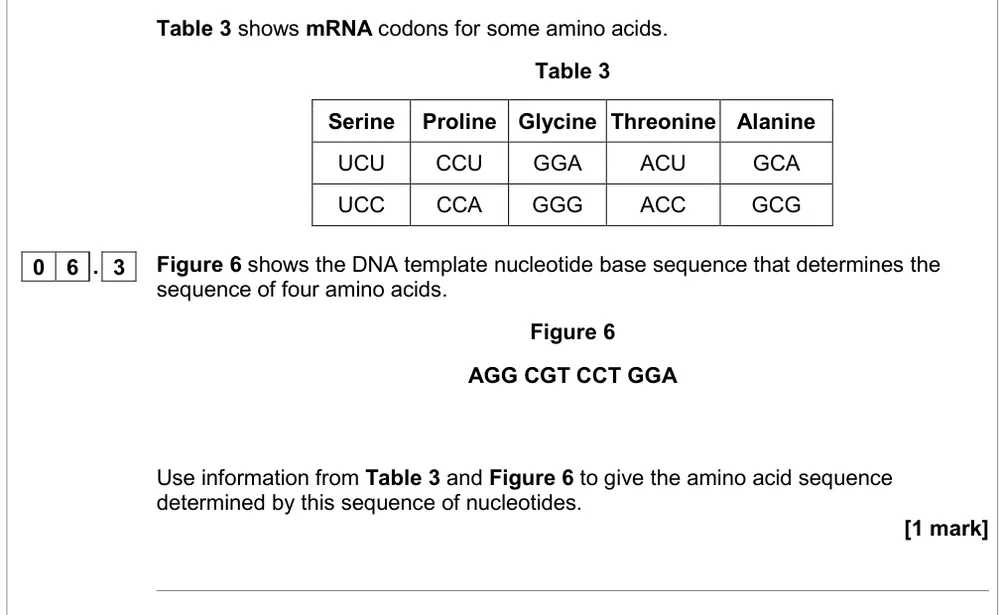
Give the amino acid sequence coded by a DNA template strand, using a codon table.
Show the mark scheme

Tap an image to open it full size.
From the examiners' report: No examiners' report for this part. It's a template strand, so write the complementary mRNA codons first (UCC GCA GGA CCU) before you use the table.
Question 16
A level Paper 1 · November 2021 · Q03.3 · 2 marks
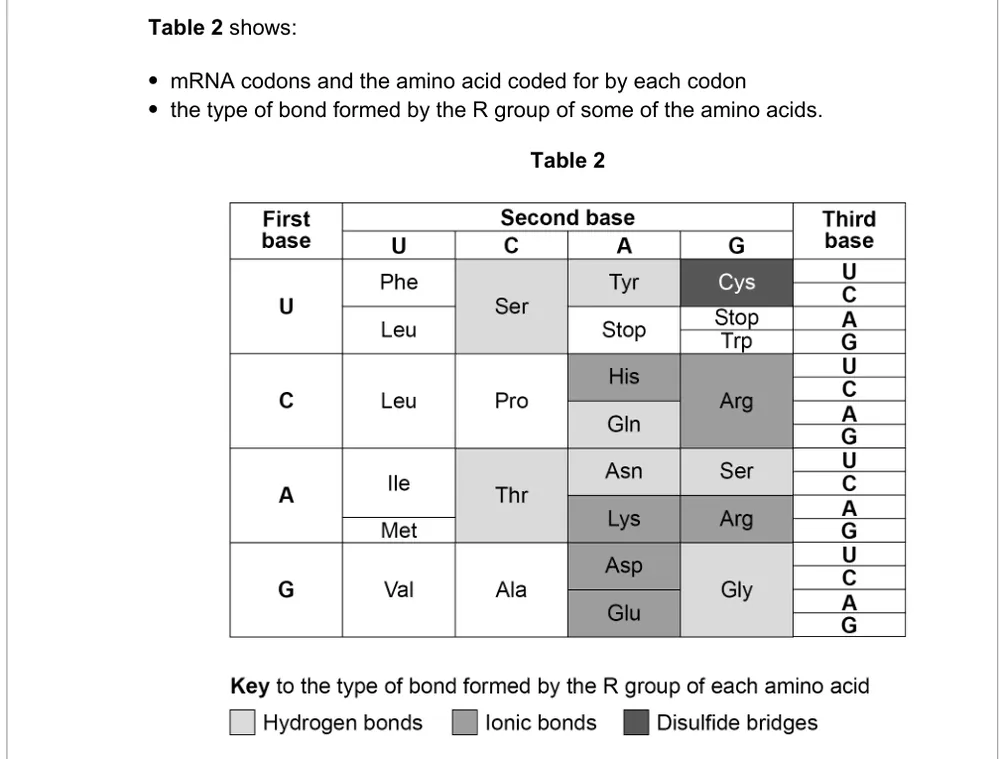
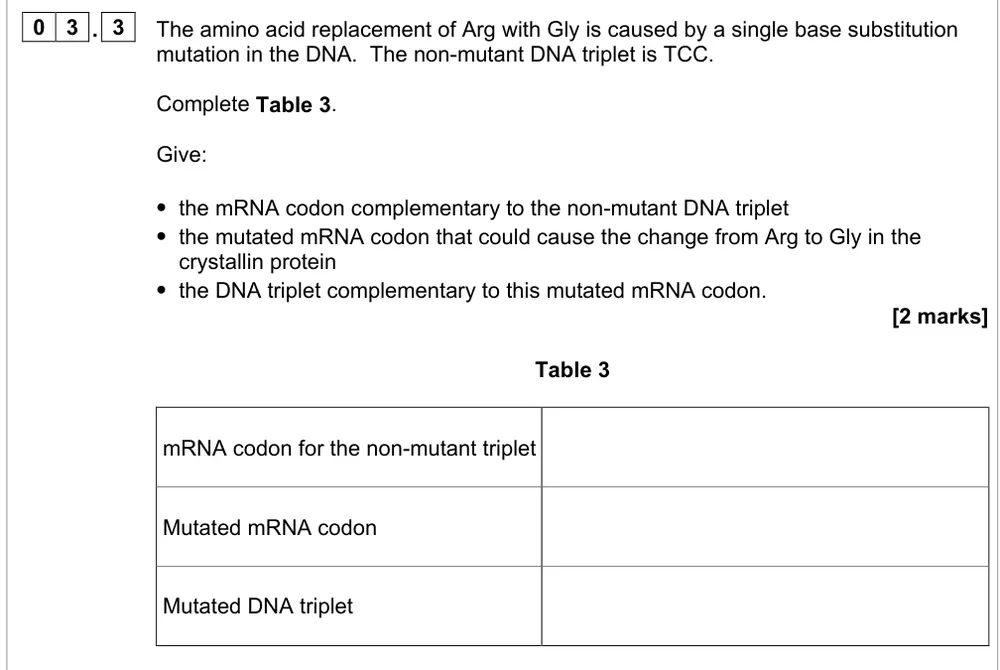
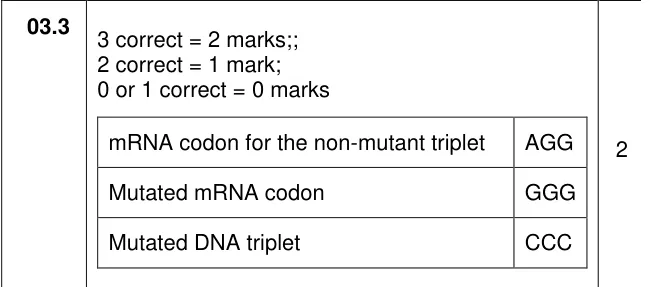
Complete a table with the mRNA codon, mutated codon and mutated DNA triplet for an Arg to Gly change.
Information from earlier in this question:
Show the mark scheme
Tap an image to open it full size.
From the examiners' report: No examiners' report for this paper. Work DNA to mRNA (TCC gives AGG), change one base to get a Gly codon (GGG), then go back to the DNA triplet (CCC).
Question 17
AS Paper 2 · June 2024 · Q04.2 · 3 marks · Hard
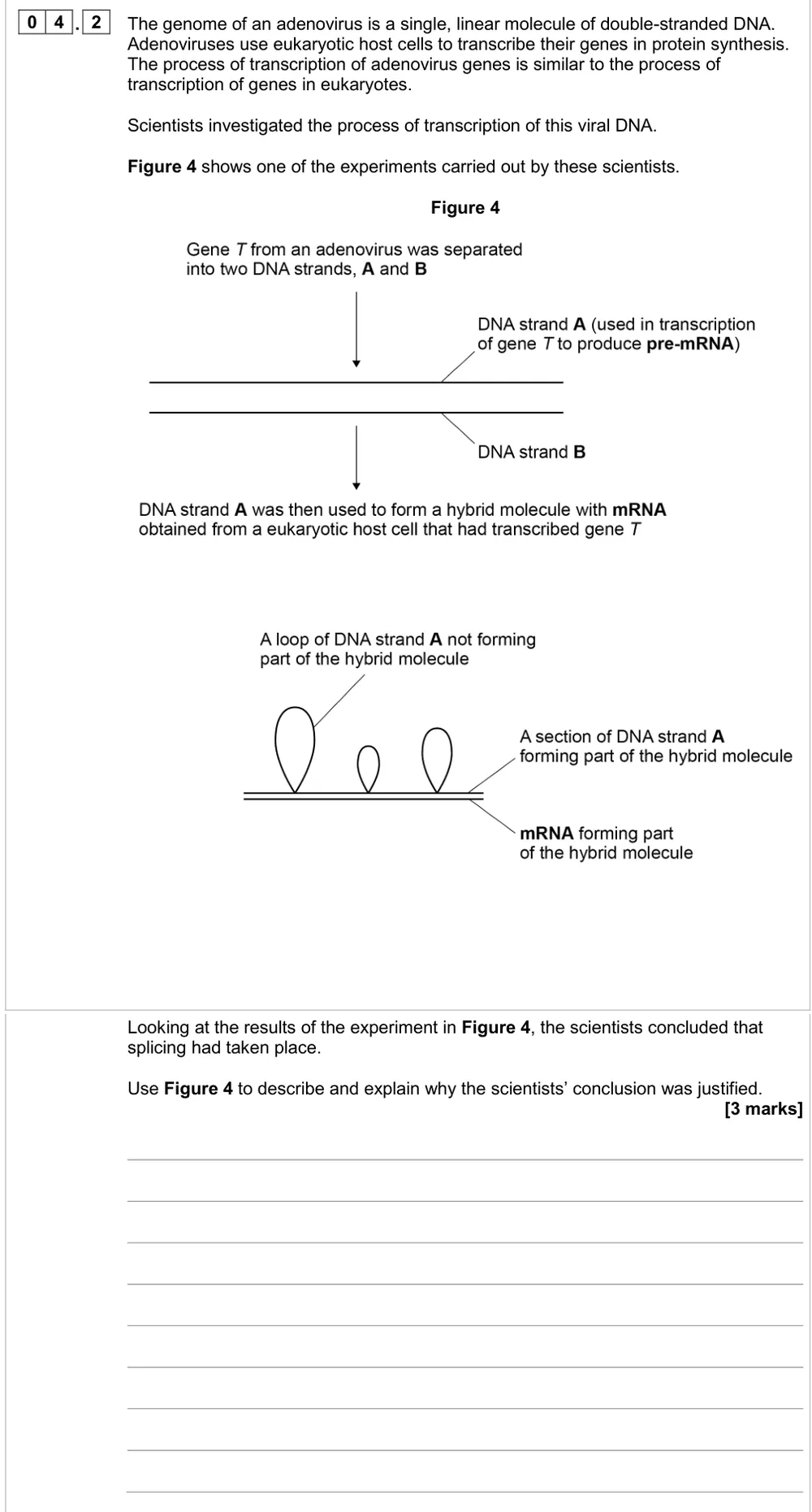
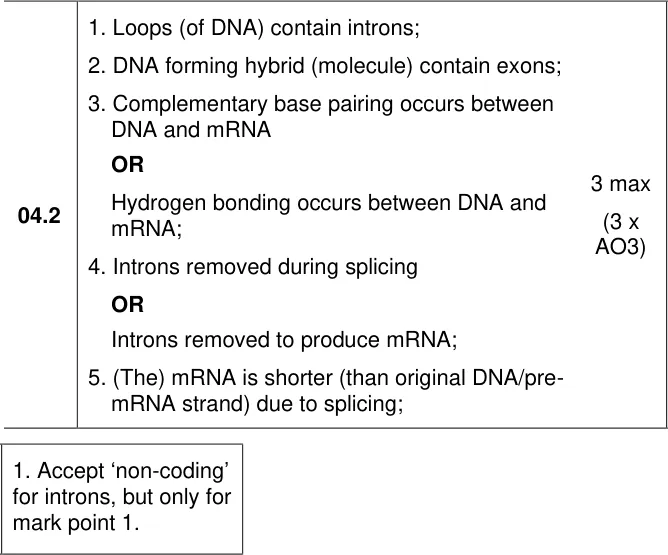
Use a DNA–mRNA hybrid experiment to explain why scientists concluded splicing had happened.
Show the mark scheme
Tap an image to open it full size.
From the examiners' report: Students struggled and many wrote everything they knew about splicing. The loops are DNA introns with no matching mRNA; say the DNA and mRNA pair by complementary base pairing.
Question 18
AS Paper 2 · June 2024 · Q04.3 · 2 marks
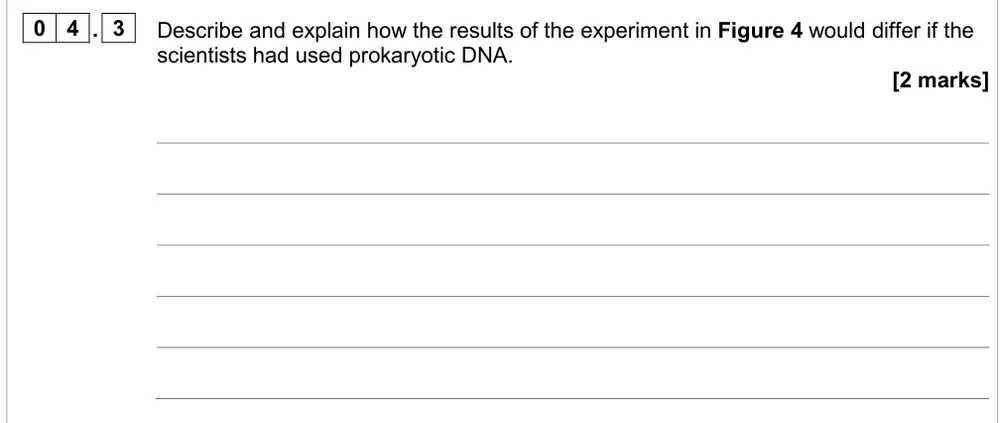
Describe and explain how the hybrid results would differ with prokaryotic DNA.
Show the mark scheme

Tap an image to open it full size.
From the examiners' report: Almost half scored zero. Prokaryotic DNA is a loop but it is double-stranded; the point is that it has no introns, so no DNA loops form.
Where students lose marks (from AQA examiners' reports and mark schemes)
Each point below is followed by wording that gained marks.
The proteome is what a cell can produce: Only 17.9% defined the proteome in 2018, and 13% didn't attempt it. In 2023 many wrote 'all the proteins in a cell' or 'all the proteins a cell codes for' without mentioning the DNA or genome, and 'number of proteins' on its own is never accepted.
✔ Gains credit: "(Full) range of proteins that a cell can produce" or "range of proteins coded for by the cell's DNA / genome".
A genome belongs to a cell, not a species: Nearly 40% missed the mark for 'genome'. The commonest wrong answers were 'all the genes in a chromosome' or 'all the genes in a species', and some confused genome with genotype. 'All the genetic information' didn't score either.
✔ Gains credit: "Complete set of genes in a cell" or "(all) the DNA in a cell / organism".
Write each RNA difference as a pair: Students who lost marks comparing mRNA and tRNA didn't state a clear difference, and some thought tRNA is a double-stranded molecule.
✔ Gains credit: "tRNA is clover leaf, mRNA is linear"; "tRNA has an amino acid binding site, mRNA does not"; "tRNA has an anticodon, mRNA has codons".
Phosphodiester bonds link the RNA nucleotides: Many didn't name phosphodiester bonds, or described bonds forming between bases or between the RNA and the DNA. Some confused phosphodiester bonds with hydrogen bonds, and RNA polymerase 'forming hydrogen bonds' or 'joining complementary bases' is rejected.
✔ Gains credit: "RNA polymerase joins adjacent RNA nucleotides by phosphodiester bonds, in a condensation reaction."
Translation only, so leave transcription out: Only 8.4% got all 5 marks on translation in 2018. Many described transcription anyway, had mRNA leaving the cell, or said RNA polymerase joins amino acids.
✔ Gains credit: "mRNA associates with a ribosome; the ribosome moves to the start codon; amino acids join by peptide bonds (using ATP)."
tRNA brings a specific amino acid: In 2023 the role of tRNA proved very challenging: answers described complementary base pairing without the anticodon binding to the codon, and said tRNA carries 'an amino acid'. In 2024 few mentioned ATP in forming peptide bonds.
✔ Gains credit: "Anticodon on tRNA binds to the complementary codon on mRNA"; "tRNA brings a specific amino acid to the ribosome".
No splicing, so the introns stay in: Only 10% scored on why bacteria might not make every human protein. Wrong ideas included bacteria having uracil instead of thymine or lacking amino acids, and many stated 'bacteria cannot splice' without explaining the consequence.
✔ Gains credit: "Bacteria cannot splice pre-mRNA, so they cannot remove introns."
A loop of DNA isn't a single strand: Almost half scored zero on how the experiment would differ with prokaryotic DNA. Many said prokaryotic DNA is single-stranded, misreading 'a single loop' of DNA.
✔ Gains credit: "No loops (of DNA), because there are no introns in prokaryotic DNA."
Download the questions
Download the PDF pack (18 questions, mark schemes at the end)
Keep practising
- DNA, genes and chromosomes: AQA A Level Biology exam questions by topic
- DNA and RNA structure: AQA A Level Biology exam questions by topic
- Mutation and meiosis: AQA A Level Biology exam questions by topic
- Mastering AQA A Level Biology 3.4.2: DNA and protein synthesis
- AQA A Level Biology masterclasses
Questions, mark schemes and examiners' report extracts © AQA.