

Digestion and absorption (AQA 3.3.3) is a short section of the Year 12 course, but it turns up on almost every AS and Paper 1 series. You need to know how starch is hydrolysed by amylase and membrane-bound disaccharidases, how lipase and bile salts digest lipids, how endopeptidases, exopeptidases and membrane-bound dipeptidases digest proteins, and how the products are absorbed by the cells lining the ileum: co-transport with sodium ions for amino acids and monosaccharides, and micelles for fatty acids and monoglycerides.
The examiners' reports show the same problems every year. Students write GCSE answers about food being 'broken down', go straight from starch to glucose without maltose, write 'protease' instead of dipeptidase, mix up endopeptidases and exopeptidases, say emulsification makes micelles, and forget that fatty acids leave micelles by simple diffusion. Questions on micelles have some of the lowest scores on the AS papers.
Start with the definition of digestion, then carbohydrates and proteins, lipids, absorption, and finish with the questions that apply it to new situations. Answer each question on paper before you open the mark scheme. If you'd like help with this topic, my AQA masterclasses run online on Tuesdays at 5.15pm for Year 12 and on Wednesdays or Thursdays at 6.30pm for Year 13.
What you need from GCSE and Year 12
Each question on this page assumes you're secure on these GCSE and Year 12 ideas. If any of them feels shaky, revise it before you start.
- GCSE: carbohydrases such as amylase, proteases and lipases digest food into small soluble molecules, and bile emulsifies fats.
- GCSE: the small intestine is lined with villi, which give a large surface area for absorption into the blood.
- Year 12 (AQA 3.1.2, 3.1.3 and 3.1.4.1): starch, triglycerides and proteins, and the glycosidic, ester and peptide bonds that hydrolysis breaks. See the Carbohydrates, Lipids and Proteins pages.
- Year 12 (AQA 3.2.3): simple diffusion, facilitated diffusion, active transport and co-transport across cell-surface membranes. See the Transport across cell membranes page.
Key terms
These words come up in the questions and mark schemes. Examiners expect you to use them exactly.
- Digestion: the hydrolysis of large biological molecules into smaller molecules that can be absorbed across cell membranes.
- Hydrolysis: breaking a chemical bond (glycosidic, ester or peptide) using a molecule of water.
- Amylase: an enzyme that hydrolyses glycosidic bonds in starch to produce maltose.
- Membrane-bound disaccharidases: enzymes such as maltase in the cell-surface membranes of the epithelial cells lining the ileum, which hydrolyse disaccharides to monosaccharides.
- Endopeptidase: hydrolyses peptide bonds within a polypeptide, making shorter polypeptides and more ends for exopeptidases.
- Exopeptidase: hydrolyses the peptide bonds at the ends of a polypeptide, releasing single amino acids or dipeptides.
- Membrane-bound dipeptidase: hydrolyses the peptide bond between the two amino acids of a dipeptide, on the cell-surface membrane of the ileum epithelial cells.
- Emulsification: bile salts break large lipid droplets into smaller droplets, increasing the surface area for lipase.
- Lipase: hydrolyses the ester bonds in triglycerides, producing fatty acids and monoglycerides.
- Micelle: a small structure of bile salts, fatty acids and monoglycerides that keeps them soluble and carries them to the cells lining the ileum, where they diffuse in.
- Co-transport: sodium ions and glucose (or amino acids) enter an ileum cell together through a carrier protein, using the sodium ion gradient made by actively transporting sodium ions out into the blood.
What these questions cover (AQA 3.3.3)
The questions test these statements from the AQA AS and A-level Biology specification (7401/7402):
- Digestion: During digestion, large biological molecules are hydrolysed to smaller molecules that can be absorbed across cell membranes.
- Digestion in mammals of: carbohydrates by amylases and membrane-bound disaccharidases
- Digestion in mammals of: lipids by lipase, including the action of bile salts
- Digestion in mammals of: proteins by endopeptidases, exopeptidases and membrane-bound dipeptidases.
- Absorption by cells lining the ileum, to include: co-transport mechanisms for the absorption of amino acids and of monosaccharides (both questions are about amino acids; the same sodium-ion co-transport mechanism absorbs glucose and galactose)
- Absorption by cells lining the ileum, to include: the role of micelles in the absorption of lipids. (the vitamin A question applies the role of micelles to a fat-soluble substance that isn't digested)
How to use this page
Write your answer on paper before you open the mark scheme. Allow about 1.3 minutes per mark: the 17 questions are worth 49 marks, so about 64 minutes in total. Then mark your answer strictly against the mark scheme and read the examiners' tip underneath it. If you'd rather print the questions, download the PDF pack.
Carbohydrates and proteins (3.3.3)
Question 1
AS Paper 2 · June 2018 · Q07.1 · 2 marks
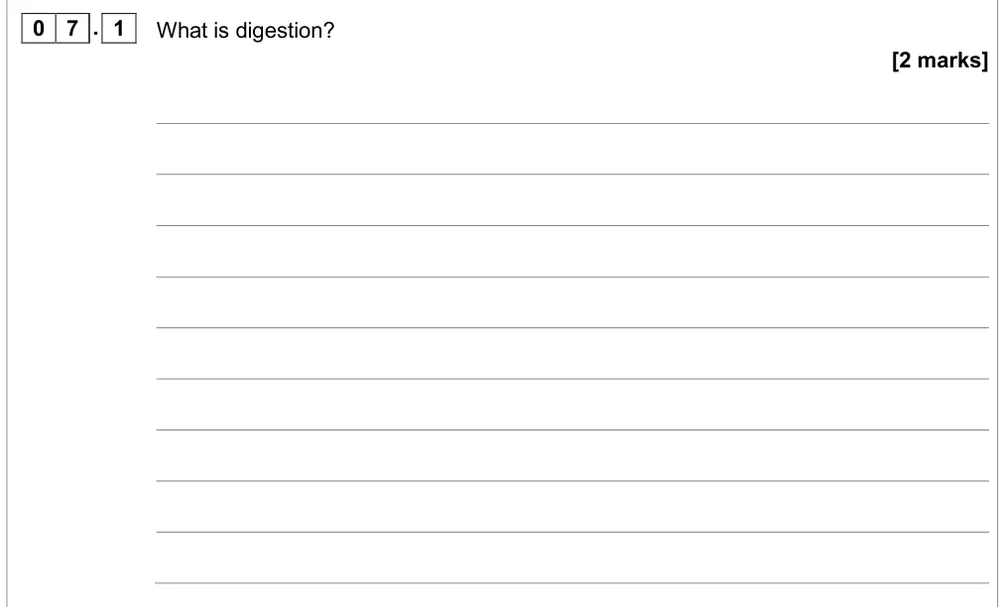
Define digestion.
Show the mark scheme

Tap an image to open it full size.
From the examiners' report: Many answers were GCSE-level, such as 'food is broken down ready for absorption'. Use the word hydrolysis, and don't include absorption: it's a separate process.
Question 2
AS Paper 1 · June 2024 · Q02.1 · 4 marks · Hard
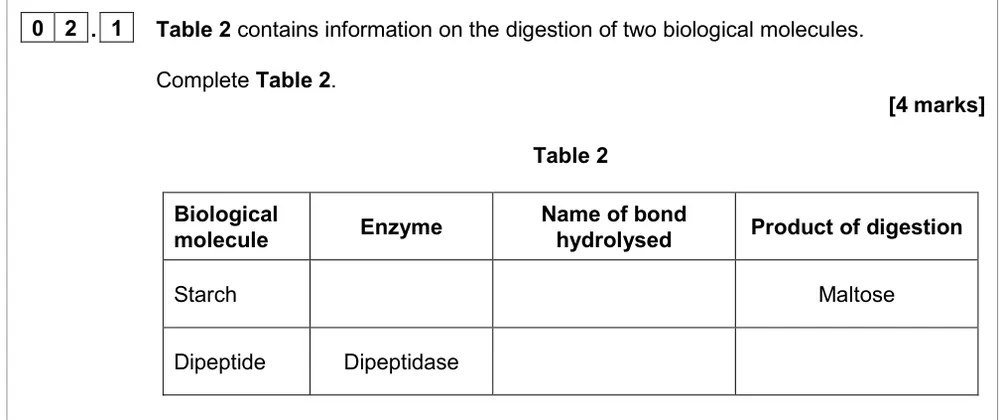
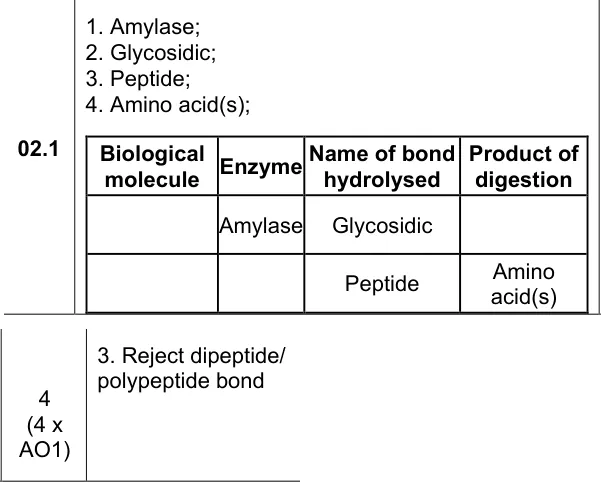
Complete a table of enzyme, bond hydrolysed and product for starch and a dipeptide.
Show the mark scheme
Tap an image to open it full size.
From the examiners' report: A straightforward recall question, but some students struggled to recall the molecules. The bond in a dipeptide is a peptide bond, not a 'dipeptide bond'.
Question 3
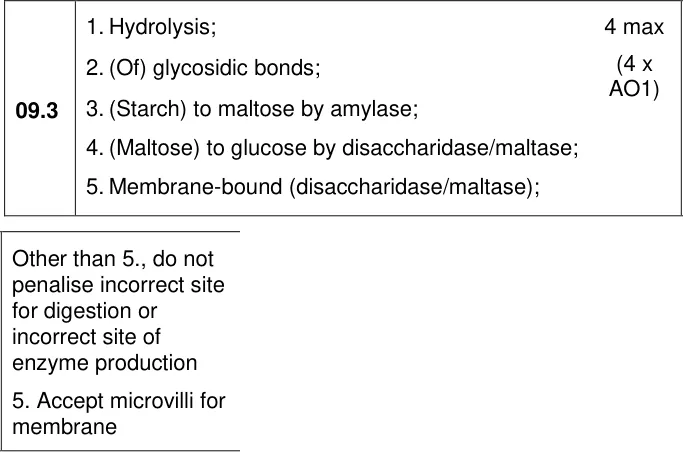
A level Paper 1 · June 2022 · Q09.3 · 4 marks · Hard
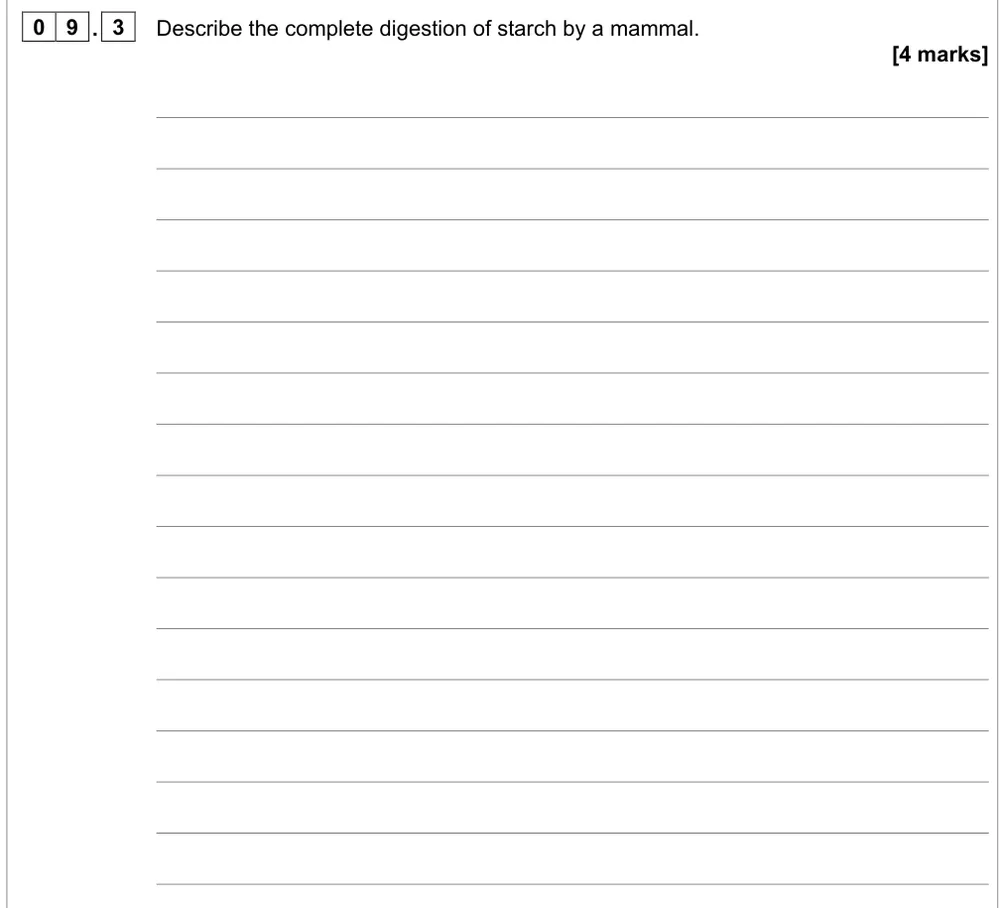
Describe the complete digestion of starch by a mammal.
Show the mark scheme
Tap an image to open it full size.
From the examiners' report: A quarter got full marks. Name maltose, not just 'disaccharide', say the maltase is membrane-bound, and mention glycosidic bonds. Bile salts and co-transport score nothing here.
Question 4
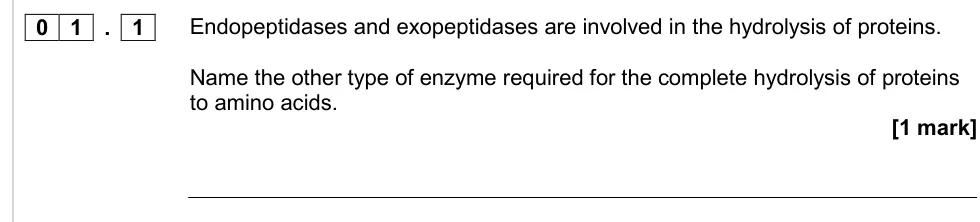
AS Paper 2 · June 2016 · Q01.1 · 1 mark · Medium
Name the third type of enzyme needed to hydrolyse proteins completely to amino acids.
Show the mark scheme

Tap an image to open it full size.
From the examiners' report: About half got this. Protease was the most common wrong answer: it's too general.
Question 5
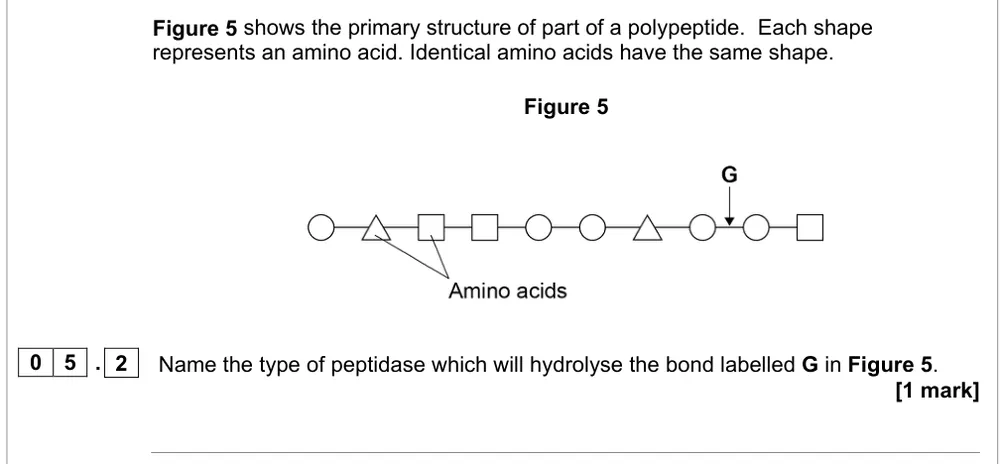
AS Paper 1 · November 2021 · Q05.2 · 1 mark
Name the type of peptidase that hydrolyses a labelled bond in a polypeptide.
Show the mark scheme

Tap an image to open it full size.
From the examiners' report: There's no examiners' comment on this part, so this tip comes from the mark scheme. Bond G is inside the chain, not at either end, so it's an endopeptidase. Exopeptidases only act on the terminal bonds.
Question 6
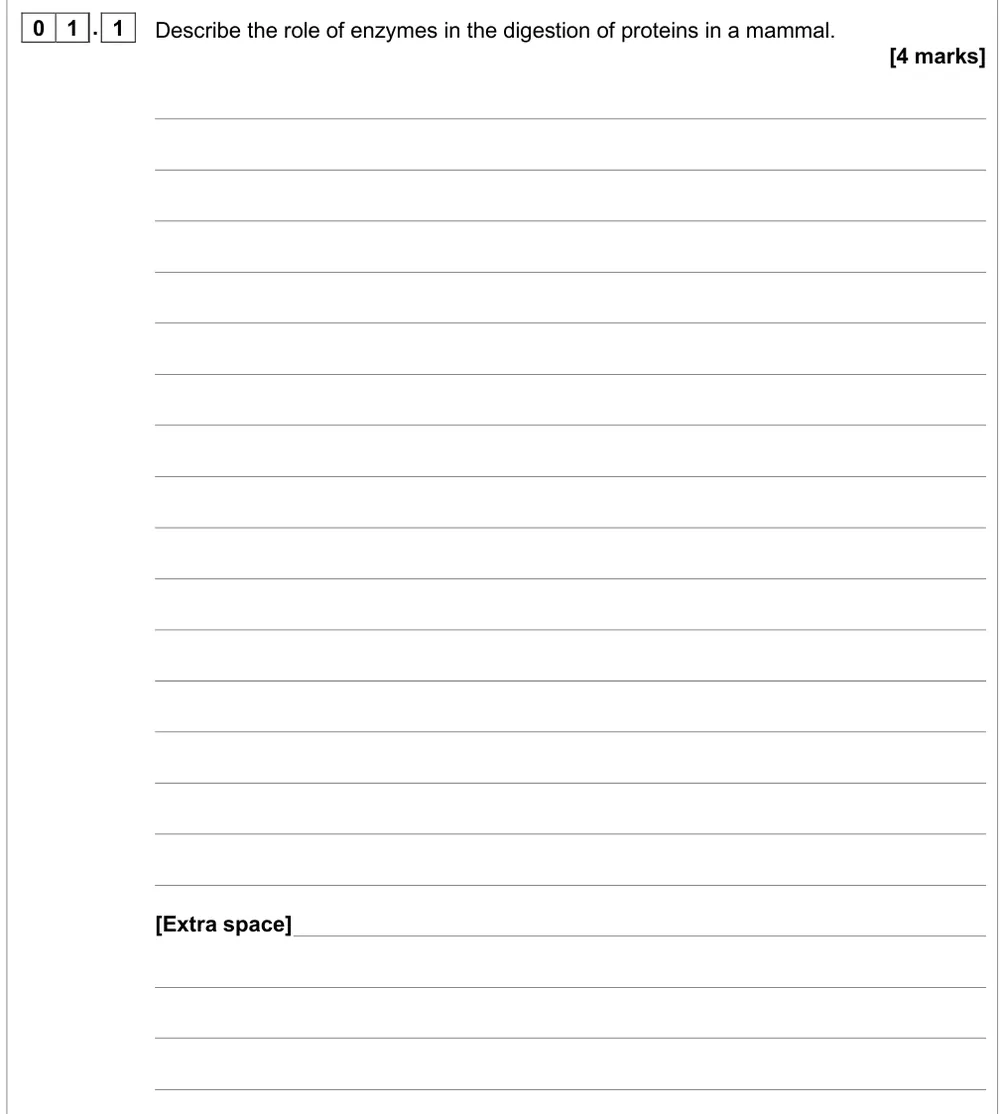
AS Paper 2 · June 2019 · Q01.1 · 4 marks · Easy
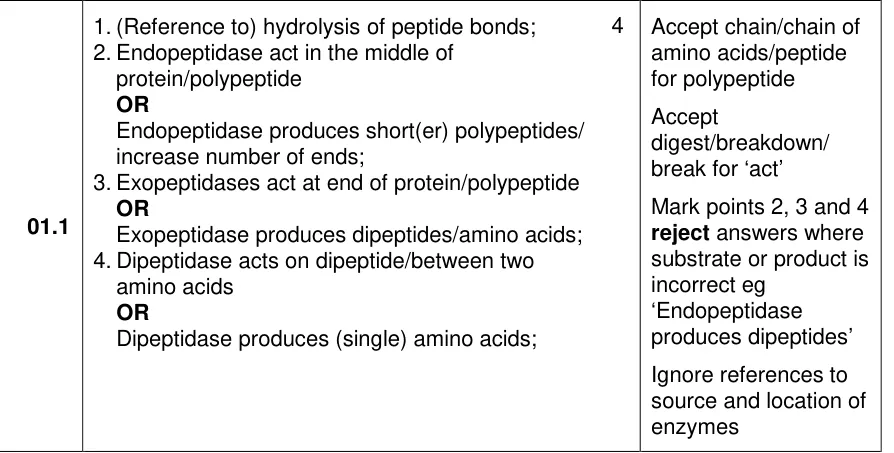
Describe the role of enzymes in the digestion of proteins in a mammal.
Show the mark scheme
Tap an image to open it full size.
From the examiners' report: About 40% showed secure understanding. Name all three enzymes with the right substrate and product, and say they hydrolyse peptide bonds: good answers often lost a mark by leaving that out.
Question 7
A level Paper 3 · November 2021 · Q05.1 · 2 marks · Medium
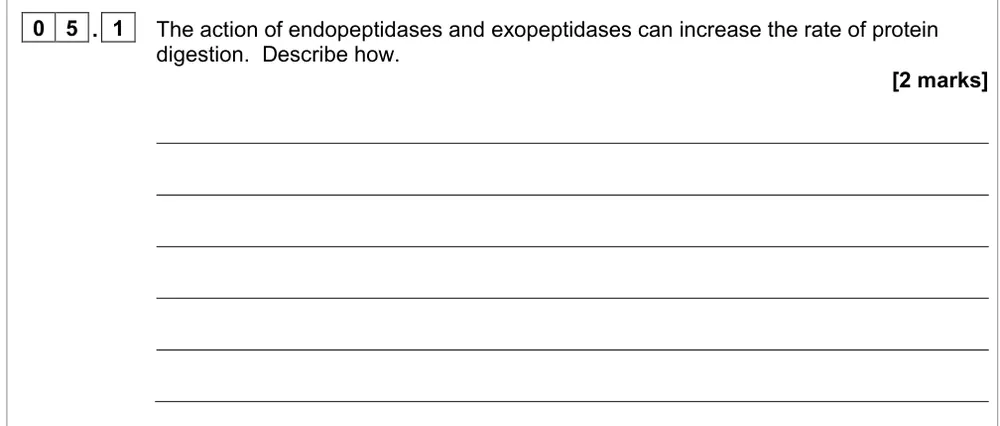
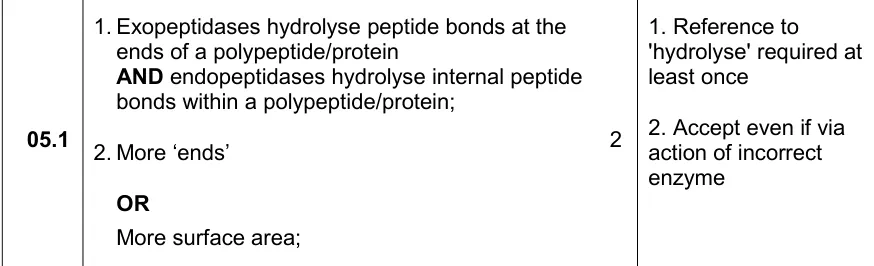
Describe how endopeptidases and exopeptidases together increase the rate of protein digestion.
Show the mark scheme
Tap an image to open it full size.
From the examiners' report: Only 14.43% got both marks; most gave the two roles but stopped there. The second mark is why it's faster: endopeptidases make more ends for exopeptidases to work on.
Lipids, lipase and bile salts (3.3.3)
Question 8
AS Paper 2 · June 2023 · Q06.1 · 2 marks · Easy
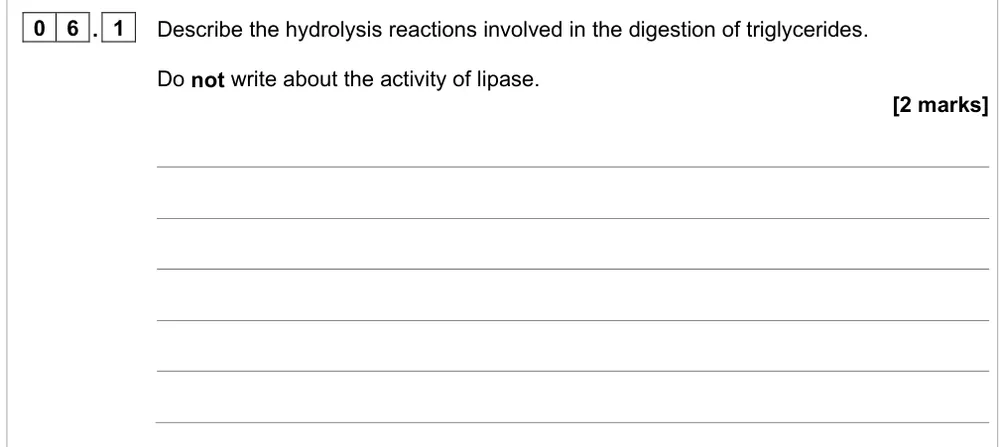
Describe the hydrolysis reactions in the digestion of triglycerides.
Show the mark scheme

Tap an image to open it full size.
From the examiners' report: Generally well answered. Name the ester bonds; some wrote hydrogen or glycosidic bonds.
Question 9
AS Paper 2 · June 2023 · Q06.2 · 2 marks · Medium
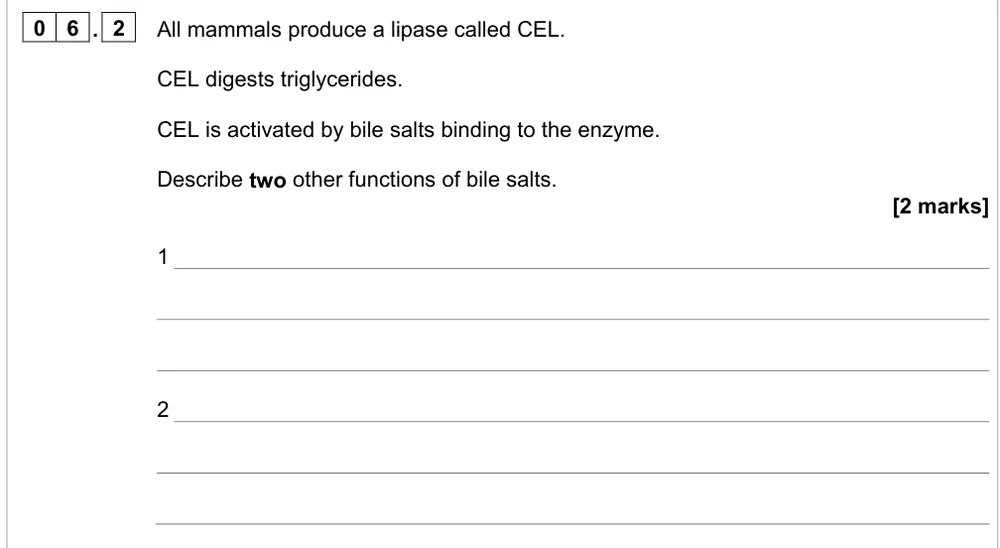
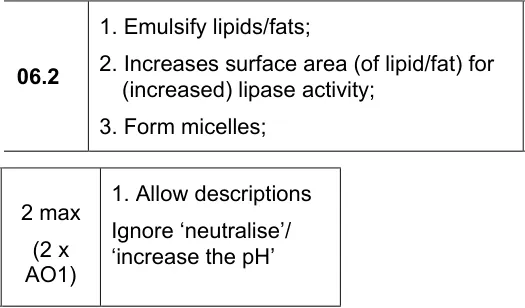
Describe two functions of bile salts other than activating lipase.
Show the mark scheme
Tap an image to open it full size.
From the examiners' report: Almost a third got both marks. Bile salts don't digest fats, and emulsification doesn't make fatty acids and glycerol: it makes smaller droplets.
Question 10
AS Paper 1 · June 2017 · Q03.2 · 3 marks · Medium
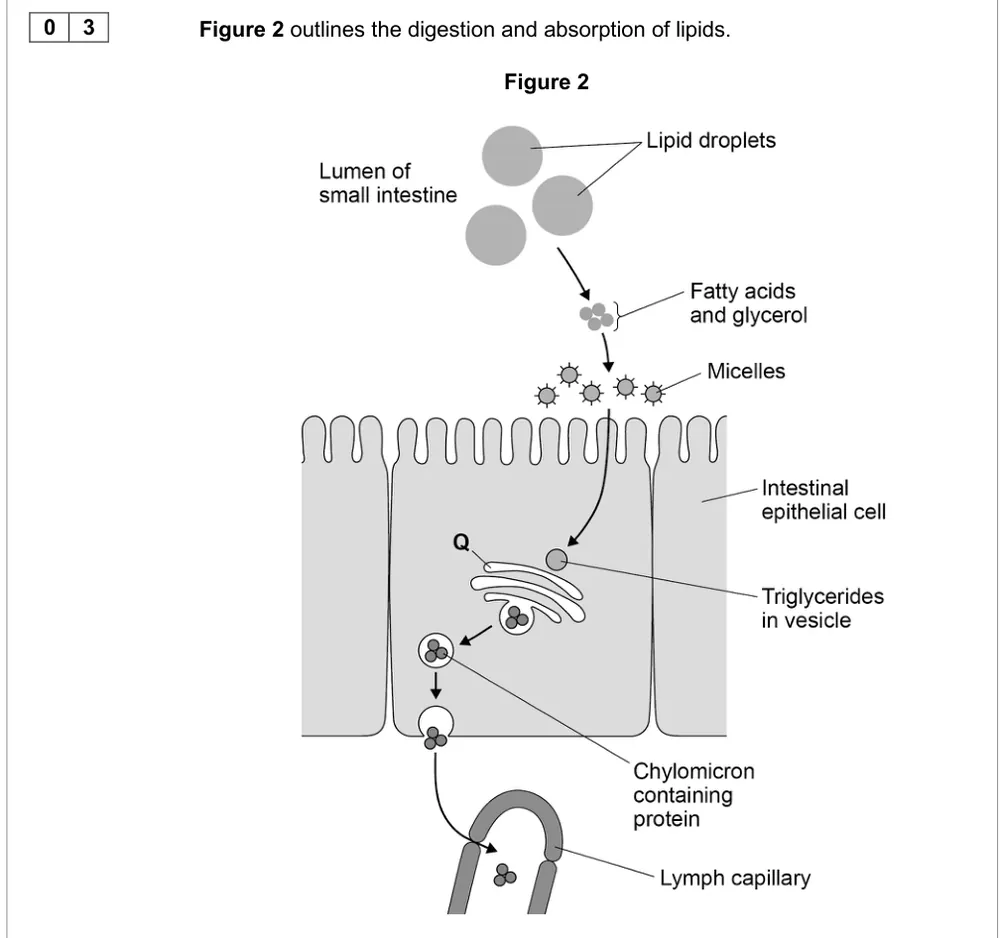
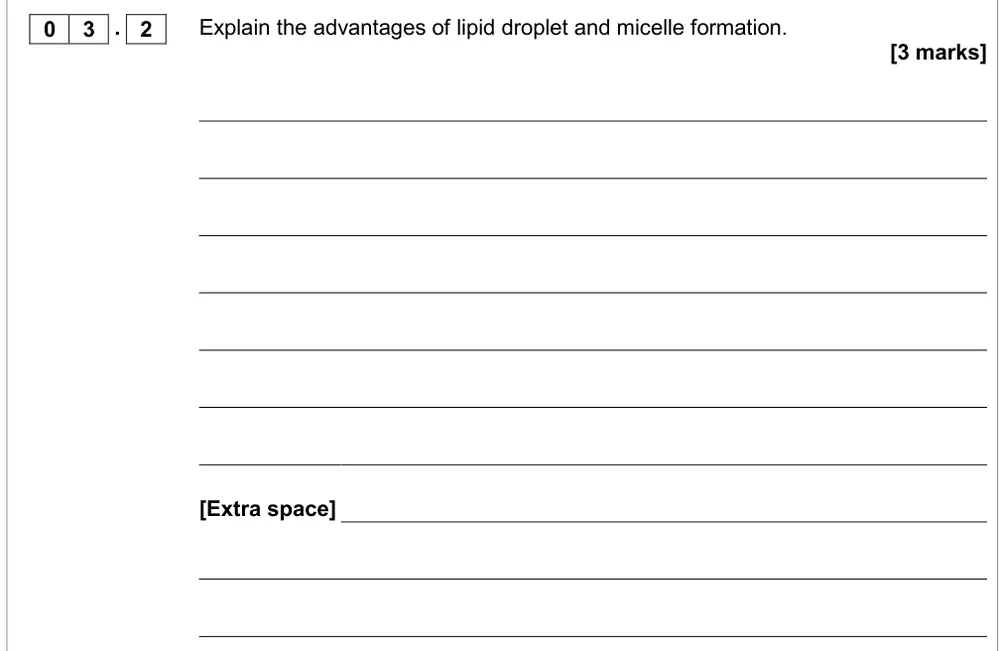
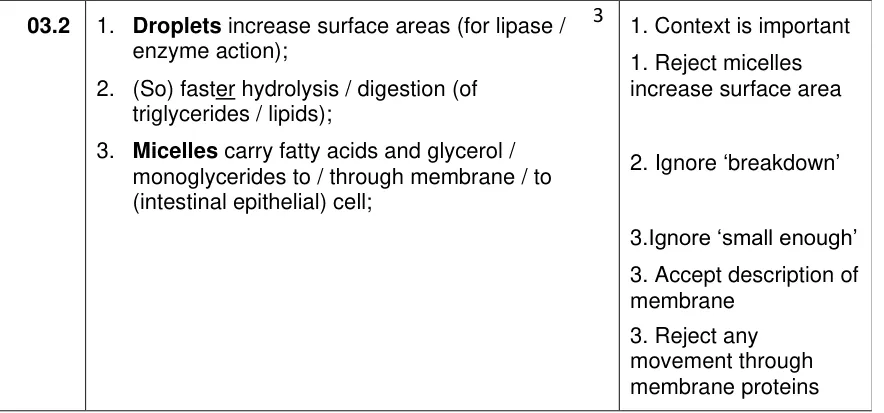
Explain the advantages of lipid droplet and micelle formation.
Information from earlier in this question:
Show the mark scheme
Tap an image to open it full size.
From the examiners' report: Only 3.7% got all three. Treat droplets and micelles separately: droplets give lipase a bigger surface area, so faster hydrolysis ('easier' isn't enough); micelles carry fatty acids to the cell.
Absorption in the ileum (3.3.3)
Question 11
AS Paper 1 · June 2022 · Q01.2 · 4 marks
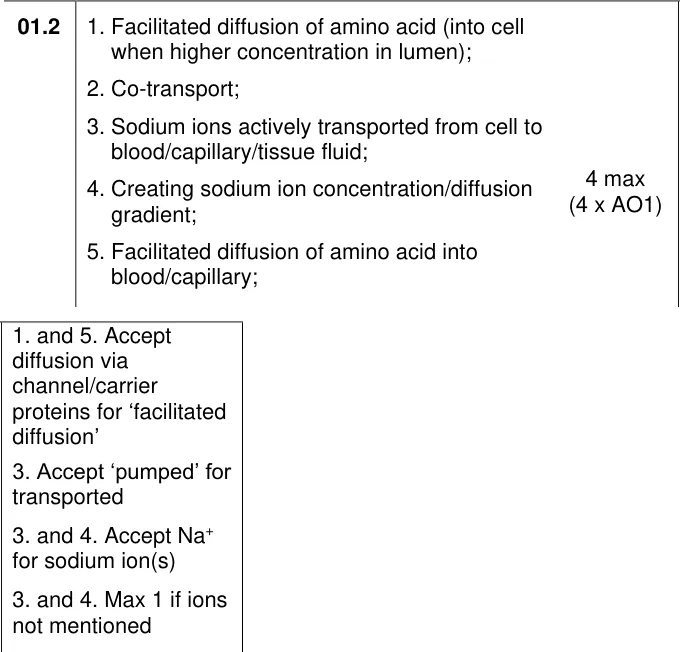
Describe the mechanism for the absorption of amino acids in the ileum.
Show the mark scheme
Tap an image to open it full size.
From the examiners' report: Lots of students gained the mark for co-transport. Weaker answers described active transport of the amino acids, or plain diffusion, instead of the sodium ion gradient and facilitated diffusion. Leave digestion out.
Question 12
AS Paper 2 · June 2016 · Q01.3 · 3 marks · Hard
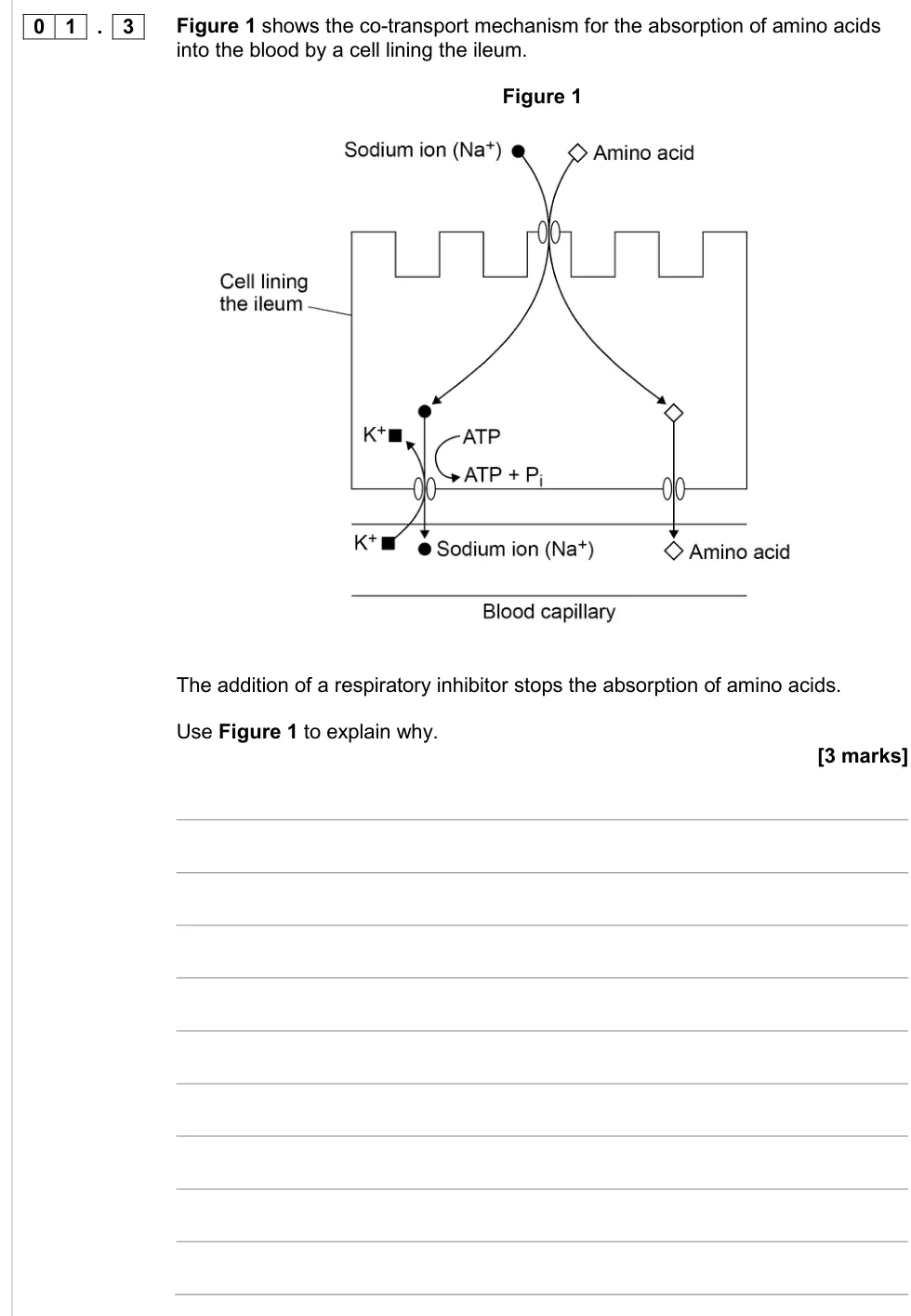
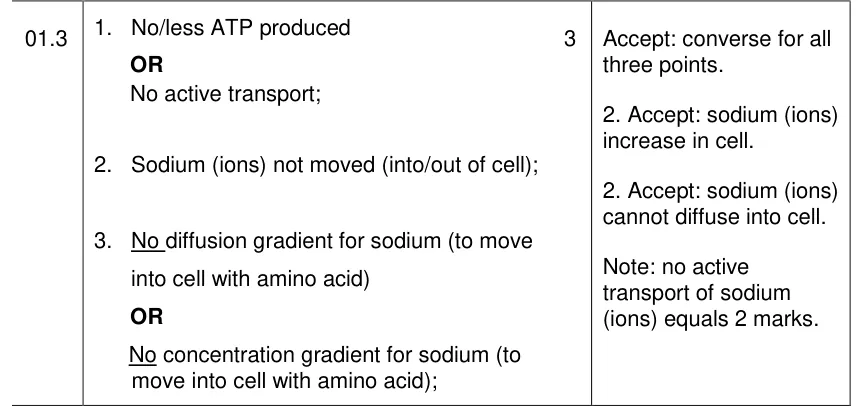
Use a co-transport diagram to explain why a respiratory inhibitor stops amino acid absorption.
Show the mark scheme
Tap an image to open it full size.
From the examiners' report: Figure 1 has a printing error (ATP should become ADP + Pi), and examiners didn't penalise answers copying it. Most got the ATP mark; the rest needs sodium ions and the loss of their diffusion gradient, not just amino acids.
Question 13
A level Paper 1 · November 2020 · Q02.3 · 3 marks · Medium
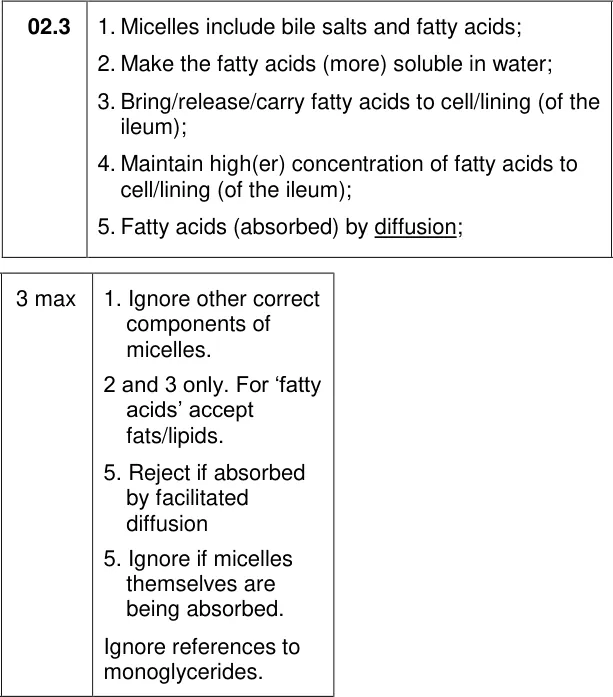
Describe the role of micelles in the absorption of fats into the cells lining the ileum.
Show the mark scheme
Tap an image to open it full size.
From the examiners' report: Only 5% scored 3. Micelles form after digestion, not by emulsification. Stop at the cell lining: chylomicrons and the lymph weren't asked for.
Question 14
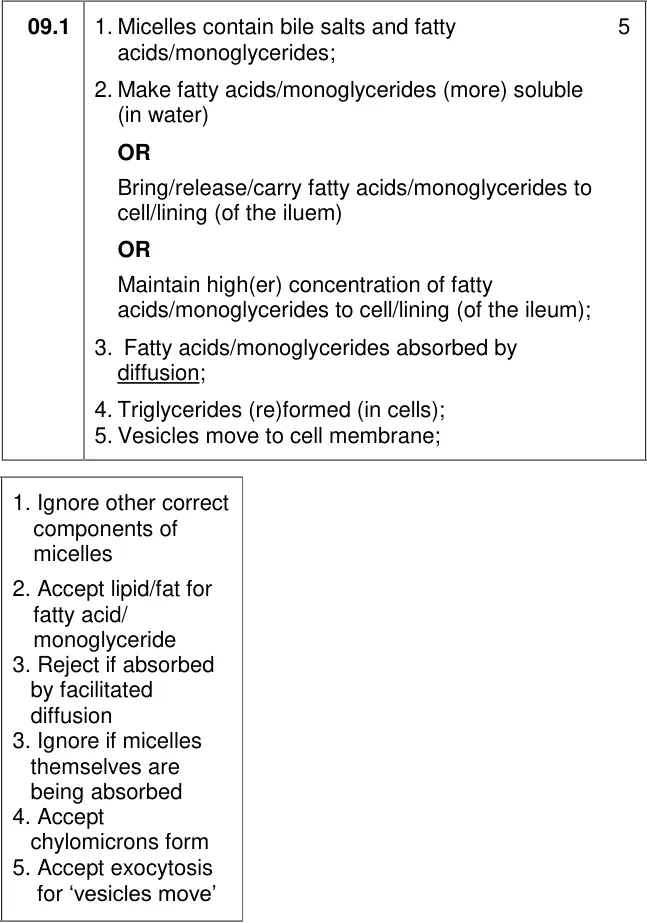
AS Paper 2 · November 2020 · Q09.1 · 5 marks · Hard
Describe how digested lipids are absorbed from the ileum and transported into lymph vessels.
Show the mark scheme
Tap an image to open it full size.
From the examiners' report: Only 30% scored any marks, and very few described micelles. Fatty acids cross by simple diffusion: facilitated diffusion, co-transport and active transport scored nothing. Then triglycerides re-form and leave in vesicles.
Applying digestion and absorption
Question 15
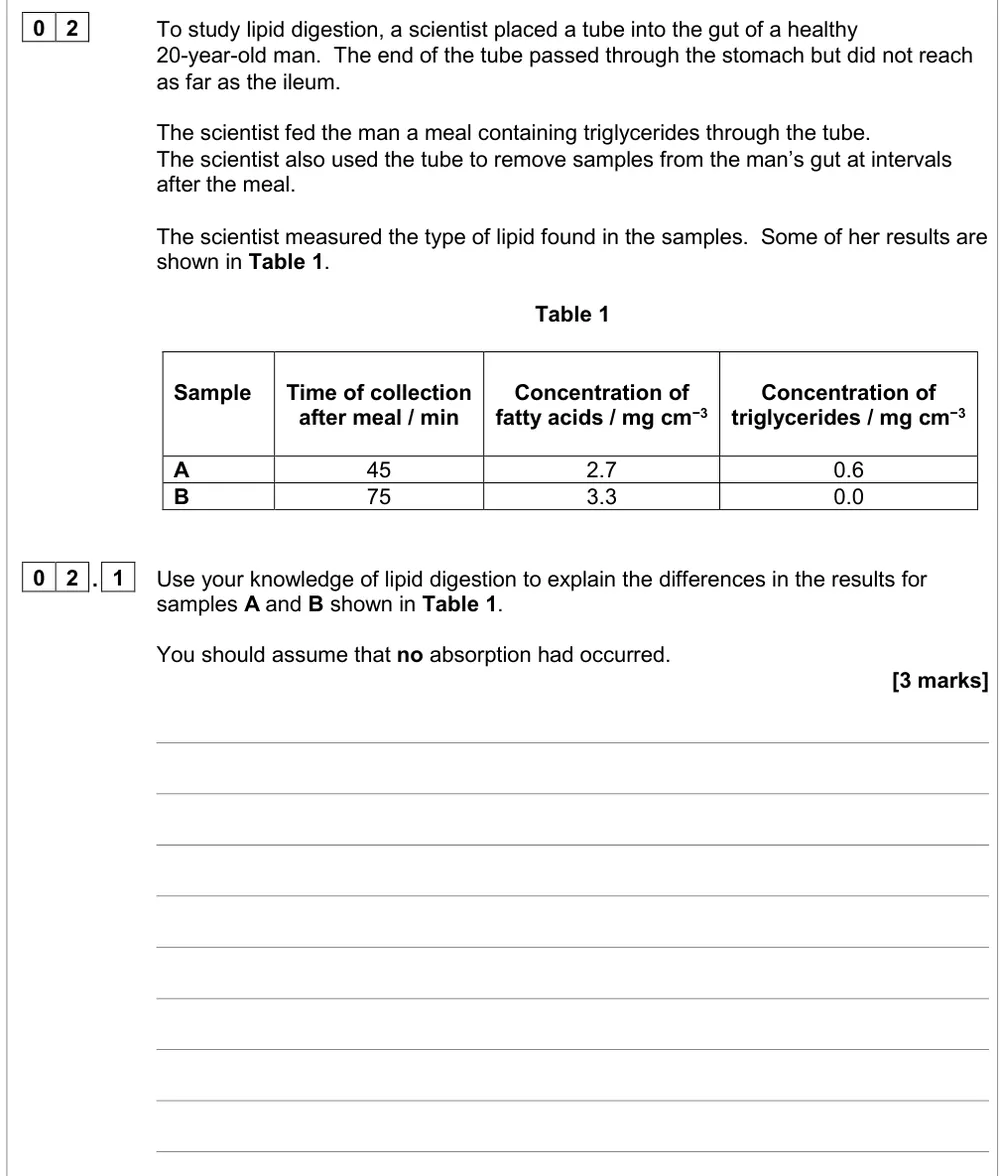
A level Paper 1 · November 2020 · Q02.1 · 3 marks · Medium
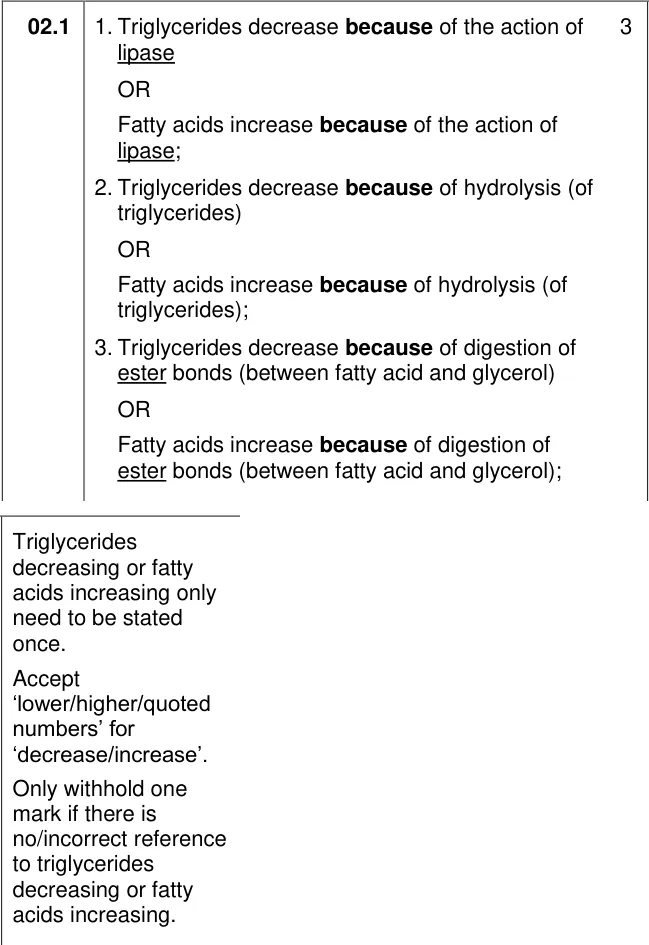
Explain the change in fatty acids and triglycerides between two gut samples.
Show the mark scheme
Tap an image to open it full size.
From the examiners' report: Only 10% gave an A-level answer worth 3 marks. Compare A with B in one sentence, then name lipase, hydrolysis and ester bonds.
Question 16
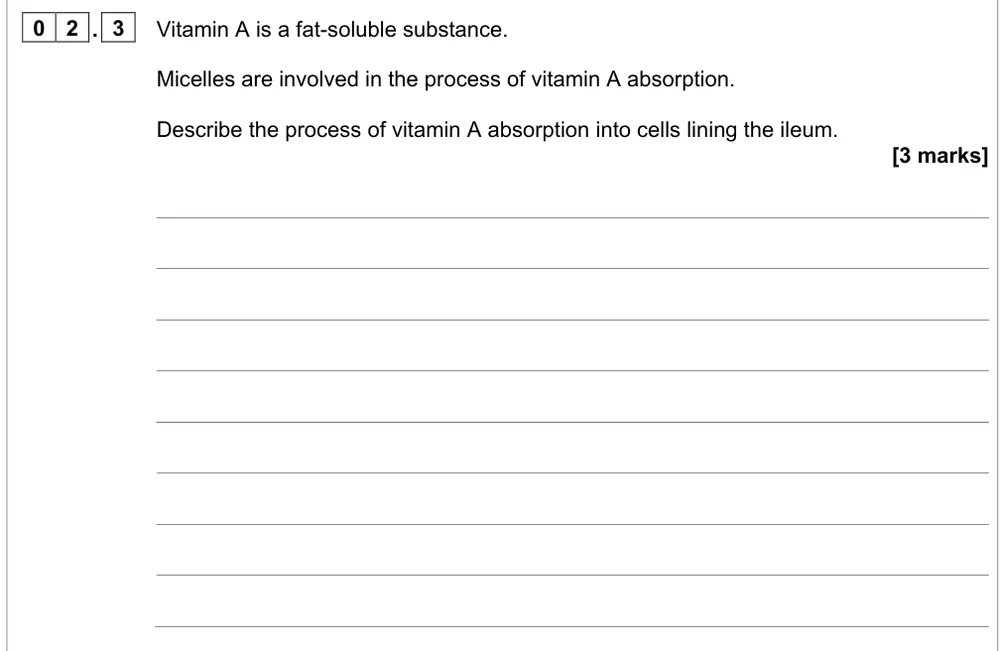
A level Paper 1 · June 2024 · Q02.3 · 3 marks
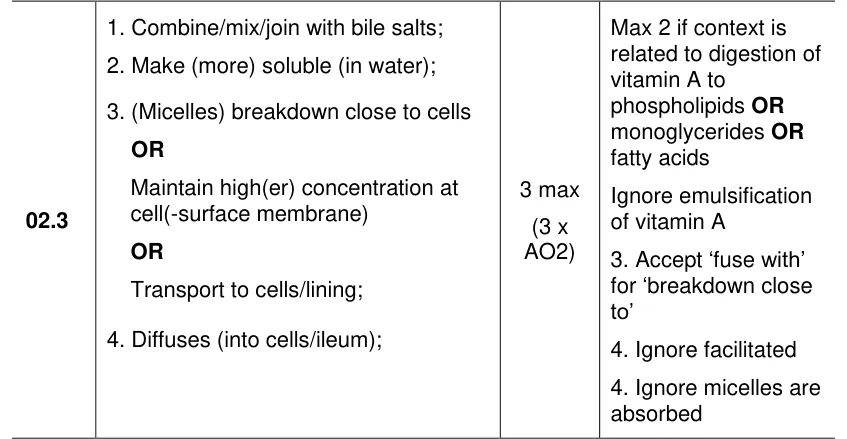
Describe how vitamin A, a fat-soluble substance, is absorbed into cells lining the ileum.
Show the mark scheme
Tap an image to open it full size.
From the examiners' report: Vitamin A isn't digested, so don't describe lipid hydrolysis or emulsification. It joins bile salts in micelles, which carry it to the cell, then it diffuses in; the micelle itself doesn't cross the membrane.
Question 17
AS Paper 2 · June 2019 · Q01.3 · 3 marks · Medium
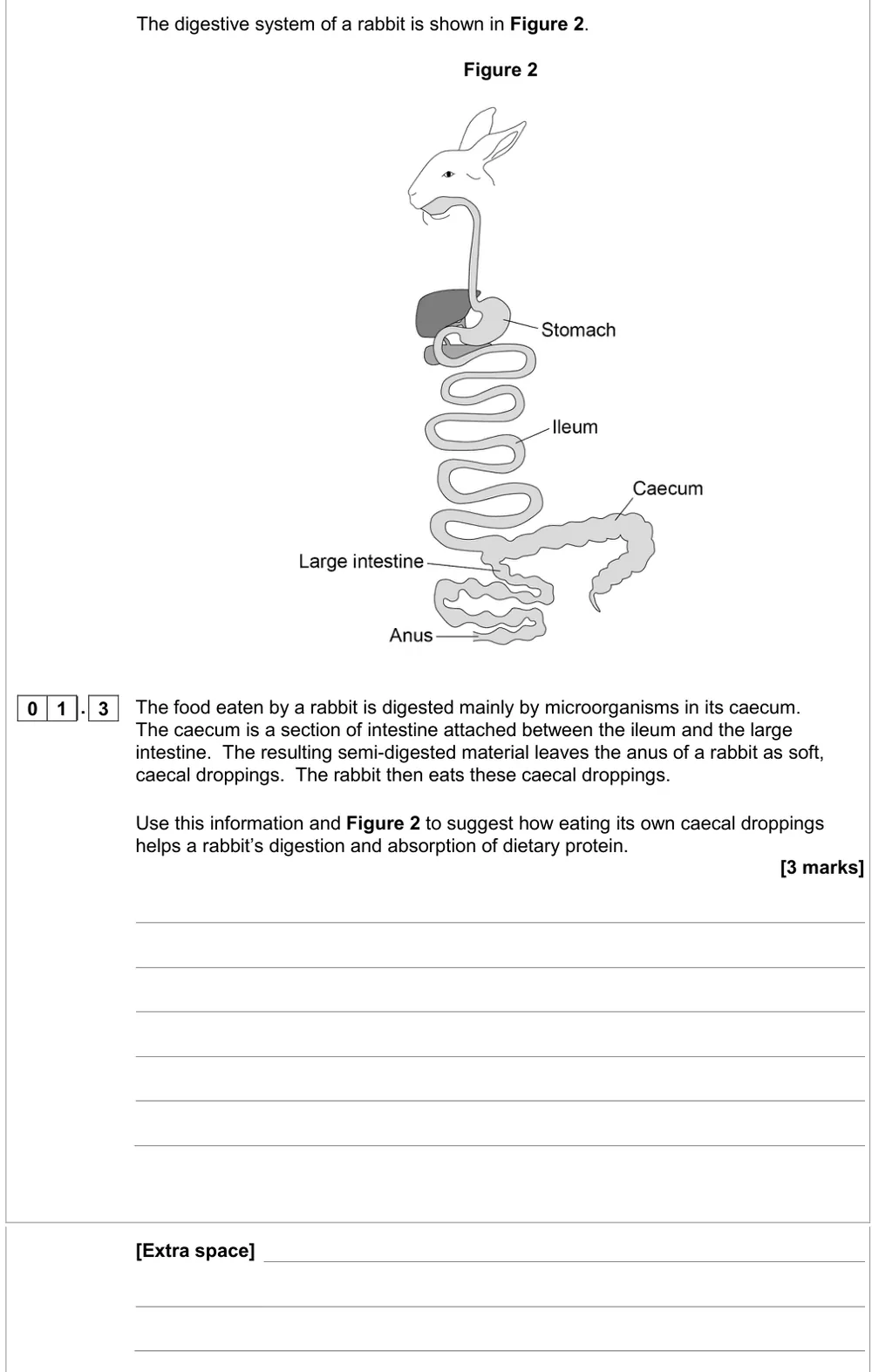
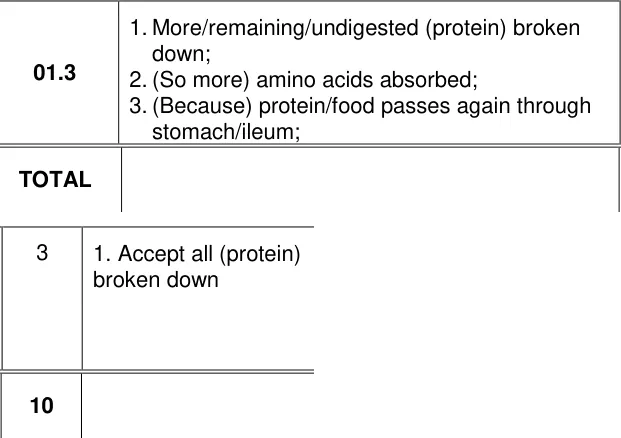
Suggest how eating its own caecal droppings helps a rabbit digest and absorb protein.
Show the mark scheme
Tap an image to open it full size.
From the examiners' report: About a third got no marks. Answer about the rabbit: the protein passes through the stomach and ileum a second time, so more is digested and more amino acids are absorbed. Say amino acids, not 'proteins'.
Where students lose marks (from AQA examiners' reports and mark schemes)
Each point below is followed by wording that gained marks.
Define digestion as hydrolysis to smaller molecules: Many definitions of digestion were well below AS standard, such as 'food is broken down ready for absorption', and many students thought absorption is part of digestion.
✔ Gains credit: "Hydrolysis of large/insoluble substances to small(er)/soluble substances" (polymer to monomer accepted).
Starch goes to maltose first: A quarter got full marks for the complete digestion of starch. Few mentioned membrane-bound enzymes, some wrote 'disaccharide' instead of maltose, and weaker answers went from starch straight to glucose in one step.
✔ Gains credit: "Hydrolysis of glycosidic bonds; (starch) to maltose by amylase; (maltose) to glucose by membrane-bound disaccharidase/maltase."
Dipeptidase, not 'protease': About 50% named the third enzyme needed to hydrolyse proteins completely to amino acids. The most common wrong answer was protease.
✔ Gains credit: "Dipeptidase" (membrane-bound dipeptidase also accepted).
Endopeptidases make more ends: Only 14.43% got both marks for how endopeptidases and exopeptidases speed up protein digestion, and in 2016 only one in five did. Most gave the roles but not why that is faster, and many swapped the two enzymes.
✔ Gains credit: "Endopeptidases hydrolyse internal peptide bonds and exopeptidases hydrolyse peptide bonds at the ends; more ends (or more surface area) for exopeptidases."
No ATP, so no sodium ion gradient: On the respiratory inhibitor question, many said the inhibitor blocks the carrier protein, or wrote only about amino acids with no mention of sodium ions. Full marks needed the sodium ion gradient.
✔ Gains credit: "No ATP produced; sodium ions not moved out of the cell; no diffusion gradient for sodium to move into the cell with the amino acid."
Faster hydrolysis, not 'easier digestion': Only 3.7% got all three marks on lipid droplets and micelles, and in 2025 less than 15% got all four on emulsification and micelles. Easier digestion doesn't equal faster digestion, and simply saying lipase digests lipid gained no credit.
✔ Gains credit: "Droplets increase surface area (for lipase action); so faster hydrolysis of triglycerides; micelles carry fatty acids and monoglycerides to the (epithelial) cell."
Micelles form after digestion, not by emulsification: Only 5% scored 3 on the role of micelles. Many thought emulsification forms micelles, and answers drifted on to chylomicrons and the lymph, which weren't asked for.
✔ Gains credit: "Micelles include bile salts and fatty acids; make the fatty acids (more) soluble in water; bring fatty acids to the cells lining the ileum."
Fatty acids leave micelles by simple diffusion: Only 30% scored any marks on lipid absorption into lymph vessels. Very few described micelles, and answers about facilitated diffusion, co-transport, active transport or osmosis scored nothing.
✔ Gains credit: "Fatty acids/monoglycerides absorbed by diffusion; triglycerides (re)formed in cells; vesicles move to the cell membrane" (facilitated diffusion rejected).
Download the questions
Download the PDF pack (17 questions, mark schemes at the end)
Keep practising
- Carbohydrates: AQA A Level Biology exam questions by topic
- Lipids: AQA A Level Biology exam questions by topic
- Proteins: AQA A Level Biology exam questions by topic
- Transport across cell membranes: AQA A Level Biology exam questions by topic
- Gas exchange: AQA A Level Biology exam questions by topic
- AQA A Level Biology masterclasses
Questions, mark schemes and examiners' report extracts © AQA.