

Haemoglobin is the first part of AQA 3.3.4.1, mass transport in animals, and it turns up on Paper 1, Paper 2 and Paper 3. You need to know that haemoglobin is a protein with a quaternary structure, how it loads oxygen in the lungs and unloads it in respiring tissues, why the dissociation curve is S-shaped, how carbon dioxide shifts the curve (the Bohr effect), and how different haemoglobins suit different animals.
The examiners' reports show the same problems every year. Students name 'positive cooperativity' without explaining the shape change, forget to say where oxygen is loaded and unloaded, say carbon dioxide binds to haemoglobin, leave out a comparative word such as 'more', and talk about haemoglobin loading 'faster' when a dissociation curve has no time on it. The data questions are where most marks go: many students can't find the lungs and the tissues on the x-axis.
Start with loading and unloading, then the Bohr effect, then the curves for other animals, and finish with the plotting question. Answer each question on paper before you open the mark scheme. If you'd like help with this topic, my AQA masterclasses run online on Tuesdays at 5.15pm for Year 12 and on Wednesdays or Thursdays at 6.30pm for Year 13.
What you need from GCSE and Year 12
Each question on this page assumes you're secure on these GCSE and Year 12 ideas. If any of them feels shaky, revise it before you start.
- GCSE: red blood cells contain haemoglobin, which carries oxygen from the lungs to the tissues.
- GCSE: aerobic respiration uses oxygen and releases carbon dioxide; without enough oxygen, muscles respire anaerobically and make lactic acid.
- Year 12 (AQA 3.1.4.1): a protein's tertiary structure is held by hydrogen, ionic and disulfide bonds, and a protein made of more than one polypeptide has a quaternary structure.
- Year 12 (AQA 3.3.2): oxygen diffuses from the alveoli into the blood in the lung capillaries, where the partial pressure of oxygen is high.
Key terms
These words come up in the questions and mark schemes. Examiners expect you to use them exactly.
- Quaternary structure: a protein made of more than one polypeptide; haemoglobin has four, each with a haem group that binds one oxygen molecule.
- Partial pressure of oxygen (pO2): a measure of oxygen concentration in kPa; high in the lungs, low in respiring tissues.
- Loading (association): oxygen binding to haemoglobin to form oxyhaemoglobin, in the lungs or gills.
- Unloading (dissociation): oxygen being released from oxyhaemoglobin, in respiring cells and tissues.
- Affinity: how readily haemoglobin binds oxygen; high affinity means it loads more readily and unloads less readily.
- Percentage saturation: the percentage of haemoglobin's oxygen binding sites that are occupied, read from the y-axis of a dissociation curve.
- Oxyhaemoglobin dissociation curve: a graph of percentage saturation of haemoglobin with oxygen against pO2; it is S-shaped (sigmoid).
- Cooperative binding: binding of the first oxygen changes the tertiary / quaternary structure of haemoglobin, uncovering another binding site so further oxygens bind more easily.
- Bohr effect: a higher carbon dioxide concentration lowers blood pH, which decreases haemoglobin's affinity for oxygen so more oxygen is unloaded.
- Curve shifted to the left: a higher affinity for oxygen at a given pO2, as in fetal haemoglobin or animals living where pO2 is low.
What these questions cover (AQA 3.3.4.1, haemoglobin)
The questions test these statements from the AQA AS and A-level Biology specification (7401/7402):
- Haemoglobins: The haemoglobins are a group of chemically similar molecules found in many different organisms. Haemoglobin is a protein with a quaternary structure. (no question asks about this on its own; the cooperative binding question expects a change in the tertiary or quaternary structure of haemoglobin)
- Oxygen transport: The role of haemoglobin and red blood cells in the transport of oxygen. The loading, transport and unloading of oxygen in relation to the oxyhaemoglobin dissociation curve. The cooperative nature of oxygen binding to show that the change in shape of haemoglobin caused by binding of the first oxygens makes the binding of further oxygens easier. The effects of carbon dioxide concentration on the dissociation of oxyhaemoglobin (the Bohr effect).
- Different haemoglobins: Many animals are adapted to their environment by possessing different types of haemoglobin with different oxygen transport properties. (the questions use fetal haemoglobin, a tubifex worm, seal myoglobin, mountain goats, mice and horses, and crab haemocyanin)
How to use this page
Write your answer on paper before you open the mark scheme. Allow about 1.3 minutes per mark: the 15 questions are worth 36 marks, so about 47 minutes in total. Then mark your answer strictly against the mark scheme and read the examiners' tip underneath it. If you'd rather print the questions, download the PDF pack.
Loading, transport and unloading (3.3.4.1)
Question 1
AS Paper 2 · June 2024 · Q09.1 · 5 marks · Easy
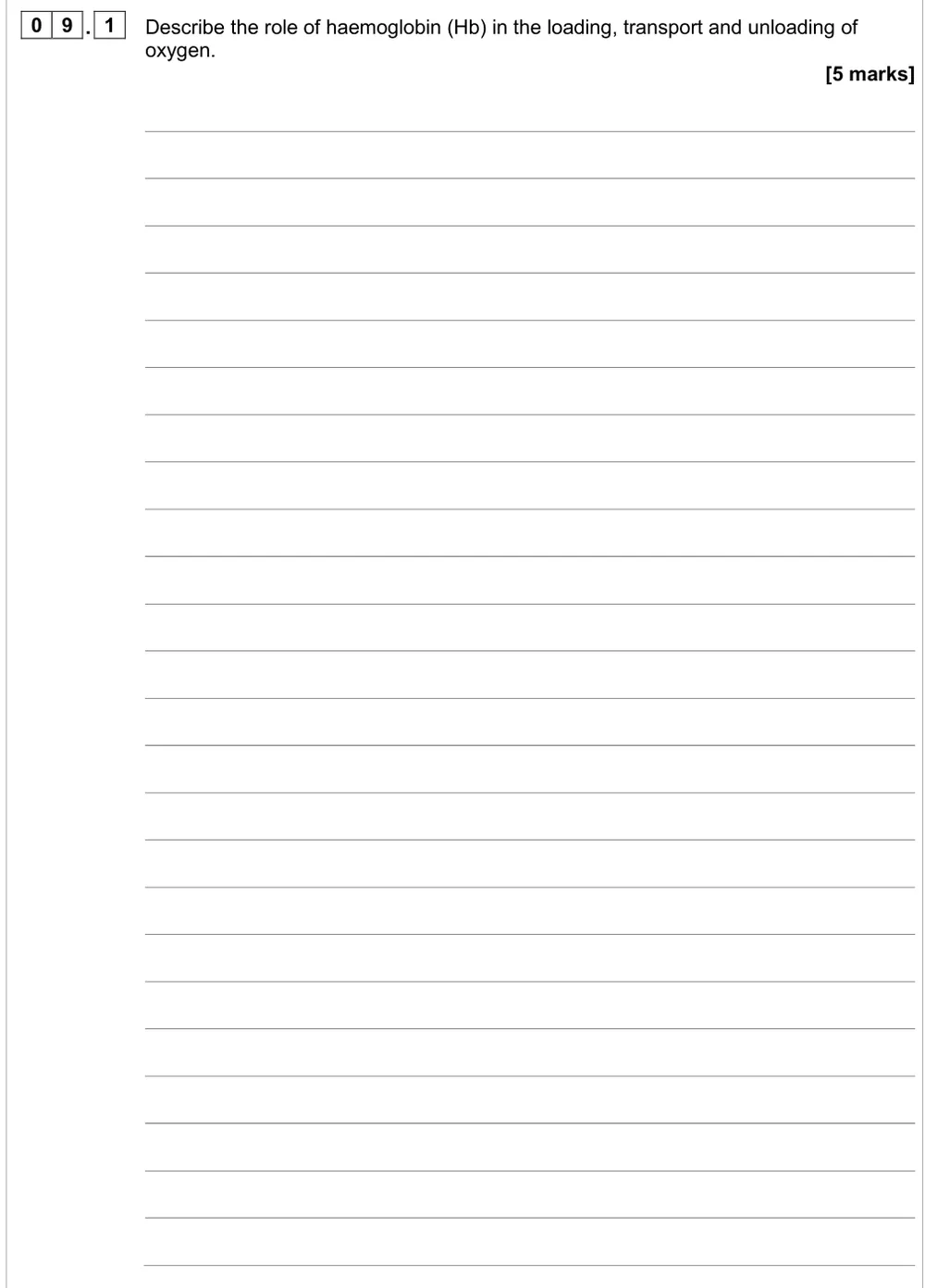
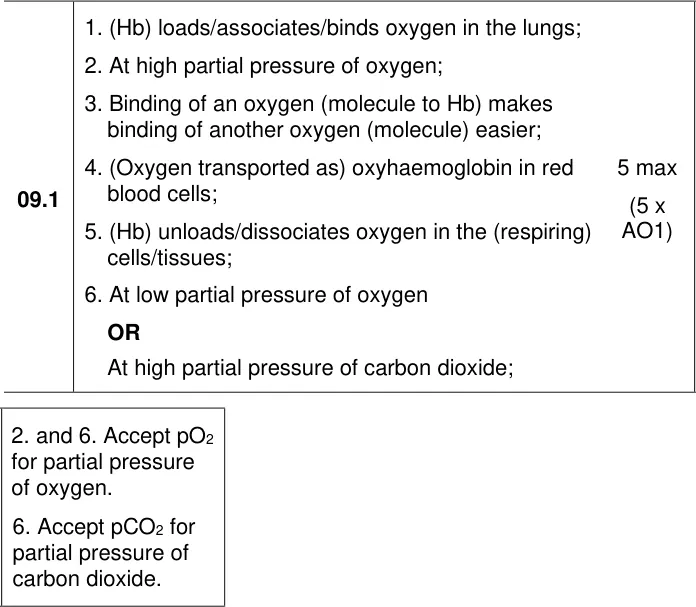
Describe the role of haemoglobin in loading, transporting and unloading oxygen.
Show the mark scheme
Tap an image to open it full size.
From the examiners' report: Most got at least 1 or 2 marks. It's a 'describe' question, so keep the pH detail short. Say where each step happens (lungs, respiring tissues), mention red blood cells, and use partial pressure, not concentration.
Question 2
A level Paper 3 · June 2018 · Q04.1 · 2 marks · Hard
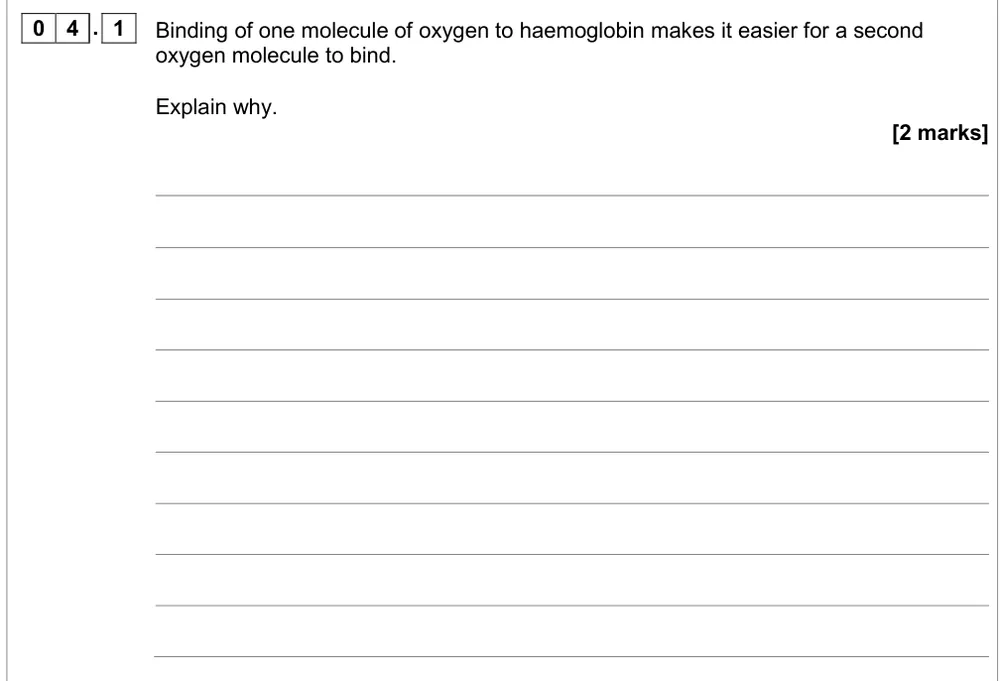
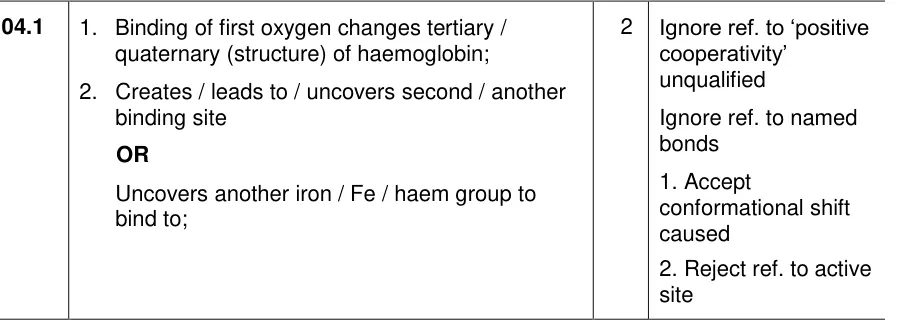
Explain why binding of one oxygen makes it easier for a second oxygen to bind to haemoglobin.
Show the mark scheme
Tap an image to open it full size.
From the examiners' report: Only 11% got both marks. Name the tertiary or quaternary structure, not just 'shape', then say a second binding site is uncovered. Naming positive cooperativity isn't explaining it.
Question 3
AS Paper 2 · June 2017 · Q05.1 · 2 marks
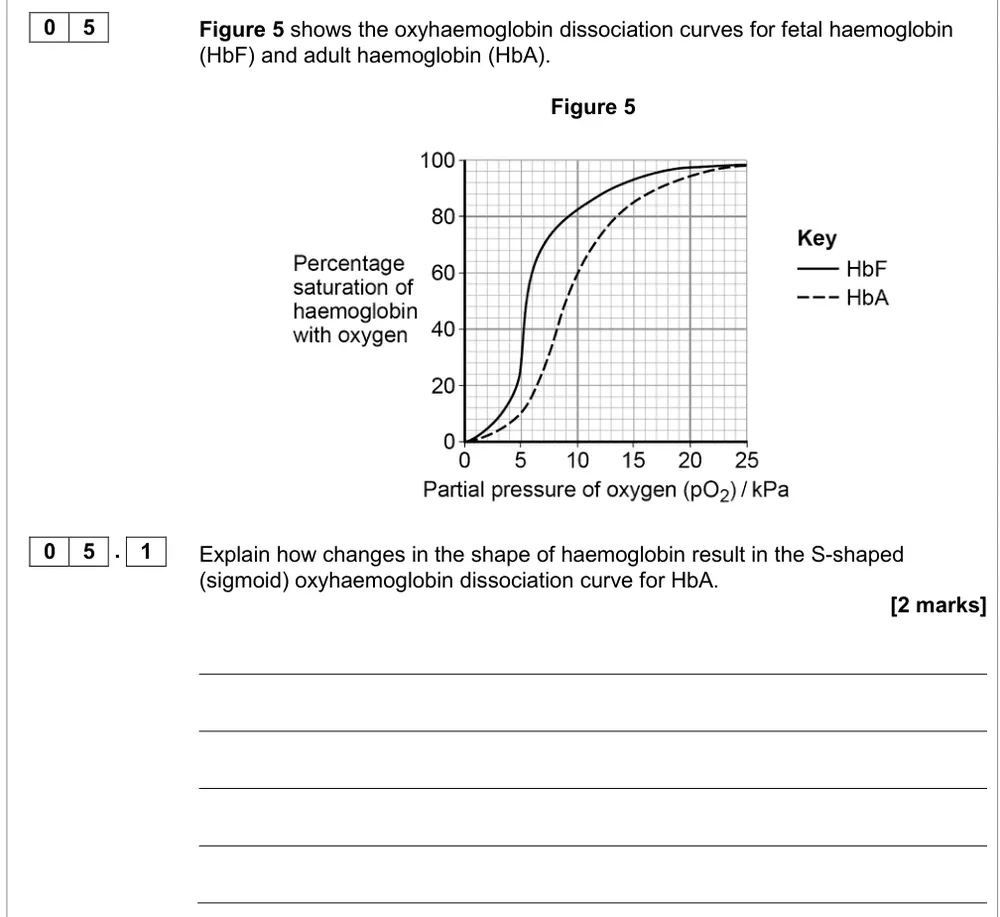
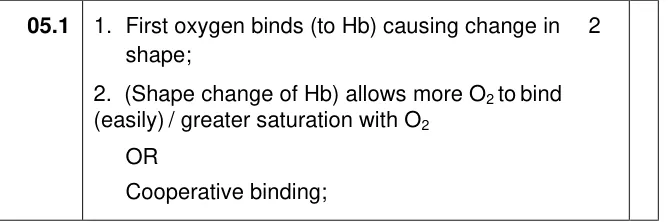
Explain how changes in haemoglobin's shape give the S-shaped dissociation curve.
Show the mark scheme
Tap an image to open it full size.
From the examiners' report: No examiners' report for this paper. The mark scheme wants the sequence: first oxygen binds, haemoglobin changes shape, then further oxygens bind more easily.
Question 4
AS Paper 2 · June 2017 · Q05.2 · 2 marks
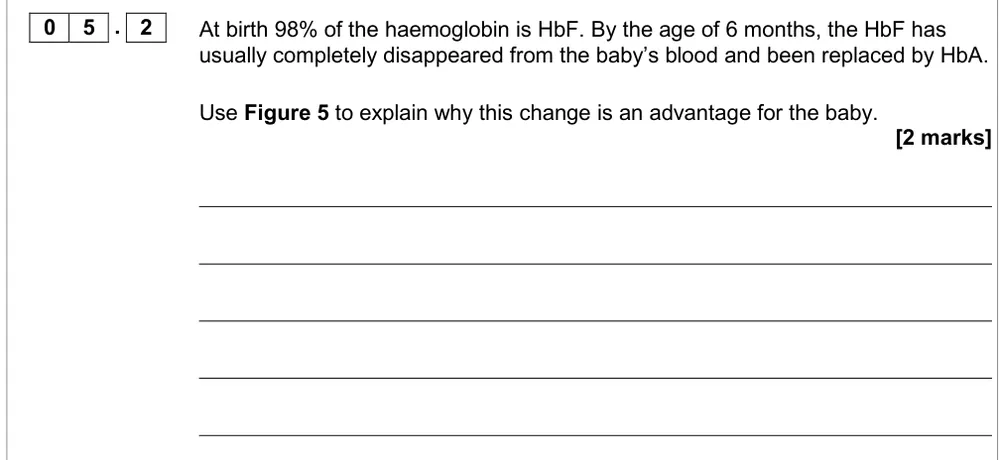
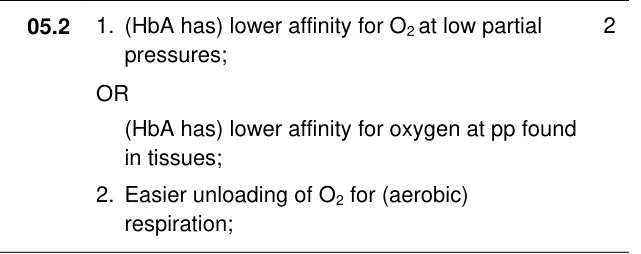
Use the fetal and adult curves to explain why replacing HbF with HbA helps a baby.
Show the mark scheme
Tap an image to open it full size.
From the examiners' report: No examiners' report for this paper. Compare affinity at the low pO2 of the tissues, and say the oxygen unloads more easily for respiration.
Question 5
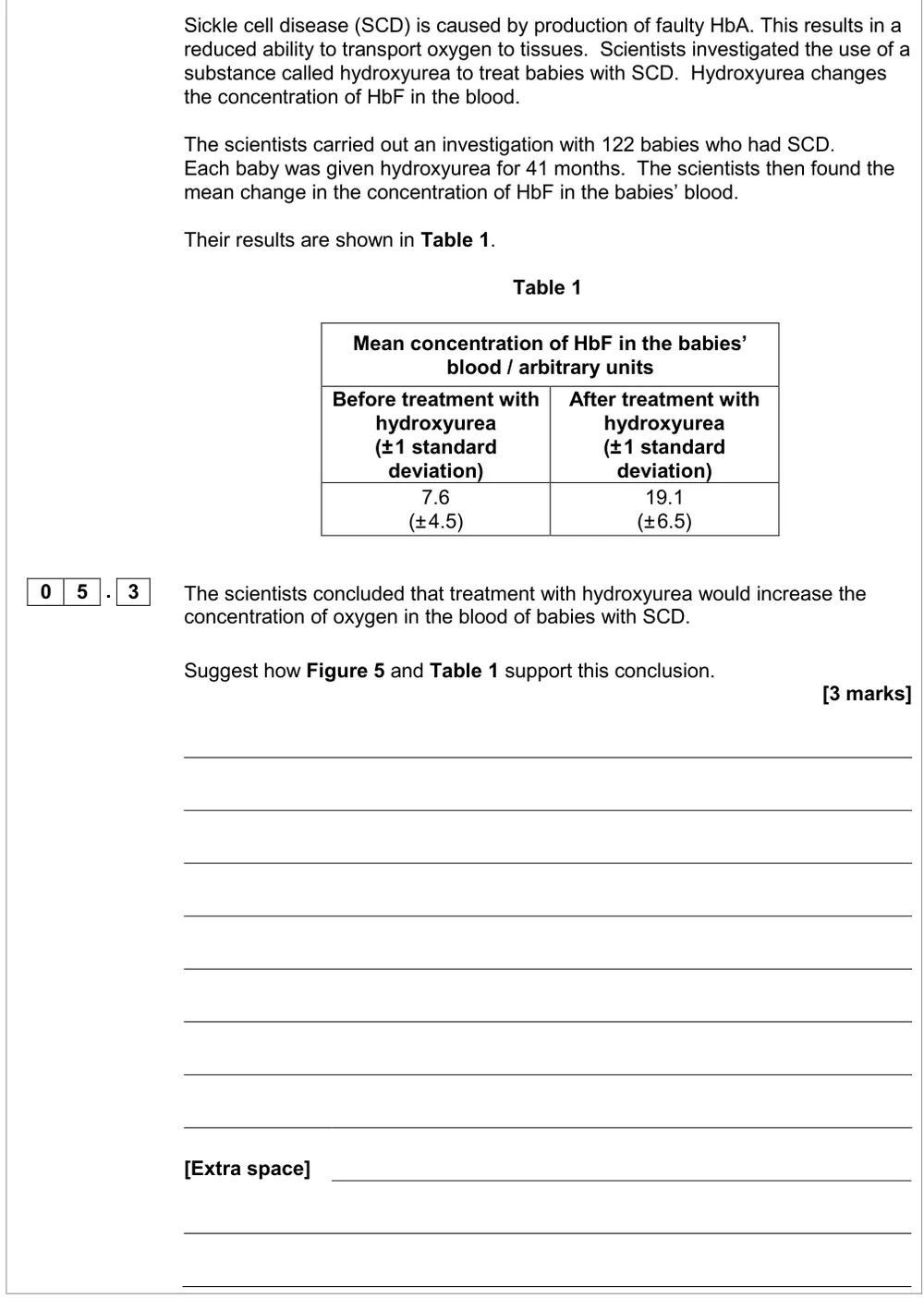
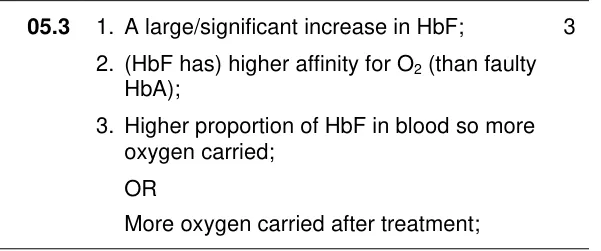
AS Paper 2 · June 2017 · Q05.3 · 3 marks
Use HbF data from a hydroxyurea trial to support a conclusion about oxygen in sickle cell disease.
Show the mark scheme
Tap an image to open it full size.
From the examiners' report: No examiners' report for this paper. Use both sources: the table shows HbF goes up, the graph shows HbF has a higher affinity, so more oxygen is carried.
The Bohr effect and other shifts (3.3.4.1)
Question 6
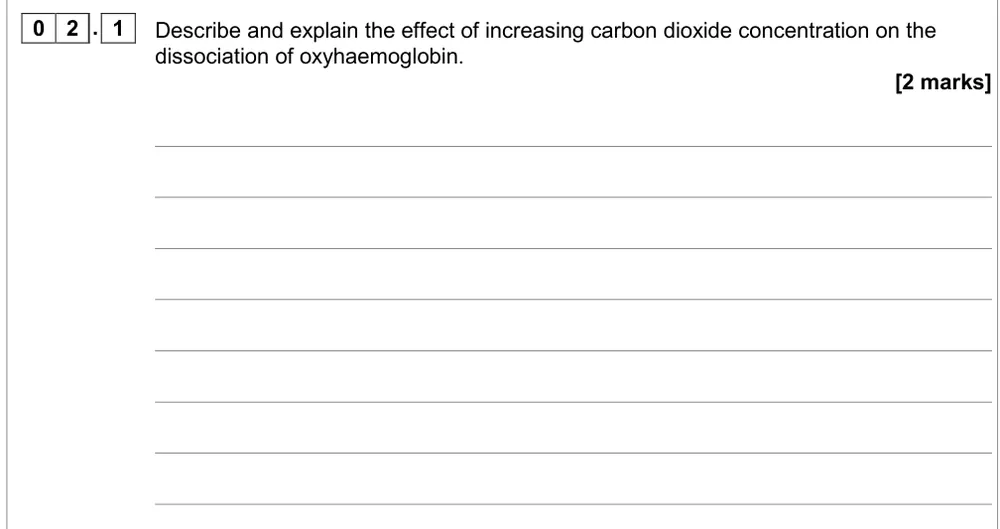
AS Paper 2 · June 2019 · Q02.1 · 2 marks
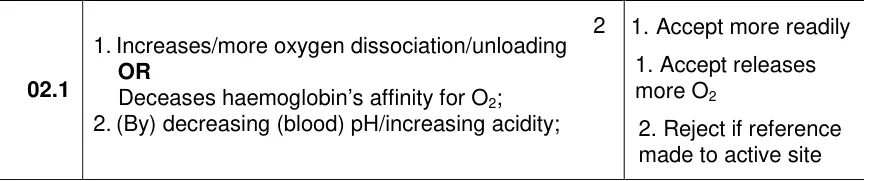
Describe and explain the effect of more carbon dioxide on the dissociation of oxyhaemoglobin.
Show the mark scheme
Tap an image to open it full size.
From the examiners' report: About two-thirds got the effect on affinity. Explain it with pH, not the rate of respiration, and say the pH falls. Carbon dioxide doesn't bind to the oxygen sites, and a shift to the left is a higher affinity.
Question 7
A level Paper 3 · November 2020 · Q06.1 · 2 marks · Medium
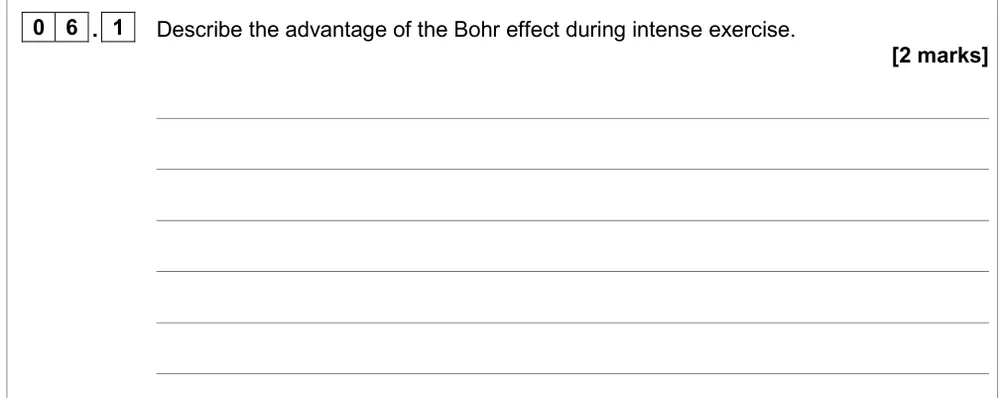
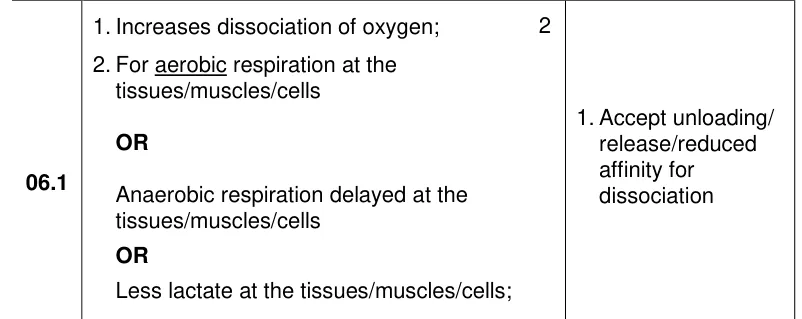
Describe the advantage of the Bohr effect during intense exercise.
Show the mark scheme
Tap an image to open it full size.
From the examiners' report: Nearly 58% scored at least 1 mark. Don't contradict yourself: a high affinity doesn't mean easy unloading. Say the oxygen is for aerobic respiration.
Question 8
A level Paper 3 · June 2022 · Q01.5 · 2 marks
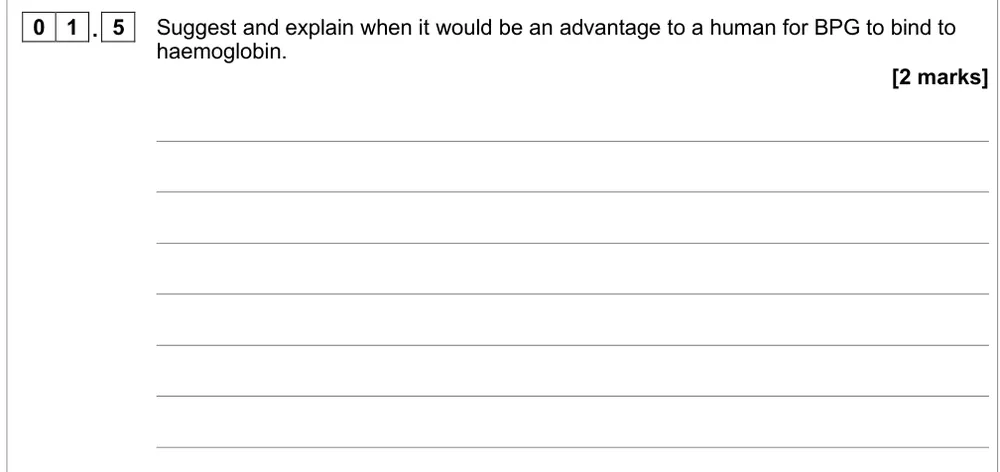
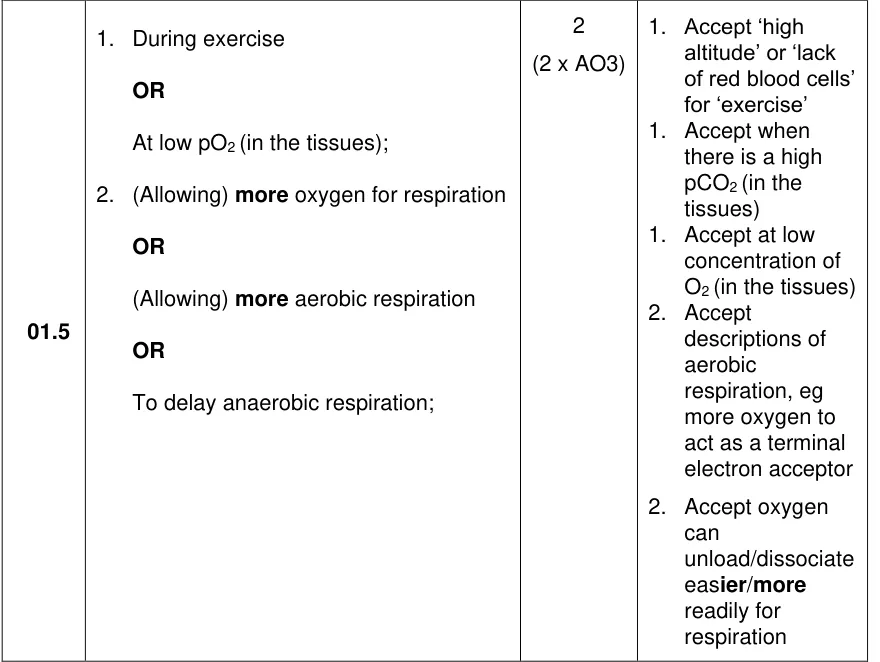
Suggest when BPG binding to haemoglobin would be an advantage, and explain why.
Information from earlier in this question:

Show the mark scheme
Tap an image to open it full size.
From the examiners' report: Marks were split evenly. Give a situation (exercise, low pO2 in the tissues), then use a comparative word: 'more' oxygen for respiration, not just 'can unload oxygen'.
Question 9
A level Paper 1 · June 2023 · Q07.1 · 3 marks · Medium
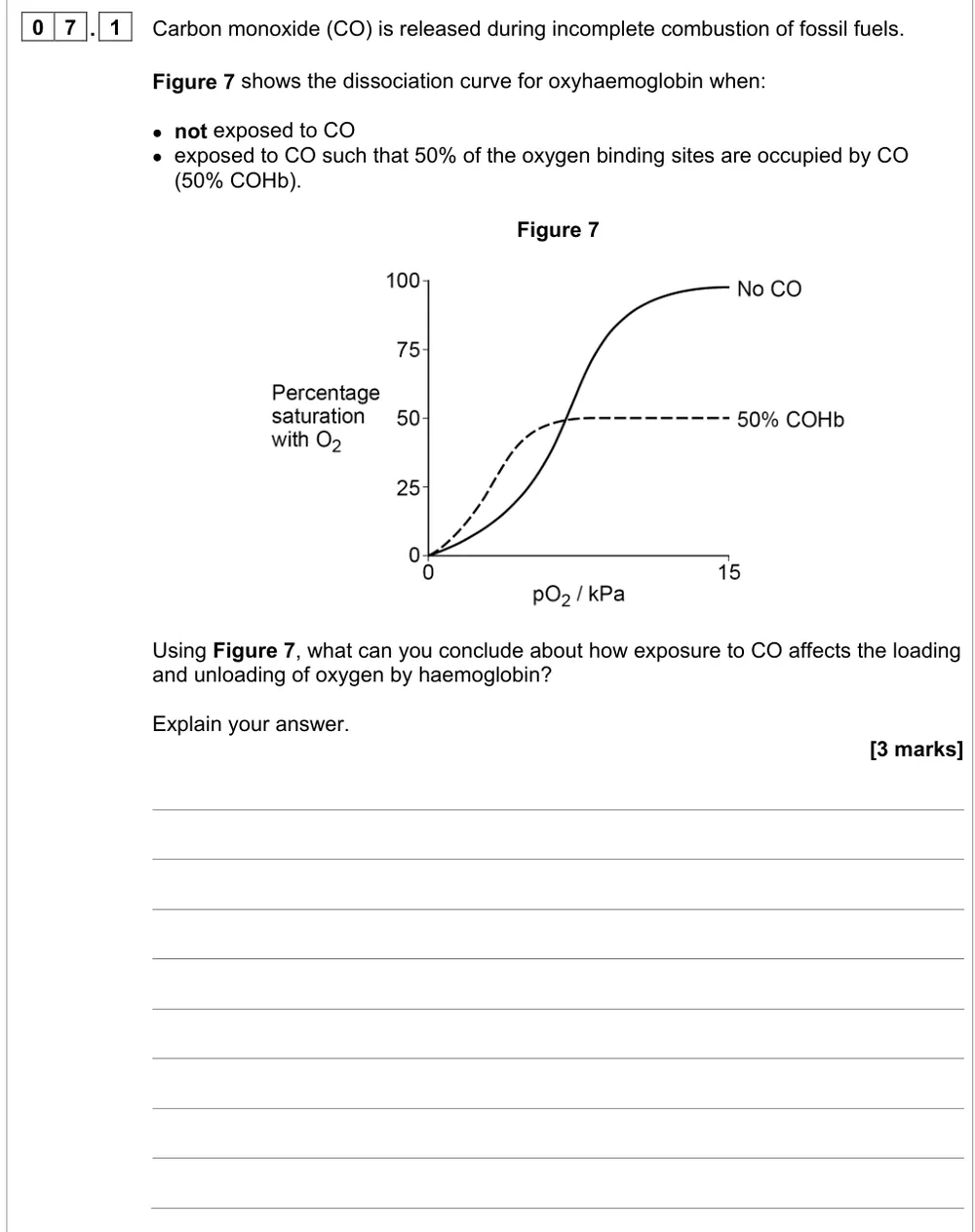
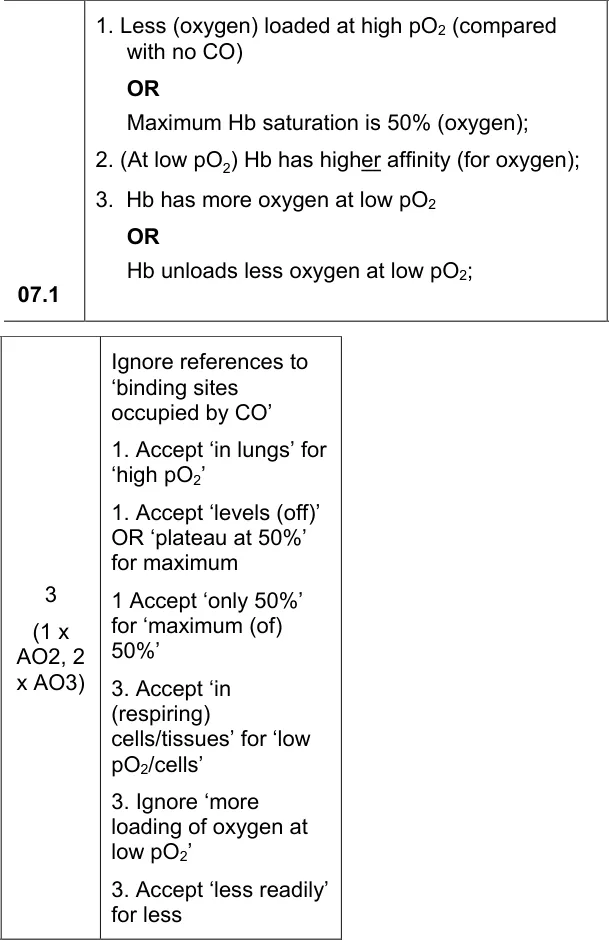
Use dissociation curves to conclude how carbon monoxide affects oxygen loading and unloading.
Show the mark scheme
Tap an image to open it full size.
From the examiners' report: 40% got no marks. Apply the graph, don't recall a general curve: with CO, haemoglobin has a higher affinity and unloads less oxygen in the tissues. The Bohr effect isn't relevant here.
Different haemoglobins and adaptations (3.3.4.1)
Question 10
AS Paper 2 · June 2016 · Q03.3 · 2 marks · Hard
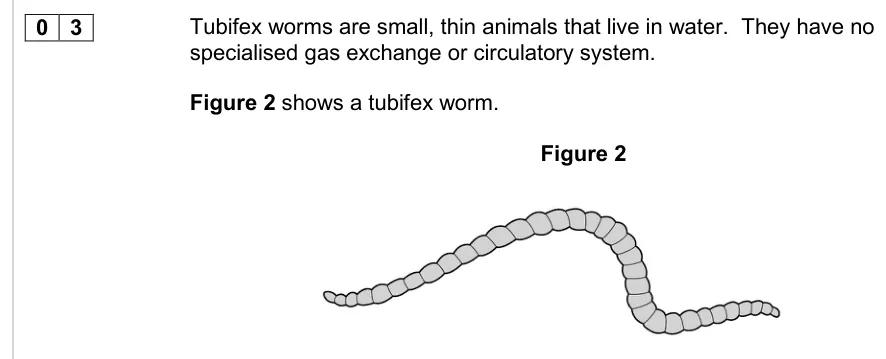
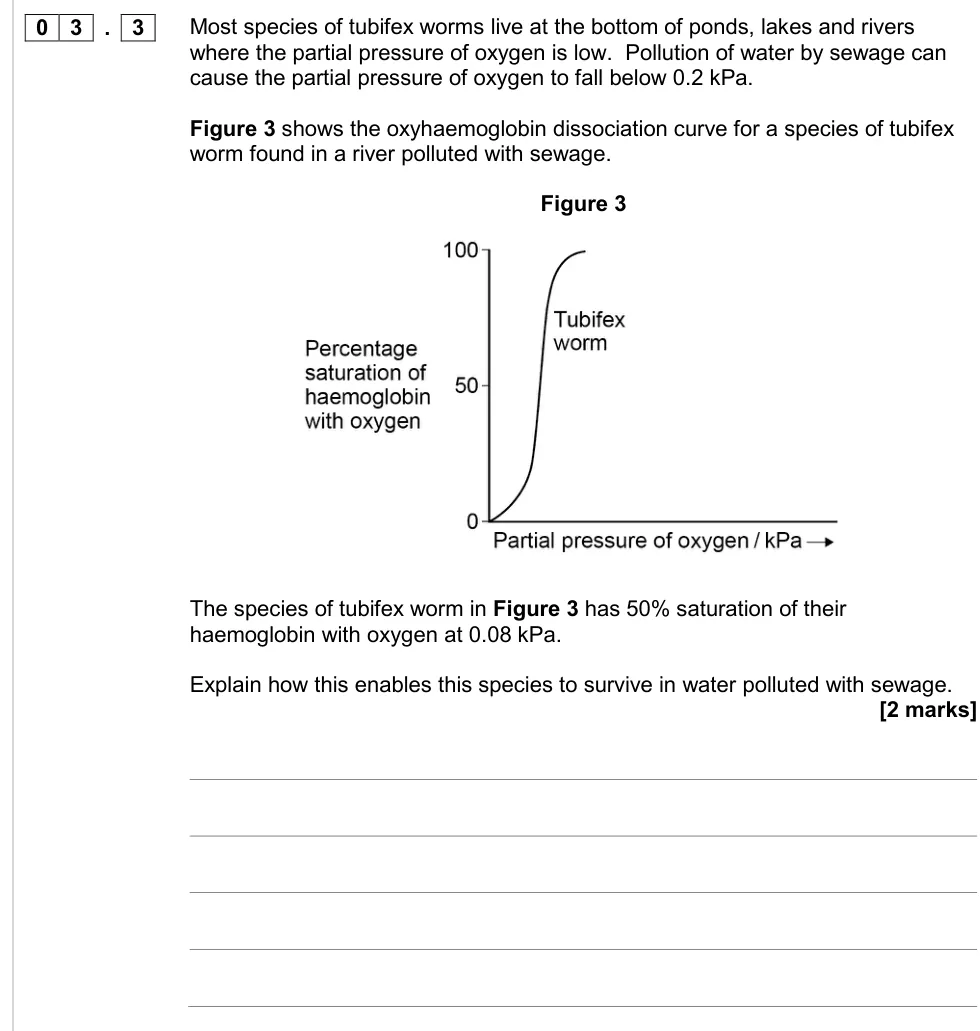
Explain how a tubifex worm's haemoglobin lets it survive in water polluted with sewage.
Information from earlier in this question:
Show the mark scheme

Tap an image to open it full size.
From the examiners' report: Less than 5% got both marks. Don't just write 'high affinity': link the percentage saturation to a partial pressure below 0.2 kPa, then say the oxygen is for respiration.
Question 11
AS Paper 2 · June 2019 · Q02.2 · 2 marks
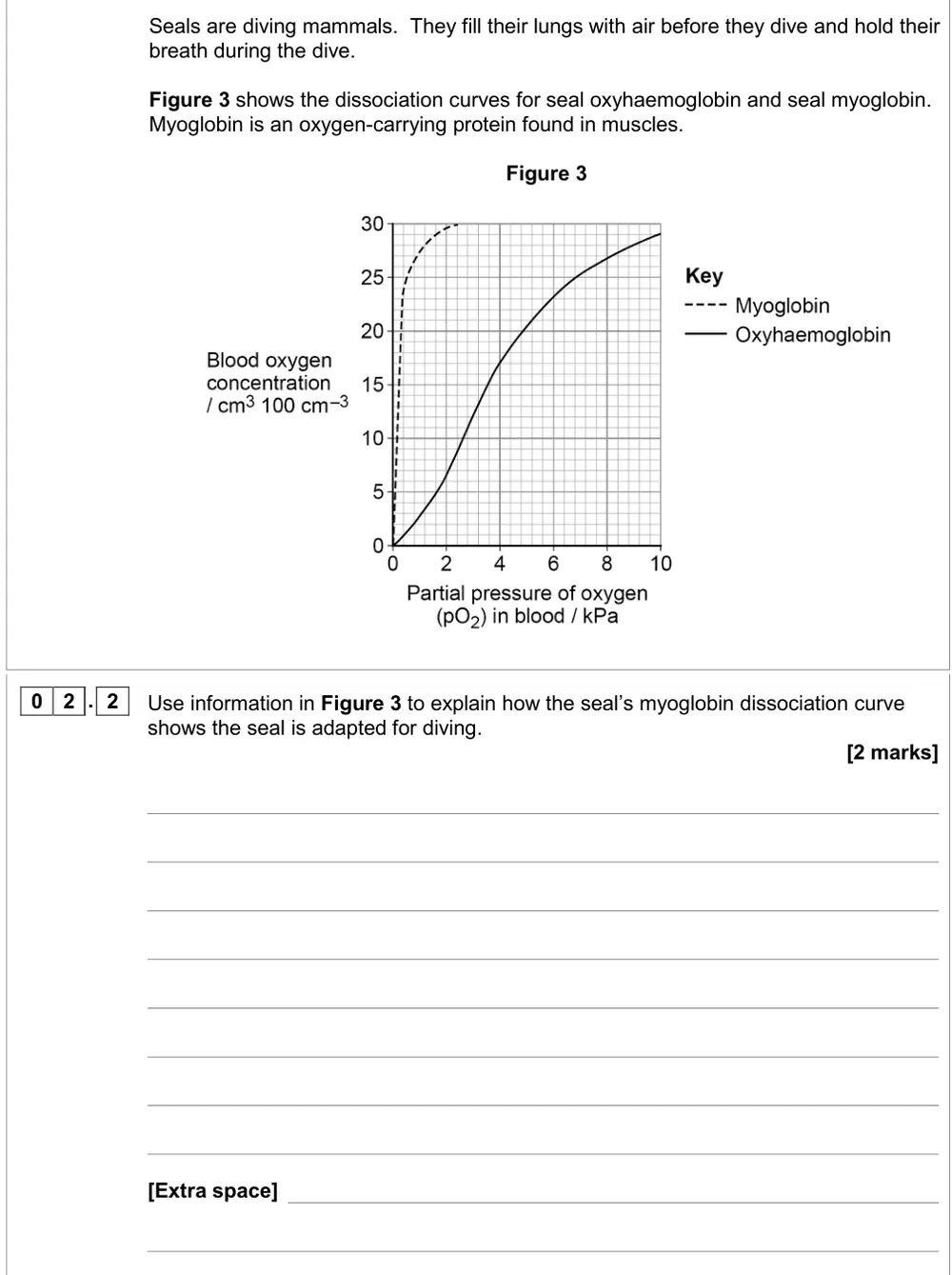
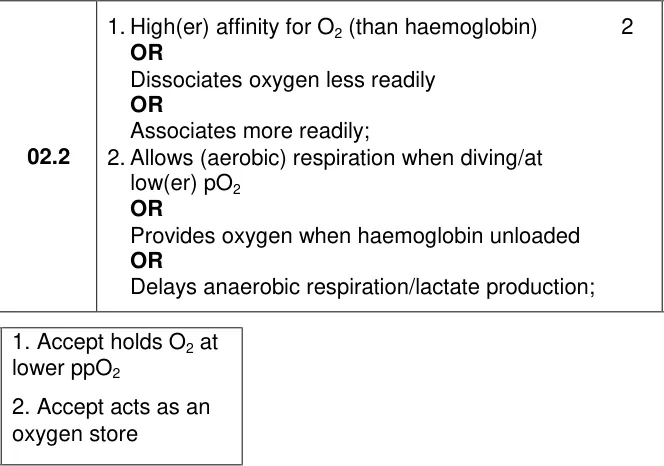
Use the seal myoglobin curve to explain how seals are adapted for diving.
Show the mark scheme
Tap an image to open it full size.
From the examiners' report: Most got the affinity mark. It's the myoglobin that has a high affinity, not the seal. Then explain the dive: an oxygen store for aerobic respiration when haemoglobin has unloaded.
Question 12
AS Paper 2 · June 2025 · Q01.4 · 2 marks · Medium
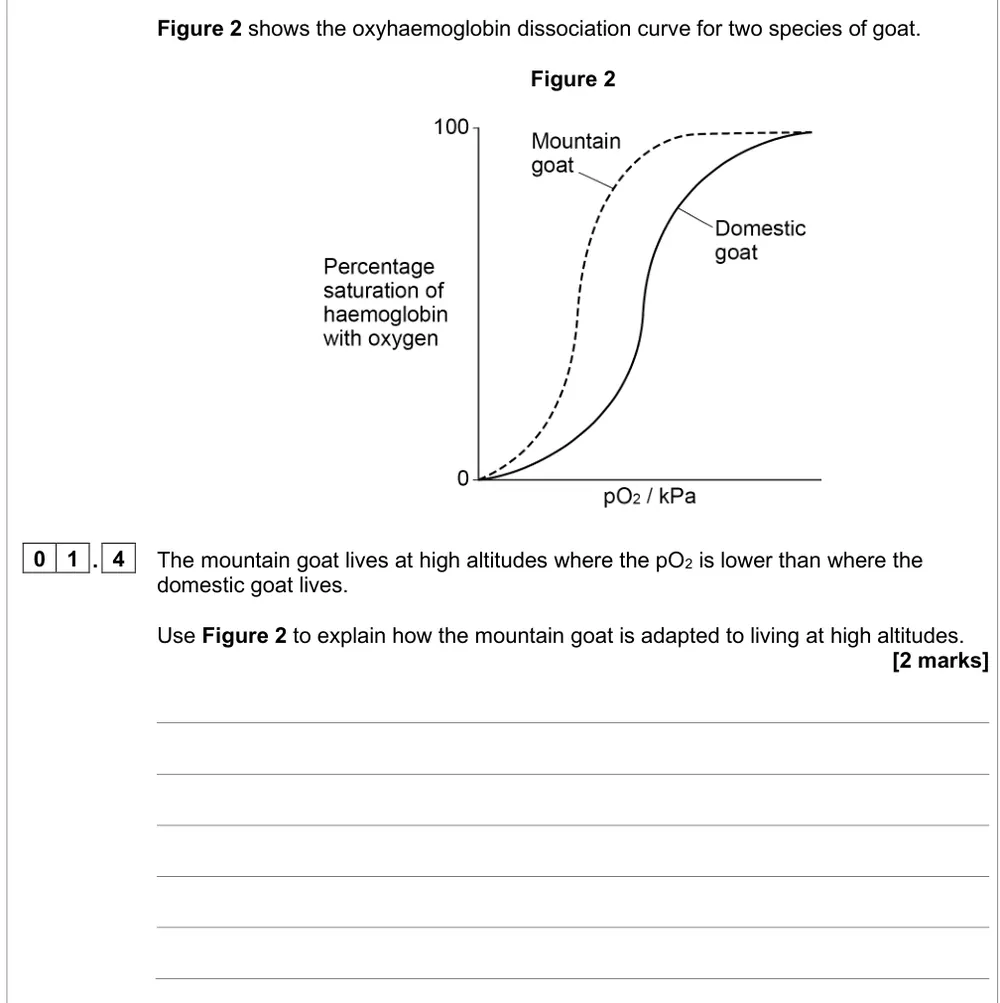
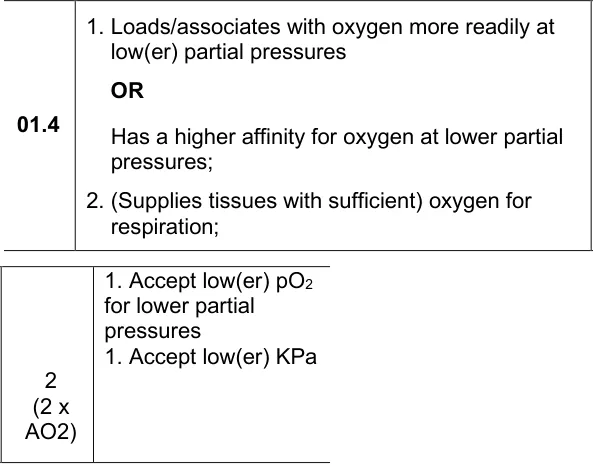
Use dissociation curves to explain how the mountain goat is adapted to high altitude.
Show the mark scheme
Tap an image to open it full size.
From the examiners' report: About 15% got both marks. Say higher affinity at low partial pressure, not 'loads faster'; there's no time on the graph. Then link it to respiration.
Question 13
A level Paper 1 · June 2019 · Q09.3 · 2 marks
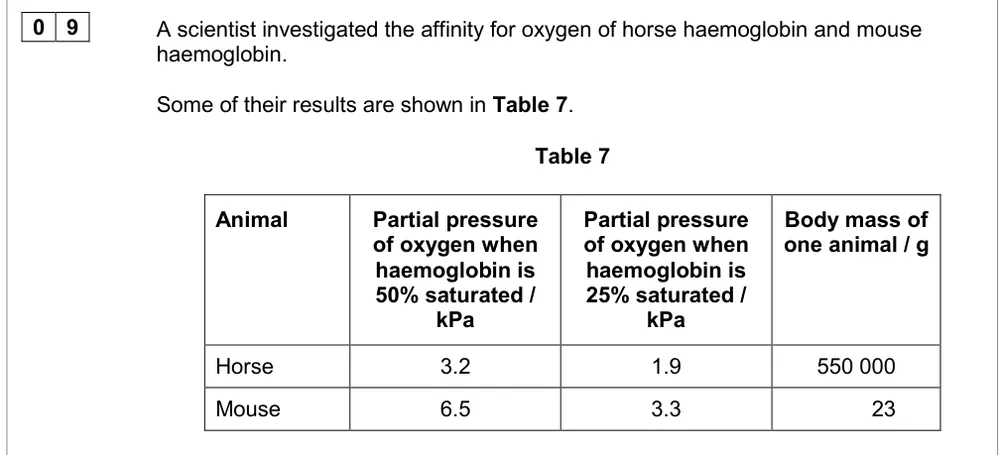
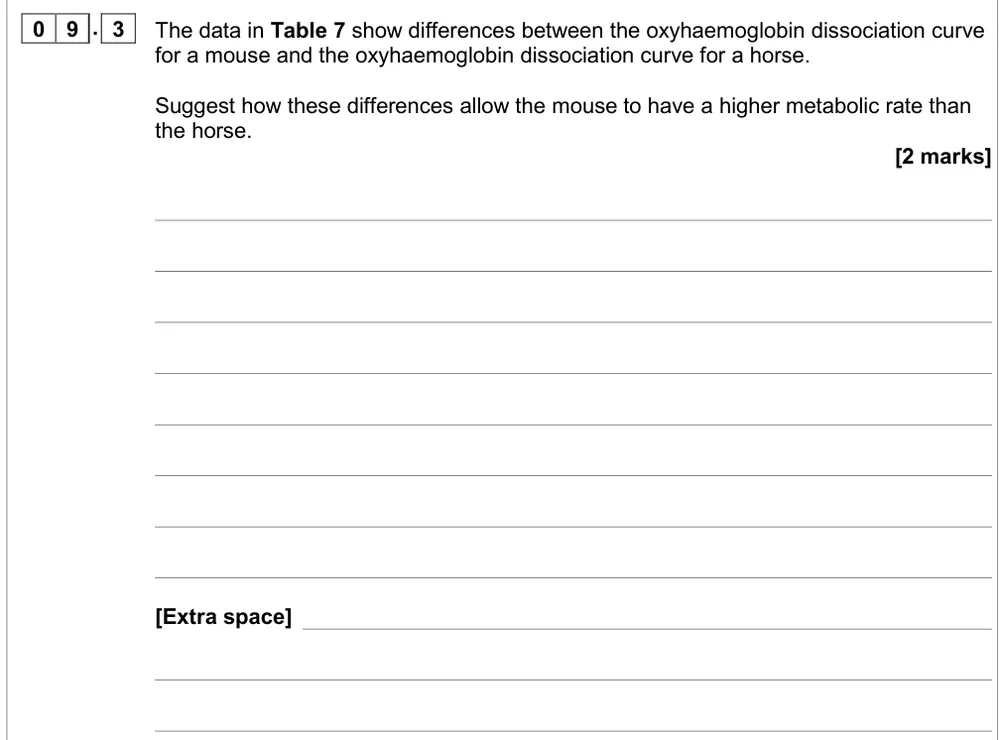
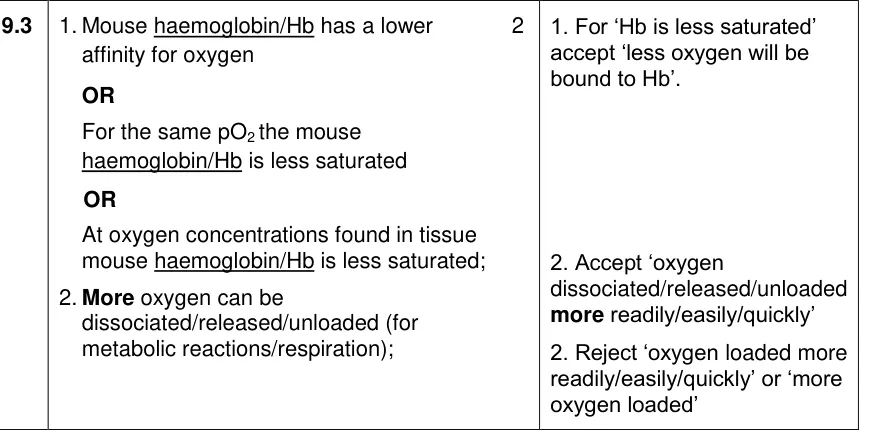
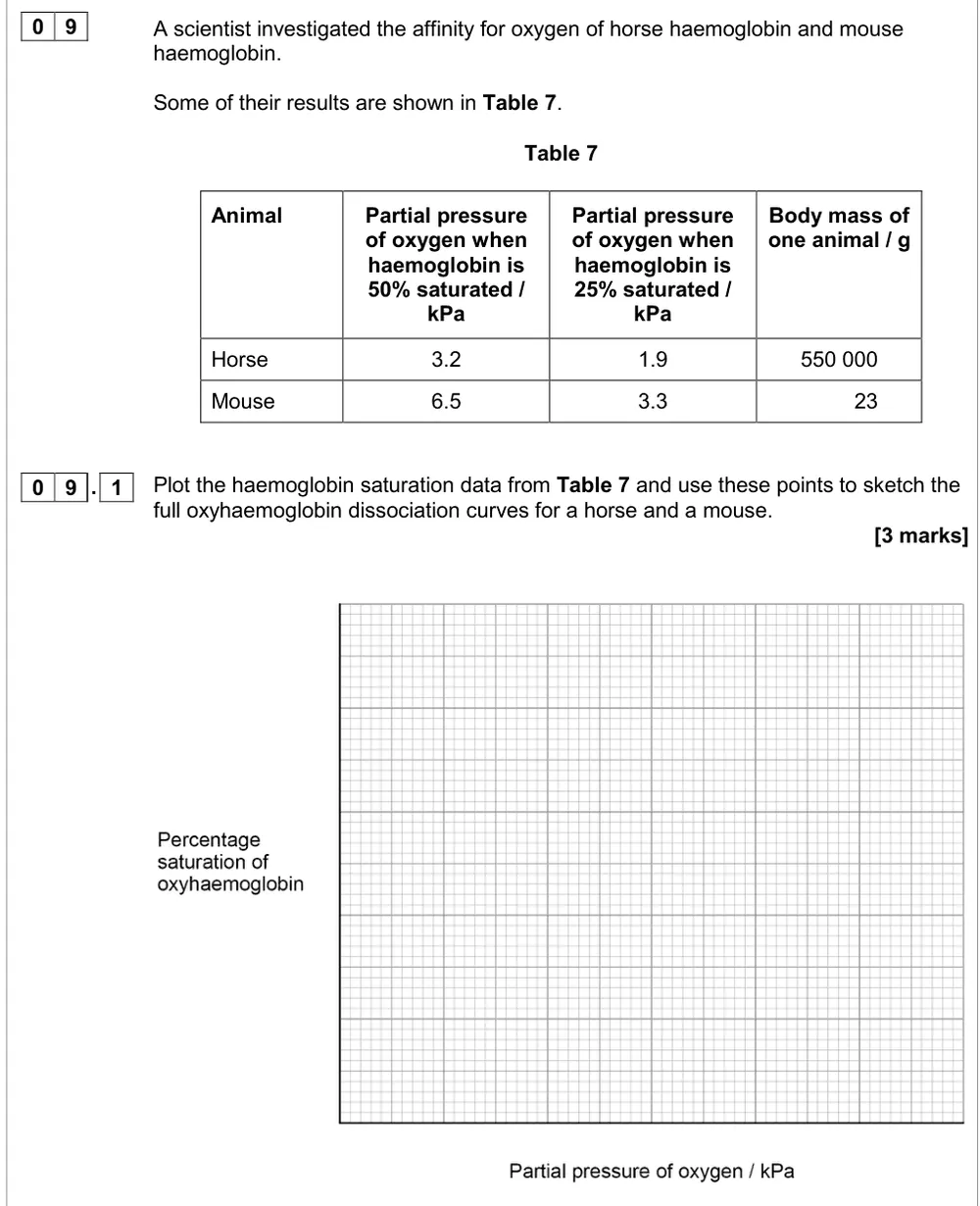
Use horse and mouse haemoglobin data to suggest how a mouse can have a higher metabolic rate.
Information from earlier in this question:
Show the mark scheme
Tap an image to open it full size.
From the examiners' report: No examiners' report for this paper. A higher pO2 for 50% saturation means a lower affinity, so oxygen unloads more readily; don't say it loads more readily.
Question 14
A level Paper 1 · June 2025 · Q06.1 · 2 marks · Hard
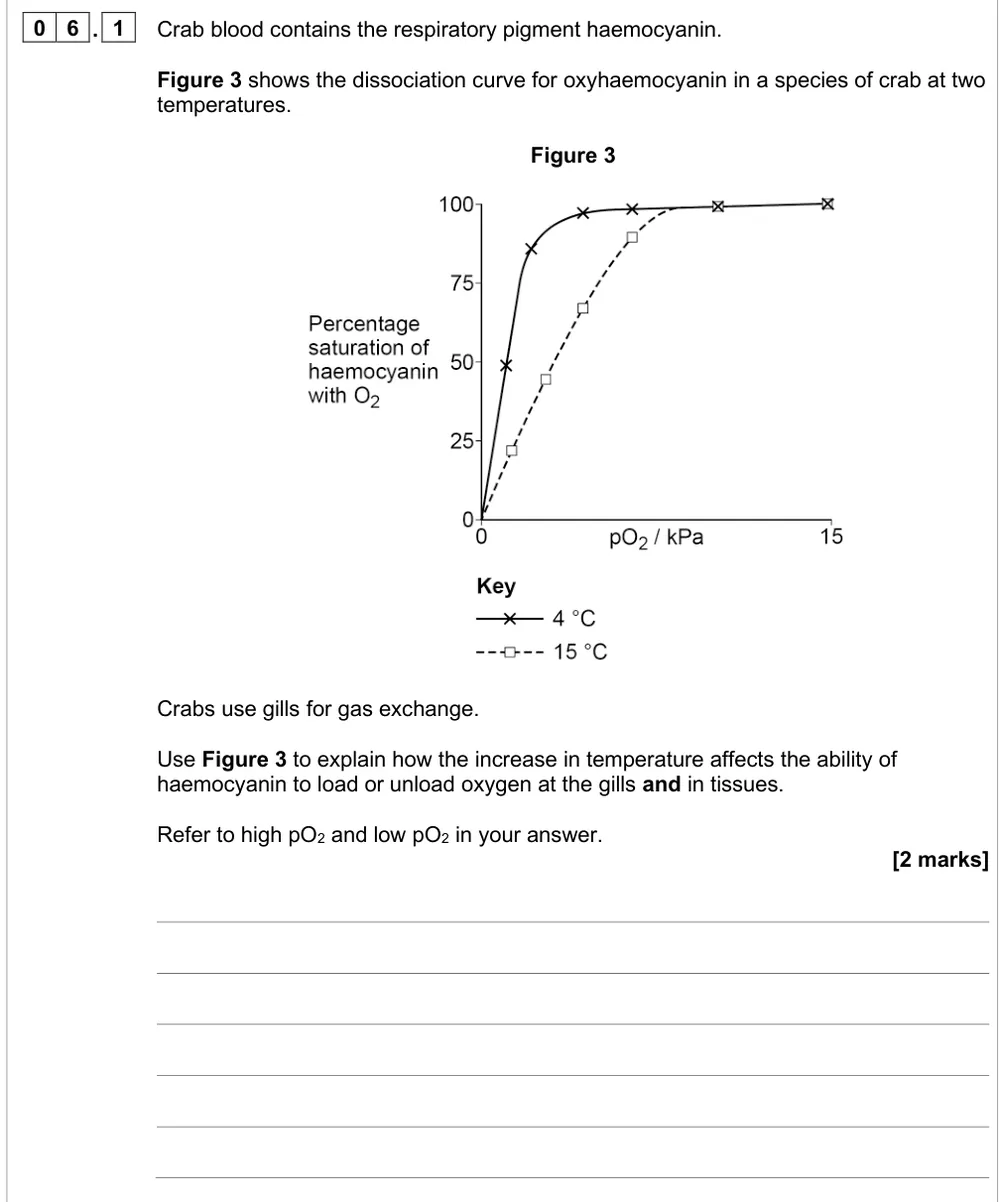
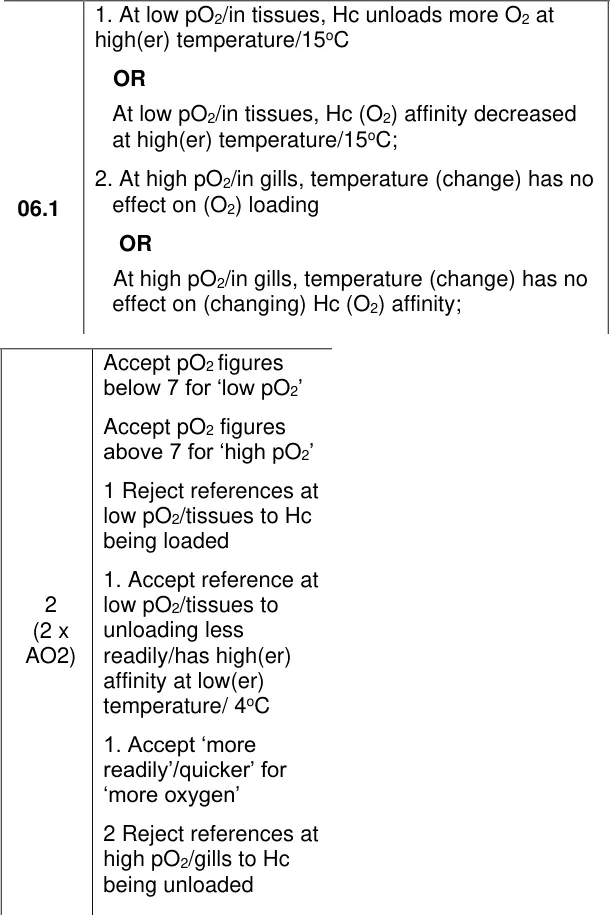
Use crab haemocyanin curves to explain how temperature affects loading at the gills and unloading in tissues.
Show the mark scheme
Tap an image to open it full size.
From the examiners' report: Less than 10% got both marks. The gills are at high pO2 (right of the graph), where the curves meet, so temperature makes no difference to loading. Don't say oxygen is loaded in the tissues.
Plotting dissociation curves (3.3.4.1)
Question 15
A level Paper 1 · June 2019 · Q09.1 · 3 marks
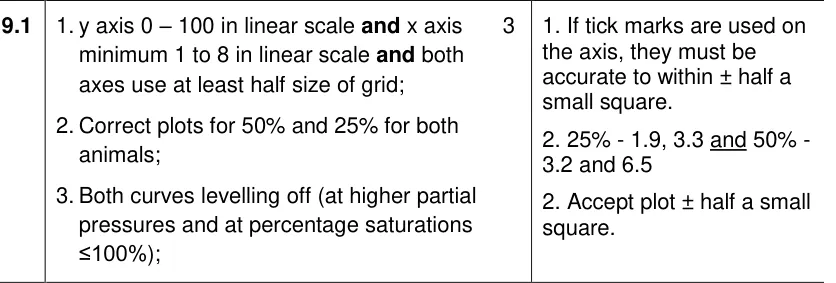
Plot the horse and mouse data and sketch both oxyhaemoglobin dissociation curves.
Show the mark scheme
Tap an image to open it full size.
From the examiners' report: No examiners' report for this paper. Plot on paper: the y-axis must run to 100%, and both S-shaped curves must level off at or below 100%.
Where students lose marks (from AQA examiners' reports and mark schemes)
Each point below is followed by wording that gained marks.
Explain the shape change, don't just name it: Only 11% got both marks for why a second oxygen binds more easily. 'Positive cooperativity' on its own didn't score, and 'changes shape so more oxygen binds' just repeated the question.
✔ Gains credit: "Binding of the first oxygen changes the tertiary / quaternary structure of haemoglobin, which uncovers another binding site / haem group."
Say where loading and unloading happen: On the 5-mark loading, transport and unloading question, the commonest omission was where each happens. Red blood cells were often not mentioned at all, so the transport mark was the lowest scoring.
✔ Gains credit: "Haemoglobin loads oxygen in the lungs at a high partial pressure of oxygen; oxygen is transported as oxyhaemoglobin in red blood cells; it unloads in respiring tissues at a low pO2."
Carbon dioxide lowers the pH; it doesn't bind: A common misconception had carbon dioxide binding to haemoglobin. Many linked the change in affinity to the rate of respiration rather than to pH, or didn't say which way the pH changed.
✔ Gains credit: "Increases oxygen dissociation / decreases haemoglobin's affinity for oxygen, by decreasing (blood) pH."
Add 'more' or 'easier': On BPG binding, many said haemoglobin 'can easily unload oxygen' without a comparative word, which it can do anyway. On the Bohr effect, many didn't say the oxygen is for aerobic respiration.
✔ Gains credit: "More oxygen for respiration"; "oxygen can unload / dissociate more readily for respiration"; "for aerobic respiration at the tissues".
Quote the saturation at that partial pressure: Less than 5% got both marks on the tubifex worm. Most just wrote 'high affinity at low partial pressure' and didn't link percentage saturation to the partial pressure of oxygen in the polluted water.
✔ Gains credit: "High / 50% saturation (with oxygen) below 0.2 kPa; (oxygen) for respiration."
Find the gills and the tissues on the x-axis: Less than 10% got both marks on crab haemocyanin. Many couldn't place the pO2 of the gills and tissues on the graph, and few saw that temperature made no difference to loading at the gills.
✔ Gains credit: "At low pO2 / in tissues, haemocyanin unloads more O2 at 15 °C; at high pO2 / in gills, temperature has no effect on loading."
Carbon monoxide means less unloading: 40% scored zero on the carbon monoxide curve. Answers that the COHb 'would load more readily at low pO2' were general recall, not the effect of carbon monoxide, and the Bohr effect wasn't relevant.
✔ Gains credit: "Maximum Hb saturation is 50%; (at low pO2) Hb has a higher affinity; Hb unloads less oxygen at low pO2."
There's no time axis on a dissociation curve: About 15% got both marks on the mountain goat. References to haemoglobin loading 'faster' gained no credit, and many didn't link the higher affinity to respiration.
✔ Gains credit: "Has a higher affinity for oxygen at lower partial pressures; (supplies tissues with sufficient) oxygen for respiration."
Download the questions
Download the PDF pack (15 questions, mark schemes at the end)
Keep practising
- Proteins: AQA A Level Biology exam questions by topic
- Gas exchange: AQA A Level Biology exam questions by topic
- The heart and circulation: AQA A Level Biology exam questions by topic
- Graph skills (MS 3): AQA A Level Biology exam questions
- AQA A Level Biology masterclasses
Questions, mark schemes and examiners' report extracts © AQA.