

Validity is the practical term OCR examiners most often say students don't understand. On the June 2019 H420/02 paper they wrote that "the lack of understanding of the word 'valid' was evident in the responses of most candidates".
This is the second of three articles on OCR practical language; the others cover repeatability and reproducibility and control variables vs control experiments. Each example shows the question, then its mark scheme, then what the examiners' report says students wrote.
What validity means
OCR definition (Practical Skills Handbook, Appendix 3): "Validity can apply to an individual measurement or a whole investigation. A measurement is valid if it measures what it is supposed to be measuring. An investigative procedure is valid if it is suitable to answer the question being asked." The handbook adds: "Validity will be reduced, for example, if no negative control is included in an investigation into the efficacy of a therapeutic drug."
In practice: a valid investigation tests only the effect of the independent variable. Validity comes from controlling other variables, including a control where one is needed, using a suitable method and sampling fairly. The examiners put it simply:
"Validity is all about controlling the variables around the collection of data so that the data are not affected by inconsistencies." (H020/01, June 2018)
"Candidates should be aware that validity for a method is referring to controlled variables." (H020/02, June 2024)
Validity is not the same as repeatability. Doing a badly designed experiment three times does not make it valid.
Validity in exam questions
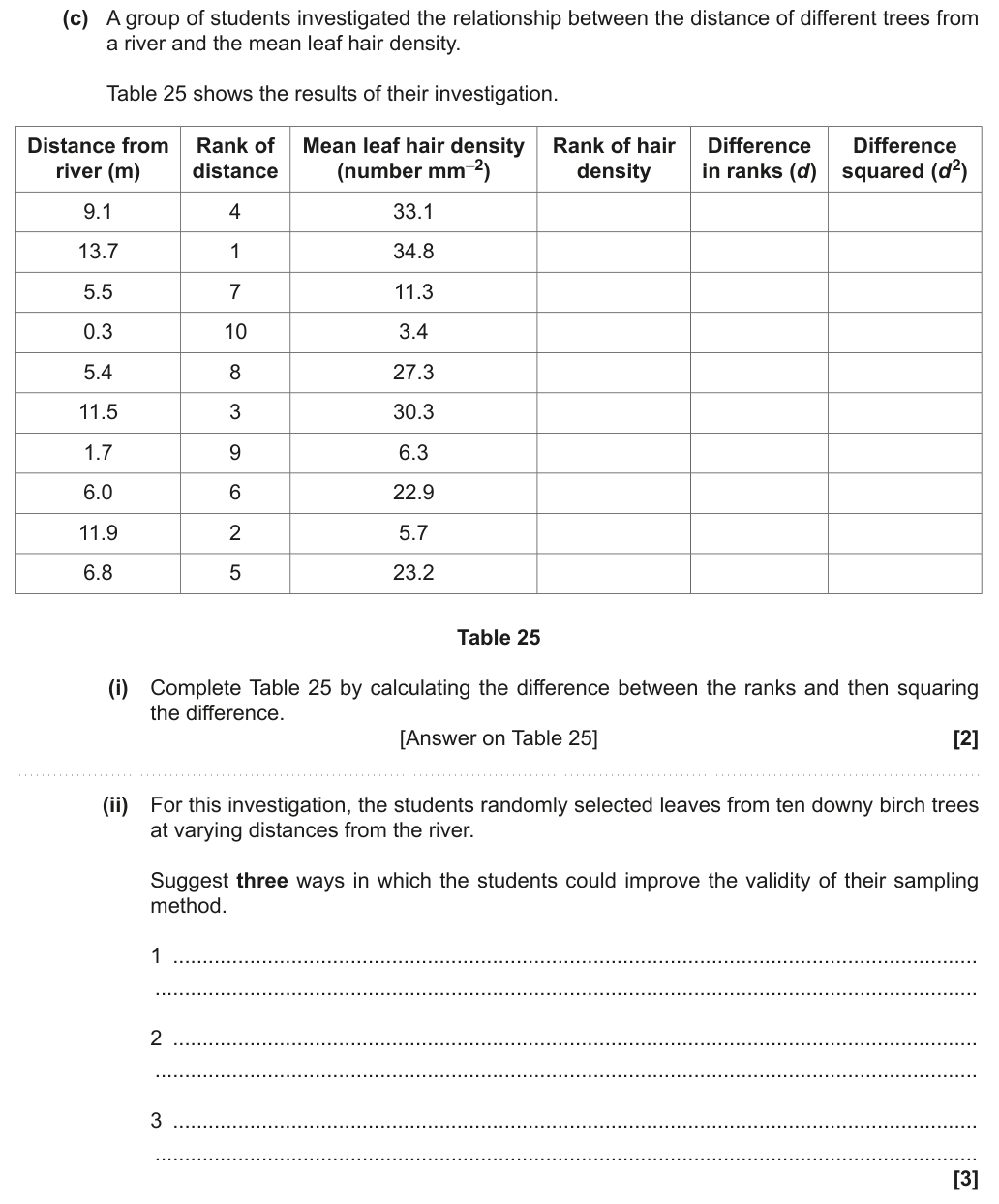
Example 1 – improving a sampling method (H020/01, June 2018, Q25(d)(ii))
Mark scheme

Examiners' report: "Validity is all about controlling the variables around the collection of data so that the data are not affected by inconsistencies. The technique is valid if it measures what it is supposed to measure. There was a wide range of responses. It was clear that many candidates did not really understand the meaning of the term 'validity'. Few candidates achieved full credit and many responses described ways to improve repeatability." The credited exemplar was praised because "each statement describes a way to remove a variable to ensure the data collected are comparable".
Why the mark scheme is right: the students want to know whether distance from the river affects leaf hair density. Anything else that could change hair density has to be kept the same, or the comparison isn't fair. That includes the age or size of the tree, the age or size of the leaf, where on the tree the leaf grows (sun or shade) and the time of year. Picking trees at "varying distances" also leaves gaps, so sampling at set distances along a transect makes sure the whole range is covered evenly. Every mark point either removes a variable or makes the sampling systematic – that is validity.
How to answer: for each suggestion, name one specific thing to keep the same, or one change to how trees are chosen. Don't suggest repeats on their own – that's repeatability.
Model answer:
Take leaves of the same age and size from each tree.
Take the leaves from the same height and the same side of each tree.
Choose trees at set distances along a transect from the river, instead of at random distances.
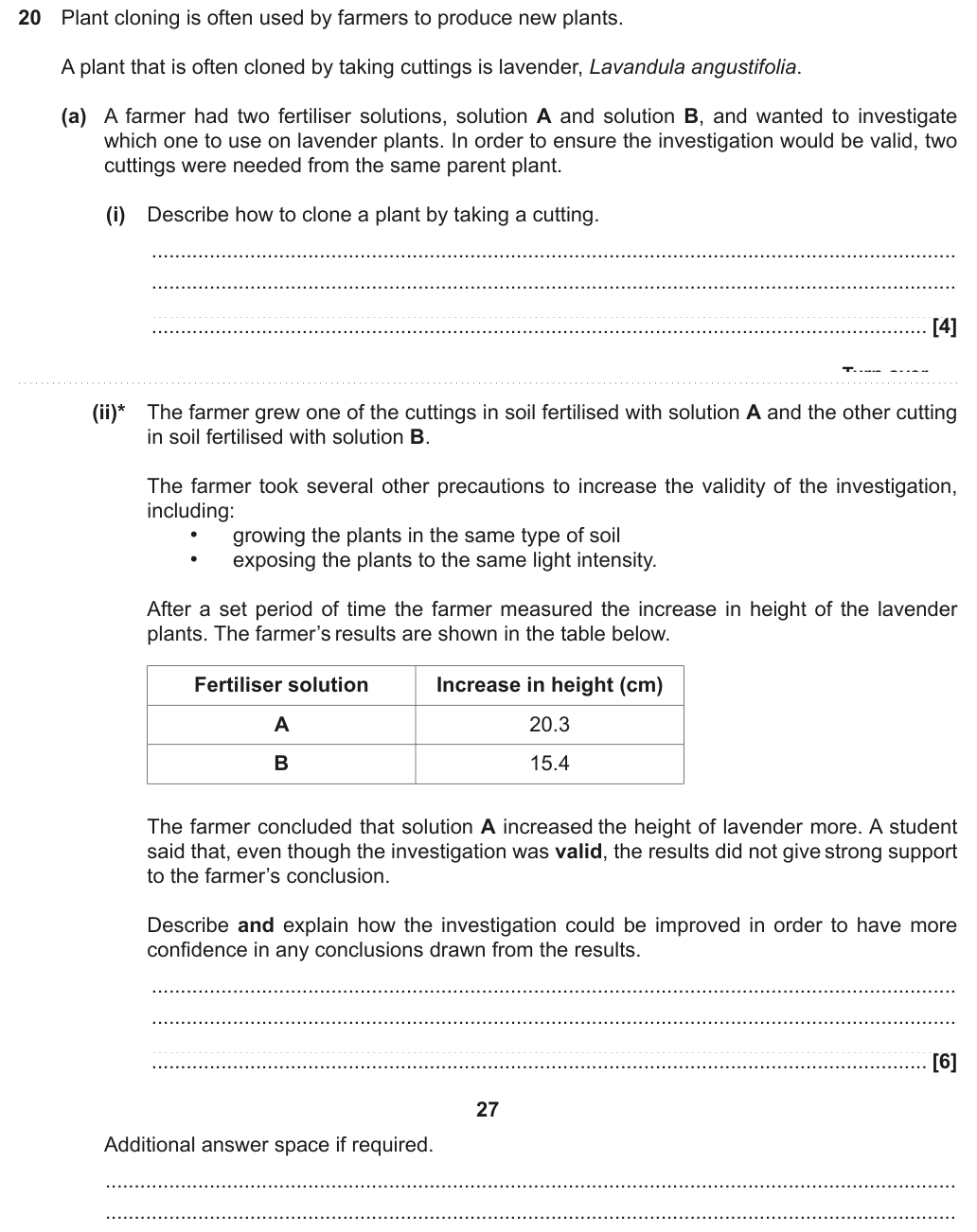
Example 2 – when the question says it is already valid (H420/02, June 2019, Q20(a)(ii))
Mark scheme
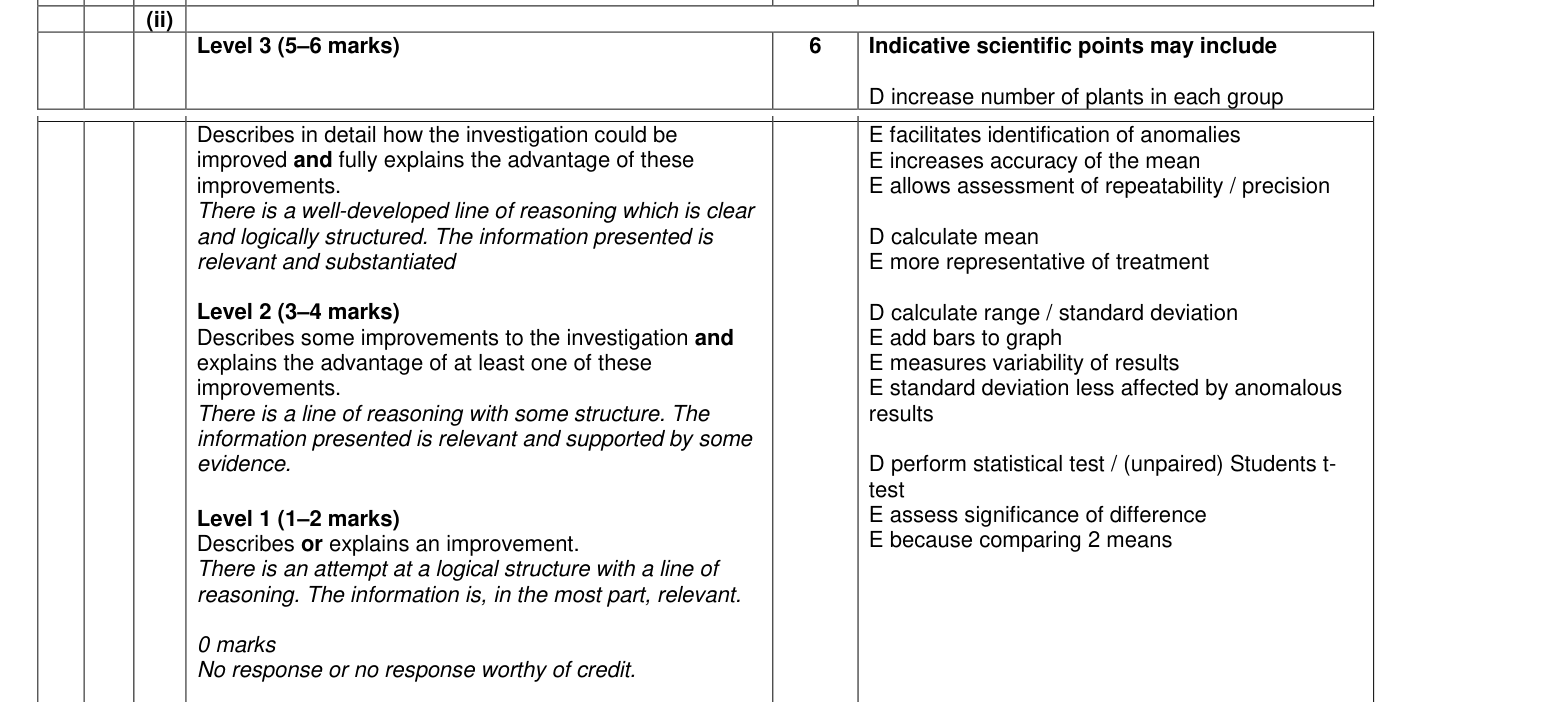
Examiners' report: "Most candidates were aware of the importance of replicates but few appreciated that, with an investigation such as this, replication can be achieved by increasing the number of individuals in each group. Few responses communicated this idea clearly, most simply stated 'do it 3 times'… The question stated, in bold, that the investigation had been valid. This was meant to indicate to candidates that discussing improvements to validity would not be credited in this question. However, most candidates either did not appreciate the significance of this statement in the question or did not understand what 'valid' meant. Most responses were filled with discussion of how variables could be controlled."
Why the mark scheme is right: the question tells you the design is already valid, so the weakness must be something else. The problem is that there is only one plant in each group. A difference of 4.9 cm between two single plants could just be natural variation between individuals. To have confidence in the conclusion you need more individuals in each group, a mean for each group, a measure of spread, and a statistical test to see if the difference between the two means is significant. Each improvement needs its explanation to reach Level 3.
How to answer: read the bold words in the stem – they tell you what not to write about. Then follow the chain: more plants → mean → standard deviation → t-test, explaining each step.
Model answer:
Grow more plants in each group, for example ten cuttings with solution A and ten with solution B, because one plant per group may not be representative. Calculate the mean increase in height for each group, which is less affected by any one unusual plant, and identify any anomalies. Calculate the standard deviation for each group to show how variable the results are, and plot error bars. Finally, use an unpaired Student's t-test to find out whether the difference between the two means is significant, since two means are being compared.
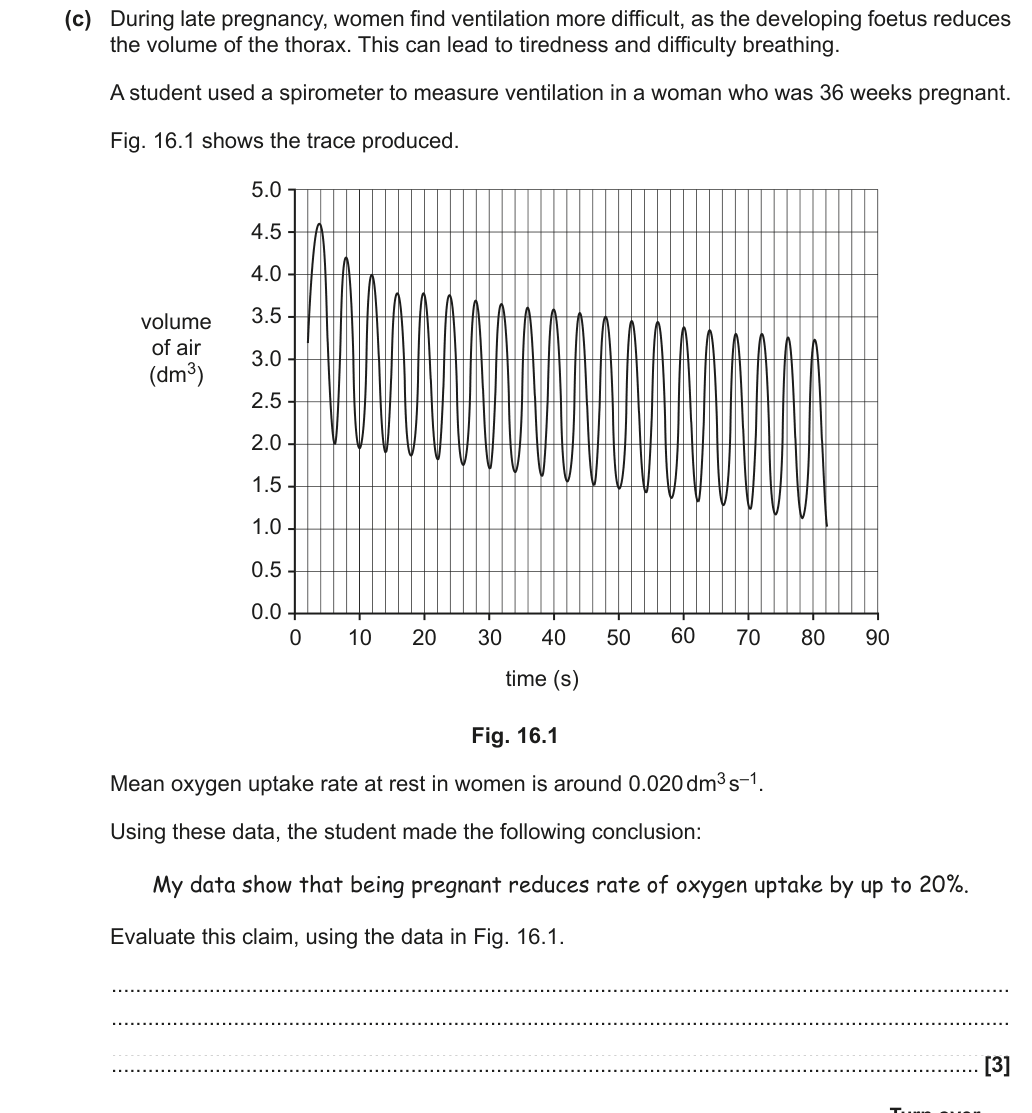
Example 3 – evaluating a claim (H420/01, June 2018, Q16(c))
Mark scheme
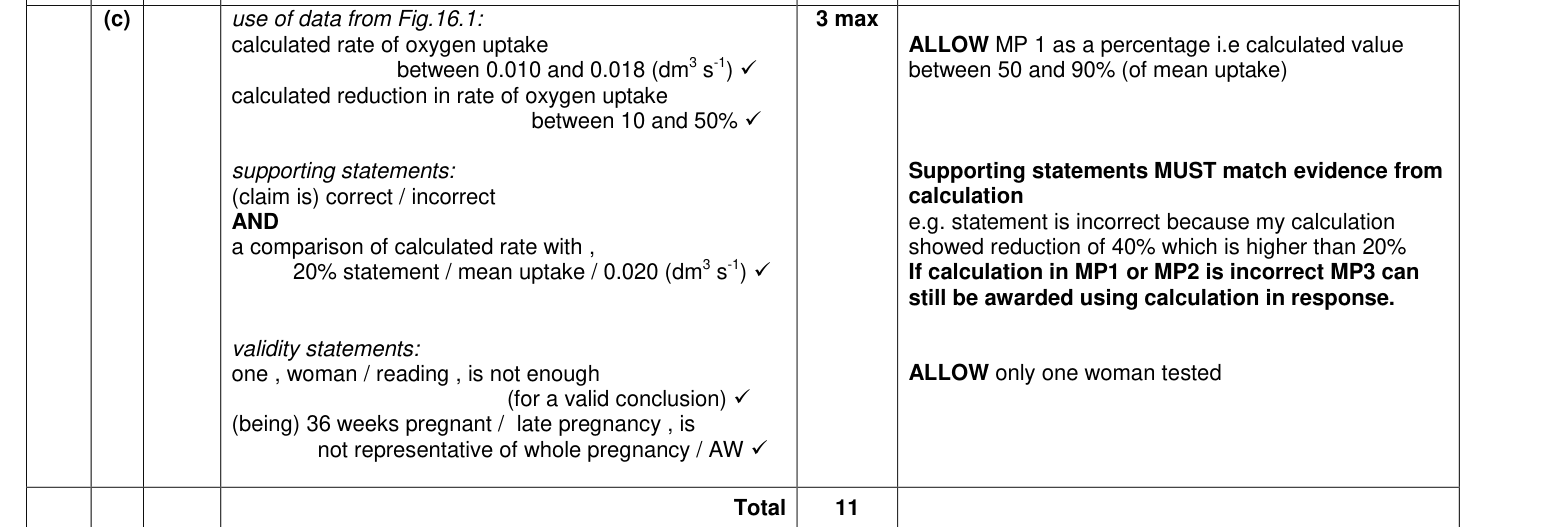
Examiners' report: "Good responses to this question assessing AO3, used the information in Fig. 16.1 to calculate oxygen uptake… Relatively few candidates commented on other aspects about the validity of the claim such as the use of only one woman 36 weeks into her pregnancy."
Why the mark scheme is right: "evaluate" means weighing the claim against the evidence. Part of that is the numbers: work out the woman's oxygen uptake rate from the trace and compare it with 0.020 dm³ s⁻¹. The other part is the method: data from one woman at one stage of pregnancy can't support a claim about "being pregnant" in general. That is a validity point, and few candidates made it.
How to answer: calculate, compare with the claim, then criticise the method.
Read the fall in the trace over a set time to get the rate of oxygen uptake in dm³ s⁻¹.
Work out the percentage reduction compared with 0.020 dm³ s⁻¹, and say whether it supports "up to 20%".
Add the validity points: only one woman was tested, and 36 weeks is late pregnancy, so it isn't representative of the whole pregnancy.
Example 4 – kick sampling in a river (H020/02, June 2024, Q1(b))
Mark scheme

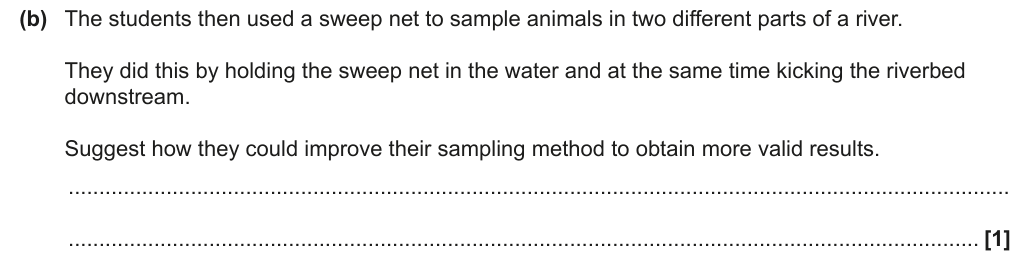
Examiners' report: "Many answers referenced 'reliability' of the data collected with suggestions of repeating the method. Candidates often suggested a different method or a different location which does not pay attention to the request for an improvement to the method. Candidates should be aware that validity for a method is referring to controlled variables."
Why the mark scheme is right: the students are comparing two parts of a river, so the sampling effort must be the same in both, or the number of animals caught depends on how hard they kicked rather than on the river. Every mark point standardises the method: the same number of kicks or time, the same kicking technique or net depth, and the net placed downstream so dislodged animals flow into it. Repeating the sample doesn't fix an unequal method, and choosing a different method or location ignores the question.
How to answer: the question asks you to improve this method. Name one thing to keep the same in both parts of the river.
Model answer:
Kick the riverbed for the same length of time, for example 30 seconds, in each part of the river.
Example 5 – outlining a valid method (H420/02, June 2023, Q18(c)(ii))
Mark scheme
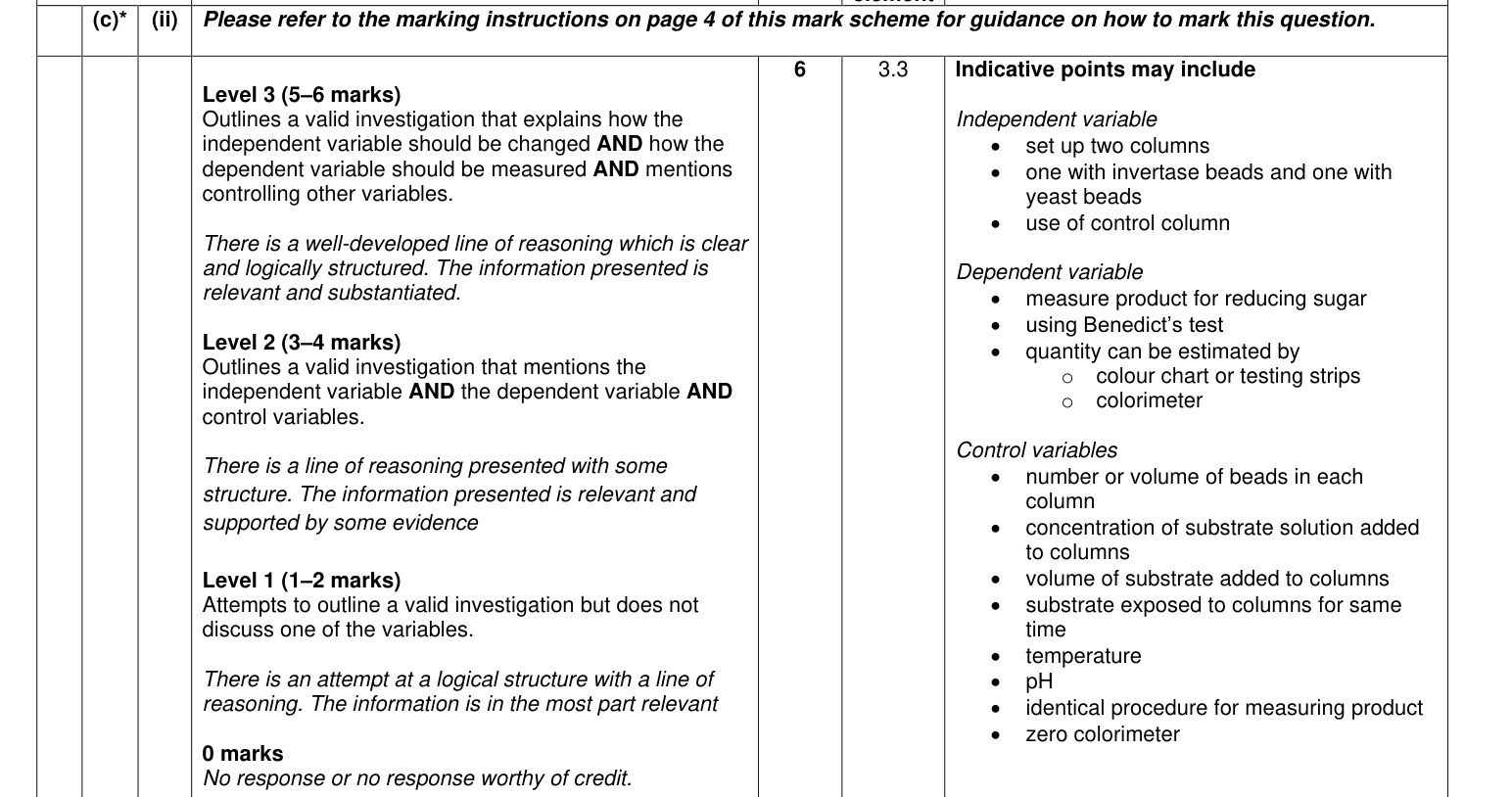
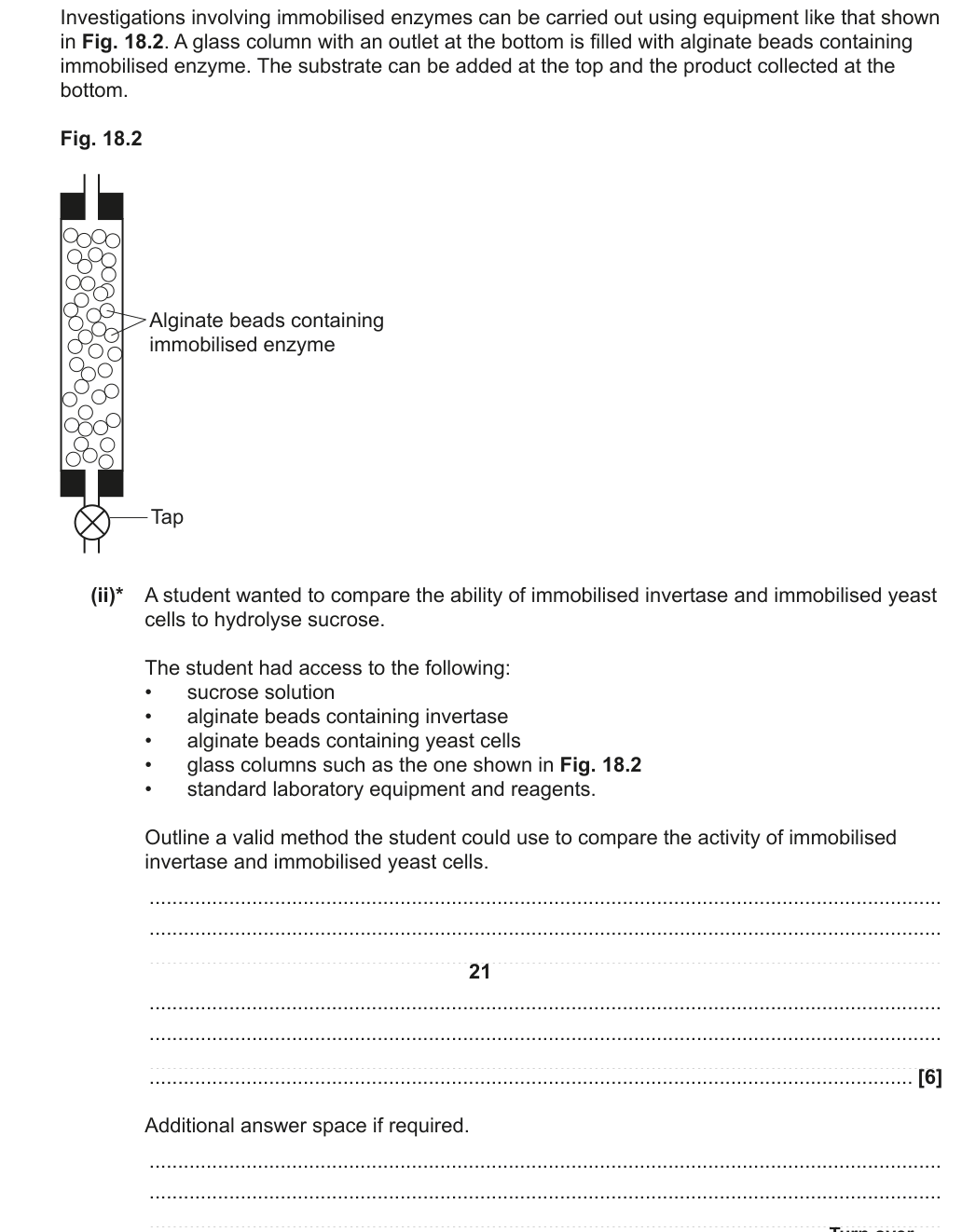
Examiners' report: "The command word was 'outline' so a good answer needed only the main steps of a method that was valid… To access Level 3, a candidate needed to outline how they would change this independent variable, measure the dependent variable and keep control variables constant… Common errors included controlling the enzyme concentration (as this was the independent variable) or using the ambiguous term 'amount' (as opposed to 'concentration' or 'volume')… Some candidates added extra detail about, for example, statistical tests, which was not required under the directed focus of validity."
Why the mark scheme is right: a valid method needs three things, which are exactly the three Level 3 requirements. First, the independent variable – here the type of immobilised catalyst – changed by setting up one column of invertase beads and one of yeast beads. Second, the dependent variable measured properly: invertase hydrolyses sucrose (a non-reducing sugar) into glucose and fructose (reducing sugars), so Benedict's test with a colorimeter measures how much product forms. Third, the other variables controlled. "Outline" means main steps only, so statistics and colorimeter filter colours aren't needed.
How to answer: use the independent → dependent → control variables structure, with one or two lines each.
Model answer:
Set up two columns, one with invertase beads and one with the same volume of yeast-cell beads. Add the same volume of the same concentration of sucrose solution to the top of each column and let it pass through for the same time. Collect the product from each column and test it with Benedict's reagent, using a colorimeter to measure the absorbance, and compare it with a calibration curve to find the concentration of reducing sugar. Keep temperature and pH the same for both columns. A third column with beads containing no enzyme could be used as a control.
Common errors
Describing repeats when the question asks about validity.
Writing "to make it valid" as an explanation, without saying which variable or bias is removed.
Suggesting a control variable the question already says is controlled.
Discussing validity when the question says the investigation is already valid.
Suggesting a different method or location when asked to improve this method.
Writing "reliable" instead of naming what is being improved.
Checklist
Validity question → name the variable to control, the bias to remove or the control to add.
Say how each variable would be kept the same (same number of kicks, leaves from the same side of each tree).
Check the question for variables that are already controlled – don't repeat them.
If the question says the investigation is valid, improve confidence instead: more individuals per group, a mean, standard deviation, a statistical test.
Never write "reliable".
Sources
OCR Biology A Practical Skills Handbook, v2.1 – Appendix 3, Measurements: useful terms
Question, mark scheme and examiners' report extracts © OCR, from the OCR Question Bank app: H020/01 June 2018 Q25(d)(ii); H420/02 June 2019 Q20(a)(ii); H420/01 June 2018 Q16(c); H020/02 June 2024 Q1(b); H420/02 June 2023 Q18(c)(ii)
OCR examiners' reports: H020/01 June 2018 · H420/02 June 2019 · H020/02 June 2024 · H420/02 June 2023