

Transport in plants is one of the longest topics in the Year 12 OCR A course, and it turns up on every paper. Spec point 3.1.3 asks you to explain why large plants need a transport system, to know the structure of xylem and phloem in roots, stems and leaves, and to follow water from the soil, through the plant and out of the stomata. You also need the adaptations of xerophytes and hydrophytes, the mechanism of translocation, and practical work with stained sections, dissected stems and the potometer.
Most lost marks here come from loose wording. The examiners' reports keep pointing to the same slips: naming a cell when the question asks for a tissue (or the other way round), writing "water is lost" instead of water vapour, saying "waxy cuticle" without "thick", and calling sucrose loading "active transport of sucrose" instead of explaining the proton pump and cotransporter.
Work through the eighteen questions below in order. They start with recall of the vascular tissues, move on to water movement, transpiration and translocation, and finish with practical and potometer questions. If you'd like to go through questions like these with me each week, my OCR A masterclasses run on Wednesdays at 5.15pm for Year 12 and on Tuesdays at 6.30pm or Thursdays at 5.15pm for Year 13.
What you need from GCSE
Each question on this page assumes you're secure on these GCSE ideas. If any of them feels shaky, look it up before you start.
- Xylem carries water and mineral ions from the roots to the leaves; phloem carries dissolved sugars made in photosynthesis around the plant.
- Water enters root hair cells by osmosis and leaves the plant as water vapour through the stomata. This loss is called transpiration.
- Transpiration is faster when it is warmer, brighter, windier or less humid.
- Guard cells open and close the stomata, which also let carbon dioxide in for photosynthesis.
- Large organisms have a smaller surface area to volume ratio than small ones, so diffusion alone can't supply all their cells.
Key terms
These words come up in the questions and mark schemes. Examiners expect you to use them exactly.
- Xylem vessel: a dead, hollow cell with lignified walls and no end walls, joined end to end to carry water and mineral ions; pits let water move sideways.
- Sieve tube element: a living phloem cell with no nucleus, joined end to end through sieve plates with sieve pores; it carries assimilates such as sucrose.
- Companion cell: the cell next to a sieve tube element, linked to it by plasmodesmata, with many mitochondria to supply ATP for loading sucrose.
- Apoplast and symplast pathways: water moving through cell walls and the spaces between them (apoplast), or through the cytoplasm and plasmodesmata (symplast).
- Casparian strip: a waterproof band in the walls of endodermis cells that blocks the apoplast pathway and forces water into the symplast.
- Transpiration: the loss of water vapour from the leaves, mainly through the stomata; a consequence of gas exchange.
- Transpiration stream: the movement of water from the roots, up the xylem, to the leaves.
- Cohesion and adhesion: hydrogen bonds holding water molecules to each other (cohesion) and to the xylem walls (adhesion).
- Xerophyte: a plant adapted to dry conditions, such as a cactus or marram grass.
- Translocation: the energy-requiring movement of assimilates in the phloem from a source to a sink by mass flow.
What these questions cover (OCR 3.1.3)
The questions test these learning outcomes from the OCR A Level Biology A specification (H420):
- (a) the need for transport systems in multicellular plants (size, metabolic rate and SA:V)
- (b)(i) the structure and function of the vascular system in the roots, stems and leaves of herbaceous dicotyledonous plants (xylem vessels, sieve tube elements and companion cells)
- (b)(ii) the examination and drawing of stained sections of plant tissue to show the distribution of xylem and phloem (PAG1)
- (b)(iii) the dissection of stems, both longitudinally and transversely, and their examination to demonstrate the position and structure of xylem vessels (PAG2)
- (c)(i) the process of transpiration and the environmental factors that affect transpiration rate
- (c)(ii) practical investigations to estimate transpiration rates (the potometer (PAG5))
- (d) the transport of water into the plant, through the plant and to the air surrounding the leaves (apoplast and symplast pathways, cohesion, adhesion)
- (e) adaptations of plants to the availability of water in their environment (xerophytes and hydrophytes)
- (f) the mechanism of translocation (active loading at the source, removal at the sink)
How to use this page
Write your answer on paper before you open the mark scheme. Allow about 1.2 minutes per mark: the 18 questions are worth 40 marks, so about 48 minutes in total. Then mark your answer strictly against the mark scheme and read the examiners' tip underneath it. If you'd rather print the questions, download the PDF pack.
Vascular tissues
Question 1
A level Paper 1 · June 2022 · Q16(a) · 3 marks · Easy
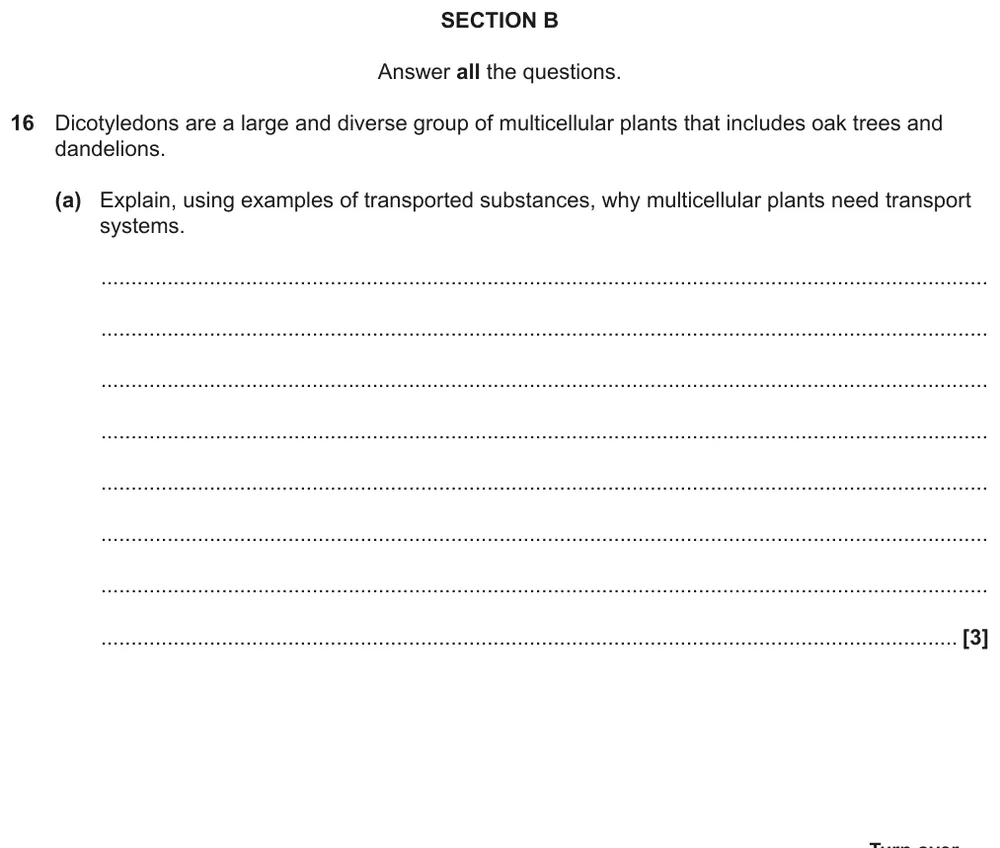
Explain, with examples of transported substances, why multicellular plants need transport systems.
Show the mark scheme
Tap an image to open it full size.
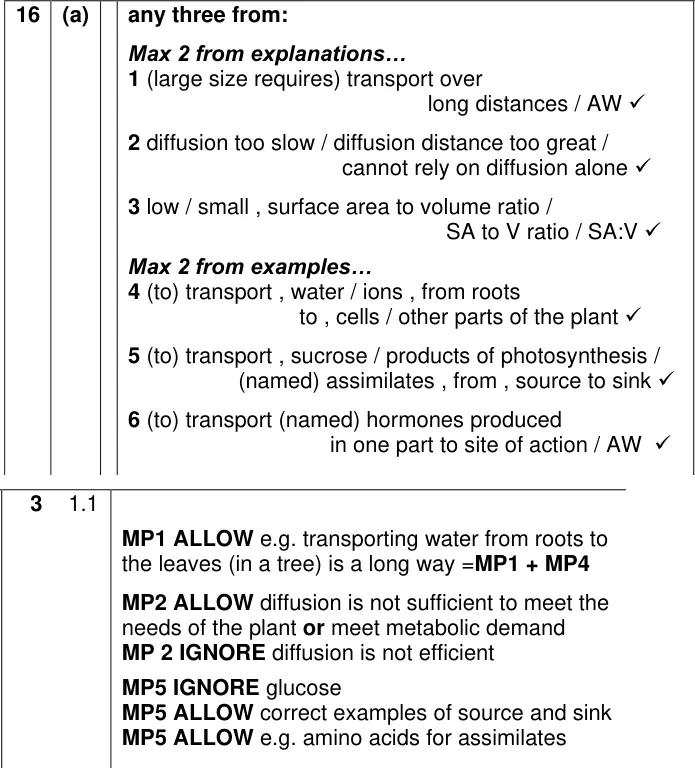
From the examiners' report: Give each example in full: what is carried, and from where to where, such as water from the roots to the leaves. Sucrose, not glucose, travels in the phloem, and a whole large plant has a small SA:V.
Question 2
A level Paper 3 · June 2018 · Q1(b) · 2 marks · Easy
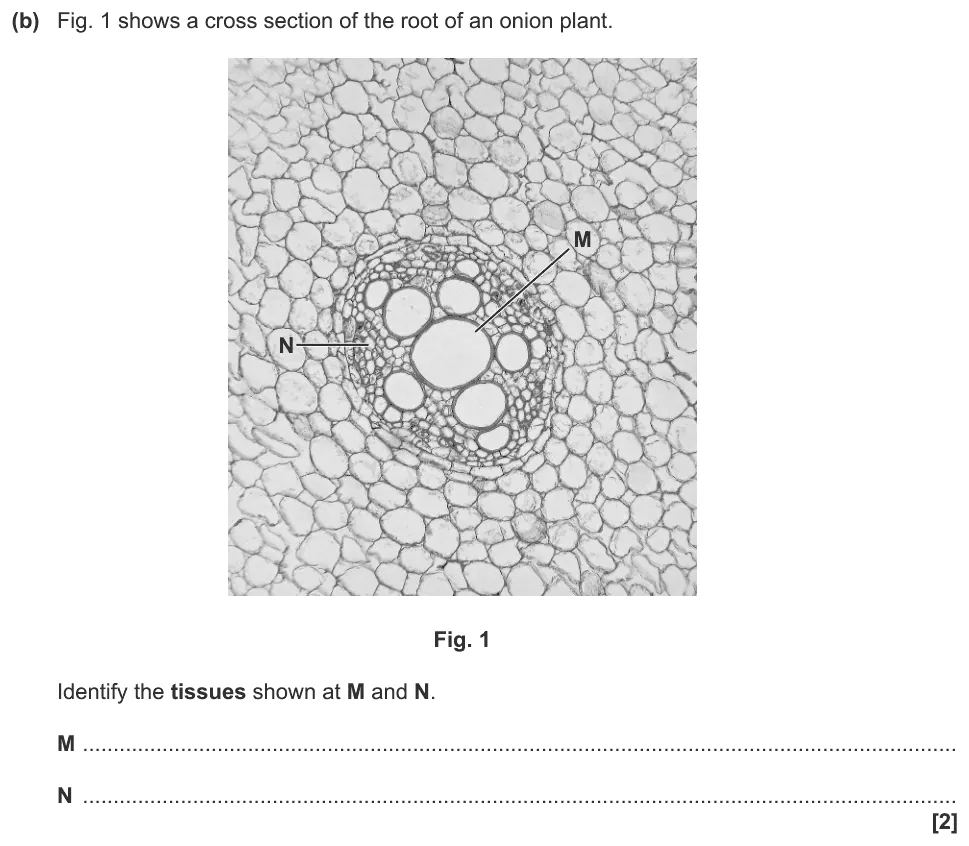
Identify the tissues at M and N in a cross section of an onion root.
Show the mark scheme

Tap an image to open it full size.
From the examiners' report: The question asks for tissues, so write xylem and phloem. Vessels, elements and sieve tubes are cells and didn't score.
Question 3
A level Paper 3 · June 2025 · Q1(a) · 2 marks · Medium
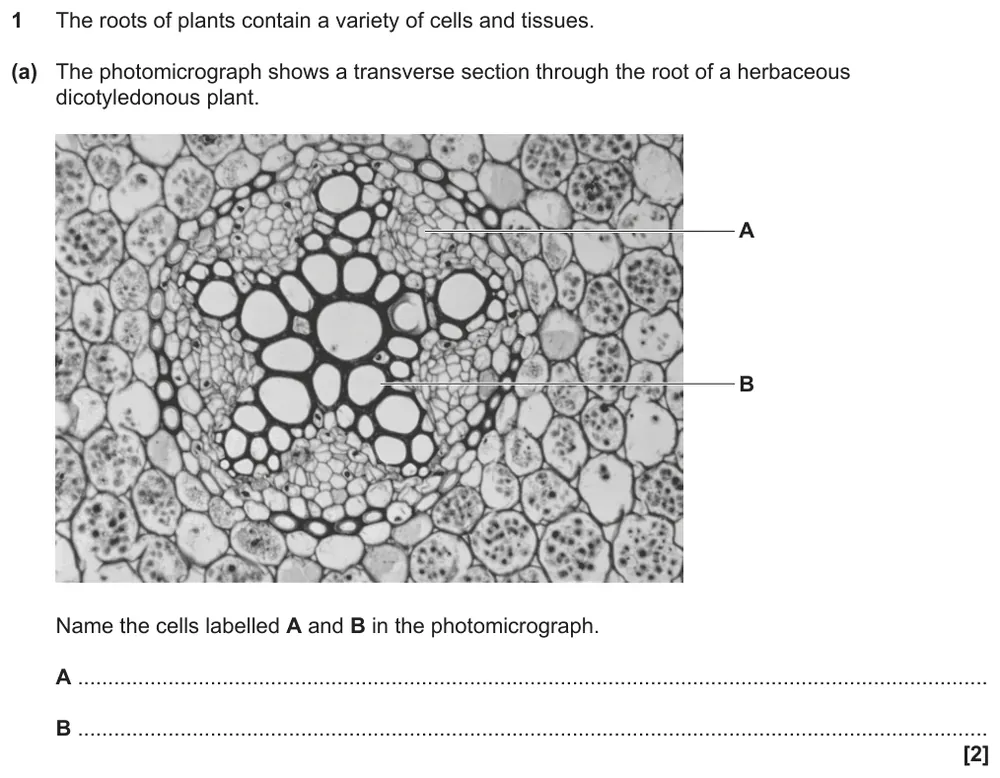
Name the cells labelled A and B in a root section.
Show the mark scheme

Tap an image to open it full size.
From the examiners' report: This time the question asks for cells, so 'phloem' wasn't enough: A is a sieve tube element and B is a xylem vessel. Always check whether you're asked for a cell or a tissue.
Question 4
A level Paper 1 · June 2022 · Q16(b)(ii) · 2 marks · Medium
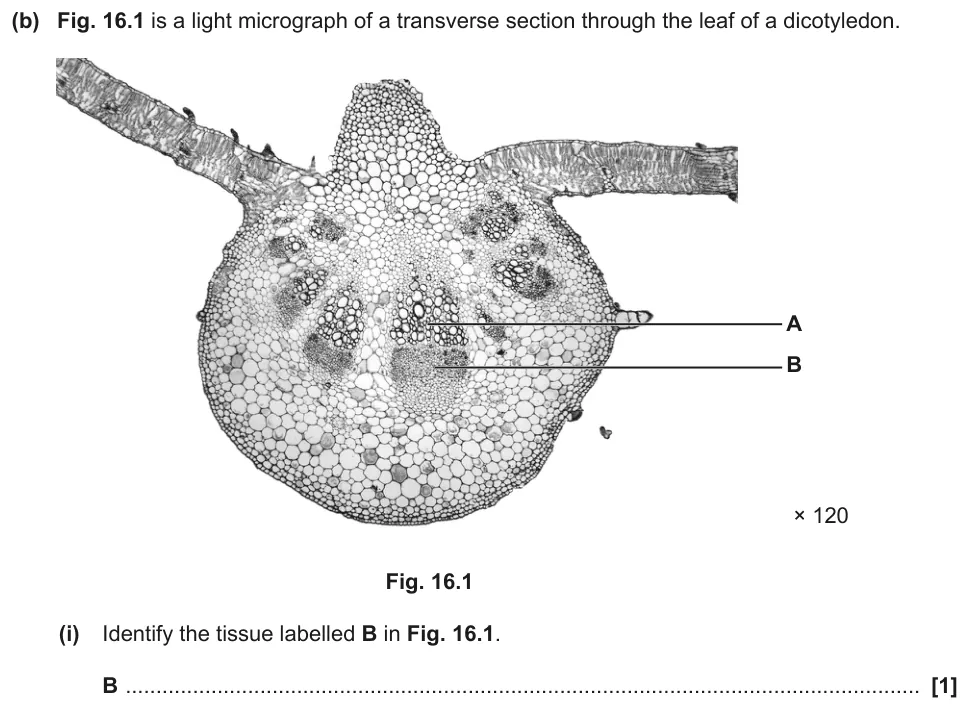
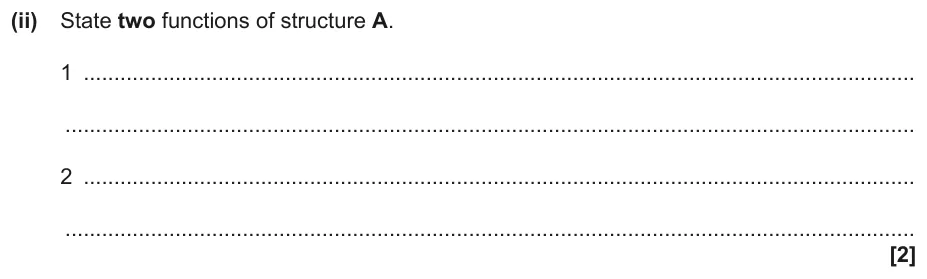
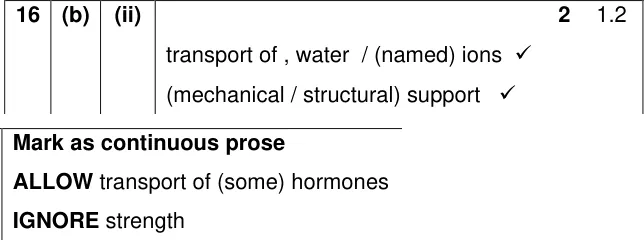
State two functions of the xylem (structure A) in a leaf section.
Information from earlier in this question:
Show the mark scheme
Tap an image to open it full size.
From the examiners' report: Give two different functions: transport and support. Transport of water and transport of ions count as one function.
Question 5
AS Paper 1 · June 2019 · Q24(c)(i) · 3 marks · Medium
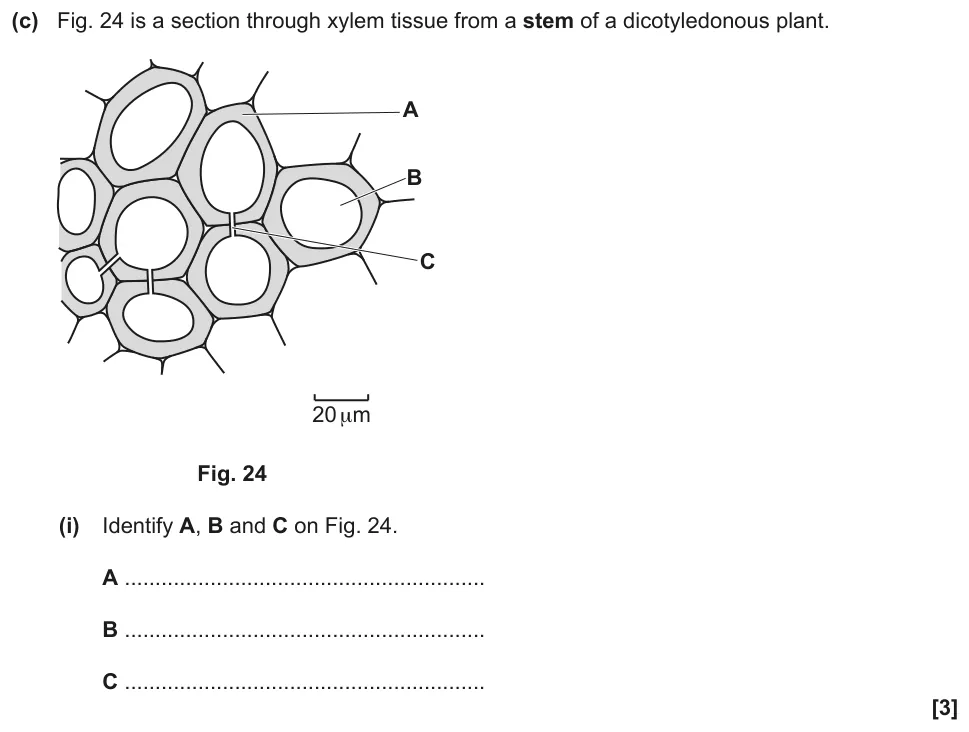
Identify the vessel wall, lumen and pit on a section through xylem.
Show the mark scheme

Tap an image to open it full size.
From the examiners' report: Use the xylem words: vessel wall (not cell wall), lumen (not hollow tube) and pit. Plasmodesmata link living cells, so they aren't found in xylem vessels.
Question 6
AS Paper 1 · June 2019 · Q24(c)(ii) · 1 mark · Medium
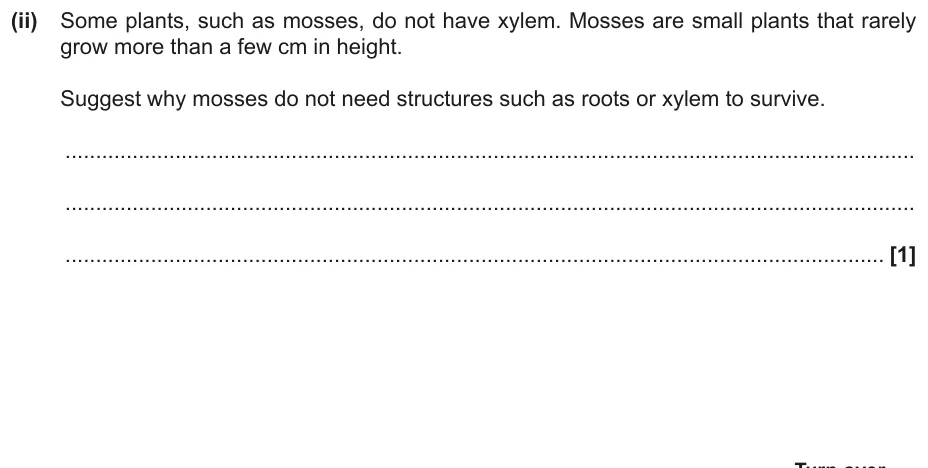
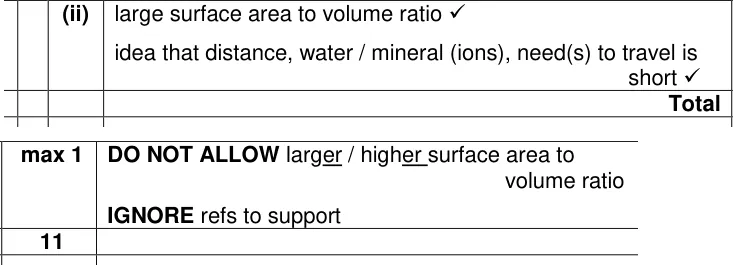
Suggest why mosses don't need roots or xylem.
Show the mark scheme
Tap an image to open it full size.
From the examiners' report: Link the small size to a large SA:V and a short distance for water to travel. Answers about support or damp habitats didn't score.
Question 7
AS Paper 1 · June 2024 · Q22(b)(i) · 2 marks · Medium
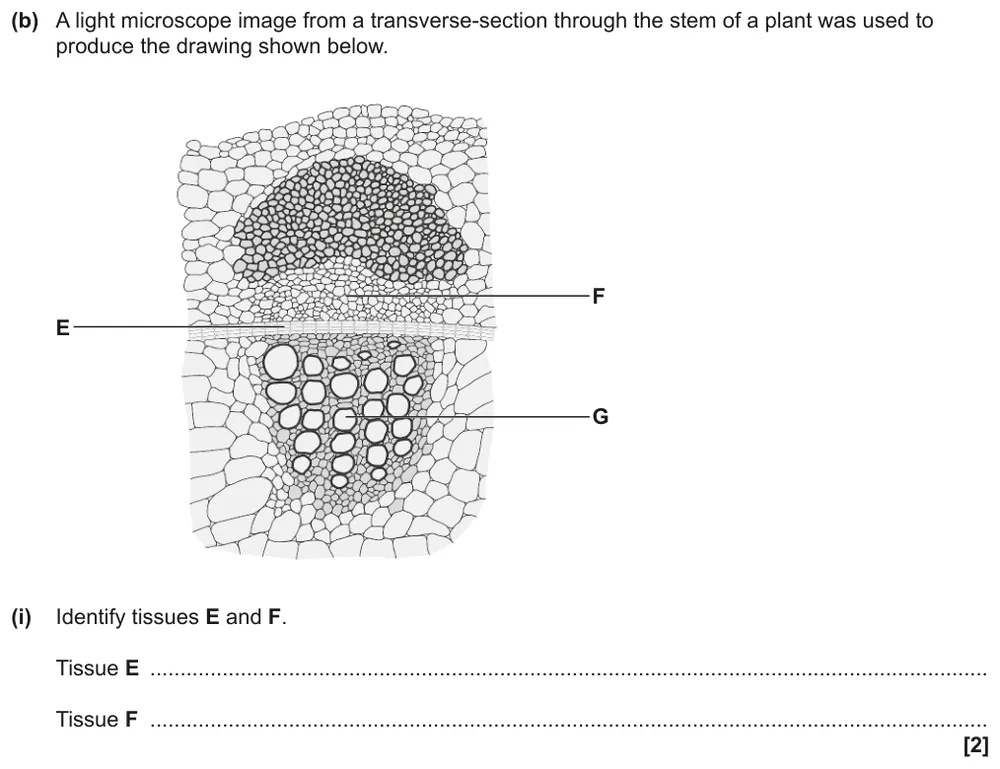
Identify tissues E and F on a drawing made from a stained stem section.
Show the mark scheme

Tap an image to open it full size.
From the examiners' report: In a vascular bundle in a stem, phloem is on the outside, xylem on the inside and cambium between them. Many students labelled F as xylem.
Question 8
AS Paper 1 · June 2024 · Q22(b)(ii) · 2 marks · Hard
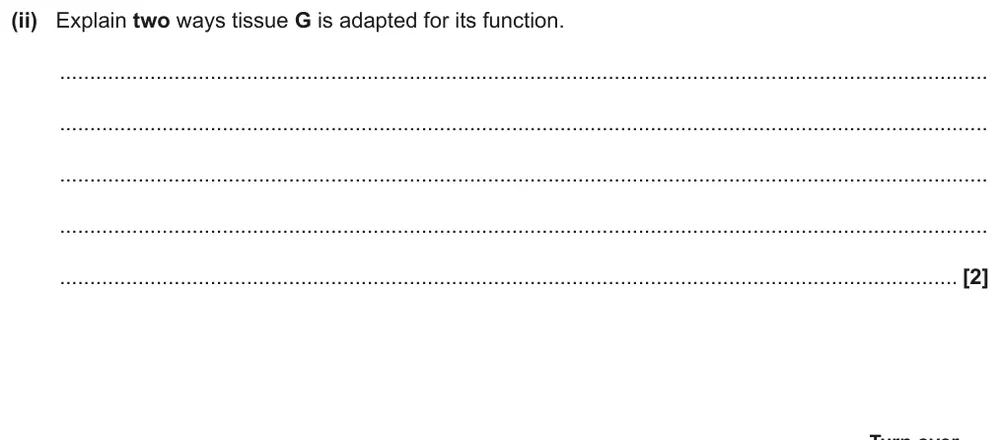
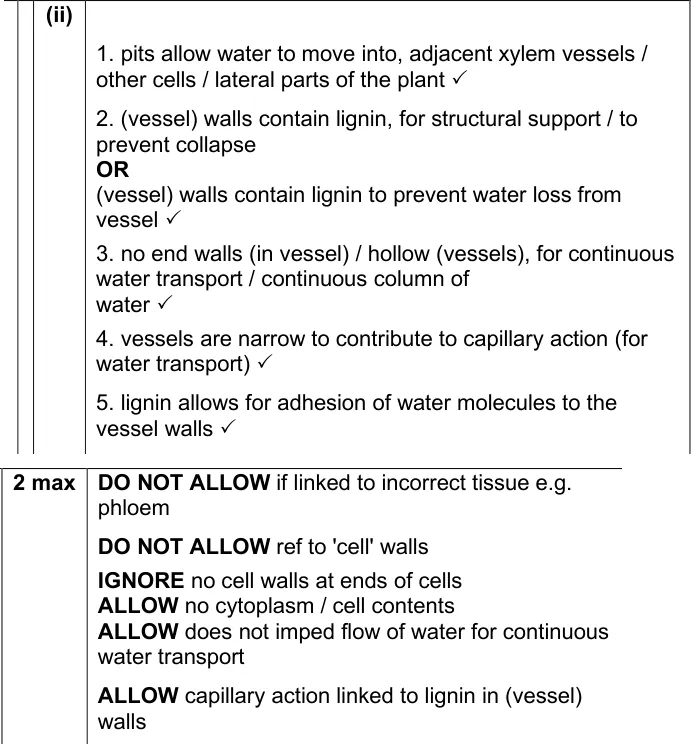
Explain two ways the xylem (tissue G) is adapted for its function.
Show the mark scheme
Tap an image to open it full size.
From the examiners' report: 'Explain' means link each feature to its job: lignified vessel walls stop the vessel collapsing, no end walls give a continuous column of water. Say 'vessel walls', not 'cell walls'.
Water transport and transpiration
Question 9
AS Paper 1 · June 2024 · Q22(c) · 3 marks · Medium
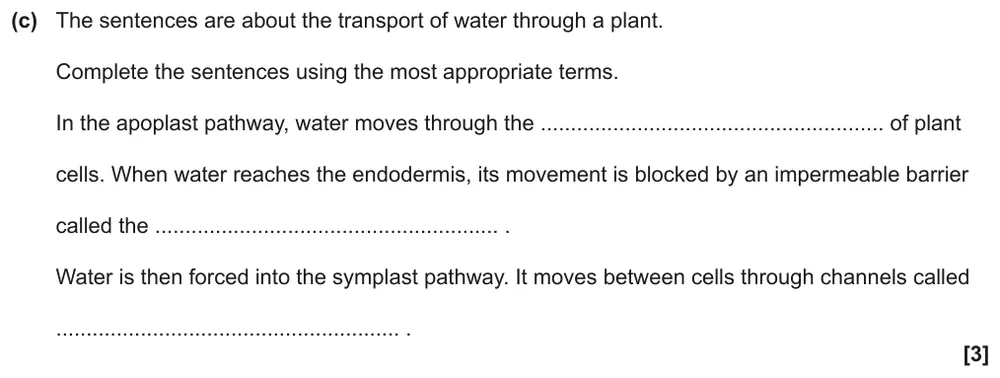
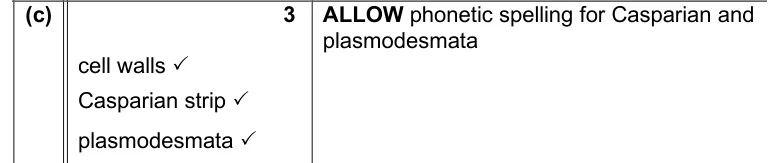
Complete sentences about the apoplast pathway, the Casparian strip and plasmodesmata.
Show the mark scheme
Tap an image to open it full size.
From the examiners' report: In the apoplast pathway water moves through the cell walls themselves, not the 'spaces between cell walls'. Learn to spell Casparian strip and plasmodesmata.
Question 10
A level Paper 1 · June 2023 · Q21(a)(i) · 2 marks · Easy
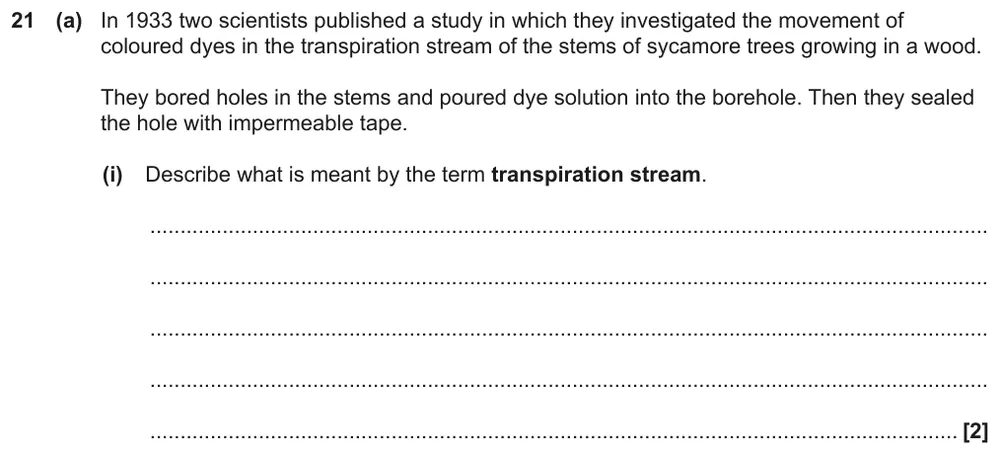
Describe what is meant by the transpiration stream.
Show the mark scheme

Tap an image to open it full size.
From the examiners' report: Say where the water starts and finishes: from the roots to the leaves. 'Through the xylem' alone misses the second mark, and you don't need cohesion-tension here.
Question 11
A level Paper 1 · June 2023 · Q21(b)(iii) · 2 marks · Medium
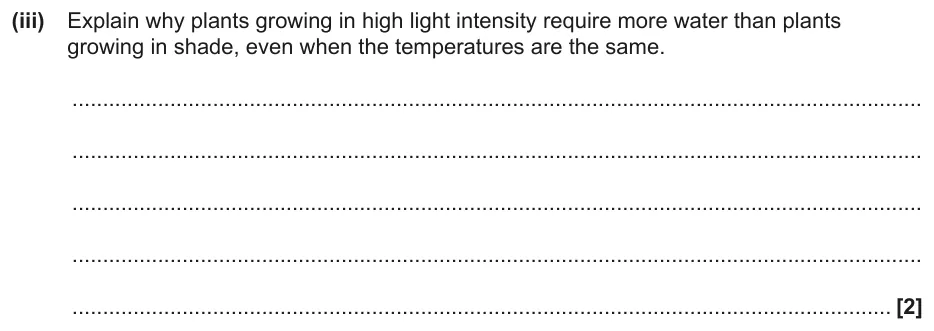
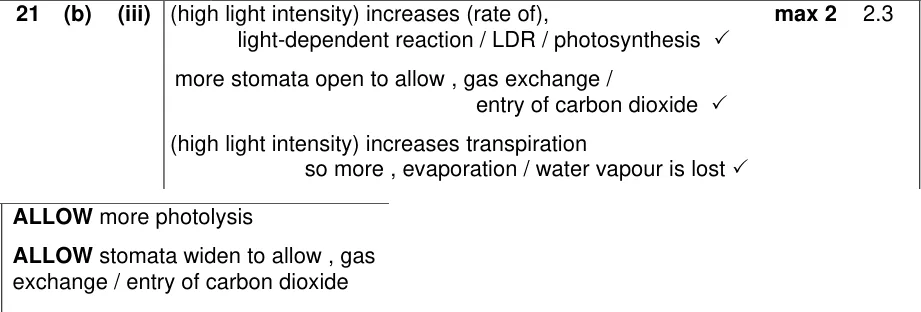
Explain why plants in high light intensity need more water than plants in shade.
Show the mark scheme
Tap an image to open it full size.
From the examiners' report: Link the chain: more light, more photosynthesis, stomata open wider for carbon dioxide, so more water vapour is lost. Plants in shade still photosynthesise, just more slowly.
Question 12
AS Paper 1 · June 2024 · Q22(d) · 2 marks · Hard
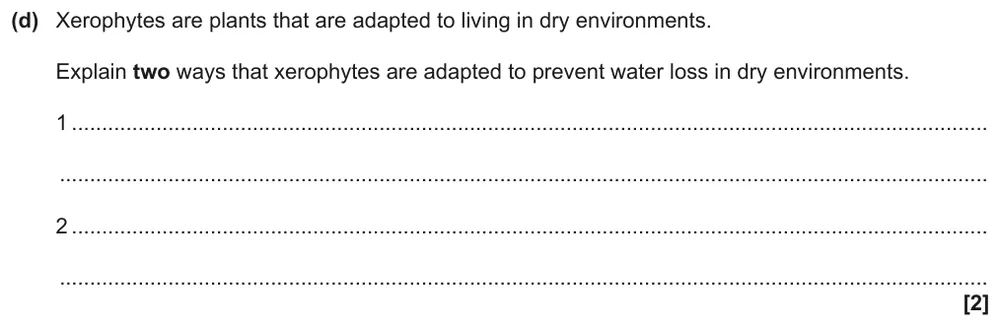
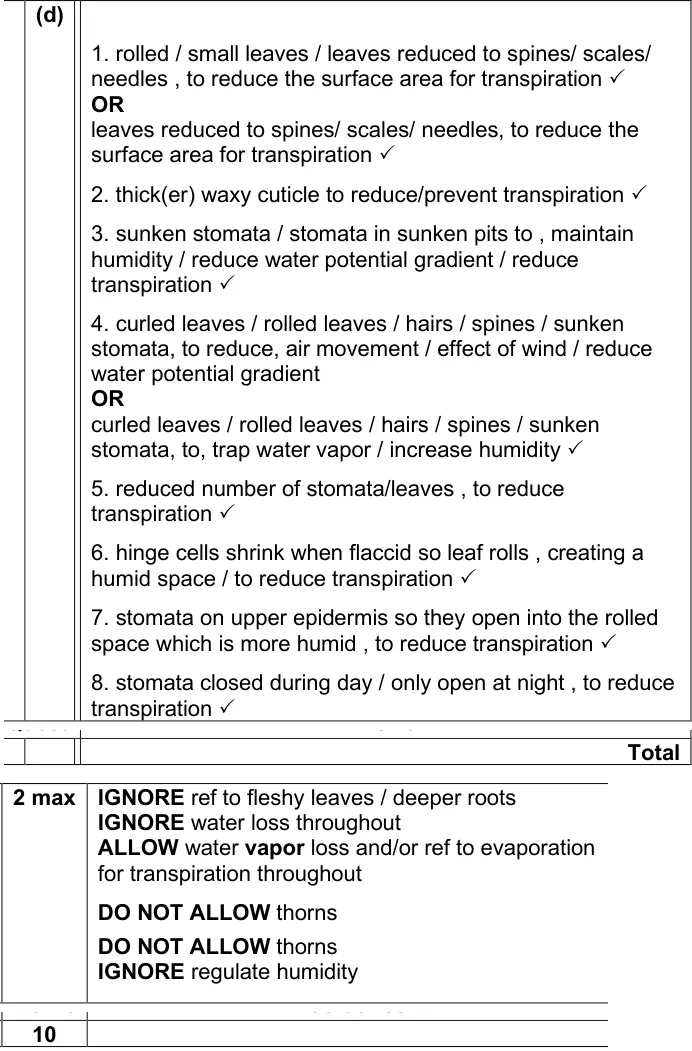
Explain two ways xerophytes are adapted to prevent water loss.
Show the mark scheme
Tap an image to open it full size.
From the examiners' report: Explain how each feature cuts transpiration: rolled leaves reduce the surface area, sunken stomata trap water vapour. All plants have a waxy cuticle, so say thick waxy cuticle.
Question 13
AS Paper 1 · June 2018 · Q25(d)(i) · 2 marks · Medium
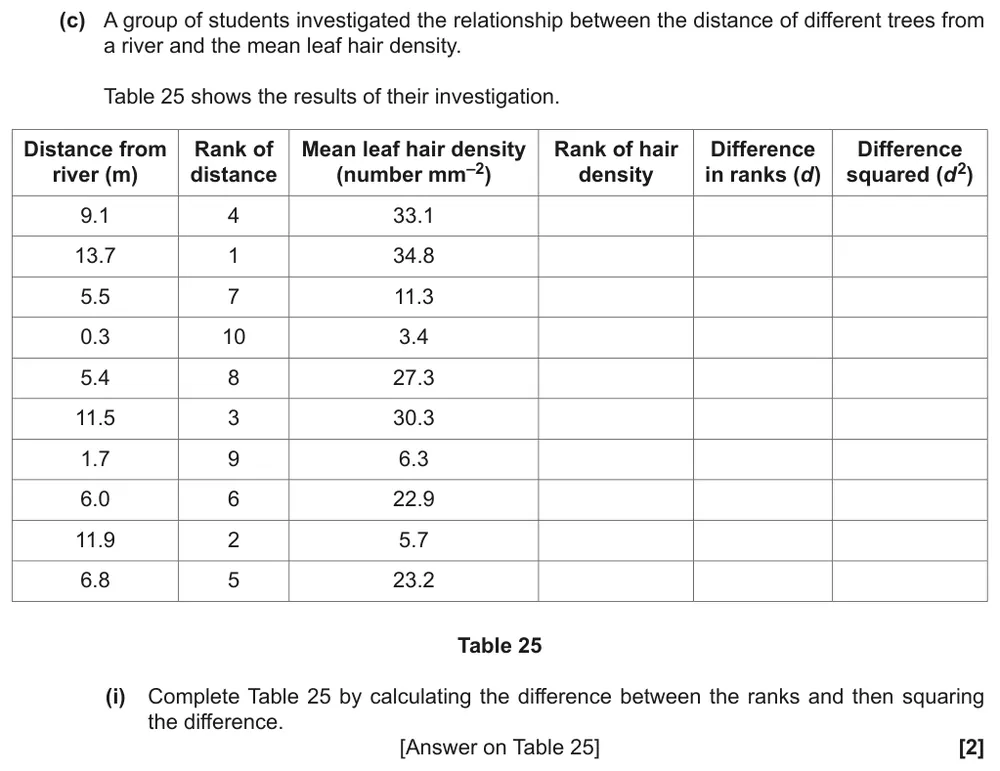
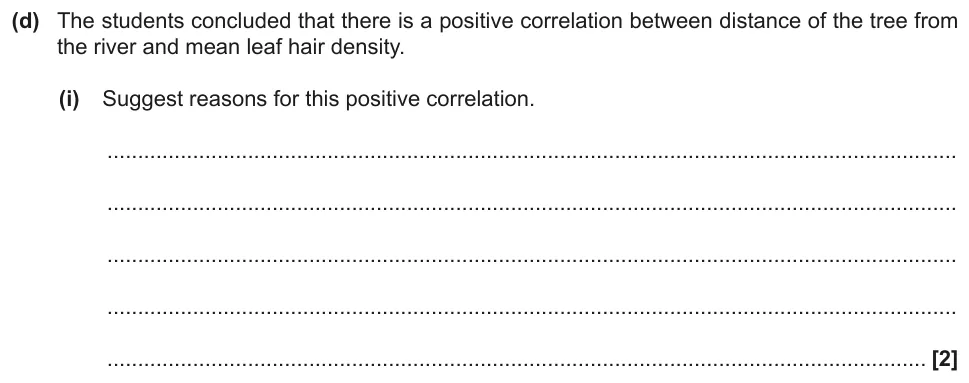
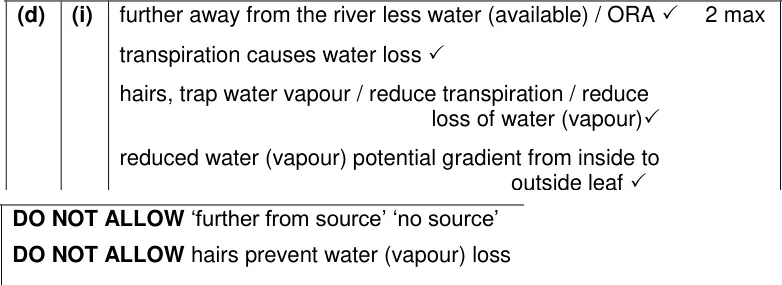
Suggest why trees further from a river have hairier leaves.
Information from earlier in this question:
Show the mark scheme
Tap an image to open it full size.
From the examiners' report: Make two linked points: less water is available further from the river, and the hairs trap water vapour so transpiration is reduced. Hairs don't absorb water from the air.
Translocation
Question 14
A level Paper 3 · June 2025 · Q1(c) · 3 marks · Easy
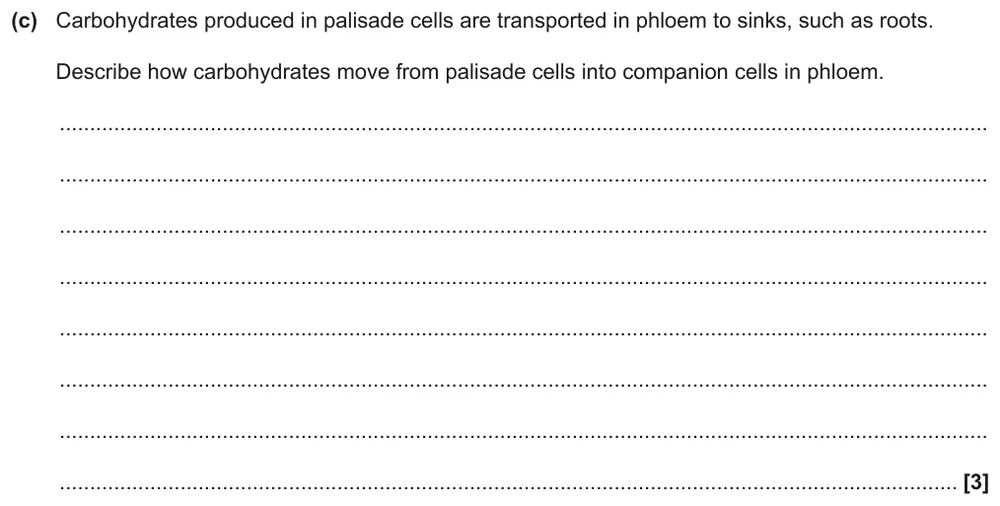
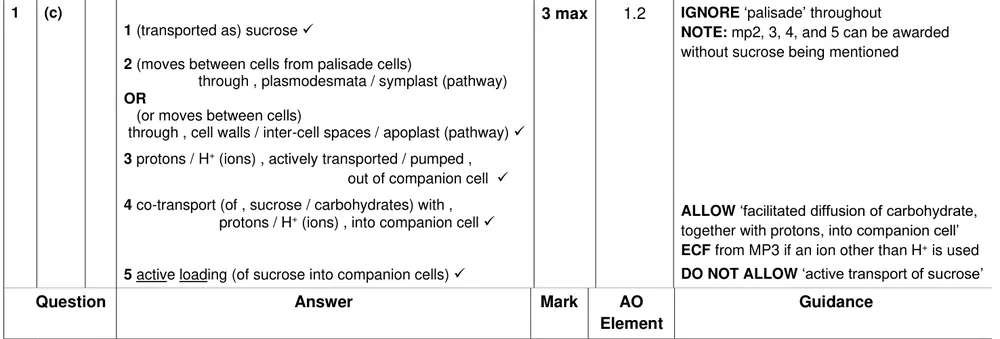
Describe how carbohydrates move from palisade cells into companion cells.
Show the mark scheme
Tap an image to open it full size.
From the examiners' report: Name sucrose, give the pathway to the phloem, then explain active loading: protons are pumped out and sucrose comes back in with them by cotransport. 'Active transport of sucrose' wasn't credited.
Question 15
AS Paper 1 · June 2025 · Q24(a) · 3 marks · Hard
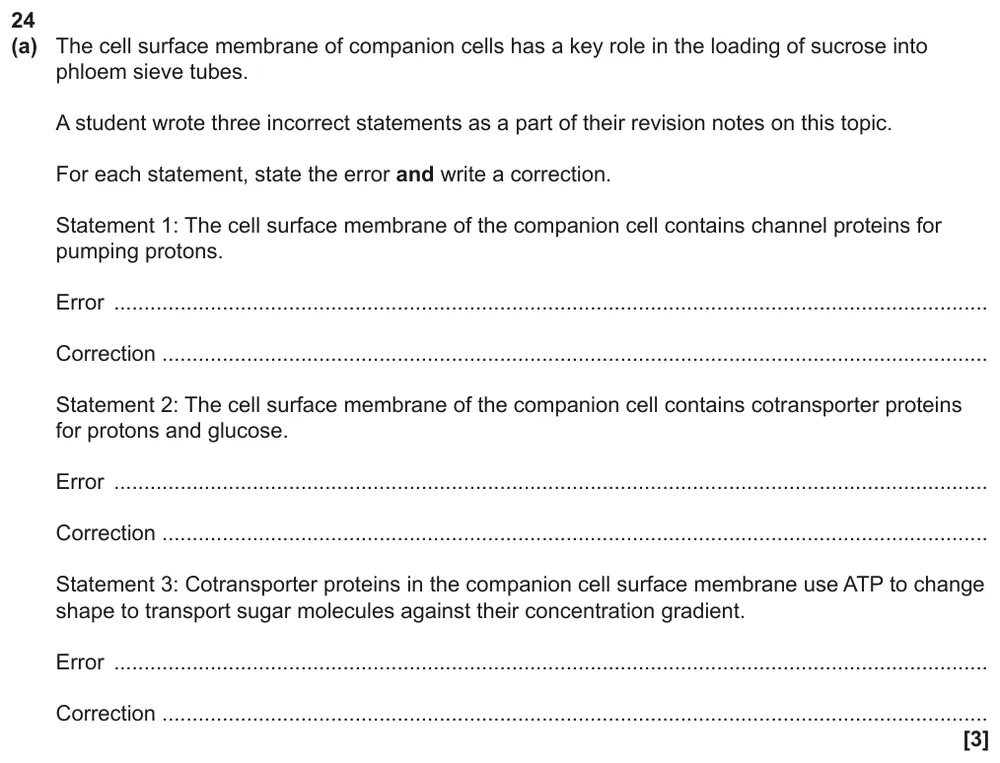
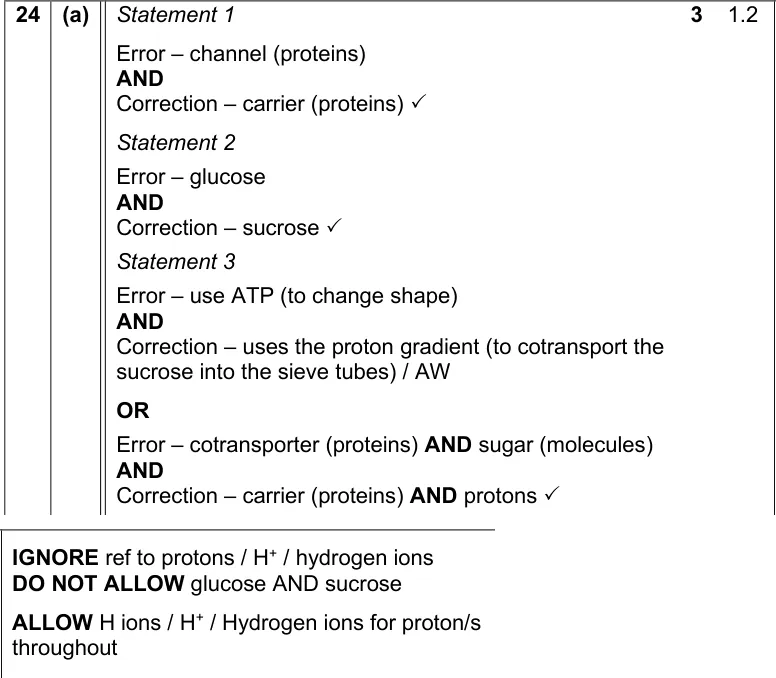
Find and correct three errors in a student's notes on loading sucrose into companion cells.
Show the mark scheme
Tap an image to open it full size.
From the examiners' report: Protons are pumped out by carrier proteins, sucrose (not glucose) is loaded, and the cotransporter is driven by protons diffusing back in down their gradient, not by ATP.
Practical and potometer
Question 16
AS Paper 2 · June 2017 · Q2(a) · 2 marks · Medium
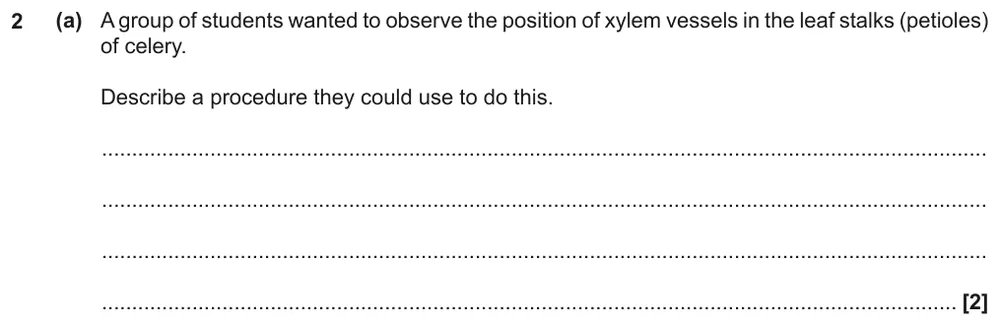
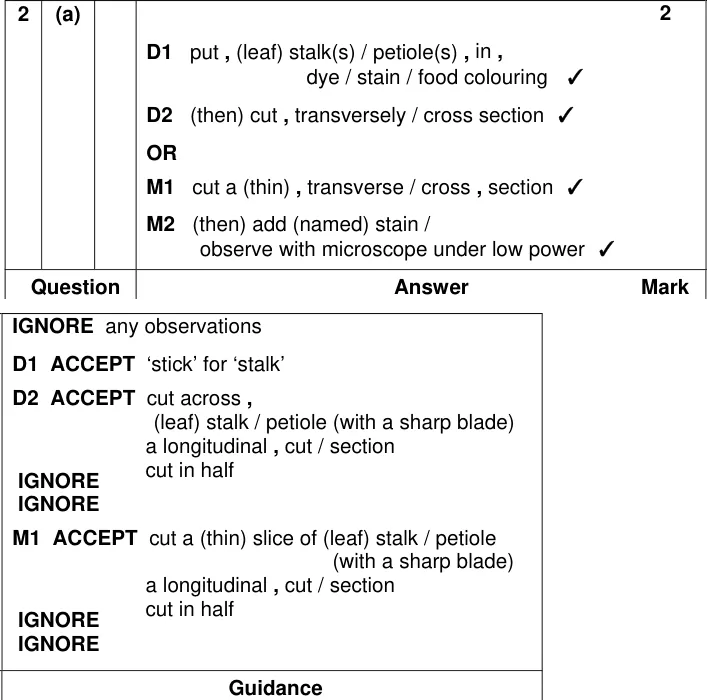
Describe how to observe the position of xylem vessels in celery stalks.
Show the mark scheme
Tap an image to open it full size.
Question 17
AS Paper 2 · June 2023 · Q2(c) · 2 marks · Medium
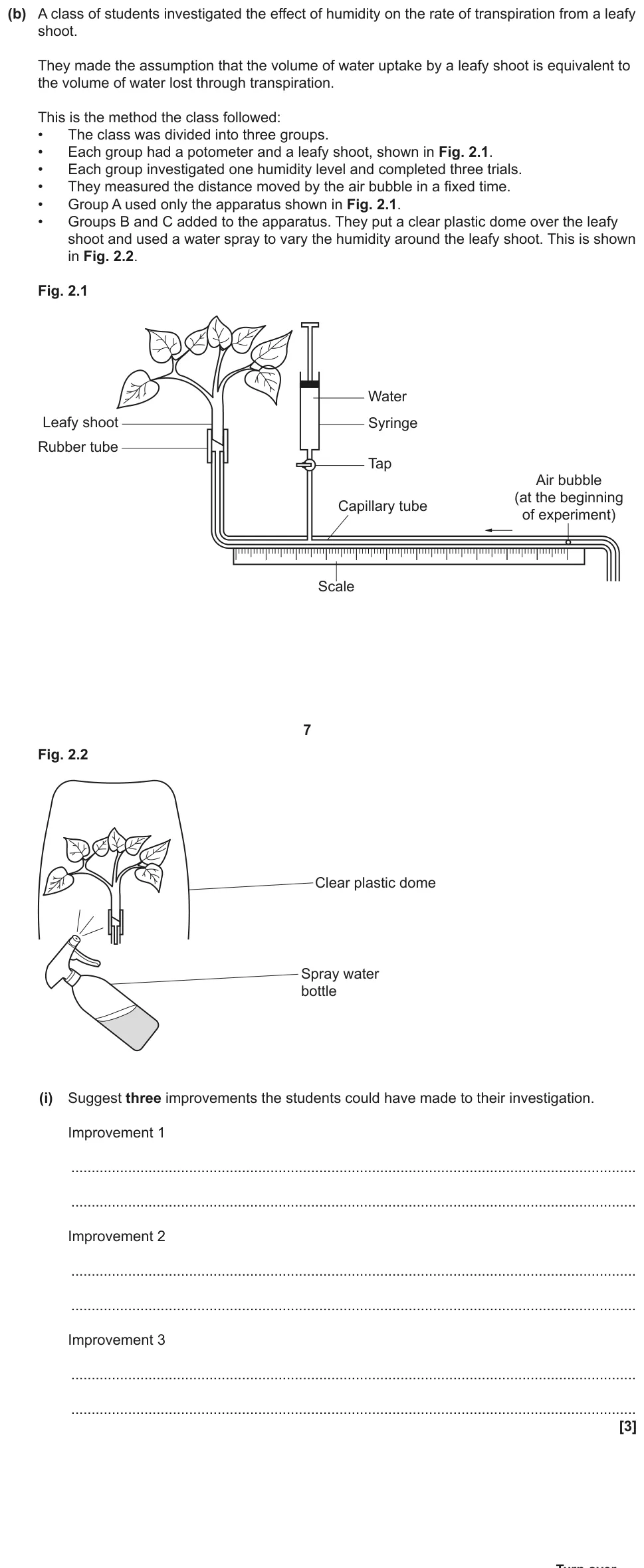
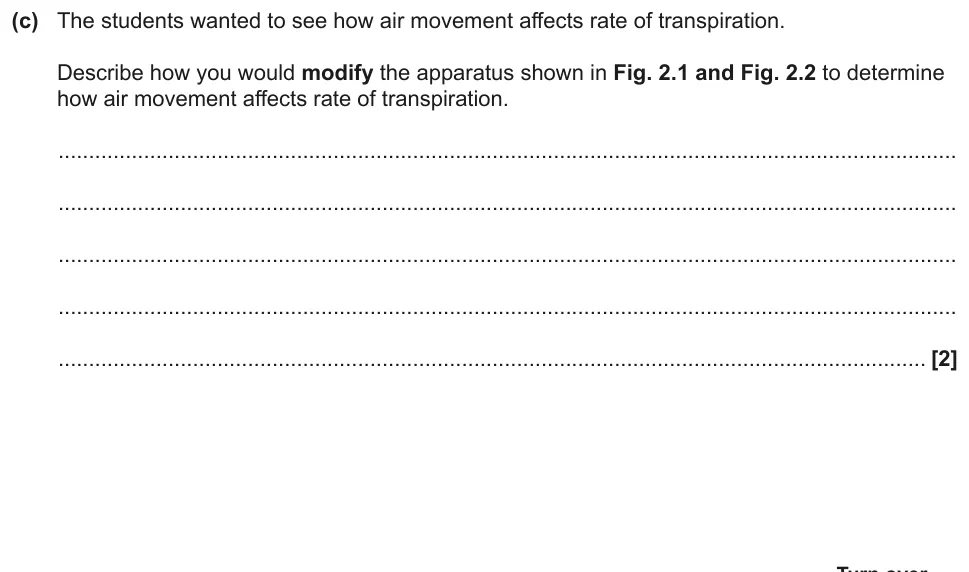
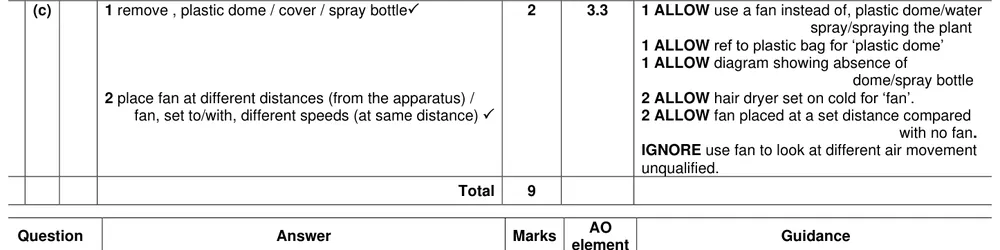
Modify the potometer set-up to test the effect of air movement on transpiration.
Information from earlier in this question:
Show the mark scheme
Tap an image to open it full size.
From the examiners' report: Change only the variable you're testing: take off the plastic dome as well as adding a fan at different speeds or distances, or humidity becomes a second variable.
Question 18
A level Paper 3 · June 2024 · Q3(c)(i) · 2 marks · Hard
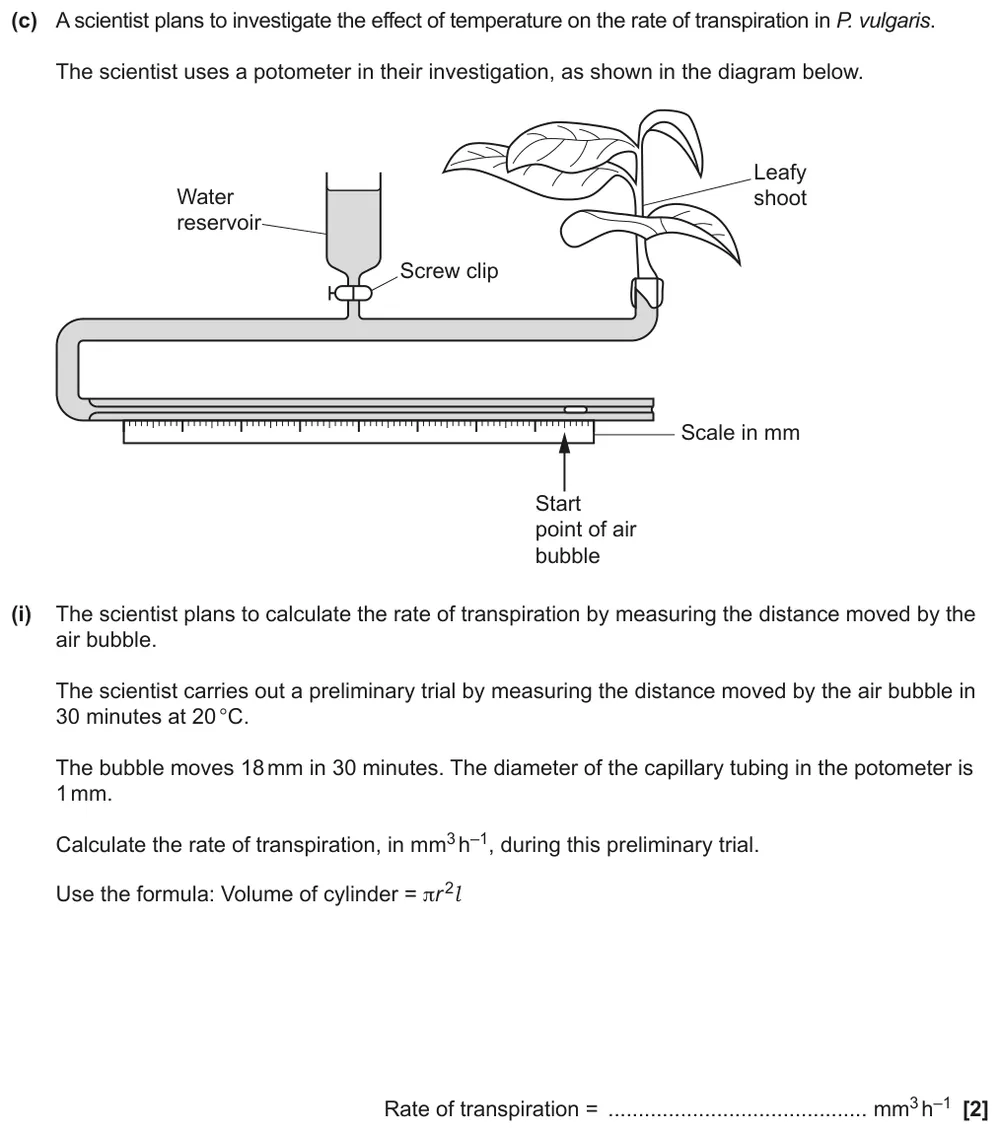
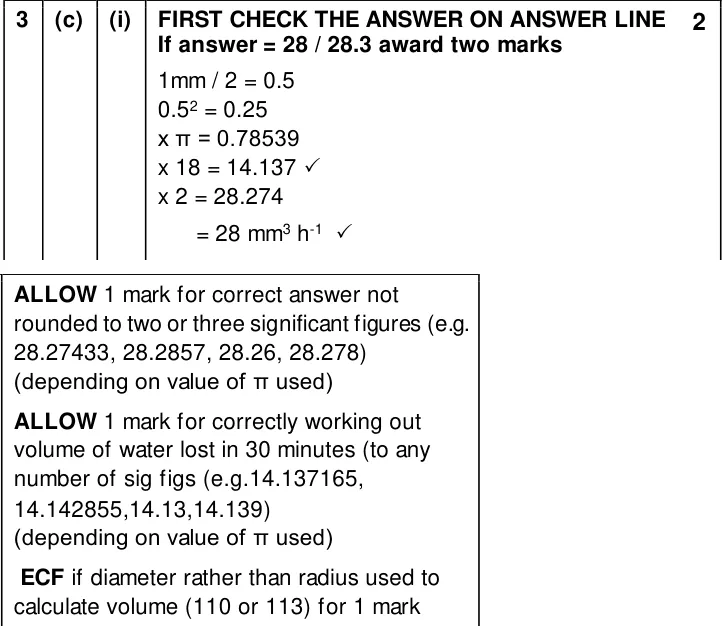
Calculate the rate of transpiration from a potometer bubble that moves 18 mm in 30 minutes.
Show the mark scheme
Tap an image to open it full size.
From the examiners' report: Halve the diameter to get the radius, square it, then convert from per 30 minutes to per hour by doubling. Give the answer to 2 or 3 significant figures and show your working.
Where students lose marks (from OCR examiners' reports and mark schemes)
Each point below is followed by wording that gained marks.
Tissue or cell? Check the question: Asked for tissues, some students wrote xylem vessels or sieve tubes and lost the marks. Asked for cells, most wrote 'phloem', which is a tissue.
✔ Gains credit: Tissues: "xylem" and "phloem". Cells: "sieve tube element" and "xylem vessel".
Xylem has pits, not plasmodesmata: On a section of xylem, students wrote 'cell wall', 'hollow tube' and 'plasmodesmata' for the labelled parts.
✔ Gains credit: "Vessel wall" (or "lignified wall"), "lumen" and "(bordered) pit".
Mosses are small, so their SA:V is large: Some wrote that mosses have a 'larger' or 'higher' SA:V, which wasn't allowed, or wrote about support instead.
✔ Gains credit: "Large surface area to volume ratio" or "the distance water and mineral ions need to travel is short".
Transpiration loses water vapour: Answers said plants in bright light 'lose more water' without saying it leaves as vapour through open stomata.
✔ Gains credit: "More stomata open to allow entry of carbon dioxide" and "increases transpiration so more water vapour is lost".
Every plant has a cuticle; xerophytes have a thick one: Students wrote 'waxy cuticle' or 'stomata on the underside', which are true of most plants, and 'small leaves' without surface area.
✔ Gains credit: "Thick(er) waxy cuticle to reduce transpiration" and "rolled leaves, to reduce the surface area for transpiration".
Active loading, not active transport of sucrose: 'Sucrose is actively transported into the companion cell' was not credited.
✔ Gains credit: "Protons actively pumped out of the companion cell" and "co-transport of sucrose with protons into the companion cell".
The cotransporter runs on protons, not ATP: Few students spotted that the cotransporter in companion cells doesn't use ATP, and many confused it with the proton pump.
✔ Gains credit: "Carrier proteins" pump protons; the cotransporter "uses the proton gradient to cotransport the sucrose".
Take the dome off when you add the fan: Most students used a fan at different settings but left the plastic dome on, so humidity changed as well.
✔ Gains credit: "Remove plastic dome / spray bottle" and "place fan at different distances / set to different speeds".
Download the questions
Download the PDF pack (18 questions, mark schemes at the end)
Keep practising
- Transport in Plants quiz
- PAG 5 Colorimeter and Potometer: OCR A Level Biology exam questions by topic
- Transport in Animals (3.1.2): OCR A Level Biology exam questions by topic
- Transport in plants: interactive written questions (20)
- OCR A Level Biology masterclasses
Questions, mark schemes and examiners' report extracts © OCR.