

Enzymes sit at the heart of OCR A Level Biology. Spec point 2.1.4 asks you to explain how an enzyme lowers activation energy, using the lock and key and induced-fit models, and to say whether an enzyme works inside or outside cells. You need to explain how temperature, pH, enzyme concentration and substrate concentration change the rate, calculate Q10, and know the jobs of cofactors, coenzymes and the different types of inhibitor.
Most of the marks lost here aren't about missing facts. Students describe a graph when the question says explain, write a GCSE answer about 37 °C being the temperature enzymes "work best at", call a calcium ion a coenzyme, or forget to round to the significant figures asked for. The examiners' reports for these questions point out each of these.
Work through the eighteen questions below in order. They start with recall, move on to unfamiliar enzymes such as creatine kinase, trypsin and chitinase, then rate graphs, and finish with the practical and Q10 calculations. If you'd like to practise questions like these with me each week, my OCR A masterclasses run on Wednesdays at 5.15pm for Year 12 and on Tuesdays at 6.30pm or Thursdays at 5.15pm for Year 13.
What you need from GCSE
Each question on this page assumes you're secure on these GCSE ideas. If any of them feels shaky, look it up before you start.
- Enzymes are proteins that act as biological catalysts: they speed up reactions without being used up.
- Each enzyme has an active site with a shape that fits one substrate (the lock and key model).
- High temperatures and the wrong pH change the shape of the active site, so the enzyme is denatured.
- Digestive enzymes such as amylase, protease and lipase break large food molecules into small ones.
- Rate can be found from the gradient of a graph: change in y divided by change in x.
Key terms
These words come up in the questions and mark schemes. Examiners expect you to use them exactly.
- Active site: the region of an enzyme, made by its tertiary structure, that is complementary to the substrate.
- Enzyme-substrate complex (ESC): the enzyme and substrate bound together at the active site, before the product forms.
- Induced fit: the active site changes shape slightly as the substrate binds, putting strain on bonds in the substrate.
- Activation energy: the energy needed to start a reaction; enzymes lower it so reactions happen fast at body temperature.
- Intracellular and extracellular: an intracellular enzyme acts inside the cell that made it (catalase); an extracellular enzyme is secreted and acts outside cells (amylase, trypsin).
- Cofactor and coenzyme: a cofactor is a non-protein helper such as an ion (Cl⁻ for amylase); a coenzyme is an organic cofactor, often made from a vitamin, that binds only temporarily.
- Competitive inhibitor: a molecule with a similar shape to the substrate that binds to the active site; its effect falls as substrate concentration rises.
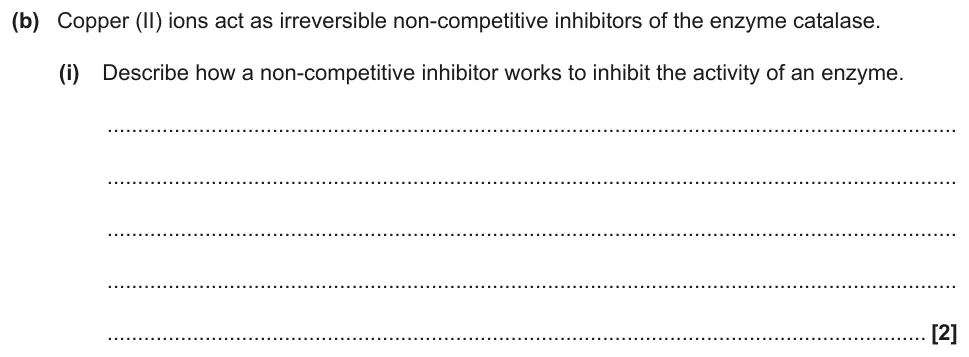
- Non-competitive inhibitor: a molecule that binds to an allosteric site away from the active site and changes the active site's shape.
- End-product inhibition: the final product of a metabolic pathway inhibits an enzyme earlier in the pathway.
- Q10 (temperature coefficient): rate at a temperature divided by the rate 10 °C lower; about 2 for enzyme-controlled reactions.
What these questions cover (OCR 2.1.4)
The questions test these learning outcomes from the OCR A Level Biology A specification (H420):
- (a) the role of enzymes in catalysing reactions that affect metabolism at a cellular and whole organism level
- (b) the role of enzymes in catalysing both intracellular and extracellular reactions (catalase (intracellular) and amylase or trypsin (extracellular))
- (c) the mechanism of enzyme action (including induced fit and lowering of activation energy)
- (d)(i) the effects of pH, temperature, enzyme concentration and substrate concentration on enzyme activity (including the temperature coefficient, Q10)
- (d)(ii) practical investigations into the effects of pH, temperature, enzyme concentration and substrate concentration on enzyme activity (PAG4 enzyme practicals)
- (e) the need for coenzymes and cofactors in some enzyme-controlled reactions
- (f) the effects of inhibitors on the rate of enzyme-controlled reactions (competitive, non-competitive, non-reversible and end-product inhibition)
How to use this page
Write your answer on paper before you open the mark scheme. Allow about 1.2 minutes per mark: the 18 questions are worth 33 marks, so about 40 minutes in total. Then mark your answer strictly against the mark scheme and read the examiners' tip underneath it. If you'd rather print the questions, download the PDF pack.
Recall
Question 1
AS Paper 2 · June 2025 · Q3(a)(i) · 2 marks · Medium
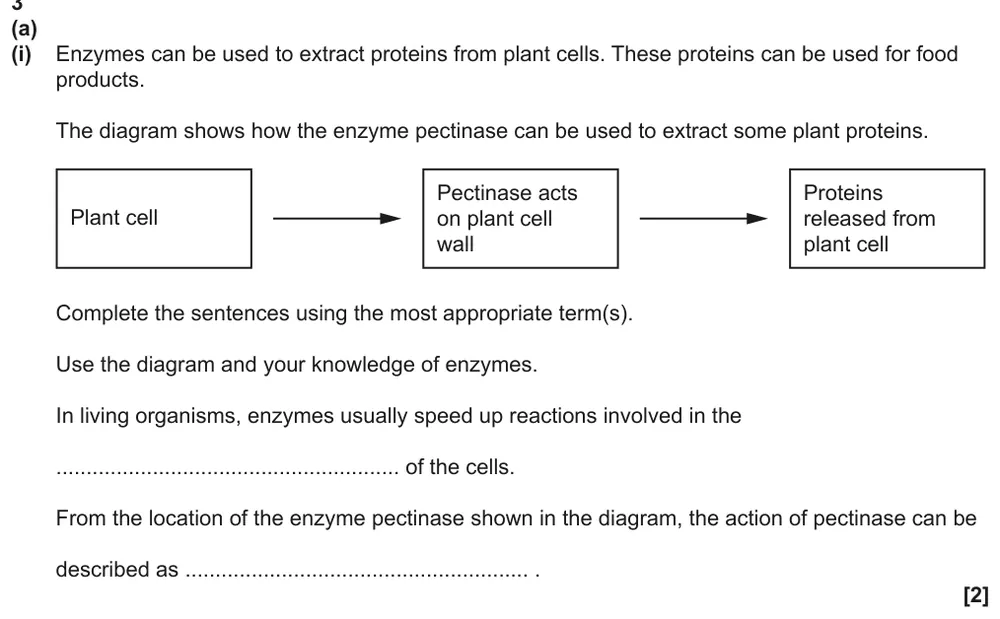
Complete two sentences about what enzymes speed up and how pectinase acts on plant cell walls.
Show the mark scheme

Tap an image to open it full size.
From the examiners' report: Most students knew enzymes speed up metabolism, but many described pectinase as "catalytic" or "faster". Use the diagram: the enzyme acts outside the cell, so its action is extracellular.
Question 2
AS Paper 1 · June 2023 · Q27(a)(i) · 2 marks · Medium
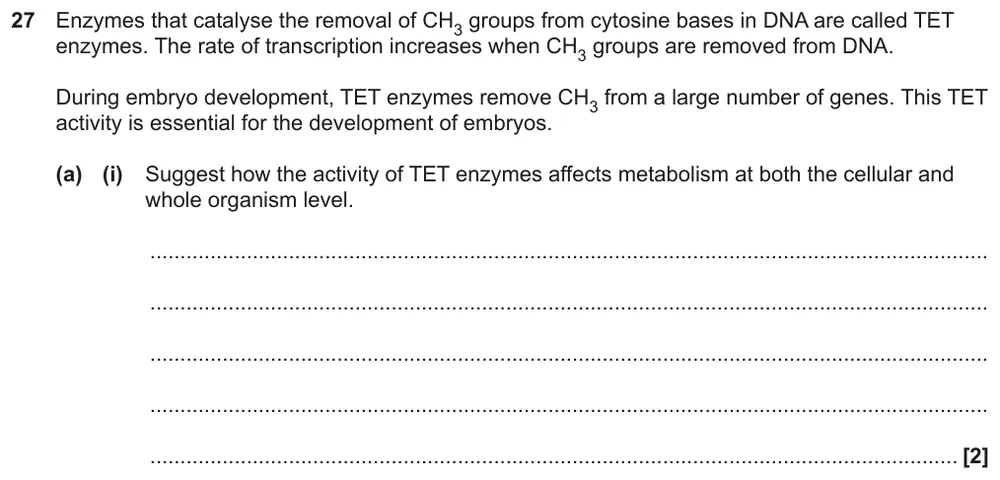
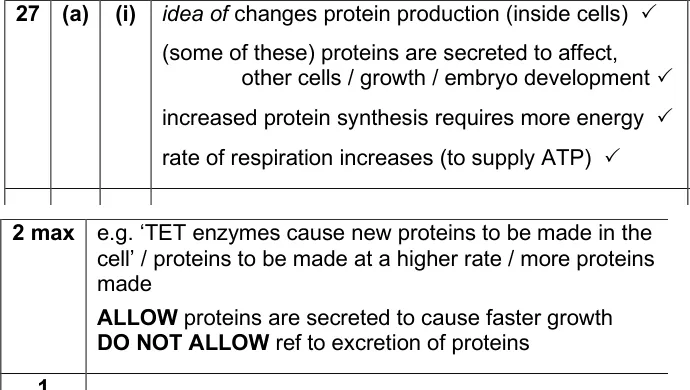
Suggest how TET enzymes, which remove CH3 groups from DNA, affect metabolism at cell and whole-organism level.
Show the mark scheme
Tap an image to open it full size.
Question 3
AS Paper 1 · June 2023 · Q27(a)(iii) · 1 mark · Medium
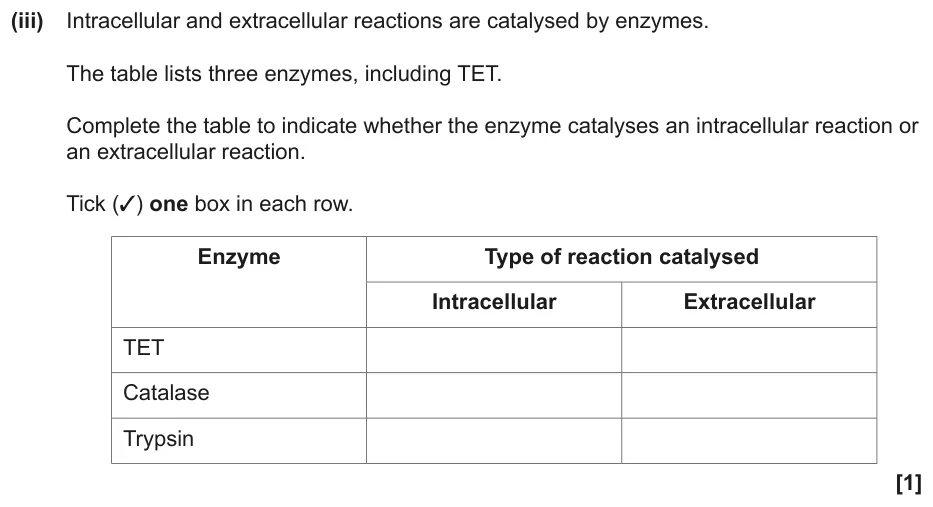
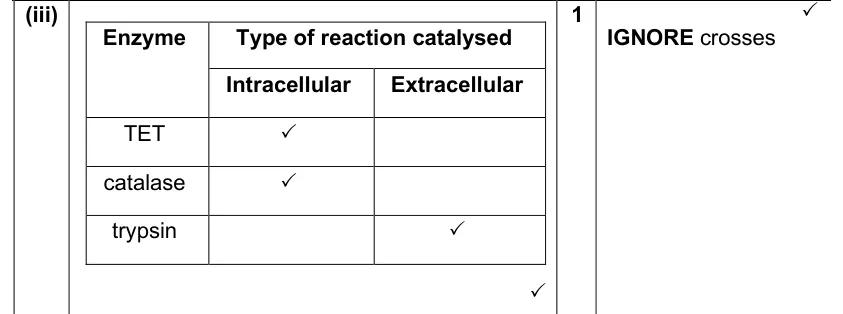
Tick whether TET, catalase and trypsin catalyse intracellular or extracellular reactions.
Show the mark scheme
Tap an image to open it full size.
From the examiners' report: The most common error was ticking catalase as extracellular, perhaps because it's used so often in lab practicals. Catalase works inside cells, breaking down hydrogen peroxide.
Question 4
A level Paper 1 · June 2018 · Q18(c) · 1 mark · Medium
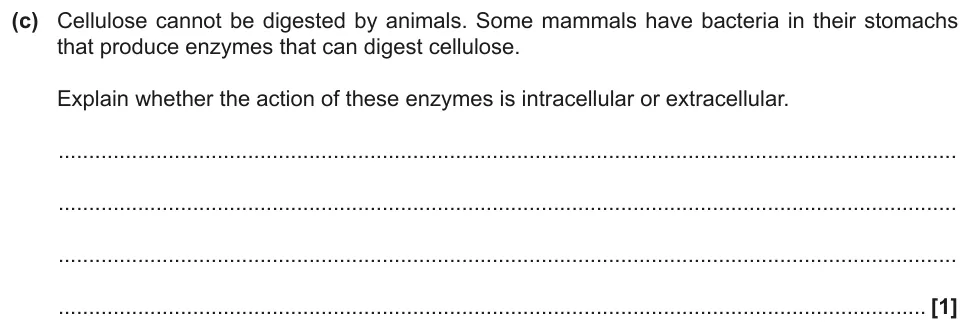
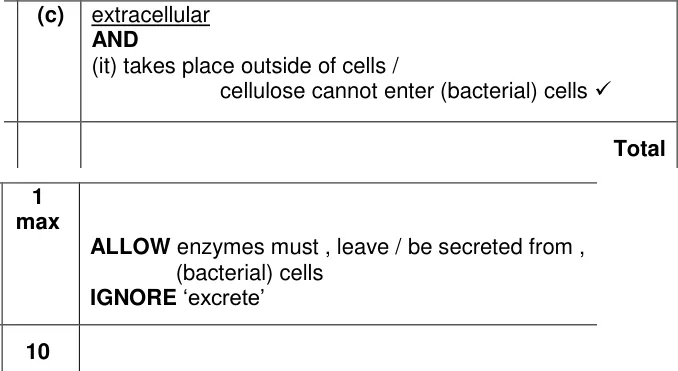
Explain whether bacterial enzymes digesting cellulose in a mammal's stomach act intracellularly or extracellularly.
Show the mark scheme
Tap an image to open it full size.
From the examiners' report: Most students who chose extracellular explained it well. Don't mix up being inside an organ, like the stomach, with being inside a cell.
Question 5
AS Paper 2 · June 2018 · Q4(b)(i) · 2 marks · Easy
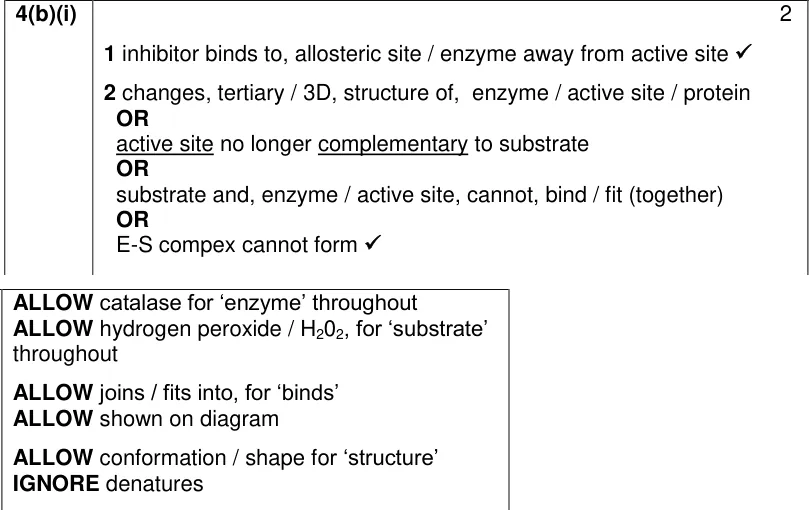
Describe how a non-competitive inhibitor such as copper(II) ions inhibits catalase.
Show the mark scheme
Tap an image to open it full size.
From the examiners' report: This was well answered. Name the allosteric site, then say how binding changes the enzyme's tertiary structure so the substrate can no longer bind.
Question 6
A level Paper 1 · June 2025 · Q17(a)(iv) · 1 mark · Medium
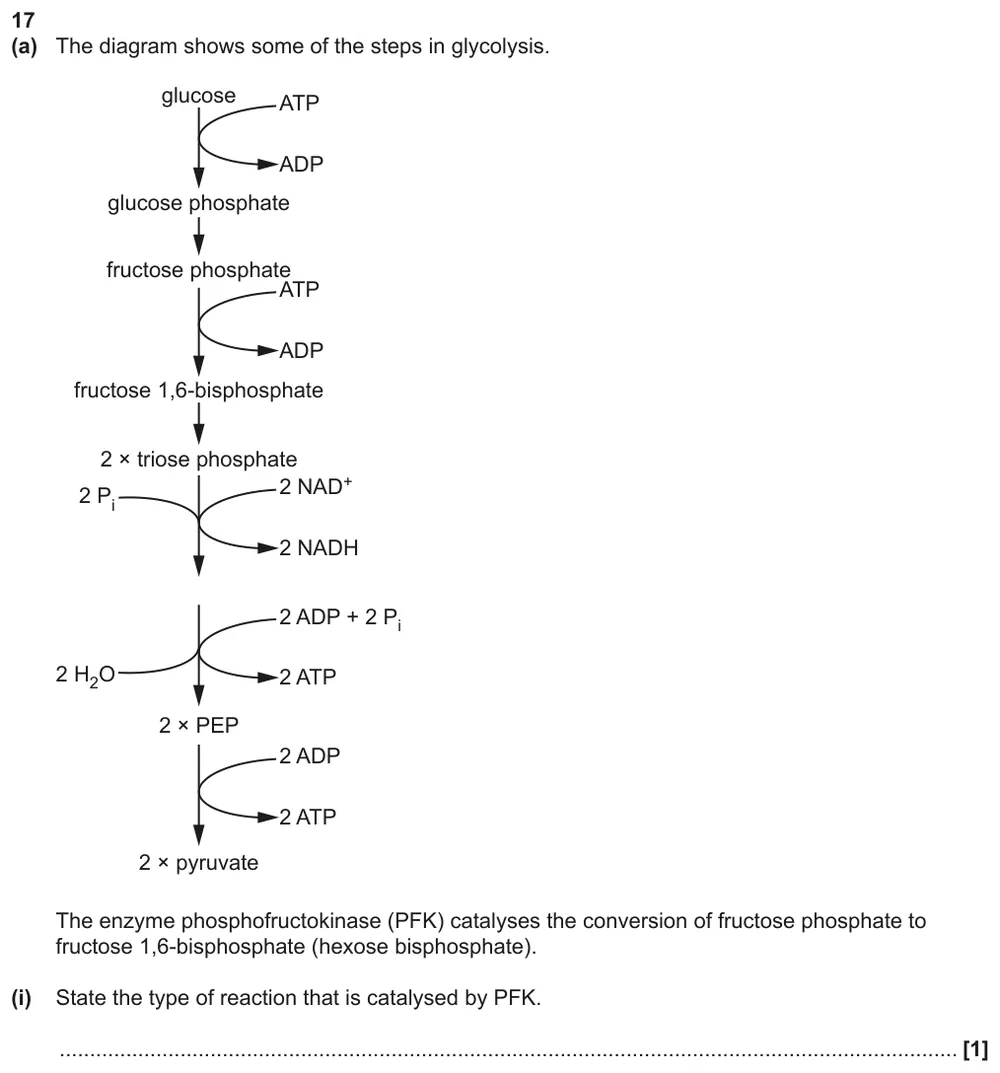
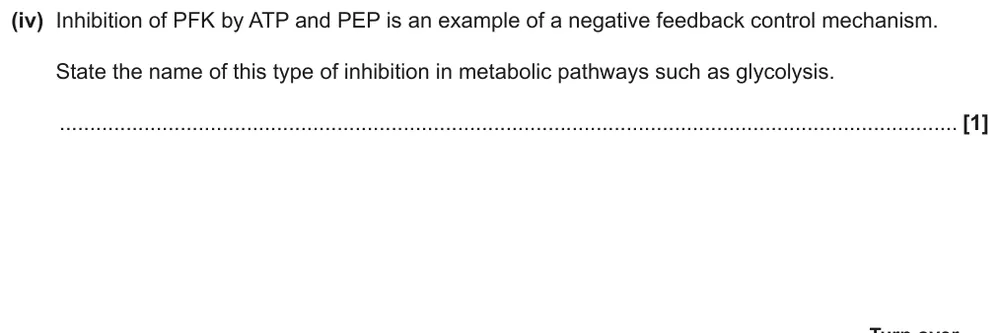
Name the type of inhibition in which ATP and PEP inhibit PFK in glycolysis.
Information from earlier in this question:
Show the mark scheme

Tap an image to open it full size.
From the examiners' report: Many students recalled this, but "end point inhibition", "homeostasis" and "negative feedback" didn't score. Think about the words: the product at the end of the pathway inhibits an earlier step.
Applying what you know
Question 7
AS Paper 1 · June 2023 · Q22(a)(ii) · 2 marks · Hard
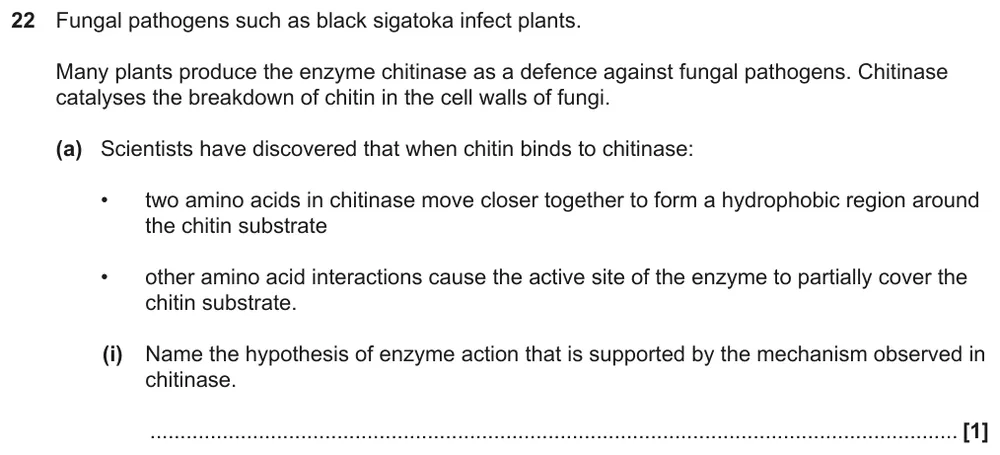
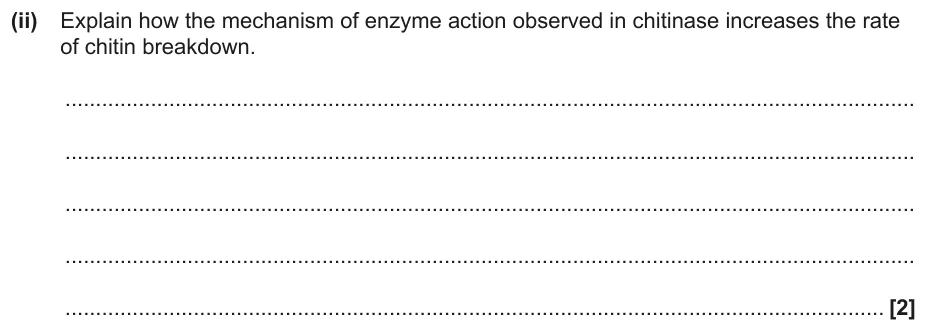
Explain how the induced-fit mechanism in chitinase speeds up the breakdown of chitin.
Information from earlier in this question:
Show the mark scheme

Tap an image to open it full size.
From the examiners' report: Many students stopped at "lowers the activation energy" without saying how, or just restated the stem. Explain that the moulded active site puts strain on bonds in the substrate, so less energy is needed.
Question 8
A level Paper 3 · November 2020 · Q2(c) · 1 mark · Hard
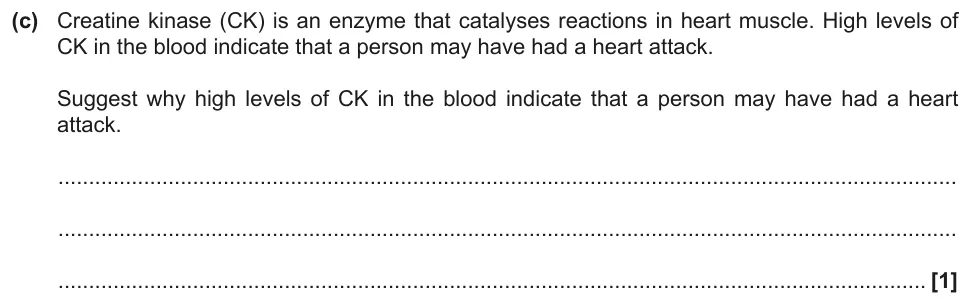
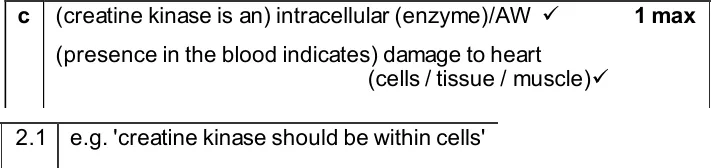
Suggest why high levels of creatine kinase in the blood indicate a heart attack.
Show the mark scheme
Tap an image to open it full size.
From the examiners' report: Very few students linked the stem to the idea that creatine kinase is an intracellular enzyme. If an enzyme that should be inside cells turns up in the blood, the cells must have been damaged.
Question 9
A level Paper 3 · June 2019 · Q3(b) · 2 marks · Medium
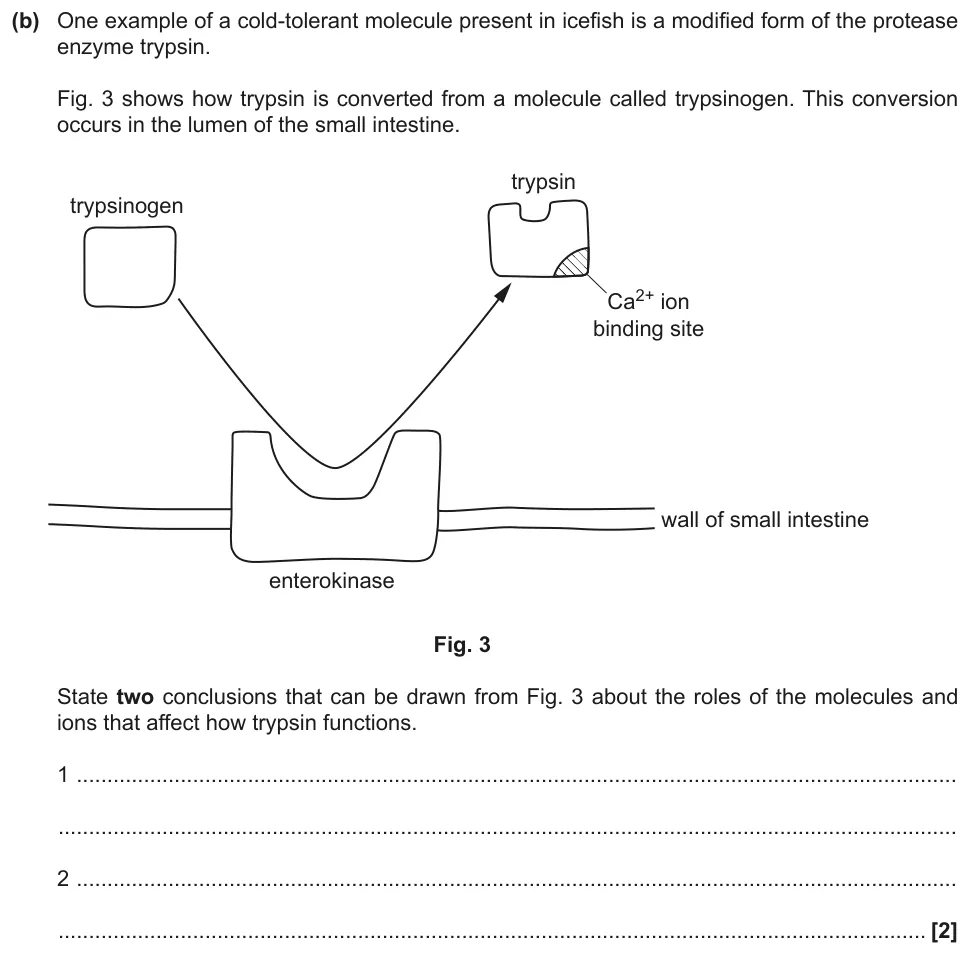
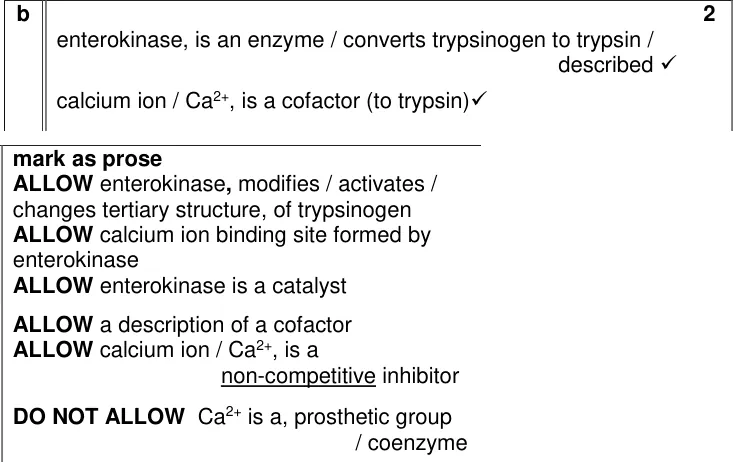
Use a diagram of trypsinogen activation to draw conclusions about enterokinase and calcium ions.
Show the mark scheme
Tap an image to open it full size.
From the examiners' report: Use the figure and pick out one molecule and one ion. A calcium ion is an inorganic cofactor: calling it a coenzyme or prosthetic group lost the mark.
Question 10
A level Paper 3 · June 2023 · Q2(d)(i) · 2 marks · Medium
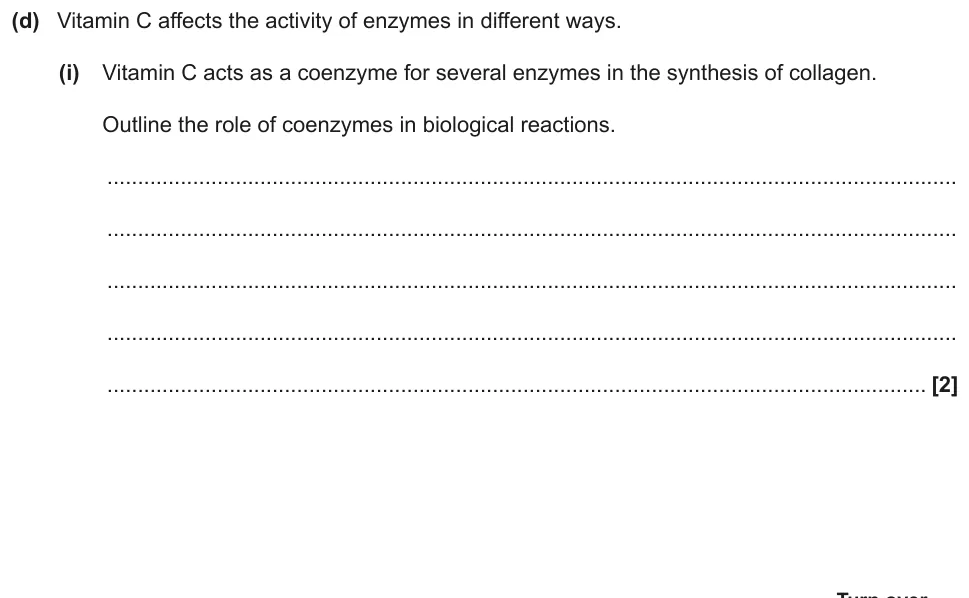
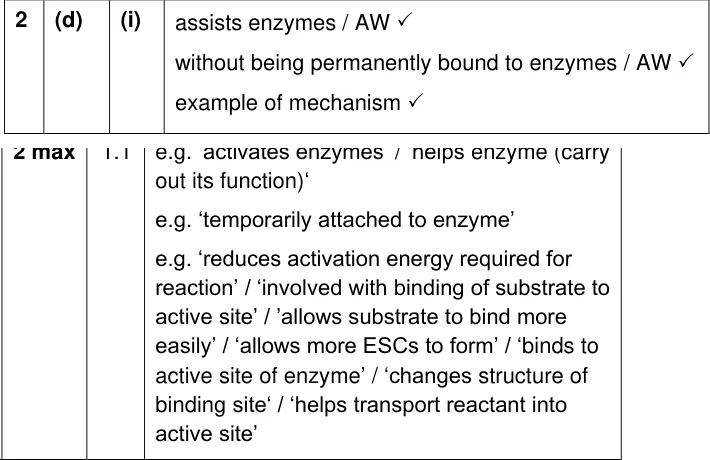
Outline the role of coenzymes such as vitamin C in biological reactions.
Show the mark scheme
Tap an image to open it full size.
From the examiners' report: Most students described how a coenzyme helps the substrate bind, but few said it isn't permanently bound to the enzyme. Give both points; saying it binds permanently wasn't credited.
Question 11
A level Paper 3 · June 2023 · Q2(d)(ii) · 2 marks · Medium
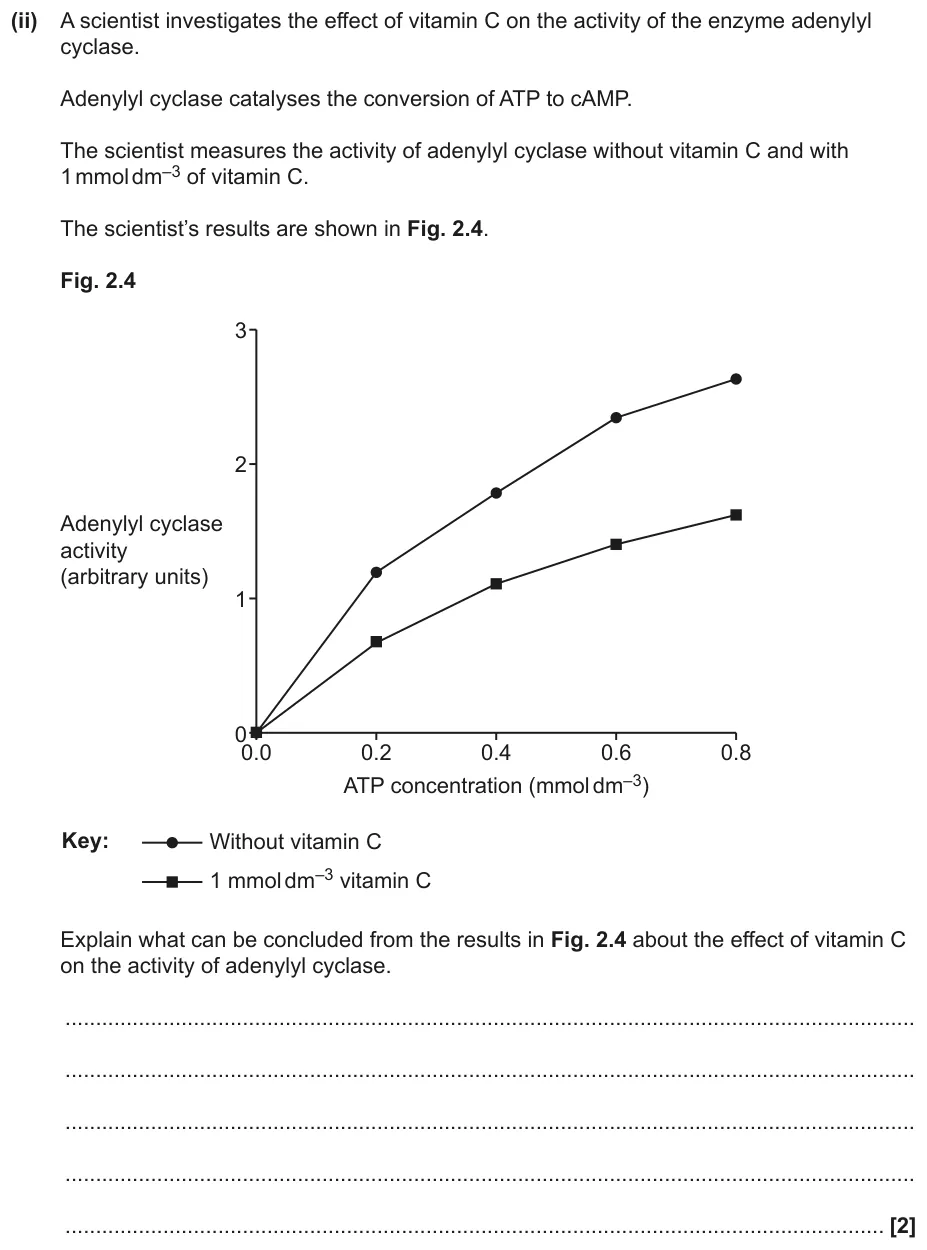
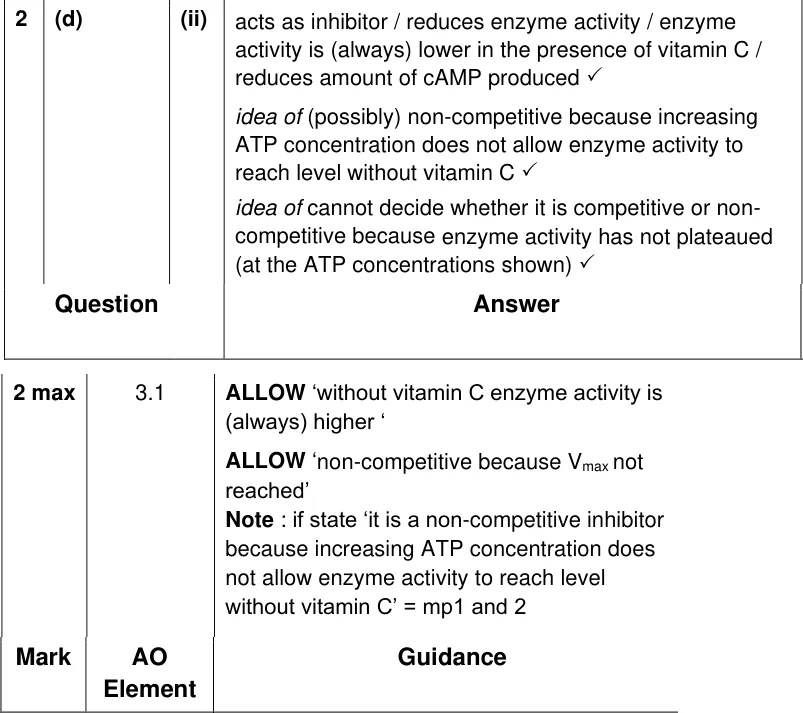
Use a graph of adenylyl cyclase activity with and without vitamin C to conclude how vitamin C affects the enzyme.
Show the mark scheme
Tap an image to open it full size.
From the examiners' report: Most students said vitamin C inhibits the enzyme. For the second mark, use the shape of the curves to say whether the inhibition could be non-competitive, or why you can't decide yet.
Explaining rate graphs
Question 12
AS Paper 1 · June 2019 · Q25(c)(i) · 2 marks · Medium
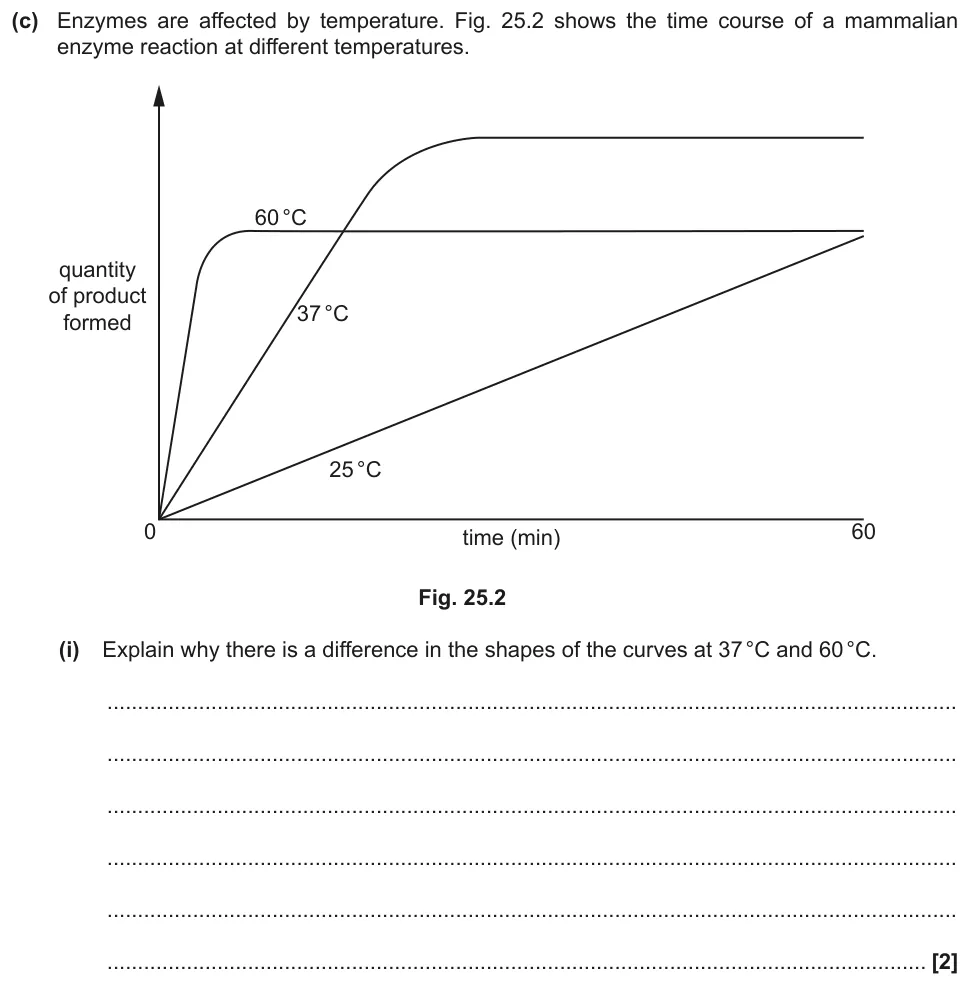
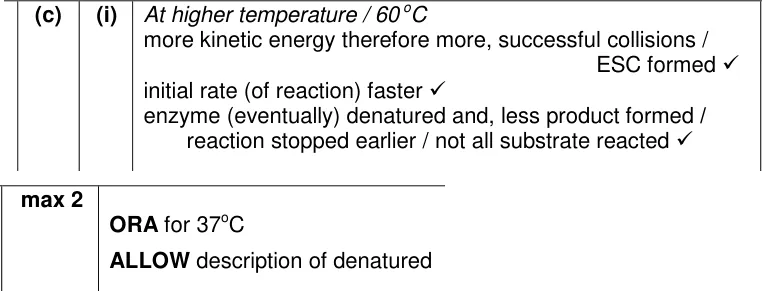
Explain why the product-time curves for a mammalian enzyme differ at 37 °C and 60 °C.
Show the mark scheme
Tap an image to open it full size.
From the examiners' report: Many students wrote GCSE answers about 37 °C being the temperature enzymes "work best at" and ignored the faster start at 60 °C. Explain both parts of the curve: more kinetic energy first, then denaturation.
Question 13
AS Paper 1 · June 2019 · Q25(c)(ii) · 2 marks · Medium
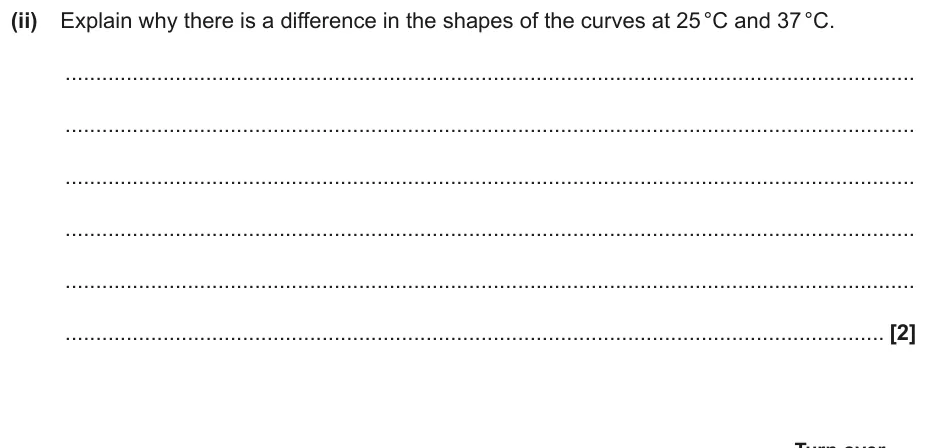
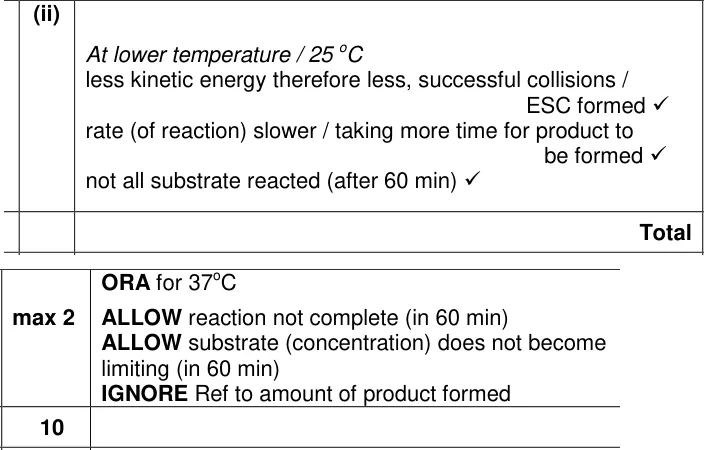
Explain why the curves at 25 °C and 37 °C differ.
Show the mark scheme
Tap an image to open it full size.
From the examiners' report: Many students said the enzyme was denatured at 37 °C, which they had just called the optimum. At 25 °C the reaction is slower because of less kinetic energy, so it simply hasn't finished in 60 minutes.
Question 14
A level Paper 2 · June 2023 · Q17(c) · 3 marks · Medium
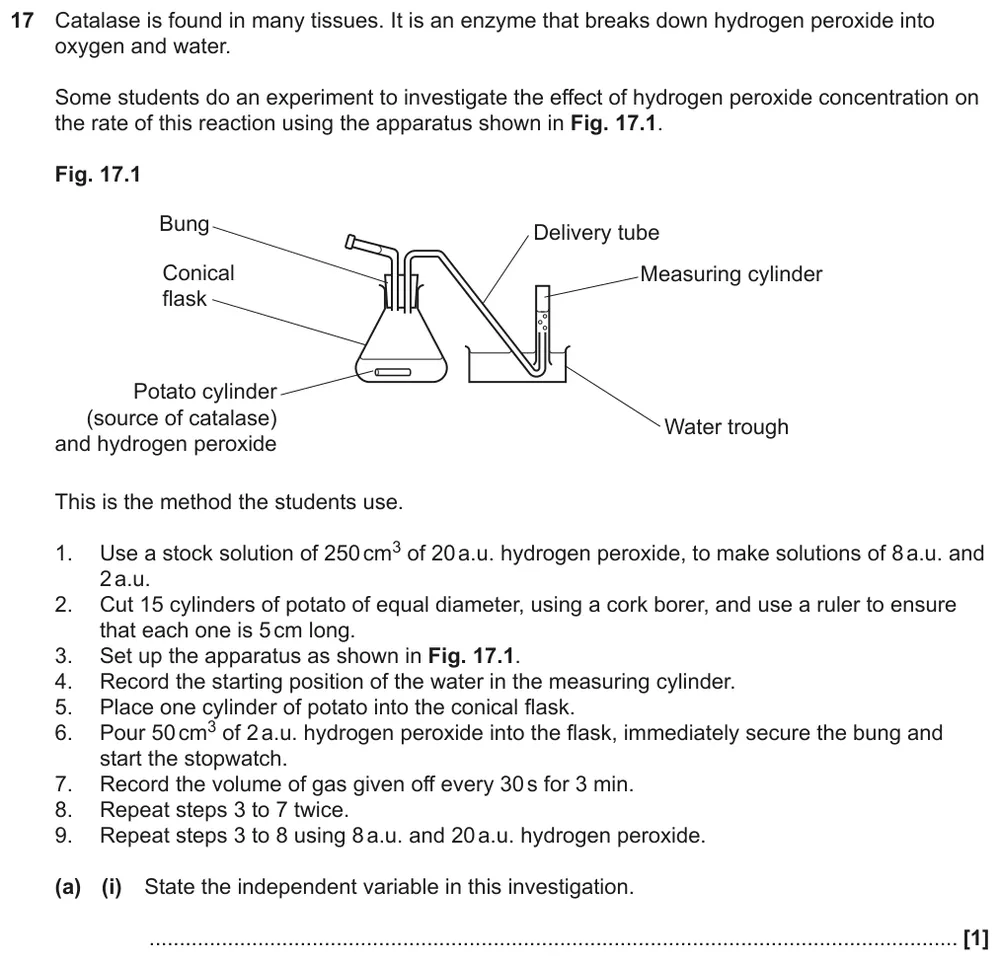
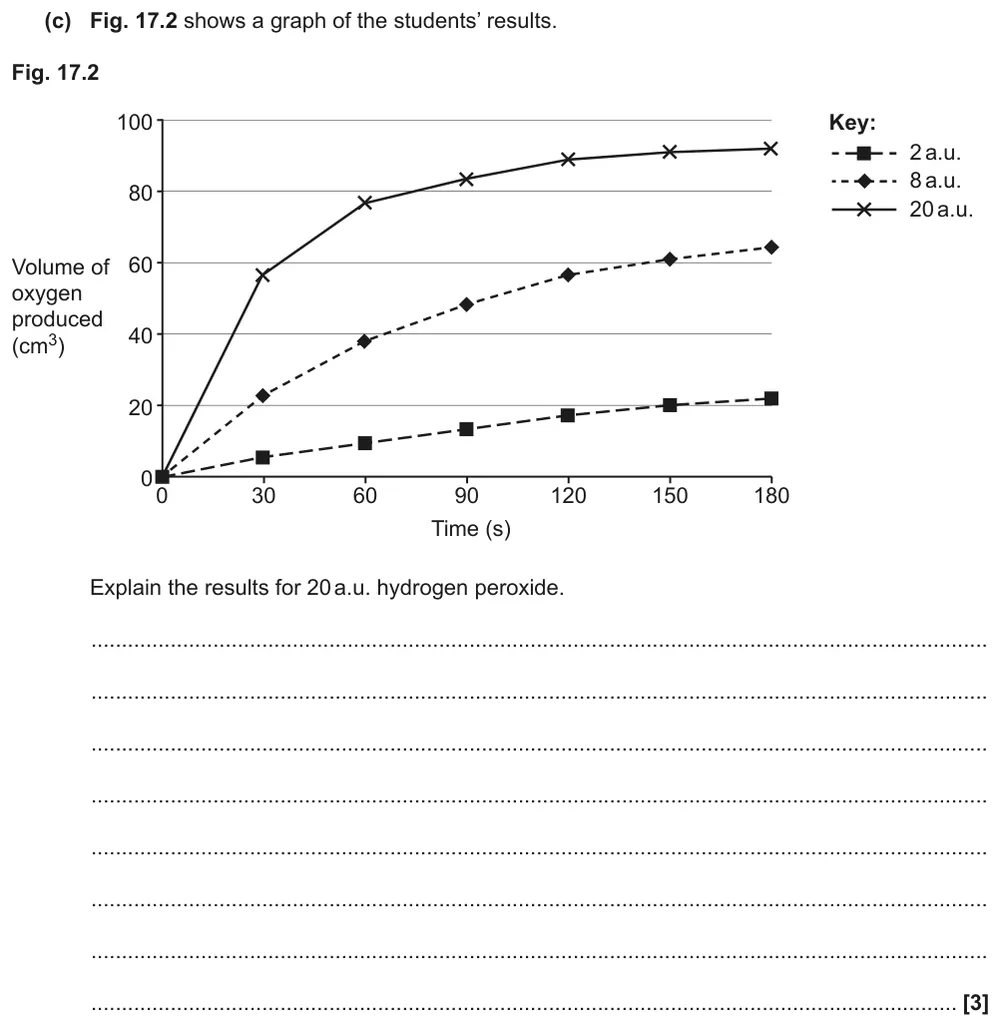
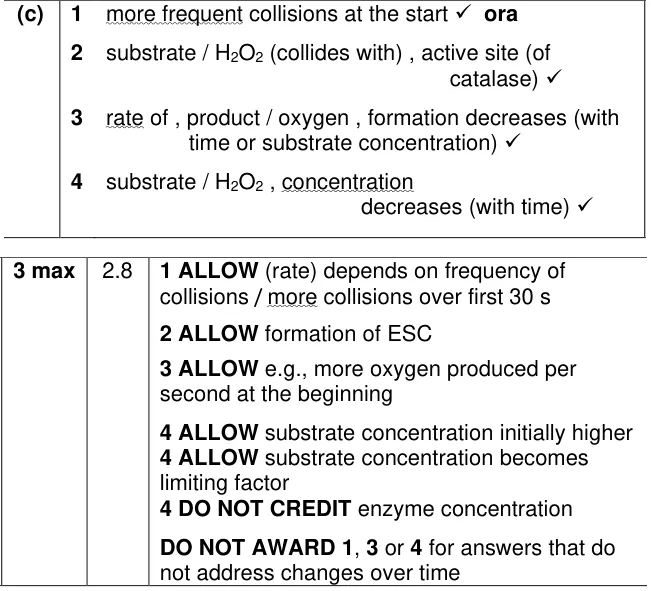
Explain the shape of the oxygen volume-time curve for catalase with 20 a.u. hydrogen peroxide.
Information from earlier in this question:
Show the mark scheme
Tap an image to open it full size.
From the examiners' report: Notice that the y-axis is volume, not rate, and explain changes over time for the 20 a.u. line only. Use the words "rate" and "substrate concentration", and link collisions to frequency.
Question 15
A level Paper 2 · June 2022 · Q21(b)(i) · 2 marks · Hard
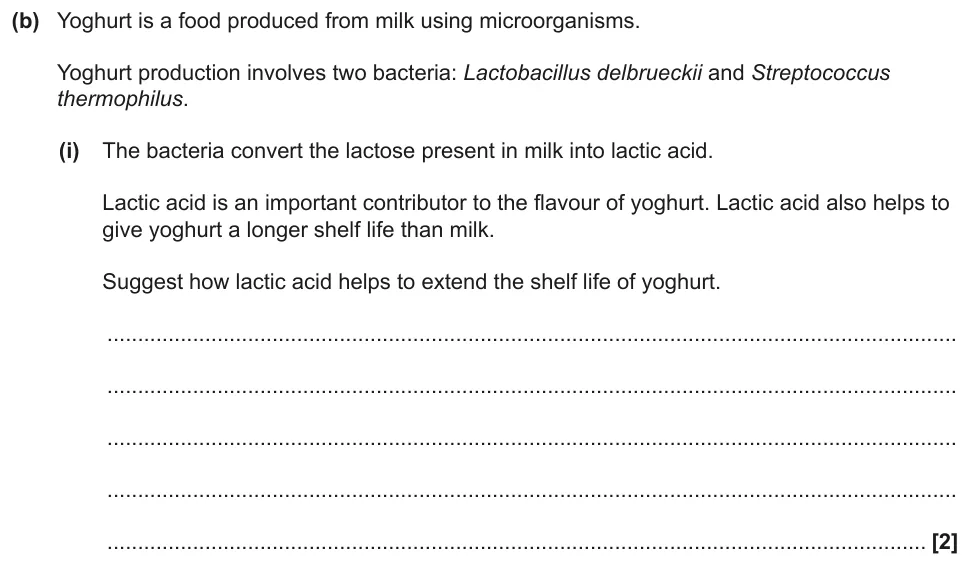
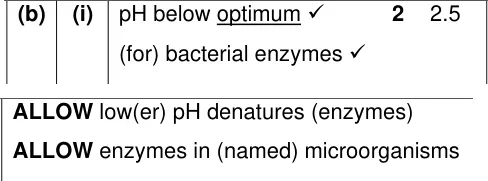
Suggest how lactic acid extends the shelf life of yoghurt.
Show the mark scheme
Tap an image to open it full size.
From the examiners' report: Most students just said lactic acid stops microbes growing. Link it to enzymes: the low pH is below the optimum for bacterial enzymes, so they work slowly or are denatured.
Practical and maths
Question 16
A level Paper 1 · June 2022 · Q20(b)(i) · 2 marks · Easy
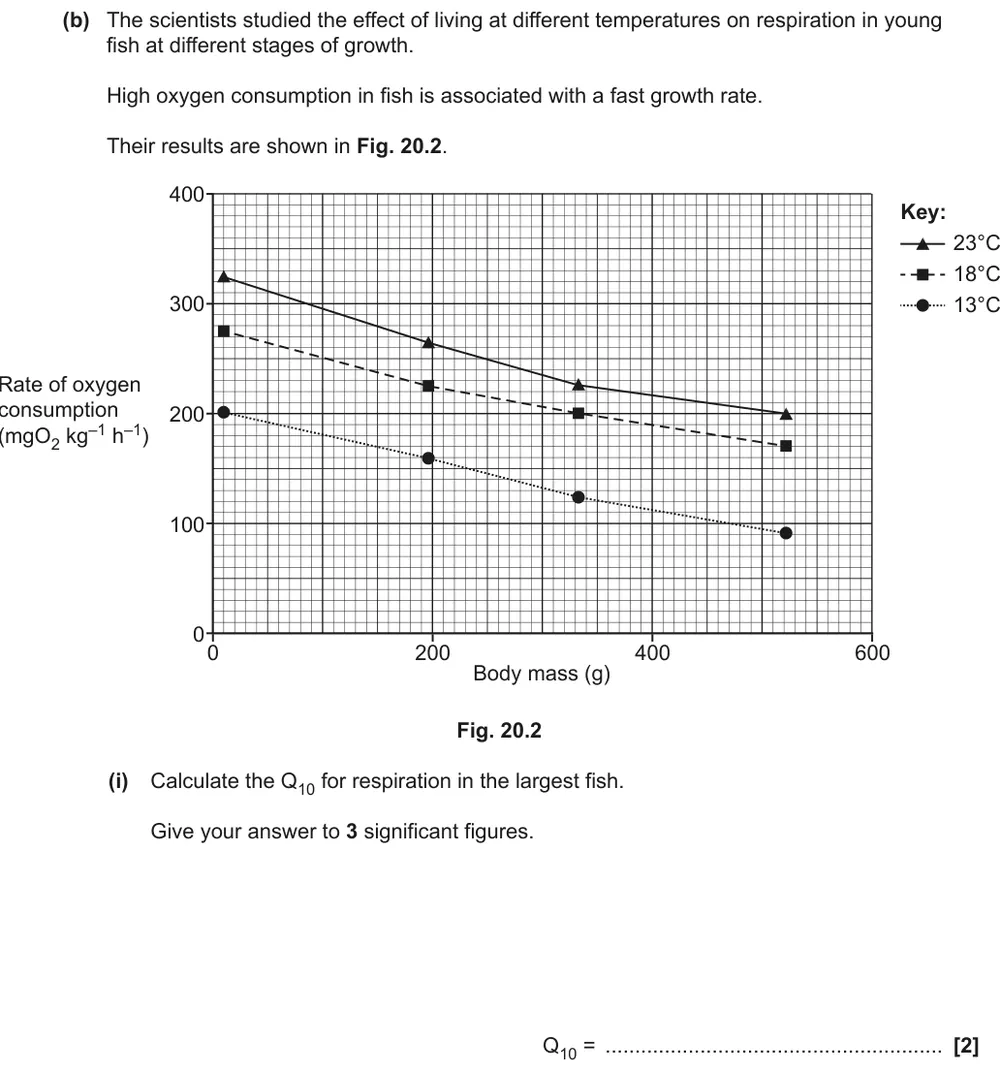
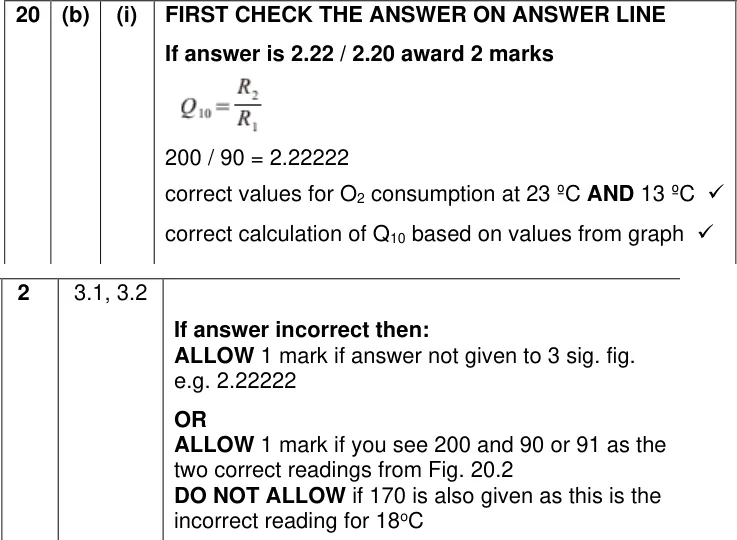
Read oxygen consumption at 23 °C and 13 °C from a graph and calculate Q10 to 3 significant figures.
Show the mark scheme
Tap an image to open it full size.
From the examiners' report: Most students did well here. Q10 compares temperatures 10 °C apart, so read the 23 °C and 13 °C lines, not 18 °C, and give the answer to 3 significant figures.
Question 17
AS Paper 2 · June 2025 · Q3(b)(i) · 3 marks · Medium
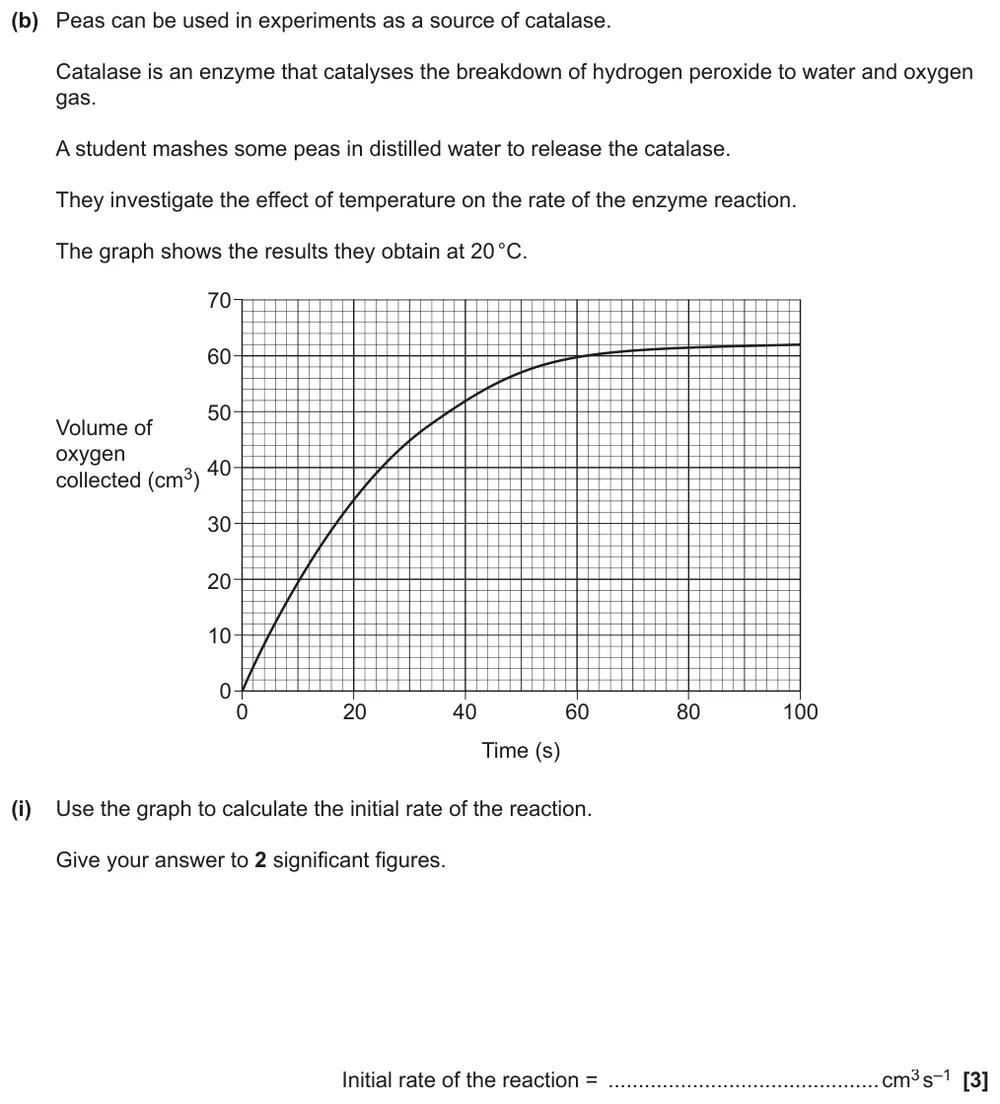
Draw a tangent to find the initial rate of catalase from pea extract, to 2 significant figures.
Show the mark scheme
Tap an image to open it full size.
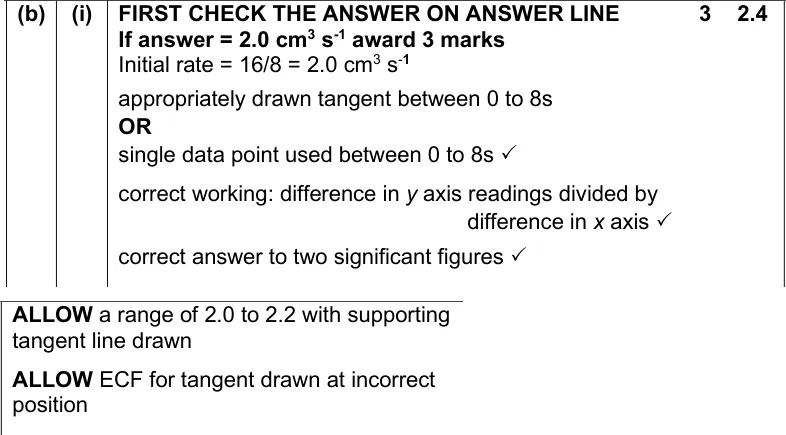
From the examiners' report: Many students drew the tangent in the wrong place or didn't give 2 significant figures. Draw the tangent at the very start of the curve (0 to 8 s) and divide the change in y by the change in x.
Question 18
AS Paper 2 · June 2025 · Q3(b)(ii) · 1 mark · Hard
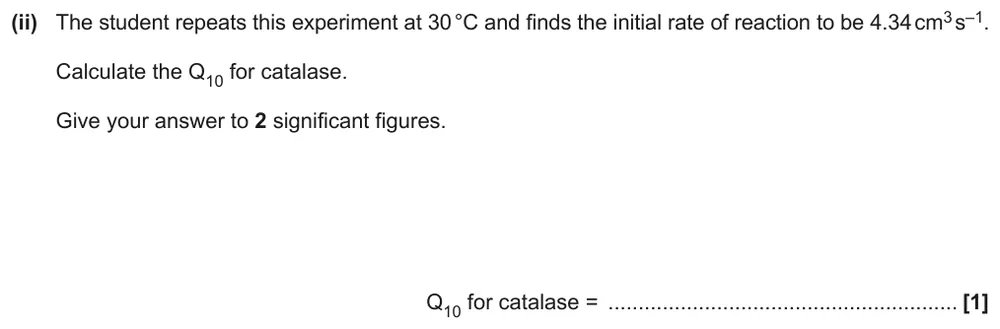
Calculate Q10 for catalase from the initial rates at 20 °C and 30 °C.
Show the mark scheme
Tap an image to open it full size.
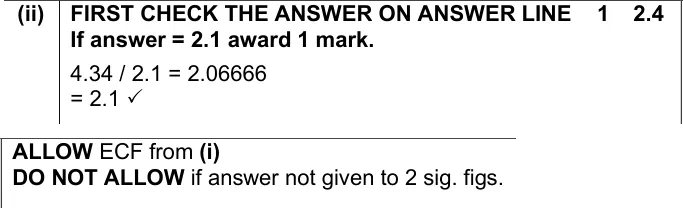
From the examiners' report: Few students got this mark, often because of rounding. Divide the rate at the higher temperature by the rate at the lower one and give exactly 2 significant figures.
Where students lose marks (from OCR examiners' reports and mark schemes)
Each point below is followed by wording that gained marks.
Inside a stomach isn't inside a cell: Asked whether bacterial cellulose-digesting enzymes act inside or outside cells, some students confused being inside an organ, the stomach, with being inside a cell.
✔ Gains credit: "Extracellular, because the reaction takes place outside the bacterial cells: cellulose cannot enter the cells."
Catalase stays inside the cell: The most common error in the intracellular/extracellular table was ticking catalase as extracellular, probably because it is used so often in practicals.
✔ Gains credit: TET and catalase catalyse intracellular reactions; trypsin catalyses an extracellular reaction.
A Ca²⁺ ion is a cofactor, never a coenzyme: Many students called the calcium ion that binds to trypsin a coenzyme or a prosthetic group, which the mark scheme does not allow.
✔ Gains credit: "The calcium ion is a cofactor for trypsin" and "enterokinase is an enzyme that converts trypsinogen to trypsin".
Coenzymes only visit: Few students said that coenzymes are not permanently bound to the enzyme, and some said they bind permanently, which was not credited.
✔ Gains credit: "Coenzymes assist enzymes without being permanently bound to them, for example by helping the substrate bind to the active site."
Read the 60 °C curve before quoting 37 °C: Most students wrote that 37 °C is the optimum where enzymes "work best", ignoring the faster start at 60 °C on the graph, and described the curves instead of explaining them.
✔ Gains credit: "At 60 °C there is more kinetic energy, so more successful collisions and ESCs and a faster initial rate; the enzyme is then denatured, so the reaction stops earlier and less product forms."
The substrate runs low, not the enzyme: Explaining why oxygen production slowed with time, many students said enzyme availability fell, which the mark scheme does not credit, and some read the volume axis as rate.
✔ Gains credit: "Collisions are more frequent at the start; the rate of oxygen formation decreases because the hydrogen peroxide concentration decreases with time."
End-product, not end-point or feedback: Naming the inhibition of PFK by ATP and PEP, some students wrote "end point inhibition", "homeostasis" or "negative feedback".
✔ Gains credit: "End-product inhibition."
Catalase's initial rate: tangent from 0 to 8 s: Many students drew the tangent away from the start of the curve, and many did not give the rate or Q10 to the 2 significant figures asked for.
✔ Gains credit: "Tangent between 0 and 8 s: 16 ÷ 8 = 2.0 cm³ s⁻¹", then "Q10 = 4.34 ÷ 2.1 = 2.1".
Download the questions
Download the PDF pack (18 questions, mark schemes at the end)
Keep practising
- Enzymes quiz
- PAG 4 Enzyme Rates: OCR A Level Biology exam questions by topic
- Graph Skills (M3): OCR A Level Biology exam questions by topic
- Biological Membranes (2.1.5): OCR A Level Biology exam questions by topic
- Enzymes: interactive written questions (20)
- OCR A Level Biology masterclasses
Questions, mark schemes and examiners' report extracts © OCR.