

Photosynthesis is one of the big topics in Module 5, and OCR like to test it with unfamiliar data. Spec point 5.2.1 asks you to link photosynthesis to respiration, to know the structure of a chloroplast and where each stage happens, to explain why plants need several pigments and how to separate them by thin layer chromatography, and to describe the light-dependent stage and the Calvin cycle. It finishes with the uses of triose phosphate and the factors that limit the rate, including what happens to GP, RuBP and TP when conditions change.
Most marks slip away on precise names and on reading data. Students confuse RuBP with RuBisCO, put the Calvin cycle in the thylakoids, write vaguely that temperature "affects" enzymes, or describe a graph without saying which factor is limiting. With an experiment, the examiners want the right comparison, such as GM against unmodified plants at the same time.
Work through the seventeen questions below in order. They start with recall, move on to applying what you know to new data, and finish with chromatography and practical work. If you'd like to go through questions like these with me each week, my OCR A masterclasses run on Wednesdays at 5.15pm for Year 12 and on Tuesdays at 6.30pm or Thursdays at 5.15pm for Year 13.
Want help with this topic? It comes up in my weekly OCR A masterclasses. See the timetable →
What you need from GCSE
Each question on this page assumes you're secure on these GCSE ideas. If any of them feels shaky, look it up before you start.
- Photosynthesis: carbon dioxide + water → glucose + oxygen, using light energy absorbed by chlorophyll in chloroplasts. It is an endothermic reaction.
- Aerobic respiration: glucose + oxygen → carbon dioxide + water, releasing energy. Plants respire all the time, day and night.
- Light intensity, carbon dioxide concentration and temperature can each limit the rate of photosynthesis.
- Plants use glucose to make starch for storage, cellulose for cell walls, and (with nitrate ions) amino acids for proteins.
- Paper chromatography separates a mixture; Rf = distance moved by the spot ÷ distance moved by the solvent.
Key terms
These words come up in the questions and mark schemes. Examiners expect you to use them exactly.
- Thylakoid and granum: flattened membrane sacs containing the photosystems and electron carriers; a stack of thylakoids is a granum. Site of the light-dependent stage.
- Stroma: the fluid inside the chloroplast envelope, containing enzymes such as RuBisCO, starch grains, DNA and ribosomes. Site of the light-independent stage.
- Primary and accessory pigments: chlorophyll a at the reaction centre loses excited electrons; accessory pigments (chlorophyll b, carotenoids) absorb other wavelengths and pass the energy to the reaction centre.
- Photolysis: splitting of water by light energy into protons, electrons and oxygen; it replaces electrons lost from photosystem II.
- Photophosphorylation: making ATP using energy from light, via the electron transport chain and chemiosmosis; non-cyclic also makes reduced NADP, cyclic makes ATP only.
- RuBP and RuBisCO: ribulose bisphosphate is the 5-carbon acceptor of CO2; ribulose bisphosphate carboxylase (RuBisCO) is the enzyme that fixes the CO2.
- GP and TP: glycerate 3-phosphate is formed when CO2 is fixed; it is reduced to triose phosphate using ATP and reduced NADP.
- Limiting factor: the factor in shortest supply, which determines the rate; increasing it increases the rate until another factor limits.
- Rf value: distance moved by a pigment ÷ distance moved by the solvent front, measured from the origin.
What these questions cover (OCR 5.2.1)
The questions test these learning outcomes from the OCR A Level Biology A specification (H420):
- (a) the interrelationship between the process of photosynthesis and respiration
- (b) the structure of a chloroplast and the sites of the two main stages of photosynthesis
- (c)(i) the importance of photosynthetic pigments in photosynthesis
- (c)(ii) practical investigations using thin layer chromatography (TLC) to separate photosynthetic pigments (PAG6)
- (d) the light-dependent stage of photosynthesis
- (e) the fixation of carbon dioxide and the light-independent stage of photosynthesis (RuBP, RuBisCO, GP and TP only; no other biochemical detail)
- (f) the uses of triose phosphate (TP)
- (g)(i) factors affecting photosynthesis (including the effect on GP, RuBP and TP)
- (g)(ii) practical investigations into factors affecting the rate of photosynthesis
How to use this page
Write your answer on paper before you open the mark scheme. Allow about 1.2 minutes per mark: the 17 questions are worth 45 marks, so about 54 minutes in total. Then mark your answer strictly against the mark scheme and read the examiners' tip underneath it. If you'd rather print the questions, download the PDF pack.
Recall
Question 1
A level Paper 3 · June 2017 · Q1(b)(ii) · 2 marks · Easy
State the precise location of photosynthetic pigments in a chloroplast.
Show the mark scheme

Tap an image to open it full size.
From the examiners' report: Most students got the thylakoid membrane. For the second mark be more precise still: the pigments sit in the photosystems, or light-harvesting systems.
Question 2
A level Paper 1 · June 2022 · Q22(a) · 4 marks · Medium
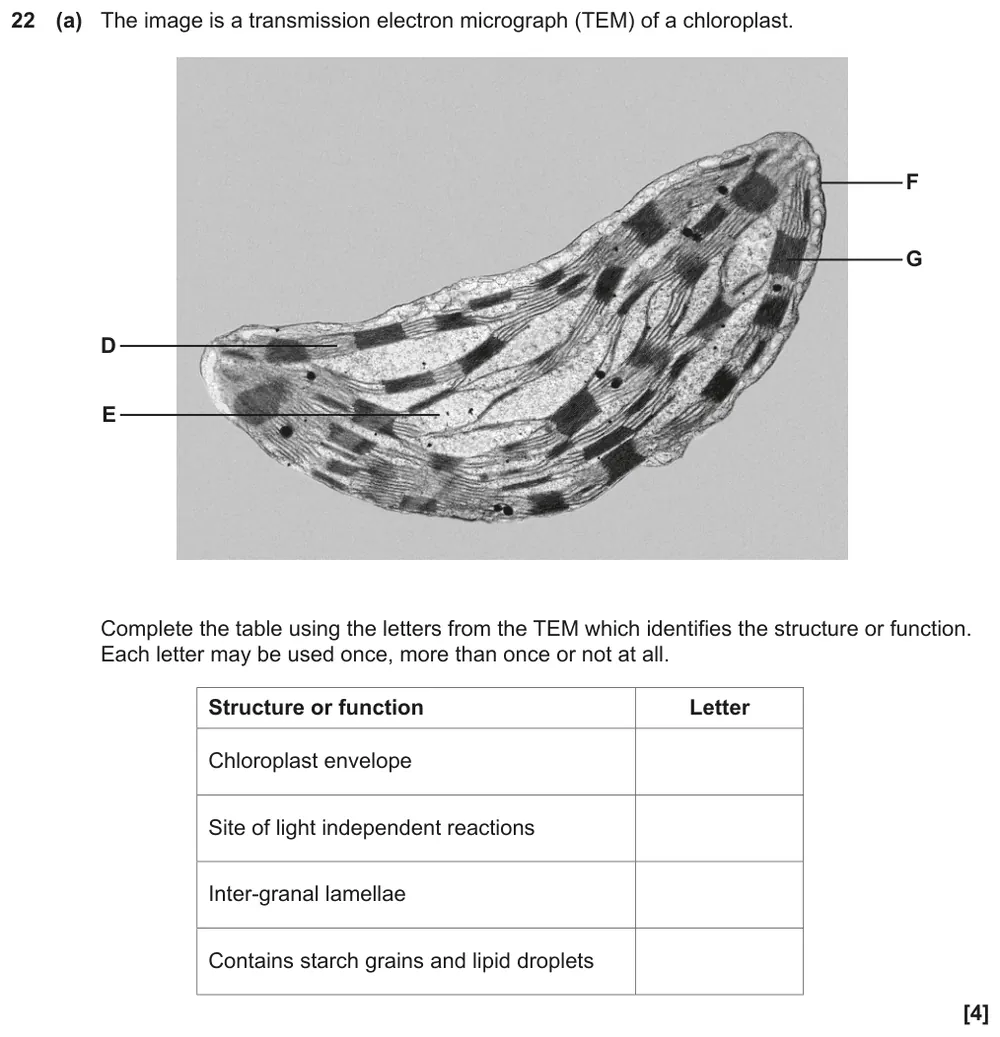
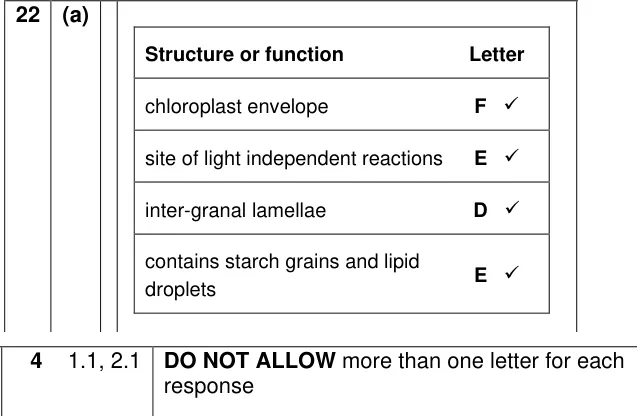
Use letters on a TEM of a chloroplast to identify the envelope, the site of the light-independent reactions, the inter-granal lamellae and starch storage.
Show the mark scheme
Tap an image to open it full size.
From the examiners' report: The light-independent stage happens in the stroma, not the thylakoids. The inter-granal lamellae are the single membranes linking one granum to the next.
Question 3
A level Paper 1 · June 2025 · Q16(a)(ii) · 2 marks · Hard
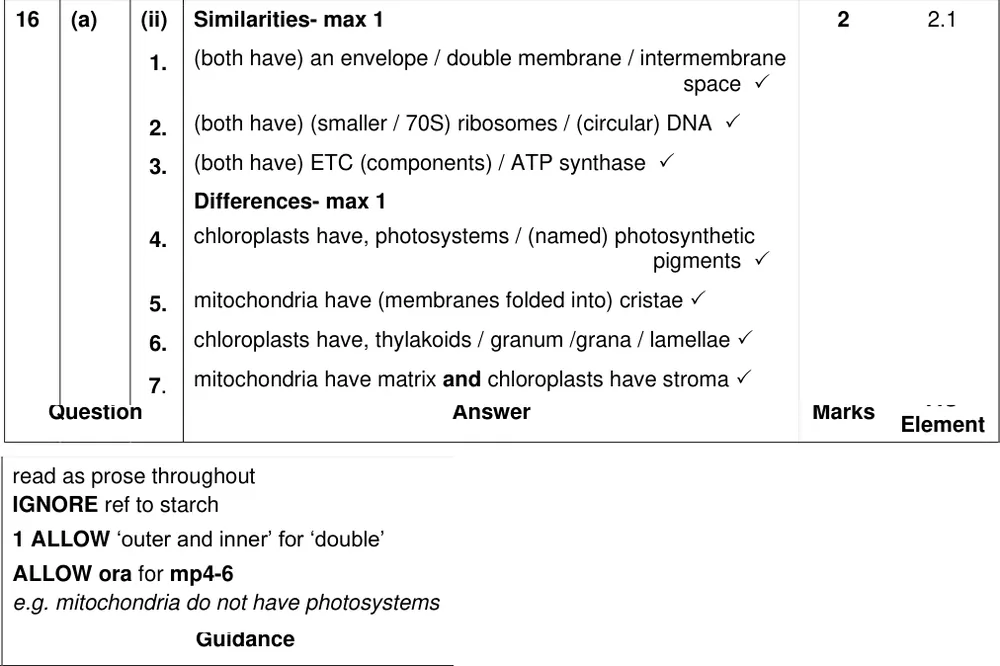
Give one structural similarity and one difference between chloroplasts and mitochondria.
Show the mark scheme
Tap an image to open it full size.
From the examiners' report: Compare organelles, not cells, so don't mention plasma membranes. Both have their own DNA, and starch is a product, not a structure, so it won't score as a difference.
Question 4
A level Paper 1 · June 2018 · Q17(a)(i) · 4 marks · Medium
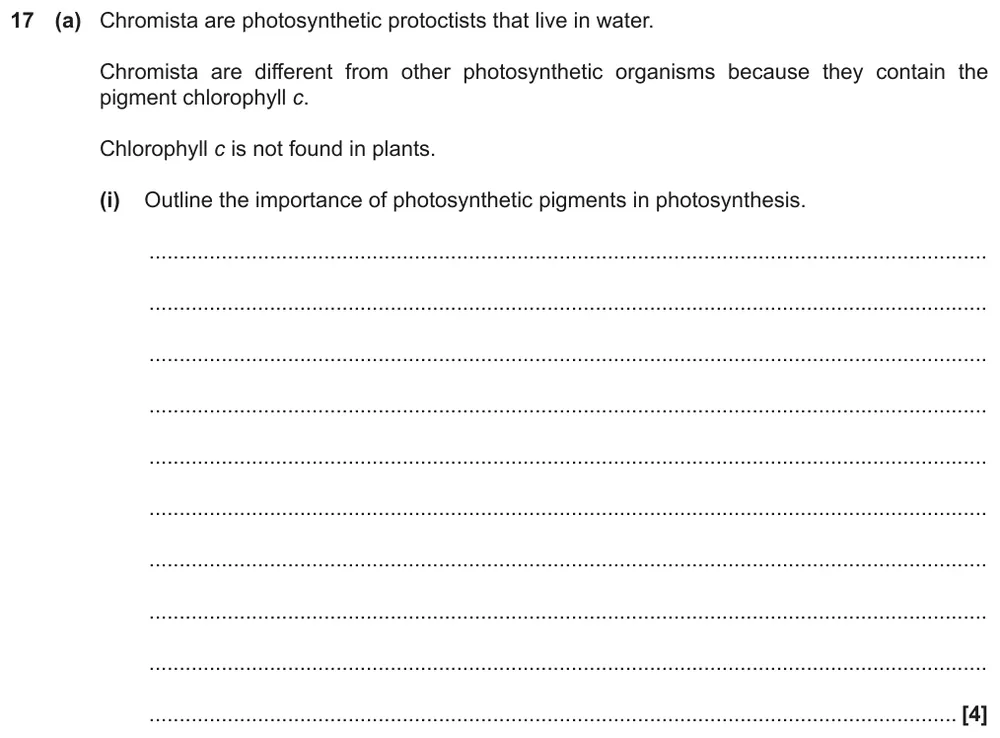
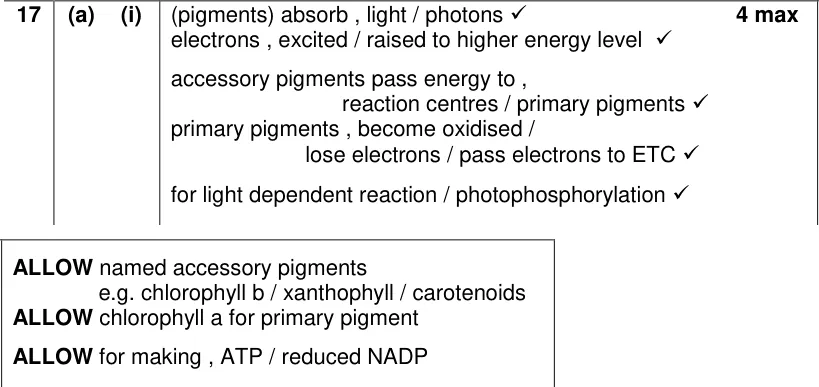
Outline the importance of photosynthetic pigments in photosynthesis.
Show the mark scheme
Tap an image to open it full size.
From the examiners' report: Absorbing light and exciting electrons are the easy marks. To reach full marks, separate the roles: accessory pigments pass energy to the reaction centre, and the primary pigment loses electrons to the electron transport chain.
Question 5
A level Paper 1 · June 2018 · Q17(a)(ii) · 1 mark · Medium
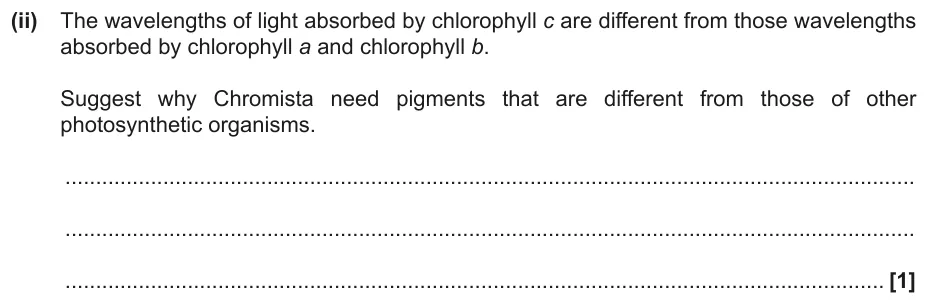
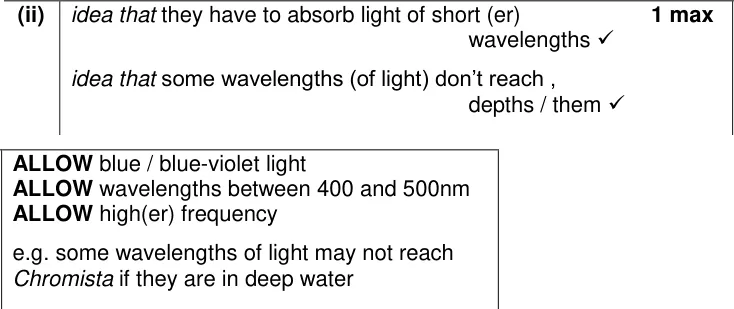
Suggest why Chromista living in water need pigments that absorb different wavelengths from plants.
Show the mark scheme
Tap an image to open it full size.
From the examiners' report: Living in water isn't enough. Say that only shorter wavelengths reach them at depth, so they need pigments that absorb those wavelengths.
Question 6
A level Paper 1 · June 2022 · Q22(b) · 5 marks · Hard
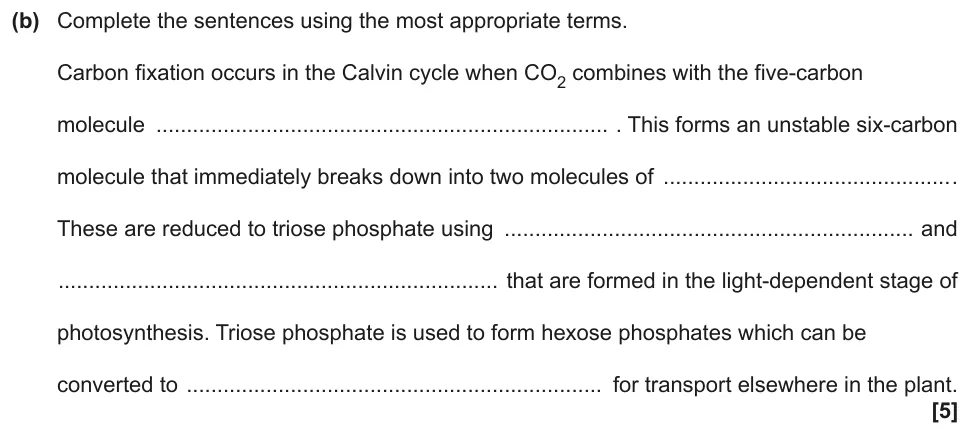
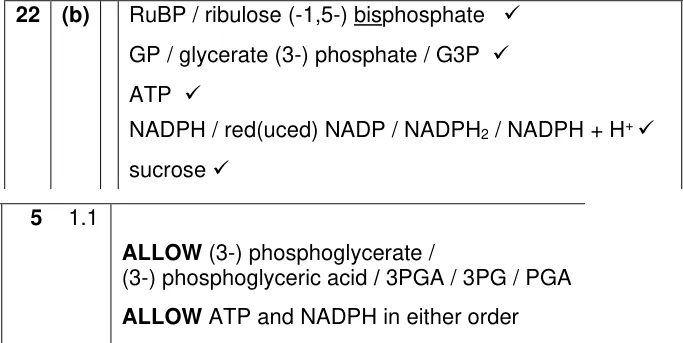
Complete sentences about carbon fixation and the Calvin cycle.
Show the mark scheme
Tap an image to open it full size.
From the examiners' report: Use the abbreviations RuBP and GP to avoid spelling slips like "biphosphate" or "glycerol phosphate", and don't mix up RuBP with RuBisCO. Write NADPH, not NADH, and read the word "transport": the answer is sucrose, not glucose.
Question 7
A level Paper 1 · June 2019 · Q22(a) · 4 marks · Medium
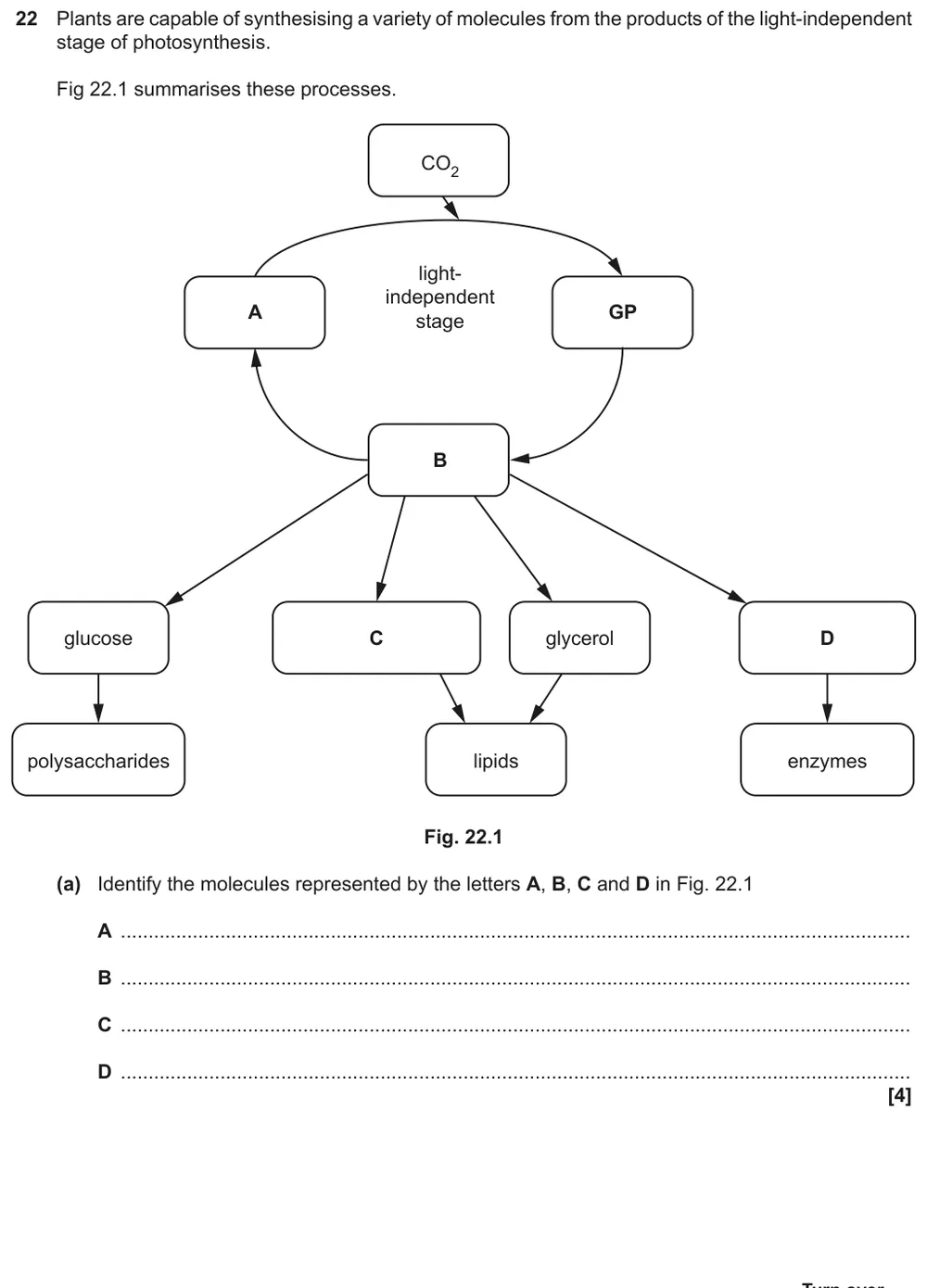
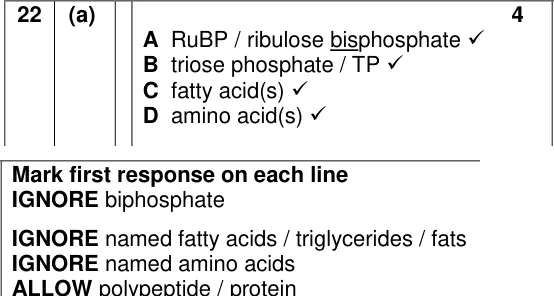
Identify four molecules in a diagram of what plants make from the light-independent stage.
Show the mark scheme
Tap an image to open it full size.
Applying what you know
Question 8
A level Paper 1 · June 2024 · Q17(a)(ii) · 3 marks · Medium
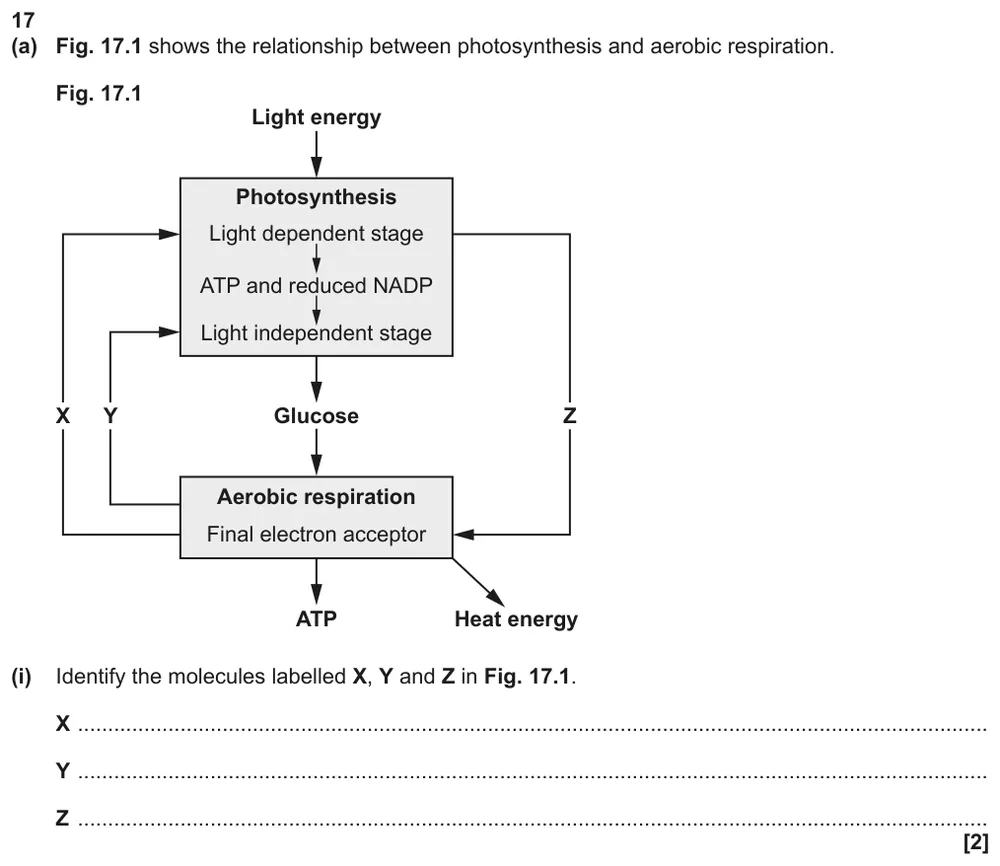
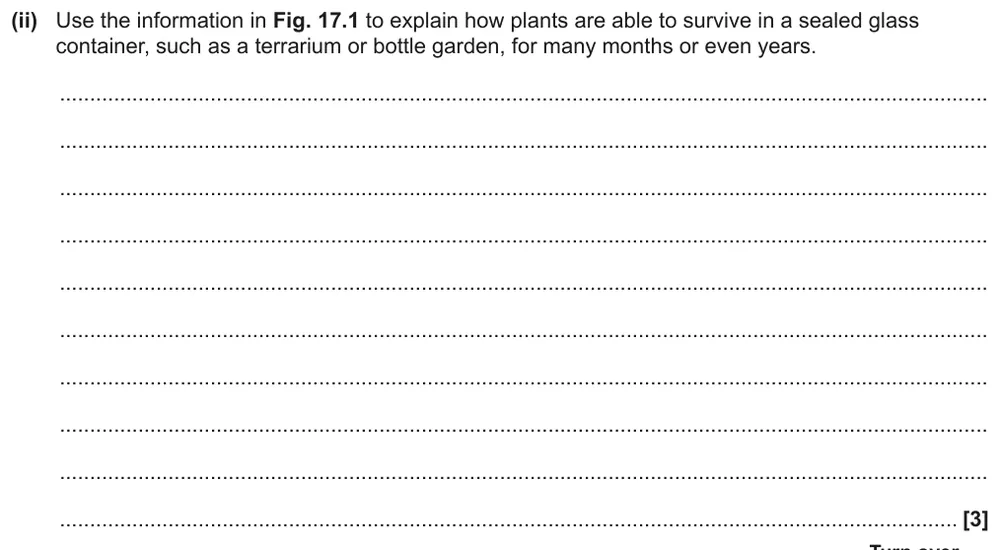
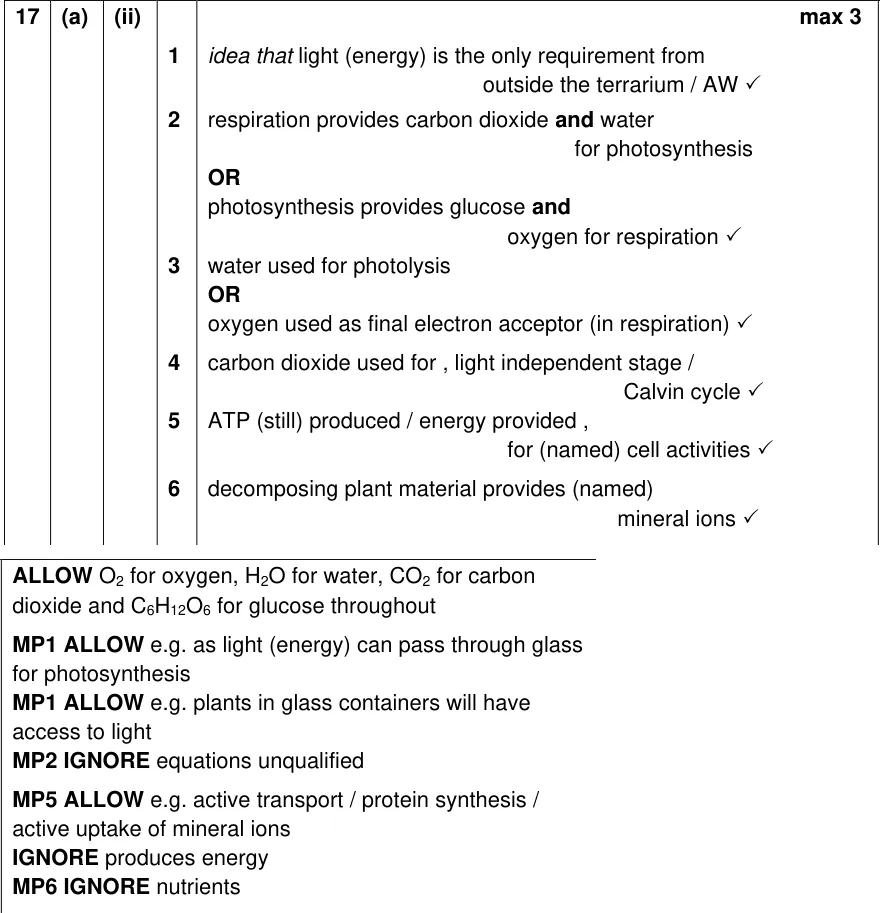
Use a diagram linking photosynthesis and respiration to explain how plants survive for years in a sealed terrarium.
Information from earlier in this question:
Show the mark scheme
Tap an image to open it full size.
Question 9
A level Paper 3 · June 2023 · Q3(a)(ii) · 2 marks · Medium
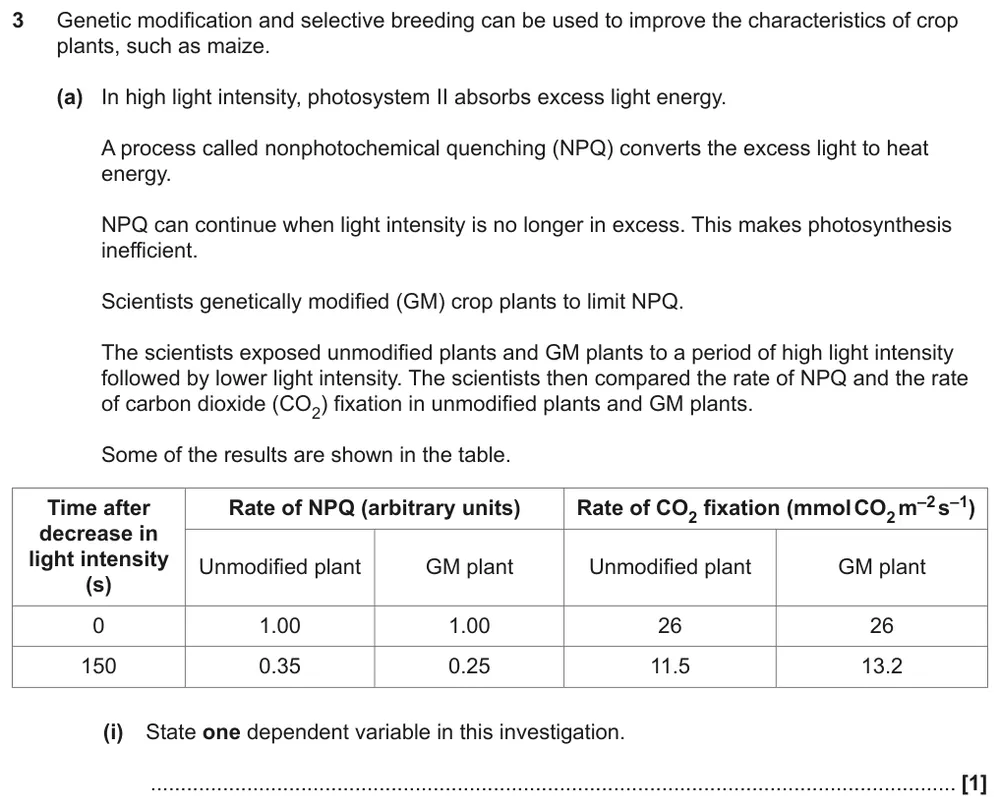
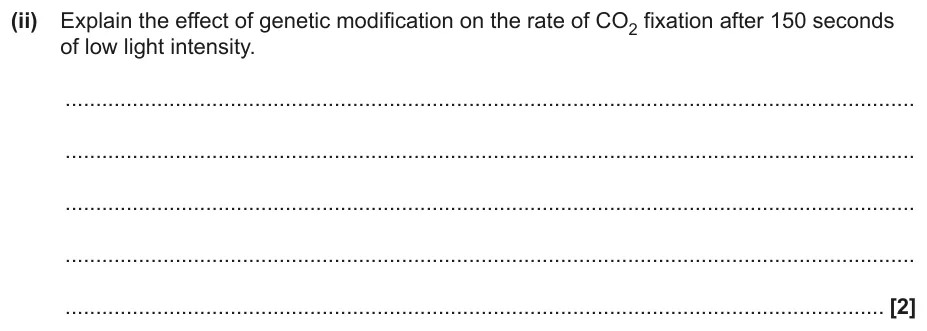
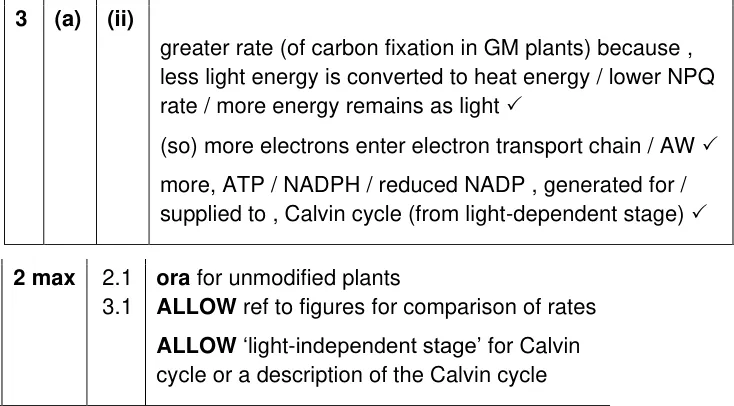
Explain the effect of genetic modification that limits NPQ on the rate of CO2 fixation in low light.
Information from earlier in this question:
Show the mark scheme
Tap an image to open it full size.
From the examiners' report: Compare GM and unmodified plants at 150 seconds, not one plant at 0 and 150 seconds. Then explain the link: less NPQ means more ATP and reduced NADP from the light-dependent stage for the Calvin cycle.
Question 10
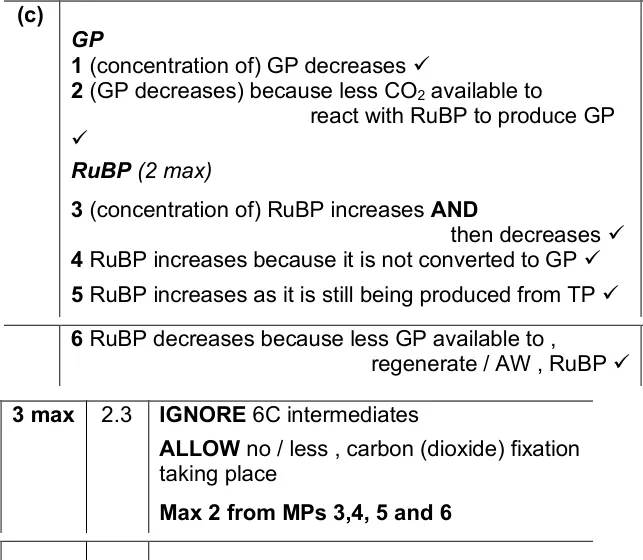
A level Paper 1 · November 2020 · Q17(c) · 3 marks · Medium
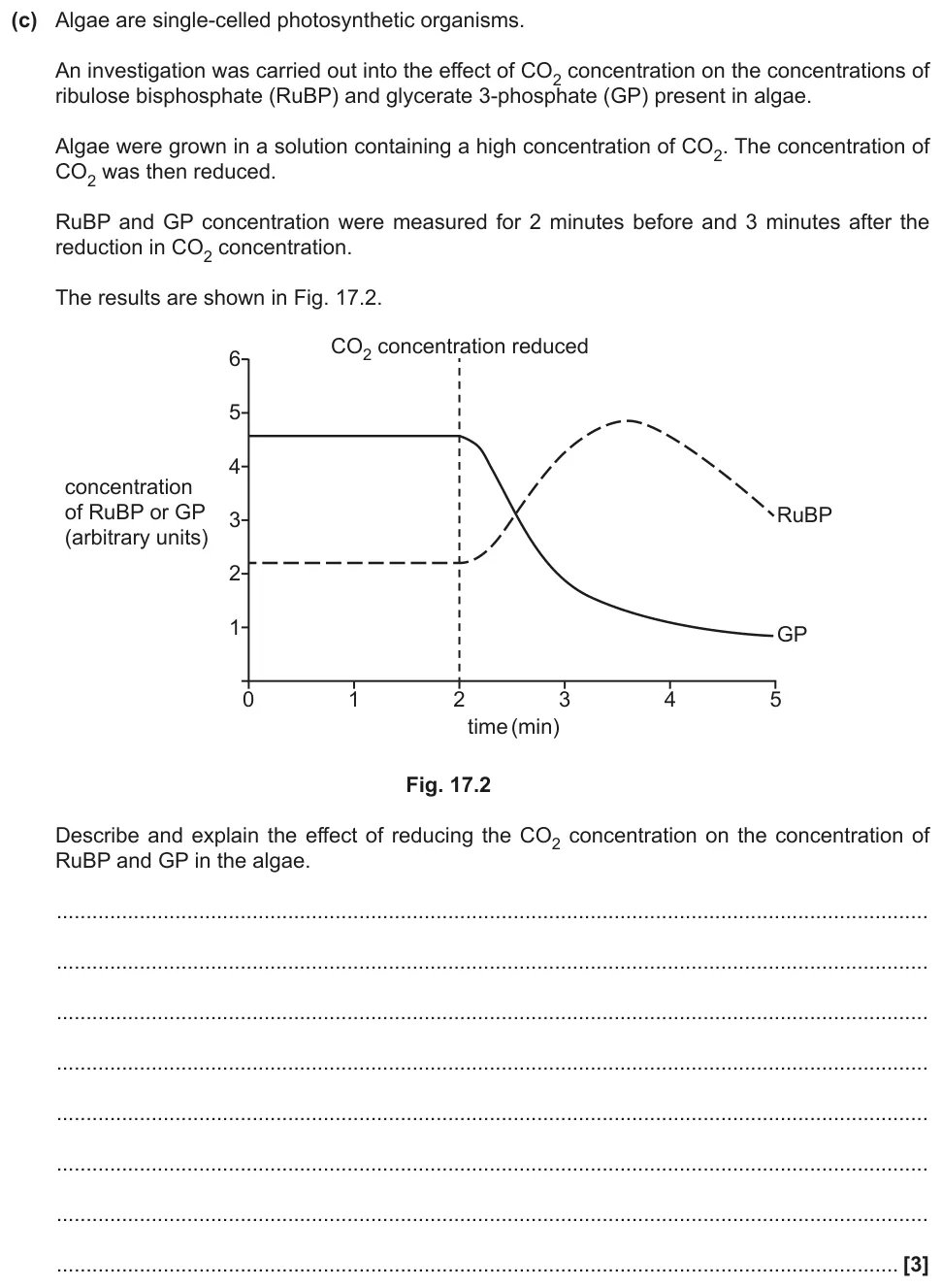
Describe and explain the effect of reducing CO2 concentration on RuBP and GP in algae.
Show the mark scheme
Tap an image to open it full size.
Question 11
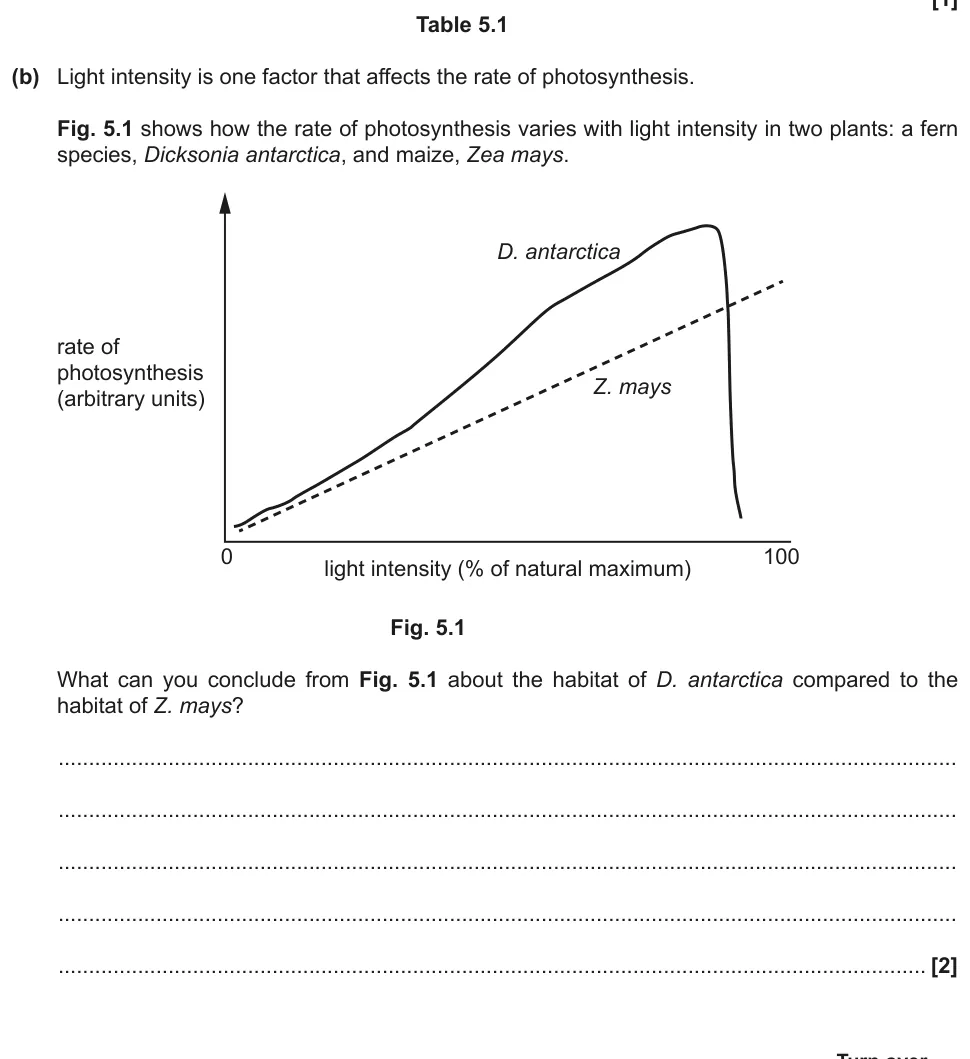
A level Paper 3 · November 2021 · Q5(b) · 2 marks · Easy
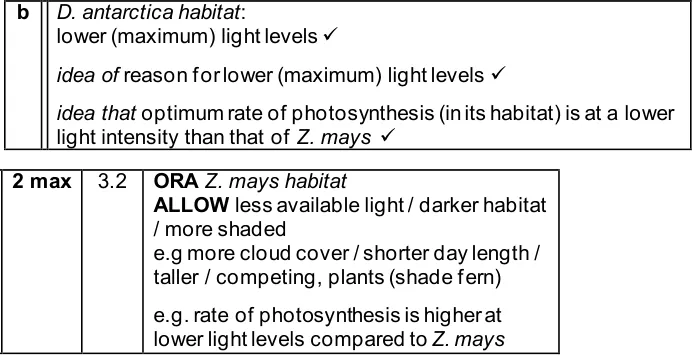
Compare the habitats of a fern and maize from graphs of photosynthesis rate against light intensity.
Show the mark scheme
Tap an image to open it full size.
From the examiners' report: Most students said the fern lives in lower light. Add a reason for the low light, such as shade from taller plants, to earn the second mark.
Question 12
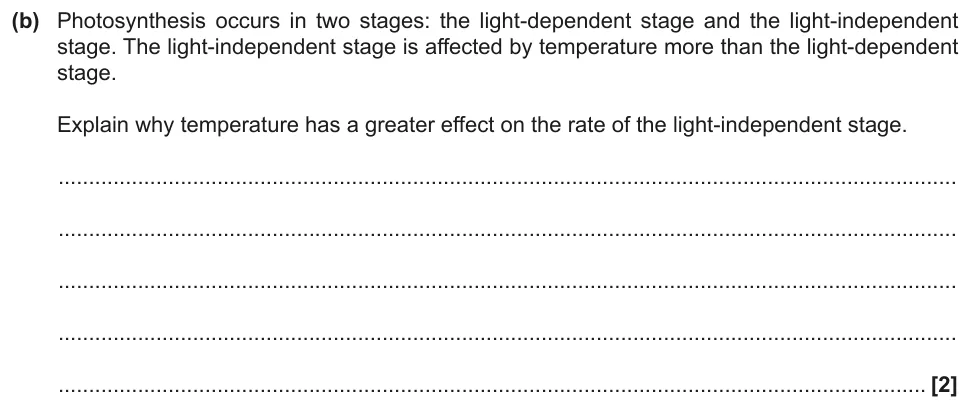
A level Paper 3 · June 2018 · Q3(b) · 2 marks · Hard
Explain why temperature affects the light-independent stage more than the light-dependent stage.
Show the mark scheme

Tap an image to open it full size.
From the examiners' report: Name RuBisCO, then be specific about temperature: more kinetic energy means more enzyme-substrate complexes, and too high a temperature denatures the enzymes. Temperature doesn't "excite" enzymes.
Question 13
A level Paper 1 · June 2025 · Q19(c)(i) · 2 marks · Hard
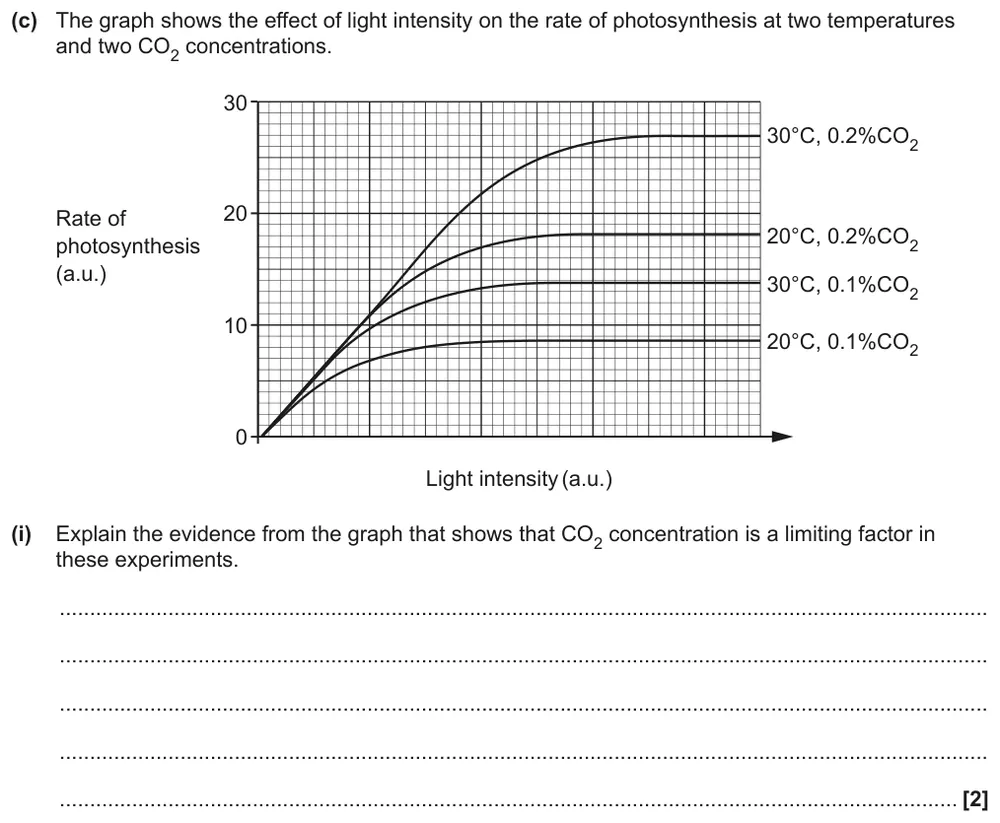
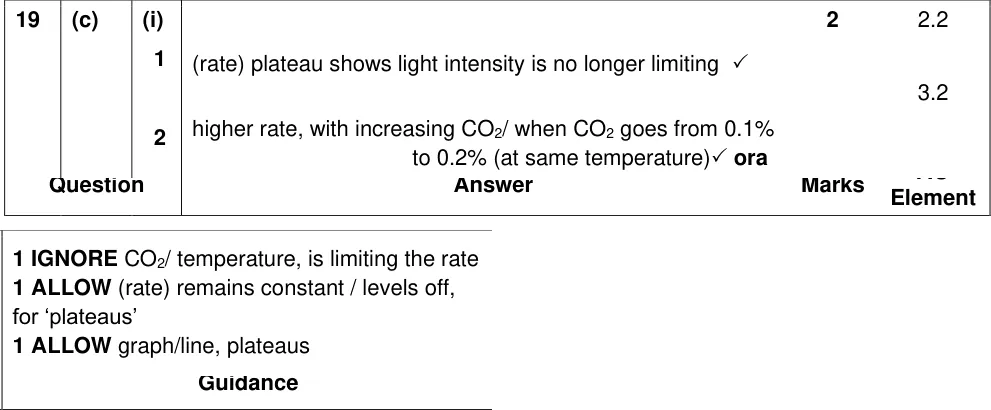
Explain the evidence from a graph that CO2 concentration is a limiting factor.
Show the mark scheme
Tap an image to open it full size.
From the examiners' report: Most students compared the two CO2 concentrations at the same temperature. For the other mark, explain that the plateau means light intensity is no longer the limiting factor.
Practical and maths
Question 14
A level Paper 1 · June 2025 · Q16(b)(i) · 3 marks · Easy
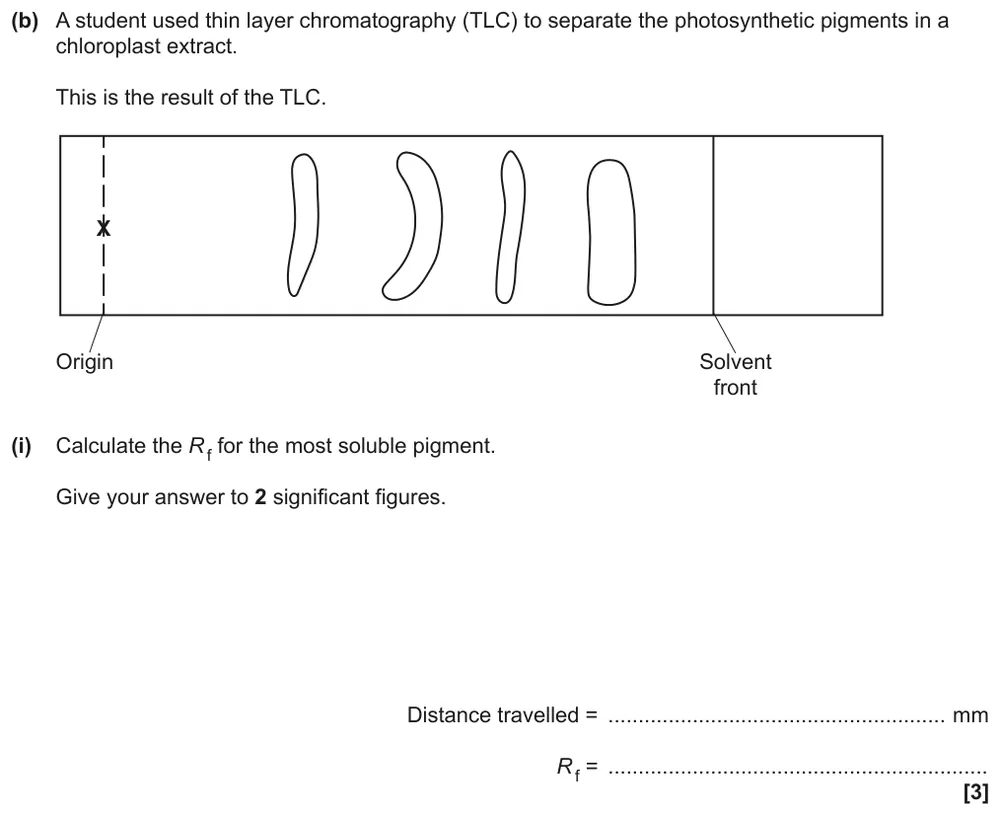
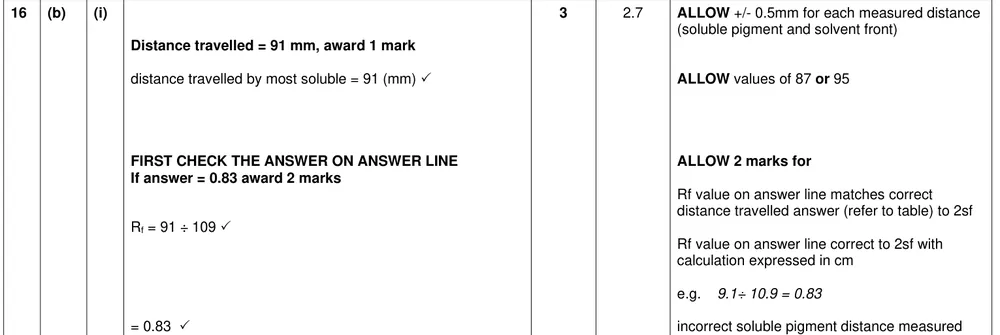
Measure a TLC plate and calculate the Rf of the most soluble pigment.
Show the mark scheme
Tap an image to open it full size.
From the examiners' report: The most soluble pigment travels furthest, nearest the solvent front. Measure from the origin to the middle of the spot in mm, as the answer line asks, and give Rf to 2 significant figures.
Question 15
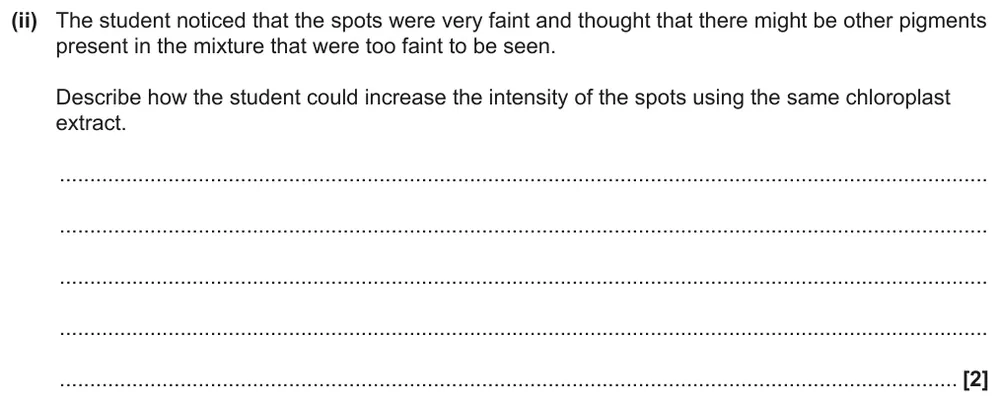
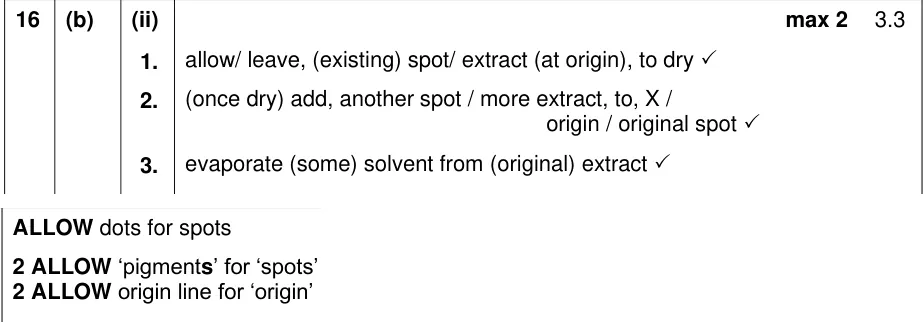
A level Paper 1 · June 2025 · Q16(b)(ii) · 2 marks · Medium
Describe how to make faint TLC spots more intense using the same chloroplast extract.
Show the mark scheme
Tap an image to open it full size.
From the examiners' report: Be explicit: let each spot of extract dry before adding more to the same spot on the origin. Just adding a bigger volume spreads the extract, and a stronger solvent or a stain doesn't help.
Question 16
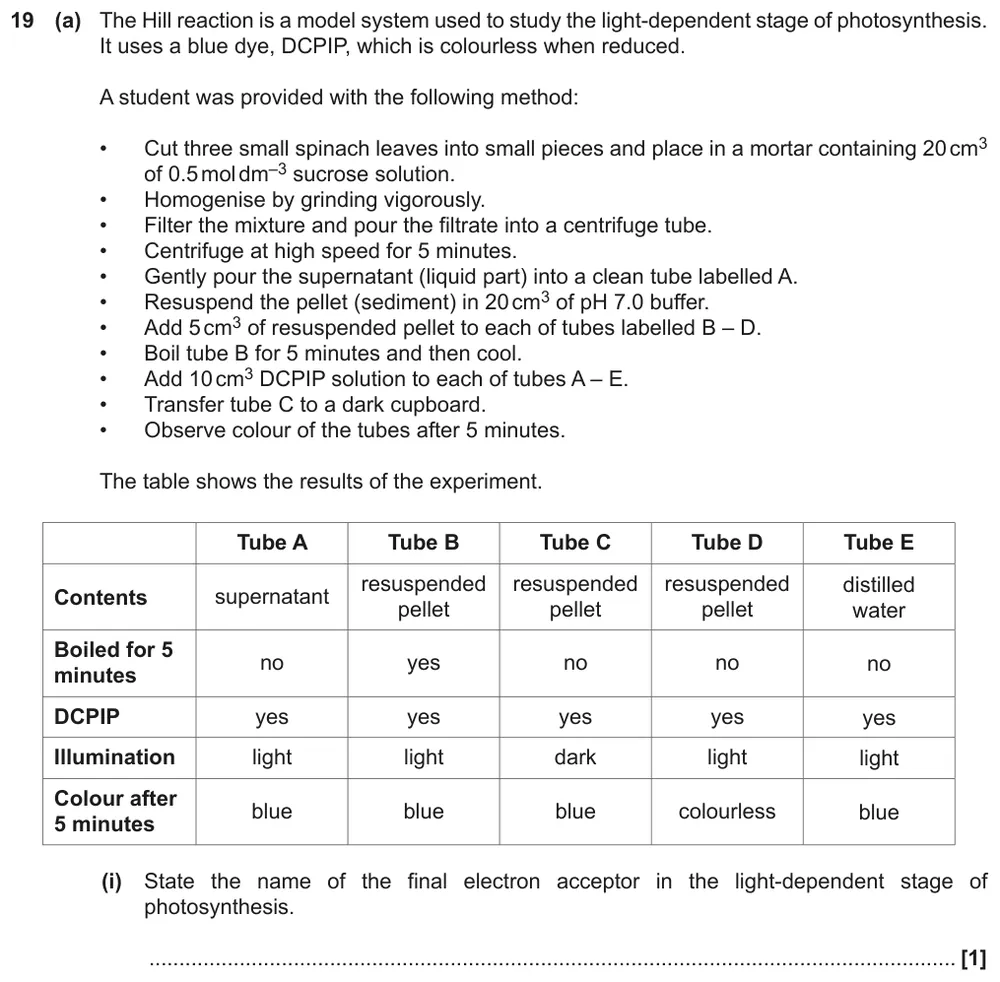
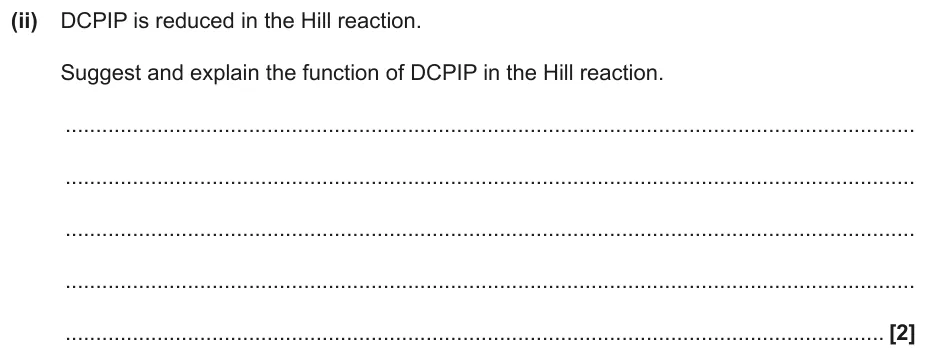
A level Paper 1 · November 2021 · Q19(a)(ii) · 2 marks · Medium
Suggest and explain the function of DCPIP in the Hill reaction.
Information from earlier in this question:
Show the mark scheme
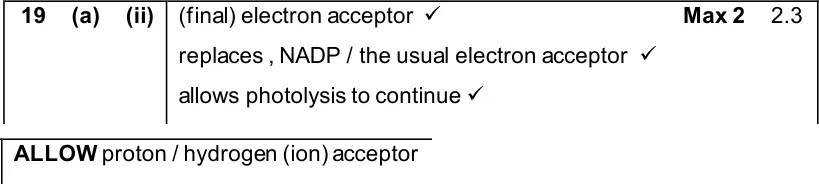
Tap an image to open it full size.
Question 17
A level Paper 1 · June 2018 · Q22(b) · 2 marks · Medium
Use respirometer results to explain the claim that photosynthesis only exceeds respiration above 1510 lux.
Information from earlier in this question:
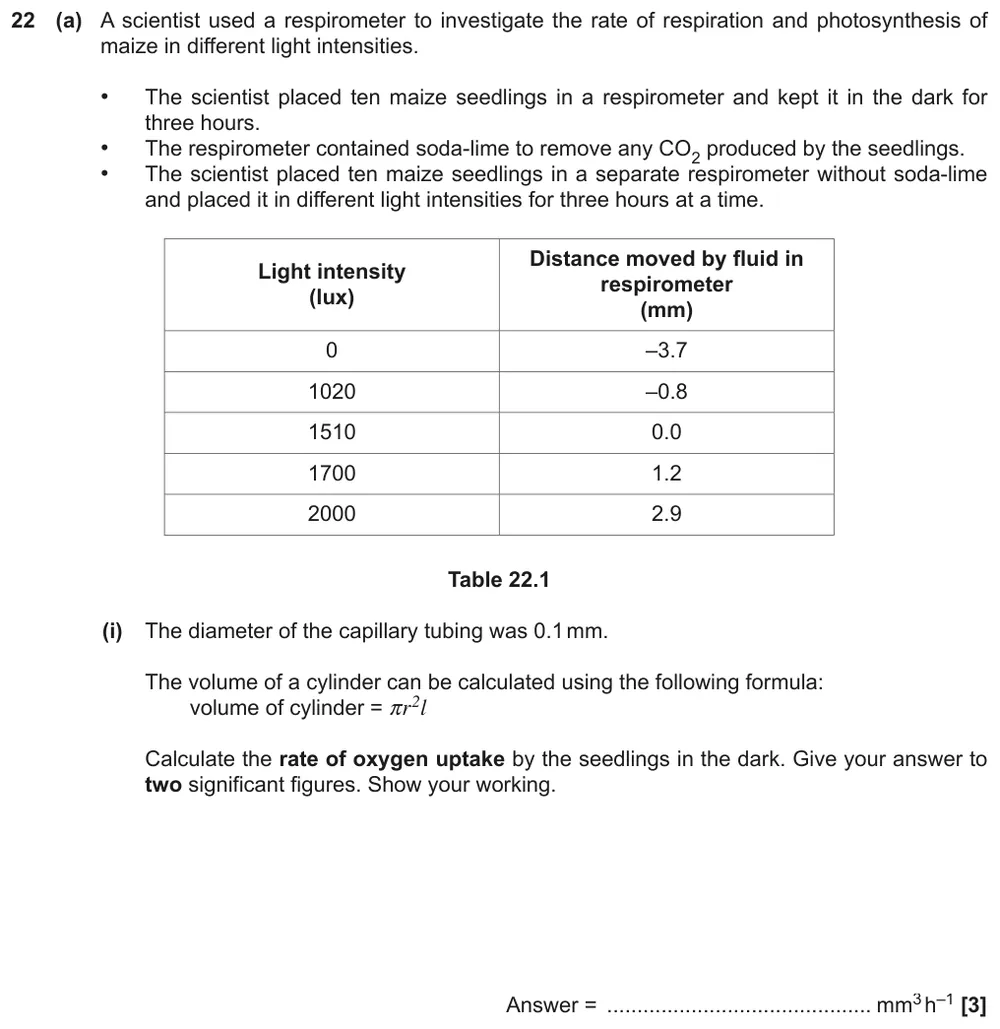
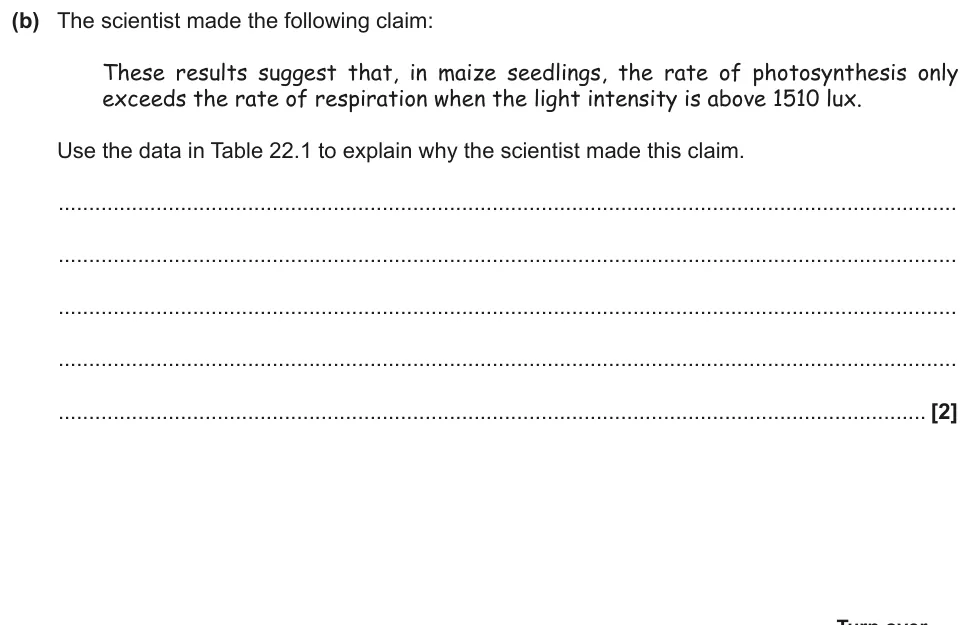
Show the mark scheme
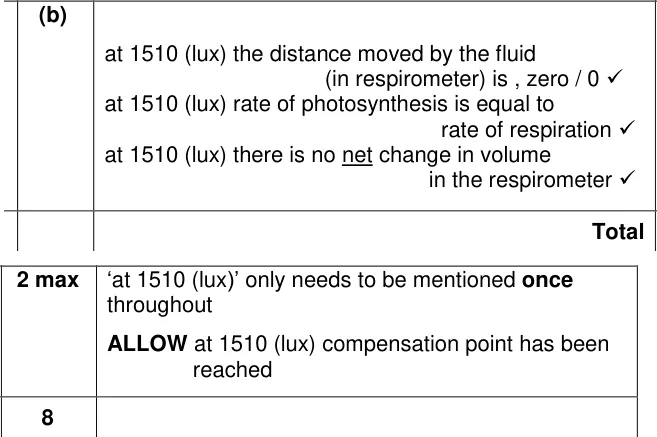
Tap an image to open it full size.
From the examiners' report: Quote the data: at 1510 lux the fluid doesn't move, so there's no net gas exchange and the rates of photosynthesis and respiration are equal.
Where students lose marks (from OCR examiners' reports and mark schemes)
Each point below is followed by wording that gained marks.
RuBP is the acceptor, RuBisCO the enzyme: In the Calvin cycle gap-fill, students wrote "ribulose biphosphate" or "glycerol phosphate", confused RuBP with RuBisCO, or wrote NADH or NADP instead of reduced NADP.
✔ Gains credit: "CO2 combines with RuBP ... two molecules of GP ... reduced to triose phosphate using ATP and reduced NADP (NADPH)".
Moved around the plant, so sucrose: Very few students spotted that the hexose phosphates were being converted for transport, and wrote glucose.
✔ Gains credit: "Triose phosphate is used to form hexose phosphates which can be converted to sucrose for transport".
The Calvin cycle runs in the stroma: On the chloroplast micrograph, the site of the light-independent reactions was often given as the thylakoids.
✔ Gains credit: "Site of light independent reactions: E", the stroma, which also contains the starch grains and lipid droplets.
Warmer RuBisCO, more collisions, then denaturing: Answers about temperature and the light-independent stage were vague, rarely mentioned kinetic energy, missed denaturation, and a few said temperature "excited" the enzymes.
✔ Gains credit: "Controlled by enzymes such as RuBisCO; higher temperature increases kinetic energy, so more enzyme-substrate complexes form; enzymes may be denatured at high temperatures".
The plateau says light no longer limits: Most students compared the 0.1% and 0.2% CO2 curves but few related the plateau to light intensity.
✔ Gains credit: "The plateau shows light intensity is no longer limiting" and "the rate is higher when CO2 goes from 0.1% to 0.2% at the same temperature".
Less NPQ, more ATP and NADPH for the Calvin cycle: Some compared one GM plant at 0 and 150 seconds and said the modification decreased fixation; few linked lower NPQ to the products of the light-dependent stage.
✔ Gains credit: "Greater rate in GM plants because less light energy is converted to heat, so more ATP and reduced NADP are supplied to the Calvin cycle".
Only short wavelengths reach deep algae: Many students said Chromista need different pigments because they live in water, but didn't explain why that matters.
✔ Gains credit: "They have to absorb light of shorter wavelengths, because some wavelengths of light don't reach those depths".
Dry the TLC spot before adding more extract: To intensify faint spots, students wrote "add more spots" without saying where, added a bigger volume, or used a stronger solvent or a stain.
✔ Gains credit: "Leave the spot of extract at the origin to dry, then add another spot of extract to the original spot".
Download the questions
Download the PDF pack (17 questions, mark schemes at the end)
Keep practising
- Photosynthesis quiz
- Photosynthesis: interactive written questions (20)
- Photosynthesis and Chloroplasts: OCR A exam questions with worked answers
- Calvin Cycle and Limiting Factors: OCR A exam questions with worked answers
- PAG 6 Chromatography and Electrophoresis: OCR A Level Biology exam questions by topic
- Respiration (5.2.2): OCR A Level Biology exam questions by topic
- OCR A Level Biology masterclasses
Questions, mark schemes and examiners' report extracts © OCR.